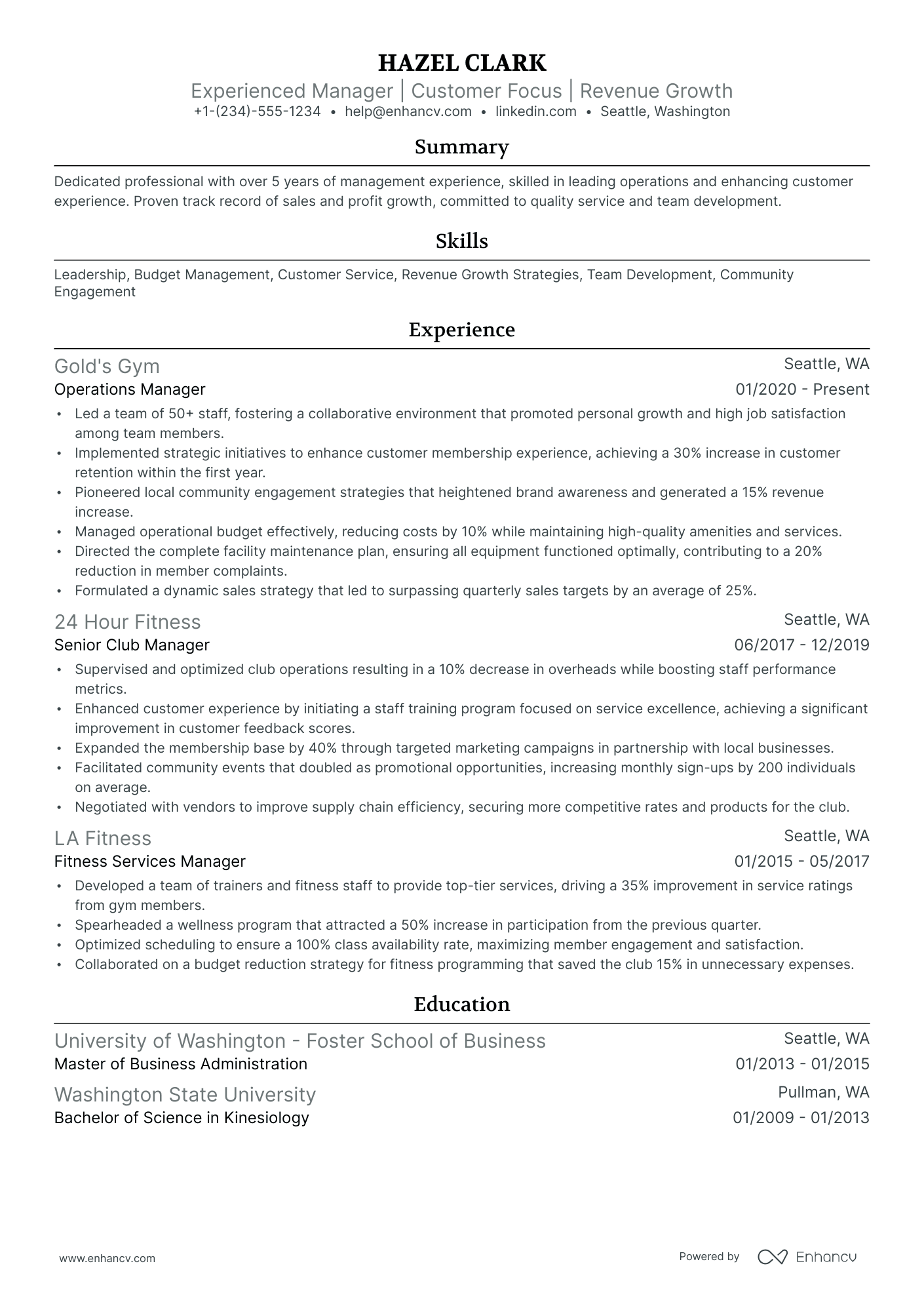
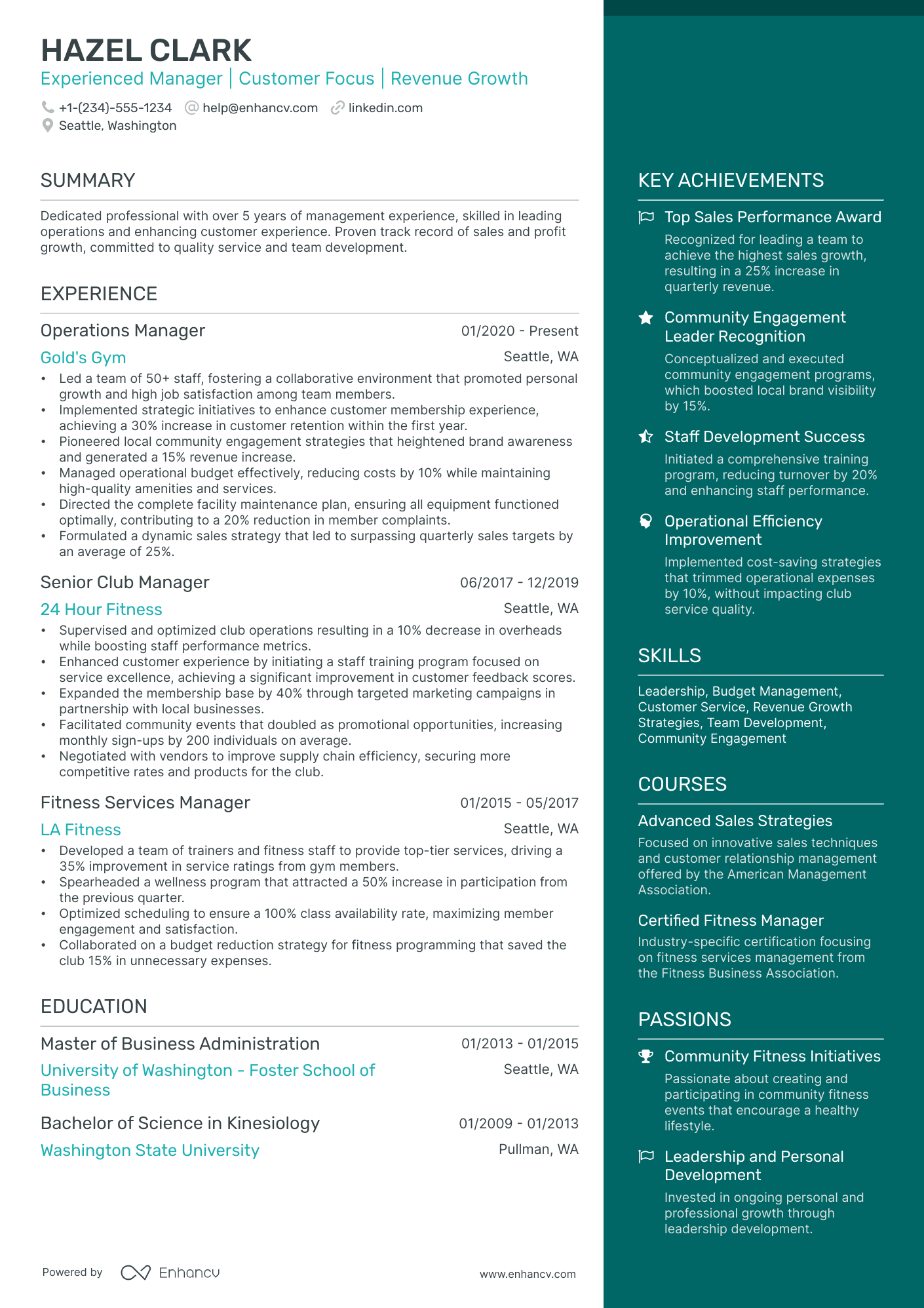
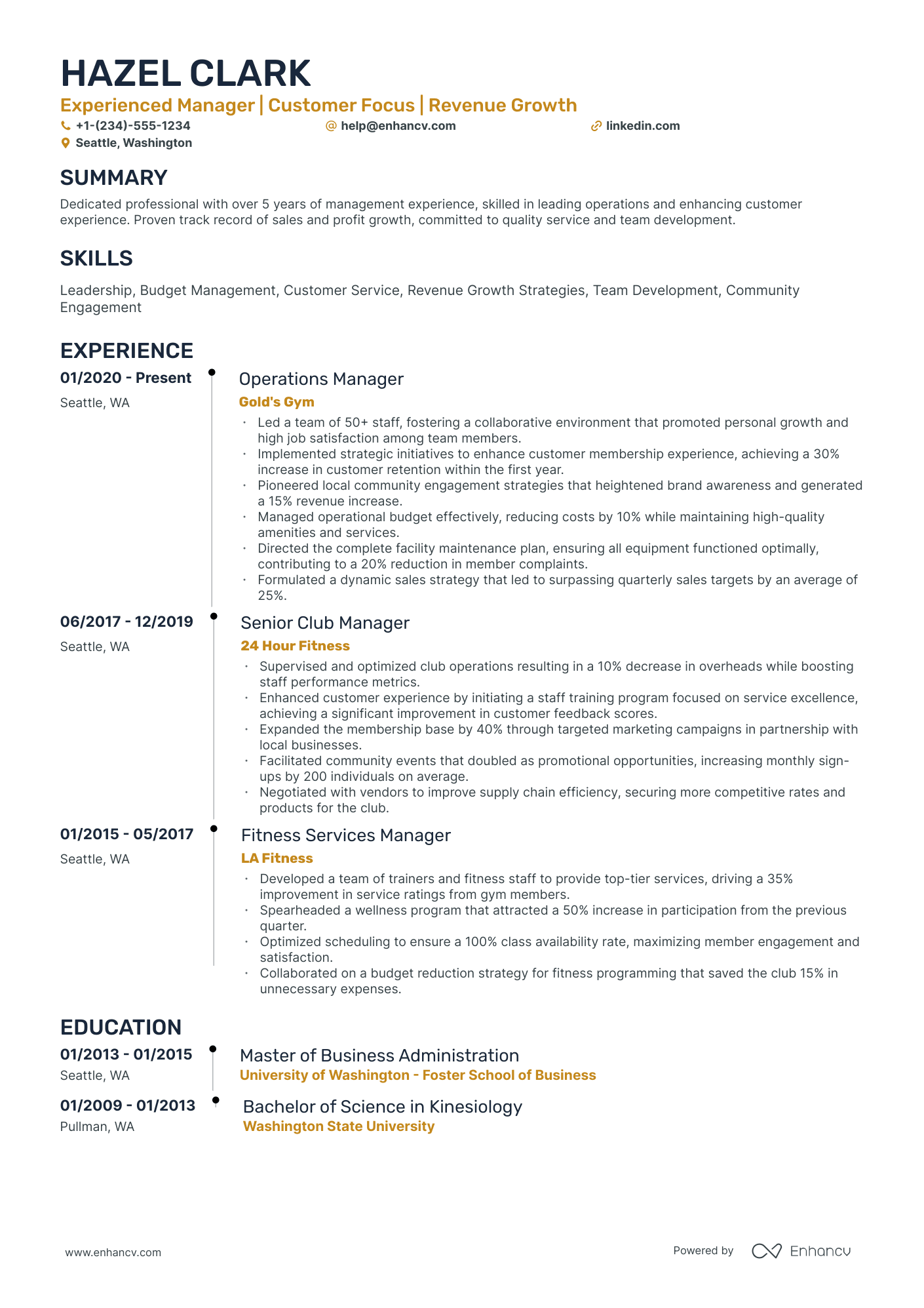
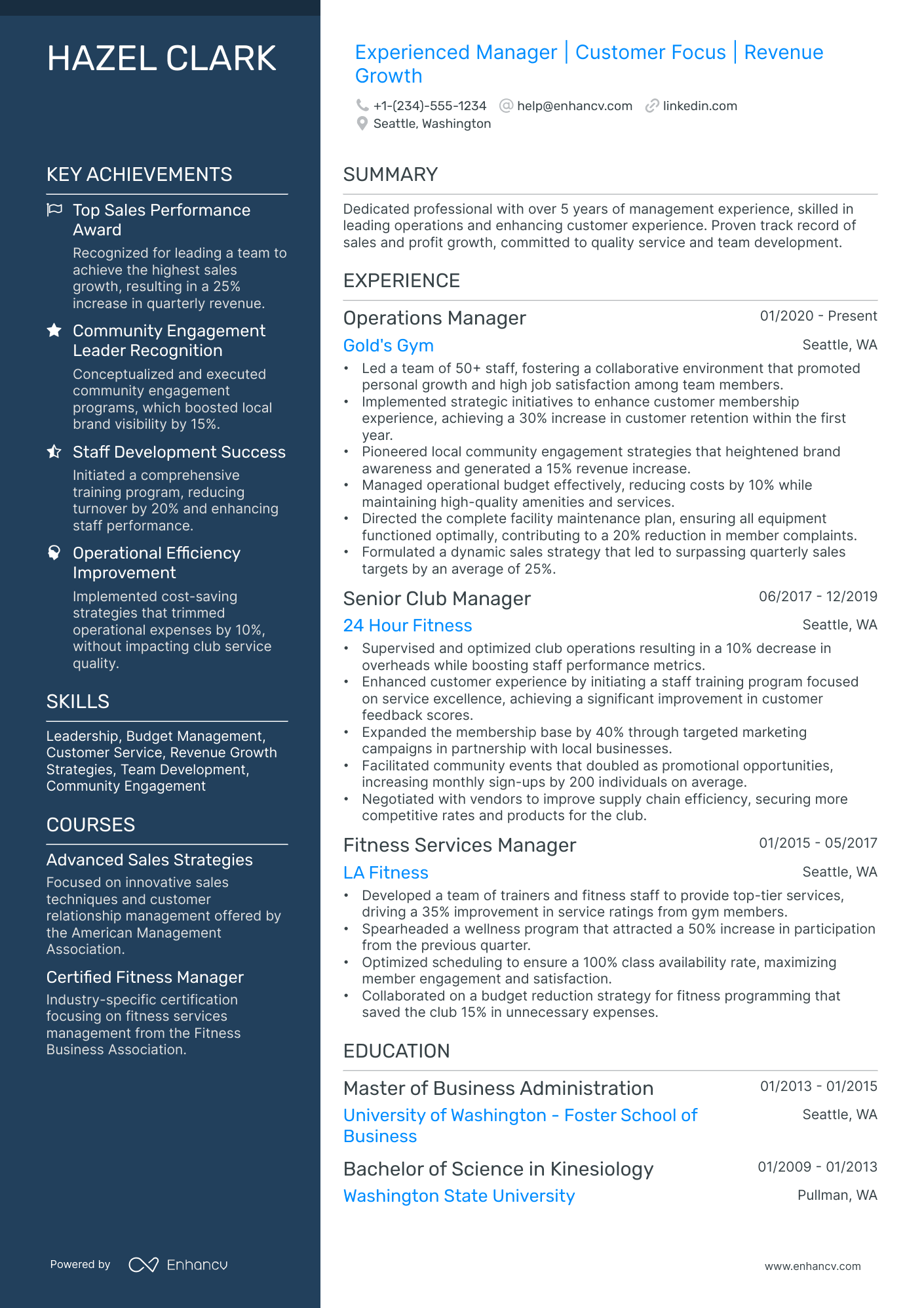
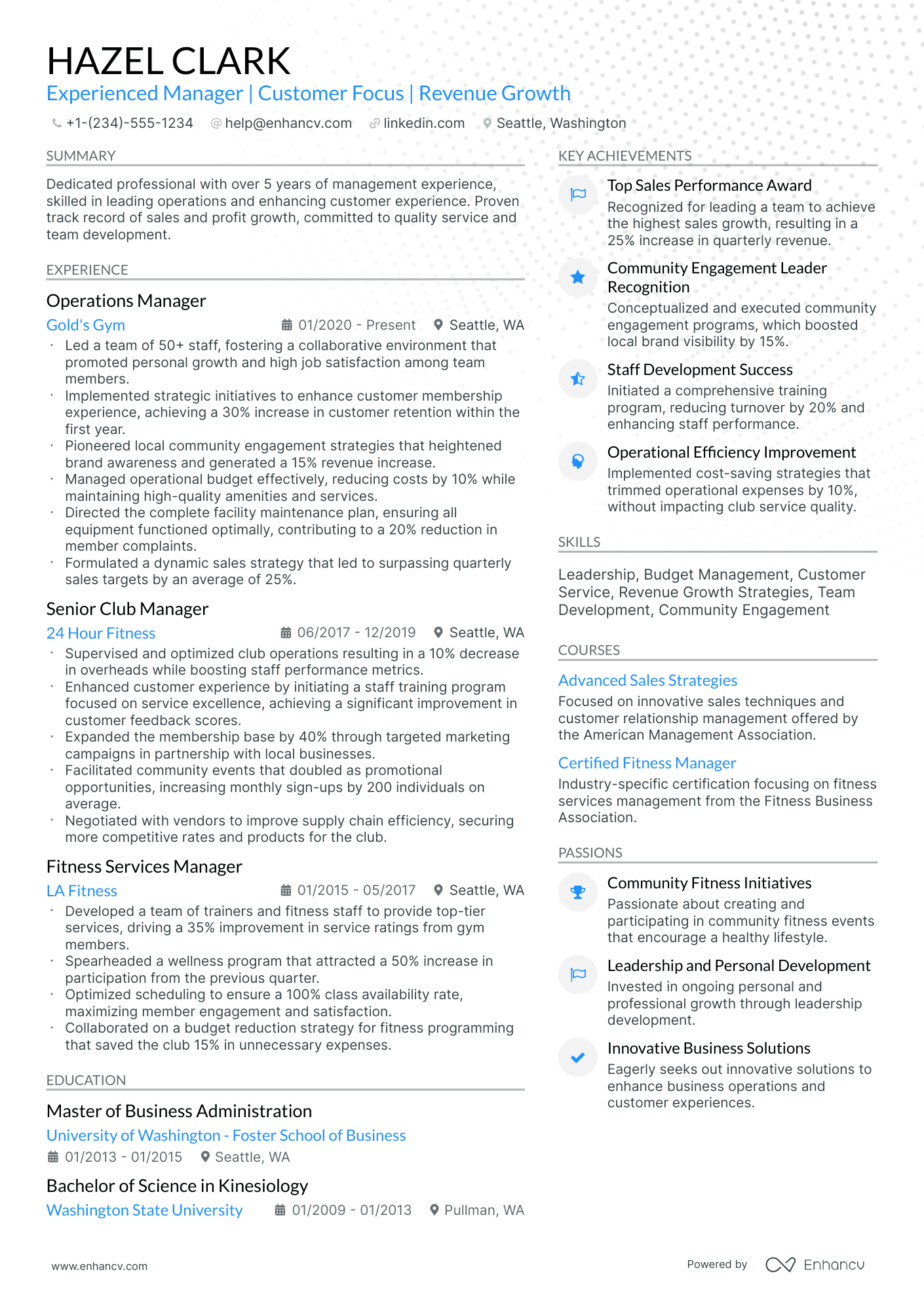
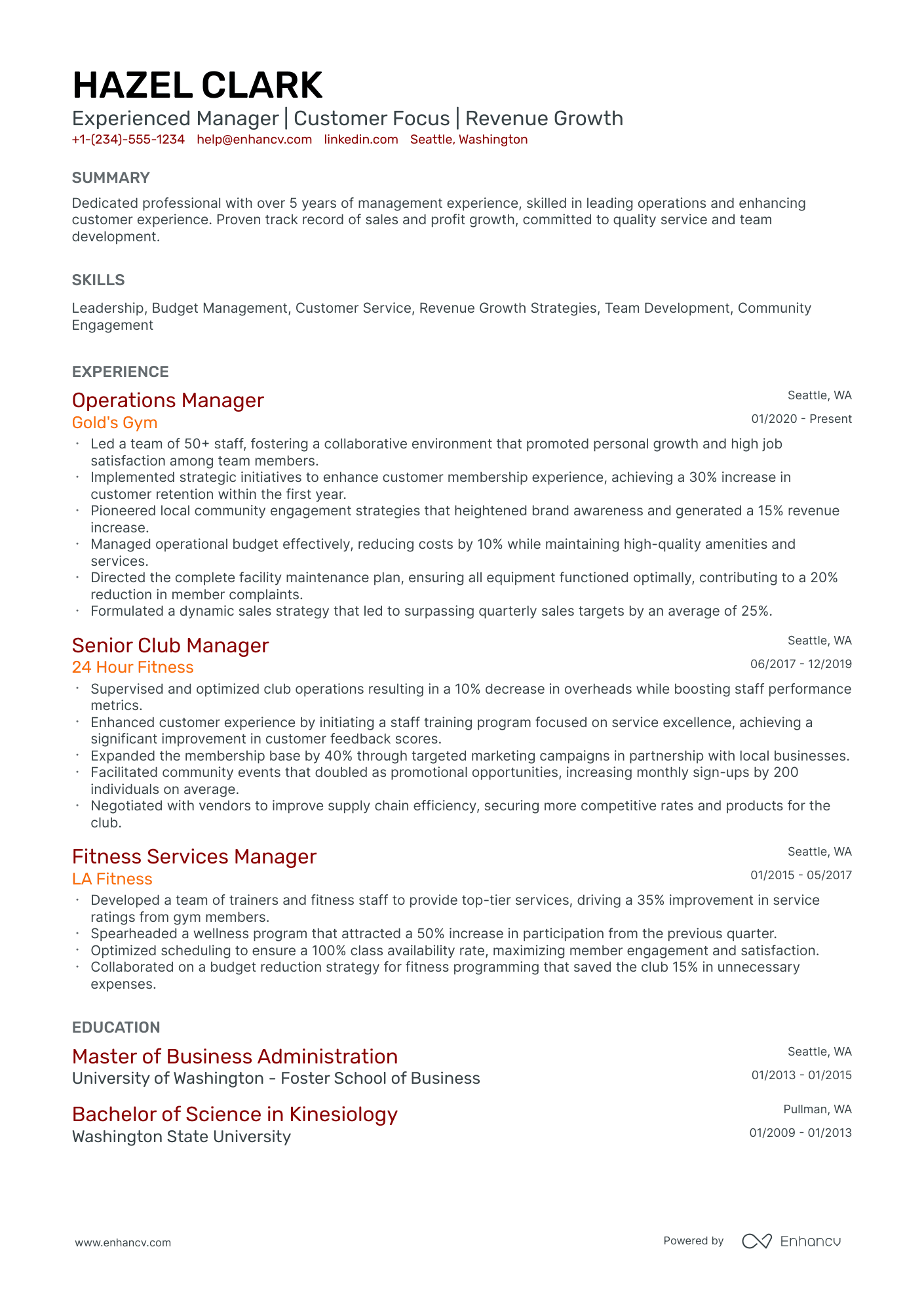
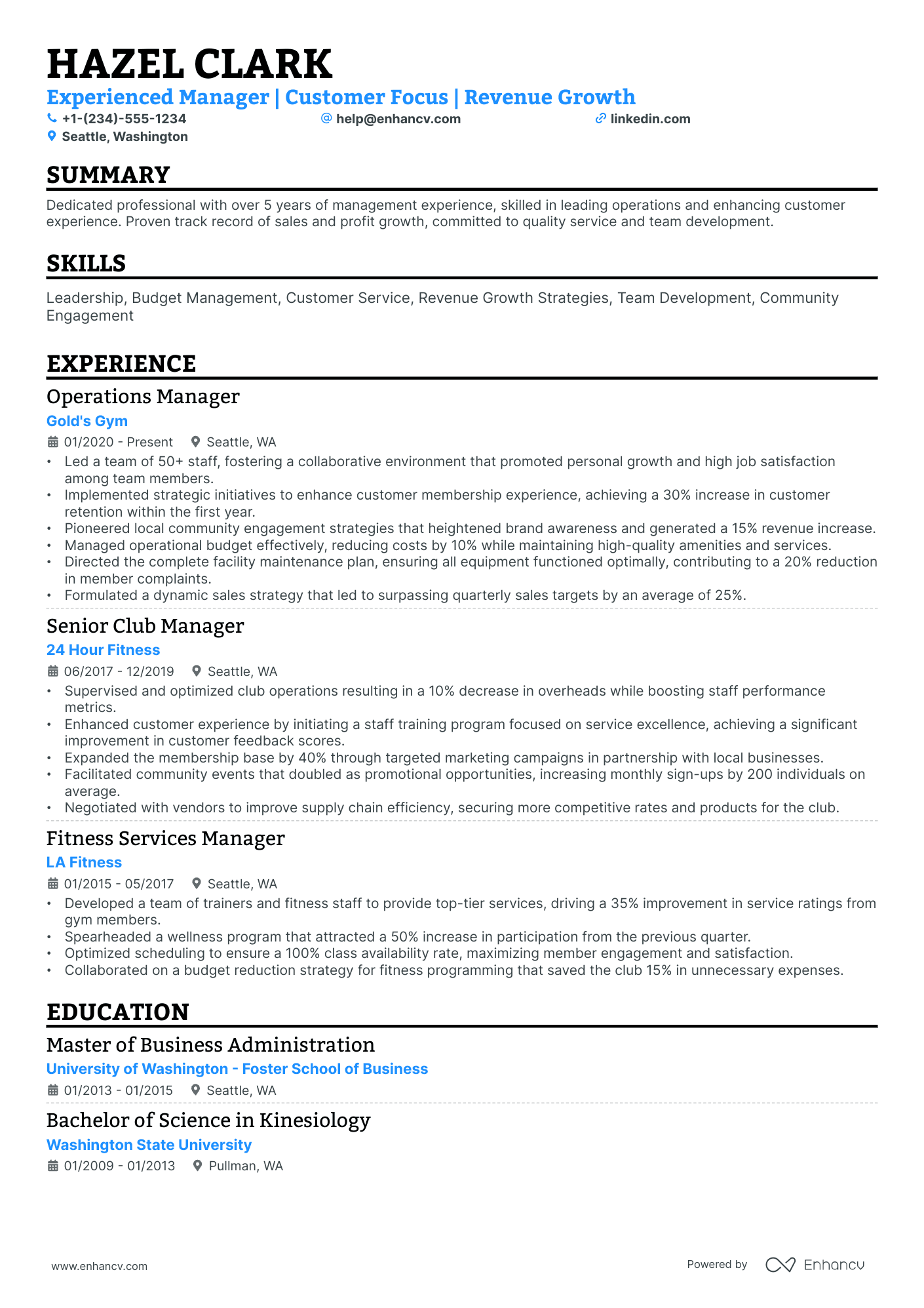
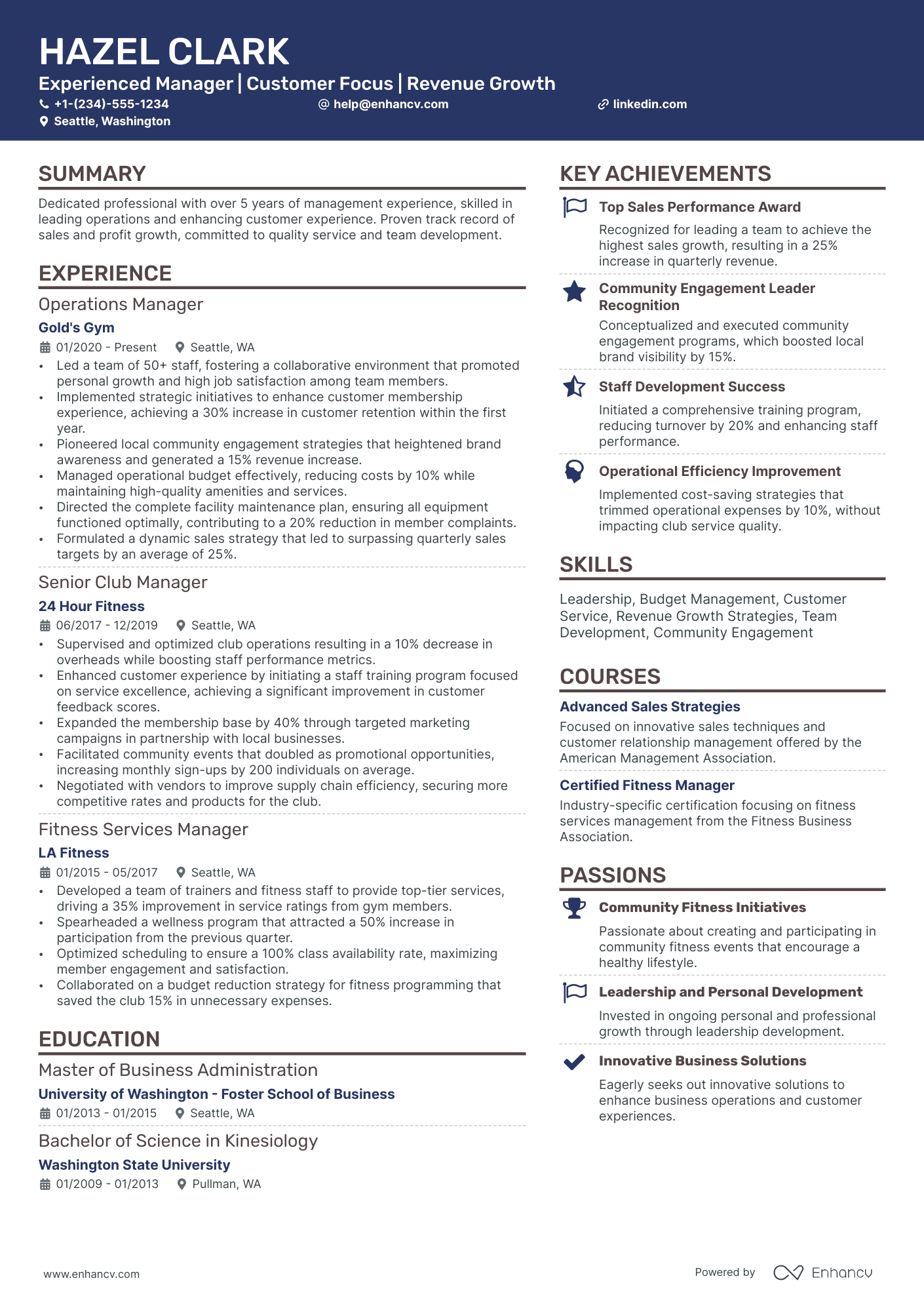
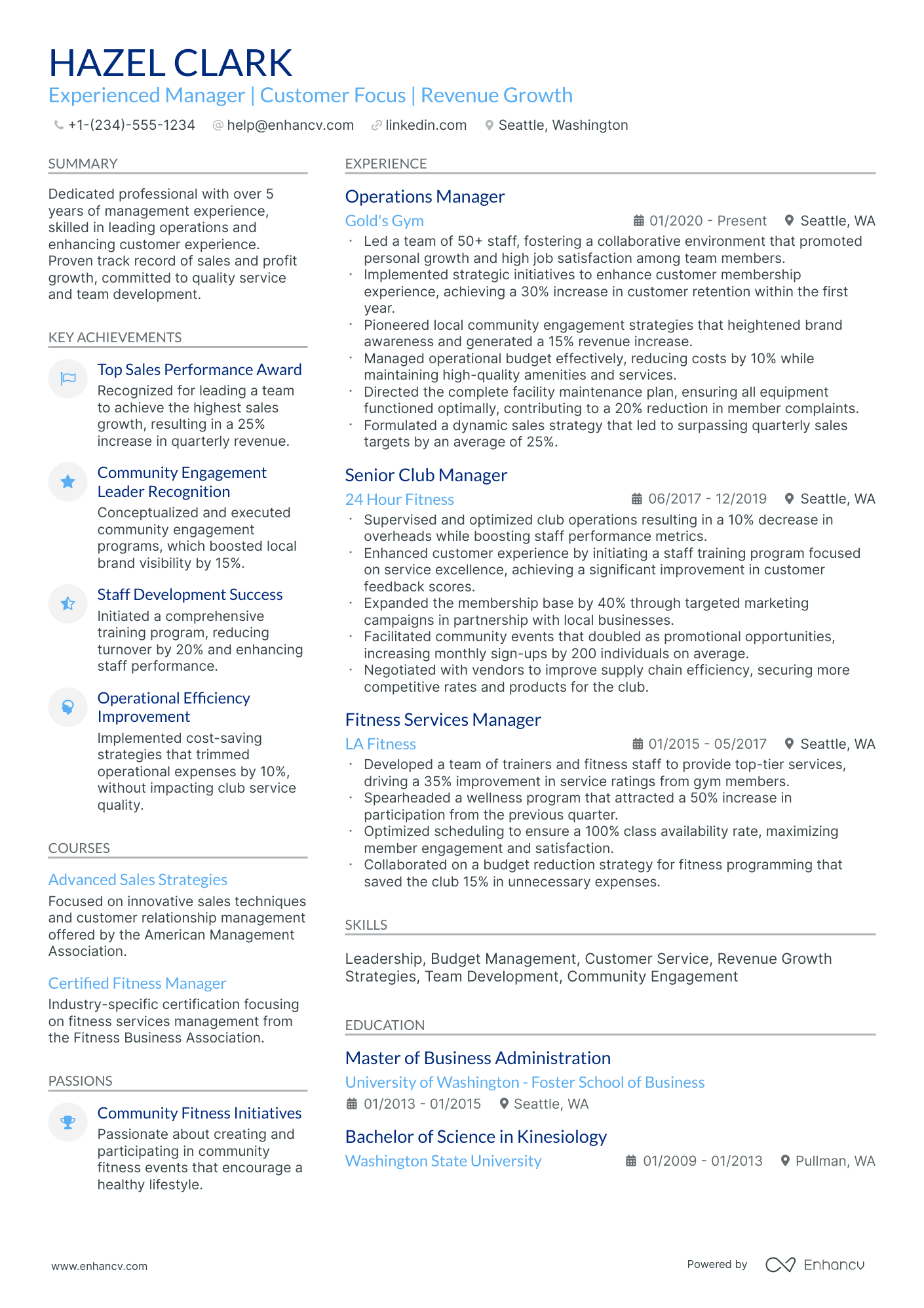
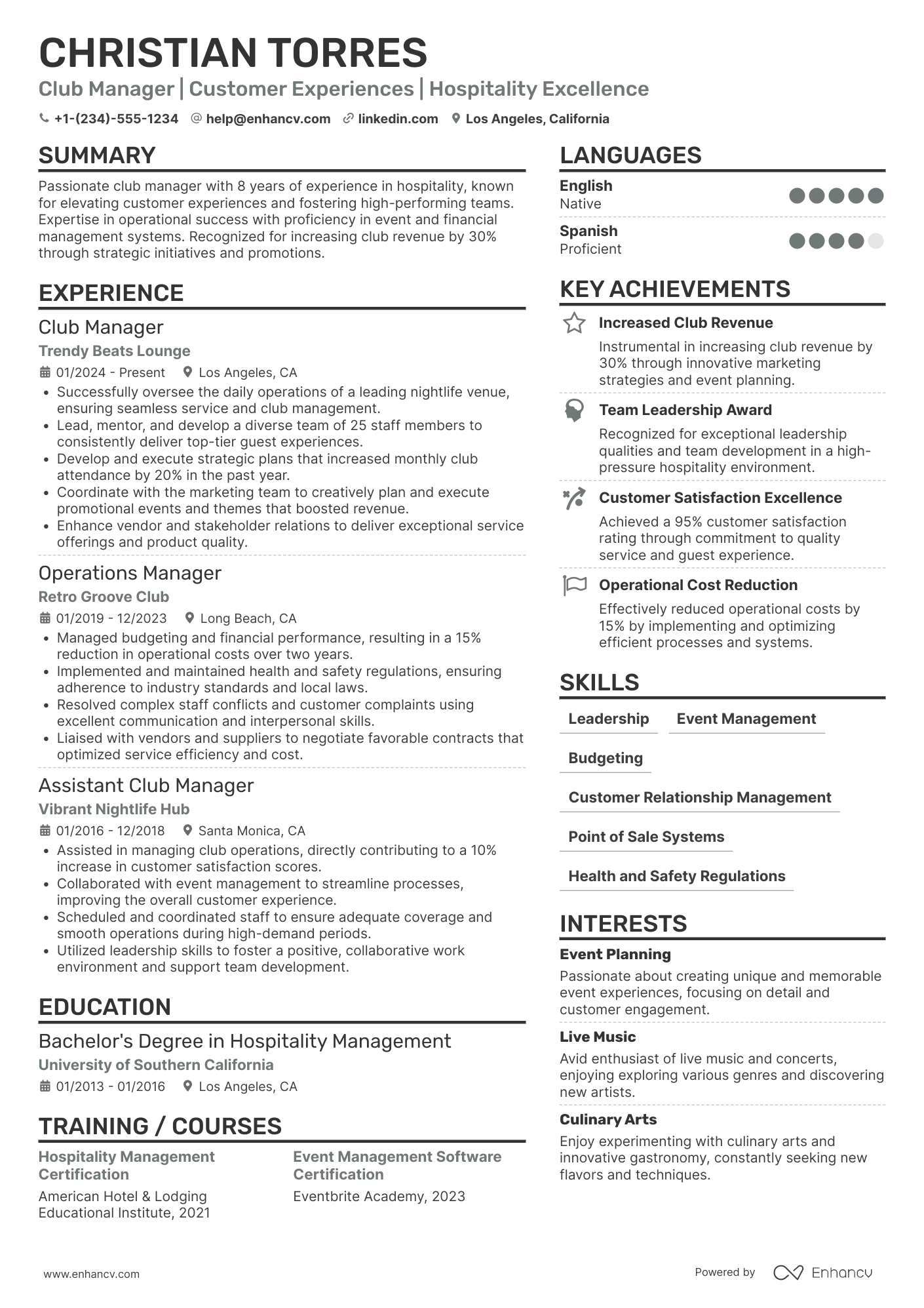
Most club manager resume drafts fail because they read like duty lists and bury results under generic hospitality language. That gets filtered by ATS screening and skipped in fast recruiter scans, especially when competition is high.
A strong resume shows what you improved and how you measured it. Knowing how to write a resume that highlights revenue growth, membership retention, event attendance, labor cost control, audit scores, incident reduction, and team size managed is essential. Include budgets owned, turnaround timelines, and service quality gains.

Key takeaways
- Quantify achievements in revenue, retention, and cost control instead of listing daily duties.
- Use reverse-chronological format if you have club management experience showing clear career progression.
- Tailor every experience bullet to mirror the specific job posting's language and priorities.
- Lead each bullet with a measurable result, then briefly describe the action behind it.
- Place skills above experience if you're junior or switching into club management.
- Pair your resume with a cover letter when the role is competitive or needs added context.
- Use Enhancv to refine bullet points and align your resume with recruiter expectations faster.
Job market snapshot for club managers
We analyzed 315 recent club manager job ads across major US job boards. These numbers help you understand experience requirements, career growth patterns, skills in demand at a glance.
What level of experience employers are looking for club managers
| Years of Experience | Percentage found in job ads |
|---|---|
| 1–2 years | 44.4% (140) |
| 3–4 years | 1.6% (5) |
| Not specified | 54.0% (170) |
Club manager ads by area of specialization (industry)
| Industry (Area) | Percentage found in job ads |
|---|---|
| Finance & Banking | 94.3% (297) |
Top companies hiring club managers
| Company | Percentage found in job ads |
|---|---|
| Planet Fitness Inc. | 94.3% (297) |
Role overview stats
These tables show the most common responsibilities and employment types for club manager roles. Use them to align your resume with what employers expect and to understand how the role is structured across the market.
Day-to-day activities and top responsibilities for a club manager
| Responsibility | Percentage found in job ads |
|---|---|
| Microsoft suite | 37.8% (119) |
| Cpr certification | 30.2% (95) |
| Customer service | 28.3% (89) |
| Leadership | 22.2% (70) |
| Basic computer proficiency | 18.7% (59) |
| Communication | 11.1% (35) |
| Organizational skills | 10.8% (34) |
| Problem resolution | 7.9% (25) |
| Computer proficiency | 7.6% (24) |
| Microsoft office | 2.2% (7) |
| Cpr/aed certification | 1.9% (6) |
| Adp | 1.6% (5) |
How to format a club manager resume
Recruiters evaluating club manager resumes focus on operational leadership, staff management, member retention, and revenue performance. A clear, well-structured resume format ensures these signals surface quickly during both human review and applicant tracking system (ATS) scans.

I have significant experience in this role—which format should I use?
Use a reverse-chronological format to present your club management career in a clear, progression-driven timeline. Do:
- Lead with your most recent role and emphasize scope of oversight—staff size, membership volume, facility operations, and budget authority.
- Highlight domain-specific expertise such as POS systems, membership management platforms, vendor negotiations, food and beverage compliance, and event programming.
- Quantify business impact through metrics like revenue growth, member retention rates, cost reductions, and staff turnover improvements.
I'm junior or switching into this role—what format works best?
A hybrid format works best, allowing you to lead with relevant skills while still showing a concise work history that provides context. Do:
- Place a skills section near the top featuring competencies like scheduling, customer service, inventory management, event coordination, and team supervision.
- Include transferable projects or transitional experience—such as managing a restaurant floor, coordinating community events, or overseeing a retail team—that demonstrates operational and leadership readiness.
- Connect every action to a result so hiring managers can see how your background applies to club operations.
Why not use a functional resume?
A functional format strips away the timeline and context that hiring managers rely on to evaluate your hands-on management readiness, making it harder to verify where and how you developed your skills.
- Career change with no direct club or hospitality experience: You've built transferable skills in retail management, event coordination, or fitness operations but haven't held a club manager title.
- Limited work history with relevant education or certifications: You recently completed a hospitality management degree or club management certification and need to foreground credentials over employment length.
- Resume gaps longer than a year: You stepped away from the workforce and want to redirect attention toward current, demonstrable competencies.
Once your resume's format establishes a clean, readable structure, the next step is filling it with the right sections to showcase your qualifications effectively.
What sections should go on a club manager resume
Recruiters expect a club manager resume to clearly show leadership, operations expertise, and measurable business results. Understanding what to put on a resume ensures you include the right details from the start.
Use this structure for maximum clarity:
- Header
- Summary
- Experience
- Skills
- Projects
- Education
- Certifications
- Optional sections: Awards, Leadership, Languages
Strong experience bullets should emphasize revenue growth, membership retention, cost control, team performance, compliance, and service quality using clear scope and results.
Is your resume good enough?
Drop your resume here or choose a file. PDF & DOCX only. Max 2MB file size.
Once you’ve organized the key resume components so hiring managers can scan your qualifications quickly, the next step is to write your club manager experience in a way that supports those sections with clear, relevant details.
How to write your club manager resume experience
The experience section is where you prove you can run a club operation—from managing staff and budgets to driving member satisfaction and revenue growth. Hiring managers prioritize demonstrated impact over descriptive task lists, so every bullet should highlight work you shipped, tools or methods you applied, and measurable outcomes you delivered.
Each entry should include:
- Job title
- Company and location (or remote)
- Dates of employment (month and year)
Three to five concise bullet points showing what you owned, how you executed, and what outcomes you delivered:
- Ownership scope: the facilities, membership programs, service departments, staff teams, or revenue streams you were directly accountable for as a club manager.
- Execution approach: the scheduling systems, point-of-sale platforms, inventory management tools, budgeting frameworks, or operational methods you used to make decisions and keep the club running smoothly.
- Value improved: changes to member retention, service quality, staff performance, operational efficiency, compliance standards, or cost control that resulted from your leadership.
- Collaboration context: how you coordinated with ownership groups, vendors, event partners, marketing teams, or department leads to align the club's operations with broader business goals.
- Impact delivered: outcomes expressed through membership growth, revenue targets, guest satisfaction benchmarks, or operational improvements rather than a simple list of daily responsibilities.
Experience bullet formula
A club manager experience example
✅ Right example - modern, quantified, specific.
Club Manager
Pulse Nightclub | Austin, TX
2022–Present
High-volume nightlife venue hosting four nights per week with two thousand plus weekly guests and VIP table service.
- Led weekly staffing plans in 7shifts and When I Work for forty plus front-of-house and security staff, cutting call-outs by twenty-four percent and reducing overtime spend by twelve percent through tighter scheduling and cross-training.
- Optimized reservations and VIP table yield in SevenRooms and OpenTable, increasing VIP revenue by eighteen percent and lifting average spend per guest by nine percent by adjusting pricing tiers, turn times, and floor plan strategy.
- Implemented Toast point-of-sale reporting, inventory counts, and variance controls, reducing liquor cost from twenty-eight percent to twenty-five percent and cutting weekly inventory time by three hours with standardized par levels and vendor reconciliation.
- Coordinated with promoters, talent agents, and marketing partners in Hootsuite and Meta Ads Manager, improving event sell-through from seventy-one percent to eighty-six percent and growing email and text list sign-ups by thirty-one percent using trackable campaigns and on-site QR capture.
- Strengthened compliance and incident response with digital ID scanning, CCTV review workflows, and documented shift logs in Google Workspace, lowering security incidents by nineteen percent and passing city and fire inspections with zero critical findings.
Now that you've seen how a strong experience section comes together, let's look at how to adjust yours to match the specific club manager role you're targeting.
How to tailor your club manager resume experience
Recruiters evaluate your club manager resume through both applicant tracking systems and manual review, so tailoring your resume to the job description matters. Tailoring your experience section ensures the most relevant qualifications stand out immediately.
Ways to tailor your club manager experience:
- Match membership management software and POS systems named in the posting.
- Mirror the exact terminology used for member retention or engagement strategies.
- Reflect revenue targets or membership growth KPIs the employer prioritizes.
- Highlight food and beverage oversight if the role specifies hospitality operations.
- Emphasize compliance with health and safety standards when the posting requires it.
- Include staff scheduling and labor cost controls relevant to the job description.
- Reference event coordination or programming frameworks the employer outlines.
- Align your leadership style with the collaboration model the posting describes.
Tailoring means connecting your real accomplishments to what the employer asks for, not forcing unrelated keywords into your experience.
Resume tailoring examples for club manager
| Job description excerpt | Untailored | Tailored |
|---|---|---|
| Oversee daily operations of a 15,000 sq. ft. private club, manage a team of 30+ staff, and ensure compliance with local health and safety regulations. | Managed club operations and supervised employees. | Directed daily operations of a 15,000 sq. ft. private club, leading a team of 32 staff members while maintaining full compliance with local health and safety codes across all service areas. |
| Drive membership growth through targeted retention strategies, event programming, and community outreach using Club Essentials CRM to track engagement metrics. | Helped increase club membership and planned events. | Grew membership 18% year over year by launching targeted retention campaigns and quarterly event programming, tracking all engagement metrics through Club Essentials CRM to refine outreach efforts. |
| Manage an annual operating budget of $1.2M, negotiate vendor contracts, and optimize food and beverage cost controls to maintain margins at or below 32%. | Handled budgeting and worked with vendors. | Managed a $1.2M annual operating budget, renegotiated four vendor contracts saving $47K annually, and reduced food and beverage costs from 36% to 31% through tighter inventory controls and menu engineering. |
Once you’ve aligned your experience with the club’s priorities, quantify your achievements to show the impact of that work with clear, measurable results.
How to quantify your club manager achievements
Quantifying achievements shows how you improved revenue, retention, operations, and member experience. For club managers, focus on membership growth, event results, budget performance, staffing efficiency, and compliance outcomes.
Quantifying examples for club manager
| Metric | Example |
|---|---|
| Revenue growth | "Grew monthly membership revenue from $48K to $62K in six months by launching two tiered plans and tracking conversions in a Google Sheets dashboard." |
| Retention rate | "Improved member retention from 71% to 84% over one year by adding quarterly check-ins and a win-back email sequence in Mailchimp." |
| Event conversion | "Increased event-to-membership conversion from 9% to 16% across twelve open-house events by standardizing tours and using a scripted follow-up cadence." |
| Labor efficiency | "Cut front-desk overtime hours by 28% in one quarter by rebuilding schedules in Deputy and cross-training five staff members." |
| Compliance risk | "Passed two unannounced health and safety inspections with zero critical findings by implementing weekly audits and a corrective-action log in Trello." |
Turn your everyday tasks into measurable, recruiter-ready resume bullets in seconds with Enhancv's Bullet Point Generator.
Once you've crafted strong bullet points that highlight your accomplishments, the next step is ensuring your resume also effectively showcases the hard and soft skills that qualify you for the club manager role.
How to list your hard and soft skills on a club manager resume
Your skills section shows you can run daily club operations, grow revenue, and lead teams—recruiters and an ATS (applicant tracking system) scan this section to confirm fit fast, so aim for a mostly hard-skill mix supported by role-specific soft skills. club manager roles require a blend of:
- Product strategy and discovery skills
- Data, analytics, and experimentation skills
- Delivery, execution, and go-to-market discipline
- Soft skills
Your skills section should be:
- Scannable (bullet-style grouping).
- Relevant to the job post.
- Backed by proof in experience bullets.
- Updated with current tools.
Place your skills section:
- Above experience if you're junior or switching careers.
- Below experience if you're mid/senior with strong achievements.

Hard skills
- Membership sales pipeline management
- Point-of-sale systems, cash handling
- Class scheduling and capacity planning
- Budgeting, forecasting, cost control
- Payroll processing and timekeeping systems
- Staff hiring, onboarding, training plans
- Customer relationship management software
- Retention metrics, churn reduction
- Event programming and promotion
- Inventory ordering and vendor management
- Health and safety compliance audits
- Incident reporting and risk management
Listing specific hard skills like POS systems and compliance auditing helps ATS tools match your resume to the posting's requirements.
Soft skills
- Lead shift execution end-to-end
- Coach performance through feedback
- Resolve member issues quickly
- De-escalate conflict on the floor
- Communicate policies with clarity
- Prioritize tasks under pressure
- Hold teams accountable to standards
- Coordinate across trainers and front desk
- Make data-informed tradeoffs
- Negotiate win-win vendor outcomes
- Adapt plans to demand changes
- Follow through on commitments
Framing soft skills as action-oriented behaviors—like de-escalating conflict or coaching through feedback—makes them concrete and credible to hiring managers.
How to show your club manager skills in context
Skills shouldn't live only in a bulleted list on your resume. Explore resume skills examples to see how top candidates integrate competencies throughout their documents.
They should be demonstrated in:
- Your summary (high-level professional identity)
- Your experience (proof through outcomes)
Here's how that looks in practice.
Summary example
Club manager with 12 years leading premium hospitality venues. Skilled in P&L oversight, staff scheduling via 7shifts, and member retention strategy. Grew annual membership renewals by 34% through personalized engagement programs and cross-departmental collaboration.
- Signals senior-level expertise immediately
- Names industry-relevant tools directly
- Quantifies a key business metric
- Highlights leadership and collaboration
Experience example
Senior Club Manager
Harborstone Athletic & Social Club | Charleston, SC
March 2018–Present
- Directed a 45-person team using 7shifts and Toast POS, reducing labor costs by 18% over two fiscal years.
- Partnered with marketing and events staff to launch a member referral program, boosting new sign-ups by 27% annually.
- Redesigned onboarding training with departmental leads, cutting new-hire turnover by 31% within the first 90 days.
- Every bullet contains measurable proof.
- Skills appear naturally through outcomes.
Once you’ve demonstrated your club manager strengths through specific examples and results, the next step is to apply that approach to building a club manager resume when you have no experience.
How do I write a club manager resume with no experience
Even without full-time experience, you can demonstrate readiness through transferable activities. If you're building a resume without work experience, focus on relevant projects and volunteer roles that showcase management potential:
- Student organization event operations
- Volunteer shift lead scheduling
- Bar or cafe supervisory shifts
- Venue front desk coordination
- Budgeting for club activities
- Social media event promotion
- CRM-based membership tracking
- Vendor coordination for events
Focus on:
- Shift scheduling and labor coverage
- Cash handling and reconciliation accuracy
- Membership growth and retention metrics
- Event execution with vendor tracking
Resume format tip for entry-level club manager
Use a hybrid resume format because it highlights relevant skills and projects first, while still showing employment and education history. Do:
- Put a "Projects" section above experience.
- Add metrics to every management bullet.
- List tools like Excel and POS.
- Mirror keywords from the job posting.
- Include availability and shift flexibility.
- Tracked one hundred fifty members in HubSpot CRM, segmented renewals, and raised monthly retention from seventy percent to eighty-two percent in eight weeks.
Even without direct experience, your education section can demonstrate the foundational knowledge and relevant coursework that qualify you for a club manager role.
How to list your education on a club manager resume
Your education section helps hiring teams confirm you have foundational knowledge in hospitality, business, or management. It validates your readiness for the club manager role.
Include:
- Degree name
- Institution
- Location
- Graduation year
- Relevant coursework (for juniors or entry-level candidates)
- Honors & GPA (if 3.5 or higher)
Skip month and day details—list the graduation year only.
Here's a strong education entry tailored to a club manager resume:
Example education entry
Bachelor of Science in Hospitality Management
University of Central Florida, Orlando, FL
Graduated 2021
GPA: 3.7/4.0
- Relevant coursework: Food & Beverage Operations, Event Planning, Club & Resort Management, Business Finance
- Honors: Magna Cum Laude, Dean's List (six consecutive semesters)
How to list your certifications on a club manager resume
Certifications show a club manager's commitment to learning, proficiency with key tools, and relevance to current industry standards. Include:
- Certificate name
- Issuing organization
- Year
- Optional: credential ID or URL
- Place certifications below education when they're older, less relevant, or supplemental to your core qualifications.
- Place certifications above education when they're recent, highly relevant, or required for the club manager roles you target.
Best certifications for your club manager resume
- Certified Club Manager (CCM)
- Certified Hospitality Supervisor (CHS)
- ServSafe Food Protection Manager Certification
- Certified Food and Beverage Executive (CFBE)
- CPR/AED Certification (American Red Cross)
- TIPS Alcohol Certification
- Project Management Professional (PMP)
Once you’ve positioned your credentials where hiring managers will notice them, shift to writing a club manager resume summary that highlights your most relevant qualifications upfront.
How to write your club manager resume summary
Your resume summary is the first thing a recruiter reads, so it needs to earn attention fast. A strong opening signals you're the right club manager for the role.
Keep it to three to four lines, with:
- Your title and total years of experience in club or hospitality management.
- The type of venue, membership model, or industry you know best.
- Core skills like budget oversight, staff scheduling, and member retention strategies.
- One or two measurable wins, such as revenue growth or membership increases.
- Soft skills tied to real results, like team leadership that reduced staff turnover.

PRO TIP
Focus on clarity, relevant skills, and early impact you've made in club operations. Highlight specific tools and measurable contributions rather than vague qualities. Avoid phrases like "passionate go-getter" or "results-driven professional." Let your numbers and experience speak instead.
Example summary for a club manager
Club manager with three years of experience overseeing daily operations at a 500-member fitness club. Increased membership retention by 18% through improved programming and staff training initiatives.
Optimize your resume summary and objective for ATS
Drop your resume here or choose a file.
PDF & DOCX only. Max 2MB file size.
Now that your summary captures the value you bring, make sure the header above it presents your contact details correctly so hiring managers can quickly reach out.
What to include in a club manager resume header
A resume header lists your key contact and professional details, which boosts visibility, builds credibility, and supports fast recruiter screening for a club manager role.
Essential resume header elements
- Full name
- Tailored job title and headline
- Location
- Phone number
- Professional email
- GitHub link
- Portfolio link
Including a LinkedIn link helps recruiters verify your experience quickly and supports screening.
Do not include a photo on a club manager resume unless the role is explicitly front-facing or appearance-dependent.
Keep your header to one or two lines, match your job title to the posting, and use links that open to updated, public profiles.
Club manager resume header
Jordan Taylor
Club Manager | Member Experience and Team Leadership
Austin, TX
(512) 555-01XX | your.name@enhancv.com | github.com/yourname | yourwebsite.com | linkedin.com/in/yourname
With your contact details and role identification set up for quick reference, the next step is to add additional sections for club manager resumes to strengthen the rest of your application.
Additional sections for club manager resumes
When your core qualifications match other applicants, well-chosen additional sections can set your club manager resume apart with role-specific credibility.
- Languages
- Certifications and licenses
- Professional affiliations and memberships
- Volunteer experience
- Awards and recognition
- Hobbies and interests
Once you've rounded out your resume with the right supplementary sections, it's worth pairing it with a cover letter to strengthen your overall application.
Do club manager resumes need a cover letter
A cover letter isn't required for a club manager, but it helps in competitive roles or when employers expect one. If you're unsure what a cover letter is and how it complements your resume, it's worth learning before you apply. It can make a difference when your resume needs context or you want to show fit fast.
Use a cover letter to add details your resume can't:
- Explain role and team fit by matching your leadership style to the club's operations, culture, staffing model, and service standards.
- Highlight one or two projects or outcomes, such as improving retention, reducing churn, increasing ancillary revenue, or raising member satisfaction scores.
- Show you understand the product, users, and business context, including member segments, peak-hour demand, and the club's pricing and service mix.
- Address career transitions or non-obvious experience by connecting transferable skills to scheduling, coaching, compliance, and performance management.
Drop your resume here or choose a file.
PDF & DOCX only. Max 2MB file size.
Even if you choose to include a cover letter to strengthen your application, using AI to improve your club manager resume helps you refine your content faster and align it with the role.
Using AI to improve your club manager resume
AI can sharpen your resume's clarity, structure, and impact. It helps refine language and highlight achievements. But overuse strips authenticity. Once your content is clear and role-aligned, step away from AI. If you're wondering which AI is best for writing resumes, start with tools that let you control the output and keep your voice intact.
Here are 10 practical prompts to strengthen specific sections of your club manager resume:
Strengthen your summary
Quantify experience bullets
Tighten action verbs
Align skills section
Refine project descriptions
Improve education relevance
Clarify certification value
Remove filler language
Tailor for specific roles
Sharpen accomplishment focus
Conclusion
A strong club manager resume proves results with numbers, highlights role-specific skills, and stays easy to scan. Show measurable outcomes in revenue, retention, member satisfaction, and cost control. Pair them with leadership, scheduling, compliance, and customer service strengths.
Keep a clear structure with a focused summary, relevant experience, and targeted skills. This format helps hiring teams compare candidates fast and supports today’s data-driven screening. With this approach, your club manager resume shows you’re ready to lead now and adapt next.