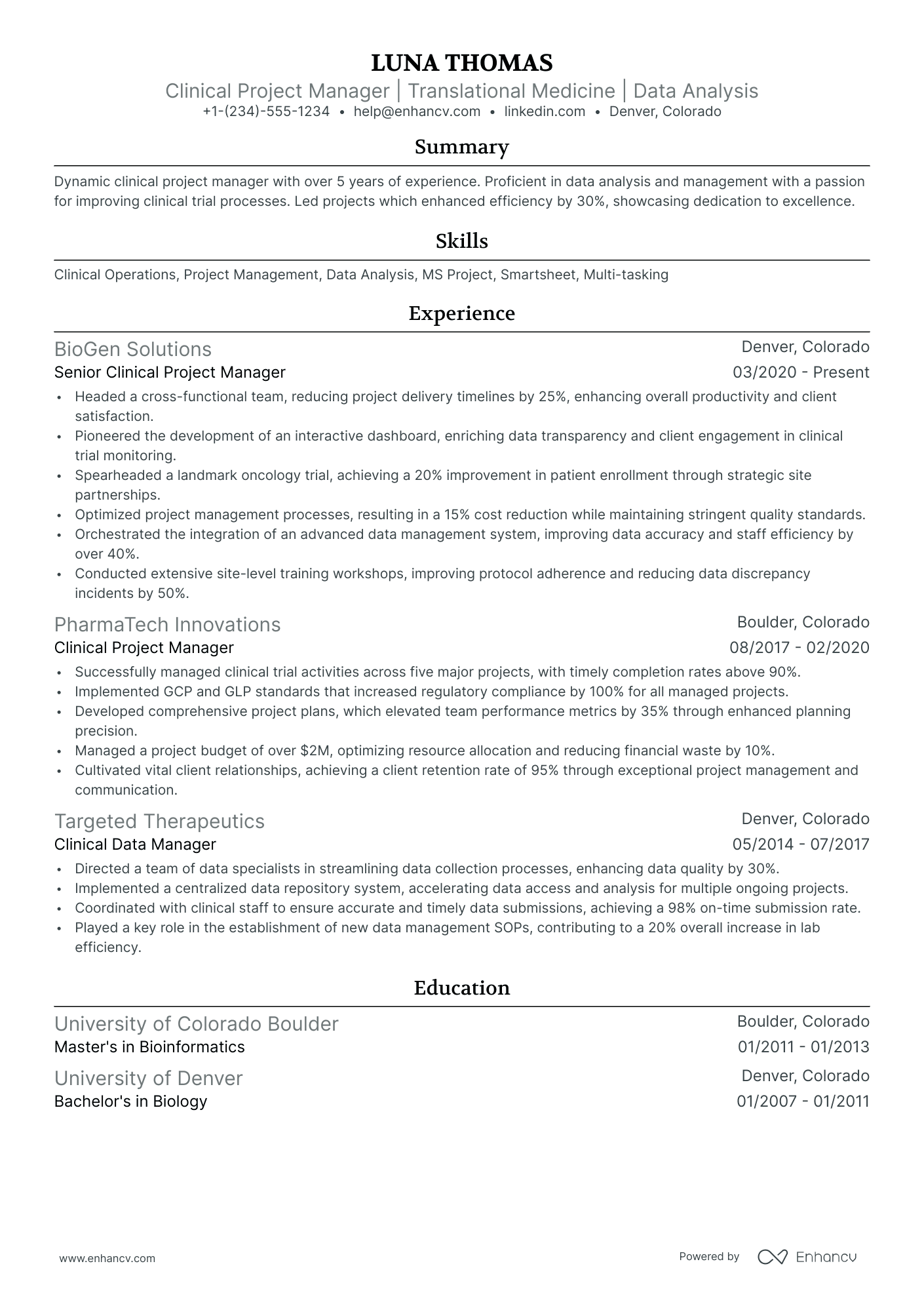
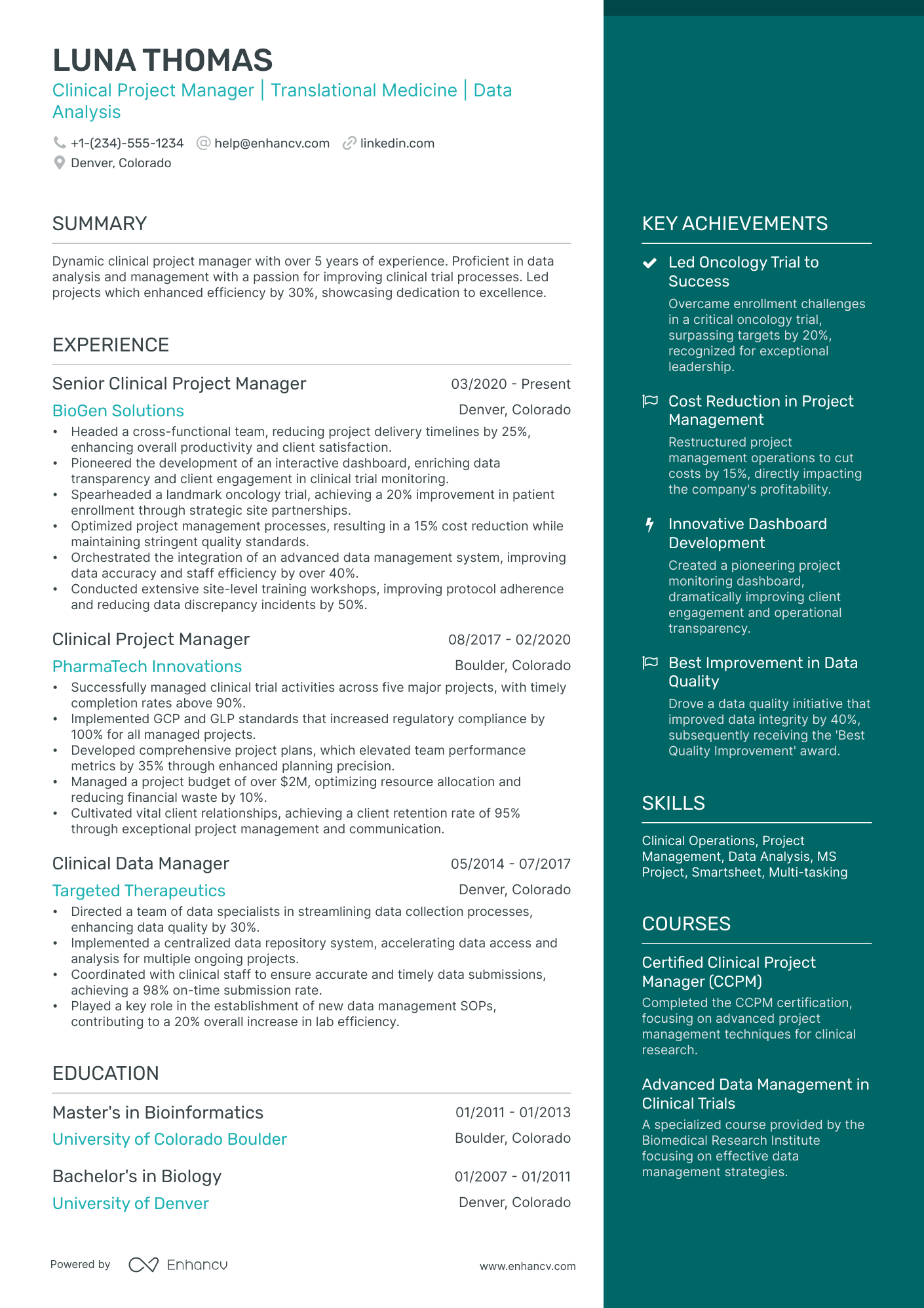
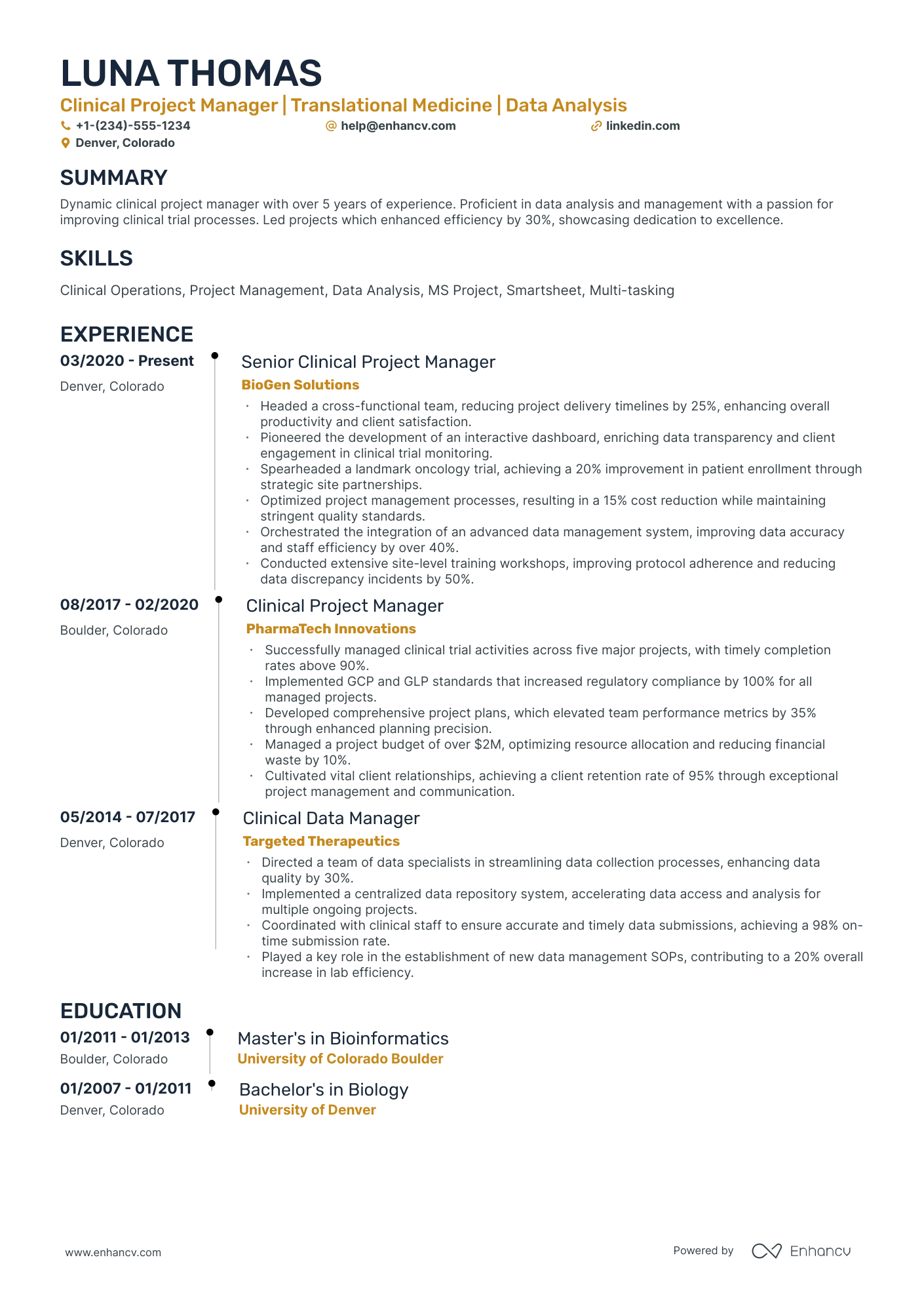
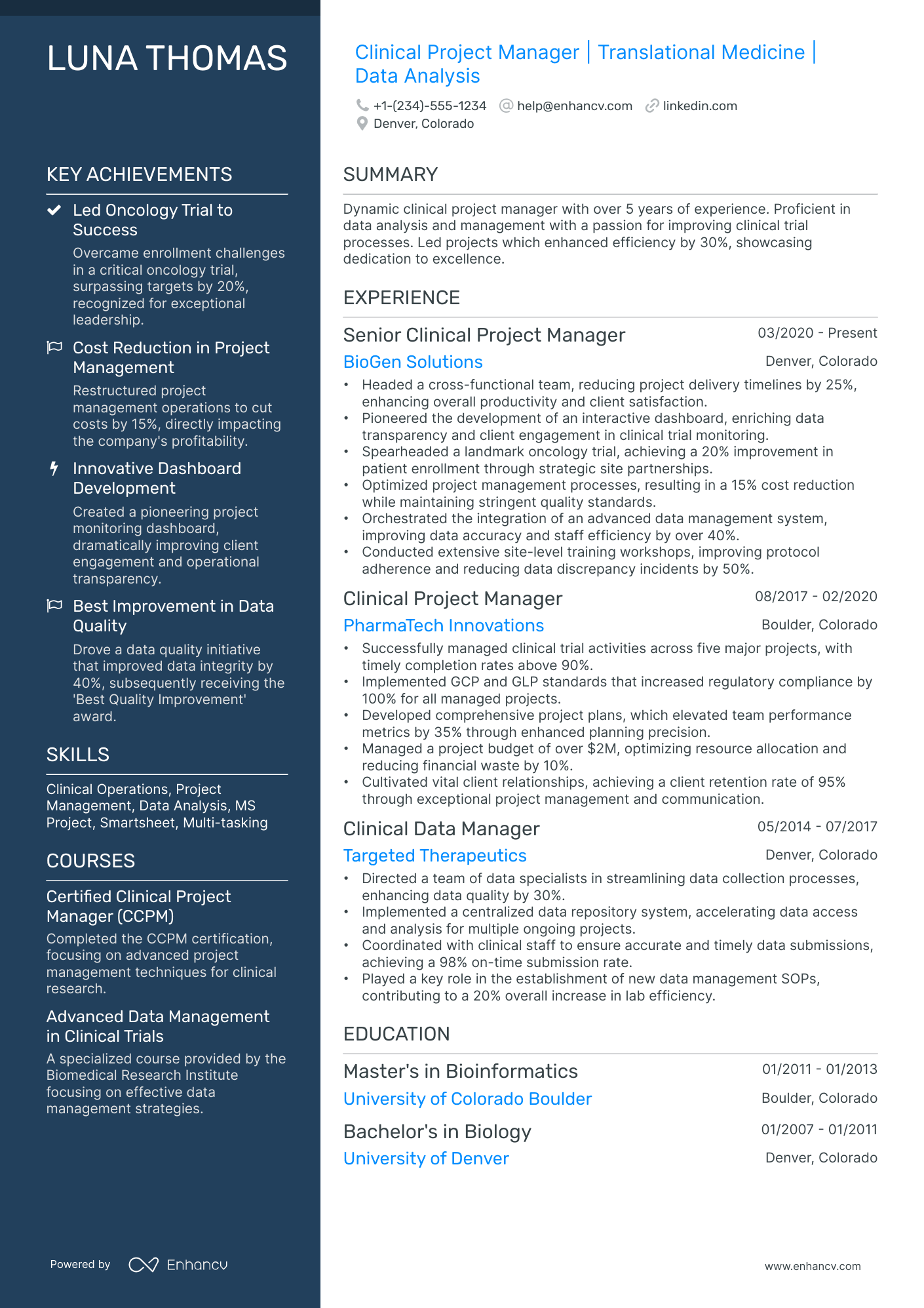
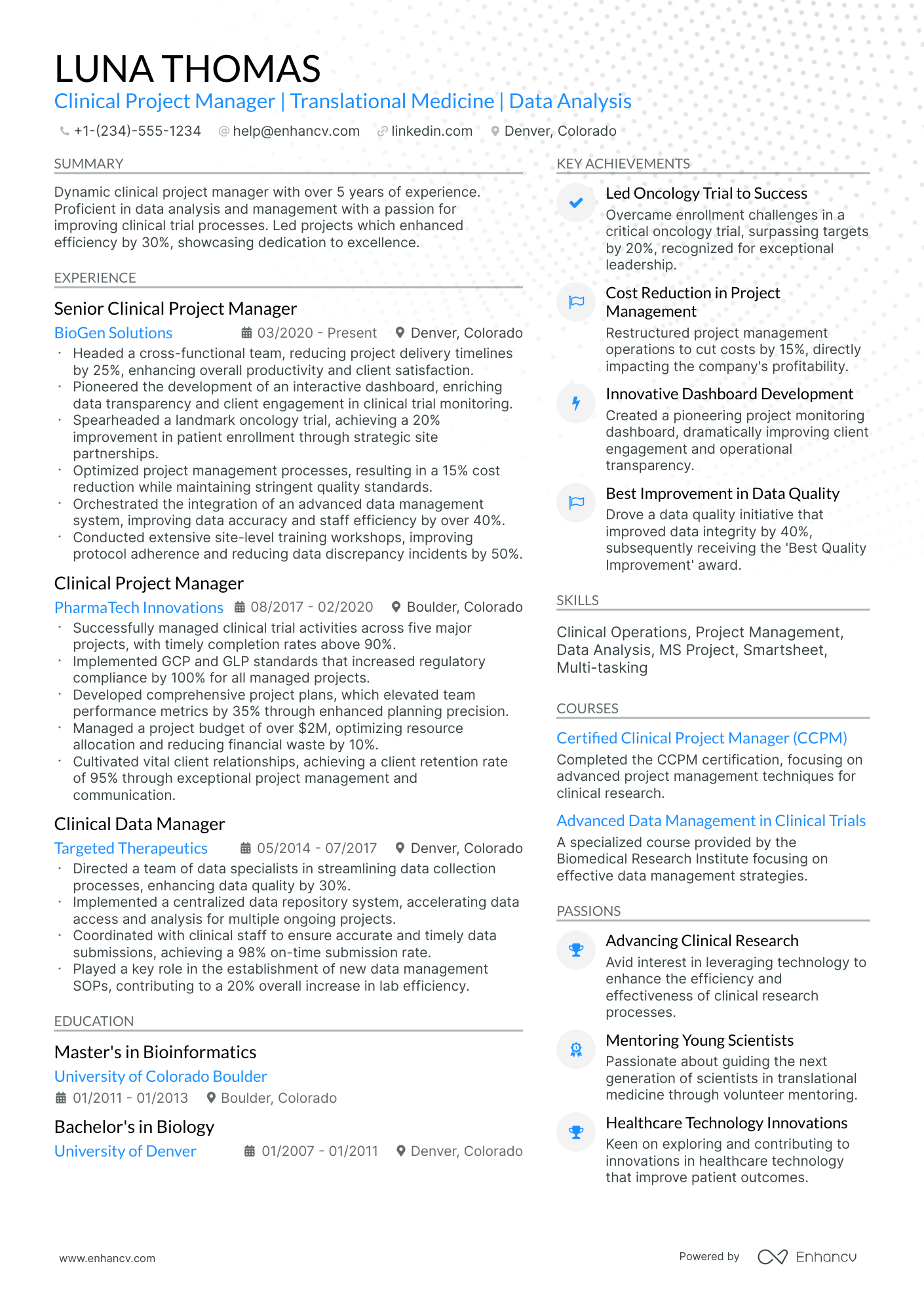
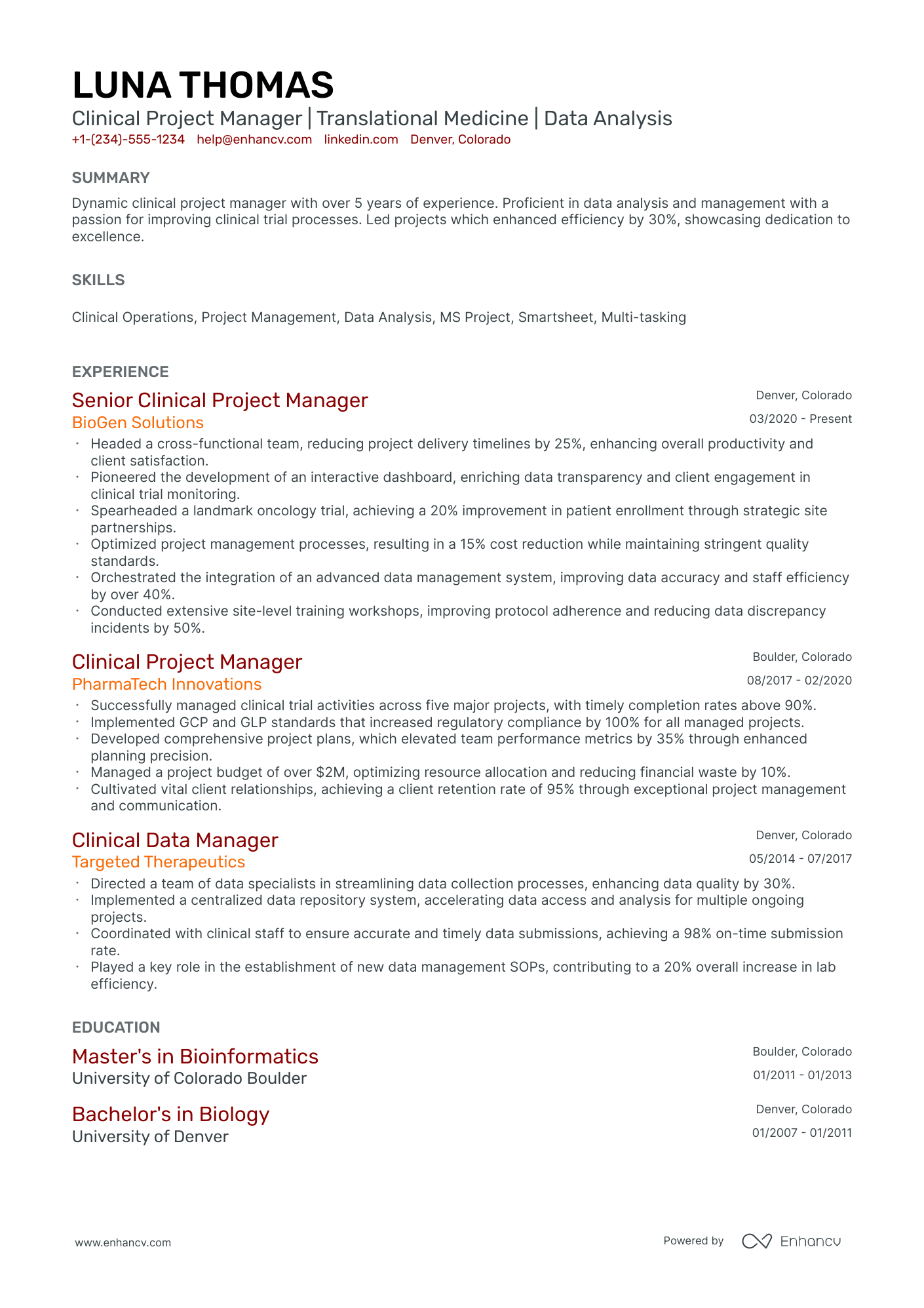
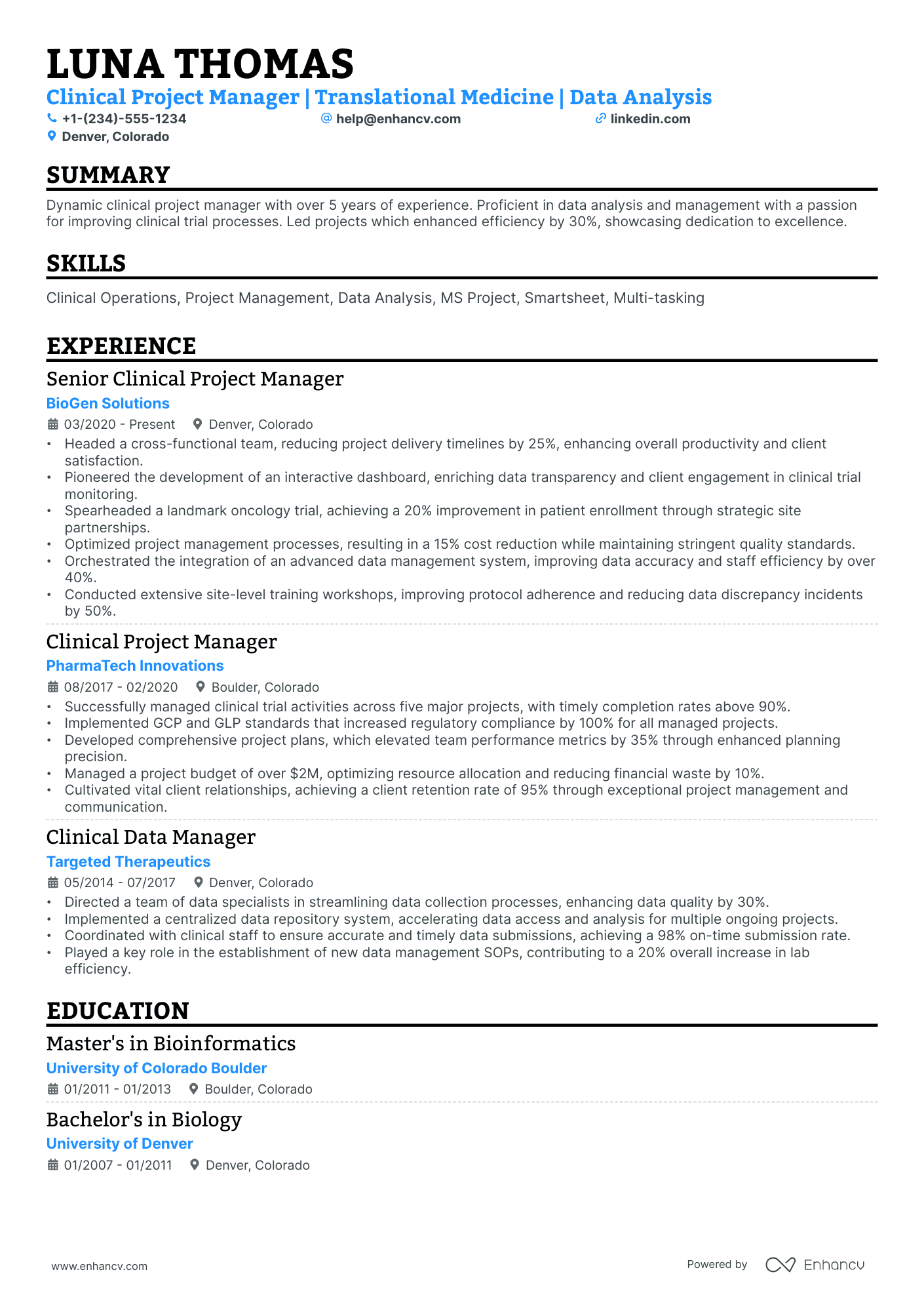
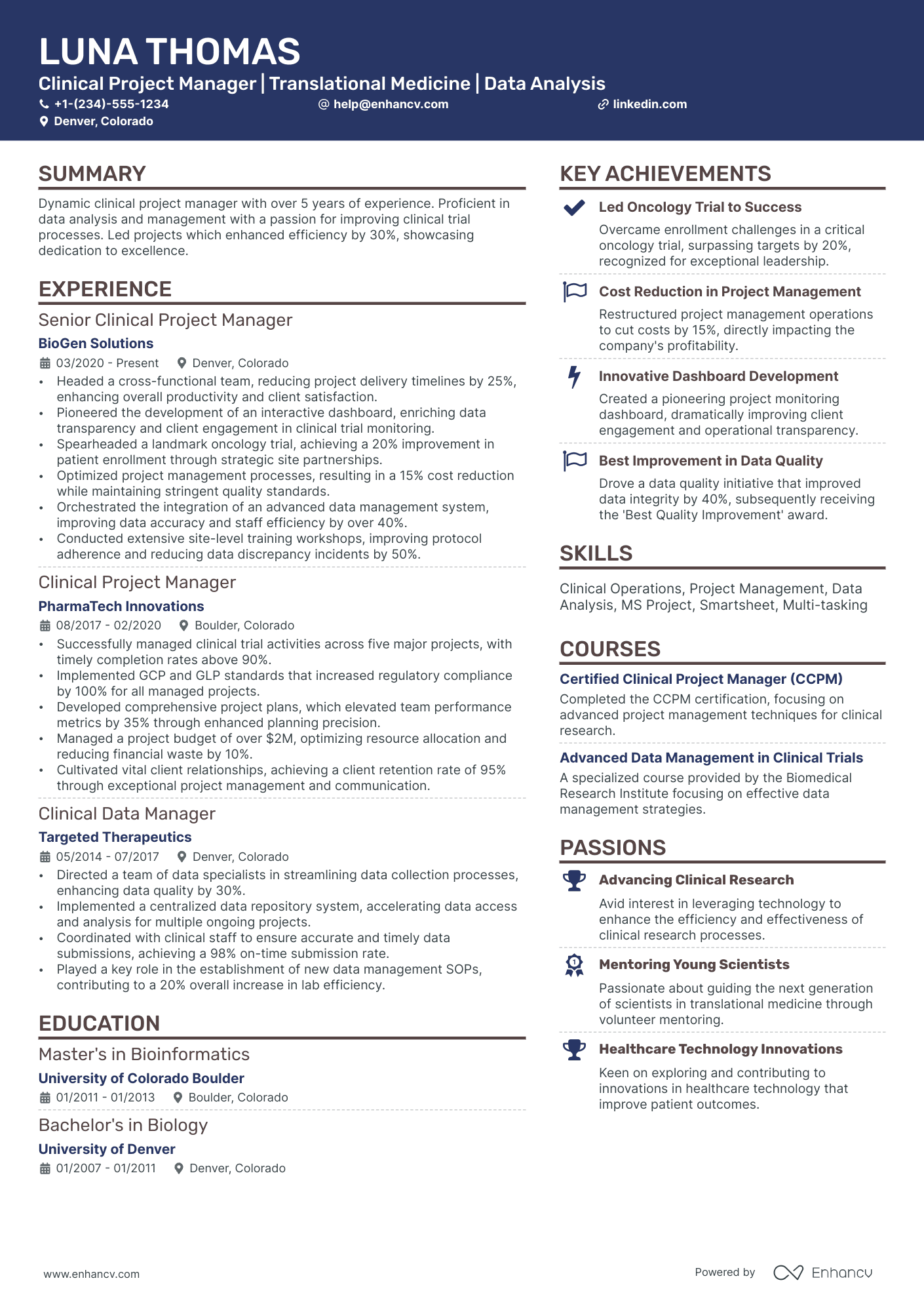
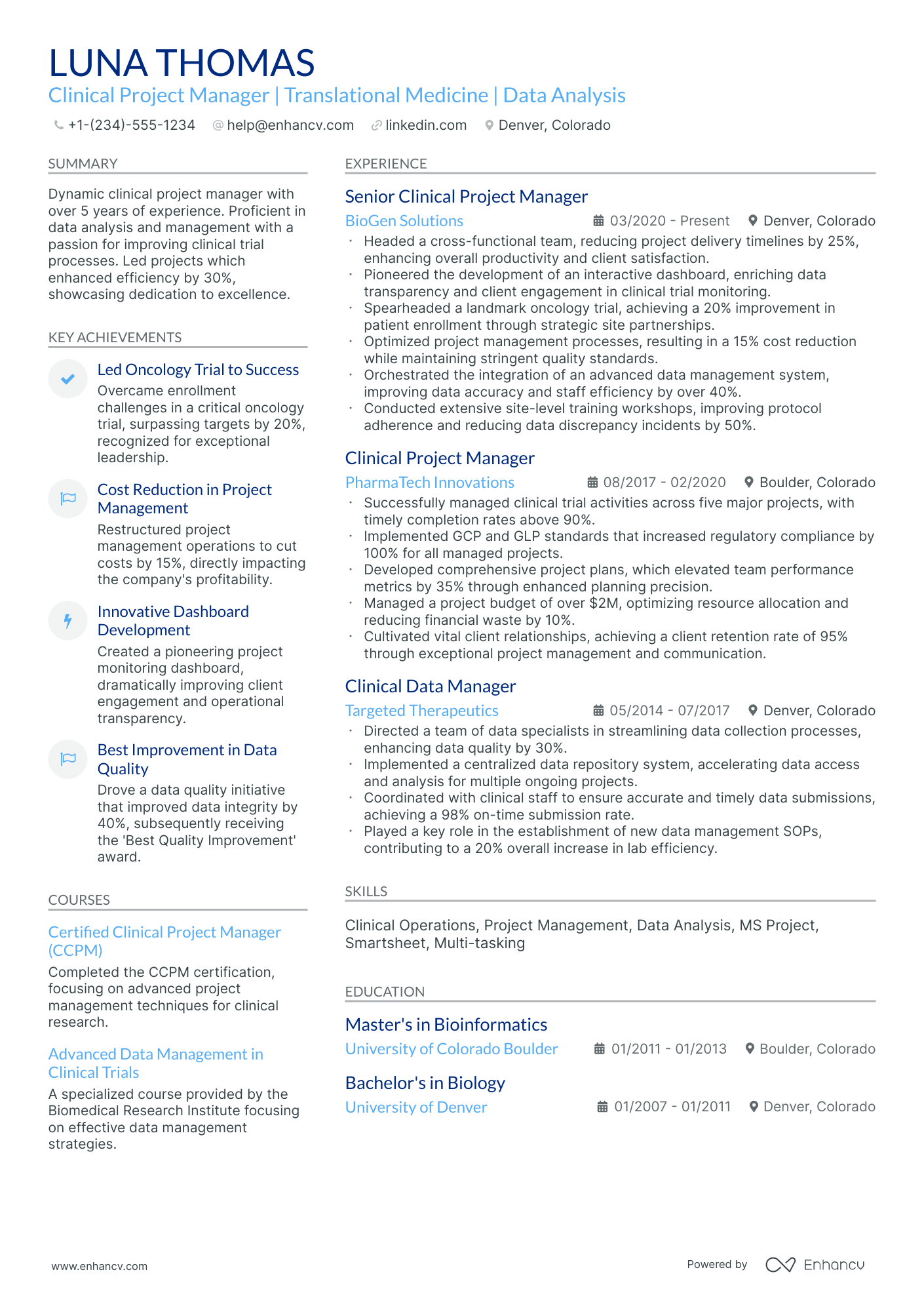
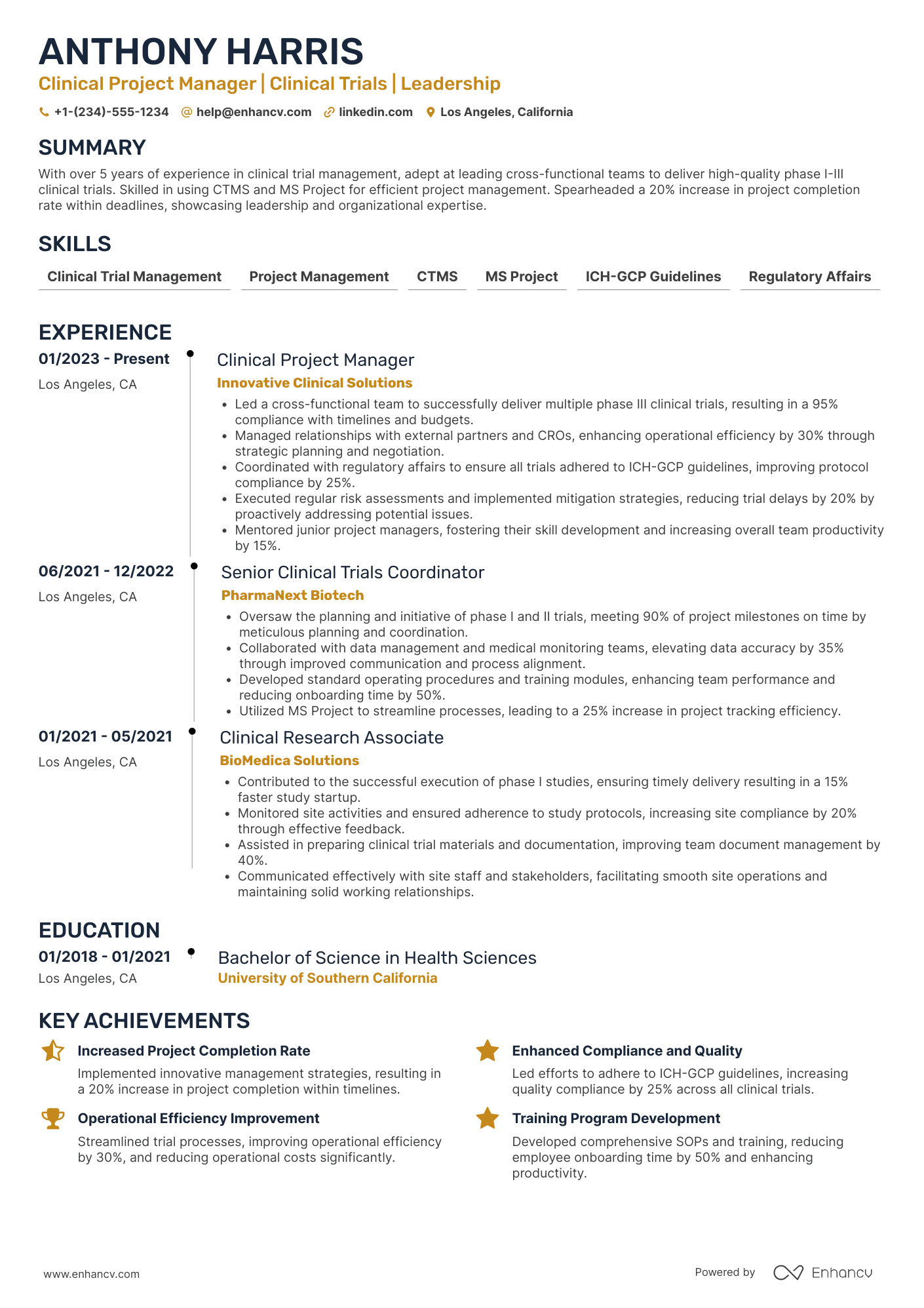
Many clinical project manager resume submissions fail because they read like task logs and bury trial outcomes, timelines, and compliance impact. That matters when an ATS (applicant tracking system) filters fast and recruiters scan in seconds amid heavy competition.
A strong resume shows what you delivered and why it mattered. You'll highlight on-time milestones, enrollment gains, protocol deviation reductions, audit-ready documentation, budget stewardship, and faster database lock across multi-site studies. You'll connect decisions to quality, risk control, and patient safety. If you're unsure where to begin, learning how to write a resume that communicates impact is an essential first step.

Key takeaways
- Quantify every experience bullet with metrics like timelines, budgets, deviations, or audit outcomes.
- Use reverse-chronological format if you have five or more years of clinical experience.
- Tailor your resume language to match each job posting's tools, phases, and therapeutic areas.
- Lead your summary with title, years of experience, and one or two measurable achievements.
- Place certifications like PMP or ACRP-CP where recruiters spot them—near your education section.
- Anchor every listed skill to a specific project, trial phase, or measurable result.
- Use Enhancv to turn vague duties into focused, results-driven bullets that pass ATS screening.
Job market snapshot for clinical project managers
We analyzed 108 recent clinical project manager job ads across major US job boards. These numbers help you understand skills in demand, role specialization trends, employer expectations at a glance.
What level of experience employers are looking for clinical project managers
| Years of Experience | Percentage found in job ads |
|---|---|
| 1–2 years | 13.0% (14) |
| 3–4 years | 4.6% (5) |
| 5–6 years | 1.9% (2) |
| 7–8 years | 4.6% (5) |
| 9–10 years | 52.8% (57) |
| 10+ years | 54.6% (59) |
| Not specified | 21.3% (23) |
Clinical project manager ads by area of specialization (industry)
| Industry (Area) | Percentage found in job ads |
|---|---|
| Healthcare | 76.9% (83) |
| Finance & Banking | 17.6% (19) |
Top companies hiring clinical project managers
| Company | Percentage found in job ads |
|---|---|
| Edwards Lifesciences Corp | 50.9% (55) |
| IQVIA Holdings Inc | 17.6% (19) |
Role overview stats
These tables show the most common responsibilities and employment types for clinical project manager roles. Use them to align your resume with what employers expect and to understand how the role is structured across the market.
Day-to-day activities and top responsibilities for a clinical project manager
| Responsibility | Percentage found in job ads |
|---|---|
| Project management | 76.9% (83) |
| Regulatory submissions | 53.7% (58) |
| Clinical trial management | 52.8% (57) |
| Ctms | 52.8% (57) |
| Etmf | 51.9% (56) |
| Ms office suite | 50.9% (55) |
| Clinical protocols | 32.4% (35) |
| Clinical project management | 26.9% (29) |
| Audits | 15.7% (17) |
| Clinical trials | 14.8% (16) |
| Vendor management | 14.8% (16) |
| Clinical operations | 13.9% (15) |
Type of employment (remote vs on-site vs hybrid)
| Employment type | Percentage found in job ads |
|---|---|
| On-site | 68.5% (74) |
| Remote | 25.9% (28) |
| Hybrid | 5.6% (6) |
How to format a clinical project manager resume
Recruiters evaluating clinical project manager resumes prioritize evidence of end-to-end trial oversight, cross-functional team leadership, and regulatory compliance accountability. A clear, progression-focused format ensures these signals aren't buried beneath formatting choices that obscure your career trajectory. Choosing the right resume format is the foundation of a strong clinical project manager application.

I have significant experience in this role—which format should I use?
Use a reverse-chronological format—it's the strongest choice for experienced clinical project managers because it puts your leadership progression and expanding scope front and center. Do:
- Lead with your most senior role and clearly define the scope of each position: number of trials managed, team size, therapeutic areas, and budget ownership.
- Highlight role-specific expertise including ICH-GCP compliance, CTMS platforms (e.g., Medidata Rave, Oracle Clinical), risk-based monitoring frameworks, and regulatory submission support.
- Quantify business impact in every role—tie your actions to timelines met, budget savings, enrollment targets, or audit outcomes.
I'm junior or switching into this role—what format works best?
A hybrid format works best because it lets you lead with transferable clinical skills while still showing a clear work history. Do:
- Place a focused skills section near the top that highlights clinical research competencies such as GCP knowledge, protocol development support, CTMS familiarity, and vendor coordination.
- Feature relevant projects, internships, or CRA-level experience prominently—even if the titles don't say "project manager," the work demonstrates readiness.
- Connect every action to an outcome: show how your contributions moved a study forward, improved a process, or supported a deliverable.
Why hybrid and functional resumes don't work for senior roles
Hybrid and functional formats fragment your career narrative, making it difficult for recruiters to trace how your leadership scope, decision-making authority, and regulatory accountability grew over time. For senior clinical project managers, these formats dilute the very signals hiring teams need—progressive trial complexity, expanding budget ownership, and cross-functional team leadership. Avoid hybrid and functional formats entirely if you have five or more years of clinical project management experience with clear upward progression.
- Edge-case exception: A functional format may be acceptable only if you're transitioning into clinical project management from a closely related discipline (e.g., clinical operations or CRA lead) and have a significant employment gap—but even then, every listed skill must be anchored to a specific project, trial phase, or measurable outcome.
With your format establishing a clean, scannable structure, the next step is filling it with the right sections to showcase your qualifications effectively.
What sections should go on a clinical project manager resume
Recruiters expect a clinical project manager resume to show end-to-end trial delivery, cross-functional leadership, and measurable results. Understanding which resume sections to include—and in what order—ensures your qualifications are easy to find and evaluate.
Use this structure for maximum clarity:
- Header
- Summary
- Experience
- Skills
- Projects
- Education
- Certifications
- Optional sections: Publications, Research, Languages
Your experience bullets should emphasize trial phase and therapeutic area scope, timelines and budgets, enrollment and quality outcomes, inspection readiness, stakeholder management, and quantifiable delivery results.
Is your resume good enough?
Drop your resume here or choose a file. PDF & DOCX only. Max 2MB file size.
Once you’ve organized the key resume components, the next step is to write your clinical project manager resume experience section so your work history aligns with that structure.
How to write your clinical project manager resume experience
The experience section is where you prove you can move clinical programs forward—from protocol development through study closeout—using the tools, regulatory frameworks, and cross-functional coordination the role demands. Hiring managers prioritize demonstrated impact over descriptive task lists, so every bullet should connect what you owned, how you delivered it, and what measurable outcome resulted.
Each entry should include:
- Job title
- Company and location (or remote)
- Dates of employment (month and year)
Three to five concise bullet points showing what you owned, how you executed, and what outcomes you delivered:
- Ownership scope: the clinical trials, therapeutic areas, study phases, site networks, or cross-functional study teams you were directly accountable for as a clinical project manager.
- Execution approach: the project management methodologies, clinical trial management systems, risk-based monitoring frameworks, regulatory submission tools, or vendor oversight processes you used to plan, track, and deliver clinical milestones.
- Value improved: changes to enrollment timelines, protocol deviation rates, audit readiness, regulatory compliance, site performance, data quality, or budget efficiency that resulted from your decisions and leadership.
- Collaboration context: how you coordinated with clinical operations, medical monitors, biostatistics, regulatory affairs, contract research organizations, data management teams, or external study sites to keep programs aligned and on schedule.
- Impact delivered: outcomes expressed through trial milestones met, submission timelines accelerated, patient safety standards upheld, budget adherence maintained, or portfolio-level contributions—framed as results rather than activity.
Experience bullet formula
A clinical project manager experience example
✅ Right example - modern, quantified, specific.
Clinical Project Manager
Ardent Clinical Research | Remote
2021–Present
Mid-size contract research organization supporting Phase II–III oncology and immunology trials across North America.
- Led end-to-end study execution for four Phase II–III oncology trials (twenty-six sites, 480 patients) using Medidata Rave and Veeva Vault eTMF, delivering all milestones on time and cutting cycle time by 12%.
- Built and maintained integrated project plans, budgets, and risk registers in Microsoft Project and Smartsheet; reduced protocol deviation rate by 18% through proactive issue management and targeted site retraining.
- Standardized feasibility, start-up, and vendor workflows with SOP updates and RACI matrices; shortened site activation timelines from a median of ten weeks to eight weeks (20% faster).
- Partnered with biostatistics, data management, and clinical operations to strengthen EDC edit checks and data cleaning cadence; improved query resolution time by 25% and increased database lock on-time performance from 82% to 95%.
- Managed CRO and central lab vendors through KPI scorecards and monthly governance meetings; lowered pass-through costs by 7% and eliminated three recurring audit findings by tightening eTMF completeness and CAPA tracking.
Now that you've seen how a strong experience section comes together, let's look at how to customize yours based on the specific role you're targeting.
How to tailor your clinical project manager resume experience
Recruiters evaluate your clinical project manager resume through both applicant tracking systems and manual review. Tailoring your resume to the job description ensures your qualifications connect directly with what hiring teams prioritize.
Ways to tailor your clinical project manager experience:
- Match clinical trial management systems and tools named in the posting.
- Mirror the exact regulatory standards like ICH-GCP or FDA guidelines listed.
- Reflect the therapeutic areas or disease categories specified in the role.
- Use the same language for study phases and milestone definitions referenced.
- Highlight cross-functional coordination with CROs and site teams when requested.
- Align your metrics with the KPIs and timelines the posting emphasizes.
- Include experience with risk-based monitoring if the description mentions it.
- Emphasize CAPA processes or audit readiness when compliance is a stated priority.
Tailoring means aligning your real accomplishments with the language and priorities of each job posting, not forcing disconnected keywords into your experience.
Resume tailoring examples for clinical project manager
| Job description excerpt | Untailored | Tailored |
|---|---|---|
| "Oversee Phase II–IV clinical trials ensuring compliance with ICH-GCP guidelines and FDA regulations across multiple therapeutic areas" | Managed clinical projects and ensured regulatory compliance. | Directed five concurrent Phase II–III oncology and immunology trials across 35 sites, maintaining full ICH-GCP and FDA compliance with zero critical audit findings over two years. |
| "Manage cross-functional teams using Medidata Rave and Oracle Clinical to track enrollment, data quality, and milestone adherence" | Coordinated with teams and used clinical trial software to support project goals. | Led a 12-member cross-functional team using Medidata Rave to monitor enrollment targets and data quality KPIs, achieving 98% milestone adherence across a 400-patient cardiovascular study. |
| "Develop and maintain project timelines, budgets, and risk mitigation plans in accordance with sponsor SOPs and CRO deliverables" | Created project plans and tracked budgets for clinical studies. | Built and maintained integrated timelines and $4.2M budgets for a Phase III respiratory trial, proactively executing risk mitigation plans that reduced CRO deliverable delays by 30% against sponsor SOPs. |
Once you’ve aligned your experience with the role’s priorities, quantify your clinical project manager achievements to show the measurable impact behind those contributions.
How to quantify your clinical project manager achievements
Quantifying your achievements shows how you improved delivery, quality, and compliance across trials. Focus on cycle time, enrollment, protocol deviations, monitoring turnaround, budget variance, and audit outcomes to prove measurable impact.
Quantifying examples for clinical project manager
| Metric | Example |
|---|---|
| Cycle time | "Cut site activation from twelve to eight weeks by standardizing feasibility and start-up checklists in Smartsheet across twenty-five sites." |
| Compliance quality | "Reduced protocol deviations by thirty percent by tightening ICH E6 training, adding eConsent checks, and tracking corrective and preventive actions in Veeva Vault." |
| Delivery throughput | "Increased monitoring visit completion from sixty-five to ninety percent on-time by rebalancing CRA workloads and enforcing trip report deadlines in CTMS." |
| Budget control | "Held spend within two percent of a $3.2M budget by renegotiating central lab rates and tightening pass-through approvals in Oracle." |
| Risk reduction | "Lowered overdue safety reporting from fifteen to three per month by implementing a weekly SAE triage huddle and escalation rules with pharmacovigilance." |
Turn vague job duties into measurable, recruiter-ready resume bullets in seconds with Enhancv's Bullet Point Generator.
Once you've crafted strong, results-driven bullet points, the next step is ensuring your resume highlights the right mix of hard and soft skills that clinical project manager roles demand.
How to list your hard and soft skills on a clinical project manager resume
Your skills section shows you can run clinical trials end to end, and recruiters and applicant tracking systems (ATS) scan this section to match your fit fast—aim for a slightly heavier mix of hard skills, supported by role-specific soft skills. clinical project manager roles require a blend of:
- Product strategy and discovery skills.
- Data, analytics, and experimentation skills.
- Delivery, execution, and go-to-market discipline.
- Soft skills.
Your skills section should be:
- Scannable (bullet-style grouping).
- Relevant to the job post.
- Backed by proof in experience bullets.
- Updated with current tools.
Place your skills section:
- Above experience if you're junior or switching careers.
- Below experience if you're mid/senior with strong achievements.

Hard skills
- ICH E6 (GCP) compliance
- Clinical trial project plans
- Study start-up, activation
- CRO and vendor management
- Site selection, initiation, monitoring
- Risk management, issue logs
- Budgeting, forecasting, accrual tracking
- CTMS: Medidata Rave CTMS, Oracle Siebel CTMS
- eTMF: Veeva Vault, Trial Interactive
- EDC: Medidata Rave, Oracle InForm
- Safety reporting, SAE workflows
- TMF inspection readiness
Soft skills
- Cross-functional stakeholder alignment
- Clear protocol and timeline communication
- Escalation with options and impact
- Proactive risk ownership
- Vendor accountability management
- Site relationship building
- Rapid prioritization under constraints
- Decision-making with incomplete data
- Meeting facilitation and follow-through
- Conflict resolution across functions
- Change control discipline
- Executive-ready status reporting
How to show your clinical project manager skills in context
Skills shouldn't live only in a bullet list on your resume. Explore resume skills examples to see how clinical project managers present their competencies effectively.
They should be demonstrated in:
- Your summary (high-level professional identity)
- Your experience (proof through outcomes)
Here's what both look like in practice.
Summary example
Clinical project manager with 10+ years leading Phase II–III oncology trials across global CROs. Skilled in Medidata Rave, risk-based monitoring, and cross-functional team leadership. Delivered 15 trials on time, reducing protocol deviations by 30%.
- Signals senior-level experience immediately
- Names industry-standard tools and platforms
- Quantifies impact with clear metrics
- Highlights leadership as a soft skill
Experience example
Senior Clinical Project Manager
Synovia Research Partners | Remote
March 2019–Present
- Led five concurrent Phase III cardiovascular trials using Medidata Rave, completing all within budget and 12% ahead of schedule.
- Partnered with biostatistics, regulatory, and site management teams to cut query resolution time by 40% through streamlined workflows.
- Implemented risk-based monitoring strategies across 120 global sites, reducing critical protocol deviations by 25% year over year.
- Every bullet includes measurable proof
- Skills surface naturally through achievements
Once you’ve demonstrated these capabilities through targeted, results-focused examples, the next step is applying the same approach to a clinical project manager resume when you don’t have direct experience.
How do I write a clinical project manager resume with no experience
Even without full-time experience, you can demonstrate readiness through clinical-adjacent projects and coursework. If you're building a resume without work experience, focus on transferable accomplishments that mirror clinical project management responsibilities:
- Clinical trial coordinator internship
- Research assistant study operations
- Graduate capstone clinical timeline
- Volunteer institutional review board support
- Site startup document collection
- Electronic data capture system practice
- Good Clinical Practice coursework
Focus on:
- Trial timelines, milestones, and deliverables
- Regulatory documents and audit readiness
- Cross-functional status reporting with metrics
- Tools: Microsoft Project, Smartsheet, Jira
Resume format tip for entry-level clinical project manager
Use a hybrid resume format because it highlights relevant projects and skills first, while still showing a clear education and work history. Do:
- Lead with a projects section.
- Mirror clinical project manager keywords from job posts.
- Quantify outputs: timelines, queries, documents.
- Name tools used in each bullet.
- Add relevant certifications and training.
- Built a Smartsheet study tracker and Jira issue log for a graduate capstone clinical timeline, cutting status update time by 30% across five stakeholders.
Once you've structured your resume around transferable skills and relevant coursework, the next step is ensuring your education section reinforces that foundation effectively.
How to list your education on a clinical project manager resume
Your education section helps hiring teams confirm you hold the foundational knowledge needed for a clinical project manager role. It validates your academic background quickly.
Include:
- Degree name
- Institution
- Location
- Graduation year
- Relevant coursework (for juniors or entry-level candidates)
- Honors & GPA (if 3.5 or higher)
Skip month and day details—list the graduation year only.
Here's a strong education entry tailored to a clinical project manager resume.
Example education entry
Bachelor of Science in Health Sciences
University of North Carolina at Chapel Hill, Chapel Hill, NC
Graduated 2018
GPA: 3.7/4.0
- Relevant Coursework: Clinical Trial Design, Biostatistics, Regulatory Affairs, Epidemiology, and Research Ethics
- Honors: Magna Cum Laude, Dean's List (six semesters)
How to list your certifications on a clinical project manager resume
Certifications on your resume show a clinical project manager's commitment to learning, proficiency with clinical tools and processes, and relevance to regulated research environments.
Include:
- Certificate name
- Issuing organization
- Year
- Optional: credential ID or URL
- Place certifications below education when they're older, less role-relevant, or your degree is recent and central to your clinical project manager profile.
- Place certifications above education when they're recent, highly relevant, or required for the clinical project manager roles you target.
Best certifications for your clinical project manager resume
- Project Management Professional (PMP)
- Certified Clinical Research Professional (CCRP)
- Certified Clinical Research Associate (CCRA)
- Certified Clinical Research Coordinator (CCRC)
- Certified Clinical Trial Manager (CCTM)
- Lean Six Sigma Green Belt
- Certified Associate in Project Management (CAPM)
Once you’ve positioned your credentials where hiring teams can spot them quickly, shift to writing your clinical project manager resume summary to connect those qualifications to your overall value at a glance.
How to write your clinical project manager resume summary
Your resume summary is the first thing a recruiter reads, so it needs to earn their attention fast. A strong opening signals you understand clinical operations and can deliver results.
Keep it to three to four lines, with:
- Your title and total years of clinical project management experience.
- Therapeutic areas, phases, or study types you've managed.
- Core tools like Medidata, Oracle Clinical, MS Project, or Veeva.
- One or two measurable achievements, such as timelines met or budget savings.
- Soft skills tied to outcomes, like cross-functional leadership or stakeholder communication.

PRO TIP
At this level, emphasize hands-on execution, relevant tools, and early wins that prove dependability. Highlight therapeutic areas and study phases you know well. Avoid vague phrases like "passionate team player" or "motivated self-starter." Recruiters want specifics, not enthusiasm.
Example summary for a clinical project manager
Clinical project manager with four years of experience leading Phase II–III oncology trials. Skilled in Medidata and MS Project. Delivered three studies on time, reducing enrollment timelines by 18% through site engagement strategies.
Optimize your resume summary and objective for ATS
Drop your resume here or choose a file.
PDF & DOCX only. Max 2MB file size.
Now that your summary captures your clinical project management expertise, make sure your header presents your contact details and credentials just as effectively.
What to include in a clinical project manager resume header
A resume header lists your key identifiers and contact details, helping clinical project manager candidates improve visibility, build credibility, and pass recruiter screening fast.
Essential resume header elements
- Full name
- Tailored job title and headline
- Location
- Phone number
- Professional email
- GitHub link
- Portfolio link
Including a LinkedIn link lets recruiters verify roles, dates, and responsibilities quickly during screening.
Do not include a photo on a clinical project manager resume unless the role is explicitly front-facing or appearance-dependent.
Match your header title to the clinical project manager job posting and keep contact links consistent with your application profiles.
Example
Clinical project manager resume header
Jordan Lee
Clinical Project Manager | Phase II–III Oncology Trials | Site Start-Up, CRO Oversight
Boston, MA
(617) 555-01XX
your.name@enhancv.com
github.com/yourname
yourwebsite.com
linkedin.com/in/yourname
Once your contact details and role identifiers are clear at the top, add optional sections to strengthen your clinical project manager resume and provide supporting context.
Additional sections for clinical project manager resumes
Adding extra sections helps you stand out when your core qualifications match other candidates, showcasing unique strengths relevant to clinical research leadership.
- Languages — listing language skills on your resume can be especially valuable for clinical project managers overseeing multi-country trials.
- Publications and presentations
- Professional affiliations (e.g., ACRP, DIA, PMI)
- Certifications and continuing education
- Volunteer work in clinical research or public health
- Awards and recognitions
Once your resume's additional sections reinforce your clinical project management qualifications, pairing it with a strong cover letter can further set your application apart.
Do clinical project manager resumes need a cover letter
A cover letter isn't required for a clinical project manager, but it often helps in competitive searches or strict hiring processes. If you're wondering what a cover letter is and when it adds value, it can make the difference when your resume needs context or when the employer expects a tailored submission.
Use a cover letter to add context your resume can't:
- Explain role and team fit: Connect your trial phase, therapeutic area, and cross-functional style to the study team's needs.
- Highlight one or two projects or outcomes: Name a study, your responsibilities, and a measurable result like faster startup, fewer deviations, or improved enrollment.
- Show product, user, or business understanding: Reference the protocol goals, patient population, site constraints, and what success means for timelines, quality, and budget.
- Address career transitions or non-obvious experience: Clarify moves from CRA work, vendor management, or operations, and map skills to clinical project manager priorities.
Drop your resume here or choose a file.
PDF & DOCX only. Max 2MB file size.
Even when you decide a cover letter won’t add value, using AI to improve your clinical project manager resume helps you strengthen the resume itself and tailor it faster.
Using AI to improve your clinical project manager resume
AI can sharpen your resume's clarity, structure, and impact. It helps reframe bullets, tighten language, and highlight measurable results. But overreliance strips authenticity. Once your content feels clear and role-aligned, step away from AI. If you're exploring options, learn which AI is best for writing resumes before committing to a single tool.
Here are 10 prompts you can copy and paste to strengthen specific sections of your clinical project manager resume:
Strengthen your summary
Quantify experience bullets
Align skills to job postings
Clarify project contributions
Tighten wordy bullets
Improve action verbs
Refine education details
Highlight certifications strategically
Remove filler language
Tailor for ATS readability
Conclusion
A strong clinical project manager resume shows measurable outcomes, role-specific skills, and a clear structure. It highlights timelines, budgets, quality, and compliance results. It uses scannable sections, consistent formatting, and precise language that matches the job.
This approach signals you can lead clinical trials, manage cross-functional teams, and reduce risk from day one. It also shows you’re ready for today’s hiring market and near-future demands. Keep it focused, accurate, and results-driven.