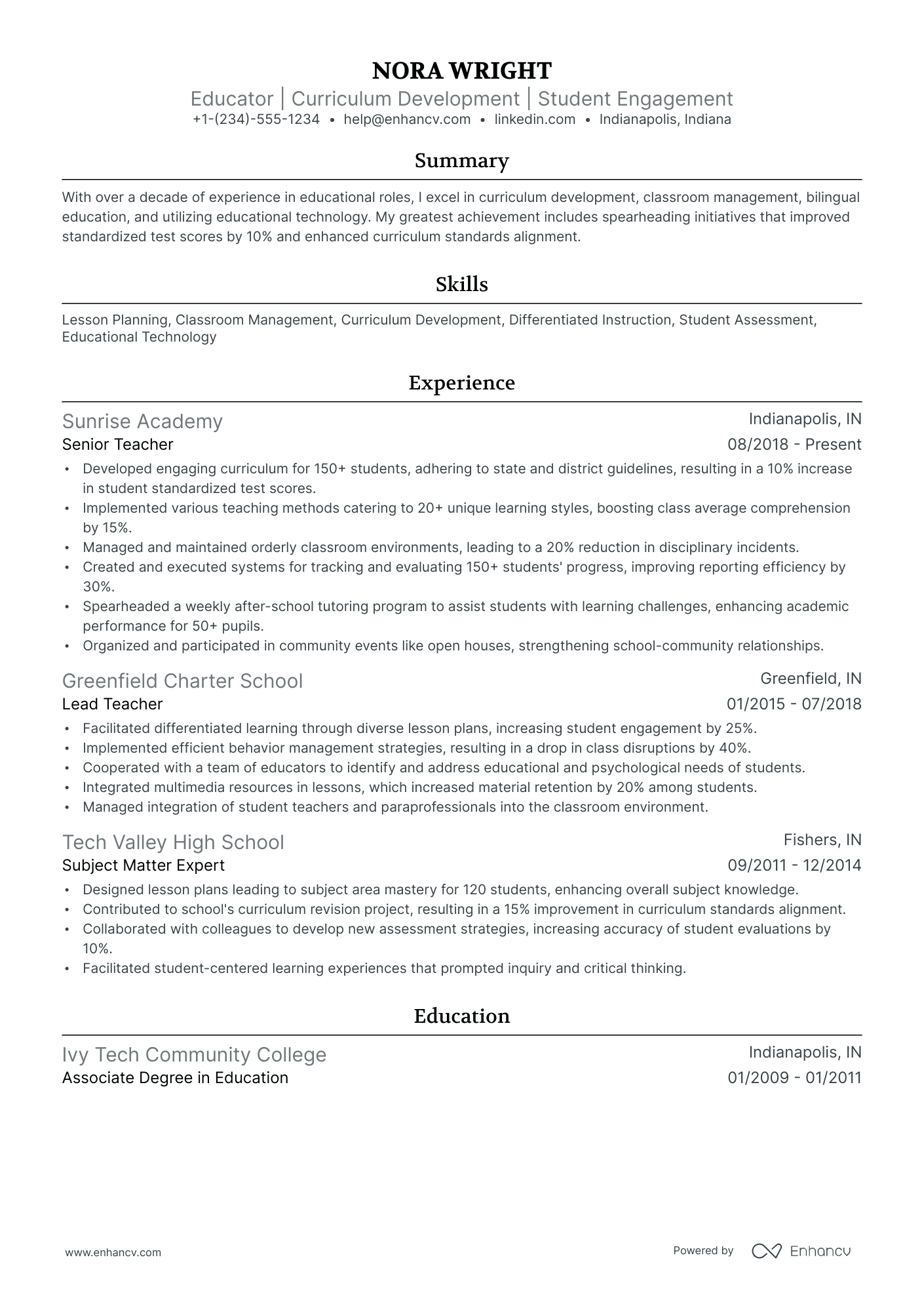
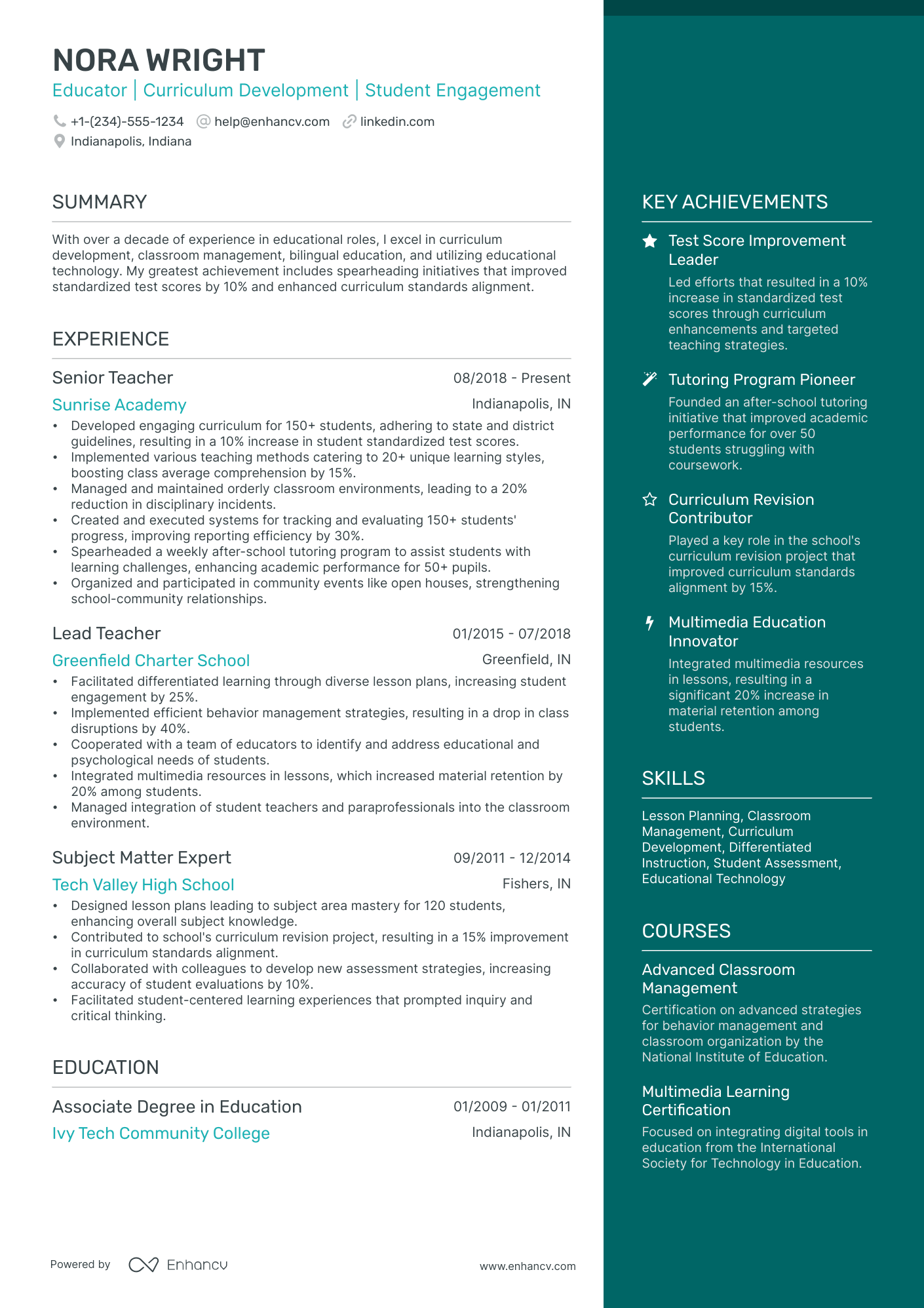
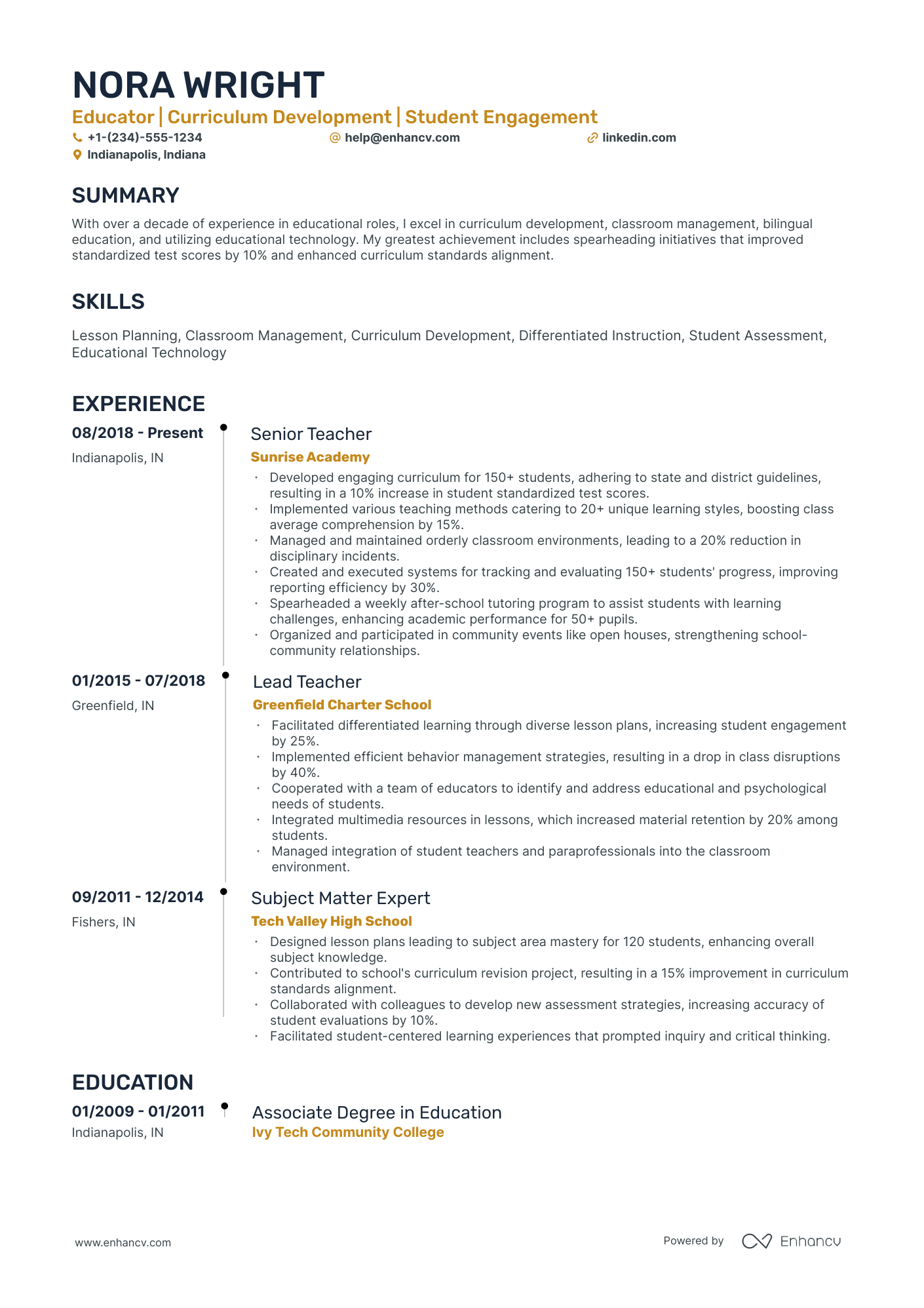
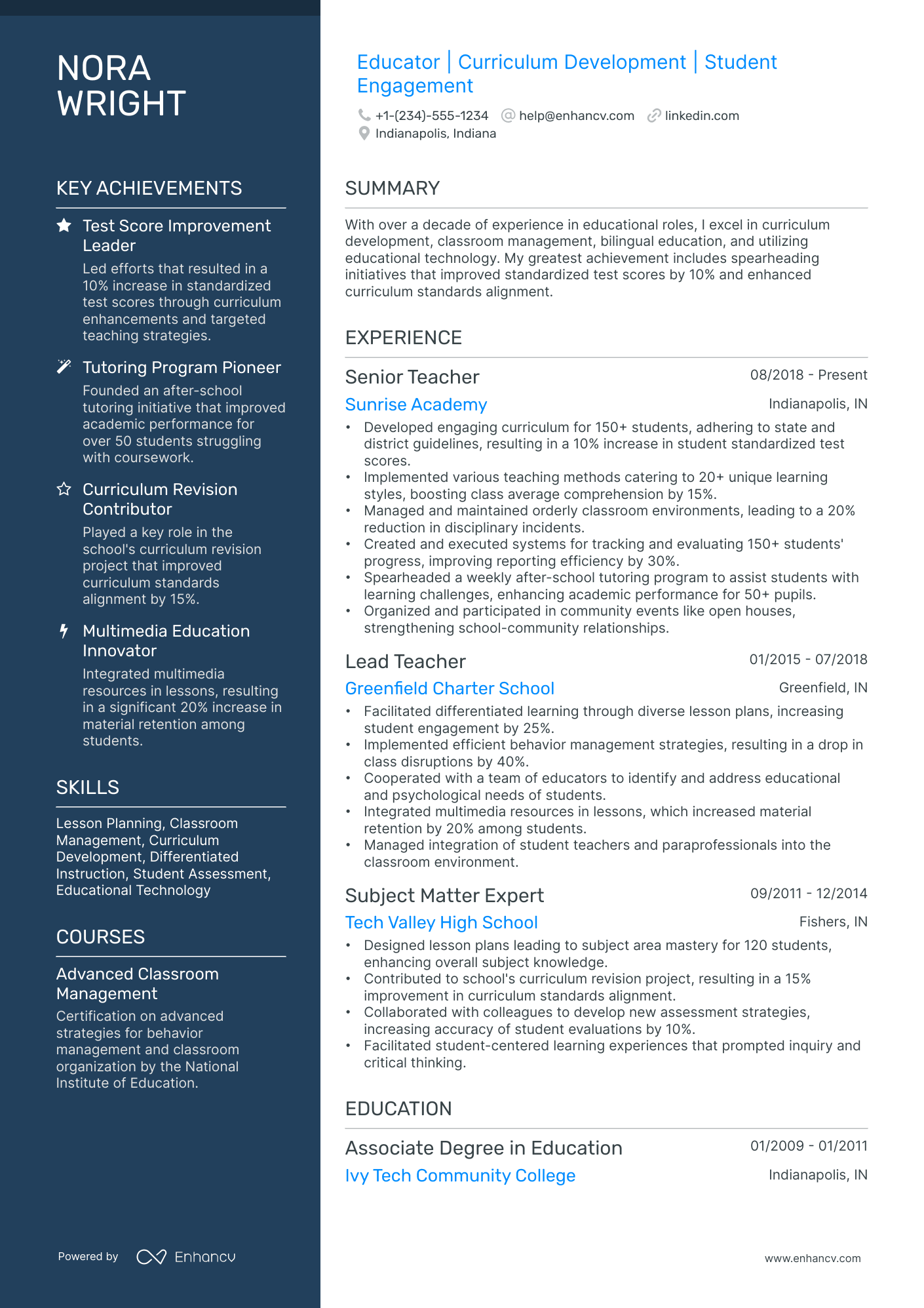
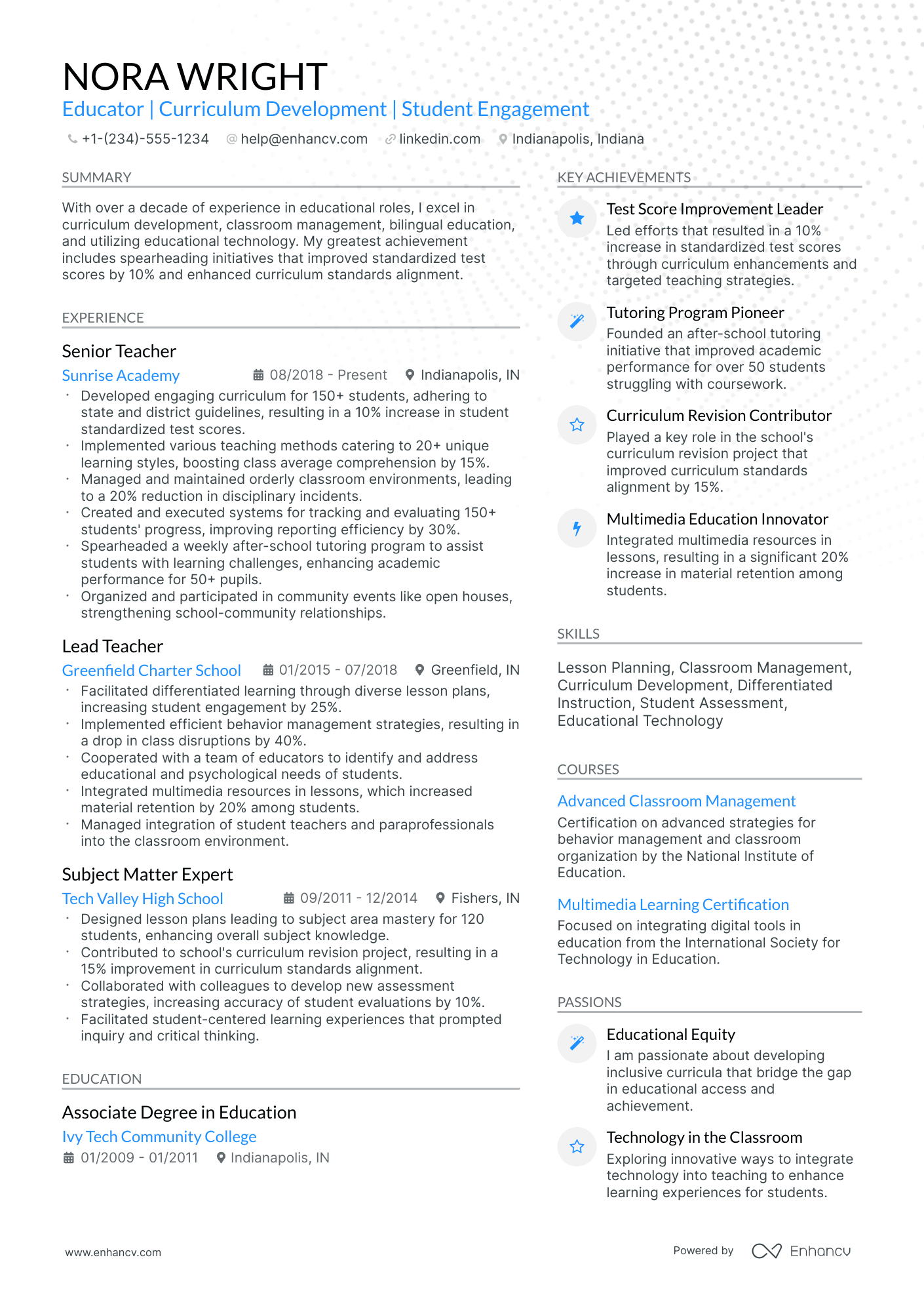
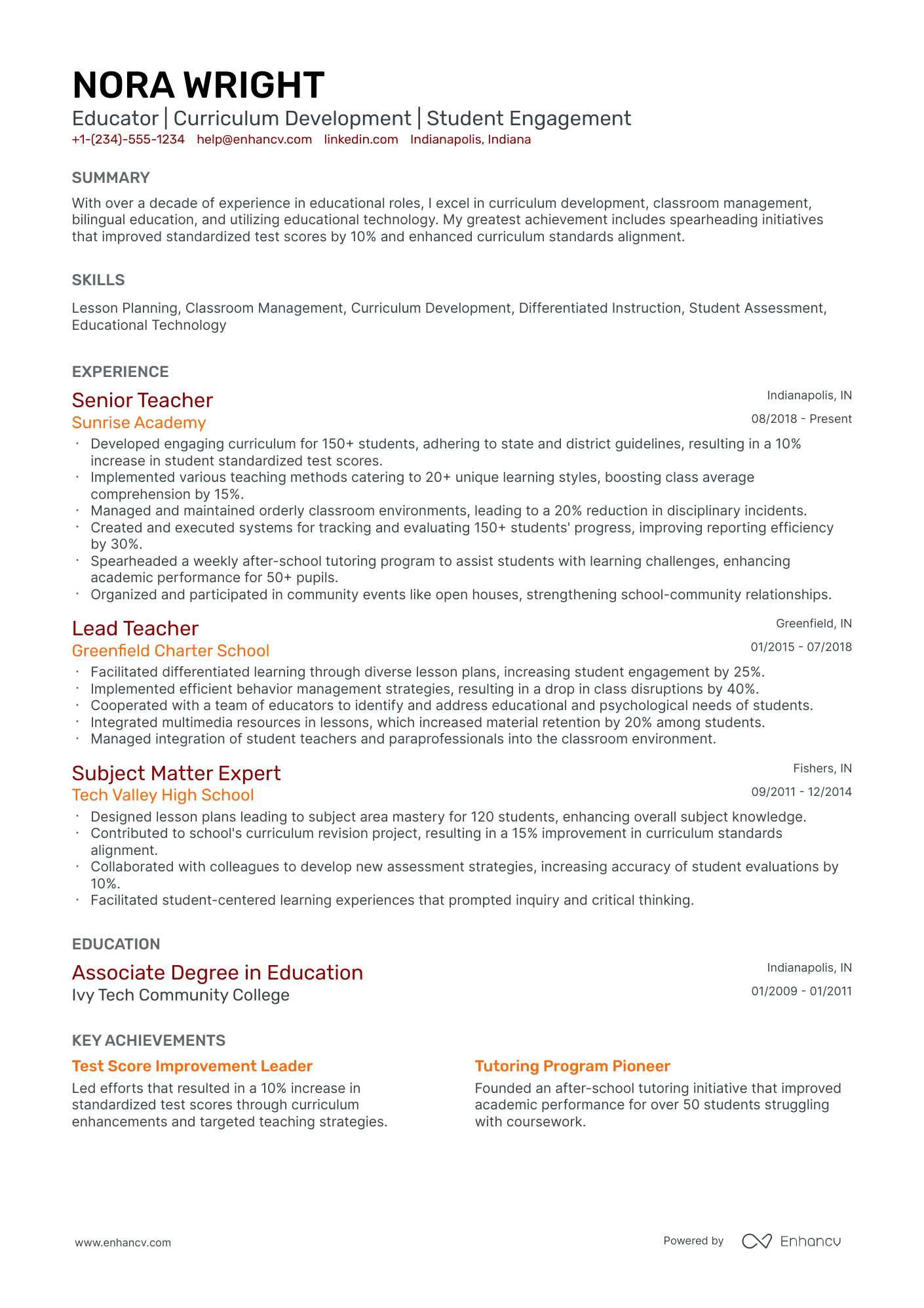
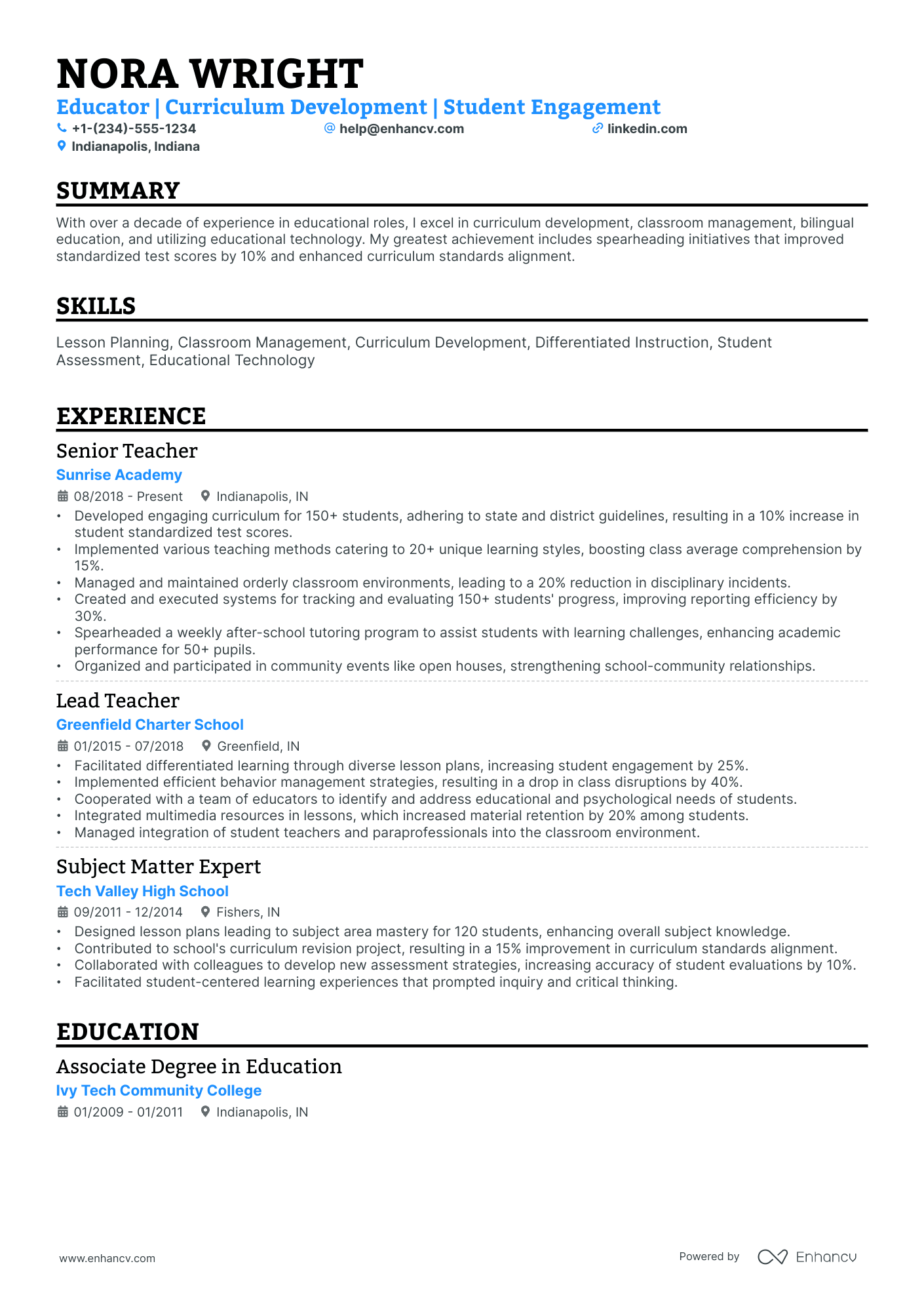
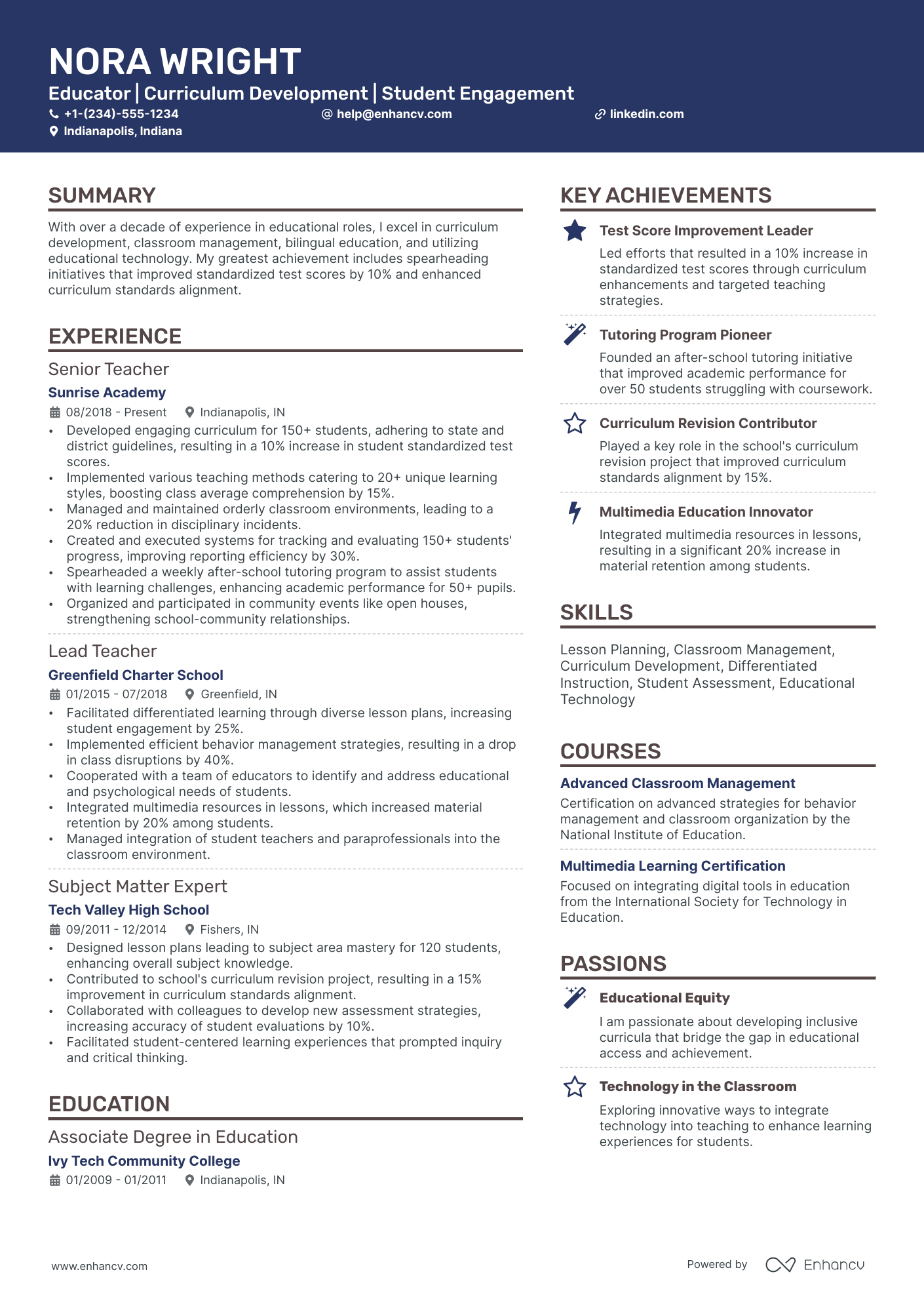
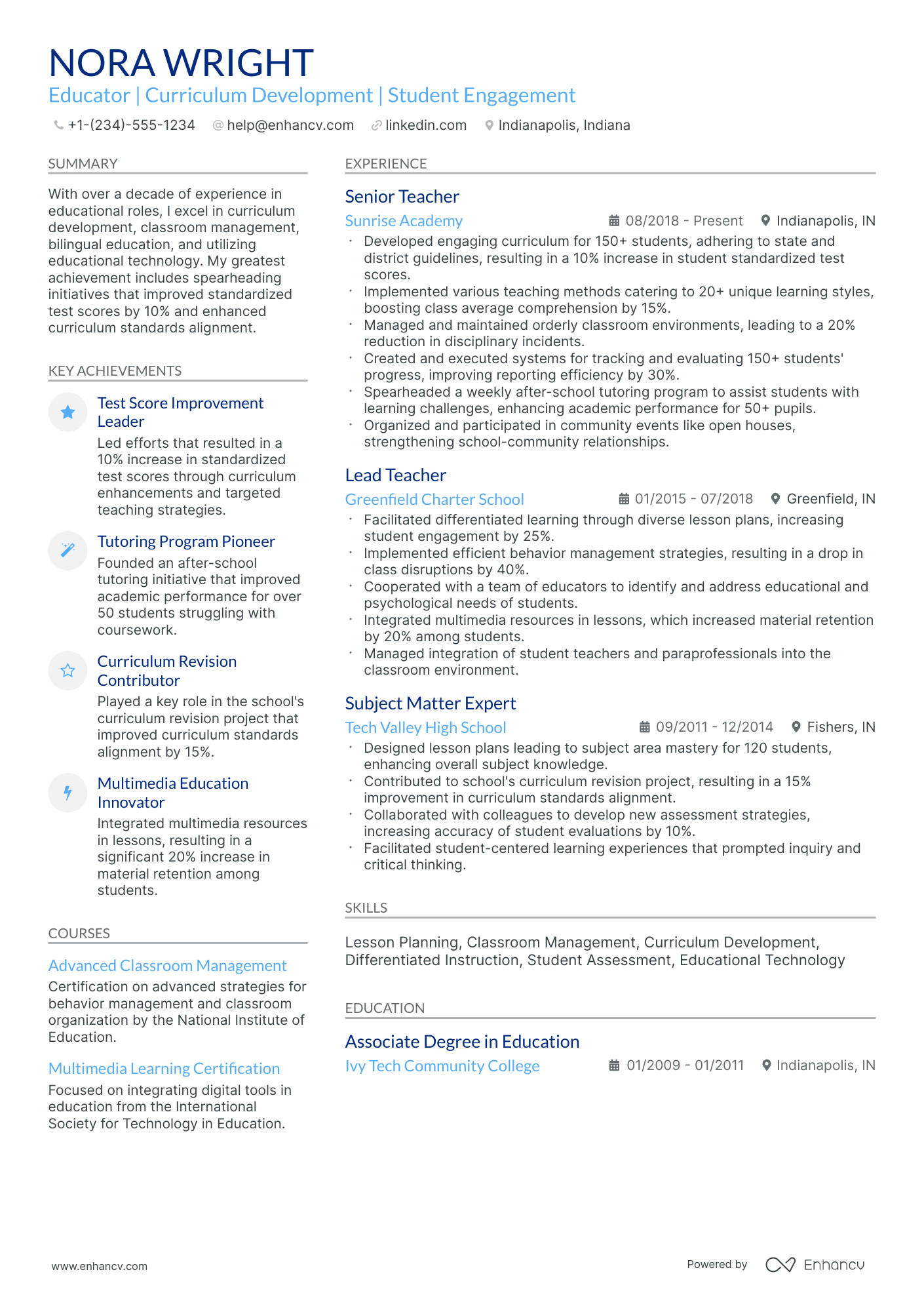
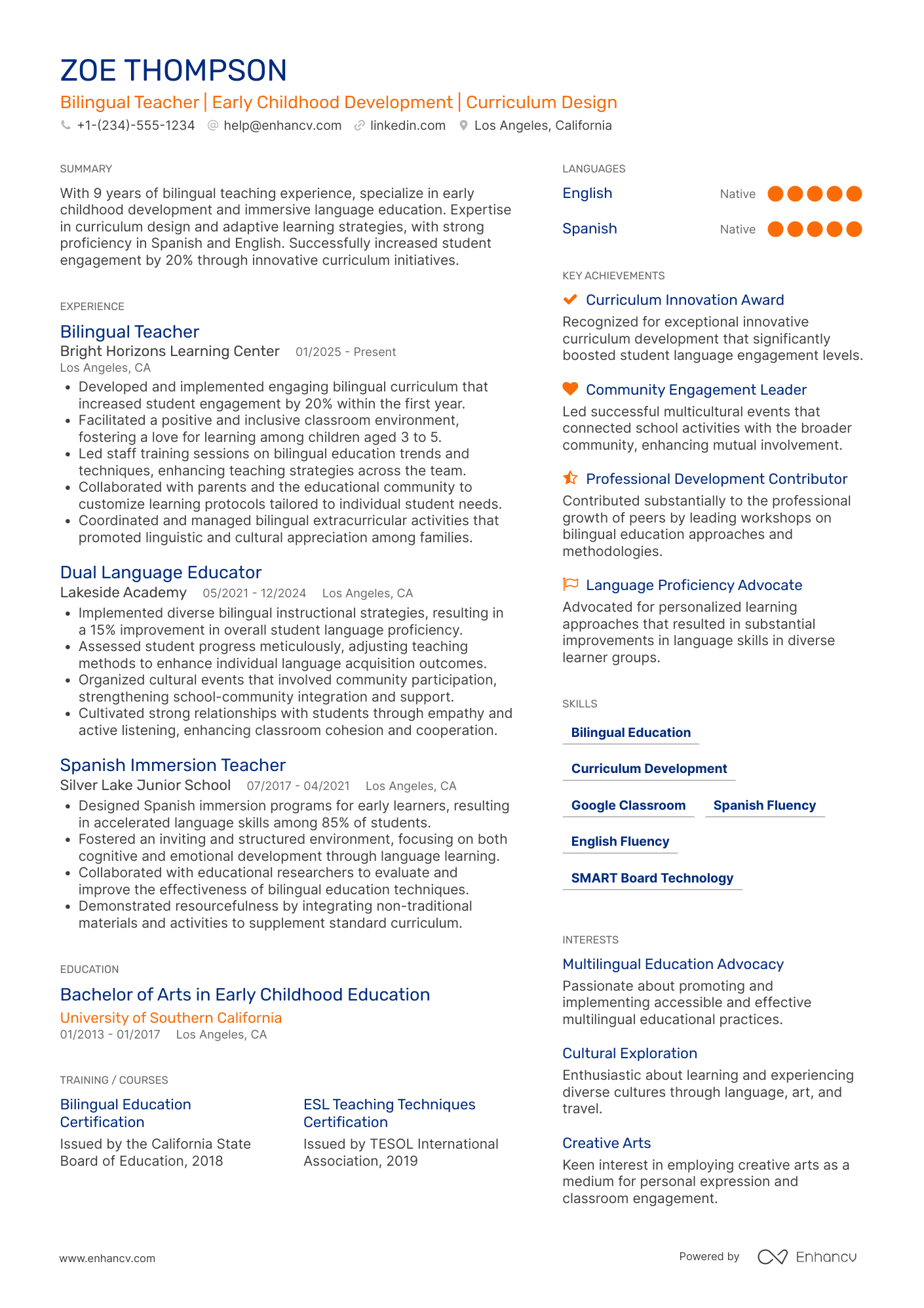
Many bilingual teacher resume submissions fail because they describe duties instead of evidence, and they bury language proficiency and student outcomes. That hurts when an ATS filters fast and recruiters scan in seconds amid heavy competition.
A strong resume shows how you improved learning and access. If you're unsure where to begin, understanding how to write a resume that highlights impact is the first step. Highlight growth in reading levels, higher assessment scores, faster language acquisition, improved attendance, reduced referral rates, and successful family engagement across grade levels. Quantify class size, caseload, and program results.

Key takeaways
- Quantify student outcomes like proficiency gains, reclassification rates, and attendance improvements in every bullet.
- Tailor experience bullets to mirror the job posting's program model, assessments, and grade levels.
- Use reverse-chronological format for experienced teachers and hybrid format for career changers.
- Anchor every listed skill to a measurable result in your experience or summary section.
- Lead your summary with years of bilingual teaching experience, specific methods, and one key metric.
- Include bilingual endorsements and certifications directly after education to verify your qualifications fast.
- Use Enhancv to turn vague duties into concise, metric-driven bullets that pass ATS screening.
How to format a bilingual teacher resume
Recruiters hiring bilingual teachers prioritize dual-language fluency, culturally responsive instruction, and classroom management across both languages. Choosing the right resume format ensures these signals surface quickly during both human review and applicant tracking system (ATS) scans.

I have significant experience in this role—which format should I use?
Use a reverse-chronological format to showcase your teaching progression, growing classroom responsibilities, and sustained bilingual instruction expertise. Do:
- Lead with your most recent bilingual teaching position, highlighting grade levels served, program model (dual-language, transitional, two-way immersion), and student caseload size.
- Feature language proficiency certifications, bilingual education endorsements, and curriculum frameworks you've used (such as Gómez & Gómez, GLAD, or SIOP).
- Quantify student outcomes, language acquisition benchmarks, and program-level impact tied directly to your instruction.
I'm junior or switching into this role—what format works best?
A hybrid format works best, letting you lead with bilingual skills and teaching competencies while still providing a concise work history section. Do:
- Place a skills section near the top that highlights language proficiency levels, ESL/bilingual certifications, and instructional methodologies relevant to dual-language classrooms.
- Include student teaching placements, tutoring roles, community language programs, or volunteer translation work as transitional experience that demonstrates bilingual instruction ability.
- Connect every listed experience to a concrete action and a measurable or observable result, even in non-traditional teaching settings.
Why not use a functional resume?
A functional resume strips away the classroom context, timeline, and student population details that hiring committees rely on to verify your bilingual teaching qualifications. Avoid a functional format unless you have no direct teaching experience and are transitioning from a related field such as interpreting, community outreach, or language tutoring—and even then, every skill listed must be anchored to a specific project, student outcome, or measurable result.
Once you've established a clean, readable layout, the next step is deciding which sections to include so each one strengthens your candidacy.
What sections should go on a bilingual teacher resume
Recruiters expect to see clear proof you can deliver strong instructional outcomes in two languages while meeting school and compliance requirements. Knowing what to put on a resume for a bilingual teaching role helps you prioritize the right details. Use this structure for maximum clarity:
- Header
- Summary
- Experience
- Skills
- Projects
- Education
- Certifications
- Optional sections: Languages, Awards, Volunteering.
Strong experience bullets should emphasize student growth, measurable outcomes, the grade levels and class sizes you supported, and how you improved engagement, equity, and family communication in both languages.
Is your resume good enough?
Drop your resume here or choose a file. PDF & DOCX only. Max 2MB file size.
Now that you’ve organized the key parts of your bilingual teacher resume, the next step is to write your experience section so it supports each one with clear, relevant proof.
How to write your bilingual teacher resume experience
The work experience section is where you prove you've delivered real instructional results in bilingual or dual-language settings—not just held a position. Hiring managers prioritize demonstrated impact on student outcomes, language proficiency growth, and culturally responsive program delivery over generic task lists.
Each entry should include:
- Job title
- Company and location (or remote)
- Dates of employment (month and year)
Three to five concise bullet points showing what you owned, how you executed, and what outcomes you delivered:
- Ownership scope: the bilingual or dual-language classrooms, grade levels, curriculum strands, or student populations you were directly accountable for, including any program-wide responsibilities such as language allocation planning or heritage language preservation initiatives.
- Execution approach: the instructional frameworks, assessment tools, language acquisition methods, or classroom technologies you used to plan lessons, differentiate instruction, and make data-driven decisions across both languages.
- Value improved: the measurable changes you drove in student language proficiency, academic achievement, literacy benchmarks, classroom engagement, or equitable access to grade-level content for English learners and native speakers alike.
- Collaboration context: how you partnered with fellow bilingual educators, monolingual teaching teams, speech-language specialists, families, or community organizations to align instruction, support student transitions, and strengthen home-school language connections.
- Impact delivered: the concrete outcomes your teaching produced—expressed through student growth results, program expansion, retention rates, reclassification progress, or contributions to schoolwide bilingual education goals—rather than a description of daily activities.
Experience bullet formula
A bilingual teacher experience example
✅ Right example - modern, quantified, specific.
Bilingual Teacher (Spanish/English), Grades 3–5
Riverview Unified School District | Austin, TX
2021–Present
Title I elementary school serving 650+ students with a dual-language program focused on biliteracy and equitable outcomes.
- Designed and delivered standards-aligned dual-language literacy and math instruction using Sheltered Instruction Observation Protocol (SIOP) and WIDA Can Do Descriptors, increasing reading proficiency from 52% to 68% in one year across 96 students.
- Built data-driven intervention groups using NWEA MAP Growth, i-Ready, and Google Sheets progress trackers, reducing the share of students below benchmark by 18% and improving median growth percentile from 44 to 56.
- Implemented differentiated lesson plans and formative checks in Google Classroom and Seesaw, cutting grading and feedback turnaround time from four days to two while raising assignment completion from 81% to 92%.
- Partnered with special education, speech-language pathology, and English learner teams to deliver aligned Individualized Education Program (IEP) supports and language accommodations, improving IEP goal attainment from 70% to 85% across twenty-three students.
- Led bilingual family engagement through Remind, ClassDojo, and translated conferences, increasing conference attendance from 62% to 84% and reducing chronic absenteeism from 14% to 10% for the homeroom cohort.
Now that you've seen how a strong bilingual teacher experience section looks in practice, let's break down how to tailor each element to match the specific job you're applying for.
How to tailor your bilingual teacher resume experience
Recruiters evaluate your bilingual teacher resume through both human review and applicant tracking systems. Tailoring your resume to the job description ensures your qualifications stand out in both screenings.
Ways to tailor your bilingual teacher experience:
- Match the bilingual program model listed such as dual language or transitional.
- Use the exact curriculum frameworks and state standards referenced in the posting.
- Mirror student performance metrics or language proficiency benchmarks they prioritize.
- Highlight experience with specific assessment tools like WIDA or TELPAS.
- Reflect the grade levels and content areas the position requires.
- Include referenced collaboration structures like co-teaching or PLC participation.
- Emphasize family engagement practices if the posting mentions community outreach.
- Align your language instruction strategies with methodologies named in the description.
Tailoring means aligning your real classroom achievements with the specific requirements of each position rather than forcing keywords where they don't belong.
Resume tailoring examples for bilingual teacher
| Job description excerpt | Untailored | Tailored |
|---|---|---|
| "Deliver dual-language instruction in Spanish and English using the Gómez & Gómez model for grades K–2, with 80/20 language allocation." | Taught lessons in both Spanish and English to young students. | Delivered dual-language instruction in Spanish and English for K–2 classrooms using the Gómez & Gómez model, maintaining an 80/20 language allocation that helped 93% of students meet biliteracy benchmarks. |
| "Administer the TELPAS and LAS Links assessments to monitor English language proficiency and reclassification readiness for a caseload of 60+ ELL students." | Gave language assessments and tracked student progress. | Administered TELPAS and LAS Links assessments for a caseload of 65 ELL students, using proficiency data to recommend 12 students for reclassification in a single academic year. |
| "Collaborate with general education teachers to co-plan TEKS-aligned, sheltered instruction lessons that integrate academic vocabulary development across content areas." | Worked with other teachers to plan lessons for English learners. | Co-planned TEKS-aligned, sheltered instruction lessons with four general education teachers, embedding tiered academic vocabulary strategies across math, science, and social studies units to raise content-area assessment scores by 15%. |
Once you’ve aligned your experience with the role’s language and classroom needs, quantify your bilingual teaching achievements to show the measurable impact of that work.
How to quantify your bilingual teacher achievements
Quantifying your achievements shows how your instruction changed student outcomes. Focus on growth in language proficiency, assessment gains, attendance, family engagement, and compliance metrics like timely individualized education program documentation.
Quantifying examples for bilingual teacher
| Metric | Example |
|---|---|
| Language growth | "Moved 18 of 24 newcomers up one WIDA (World-Class Instructional Design and Assessment) proficiency level in one semester using weekly speaking rubrics and targeted small-group lessons." |
| Assessment gains | "Raised dual-language reading benchmark pass rate from 52% to 74% in twelve weeks by reteaching phonics gaps and tracking progress in Google Sheets." |
| Family engagement | "Increased parent conference attendance from 40% to 78% by offering bilingual SignUpGenius scheduling and sending weekly WhatsApp updates in Spanish and English." |
| Documentation accuracy | "Cut individualized education program documentation errors from nine per quarter to two by using a checklist and same-day translation review with the case manager." |
| Instructional throughput | "Created and delivered 36 bilingual lesson plans and 120 translated materials per quarter, meeting one hundred percent of deadlines across three grade levels." |
Turn vague job duties into measurable, recruiter-ready resume bullets in seconds with Enhancv's Bullet Point Generator.
Once you've crafted strong bullet points for your experience section, you'll want to apply that same precision to presenting your hard and soft skills.
How to list your hard and soft skills on a bilingual teacher resume
Your skills section shows hiring teams and an ATS (applicant tracking system) you can deliver instruction in two languages, manage compliance, and drive student growth; recruiters scan this section first, so aim for a balanced mix of roughly two-thirds hard skills and one-third soft skills. bilingual teacher roles require a blend of:
- Product strategy and discovery skills.
- Data, analytics, and experimentation skills.
- Delivery, execution, and go-to-market discipline.
- Soft skills.
Your skills section should be:
- Scannable (bullet-style grouping).
- Relevant to the job post.
- Backed by proof in experience bullets.
- Updated with current tools.
Place your skills section:
- Above experience if you're junior or switching careers.
- Below experience if you're mid/senior with strong achievements.

Hard skills
- Bilingual instruction, Spanish–English
- Sheltered Instruction Observation Protocol (SIOP)
- English language development standards
- Dual language immersion models
- Individualized Education Program documentation
- Multi-Tiered System of Supports
- Differentiated instruction strategies
- Curriculum mapping, unit planning
- Student data analysis, progress monitoring
- Formative assessment design, rubrics
- Google Classroom, Canvas, Seesaw
- Translation and interpretation for families
Soft skills
- Deliver clear bilingual explanations
- Set language objectives and norms
- Partner with special education teams
- Collaborate with grade-level teams
- Communicate with families consistently
- Facilitate student-centered discussions
- De-escalate and restore classroom culture
- Advocate for multilingual learners
- Prioritize high-impact interventions
- Align stakeholders on student plans
- Document decisions and follow through
- Adjust instruction based on feedback
How to show your bilingual teacher skills in context
Skills shouldn't live only in a bulleted list on your resume. Browse resume skills examples to see how bilingual educators present their competencies effectively.
They should be demonstrated in:
- Your summary (high-level professional identity)
- Your experience (proof through outcomes)
Here's what that looks like in practice.
Summary example
Bilingual teacher with 12 years of experience designing dual-language curricula using sheltered instruction and Seesaw. Raised English learner proficiency rates by 34% across three grade levels while fostering inclusive, culturally responsive classrooms.
- Reflects senior-level expertise clearly
- Names specific tools and methods
- Includes a strong measurable outcome
- Highlights cultural responsiveness as soft skill
Experience example
Senior Bilingual Teacher
Puente Academy | San Antonio, TX
August 2018–June 2024
- Designed dual-language literacy units using Gomez & Gomez model, improving state reading scores by 21% over two years.
- Collaborated with speech-language pathologists and ESL coordinators to implement scaffolded supports, reducing reclassification timelines by 30%.
- Tracked student progress through Ellevation and Canvas, presenting quarterly data reports that guided instructional decisions for a 400-student bilingual program.
- Every bullet includes measurable proof
- Skills appear naturally through real outcomes
Once you’ve demonstrated your language and instructional strengths through specific classroom-aligned examples, the next step is to apply that same approach to structuring a bilingual teacher resume when you have no experience.
How do I write a bilingual teacher resume with no experience
Even without full-time experience, you can demonstrate readiness for a bilingual teaching role. Writing a resume without work experience means showcasing transferable skills through:
- Student teaching in bilingual classrooms
- Tutoring multilingual learners after school
- ESL practicum or field placement
- Volunteer literacy or homework support
- Lesson plans with language objectives
- Small-group reading intervention sessions
- Translation support for school events
- Classroom observations with reflections
Focus on:
- Target language proficiency proof
- Standards-aligned lesson planning samples
- Data-driven student progress tracking
- Classroom management in practice settings
Resume format tip for entry-level bilingual teacher
Use a hybrid resume format because it highlights bilingual teacher skills and projects first, while still showing education and practicum experience clearly. Do:
- Add a skills section with proof.
- Include a projects section with outcomes.
- List practicum details like a job.
- Attach a lesson plan portfolio link.
- Quantify results using student data.
- Designed and taught five standards-aligned bilingual teacher lessons using WIDA Can Do Descriptors and Google Classroom, improving unit quiz averages from 68% to 82%.
Once you've positioned your limited experience as a strength, presenting your education effectively becomes the next essential step in building credibility.
How to list your education on a bilingual teacher resume
Your education section lets hiring teams confirm you hold the foundational knowledge a bilingual teacher needs. It validates your training in language acquisition, pedagogy, and multicultural instruction.
Include:
- Degree name
- Institution
- Location
- Graduation year
- Relevant coursework (for juniors or entry-level candidates)
- Honors & GPA (if 3.5 or higher)
Skip month and day details—list the graduation year only.
Here's a strong education entry tailored for a bilingual teacher resume:
Example education entry
Bachelor of Arts in Bilingual Education
University of Texas at San Antonio, San Antonio, TX
Graduated 2021
GPA: 3.8/4.0
- Relevant Coursework: Second Language Acquisition, Dual-Language Curriculum Design, Cross-Cultural Communication, ESL Methods
- Honors: Magna Cum Laude, Dean's List (all semesters)
How to list your certifications on a bilingual teacher resume
Certifications on a resume show a bilingual teacher's commitment to learning, comfort with classroom tools, and alignment with current standards in language instruction and student support.
Include:
- Certificate name
- Issuing organization
- Year
- Optional: credential ID or URL
- Place certifications below education when your most relevant credentials are older or already covered by your degree and teaching license.
- Place certifications above education when they are recent and directly support your bilingual teacher role, such as language proficiency or dual language training.
Best certifications for your bilingual teacher resume
- State Teaching License with Bilingual Education Endorsement
- TESOL Certification
- Dual Language Immersion (DLI) Teacher Certification
- Seal of Biliteracy Educator Certification
- WIDA English Language Development Certification
- Google Certified Educator Level 1
- CPR and First Aid Certification
Once you’ve positioned your credentials to confirm you meet bilingual teaching requirements, shift to your bilingual teacher resume summary to highlight those qualifications upfront.
How to write your bilingual teacher resume summary
Your resume summary is the first thing a recruiter reads. A strong one immediately signals you're qualified to manage a bilingual classroom and deliver measurable student outcomes.
Keep it to three to four lines, with:
- Your title and total years of bilingual teaching experience.
- The educational setting, grade levels, or program model you specialize in.
- Core skills like curriculum design, dual-language instruction, or literacy assessment tools.
- One or two quantified achievements, such as improved test scores or student proficiency rates.
- Soft skills tied to real outcomes, like parent engagement that boosted program enrollment.

PRO TIP
At this level, emphasize classroom skills, relevant certifications, and early wins with students. Avoid vague phrases like "passionate educator" or "dedicated team player." Instead, show what you accomplished and which tools or methods you used to get there.
Example summary for a bilingual teacher
Bilingual teacher with three years of experience in dual-language elementary programs. Raised English learner reading proficiency by 22% using structured literacy strategies. Skilled in sheltered instruction and culturally responsive curriculum development.
Optimize your resume summary and objective for ATS
Drop your resume here or choose a file.
PDF & DOCX only. Max 2MB file size.
Now that your summary captures your bilingual teaching strengths, make sure your header presents the essential contact and identification details recruiters need to reach you.
What to include in a bilingual teacher resume header
Your resume header is the top section with your key details, and it boosts visibility, credibility, and recruiter screening for a bilingual teacher.
Essential resume header elements
- Full name
- Tailored job title and headline
- Location
- Phone number
- Professional email
- GitHub link
- Portfolio link
A LinkedIn link helps recruiters verify experience quickly and supports screening.
Don't include a photo on a bilingual teacher resume unless the role is explicitly front-facing or appearance-dependent.
Use a tailored job title, list both languages in your headline, and keep every link current and easy to scan.
Example
Bilingual teacher resume header
Marisol Rivera
Bilingual teacher (Spanish-English) | Elementary literacy and ESL support
Austin, TX
(512) 867-53XX
marisol.rivera@enhancv.com
github.com/marisolrivera
marisolrivera.com
linkedin.com/in/marisolrivera
Once your contact details, credentials, and language information are clearly presented at the top, add targeted additional sections to reinforce your qualifications and support the rest of your resume.
Additional sections for bilingual teacher resumes
Beyond core qualifications, additional sections help a bilingual teacher stand out by showcasing unique strengths and cultural depth relevant to the role. For example, listing language skills with proficiency levels reinforces your bilingual credentials beyond a simple mention in your headline.
- Languages
- Certifications and endorsements
- Professional development and training
- Community involvement and outreach
- Publications and conference presentations
- Hobbies and interests
- Awards and recognitions
Once you've strengthened your resume with targeted additional sections, pairing it with a well-crafted cover letter can further set your application apart.
Do bilingual teacher resumes need a cover letter
A cover letter isn't required for a bilingual teacher, but it helps in competitive roles or districts that expect one. If you're unfamiliar with the format, learn what a cover letter is and how it complements your resume. It can make a difference when your resume needs context, or when you want to show fit with a specific program.
Use a cover letter to add details your bilingual teacher resume can't show quickly:
- Explain role or team fit by matching your bilingual teacher experience to the school's language model, grade band, and student population.
- Highlight one or two relevant projects or outcomes, such as dual-language curriculum work, family engagement results, or measurable language growth.
- Show understanding of the product, users, or business context by referencing the district's bilingual program goals, assessment approach, and community needs.
- Address career transitions or non-obvious experience by connecting prior roles, certifications, or volunteer work to bilingual teacher responsibilities.
Drop your resume here or choose a file.
PDF & DOCX only. Max 2MB file size.
Once you’ve decided whether to include a cover letter to add context beyond your resume, the next step is using AI to strengthen your bilingual teacher resume faster and more consistently.
Using AI to improve your bilingual teacher resume
AI can sharpen your resume's clarity, structure, and impact. It helps you find stronger words and tighter phrasing. But overuse strips away authenticity. Once your content is clear and role-aligned, step away from AI. If you're exploring AI tools, see our guide on which AI is best for writing resumes to choose the right one.
Here are 10 practical prompts you can copy and paste to strengthen specific sections:
- Strengthen your summary: "Rewrite my bilingual teacher resume summary to highlight dual-language instruction experience and measurable student outcomes in two concise sentences."
- Quantify experience bullets: "Add specific metrics to these bilingual teacher experience bullets, focusing on student achievement gains, class sizes, and language proficiency improvements."
- Tighten action verbs: "Replace weak verbs in my bilingual teacher experience section with strong, classroom-specific action verbs that show direct instructional impact."
- Align skills strategically: "Review this bilingual teacher skills section and reorder entries to match the priorities listed in the attached job description."
- Clarify certification details: "Reformat my bilingual teacher certifications section so each entry clearly states the credential name, issuing body, and expiration date."
- Refine project descriptions: "Shorten these bilingual teacher curriculum project descriptions to one bullet each, emphasizing scope, language components, and student results."
- Improve education formatting: "Restructure my bilingual teacher education section to lead with the most relevant degree and include any bilingual or ESL endorsements."
- Remove redundant phrasing: "Identify and cut redundant words or phrases across my entire bilingual teacher resume without losing any meaningful detail."
- Target a posting: "Compare my bilingual teacher resume against this job posting and suggest specific wording changes to better match the listed qualifications."
- Polish for consistency: "Check my bilingual teacher resume for inconsistent tense, formatting, and punctuation across all sections, then suggest corrections."
Stop using AI once your resume sounds accurate, specific, and aligned with real experience. AI should never invent experience or inflate claims—if it didn't happen, it doesn't belong here.
Conclusion
A strong bilingual teacher resume highlights measurable outcomes, role-specific skills, and a clear structure. It shows student growth, language proficiency gains, and family engagement results. It matches your experience to the role, using concise bullets and consistent formatting.
Hiring teams need bilingual teacher candidates who can deliver results now and adapt to evolving classroom needs. A focused summary, targeted skills, and quantified achievements show you’re ready. Keep it organized, direct, and easy to scan.