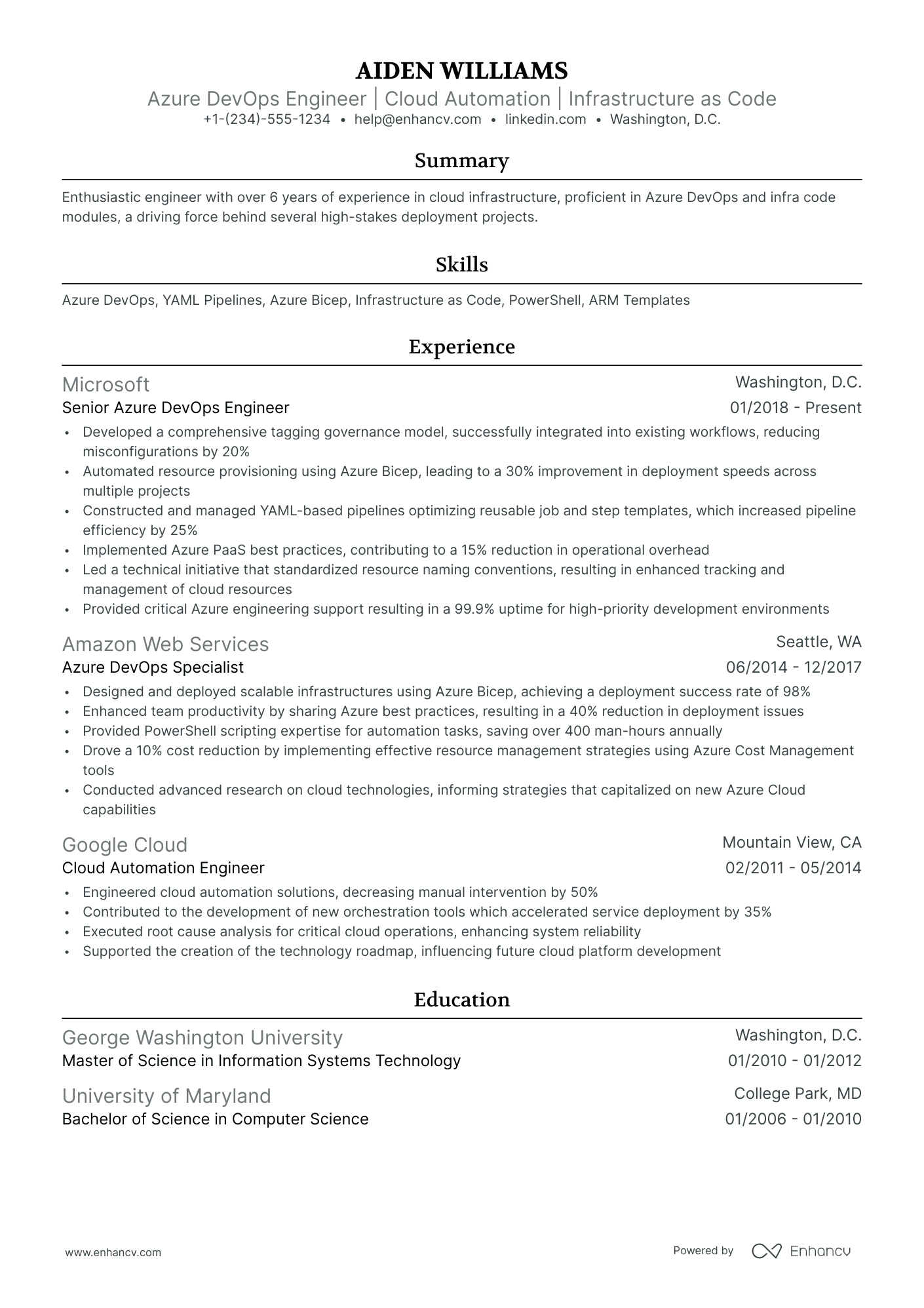
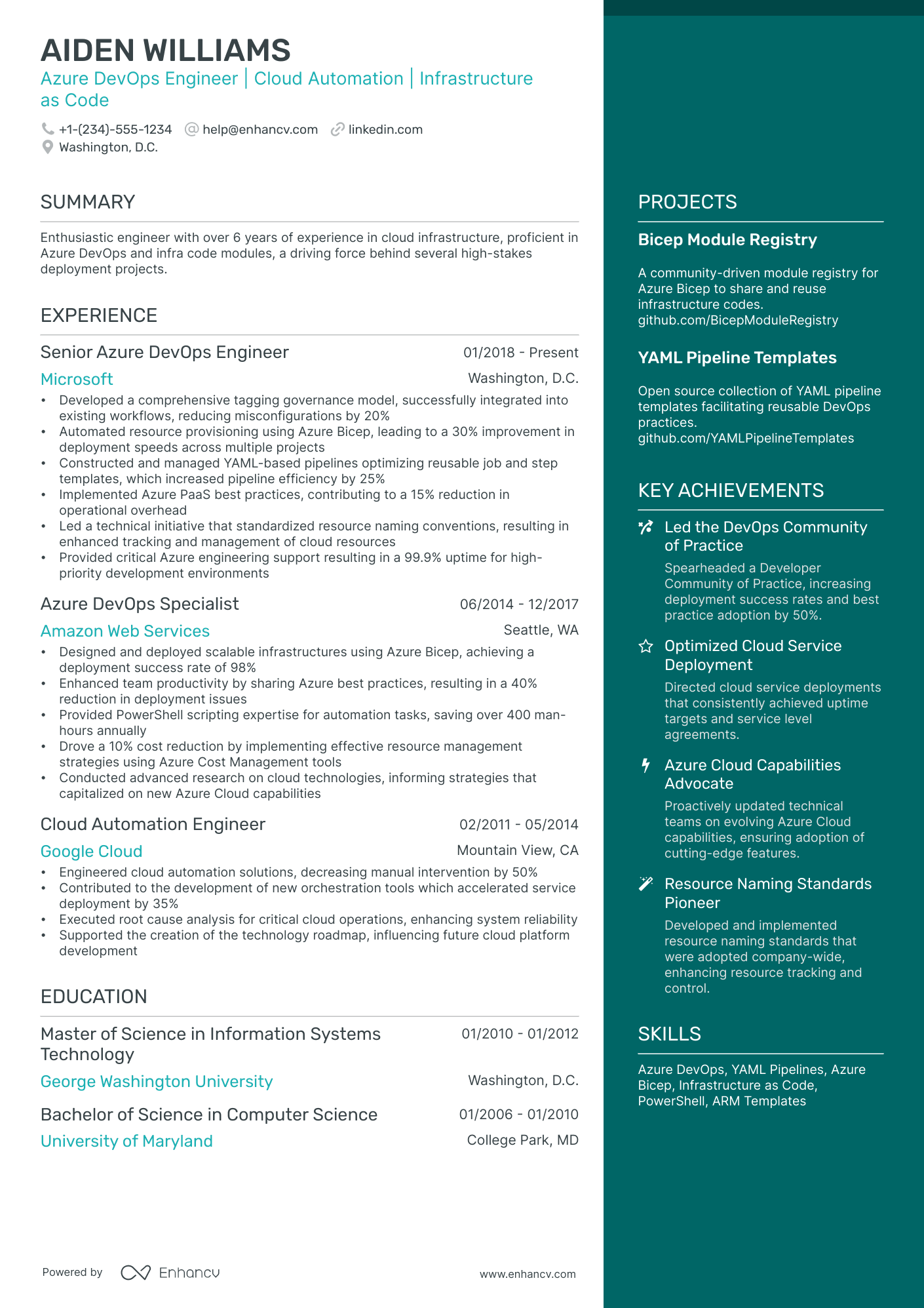
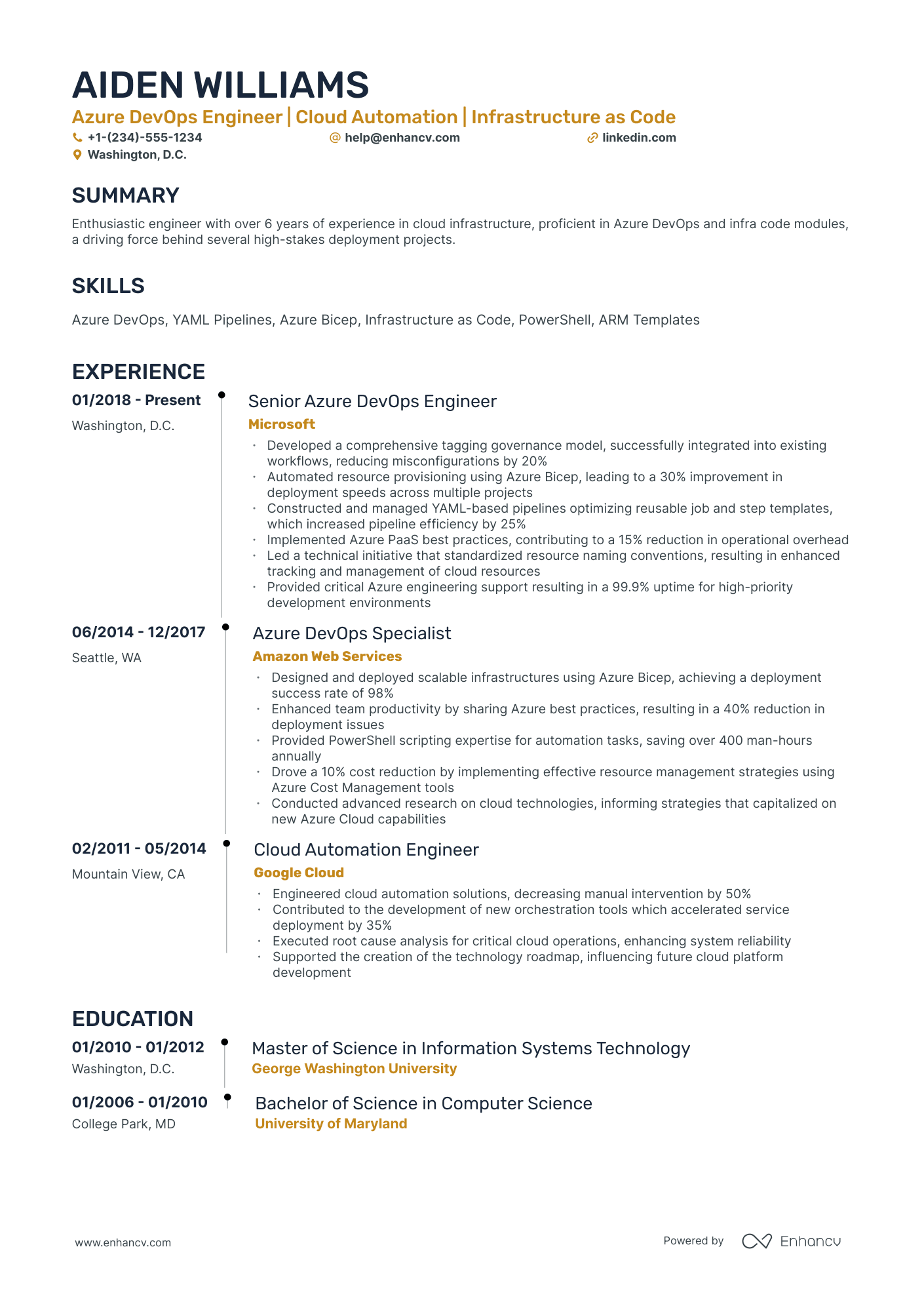
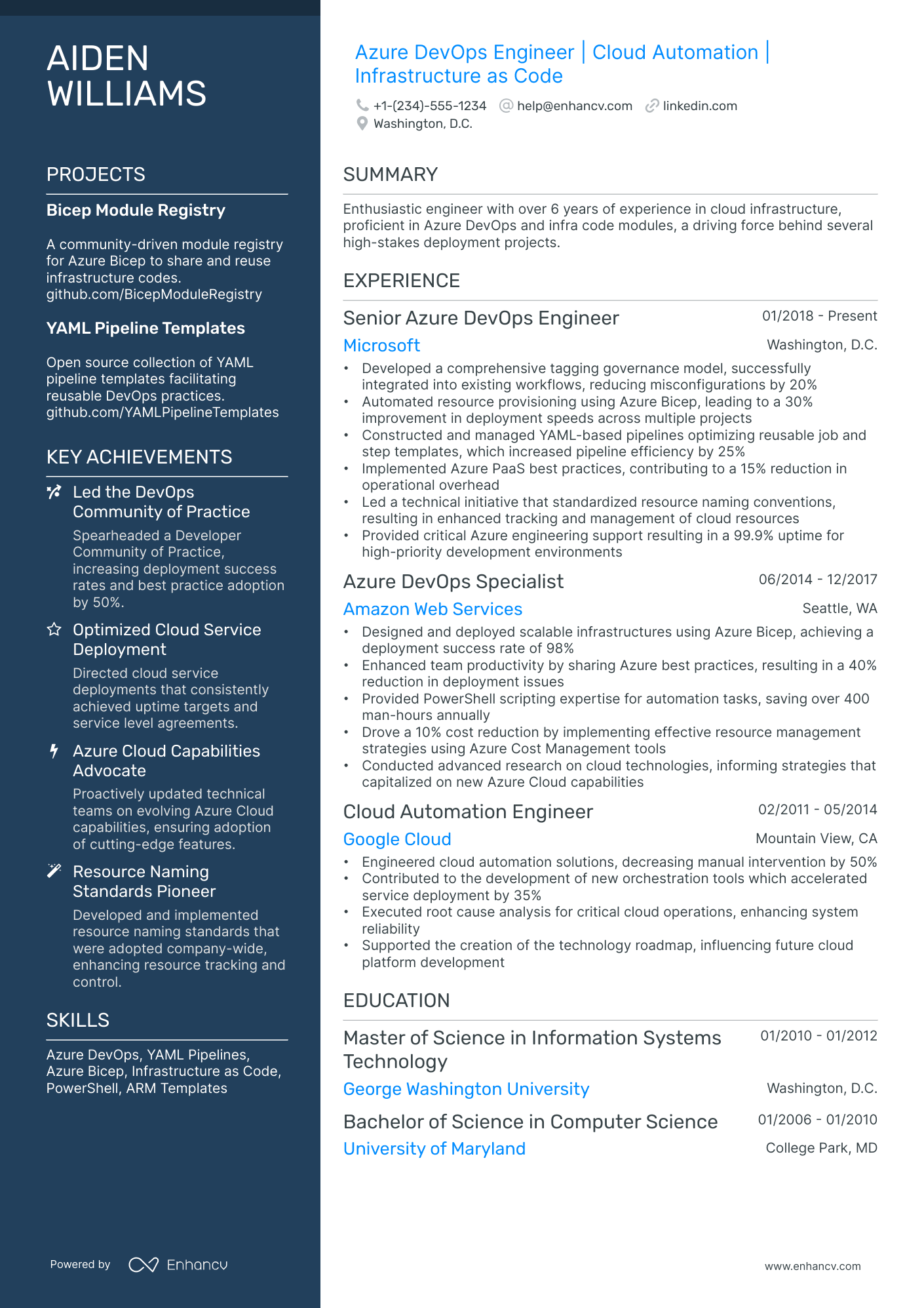
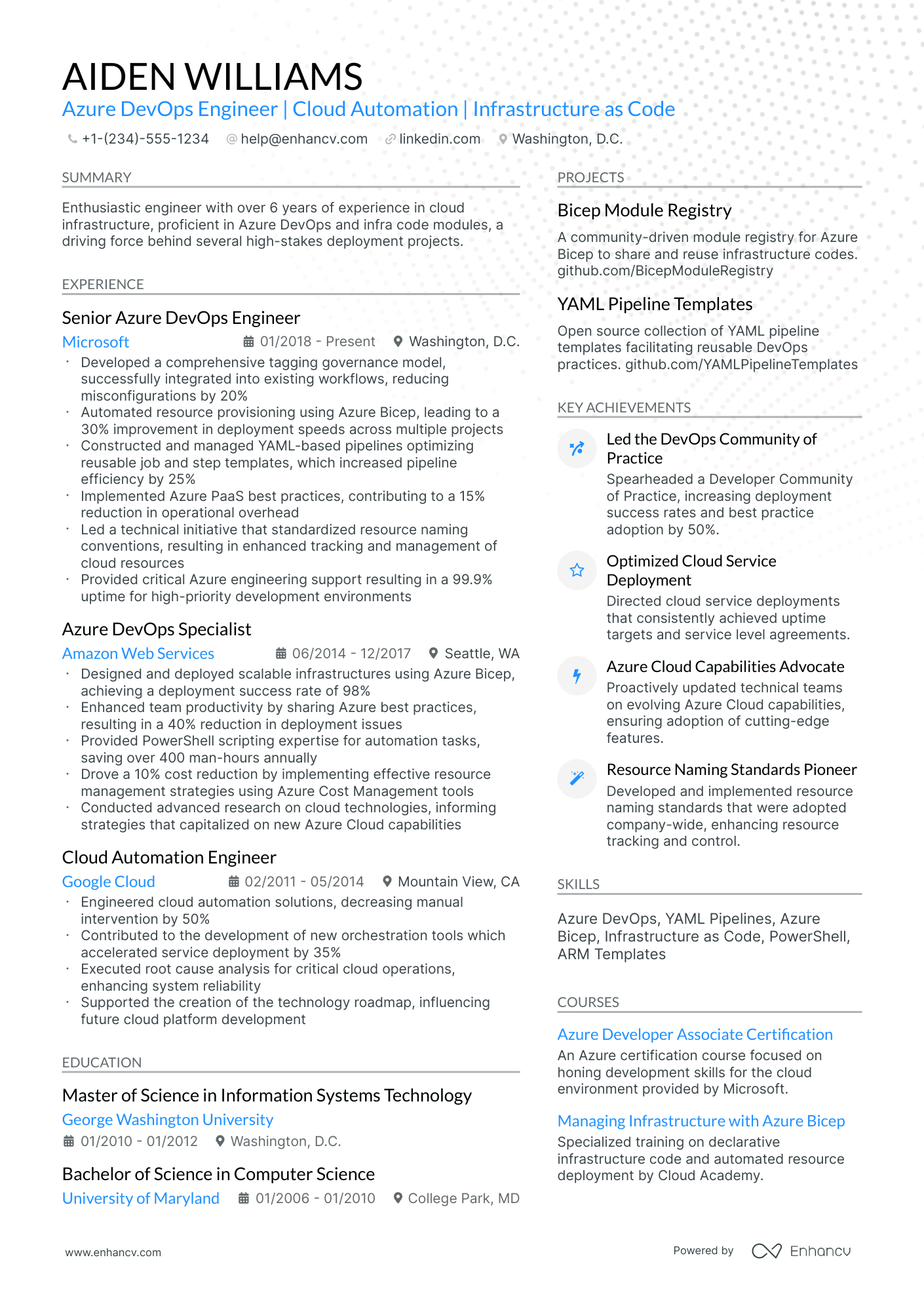
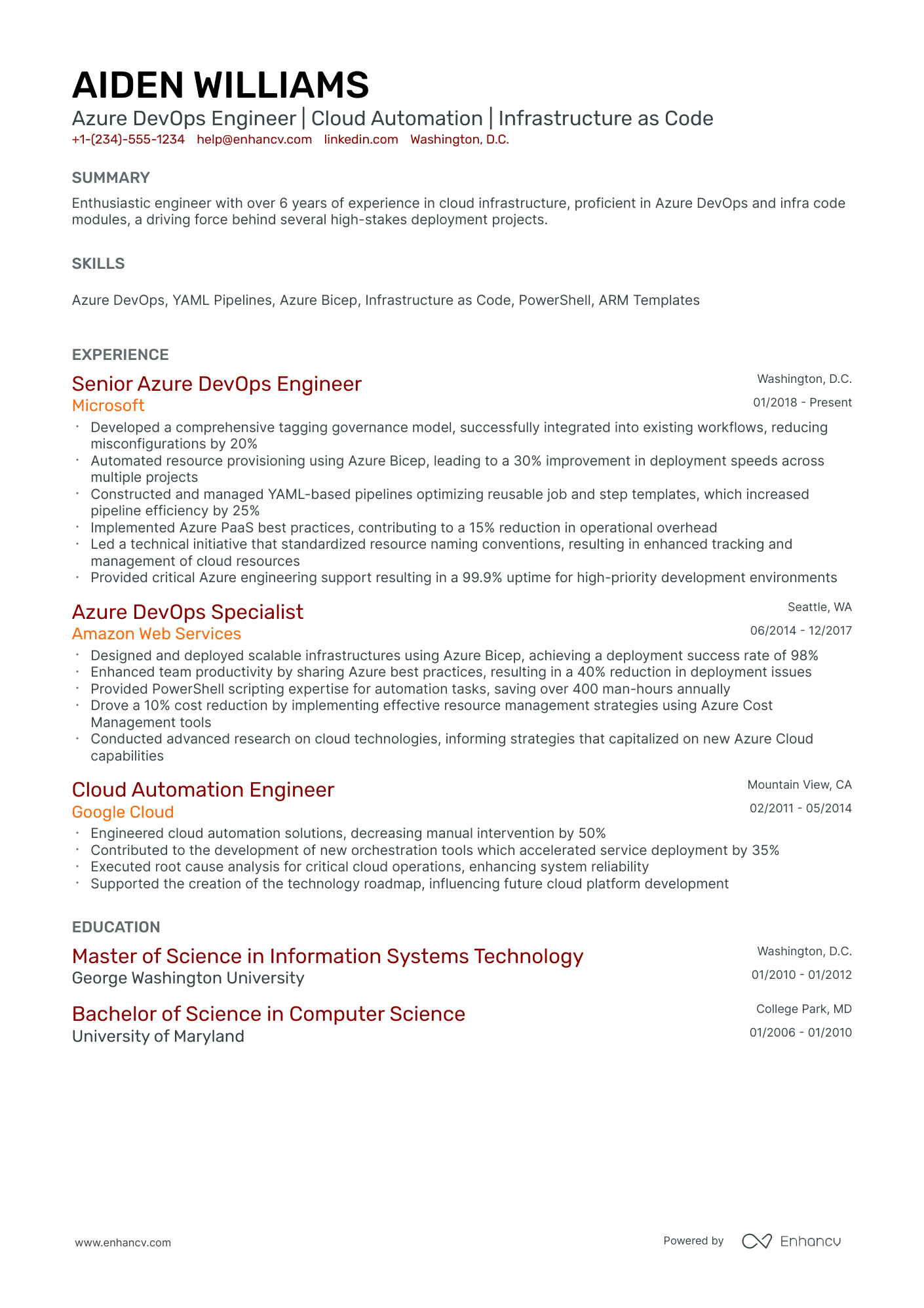
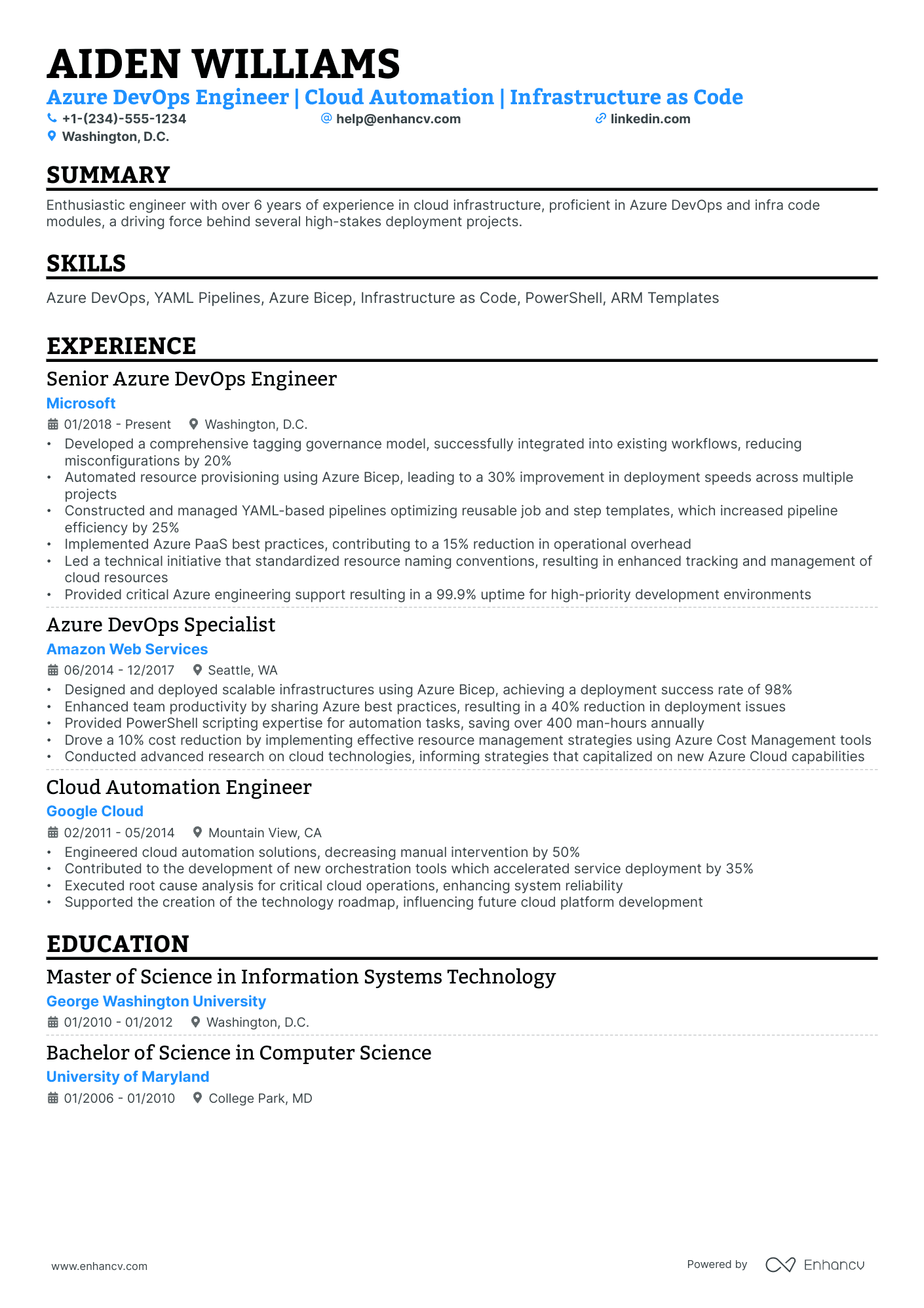
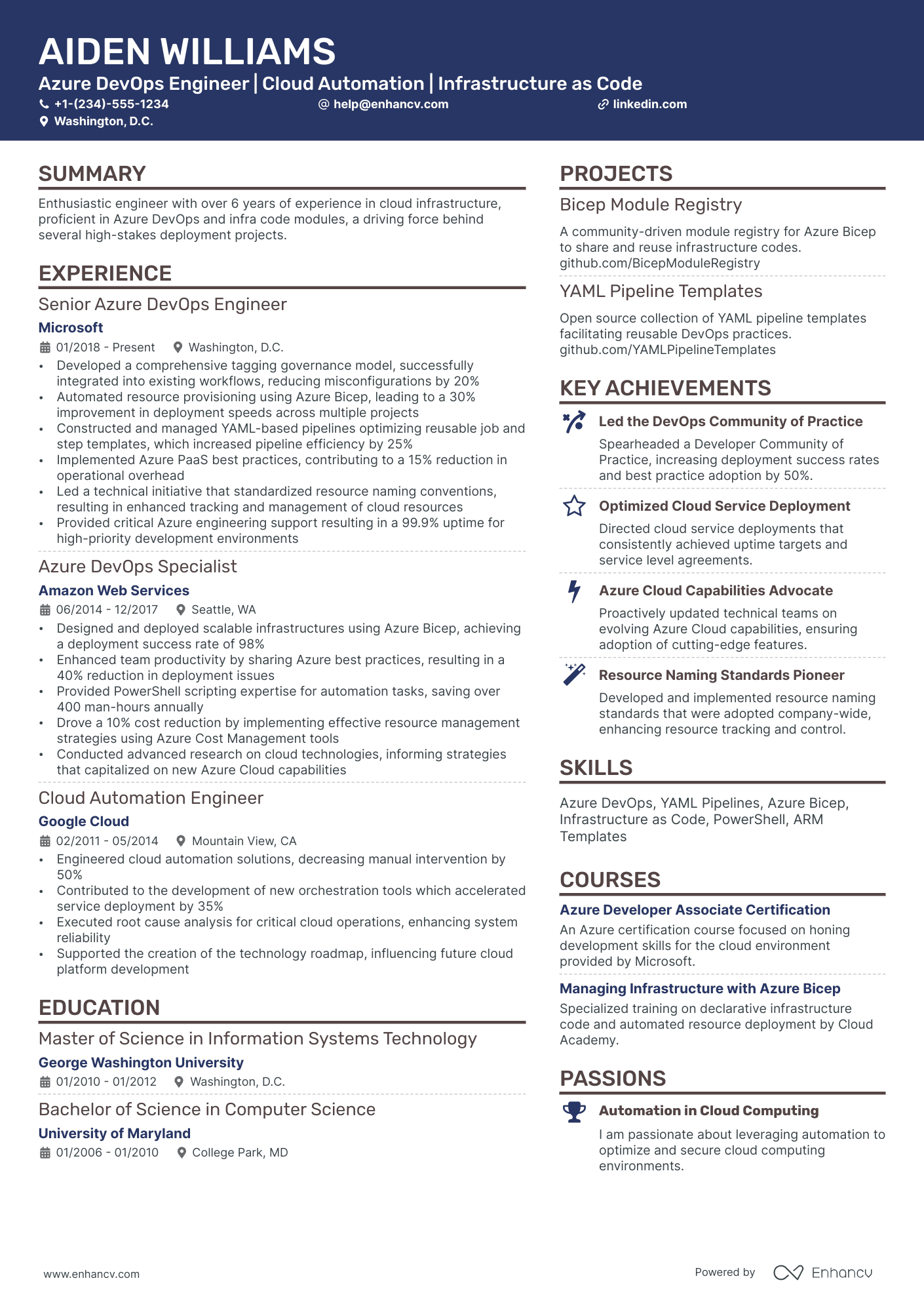
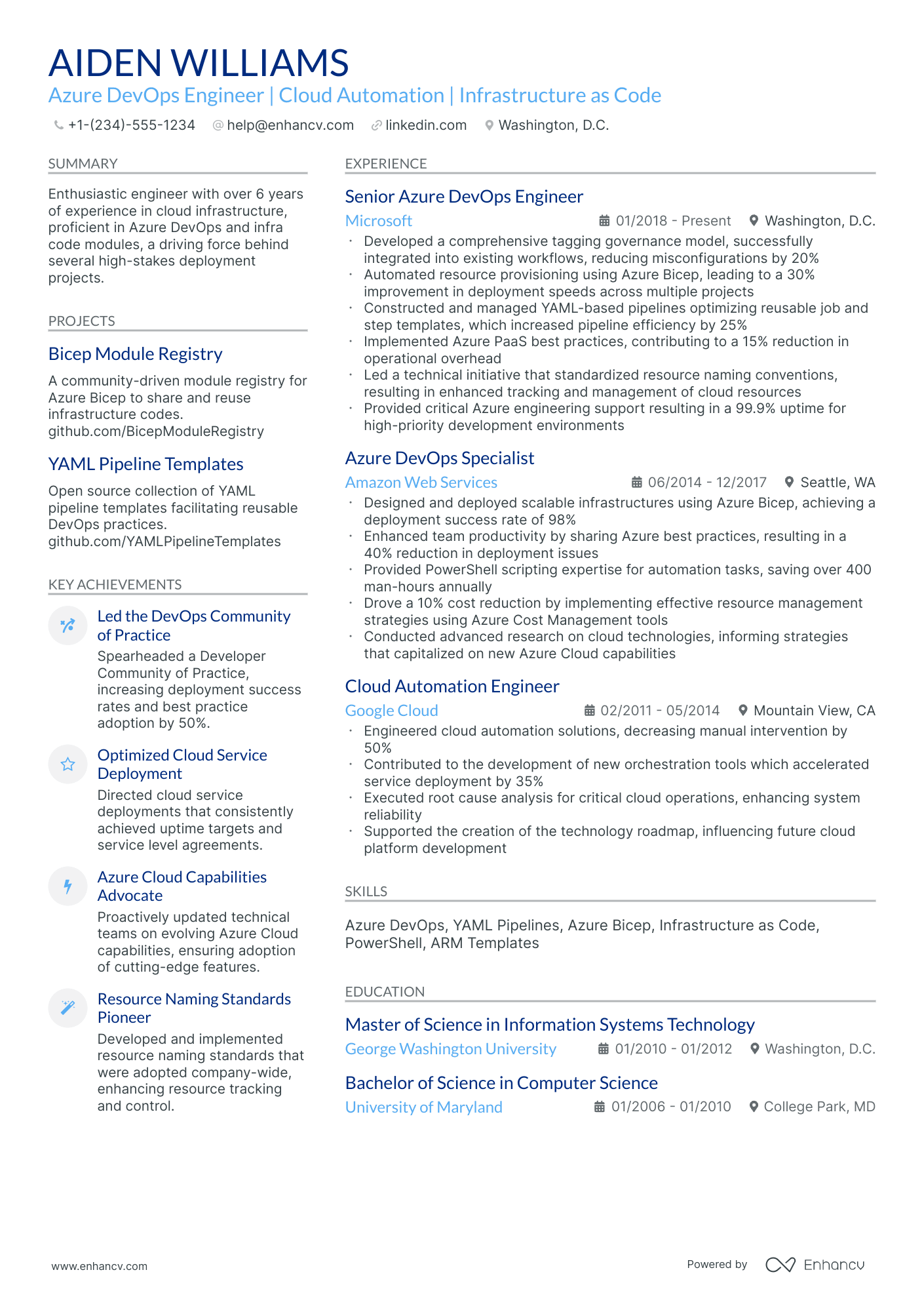
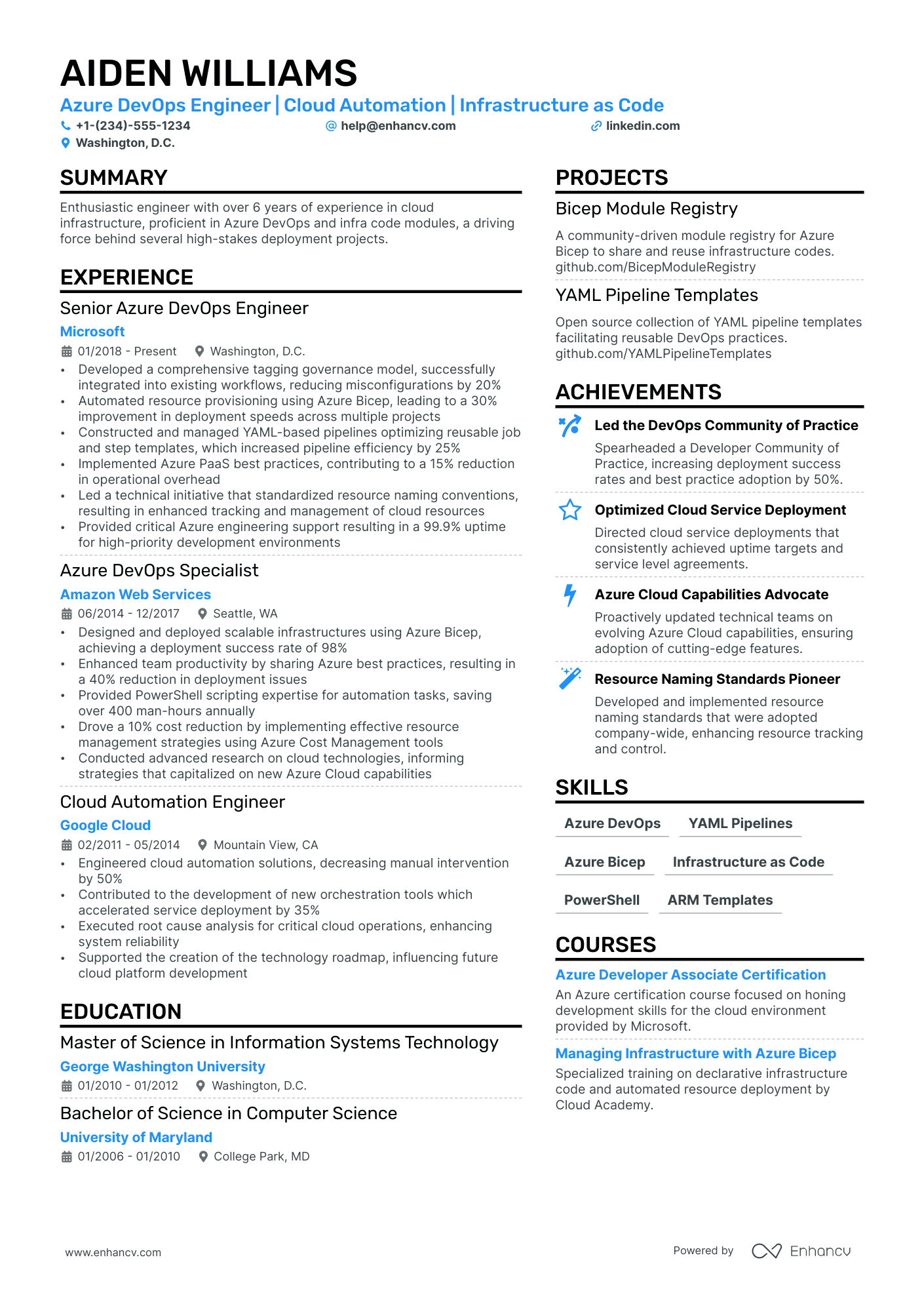
Most Azure DevOps engineer resume submissions fail because they list pipelines and tools without proving delivery impact or reliability gains. In today's Azure DevOps engineer resume screening, an ATS and a rushed recruiter miss relevance fast amid heavy competition.
A strong resume shows what changed because of your work. Knowing how to make your resume stand out means you should highlight faster release cycles, reduced deployment failures, improved mean time to recovery, higher build success rates, cost savings, and secure compliance-ready delivery.

Key takeaways
- Quantify pipeline, reliability, and cost outcomes instead of listing tools or daily tasks.
- Use reverse-chronological format for experienced engineers and hybrid format for career switchers.
- Tailor every experience bullet to mirror the job posting's specific tools and terminology.
- Place certifications like AZ-400 above education when they're recent and role-relevant.
- Anchor skills in your summary and experience sections with measurable proof, not standalone keyword lists.
- Showcase lab builds, open-source work, or homelab projects if you lack professional DevOps experience.
- Use Enhancv to turn routine DevOps tasks into focused, metric-driven resume bullets.
How to format a Azure DevOps engineer resume
Recruiters hiring for Azure DevOps engineer roles prioritize hands-on experience with CI/CD pipelines, infrastructure as code, and Azure-native services, along with evidence that you can bridge development and operations workflows effectively. A clean, well-structured resume format ensures these technical signals and project contributions surface quickly during both ATS parsing and human review.

I have significant experience in this role—which format should I use?
Use a reverse-chronological format to present your deepest and most recent Azure DevOps work first. Do:
- Lead each role entry with your scope of ownership—number of pipelines managed, environments supported, and teams you collaborated with across the release lifecycle.
- Highlight proficiency with role-specific tools and domains such as Azure Pipelines, Terraform, ARM templates, Kubernetes (AKS), Azure Monitor, and YAML-based pipeline authoring.
- Quantify outcomes tied to deployment frequency, mean time to recovery, infrastructure cost reduction, or release cycle improvements.
I'm junior or switching into this role—what format works best?
Use a hybrid format that leads with a focused technical skills section, then supports it with reverse-chronological work or project experience. Do:
- Place core Azure and DevOps skills—such as Azure Pipelines, Docker, Git, YAML, and infrastructure as code—near the top of your resume so ATS systems and recruiters see them immediately.
- Feature personal projects, lab environments, homelab configurations, or open-source contributions that demonstrate real pipeline builds, IaC deployments, or monitoring setups, even if they weren't performed in a professional setting.
- Connect every listed skill to a specific action and a measurable or observable result so recruiters see applied capability, not just keyword lists.
Why not use a functional resume?
A functional format strips away the timeline and context recruiters need to evaluate how your Azure DevOps skills were applied in real environments, making it difficult to assess the depth and relevance of your hands-on experience.
- A functional format may be acceptable if you're transitioning from a sysadmin or software development role into DevOps and lack dedicated DevOps job titles—but only if you tie every listed skill to specific projects, pipeline builds, or infrastructure outcomes rather than presenting them as standalone keywords.
With your resume's structure and layout in place, the next step is determining which sections to include so each one reinforces your qualifications as an Azure DevOps engineer.
What sections should go on a Azure DevOps engineer resume
Recruiters expect a clear, role-aligned resume that proves you can build, secure, and scale delivery pipelines and cloud infrastructure in Azure DevOps. Understanding what to put on a resume helps you prioritize the right content for this technical role.
Use this structure for maximum clarity:
- Header
- Summary
- Experience
- Skills
- Projects
- Education
- Certifications
- Optional sections: Open-source work, Leadership, Languages
Strong experience bullets should emphasize measurable impact, delivery outcomes, system scope, reliability gains, security improvements, and cost or time savings tied to Azure DevOps initiatives.
Is your resume good enough?
Drop your resume here or choose a file. PDF & DOCX only. Max 2MB file size.
With your resume’s key components in place, the next step is to write your Azure DevOps engineer resume experience section so it aligns with those elements and supports the role you’re targeting.
How to write your Azure DevOps engineer resume experience
Your experience section should highlight the pipelines you've built, the infrastructure you've automated, and the measurable improvements you've driven across delivery speed, system reliability, and operational efficiency. Hiring managers prioritize demonstrated impact—deployments accelerated, downtime reduced, environments stabilized—over descriptive task lists that simply catalog daily responsibilities.
Each entry should include:
- Job title
- Company and location (or remote)
- Dates of employment (month and year)
Three to five concise bullet points showing what you owned, how you executed, and what outcomes you delivered:
- Ownership scope: the CI/CD pipelines, Azure infrastructure, release environments, repositories, or platform services you were directly accountable for maintaining, scaling, or modernizing.
- Execution approach: the Azure DevOps services, IaC tools, scripting languages, containerization platforms, monitoring solutions, or automation frameworks you used to design, implement, and optimize delivery workflows.
- Value improved: the changes you drove in deployment frequency, build reliability, environment provisioning speed, incident response time, infrastructure cost efficiency, or security posture across your Azure environments.
- Collaboration context: how you partnered with development teams, security engineers, platform architects, QA leads, or product stakeholders to align DevOps practices with broader organizational and compliance goals.
- Impact delivered: the outcomes your work produced expressed through improvements in release velocity, system uptime, resource utilization, developer productivity, or reduction in manual intervention—framed as results rather than activities.
Experience bullet formula
A Azure DevOps engineer experience example
✅ Right example - modern, quantified, specific.
Azure DevOps Engineer
NorthPeak HealthTech | Remote
2022–Present
Built and operated Azure-native platforms supporting a HIPAA-regulated patient engagement product used by two million monthly active users.
- Architected Azure DevOps Pipelines with YAML, reusable templates, and gated approvals, cutting deployment time from forty-five minutes to twelve minutes and increasing release frequency from weekly to daily.
- Implemented infrastructure as code with Terraform and Azure Resource Manager (ARM) templates across three environments, reducing configuration drift by 80% and accelerating environment provisioning from two days to forty minutes.
- Hardened CI/CD security by integrating Microsoft Defender for Cloud, Azure Key Vault, and Snyk scanning, lowering critical vulnerabilities in production releases by 65% and passing two external audits with zero high findings.
- Improved reliability by instrumenting Azure Monitor, Application Insights, and Log Analytics with actionable alerts and runbooks, reducing mean time to recovery from fifty minutes to eighteen minutes in partnership with on-call engineers and product owners.
- Optimized build and test performance by parallelizing Azure DevOps agents, enabling Docker layer caching, and right-sizing Azure Kubernetes Service (AKS) node pools, cutting pipeline compute spend by 22% while maintaining 99.95% service availability.
Now that you have a solid foundation for structuring your experience entries, the next step is adapting them to match the specific requirements of each job posting.
How to tailor your Azure DevOps engineer resume experience
Recruiters evaluate your Azure DevOps engineer resume through both human review and applicant tracking systems (ATS). Tailoring your resume to the job description ensures you pass automated filters and hold a hiring manager's attention.
Ways to tailor your Azure DevOps engineer experience:
- Match the specific CI/CD tools and pipeline platforms listed in the posting.
- Mirror the exact cloud services and infrastructure provisioning technologies referenced.
- Use the same terminology for DevOps methodologies or release management frameworks mentioned.
- Reflect the compliance and security standards the employer names in requirements.
- Highlight container orchestration platforms and IaC tools the role specifies.
- Include monitoring and observability solutions that align with their tech stack.
- Emphasize cross-functional collaboration models or agile workflows the posting describes.
- Reference the reliability or performance benchmarks tied to their deployment goals.
Tailoring means aligning your real accomplishments with a specific role's requirements—not forcing keywords where they don't belong.
Resume tailoring examples for Azure DevOps engineer
| Job description excerpt | Untailored | Tailored |
|---|---|---|
| Design and maintain CI/CD pipelines using Azure Pipelines and YAML templates to support microservices deployed to Azure Kubernetes Service (AKS). | Worked on deployment pipelines and helped with releases for various applications. | Built and maintained 15+ YAML-based CI/CD pipelines in Azure Pipelines, automating deployments for microservices running on AKS and reducing release cycle time by 40%. |
| Implement Infrastructure as Code (IaC) using Terraform and Azure Resource Manager (ARM) templates to provision and manage cloud environments across multiple subscriptions. | Helped set up cloud infrastructure and managed some server configurations. | Provisioned and managed cloud environments across six Azure subscriptions using Terraform and ARM templates, cutting manual infrastructure provisioning from days to under 30 minutes per environment. |
| Monitor system reliability using Azure Monitor, Log Analytics, and Grafana dashboards, and define SLOs/SLIs to drive incident response and capacity planning. | Monitored systems and responded to incidents when issues came up. | Configured Azure Monitor and Log Analytics alerting rules across 200+ resources, built Grafana dashboards tracking SLOs/SLIs, and reduced mean time to detection by 55% through proactive capacity planning. |
Once your experience aligns with the role’s requirements, quantify your Azure DevOps engineer achievements to show the measurable impact behind each contribution.
How to quantify your Azure DevOps engineer achievements
Quantifying your achievements proves business impact beyond "kept things running." Focus on deployment speed, reliability, pipeline quality, cost, and security outcomes. Use before-and-after numbers from Azure DevOps, Azure Monitor, and incident and change records.
Quantifying examples for Azure DevOps engineer
| Metric | Example |
|---|---|
| Deployment frequency | "Increased production releases from two per week to two per day by standardizing Azure DevOps YAML pipelines and reusable templates across eight services." |
| Lead time | "Cut lead time from commit to production from three days to six hours by adding automated approvals, artifact versioning, and environment promotions." |
| Reliability | "Improved availability from 99.5% to 99.95% by implementing Azure Monitor alerts, runbooks, and automated rollback for failed deployments." |
| Build quality | "Reduced pipeline failure rate from 18% to 4% by stabilizing flaky tests, adding caching, and enforcing code quality gates in pull requests." |
| Cost efficiency | "Lowered Azure compute spend by 22% by right-sizing build agents, scheduling nonproduction shutdowns, and optimizing container image layers." |
Turn your everyday tasks into measurable, recruiter-ready resume bullets in seconds with Enhancv's Bullet Point Generator.
With strong bullet points in place, it's equally important to highlight the right hard and soft skills that position you as a well-rounded Azure DevOps engineer.
How to list your hard and soft skills on a Azure DevOps engineer resume
Your skills section matters because Azure DevOps engineers get screened on tooling and delivery outcomes, and recruiters and ATS scan this section for exact keywords; aim for a balanced mix of hard skills plus execution-focused soft skills.
Azure DevOps engineer roles require a blend of:
- Product strategy and discovery skills.
- Data, analytics, and experimentation skills.
- Delivery, execution, and go-to-market discipline.
- Soft skills.
Your skills section should be:
- Scannable (bullet-style grouping).
- Relevant to the job post.
- Backed by proof in experience bullets.
- Updated with current tools.
Place your skills section:
- Above experience if you're junior or switching careers.
- Below experience if you're mid/senior with strong achievements.

Hard skills
- Azure DevOps, Git repos
- CI/CD pipelines, YAML
- Infrastructure as Code, Terraform
- ARM templates, Bicep
- Docker, Kubernetes, Helm
- Azure Kubernetes Service
- GitHub Actions, Azure Pipelines
- PowerShell, Bash scripting
- Azure Monitor, Log Analytics
- Application Insights, OpenTelemetry
- Secrets management, Key Vault
- Security scanning, SAST/DAST
Soft skills
- Translate requirements into pipelines
- Partner with developers and QA
- Drive incident response and follow-ups
- Prioritize reliability and delivery risk
- Write clear runbooks and standards
- Communicate tradeoffs to stakeholders
- Lead postmortems and remediation plans
- Enforce change control and approvals
- Coach teams on DevOps practices
- Manage cross-team dependencies
- Escalate blockers with solutions
- Maintain ownership of production health
How to show your Azure DevOps engineer skills in context
Skills shouldn't live only in a dedicated skills list. Explore resume skills examples to see how top candidates weave technical abilities into real accomplishments.
They should be demonstrated in:
- Your summary (high-level professional identity)
- Your experience (proof through outcomes)
Here's what this looks like in practice.
Summary example
Senior Azure DevOps engineer with eight years of experience in fintech. Skilled in Terraform, Kubernetes, and CI/CD pipeline design. Reduced deployment failures by 60% while mentoring cross-functional teams on infrastructure-as-code best practices.
- Signals senior-level expertise immediately
- Names specific, relevant tools
- Leads with a measurable outcome
- Highlights mentoring as a soft skill
Experience example
Senior Azure DevOps Engineer
Meridian Financial Technologies | Remote
March 2020–Present
- Architected Terraform modules across 12 Azure subscriptions, cutting infrastructure provisioning time by 45% in collaboration with platform engineering.
- Built YAML-based CI/CD pipelines in Azure DevOps, increasing release frequency from biweekly to daily for three product teams.
- Led Kubernetes cluster migration to AKS with the security team, reducing container vulnerabilities by 70% within six months.
- Every bullet includes measurable proof.
- Skills appear naturally through real outcomes.
Once you’ve anchored your Azure DevOps engineering skills in real outcomes and examples, the next step is to apply the same approach to building an Azure DevOps engineer resume with no experience.
How do I write a Azure DevOps engineer resume with no experience
Even without full-time experience, you can demonstrate readiness through projects and self-directed learning. If you're building a resume without work experience, focus on showcasing applied skills rather than job titles:
- Personal CI/CD pipeline lab builds
- GitHub portfolio with Azure repos
- Azure DevOps engineer certification projects
- Infrastructure as code practice repos
- Open-source pipeline contributions and reviews
- Cloud cost and reliability experiments
- Internship or volunteer release support
- Home lab Kubernetes deployments on Azure
Focus on:
- CI/CD pipelines with YAML
- Infrastructure as code with Terraform
- Azure monitoring, logs, alerts
- Security scanning in pipelines
Resume format tip for entry-level Azure DevOps engineer
Use a hybrid resume format because it highlights projects and technical skills first, while still showing education and any related work history. Do:
- Lead with a "Projects" section.
- Add links to GitHub and demos.
- List tools next to outcomes.
- Include one-line tech stack per project.
- Quantify build, deploy, and cost results.
- Built an Azure DevOps engineer CI/CD pipeline with YAML, Terraform, and Azure Key Vault, cutting deployment time from 30 minutes to eight.
Even without professional experience, your education section can demonstrate the technical foundation and relevant coursework that make you a strong candidate—here's how to present it effectively.
How to list your education on a Azure DevOps engineer resume
Your education section helps hiring teams confirm you have the foundational knowledge needed for an Azure DevOps engineer role. It validates technical training and academic preparation quickly.
Include:
- Degree name
- Institution
- Location
- Graduation year
- Relevant coursework (for juniors or entry-level candidates)
- Honors & GPA (if 3.5 or higher)
Skip month and day details—list the graduation year only.
Here's a strong education entry tailored for an Azure DevOps engineer resume:
Example education entry
Bachelor of Science in Computer Science
Georgia Institute of Technology, Atlanta, GA
Graduated 2021
GPA: 3.7/4.0
- Relevant coursework: Cloud Computing Architecture, Operating Systems, Software Engineering, Network Security, and Automation Fundamentals
- Honors: Dean's List (six consecutive semesters), Magna Cum Laude
How to list your certifications on a Azure DevOps engineer resume
Certifications show an Azure DevOps engineer's commitment to learning, proficiency with key tools, and alignment with current industry standards in cloud, automation, and delivery. Include:
- Certificate name
- Issuing organization
- Year
- Optional: credential ID or URL
- Place certifications below education when your degree is recent and your certifications are older or less relevant to the Azure DevOps engineer role.
- Place certifications above education when they are recent, role-relevant, or required, especially for cloud, security, or DevOps platforms.
Best certifications for your Azure DevOps engineer resume
- Microsoft Certified: DevOps Engineer Expert
- Microsoft Certified: Azure Administrator Associate
- Microsoft Certified: Azure Solutions Architect Expert
- Microsoft Certified: Azure Security Engineer Associate
- HashiCorp Certified: Terraform Associate
- Certified Kubernetes Administrator (CKA)
- AWS Certified DevOps Engineer – Professional
Once you’ve positioned your certifications where they add the most value, use your Azure DevOps engineer resume summary to connect those credentials to your core strengths upfront.
How to write your Azure DevOps engineer resume summary
Your resume summary is the first thing a recruiter reads, so it needs to earn their attention fast. A strong opening positions you as a qualified Azure DevOps engineer before they scan the rest of your resume.
Keep it to three to four lines, with:
- Your title and total years of relevant DevOps experience.
- The domain or industry you've worked in, such as fintech, healthcare, or SaaS.
- Core tools like Azure DevOps, Terraform, Kubernetes, or ARM templates.
- One or two measurable achievements, such as deployment frequency or downtime reduction.
- A practical soft skill tied to a real outcome, like cross-team collaboration that shortened release cycles.

PRO TIP
At this level, focus on demonstrating hands-on proficiency with CI/CD pipelines, infrastructure as code, and cloud-native Azure services. Highlight early wins that show initiative and technical growth. Avoid vague phrases like "passionate problem-solver" or "fast learner." Replace them with specific tools you've used and results you've delivered.
Example summary for a Azure DevOps engineer
Azure DevOps engineer with three years of experience building CI/CD pipelines in Azure DevOps and Terraform. Reduced deployment time by 40% for a SaaS platform. Skilled in Kubernetes, ARM templates, and cross-team release coordination.
Optimize your resume summary and objective for ATS
Drop your resume here or choose a file.
PDF & DOCX only. Max 2MB file size.
With your summary crafted to highlight your strongest qualifications, make sure the header framing it presents your contact details and professional identity just as effectively.
What to include in a Azure DevOps engineer resume header
A resume header lists your key identity and contact details, and it matters for a Azure DevOps engineer because it boosts visibility, credibility, and recruiter screening speed.
Essential resume header elements
- Full name
- Tailored job title and headline
- Location
- Phone number
- Professional email
- GitHub link
- Portfolio link
A LinkedIn link helps recruiters verify experience quickly and supports screening.
Do not include photos on a Azure DevOps engineer resume unless the role is explicitly front-facing or appearance-dependent.
Use a job-title line that matches the posting and add working links, so recruiters can confirm your work without extra steps.
Example
Azure DevOps engineer resume header
Jordan Lee
Azure DevOps engineer | CI/CD, IaC, and Azure Kubernetes Service
Austin, TX
(512) 555-01XX
jordan.lee@enhancv.com
github.com/jordanlee
jordanlee.dev
linkedin.com/in/jordanlee
Once your contact details and role-specific identifiers are set, add additional sections to highlight supporting qualifications that strengthen your Azure DevOps engineer resume.
Additional sections for Azure DevOps engineer resumes
When your core sections don't fully capture your expertise, additional sections help you stand out with role-specific credibility.
- Certifications (Azure, Kubernetes, Terraform, or DevOps-specific)
- Technical publications or blog posts
- Open-source contributions
- Conference talks or webinars
- Languages
- Professional memberships (DevOps or cloud engineering communities)
- Hobbies and interests
Beyond tailoring your resume's extra sections, pairing it with a strong cover letter can further set your application apart.
Do Azure DevOps engineer resumes need a cover letter
A cover letter isn't required for an Azure DevOps engineer, but it helps in competitive roles or teams with strict hiring expectations. If you're unsure what a cover letter is or when to use one, it can make a difference when your resume needs context or when you want to show clear fit fast.
Use a cover letter to add detail your resume can't show:
- Explain role or team fit: Match your experience to their stack, delivery model, and on-call expectations, and name how you'll support their workflows.
- Highlight one or two relevant projects or outcomes: Share a specific pipeline, infrastructure, or reliability change, and quantify impact on lead time, cost, or incidents.
- Show understanding of the product, users, or business context: Connect your work to release risk, compliance needs, customer experience, or revenue impact.
- Address career transitions or non-obvious experience: Explain shifts from development, operations, or support, and link transferable skills to Azure DevOps engineer work.
Drop your resume here or choose a file.
PDF & DOCX only. Max 2MB file size.
Even if you decide a cover letter adds limited value for your application, using AI to improve your Azure DevOps engineer resume is the next step to strengthen what recruiters review first.
Using AI to improve your Azure DevOps engineer resume
AI can sharpen your resume's clarity, structure, and impact. It helps refine language and highlight relevant achievements. However, overusing it risks sounding generic. If you're exploring ChatGPT resume writing prompts, stop once your content feels authentic and role-aligned.
Here are 10 practical prompts to strengthen specific sections of your Azure DevOps engineer resume:
Strengthen summary focus
Quantify experience bullets
Align skills section
Improve action verbs
Refine project descriptions
Tailor to job posting
Tighten certification details
Clarify education relevance
Eliminate filler language
Showcase CI/CD impact
Conclusion
A strong Azure DevOps engineer resume proves impact with measurable outcomes, like faster deployments, lower incident rates, and reduced cloud spend. It highlights role-specific skills, including Azure, pipelines, infrastructure as code, and monitoring, in a clear structure.
Keep it focused, scannable, and aligned to today’s hiring needs, where reliability and secure automation matter. With results, relevant skills, and clean formatting, your Azure DevOps engineer resume shows you can deliver now and adapt next.