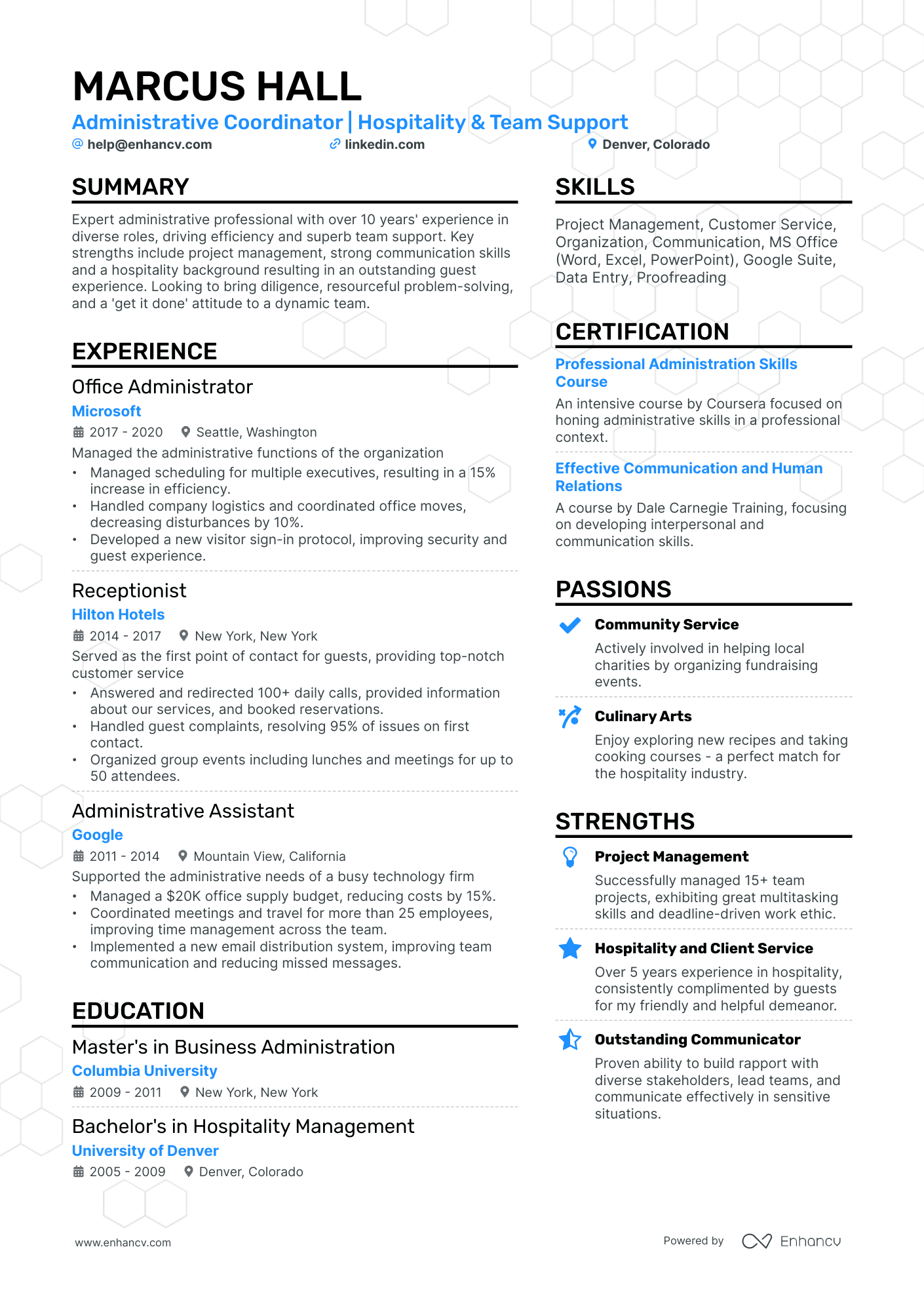
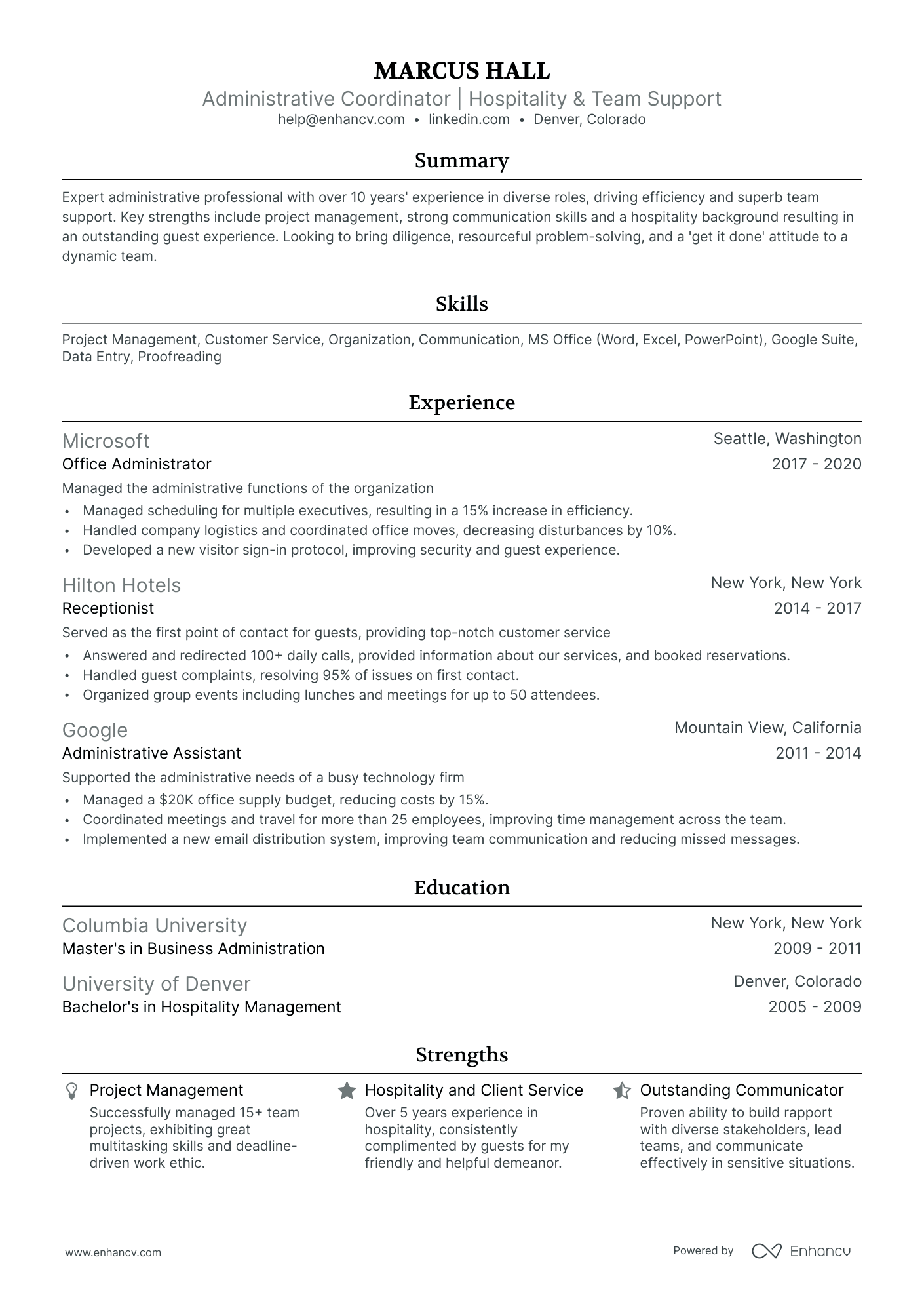
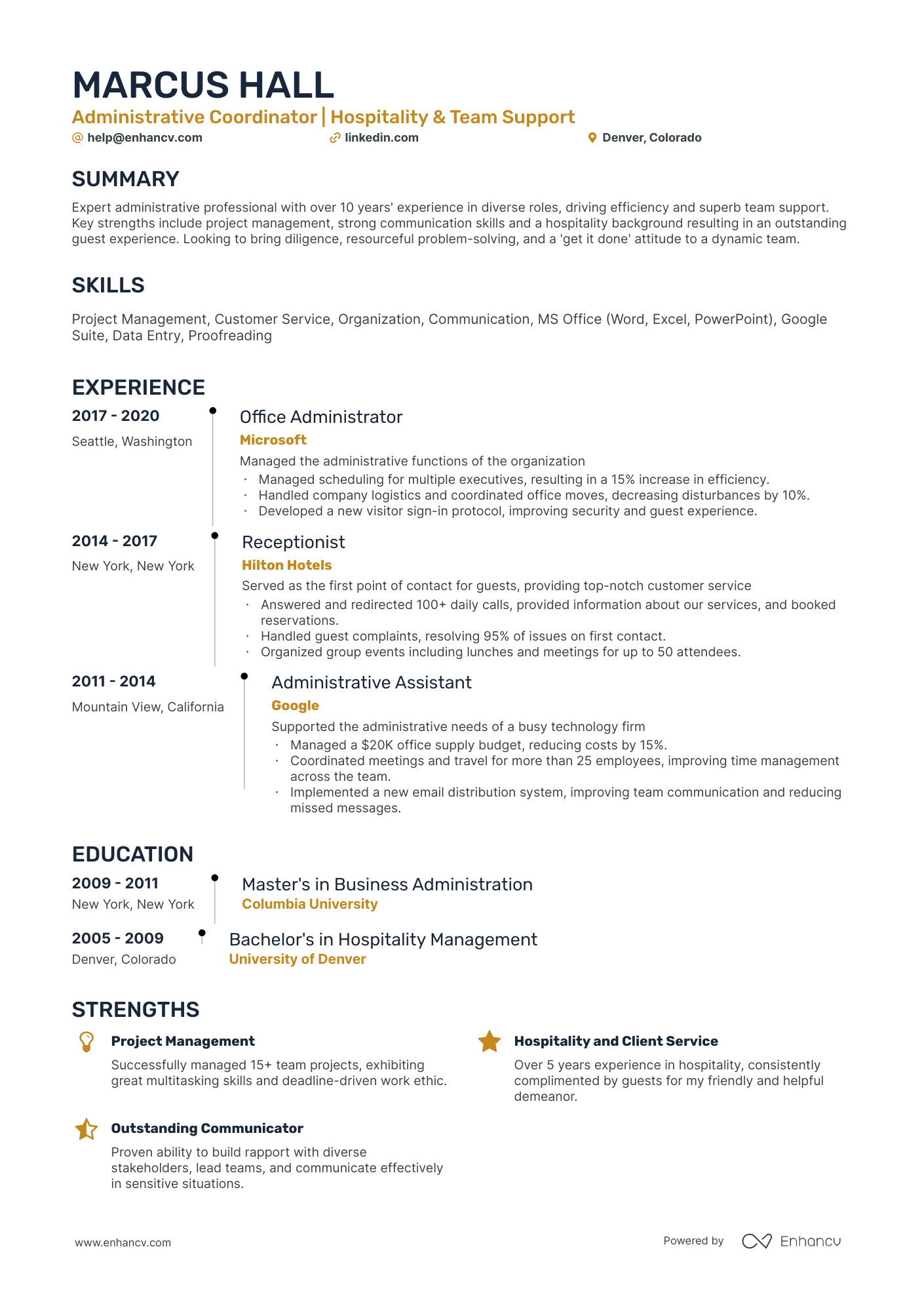
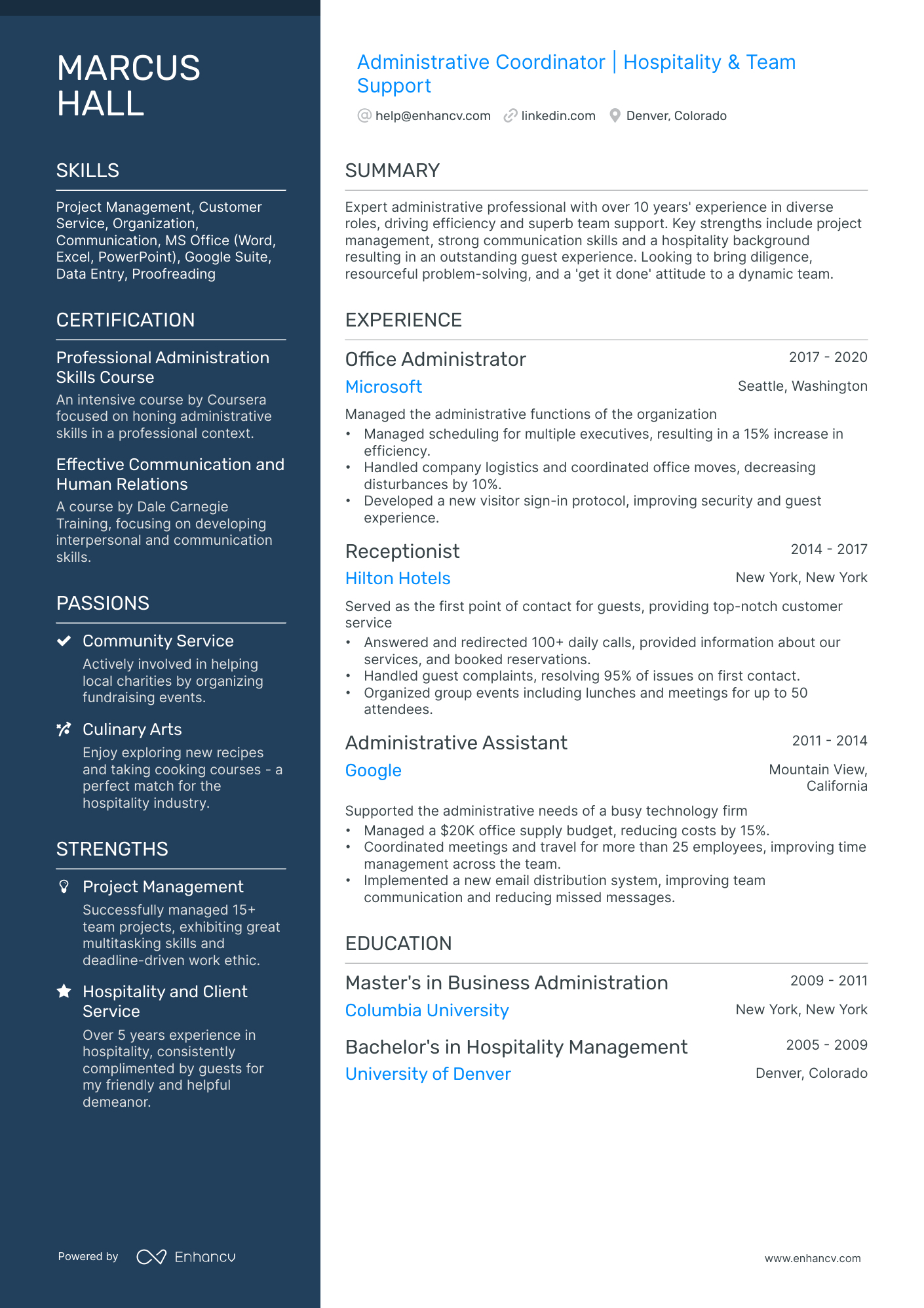
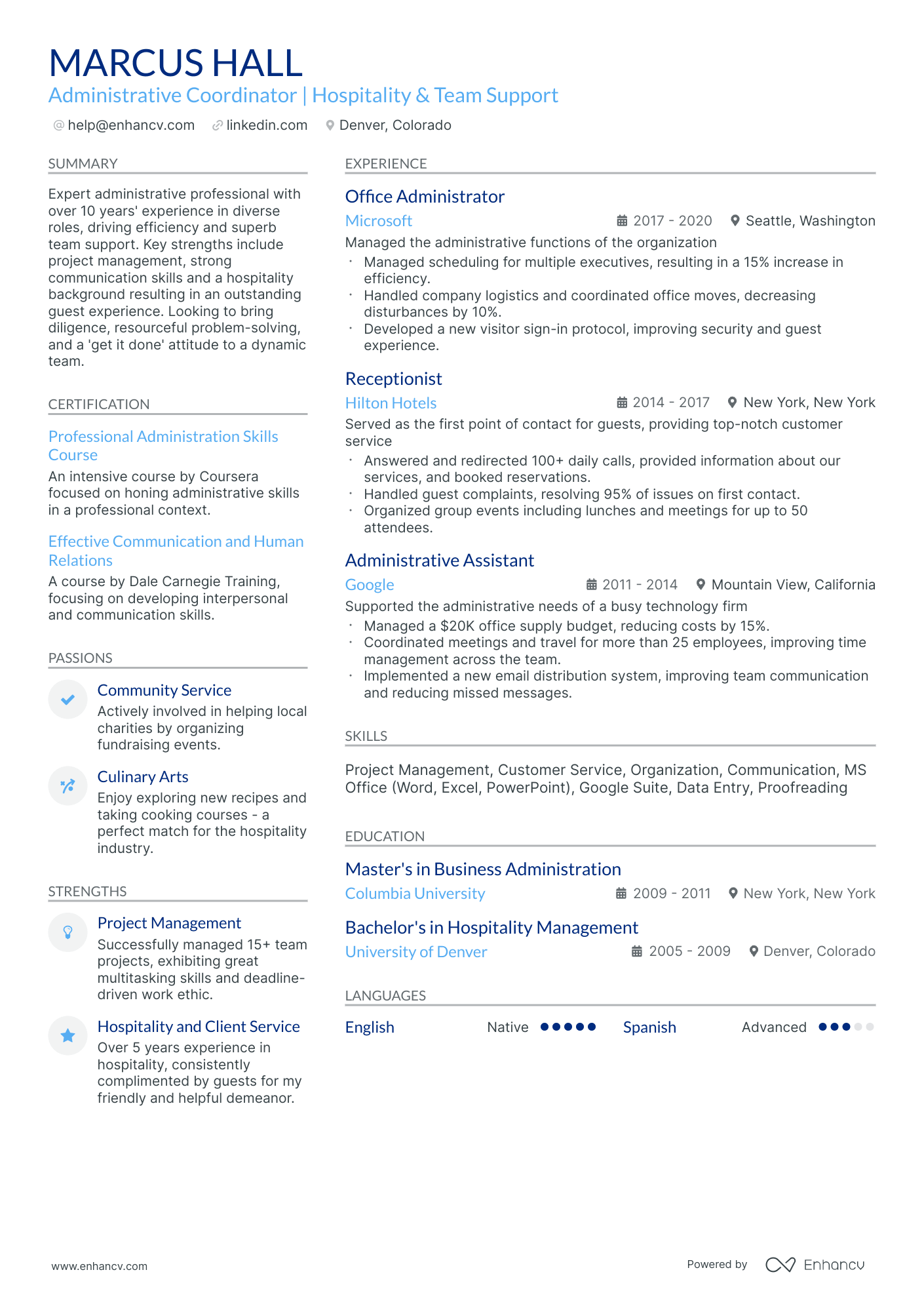
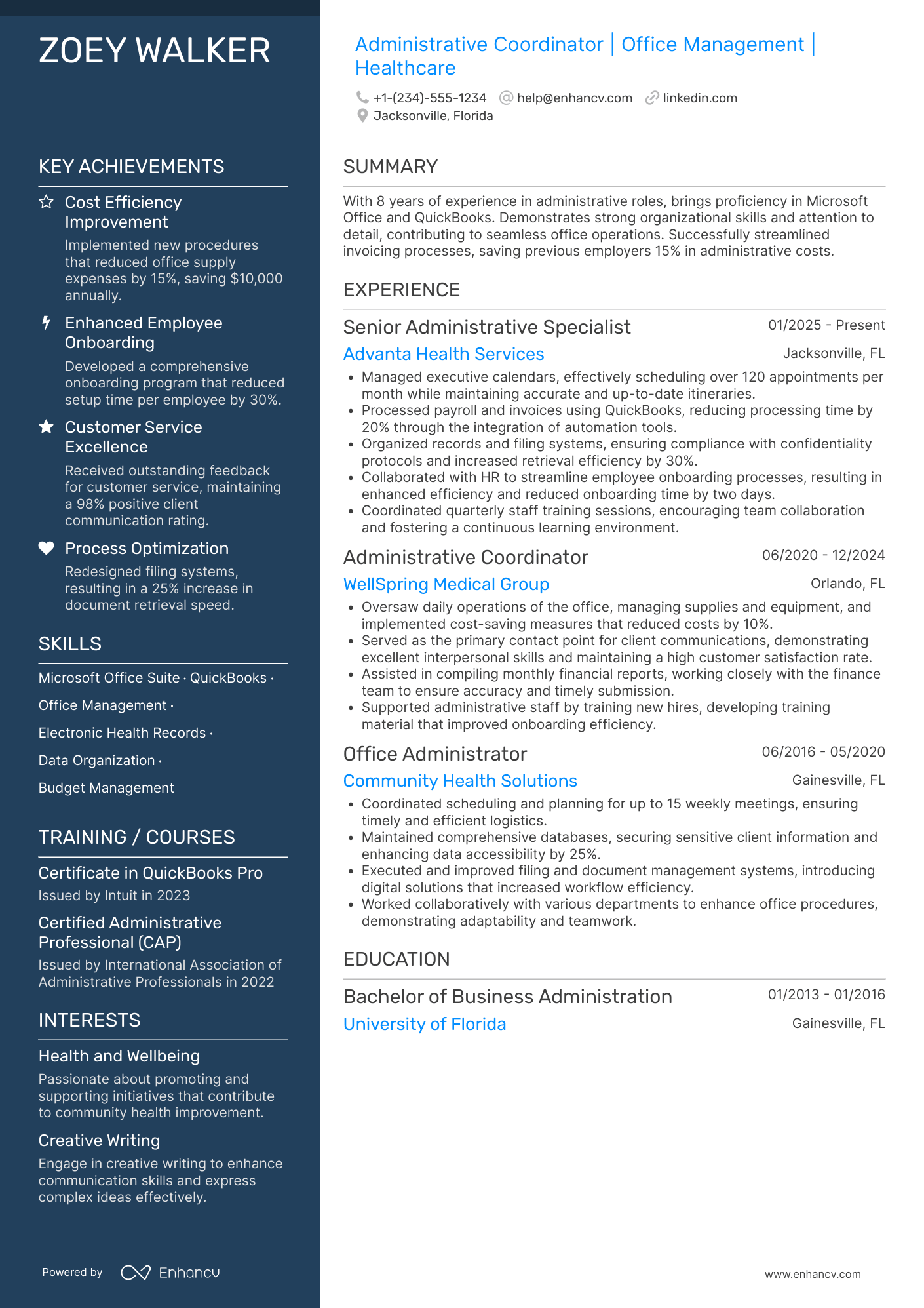
Most administrative coordinator resume drafts fail because they read like task lists and bury the details that prove impact. That matters when an applicant tracking system filters by keywords and recruiters scan in seconds amid heavy competition.
A strong resume shows how you improved operations and delivered results. Knowing how to make your resume stand out means you should highlight faster scheduling cycles, fewer errors, smoother onboarding for fifty hires, tighter vendor costs, calendar coverage for five leaders, and on-time meeting materials that kept projects moving.

Key takeaways
- Quantify every experience bullet with metrics like time saved, costs reduced, or error rates improved.
- Choose reverse-chronological format for deep experience and hybrid format for career changers.
- Tailor each resume to the job posting by mirroring its exact tools, terms, and priorities.
- Place skills above experience when junior, and below experience when your achievements speak louder.
- Pair your skills section with proof—every listed skill should appear in an experience bullet.
- Use AI to tighten language and spot gaps, but stop before it invents or inflates claims.
- Enhancv can help you turn vague duties into measurable, recruiter-ready resume bullets faster.
Job market snapshot for administrative coordinators
We analyzed 647 recent administrative coordinator job ads across major US job boards. These numbers help you understand regional hotspots, top companies hiring, skills in demand at a glance.
What level of experience employers are looking for administrative coordinators
| Years of Experience | Percentage found in job ads |
|---|---|
| 1–2 years | 10.7% (69) |
| 3–4 years | 7.3% (47) |
| 5–6 years | 3.2% (21) |
| 7–8 years | 0.8% (5) |
| 10+ years | 0.9% (6) |
| Not specified | 76.8% (497) |
Administrative coordinator ads by area of specialization (industry)
| Industry (Area) | Percentage found in job ads |
|---|---|
| Finance & Banking | 33.2% (215) |
| Healthcare | 27.5% (178) |
| Education | 26.3% (170) |
| Government | 9.0% (58) |
Top companies hiring administrative coordinators
| Company | Percentage found in job ads |
|---|---|
| State of Louisiana | 5.1% (33) |
| The TJX Companies, Inc. | 4.6% (30) |
| Nutrien Ltd. | 3.7% (24) |
| Kaiser Permanente | 3.1% (20) |
| UnitedHealth Group Inc. | 2.6% (17) |
| Texas A&M University | 2.2% (14) |
| Common Spirit | 1.5% (10) |
Role overview stats
These tables show the most common responsibilities and employment types for administrative coordinator roles. Use them to align your resume with what employers expect and to understand how the role is structured across the market.
Day-to-day activities and top responsibilities for a administrative coordinator
| Responsibility | Percentage found in job ads |
|---|---|
| Excel | 24.7% (160) |
| Microsoft office | 22.4% (145) |
| Powerpoint | 17.6% (114) |
| Word | 15.9% (103) |
| Outlook | 14.4% (93) |
| Microsoft word | 7.7% (50) |
| Microsoft excel | 6.8% (44) |
| Word processing | 6.0% (39) |
| Spreadsheets | 5.6% (36) |
| 5.4% (35) | |
| Microsoft office suite | 5.4% (35) |
| Ms office | 5.1% (33) |
Type of employment (remote vs on-site vs hybrid)
| Employment type | Percentage found in job ads |
|---|---|
| On-site | 86.9% (562) |
| Hybrid | 9.6% (62) |
| Remote | 3.6% (23) |
How to format a administrative coordinator resume
Recruiters evaluating administrative coordinator resumes look for organized workflows, cross-departmental coordination skills, and evidence that you can keep operations running smoothly under pressure. Your resume format directly affects how quickly a hiring manager can spot these signals—choosing the right structure ensures your coordination experience, software proficiency, and process improvements are visible within the first few seconds of a scan.

I have significant experience in this role—which format should I use?
Use a reverse-chronological format to put your deepest coordination experience front and center. Do:
- Lead with your most recent role and highlight the scope of your coordination responsibilities—number of departments supported, executive calendars managed, or budget lines tracked.
- Feature role-specific tools and domains prominently, including calendar and project management platforms (Microsoft 365, Google Workspace, Asana, SAP), travel coordination, and vendor management.
- Quantify outcomes that show operational impact, such as time saved through process improvements, error reductions, or cost savings from vendor negotiations.
I'm junior or switching into this role—what format works best?
A hybrid format works best because it lets you lead with transferable coordination and organizational skills while still showing a concise work history. Do:
- Place a skills section near the top that highlights administrative competencies like scheduling, data entry, document management, and communication tools—these are the keywords applicant tracking systems (ATS) scan for first.
- Include internships, volunteer coordination, or project-based experience where you managed logistics, organized events, or supported a team's daily operations.
- Connect every skill to a specific action and its result so recruiters see capability, not just a list of software names.
Why not use a functional resume?
A functional format strips away the timeline and context that show how your coordination skills developed, making it harder for recruiters to trust the depth of your experience.
- Career changers: You have strong transferable skills from roles like office management, customer service, or event planning but no formal administrative coordinator title yet.
- Limited work history: You're a recent graduate whose relevant experience comes primarily from internships, campus organizations, or freelance projects.
- Resume gaps: You've taken time away from the workforce but maintained relevant skills through volunteer work or professional development courses.
Once you've established a clean, readable format, the next step is deciding which sections to include so each one reinforces your qualifications as an administrative coordinator.
What sections should go on a administrative coordinator resume
Recruiters expect you to present a clear snapshot of your administrative support, coordination, and operational impact. Understanding what to put on a resume ensures you include the right details for this role.
Use this structure for maximum clarity:
- Header
- Summary
- Experience
- Skills
- Projects
- Education
- Certifications
- Optional sections: Awards, Volunteering, Languages
Strong experience bullets should emphasize measurable outcomes, the scope you supported, process improvements, and the results you delivered across scheduling, communication, and office operations.
Is your resume good enough?
Drop your resume here or choose a file. PDF & DOCX only. Max 2MB file size.
Once you’ve organized your resume with the right structure and categories, focus next on writing your administrative coordinator resume experience section to show impact within that framework.
How to write your administrative coordinator resume experience
Your experience section should spotlight the administrative coordination work you've actually delivered—scheduling systems you managed, office operations you streamlined, and tools you used to keep teams running efficiently. Hiring managers prioritize demonstrated impact over descriptive task lists, so every bullet should connect your responsibilities to a measurable outcome. Building a targeted resume ensures each entry speaks directly to the role you're pursuing.
Each entry should include:
- Job title
- Company and location (or remote)
- Dates of employment (month and year)
Three to five concise bullet points showing what you owned, how you executed, and what outcomes you delivered:
- Ownership scope: the office functions, administrative systems, calendars, vendor relationships, or internal teams you were directly accountable for as an administrative coordinator.
- Execution approach: the software, scheduling platforms, document management tools, or organizational methods you relied on to prioritize tasks, track deadlines, and maintain operational accuracy.
- Value improved: the changes you drove in office efficiency, process turnaround time, record accuracy, resource allocation, or compliance reliability within your administrative coordination role.
- Collaboration context: how you partnered with department leads, executives, external vendors, or cross-functional teams to align administrative support with broader organizational needs.
- Impact delivered: the outcomes your coordination produced—expressed through operational improvements, cost reductions, or scale of support—rather than a simple list of daily activities.
Experience bullet formula
A administrative coordinator experience example
✅ Right example - modern, quantified, specific.
Administrative Coordinator
Northbridge Health Partners | Austin, TX
2022–Present
Multi-site outpatient healthcare group supporting three clinics and 120+ employees across Central Texas.
- Streamlined executive and clinic scheduling in Microsoft Outlook and Calendly by consolidating templates and routing rules, cutting reschedules by 28% and saving eight hours per week across leaders.
- Built a standardized onboarding workflow in BambooHR (human resources information system) and DocuSign, reducing new-hire setup time from five days to two days and improving first-week compliance completion to 98%.
- Implemented purchase request and invoice tracking in SAP Concur and Excel (Power Query), improving month-end close accuracy by 22% and preventing $18,000 in duplicate or late-fee charges.
- Coordinated cross-functional meeting cadences for operations, HR, and clinic managers using Microsoft Teams and OneNote, increasing action-item closure rate from 64% to 90% within thirty days.
- Led office and vendor operations—service tickets, badge access, and supply contracts—through Jira Service Management and negotiated renewals, reducing facilities downtime by 15% and lowering annual supply spend by 12%.
Now that you've seen how a strong experience section looks in practice, let's focus on tailoring those details to match the specific administrative coordinator role you're targeting.
How to tailor your administrative coordinator resume experience
Recruiters evaluate your administrative coordinator resume through both human review and applicant tracking systems. Tailoring your resume to the job description ensures you pass both screenings.
Ways to tailor your administrative coordinator experience:
- Match scheduling and calendar management tools named in the posting.
- Mirror the exact office software and database platforms listed.
- Use the same terminology for filing and records management processes.
- Reflect compliance or regulatory standards the employer specifically mentions.
- Highlight cross-departmental coordination workflows referenced in the description.
- Include relevant industry experience when the posting specifies a sector.
- Emphasize budget tracking or procurement methods the role requires.
- Align your metrics with the KPIs or performance criteria they outline.
Tailoring means aligning your real accomplishments with what the employer asks for, not forcing disconnected keywords into your experience.
Resume tailoring examples for administrative coordinator
| Job description excerpt | Untailored | Tailored |
|---|---|---|
| Manage executive calendars, coordinate travel arrangements, and serve as a liaison between department heads using Microsoft Outlook and Concur. | Helped with scheduling and travel for the team. | Coordinated daily calendars for three department heads in Microsoft Outlook and processed 15+ travel requests per month through Concur, reducing booking errors by 30%. |
| Maintain and update records in Salesforce, generate weekly status reports, and ensure compliance with internal data-entry standards. | Kept databases updated and created reports as needed. | Maintained 2,000+ client records in Salesforce with 99% data accuracy, generating weekly status reports that informed leadership decisions on resource allocation. |
| Support onboarding logistics for new hires, including preparing offer packets, scheduling orientation sessions, and coordinating with HR and IT for equipment setup. | Assisted with onboarding tasks for new employees. | Managed end-to-end onboarding logistics for 10–12 new hires per quarter, preparing offer packets, scheduling orientation sessions, and coordinating equipment setup with HR and IT to ensure day-one readiness. |
Once you’ve aligned your experience with the role’s priorities, the next step is to quantify your administrative coordinator achievements so employers can see the impact behind that fit.
How to quantify your administrative coordinator achievements
Quantifying your achievements proves you run operations smoothly, not just stay busy. Focus on cycle time, accuracy, volume handled, compliance, cost savings, and stakeholder satisfaction across scheduling, travel, meetings, and vendor coordination.
Quantifying examples for administrative coordinator
| Metric | Example |
|---|---|
| Cycle time | "Cut meeting scheduling time from three days to one day by standardizing Outlook templates and Calendly rules for a 40-person department." |
| Accuracy | "Reduced expense report rework from 18% to 6% by adding a receipt checklist and Concur validation steps across 120 monthly submissions." |
| Volume handled | "Coordinated 25–35 executive meetings weekly, including agendas and minutes, while maintaining a 98% on-time distribution rate in SharePoint." |
| Compliance risk | "Improved policy compliance from 85% to 97% by tracking mandatory training in Workday and sending automated reminders to 150 employees." |
| Cost savings | "Saved $12,400 annually by renegotiating office supply pricing with two vendors and consolidating orders into a weekly purchase schedule." |
Turn vague job duties into measurable, recruiter-ready resume bullets in seconds with Enhancv's Bullet Point Generator.
Once you've crafted strong bullet points to showcase your experience, the next step is ensuring your resume also highlights the right hard and soft skills employers expect from an administrative coordinator.
How to list your hard and soft skills on a administrative coordinator resume
Your skills section shows recruiters and an ATS (applicant tracking system) how you support executives, keep operations running, and manage details at scale, so aim for a balanced mix of hard skills and soft skills that match the job post. administrative coordinator roles require a blend of:
- Product strategy and discovery skills.
- Data, analytics, and experimentation skills.
- Delivery, execution, and go-to-market discipline.
- Soft skills.
Your skills section should be:
- Scannable (bullet-style grouping).
- Relevant to the job post.
- Backed by proof in experience bullets.
- Updated with current tools.
Place your skills section:
- Above experience if you're junior or switching careers.
- Below experience if you're mid/senior with strong achievements.

Hard skills
- Microsoft Office, Google Workspace
- Microsoft Outlook calendar management
- Microsoft Teams, Zoom
- Travel booking and expense reports
- Concur, Expensify
- Meeting agendas and minutes
- Document control and versioning
- SharePoint, OneDrive, Dropbox
- Data entry and record management
- CRM updates, Salesforce
- Purchase orders and invoicing
- Vendor coordination and onboarding
Soft skills
- Prioritize competing requests
- Manage stakeholder expectations
- Communicate status and blockers
- Coordinate across departments
- Write clear, concise emails
- Run meetings to time
- Follow through on action items
- Catch errors before escalation
- Handle sensitive information discreetly
- Improve workflows and templates
- Stay calm under pressure
- Escalate risks with context
How to show your administrative coordinator skills in context
Skills shouldn't live only in a bulleted list on your resume. Explore resume skills examples to see how top candidates weave competencies throughout their application.
They should be demonstrated in:
- Your summary (high-level professional identity)
- Your experience (proof through outcomes)
Here's what strong, skill-rich entries look like in practice.
Summary example
Administrative coordinator with 10+ years supporting executive teams in healthcare operations. Skilled in Epic scheduling, vendor management, and cross-department communication. Streamlined supply ordering workflows, cutting procurement costs by 18% across three clinic locations.
- Signals senior-level experience immediately
- Names role-relevant tools like Epic
- Quantifies cost savings with a metric
- Highlights communication as a soft skill
Experience example
Senior Administrative Coordinator
Lakeview Regional Medical Group | Milwaukee, WI
June 2018–March 2024
- Managed calendars and travel logistics for five directors using Concur, reducing scheduling conflicts by 32% year over year.
- Coordinated onboarding for 60+ new hires annually alongside HR, cutting process completion time from 14 days to nine.
- Designed a digital filing system in SharePoint that improved document retrieval speed by 40% across four departments.
- Every bullet includes measurable proof.
- Skills surface naturally through outcomes.
Once you’ve demonstrated how your administrative coordinator strengths translate into real outcomes, the next step is learning how to structure a resume with no experience to highlight those same capabilities effectively.
How do I write a administrative coordinator resume with no experience
Even without full-time experience, you can demonstrate readiness through:
- Student organization event coordination
- Volunteer office scheduling and support
- Internship administrative assistant tasks
- Campus department front desk coverage
- Coursework in office administration
- Personal project tracking budgets and deadlines
- Temp reception or clerical shifts
If you're building a resume without work experience, focus on:
- Calendar, travel, and meeting coordination
- Document control and file organization
- Tools: Microsoft Office, Google Workspace
- Metrics: volume, accuracy, turnaround time
Resume format tip for entry-level administrative coordinator
Use a hybrid resume format because it highlights relevant skills and projects before limited work history, while keeping a clear timeline. Do:
- Add a "Projects" section with outcomes.
- List tools used for each entry.
- Quantify volume, accuracy, and deadlines.
- Mirror keywords from the job posting.
- Include relevant coursework and certifications.
- Coordinated three student organization events using Google Calendar, Sheets, and Trello, tracking a $1,200 budget and improving RSVP accuracy by 20%.
Even without direct work experience, your education section can demonstrate the foundational knowledge and relevant coursework that qualify you for an administrative coordinator role.
How to list your education on a administrative coordinator resume
Your education section helps hiring teams confirm you have the foundational knowledge needed for the administrative coordinator role. It validates relevant training in communication, organization, and business operations.
Include:
- Degree name
- Institution
- Location
- Graduation year
- Relevant coursework (for juniors or entry-level candidates)
- Honors & GPA (if 3.5 or higher)
Avoid listing specific months or days for your graduation. Use the year only to keep things clean.
Here's a strong education entry tailored to the administrative coordinator role.
Example education entry
Bachelor of Science in Business Administration
University of North Carolina at Charlotte, Charlotte, NC
Graduated 2021
GPA: 3.7/4.0
- Relevant coursework: Office Management, Business Communication, Organizational Behavior, Records Administration
- Honors: Dean's List (six semesters), Beta Gamma Sigma Honor Society
How to list your certifications on a administrative coordinator resume
Certifications on your resume show your commitment to learning, confirm proficiency with office tools, and signal industry relevance as an administrative coordinator. Include:
- Certificate name
- Issuing organization
- Year
- Optional: credential ID or URL
- Place certifications below education when they're older or less relevant than your degree.
- Place certifications above education when they're recent and directly match the administrative coordinator role requirements.
Best certifications for your administrative coordinator resume
Microsoft Office Specialist (MOS) Certified Administrative Professional (CAP) Professional Administrative Certificate of Excellence (PACE) Google Workspace Administrator Certification Notary Public Commission Certified Meeting Professional (CMP) Project Management Professional (PMP)
Once you’ve placed your certifications where hiring managers can quickly verify them, the next step is writing your administrative coordinator resume summary to connect those credentials to your value at a glance.
How to write your administrative coordinator resume summary
Your resume summary is the first thing a recruiter reads. A sharp, specific opening instantly signals you're the right fit for the administrative coordinator role.
Keep it to three to four lines, with:
- Your title and total years of administrative or coordination experience.
- The industry or domain where you've worked, such as healthcare, education, or corporate operations.
- Core tools and skills like Microsoft Office Suite, scheduling platforms, or database management.
- One or two measurable accomplishments, such as cost savings or efficiency gains.
- Soft skills tied to real outcomes, like communication that reduced scheduling conflicts or organization that streamlined filing systems.

PRO TIP
At this level, emphasize relevant skills, tools you've actually used, and early wins that show initiative. Avoid vague phrases like "hardworking team player" or "passionate self-starter." Recruiters want concrete proof you can handle coordination tasks and deliver results from day one.
Example summary for a administrative coordinator
Administrative coordinator with three years of experience supporting corporate operations teams. Proficient in SAP, Google Workspace, and travel logistics. Reduced supply order processing time by 30% through a streamlined vendor tracking system.
Optimize your resume summary and objective for ATS
Drop your resume here or choose a file.
PDF & DOCX only. Max 2MB file size.
Now that your summary captures your strongest qualifications, make sure the header framing it presents your contact details correctly so recruiters can actually reach you.
What to include in a administrative coordinator resume header
A resume header lists your key identifying and contact details, helping an administrative coordinator stand out in searches, build credibility, and pass recruiter screening fast.
Essential resume header elements
- Full name
- Tailored job title and headline
- Location
- Phone number
- Professional email
- GitHub link
- Portfolio link
A LinkedIn link lets recruiters confirm roles, dates, and titles quickly, which speeds up screening.
Don't include a photo on a administrative coordinator resume unless the role is explicitly front-facing or appearance-dependent.
Match your header job title to the posting and keep formatting consistent so recruiters can scan it in seconds.
Example
Administrative coordinator resume header
Jordan Taylor
Administrative coordinator | Office operations and scheduling support
Austin, TX
(512) 555-01XX
jordan.taylor@enhancv.com
github.com/jordantaylor
jordantaylor.com
linkedin.com/in/jordantaylor
Once your contact details and professional identifiers are set at the top, you can strengthen the rest of your application with additional sections that add context and credibility.
Additional sections for administrative coordinator resumes
When your core qualifications match other candidates, well-chosen additional sections can set your administrative coordinator resume apart. For example, listing language skills can demonstrate your ability to communicate with diverse teams and clients.
- Languages
- Certifications and professional development
- Volunteer experience
- Software and technology proficiencies
- Professional affiliations and memberships
- Awards and recognitions
With your resume's additional sections reinforcing your qualifications, pairing it with a well-crafted cover letter can further strengthen your application.
Do administrative coordinator resumes need a cover letter
A cover letter isn't required for an administrative coordinator, but it helps when roles are competitive or employers expect one. If you're unsure what a cover letter is or how it complements your resume, it can make a difference when your resume needs context or when the posting asks for one.
Use a cover letter to add details your resume can't:
- Explain role and team fit by linking your experience to the department's pace, stakeholders, and support needs.
- Highlight one or two relevant projects or outcomes, such as improving scheduling accuracy, reducing invoice errors, or streamlining onboarding steps.
- Show you understand the product, users, or business context by referencing who you support and what success looks like for them.
- Address career transitions or non-obvious experience by connecting transferable skills to administrative coordinator work and clarifying any gaps.
Drop your resume here or choose a file.
PDF & DOCX only. Max 2MB file size.
Once you’ve decided how to position your application beyond the resume, you can use AI to improve your administrative coordinator resume by tightening your content and aligning it with the role.
Using AI to improve your administrative coordinator resume
AI can sharpen your resume's clarity, structure, and overall impact. It helps tighten language and highlight relevant strengths. But overuse risks making your resume sound generic or robotic. Once your content feels clear and aligned with the role, step away from AI. If you're exploring options, learn which AI is best for writing resumes before committing to a single tool.
Here are 10 practical prompts you can copy and paste to strengthen specific sections of your resume:
- Sharpen your summary: "Rewrite my resume summary to clearly position me as an administrative coordinator with strong organizational and communication skills in under four sentences."
- Quantify experience bullets: "Review my administrative coordinator experience bullets and suggest ways to add measurable results, such as time saved or processes improved."
- Tighten bullet language: "Edit these administrative coordinator job bullets to start with strong action verbs and remove unnecessary filler words."
- Align skills section: "Compare this administrative coordinator job description with my skills section and identify gaps I should address."
- Improve project descriptions: "Rewrite my project descriptions to highlight coordination, scheduling, and cross-department collaboration relevant to an administrative coordinator role."
- Strengthen education section: "Suggest how to frame my education section to emphasize coursework or training relevant to an administrative coordinator position."
- Refine certification details: "Rewrite my certifications section to clearly show how each credential supports my qualifications as an administrative coordinator."
- Remove redundant phrasing: "Identify and remove redundant or vague phrases across my entire administrative coordinator resume without changing the meaning."
- Tailor to job posting: "Adjust my administrative coordinator resume bullets to better reflect the priorities and keywords in this specific job posting."
- Check overall consistency: "Review my administrative coordinator resume for inconsistent formatting, verb tense shifts, and misaligned date ranges across all sections."
Stop using AI once your resume sounds accurate, specific, and aligned with real experience. AI should never invent experience or inflate claims—if it didn't happen, it doesn't belong here.
Conclusion
A strong administrative coordinator resume shows measurable outcomes, role-specific skills, and a clear structure. Use concise bullets, consistent formatting, and easy-to-scan sections that highlight results, tools, scheduling, and cross-team coordination.
This approach signals readiness for today’s hiring market and near-future expectations. It helps employers quickly see how you improve workflows, support leaders, and keep operations on track with accuracy.