About 83% of hiring managers read the cover letter even when listed as optional, and marketing roles weight it heavier because the work itself is storytelling.
The letter pitches the strategist; the resume has to prove the funnel — our marketing resume guide walks through how to format the campaigns, channels, and revenue-impact numbers a CMO or hiring marketer expects to see alongside this letter.
A marketing cover letter turns one campaign into a hiring case—the constraint that shaped it, the call you made, the trade-off you accepted, the outcome you got.
With AI-generated applications making hiring harder, the cover letter is one of the last reliable signals that a marketer can think under uncertainty. This is why a strong cover letter example lands harder in marketing than in most other categories.
Enhancv's Cover Letter Builder handles the mechanics, tailoring the draft to the job ad and matching it to your resume, so the writing time goes into the campaign story rather than the formatting.

Key takeaways
- Lead with the decision, not the data: Marketing directors already see your results on your resume; use the cover letter to explain the "why".
- Contextualize your metrics: Avoid dashboard reporting by providing the four pillars of a campaign story: the constraint you faced, the call you made, the trade-off you accepted, and the cost you ate.
- Anchor with a high-constraint campaign: Choose the one where the stakes were sharpest.
- Mirror the role’s commercial model: Tailor your metrics to the audience—VP of Growth roles care about CAC payback and pipeline, while brand directors prioritize aided awareness and share of voice.
- Treat the letter as a "thinking" signal: In an era of AI-generated noise, a concise, 350-word letter that defends an unpopular data-driven call is the most reliable proof that you can think under uncertainty.
What do marketing directors read past the metrics?
Marketing directors read for the decision behind the dashboard.
"Grew MQLs 47% YoY" reads identical across forty resumes—the VP Marketing at a Series B SaaS or the growth lead at a DTC brand. They want the call you made: which channel you cut, which ICP segment you tested first, what reallocation between Meta Ads, Google Ads, and LinkedIn produced the lift. The cover letter is where that judgment lives.
CTR, ROAS, CAC, and payback are table stakes on any 2026 marketing resume. Recruiters skim past the numbers and scan for what didn't work, what trade-off you made, what surprised you, what you'd repeat.
The letter that gets pulled from the stack names a campaign in the first three lines and the constraint that produced the number.

Which campaign should anchor the letter?
Campaign choice usually decides the letter before the first word gets written.
Pick the one where the constraint was sharpest, not the one with the biggest top-line number. A 47% MQL lift on an open budget is less interesting than a 12% lift you pulled out of a frozen budget after killing a podcast sponsorship two weeks before it ran. Marketing directors hire for the second story.
For a brand-side role, attach a brand metric (aided awareness, share of voice, NPS shift). For growth or demand-gen, lead with pipeline-influenced revenue, payback period, or CAC by channel.
How do you write metrics so they don't read like a dashboard?
Metrics in a cover letter need four pieces of context the raw reporting never carries:
- The constraint that set the bar
- The call you made
- The trade-off you accepted
- The cost you ate
"ROAS 4.2x on Meta Ads" is dashboard. "Hit ROAS 4.2x on Meta Ads after pausing Google brand for six weeks and reallocating $180k into prospecting—payback dropped from 14 months to 8, brand search volume held flat" is a story. Same number, read differently.
Use the metric the audience uses. A CMO reads pipeline-influenced revenue and CAC payback. A brand director reads aided awareness and share of voice.
Finally, resist over-reporting, because senior-level cover letter format conventions expect one or two precise numbers, not seven.
What does a strong marketing cover letter look like?
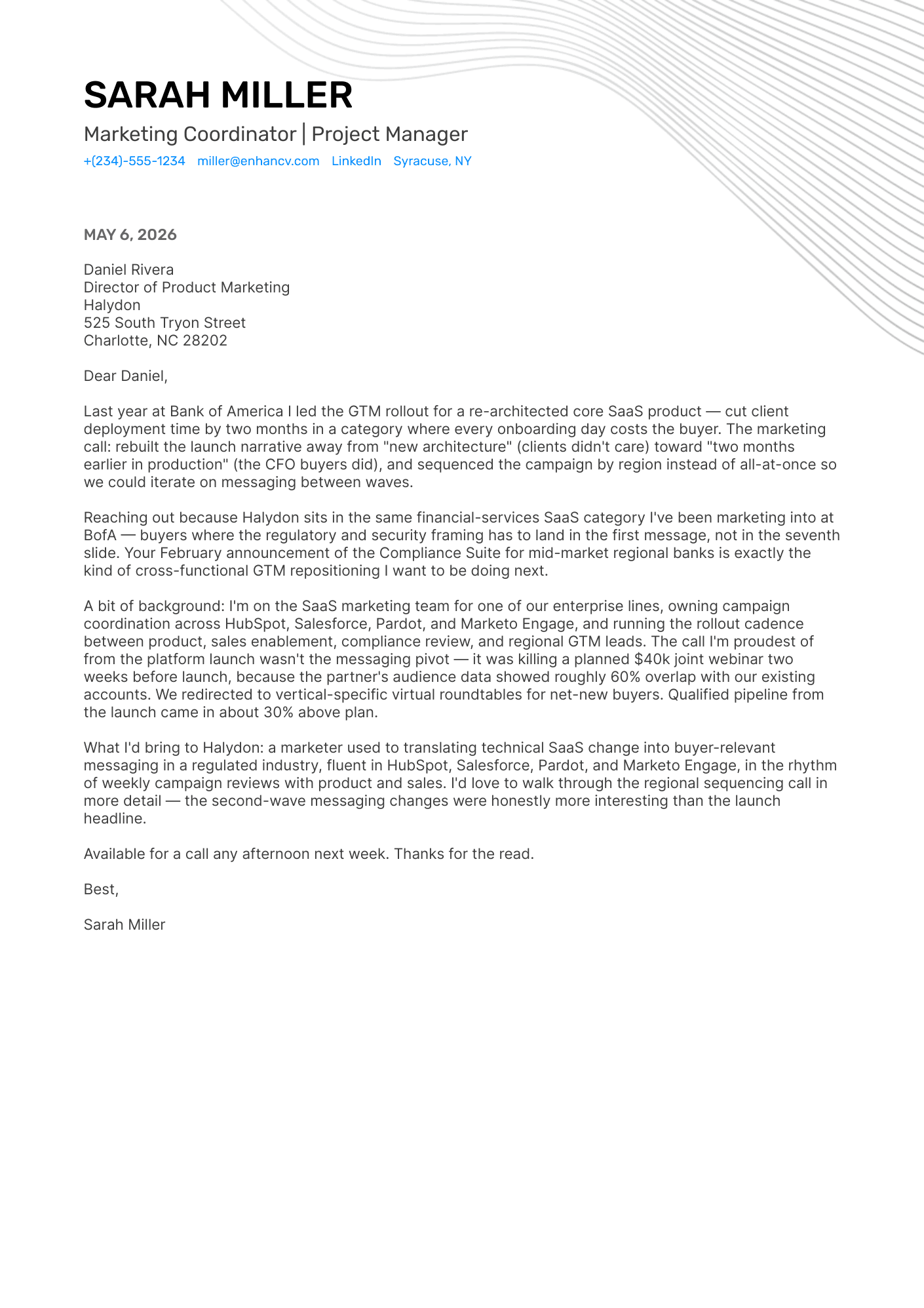
Marketing cover letters at the senior level look like the sample below—a senior manager at a Series B SaaS applying to a similar role one stage further along. Hook with a specific campaign result and a constraint, not a credential summary.
Devin Rao
San Francisco, CA
(415) 555-0148
devin.rao@email.com


Enhancv's Cover Letter Builder generates drafts in this shape, tailored to the job ad and matched to the candidate's resume design.
Here’s what the sample does well:
Opening
The letter opens with the campaign before introducing the candidate. The hook compresses the constraint, the decision, the trade-off, and the result into three sentences (frozen budget → paused Google brand → LinkedIn ABM test → 41% CAC drop).
Marketing openings should never start with career-story framing or "passionate about" language. Lead with a specific campaign result and the constraint that shaped it; the credential anchor can wait until paragraph two.
Body paragraphs
Name your current scope — channels owned, team size, the attribution stack you operate, tools you're fluent in. Then walk through the one campaign you most want to defend in an interview. The judgment moment is what marketing directors actually buy: a costly call made under data pressure, like the killed podcast sponsorship in the sample.
Pick a moment where you cut something working, killed something popular, reallocated against internal pressure, or stood by an unpopular call, and explain the data that made you do it.
Two body paragraphs is the ceiling—more reads as padding.
Closing
When you end your cover letter, do four things:
- Surface tools and rhythms that match the role's stack (HubSpot, Salesforce, Looker, weekly pipeline reviews—pick the matches).
- Name a fitting credential or two.
- Tee up the specific conversation you want to have ("walk through the LinkedIn ABM test in more detail").
- Propose actual availability.
Avoid "I look forward to hearing from you"—it reads as filler. The sample's "Available for a call any afternoon next week. Thanks for the read." works because it's specific and unceremonious.
How to tailor the marketing cover letter to different companies
Company type changes the metric, the hiring manager, and the tone.
- An agency letter to a creative director leads with the client roster, the brief you cracked, the new business pitch you contributed to, the campaign that won the year-end award. CAC and ROAS rarely come up because the agency's commercial model isn't yours to defend.
- In-house brand roles at a CPG, retail, DTC, or QSR company want the campaign-as-narrative version: insight, audience tension, creative call, lift. Aided awareness, brand search volume, Nielsen panel data, and unaided recall tend to show up. Write tighter (under 350 words) because brand directors read for craft, and longer cover letter formats frequently read as panicky.
- In-house growth or demand-gen roles at a Series A–C SaaS want the dashboard-with-judgment version the sample above models.
- Startups often skip the cover letter on a Greenhouse application, so when one is requested, treat it as a sign—the hiring manager wants to read it.
- Director-level letters and digital-marketing-specific letters shift on tone and metric set, but the spine holds.
The resume side of the application does credentials. The letter does judgment.
Drop your resume here or choose a file.
PDF & DOCX only. Max 2MB file size.
Frequently asked questions marketing applicants have
Marketing applicants ask a handful of mechanics questions over and over.
The most common:
Should I include my portfolio link in the body or the header?
Header. One line under your contact info—"Portfolio: devin.rao/work"—keeps the body focused on the campaign story. Embedding it mid-paragraph reads as a hedge.
How do I handle campaign numbers I'm under NDA on?
Round and label. Say something like:
"Cut paid CAC by ~40% (specifics under NDA, happy to walk through directionally)"
Hiring managers deal with NDAs constantly—they'll penalize a fabricated number, not a labeled approximation.
Do I need to list every certification I have?
No. Pick the one matching the role's stack and mention it in passing. The cover letter header section is where credentials belong, not the body.
Who do I address it to if no name is listed?
Address it by title. "Dear Marketing Director" beats "Dear Hiring Manager"—or spend three minutes on LinkedIn finding the actual name.
Conclusion
A 2026 marketing cover letter earns its read in the first three lines. Name the campaign, attach the number with the constraint that shaped it, highlight the trade-off you made, say what you'd do differently now. Marketing directors triaging fifty applications spot the difference between a letter written by a marketer and one written about marketing in roughly eight seconds . Those eight seconds go to the opening hook.