A paraprofessional cover letter usually gets read twice. The SPED director reads it first, checking credentials and whether you've worked with the disability categories the program serves. The building principal reads it second, checking whether you'll fit the staff and the teacher you'd report to. Most applicants write to one of those readers, not both, which is why most letters get filed without a callback.
The letter still has to ride alongside a resume that holds up under both readers — our paraprofessional resume guide shows how to document IEP support, behavior data, and certifications in the bullet form a SPED director scans for first.
The format itself is the same as any cover letter: page count, margins, the usual sign-off, andwhen you write a cover letter, you cover those mechanics. What changes for paraprofessional applications is the content.

Key takeaways for a paraprofessional cover letter
- Open with a real outcome, not a self-summary: An incident rate that came down or an IEP goal that got met in a quarter — something the principal can verify with one follow-up question. Vague enthusiasm doesn't survive the first read.
- Show you understand the support-versus-substitute line: Paras don't design curriculum. They implement what the lead teacher is delivering, often with one student or a small group at a time. A letter that confuses the two roles gets cut.
- Write differently if it's your first role versus your tenth: New paras lean on transferable stories and named credentials in progress. Experienced paras lean on specialty fit and one specific story from a real classroom.
- Name your credentials in one line, then move on: ParaPro, RBT, CPI, mandated reporter — list them cleanly. Tie at least one to a thing you actually did.
- Reference something specific about the school: A program the principal wrote about. A district initiative covered in the newsletter. A grade-level mix that matches your experience. If your letter could go to any district by changing the address block, the principal will treat it like you sent it to any district.
Paraprofessional cover letter example
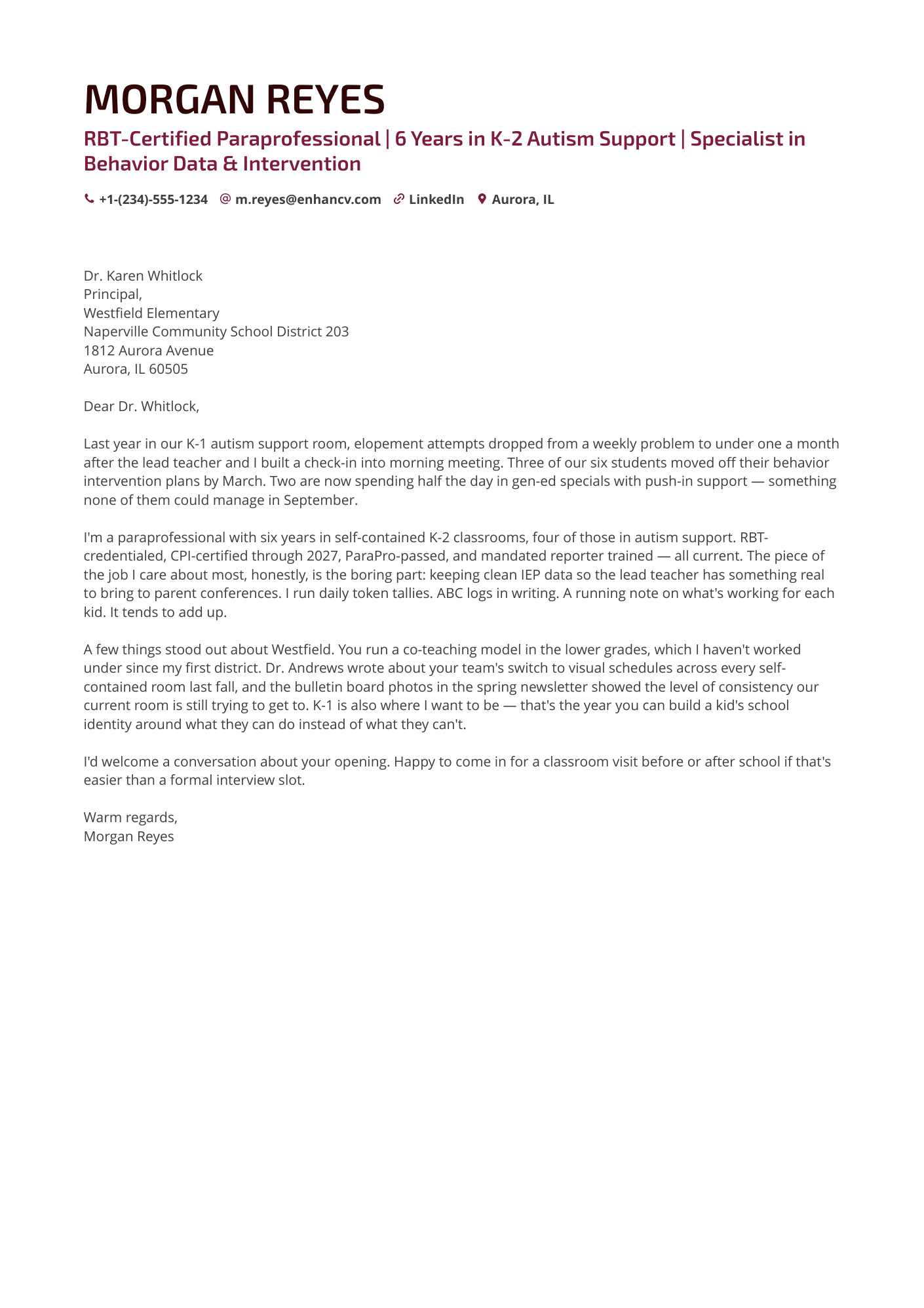
This is what a strong cover letter for a paraprofessional role tends to look like in practice — not a template, but a real applicant's letter for a real K-2 autism support opening. The hiring side is usually a SPED director or a building principal, sometimes both. They're not reading for polish. They're reading for whether you've actually been in a self-contained room and know what the work asks of you.
Morgan Reyes
Aurora, IL
+1-(234)-555-1234
m.reyes@enhancv.com
Principal,
1812 Aurora Avenue


What makes this cover letter for a paraprofessional work:
- Opens with a real outcome, not a self-summary: Elopement attempts dropped from weekly to under one a month — that's the kind of number a SPED director can verify by asking one follow-up question
- Names the credentials in one line, then moves on: ParaPro, RBT, CPI, mandated reporter — listed cleanly, not stretched into a paragraph
- Treats the lead teacher as a partner, not a boss: Morgan describes the check-in system as "the lead teacher and I built" — that's how strong paras actually talk about their classrooms
- References specifics about the school: The co-teaching model, Dr. Andrews's newsletter piece, the visual schedule rollout — not flattery, just evidence Morgan did the homework
What should your paraprofessional cover letter actually look like?
One page. Single-spaced inside paragraphs, a blank line between them, one-inch margins on every side. The header carries your name, phone, email, LinkedIn or portfolio if you have one, and the city you're applying from. Below that goes the date, then a full address block for the school—building name, district, street address, and the principal's full title if you can find it. Yes, the full block. Generic "Dear Hiring Manager" letters get read like generic letters.
A few things worth getting right that most paraprofessional applicants miss:
- Match the font to your resume. If your resume is in Rubik, your cover letter goes in Rubik too. Mismatched fonts read sloppy and it's the kind of small thing that gets noticed when someone is screening forty applications in a sitting.
- Save as PDF. Districts often use Frontline or AppliTrack, neither of which is an ATS in the corporate sense. The PDF preserves your formatting on the SPED director's screen.
- Don't link out to anything fancy. No QR codes, no portfolio sites, no video introductions. The folks reading want a letter, not a campaign.

PRO TIP
Enhancv's Cover Letter Builder keeps formatting clean without fiddling with margins. Use the time you save to add one more specific student example to the letter.
What to cover in a paraprofessional cover letter
A hiring panel reading a paraprofessional cover letter is trying to answer four questions.
1. Have you actually worked with students who have the needs we're supporting?
Disability categories matter. Experience with students on the autism spectrum is different from experience with students with physical disabilities or learning disabilities. Name the populations you've worked with and the strategies you've used.
2. Do you understand your role — support, not substitute?
This is the relationship that derails many paraprofessionals: overstepping the teacher's role or not taking enough initiative when the teacher needs coverage. A good letter signals that you know the difference.
3. Are you credentialed for this specific district or state?
Many districts require paraprofessional authorization, proof of 48+ college credit hours for Title I schools, or specific health and safety training. Name what you hold explicitly. Don't assume they'll find it on the resume.
4. Can you build a relationship with a student who is resistant or dysregulated?
This is the real skill. Any letter that describes only successful, compliant student interactions raises a quiet flag. Describing a difficult moment — and how you navigated it — signals experience with the full range of what the job requires.
How to start your paraprofessional cover letter?
The opening paragraph runs two or three sentences and does one thing: prove you've actually done the work. The strongest openings name a concrete outcome from a real classroom—a behavioral incident rate that came down, a student who moved from pull-out to push-in, an IEP goal that got met in a quarter. Numbers help, but they don't have to be percentages. "Four of my K-1 students hit their reading goals by spring conferences" is a number.
The opening looks different for new paras and experienced paras, and that's the spine ofhow to start a cover letter for this role:
- Experienced para: Lead with the outcome. The credentials can wait until paragraph two. The SPED director already knows you've passed the ParaPro from your resume header. They don't yet know what you did with the credential.
- First-year para or career changer: Lead with what's transferable and specific. A medic transitioning to a behavior aide role can open with crisis de-escalation experience. A parent re-entering after raising a child with an IEP can open with the specific work of advocating inside that process. "Passion for working with children" is the wrong opening because every applicant has that.
What both versions skip: the autobiographical wind-up. Nobody reading needs to know how you discovered your love for education in third grade. Focus on what happens in the classroom.
What goes in the body of a paraprofessional cover letter?
The body of your cover letter is where you make your main point, and it’ll look different depending on your experience. A one-size cover letter is what makes most applications blur together for the person reading.
Here’s how to approach this section depending on your experience level.
For experienced paras (3+ years in classrooms)
Pick one story. One classroom, one student or small group, one concrete intervention you ran or co-ran with the lead teacher, one measurable result. Three to five sentences. Then a second paragraph that connects what you did there to the school’s challenges. To get to know them better, read the district's most recent SPED program review or the principal's welcome letter. Aim to be specific rather than thorough.

Wording that lands with paraprofessional hiring managers
- IEP data collection: daily token economies, ABC logs, progress monitoring against measurable annual goals, written notes the teacher can hand to parents at conferences
- Behavior plans: FBA participation, BIP implementation, fidelity tracking, replacement-behavior modeling on a schedule
- Curriculum supports: visual schedules, first-then boards, social stories, AAC devices (PECS, Proloquo2Go), choice boards
- Crisis response: CPI, Mandt, Ukeru, whichever your district uses
- Co-teaching mechanics: push-in vs pull-out, parallel teaching, station rotation
You don't need to use all of these. Naming two or three with real context beats listing eight.
For new paras and career changers
One transferable story, told concretely. The story is the same shape: one situation, one thing you did, one measurable result, but it comes from outside the K-12 setting. A daycare lead who managed a behavioral incident plan. A camp counselor who ran a one-on-one with a child on the spectrum. A church or community-center tutor who tracked reading progress on a real schedule. Anything that proves you can be calm and consistent with kids in a room, on a schedule, under supervision.
Follow this with a paragraph that's honest about what you don't have and specific about what you're already doing to close the gap. "I've completed the ParaPro Assessment and I'm registered for CPI training in November" is a stronger sentence than three paragraphs of enthusiasm.
How should a paraprofessional cover letter end?
Skip "Thank you for your consideration" and skip the second wind-up. The closing is two or three sentences. State what you want next—usually a classroom visit or a phone call. Make it easy to schedule. The strong closings I've seen offer a window: "I can come in before school any day next week, or after the bell most afternoons."
If the posting names a start date, mention it. SPED rooms often need a para mid-year because someone left or a 1:1 was added to a student's IEP, and a candidate who can name the date the district needs filled gets a callback faster than one who can't.How to end a cover letter walks through a few variations.
Sign off with "Sincerely" or “Warm/Kind/Best regards” and your name. Don't get clever with the sign-off. The fingerprints of a strong paraprofessional show in the body of the letter, not in whether you wrote "Warm regards."
Common mistakes in a paraprofessional cover letter
A few patterns kill these letters faster than anything else:
- Confusing the para role with the teacher role: "I'm excited to design curriculum" doesn’t sound convincing. Paraprofessionals support the curriculum the lead teacher is delivering. Showing you know the line matters.
- Listing certs without context: Certificates like RBT, CPI, ParaPro are okay to list, but tie at least one to a thing you actually did. A CPI cert that's never been used in a real de-escalation is just a card in a wallet.
- Generic enthusiasm: "Passionate about helping students reach their potential" tells the principal nothing. Six out of ten applicants will write some version of this sentence. Skip it.
- Wrong audience: Letters written for the principal that should have been written for the SPED director, or vice versa. Read the posting closely. Whoever the hiring contact is, that's who you write to.
- No school-specific evidence: If your letter could be sent to any district by changing the address block, the principal will treat it like you sent it to any district.
What if you've never worked as a paraprofessional before?
For first-year applicants, hiring is mostly a reliability and temperament read. The principal isn't expecting you to walk in fluent in IEP language. They're checking whether you'll show up at 7:45 every morning. Whether you'll keep your composure when a six-year-old throws a chair. Whether the lead teacher will trust you by week three. A cover letter that proves those things beats a cover letter that pretends to credentials you don't have.

Three moves that work for first-year cover letters:
- Name the cert you do have or the one you're getting: ParaPro passed in August. Title I credit hours completed at the community college. CPI registered for next month. A specific, time-stamped credential reads as commitment in a way that "willingness to learn" doesn't.
- Tell one transferable story: Choose one situation from work, volunteer, or caregiving where you handled a child or small group with real stakes. Three to five sentences. End with what happened, not how it made you feel.
- Ask about the classroom you'd be joining: Closing your letter with a specific question — about the lead teacher's caseload mix, or whether the room runs a token economy — signals you're already thinking like a coworker, not a candidate.
PRO TIP
If you're at a year or two of experience, maybe in a different state or a different specialty, write the letter as an experienced para's letter, but acknowledge the specialty change in one honest sentence in the middle. "I've spent two years in self-contained K-2 and I'm moving toward autism support specifically because…" reads as deliberate. A pretend-veteran letter from an applicant with eighteen months of experience reads like a stretch and gets caught.
Frequently asked questions about paraprofessionals
Did we miss anything in our guide? Check out those commonly asked questions below.
What does a paraprofessional do in a cover letter context?
A paraprofessional supports classroom instruction under a licensed teacher's direction, working with individual students or small groups to implement IEP goals, behavioral support plans, or differentiated instruction. Your cover letter should make clear you understand this role — supportive, not directive — and that you have specific methods for executing it. The clearest way to show that is through a real student example.
What credentials should I mention in a paraprofessional cover letter?
Name your paraprofessional authorization if you hold one. For Title I schools, mention your college credit hours (48+ required in most districts). Include any specific training: PECS, AAC device use, crisis de-escalation certification (CPI or MANDT), CPR/first aid, and any structured literacy or behavioral intervention training. These aren't extras — they're the credentials screening committees are looking for.
Should I mention a specific student in my paraprofessional cover letter?
Yes — anonymized. Reference the student by grade level and need, not name. "A third-grade student with ASD who was nonverbal" gives the hiring panel enough context to evaluate your experience. Describing a real student interaction is the single most effective way to differentiate a paraprofessional cover letter.
How do I write a cover letter for a special education paraprofessional position?
Target the letter to the specific disability populations and grade levels in the posting. If the position is for an autism support classroom, your letter should explicitly address ASD experience, AAC strategies, and behavioral support methods. If it's for a mild-to-moderate resource room, focus on academic support strategies and co-teaching collaboration.