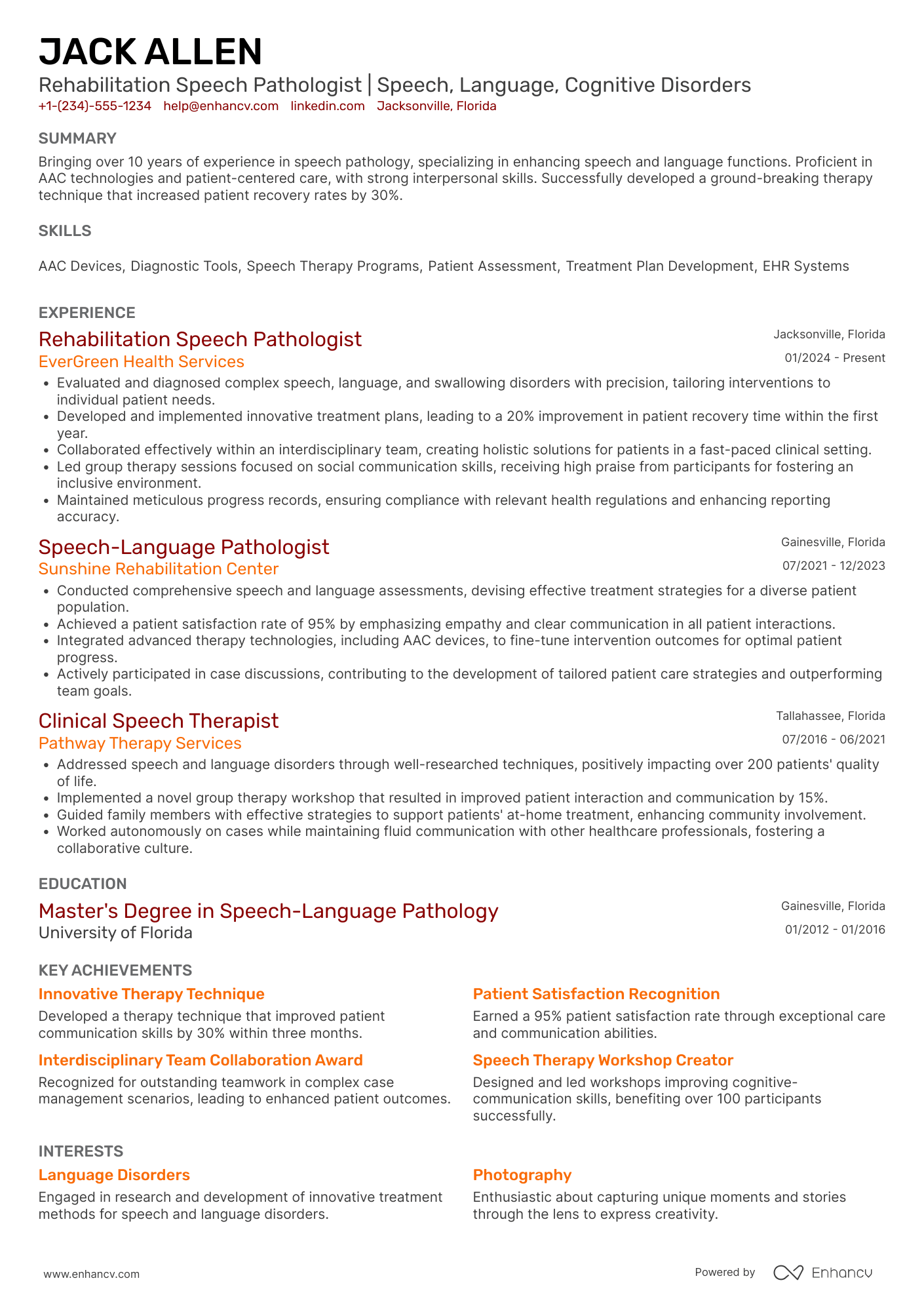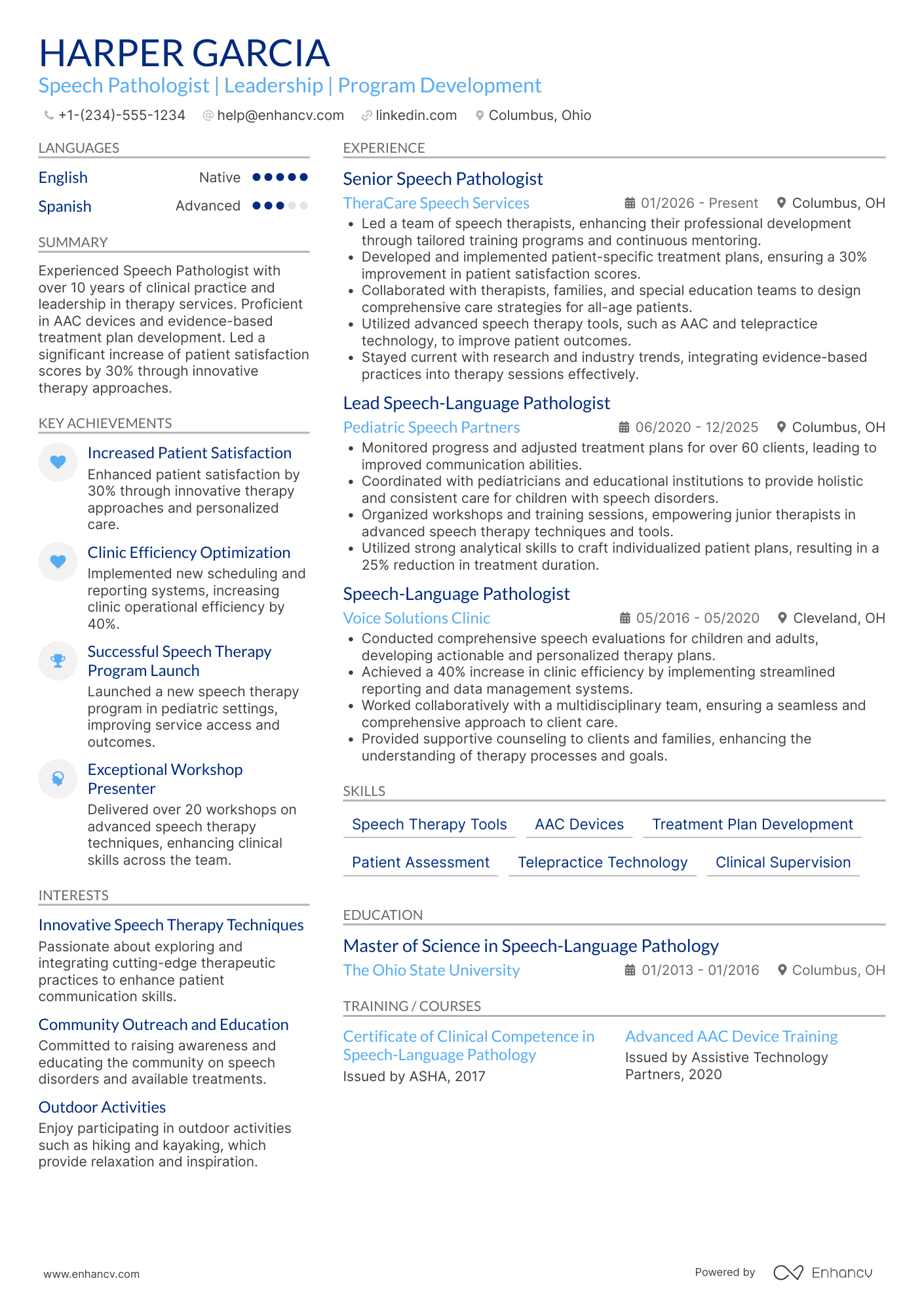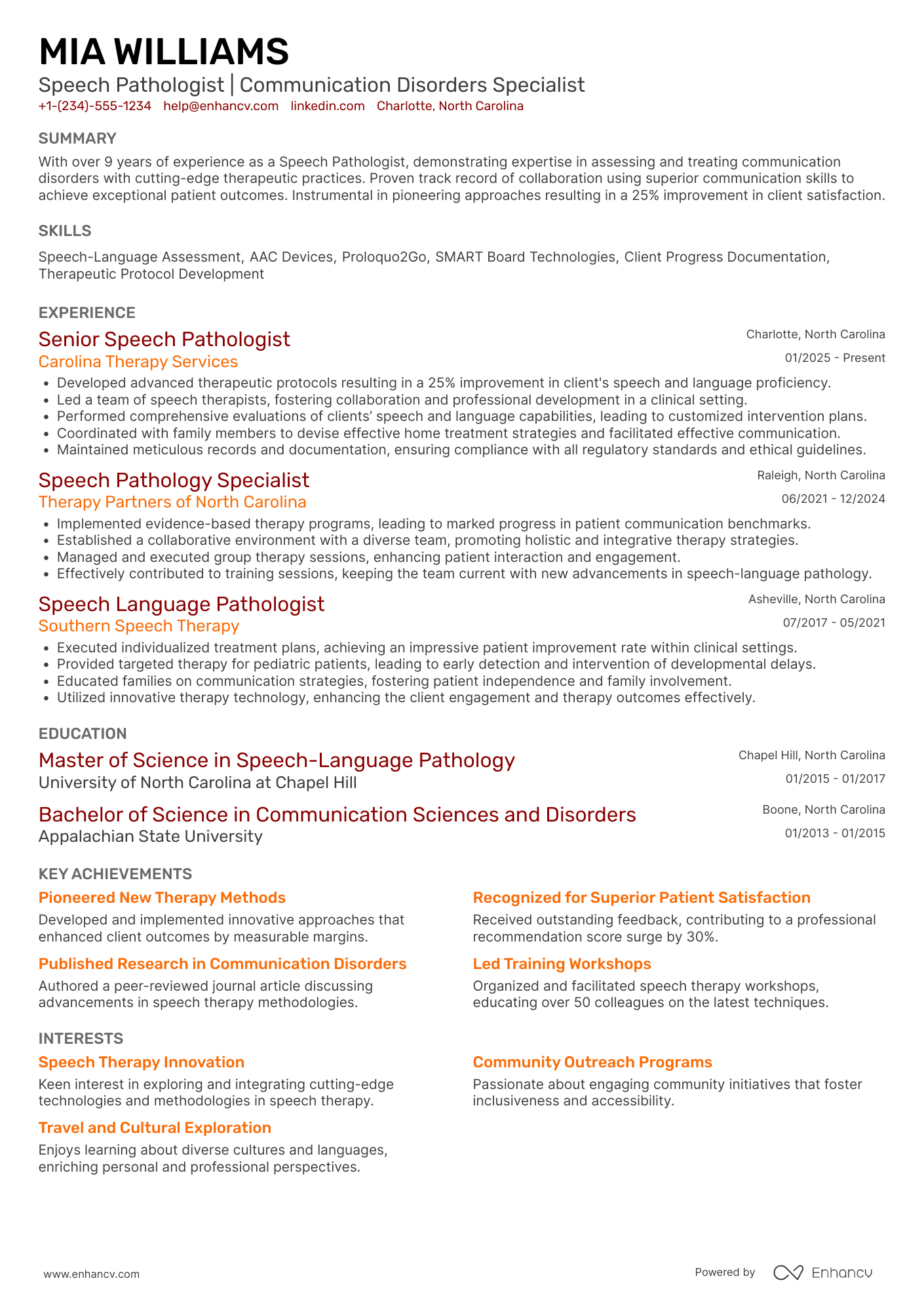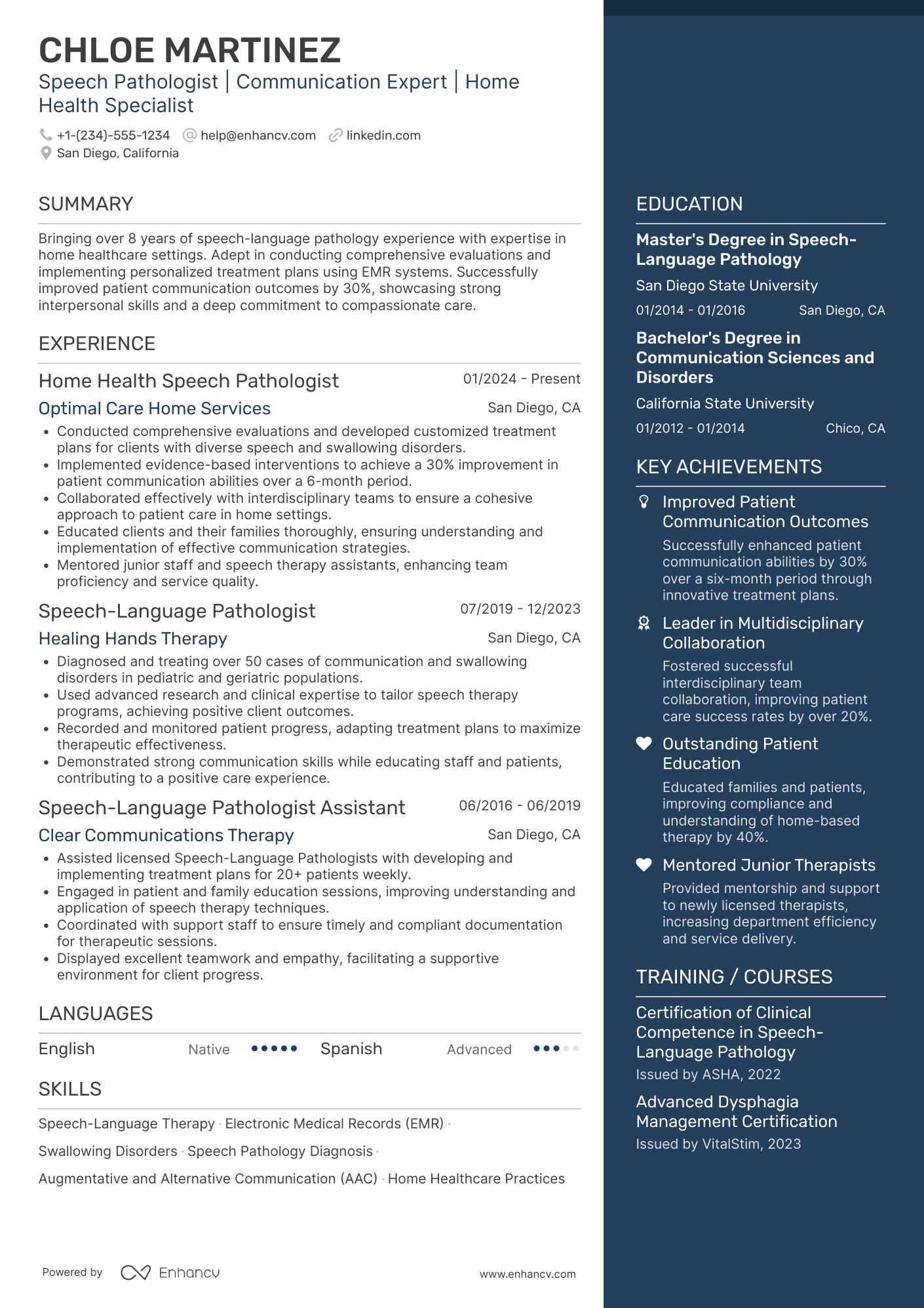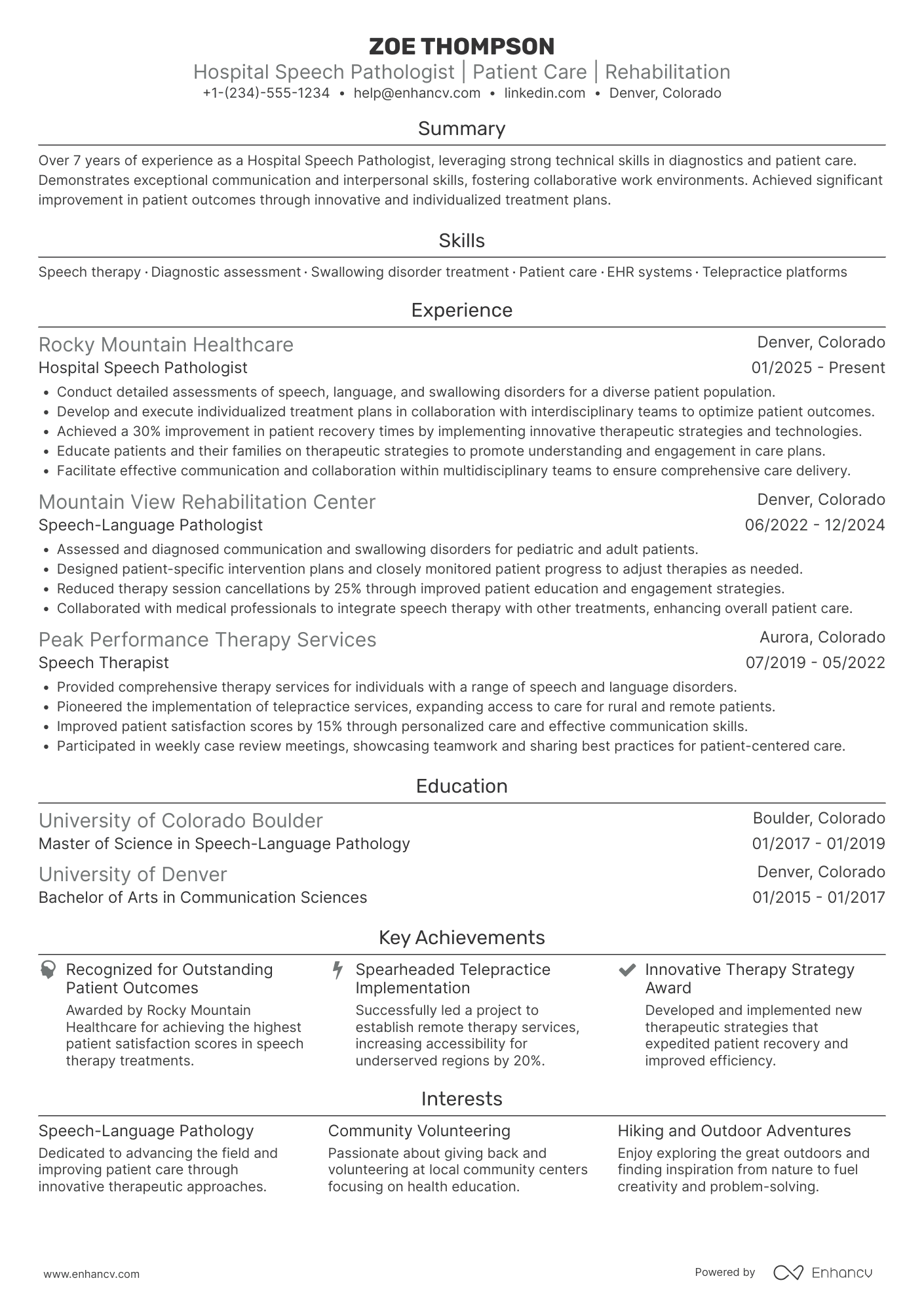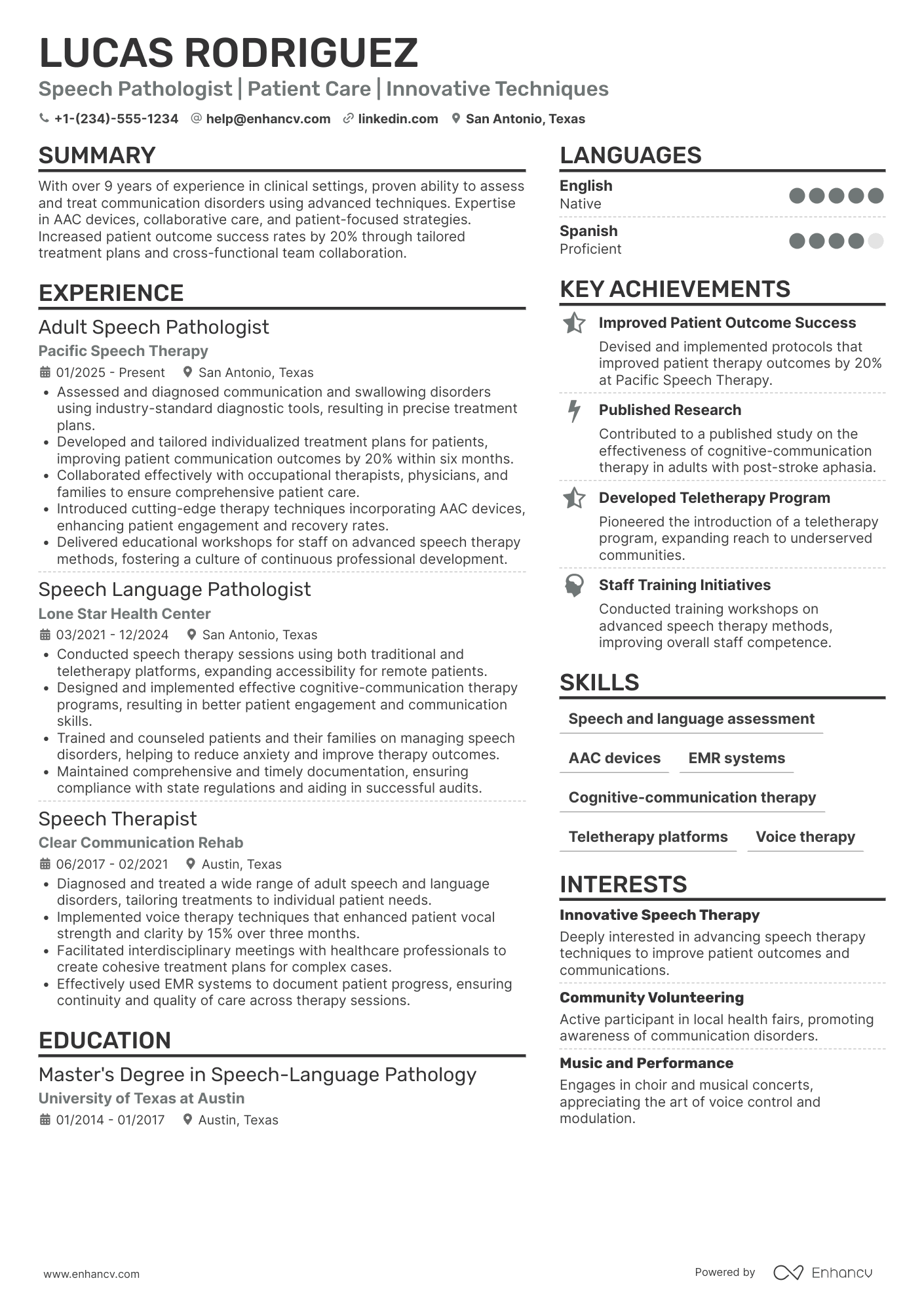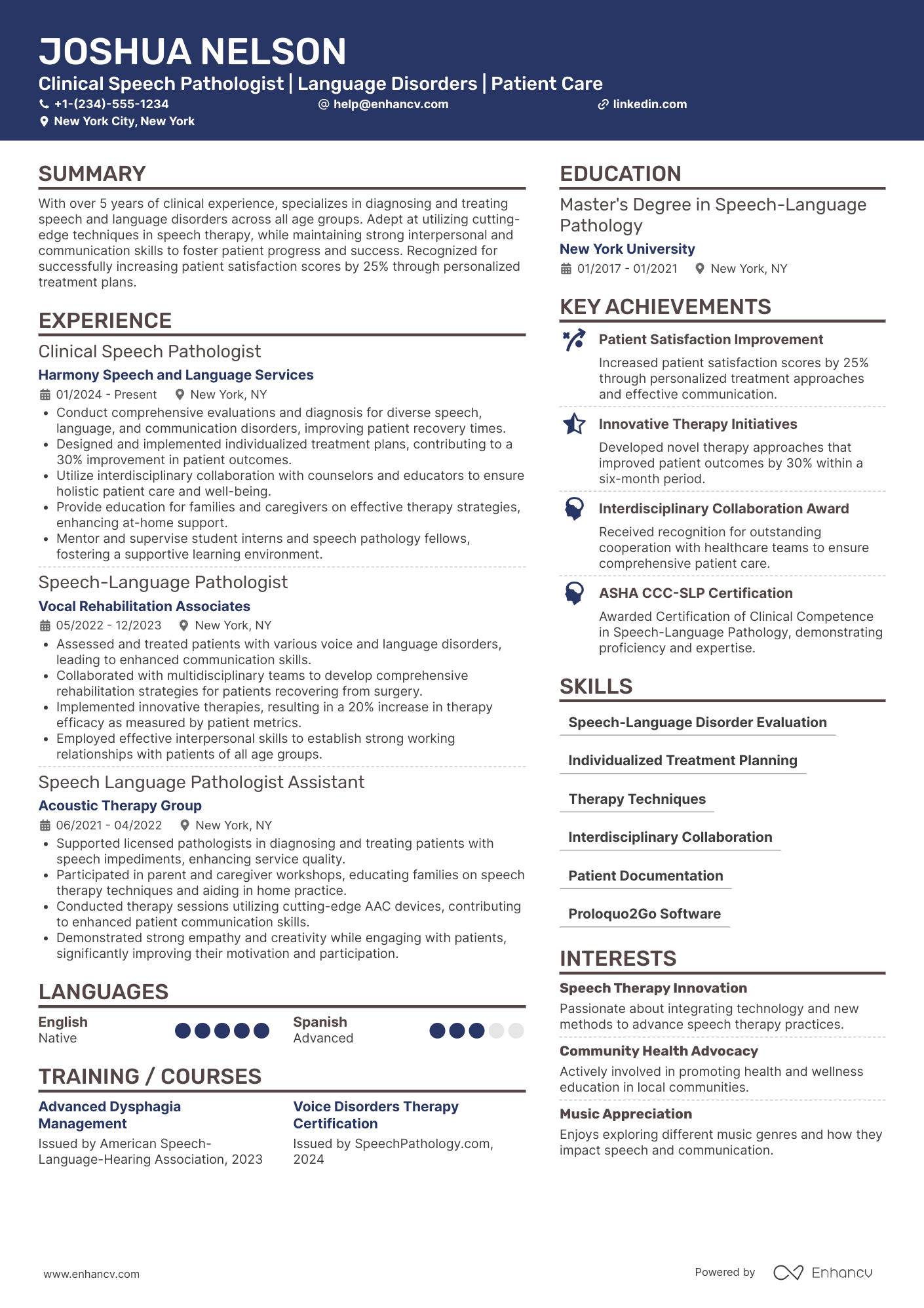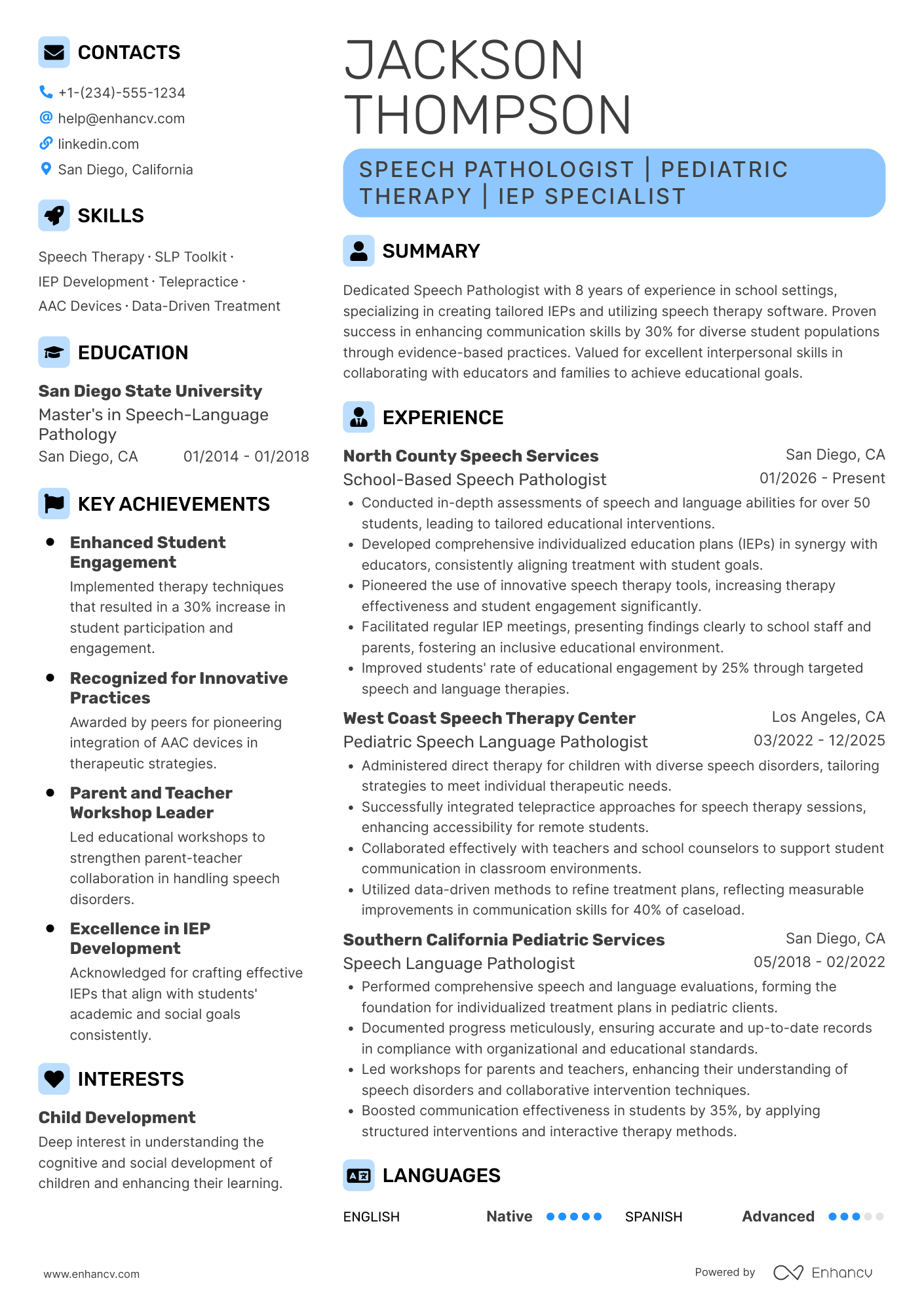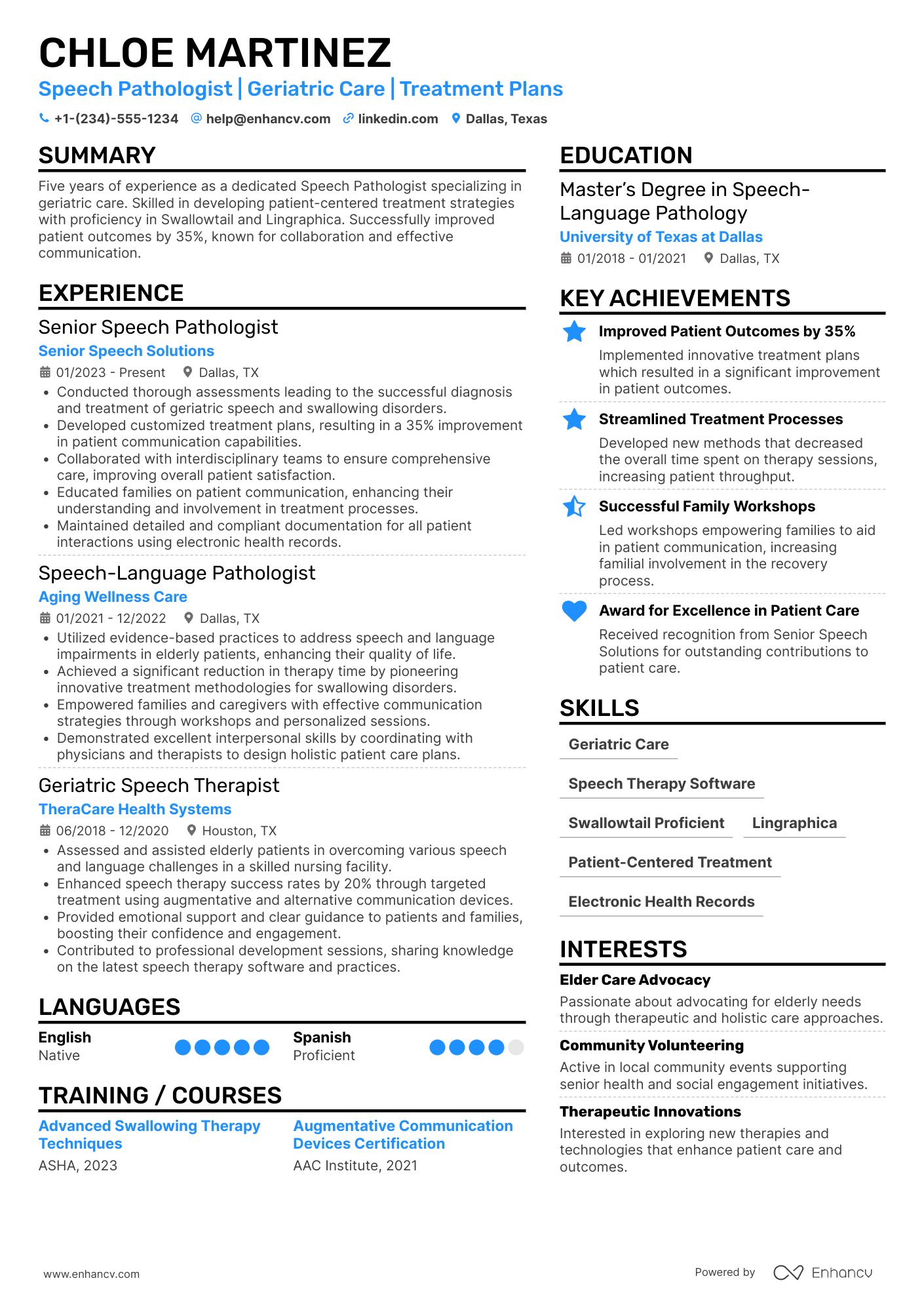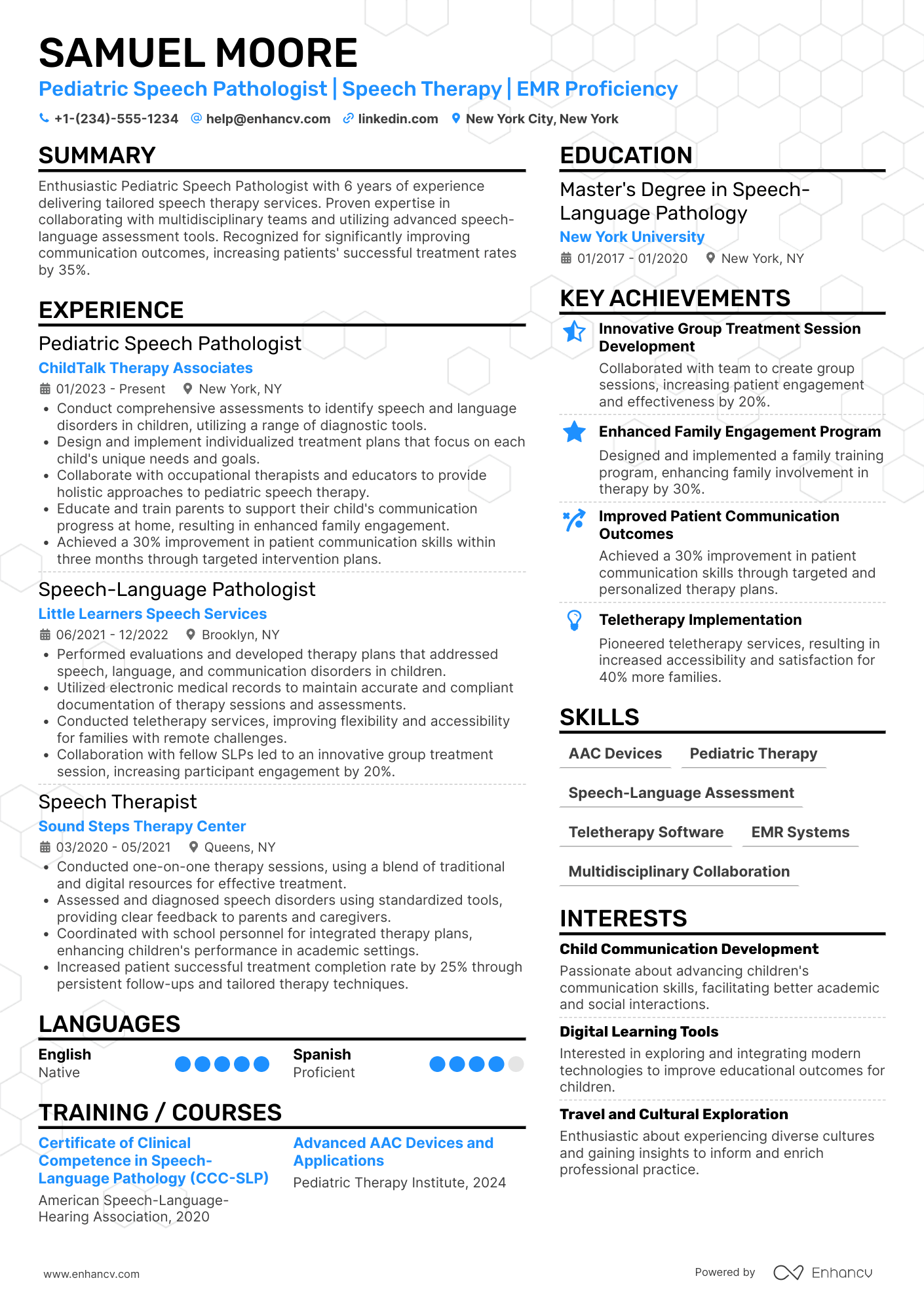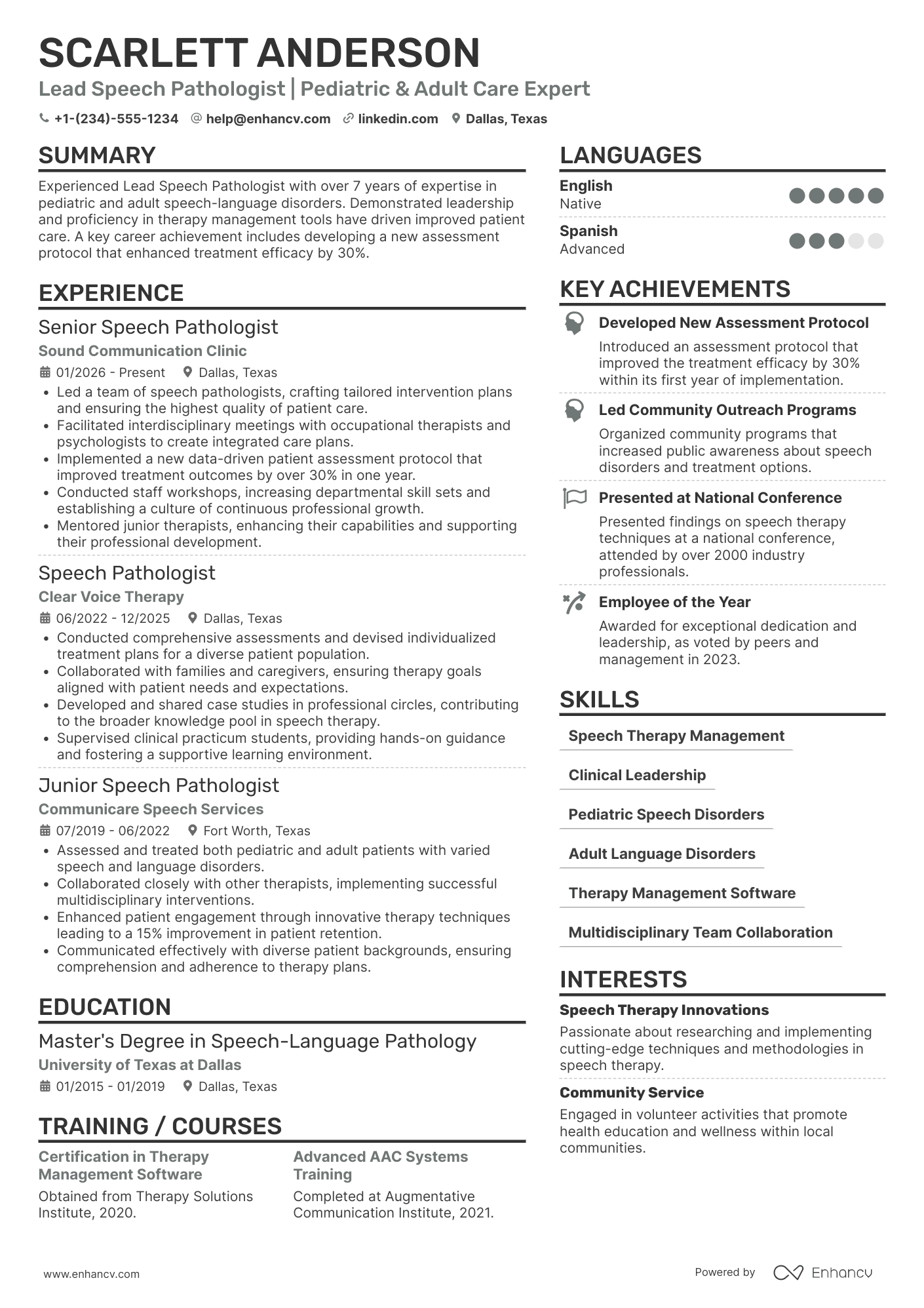
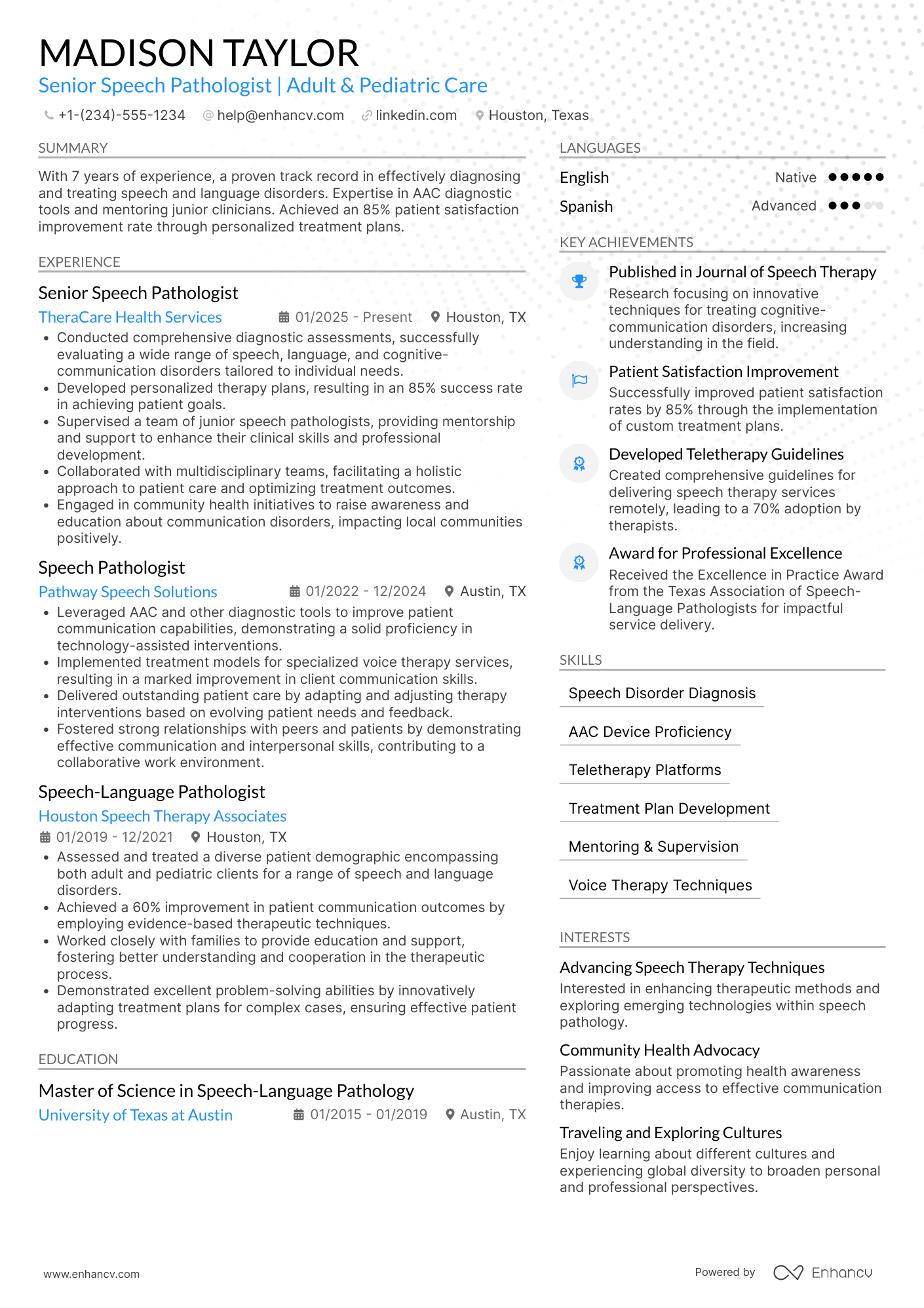
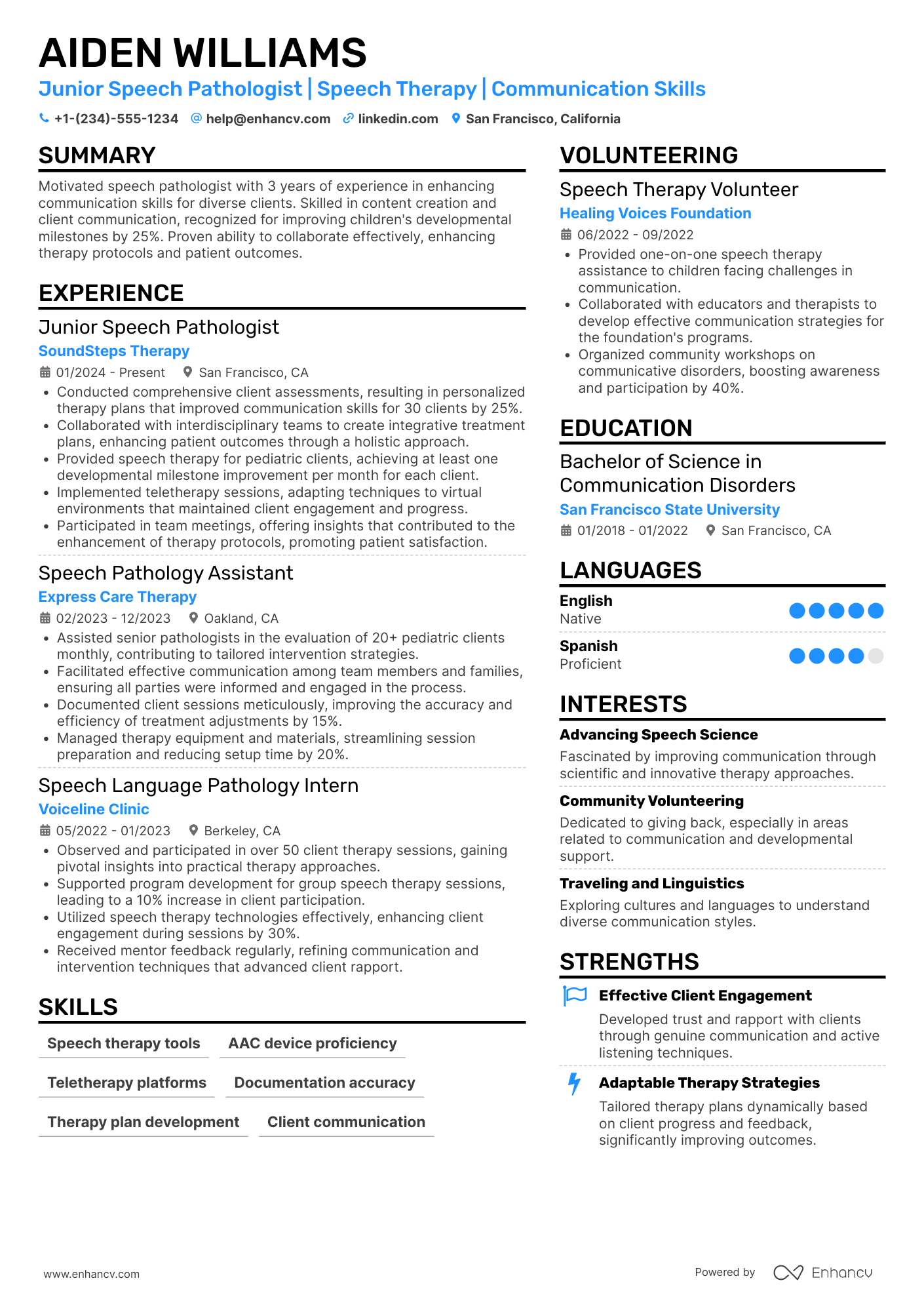
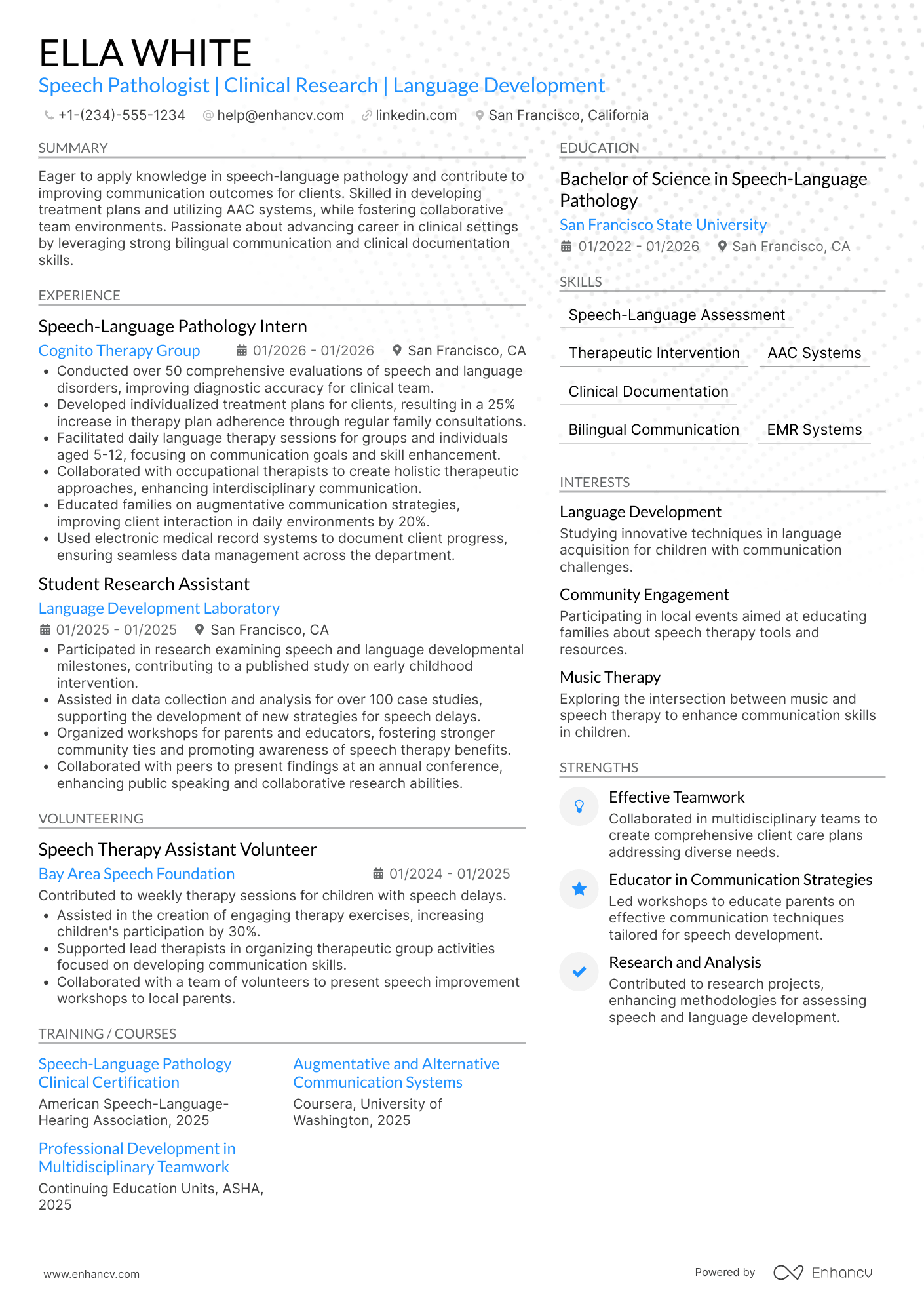
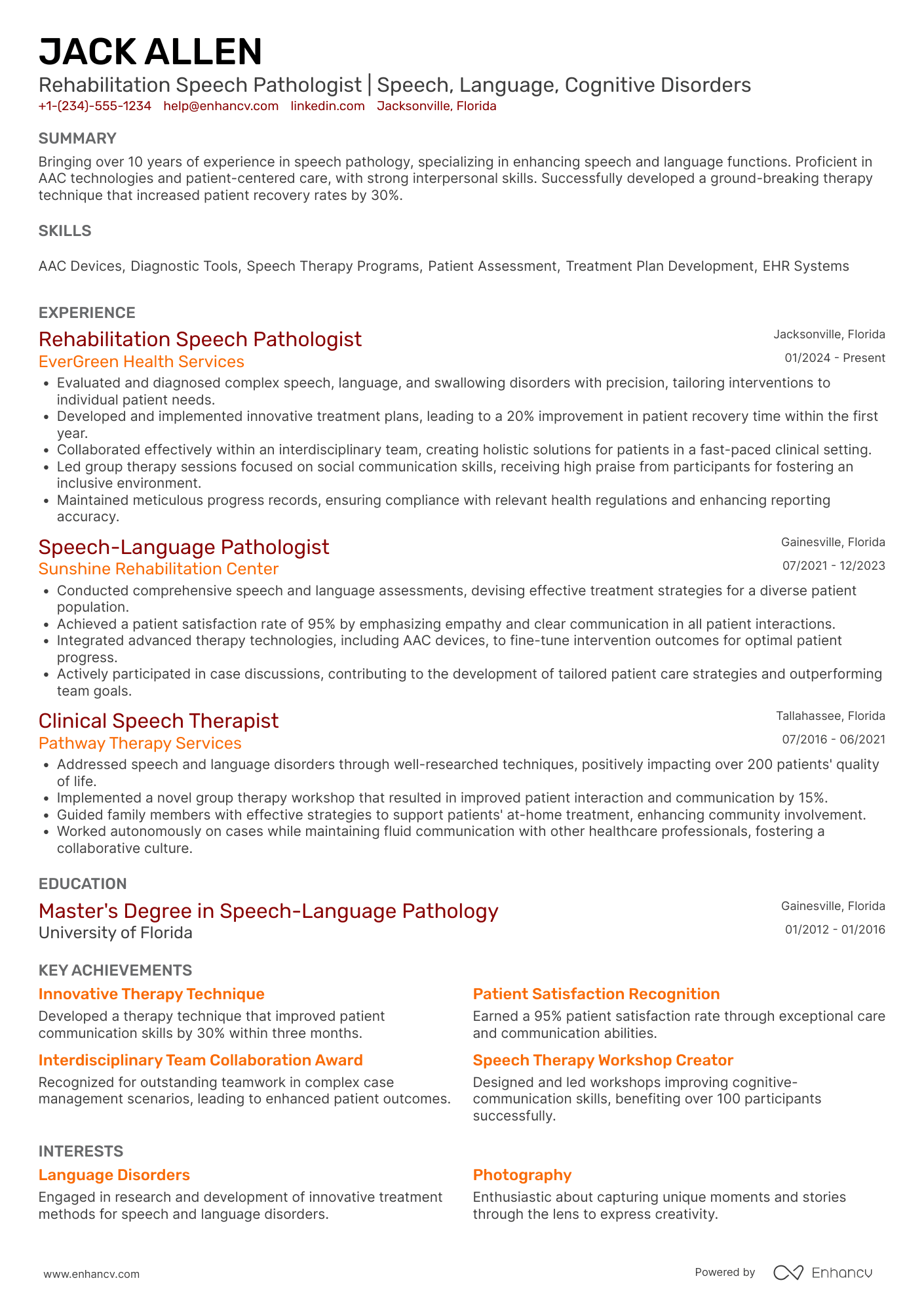
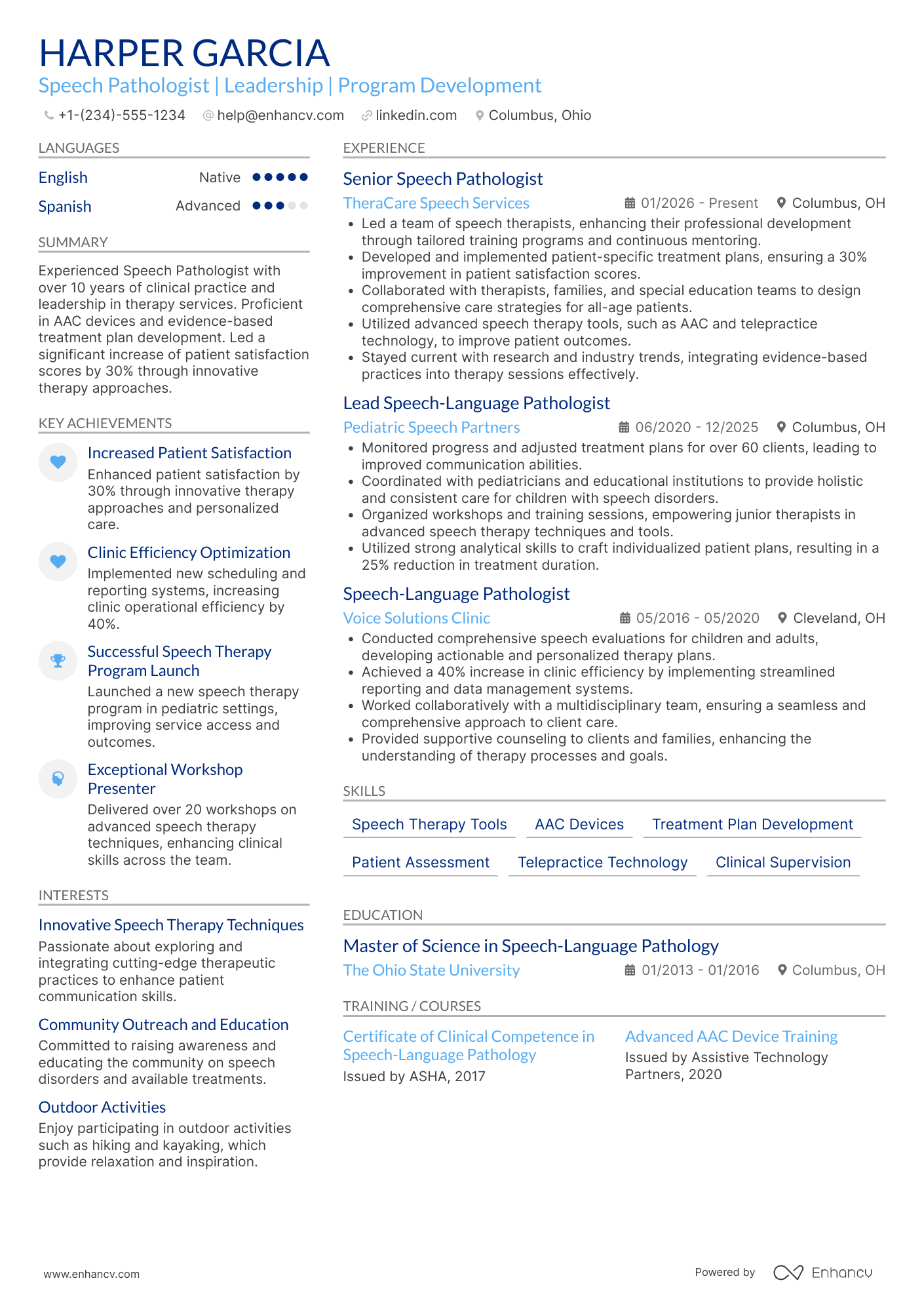
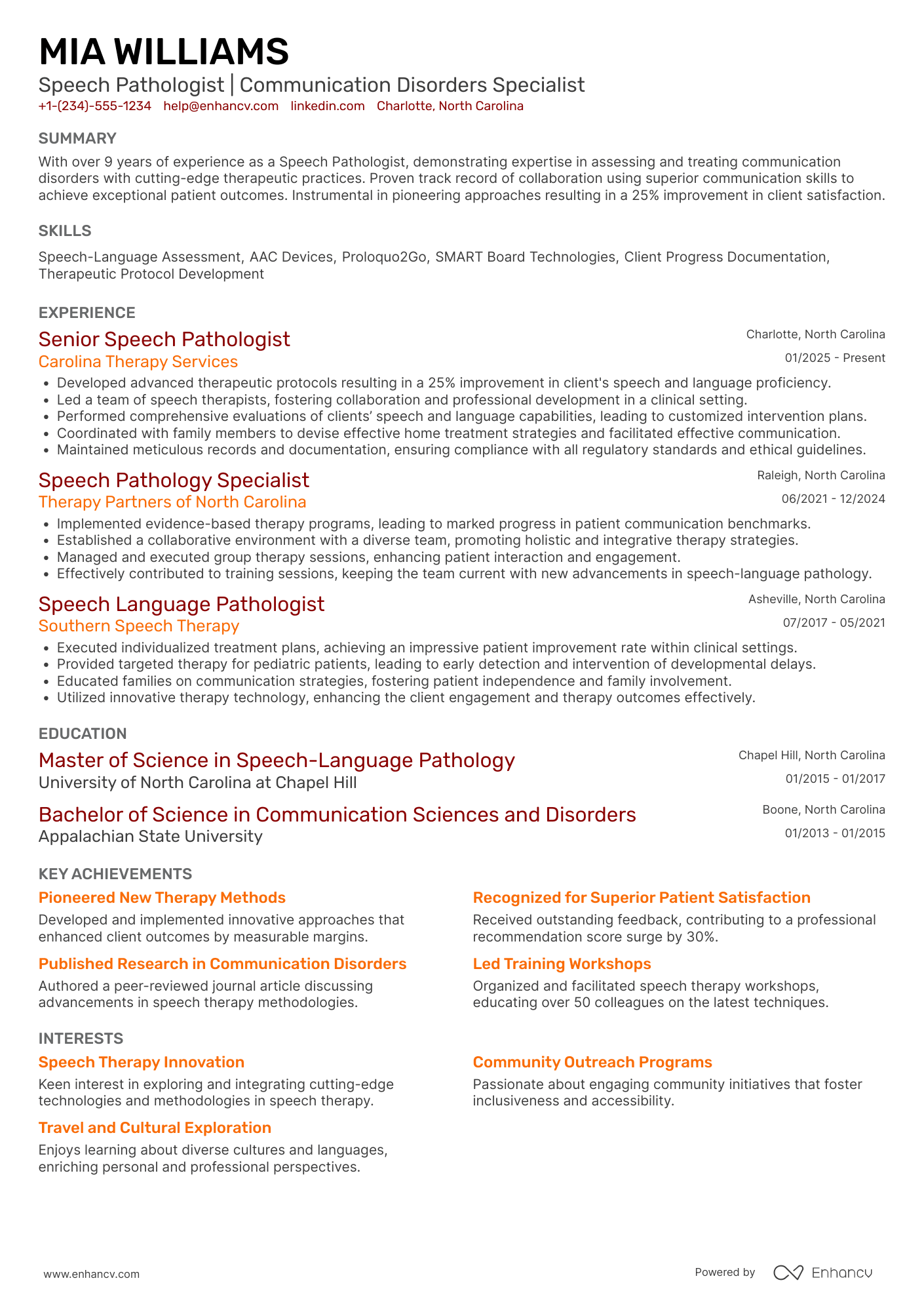
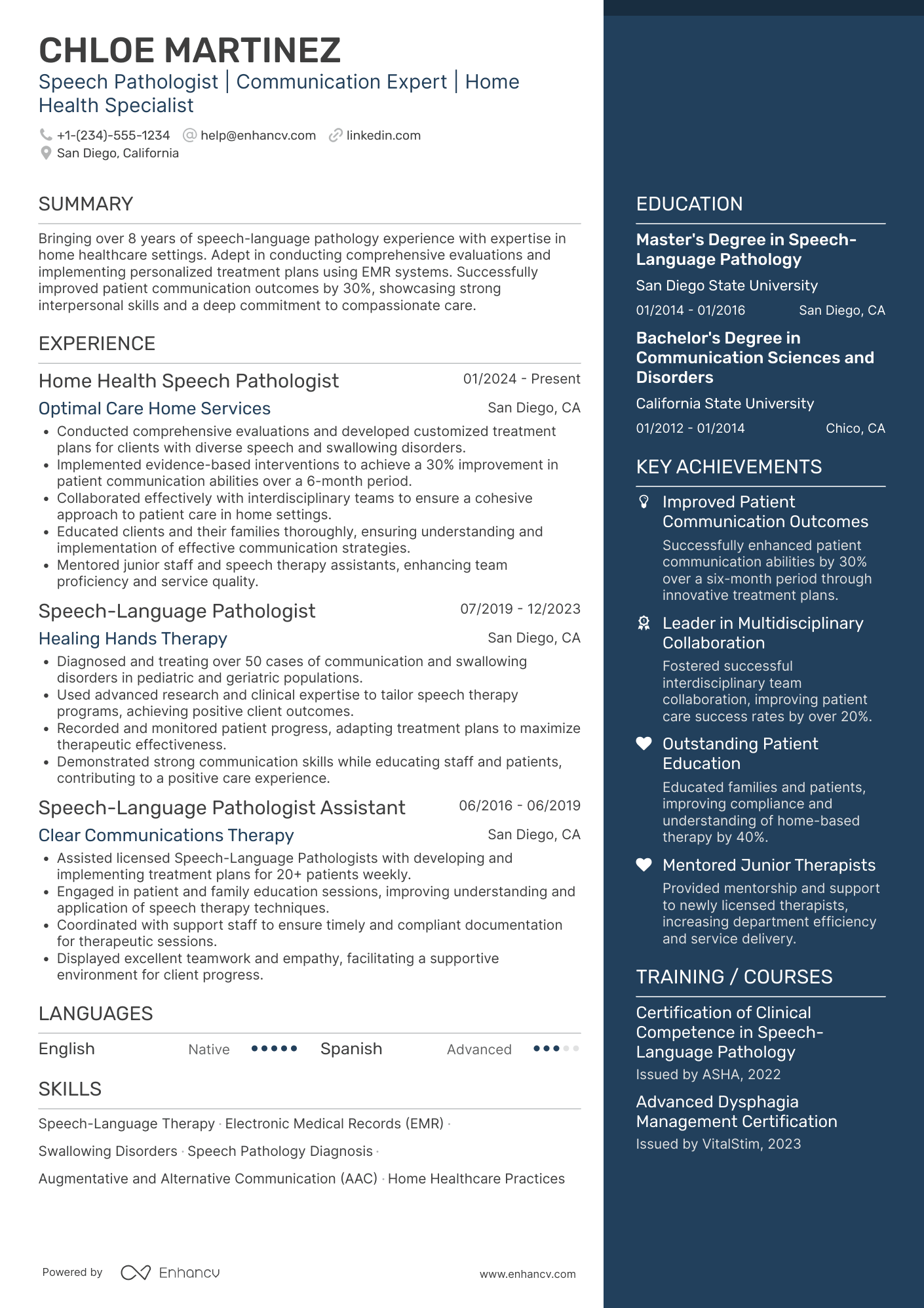
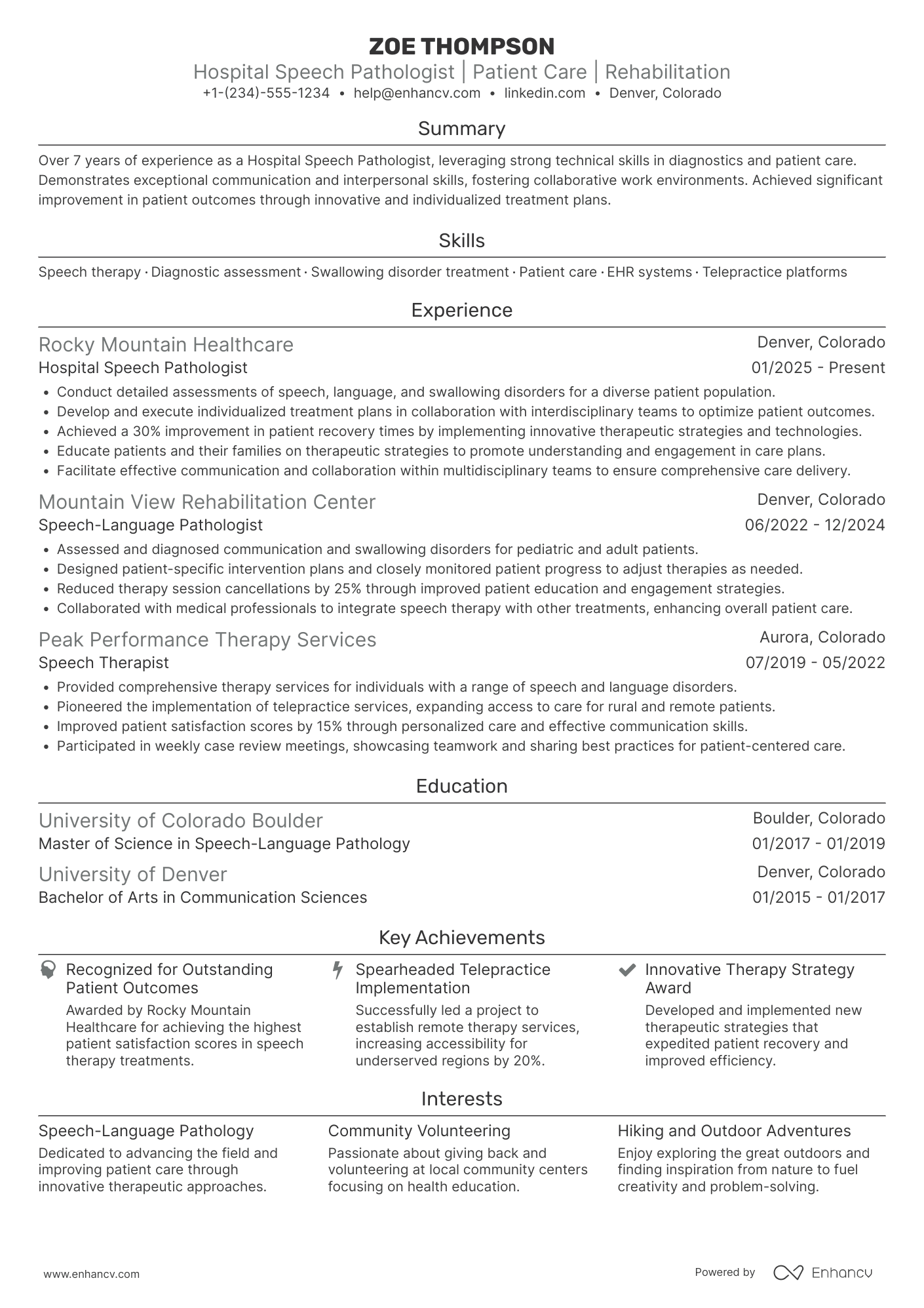
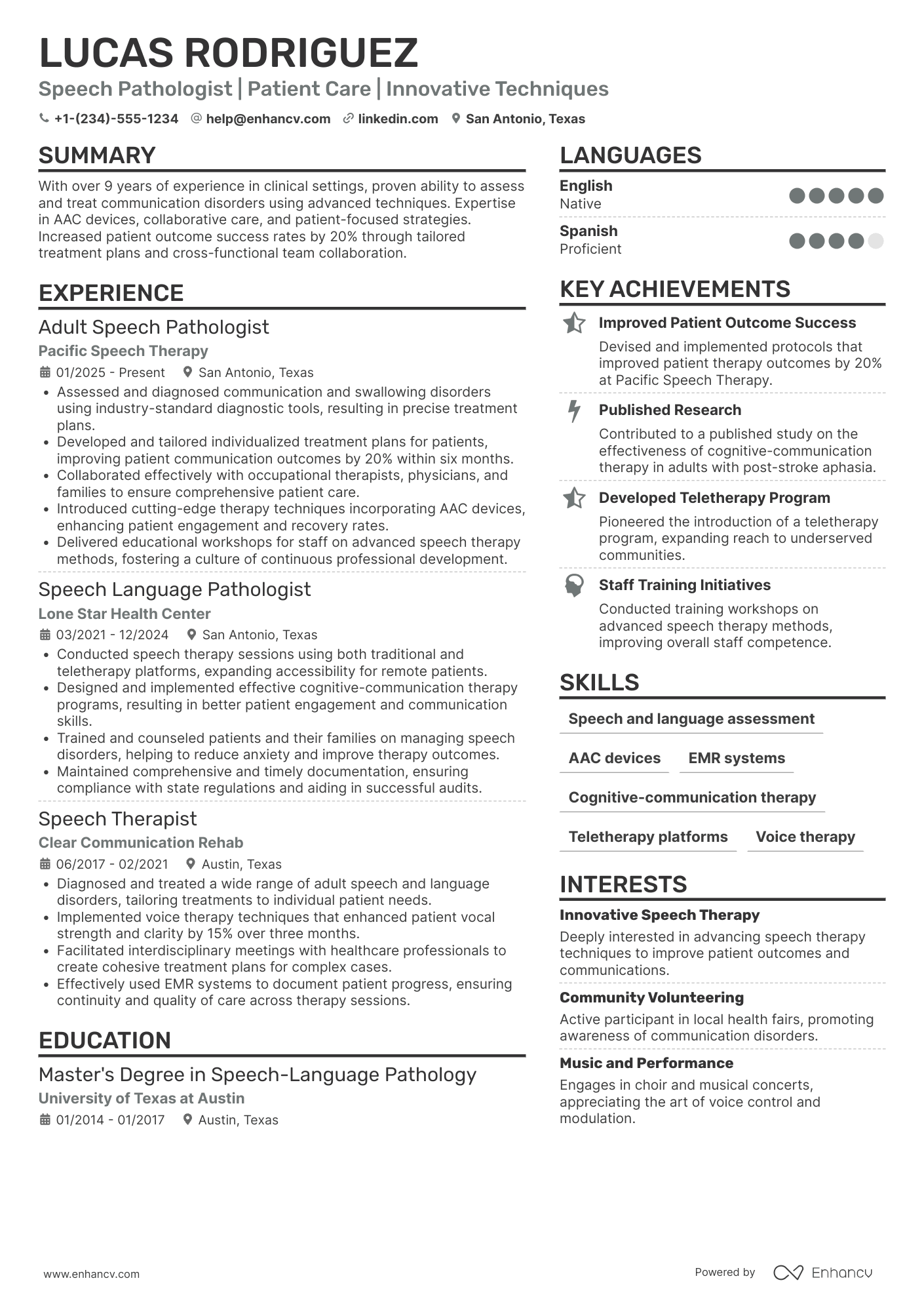
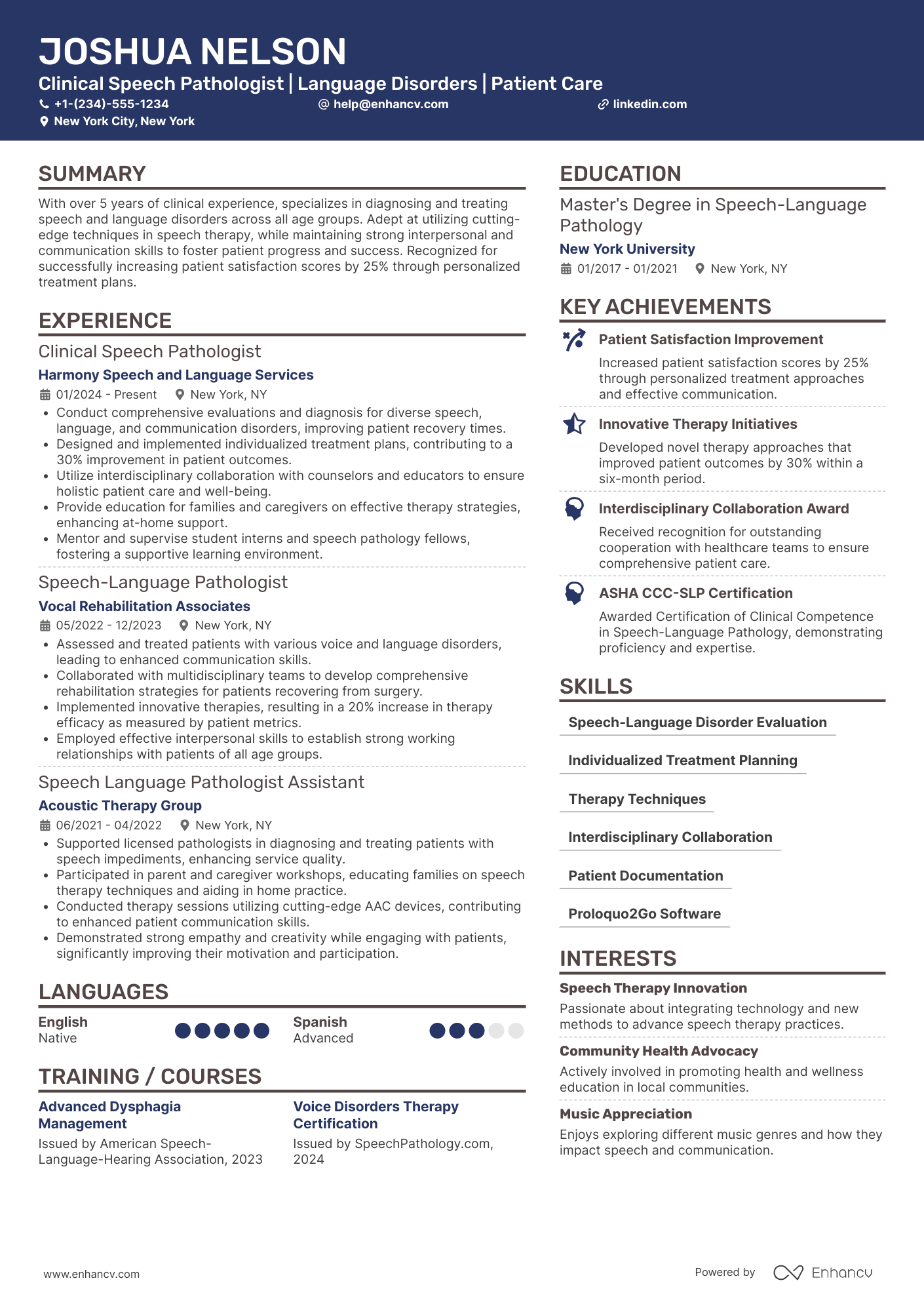
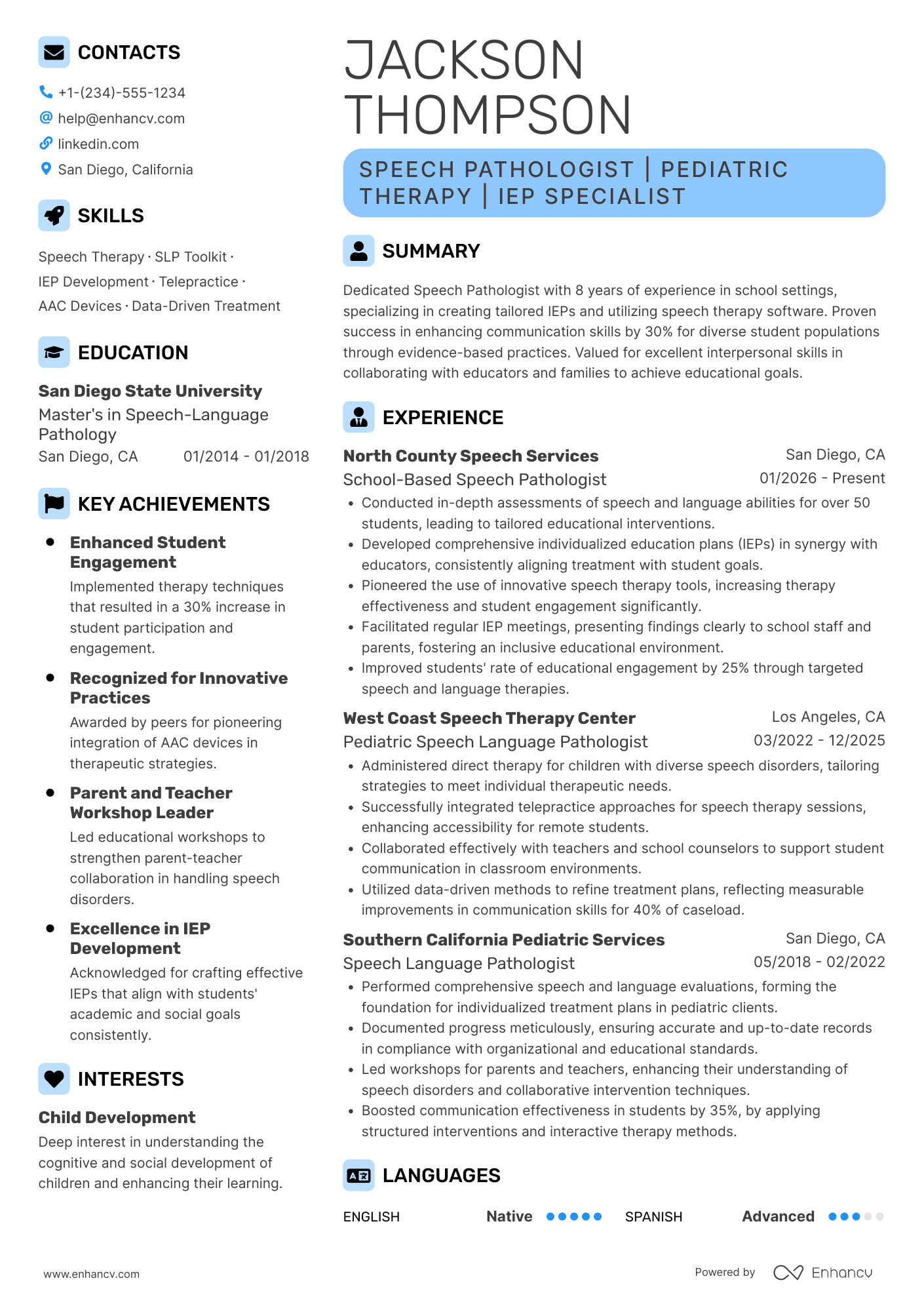
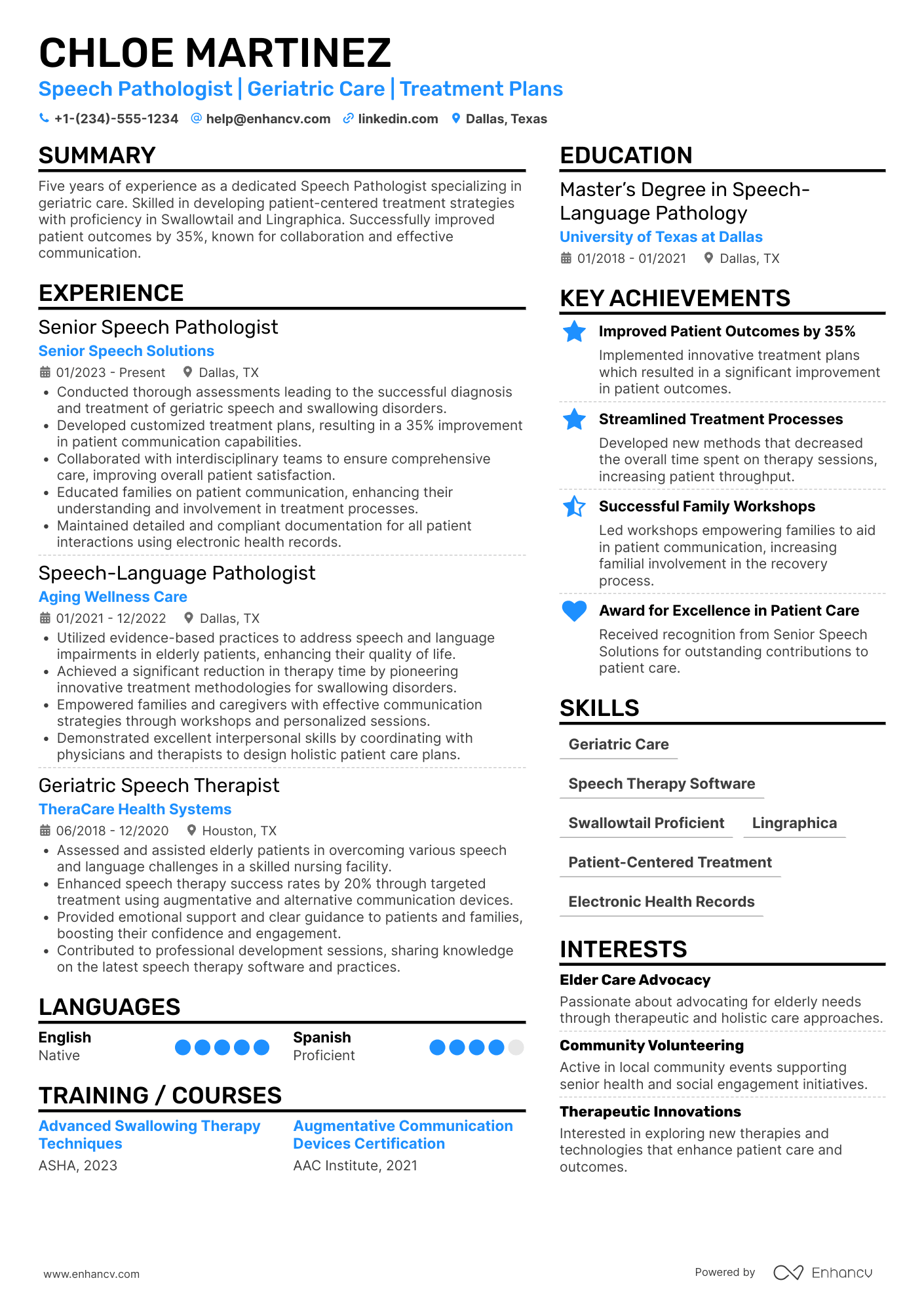
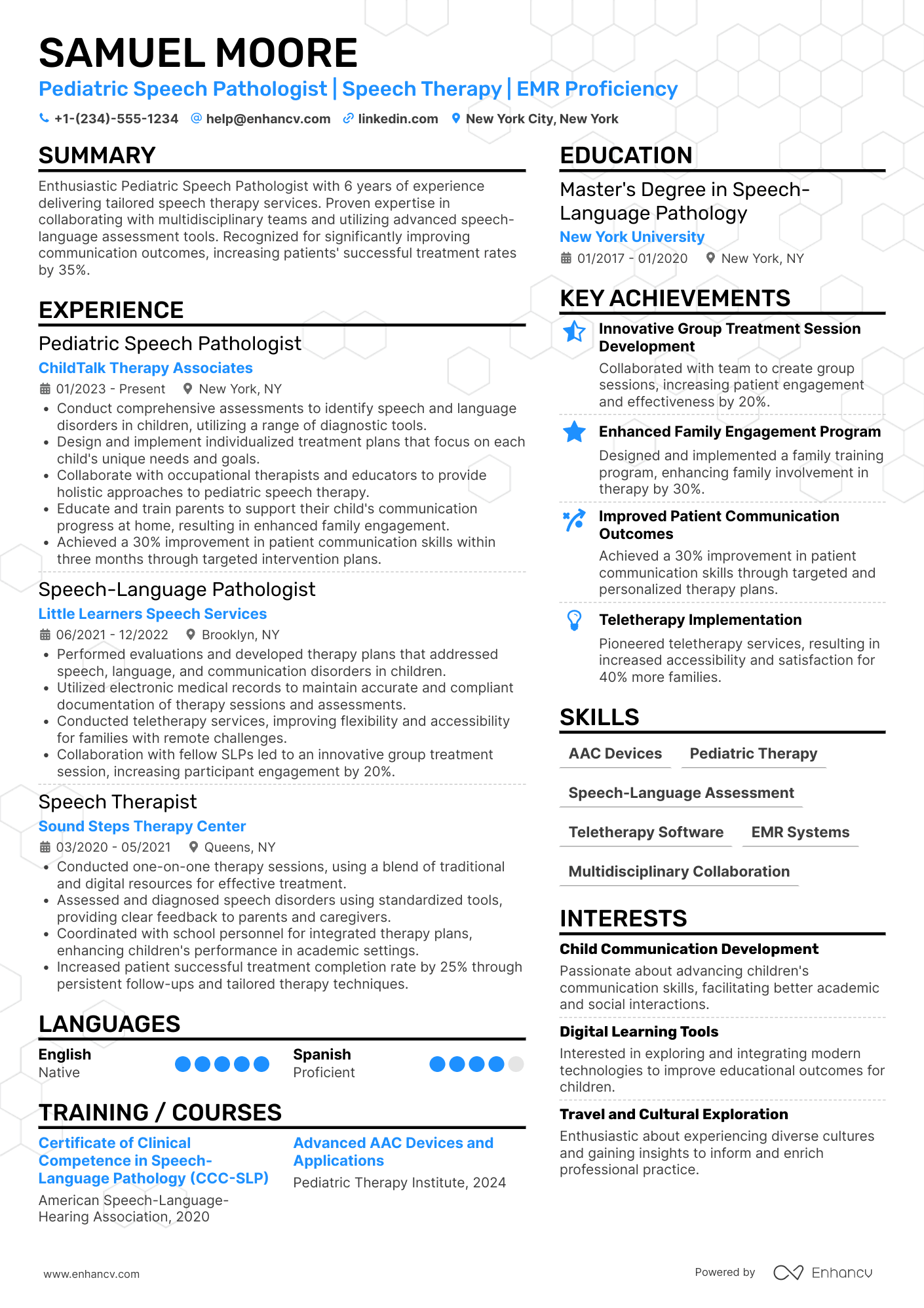
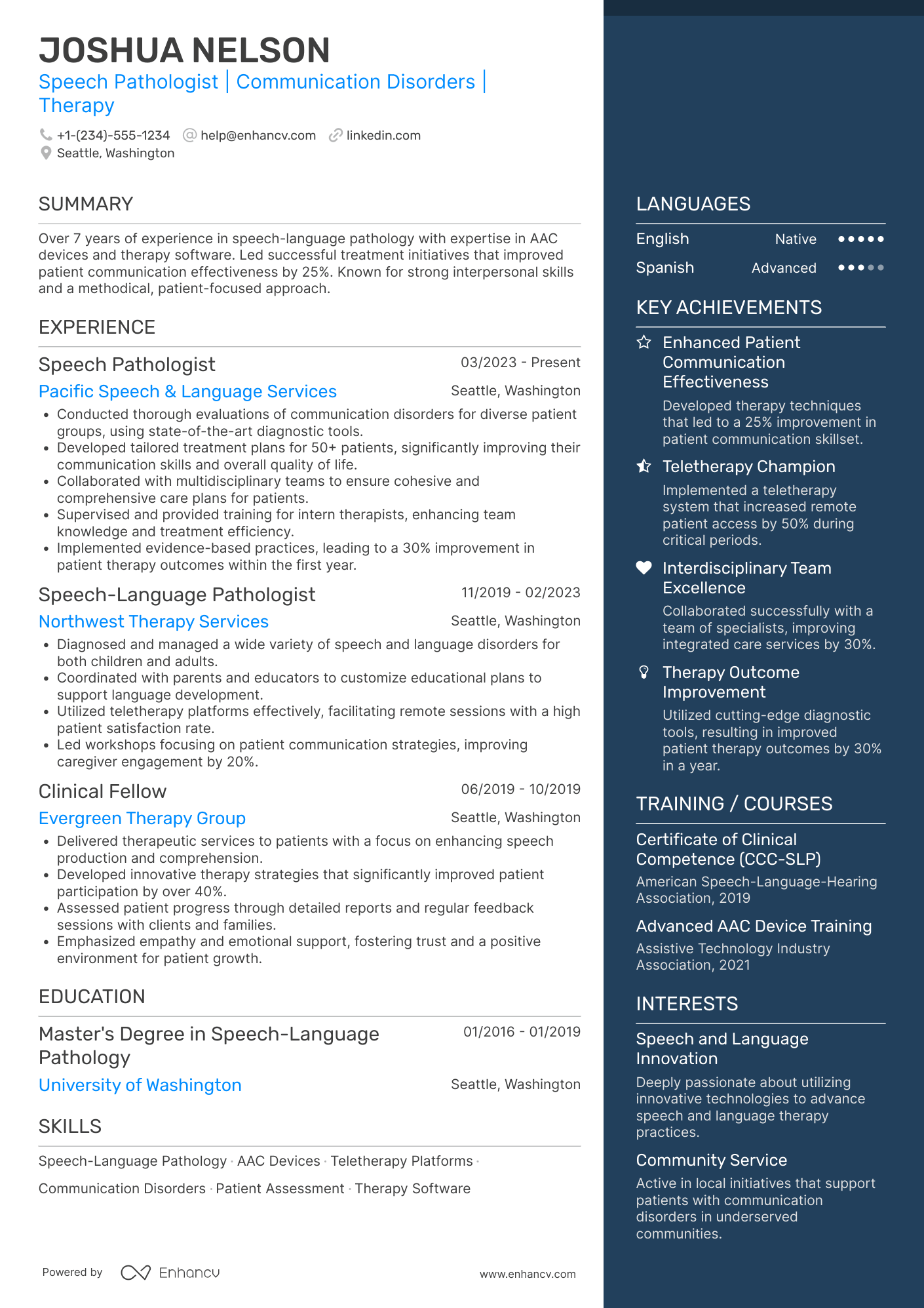
Many speech pathologist resume drafts fail because they read like therapy notes: task-heavy, acronym-filled, and light on measurable impact. That format gets filtered by ATS systems and skimmed in seconds, especially when competition is high.
A strong resume shows what changed because of your care, not just what you did. Understanding how to make your resume stand out means you'll highlight caseload size, progress rates, discharge outcomes, goal attainment, reduced wait times, improved caregiver adherence, fewer missed sessions, smoother IEP delivery, and stronger documentation quality.

Key takeaways
- Quantify caseload size, progress rates, and discharge outcomes instead of listing routine therapy duties.
- Use reverse-chronological format for experienced clinicians and hybrid format for career changers.
- Mirror the job posting's exact assessment tools, therapy approaches, and population terminology.
- Place certifications like the CCC-SLP near your education to confirm clinical readiness fast.
- Demonstrate skills through measurable experience bullets, not isolated lists of competencies.
- Enhancv can help you turn vague duties into specific, recruiter-ready resume bullets.
- Stop using AI once your resume accurately reflects real experience without inflated claims.
Job market snapshot for speech pathologists
We analyzed 418 recent speech pathologist job ads across major US job boards. These numbers help you understand industry demand, regional hotspots, top companies hiring at a glance.
What level of experience employers are looking for speech pathologists
| Years of Experience | Percentage found in job ads |
|---|---|
| 1–2 years | 8.6% (36) |
| 3–4 years | 0.5% (2) |
| 5–6 years | 0.5% (2) |
| 10+ years | 0.2% (1) |
| Not specified | 89.2% (373) |
Speech pathologist ads by area of specialization (industry)
| Industry (Area) | Percentage found in job ads |
|---|---|
| Healthcare | 85.4% (357) |
| Finance & Banking | 7.2% (30) |
| Education | 6.2% (26) |
Top companies hiring speech pathologists
| Company | Percentage found in job ads |
|---|---|
| Encompass Health Corp. | 17.5% (73) |
| Alexander Graham Bell Association for the Deaf and Hard of Hearing | 15.3% (64) |
| Amedisys Inc. | 7.4% (31) |
| Wellstar Health System, Inc. | 2.9% (12) |
| Indiana University Health | 2.4% (10) |
| LifePoint Hospitals | 2.4% (10) |
Role overview stats
These tables show the most common responsibilities and employment types for speech pathologist roles. Use them to align your resume with what employers expect and to understand how the role is structured across the market.
Day-to-day activities and top responsibilities for a speech pathologist
| Responsibility | Percentage found in job ads |
|---|---|
| Speech pathology | 24.4% (102) |
| Basic life support | 14.4% (60) |
| Speech language pathology | 13.2% (55) |
| Speech-language pathology | 12.0% (50) |
| Documentation | 10.3% (43) |
| Treatment planning | 8.9% (37) |
| Bls | 7.9% (33) |
| Bls certification | 7.2% (30) |
| Cpr | 7.2% (30) |
| Cpr certification | 7.2% (30) |
| Patient care | 7.2% (30) |
| Aural rehabilitation | 5.3% (22) |
How to format a speech pathologist resume
Recruiters evaluating speech pathologist resumes prioritize clinical competencies, caseload scope, setting diversity (schools, hospitals, private practice), and licensure credentials like the Certificate of Clinical Competence in Speech-Language Pathology (CCC-SLP). Choosing the right resume format ensures these signals surface immediately rather than getting buried beneath dense paragraphs or unconventional layouts that confuse both hiring managers and applicant tracking systems.

I have significant experience in this role—which format should I use?
Use a reverse-chronological format to present your clinical career in a clear, progressive timeline that highlights growing caseload responsibility and specialization depth. Do:
- Lead each role entry with the clinical setting, population served, and caseload size to establish scope and ownership of patient outcomes.
- Feature relevant tools, methodologies, and domains—such as AAC devices, PROMPT therapy, dysphagia management, or pediatric articulation protocols—within each position's bullet points.
- Quantify outcomes and business impact wherever possible, including discharge rates, caseload volumes, IEP compliance metrics, or measurable patient progress benchmarks.
I'm junior or switching into this role—what format works best?
A hybrid format works best because it lets you lead with relevant clinical skills and training while still providing a chronological work history that demonstrates practical application. Do:
- Place a dedicated skills section near the top of your resume featuring clinical competencies such as fluency disorders, speech sound assessment, and electronic health record documentation.
- Include your Clinical Fellowship (CF), graduate practicum placements, volunteer therapy work, or related roles (such as teaching or behavioral health support) as substantive experience entries.
- Connect every action to a result—even in academic or transitional settings—to demonstrate clinical reasoning and patient impact from the start.
Why not use a functional resume?
A functional format strips away the clinical context—setting, population, and timeline—that hiring managers need to evaluate whether your therapy experience aligns with their caseload demands and compliance requirements. A functional format may make sense in a narrow set of circumstances:
- You're transitioning into speech pathology from a related field, such as occupational therapy, special education, or linguistics, and need to reframe transferable clinical skills.
- You have a significant gap in clinical employment but completed continuing education, volunteer therapy hours, or telepractice work during that period.
- You hold a CCC-SLP but spent several years in a non-clinical role (research, administration) and are returning to direct patient care.
- A functional resume is acceptable only when you have no direct speech pathology employment history to list, but you must still tie every skill to a specific project, practicum, or measurable outcome rather than listing competencies in isolation.
Once you've established a clean, readable format, the next step is deciding which sections to include and how to arrange them for maximum impact.
What sections should go on a speech pathologist resume
Recruiters expect to quickly find your clinical focus, credentials, and measurable patient outcomes on your speech pathologist resume. Knowing which resume sections to include ensures maximum clarity:
- Header
- Summary
- Experience
- Skills
- Projects
- Education
- Certifications
- Optional sections: Awards, Publications, Volunteering
Strong experience bullets should emphasize caseload scope, assessment and treatment outcomes, collaboration across care teams, and measurable progress toward patient goals.
Is your resume good enough?
Drop your resume here or choose a file. PDF & DOCX only. Max 2MB file size.
Once you’ve organized your resume with the right set of sections, the next step is to write your speech pathologist resume experience in a way that supports each section with clear, relevant detail.
How to write your speech pathologist resume experience
The experience section is where you prove you've delivered meaningful clinical outcomes—not just performed routine duties. Hiring managers reviewing speech pathologist resumes prioritize demonstrated impact through evidence-based treatment methods, measurable patient progress, and role-relevant diagnostic tools over generic task descriptions. Building a targeted resume ensures each entry speaks directly to the role you're pursuing.
Each entry should include:
- Job title
- Company and location (or remote)
- Dates of employment (month and year)
Three to five concise bullet points showing what you owned, how you executed, and what outcomes you delivered:
- Ownership scope: the caseloads, patient populations, therapy programs, or clinical service areas you were directly accountable for as a speech pathologist.
- Execution approach: the assessment instruments, treatment protocols, augmentative and alternative communication systems, or evidence-based therapeutic frameworks you applied to diagnose and treat speech, language, and swallowing disorders.
- Value improved: changes to patient communication outcomes, treatment plan effectiveness, session efficiency, service accessibility, or documentation accuracy resulting from your clinical decisions.
- Collaboration context: how you coordinated with interdisciplinary teams—including occupational therapists, teachers, physicians, caregivers, and special education staff—to align on individualized treatment goals and patient care plans.
- Impact delivered: outcomes framed as clinical results, caseload scale, program growth, or improvements in patient functional independence rather than a list of daily therapeutic activities.
Experience bullet formula
A speech pathologist experience example
✅ Right example - modern, quantified, specific.
Speech-Language Pathologist (SLP)
Riverside Children’s Therapy Center | Austin, TX
2022–Present
Outpatient pediatric clinic supporting school-age and early intervention clients with speech, language, and feeding needs.
- Administered and interpreted standardized assessments (CELF-5, GFTA-3, PLS-5) and language sampling (SALT) to cut evaluation turnaround time from ten days to five days while maintaining a 98% documentation accuracy rate in the electronic health record (Epic).
- Designed and executed individualized treatment plans using evidence-based methods (Cycles Approach, Minimal Pairs, Hanen strategies), improving intelligibility by 22% on clinic rating scales across a caseload of thirty-five clients within twelve weeks.
- Implemented augmentative and alternative communication (AAC) systems (TD Snap, Proloquo2Go) and coordinated device trials with vendors and caregivers, increasing functional communication attempts by 40% and reducing behavior-related session disruptions by 18%.
- Partnered with occupational therapists, board certified behavior analysts, and school individualized education program teams to align goals and carryover plans, boosting home program adherence from 55% to 78% and increasing session-to-session skill generalization by 25%.
- Streamlined progress monitoring with goal banks, rubrics, and automated data collection templates in the electronic health record (Epic), saving three hours per week and improving on-time reauthorization submissions from 86% to 97%.
Now that you've seen how a strong experience section comes together, let's look at how to adjust those details to match the specific job you're targeting.
How to tailor your speech pathologist resume experience
Recruiters evaluate your speech pathologist resume through applicant tracking systems and manual review. Tailoring your resume to the job description helps you clear both screens.
Ways to tailor your speech pathologist experience:
- Match specific assessment tools or standardized tests listed in the posting.
- Use the exact therapy approach terminology the job description names.
- Mirror caseload size or patient volume metrics the employer references.
- Include relevant clinical settings like schools hospitals or private practice.
- Highlight ASHA certification and state licensure requirements they specify.
- Reflect documentation systems or electronic health records the role requires.
- Emphasize interdisciplinary collaboration models described in the posting.
- Align your population experience with the age groups they serve.
The goal is to frame your real clinical achievements using language that directly reflects what the employer is asking for.
Resume tailoring examples for speech pathologist
| Job description excerpt | Untailored | Tailored |
|---|---|---|
| Provide assessment and treatment for pediatric patients with articulation, fluency, and language disorders using evidence-based practices such as PROMPT and Hanen techniques. | Worked with children on speech and language skills in a clinical setting. | Delivered individualized articulation and fluency therapy to a caseload of 45 pediatric patients, applying PROMPT and Hanen techniques to achieve measurable progress on 80% of IEP goals within six months. |
| Collaborate with multidisciplinary teams including occupational therapists, teachers, and BCBAs to develop and implement AAC solutions for nonverbal students in a K–5 school setting. | Participated in team meetings and helped plan treatment for students. | Partnered with occupational therapists, teachers, and BCBAs to design and implement AAC systems—including TouchChat and LAMP—for 12 nonverbal students across three K–5 classrooms, increasing functional communication initiations by 40%. |
| Conduct modified barium swallow studies (MBSS) and provide dysphagia treatment for adult and geriatric patients in an acute care hospital environment. | Treated patients with swallowing difficulties and documented progress. | Performed an average of eight modified barium swallow studies per week in acute care, diagnosing and treating oropharyngeal dysphagia in adult and geriatric patients while reducing aspiration pneumonia readmission rates by 15% over one year. |
Once you’ve aligned your experience with the role’s priorities, quantify your speech pathologist achievements to show the impact of that work in measurable terms.
How to quantify your speech pathologist achievements
Quantifying your work proves clinical impact and operational value. Quantifying achievements means tracking therapy volume, outcome gains, evaluation turnaround time, documentation accuracy, and safety or compliance improvements across your caseload, setting, and age groups.
Quantifying examples for speech pathologist
| Metric | Example |
|---|---|
| Caseload volume | "Managed a caseload of 38 K-5 students and delivered 24 to 28 therapy sessions weekly while maintaining 100% IEP service minutes." |
| Outcome improvement | "Improved articulation accuracy from 62% to 85% over 12 weeks for a group of eight students using minimal pairs and structured home practice." |
| Evaluation turnaround | "Cut initial evaluation turnaround from 14 days to six days by standardizing intake checklists and using a shared scheduling tracker." |
| Documentation compliance | "Raised Medicaid billing documentation accuracy from 90% to 98% by auditing ten notes weekly and retraining staff on required elements." |
| Risk reduction | "Reduced aspiration incidents by 40% on a 24-bed skilled nursing unit by implementing a dysphagia screening protocol and staff swallow-safety training." |
Turn vague job duties into measurable, recruiter-ready resume bullets in seconds with Enhancv's Bullet Point Generator.
With your experience clearly articulated in strong bullet points, the next step is ensuring your skills section showcases the right mix of hard and soft skills that hiring managers expect from a speech pathologist.
How to list your hard and soft skills on a speech pathologist resume
Your skills section shows recruiters and an ATS (applicant tracking system) you can assess, treat, and document communication and swallowing disorders, and it should balance role-specific clinical hard skills with job-relevant soft skills that support patient outcomes and care-team coordination. speech pathologist roles require a blend of:
- Product strategy and discovery skills.
- Data, analytics, and experimentation skills.
- Delivery, execution, and go-to-market discipline.
- Soft skills.
Your skills section should be:
- Scannable (bullet-style grouping).
- Relevant to the job post.
- Backed by proof in experience bullets.
- Updated with current tools.
Place your skills section:
- Above experience if you're junior or switching careers.
- Below experience if you're mid/senior with strong achievements.

Hard skills
- Speech and language evaluation
- Dysphagia assessment and treatment
- Modified barium swallow study support
- Fiberoptic endoscopic evaluation of swallowing support
- AAC assessment and device programming
- Articulation, phonology intervention
- Language intervention planning
- Voice evaluation and therapy
- Fluency evaluation and stuttering treatment
- Cognitive-communication therapy
- Goal writing, SOAP documentation
- EHR documentation, HIPAA compliance
Soft skills
- Patient and caregiver education
- Interdisciplinary care coordination
- Clinical decision-making under constraints
- Treatment planning and prioritization
- Rapport-building with diverse patients
- Clear, empathetic counseling
- Progress updates to stakeholders
- Conflict de-escalation in sessions
- Time management across caseloads
- Adapt therapy to patient response
- Advocate for patient needs
- Follow-through on care plans
How to show your speech pathologist skills in context
Skills shouldn't live only in a bulleted list on your resume. Explore examples of resume skills shown in context to see how top candidates integrate them throughout their documents.
They should be demonstrated in:
- Your summary (high-level professional identity)
- Your experience (proof through outcomes)
Here's what both look like in practice.
Summary example
Senior speech-language pathologist with 10+ years in pediatric rehabilitation. Skilled in AAC implementation, PROMPT therapy, and family-centered coaching. Improved functional communication outcomes by 35% across a 60-patient caseload through individualized, evidence-based treatment planning.
- Reflects senior-level expertise clearly
- Names specific tools and methods
- Includes a strong measurable outcome
- Highlights collaboration through coaching
Experience example
Senior Speech-Language Pathologist
Bright Horizons Pediatric Therapy | Austin, TX
March 2018–Present
- Implemented AAC devices for 45+ nonverbal patients, increasing functional communication scores by 40% within six months.
- Collaborated with occupational therapists and educators to design integrated treatment plans, improving IEP goal achievement rates by 28%.
- Trained four junior clinicians on PROMPT technique, reducing average session-plan development time by 20%.
- Every bullet contains measurable proof.
- Skills appear naturally within achievements.
Once you’ve tied your clinical strengths to real outcomes and settings, the next step is to apply that same approach to building a speech pathologist resume when you don’t have formal experience yet.
How do I write a speech pathologist resume with no experience
Even without full-time experience, you can demonstrate readiness through clinical and academic work. Our guide on writing a resume without work experience covers strategies that apply directly to entry-level speech pathologists:
- Clinical practicum therapy sessions
- University speech clinic caseload
- Supervised screening and assessment
- Individualized treatment plan writing
- Progress notes and data tracking
- IEP meeting observation and support
- AAC device setup and trials
- Teletherapy sessions under supervision
Focus on:
- Assessment tools and scoring accuracy
- Treatment planning tied to data
- Documentation quality and compliance
- Population and setting exposure
Resume format tip for entry-level speech pathologist
Use a combination resume format because it highlights clinical skills and supervised experiences before limited work history. Do:
- Start with clinical skills and tools.
- List practicum by setting and population.
- Add assessments, protocols, and scoring.
- Quantify caseload, sessions, and outcomes.
- Include documentation and billing exposure.
- Delivered twelve supervised articulation sessions using GFTA-3 screening and weekly data tracking, improving target sound accuracy from 40% to 70% over six weeks.
Once you've positioned your limited experience in the best light, the next step is ensuring your education section reinforces your qualifications—since for entry-level candidates, it often carries the most weight.
How to list your education on a speech pathologist resume
Your education section helps hiring teams confirm you hold the foundational knowledge required for clinical practice. It validates your academic preparation as a speech pathologist.
Include:
- Degree name
- Institution
- Location
- Graduation year
- Relevant coursework (for juniors or entry-level candidates)
- Honors & GPA (if 3.5 or higher)
Skip month and day details—list the graduation year only.
Here's a strong education entry tailored for a speech pathologist resume:
Example education entry
Master of Science in Speech-Language Pathology
Emerson College, Boston, MA
Graduated 2021
GPA: 3.8/4.0
- Relevant coursework: Fluency Disorders, Augmentative Communication, Pediatric Dysphagia, and Neurogenic Language Disorders
- Honors: Summa Cum Laude, Dean's List all semesters
How to list your certifications on a speech pathologist resume
Certifications on a resume show a speech pathologist's commitment to ongoing learning, proficiency with clinical tools, and alignment with current standards across pediatric and adult care settings. Include:
- Certificate name
- Issuing organization
- Year
- Optional: credential ID or URL
- Place certifications below education when your degree is recent and your certifications add support rather than define your specialization.
- Place certifications above education when they are recent, highly relevant to the role, or required for the speech pathologist position.
Best certifications for your speech pathologist resume
- Certificate of Clinical Competence in Speech-Language Pathology (CCC-SLP)
- Board Certified Specialist in Swallowing and Swallowing Disorders (BCS-S)
- Hanen Certified Speech-Language Pathologist
- PROMPT Trained Clinician
- PECS Level 1 Certification
- LSVT LOUD Certification
- VitalStim Therapy Certification
Once you’ve highlighted the credentials that validate your licensure and expertise, the next step is to write your speech pathologist resume summary so those qualifications support a clear, targeted first impression.
How to write your speech pathologist resume summary
Your resume summary is the first thing a recruiter reads, so it needs to earn their attention fast. A strong opening frames your clinical expertise and sets you apart from other speech pathologist candidates.
Keep it to three to four lines, with:
- Your title and total years of clinical speech pathology experience.
- The setting you work in, such as pediatric, acute care, or school-based.
- Core skills like dysphagia management, AAC devices, or articulation therapy.
- One or two measurable achievements, such as caseload size or patient outcome improvements.
- Soft skills tied to real results, like collaboration that improved IEP completion rates.

PRO TIP
At this level, emphasize clinical skills, relevant certifications, and early wins that show you can handle a caseload independently. Highlight specific populations you've treated and tools you've used. Avoid vague phrases like "passionate about helping others" or "strong communicator." Let concrete results speak for you instead.
Example summary for a speech pathologist
ASHA-certified speech pathologist with three years of pediatric experience across school and outpatient settings. Skilled in articulation therapy and AAC implementation, improving functional communication goals by 30% across a 45-student caseload.
Optimize your resume summary and objective for ATS
Drop your resume here or choose a file.
PDF & DOCX only. Max 2MB file size.
Now that your summary is ready to showcase your qualifications at a glance, make sure your header provides the essential contact details recruiters need to actually reach you.
What to include in a speech pathologist resume header
Your resume header lists your key contact and professional details, helping a speech pathologist stay visible, credible, and easy to screen quickly.
Essential resume header elements
- Full name
- Tailored job title and headline
- Location
- Phone number
- Professional email
- GitHub link
- Portfolio link
A LinkedIn link helps recruiters verify experience quickly and supports screening.
Do not include photos on a speech pathologist resume unless the role is explicitly front-facing or appearance-dependent.
Use a clear job title that matches the posting, and keep every link short, accurate, and easy to copy.
Example
Speech pathologist resume header
Jordan Lee
Speech pathologist | Pediatric speech and language therapy
Austin, TX
(512) 555-12XX
jordan.lee@enhancv.com github.com/jordanlee yourwebsite.com linkedin.com/in/jordanlee
Once your contact details and key credentials are clearly presented at the top, you can strengthen your application with additional resume sections that add relevant context and support.
Additional sections for speech pathologist resumes
Beyond core qualifications, additional sections help you stand out by showcasing unique strengths directly relevant to clinical practice and patient outcomes. For example, listing language skills on your resume can demonstrate your ability to serve diverse patient populations.
- Languages
- Certifications and licenses
- Publications and research
- Professional affiliations
- Continuing education
- Volunteer experience in communication disorders
- Conference presentations
Once you've strengthened your resume with relevant additional sections, the next step is pairing it with a cover letter to give hiring managers a fuller picture of your qualifications.
Do speech pathologist resumes need a cover letter
A cover letter isn't required for every speech pathologist role. If you're unsure what a cover letter is and when it matters, it helps most for competitive openings, hospital systems, and school districts with strict hiring steps. It can also make a difference when your resume doesn't clearly show fit.
Use a cover letter to add context your resume can't:
- Explain role and team fit by matching your setting experience to the caseload, schedule, documentation style, and collaboration needs.
- Highlight one or two outcomes, such as improved functional communication scores, reduced discharge delays, or higher session attendance.
- Show you understand the organization's users and constraints, including families, teachers, physicians, payer rules, and care pathways.
- Address career transitions or non-obvious experience by connecting transferable skills to speech pathologist responsibilities and required competencies.
Drop your resume here or choose a file.
PDF & DOCX only. Max 2MB file size.
Even if you decide to include a cover letter to add context, using AI to improve your speech pathologist resume helps you strengthen the document recruiters review first.
Using AI to improve your speech pathologist resume
AI can sharpen your resume's clarity, structure, and impact. It helps refine wording and highlight measurable results. But overuse strips away authenticity. Once your content feels clear and role-aligned, step away from AI. If you're wondering which AI is best for writing resumes, the key is choosing tools that enhance rather than fabricate your experience.
Here are 10 practical prompts to strengthen specific sections of your speech pathologist resume:
- Strengthen your summary. "Rewrite my speech pathologist resume summary to highlight clinical specialties, patient populations, and years of experience in under four sentences."
- Quantify experience bullets. "Add measurable outcomes to these speech pathologist experience bullets, focusing on caseload size, progress rates, and treatment frequency."
- Tailor skills placement. "Reorganize my speech pathologist skills section to prioritize abilities matching this job description, removing irrelevant or redundant entries."
- Sharpen action verbs. "Replace weak or repetitive verbs in my speech pathologist experience section with precise clinical action verbs that show direct patient impact."
- Refine certification details. "Rewrite my speech pathologist certifications section to clearly list credential names, issuing bodies, and current status in a consistent format."
- Clarify education entries. "Edit my speech pathologist education section to emphasize relevant coursework, clinical practicum hours, and any honors or distinctions earned."
- Improve project descriptions. "Rewrite my speech pathologist project descriptions to highlight goals, methods, patient outcomes, and collaboration with multidisciplinary teams."
- Remove filler language. "Identify and remove vague or filler phrases throughout my speech pathologist resume, replacing them with specific, evidence-based language."
- Align with job posting. "Compare my speech pathologist resume against this job posting and suggest targeted edits to close gaps in terminology and qualifications."
- Tighten bullet length. "Shorten each speech pathologist experience bullet to one concise line that leads with an action verb and ends with a clear result."
Stop using AI once your resume sounds accurate, specific, and aligned with real experience. AI should never invent experience or inflate claims—if it didn't happen, it doesn't belong here.
Conclusion
A strong speech pathologist resume shows measurable outcomes, role-specific skills, and a clear structure. Use specific numbers for progress, caseloads, and timelines. Highlight assessment, treatment planning, documentation, and collaboration in language employers can scan fast.
Keep every section focused on impact and fit for the role. A clean format and targeted keywords show you’re ready for today’s hiring market and near-future needs. When your results and skills are easy to find, your resume works harder for you.
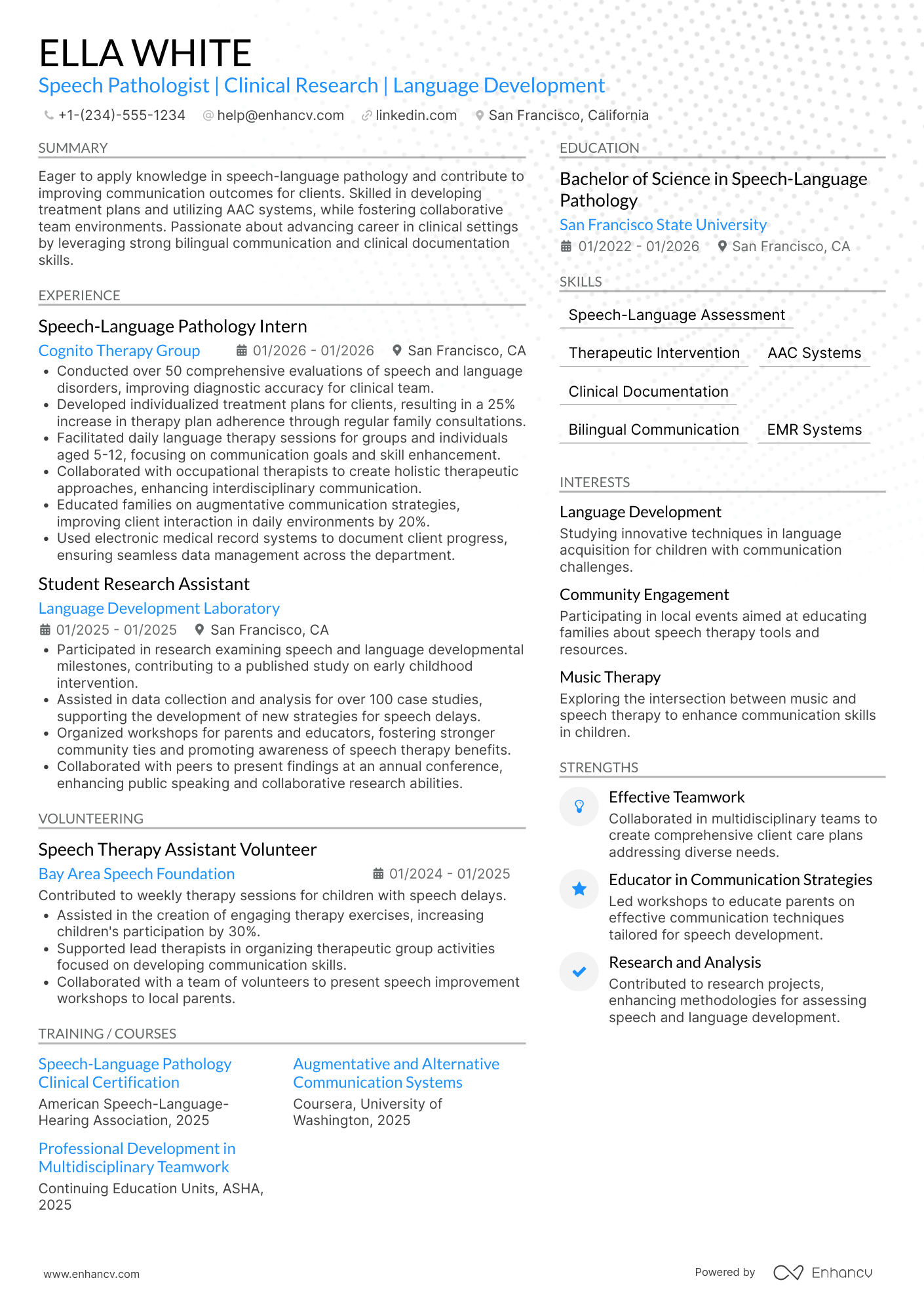
Speech Pathologist resume examples
By Experience
By Role