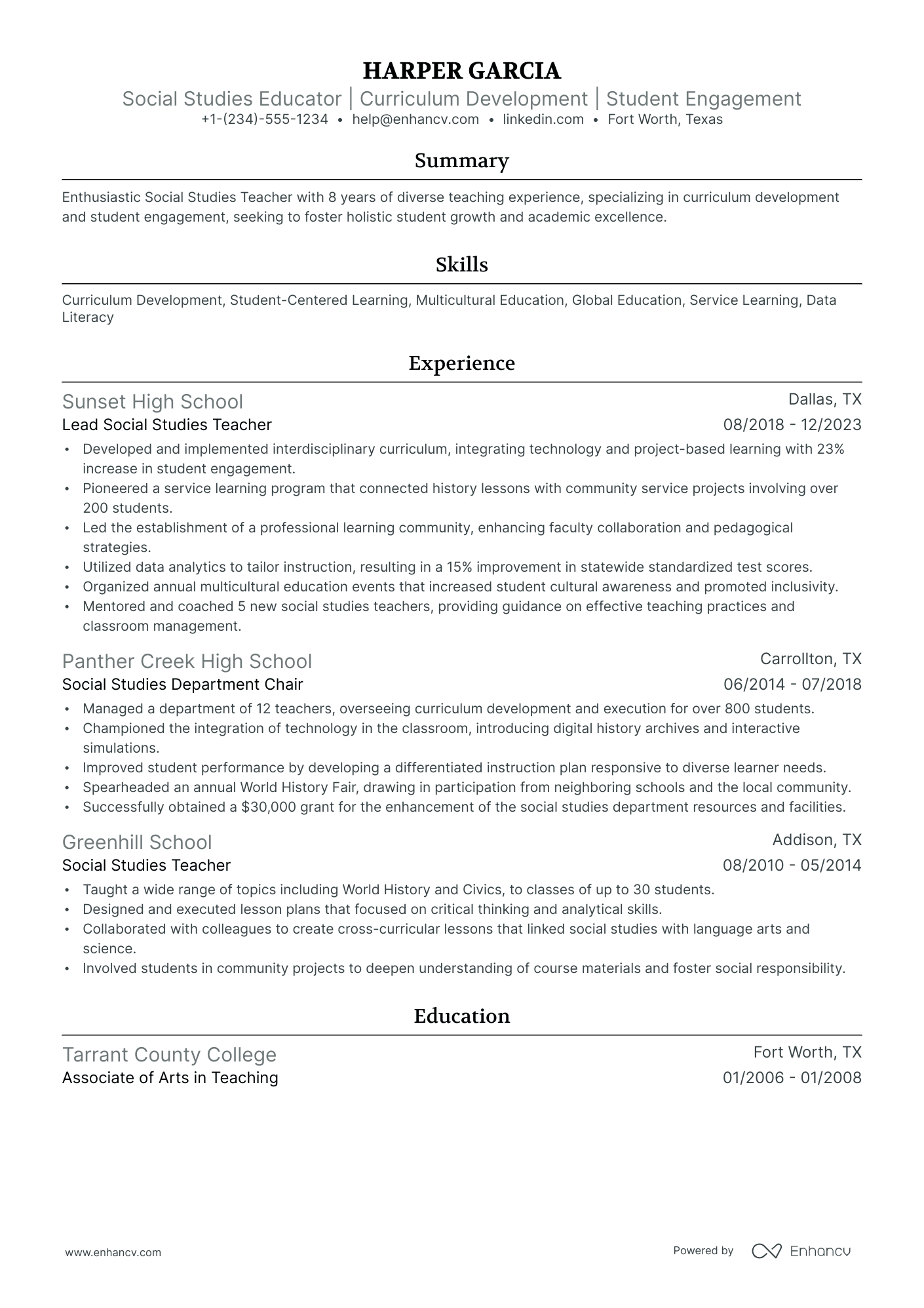
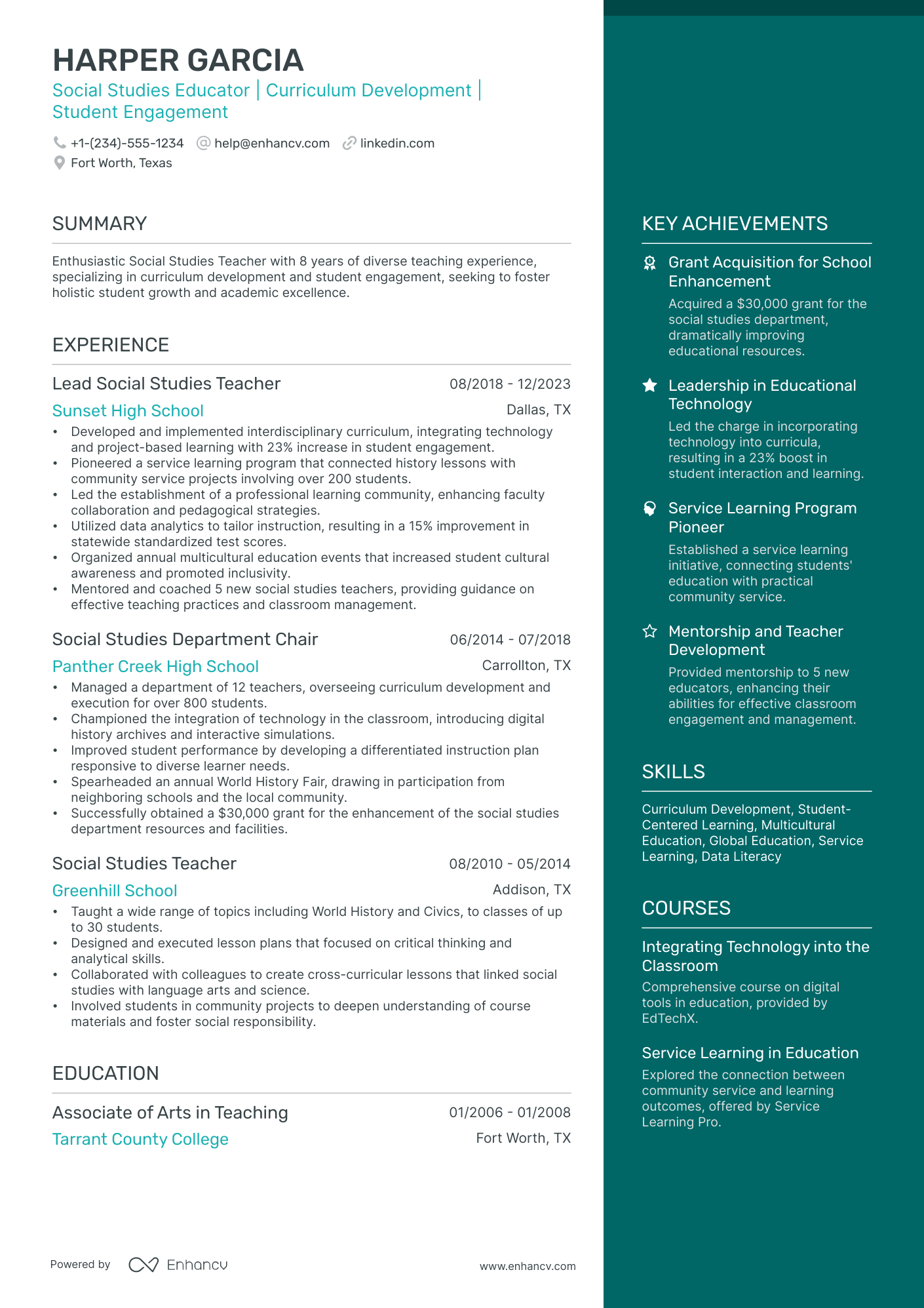
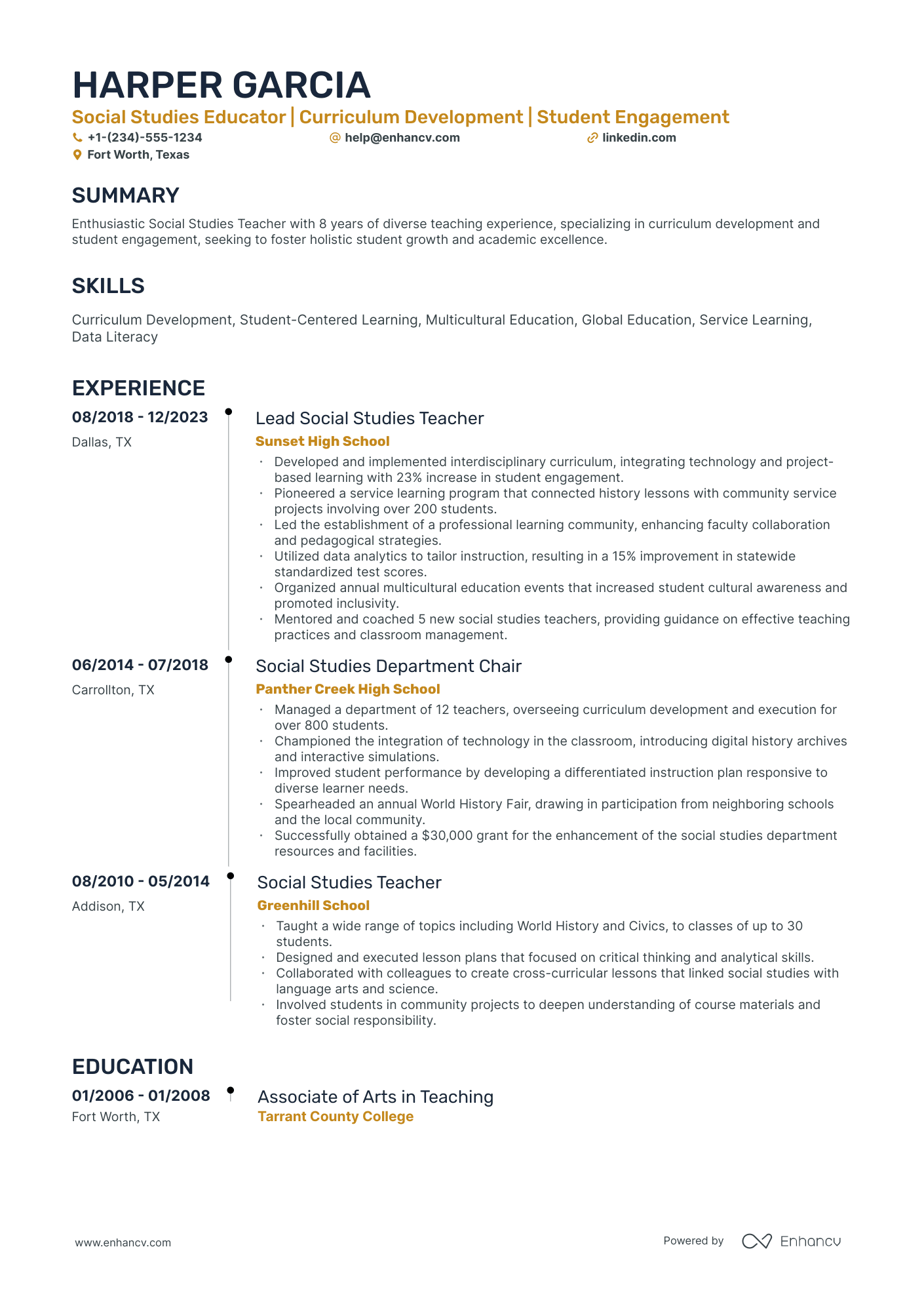
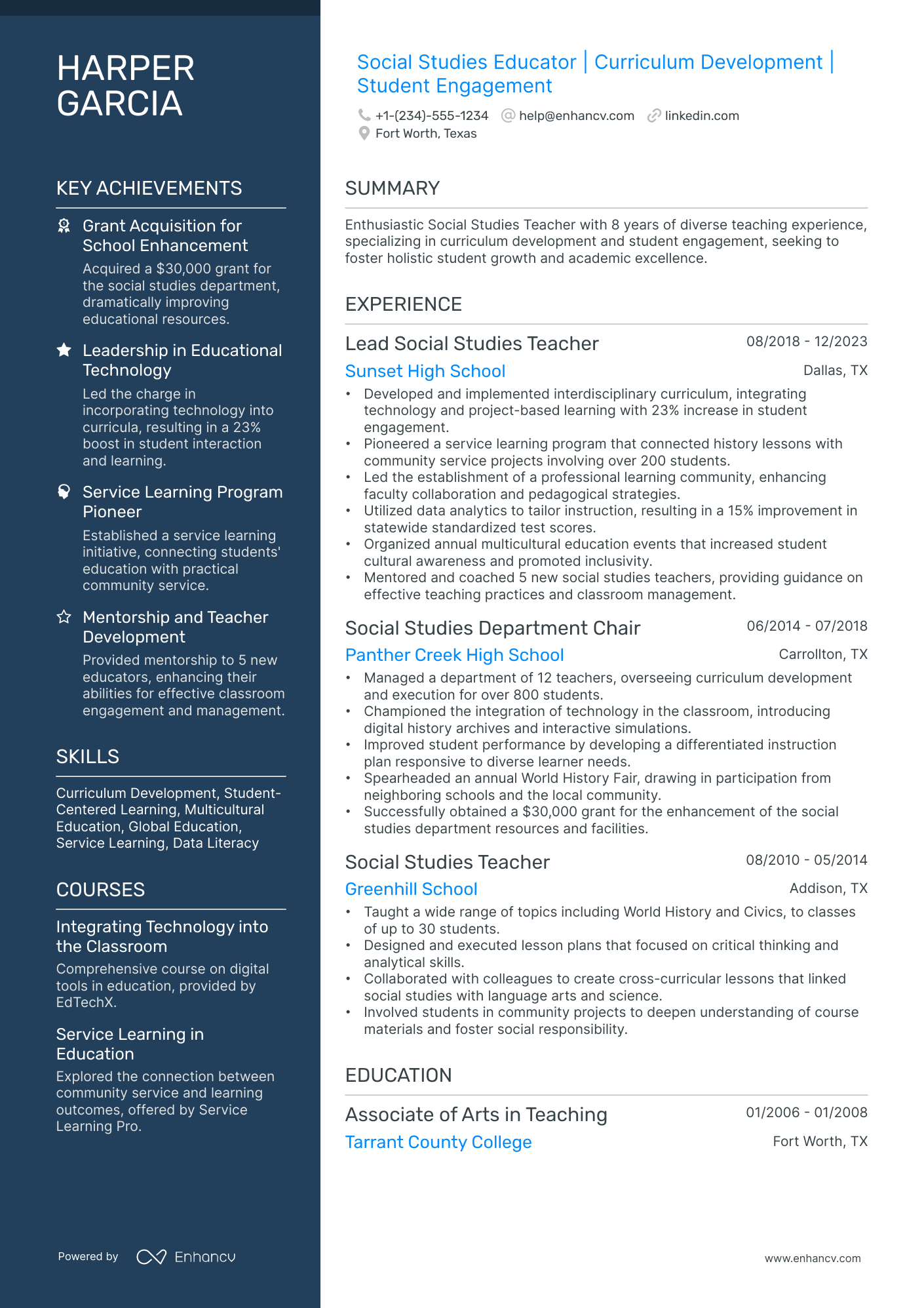
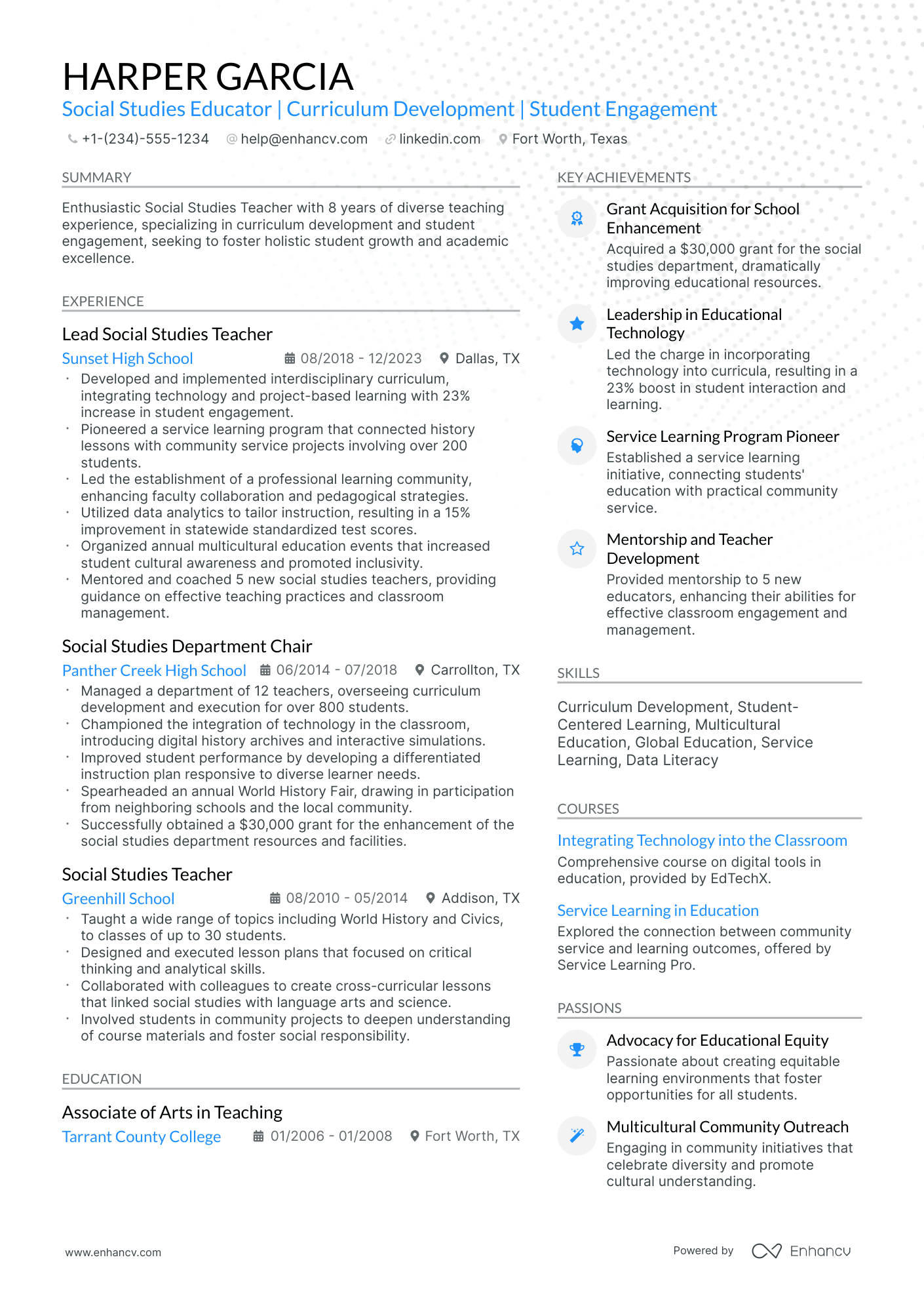
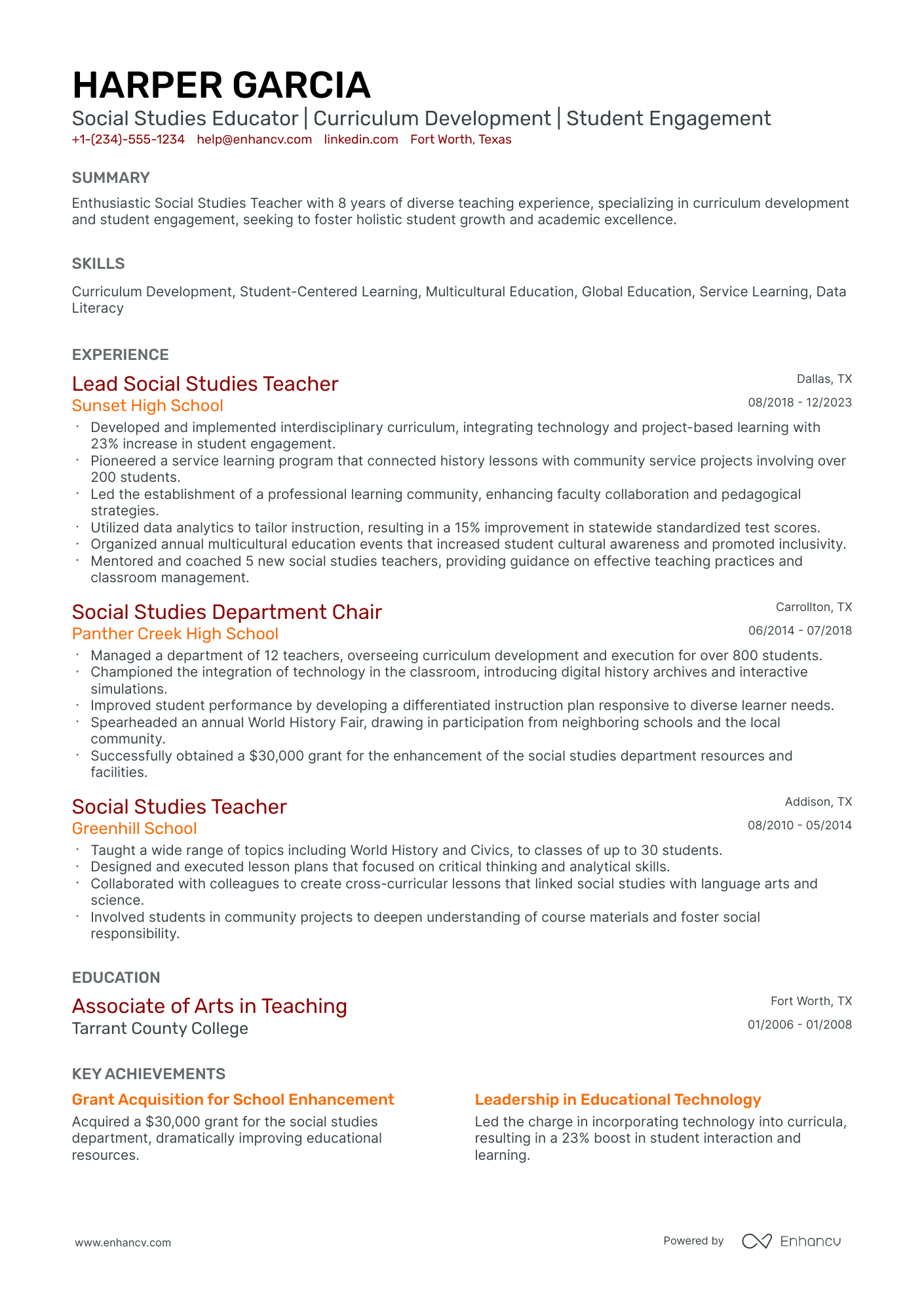
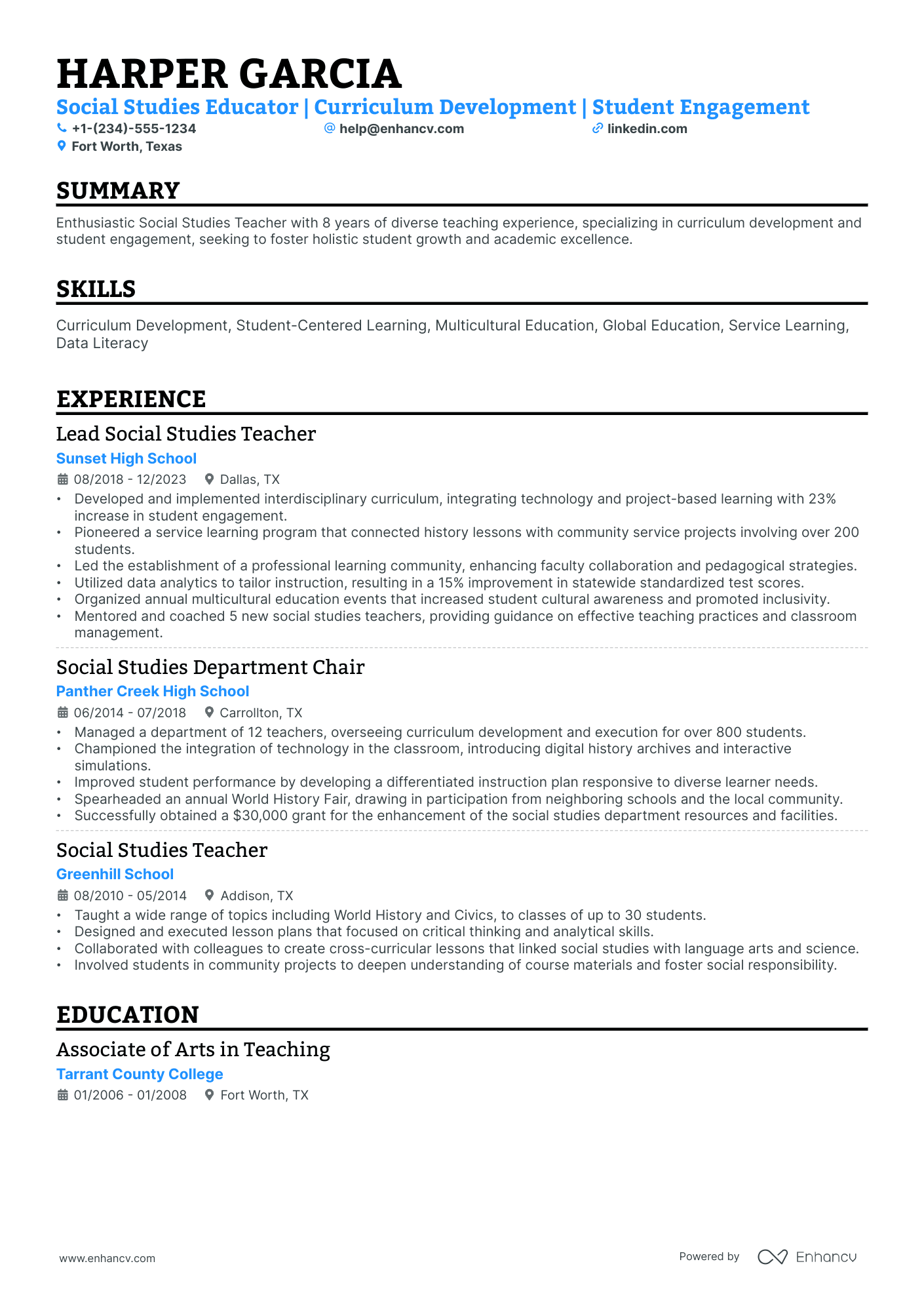
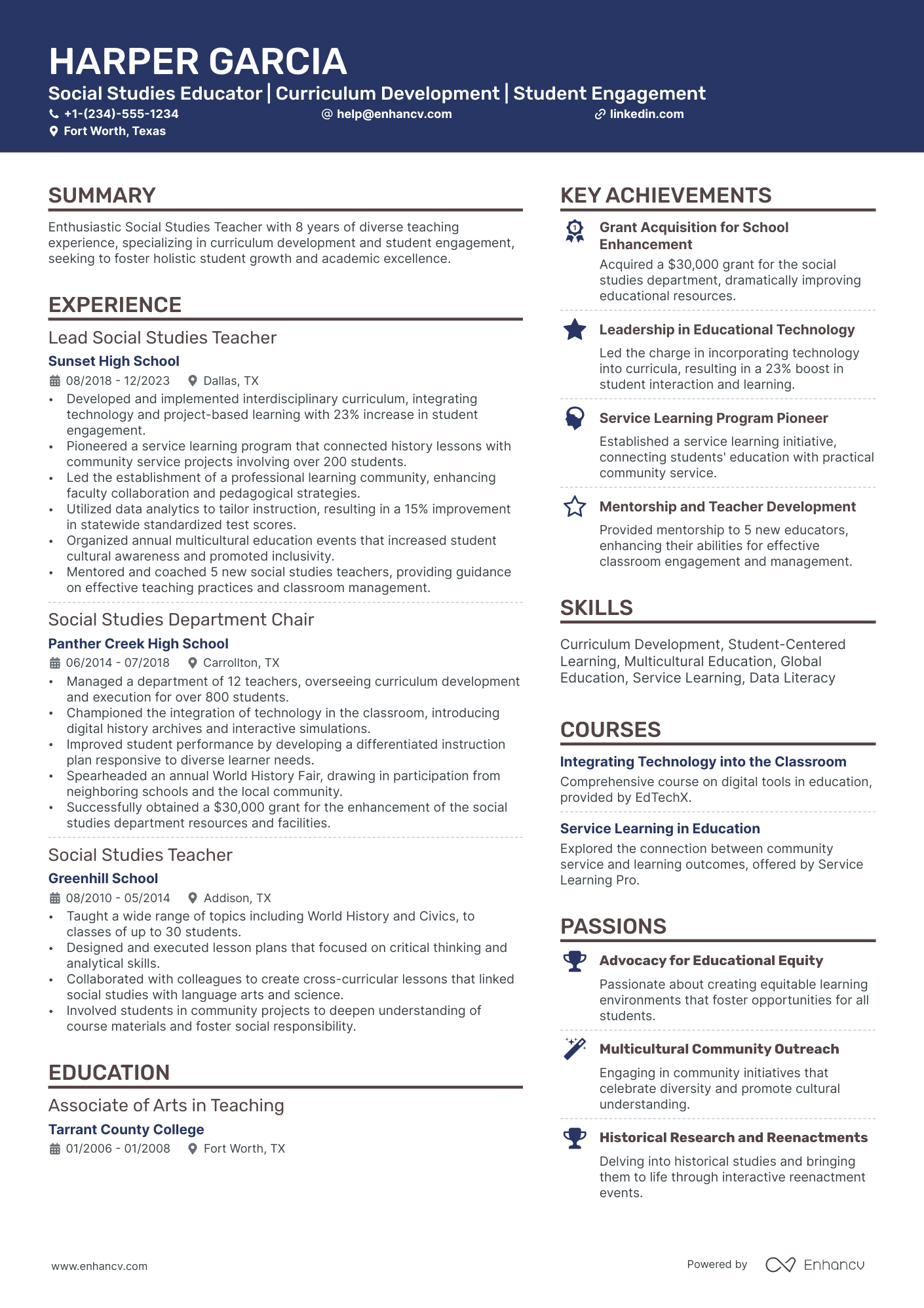
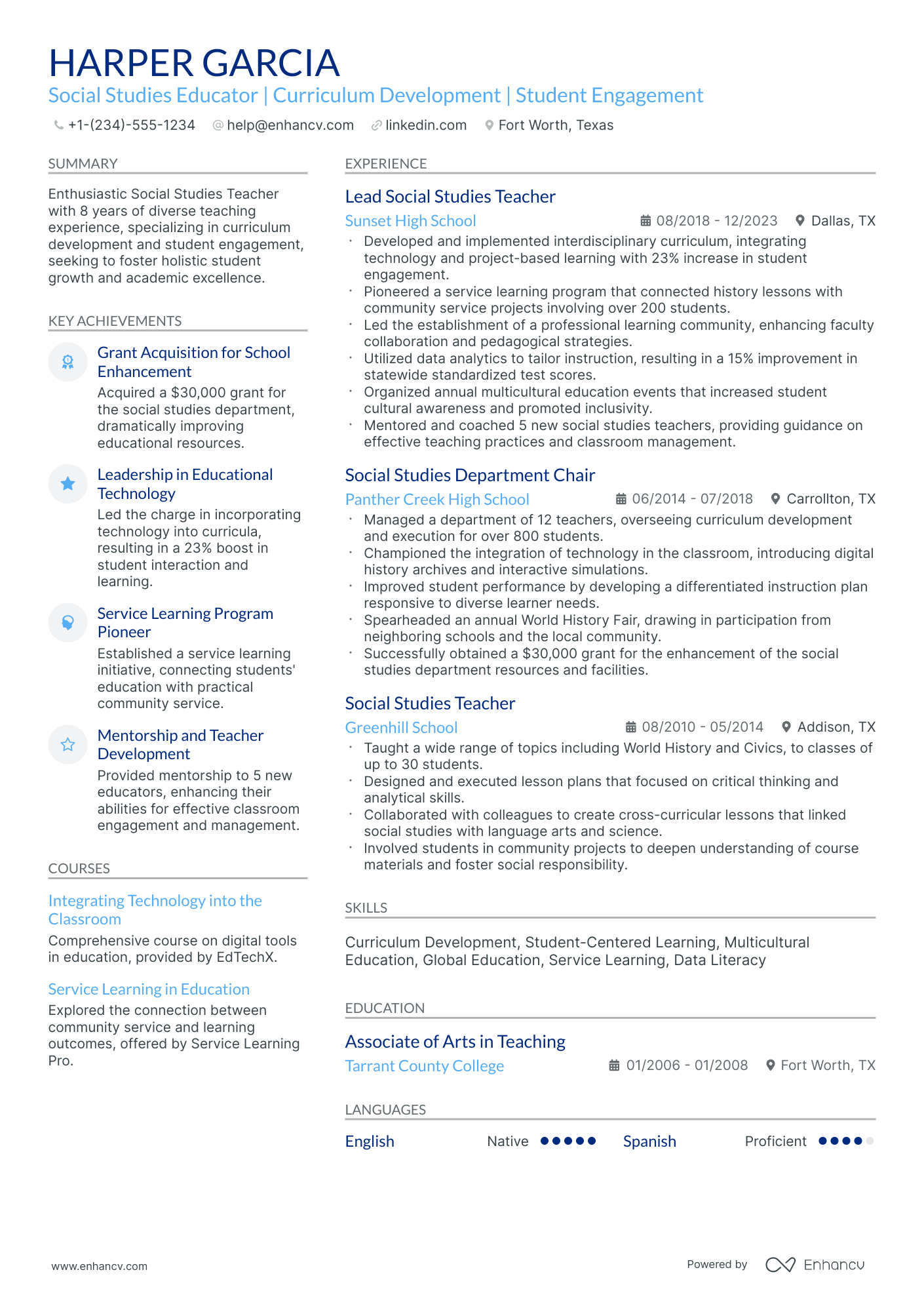
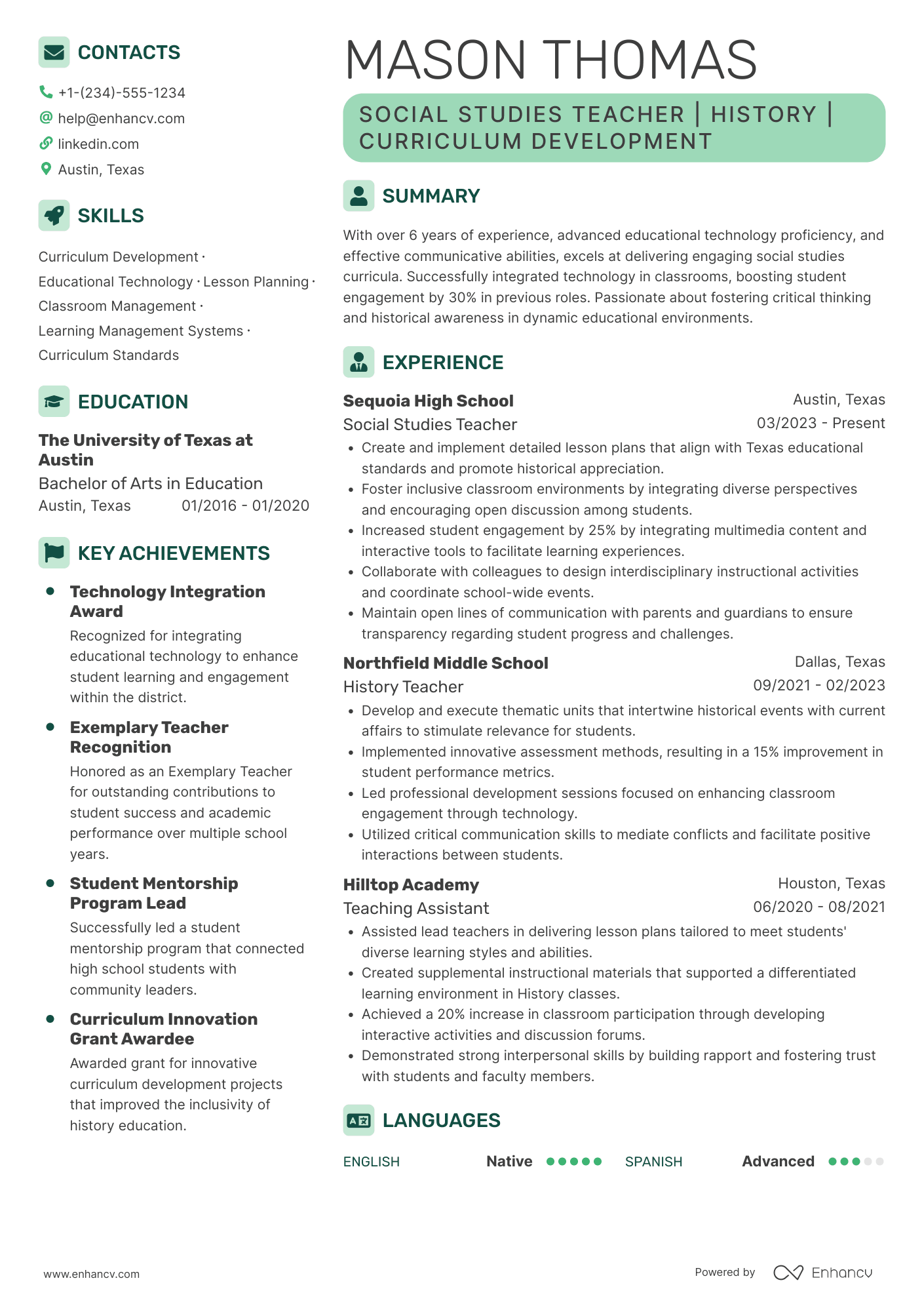
Many social studies teacher resumes fail because they list duties but don't show measurable learning impact or standards alignment. A social studies teacher resume must also scan cleanly for an ATS (applicant tracking system) and stand out in fast recruiter reviews.
A strong resume shows what changed because of your teaching. Knowing how to write a resume that highlights growth in assessment scores, improved literacy in primary source analysis, higher pass rates, stronger project completion, and successful curriculum launches across multiple grade levels is essential.

Key takeaways
- Quantify student outcomes like assessment growth, engagement rates, and pass rates in every bullet.
- Use reverse-chronological format for experienced teachers and hybrid format for career changers.
- Tailor experience bullets to each job posting's standards, tools, and instructional language.
- Demonstrate skills through measurable accomplishments, not isolated keyword lists.
- Place certifications above or below education based on their relevance to the specific role.
- Write a three-to-four-line summary with subject areas, core skills, and one concrete result.
- Use Enhancv to turn routine teaching duties into quantified, recruiter-ready resume bullets.
Job market snapshot for social studies teachers
We analyzed 216 recent social studies teacher job ads across major US job boards. These numbers help you understand salary landscape, employer expectations, industry demand at a glance.
What level of experience employers are looking for social studies teachers
| Years of Experience | Percentage found in job ads |
|---|---|
| 1–2 years | 1.9% (4) |
| 3–4 years | 0.5% (1) |
| 10+ years | 0.9% (2) |
| Not specified | 93.5% (202) |
Social studies teacher ads by area of specialization (industry)
| Industry (Area) | Percentage found in job ads |
|---|---|
| Education | 79.2% (171) |
| Finance & Banking | 12.0% (26) |
| Healthcare | 8.8% (19) |
Top companies hiring social studies teachers
| Company | Percentage found in job ads |
|---|---|
| Indiana Public Schools | 5.1% (11) |
Role overview stats
These tables show the most common responsibilities and employment types for social studies teacher roles. Use them to align your resume with what employers expect and to understand how the role is structured across the market.
Day-to-day activities and top responsibilities for a social studies teacher
| Responsibility | Percentage found in job ads |
|---|---|
| Lesson planning | 10.6% (23) |
| Curriculum development | 8.3% (18) |
| Classroom management | 7.9% (17) |
| Data analysis | 7.4% (16) |
| Student assessment | 6.5% (14) |
| Instructional strategies | 4.2% (9) |
| Curriculum | 3.7% (8) |
| Instructional technology | 3.7% (8) |
| Technology integration | 3.7% (8) |
| Computer | 3.2% (7) |
| Software applications | 3.2% (7) |
| Communication | 2.8% (6) |
How to format a social studies teacher resume
Recruiters hiring social studies teachers prioritize classroom management experience, curriculum development skills, content-area expertise (history, government, economics, geography), and evidence of student achievement gains. A clean, well-organized resume format ensures these signals surface quickly during the six-to-ten-second initial scan and passes through an ATS (applicant tracking system) without formatting errors stripping away critical details.

I have significant experience as a social studies teacher—which format should I use?
Use a reverse-chronological format to present your teaching career in a clear, linear progression that highlights growing responsibility and classroom impact. Do:
- Lead each position entry with your scope of responsibility—grade levels taught, number of students per year, and any department or curriculum leadership roles you held.
- Feature content-area expertise and instructional tools prominently, including learning management systems (Google Classroom, Canvas), state standards alignment, and assessment design methods.
- Quantify student outcomes and program results wherever possible, tying your instruction directly to measurable achievement data.
I'm junior or switching into a social studies teaching role—what format works best?
A hybrid format works best because it lets you lead with relevant skills and content knowledge while still showing your work or student-teaching timeline. Do:
- Place a skills section near the top of your resume highlighting social studies content areas, instructional strategies, classroom technology, and any relevant certifications or endorsements.
- Include student-teaching placements, practicum hours, long-term substitute assignments, tutoring roles, or relevant volunteer work as experience entries with specific responsibilities listed.
- Connect every action you describe to a tangible outcome—improved engagement, assessment scores, curriculum deliverables, or positive evaluations.
Why not use a functional resume?
A functional resume strips away the timeline context that hiring committees need to verify your teaching credentials, progression through licensure stages, and consistent classroom presence—all of which are baseline requirements for social studies teaching positions.
- A functional format may be acceptable if you're transitioning into social studies education from a related field (museum education, political advocacy, academic research) or re-entering teaching after an extended career gap, but only if you anchor every listed skill to a specific project, lesson, or measurable student outcome rather than presenting skills in isolation.
Once you've settled on a clean, readable format, the next step is deciding which sections to include and how to arrange them.
What sections should go on a social studies teacher resume
Recruiters expect a social studies teacher resume to clearly show your classroom experience, instructional results, and credentials. Understanding what to put on a resume helps you prioritize the right details for education roles.
Use this structure for maximum clarity:
- Header
- Summary
- Experience
- Skills
- Projects
- Education
- Certifications
- Optional sections: Awards, Leadership, Volunteering
Strong experience bullets should highlight measurable student outcomes, curriculum scope, classroom management impact, and data-driven improvements.
Is your resume good enough?
Drop your resume here or choose a file. PDF & DOCX only. Max 2MB file size.
Now that you’ve organized the key resume components, the next step is to write your experience section so it supports each one with clear, role-specific evidence.
How to write your social studies teacher resume experience
The experience section is where you prove you've delivered meaningful educational outcomes—not just occupied a classroom. Hiring managers prioritize demonstrated impact through curriculum delivery, instructional methods, and measurable student growth over generic task lists.
Each entry should include:
- Job title
- Company and location (or remote)
- Dates of employment (month and year)
Three to five concise bullet points showing what you owned, how you executed, and what outcomes you delivered:
- Ownership scope: the courses, grade levels, curriculum areas, student populations, or departmental programs you were directly accountable for as a social studies teacher.
- Execution approach: the instructional strategies, assessment frameworks, educational technologies, or pedagogical methods you used to plan lessons, differentiate instruction, and drive student engagement.
- Value improved: changes to student achievement, comprehension, civic literacy, classroom participation, assessment pass rates, or curriculum accessibility that resulted from your teaching.
- Collaboration context: how you worked with fellow teachers, administrators, parents, special education staff, guidance counselors, or community organizations to support student learning and align social studies instruction with broader school goals.
- Impact delivered: outcomes expressed through student progress, program growth, or institutional improvement rather than routine teaching duties—connecting your work to lasting educational results.
Experience bullet formula
A social studies teacher experience example
✅ Right example - modern, quantified, specific.
Social Studies Teacher (Grades 9–12)
Jefferson Public High School | Columbus, OH
2021–Present
One thousand eight hundred-student Title I high school focused on college and career readiness and civic engagement.
- Designed standards-aligned U.S. History and Civics units in Google Classroom using Inquiry Design Model frameworks, increasing end-of-unit mastery from 68% to 82% across five sections.
- Built data cycles in Illuminate Education and Google Sheets to target skill gaps, cutting re-teach time by 25% and improving document-based writing scores by 0.7 points on a four-point rubric.
- Facilitated primary-source analysis with Stanford History Education Group routines and Edpuzzle checks for understanding, reducing missing assignments by 30% and raising on-time submission to 92%.
- Led a cross-department team with ELA teachers and instructional coaches to calibrate rubrics and feedback in Turnitin, improving inter-rater agreement from 62% to 85% and accelerating grading turnaround by two days.
- Coordinated a schoolwide voter registration and civic action project with local election officials and counselors, engaging 220 eligible seniors and increasing registered student voters by 41% year over year.
Now that you've seen how a strong experience section looks in practice, let's break down how to tailor each element to match the specific job you're applying for.
How to tailor your social studies teacher resume experience
Recruiters evaluate your social studies teacher resume through both human review and applicant tracking systems. Tailoring your resume to the job description increases your chances of passing both screenings.
Ways to tailor your social studies teacher experience:
- Match state standards and curriculum frameworks named in the posting.
- Use the exact terminology for instructional methods the district specifies.
- Mirror student performance metrics or assessment tools the role requires.
- Highlight experience with learning management systems the school uses.
- Incorporate differentiated instruction strategies referenced in the job description.
- Emphasize civic literacy or social justice initiatives the posting prioritizes.
- Include cross-curricular collaboration models the district values.
- Reference relevant experience with diverse or underserved student populations.
Tailoring means aligning your real accomplishments with what the role demands—not forcing keywords where they don't belong.
Resume tailoring examples for social studies teacher
| Job description excerpt | Untailored | Tailored |
|---|---|---|
| Develop and implement curriculum aligned with state social studies standards, including U.S. history, geography, and civics, using backward design principles | Taught social studies topics to high school students throughout the school year | Designed and implemented backward design units covering U.S. history, geography, and civics for 150+ students, ensuring full alignment with state social studies standards |
| Integrate primary source analysis and document-based questions (DBQs) to build students' critical thinking and historical reasoning skills | Helped students improve their critical thinking skills using various classroom activities | Incorporated primary source analysis and DBQs into weekly instruction, strengthening historical reasoning skills and raising average scores on document analysis assessments by 18% |
| Use culturally responsive teaching strategies to engage diverse learners in exploring topics such as government, economics, and world cultures | Taught lessons on different cultures and government systems to a diverse group of students | Applied culturally responsive teaching strategies across units on government, economics, and world cultures, increasing engagement among English language learners and lifting course pass rates from 74% to 89% |
Once you’ve aligned your experience with the role’s priorities, quantify your social studies teacher achievements to show the impact of that work.
How to quantify your social studies teacher achievements
Quantifying your achievements shows how your teaching changed learning, engagement, and readiness. Focus on growth in assessment scores, student participation, attendance, writing quality, and on-time delivery of curriculum, projects, and compliance tasks.
Quantifying examples for social studies teacher
| Metric | Example |
|---|---|
| Assessment growth | "Raised average unit assessment scores from 72% to 84% in one semester using weekly retrieval quizzes and Google Forms item analysis." |
| Engagement rate | "Increased discussion participation from 40% to 85% of students per class by using structured academic controversy and equity sticks." |
| Writing quality | "Improved DBQ rubric proficiency from 2.1 to 3.4 out of four across three essays by using targeted feedback in Google Classroom." |
| Attendance | "Reduced chronic absenteeism in one section from 18% to 10% by coordinating weekly family outreach and counselor check-ins." |
| Delivery timeliness | "Delivered 100% of required pacing guide units on schedule and graded major assignments within five school days for one hundred twenty students." |
Turn vague job duties into measurable, recruiter-ready resume bullets in seconds with Enhancv's Bullet Point Generator.
With strong bullet points in place, the next step is ensuring your skills section effectively showcases the hard and soft skills that qualify you for the role.
How to list your hard and soft skills on a social studies teacher resume
Your skills section shows you can deliver standards-aligned instruction and manage a classroom, and recruiters and applicant tracking systems (ATS) scan this section for role keywords, tools, and competencies—aim for a balanced mix of hard skills and job-specific soft skills. social studies teacher roles require a blend of:
- Product strategy and discovery skills.
- Data, analytics, and experimentation skills.
- Delivery, execution, and go-to-market discipline.
- Soft skills.
Your skills section should be:
- Scannable (bullet-style grouping).
- Relevant to the job post.
- Backed by proof in experience bullets.
- Updated with current tools.
Place your skills section:
- Above experience if you're junior or switching careers.
- Below experience if you're mid/senior with strong achievements.

Hard skills
- Curriculum mapping (C3 Framework)
- Standards-aligned lesson design
- Document-based instruction (DBQs)
- Primary source analysis
- Inquiry-based learning design
- Differentiated instruction planning
- Formative assessment design
- Data-driven instruction, item analysis
- Learning management systems: Google Classroom, Canvas, Schoology
- Student information systems: PowerSchool, Infinite Campus
- Google Workspace, Microsoft 365
Soft skills
- Facilitate structured discussions
- Manage classroom routines
- De-escalate student conflict
- Confer with families
- Collaborate in professional learning communities
- Align with special education and 504 teams
- Give timely, actionable feedback
- Adapt instruction in real time
- Advocate for student needs
- Maintain consistent documentation
- Lead project-based learning teams
How to show your social studies teacher skills in context
Skills shouldn't live only in a bulleted list on your resume. Explore examples of resume skills shown in context to see how top candidates integrate them naturally.
They should be demonstrated in:
- Your summary (high-level professional identity)
- Your experience (proof through outcomes)
Here's what this looks like in practice.
Summary example
Senior social studies teacher with 12 years of experience designing inquiry-based curricula aligned to C3 Framework standards. Skilled in differentiated instruction, Google Classroom integration, and Socratic seminar facilitation. Raised student proficiency on state assessments by 18% over three years.
- Reflects senior-level classroom experience
- Names specific frameworks and tools
- Includes a concrete performance metric
- Highlights facilitation and instructional soft skills
Experience example
Senior Social Studies Teacher
Lincoln Heights Academy | Columbus, OH
August 2017–June 2024
- Implemented project-based learning units using DBQ Online, increasing critical-thinking assessment scores by 22% across four grade levels.
- Collaborated with a seven-member interdisciplinary team to redesign the school's civic engagement curriculum, boosting student participation in community projects by 35%.
- Integrated Google Classroom and Nearpod into daily instruction, improving assignment completion rates by 19% within one academic year.
- Every bullet contains measurable proof.
- Skills appear naturally within accomplishments.
Once you’ve demonstrated your teaching strengths through specific classroom examples, the next step is to structure a social studies teacher resume with no experience so those strengths still stand out.
How do I write a social studies teacher resume with no experience
Even without full-time experience, you can demonstrate readiness through the strategies outlined in our guide on writing a resume without work experience:
- Student teaching or practicum hours
- Substitute teaching in social studies
- Lesson plans for unit sequences
- Tutoring history and civics support
- Curriculum alignment to state standards
- Classroom observations with reflections
- After-school history club advising
- Museum or archive education volunteering
Focus on:
- Standards-aligned unit and assessments
- Classroom management evidence and outcomes
- Instructional technology and data tracking
- Clear writing and stakeholder communication
Resume format tip for entry-level social studies teacher
Use a hybrid resume format because it highlights teaching projects and skills first, while still showing education and relevant experience clearly. Do:
- Put student teaching and practicum first.
- Add a "Teaching Projects" section.
- Quantify outcomes with student data.
- List tools: Google Classroom, Nearpod.
- Match keywords to the job post.
- Designed a five-lesson civics unit aligned to state standards, used Nearpod checks for understanding, and raised quiz averages from 68% to 82% in two weeks.
Once you've structured your resume around transferable skills and relevant coursework, the next step is presenting your education effectively—often the strongest section for candidates entering the field.
How to list your education on a social studies teacher resume
Your education section lets hiring teams quickly confirm you hold the foundational knowledge a social studies teacher needs. It validates your academic preparation in history, government, and pedagogy.
Include:
- Degree name
- Institution
- Location
- Graduation year
- Relevant coursework (for juniors or entry-level candidates)
- Honors & GPA (if 3.5 or higher)
Skip month and day details—list the graduation year only.
Here's a strong education entry for a social studies teacher resume:
Example education entry
Bachelor of Arts in History and Social Sciences Education
University of Wisconsin–Madison, Madison, WI
Graduated 2021
GPA: 3.7/4.0
- Relevant coursework: U.S. Government, World History Methods, Multicultural Education, Curriculum Design for Secondary Social Studies
- Honors: Magna Cum Laude, Dean's List (six semesters)
How to list your certifications on a social studies teacher resume
Certifications on your resume show your commitment to learning, prove proficiency with classroom tools, and confirm industry relevance as a social studies teacher.
Include:
- Certificate name
- Issuing organization
- Year
- Optional: credential ID or URL
- Place certifications below education when they're older, less role-specific, or secondary to your degree and teaching license.
- Place certifications above education when they're recent, highly relevant to a social studies teacher role, or required by the district.
Best certifications for your social studies teacher resume
- State Teaching License in Social Studies (Grades 6–12)
- National Board Certification (Adolescence and Young Adulthood—Social Studies)
- Google Certified Educator Level 1
- Google Certified Educator Level 2
- AP U.S. History Professional Learning Certificate (College Board)
- AP World History: Modern Professional Learning Certificate (College Board)
- TESOL Certification
Once you’ve included your teaching credentials and related certifications in a clear, easy-to-scan format, focus on your social studies teacher resume summary to quickly connect those qualifications to the value you bring.
How to write your social studies teacher resume summary
Your resume summary is the first thing a recruiter reads. A strong one instantly signals you're qualified to engage students in history, civics, and geography.
Keep it to three to four lines, with:
- Your title and total years of classroom teaching experience.
- Subject areas such as U.S. history, world geography, economics, or government.
- Core skills like lesson planning, differentiated instruction, and assessment design.
- One or two measurable results, such as improved test scores or student engagement rates.
- Soft skills tied to outcomes, like classroom management that reduced behavioral referrals.

PRO TIP
At this level, emphasize subject-matter knowledge, instructional skills, and any early measurable impact you've made. Avoid vague phrases like "passionate educator" or "lifelong learner." Recruiters want concrete proof you can plan effective lessons and improve student outcomes.
Example summary for a social studies teacher
Social studies teacher with three years of experience teaching U.S. history and civics. Redesigned assessment strategies that raised end-of-year exam pass rates by 18%. Skilled in differentiated instruction and classroom management.
Optimize your resume summary and objective for ATS
Drop your resume here or choose a file.
PDF & DOCX only. Max 2MB file size.
Now that your summary captures your teaching strengths, make sure your resume header presents the essential contact details hiring managers need to reach you.
What to include in a social studies teacher resume header
Your resume header lists your key contact details and role focus, helping a social studies teacher stand out in searches, build credibility, and pass recruiter screening.
Essential resume header elements
- Full name
- Tailored job title and headline
- Location
- Phone number
- Professional email
- GitHub link
- Portfolio link
A LinkedIn link helps recruiters verify your experience quickly and supports screening.
Do not include a photo on a social studies teacher resume unless the role is explicitly front-facing or appearance-dependent.
Match your header job title to the posting and keep every link current, professional, and easy to scan.
Social studies teacher resume header
Jordan Mitchell
Social studies teacher | Middle school civics, U.S. history, and inquiry-based instruction
Denver, CO
(303) 555-01XX
jordan.mitchell@enhancv.com github.com/jordanmitchell yourwebsite.com linkedin.com/in/jordanmitchell
Once your contact details and key identifiers are set at the top, add the following optional sections to round out your social studies teacher resume.
Additional sections for social studies teacher resumes
When your core qualifications match other applicants, well-chosen additional sections help you stand out as a memorable social studies teacher candidate. For example, listing language skills can demonstrate your ability to connect with diverse student populations and families.
- Languages
- Professional memberships (e.g., National Council for the Social Studies)
- Publications
- Volunteer experience
- Conference presentations
- Coaching or extracurricular leadership
- Honors and awards
Once you've finalized every section of your resume, pair it with a strong cover letter to give hiring committees the full picture of your qualifications.
Do social studies teacher resumes need a cover letter
A cover letter isn't always required for a social studies teacher, but it often helps in competitive districts or schools with strict hiring expectations. If you're unsure where to start, understanding what a cover letter is and how it complements your resume can clarify its value. It can make a difference when hiring teams compare similar resumes or want clearer evidence of fit.
Use a cover letter to add details your resume can't:
- Explain role or team fit by connecting your approach to the school's curriculum, student population, and department priorities.
- Highlight one or two relevant projects or outcomes, such as inquiry units, primary source analysis gains, or improved writing performance in social studies.
- Show understanding of the school's context by referencing its programs, community needs, and how students use social studies skills across classes.
- Address career transitions or non-obvious experience by translating prior roles into classroom-ready skills, like assessment design, facilitation, or family communication.
Drop your resume here or choose a file.
PDF & DOCX only. Max 2MB file size.
Even when you decide to include a cover letter to strengthen your application, you can use AI to improve your social studies teacher resume by refining its content and alignment with the role.
Using AI to improve your social studies teacher resume
AI can sharpen your resume's clarity, structure, and impact. It helps refine language and highlight measurable results. But overuse strips authenticity. Once your content is clear and role-aligned, step away from AI. If you're exploring AI tools, our guide on which AI is best for writing resumes can help you choose the right one.
Here are 10 practical prompts to strengthen specific sections of your social studies teacher resume:
Strengthen your summary
Quantify experience bullets
Align skills precisely
Improve action verbs
Tighten project descriptions
Refine education details
Clarify certification entries
Remove filler language
Target curriculum keywords
Sharpen accomplishment statements
Conclusion
A strong social studies teacher resume ties measurable outcomes to role-specific skills in clear sections. Lead with student growth, assessment gains, and engagement results. Support them with lesson planning, primary source analysis, classroom management, and collaboration.
Hiring teams want proof you can teach, adapt, and deliver results now and next year. A clean structure, targeted keywords, and quantified achievements show readiness for today’s hiring market. Keep every line relevant, and let your impact speak first.