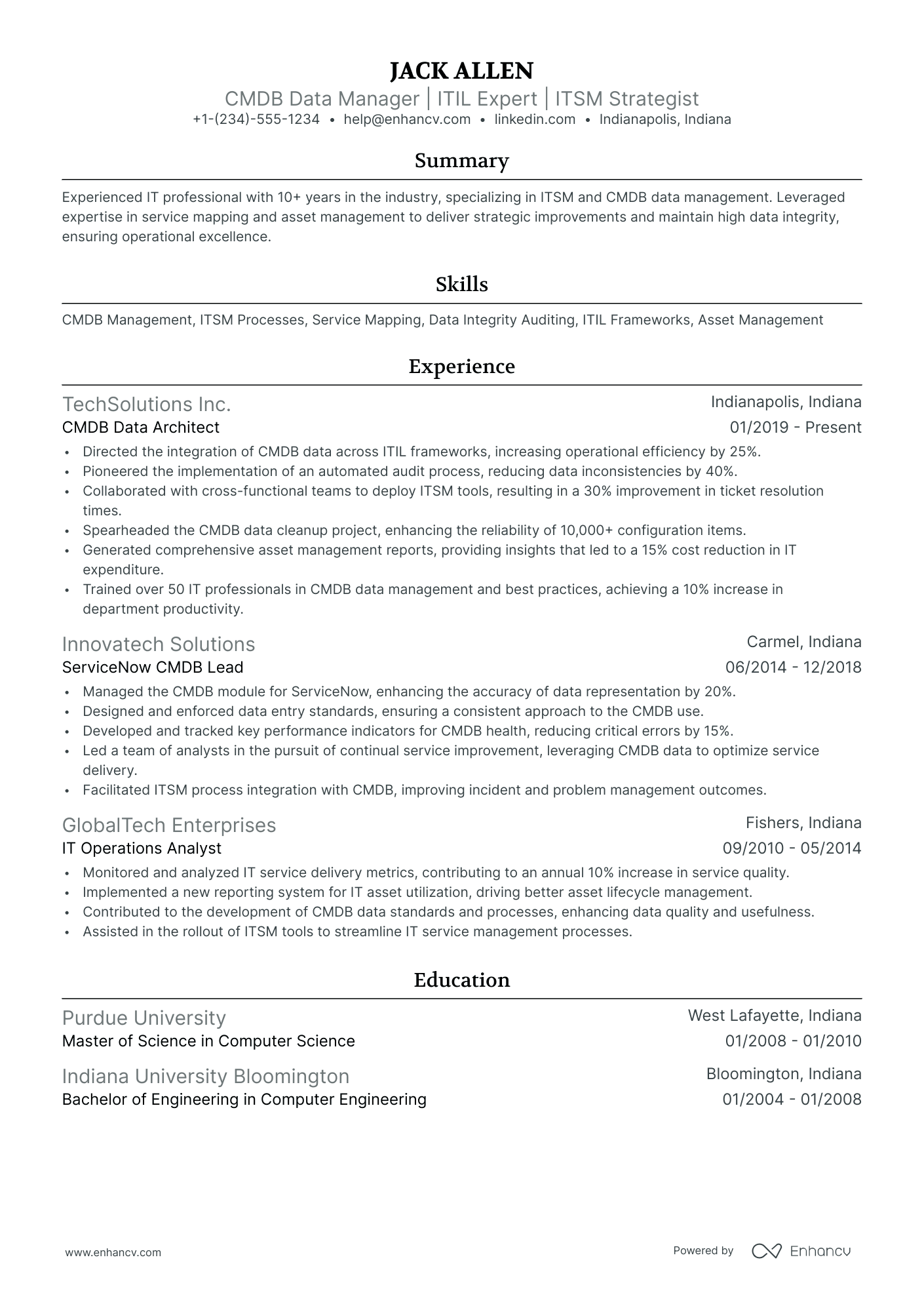
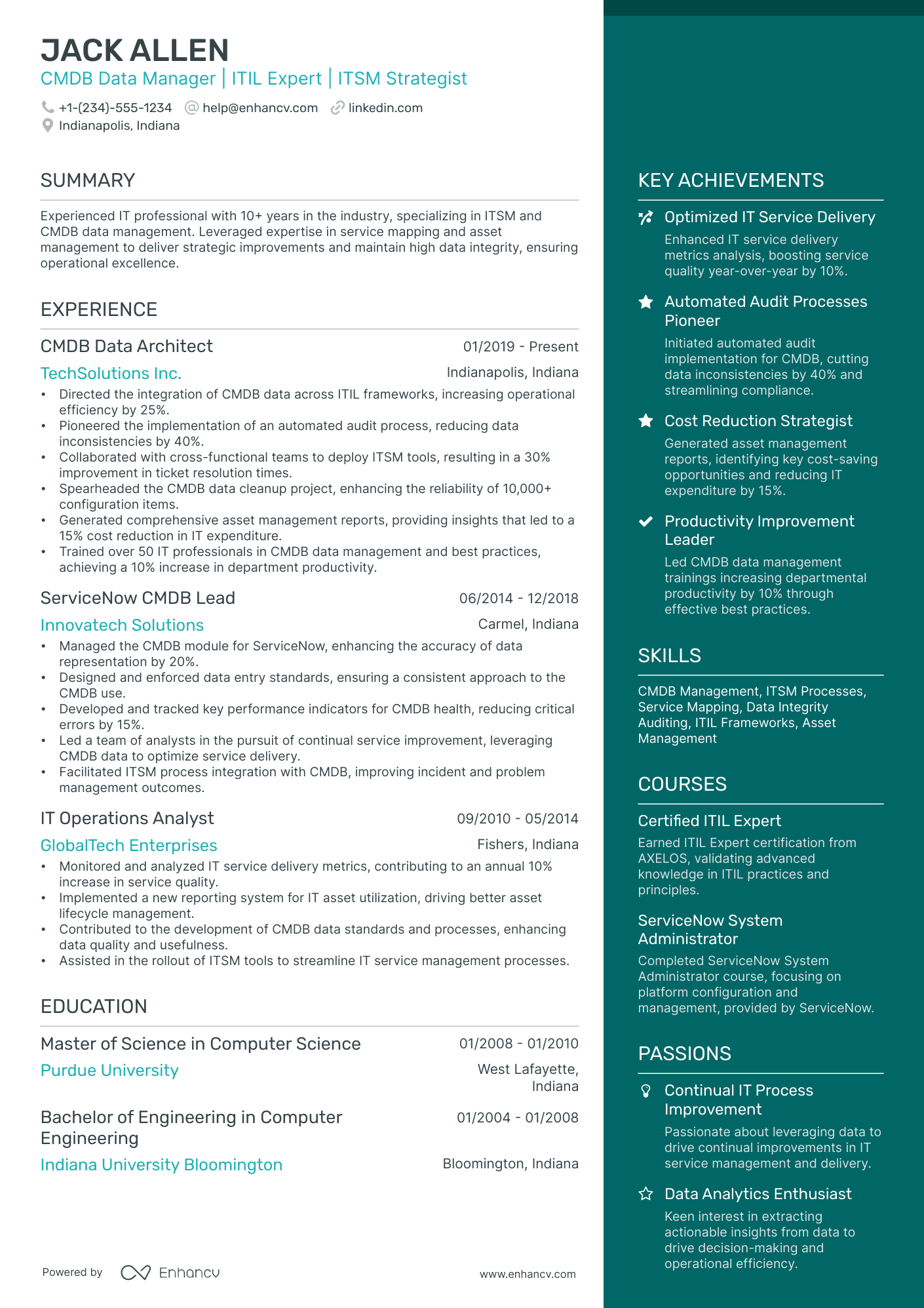
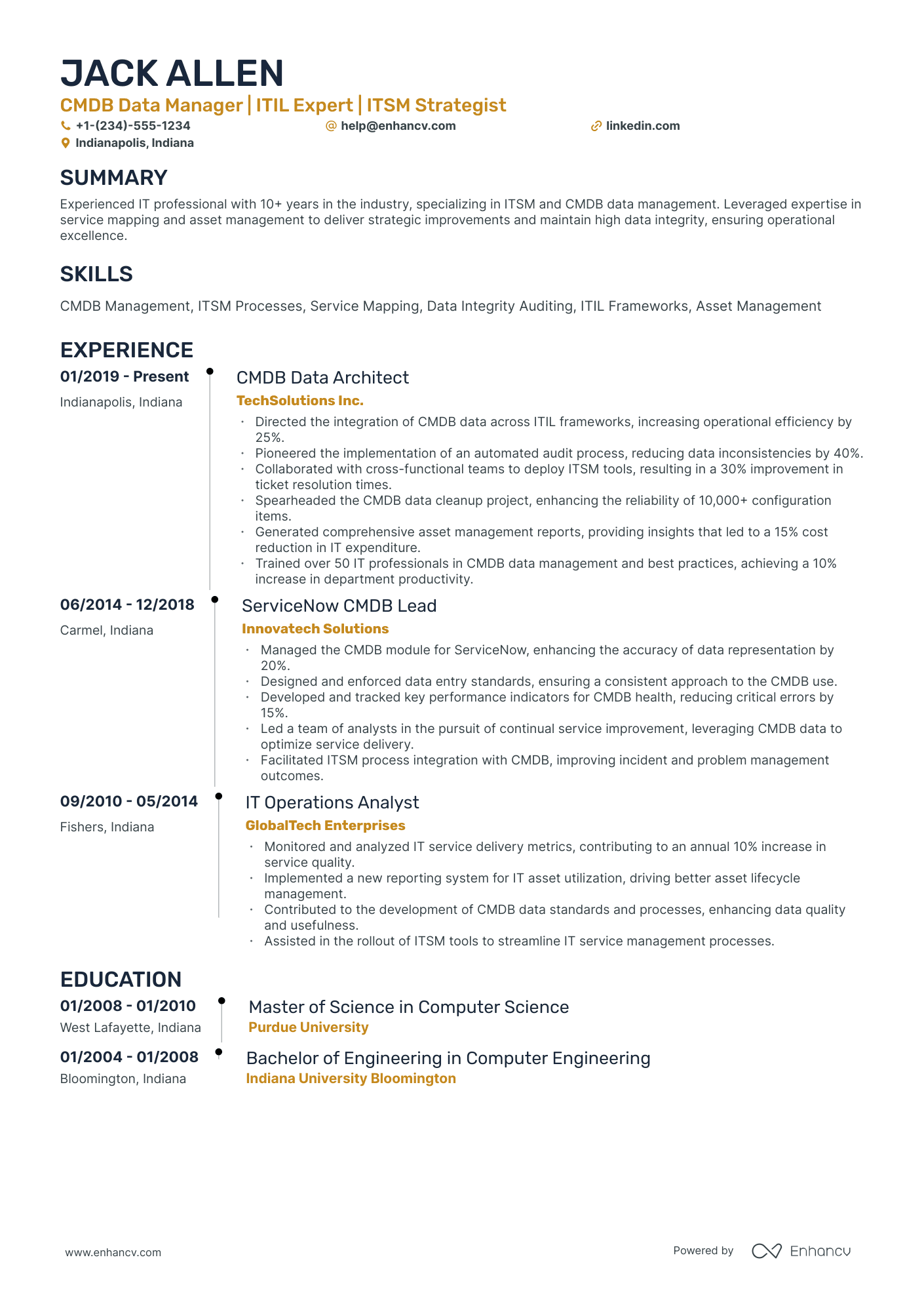
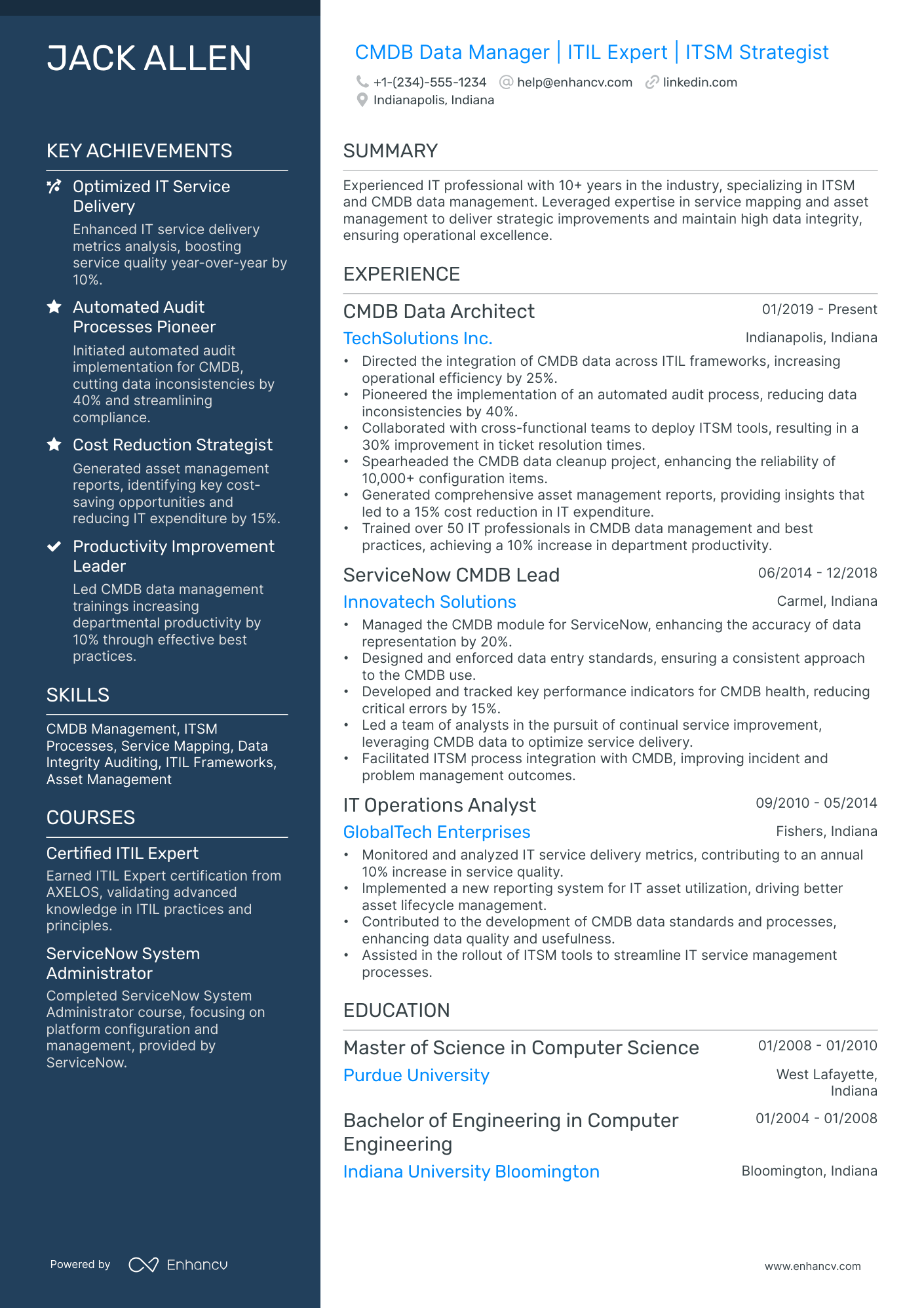
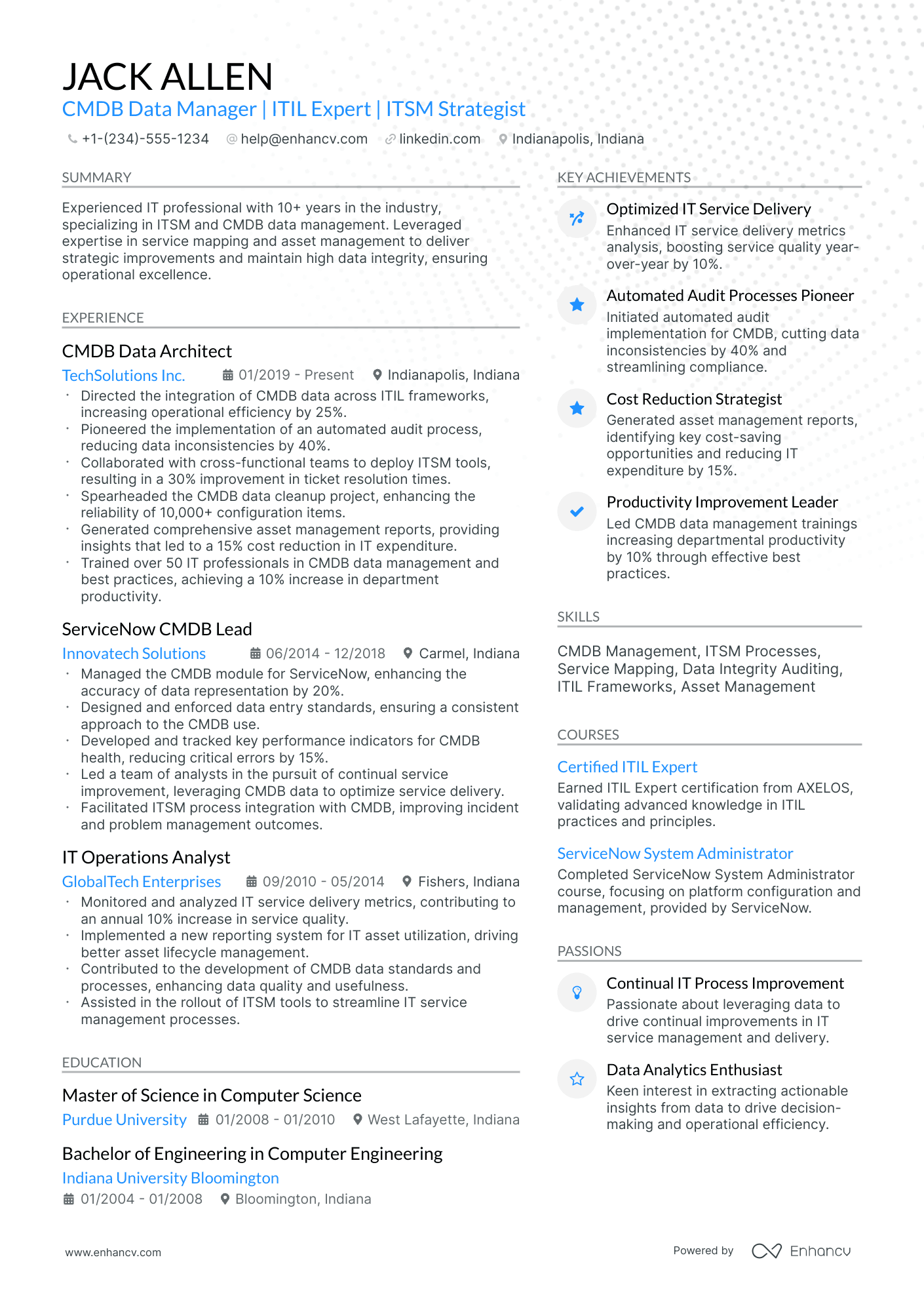
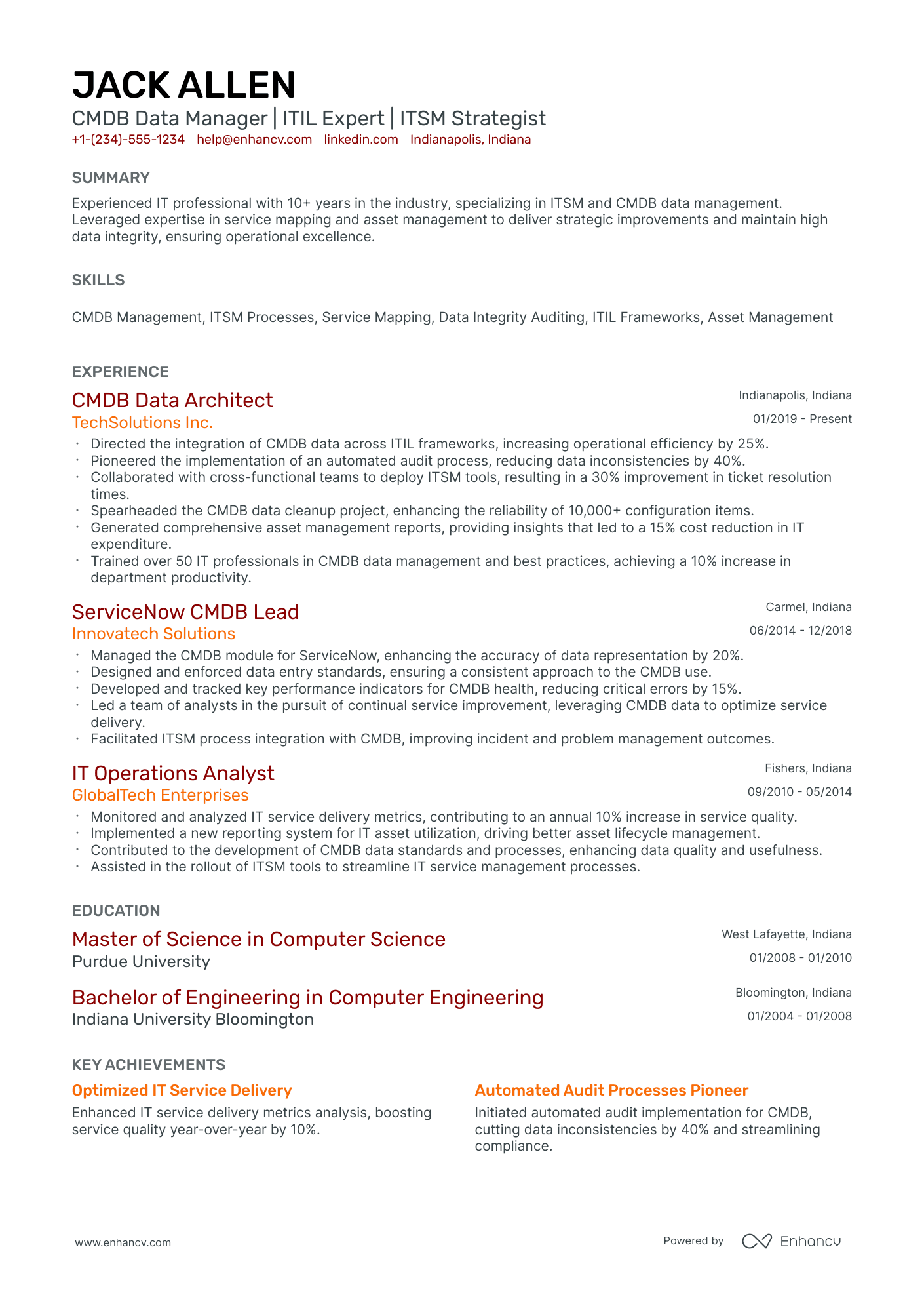
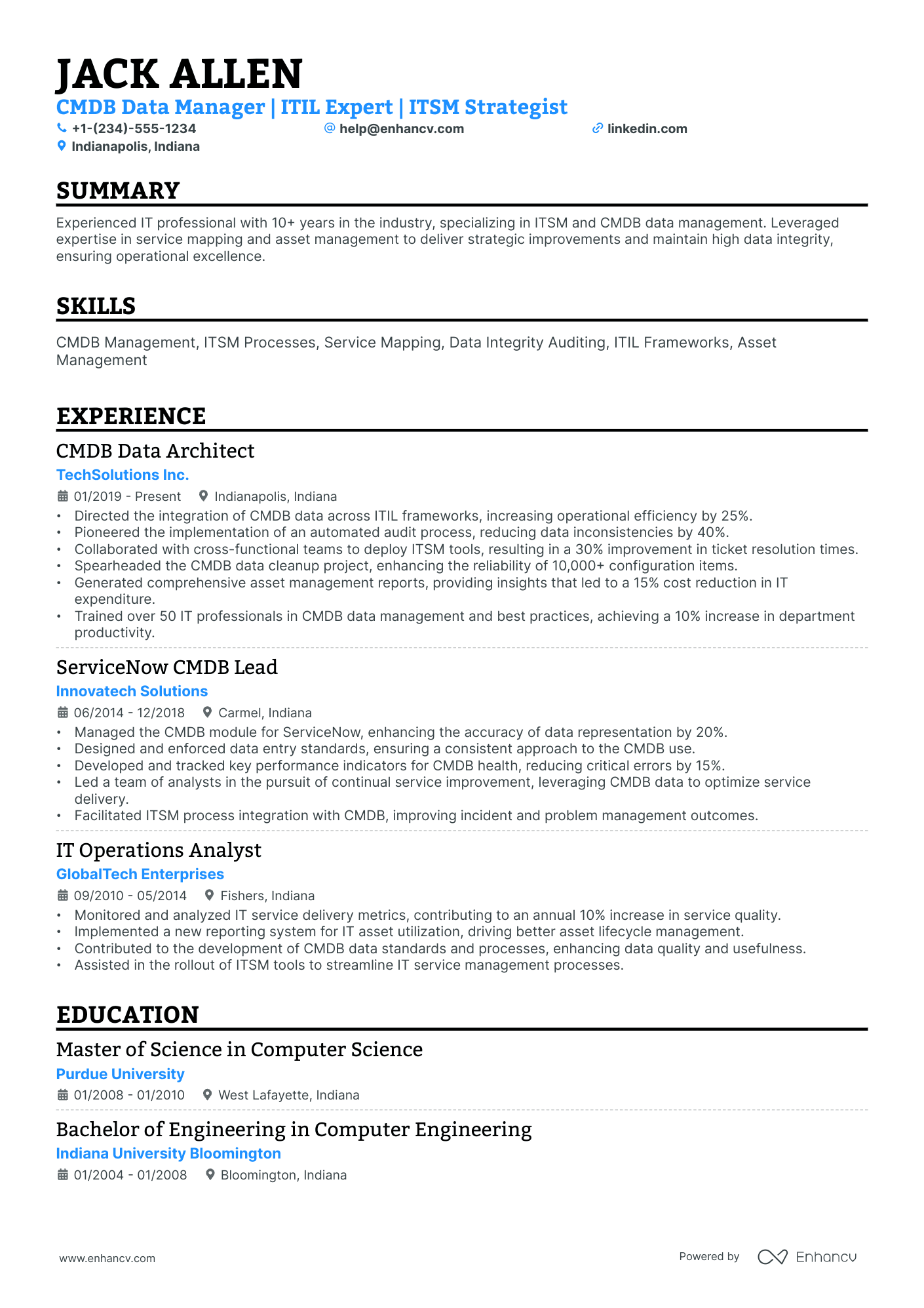
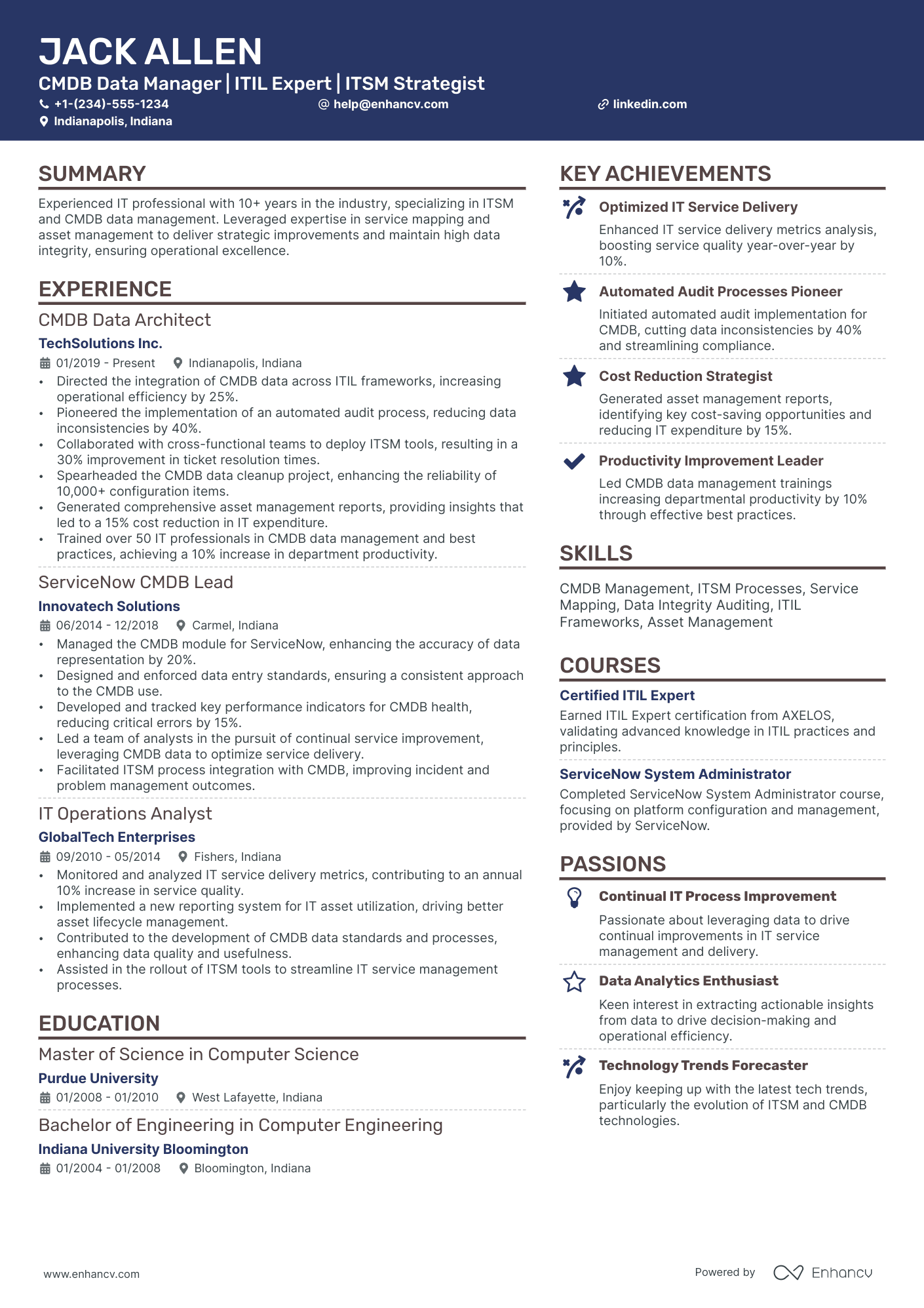
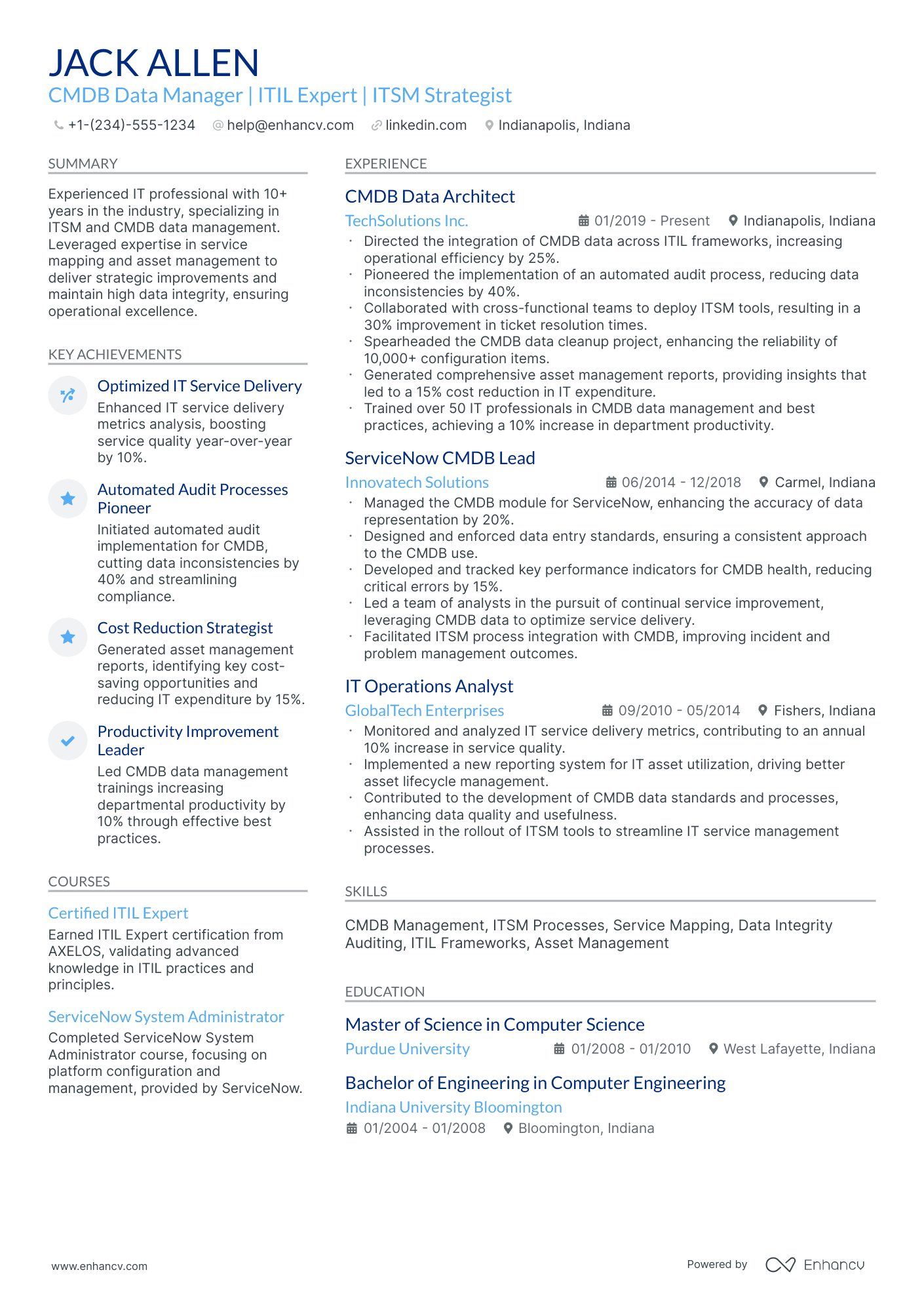
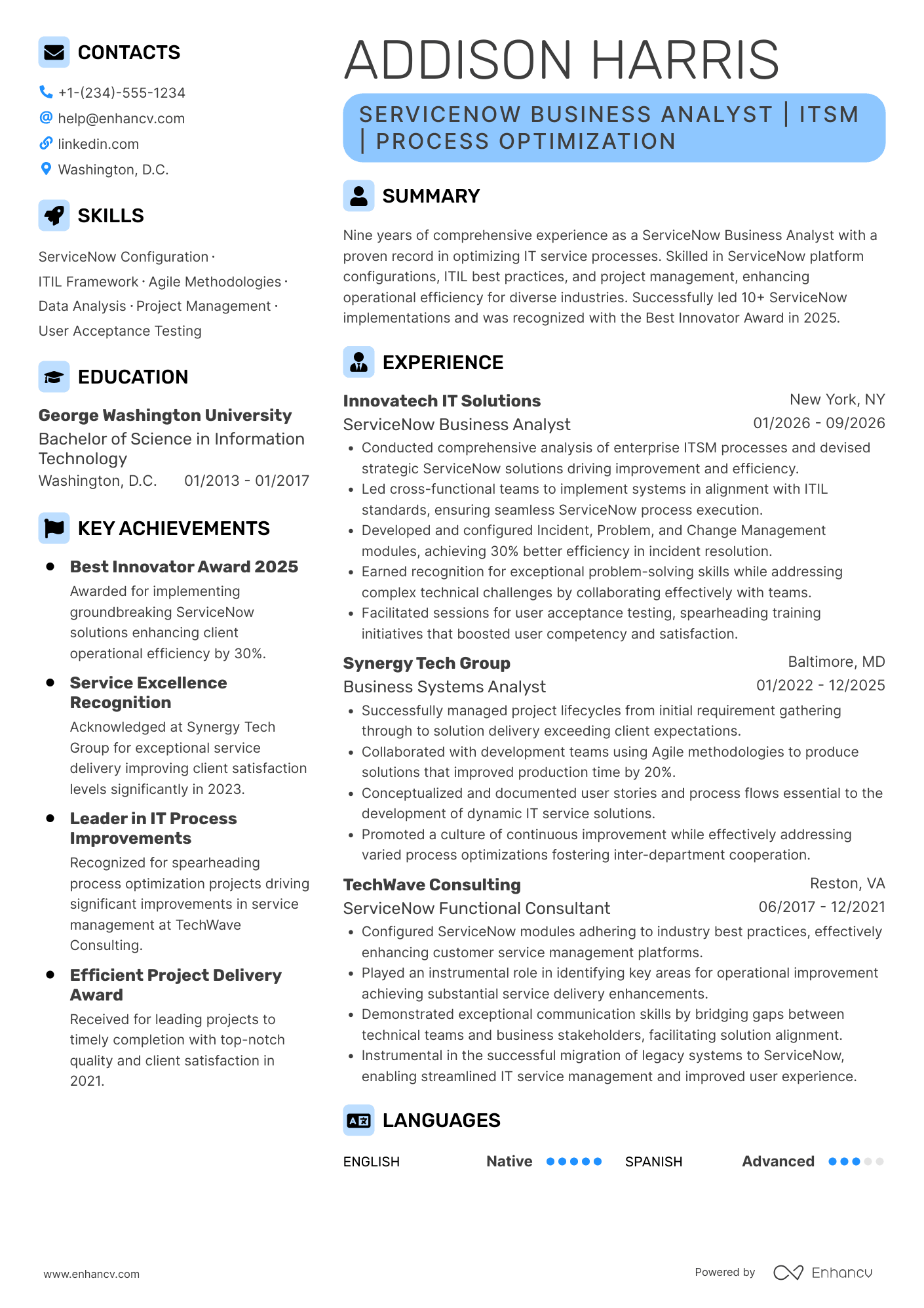
A ServiceNow business analyst resume often fails because it lists modules and tasks without tying them to measurable delivery results. That hurts in ATS screening and rapid recruiter scans, where high competition favors clear impact.
A strong resume shows what you changed and why it mattered. Knowing how to make your resume stand out means highlighting cycle-time reductions, ticket backlog drops, adoption gains, audit pass rates, SLA improvements, release throughput, or defects prevented across scoped workflows. Show the business value you delivered.

Key takeaways
- Tie every resume bullet to measurable outcomes like cycle-time reductions, adoption gains, or cost savings.
- Tailor experience entries to mirror the exact ServiceNow modules and terminology each job posting uses.
- Use reverse-chronological format when experienced and hybrid format when switching into the role.
- Demonstrate skills in context through your summary and experience bullets, not just a standalone list.
- Quantify achievements across delivery speed, process efficiency, data quality, adoption, and risk reduction.
- Showcase ServiceNow certifications like CSA or CIS-ITSM directly alongside your education credentials.
- Use Enhancv's Bullet Point Generator to turn vague duties into specific, results-driven resume bullets.
How to format a ServiceNow business analyst resume
Recruiters evaluating ServiceNow business analyst candidates prioritize platform-specific expertise, requirements gathering methodology, and the ability to translate business needs into configured ServiceNow solutions. Choosing the right resume format ensures these signals—along with progression across modules and increasing project scope—are immediately visible to both hiring managers and applicant tracking systems.

I have significant experience in this role—which format should I use?
Use a reverse-chronological format to present your ServiceNow business analyst career in a clear, progression-driven narrative. Do:
- Lead each role entry with scope indicators: number of stakeholders managed, modules configured (ITSM, HRSD, CSM), and organizational breadth of implementations.
- Highlight platform-specific competencies such as ServiceNow requirements documentation, process mapping in Flow Designer, demand management, and CMDB governance alongside business analysis frameworks like Agile and ITIL.
- Quantify outcomes tied to efficiency gains, cost reduction, user adoption rates, or SLA improvements resulting from your requirements and configuration work.
I'm junior or switching into this role—what format works best?
A hybrid format works best, letting you lead with relevant ServiceNow and business analysis skills before supporting them with your experience history. Do:
- Place a skills section near the top featuring ServiceNow platform knowledge (even from certifications or labs), requirements elicitation techniques, and process modeling tools.
- Include project-based entries—such as ServiceNow CSA coursework, personal developer instance configurations, or cross-functional process improvement initiatives—that demonstrate hands-on platform exposure.
- Connect every listed skill or project to a concrete action and a measurable or observable result.
Why not use a functional resume?
A functional format strips away the timeline and context that hiring managers need to evaluate how your ServiceNow business analysis skills were applied in real project environments, making it harder to verify your contributions and growth.
- A functional format may be acceptable if you're transitioning from a general business analyst or IT support role into ServiceNow-specific work and have limited platform experience in a professional setting—but only if every listed skill is anchored to a specific project, certification lab, or measurable outcome rather than presented in isolation.
With your resume's structure and layout in place, the next step is determining which sections to include so each one serves a clear purpose.
What sections should go on a ServiceNow business analyst resume
Recruiters expect a clean, role-specific resume that shows you can translate business needs into ServiceNow solutions and measurable outcomes. Understanding what to put on a resume helps you prioritize the right content. Use this structure for maximum clarity:
- Header
- Summary
- Experience
- Skills
- Projects
- Education
- Certifications
- Optional sections: Awards, Leadership, Languages
Your experience bullets should emphasize business impact, delivered outcomes, platform scope, and results tied to ServiceNow implementations and process improvements.
Is your resume good enough?
Drop your resume here or choose a file. PDF & DOCX only. Max 2MB file size.
Now that you’ve organized the key resume components employers expect, focus next on writing your ServiceNow business analyst experience to show impact and fit.
How to write your ServiceNow business analyst resume experience
Your experience section is where you prove you've delivered real work—not just participated in it. Hiring managers scanning ServiceNow business analyst resumes prioritize demonstrated impact through platform implementations, process improvements, and measurable business outcomes over generic task descriptions. Building a targeted resume ensures each entry speaks directly to what the employer needs.
Each entry should include:
- Job title
- Company and location (or remote)
- Dates of employment (month and year)
Three to five concise bullet points showing what you owned, how you executed, and what outcomes you delivered:
- Ownership scope: the ServiceNow modules, workflows, service catalogs, or business processes you were directly accountable for defining, analyzing, or optimizing across the organization.
- Execution approach: the requirements gathering techniques, process mapping frameworks, ServiceNow configuration knowledge, or agile methodologies you applied to translate stakeholder needs into platform solutions.
- Value improved: the gains you drove in service delivery efficiency, incident resolution speed, process standardization, reporting accuracy, or operational risk reduction tied to your ServiceNow initiatives.
- Collaboration context: how you partnered with platform developers, IT service management teams, process owners, end users, or external vendors to align business requirements with technical implementation on the ServiceNow platform.
- Impact delivered: the tangible outcomes your analysis and recommendations produced—expressed through adoption rates, cost savings, cycle time reductions, or successful go-lives rather than a list of activities you performed.
Experience bullet formula
A ServiceNow business analyst experience example
✅ Right example - modern, quantified, specific.
ServiceNow Business Analyst
NorthBridge Health Systems | Remote
2022–Present
Multi-hospital healthcare network supporting twenty-five thousand employees and clinicians across IT service management and HR workflows.
- Led requirements discovery and process mapping for IT service management and HR service delivery using workshops, journey mapping, and user stories in Azure DevOps, cutting average request resolution time by 22%.
- Configured ServiceNow Service Catalog items, record producers, and Flow Designer automations with approval routing and notifications, reducing manual triage effort by 18 hours per week.
- Built performance analytics dashboards and key performance indicator scorecards for incident, change, and request management, improving service-level agreement attainment from 86% to 94% in two quarters.
- Partnered with product managers, developers, and security to define acceptance criteria and execute user acceptance testing in Automated Test Framework (ATF), lowering post-release defects by 31%.
- Standardized data quality rules and reporting definitions across configuration management database and core tables using data dictionary updates and governance reviews, cutting duplicate configuration items by 27% and reducing audit findings by 40%.
Now that you've seen how a strong experience section comes together, let's look at how to adjust yours to match the specific ServiceNow business analyst role you're targeting.
How to tailor your ServiceNow business analyst resume experience
Recruiters evaluate your ServiceNow business analyst resume through both human review and applicant tracking systems (ATS). Tailoring your resume to the job description increases your chances of passing both filters.
Ways to tailor your ServiceNow business analyst experience:
- Match ServiceNow modules and tools named in the job description.
- Mirror the exact ITIL process terminology the posting uses.
- Reflect specific KPIs or success criteria the employer highlights.
- Reference industry or domain experience relevant to the role.
- Emphasize compliance or governance responsibilities when listed as priorities.
- Align your workflow documentation methods with their stated frameworks.
- Highlight cross-functional collaboration models the job description mentions.
- Include integration platforms or reporting tools the posting specifies.
Tailoring means aligning your real accomplishments with what the employer asks for, not forcing keywords where they don't belong.
Resume tailoring examples for ServiceNow business analyst
| Job description excerpt | Untailored | Tailored |
|---|---|---|
| "Gather and document business requirements for ServiceNow ITSM modules, including Incident, Problem, and Change Management, and translate them into user stories for agile development teams." | Worked with stakeholders to collect requirements and create documentation for IT projects. | Elicited and documented business requirements for ServiceNow ITSM modules—Incident, Problem, and Change Management—translating them into user stories that reduced agile sprint backlog ambiguity by 30%. |
| "Configure and maintain ServiceNow workflows, catalog items, and business rules while collaborating with platform administrators to ensure alignment with ITIL best practices." | Helped configure software tools and supported the IT team with system updates. | Configured and maintained 45+ ServiceNow workflows, catalog items, and business rules in partnership with platform administrators, ensuring full alignment with ITIL v4 framework standards across three business units. |
| "Facilitate UAT sessions with cross-functional stakeholders, document defects in ServiceNow's ATF (Automated Test Framework), and drive resolution before production deployment." | Participated in testing activities and reported issues to the development team. | Facilitated UAT sessions with 20+ cross-functional stakeholders, logging and triaging defects in ServiceNow's Automated Test Framework (ATF) to achieve a 98% defect resolution rate before each production deployment. |
Once you’ve aligned your experience with the role’s ServiceNow requirements, quantify your ServiceNow business analyst achievements to show the measurable impact of that work.
How to quantify your ServiceNow business analyst achievements
Quantifying your achievements proves business impact, not just activity. For a ServiceNow business analyst, track delivery speed, process efficiency, data quality, adoption, and risk reduction across incidents, requests, changes, and workflow automations.
Quantifying examples for ServiceNow business analyst
| Metric | Example |
|---|---|
| Delivery speed | "Cut requirements-to-release cycle from 6 weeks to 4 weeks by tightening user story acceptance criteria and grooming cadence in Jira." |
| Process efficiency | "Reduced manual triage time 35% by redesigning ServiceNow incident categorization and routing rules for a 12,000-user ITSM instance." |
| Data quality | "Improved configuration item accuracy from 78% to 93% by defining validation rules and audit reports for 25 critical services in the configuration management database." |
| Adoption rate | "Increased self-service portal usage from 40% to 62% in 90 days by simplifying catalog items and adding guided questions for top 15 requests." |
| Risk reduction | "Lowered failed change rate from 9% to 5% by standardizing change templates and adding pre-implementation checks for 120 monthly changes." |
Turn vague job duties into measurable, recruiter-ready resume bullets in seconds with Enhancv's Bullet Point Generator.
Once you've crafted strong, impact-driven bullet points for your experience section, it's equally important to strategically present the hard and soft skills that qualify you for a ServiceNow business analyst role.
How to list your hard and soft skills on a ServiceNow business analyst resume
Your skills section matters because ServiceNow business analysts translate business needs into platform requirements; recruiters and ATS scan this section to confirm core platform, process, and delivery fit, so aim for a balanced mix of hard skills and role-specific soft skills. ServiceNow business analyst roles require a blend of:
- Product strategy and discovery skills.
- Data, analytics, and experimentation skills.
- Delivery, execution, and go-to-market discipline.
- Soft skills.
Your skills section should be:
- Scannable (bullet-style grouping).
- Relevant to the job post.
- Backed by proof in experience bullets.
- Updated with current tools.
Place your skills section:
- Above experience if you're junior or switching careers.
- Below experience if you're mid/senior with strong achievements.

Hard skills
- ServiceNow platform configuration
- IT service management, ITIL
- ServiceNow SPM, Agile development
- Flow Designer, Workflow Editor
- Business rules, client scripts
- Service Catalog, request fulfillment
- CMDB, CSDM alignment
- IntegrationHub, REST APIs
- Performance Analytics, dashboards
- Requirements elicitation, user stories
- Process mapping, BPMN
- UAT planning, test cases
Soft skills
- Translate needs into requirements
- Facilitate stakeholder workshops
- Clarify scope and acceptance criteria
- Negotiate tradeoffs and priorities
- Write crisp functional specifications
- Drive alignment across teams
- Manage change and adoption
- Communicate risks and dependencies
- Ask incisive, structured questions
- Resolve ambiguity with decisions
- Influence without authority
- Own outcomes through delivery
How to show your ServiceNow business analyst skills in context
Skills shouldn't live only in a bulleted list on your resume. Explore examples of resume skills shown in context to see how top candidates integrate them naturally.
They should be demonstrated in:
- Your summary (high-level professional identity)
- Your experience (proof through outcomes)
Here's what that looks like in practice.
Summary example
Senior ServiceNow business analyst with eight years in healthcare IT. Skilled in ITSM configuration, requirements elicitation, and stakeholder facilitation. Led a CSM module rollout that reduced ticket resolution time by 34% across three regional service desks.
- Reflects senior-level experience clearly
- Names role-relevant ServiceNow modules
- Includes a specific, measurable outcome
- Highlights stakeholder collaboration skills
Experience example
Senior Business Analyst
Meridian Health Partners | Remote
March 2020–Present
- Gathered and translated clinical workflow requirements into ServiceNow ITSM stories, cutting development rework by 28% over two release cycles.
- Partnered with infrastructure and compliance teams to configure a CMDB strategy, improving asset accuracy from 71% to 95%.
- Facilitated weekly sprint reviews with cross-functional stakeholders, accelerating average module delivery timelines by three weeks per quarter.
- Every bullet ties skills to measurable results.
- Tools and collaboration appear naturally in context.
Once you’ve demonstrated your ServiceNow business analyst capabilities through specific, results-focused examples, the next step is applying that approach to a resume when you don’t have formal experience.
How do I write a ServiceNow business analyst resume with no experience
Even without full-time experience, you can demonstrate readiness. Writing a resume without work experience is possible when you focus on transferable projects and platform exposure:
- ServiceNow personal developer instance builds
- IT service management process mapping
- User story and acceptance criteria writing
- ServiceNow reporting and dashboard projects
- ServiceNow Service Catalog mock requests
- Data cleansing and import exercises
- Shadowing change advisory board meetings
- Volunteer ticket triage documentation
Focus on:
- ServiceNow platform basics, proven work
- Requirements artifacts with traceability
- IT service management process alignment
- Metrics, dashboards, and outcomes
Resume format tip for entry-level ServiceNow business analyst
Use a skills-first hybrid resume format because it highlights ServiceNow business analyst projects, tools, and artifacts before limited work history. Do:
- Add a "Projects" section above experience.
- List ServiceNow modules you used.
- Include artifacts: stories, process maps.
- Quantify outcomes: time, errors, volume.
- Link to a portfolio or repository.
- Built a ServiceNow reporting dashboard from fifty mock incidents, reducing weekly status prep time by 30 percent using grouped filters and scheduled reports.
Even without direct experience, your educational background can demonstrate the foundational knowledge and analytical skills that qualify you for a ServiceNow business analyst role.
How to list your education on a ServiceNow business analyst resume
Your education section helps hiring teams confirm you have the foundational knowledge needed. It validates your analytical, technical, and business skills relevant to the ServiceNow business analyst role.
Include:
- Degree name
- Institution
- Location
- Graduation year
- Relevant coursework (for juniors or entry-level candidates)
- Honors & GPA (if 3.5 or higher)
Skip month and day details—list the graduation year only.
Here's a strong education entry tailored for a ServiceNow business analyst resume.
Example education entry
Bachelor of Science in Management Information Systems
University of Illinois at Urbana-Champaign, Champaign, IL
Graduated 2021
GPA: 3.7/4.0
- Relevant Coursework: Business Process Analysis, Enterprise Systems Architecture, IT Service Management, Database Design, Requirements Engineering
- Honors: Dean's List (six semesters), Beta Gamma Sigma Honor Society
How to list your certifications on a ServiceNow business analyst resume
Certifications on your resume show your commitment to learning, your proficiency with ServiceNow tools, and your understanding of industry standards for a ServiceNow business analyst.
Include:
- Certificate name
- Issuing organization
- Year
- Optional: credential ID or URL
- Place certifications below education when your degree is recent and more relevant than older or entry-level certifications.
- Place certifications above education when they are recent, ServiceNow-focused, and strongly aligned with the ServiceNow business analyst role.
Best certifications for your ServiceNow business analyst resume
- ServiceNow Certified System Administrator (CSA)
- ServiceNow Certified Implementation Specialist—IT Service Management (CIS-ITSM)
- ServiceNow Certified Application Developer (CAD)
- ITIL 4 Foundation
- Certified Business Analysis Professional (CBAP)
- PMI Professional in Business Analysis (PMI-PBA)
- Agile Certified Practitioner (PMI-ACP)
Once you’ve positioned your ServiceNow credentials where they’ll get noticed, move to your ServiceNow business analyst resume summary to quickly connect those qualifications to the value you deliver.
How to write your ServiceNow business analyst resume summary
Your resume summary is the first thing a recruiter reads. A sharp, focused opening frames you as the right fit for the ServiceNow business analyst role.
Keep it to three to four lines, with:
- Your title and years of relevant experience.
- The domain or industry you've worked in most.
- Core tools like ServiceNow modules, ITSM, or reporting platforms.
- One or two quantified achievements that show real impact.
- Soft skills tied to outcomes, such as stakeholder communication or requirements gathering.

PRO TIP
At this level, lead with specific tools and measurable contributions rather than vague descriptors. Highlight ServiceNow modules you've configured or supported and any process improvements you drove. Avoid phrases like "passionate team player" or "eager to learn." Replace them with concrete skills and early wins that prove your value.
Example summary for a ServiceNow business analyst
ServiceNow business analyst with two years of experience in ITSM and CSM modules. Streamlined incident reporting workflows, reducing resolution time by 18%. Skilled in requirements documentation, stakeholder interviews, and process mapping.
Optimize your resume summary and objective for ATS
Drop your resume here or choose a file.
PDF & DOCX only. Max 2MB file size.
With your summary crafting a strong first impression of your qualifications, it's equally important that your header presents your contact details and professional branding clearly so recruiters can reach you without friction.
What to include in a ServiceNow business analyst resume header
Your resume header is the top section with your identity and contact details, and it drives visibility, credibility, and fast recruiter screening for a ServiceNow business analyst.
Essential resume header elements
- Full name
- Tailored job title and headline
- Location
- Phone number
- Professional email
- GitHub link
- Portfolio link
A LinkedIn link helps recruiters verify your experience quickly and supports screening.
Don't include a photo on a ServiceNow business analyst resume unless the role is explicitly front-facing or appearance-dependent.
Match your header job title to the posting and keep every link active, professional, and consistent with your name across profiles.
Example
ServiceNow business analyst resume header
Jordan Taylor
ServiceNow business analyst | ITSM requirements, workflows, and stakeholder alignment
Austin, TX
(512) 555-01XX
your.name@enhancv.com
github.com/yourname
yourwebsite.com
linkedin.com/in/yourname
Once your name, contact details, and role focus are clear at the top, add relevant additional sections to strengthen your ServiceNow business analyst resume with supporting details.
Additional sections for ServiceNow business analyst resumes
Adding extra sections helps you stand out when your core experience alone doesn't fully capture your ServiceNow expertise or industry credibility.
- Languages
- ServiceNow certifications and micro-certifications
- Industry conferences and speaking engagements
- Professional affiliations (such as IIBA or ITIL communities)
- Publications or whitepapers on ITSM or digital transformation
- Volunteer work involving process improvement or technology consulting
Beyond strengthening your resume with targeted extra sections, pairing it with a well-crafted cover letter can further set your application apart.
Do ServiceNow business analyst resumes need a cover letter
A cover letter isn't required for a ServiceNow business analyst, but it often helps in competitive roles or teams with strict hiring expectations. Understanding what a cover letter is and how to use it effectively can make a difference when your resume needs context, or when the role demands tight stakeholder alignment.
Use a cover letter to add only what the resume can't show:
- Explain role and team fit by naming the workflow area, stakeholders, and delivery style you support, such as agile teams and shared service owners.
- Highlight one or two relevant projects or outcomes, including measurable results like reduced cycle time, fewer incidents, or higher self-service adoption.
- Show understanding of ServiceNow, its users, and the business context by referencing modules, processes, governance, and how requirements become configurations and reports.
- Address career transitions or non-obvious experience by mapping prior work to ServiceNow business analyst tasks, such as discovery, user stories, and acceptance criteria.
Drop your resume here or choose a file.
PDF & DOCX only. Max 2MB file size.
Even if you decide a cover letter won’t add value for this role, using AI to improve your ServiceNow business analyst resume is the next step to strengthen your application materials efficiently.
Using AI to improve your ServiceNow business analyst resume
AI can sharpen your resume's clarity, structure, and impact. It helps refine wording and highlight measurable results. But overuse strips authenticity. Once your content is clear and role-aligned, step away from AI tools. If you're curious about which AI is best for writing resumes, start with tools that focus on structure and quantification rather than generating content from scratch.
Here are 10 practical prompts to strengthen specific sections of your resume:
Strengthen your summary
Quantify experience bullets
Align skills with job posts
Sharpen project descriptions
Remove filler language
Improve action verbs
Tailor certification details
Refine education section
Tighten bullet structure
Check role consistency
Conclusion
A strong ServiceNow business analyst resume shows measurable outcomes, role-specific skills, and a clear structure. It ties your work to faster cycle times, fewer incidents, higher adoption, and cleaner data. It highlights requirements, process mapping, user stories, reporting, and stakeholder management.
Keep your ServiceNow business analyst resume easy to scan and consistent across sections. Use clear headings, focused bullets, and metrics that prove impact. This approach matches today’s hiring expectations and keeps you ready for near-future role requirements.