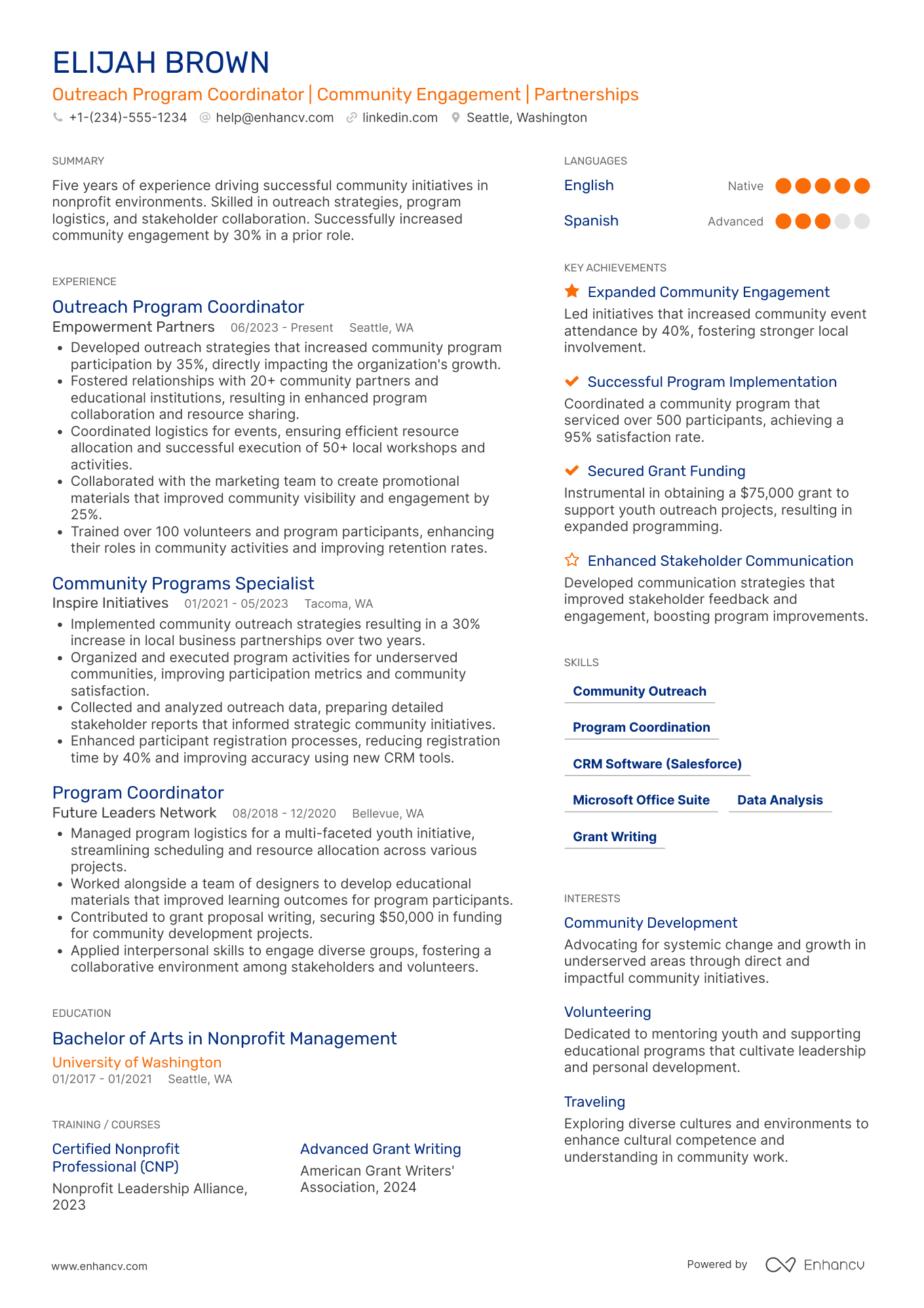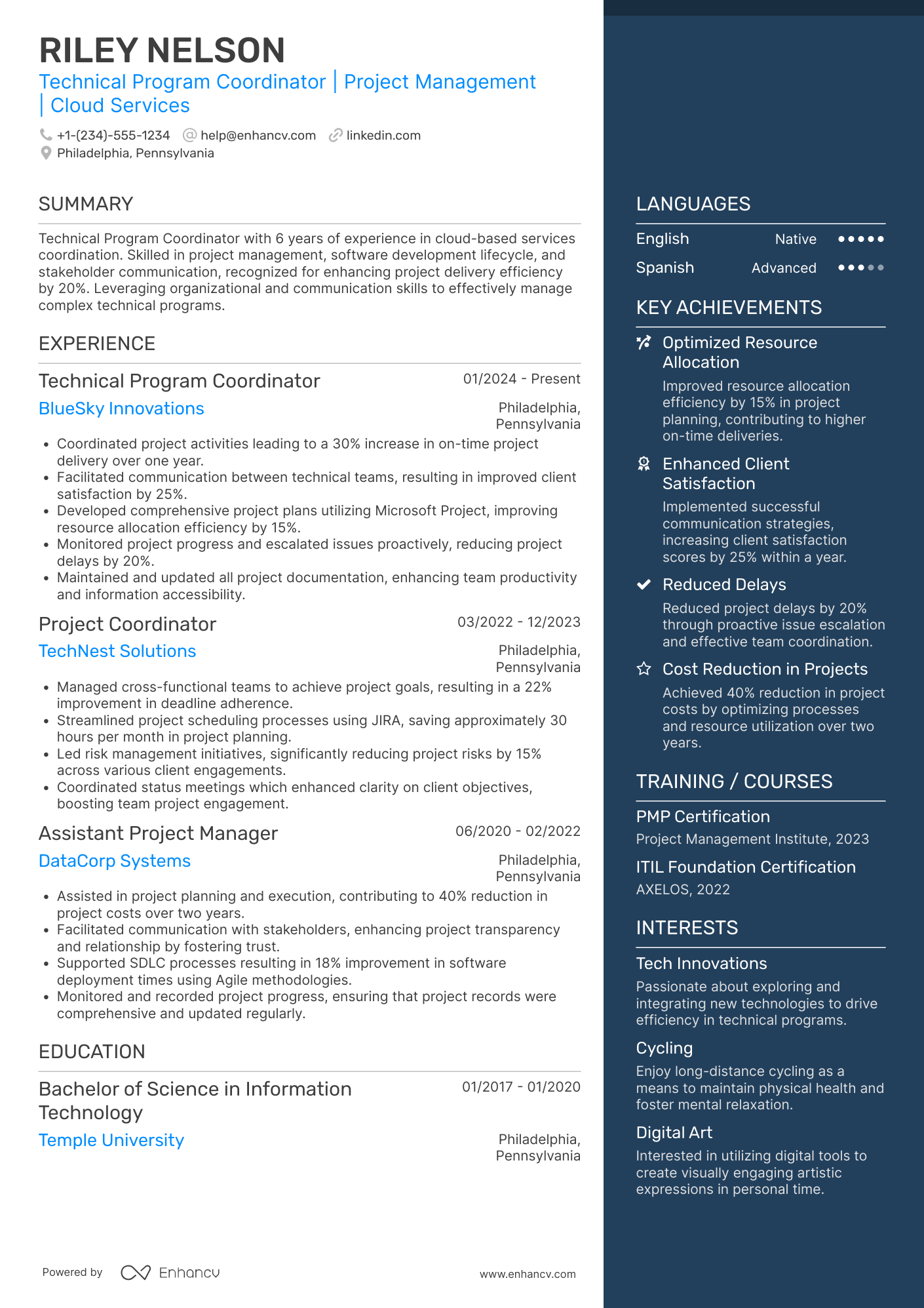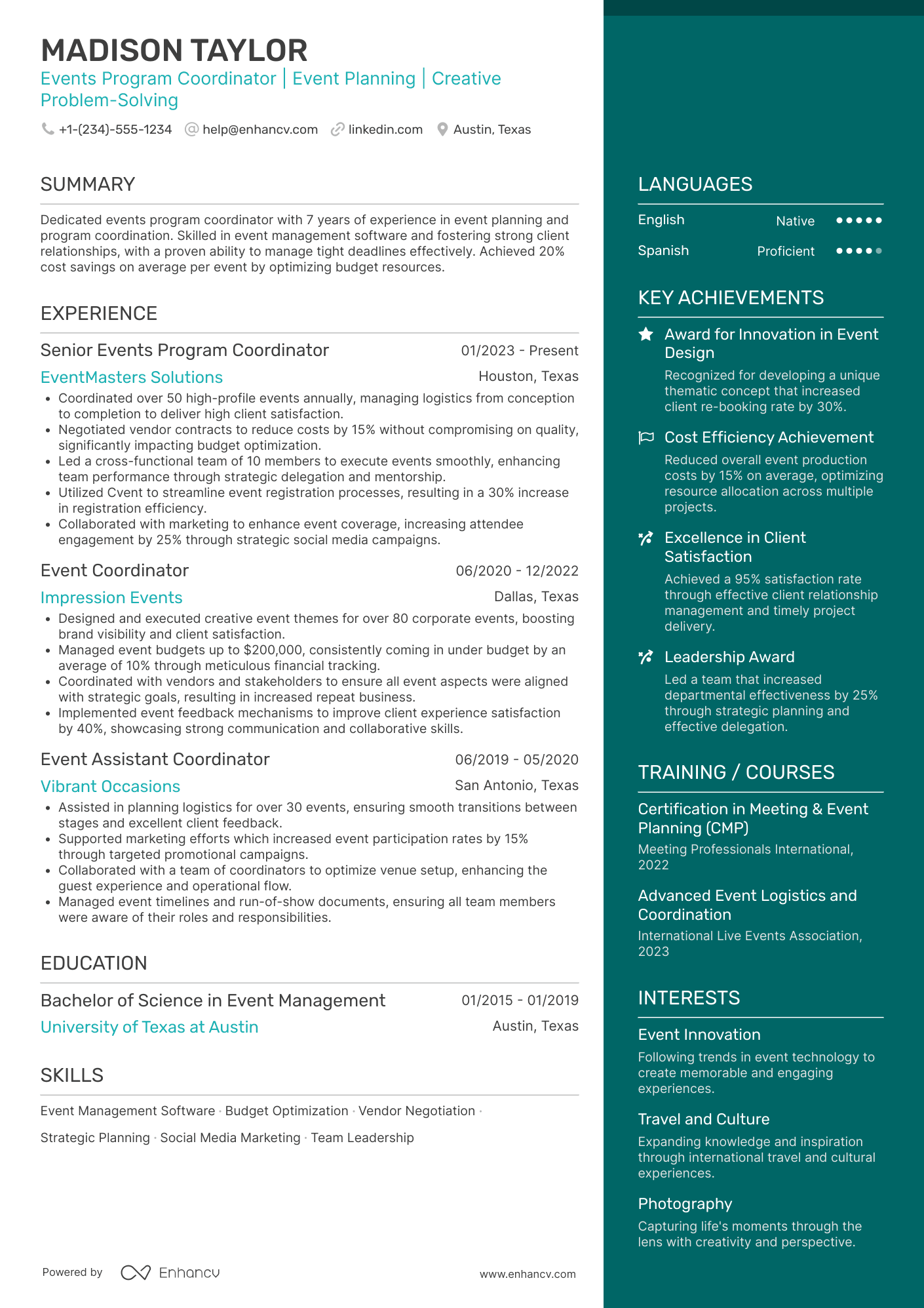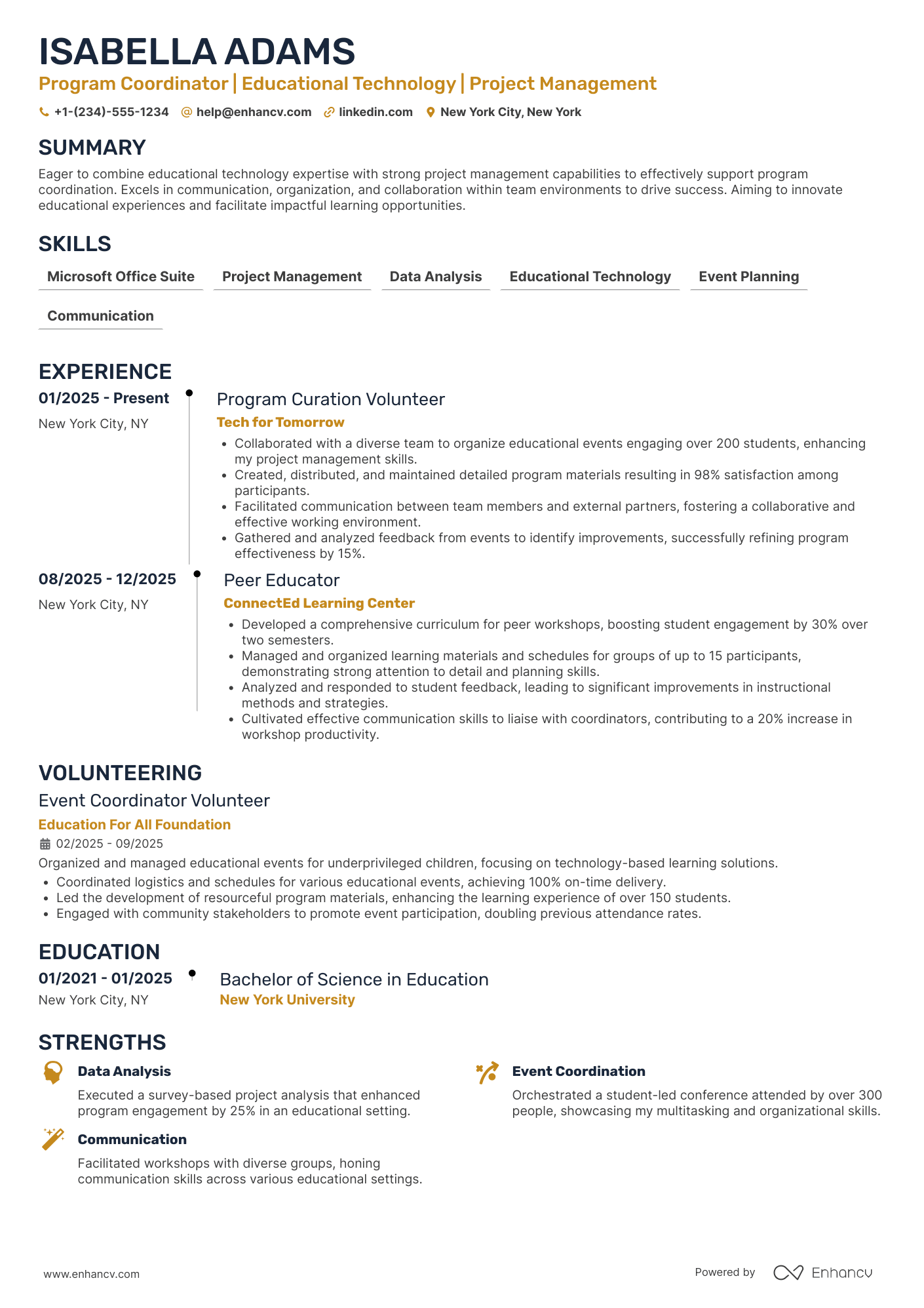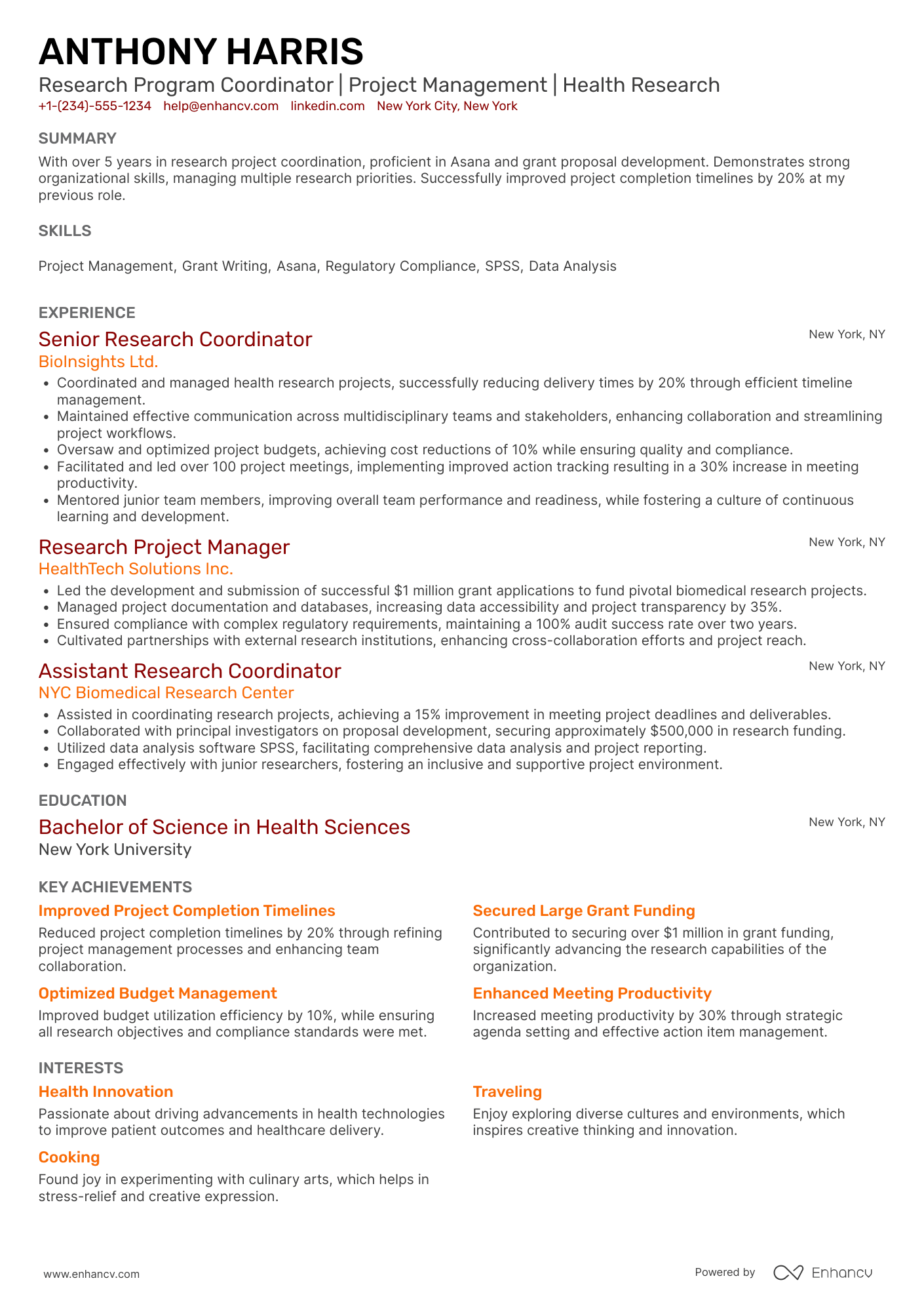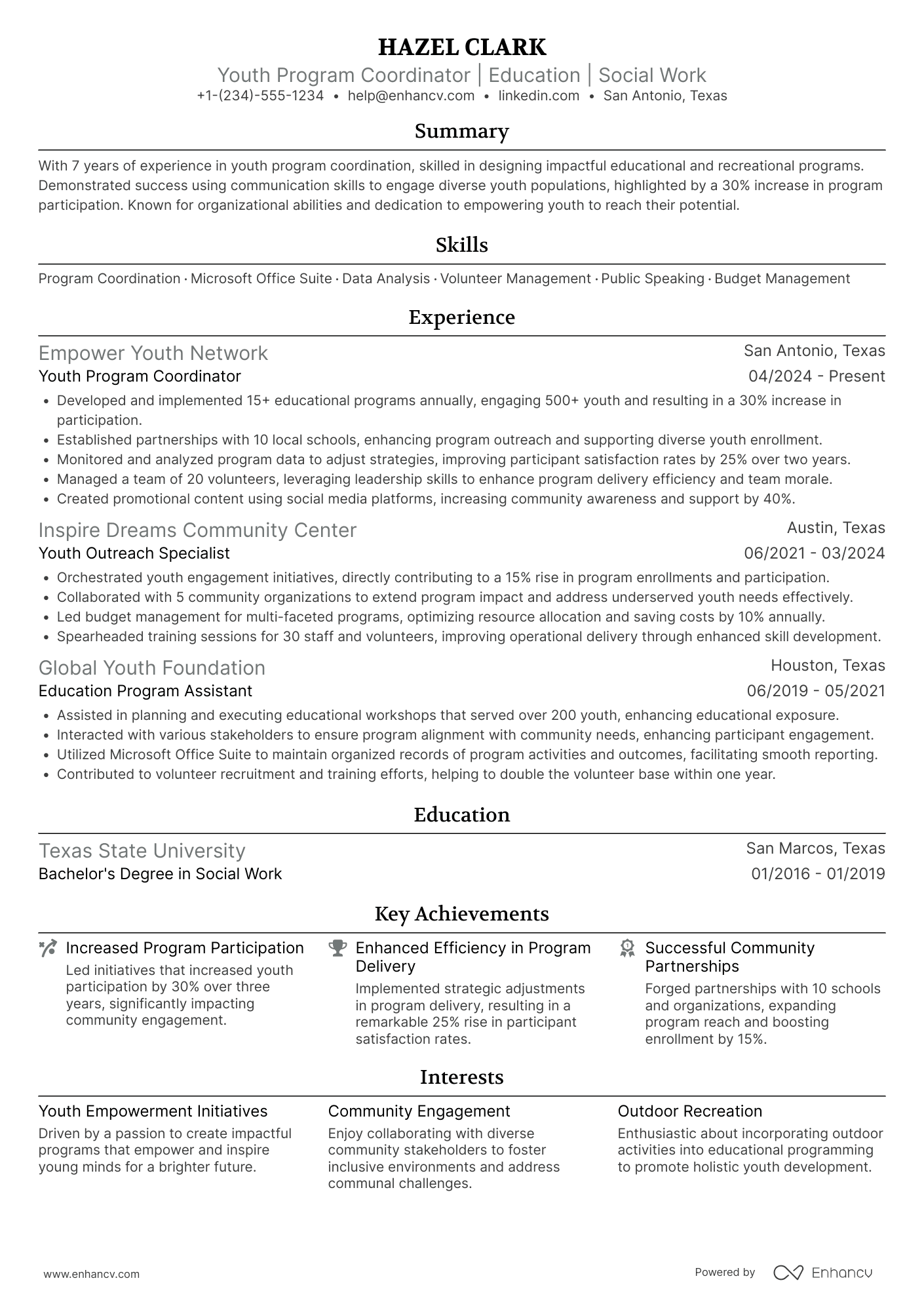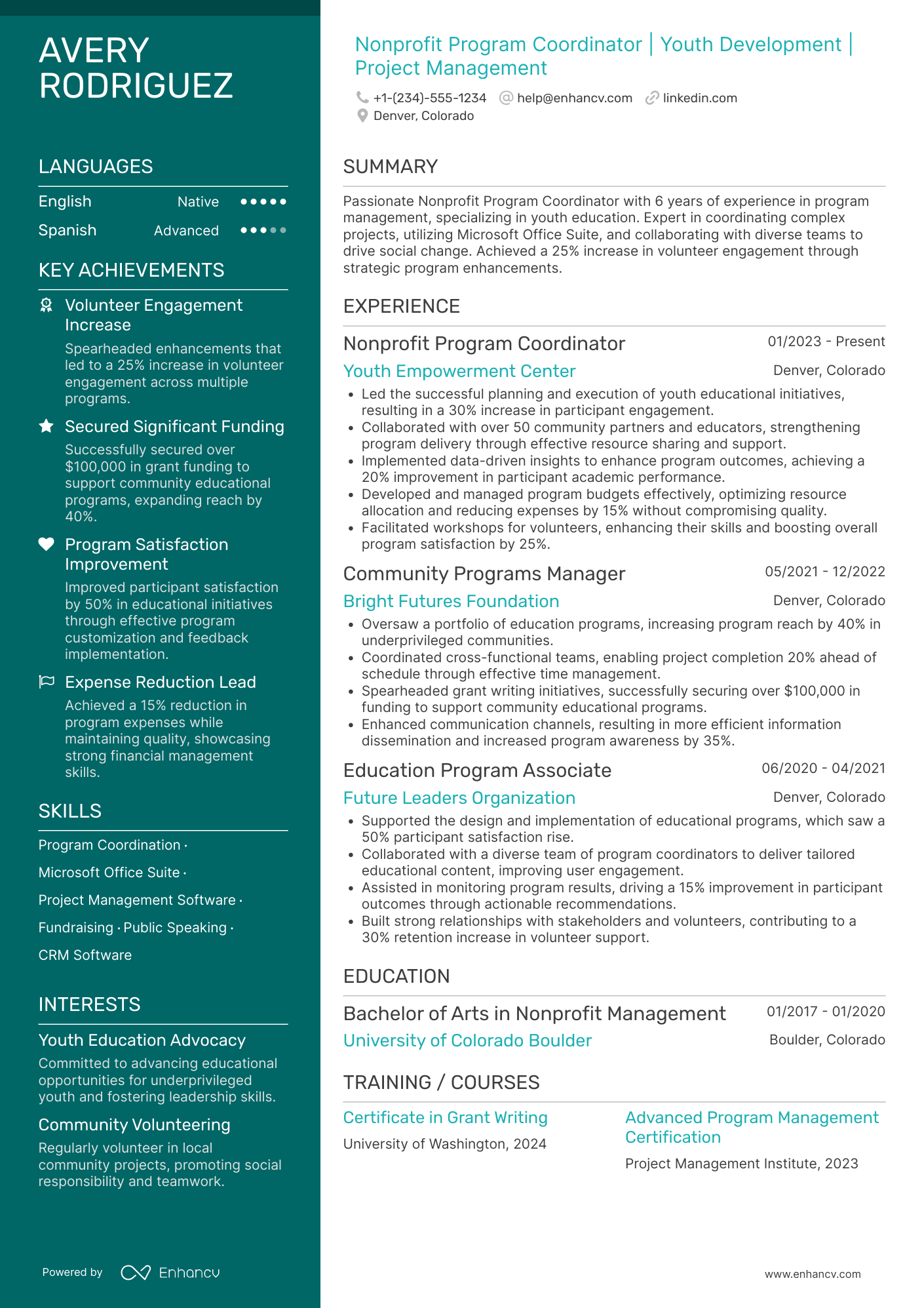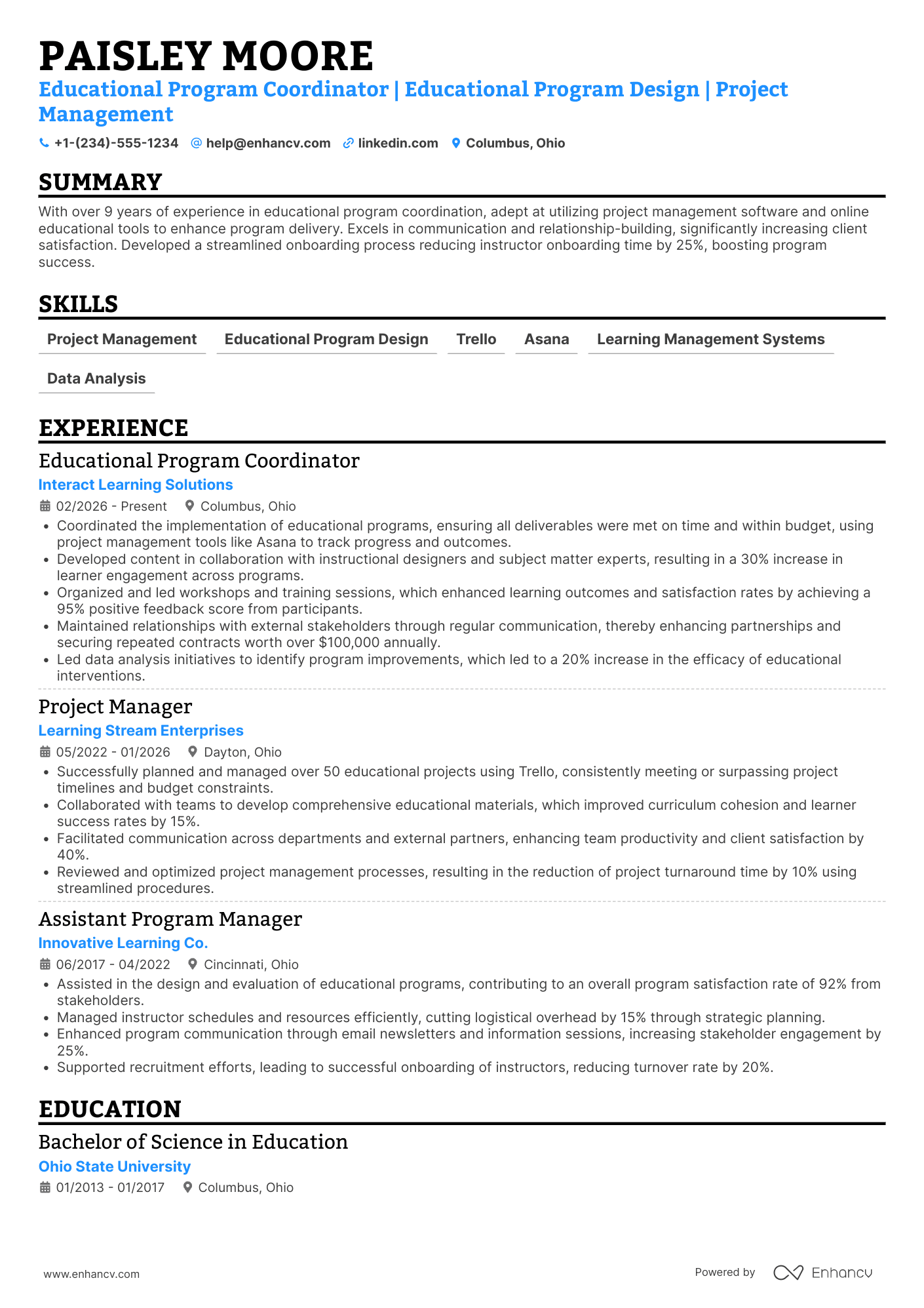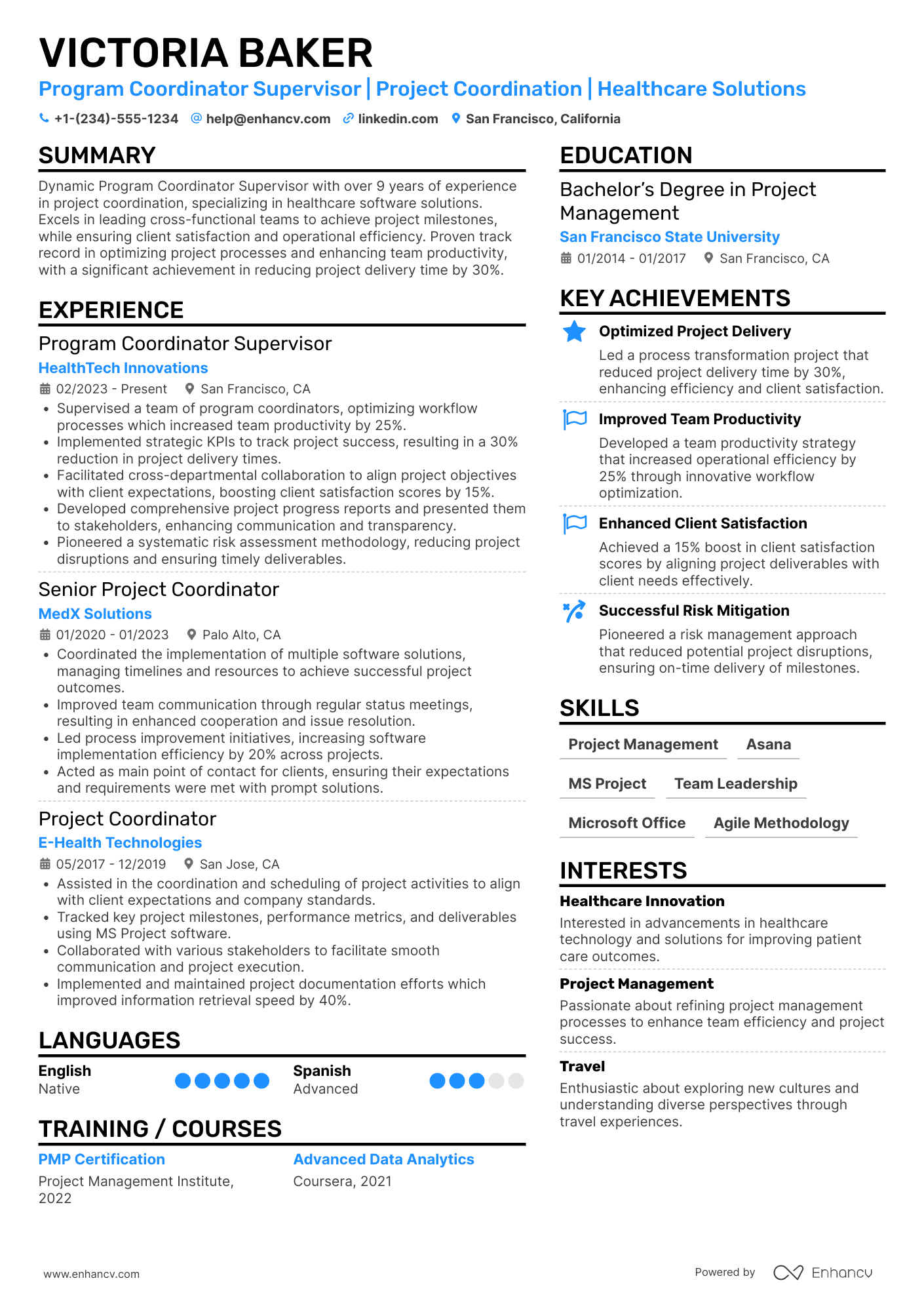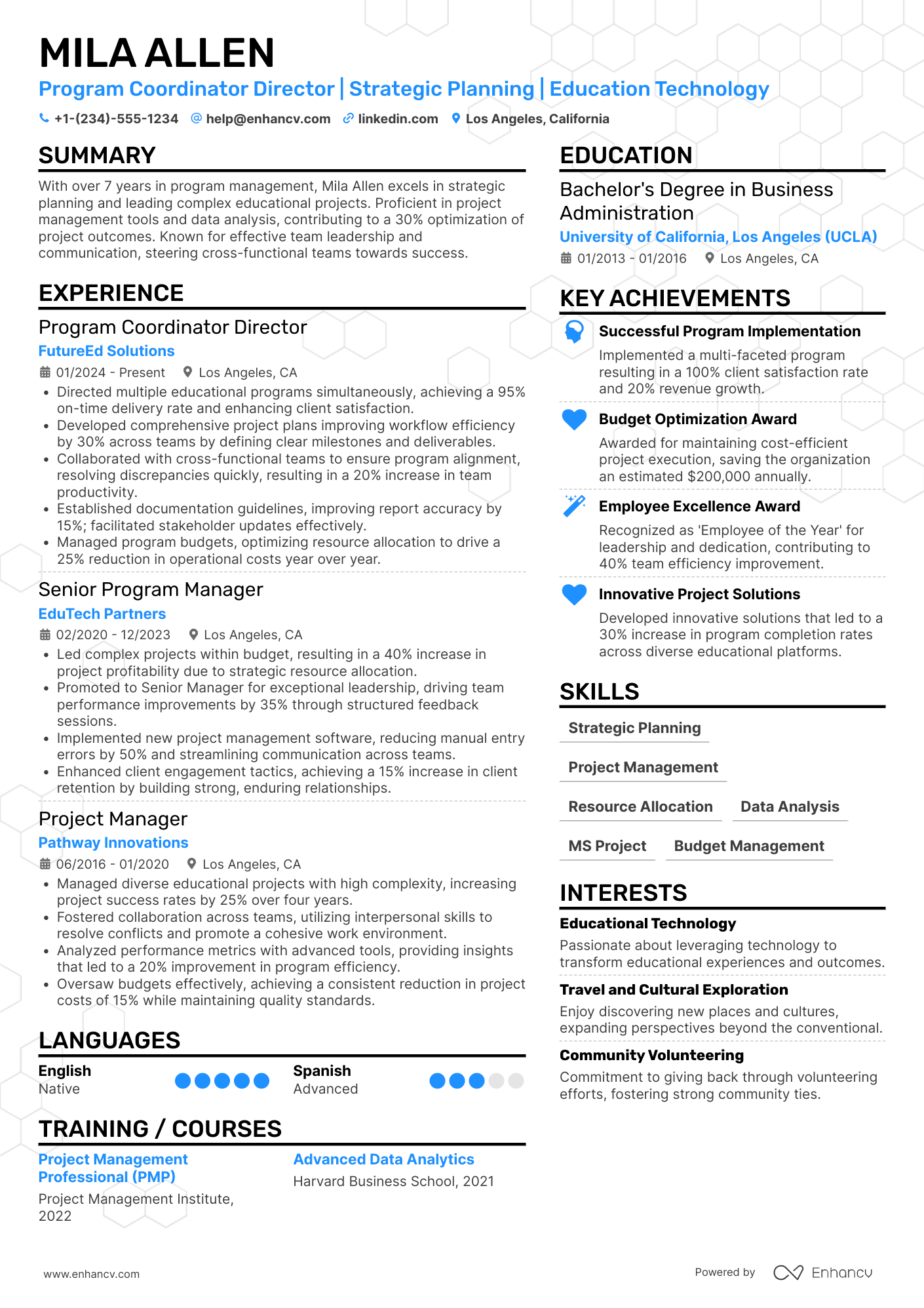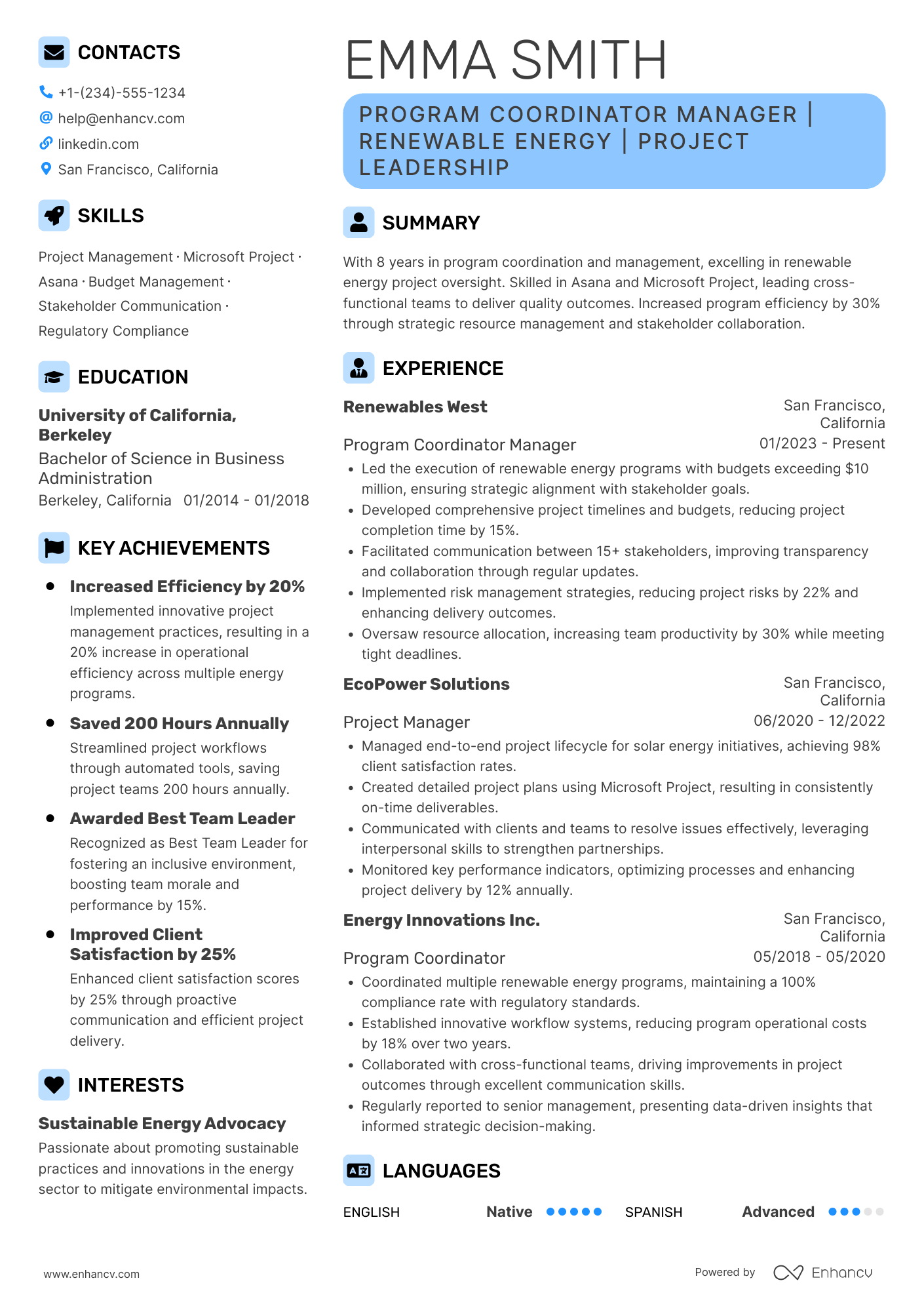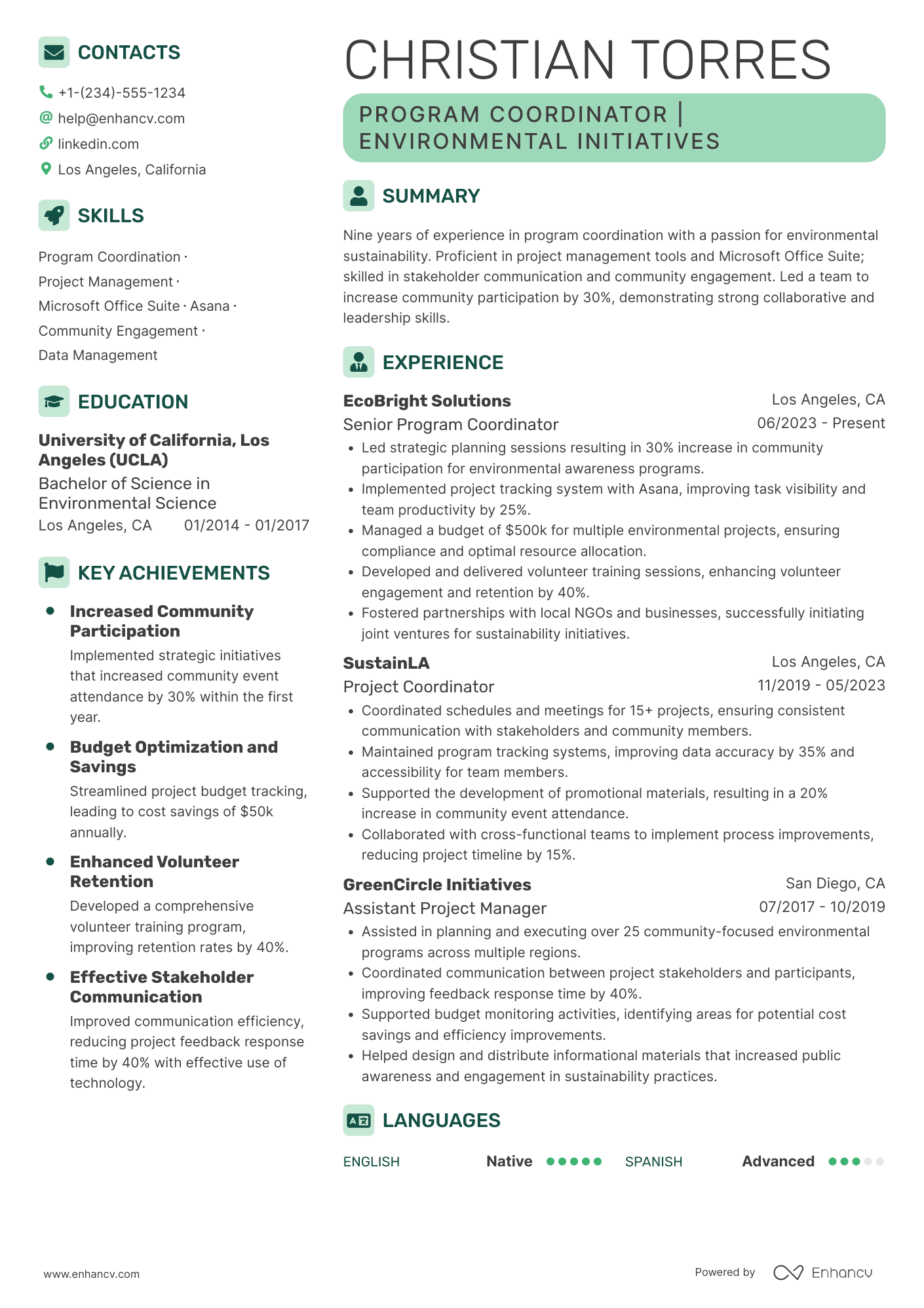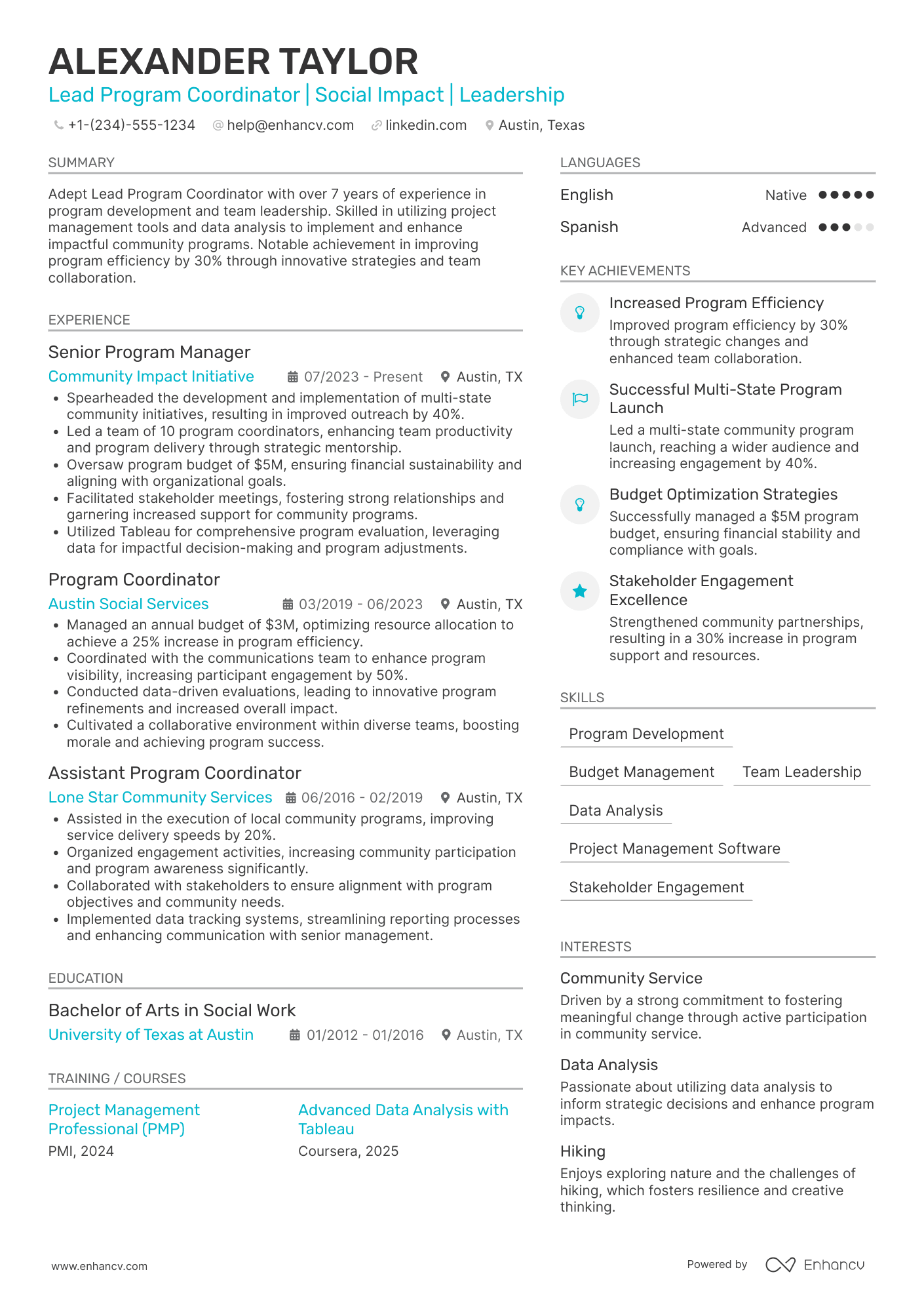
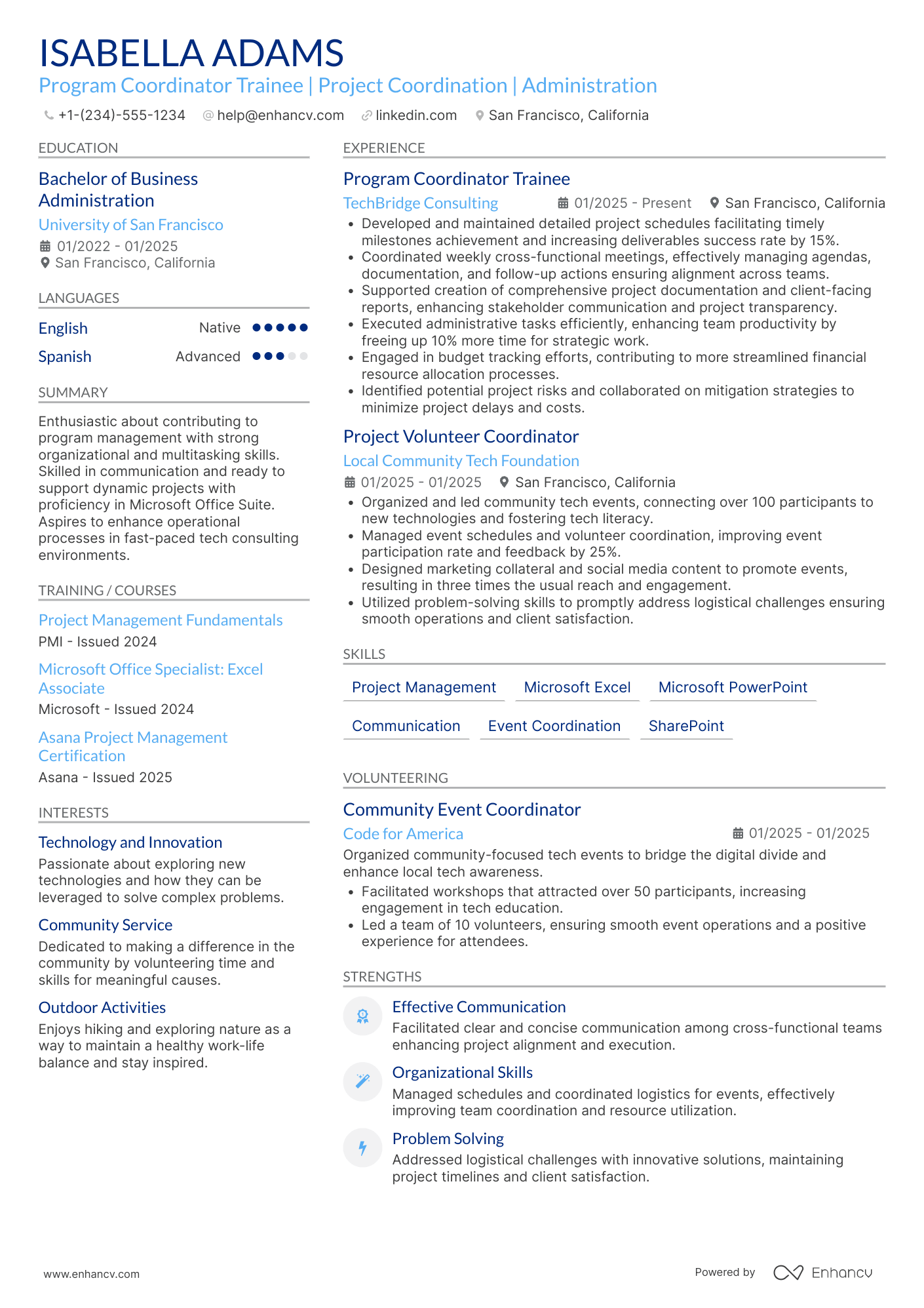
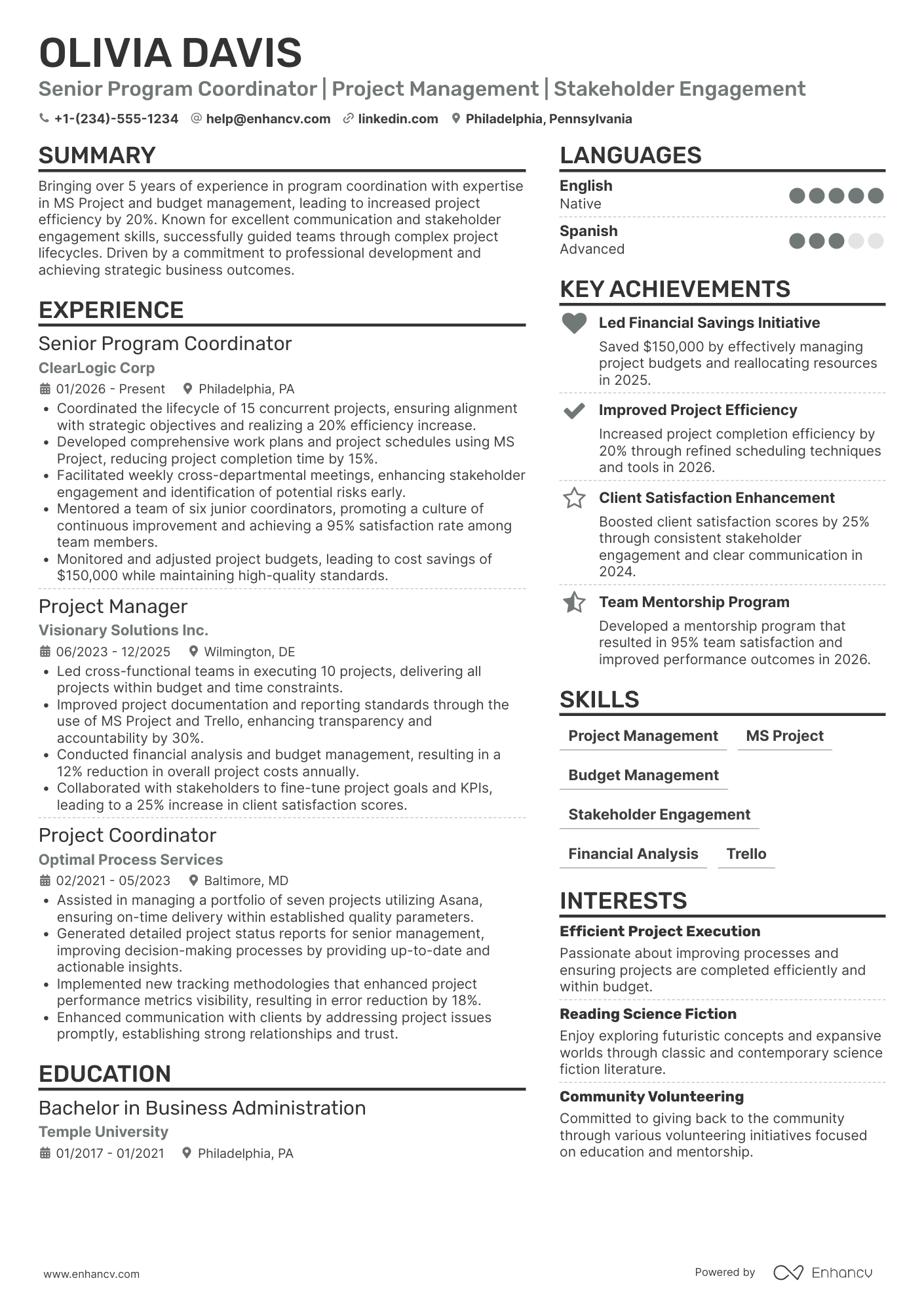
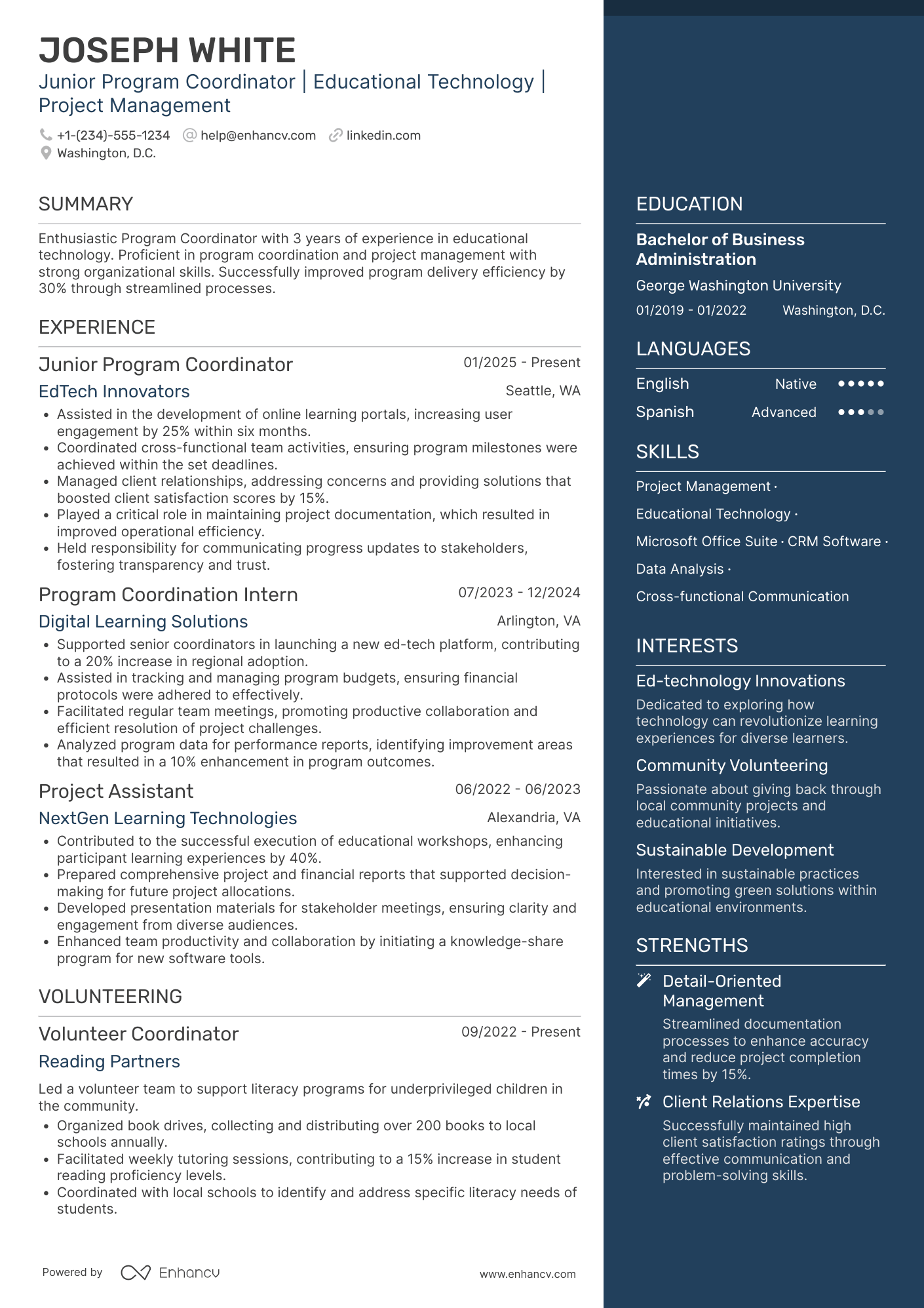
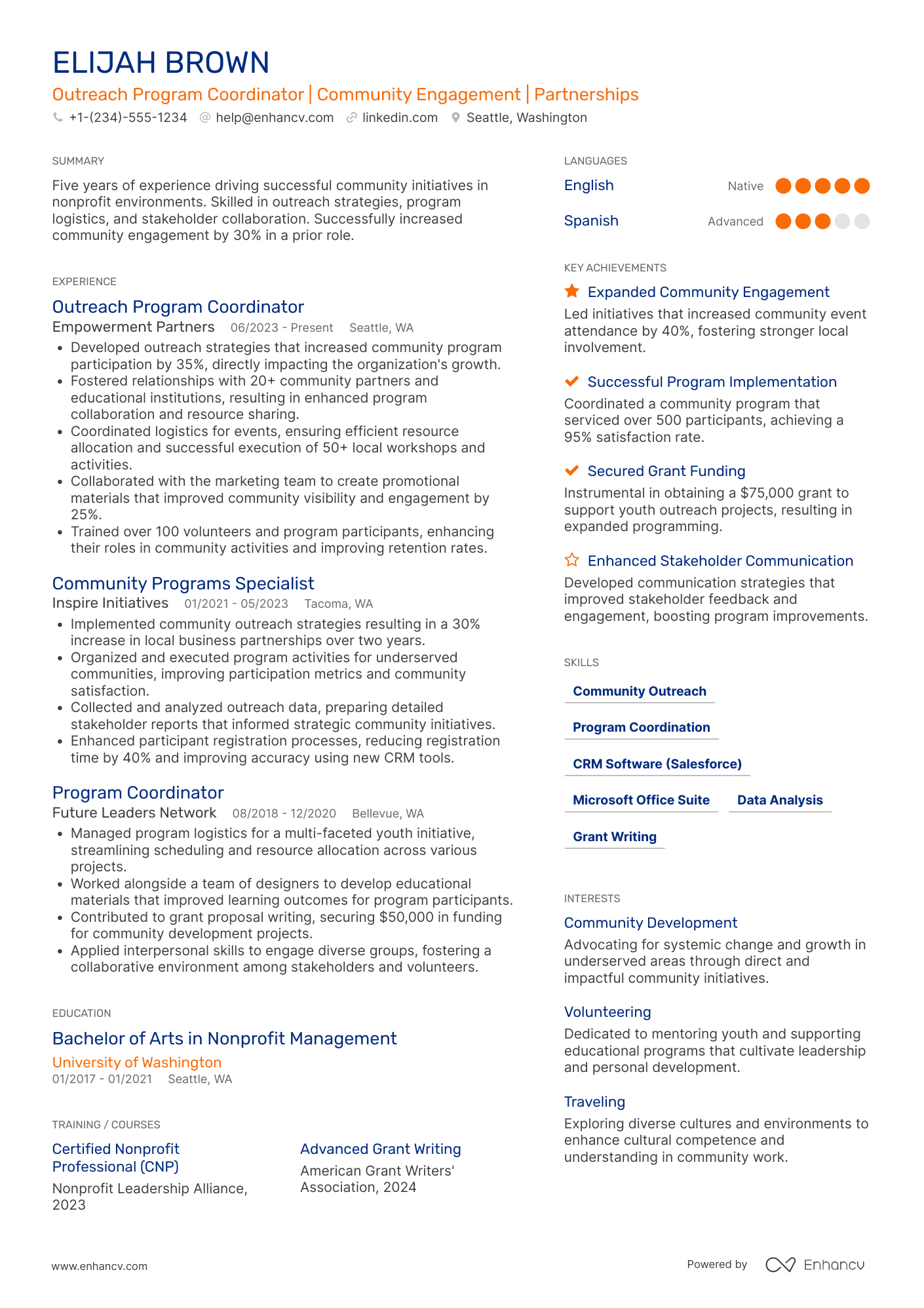
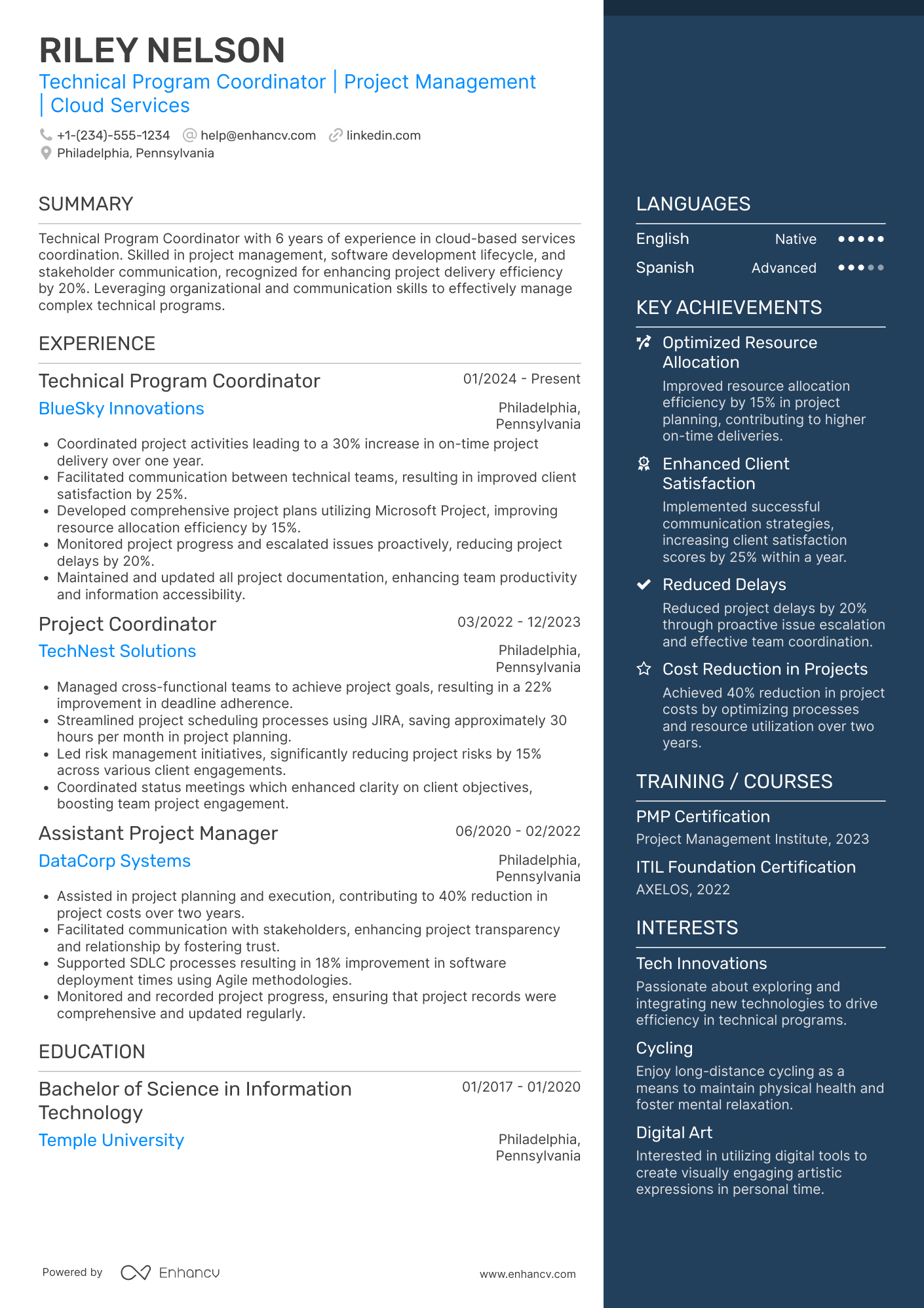
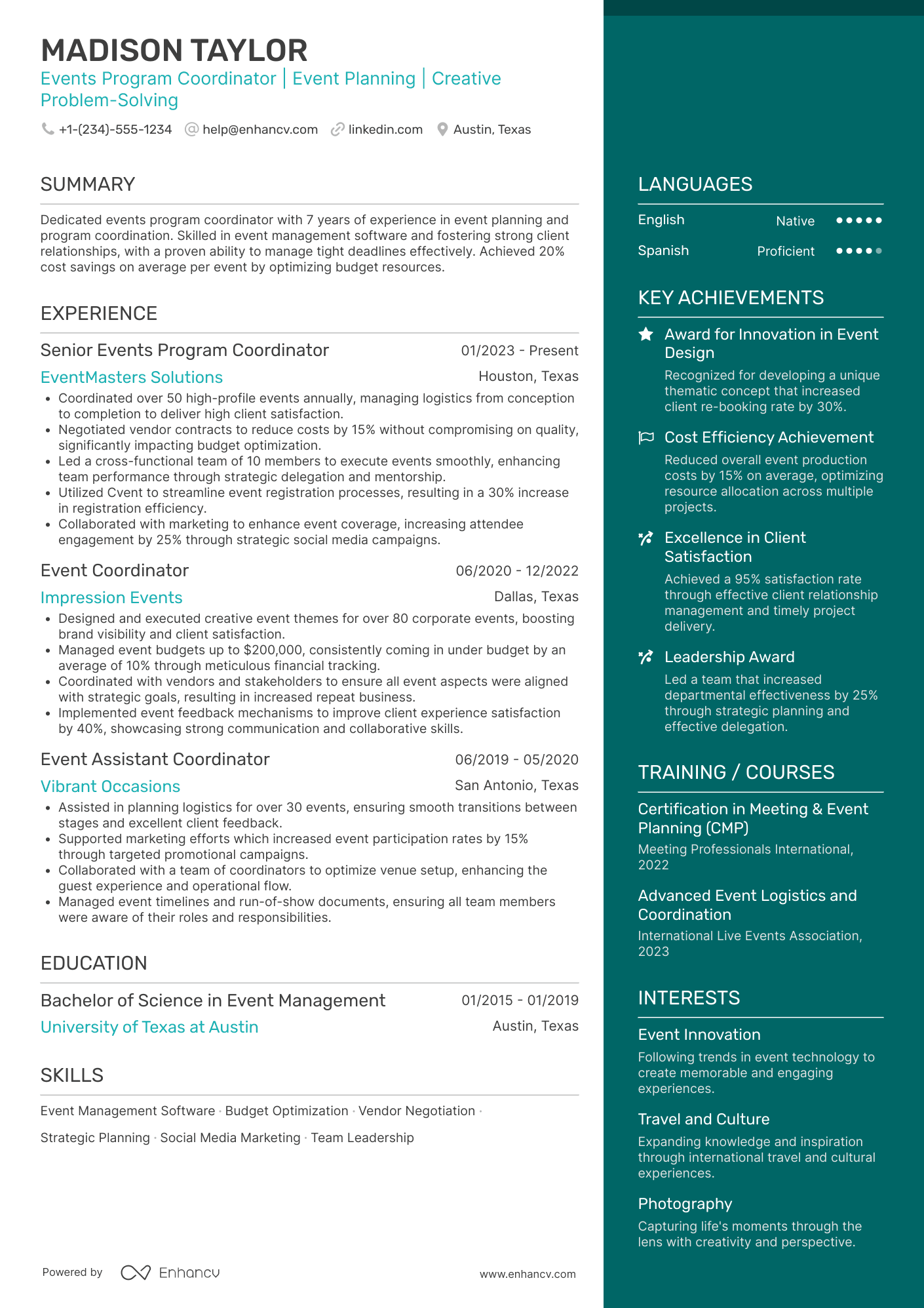
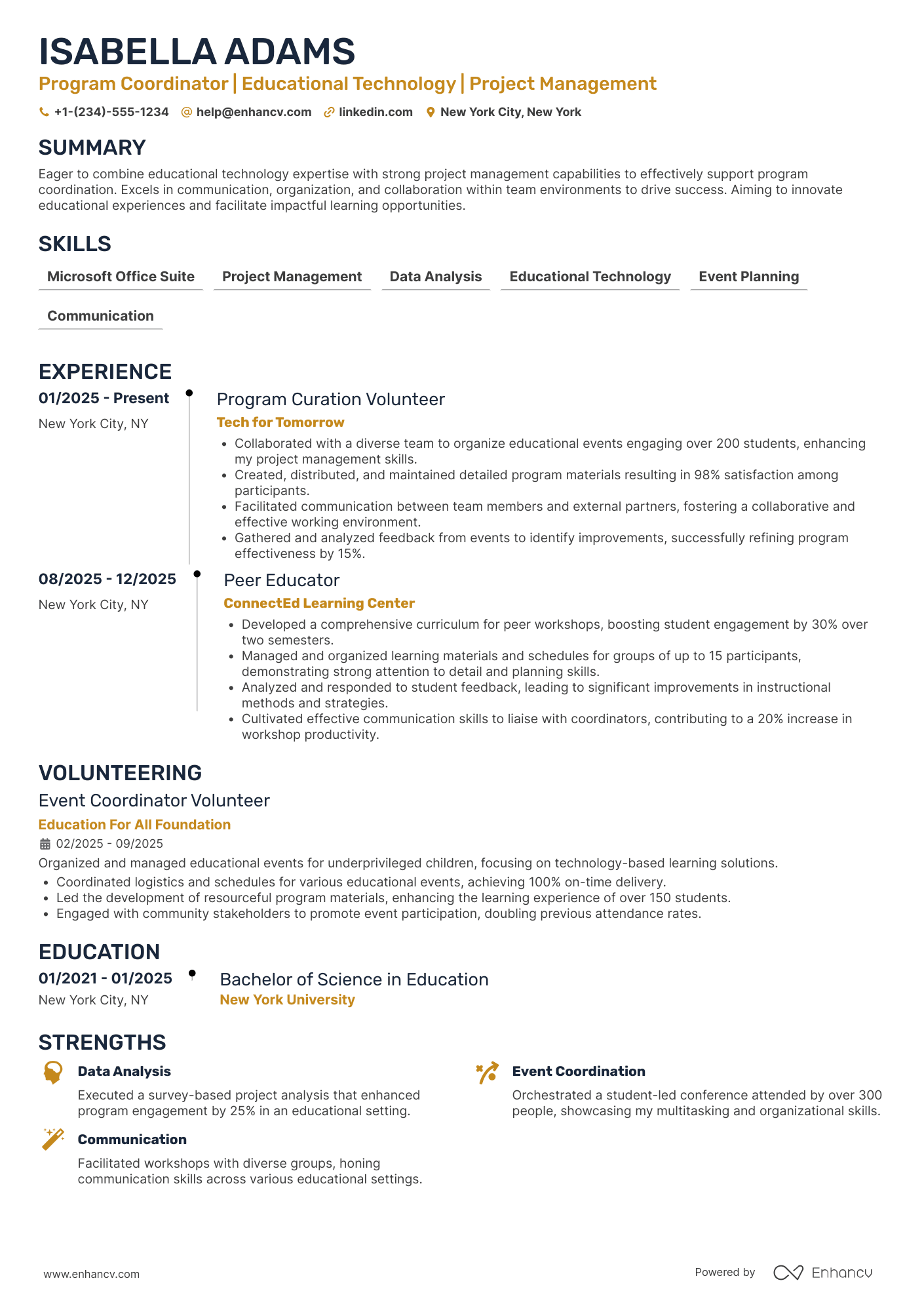
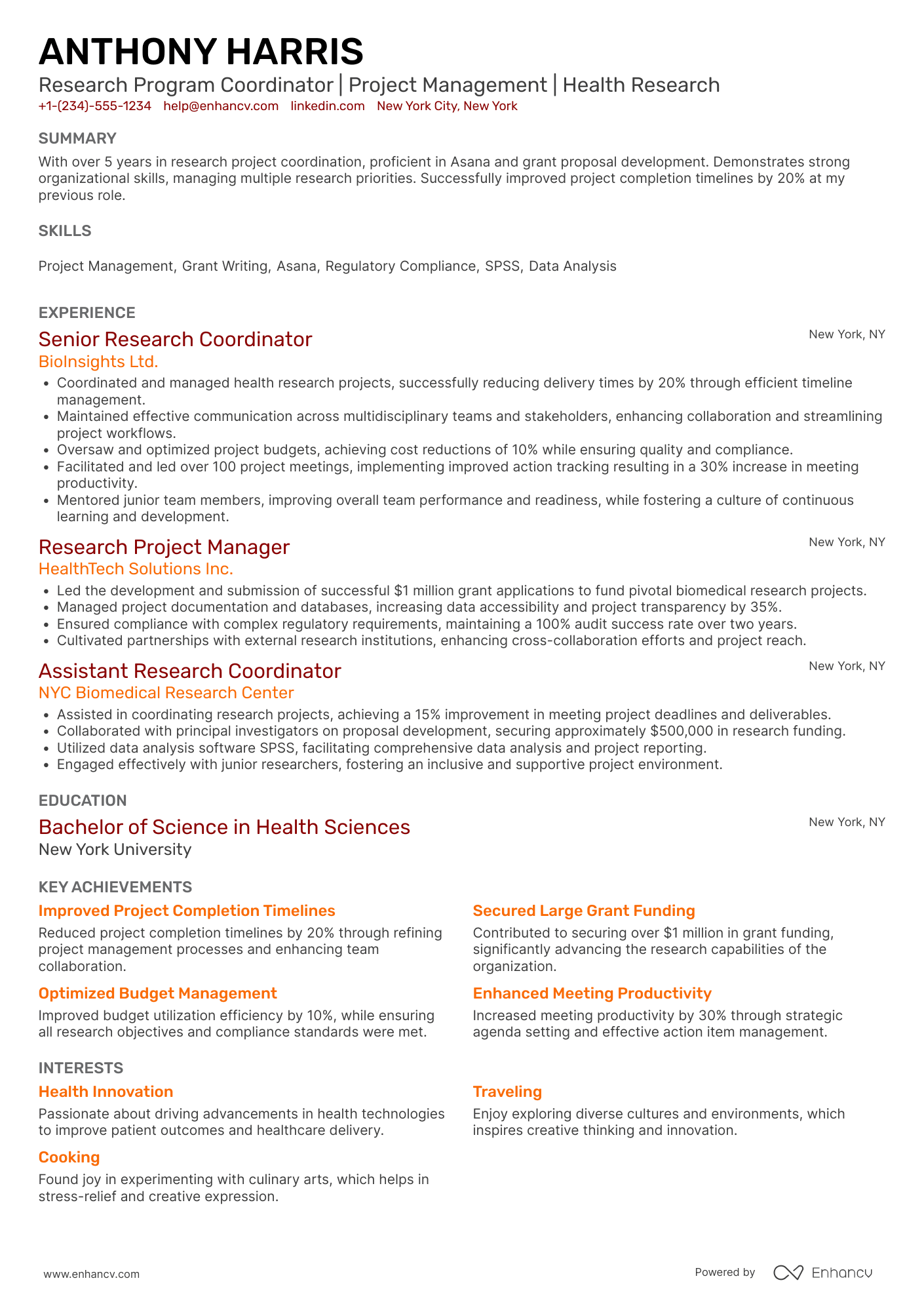
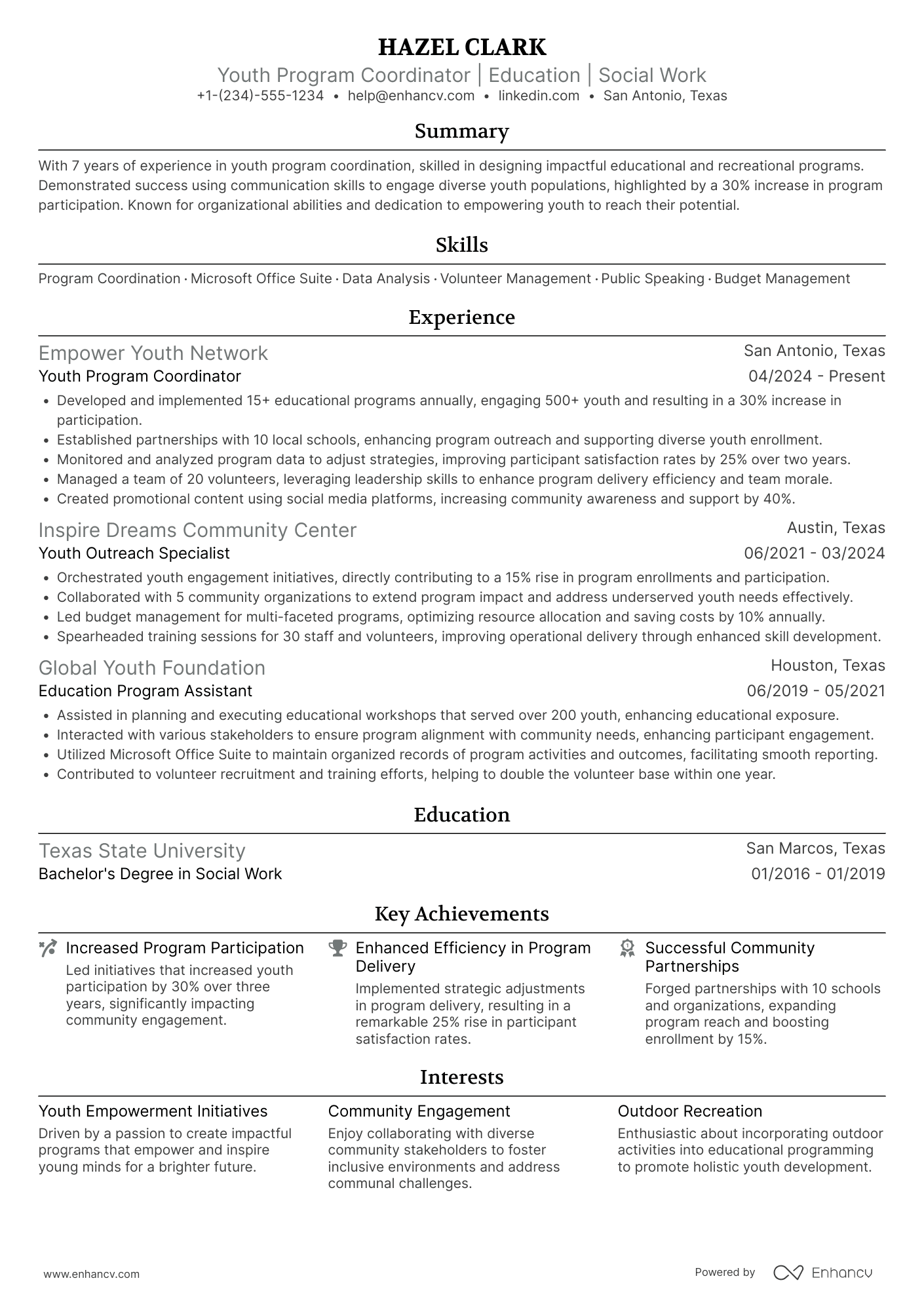
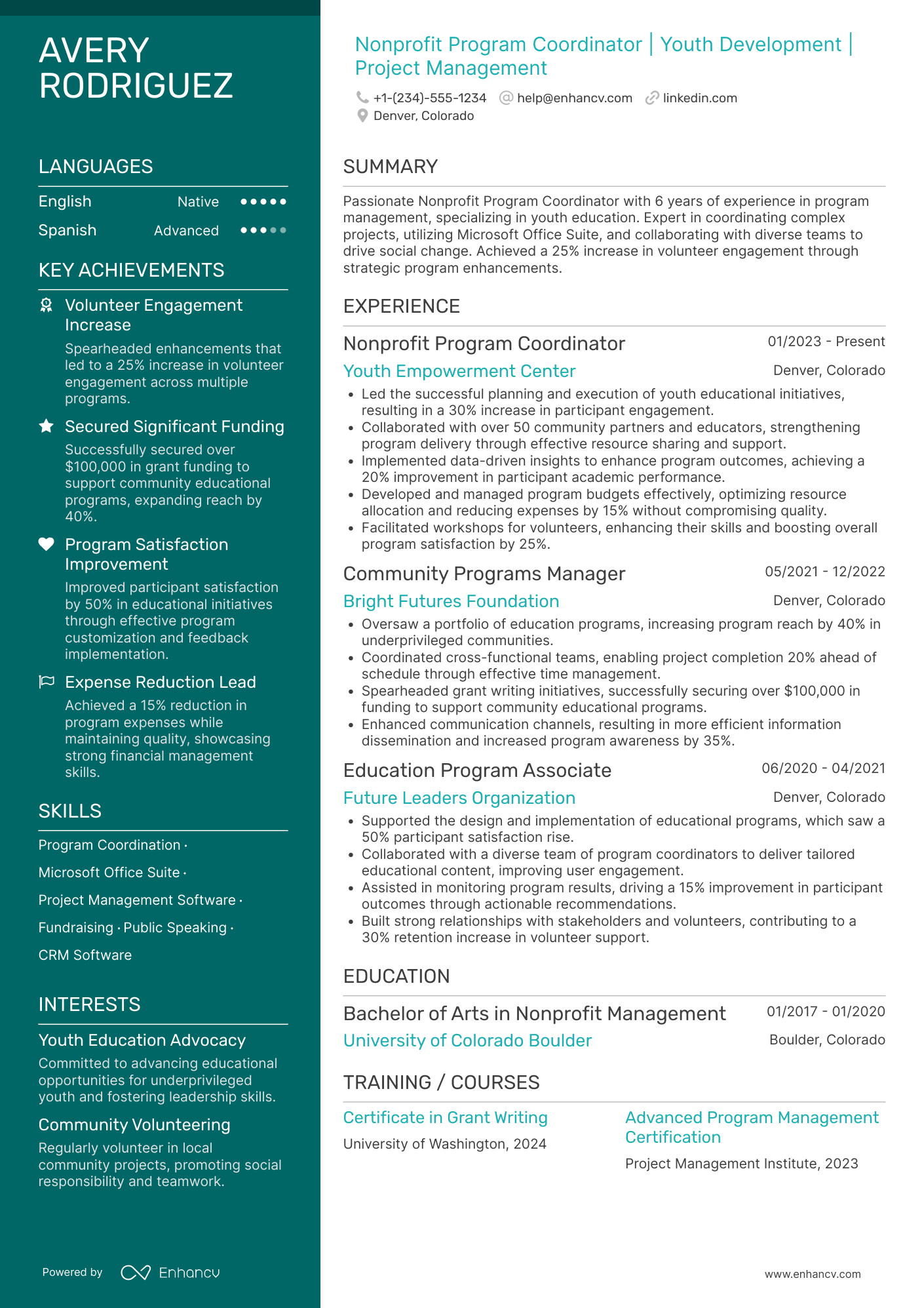
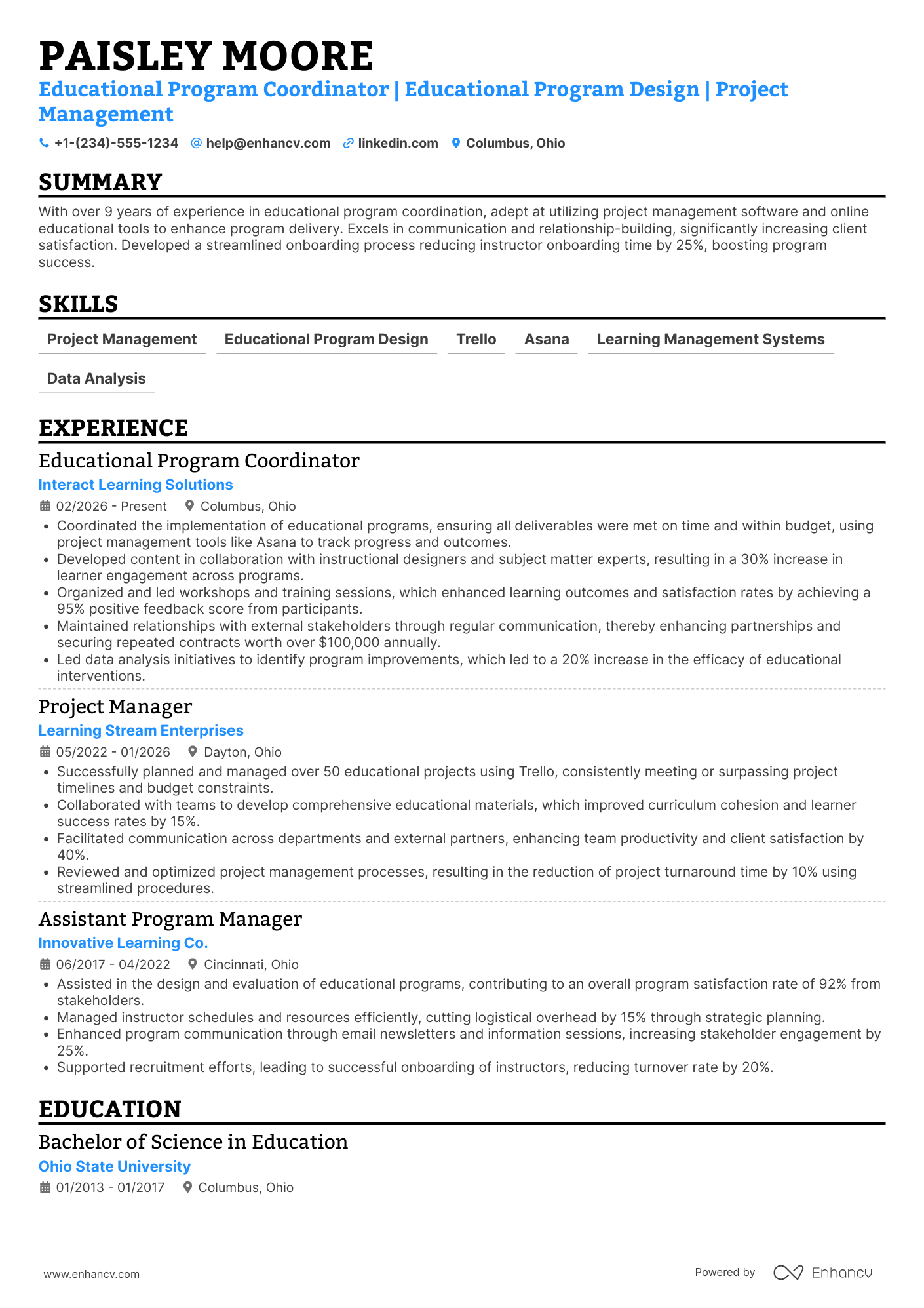
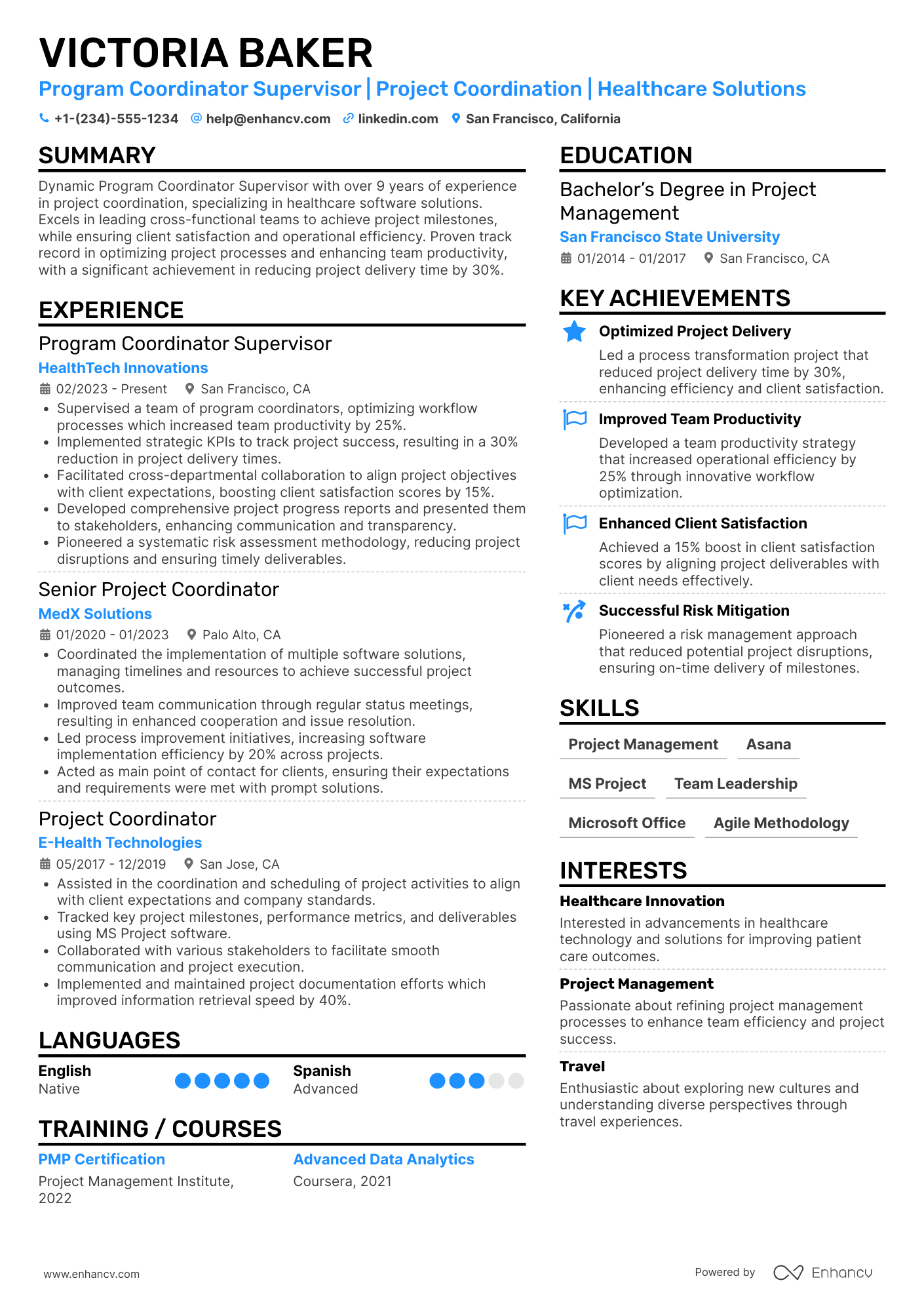
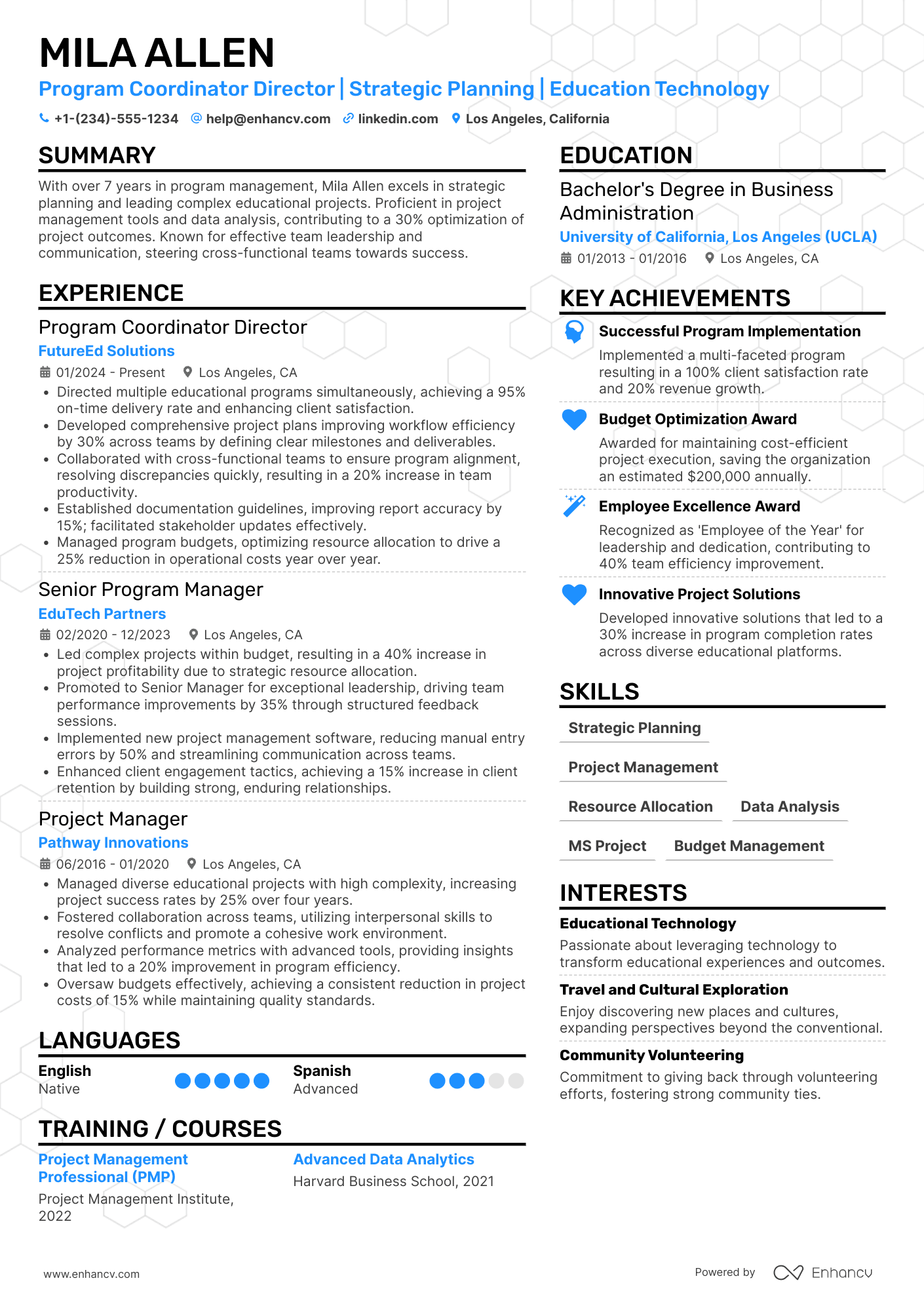
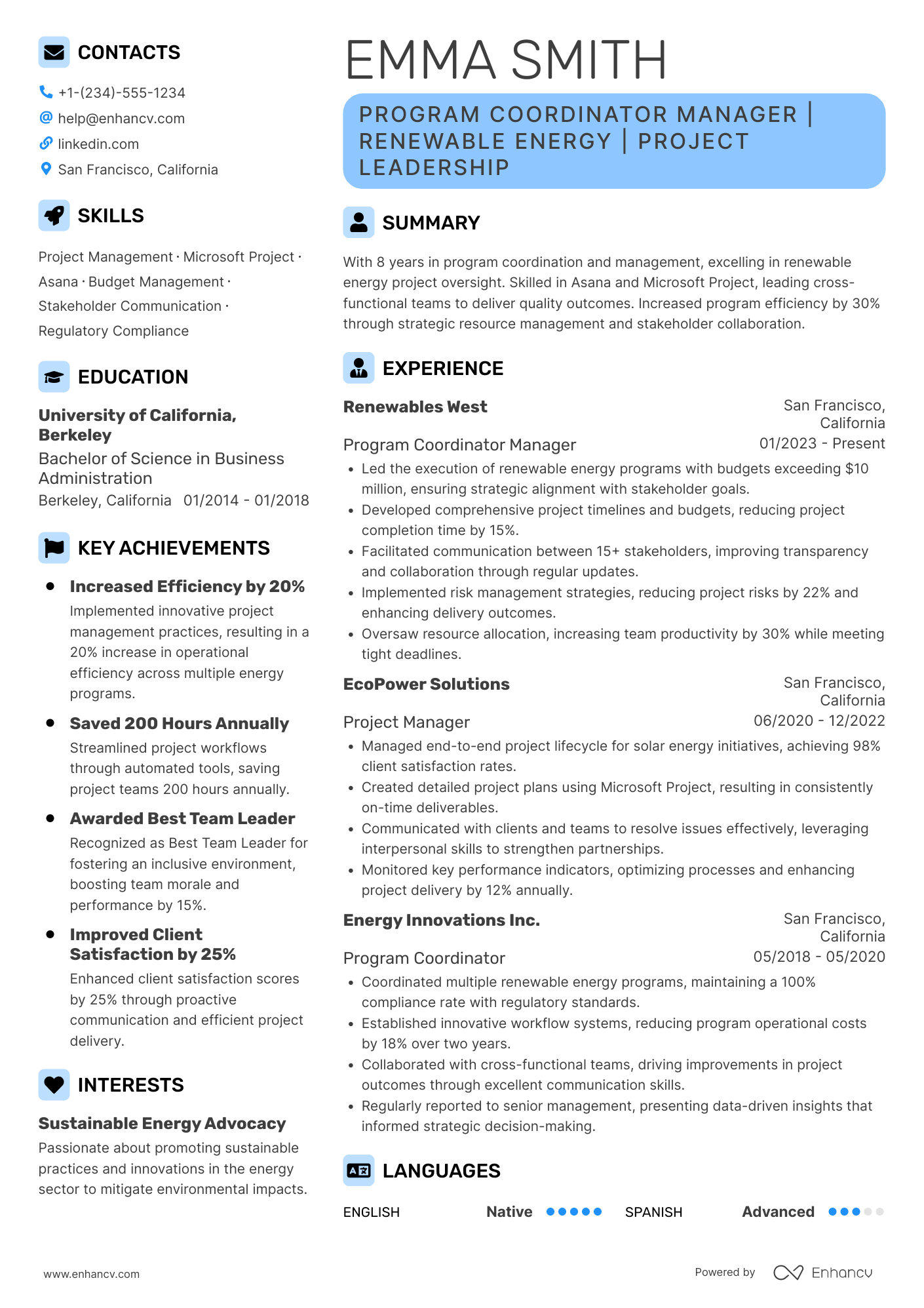
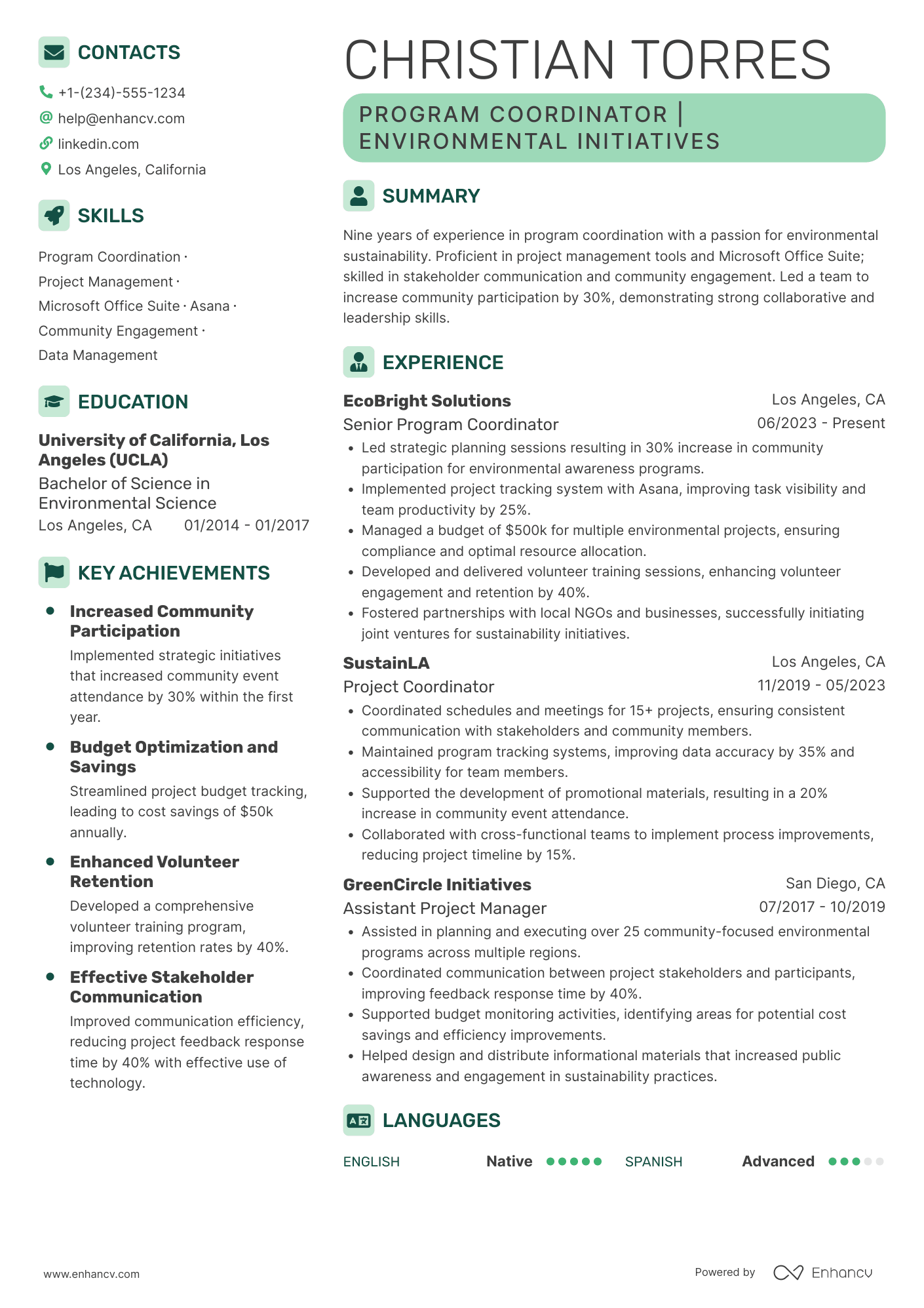
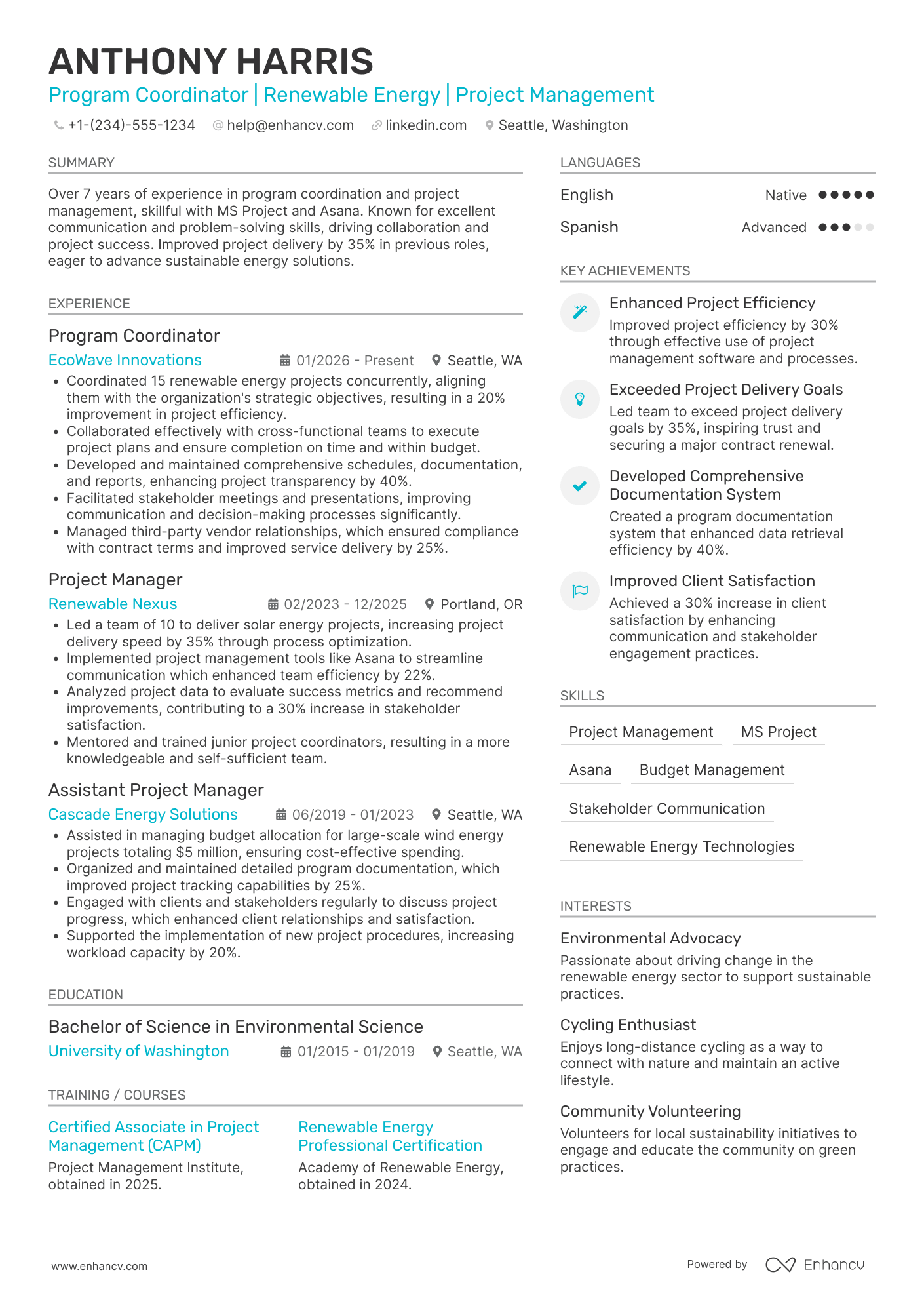
Most program coordinator resume drafts fail because they read like task lists and bury results under meeting notes, tools, and acronyms. That hurts in ATS screening and fast recruiter scans, where high competition rewards clear impact.
A strong resume shows what changed because of your work, so you stand out quickly. Knowing how to make your resume stand out starts with quantifying timelines met, budget tracked, vendors managed, stakeholder satisfaction, process cycle time reduced, audit findings avoided, and program deliverables shipped across teams.

Key takeaways
- Quantify program outcomes like delivery speed, budget savings, and compliance rates in every bullet.
- Use reverse-chronological format for experienced coordinators and hybrid format for career changers.
- Mirror exact tools, workflows, and KPIs from the job posting to pass ATS screening.
- Lead each experience bullet with ownership scope, execution method, and a measurable result.
- Place skills above experience if you're junior, below experience if you're mid-level or senior.
- Write a three- to four-line summary featuring your domain, core tools, and a specific achievement.
- Use Enhancv to turn vague duties into focused, metric-driven resume bullets faster.
Job market snapshot for program coordinators
We analyzed 1,601 recent program coordinator job ads across major US job boards. These numbers help you understand top companies hiring, industry demand, experience requirements at a glance.
What level of experience employers are looking for program coordinators
| Years of Experience | Percentage found in job ads |
|---|---|
| 1–2 years | 11.0% (176) |
| 3–4 years | 5.6% (89) |
| 5–6 years | 4.4% (70) |
| 7–8 years | 0.4% (6) |
| 9–10 years | 0.1% (1) |
| 10+ years | 1.6% (25) |
| Not specified | 76.6% (1227) |
Program coordinator ads by area of specialization (industry)
| Industry (Area) | Percentage found in job ads |
|---|---|
| Education | 35.6% (570) |
| Healthcare | 23.6% (378) |
| Government | 21.0% (336) |
| Finance & Banking | 18.0% (288) |
| Manufacturing | 0.6% (10) |
Top companies hiring program coordinators
| Company | Percentage found in job ads |
|---|---|
| Department of Veterans Affairs | 6.1% (98) |
| Department of the Air Force | 2.8% (45) |
| State of South Carolina | 2.6% (41) |
| Mac's List | 2.0% (32) |
| Encompass Health Corp. | 1.7% (28) |
| Department Of Justice | 1.6% (26) |
| Cleveland Clinic | 1.3% (21) |
| Rutgers University | 1.3% (21) |
| State of North Carolina | 1.3% (21) |
| University of Missouri System | 1.3% (21) |
Role overview stats
These tables show the most common responsibilities and employment types for program coordinator roles. Use them to align your resume with what employers expect and to understand how the role is structured across the market.
Day-to-day activities and top responsibilities for a program coordinator
| Responsibility | Percentage found in job ads |
|---|---|
| Microsoft office | 13.6% (217) |
| Excel | 11.1% (177) |
| Data analysis | 6.7% (108) |
| Word | 6.6% (106) |
| Project management | 6.6% (105) |
| Communication | 5.6% (89) |
| Powerpoint | 5.6% (89) |
| Microsoft word | 5.2% (83) |
| Microsoft excel | 4.9% (78) |
| Outlook | 4.6% (74) |
| Spreadsheets | 4.4% (70) |
| Word processing | 4.1% (66) |
Type of employment (remote vs on-site vs hybrid)
| Employment type | Percentage found in job ads |
|---|---|
| On-site | 81.3% (1301) |
| Hybrid | 16.1% (257) |
| Remote | 2.7% (43) |
How to format a program coordinator resume
Recruiters evaluating program coordinator resumes prioritize organizational skills, cross-functional coordination experience, and evidence of managing timelines, budgets, or stakeholder relationships. A clean, well-structured resume format ensures these signals surface quickly during both automated screening and the initial human review.

I have significant experience in this role—which format should I use?
Use a reverse-chronological format to highlight your depth of coordination experience and growing responsibility across programs. Do:
- Lead with your most recent role and emphasize the scope of programs you managed, including team sizes, budgets, and the number of concurrent workstreams.
- Feature role-specific tools and domains—project management platforms (Asana, Monday.com, MS Project), grant tracking systems, stakeholder reporting, and compliance frameworks.
- Quantify outcomes tied to efficiency, delivery, or impact rather than listing duties.
I'm junior or switching into this role—what format works best?
A hybrid format works best, letting you lead with relevant coordination and organizational skills while supporting them with any professional or project-based experience you have. Do:
- Place a skills section near the top that highlights program coordination competencies like scheduling, data tracking, stakeholder communication, and event logistics.
- Include academic projects, volunteer coordination, internships, or cross-functional team experience that demonstrates your ability to manage moving parts.
- Connect every skill or experience to a clear action and a measurable or observable result.
Why not use a functional resume?
A functional format strips away the timeline and context recruiters need to evaluate how you applied coordination skills in real work or project settings, making it harder to assess your readiness for managing structured programs.
- A functional format may be acceptable if you're transitioning from a related administrative or operations role and have no direct coordination titles—but only if you tie every listed skill to a specific project, volunteer initiative, or measurable outcome.
Once you've established a clean, readable layout, the next step is deciding which sections to include so each one earns its place on the page.
What sections should go on a program coordinator resume
Recruiters expect a program coordinator resume to highlight how you plan, execute, and improve programs while keeping stakeholders aligned and timelines on track. Understanding which resume sections to include helps you present your qualifications with maximum clarity.
Use this structure for maximum clarity:
- Header
- Summary
- Experience
- Skills
- Projects
- Education
- Certifications
- Optional sections: Awards, Volunteering, Languages
Strong experience bullets should emphasize measurable impact, program scope, on-time delivery, stakeholder coordination, process improvements, and results against goals.
Is your resume good enough?
Drop your resume here or choose a file. PDF & DOCX only. Max 2MB file size.
Now that you’ve organized the key resume components, focus on writing your program coordinator experience section so it supports those elements with clear, role-relevant impact.
How to write your program coordinator resume experience
The experience section is where you prove you can move programs forward—highlight work you've shipped or delivered, the coordination tools and methods you relied on, and the measurable outcomes that followed. Hiring managers prioritize demonstrated impact over descriptive task lists, so every bullet should connect what you did to a result the organization valued.
Each entry should include:
- Job title
- Company and location (or remote)
- Dates of employment (month and year)
Three to five concise bullet points showing what you owned, how you executed, and what outcomes you delivered:
- Ownership scope: the programs, initiatives, grant portfolios, service areas, or cross-departmental workstreams you were directly accountable for as a program coordinator.
- Execution approach: the project management platforms, scheduling systems, reporting frameworks, or stakeholder communication methods you used to keep programs on track and inform decisions.
- Value improved: the changes you drove in program efficiency, participant satisfaction, service delivery timelines, compliance accuracy, or resource utilization tied to your coordination work.
- Collaboration context: how you partnered with internal teams, community organizations, funding bodies, vendors, or leadership to align priorities and remove obstacles across the program lifecycle.
- Impact delivered: the outcomes your coordination produced, expressed through program growth, cost savings, improved retention, expanded reach, or strengthened organizational capacity rather than routine activity.
Experience bullet formula
A program coordinator experience example
✅ Right example - modern, quantified, specific.
Program Coordinator
BrightPath Community Health | Austin, TX
2022–Present
Coordinated cross-functional public health programs across five clinics serving 30,000+ patients annually.
- Orchestrated end-to-end program schedules in Asana and Microsoft Teams, improving on-time milestone delivery from 78% to 94% across twelve concurrent workstreams.
- Built Smartsheet dashboards and Power BI reports for leadership and clinic managers, cutting weekly status reporting time by six hours and reducing escalation response time by 30%.
- Standardized intake, consent, and referral workflows in Salesforce and DocuSign, lowering data entry errors by 22% and increasing same-day enrollment by 15% in three months.
- Coordinated vendor contracting, procurement, and budget tracking in Excel and NetSuite, reconciling 200+ invoices with 99% accuracy and preventing $48,000 in duplicate or late charges.
- Facilitated weekly stakeholder reviews with clinicians, operations leads, and IT, documenting decisions in Confluence and driving closure of 90% of action items within seven days.
Now that you've seen how a strong experience section comes together, let's look at how to adjust yours to match the specific role you're applying for.
How to tailor your program coordinator resume experience
Recruiters evaluate your program coordinator resume through both human review and applicant tracking systems (ATS), so tailoring your resume to the job description is essential. Tailoring ensures your most relevant qualifications stand out to both audiences.
Ways to tailor your program coordinator experience:
- Match project management tools and platforms named in the job description.
- Mirror the exact terminology used for program workflows and processes.
- Reflect specific KPIs or success metrics the employer prioritizes.
- Include relevant industry or domain experience the posting requests.
- Highlight compliance or quality assurance duties when the role requires them.
- Use the same language for stakeholder collaboration models referenced.
- Emphasize scheduling or resource coordination methods the employer values.
- Align reporting and documentation practices with stated expectations.
Tailoring means connecting your real accomplishments to what the employer asks for, not forcing keywords where they don't belong.
Resume tailoring examples for program coordinator
| Job description excerpt | Untailored | Tailored |
|---|---|---|
| "Coordinate after-school enrichment programs for K–8 students using Salesforce to track enrollment, attendance, and family engagement across three site locations." | Helped run youth programs and kept track of participant information. | Coordinated after-school enrichment programs for 450+ K–8 students across three sites, using Salesforce to monitor enrollment, attendance, and family engagement metrics quarterly. |
| "Collaborate with cross-functional teams to plan and execute community health initiatives, managing budgets up to $150K and reporting outcomes to grant funders." | Worked with different departments on program planning and budget tasks. | Partnered with cross-functional teams to plan and execute four community health initiatives annually, managing a $150K budget and delivering quarterly outcome reports to grant funders. |
| "Develop and maintain program timelines in Asana, ensuring milestones are met for workforce development training cohorts serving adult learners." | Created schedules and made sure projects stayed on track. | Built and maintained program timelines in Asana for six workforce development training cohorts, tracking milestone completion for 200+ adult learners and reducing scheduling delays by 30%. |
Once you’ve aligned your experience with the role’s priorities, the next step is to quantify your program coordinator achievements so employers can see the impact behind that fit.
How to quantify your program coordinator achievements
Quantifying your achievements proves you drove outcomes, not just tasks. For program coordinators, track delivery speed, volume handled, budget control, accuracy, compliance, satisfaction, and risk reduction across stakeholders, vendors, and timelines.
Quantifying examples for program coordinator
| Metric | Example |
|---|---|
| Delivery speed | "Cut event planning cycle time from six weeks to four by using Asana templates and a standardized intake form across eight stakeholders." |
| Volume handled | "Coordinated 120+ workshops in twelve months, managing speaker logistics, contracts, and calendars for a 500-employee program." |
| Budget control | "Reduced vendor spend by 14% ($38K annually) by rebidding catering and AV contracts and tracking invoices in Excel and NetSuite." |
| Accuracy | "Lowered registration and roster errors from 6% to 1% by adding Salesforce validation rules and a two-step confirmation email workflow." |
| Compliance risk | "Achieved 100% on-time documentation for 60 grants by building a Smartsheet deadline tracker and running weekly compliance checks." |
Turn vague job duties into measurable, recruiter-ready resume bullets in seconds with Enhancv's Bullet Point Generator.
Once you've crafted strong bullet points that highlight your accomplishments, the next step is ensuring your resume also showcases the right mix of hard and soft skills employers expect from a program coordinator.
How to list your hard and soft skills on a program coordinator resume
Your skills section shows you can run cross-functional programs, and recruiters and an ATS (applicant tracking system) scan this section to confirm role fit and keywords—aim for a hard-skill-heavy mix supported by a smaller set of execution-focused soft skills. program coordinator roles require a blend of:
- Product strategy and discovery skills.
- Data, analytics, and experimentation skills.
- Delivery, execution, and go-to-market discipline.
- Soft skills.
Your skills section should be:
- Scannable (bullet-style grouping).
- Relevant to the job post.
- Backed by proof in experience bullets.
- Updated with current tools.
Place your skills section:
- Above experience if you're junior or switching careers.
- Below experience if you're mid/senior with strong achievements.

Hard skills
- Program planning and scheduling
- Work breakdown structures, milestones
- Risk and issue management
- Budget tracking and forecasting
- Stakeholder reporting and dashboards
- Jira, Asana, Trello
- Smartsheet, Microsoft Project
- Confluence, SharePoint documentation
- Salesforce, HubSpot CRM
- Microsoft Excel, Google Sheets
- Survey design and analysis
- Event logistics and vendor management
Soft skills
- Cross-functional coordination
- Clear status updates
- Agenda setting and facilitation
- Action-item follow-through
- Stakeholder expectation management
- Escalation judgment
- Prioritization under constraints
- Detail control at speed
- Written documentation discipline
- Meeting notes into decisions
- Vendor and partner communication
- Ownership of timelines and outcomes
How to show your program coordinator skills in context
Skills shouldn't live only in a bulleted list on your resume. Explore how other professionals present their resume skills to see effective examples in action.
They should be demonstrated in:
- Your summary (high-level professional identity)
- Your experience (proof through outcomes)
Here's what strong, skill-rich entries look like in practice.
Summary example
Program coordinator with eight years in public health, skilled in Asana-based workflow management, cross-departmental stakeholder engagement, and grant compliance. Streamlined reporting processes across 12 federally funded programs, reducing cycle time by 30%.
- Reflects senior-level experience clearly
- Names a role-relevant tool
- Includes a specific measurable outcome
- Highlights communication and collaboration
Experience example
Senior Program Coordinator
Meridian Health Partners | Remote
June 2019–March 2024
- Managed five concurrent community wellness programs in Salesforce, improving participant retention by 22% over two years through data-driven engagement strategies.
- Collaborated with clinical teams and external vendors to redesign onboarding workflows, cutting new-program launch timelines from 14 weeks to nine.
- Built standardized reporting dashboards in Google Sheets for leadership, reducing monthly status-update preparation time by 40% across the coordination team.
- Every bullet contains measurable proof.
- Skills surface naturally through actions.
Once you’ve demonstrated your program coordination strengths through relevant examples, the next step is to apply that approach to structuring a program coordinator resume when you don’t have formal experience.
How do I write a program coordinator resume with no experience
Even without full-time experience, you can demonstrate readiness through:
- Campus event logistics coordination
- Student organization program scheduling
- Volunteer program intake tracking
- Internship project timeline management
- Fundraising campaign reporting support
- Community workshop registration management
- Committee meeting notes and follow-ups
If you're building a resume without work experience, focus on:
- Defined scope, timeline, deliverables
- Tools used: Excel, Asana
- Metrics: attendance, budget, deadlines
- Stakeholder updates and documentation
Resume format tip for entry-level program coordinator
Use a hybrid resume format. It highlights relevant projects and tools first, while still showing education and roles that support program coordinator work. Do:
- Lead with a "Projects" section.
- Add tools in each bullet.
- Quantify outputs, deadlines, and volume.
- Mirror program coordinator keywords from postings.
- Include relevant coursework and certifications.
- Coordinated campus workshop registration in Google Sheets and Asana, tracked one hundred twenty sign-ups, and reduced no-shows by 18% through automated reminders.
Even without direct experience, your educational background can strengthen your candidacy—here's how to present it effectively on your resume.
How to list your education on a program coordinator resume
Your education section helps hiring teams confirm you have the foundational knowledge needed for program coordination. It validates your training in areas like project management, communication, and organizational leadership.
Include:
- Degree name
- Institution
- Location
- Graduation year
- Relevant coursework (for juniors or entry-level candidates)
- Honors & GPA (if 3.5 or higher)
Skip month and day details—list the graduation year only.
Here's a strong education entry tailored to a program coordinator resume.
Example education entry
Bachelor of Arts in Communication Studies
University of Michigan, Ann Arbor, MI
Graduated 2021
GPA: 3.7/4.0
- Relevant Coursework: Program Planning, Nonprofit Management, Organizational Behavior, Grant Writing
- Honors: Magna Cum Laude, Dean's List (six semesters)
How to list your certifications on a program coordinator resume
Certifications show a program coordinator's commitment to learning, proficiency with essential tools, and understanding of industry standards. They also signal readiness to manage timelines, stakeholders, and compliance requirements.
Include:
- Certificate name
- Issuing organization
- Year
- Optional: credential ID or URL
- Place certifications below education when your education is recent and directly aligned with program coordinator work.
- Place certifications above education when they are recent, highly relevant, or required for the program coordinator role.
Best certifications for your program coordinator resume
Project Management Professional (PMP) Certified Associate in Project Management (CAPM) Certified ScrumMaster (CSM) Lean Six Sigma Green Belt Microsoft Office Specialist (MOS) Certified Nonprofit Professional (CNP) Google Project Management: Professional Certificate
Once you’ve positioned your certifications to support your qualifications, focus on writing your program coordinator resume summary to highlight those strengths upfront.
How to write your program coordinator resume summary
Your resume summary is the first thing a recruiter reads. A strong one immediately signals you're qualified and worth a closer look.
Keep it to three to four lines, with:
- Your title and total years of relevant coordination experience.
- The domain or industry you've worked in, such as nonprofit, healthcare, or education.
- Core tools and skills like project management software, budgeting, or stakeholder communication.
- One or two measurable achievements that show your direct impact on program outcomes.
- Soft skills tied to real results, such as cross-team collaboration that improved delivery timelines.

PRO TIP
At the program coordinator level, emphasize specific skills, tools, and early contributions that prove you can execute. Highlight any measurable wins, even small ones, to stand out. Avoid vague phrases like "passionate team player" or "motivated self-starter." Replace them with concrete actions and results.
Example summary for a program coordinator
Program coordinator with three years of experience in nonprofit education initiatives. Managed scheduling, vendor logistics, and grant tracking in Asana, improving on-time program delivery by 18%.
Optimize your resume summary and objective for ATS
Drop your resume here or choose a file.
PDF & DOCX only. Max 2MB file size.
Now that your summary is ready to showcase your qualifications at a glance, make sure your header—the first thing recruiters see—presents your contact details and professional identity just as effectively.
What to include in a program coordinator resume header
A resume header is the top section with your key contact details, and it boosts visibility, credibility, and recruiter screening for a program coordinator role.
Essential resume header elements
- Full name
- Tailored job title and headline
- Location
- Phone number
- Professional email
- GitHub link
- Portfolio link
A LinkedIn link helps recruiters verify experience quickly and supports screening.
Don't include a photo on a program coordinator resume unless the role is explicitly front-facing or appearance-dependent.
Match your header job title and headline to the program coordinator posting, and keep formatting consistent across your resume and LinkedIn.
Program coordinator resume header
Jordan Taylor
Program Coordinator | Higher Education Programs and Stakeholder Support
Austin, TX
(512) 555-01XX
jordan.taylor@enhancv.com
github.com/jordantaylor
jordantaylor.co
linkedin.com/in/jordantaylor
Once your contact details and role identifiers are clear and accurate, add targeted additional sections to reinforce your qualifications and support the rest of your resume.
Additional sections for program coordinator resumes
When your core sections don't fully capture your qualifications, additional sections help you stand out with role-specific credibility. For example, listing language skills can demonstrate your ability to coordinate with diverse stakeholders and communities.
- Languages
- Certifications
- Volunteer experience
- Professional affiliations
- Publications
- Awards and honors
- Community engagement initiatives
Once you've rounded out your resume with the right supplementary sections, it's worth pairing it with a cover letter to strengthen your overall application.
Do program coordinator resumes need a cover letter
A cover letter isn't required for every program coordinator role, but it helps in competitive searches or when hiring managers expect one. If you're unsure where to start, understanding what a cover letter is and how it complements your resume can clarify when it's worth including one. It can make a difference when your resume needs context, or when you want to clarify fit quickly.
Use your cover letter to add context your resume can't:
- Explain role or team fit: Connect your coordination style to the program coordinator team's priorities, workflows, and stakeholders.
- Highlight one or two relevant projects or outcomes: Share a specific result, your role, and what you improved in delivery, reporting, or communications.
- Show understanding of the product, users, or business context: Reference the audience served, key constraints, and how you'd support adoption, quality, or timelines.
- Address career transitions or non-obvious experience: Translate related work into program coordinator skills, and explain the change in one clear, direct sentence.
Drop your resume here or choose a file.
PDF & DOCX only. Max 2MB file size.
Once you’ve decided whether to include a cover letter based on the role and employer expectations, you can use AI to improve your program coordinator resume so it aligns more closely with the job requirements.
Using AI to improve your program coordinator resume
AI can sharpen your resume's clarity, structure, and impact. It helps tighten language and highlight measurable results. But overuse strips authenticity. Once your content feels clear and role-aligned, step away from AI. If you're exploring options, learn which AI is best for writing resumes to find the right tool for your needs.
Here are 10 practical prompts to strengthen specific sections of your program coordinator resume:
Strengthen your summary
Quantify experience bullets
Tighten action verbs
Align skills strategically
Refine project descriptions
Improve education relevance
Clarify certification value
Remove filler language
Tailor to job posting
Fix inconsistent formatting
Conclusion
A strong program coordinator resume proves impact with measurable outcomes, highlights role-specific skills, and stays easy to scan. Use clear headings, clean formatting, and consistent dates. Show results in numbers, and tie each accomplishment to coordination, communication, and problem-solving.
Hiring teams need program coordinators who can deliver reliable execution now and adapt to changing priorities. A structured resume with specific outcomes and relevant skills helps you compete in today’s market. Keep it focused, accurate, and ready to submit.
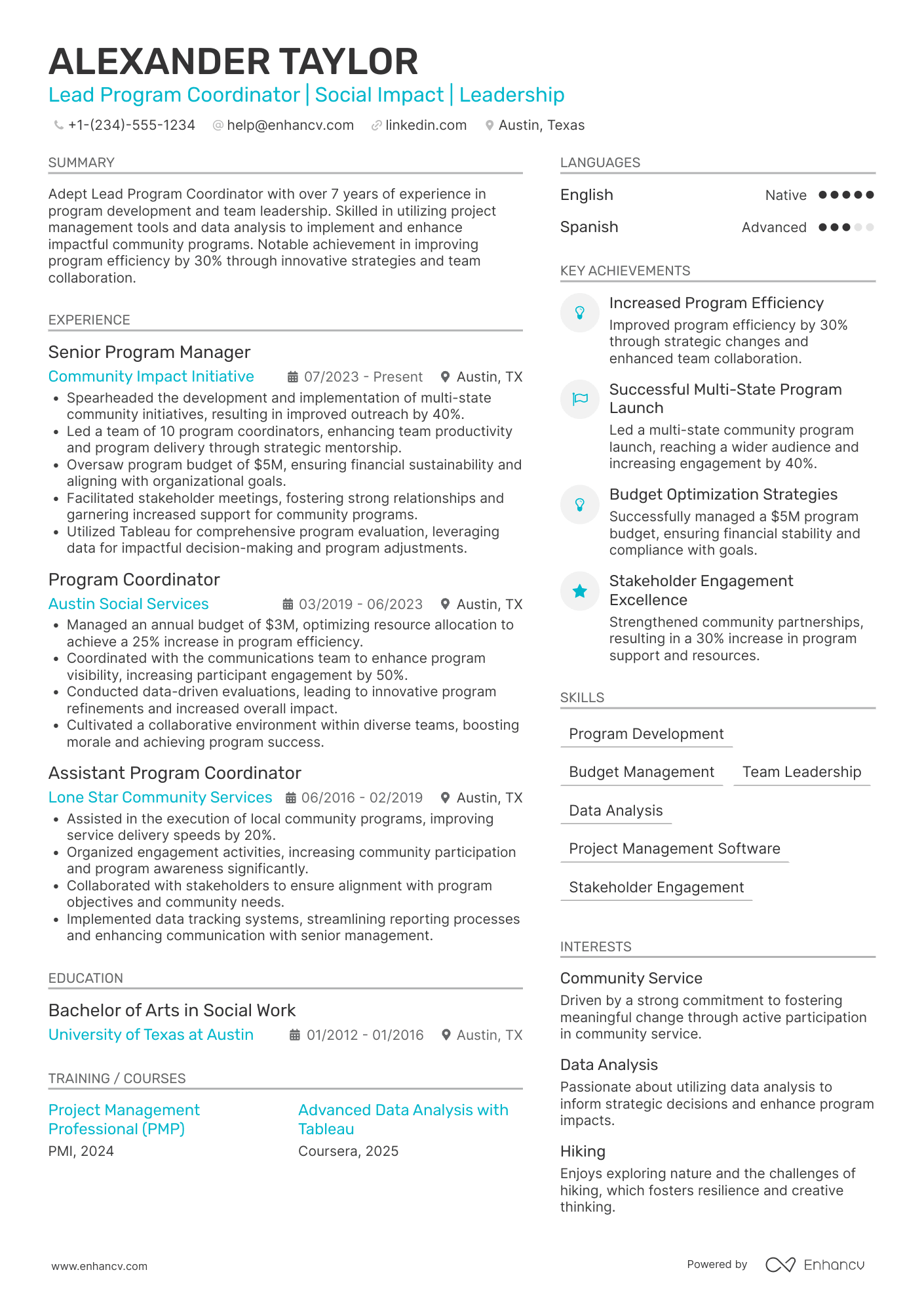
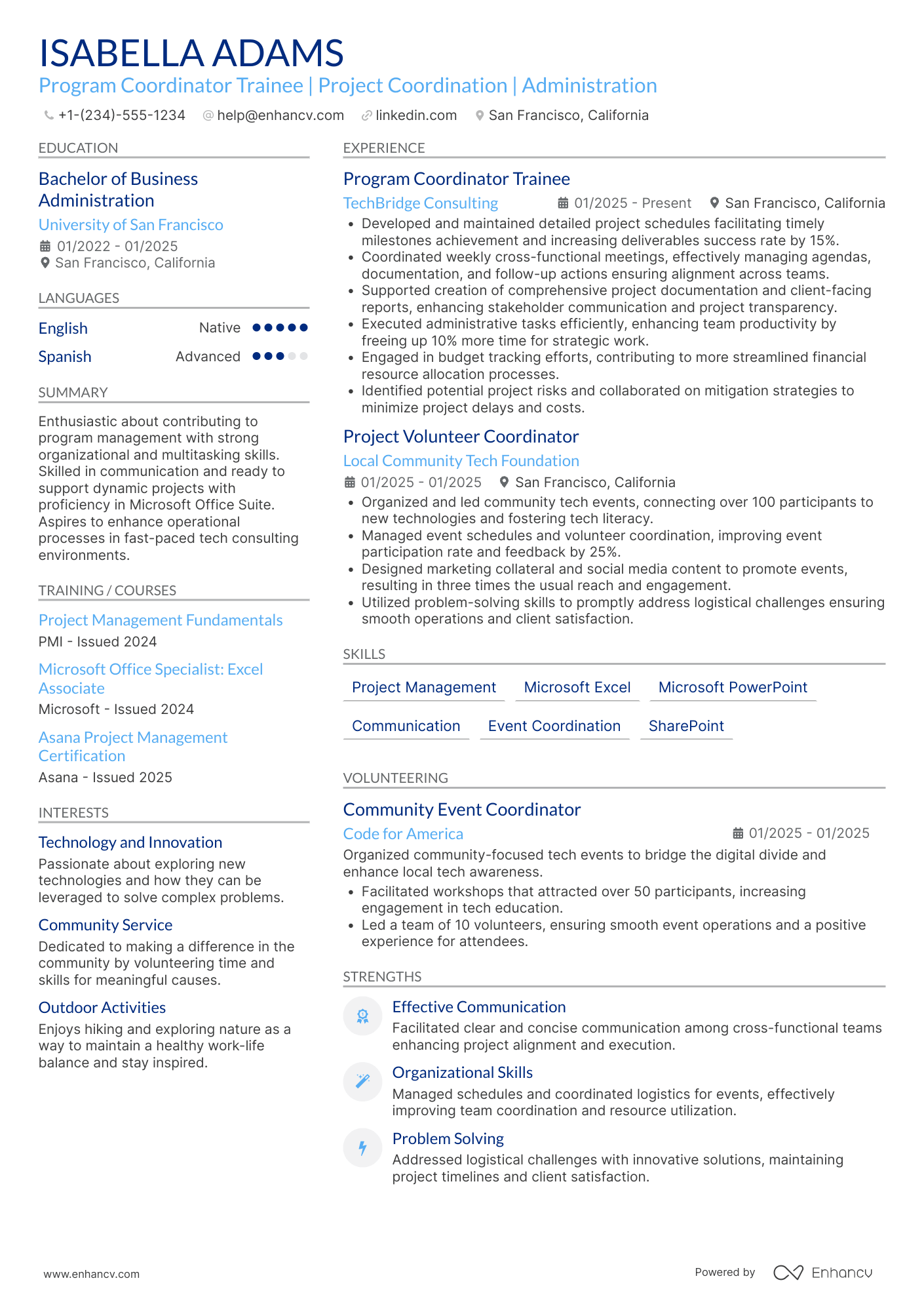
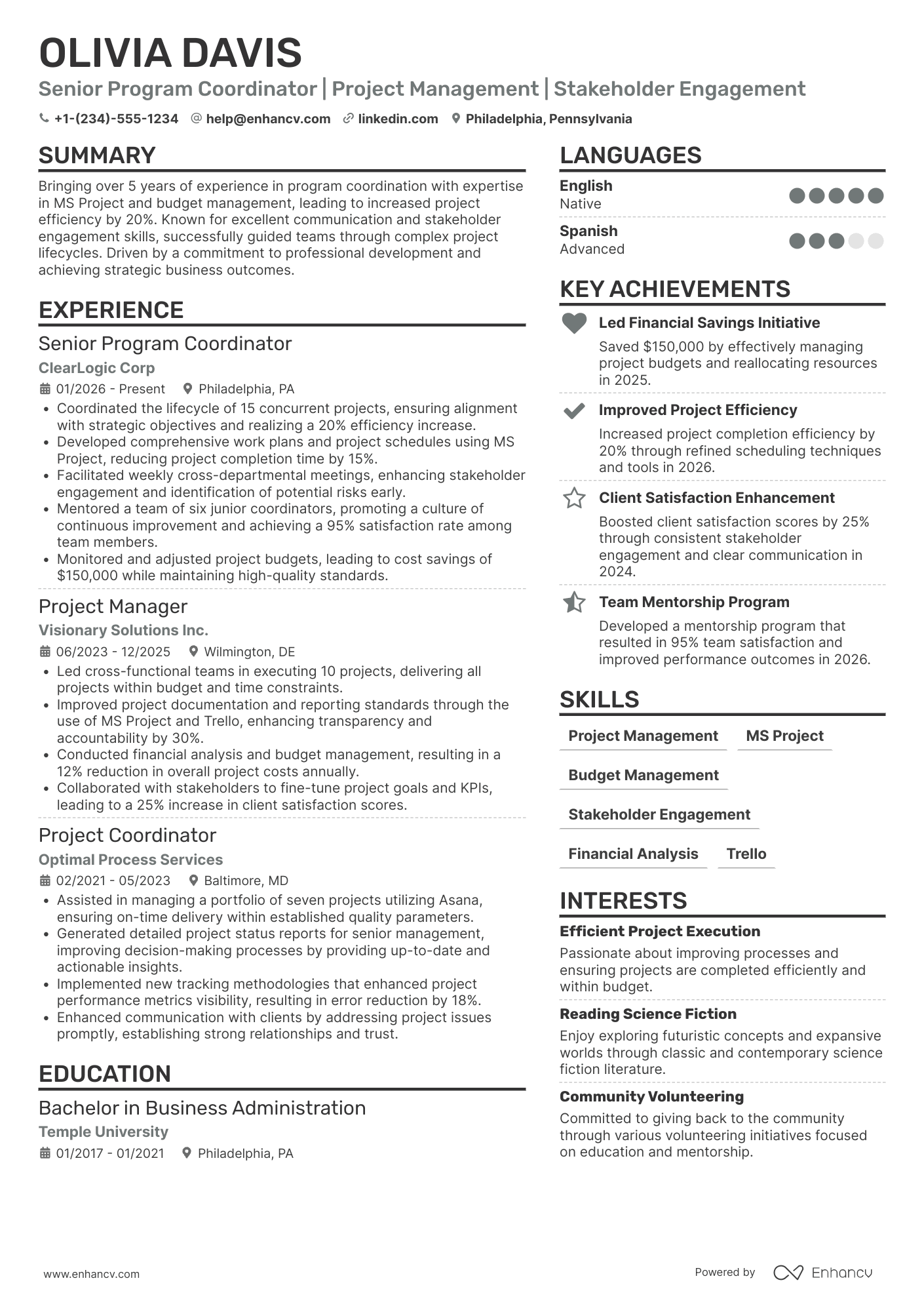
Program Coordinator resume examples
By Experience
By Role