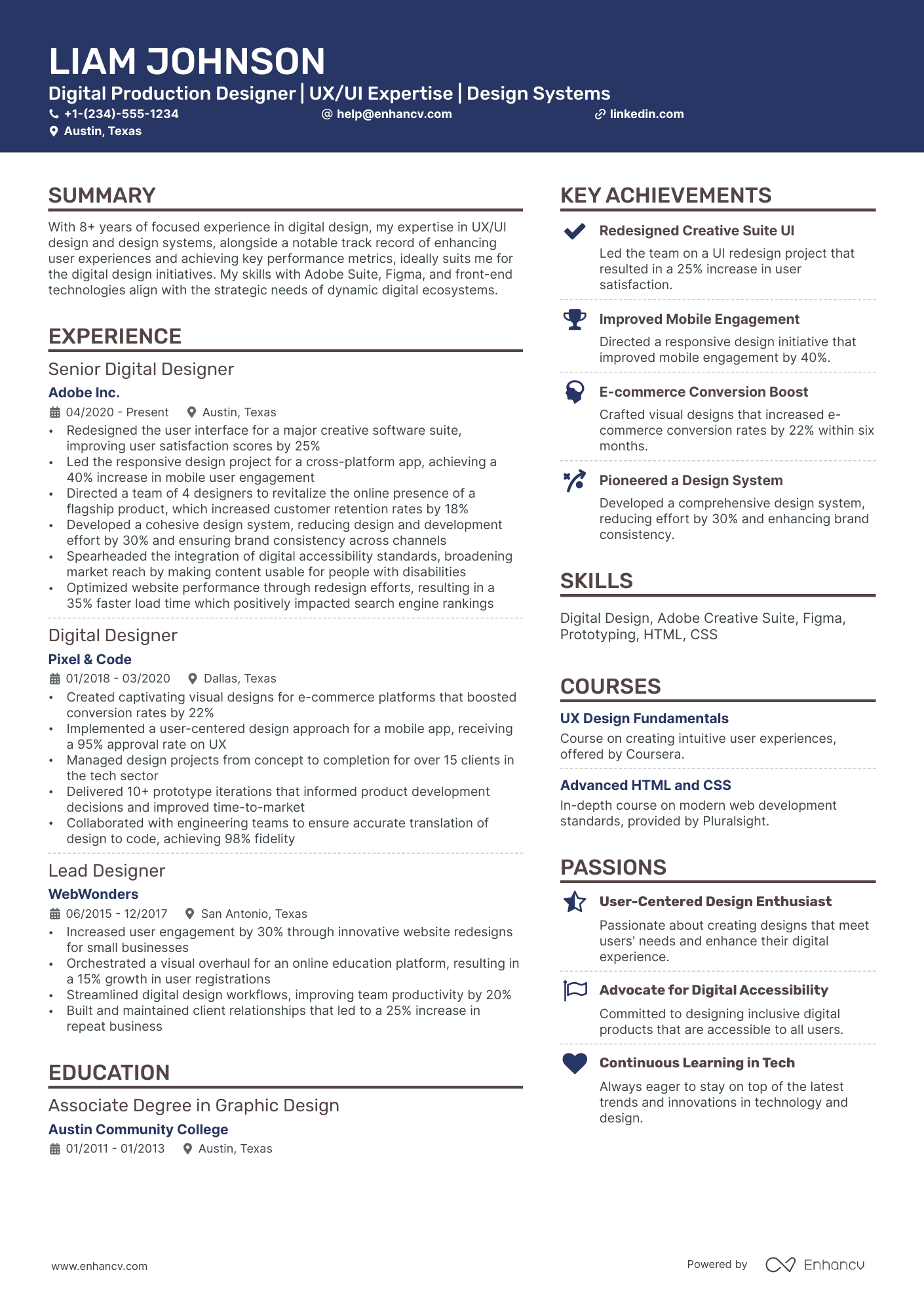
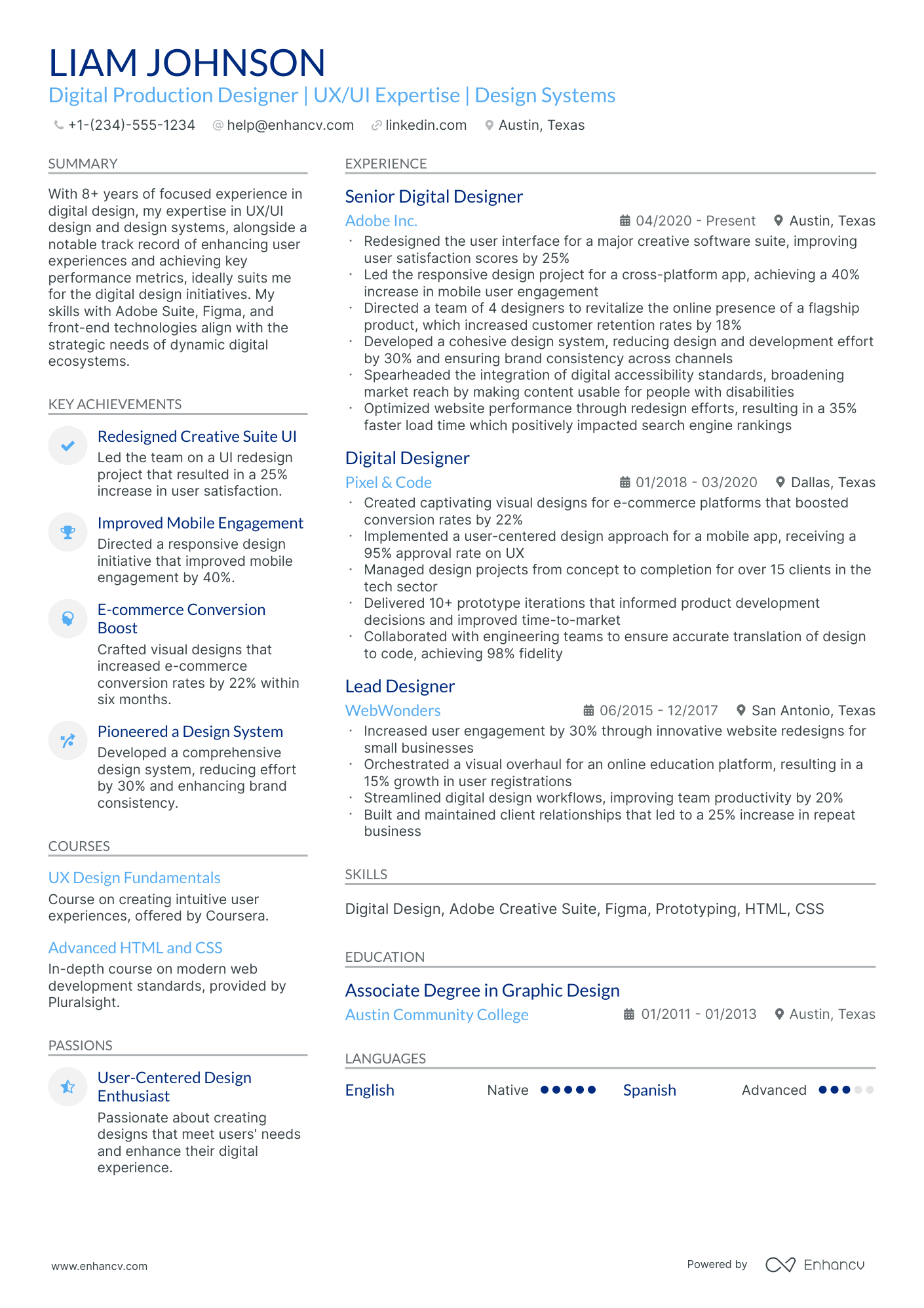
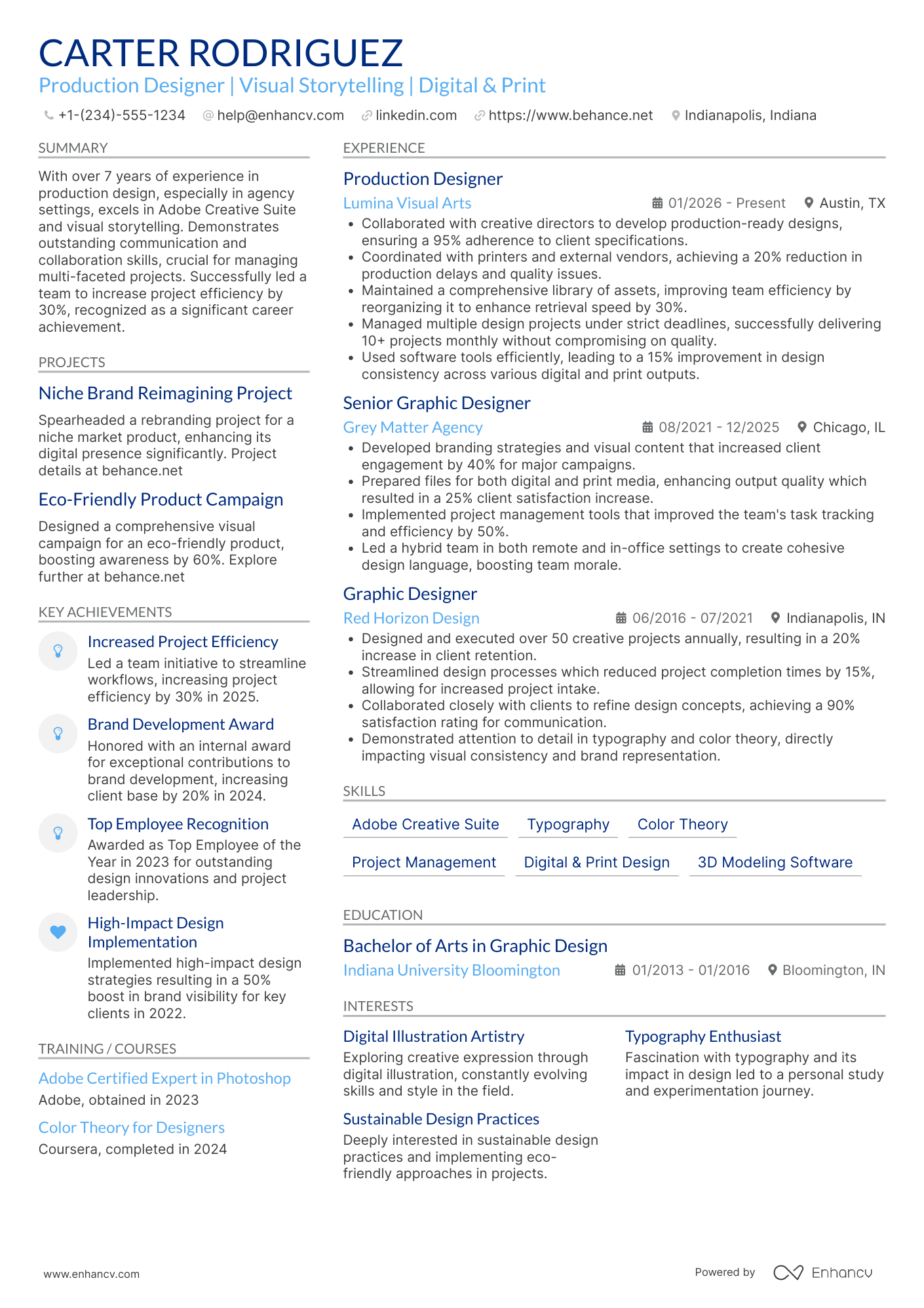
Many production designer resumes fail because they bury delivery-ready work behind tool lists and vague credits, so recruiters can't assess scope fast. In today's hiring, your production designer resume must pass ATS keywords and win a ten-second scan in a crowded field. Understanding how to make your resume stand out is essential in such a competitive landscape.
A strong resume shows what you delivered and how it performed. You should highlight on-time launches, error-rate reductions, high-volume asset output, localization accuracy, accessibility compliance, and measurable impact on conversion, retention, or support tickets.

Key takeaways
- Quantify set builds, budgets, and timelines instead of listing vague duties or tools.
- Use reverse-chronological format if you have relevant production design experience.
- Tailor every resume to match the specific job posting's tools and terminology.
- Lead with a projects section when you lack full-time production design credits.
- Place skills above experience for career changers and below it for senior designers.
- Use Enhancv's Bullet Point Generator to turn routine tasks into measurable, recruiter-ready bullets.
- Stop using AI once your resume accurately reflects real experience—never fabricate claims.
Job market snapshot for production designers
We analyzed 1,218 recent production designer job ads across major US job boards. These numbers help you understand employer expectations, skills in demand, employment type trends at a glance.
What level of experience employers are looking for production designers
| Years of Experience | Percentage found in job ads |
|---|---|
| 1–2 years | 2.9% (35) |
| 3–4 years | 9.0% (110) |
| 5–6 years | 17.4% (212) |
| 7–8 years | 10.8% (131) |
| 9–10 years | 5.7% (70) |
| 10+ years | 7.2% (88) |
| Not specified | 52.3% (637) |
Production designer ads by area of specialization (industry)
| Industry (Area) | Percentage found in job ads |
|---|---|
| Finance & Banking | 54.4% (663) |
| Healthcare | 16.1% (196) |
| Retail & E-commerce | 10.4% (127) |
| Education | 6.7% (82) |
| Manufacturing | 3.4% (41) |
| Media & Entertainment | 3.2% (39) |
| Government | 1.6% (19) |
| Energy | 1.1% (14) |
| Professional Services | 1.1% (14) |
| Real Estate & Construction | 1.1% (13) |
Top companies hiring production designers
| Company | Percentage found in job ads |
|---|---|
| Cisco Systems, Inc. | 4.4% (54) |
| Deloitte | 3.5% (43) |
| Capital One | 3.4% (41) |
| Uber | 2.5% (30) |
| Meta Platforms, Inc. | 2.1% (26) |
| Doordash | 2.1% (25) |
| n8n | 2.1% (25) |
| Apple Inc. | 2.0% (24) |
| Microsoft Corporation | 1.9% (23) |
| Media.Monks | 1.7% (21) |
Role overview stats
These tables show the most common responsibilities and employment types for production designer roles. Use them to align your resume with what employers expect and to understand how the role is structured across the market.
Day-to-day activities and top responsibilities for a production designer
| Responsibility | Percentage found in job ads |
|---|---|
| Figma | 50.1% (610) |
| Product design | 27.8% (338) |
| Prototyping | 26.7% (325) |
| Interaction design | 25.5% (310) |
| Visual design | 18.7% (228) |
| Design systems | 18.5% (225) |
| Ai | 13.3% (162) |
| Ux | 13.1% (160) |
| User research | 12.2% (148) |
| Css | 9.5% (116) |
| Agile | 9.4% (115) |
| Html | 9.3% (113) |
Type of employment (remote vs on-site vs hybrid)
| Employment type | Percentage found in job ads |
|---|---|
| On-site | 50.2% (611) |
| Hybrid | 27.8% (339) |
| Remote | 22.0% (268) |
How to format a production designer resume
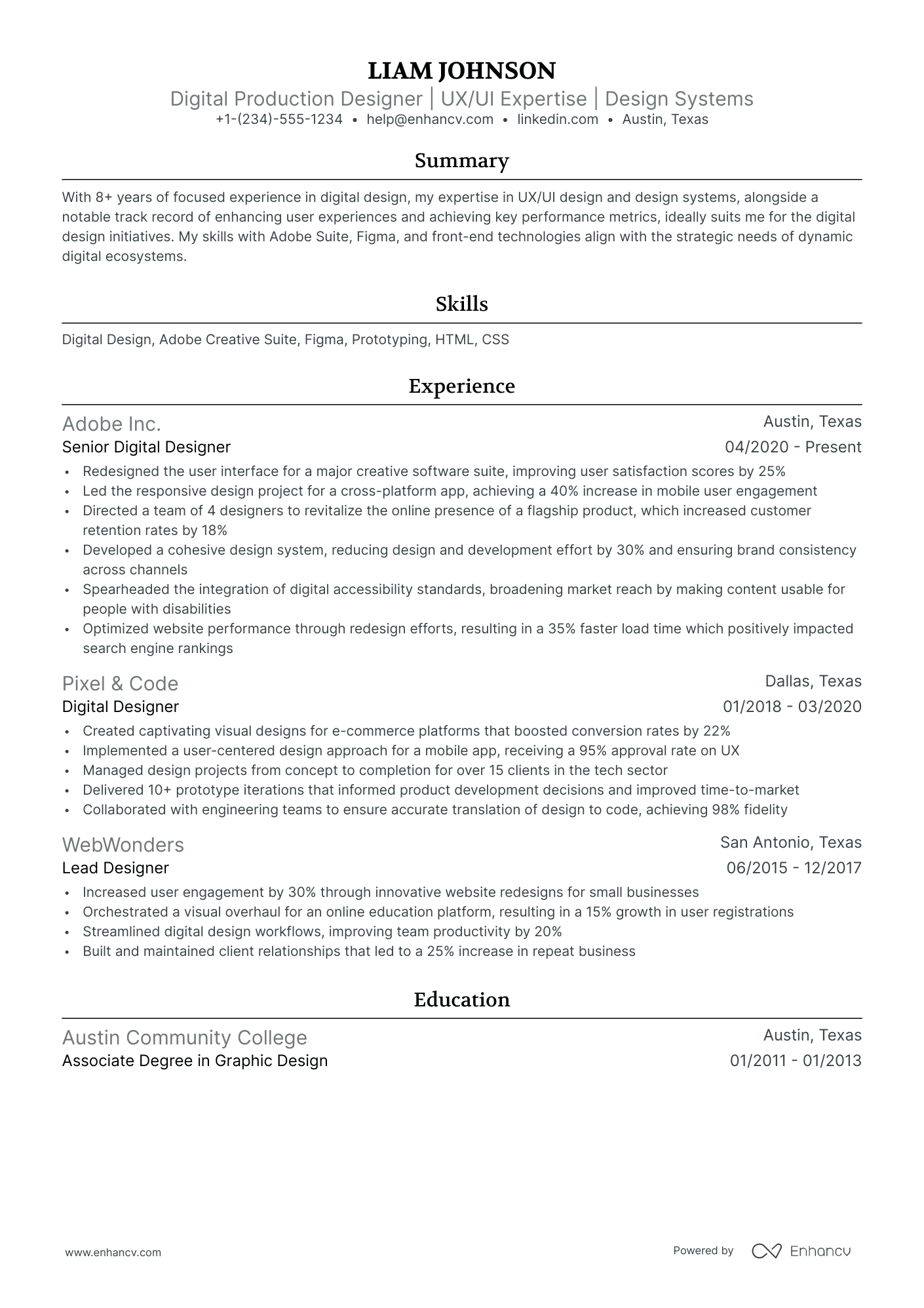
Recruiters evaluating production designers look for a clear creative vision backed by tangible results—budget management, cross-departmental collaboration, and the ability to translate a script or brief into a fully realized physical or digital environment. The right resume format puts that progression and project scope front and center, making it easy for both hiring managers and applicant tracking systems to find the signals that matter.

I have significant experience in this role—which format should I use?
Use a reverse-chronological format to give recruiters an immediate, linear view of your growing responsibility across productions. Do:
- Lead with your most recent credits, emphasizing the scale of each production (budget size, crew oversight, number of sets or locations).
- Highlight role-specific tools and domains—art direction software such as SketchUp or Vectorworks, set construction oversight, location scouting, and vendor negotiation.
- Quantify outcomes that reflect business or production impact, such as cost savings, on-time delivery, or award recognition.
I'm junior or switching into this role—what format works best?
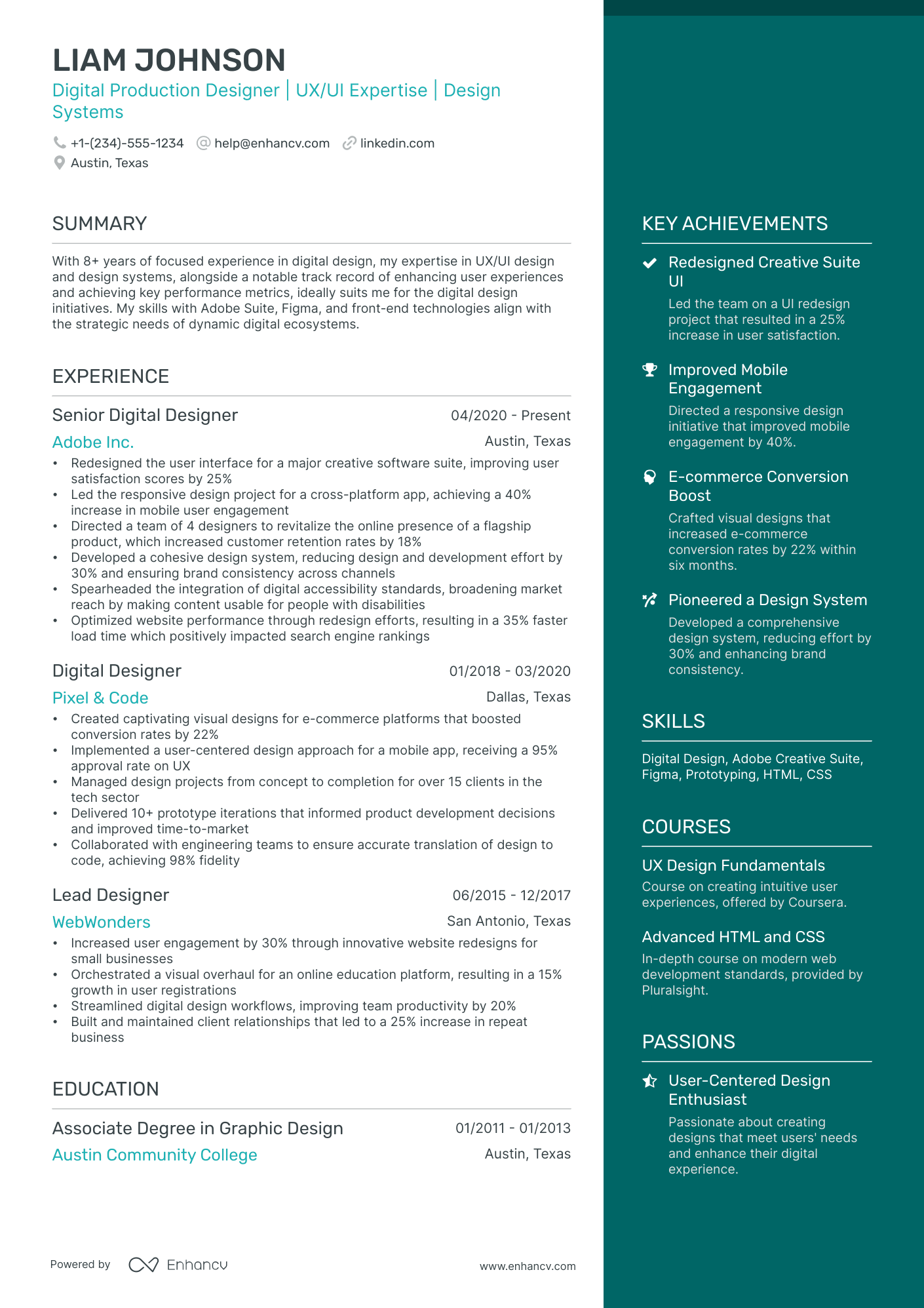
A hybrid format works well because it lets you lead with relevant design skills and tools while still showing a concise work history that provides context. Do:
- Place a dedicated skills section near the top, featuring production-specific competencies like concept illustration, scenic painting, material sourcing, and CAD drafting.
- Include academic projects, short films, theater productions, or freelance work that demonstrates hands-on set design or art department experience.
- Connect every listed skill to a specific action and a measurable or observable result.
Why not use a functional resume?
A functional format strips away the production-by-production context that hiring managers rely on to assess the complexity of your work and your growth within art departments.
- Career changer with transferable design skills: You have a background in architecture, interior design, or theatrical scenic design and can map those competencies directly to production design tasks.
- Limited production credits but strong project work: You've completed intensive film program builds, immersive event designs, or substantial personal projects that demonstrate set design ability.
Once your layout and formatting choices are in place, the next step is deciding which sections to include so each one serves a clear purpose on your resume.
What sections should go on a production designer resume
Recruiters expect a production designer resume to show clear credits, visual leadership, and end-to-end ownership across pre-production through wrap. Knowing what to put on a resume helps you prioritize the sections that matter most.
Use this structure for maximum clarity:
- Header
- Summary
- Experience
- Skills
- Projects
- Education
- Certifications
- Optional sections: Awards, Publications, Languages
Strong experience bullets should emphasize project scale, budget and schedule impact, cross-department collaboration, and measurable outcomes across sets, locations, and visual continuity.
Is your resume good enough?
Drop your resume here or choose a file. PDF & DOCX only. Max 2MB file size.
Once you’ve organized your resume with the right structure and supporting sections, the next step is learning how to write your production designer resume experience so it fits that framework and shows your impact.
How to write your production designer resume experience
The experience section is where you prove you've shipped creative work that shaped the look and feel of real productions. Hiring managers prioritize demonstrated impact—sets built, environments realized, budgets managed, and visual narratives delivered—over descriptive task lists that only outline daily duties.
Each entry should include:
- Job title
- Company and location (or remote)
- Dates of employment (month and year)
Three to five concise bullet points showing what you owned, how you executed, and what outcomes you delivered:
- Ownership scope: the productions, stages, sets, visual environments, or design departments you were directly accountable for, including the scale and type of each project.
- Execution approach: the tools, techniques, and workflows you relied on to develop concepts and deliver final designs—such as drafting software, model-building methods, material sourcing strategies, or previsualization processes.
- Value improved: the specific ways your work elevated production quality, visual coherence, scheduling efficiency, material sustainability, budget reliability, or safety compliance across a production.
- Collaboration context: how you partnered with directors, directors of photography, art directors, costume designers, construction coordinators, VFX supervisors, or location managers to align the visual world with the story's creative vision.
- Impact delivered: the tangible results your design decisions produced—measured through completed productions, audience or critical reception, on-time delivery, cost savings, or the advancement of a project's overall visual storytelling rather than a list of activities performed.
Experience bullet formula
A production designer experience example
✅ Right example - modern, quantified, specific.
Production Designer
LumenPay | Remote
2022–Present
High-volume fintech platform serving over two million small business customers across the United States.
- Built and maintained a Figma production system—libraries, components, variants, and tokens—cutting design-to-dev handoff time by 35% across eight product squads.
- Produced release-ready UI assets and specs using Figma, Zeplin, and Storybook alignment, reducing implementation rework by 28% through tighter documentation and QA checklists.
- Partnered with product managers, UX designers, and engineers to translate concepts into responsive layouts for Web and iOS, improving task completion by 12% on the top three payment flows.
- Ran accessibility and visual QA using WCAG checkers, Stark, and browser dev tools, lowering post-release UI defects by 22% and achieving AA compliance on five core screens.
- Automated asset export and versioning via Figma plugins and naming conventions, saving 10 hours per sprint and preventing 90% of duplicate or outdated icon usage.
Now that you've seen how a strong experience section comes together, let's look at how to adjust yours to match the specific job you're targeting.
How to tailor your production designer resume experience
Recruiters evaluate your production designer resume through both human review and applicant tracking systems (ATS), so tailoring your resume to the job description is essential. Tailoring ensures the specific tools, workflows, and design expertise you highlight match what the hiring team is actually searching for.
Ways to tailor your production designer experience:
- Match design software and visualization tools named in the job description.
- Mirror the exact terminology used for set design processes or standards.
- Reflect production budget KPIs or success criteria the posting emphasizes.
- Include industry experience relevant to the genre or production type listed.
- Highlight collaboration with directors and art departments when referenced.
- Emphasize union compliance or safety standards if the posting mentions them.
- Align your workflow descriptions with the production pipeline they describe.
- Reference pre-visualization or drafting methods specified in the listing.
Tailoring means aligning your real accomplishments with each role's stated requirements, not forcing disconnected keywords into your experience section.
Resume tailoring examples for production designer
| Job description excerpt | Untailored | Tailored |
|---|---|---|
| Collaborate with the art director and set decorators to develop visual concepts for episodic television using SketchUp and AutoCAD. | Worked on visual designs for various projects. | Partnered with art directors and set decorators to develop visual concepts across 3 seasons of episodic television, drafting all set designs in SketchUp and AutoCAD. |
| Manage production design budgets up to $2M for feature films, coordinating with construction and props departments to ensure builds stay on schedule. | Helped manage budgets and coordinated with different teams. | Oversaw production design budgets of up to $2M on two independent feature films, coordinating directly with construction and props departments to deliver all builds on schedule and 8% under budget. |
| Lead the design of immersive themed environments for live events, translating brand guidelines into physical spaces using Vectorworks and Adobe Creative Suite. | Created designs for events and other experiences. | Led production design for 5 large-scale branded live events, translating client brand guidelines into immersive physical environments using Vectorworks for technical drawings and Adobe Creative Suite for presentation decks. |
Once you’ve aligned your experience to the role’s priorities, quantify your production designer achievements to show the impact of that work with clear results.
How to quantify your production designer achievements
Quantifying your achievements shows how your design work improves speed, accuracy, and delivery across teams. Focus on turnaround time, revision volume, error rates, compliance, and output scale across campaigns, templates, and channels.
Quantifying examples for production designer
| Metric | Example |
|---|---|
| Turnaround time | "Cut average asset turnaround from three days to one day by building Figma component libraries and a request intake form for eight stakeholders." |
| Accuracy rate | "Reduced preflight errors by 60% by standardizing InDesign packaging, font management, and export presets across 120 print and digital deliverables." |
| Volume delivered | "Produced 350+ localized ad variants in six weeks using Figma variables and batch exports, supporting five regions and three channel specs." |
| Compliance risk | "Achieved 98% first-pass legal approval by adding a checklist and version-control naming rules in Frame.io for regulated campaign assets." |
| Cost savings | "Saved $18,000 annually by shifting routine resizing in Photoshop to automated actions and templates, cutting outsourced production hours by 40%." |
Turn vague job duties into measurable, recruiter-ready resume bullets in seconds with Enhancv's Bullet Point Generator.
Once you've crafted strong bullet points to showcase your experience, the next step is ensuring your resume also highlights the right hard and soft skills that production design employers look for.
How to list your hard and soft skills on a production designer resume
Your skills section matters because production designers must translate scripts into buildable, on-budget worlds—recruiters and applicant tracking systems scan this section for role-specific keywords and capability signals, and strong resumes typically balance hard skills with practical, job-relevant soft skills.
production designer roles require a blend of:
- Product strategy and discovery skills
- Data, analytics, and experimentation skills
- Delivery, execution, and go-to-market discipline
- Soft skills
Your skills section should be:
- Scannable (bullet-style grouping).
- Relevant to the job post.
- Backed by proof in experience bullets.
- Updated with current tools.
Place your skills section:
- Above experience if you're junior or switching careers.
- Below experience if you're mid/senior with strong achievements.

Hard skills
- Script breakdowns
- Concept development, mood boards
- Set design, drafting
- SketchUp, Rhino, AutoCAD
- Adobe Photoshop, Illustrator, InDesign
- Vectorworks Spotlight
- 3D rendering, previsualization
- Scenic construction documentation
- Materials, finishes, prop sourcing
- Budgeting, cost tracking
- Scheduling, call sheets
- Safety compliance (OSHA)
Soft skills
- Translate story into visuals
- Align creative with budget
- Lead art department workflows
- Direct set builds on schedule
- Collaborate with directors and cinematographers
- Negotiate vendors and rentals
- Communicate constraints early
- Resolve design trade-offs fast
- Maintain continuity across scenes
- Run efficient production meetings
- Give clear, actionable feedback
- Own decisions under pressure
How to show your production designer skills in context
Skills shouldn't live only in a dedicated skills list. Explore resume skills examples to see how production designers weave competencies throughout their resumes.
They should be demonstrated in:
- Your summary (high-level professional identity)
- Your experience (proof through outcomes)
Here's how that looks in practice.
Summary example
Senior production designer with 12 years in feature film and streaming content. Skilled in AutoCAD, SketchUp, and cross-department collaboration. Led design for a $40M production, delivering all sets 10% under budget.
- Reflects senior-level experience clearly
- Names industry-standard design tools
- Includes a concrete budget metric
- Highlights collaboration as a strength
Experience example
Senior Production Designer
Ridgeline Studios | Vancouver, BC
March 2019–Present
- Designed 28 sets across three series using SketchUp and AutoCAD, reducing revision cycles by 35% through early 3D previsualization.
- Collaborated with directors, art directors, and construction teams to deliver builds 15% under budget across two consecutive seasons.
- Standardized material sourcing workflows with the props department, cutting procurement timelines by 20% and improving on-set readiness.
- Every bullet includes measurable proof
- Skills surface naturally through real outcomes
Once you’ve tied your design strengths to real project outcomes, the next step is applying that same approach to writing a production designer resume with no experience.
How do I write a production designer resume with no experience
How do I write a production designer resume with no experience?
Even without full-time experience, you can demonstrate readiness through academic and personal projects. Writing a resume without work experience is entirely possible when you focus on transferable skills and hands-on projects:
- Student film set design projects
- Community theater set builds
- Short film art department work
- Prop fabrication and sourcing
- Set dressing for photo shoots
- Concept art and mood boards
- CAD drafting for floor plans
- Internship or shadowing credits
Focus on:
- Portfolio links with role context
- Budgets, timelines, and deliverables
- Drafting, rendering, and sourcing
- Credits, tools, and scale
Resume format tip for entry-level production designer
Use a combination resume format. It highlights projects and tools first, while still showing education and any related work. Do:
- Lead with a "Selected Projects" section.
- Add tools used to each project.
- Quantify budgets, assets, or timelines.
- List credits, role, and production type.
- Link a portfolio with breakdowns.
- Production designer, student short film—built SketchUp floor plan and prop list, sourced 18 items under a $300 budget, and delivered set on schedule.
Even without formal work experience, your educational background can demonstrate relevant knowledge and training that strengthens your candidacy—so presenting it effectively is essential.
How to list your education on a production designer resume
Your education section helps hiring teams confirm you have foundational training in design, visual storytelling, and spatial concepts essential to the production designer role.
Include:
- Degree name
- Institution
- Location
- Graduation year
- Relevant coursework (for juniors or entry-level candidates)
- Honors & GPA (if 3.5 or higher)
Skip month and day details—list the graduation year only.
Here's a strong education entry tailored for a production designer resume.
Example education entry
Bachelor of Fine Arts in Production Design
California Institute of the Arts, Valencia, CA
Graduated 2021
GPA: 3.7/4.0
- Relevant Coursework: Set Design, Visual Storytelling, Scenic Art, Architectural Drafting, Art Direction for Film
- Honors: Dean's List, four consecutive semesters
How to list your certifications on a production designer resume
Certifications show a production designer's commitment to learning, proficiency with key tools, and alignment with current industry standards for film, television, and live events.
Include:
- Certificate name
- Issuing organization
- Year
- Optional: credential ID or URL
- Place certifications below education when your degree is recent and the certifications only support it.
- Place certifications above education when they are recent, highly relevant, or required for the production designer roles you target.
Best certifications for your production designer resume
Autodesk Certified Professional: AutoCAD for Design and Drafting Autodesk Certified Professional: Revit for Architectural Design SketchUp Certification Adobe Certified Professional: Photoshop Adobe Certified Professional: Illustrator Vectorworks Certified Professional OSHA 10-Hour General Industry Safety Training
Once you’ve placed your credentials where hiring teams can spot them, shift to your production designer resume summary to quickly frame that expertise in a focused, role-relevant narrative.
How to write your production designer resume summary
Your resume summary is the first thing a recruiter reads. A strong one instantly signals you're qualified and worth interviewing for a production designer role.
Keep it to three to four lines, with:
- Your title and total years of experience in production design.
- The domain or industry you specialize in, such as film, television, or theater.
- Core tools and skills like AutoCAD, SketchUp, set construction, and visual storytelling.
- One or two quantified achievements that show your creative impact.
- Soft skills tied to real outcomes, such as collaboration that improved workflow efficiency.

PRO TIP
At a junior or mid-level, lead with your strongest technical skills and relevant project experience. Highlight early wins with specific numbers. Avoid vague phrases like "passionate creative" or "hardworking team player." Ground every claim in something measurable or observable.
Example summary for a production designer
Production designer with four years of experience in independent film and episodic television. Designed sets for 12 productions using SketchUp and AutoCAD, reducing build costs by 18% through resourceful material sourcing.
Optimize your resume summary and objective for ATS
Drop your resume here or choose a file.
PDF & DOCX only. Max 2MB file size.
Now that your summary captures your production design expertise at a glance, make sure your header presents the essential contact details hiring managers need to reach you.
What to include in a production designer resume header
A resume header lists your key contact details and professional links, helping production designers boost visibility, build credibility, and pass recruiter screening fast.
Essential resume header elements
- Full name
- Tailored job title and headline
- Location
- Phone number
- Professional email
- GitHub link
- Portfolio link
A LinkedIn link helps recruiters verify experience quickly and supports screening.
Do not include a photo on a production designer resume unless the role is explicitly front-facing or appearance-dependent.
Keep the header on one or two lines, match your job title to the posting, and use links that open to the right page.
Example
Production designer resume header
Jordan Lee
Production designer | Film and TV sets, props, and scenic coordination
Los Angeles, CA
(323) 555-01XX
your.name@enhancv.com
github.com/yourname
yourwebsite.com
linkedin.com/in/yourname
Once your contact details and role identifier are clear at the top, add targeted additional sections to reinforce your fit and provide supporting context.
Additional sections for production designer resumes
When your core sections don't fully capture your expertise, additional sections help you stand out and build role-specific credibility as a production designer. For example, listing language skills can be a strong differentiator if you work on international productions or collaborate with multilingual crews.
- Languages
- Hobbies and interests
- Publications and features
- Awards and nominations
- Professional affiliations
- Notable productions and credits
- Workshops and masterclasses
Once you've rounded out your resume with sections that showcase your full professional profile, it's worth pairing it with a strong cover letter to make an even greater impression.
Do production designer resumes need a cover letter
A cover letter isn't required for a production designer, but it helps in competitive roles or teams that expect one. If you're unsure where to start, understanding what a cover letter is and how it complements your resume can help you decide when to include one. It can make a difference when your resume needs context, or when you want to show fit beyond tools and tasks.
Use a cover letter when it adds clear, role-specific value:
- Explain team and role fit by connecting your production designer strengths to their workflow, design system, and cross-functional partners.
- Highlight one or two relevant projects and outcomes, such as faster asset delivery, fewer defects, or smoother handoffs to engineering.
- Show you understand the product, users, and business context by referencing a key use case, platform constraint, or brand requirement.
- Address career transitions or non-obvious experience by clarifying your scope, level of ownership, and how your background maps to production designer work.
Drop your resume here or choose a file.
PDF & DOCX only. Max 2MB file size.
Even if you decide a cover letter adds value for certain production designer applications, the next step is using AI to sharpen your production designer resume faster and more consistently.
Using AI to improve your production designer resume
AI can sharpen your resume's clarity, structure, and impact. It helps refine language and highlight relevant strengths. But overuse strips authenticity. Once your content feels clear and role-aligned, step away from AI entirely. If you're wondering which AI is best for writing resumes, the answer depends on your specific needs and how much control you want over the output.
Here are 10 practical prompts to strengthen specific sections of your production designer resume:
- Strengthen your summary. "Rewrite my production designer resume summary to highlight my strongest design skills and years of industry experience in under four sentences."
- Quantify set achievements. "Add measurable results to these production designer experience bullets, focusing on budget management, team size, and project scale."
- Sharpen action verbs. "Replace weak verbs in my production designer experience section with strong, industry-specific action verbs that convey creative leadership."
- Tailor skills relevance. "Review my production designer skills section and remove any entries not directly relevant to film, television, or theater production design."
- Align with job posting. "Compare my production designer resume to this job description and suggest specific edits to improve alignment without fabricating experience."
- Refine project descriptions. "Rewrite my production designer project entries to clearly state my role, the medium, and the visual outcome of each production."
- Trim redundant phrasing. "Identify and remove repetitive or filler language across all sections of my production designer resume while preserving meaning."
- Improve education details. "Reformat my production designer education section to emphasize coursework, thesis projects, or training directly tied to set design."
- Highlight certifications clearly. "Reorganize my production designer certifications section so the most industry-relevant credentials appear first with clear formatting."
- Tighten bullet consistency. "Ensure all experience bullets on my production designer resume follow parallel structure, consistent tense, and similar length."
Stop using AI once your resume sounds accurate, specific, and aligned with real experience. AI should never invent experience or inflate claims—if it didn't happen, it doesn't belong here.
Conclusion
A strong production designer resume shows measurable outcomes, role-specific skills, and a clear structure. It connects your design choices to results, such as budgets met, schedules protected, and teams aligned.
Keep each section easy to scan, with focused bullets and consistent formatting. This approach shows you are ready for today’s hiring market and the next hiring cycle.