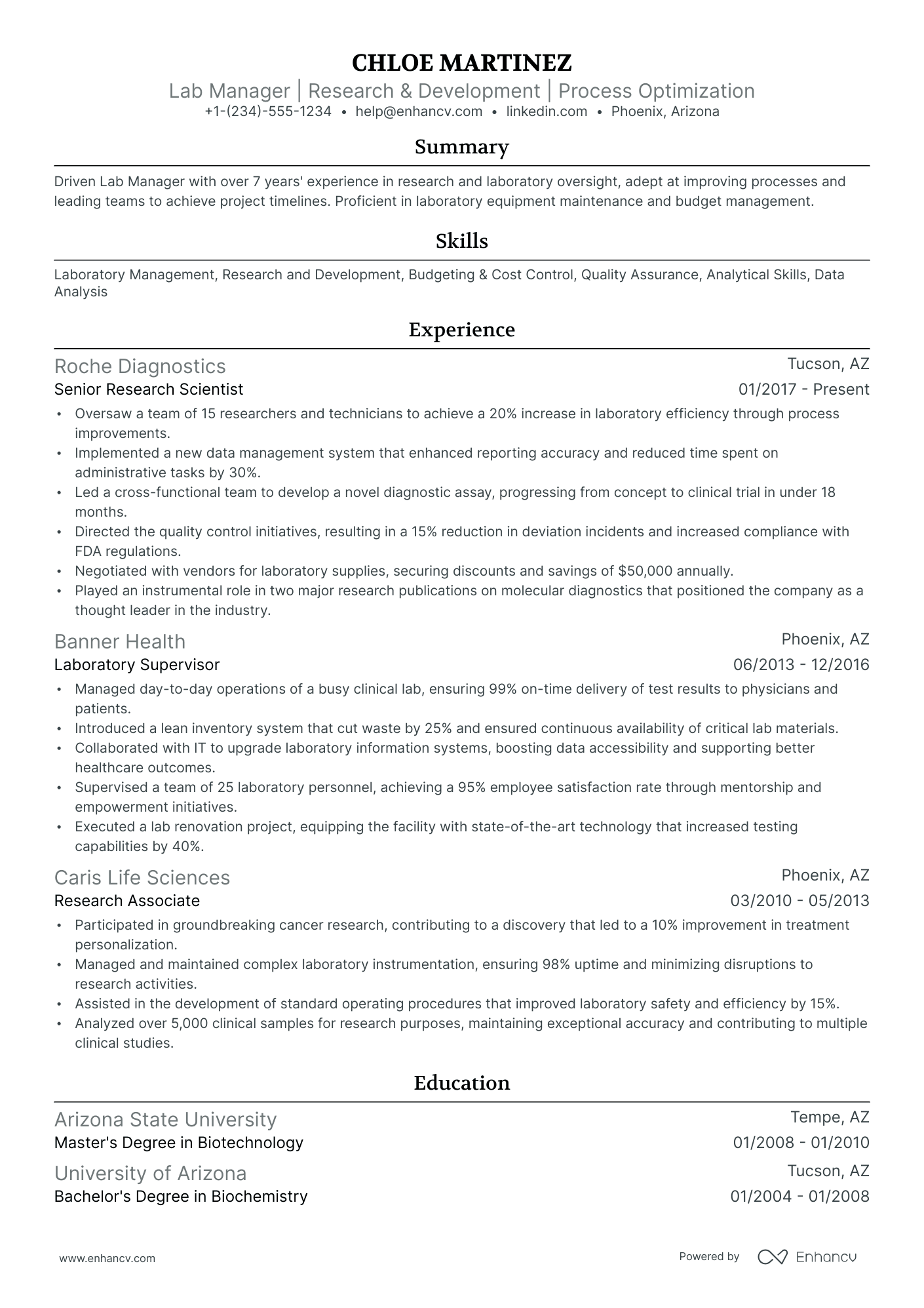
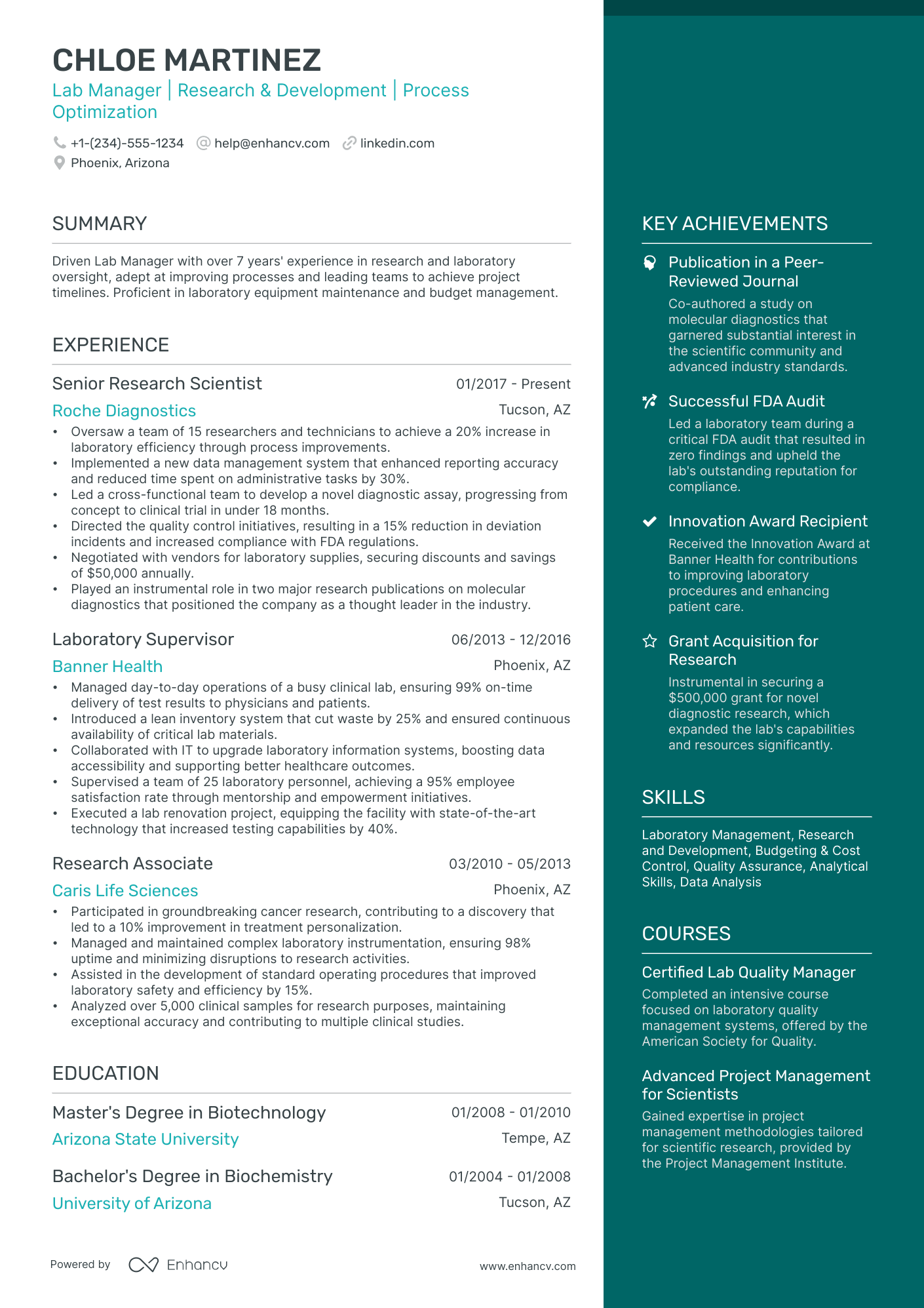
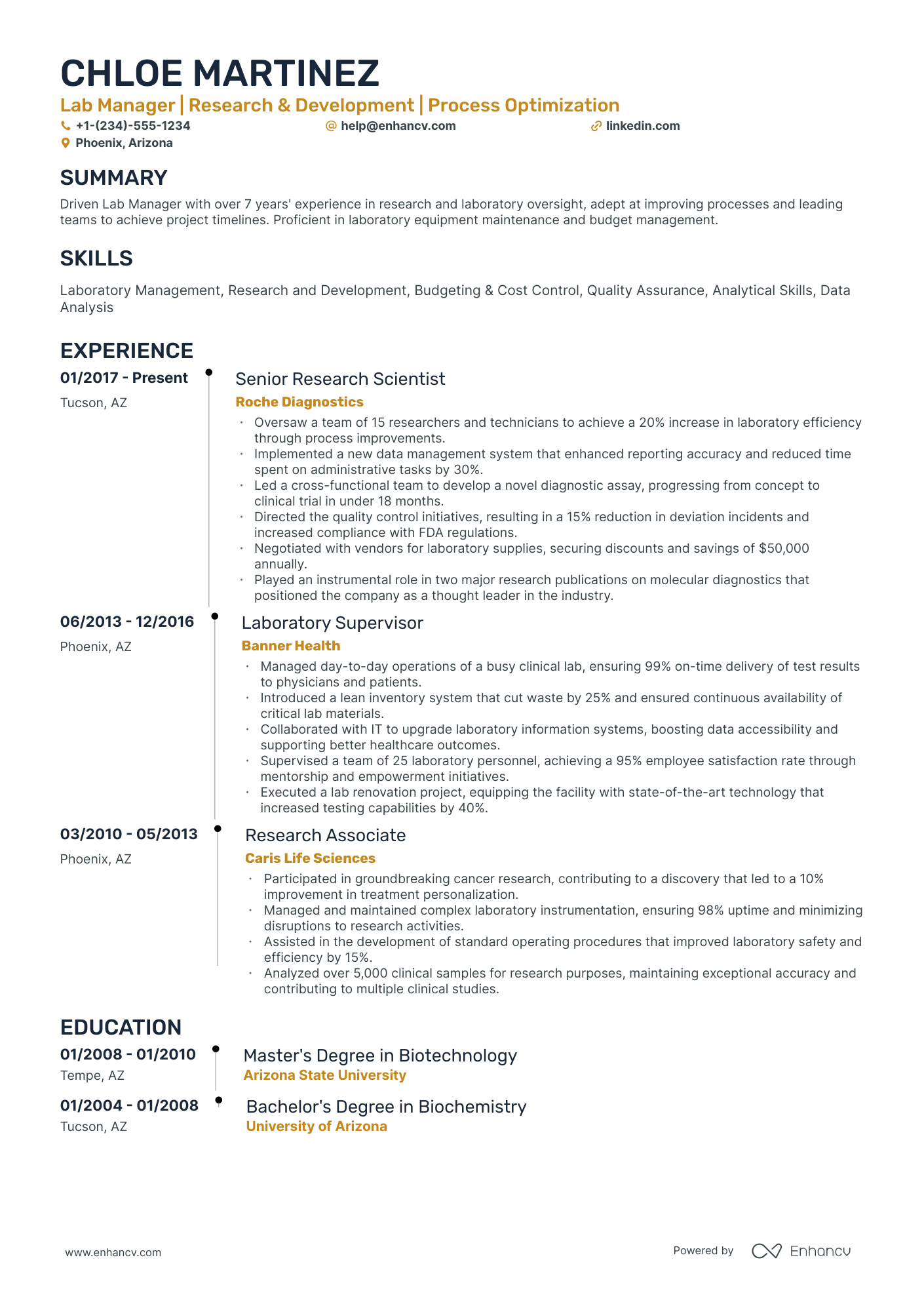
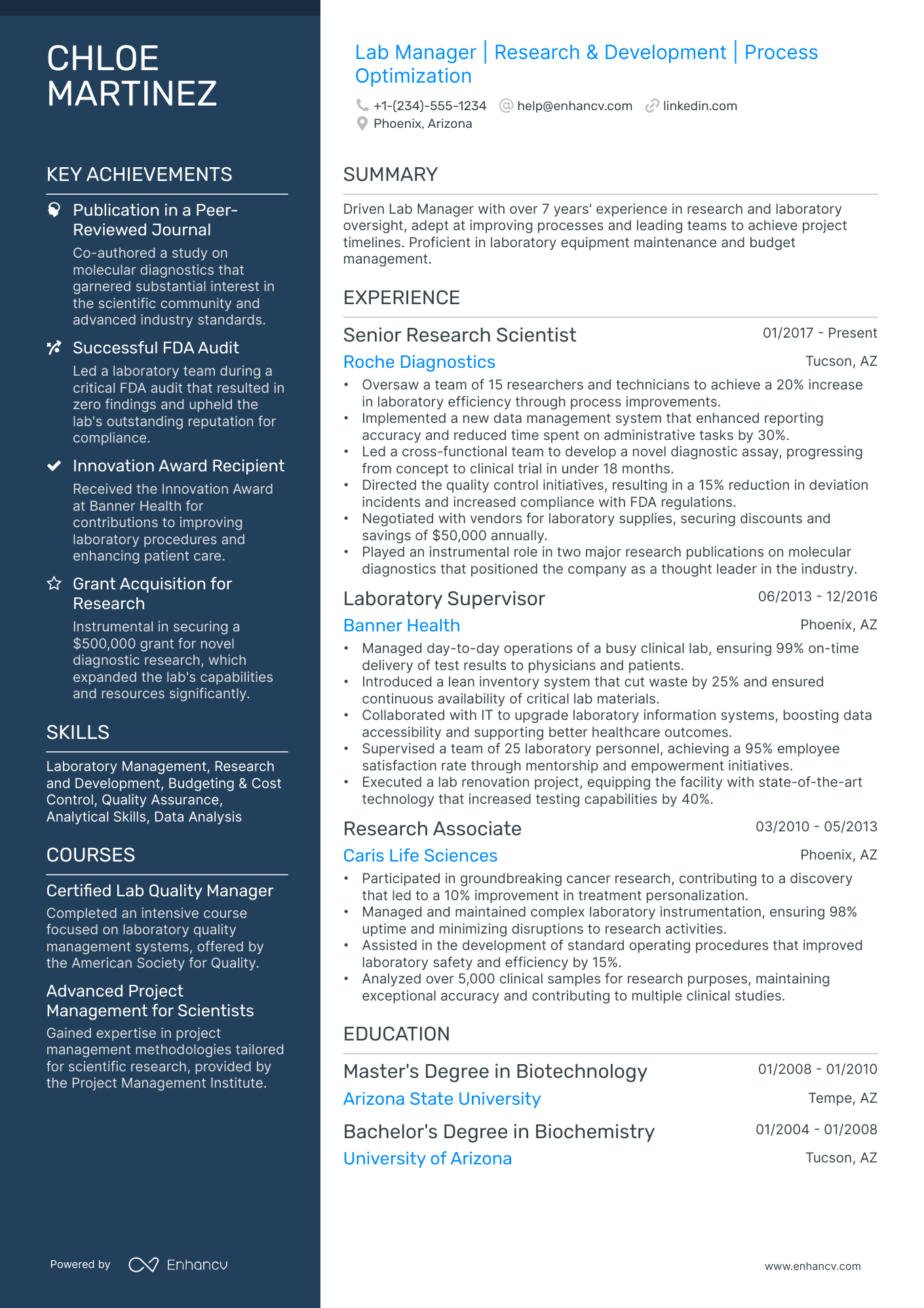
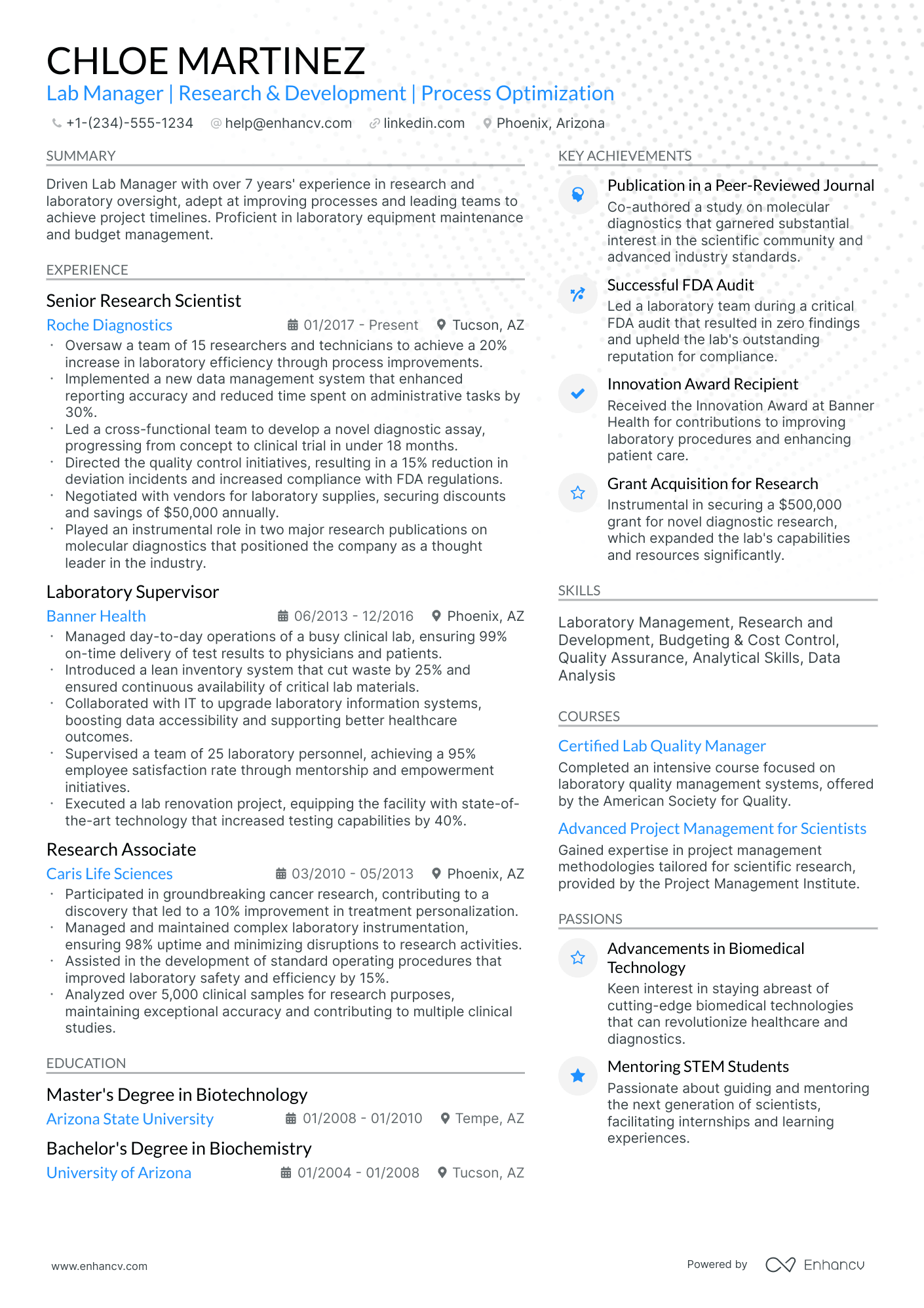
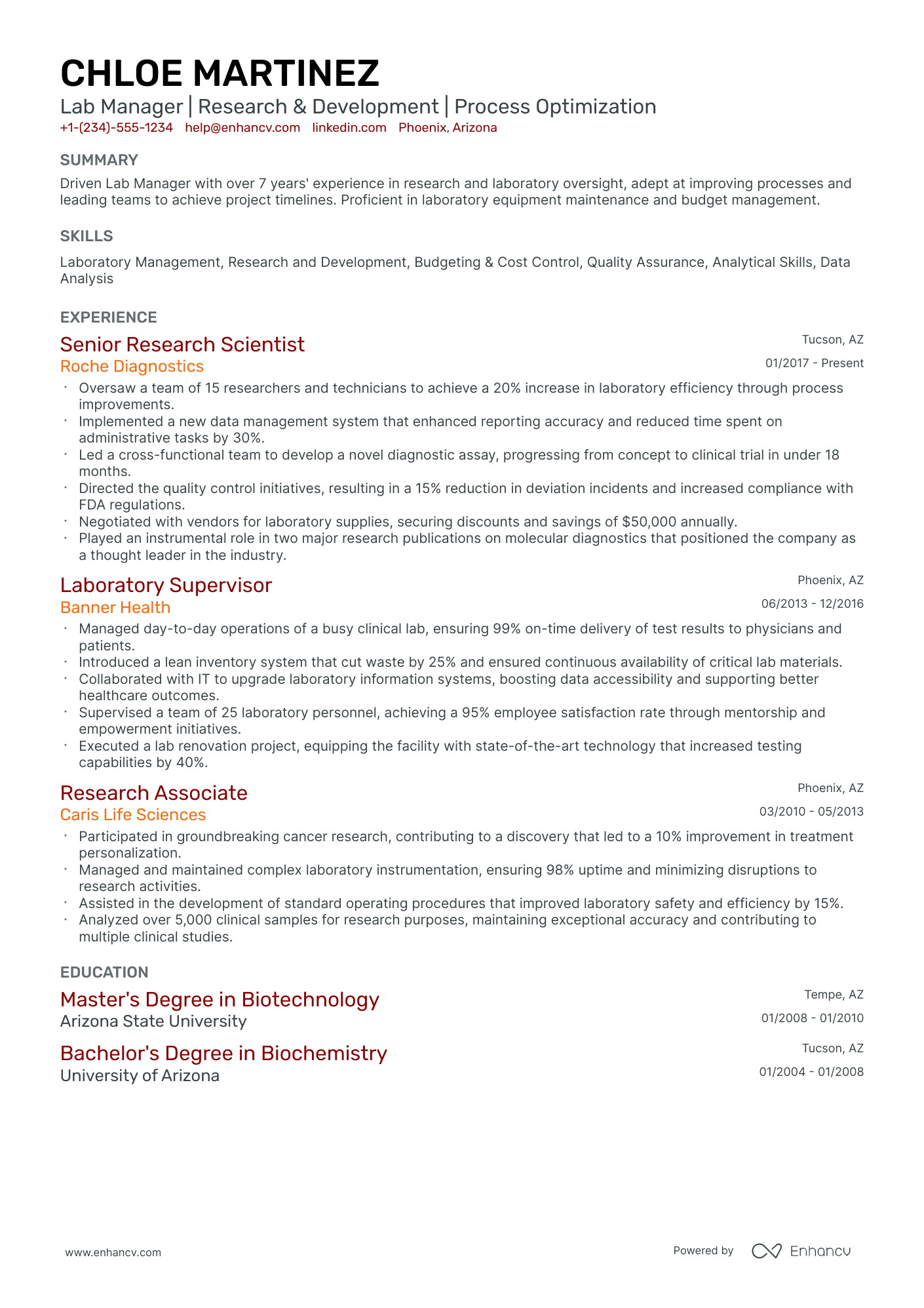
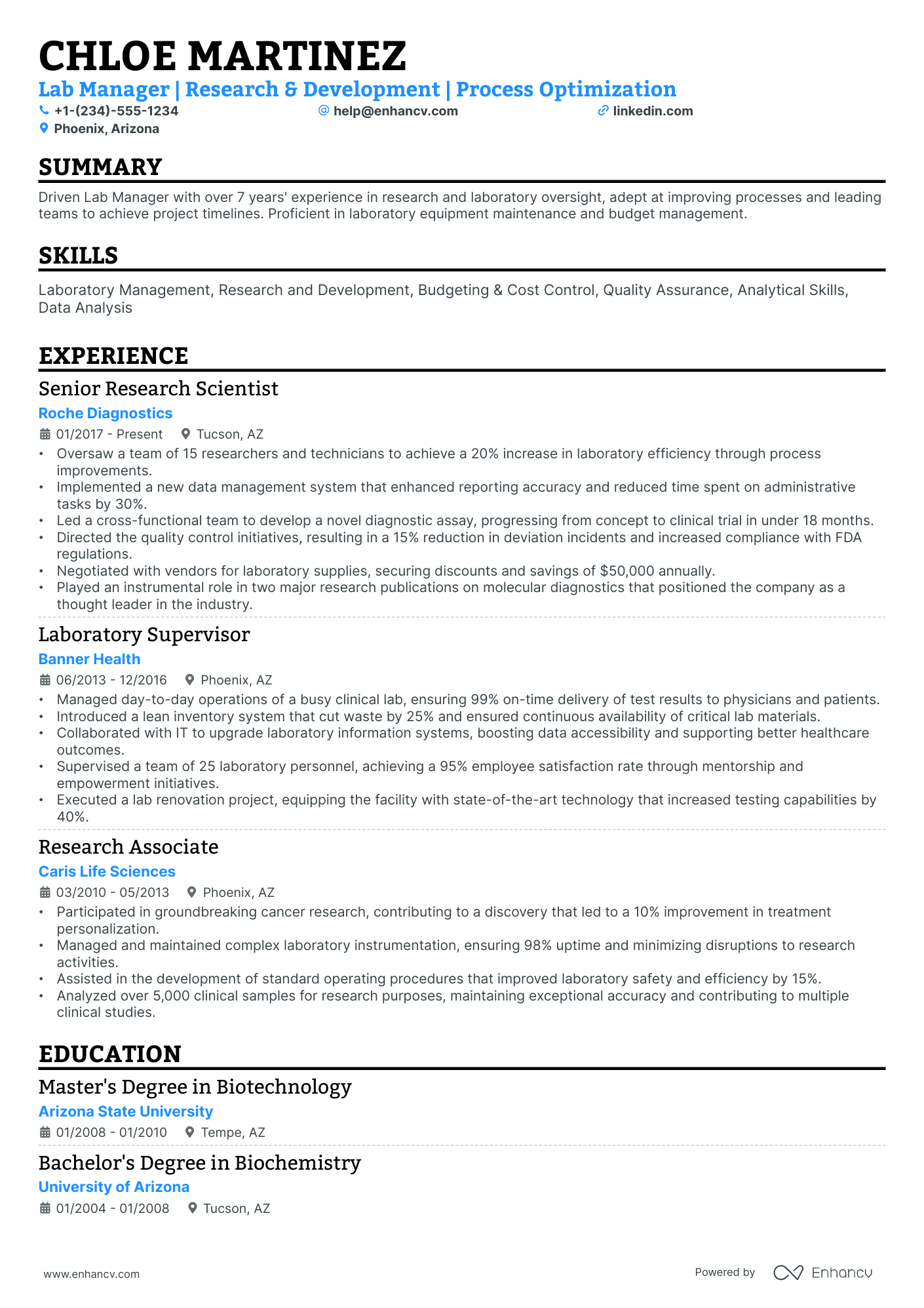
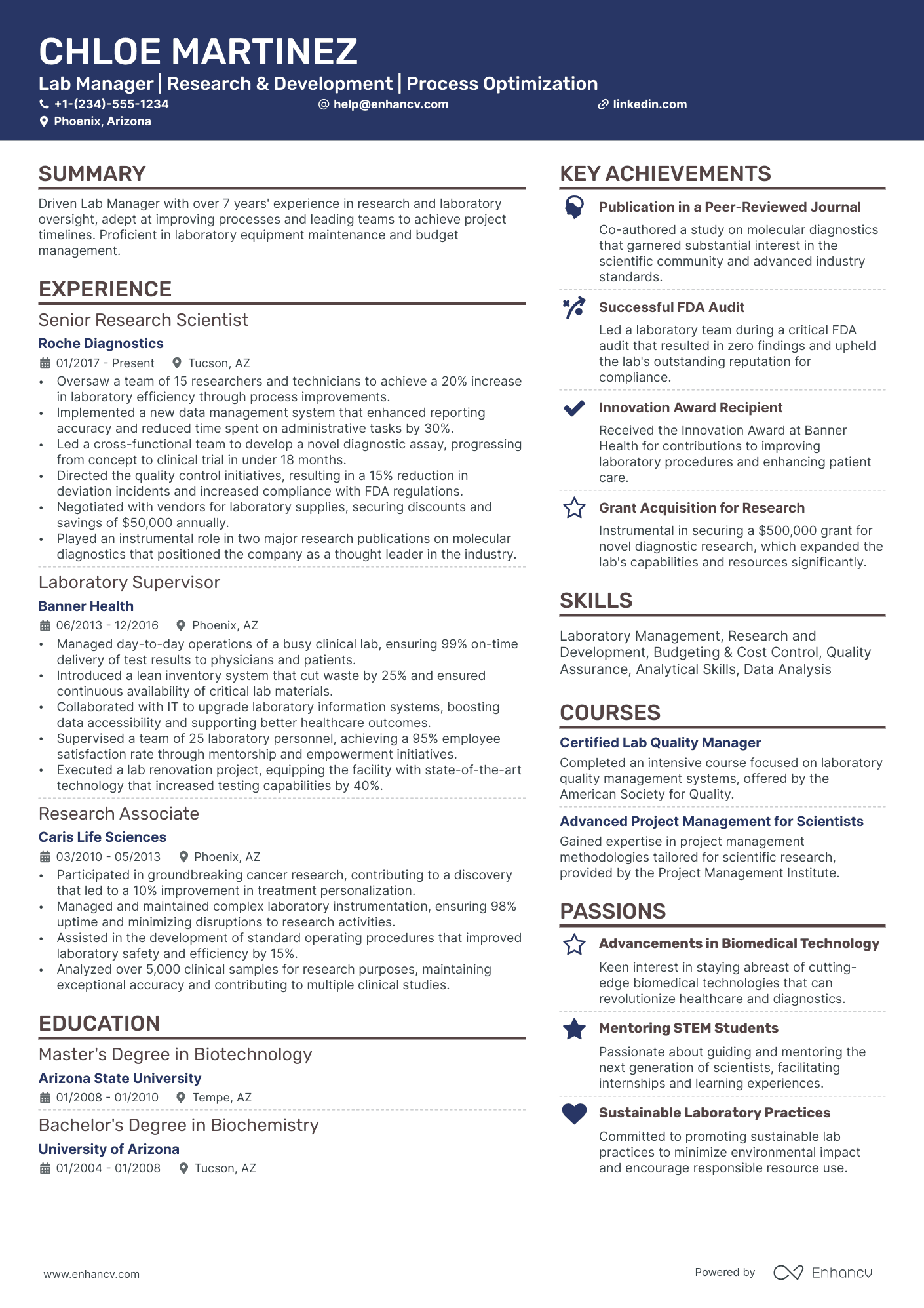
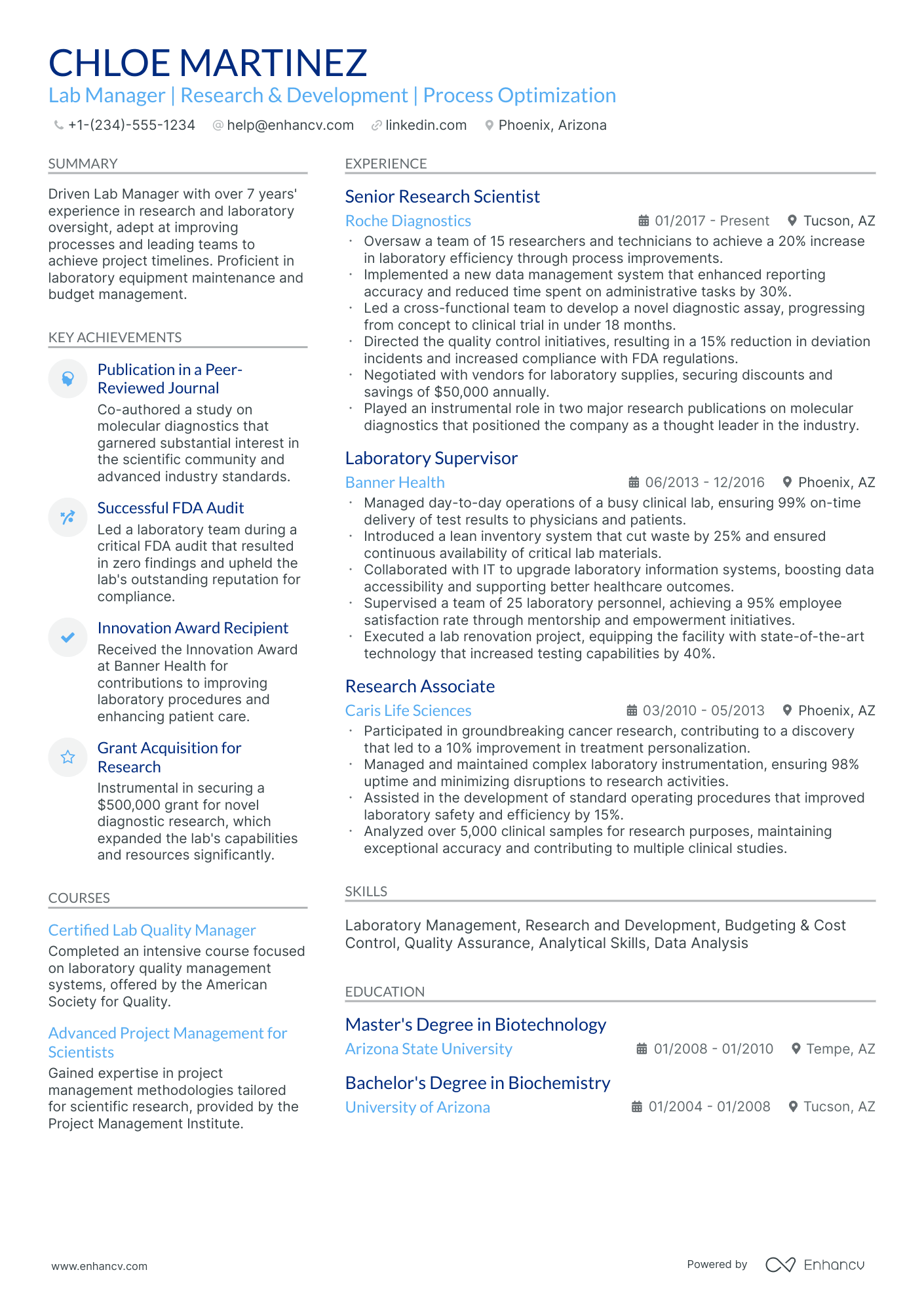
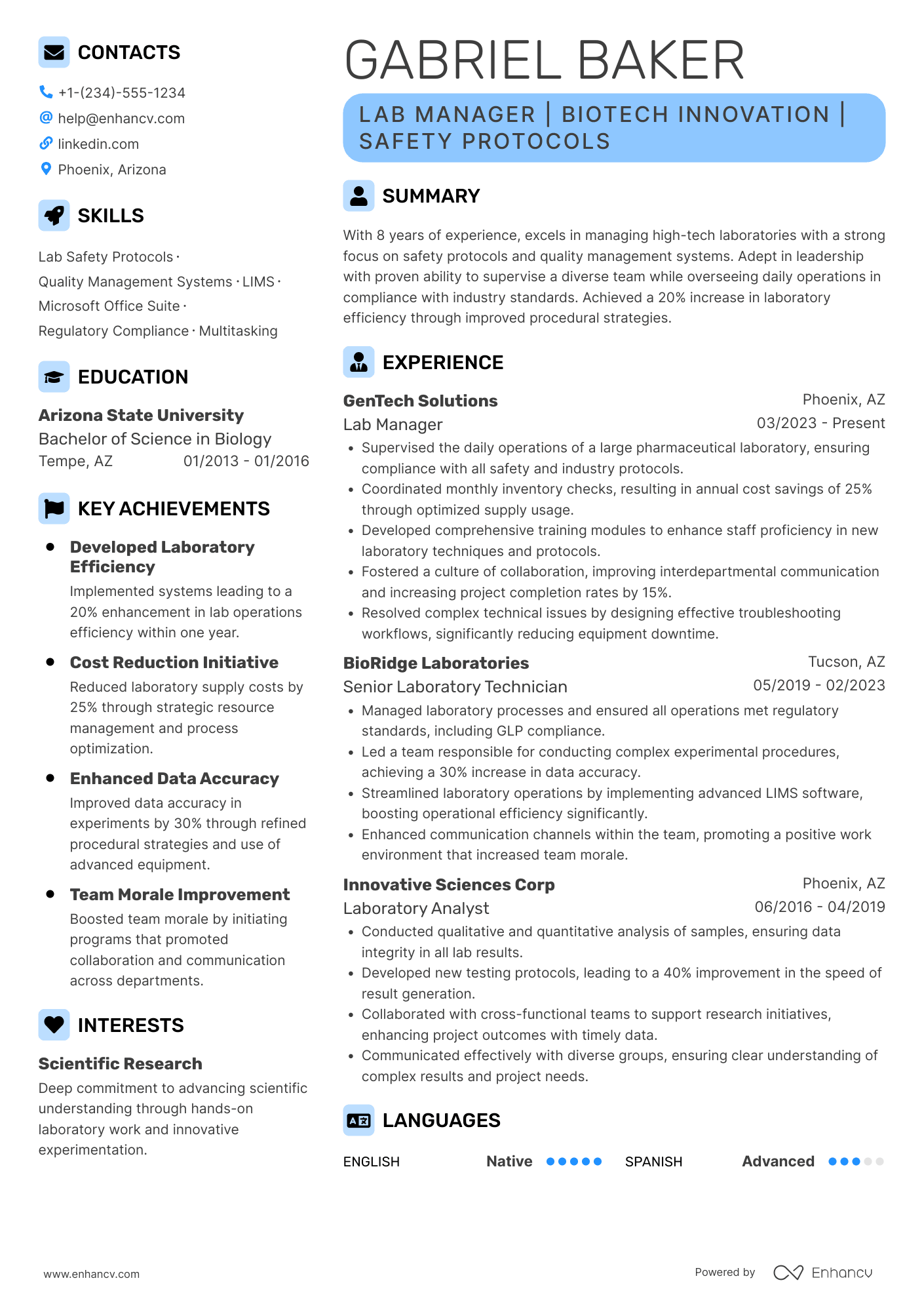
Lab manager resume drafts often fail because they read like equipment inventories and task lists, not evidence of controlled, compliant operations. That gets missed in applicant tracking system filters and fast recruiter scans, especially when qualified candidates compete closely.
Once the resume covers the protocols and instrumentation, the letter is where one audit pass, one assay rollout, or one team build-up earns its own paragraph — our lab manager cover letter guide shows how to frame it for a PI without rehashing the resume.
A strong resume shows what you improved and protected. Knowing how to make your resume stand out means highlighting audit readiness, reduced turnaround time, higher sample throughput, fewer deviations, lower reagent spend, instrument uptime, on-time study delivery, and safer workflows across teams and sites.

Key takeaways
- Quantify lab outcomes like turnaround time, uptime, audit results, and cost savings in every bullet.
- Use reverse-chronological format for experienced candidates and hybrid format for career switchers.
- Tailor instruments, compliance standards, and terminology to match each specific job posting.
- Anchor every listed skill to a concrete action and measurable result in your experience section.
- Place certifications above education when they're more recent and directly relevant to the role.
- Write a three-to-four-line summary highlighting your title, specialization, core skills, and one key achievement.
- Use Enhancv to turn vague lab duties into measurable, recruiter-ready resume bullets faster.
Job market snapshot for lab managers
We analyzed 124 recent lab manager job ads across major US job boards. These numbers help you understand career growth patterns, skills in demand, employer expectations at a glance.
What level of experience employers are looking for lab managers
| Years of Experience | Percentage found in job ads |
|---|---|
| 1–2 years | 3.2% (4) |
| 3–4 years | 7.3% (9) |
| 5–6 years | 20.2% (25) |
| 7–8 years | 4.0% (5) |
| 9–10 years | 4.0% (5) |
| 10+ years | 5.6% (7) |
| Not specified | 59.7% (74) |
Lab manager ads by area of specialization (industry)
| Industry (Area) | Percentage found in job ads |
|---|---|
| Finance & Banking | 37.9% (47) |
| Healthcare | 22.6% (28) |
| Education | 21.8% (27) |
Top companies hiring lab managers
| Company | Percentage found in job ads |
|---|---|
| Actalent | 8.1% (10) |
Role overview stats
These tables show the most common responsibilities and employment types for lab manager roles. Use them to align your resume with what employers expect and to understand how the role is structured across the market.
Day-to-day activities and top responsibilities for a lab manager
| Responsibility | Percentage found in job ads |
|---|---|
| Microsoft office | 12.1% (15) |
| Chemistry | 10.5% (13) |
| Project management | 10.5% (13) |
| Inventory management | 8.1% (10) |
| Lab management | 8.1% (10) |
| Microbiology | 7.3% (9) |
| Excel | 5.6% (7) |
| Clia | 4.8% (6) |
| Data analysis | 4.8% (6) |
| Laboratory safety | 4.8% (6) |
| Biology | 4.0% (5) |
| Budget management | 4.0% (5) |
How to format a lab manager resume
Recruiters evaluating lab manager candidates prioritize hands-on technical expertise, laboratory operations management, and the ability to maintain compliance, safety, and efficiency across workflows. A clean, well-structured resume format ensures these signals surface quickly during both human review and applicant tracking system (ATS) scans.

I have significant experience in this role—which format should I use?
Use a reverse-chronological format to present your laboratory management experience in a clear, progressive timeline. Do:
- Lead with your most recent role and highlight the scope of your oversight, including team size, lab budget, and number of active protocols or projects.
- Feature role-specific competencies such as LIMS administration, GLP/GMP compliance, equipment calibration programs, and vendor management.
- Quantify operational outcomes tied to efficiency, cost savings, safety records, or throughput improvements.
- "Managed a 12-person research lab operating under GLP standards, reducing equipment downtime by 34% through a preventive maintenance program that saved $87,000 annually."
I'm junior or switching into this role—what format works best?
A hybrid format works best, allowing you to lead with relevant technical skills while still showing a chronological work history. Do:
- Place a skills section near the top featuring laboratory techniques, safety certifications, instrument proficiency, and relevant software like LIMS or ELN platforms.
- Include academic research projects, internships, or volunteer lab coordination experience that demonstrates supervisory or organizational responsibilities.
- Connect every listed skill to a concrete action and a measurable or observable result.
- LIMS proficiency → migrated sample tracking from spreadsheets to a centralized LIMS database → reduced data entry errors by 22% across three concurrent studies.
Why not use a functional resume?
A functional format strips away the timeline context that hiring managers rely on to verify your hands-on lab experience, compliance track record, and growth into supervisory responsibilities. A functional resume might be acceptable if you're transitioning from a bench scientist or research associate role into lab management and lack formal management titles—but only if every skill listed is anchored to specific projects, outcomes, or measurable contributions rather than presented in isolation.
Now that you've established a clean, readable structure, it's time to fill it with the right sections that showcase your qualifications.
What sections should go on a lab manager resume
Recruiters expect a lab manager resume to quickly show lab operations leadership, compliance, and measurable outcomes. Understanding which resume sections to include ensures maximum clarity.
Use this structure for maximum clarity:
- Header
- Summary
- Experience
- Skills
- Projects
- Education
- Certifications
- Optional sections: Publications, Awards, Leadership
Strong experience bullets should emphasize operational impact, compliance results, budget and inventory scope, team leadership, and improvements in throughput, quality, safety, and uptime.
Is your resume good enough?
Drop your resume here or choose a file. PDF & DOCX only. Max 2MB file size.
Once you’ve organized your resume with the right components in place, the next step is to write your lab manager experience section so it supports each one with clear, job-relevant results.
How to write your lab manager resume experience
The experience section is where you prove you've delivered results—not just performed duties—by highlighting the instruments, protocols, and management systems you used and the measurable outcomes you achieved in a laboratory setting. Hiring managers prioritize demonstrated impact over descriptive task lists, so every line should connect your work to a concrete improvement in safety, throughput, compliance, or research quality.
Each entry should include:
- Job title
- Company and location (or remote)
- Dates of employment (month and year)
Three to five concise bullet points showing what you owned, how you executed, and what outcomes you delivered:
- Ownership scope: the laboratories, equipment inventories, research programs, safety protocols, or technical teams you were directly accountable for as a lab manager.
- Execution approach: the analytical instruments, quality-management systems, regulatory frameworks, laboratory information management systems (LIMS), or standard operating procedures you applied to guide decisions and deliver work.
- Value improved: changes to experimental accuracy, turnaround time, regulatory compliance rates, equipment uptime, sample integrity, or workplace safety outcomes tied to your lab management responsibilities.
- Collaboration context: how you coordinated with principal investigators, procurement teams, environmental health and safety officers, external auditors, or vendor partners to advance laboratory objectives.
- Impact delivered: outcomes framed as research milestones reached, compliance benchmarks met, cost reductions realized, or operational improvements scaled—expressed through results and significance rather than activity descriptions.
Experience bullet formula
A lab manager experience example
✅ Right example - modern, quantified, specific.
Lab Manager
HelixPoint Biologics | Cambridge, MA
2021–Present
Supported a thirty-person translational research lab developing antibody therapeutics across discovery and preclinical workflows.
- Standardized sample tracking in Benchling and barcode labeling (Zebra printers), cutting specimen mislabeling by 72% and reducing retrieval time from fifteen minutes to four minutes per request.
- Implemented preventive maintenance and calibration schedules for LC-MS, qPCR, and biosafety cabinets using a computerized maintenance management system (CMMS), improving instrument uptime from 91% to 98% and avoiding $120K in outsourced testing.
- Built an inventory and vendor management program in Quartzy with par-levels and automated reorders, reducing stockouts by 63% and lowering monthly spend by 11% through negotiated pricing and consolidated purchasing.
- Led biosafety and chemical hygiene compliance under Biosafety Level 2 protocols, updating standard operating procedures and training forty-two staff; passed two internal audits with zero major findings and cut incident reports by 40%.
- Partnered with principal investigators, research associates, and facilities to redesign cold storage (–80°C, –20°C, and liquid nitrogen) with temperature monitoring (Sensaphone), preventing three freezer excursions and protecting $2.1M in critical samples.
Now that you've seen how a strong experience section comes together, let's look at how to adjust those details to match the specific job you're targeting.
How to tailor your lab manager resume experience
Recruiters evaluate lab manager resumes through both human review and applicant tracking systems, so tailoring your resume to the job description is essential. Tailoring ensures your most relevant qualifications surface quickly during both screening methods.
Ways to tailor your lab manager experience:
- Match exact instruments and software platforms named in the job posting.
- Mirror the compliance standards and regulatory frameworks the employer references.
- Use the same terminology for laboratory methodologies and protocols listed.
- Highlight quality assurance or quality control processes when the role requires them.
- Include relevant industry experience such as pharmaceutical or clinical settings.
- Reflect the specific KPIs or performance benchmarks the posting emphasizes.
- Reference team supervision or cross-departmental collaboration models described.
- Emphasize safety protocols and accreditation maintenance if the posting mentions them.
Tailoring means aligning your real accomplishments with what the employer needs rather than forcing disconnected keywords into your experience section.
Resume tailoring examples for lab manager
| Job description excerpt | Untailored | Tailored |
|---|---|---|
| Oversee daily operations of a BSL-2 molecular biology laboratory, including equipment maintenance, safety compliance, and inventory management using LabArchives. | Managed lab operations and maintained equipment. | Directed daily operations of a BSL-2 molecular biology lab serving 14 researchers, enforced safety compliance protocols, and tracked inventory and SOPs through LabArchives, reducing supply waste by 22%. |
| Supervise a team of 6 research technicians, coordinate project timelines, and ensure reproducibility of experimental results using LIMS-based data tracking. | Led a team and helped keep projects on schedule. | Supervised six research technicians across three concurrent studies, managed project timelines through weekly milestone reviews, and implemented LIMS-based data tracking that improved experimental reproducibility rates to 96%. |
| Develop and validate new assay protocols for CRISPR gene-editing workflows, maintain cold storage systems, and prepare quarterly compliance reports for IACUC review. | Created protocols and handled compliance paperwork. | Developed and validated five assay protocols for CRISPR gene-editing workflows, maintained –80°C cold storage systems for 1,200+ biological samples, and prepared quarterly IACUC compliance reports with zero audit deficiencies over two years. |
Once you’ve aligned your experience with the role’s priorities, quantify your lab manager achievements to show the measurable impact of that work.
How to quantify your lab manager achievements
Quantifying your achievements shows how you improved lab quality, throughput, cost, and compliance. Focus on turnaround time, error rates, uptime, audit outcomes, spend, and safety incidents tied to the lab's tools and volume.
Quantifying examples for lab manager
| Metric | Example |
|---|---|
| Turnaround time | "Cut sample turnaround time from 48 hours to 30 hours by redesigning intake triage in LIMS and adding two daily run windows." |
| Quality accuracy | "Reduced repeat-test rate from 6.2% to 2.1% by tightening QC rules, retraining eight technicians, and standardizing pipette calibration logs." |
| Equipment uptime | "Raised critical instrument uptime from 92% to 98% by launching a preventive maintenance calendar and tracking service tickets in Jira." |
| Cost control | "Lowered consumables spend by 14% ($38K annually) by consolidating vendors, setting par levels, and renegotiating bulk pricing for reagents." |
| Compliance risk | "Passed two ISO 17025 surveillance audits with zero major nonconformities by closing twenty-three corrective actions and improving chain-of-custody documentation." |
Turn vague job duties into measurable, recruiter-ready resume bullets in seconds with Enhancv's Bullet Point Generator.
Once you've crafted strong bullet points to showcase your experience, you'll want to pair them with a well-organized skills section that highlights both your technical expertise and interpersonal strengths.
How to list your hard and soft skills on a lab manager resume
Your skills section shows you can run safe, compliant, efficient lab operations, and recruiters and applicant tracking systems scan this section for role keywords; aim for a hard-skill-heavy mix supported by a smaller set of job-specific soft skills. lab manager roles require a blend of:
- Product strategy and discovery skills.
- Data, analytics, and experimentation skills.
- Delivery, execution, and go-to-market discipline.
- Soft skills.
Your skills section should be:
- Scannable (bullet-style grouping).
- Relevant to the job post.
- Backed by proof in experience bullets.
- Updated with current tools.
Place your skills section:
- Above experience if you're junior or switching careers.
- Below experience if you're mid/senior with strong achievements.

Hard skills
- Laboratory safety, OSHA compliance
- Chemical hygiene plans, hazard assessments
- Biosafety, risk mitigation
- Good Laboratory Practice (GLP)
- Standard operating procedures (SOPs)
- Quality management systems, CAPA
- Equipment qualification, calibration, PM schedules
- LIMS administration, ELN workflows
- Inventory control, procurement, vendor management
- Method validation, assay development
- Data integrity, audit readiness
- Budget forecasting, cost control
Soft skills
- Cross-functional stakeholder alignment
- Clear SOP and training communication
- Coaching and onboarding technicians
- Prioritization under shifting timelines
- Incident response leadership
- Root-cause problem solving
- Ownership of lab readiness and uptime
- Conflict resolution in shared spaces
- Decision-making with incomplete data
- Process improvement mindset
- Vendor and service partner negotiation
- Calm, precise escalation management
How to show your lab manager skills in context
Skills shouldn't live only in a bulleted list on your resume. Explore resume skills examples to see how other professionals integrate competencies throughout their documents.
They should be demonstrated in:
- Your summary (high-level professional identity)
- Your experience (proof through outcomes)
Here's what that looks like in practice.
Summary example
Senior lab manager with 12 years in pharmaceutical quality control. Skilled in HPLC, GMP compliance, and LIMS administration. Led a 15-member team that reduced sample turnaround time by 30% through streamlined SOPs and cross-departmental workflow optimization.
- Reflects senior-level expertise immediately
- Names industry-specific tools and methods
- Includes a concrete, measurable outcome
- Highlights leadership and collaboration skills
Experience example
Senior Lab Manager
Vantage Biopharma | Cambridge, MA
June 2018–Present
- Implemented a new LIMS platform across three departments, cutting data entry errors by 42% within six months.
- Partnered with R&D and quality assurance teams to revise 25+ SOPs, improving audit readiness scores by 35%.
- Managed calibration schedules for 60+ instruments using HPLC and mass spectrometry, maintaining 99.7% uptime.
- Every bullet includes measurable proof
- Skills appear naturally within real achievements
Once you’ve tied your lab management strengths to real outcomes and responsibilities, the next step is applying that same approach to building a lab manager resume when you don’t have formal experience.
How do I write a lab manager resume with no experience
Even without full-time experience, you can demonstrate readiness through:
- University teaching lab coordination
- Research lab inventory tracking
- Safety training and incident logs
- Equipment maintenance and calibration records
- Chemical ordering and receiving
- LIMS data entry and audits
- SOP drafting and updates
- Quality control sample documentation
If you're building a resume without work experience, focus on:
- SOPs, GLP, and compliance
- Inventory systems and purchasing controls
- Equipment uptime and calibration logs
- LIMS accuracy and traceability
Resume format tip for entry-level lab manager
Use a hybrid resume format because it highlights lab manager skills and projects first, while still showing education and limited experience clearly. Do:
- Put a "Lab Operations Projects" section near the top.
- List tools and systems: LIMS, Excel, CMMS.
- Quantify results: counts, time saved, error rate.
- Include compliance work: SOPs, GLP, OSHA training.
- Add relevant coursework as scoped labs.
- Built an Excel inventory tracker for a teaching lab, reducing stockouts by 30% and cutting weekly ordering time from two hours to one.
Even without direct experience, your educational background can serve as strong evidence of your lab qualifications—so presenting it effectively is essential.
How to list your education on a lab manager resume
Your education section helps hiring teams confirm you have the scientific foundation a lab manager needs. It validates your training in relevant disciplines quickly.
Include:
- Degree name
- Institution
- Location
- Graduation year
- Relevant coursework (for juniors or entry-level candidates)
- Honors & GPA (if 3.5 or higher)
Skip month and day details—list the graduation year only.
Here's a strong education entry tailored to a lab manager resume.
Example education entry
Bachelor of Science in Biochemistry
University of Wisconsin–Madison, Madison, WI
Graduated 2019
GPA: 3.7/4.0
- Relevant Coursework: Analytical Chemistry, Laboratory Safety Management, Molecular Biology, Biostatistics
- Honors: Magna Cum Laude, Dean's List (six semesters)
How to list your certifications on a lab manager resume
Certifications on your resume show your commitment to learning, prove tool proficiency, and confirm industry relevance for a lab manager. They also help hiring teams trust your compliance, safety, and quality skills.
Include:
- Certificate name
- Issuing organization
- Year
- Optional: credential ID or URL
- Place certifications below education when your degree is recent and matches the lab manager role.
- Place certifications above education when they are more recent than your degree and directly match the lab manager job requirements.
Best certifications for your lab manager resume
- ASQ Certified Quality Improvement Associate (CQIA)
- ASQ Certified Quality Technician (CQT)
- ASQ Certified Calibration Technician (CCT)
- OSHA 30-Hour General Industry
- IATA Dangerous Goods Regulations (DGR) Certification
- American Society for Microbiology (ASM) Certified Microbiologist (CM)
Once you’ve positioned your credentials where hiring managers will see them, use your lab manager resume summary to reinforce those qualifications upfront and tie them to the role you’re targeting.
How to write your lab manager resume summary
Your resume summary is the first thing a recruiter reads. A strong one immediately signals you're qualified and worth interviewing for the lab manager role.
Keep it to three to four lines, with:
- Your title and total years of relevant laboratory management experience.
- The type of lab environment, industry, or research domain you specialize in.
- Core skills like regulatory compliance, equipment calibration, inventory management, or LIMS proficiency.
- One or two measurable achievements, such as cost reductions, efficiency gains, or audit outcomes.
- Soft skills tied to real results, like cross-functional coordination or mentoring junior staff.

PRO TIP
At this level, emphasize hands-on operational results and specific technical competencies. Highlight how your work improved lab processes or supported research goals. Avoid vague phrases like "passionate scientist" or "dedicated professional." Recruiters want evidence, not enthusiasm.
Example summary for a lab manager
Lab manager with six years of experience in pharmaceutical quality control environments. Skilled in LIMS administration, SOP development, and ISO 17025 compliance. Reduced sample turnaround time by 22% through workflow redesign.
Optimize your resume summary and objective for ATS
Drop your resume here or choose a file.
PDF & DOCX only. Max 2MB file size.
Now that your summary effectively showcases your qualifications, make sure your header presents your contact details correctly so hiring managers can easily reach you.
What to include in a lab manager resume header
A resume header lists your key contact details and role focus, helping a lab manager stand out for visibility, credibility, and recruiter screening.
Essential resume header elements
- Full name
- Tailored job title and headline
- Location
- Phone number
- Professional email
- GitHub link
- Portfolio link
A LinkedIn link helps recruiters verify experience quickly and supports screening.
Don't include a photo on a lab manager resume unless the role is explicitly front-facing or appearance-dependent.
Match your header job title to the posting, and keep links short, working, and consistent with your name across profiles.
Example
Lab manager resume header
Jordan Lee
Lab manager | Clinical operations and compliance
Boston, MA
(617) 555-12XX
jordan.lee@enhancv.com
github.com/jordanlee yourwebsite.com linkedin.com/in/jordanlee
Once your contact details and role-identifying information are in place at the top, you can strengthen the rest of your resume with additional sections that highlight relevant qualifications.
Additional sections for lab manager resumes
When your core qualifications match other candidates, additional sections can set you apart and reinforce your lab manager credibility.
Consider adding these sections if they're relevant to the role:
- Languages
- Publications and research contributions
- Professional affiliations and memberships
- Certifications and licenses
- Conferences and presentations
- Hobbies and interests
- Volunteer experience
Once you've strengthened your resume with relevant additional sections, pairing it with a well-crafted cover letter can further set your application apart.
Do lab manager resumes need a cover letter
A cover letter isn't required for a lab manager, but it often helps. If you're wondering what a cover letter is and when it matters most, consider competitive roles or organizations that expect one. It can make a difference when your resume needs context or your fit is not obvious.
Use a cover letter to add clarity and proof:
- Explain role and team fit by matching your lab manager strengths to the lab's workflow, compliance needs, and collaboration style.
- Highlight one or two projects or outcomes, such as improving turnaround time, reducing errors, passing audits, or stabilizing instrument uptime.
- Show you understand the product, users, or business context by connecting lab work to patients, research goals, manufacturing needs, or customer requirements.
- Address career transitions or non-obvious experience by translating related work into lab manager responsibilities, tools, and regulated processes.
Drop your resume here or choose a file.
PDF & DOCX only. Max 2MB file size.
Even if you decide a cover letter adds value for context and fit, using AI to improve your lab manager resume helps you strengthen the document hiring teams review first and tailor it faster.
Using AI to improve your lab manager resume
AI can sharpen your resume's clarity, structure, and impact. It helps tighten language and highlight results. But overuse dulls authenticity. If you're curious about which AI is best for writing resumes, start with targeted prompts and stop once your content feels clear and role-aligned.
Here are 10 practical prompts to strengthen specific sections of your lab manager resume:
- Sharpen your summary: "Rewrite my lab manager resume summary to emphasize leadership, compliance oversight, and measurable lab efficiency improvements in under four sentences."
- Quantify experience bullets: "Add specific metrics to these lab manager experience bullets, focusing on throughput, turnaround times, error reduction, and team size managed."
- Align skills to posting: "Compare my lab manager skills section against this job description and suggest missing technical or regulatory skills I should add."
- Strengthen action verbs: "Replace weak or passive verbs in my lab manager experience section with strong, precise action verbs suited to laboratory operations."
- Tighten project descriptions: "Condense these lab manager project descriptions into concise bullets that highlight scope, methodology, and outcomes."
- Improve certifications section: "Reorganize my lab manager certifications section by relevance, and suggest brief context for each credential's workplace value."
- Clarify education entries: "Rewrite my lab manager education section to emphasize coursework, research, and lab techniques directly relevant to this role."
- Remove redundant phrasing: "Identify and eliminate filler words, clichés, and redundant phrases across my entire lab manager resume."
- Tailor to industry: "Adjust the tone and terminology of my lab manager resume to better match a pharmaceutical, clinical, or academic research environment."
- Enhance leadership impact: "Rewrite these lab manager experience bullets to better showcase team mentorship, cross-department collaboration, and process improvement outcomes."
Stop using AI once your resume sounds accurate, specific, and aligned with real experience. AI should never invent experience or inflate claims—if it didn't happen, it doesn't belong here.
Conclusion
A strong lab manager resume proves impact with measurable outcomes, shows role-specific skills, and follows a clear structure. Use metrics to show safety improvements, uptime, turnaround time, budget control, and audit results.
Keep every section easy to scan and aligned to the lab manager role you want now. This approach shows readiness for today’s hiring market and near-future needs, and it helps hiring teams trust your fit quickly.