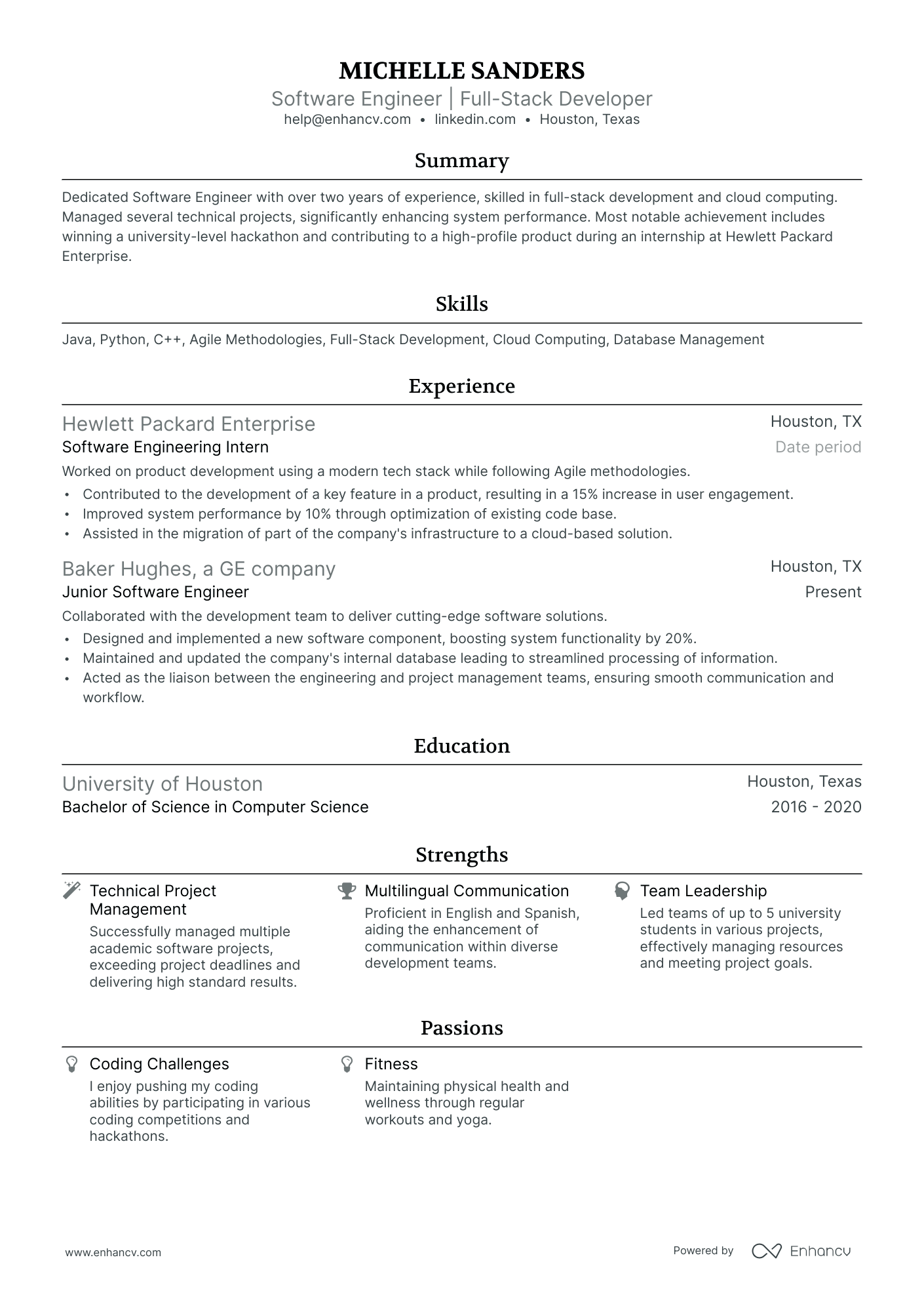
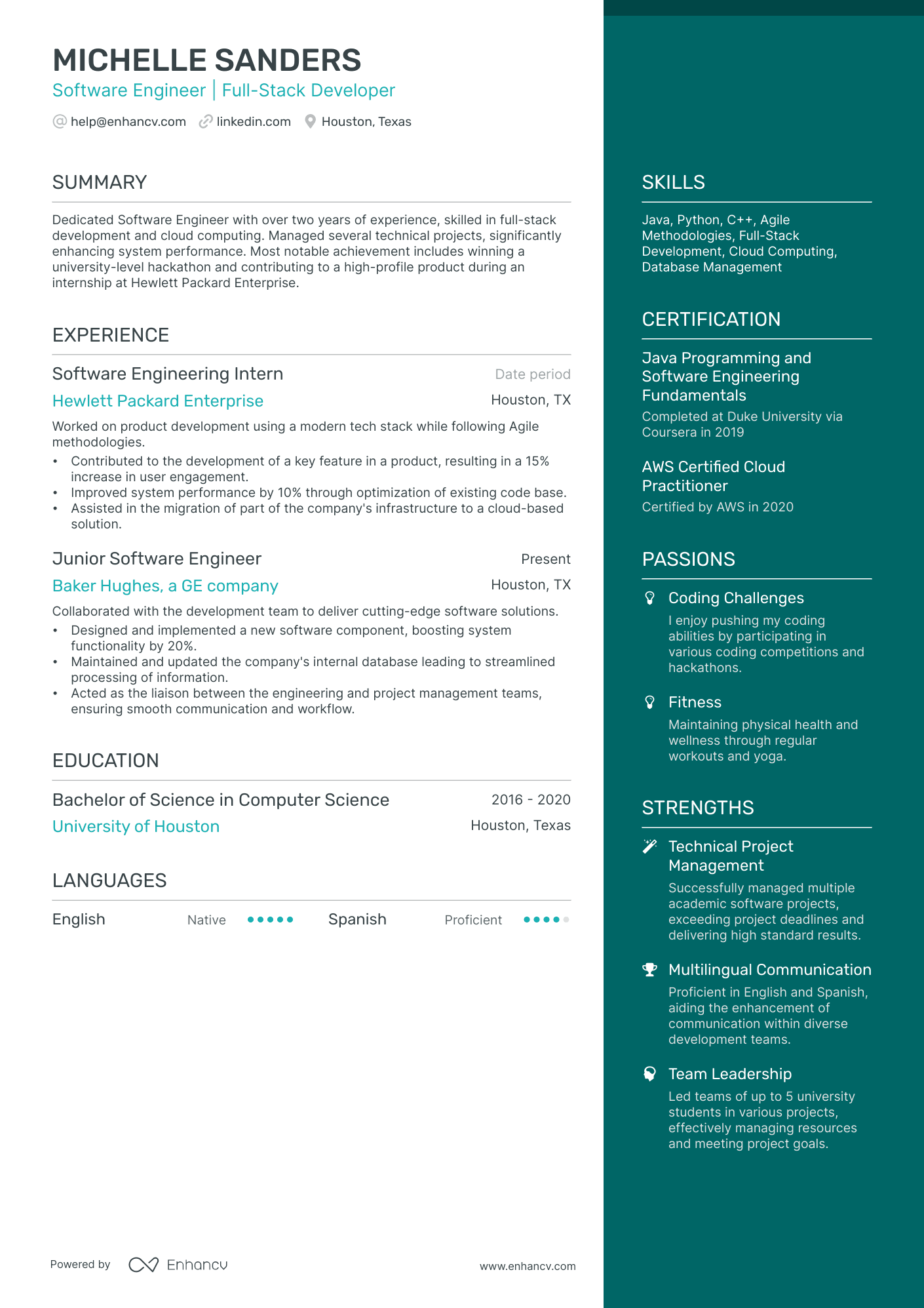
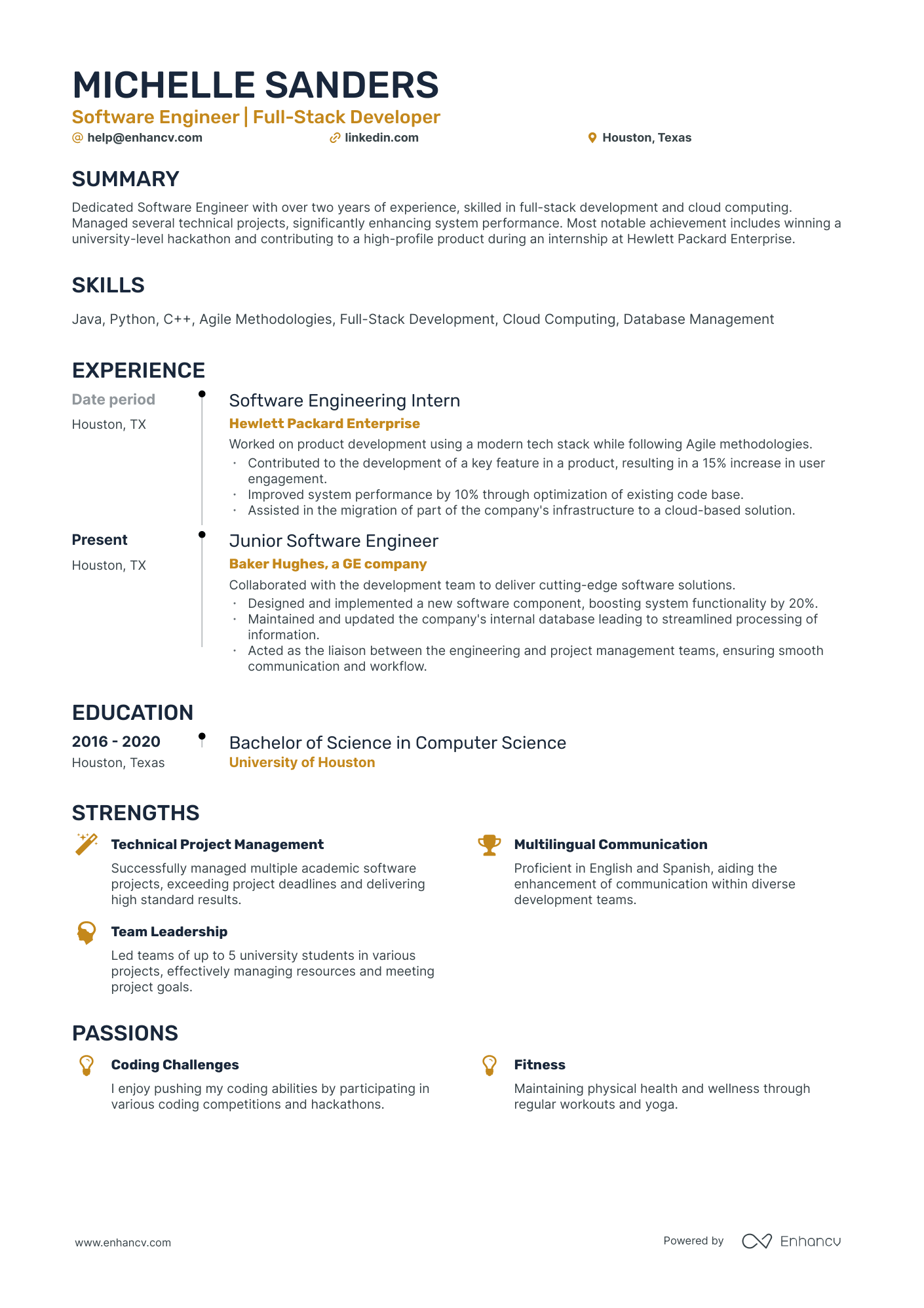
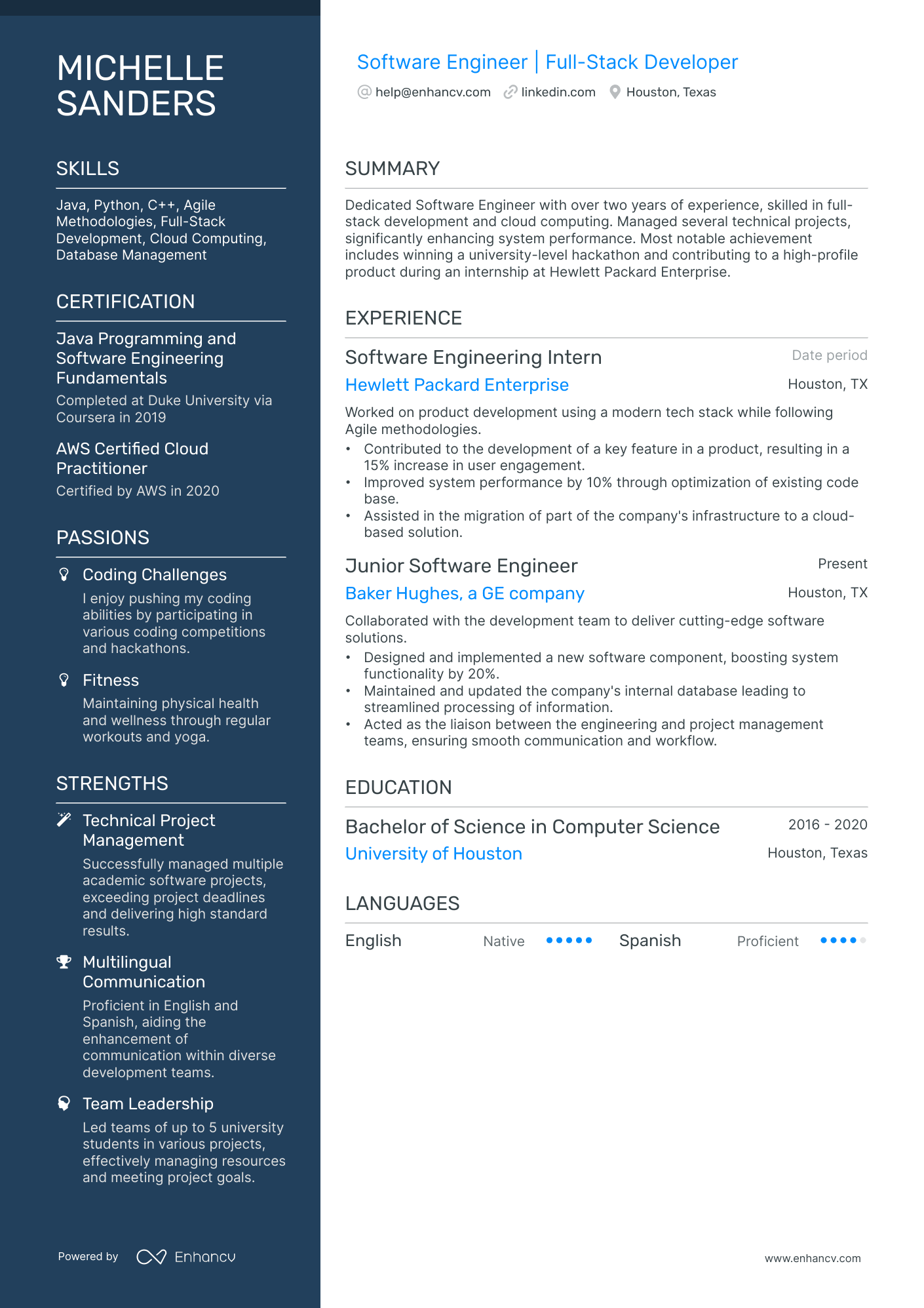
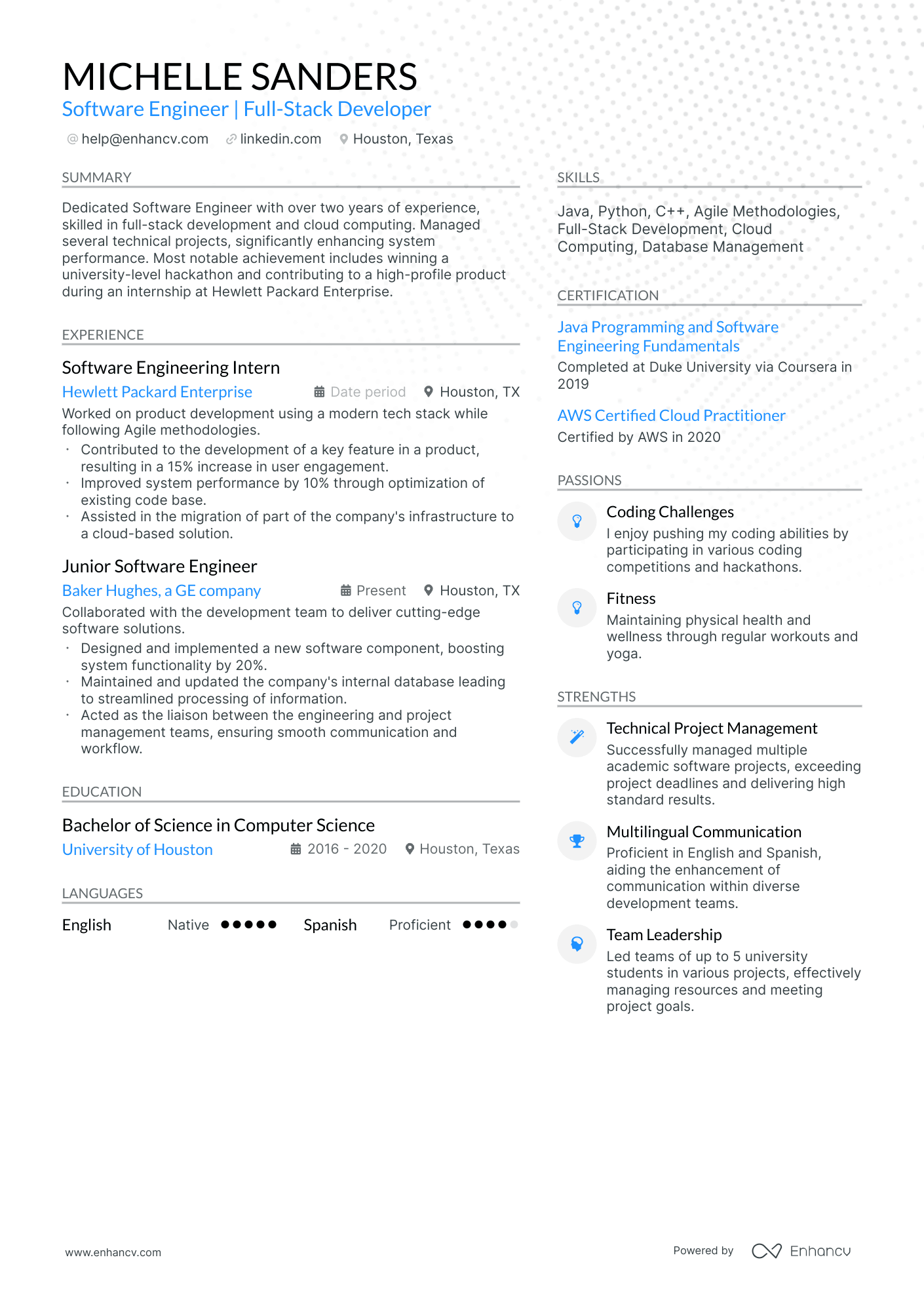
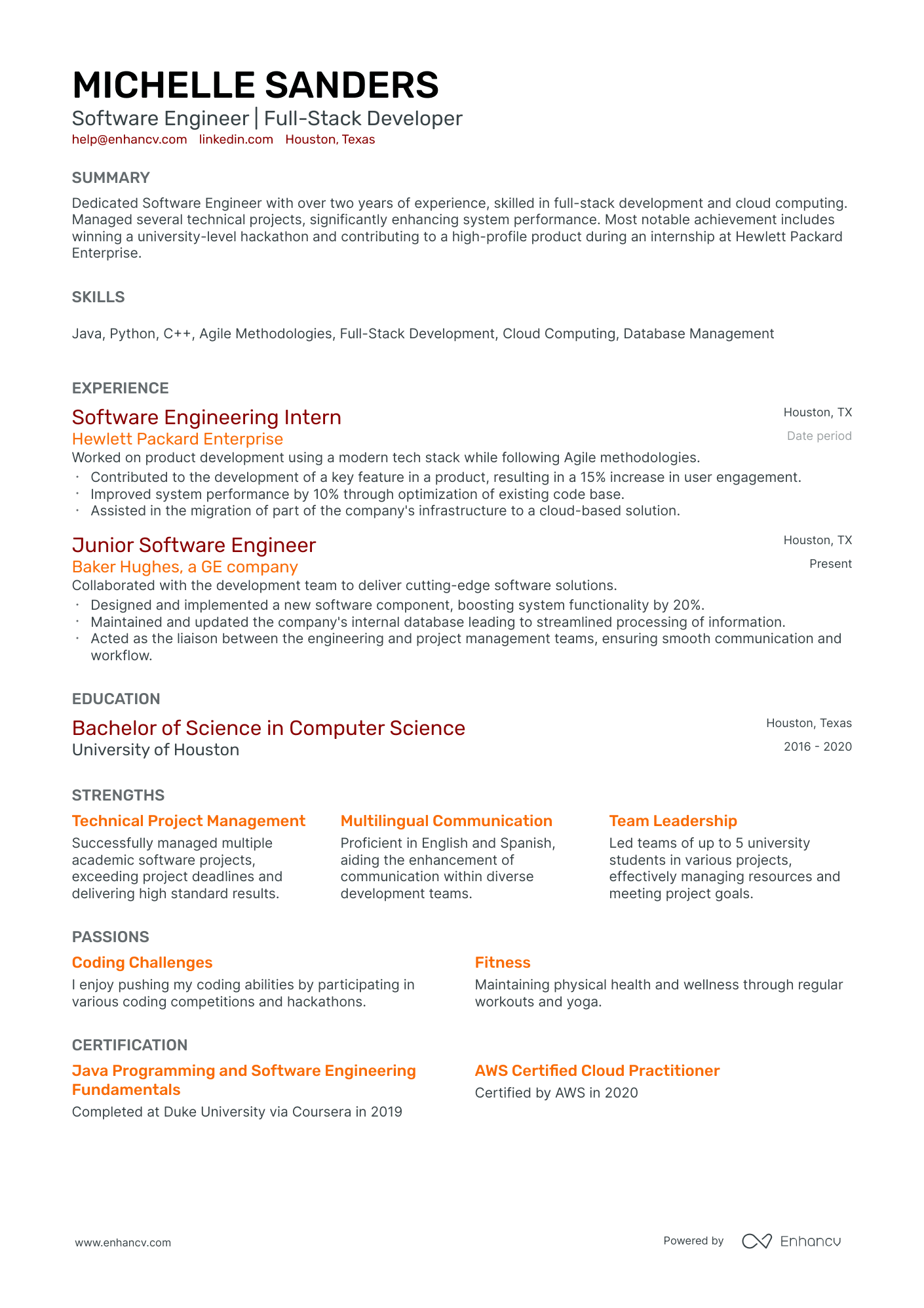
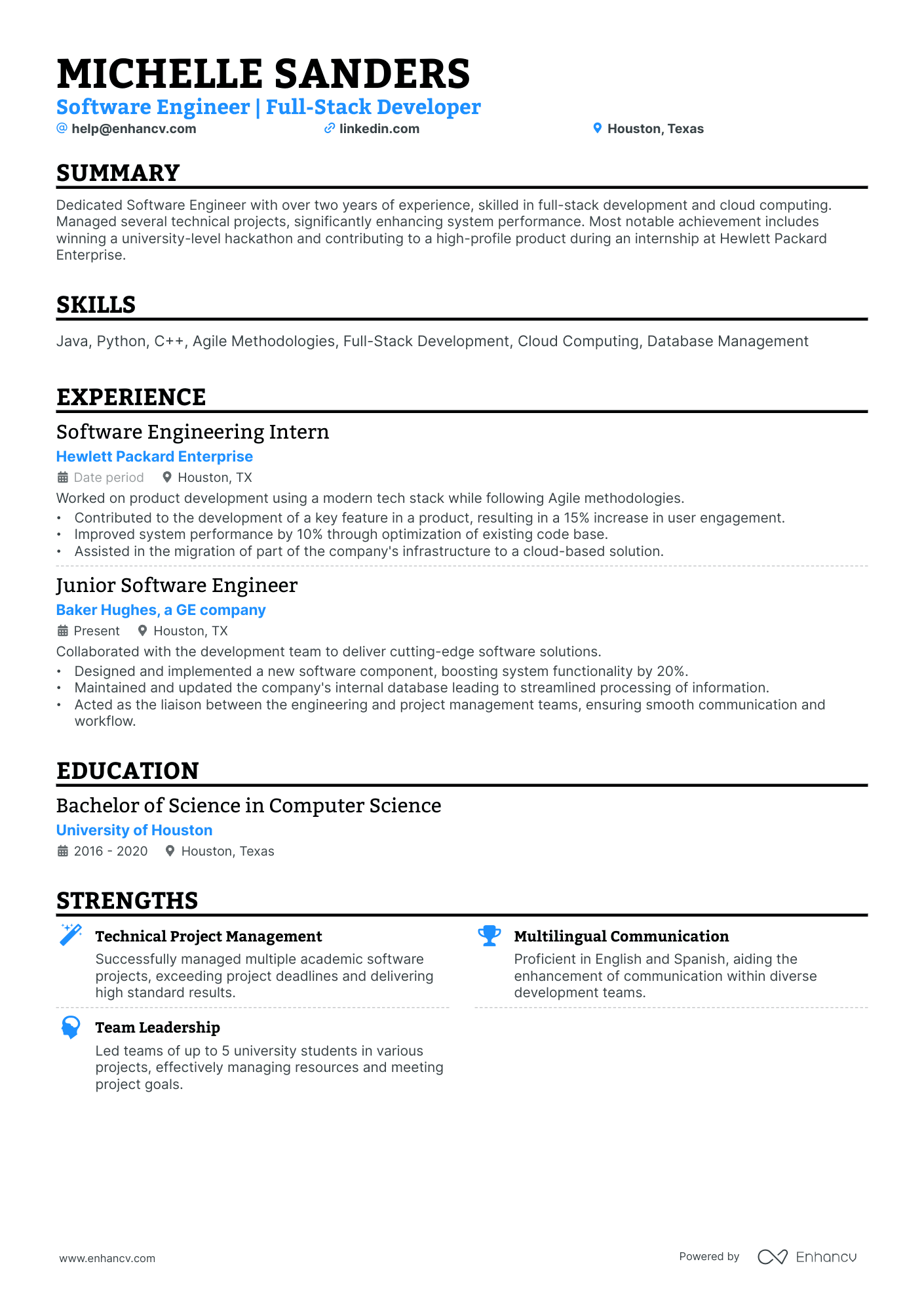
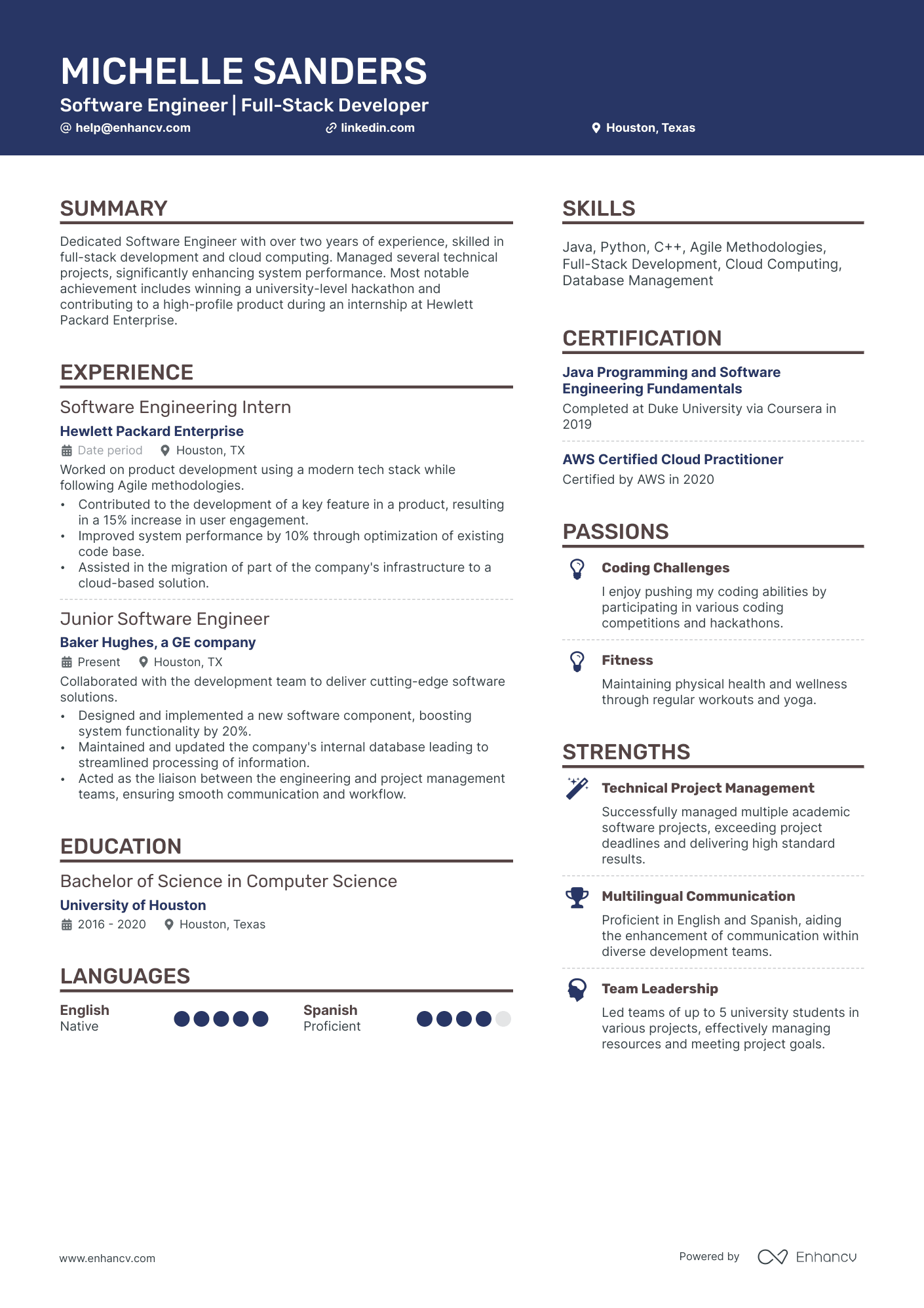
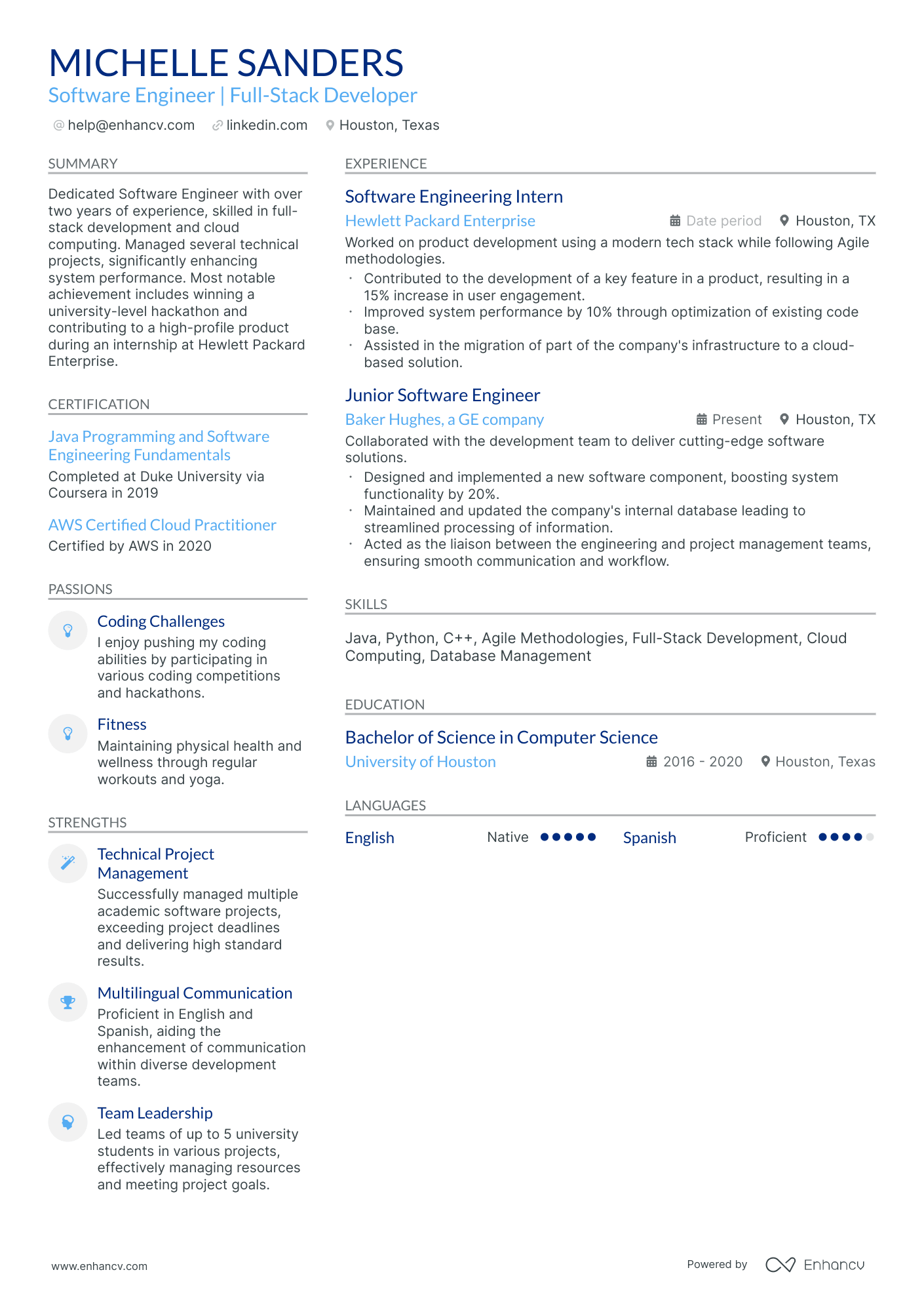
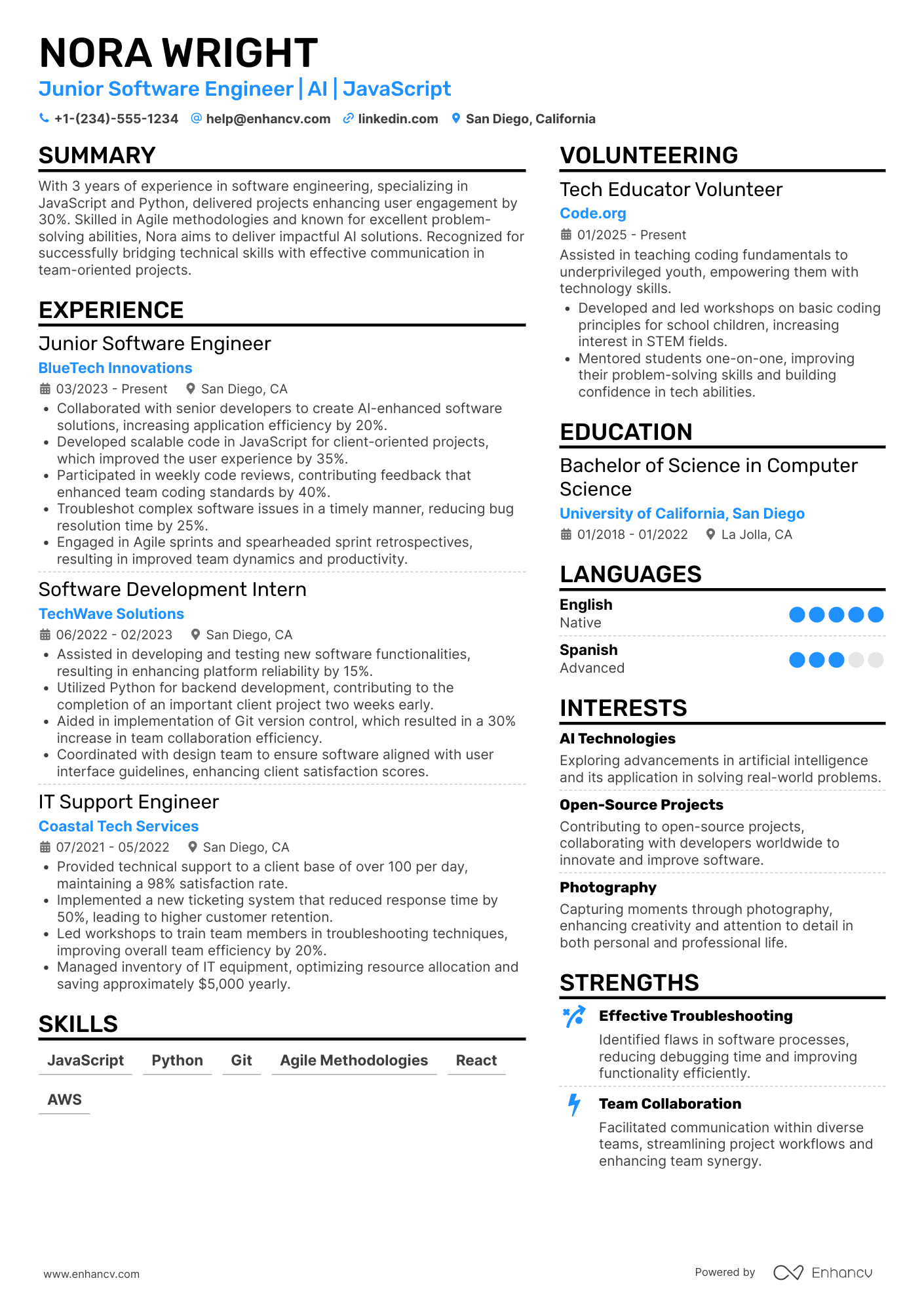
Many junior software engineer resume submissions fail because they list coursework and tools but don't prove impact, so they blend together. That hurts in today's hiring process, where an ATS filters keywords and recruiters scan fast in a crowded market.
A strong resume shows what you shipped and what improved because of it. Knowing how to make your resume stand out means you'll highlight features delivered, bugs reduced, test coverage increased, latency cut, build times improved, and user or revenue impact tied to your changes.

Key takeaways
- Quantify every experience bullet with metrics like latency, bug reduction, or test coverage gains.
- Use a hybrid format if you lack work history, leading with skills and project entries.
- Tailor your resume to each job posting by mirroring its exact tools and terminology.
- Anchor every listed skill to a specific project, contribution, or measurable outcome.
- Replace vague task descriptions with ownership, execution approach, and impact delivered.
- Use AI prompts to tighten phrasing and add metrics, but stop before it invents experience.
- Build your resume faster with Enhancv to ensure clean structure and recruiter-ready formatting.
How to format a junior software engineer resume
Recruiters screening junior software engineer resumes prioritize technical skills, relevant projects, and evidence that you can translate learning into practical output. Your resume format determines how quickly a recruiter spots these signals, so choosing the right structure directly affects whether you advance past the initial review.

I have significant experience in this role—which format should I use?
Use a reverse-chronological format to place your most recent and relevant engineering work front and center. Do:
- Lead with your most recent role and highlight scope of ownership, such as features built, systems maintained, or team collaboration.
- List role-specific tools, languages, and frameworks (e.g., Python, JavaScript, Git, React, SQL, CI/CD pipelines) within each position's context.
- Quantify outcomes wherever possible—deployment frequency, bug reduction, performance improvements, or user-facing impact.
I'm junior or switching into this role—what format works best?
Use a hybrid format that leads with a technical skills section, then supports it with project experience and any relevant work history. Do:
- Place a dedicated skills section near the top of your resume, grouping languages, frameworks, and tools by category for fast scanning.
- Feature academic projects, bootcamp capstones, open-source contributions, or freelance work as structured experience entries with descriptions of your responsibilities and deliverables.
- Connect every action to a clear outcome, even at a small scale, so recruiters see cause-and-effect thinking.
When does a functional resume make sense?
In limited scenarios, a functional format can work for junior software engineer candidates who lack traditional work experience but have strong demonstrable skills.
- You're switching careers and your prior job titles don't reflect your technical abilities.
- You completed a bootcamp or self-taught program and have no formal engineering employment history.
- You have gaps in your work history but built portfolio projects or contributed to open-source during that time.
- A functional resume is acceptable only when you have no relevant work history at all—and even then, every skill listed must be anchored to a specific project, contribution, or measurable outcome.
Now that you've established a clean, readable layout, it's time to fill it with the right sections to highlight your qualifications effectively.
What sections should go on a junior software engineer resume
Recruiters expect you to present your core technical skills, relevant experience, and proof you can ship working software. Understanding which resume sections to include helps you structure your content for maximum clarity:
- Header
- Summary
- Experience
- Skills
- Projects
- Education
- Certifications
- Optional sections: Open-source work, awards, languages
Strong experience bullets should emphasize measurable impact, shipped outcomes, technical scope, and results tied to product or engineering goals.
Is your resume good enough?
Drop your resume here or choose a file. PDF & DOCX only. Max 2MB file size.
Now that you’ve identified the key resume components to include, the next step is to write your junior software engineer resume experience section so those details translate into clear, role-relevant impact.
How to write your junior software engineer resume experience
The experience section is where you prove you've shipped real software—not just studied it. Hiring managers prioritize demonstrated impact over descriptive task lists, so focus each entry on work you delivered, the tools and methods you used, and measurable outcomes that show your contributions mattered.
Each entry should include:
- Job title
- Company and location (or remote)
- Dates of employment (month and year)
Three to five concise bullet points showing what you owned, how you executed, and what outcomes you delivered:
- Ownership scope: the features, modules, services, or codebases you were directly responsible for as a junior software engineer, including any platforms or internal tools you maintained or built from scratch.
- Execution approach: the languages, frameworks, development practices, or workflows you used to deliver work—such as version control systems, CI/CD pipelines, testing strategies, or agile ceremonies that shaped how you wrote and shipped code.
- Value improved: the specific quality, performance, reliability, or maintainability gains your engineering work produced, whether that meant reducing bugs, improving load times, increasing test coverage, or lowering technical debt.
- Collaboration context: how you worked alongside senior engineers, product managers, designers, or QA teammates to scope requirements, review code, resolve blockers, and deliver features that met cross-functional goals.
- Impact delivered: the tangible results your contributions created, expressed through outcomes like user-facing improvements, deployment frequency, system uptime, or adoption metrics rather than a list of tasks you completed.
Experience bullet formula
A junior software engineer experience example
✅ Right example - modern, quantified, specific.
Junior Software Engineer
BrightCart | Austin, TX
2023–2025
Built and maintained e-commerce features for a high-traffic marketplace serving 500,000+ monthly users.
- Shipped eight customer-facing features in React, TypeScript, and Node.js, improving checkout conversion by 3.2% and reducing cart abandonment by 2.1% in partnership with product managers and designers.
- Reduced median API latency by 28% by adding Redis caching, optimizing PostgreSQL queries, and profiling Node.js endpoints with OpenTelemetry across twenty-five high-traffic routes.
- Increased automated test coverage from 42% to 71% using Jest, React Testing Library, and Playwright, cutting production defects by 19% and improving release confidence for the engineering team.
- Implemented CI/CD checks in GitHub Actions—linting, type checks, and parallel test runs—cutting average build time from twelve minutes to seven minutes and reducing failed deployments by 23%.
- Partnered with senior engineers to remediate five security findings by tightening OAuth scopes, rotating secrets in AWS Secrets Manager, and adding input validation, reducing high-severity alerts to zero for two consecutive quarters.
Now that you've seen how a strong experience section comes together, let's look at how to adjust those details to match the specific job you're applying for.
How to tailor your junior software engineer resume experience
Recruiters evaluate your junior software engineer resume through applicant tracking systems and manual review, filtering for specific skills and qualifications. Tailoring your resume to the job description ensures your relevant work rises to the top.
Ways to tailor your junior software engineer experience:
- Match programming languages and frameworks listed in the job description.
- Use the exact terminology for development methodologies like Agile or Scrum.
- Mirror performance metrics or code quality standards the posting references.
- Highlight version control tools and CI/CD pipelines the team uses.
- Include relevant domain experience such as fintech or healthcare software.
- Emphasize testing practices and quality assurance processes when mentioned.
- Reference collaboration workflows like code reviews or pair programming.
- Align your debugging and troubleshooting experience with stated reliability goals.
Tailoring means aligning your real accomplishments with what the role demands, not forcing disconnected keywords into your experience bullets.
Resume tailoring examples for junior software engineer
| Job description excerpt | Untailored | Tailored |
|---|---|---|
| "Build and maintain RESTful APIs using Python and Django. Collaborate with front-end developers to integrate user-facing elements with server-side logic." | Worked on back-end development tasks and helped with team projects. | Built and maintained RESTful APIs in Python and Django, collaborating with three front-end developers to integrate UI components with server-side logic across 12 endpoints. |
| "Write unit and integration tests using Jest and React Testing Library. Participate in code reviews and contribute to improving code quality." | Assisted with testing and quality assurance for software applications. | Wrote 80+ unit and integration tests using Jest and React Testing Library, reducing production bugs by 30% while participating in weekly code reviews to enforce consistent standards. |
| "Assist in migrating legacy systems to AWS cloud infrastructure. Monitor application performance using CloudWatch and troubleshoot deployment issues." | Helped with system updates and monitored application performance. | Supported migration of two legacy .NET services to AWS EC2 and S3, using CloudWatch to monitor uptime and resolve deployment failures within a four-hour SLA. |
Once you’ve aligned your experience with the role’s priorities, the next step is to quantify your junior software engineer achievements so hiring managers can quickly see your impact.
How to quantify your junior software engineer achievements
Quantifying your work proves you shipped real value, not just code. For junior software engineers, focus on performance, reliability, quality, delivery speed, and security metrics tied to features, bugs, and user impact.
Quantifying examples for junior software engineer
| Metric | Example |
|---|---|
| Performance | "Reduced API p95 latency from 420 ms to 260 ms by adding Redis caching and optimizing PostgreSQL indexes across three endpoints." |
| Reliability | "Cut checkout error rate from 1.8% to 0.9% by improving retries, adding circuit breakers, and instrumenting alerts in Datadog." |
| Quality | "Decreased production bugs by 30% quarter over quarter by adding unit tests in Jest and raising coverage from 45% to 70%." |
| Delivery speed | "Shortened feature lead time from eight days to five by splitting stories, automating CI in GitHub Actions, and improving PR templates." |
| Security | "Resolved twelve high-severity vulnerabilities by upgrading dependencies, adding Snyk checks, and enforcing least-privilege IAM policies." |
Turn vague job duties into measurable, recruiter-ready resume bullets in seconds with Enhancv's Bullet Point Generator.
Once you've crafted strong bullet points for your experience section, you'll want to apply that same precision to presenting your hard and soft skills effectively.
How to list your hard and soft skills on a junior software engineer resume
Your skills section shows you can build and ship software, and recruiters and an ATS (applicant tracking system) scan this section to match keywords fast—aim for mostly hard skills with a smaller set of role-specific soft skills. junior software engineer roles require a blend of:
- Product strategy and discovery skills.
- Data, analytics, and experimentation skills.
- Delivery, execution, and go-to-market discipline.
- Soft skills.
Your skills section should be:
- Scannable (bullet-style grouping).
- Relevant to the job post.
- Backed by proof in experience bullets.
- Updated with current tools.
Place your skills section:
- Above experience if you're junior or switching careers.
- Below experience if you're mid/senior with strong achievements.

Hard skills
- Java, Python, JavaScript
- TypeScript, Node.js
- React, HTML, CSS
- REST APIs, JSON
- SQL, PostgreSQL, MySQL
- Git, GitHub, pull requests
- Unit testing, JUnit, pytest
- CI/CD, GitHub Actions
- Docker, containers
- AWS services, IAM, S3
- Linux, Bash scripting
- Agile, Scrum ceremonies
Soft skills
- Break down tickets into tasks
- Ask clarifying questions early
- Communicate status and blockers
- Write clear technical notes
- Take feedback and iterate fast
- Review code with specific suggestions
- Pair program to unblock teammates
- Prioritize fixes by user impact
- Follow through on commitments
- Escalate risks with context
- Learn unfamiliar codebases quickly
- Collaborate across QA and product
How to show your junior software engineer skills in context
Skills shouldn't live only in a dedicated skills list. Browse resume skills examples to see how other engineers present their technical abilities effectively.
They should be demonstrated in:
- Your summary (high-level professional identity)
- Your experience (proof through outcomes)
Here's what that looks like in practice.
Summary example
Junior software engineer with two years of experience building RESTful APIs and React interfaces for fintech platforms. Reduced average API response time by 30% through query optimization. Collaborative team member skilled in Agile workflows, Git, and test-driven development.
- Specifies a clear experience level
- Names role-relevant tools and frameworks
- Leads with a measurable performance metric
- Highlights collaboration and methodology
Experience example
Junior Software Engineer
Helix Financial Technologies | Austin, TX
June 2022–Present
- Built and maintained 12 RESTful API endpoints using Node.js and Express, reducing data retrieval latency by 25% across the client dashboard.
- Partnered with UX designers and QA engineers to ship a React-based onboarding flow, increasing user activation rates by 18%.
- Wrote unit and integration tests with Jest, raising overall code coverage from 54% to 87% within six months.
- Every bullet includes measurable proof
- Skills appear naturally through real outcomes
Once you’ve tied your junior software engineer strengths to real examples, the next step is to apply that same approach to writing a junior software engineer resume with no experience.
How do I write a junior software engineer resume with no experience
Even without full-time experience, you can demonstrate readiness through projects and self-directed work. If you're writing a resume without work experience, focus on these alternatives:
- Personal coding projects on GitHub
- Open-source contributions and pull requests
- Freelance or volunteer software work
- Hackathon projects and demos
- Capstone or course software projects
- Technical internships or co-ops
- Coding challenges with write-ups
- Technical blog posts on projects
Focus on:
- Shipped code and working demos
- GitHub links and clean commits
- Tech stack aligned to roles
- Measurable outcomes and impact
Resume format tip for entry-level junior software engineer
Use a reverse-chronological resume format, because it highlights recent projects, education, and internships in a recruiter-friendly scan order. Do:
- Put projects above work history.
- Link GitHub and live demos.
- List tools beside each project.
- Quantify results with clear metrics.
- Tailor keywords to each job.
- Built a React and Node.js task tracker on GitHub, added Jest tests and GitHub Actions, and reduced reported bugs by 30% across ten test scenarios.
Once you've structured your resume around skills and projects rather than job history, your education section becomes one of the strongest assets you can highlight.
How to list your education on a junior software engineer resume
Your education section helps hiring teams confirm you have the foundational knowledge needed for a junior software engineer role. It validates technical training and academic preparation quickly.
Include:
- Degree name
- Institution
- Location
- Graduation year
- Relevant coursework (for juniors or entry-level candidates)
- Honors & GPA (if 3.5 or higher)
Skip month and day details—list the graduation year only.
Here's a strong education entry tailored for a junior software engineer resume.
Example education entry
Bachelor of Science in Computer Science
University of Wisconsin–Madison, Madison, WI
2024 | GPA: 3.7/4.0
- Relevant coursework: Data Structures, Algorithms, Object-Oriented Programming, Database Systems, Operating Systems, Software Engineering
- Honors: Dean's List (six semesters), Magna Cum Laude
How to list your certifications on a junior software engineer resume
Certifications show a junior software engineer's commitment to learning, proficiency with tools, and alignment with current industry practices, even without extensive work experience.
Include:
- Certificate name
- Issuing organization
- Year
- Optional: credential ID or URL
- Place certifications below education when your degree is recent and your certifications are older or less relevant to the junior software engineer role.
- Place certifications above education when they are recent, highly relevant, and help you match the junior software engineer role faster.
Best certifications for your junior software engineer resume
- AWS Certified Cloud Practitioner
- Microsoft Certified: Azure Fundamentals
- Google Associate Cloud Engineer
- CompTIA Security+
- Oracle Certified Professional, Java SE Developer
- Certified Kubernetes Application Developer (CKAD)
- Professional Scrum Master I (PSM I)
Once you’ve positioned your credentials where recruiters will see them, shift to writing your junior software engineer resume summary to tie those qualifications to the role you’re targeting.
How to write your junior software engineer resume summary
Your resume summary is the first thing a recruiter reads. A strong one instantly signals you're worth interviewing for a junior software engineer role.
Keep it to three to four lines, with:
- Your title and years of relevant experience.
- The domain or product type you've worked in.
- Core programming languages, frameworks, or tools you use daily.
- One or two measurable contributions from projects, internships, or coursework.
- Soft skills tied to real outcomes, such as collaboration that shortened a sprint cycle.

PRO TIP
At the junior level, emphasize technical skills, relevant tools, and any early impact you've made. Quantify contributions even from internships or academic projects. Avoid generic phrases like "passionate self-starter" or "fast learner." Recruiters want proof, not personality summaries.
Example summary for a junior software engineer:
Example summary for a junior software engineer
Junior software engineer with one year of experience building REST APIs in Python and React. Reduced API response times by 30% during an internship. Comfortable with Agile workflows and cross-functional collaboration.
Optimize your resume summary and objective for ATS
Drop your resume here or choose a file.
PDF & DOCX only. Max 2MB file size.
Now that your summary captures your value at a glance, make sure recruiters can actually reach you by setting up a clean, complete resume header.
What to include in a junior software engineer resume header
A resume header is the top section with your identity and contact details, helping junior software engineer candidates boost visibility, credibility, and recruiter screening speed.
Essential resume header elements
- Full name
- Tailored job title and headline
- Location
- Phone number
- Professional email
- GitHub link
- Portfolio link
A LinkedIn link helps recruiters verify experience quickly and supports screening.
Do not include a photo on a junior software engineer resume unless the role is explicitly front-facing or appearance-dependent.
Keep your header on one to two lines, use a tailored junior software engineer title, and match links and contact details to your application.
Junior software engineer resume header
Jordan Lee
Junior Software Engineer | Java, Python, and REST APIs
Austin, TX
(512) 555-01XX
your.name@enhancv.com github.com/yourname yourwebsite.com linkedin.com/in/yourname
Once your contact details and key identifiers are clear and easy to scan, add optional sections that reinforce your qualifications and help your resume stand out.
Additional sections for junior software engineer resumes
When your work experience is limited, additional sections help you stand out by showcasing relevant skills, interests, and achievements. For example, listing language skills can highlight your ability to work in multilingual teams or global environments.
- Languages
- Certifications
- Hackathons and coding competitions
- Open source contributions
- Hobbies and interests
- Publications and technical blog posts
- Professional memberships
Once you've rounded out your resume with the right supplementary sections, it's worth pairing it with a cover letter to strengthen your overall application.
Do junior software engineer resumes need a cover letter
A cover letter isn't required for a junior software engineer, and many teams skip it. If you're unsure what a cover letter is and when it matters, it helps when the role is competitive, the company expects one, or your resume needs context. It can make a difference when it clarifies fit faster than your bullet points.
Use a cover letter to add details your resume can't:
- Explain role or team fit by naming the stack, domain, or workflows you've used, and why they match the junior software engineer role.
- Highlight one or two relevant projects or outcomes, and quantify impact with metrics like latency, test coverage, bug count, or user adoption.
- Show understanding of the product, users, or business context by referencing one feature, pain point, or customer segment, and how you'd contribute.
- Address career transitions or non-obvious experience by connecting past work to engineering skills like debugging, collaboration, or shipping reliable changes.
Drop your resume here or choose a file.
PDF & DOCX only. Max 2MB file size.
Whether you include a cover letter or rely on your resume alone, using AI to improve your junior software engineer resume helps you refine it faster and more accurately.
Using AI to improve your junior software engineer resume
AI can sharpen your resume's clarity, structure, and impact. It helps refine weak phrasing and highlight relevant skills. But overuse kills authenticity. Once your content reads clearly and fits the role, step away from AI. If you're wondering which AI is best for writing resumes, focus on tools that enhance rather than fabricate your experience.
Here are 10 practical prompts to strengthen specific sections of your junior software engineer resume:
- Strengthen your summary. "Rewrite my junior software engineer resume summary to highlight relevant technical skills and one measurable achievement in under four sentences."
- Quantify experience bullets. "Add specific metrics to these junior software engineer experience bullets so each one shows measurable impact or scope."
- Tailor skills to the job. "Compare this job posting to my junior software engineer skills section and remove irrelevant skills while prioritizing matching ones."
- Clarify project descriptions. "Rewrite my junior software engineer project descriptions to clearly state the tech stack, my role, and the outcome."
- Tighten wordy bullets. "Shorten each of these junior software engineer experience bullets to one concise line starting with a strong action verb."
- Improve education relevance. "Highlight the most relevant coursework and academic achievements in my junior software engineer education section for this role."
- Align certifications strategically. "Reorder my junior software engineer certifications section so the most job-relevant credentials appear first."
- Remove filler language. "Identify and remove vague or filler phrases from my junior software engineer resume without changing the core meaning."
- Fix inconsistent formatting. "Standardize tense, punctuation, and structure across all bullet points in my junior software engineer experience section."
- Optimize for applicant tracking. "Identify missing keywords from this job description and naturally integrate them into my junior software engineer resume."
Stop using AI once your resume sounds accurate, specific, and aligned with real experience. AI should never invent experience or inflate claims—if it didn't happen, it doesn't belong here.
Conclusion
A strong junior software engineer resume proves impact with measurable outcomes, highlights role-specific skills, and follows a clear structure that’s easy to scan. It connects your projects and experience to real results, using precise details and consistent formatting.
This approach shows you’re ready for today’s hiring market and the roles teams will keep filling next. With clear evidence of what you built, how you improved it, and the tools you used, you’ll earn interviews faster.