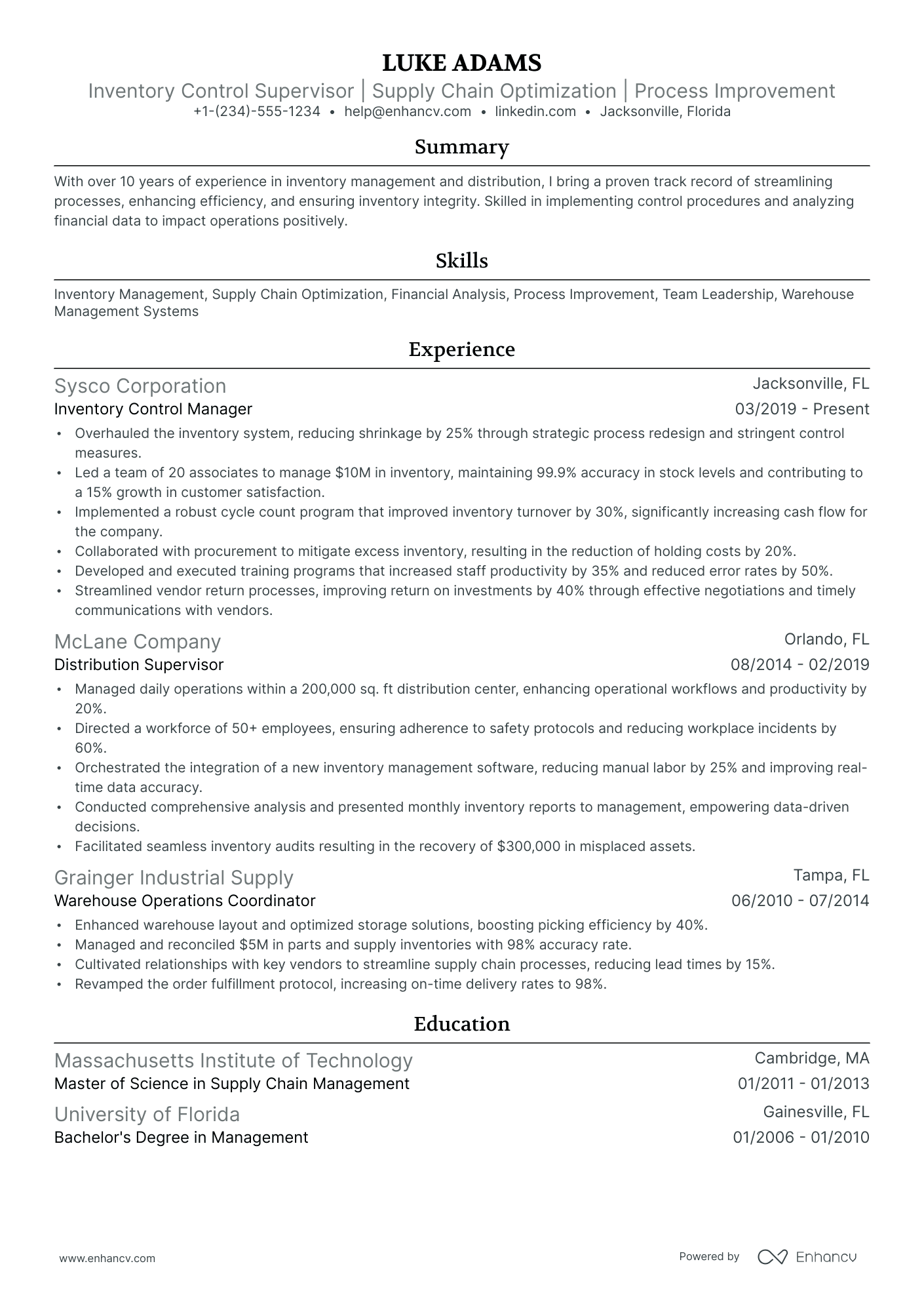
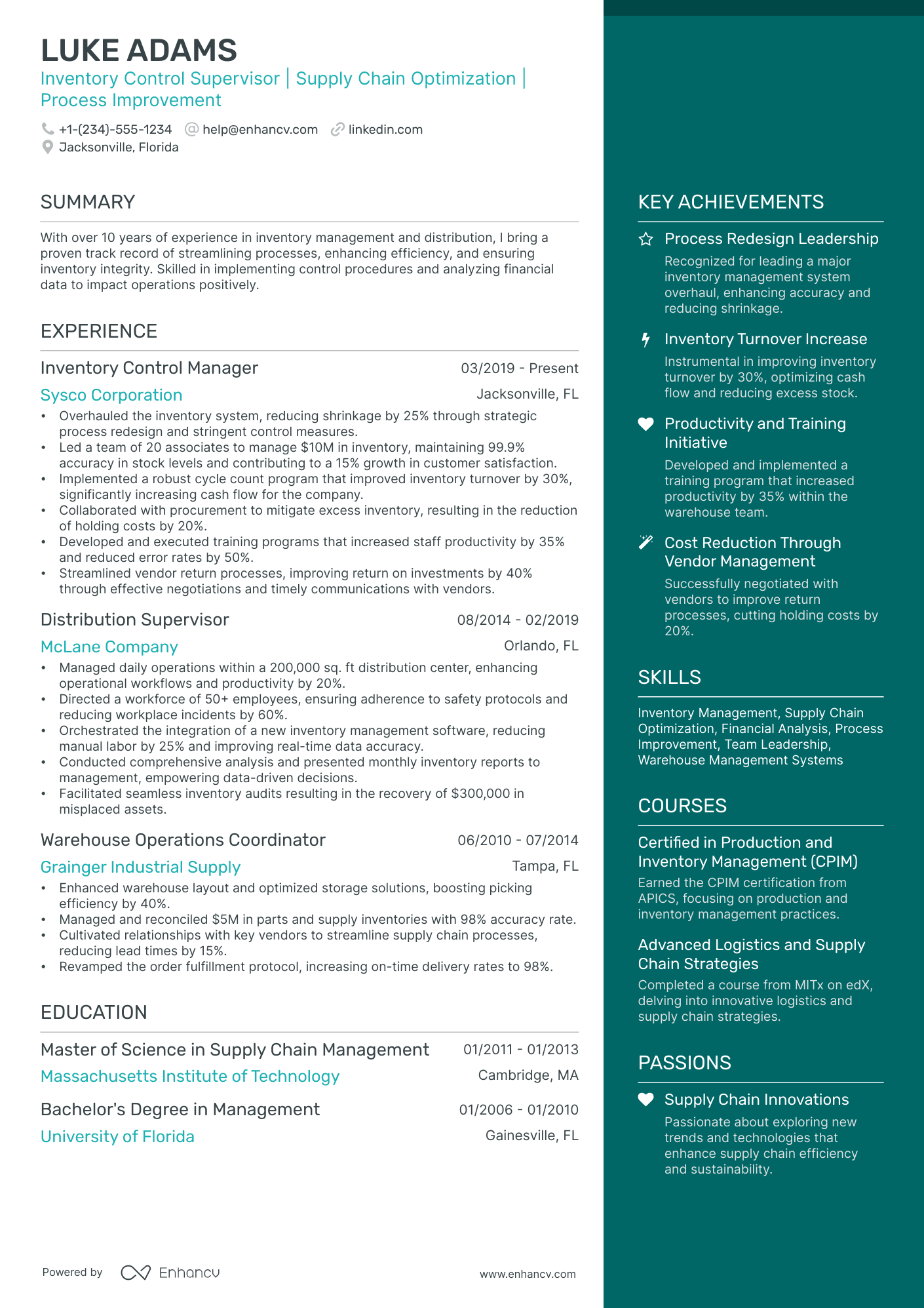
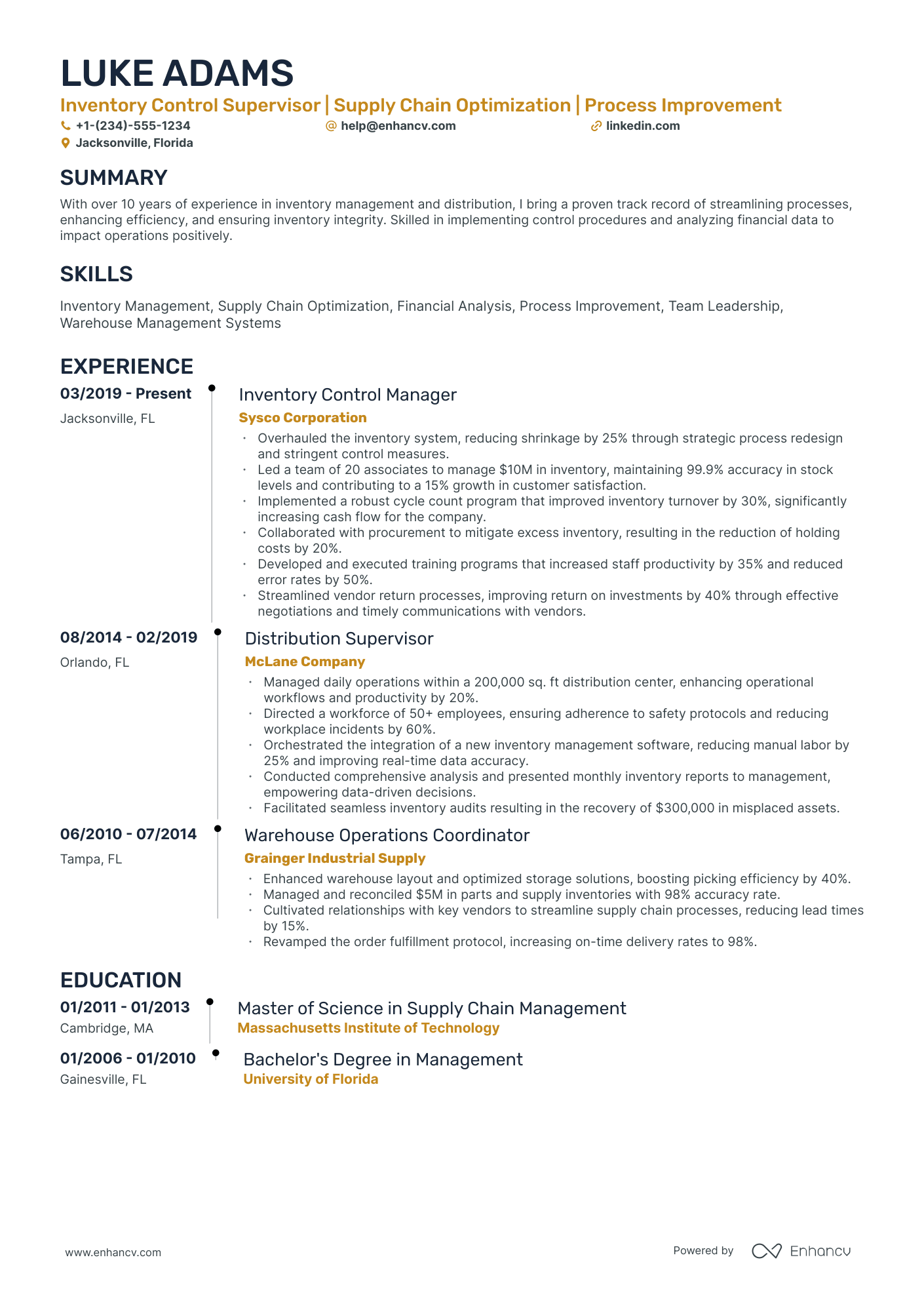
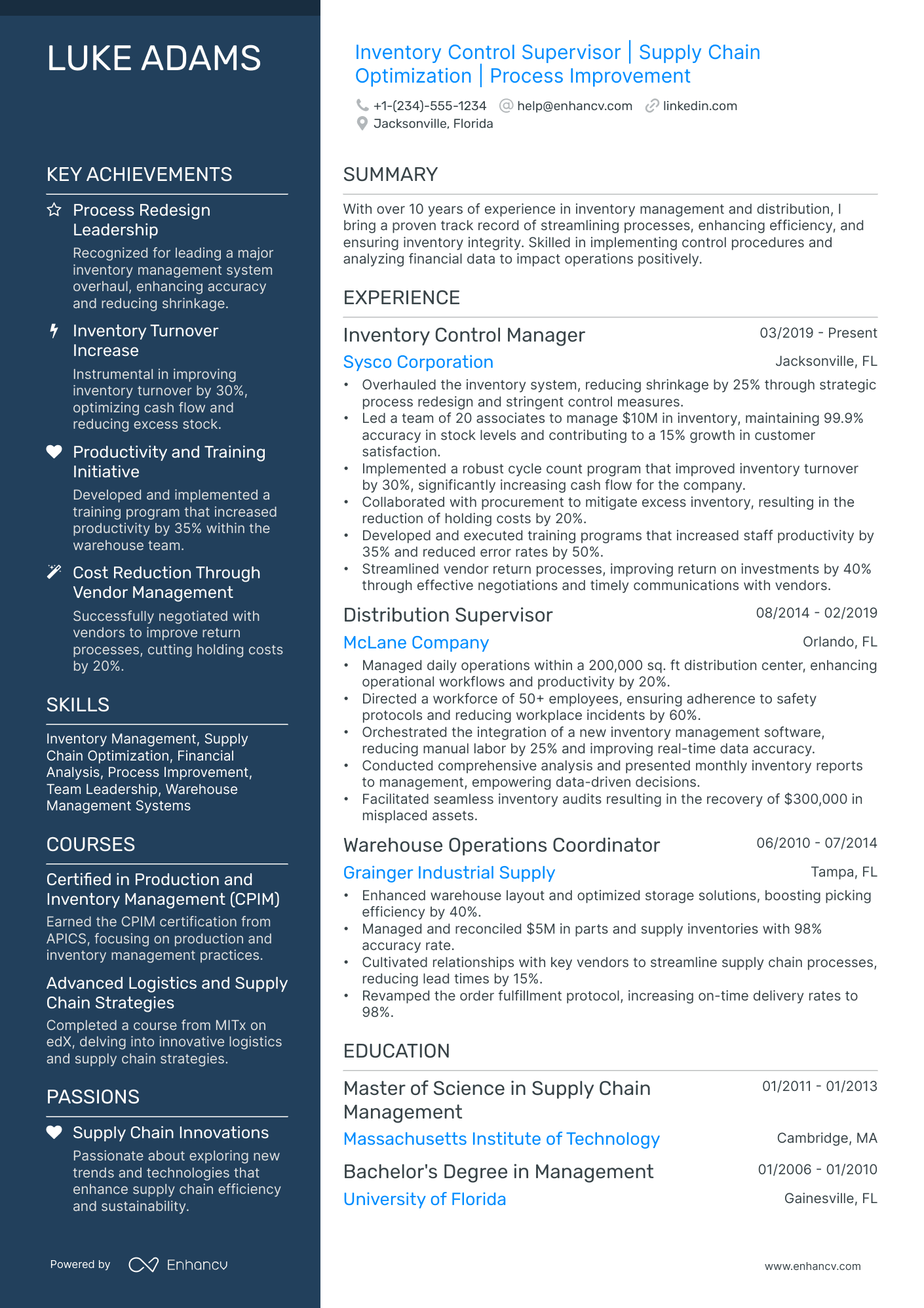
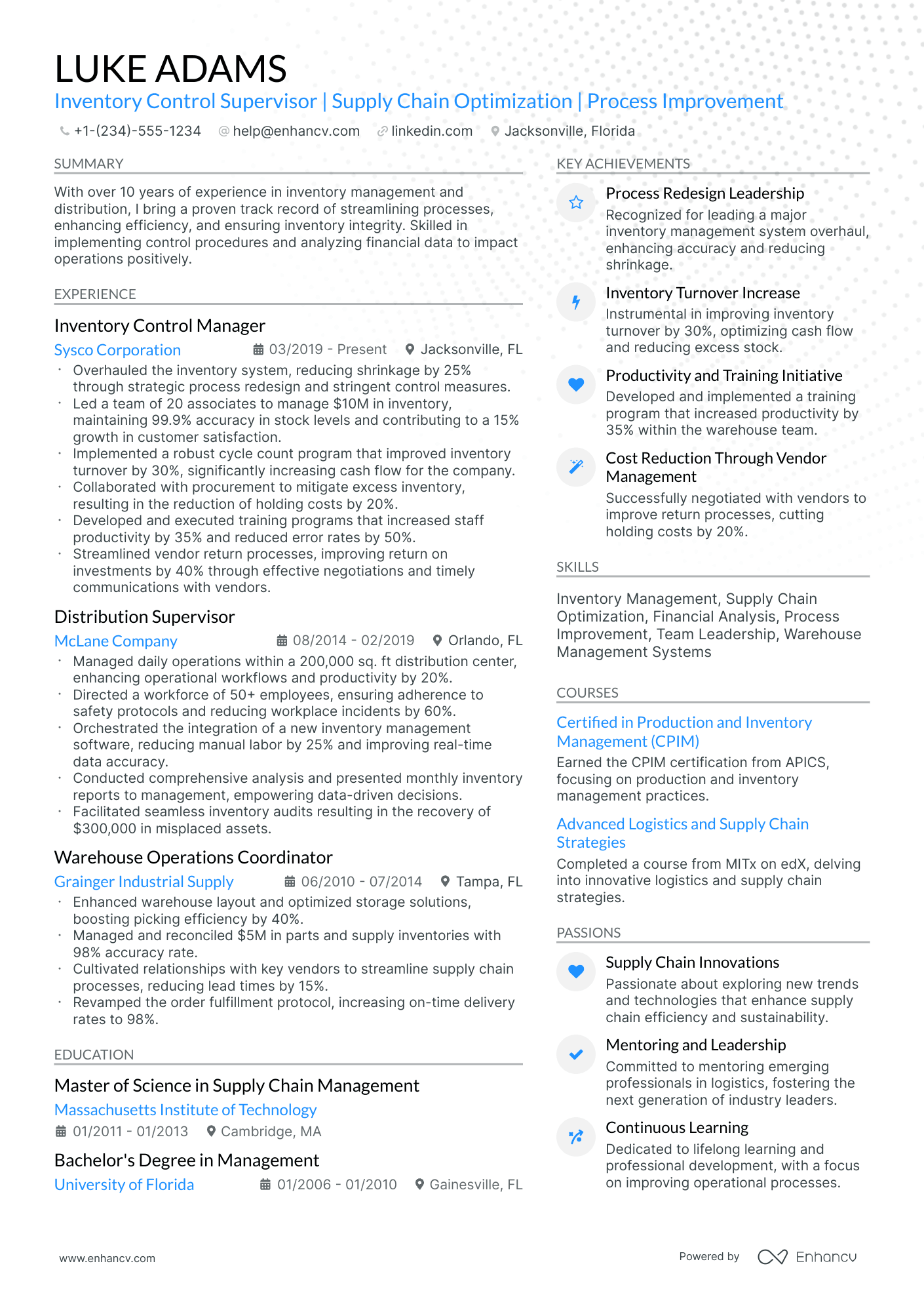
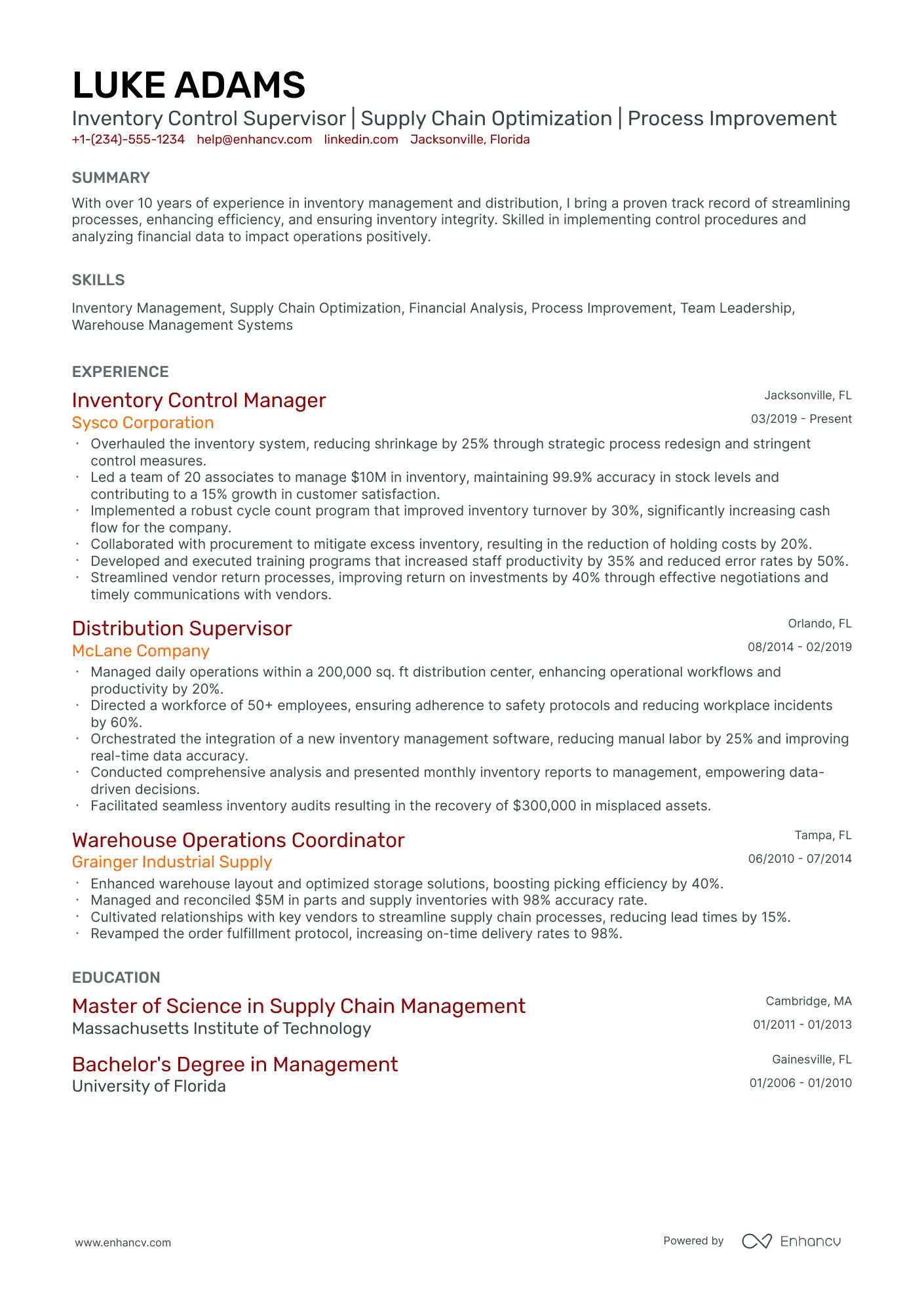
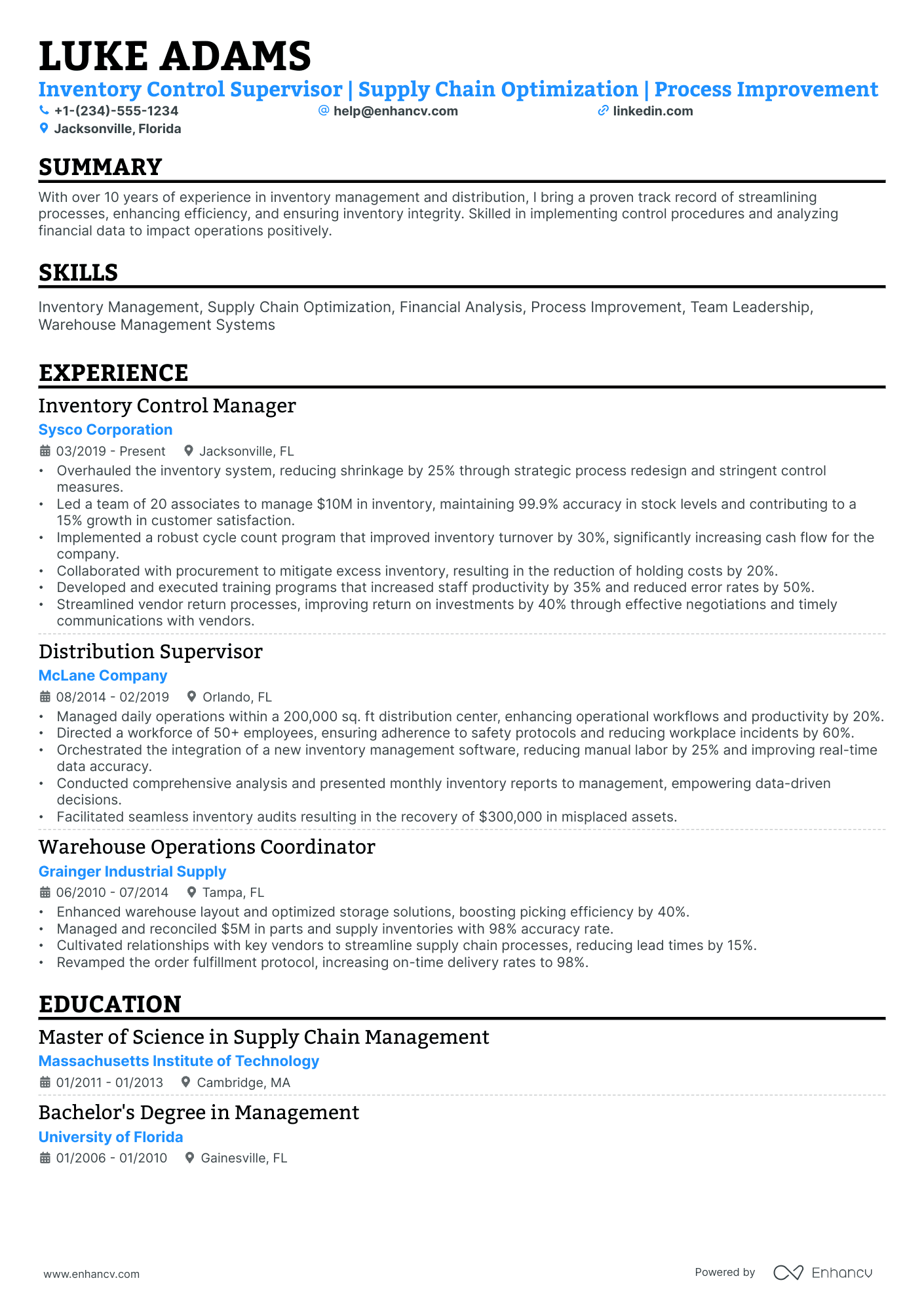
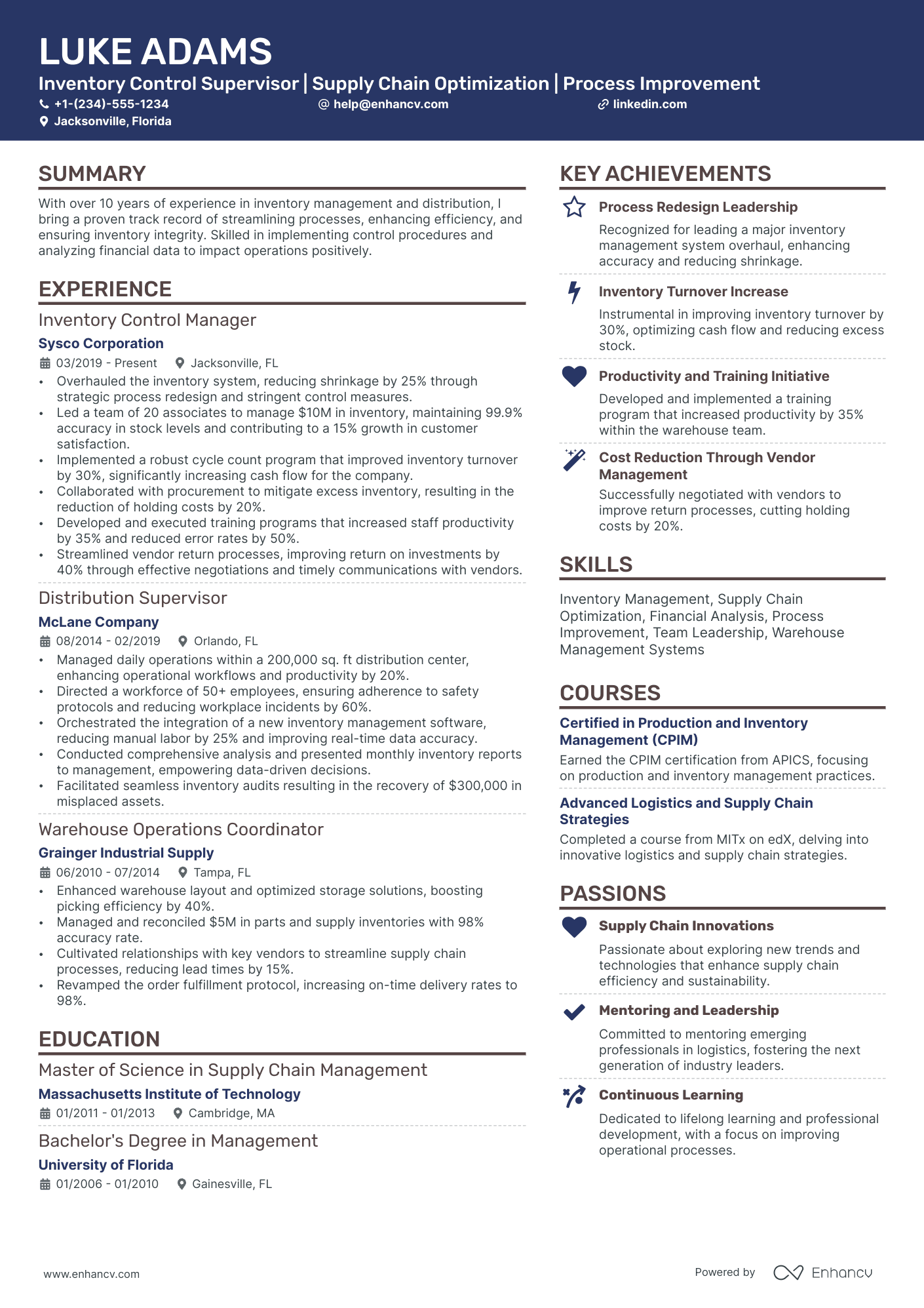
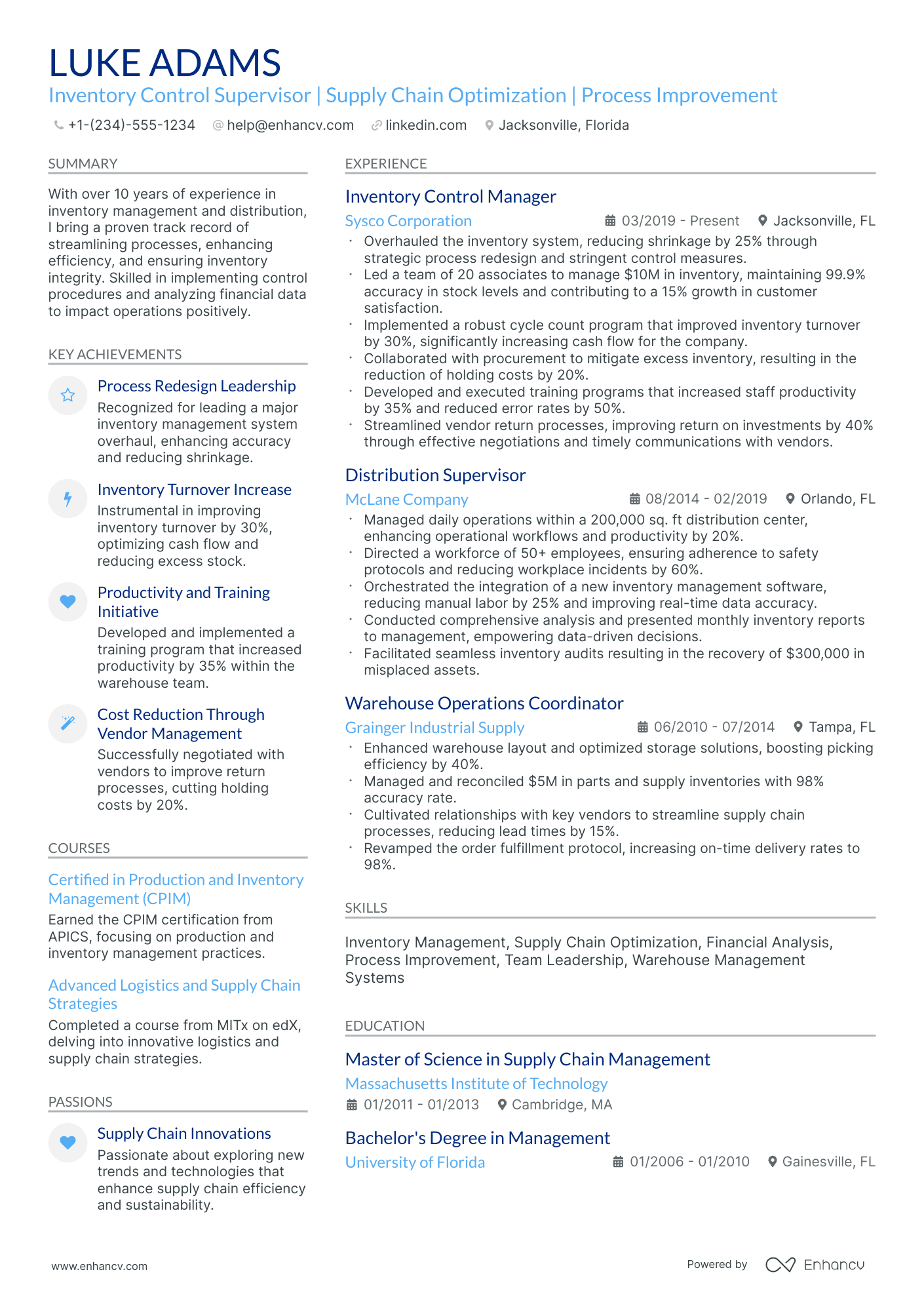
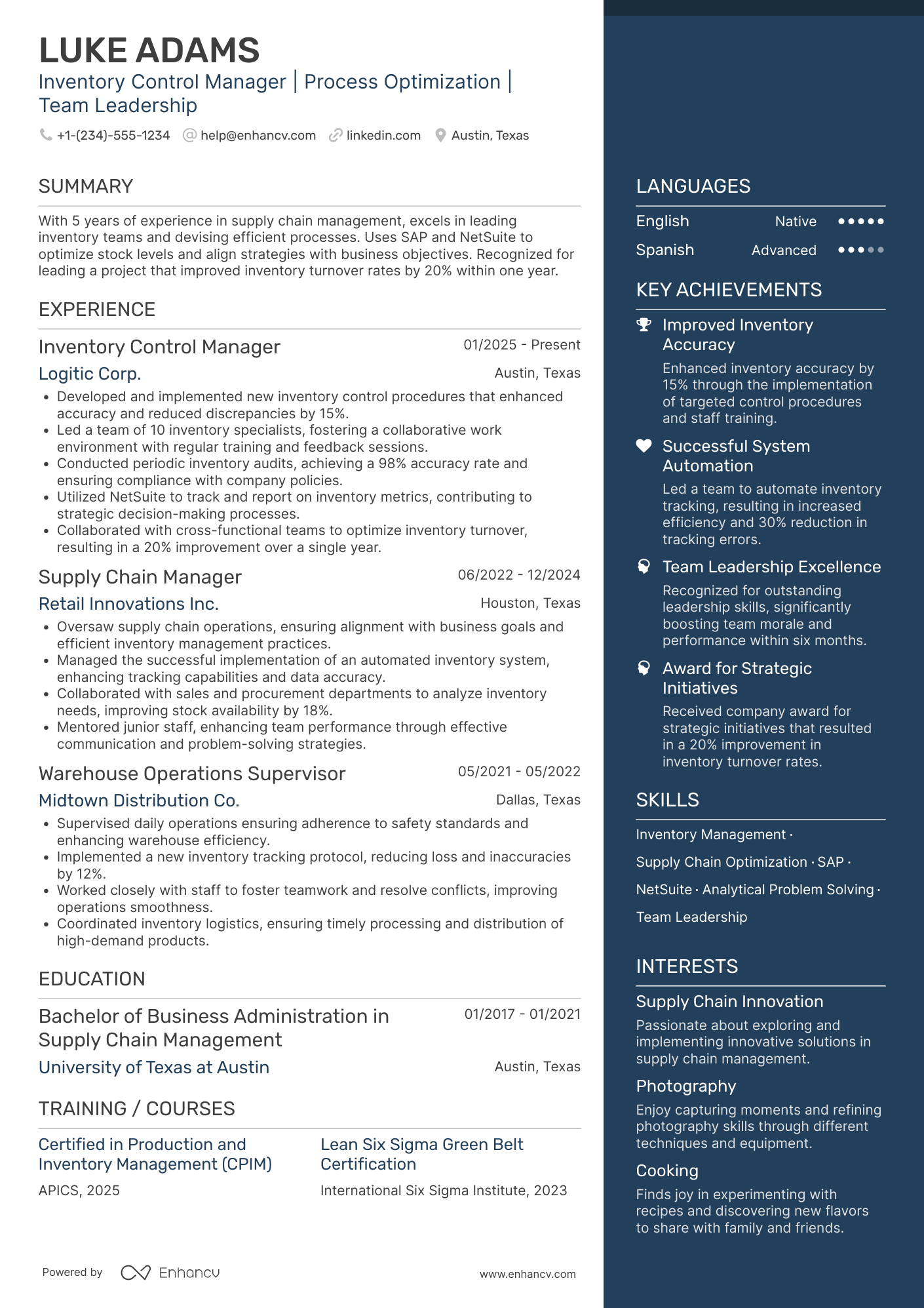
Many inventory control manager resumes fail because they list systems and tasks but don't show measurable control over accuracy, cost, and continuity. That hurts in ATS screening and fast recruiter scans, where proof of impact beats generic responsibility.
A strong resume shows what you improved and how you measured it. Knowing how to make your resume stand out starts with highlighting reduced shrink, higher inventory accuracy, faster cycle counts, better fill rates, fewer stockouts, cleaner audits, and tighter carrying costs across locations. Quantify scope, timelines, and savings.

Key takeaways
- Quantify inventory accuracy, shrink reduction, and cost savings in every experience bullet.
- Use reverse-chronological format if you have steady inventory management career progression.
- Choose a hybrid format when switching careers to spotlight transferable supply chain skills first.
- Tailor each resume to the job posting's specific systems, KPIs, and methodology terms.
- Back every listed skill with a measurable outcome in your summary or experience section.
- Place certifications like APICS CPIM above education when they're recent and role-relevant.
- Use Enhancv's Bullet Point Generator to turn routine inventory tasks into results-driven resume bullets.
How to format a inventory control manager resume
Recruiters evaluating inventory control manager candidates prioritize evidence of process optimization, inventory accuracy improvements, and team coordination across warehouse or supply chain operations. A well-chosen resume format ensures these signals—hands-on management experience, system proficiency, and measurable cost or efficiency gains—are immediately visible rather than buried beneath formatting that obscures your career trajectory.

I have significant experience in this role—which format should I use?
Use a reverse-chronological format to present your inventory management career in a clear, linear progression that highlights increasing responsibility. Do:
- Lead with your most recent role and emphasize scope: team size, facility count, inventory value managed, and budget ownership.
- Feature role-specific tools and domains prominently—WMS platforms (SAP, Oracle, NetSuite), demand forecasting, cycle counting methodologies, and ERP systems.
- Quantify outcomes tied to business impact, such as shrinkage reduction, carrying cost savings, or order fulfillment accuracy improvements.
I'm junior or switching into this role—what format works best?
A hybrid format works best, allowing you to spotlight transferable inventory or supply chain skills at the top while still showing relevant work history in chronological order. Do:
- Place a dedicated skills section near the top of your resume featuring inventory-specific competencies: stock reconciliation, demand planning, loss prevention, and warehouse management systems.
- Include projects, internships, or cross-functional assignments that demonstrate hands-on inventory work—even if they came from adjacent roles like purchasing, logistics, or retail operations.
- Connect every action to a clear outcome so hiring managers can see the value you delivered, not just the tasks you performed.
Why not use a functional resume?
A functional format strips away the timeline and context that hiring managers need to evaluate how you built your inventory management competencies, making it harder to verify the depth and relevance of your experience.
- Career changers moving from adjacent fields (e.g., retail management, logistics coordination, or procurement) who have inventory-related skills but no direct inventory control manager title.
- Candidates with resume gaps who still completed relevant certifications (such as APICS CPIM) or freelance inventory consulting during those periods.
- Recent graduates with internship or project-based inventory experience but limited full-time work history.
With your format established, the next step is filling it with the right sections that showcase your qualifications as an inventory control manager.
What sections should go on a inventory control manager resume
Recruiters expect to see clear proof that you can reduce inventory errors, improve accuracy, and control costs across the supply chain. Understanding which resume sections to include ensures you present that proof effectively.
Use this structure for maximum clarity:
- Header
- Summary
- Experience
- Skills
- Projects
- Education
- Certifications
- Optional sections: Awards, Leadership, Languages
Strong experience bullets should emphasize measurable impact, operational scope, and results such as accuracy gains, shrink reduction, cycle count performance, and cost savings.
Is your resume good enough?
Drop your resume here or choose a file. PDF & DOCX only. Max 2MB file size.
Once you’ve organized your resume with the right sections to cover your background, focus next on writing your inventory control manager experience to show impact within that structure.
How to write your inventory control manager resume experience
Your experience section should demonstrate the inventory control systems you've managed, the methodologies you've applied, and the measurable improvements you've driven in accuracy, cost savings, and operational efficiency. Hiring managers prioritize demonstrated impact over descriptive task lists—they want to see what changed because of your work.
Each entry should include:
- Job title
- Company and location (or remote)
- Dates of employment (month and year)
Three to five concise bullet points showing what you owned, how you executed, and what outcomes you delivered:
- Ownership scope: the warehouses, distribution centers, inventory systems, product categories, or teams you were directly accountable for as an inventory control manager.
- Execution approach: the tools, frameworks, and methods you used to manage stock levels and drive decisions—such as ERP platforms, warehouse management systems, cycle counting programs, demand forecasting models, or lean inventory practices.
- Value improved: the specific operational areas you strengthened, whether that's inventory accuracy, shrinkage reduction, carrying cost efficiency, order fulfillment reliability, or compliance with safety and regulatory standards.
- Collaboration context: how you partnered with procurement, logistics, warehouse operations, finance, suppliers, or senior leadership to align inventory strategy with broader supply chain and business objectives.
- Impact delivered: the tangible results your work produced, expressed through improvements in inventory turnover, waste reduction, cost containment, audit outcomes, or supply chain resilience rather than routine activities.
Experience bullet formula
A inventory control manager experience example
✅ Right example - modern, quantified, specific.
Inventory Control Manager
Summit Outdoor Supply Co. | Denver, CO
2021–Present
Multi-site wholesale distributor supporting two distribution centers and over 18,000 active stock keeping units across North America.
- Led cycle count program in NetSuite Enterprise Resource Planning (ERP) using ABC analysis and root cause tracking; improved inventory accuracy from 96.2% to 99.1% and cut annual physical inventory variance by 38%.
- Implemented barcode scanning with Zebra handhelds and RF-SMART mobile workflows; reduced receiving-to-putaway time by 27% and increased dock-to-stock throughput by 19% during peak season.
- Built Power BI dashboards integrating NetSuite, WMS, and freight data; delivered daily exception reporting that reduced stockouts by 22% and improved order fill rate from 94% to 97%.
- Partnered with procurement, finance, and warehouse leads to tighten lot and expiration controls and quarantine processes; lowered write-offs by 31% and reduced compliance audit findings to zero.
- Standardized reorder points and safety stock using demand variability and lead-time analysis; decreased excess inventory by 14% while sustaining a 98% service level for top 500 items.
Now that you've seen what a strong experience section looks like, let's break down how to customize yours for each specific job posting.
How to tailor your inventory control manager resume experience
Recruiters evaluate your inventory control manager resume through both human review and applicant tracking systems (ATS). Tailoring your resume to the job description increases your chances of passing both screenings.
Ways to tailor your inventory control manager experience:
- Match warehouse management systems or ERP platforms named in the posting.
- Mirror the exact inventory methodology terms like FIFO or JIT.
- Reflect specific KPIs such as shrinkage rates or turnover ratios mentioned.
- Highlight experience with cycle counting or physical inventory audit processes.
- Include industry-specific supply chain knowledge when the role requires it.
- Emphasize regulatory compliance or quality control standards referenced in the listing.
- Align your experience with cross-functional coordination workflows they describe.
- Reference demand forecasting or replenishment planning if the posting specifies them.
Tailoring means aligning your real accomplishments with what the employer asks for, not forcing keywords where they don't belong.
Resume tailoring examples for inventory control manager
| Job description excerpt | Untailored | Tailored |
|---|---|---|
| Manage cycle counting programs across multiple warehouse locations using Oracle WMS to maintain 99%+ inventory accuracy. | Helped with inventory counts and tracked stock levels in the warehouse. | Managed cycle counting programs across four warehouse locations using Oracle WMS, maintaining 99.3% inventory accuracy and reducing shrinkage by 18% year over year. |
| Analyze root causes of inventory discrepancies and implement corrective actions to reduce variance, partnering with procurement and receiving teams. | Worked with other departments to fix inventory issues when they came up. | Conducted root cause analysis on inventory discrepancies, partnering with procurement and receiving teams to implement corrective actions that reduced variance from 3.2% to 0.8% within six months. |
| Oversee min/max replenishment strategies and safety stock levels using demand forecasting tools such as SAP IBP to prevent stockouts and overstock conditions. | Monitored inventory levels and reordered products as needed to keep shelves stocked. | Optimized min/max replenishment strategies and safety stock levels using SAP IBP demand forecasting, cutting stockouts by 34% while reducing excess inventory carrying costs by $220K annually. |
Once your experience aligns with the role’s priorities, quantify your inventory control manager achievements to show the measurable impact behind those choices.
How to quantify your inventory control manager achievements
Quantifying your achievements shows how your decisions improved accuracy, reduced cost, and lowered risk. Focus on inventory accuracy, shrink, cycle count speed, stockout rate, carrying cost, and on-time replenishment across sites, stock keeping units, and systems.
Quantifying examples for inventory control manager
| Metric | Example |
|---|---|
| Inventory accuracy | "Raised inventory accuracy from 94.1% to 98.7% in six months by tightening receiving controls and reconciling SAP transactions across 18,000 stock keeping units." |
| Shrink reduction | "Cut shrink from 1.9% to 1.1% of inventory value by adding cycle count triggers, CCTV exception reviews, and bin audits for top 200 high-risk items." |
| Cycle count throughput | "Increased cycle count throughput by 32% by moving from monthly full counts to ABC counting, completing 1,200 locations weekly with a two-person team." |
| Stockout rate | "Reduced stockouts by 41% by recalibrating reorder points and lead times in Oracle NetSuite, improving fill rate from 92% to 97%." |
| Carrying cost | "Lowered carrying cost by $240K annually by consolidating slow movers, retiring obsolete stock, and tightening min-max levels across three warehouses." |
Turn your everyday tasks into measurable, recruiter-ready resume bullets in seconds with Enhancv's Bullet Point Generator.
Once you've crafted strong bullet points for your experience section, the next step is ensuring your resume also highlights the right hard and soft skills that inventory control manager roles demand.
How to list your hard and soft skills on a inventory control manager resume
Your skills section shows you can protect inventory accuracy, control shrink, and keep service levels high; recruiters scan them fast, and an ATS (applicant tracking system) matches them to the job post, so aim for a balanced mix of hard skills and soft skills. inventory control manager roles require a blend of:
- Product strategy and discovery skills
- Data, analytics, and experimentation skills
- Delivery, execution, and go-to-market discipline
- Soft skills
Your skills section should be:
- Scannable (bullet-style grouping).
- Relevant to the job post.
- Backed by proof in experience bullets.
- Updated with current tools.
Place your skills section:
- Above experience if you're junior or switching careers.
- Below experience if you're mid/senior with strong achievements.

Hard skills
- Inventory accuracy and cycle counting
- ABC analysis and slotting
- Reorder points, safety stock
- Demand planning and forecasting
- Warehouse management systems, enterprise resource planning systems
- Barcode scanning, radio frequency identification
- Bill of materials, kitting
- Lot, serial, expiration tracking
- Root cause analysis, corrective actions
- Physical inventory planning
- Shrink control and audit controls
- Microsoft Excel, Power BI
Soft skills
- Cross-functional alignment with operations
- Vendor and supplier coordination
- Clear variance and risk reporting
- Prioritizing high-impact discrepancies
- Leading cycle count teams
- Coaching standard work adherence
- Escalating issues with solutions
- Stakeholder management across sites
- Decision-making under time pressure
- Owning process improvements
- Negotiating inventory trade-offs
- Documenting and enforcing procedures
How to show your inventory control manager skills in context
Skills shouldn't live only in a dedicated skills list. Explore resume skills examples to see how top candidates weave competencies throughout their resumes.
They should be demonstrated in:
- Your summary (high-level professional identity)
- Your experience (proof through outcomes)
Here's what strong, skill-rich entries look like in practice.
Summary example
Inventory control manager with 10+ years in food and beverage distribution. Skilled in SAP WM, cycle counting, and demand forecasting. Reduced shrinkage by 34% through cross-functional process redesign while leading teams of up to 15 warehouse associates.
- Signals senior-level depth immediately
- Names industry-specific tools
- Leads with a measurable outcome
- Highlights leadership and collaboration
Experience example
Inventory Control Manager
Redfield Distribution Co. | Charlotte, NC
March 2019–Present
- Implemented RF barcode scanning with NetSuite WMS, cutting picking errors by 27% across three fulfillment centers within six months.
- Partnered with procurement and sales teams to build rolling demand forecasts, reducing overstock carrying costs by $180K annually.
- Led quarterly cycle count programs covering 12,000+ SKUs, maintaining inventory accuracy above 99.2% for eight consecutive quarters.
- Every bullet contains measurable proof.
- Skills appear through real achievements.
Once you’ve demonstrated these abilities through specific examples, the next step is to apply the same approach to building an inventory control manager resume with no experience by positioning transferable skills and relevant achievements effectively.
How do I write a inventory control manager resume with no experience
Even without full-time experience, you can demonstrate readiness through transferable work. If you're building a resume without work experience, focus on projects, coursework, and volunteer roles that prove inventory competence:
- Retail stockroom cycle counts
- Warehouse receiving and putaway shifts
- Inventory audits for student organizations
- Point-of-sale inventory reconciliations
- Spreadsheet reorder point tracking
- Volunteer supply closet management
- Coursework in operations management
- ERP practice in training labs
Focus on:
- Cycle count accuracy and variance
- Receiving, putaway, and labeling
- Reorder points and stock levels
- Spreadsheet or ERP reporting
Resume format tip for entry-level inventory control manager
Use a combination resume format because it highlights inventory control manager skills and projects first, while still showing steady work history and training. Do:
- Add a skills section with cycle counting, receiving, and reconciliation.
- Include tools like Excel and an ERP (enterprise resource planning) system.
- Turn substitutes into measurable project bullets with counts, variances, and time saved.
- List relevant coursework and certifications near the top.
- Match keywords to the inventory control manager job posting.
- Built an Excel reorder point tracker for a volunteer supply closet, reducing stockouts by 30% and cutting weekly inventory checks from two hours to one.
When you lack professional experience, your education section becomes one of the strongest tools for demonstrating relevant qualifications—so presenting it effectively is essential.
How to list your education on a inventory control manager resume
Your education section helps hiring teams confirm you have the foundational knowledge needed for an inventory control manager role. It validates your academic background quickly.
Include:
- Degree name
- Institution
- Location
- Graduation year
- Relevant coursework (for juniors or entry-level candidates)
- Honors & GPA (if 3.5 or higher)
Skip month and day details—list the graduation year only.
Here's a strong education entry tailored to the inventory control manager role.
Example education entry
Bachelor of Science in Supply Chain Management
University of Tennessee, Knoxville, TN
Graduated: 2019
GPA: 3.7/4.0
- Relevant Coursework: Inventory Systems Design, Warehouse Operations, Demand Forecasting, and Logistics Analytics
- Honors: Magna Cum Laude, Dean's List (six consecutive semesters)
How to list your certifications on a inventory control manager resume
Certifications on your resume show an inventory control manager's commitment to learning, proficiency with key tools, and alignment with industry standards that employers trust.
Include:
- Certificate name
- Issuing organization
- Year
- Optional: credential ID or URL
- Place certifications below education when they are older, less relevant, or used mainly to round out your qualifications.
- Place certifications above education when they are recent, role-relevant, or required for the inventory control manager roles you target.
Best certifications for your inventory control manager resume
- APICS Certified in Planning and Inventory Management (CPIM)
- APICS Certified Supply Chain Professional (CSCP)
- Certified Inventory Optimization Professional (CIOP)
- Lean Six Sigma Green Belt
- Project Management Professional (PMP)
- SAP Certified Application Associate
- Oracle Inventory Cloud Certified Implementation Professional
Once you’ve positioned your credentials to validate your expertise, shift to your inventory control manager resume summary to highlight that value upfront and set the tone for the rest of your resume.
How to write your inventory control manager resume summary
Your resume summary is the first thing a recruiter reads. A sharp, specific opening signals you understand inventory operations and can deliver results.
Keep it to three to four lines, with:
- Your title and total years of inventory control or warehouse management experience.
- The industry or domain you've worked in, such as retail, manufacturing, or distribution.
- Core tools and skills like ERP systems, cycle counting, demand forecasting, or WMS platforms.
- One or two measurable achievements, such as shrinkage reduction or accuracy improvements.
- Soft skills tied to real outcomes, like cross-functional coordination that improved fulfillment speed.

PRO TIP
At this level, lead with operational results and team oversight rather than listing tasks. Highlight how you improved accuracy, reduced costs, or streamlined processes across facilities. Avoid vague phrases like "detail-oriented professional" or "passionate about supply chain excellence."
Example summary for a inventory control manager
Inventory control manager with seven years in retail distribution. Led a 12-person team, reduced shrinkage by 23%, and improved cycle count accuracy to 99.4% using SAP WMS.
Optimize your resume summary and objective for ATS
Drop your resume here or choose a file.
PDF & DOCX only. Max 2MB file size.
Once your summary captures your strongest qualifications, make sure your header presents the essential contact details hiring managers need to reach you.
What to include in a inventory control manager resume header
A resume header is the contact and identity block at the top, and it drives visibility, credibility, and recruiter screening for a inventory control manager.
Essential resume header elements
- Full name
- Tailored job title and headline
- Location
- Phone number
- Professional email
- GitHub link
- Portfolio link
A LinkedIn link helps recruiters verify experience quickly and supports screening.
Don't include a photo on a inventory control manager resume unless the role is explicitly front-facing or appearance-dependent.
Match your job title and headline to the posting and keep contact details consistent across your resume and online profiles.
Example
Inventory control manager resume header
Jordan M. Taylor
Inventory Control Manager | Cycle Counts, ERP Accuracy, and Warehouse Reconciliation
Dallas, TX
(214) 555-01XX
your.name@enhancv.com
github.com/yourname
yourwebsite.com
linkedin.com/in/yourname
Once your contact details and role identifiers are in place at the top, add relevant additional sections to reinforce your qualifications and support the rest of your resume.
Additional sections for inventory control manager resumes
When your core qualifications match other candidates, additional sections help you stand out by showcasing relevant expertise and industry credibility.
- Languages
- Certifications and licenses
- Professional affiliations and memberships
- Continuous education and training
- Volunteer experience in supply chain or logistics
- Awards and recognitions
- Publications or industry presentations
Once you've strengthened your resume with relevant extra sections, pair it with a tailored cover letter to give hiring managers a fuller picture of your qualifications.
Do inventory control manager resumes need a cover letter
A cover letter isn't required for an inventory control manager, but it helps in competitive searches or when employers expect one. Understanding what a cover letter is and how to use it effectively can make a difference when your resume needs context, or when you're aiming for a specific team.
Use a cover letter to add details your resume can't:
- Explain role and team fit: Connect your experience to their warehouse setup, systems, and cross-functional partners.
- Highlight one or two outcomes: Share a project that improved accuracy, reduced shrink, increased turns, or cut cycle count time.
- Show business context: Reference their product mix, demand patterns, service levels, and how inventory decisions affect customers and margins.
- Address transitions or non-obvious experience: Clarify a move between industries, a step up in scope, or transferable systems and process work.
Drop your resume here or choose a file.
PDF & DOCX only. Max 2MB file size.
Whether you include a cover letter or not, using AI to improve your inventory control manager resume helps you strengthen the document hiring teams will review first.
Using AI to improve your inventory control manager resume
AI can sharpen your resume's clarity, structure, and impact. It helps tighten language and highlight results. But overuse strips authenticity. If you're wondering which AI is best for writing resumes, focus on tools that enhance rather than replace your own voice. Once your content is clear and role-aligned, step away from AI.
Here are 10 practical prompts to strengthen specific sections of your inventory control manager resume:
Strengthen your summary
Quantify experience bullets
Align skills to job posts
Tighten action verbs
Refine certification details
Improve project descriptions
Tailor education entries
Eliminate redundancy
Clarify technical tools
Sharpen accomplishment statements
Conclusion
A strong inventory control manager resume highlights measurable outcomes, such as higher inventory accuracy, fewer stockouts, lower shrink, and faster cycle counts. It pairs role-specific skills with clear structure, using consistent headings, clean formatting, and results-first bullets.
Today’s hiring market rewards inventory control managers who show control, visibility, and reliable execution across systems and teams. A focused, well-organized resume proves you can protect margins, support operations, and deliver steady improvements now and next year.