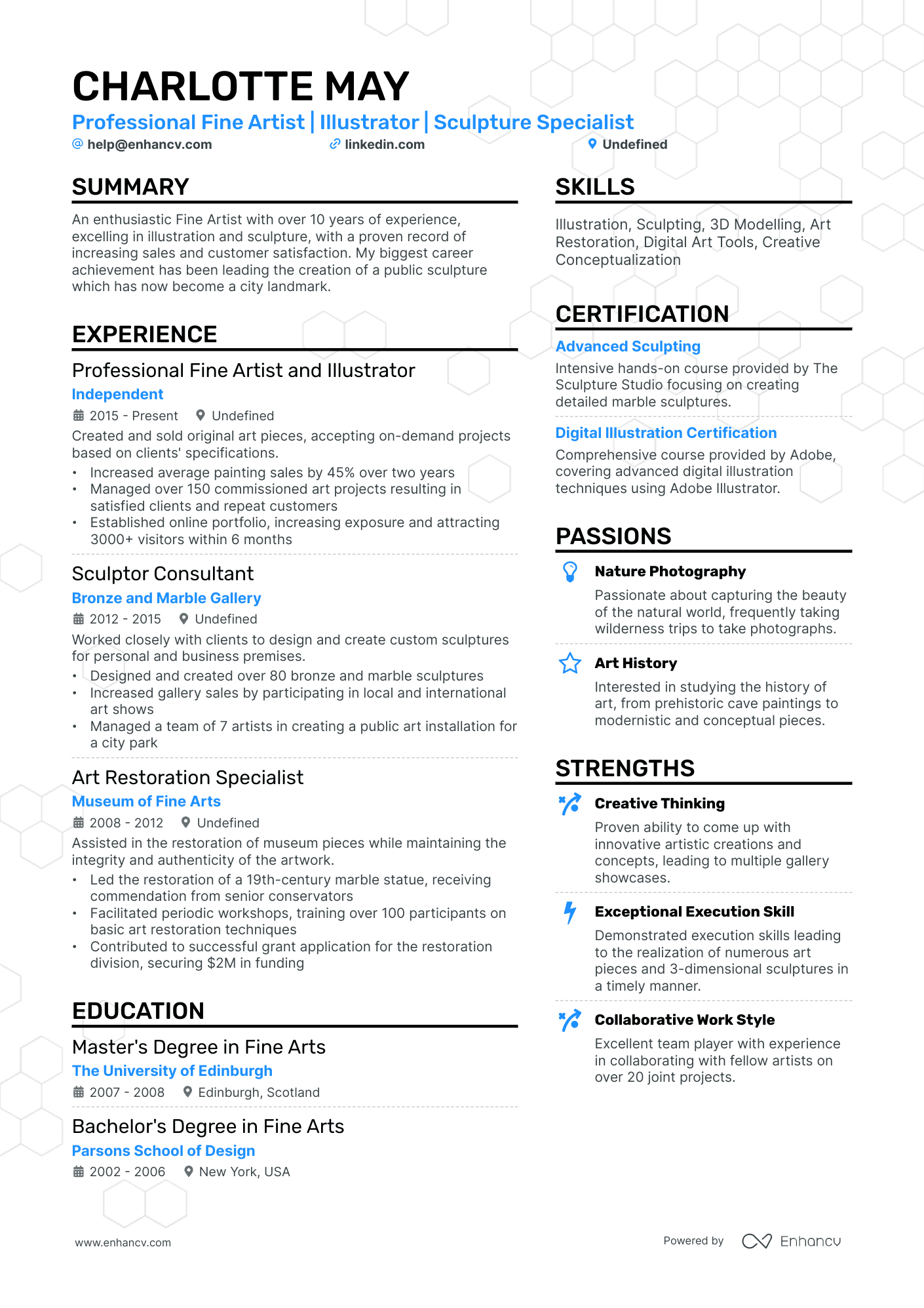
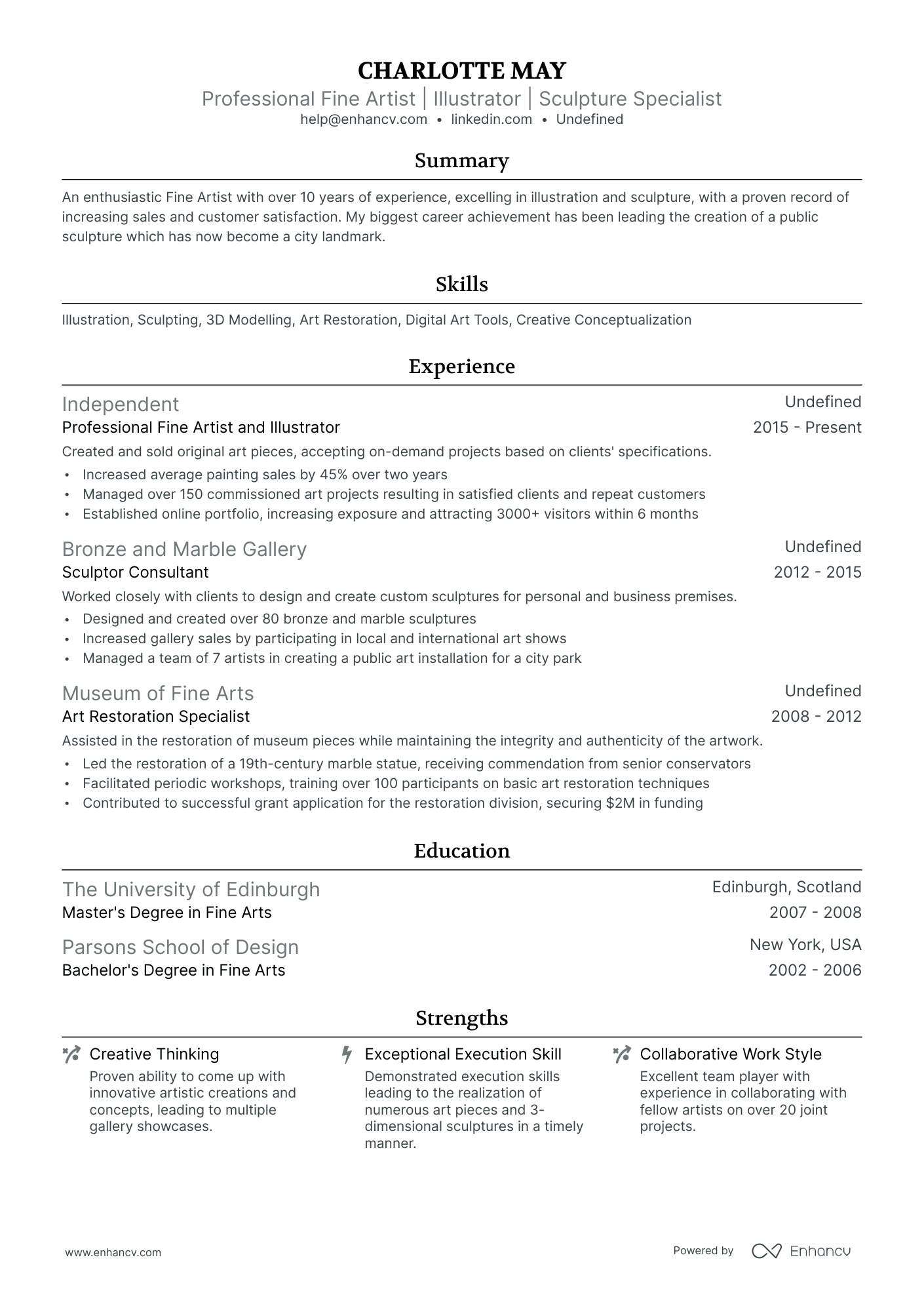
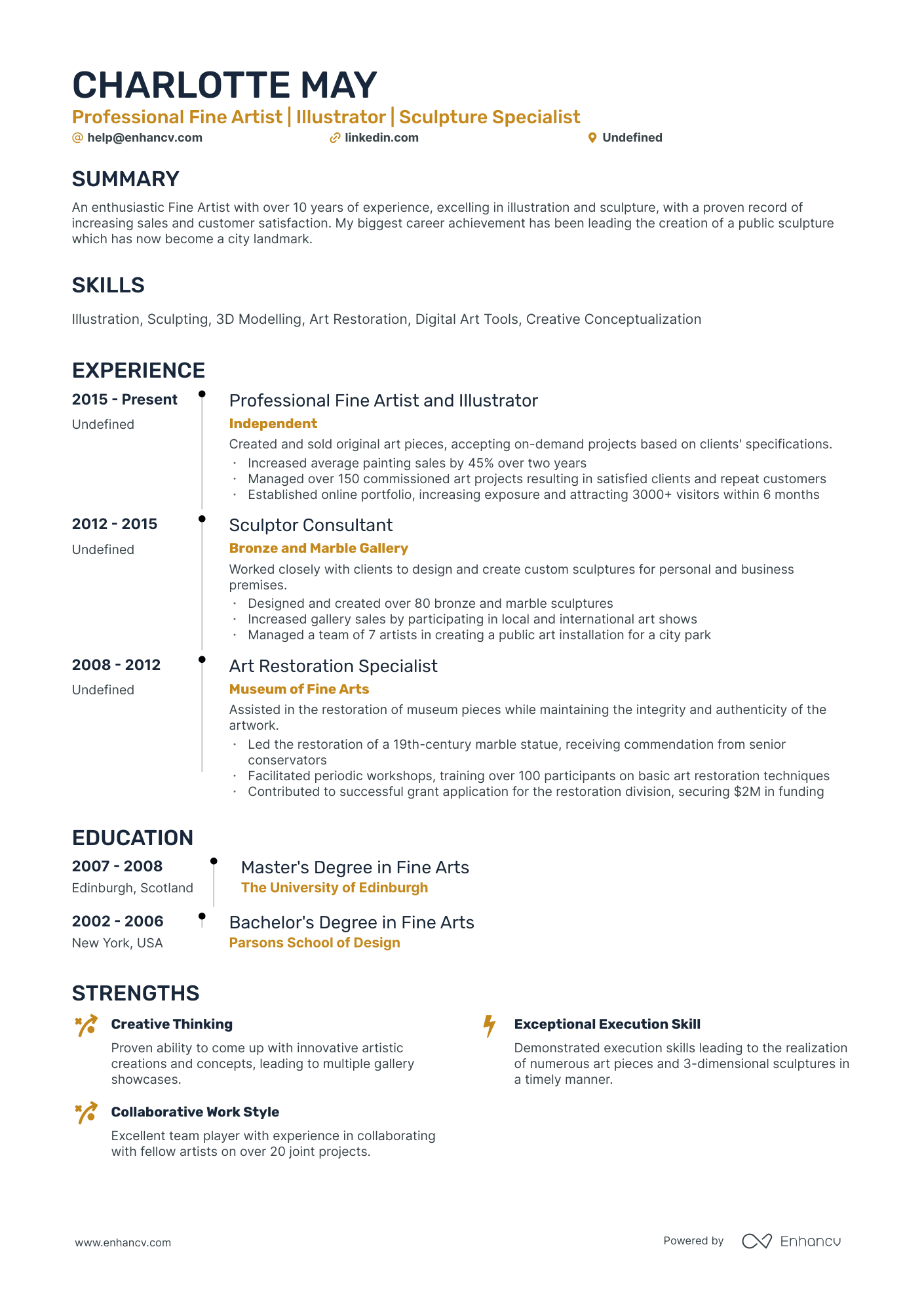
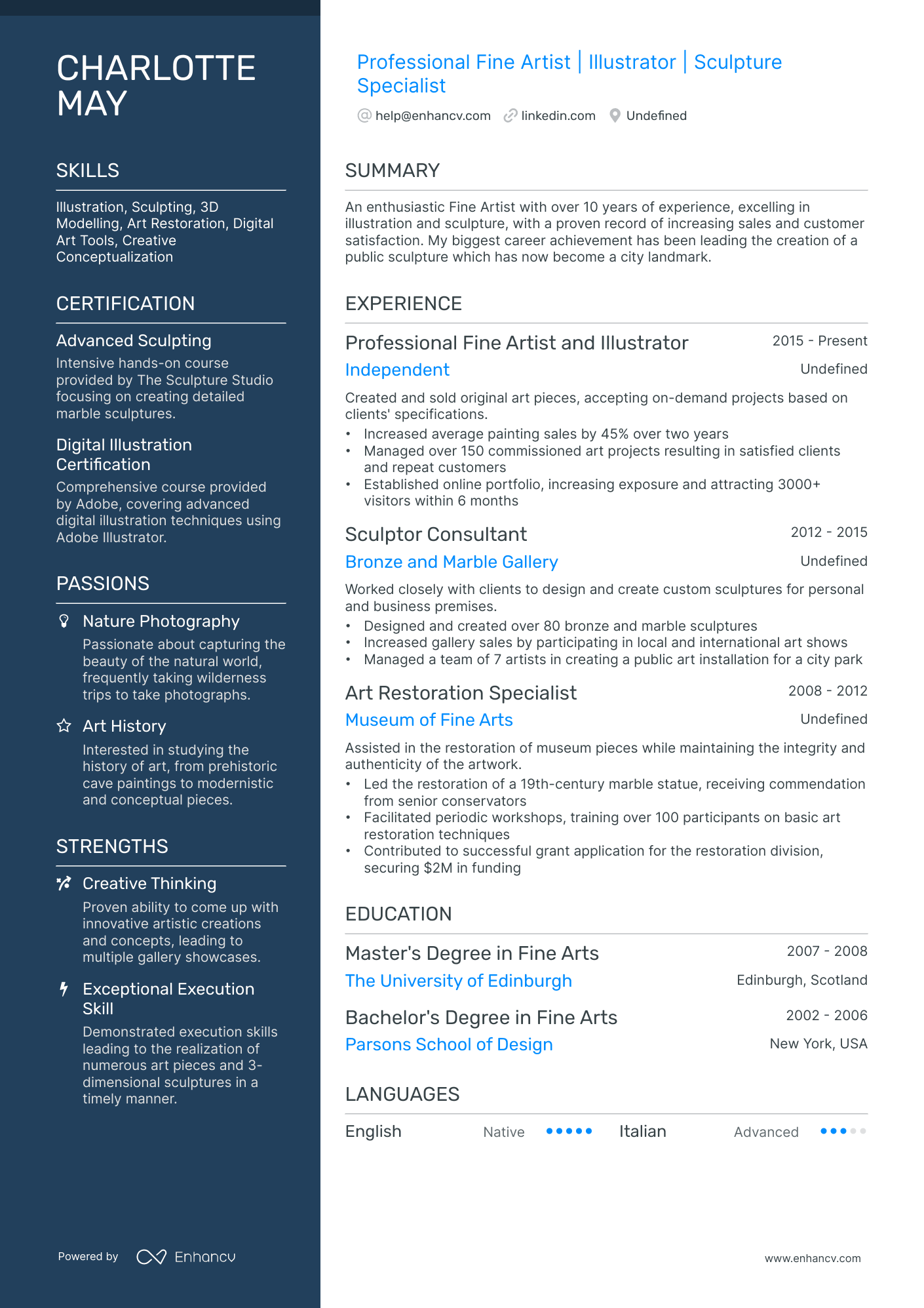
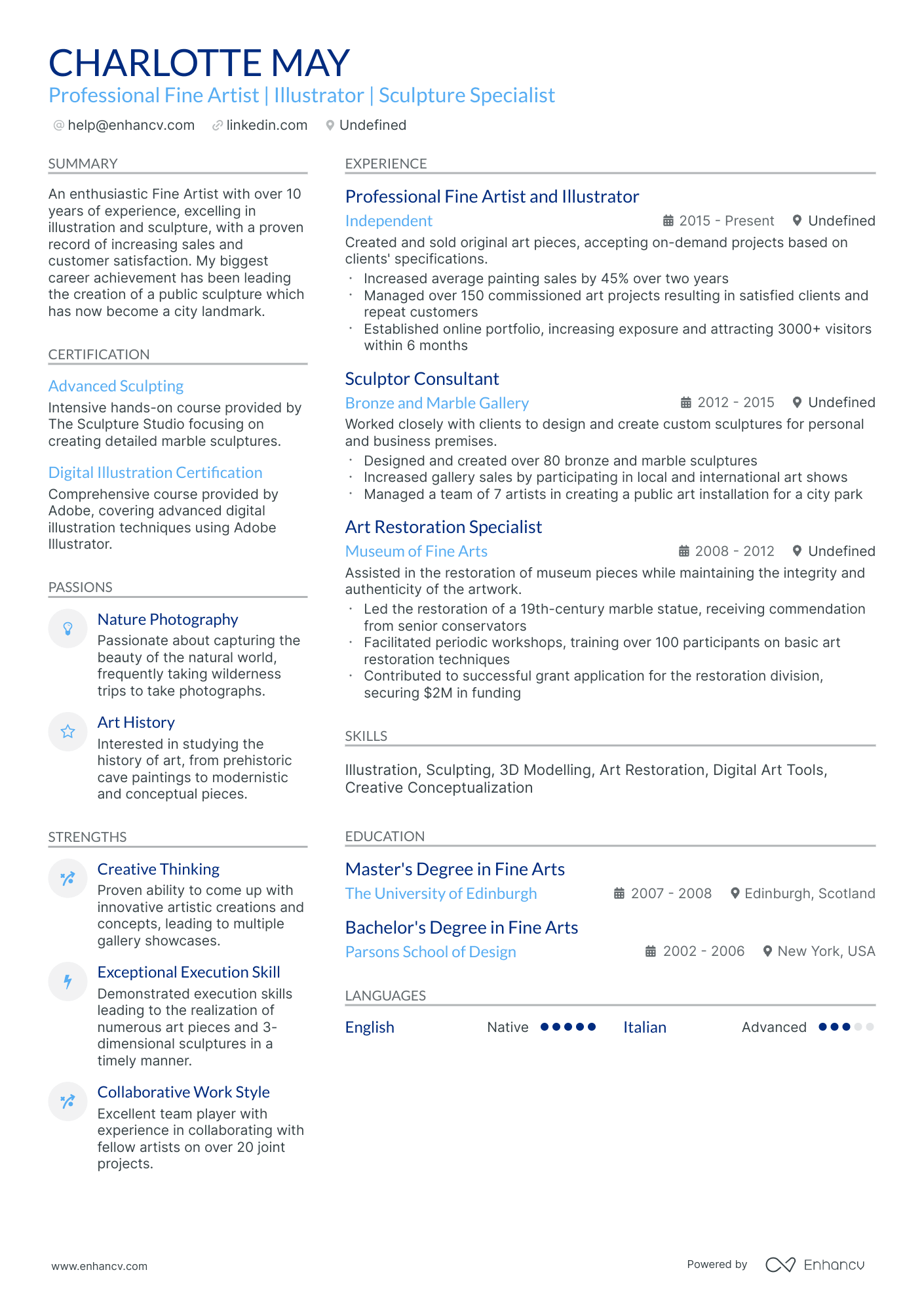
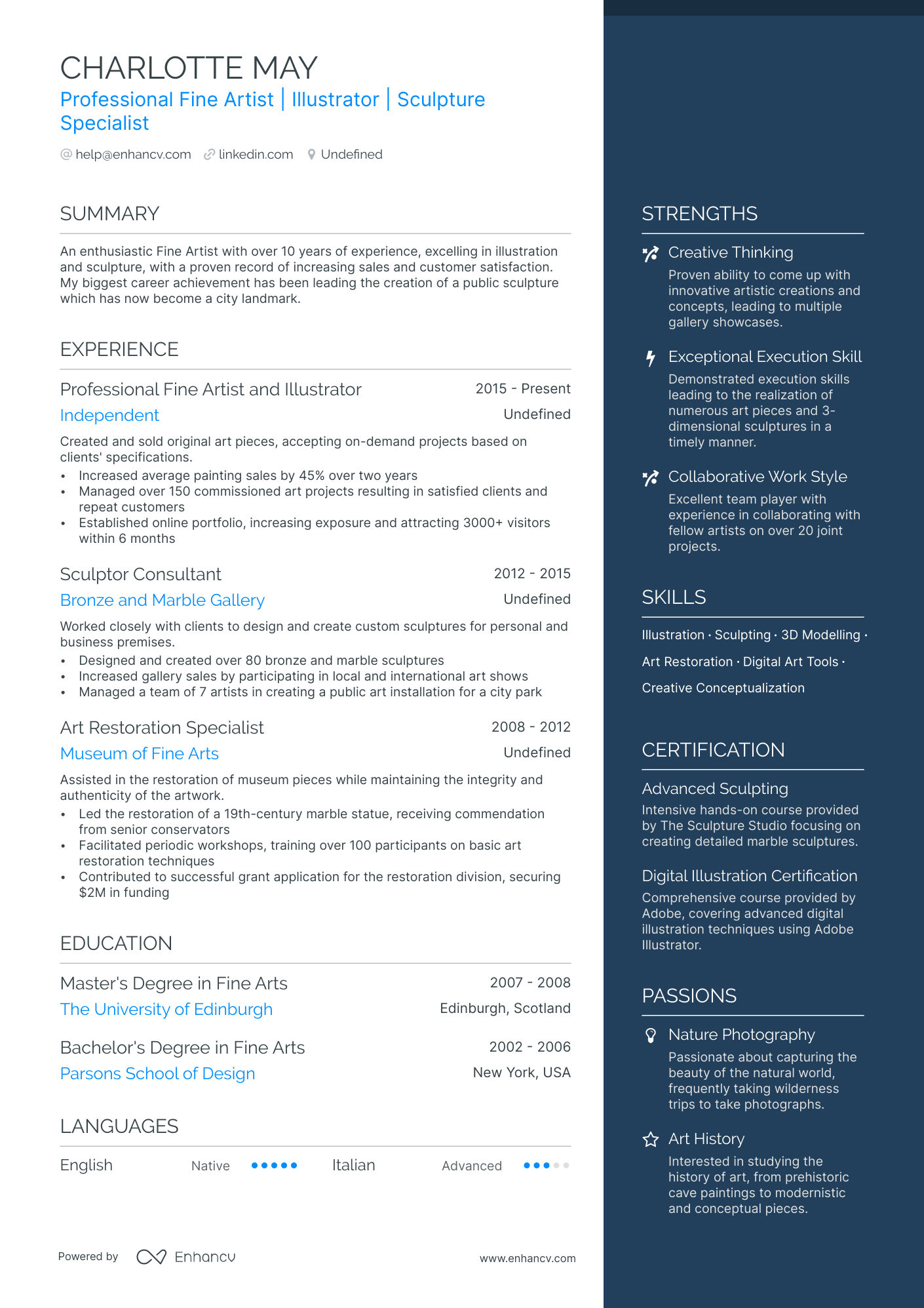
Many fine artist resume drafts fail because they read like artist statements, not hiring documents. They bury results under materials and exhibitions, so recruiters miss fit during fast scans and ATS screening. If you're unsure where to begin, understanding how to write a resume that prioritizes impact over description is the essential first step.
A strong resume shows what changed because of your work. You should highlight funded commissions won, exhibitions delivered on deadline, sales revenue, audience growth, press mentions, collection placements, and measurable project scope. Emphasize collaboration outcomes, budget stewardship, and repeat-client retention.

Key takeaways
- Quantify exhibitions, sales, commissions, and audience reach instead of listing routine studio tasks.
- Use reverse-chronological format for established artists and hybrid format for career changers.
- Tailor every experience bullet to the job posting's specific media, methods, and priorities.
- Demonstrate skills through measurable outcomes in your summary and experience, not just a skills list.
- Include a portfolio link, clean header, and consistent details across your resume and LinkedIn.
- Use AI to sharpen language and structure, but stop before it overrides your authentic voice.
- Build your resume faster with Enhancv to ensure each section highlights real, verifiable results.
How to format a fine artist resume
Recruiters and gallery directors reviewing fine artist resumes prioritize exhibition history, body of work coherence, medium expertise, and evidence of professional growth within the art world. Choosing the right resume format ensures these signals surface immediately rather than getting buried beneath generic formatting choices. Your resume layout should guide the reader's eye from your strongest qualifications to supporting details in a logical flow.

I have significant experience in this role—which format should I use?
Use a reverse-chronological format—it's the strongest choice for showcasing a sustained and evolving fine art practice. Do:
- Lead with your most recent and prestigious exhibitions, residencies, and commissions to demonstrate the scope and ownership of your artistic career.
- Highlight role-specific expertise such as medium specialization (oil, sculpture, mixed media, installation), gallery representation, public art programs, and grant-writing proficiency.
- Quantify outcomes wherever possible, including sales figures, attendance numbers, collection acquisitions, and funded project budgets.
I'm junior or switching into this role—what format works best?
A hybrid format works best because it lets you lead with relevant artistic skills and training while still providing a timeline of any professional or creative experience. Do:
- Place a dedicated skills section near the top that highlights your primary mediums, technical proficiencies (printmaking, digital fabrication, ceramic glazing), and software tools (Adobe Creative Suite, CAD, Procreate).
- Feature academic exhibitions, collaborative projects, juried shows, residency applications, or freelance commissions as transitional experience that validates your practice.
- Connect every entry to a clear action and outcome so reviewers see your creative process translating into tangible results.
Why not use a functional resume?
A functional resume strips away the timeline of your artistic development, making it nearly impossible for reviewers to assess the progression of your practice, exhibition history, or growing recognition within the art community. A functional format might be acceptable if you're transitioning from a related creative field (graphic design, art education, or art therapy) with limited formal exhibition history—but only if you anchor every listed skill to specific projects, shows, or measurable outcomes rather than presenting abilities in isolation.
Now that you've established a clean, readable layout, it's time to fill each part of your resume with the right content.
What sections should go on a fine artist resume
Recruiters expect you to present a clean snapshot of your exhibitions, commissions, and artistic impact at a glance. Knowing which resume sections to include and how to order them is key to making that impression. Use this structure for maximum clarity:
- Header
- Summary
- Experience
- Skills
- Projects
- Education
- Certifications
- Optional sections: Awards, Publications, Languages
Strong experience bullets should emphasize measurable outcomes, exhibition or client scope, and the results your work delivered.
Is your resume good enough?
Drop your resume here or choose a file. PDF & DOCX only. Max 2MB file size.
Once you’ve organized your resume around the right components, the next step is to write your fine artist resume experience section so it supports those elements with clear, relevant details.
How to write your fine artist resume experience
The experience section of your fine artist resume should highlight work you've shipped or delivered—exhibitions mounted, commissions completed, collections placed—alongside the specific tools, media, and methods that define your studio practice. Hiring managers and gallery directors prioritize demonstrated impact, such as audience reach, sales volume, or critical recognition, over descriptive task lists that simply catalog daily activities.
Each entry should include:
- Job title
- Company and location (or remote)
- Dates of employment (month and year)
Three to five concise bullet points showing what you owned, how you executed, and what outcomes you delivered:
- Ownership scope: the bodies of work, exhibition programs, studio operations, public art projects, or creative teams you were directly accountable for as a fine artist.
- Execution approach: the media, techniques, fabrication processes, or digital tools—such as oil painting, bronze casting, laser cutting, or 3D modeling software—you used to develop concepts and produce finished work.
- Value improved: changes you drove in artistic quality, production efficiency, material sustainability, audience accessibility, or preservation standards relevant to your fine art practice.
- Collaboration context: how you partnered with curators, gallerists, fabricators, arts administrators, grant panels, or community organizations to bring projects from concept to completion.
- Impact delivered: outcomes framed through exhibition attendance, pieces acquired by collections, revenue generated, awards received, or expanded public engagement rather than routine studio activity.
Experience bullet formula
A fine artist experience example
✅ Right example - modern, quantified, specific.
Fine Artist (Painter and Installation)
Lumen Contemporary Studio | Los Angeles, CA
2021–Present
Artist-led studio producing gallery exhibitions and commissioned large-scale works for hospitality and corporate collections.
- Produced twelve exhibition-ready works and three site-specific installations using oil, acrylic, cold wax medium, and archival varnish—delivering 100 percent on-time drops across five shows.
- Increased commission revenue 28 percent year over year by standardizing client approvals with Procreate mockups, calibrated proofs, and a two-round feedback workflow with collectors, curators, and art consultants.
- Reduced material waste 18 percent by implementing an inventory system in Airtable, tracking pigments, substrates, and framing supplies, and negotiating vendor pricing for linen, gesso, and UV-filter acrylic.
- Elevated print edition quality by managing color in Adobe Photoshop and Lightroom, creating ICC profiles, and partnering with a giclée print lab—cutting reprint rates from nine percent to three percent.
- Accelerated installation turnaround 30 percent by coordinating rigging plans, hardware specs, and load-in schedules with fabricators, gallery installers, and venue operations teams for works up to ten by twelve feet.
Now that you've seen how to structure your experience entries, let's focus on aligning them with the specific requirements of each job posting.
How to tailor your fine artist resume experience
Recruiters evaluate your fine artist resume through both human review and applicant tracking systems, so alignment with the job posting matters. Tailoring your resume to the job description ensures that your strongest qualifications connect directly to what each role demands.
Ways to tailor your fine artist experience:
- Match specific media and techniques listed in the job description.
- Mirror terminology for artistic processes or studio methodologies referenced.
- Reflect exhibition or portfolio review criteria the posting emphasizes.
- Include relevant domain experience such as public art or gallery work.
- Highlight collaboration models like interdisciplinary projects or residency frameworks.
- Use the same language for quality standards or material specifications mentioned.
- Emphasize grant writing or funding acquisition if the role requires it.
- Reference accessibility or community engagement priorities stated in the posting.
Tailoring means aligning your real accomplishments with each role's requirements, not forcing keywords where they don't naturally belong.
Resume tailoring examples for fine artist
| Job description excerpt | Untailored | Tailored |
|---|---|---|
| Seeking a fine artist to create large-scale oil paintings for a corporate art collection, collaborating with interior designers to match thematic and spatial requirements. | Created various paintings using different techniques and styles. | Produced 12 large-scale oil paintings for a corporate collection, collaborating directly with interior designers to align color palettes, themes, and dimensions with architectural specifications across three office locations. |
| Looking for a sculptor experienced in bronze casting and mixed-media installation for a public art commission funded by the city arts council, with community engagement responsibilities. | Worked on sculpture projects and participated in art events. | Designed and fabricated a 9-foot bronze and mixed-media installation for a city arts council commission, leading four community workshops to gather public input that shaped the final concept and placement. |
| Fine artist needed to develop a series of original lithographic prints for a gallery's limited-edition program, managing editions from proofing through hand-finishing and artist documentation. | Made prints and helped with gallery operations. | Developed a series of 30 original lithographic prints for a limited-edition gallery program, overseeing proofing, hand-finishing, and edition documentation for runs of 50, resulting in a sold-out release within six weeks. |
Once you’ve aligned your experience with the role and gallery’s priorities, the next step is to quantify your fine artist achievements so hiring teams can quickly gauge your impact.
How to quantify your fine artist achievements
Quantifying your achievements proves impact beyond aesthetics by showing sales, turnaround time, audience engagement, and exhibition outcomes. Track pieces delivered, acceptance rates, commissions closed, production hours saved, and preservation quality metrics.
Quantifying examples for fine artist
| Metric | Example |
|---|---|
| Revenue generated | "Sold 18 original paintings in six months, generating $14,200 in revenue through Shopify and two local gallery consignments." |
| Turnaround time | "Cut commission delivery time from eight weeks to five by batching sketches in Procreate and standardizing a three-round approval workflow." |
| Acceptance rate | "Earned acceptance into seven of 22 juried exhibitions (32%) by tailoring submissions to each call and refining statements and framing." |
| Audience engagement | "Increased newsletter click-through rate from 3.1% to 6.4% across nine campaigns by A-B testing subject lines and featuring process videos." |
| Quality preservation | "Reduced varnish rework from five pieces per quarter to one by switching to Golden Polymer Varnish and logging humidity at 45%–55%." |
Turn vague job duties into measurable, recruiter-ready resume bullets in seconds with Enhancv's Bullet Point Generator.
Once you've crafted strong bullet points for your experience section, you'll want to apply the same level of precision to presenting your hard and soft skills throughout your fine artist resume.
How to list your hard and soft skills on a fine artist resume
Your skills section shows your studio capabilities and professional workflow, helps recruiters quickly confirm fit, and lets an ATS (applicant tracking system) match your resume to the job post—aim for a balance of medium-specific hard skills and practical, collaboration-ready soft skills. fine artist roles require a blend of:
- Product strategy and discovery skills.
- Data, analytics, and experimentation skills.
- Delivery, execution, and go-to-market discipline.
- Soft skills.
Your skills section should be:
- Scannable (bullet-style grouping).
- Relevant to the job post.
- Backed by proof in experience bullets.
- Updated with current tools.
Place your skills section:
- Above experience if you're junior or switching careers.
- Below experience if you're mid/senior with strong achievements.

Hard skills
- Oil, acrylic, watercolor painting
- Charcoal, graphite, ink drawing
- Mixed media, collage, assemblage
- Canvas, panel, paper preparation
- Color theory and composition
- Archival materials and varnishing
- Adobe Photoshop, Illustrator, InDesign
- Procreate, Wacom tablet workflows
- Digital photography and lighting
- Artwork scanning and file prep
- Framing and presentation standards
- Inventory, pricing, and provenance tracking
Soft skills
- Translate concepts into visual narratives
- Take critique and iterate quickly
- Write clear artist statements
- Communicate scope, timelines, and constraints
- Collaborate with curators and installers
- Manage multiple commissions at once
- Make trade-offs under deadlines
- Maintain consistent studio routines
- Present work to non-artist audiences
- Negotiate contracts and deliverables
- Document process for stakeholders
- Follow through on exhibition logistics
How to show your fine artist skills in context
Skills shouldn't live only in a dedicated skills list. Browse resume skills examples to see how other professionals weave abilities into their resumes effectively.
They should be demonstrated in:
- Your summary (high-level professional identity)
- Your experience (proof through outcomes)
Here's what that looks like in practice.
Summary example
Senior fine artist with 12 years of experience in large-scale oil painting and mixed-media installation. Skilled in color theory, digital rendering with Procreate, and gallery curation. Grew collector engagement by 35% through immersive solo exhibitions.
- Reflects senior-level expertise clearly
- Names specific tools and methods
- Includes a measurable outcome
- Signals collaboration and creative leadership
Experience example
Senior Fine Artist
Alcove Contemporary Gallery | Santa Fe, NM
June 2018–Present
- Produced 40+ original mixed-media works, generating $180,000 in collector sales over three years through gallery exhibitions and private commissions.
- Collaborated with curators and lighting designers using Adobe Illustrator to plan installations that increased visitor dwell time by 25%.
- Led weekly figure-drawing workshops for emerging artists, improving participant portfolio completion rates by 60% within six months.
- Every bullet contains measurable proof
- Skills appear naturally through real outcomes
Once you’ve demonstrated your abilities through specific projects and outcomes, the next step is to translate that evidence into a resume format even if you don’t have formal experience.
How do I write a fine artist resume with no experience
Even without full-time experience, you can demonstrate readiness through:
- Juried exhibitions and accepted submissions
- Self-directed series with documented process
- Commissioned portraits for local clients
- Art school critiques and portfolio reviews
- Gallery internships or studio assisting
- Community mural or public art
- Online shop listings and sales
- Artist residencies or workshops
If you're in this position, our guide on building a resume without work experience walks you through strategies for turning creative projects into compelling resume content.
Focus on:
- Portfolio quality and cohesive style
- Medium mastery with named tools
- Exhibitions, sales, or commissions
- Process documentation and final outputs
Resume format tip for entry-level fine artist
Use a combination resume format because it highlights portfolio projects and exhibitions first, while still showing education and relevant experience. Do:
- Lead with a portfolio link and highlights.
- List projects with medium, tools, and outcomes.
- Add exhibitions with venue, date, and role.
- Quantify sales, commissions, or audience reach.
- Match keywords to the job posting.
- Created a six-piece oil portrait series using alla prima and glazing techniques; exhibited at a juried local show and sold two pieces for $600 total.
Even without traditional work experience, your education section can serve as a strong foundation for your fine artist resume.
How to list your education on a fine artist resume
Your education section helps hiring teams verify foundational training in studio art, art history, and creative techniques. It confirms you have the academic grounding fine artist roles demand.
Include:
- Degree name
- Institution
- Location
- Graduation year
- Relevant coursework (for juniors or entry-level candidates)
- Honors & GPA (if 3.5 or higher)
List your graduation year only. Avoid adding specific months or days to keep the section clean.
Here's a strong education entry tailored for a fine artist resume.
Example education entry
Bachelor of Fine Arts in Studio Art
Rhode Island School of Design, Providence, RI
Graduated 2021
GPA: 3.7/4.0
- Relevant Coursework: Figure Drawing, Oil Painting Techniques, Color Theory, Contemporary Sculpture, and Printmaking
- Honors: Dean's List (six semesters), recipient of the Annual Juried Exhibition Award
How to list your certifications on a fine artist resume
Certifications on your resume show a fine artist's commitment to learning, proficiency with specific tools, and relevance to current industry expectations, especially for digital workflows and safety standards.
Include:
- Certificate name
- Issuing organization
- Year
- Optional: credential ID or URL
- Place certifications below education when your degree is recent and more relevant than specialized credentials.
- Place certifications above education when the credential is recent, role-relevant, or tied to tools and services you use now.
Best certifications for your fine artist resume
- Adobe Certified Professional (ACP) in Photoshop
- Adobe Certified Professional (ACP) in Illustrator
- Autodesk Certified User (ACU): AutoCAD
- OSHA 10-Hour General Industry
- Golden Artist Colors—Just Paint Studio Workshop Certificate
- GIA Applied Jewelry Professional (AJP)
Once you’ve positioned your certifications to support your qualifications, you can write your fine artist resume summary to highlight those strengths upfront.
How to write your fine artist resume summary
Your resume summary is the first thing a recruiter reads, so it sets the tone for everything that follows. A strong opening positions you as a capable fine artist with relevant skills and early creative contributions.
Keep it to three to four lines, with:
- Your title and total years of fine art experience.
- The domain or medium you specialize in, such as oil painting, sculpture, or mixed media.
- Core skills and tools like Adobe Creative Suite, printmaking techniques, or digital illustration software.
- One or two measurable achievements, such as exhibitions held or pieces sold.
- Soft skills tied to real outcomes, like collaboration that led to a successful group show.

PRO TIP
At this level, emphasize technical skills, the mediums you work in, and any early wins like juried exhibitions or commissions. Avoid vague phrases like "passionate creative" or "motivated self-starter." Recruiters want specifics—name your tools, your medium, and your results.
Example summary for a fine artist
Fine artist with two years of experience in oil painting and mixed media. Completed 12 commissioned pieces and exhibited work in three juried group shows across the Northeast region.
Optimize your resume summary and objective for ATS
Drop your resume here or choose a file.
PDF & DOCX only. Max 2MB file size.
Now that your summary captures your artistic identity and key strengths, make sure your resume header presents the essential contact details recruiters need to reach you.
What to include in a fine artist resume header
A resume header is the top section with your key identifiers, and it matters for fine artist visibility, credibility, and fast recruiter screening.
Essential resume header elements
- Full name
- Tailored job title and headline
- Location
- Phone number
- Professional email
- GitHub link
- Portfolio link
A LinkedIn link lets recruiters confirm your work history fast and supports screening with consistent dates, titles, and organizations.
Don't include a photo on a fine artist resume unless the role is explicitly front-facing or appearance-dependent.
Keep your header on one to two lines, match names across platforms, and use a headline that mirrors the fine artist role you want.
Fine artist resume header
Jordan Rivera
Fine Artist | Contemporary Painting and Mixed Media
Brooklyn, NY
(917) 555-12XX
your.name@enhancv.com github.com/yourname yourwebsite.com linkedin.com/in/yourname
Once your contact details and professional identifiers are in place, you can strengthen the rest of your resume with additional sections that add relevant context and credibility.
Additional sections for fine artist resumes
When your core sections don't fully capture your artistic profile, additional sections help showcase unique qualifications that set you apart.
- Languages — listing language skills can be especially valuable if you work with international galleries, residencies, or collectors.
- Publications and press coverage
- Artist residencies
- Grants and fellowships
- Collections (public and private)
- Professional affiliations and memberships
- Hobbies and interests
Once you've rounded out your resume with sections that showcase the full scope of your artistic profile, the next step is pairing it with a cover letter that brings your narrative to life.
Do fine artist resumes need a cover letter
A cover letter isn't required for every fine artist role, but it helps in competitive openings or when hiring managers expect context. If you're unfamiliar with the format, start by learning what a cover letter is and how it complements your resume. It can make a difference when your resume and portfolio don't fully explain your fit.
Use a cover letter to add clarity and relevance:
- Explain how your practice fits the role, team, and working style, including collaboration, deadlines, and feedback cycles.
- Highlight one or two relevant projects and outcomes, such as a commissioned series, exhibition results, or measurable audience engagement.
- Show you understand the product, users, or business context, including audience, brand constraints, budget, and production requirements.
- Address career transitions or non-obvious experience by connecting past work to the role's materials, themes, or deliverables.
Drop your resume here or choose a file.
PDF & DOCX only. Max 2MB file size.
Once you’ve decided whether to include a cover letter to add context and intent, you can use AI to improve your fine artist resume by strengthening the same core details quickly and consistently.
Using AI to improve your fine artist resume
AI can sharpen your resume's clarity, structure, and impact. It helps refine language and highlight achievements more effectively. However, overusing it risks stripping away your authentic voice. Once your content is clear and role-aligned, step back from AI assistance. If you're curious about where to start, explore which AI is best for writing resumes to find the right tool for your needs.
Here are 10 practical prompts to strengthen specific sections of your fine artist resume:
Strengthen your summary
Quantify exhibition experience
Refine skills section
Clarify project descriptions
Improve action verbs
Tailor for relevance
Tighten education details
Highlight certifications
Eliminate redundancy
Align with job posting
Conclusion
A strong fine artist resume shows measurable outcomes, role-specific skills, and a clear structure. It highlights exhibitions, sales, commissions, grants, and press with dates and results. It lists technical abilities, mediums, tools, and studio practices that match the role.
This format signals readiness for today’s hiring market and what’s next. It helps reviewers scan fast, compare work, and trust your process. With focused details and clean organization, your fine artist resume supports confident, consistent decisions.