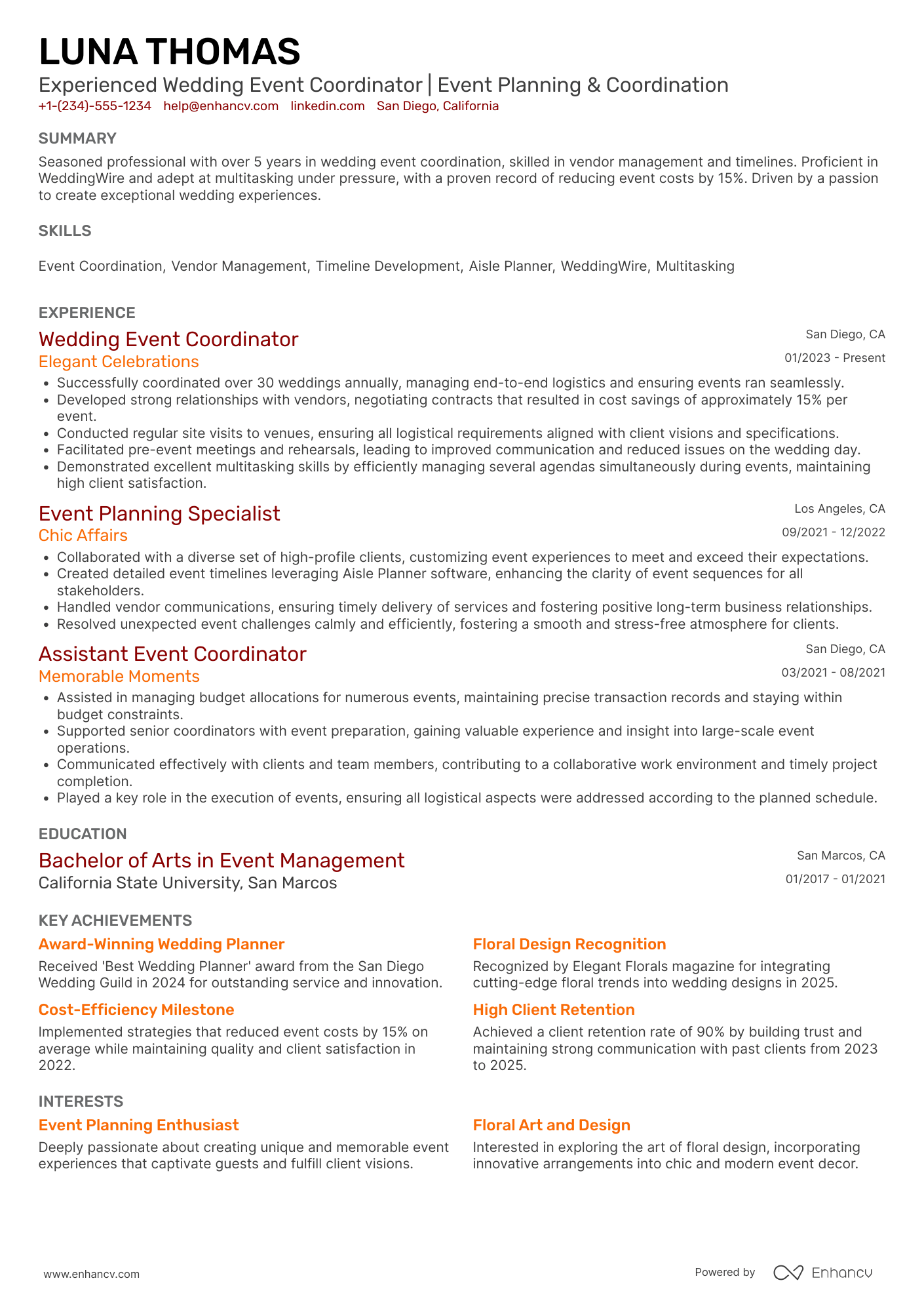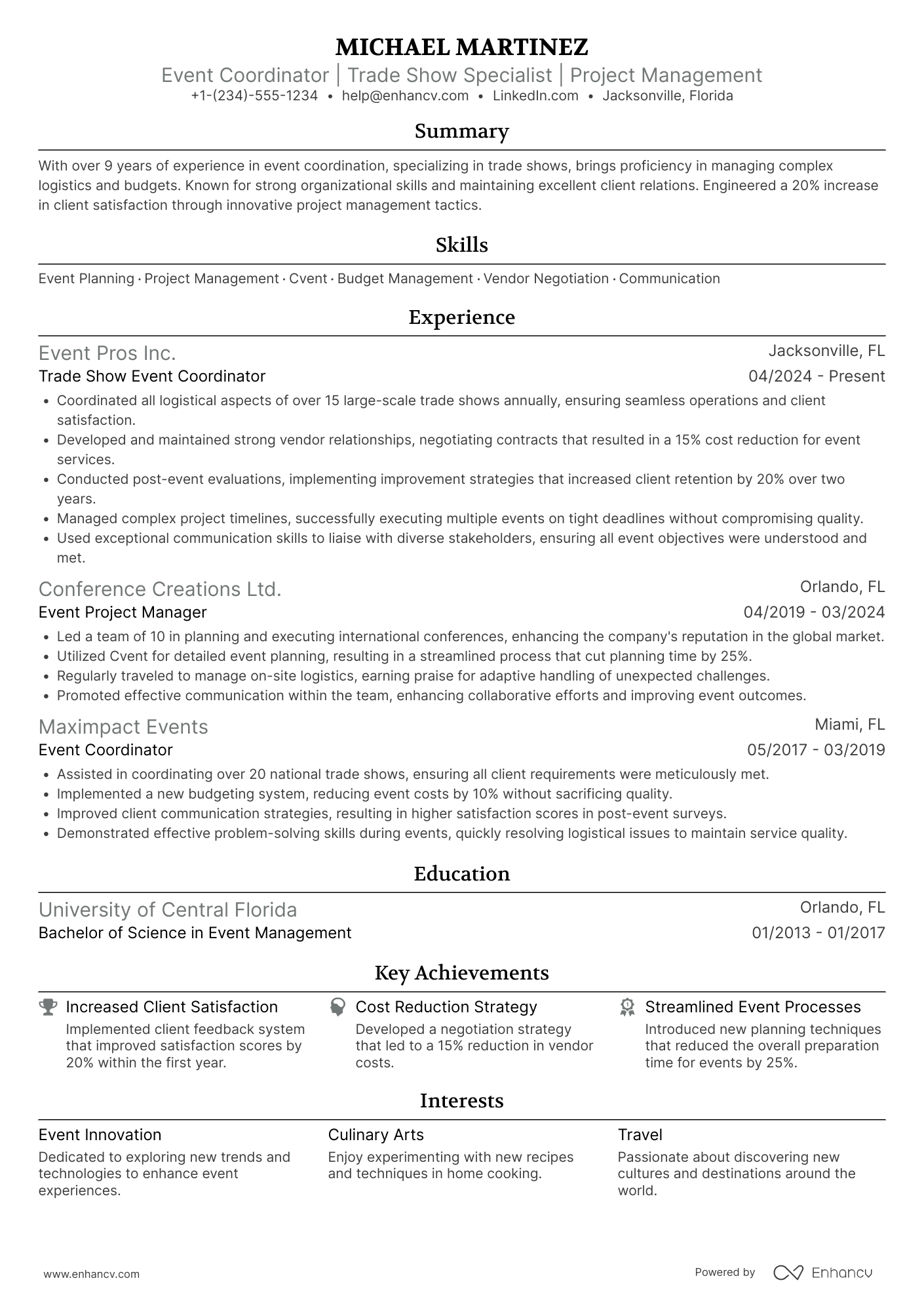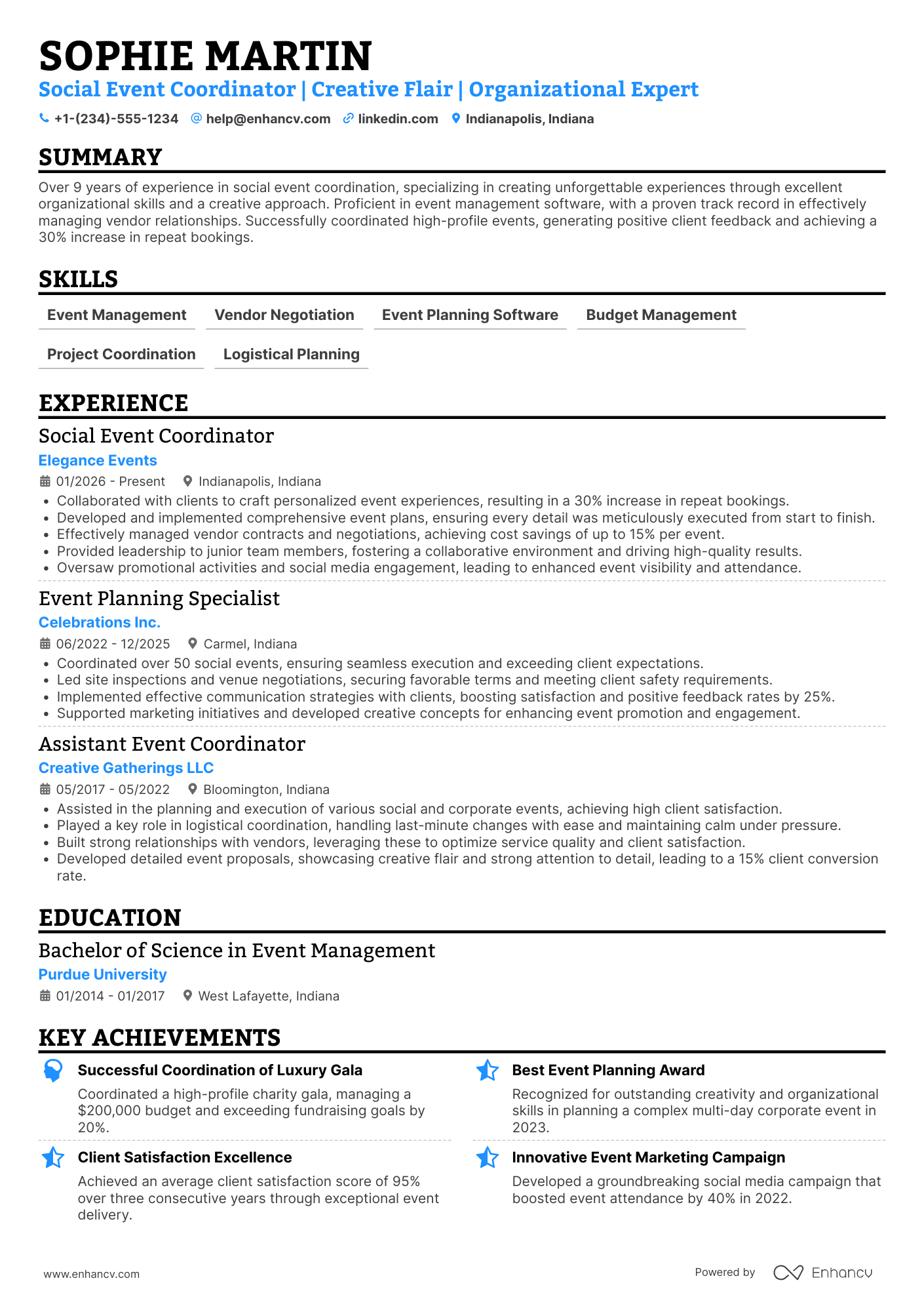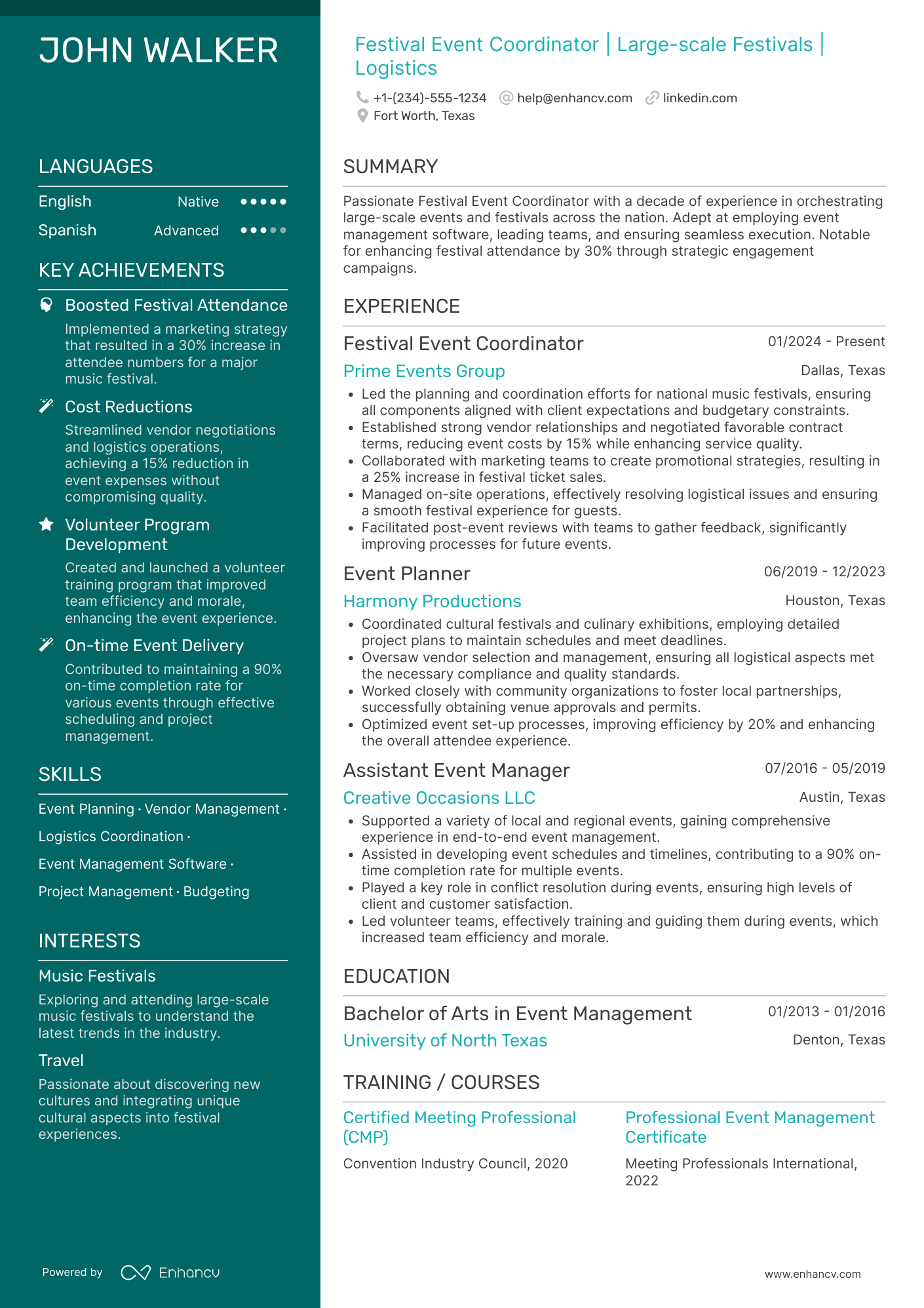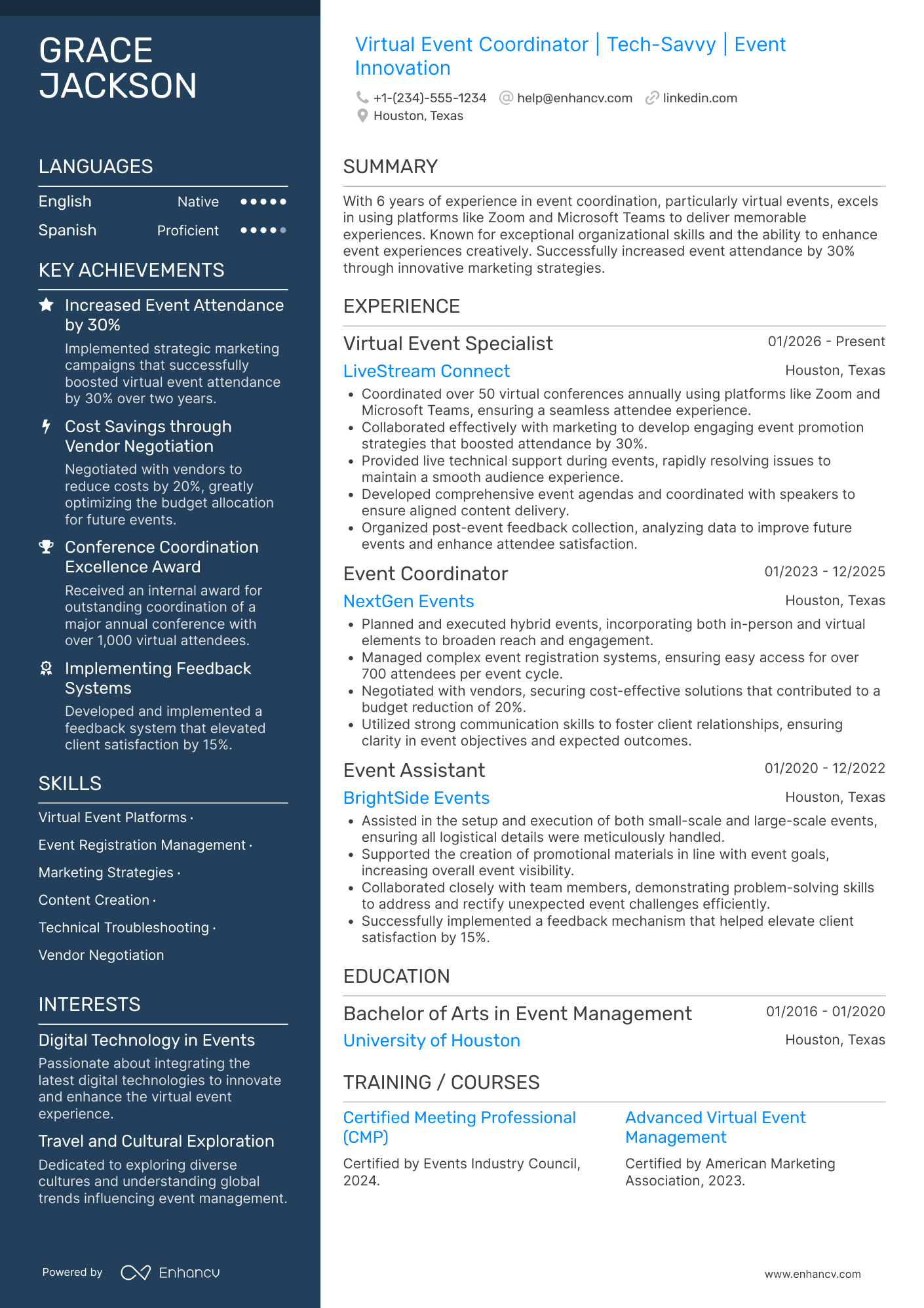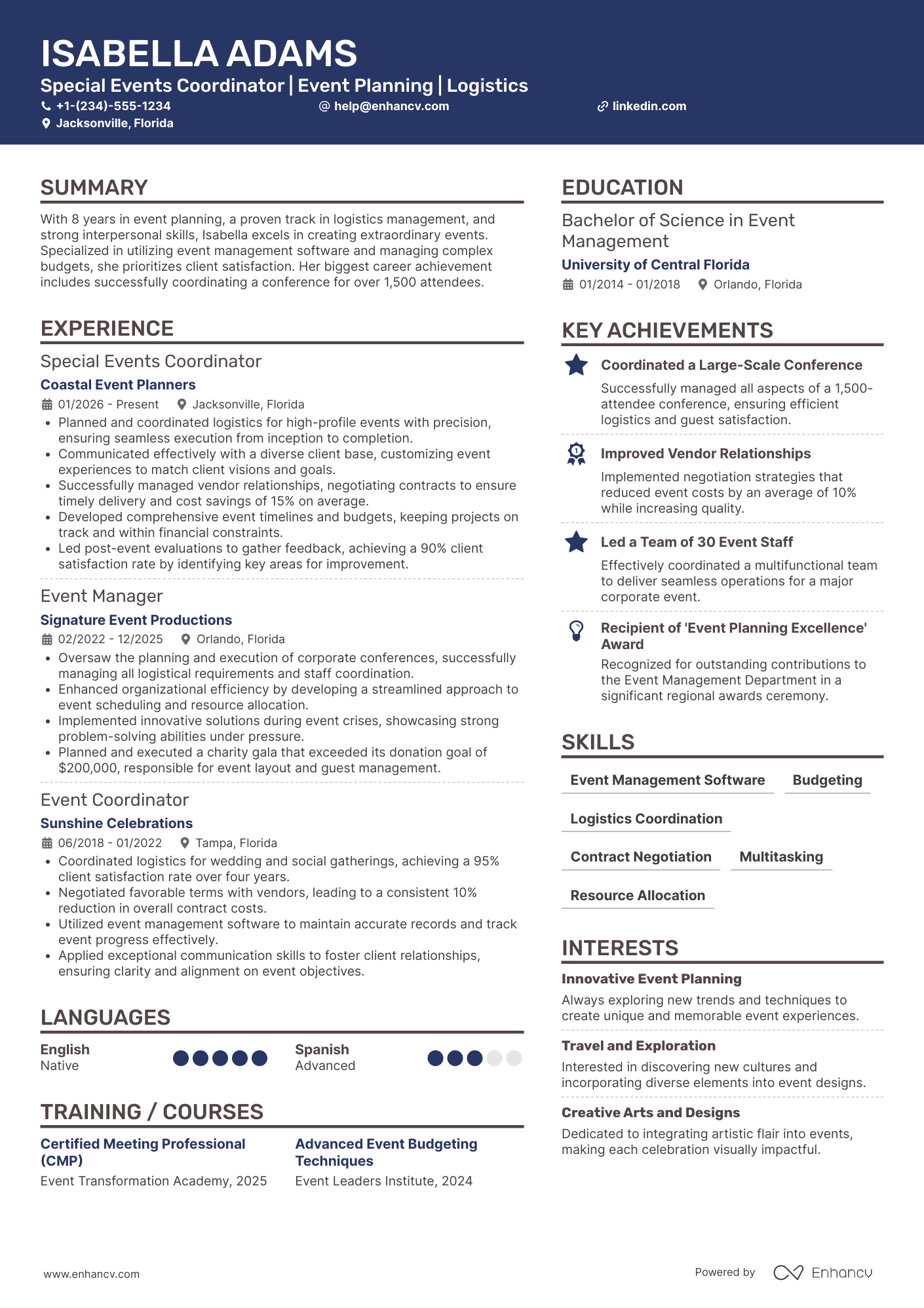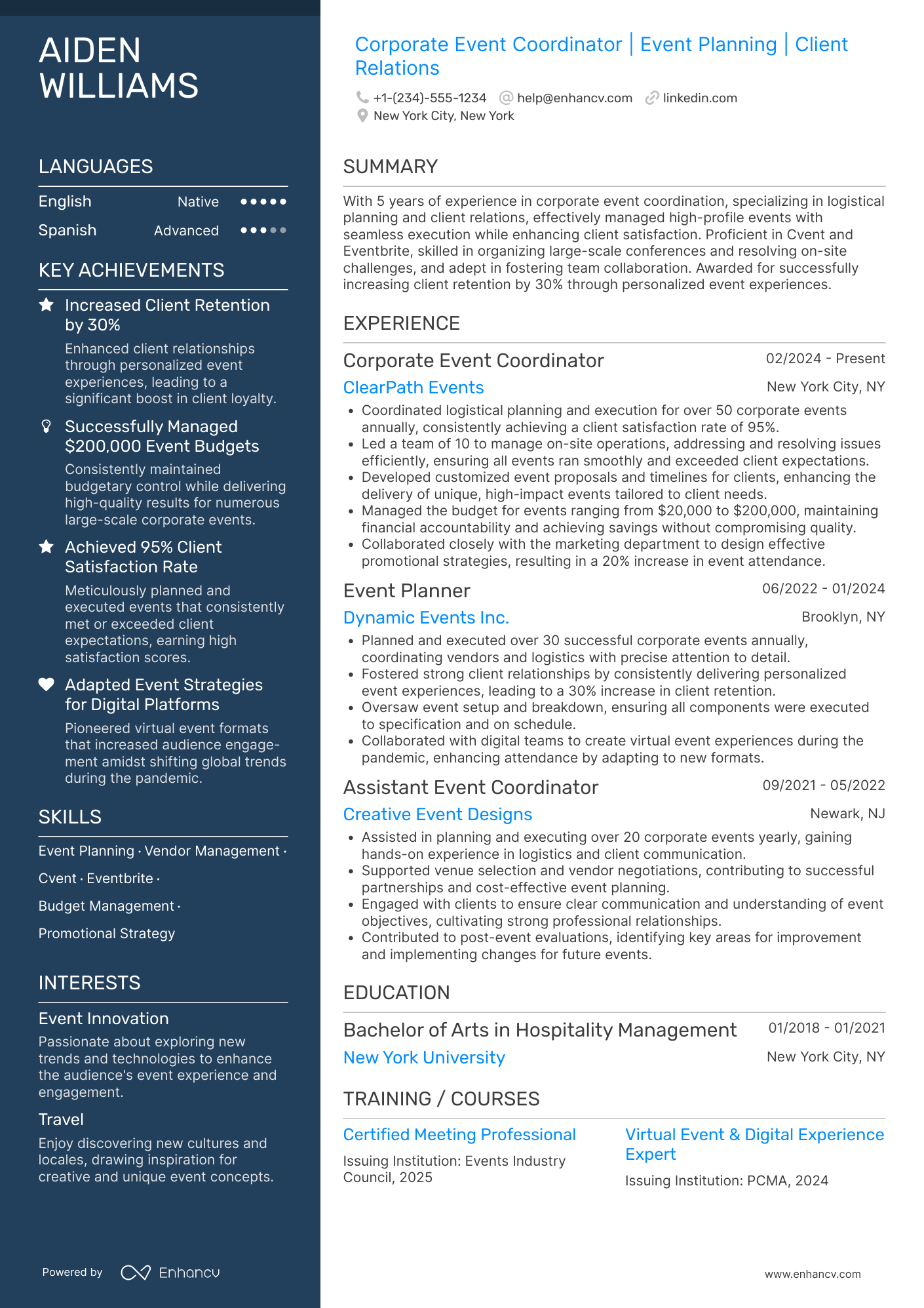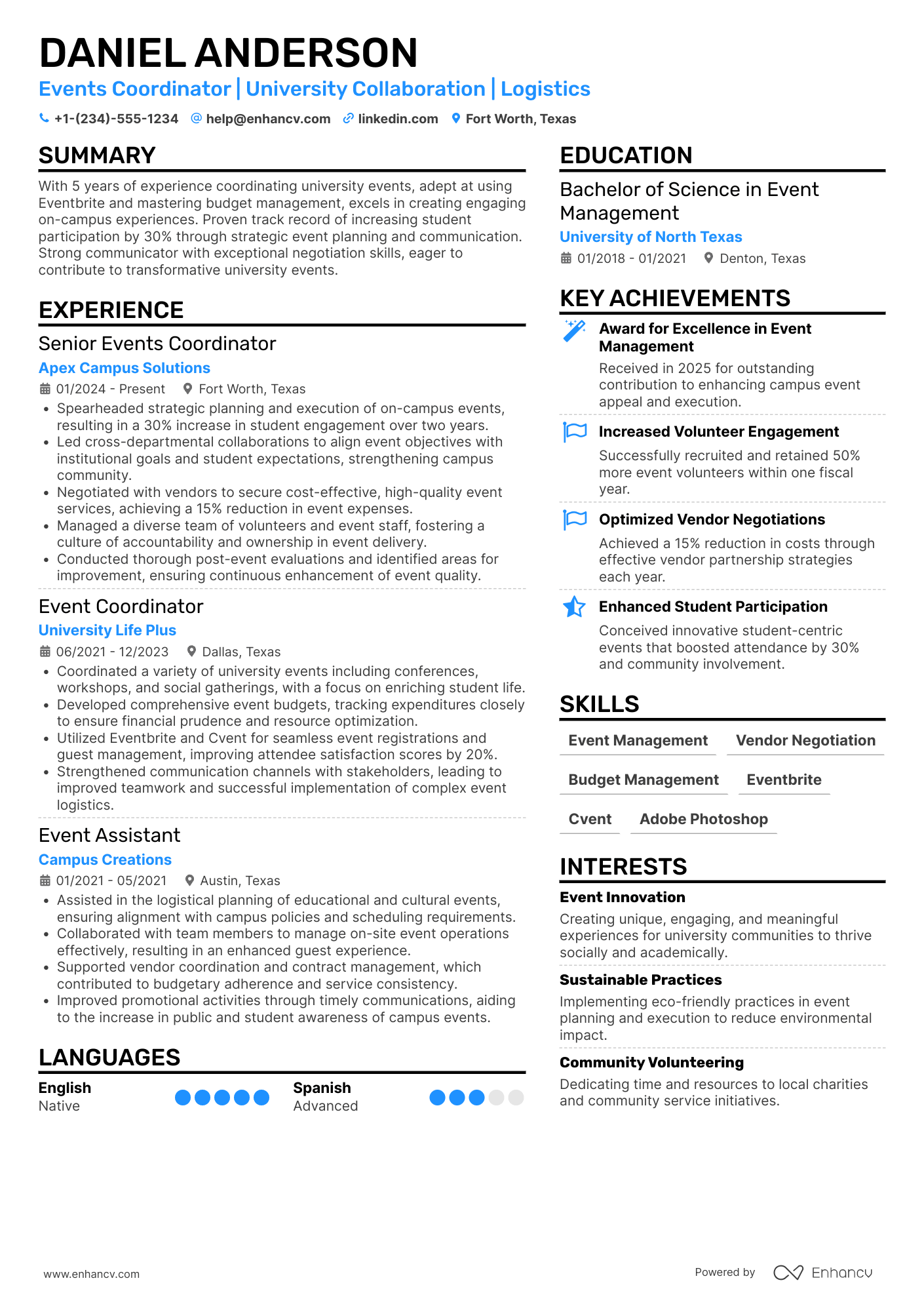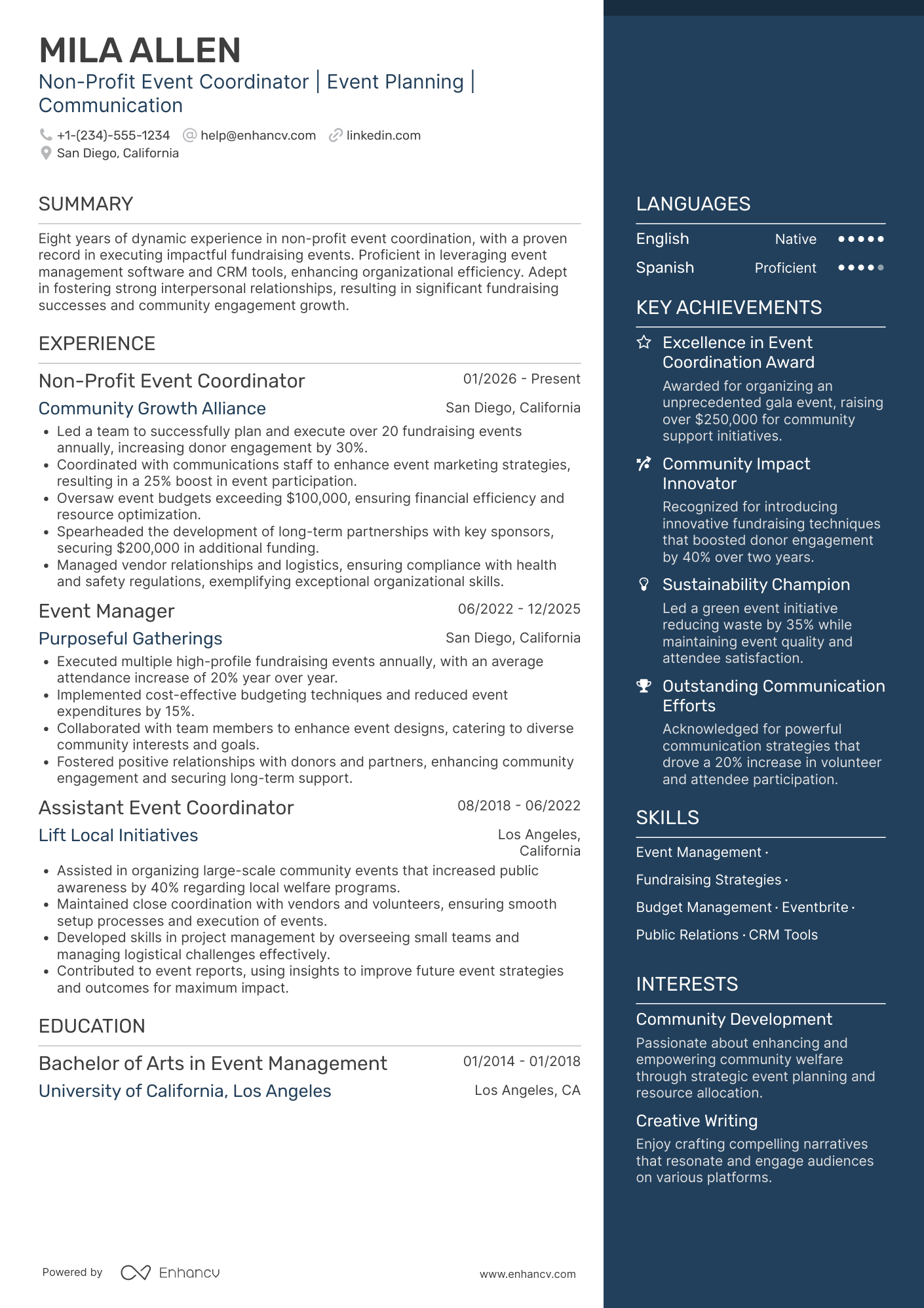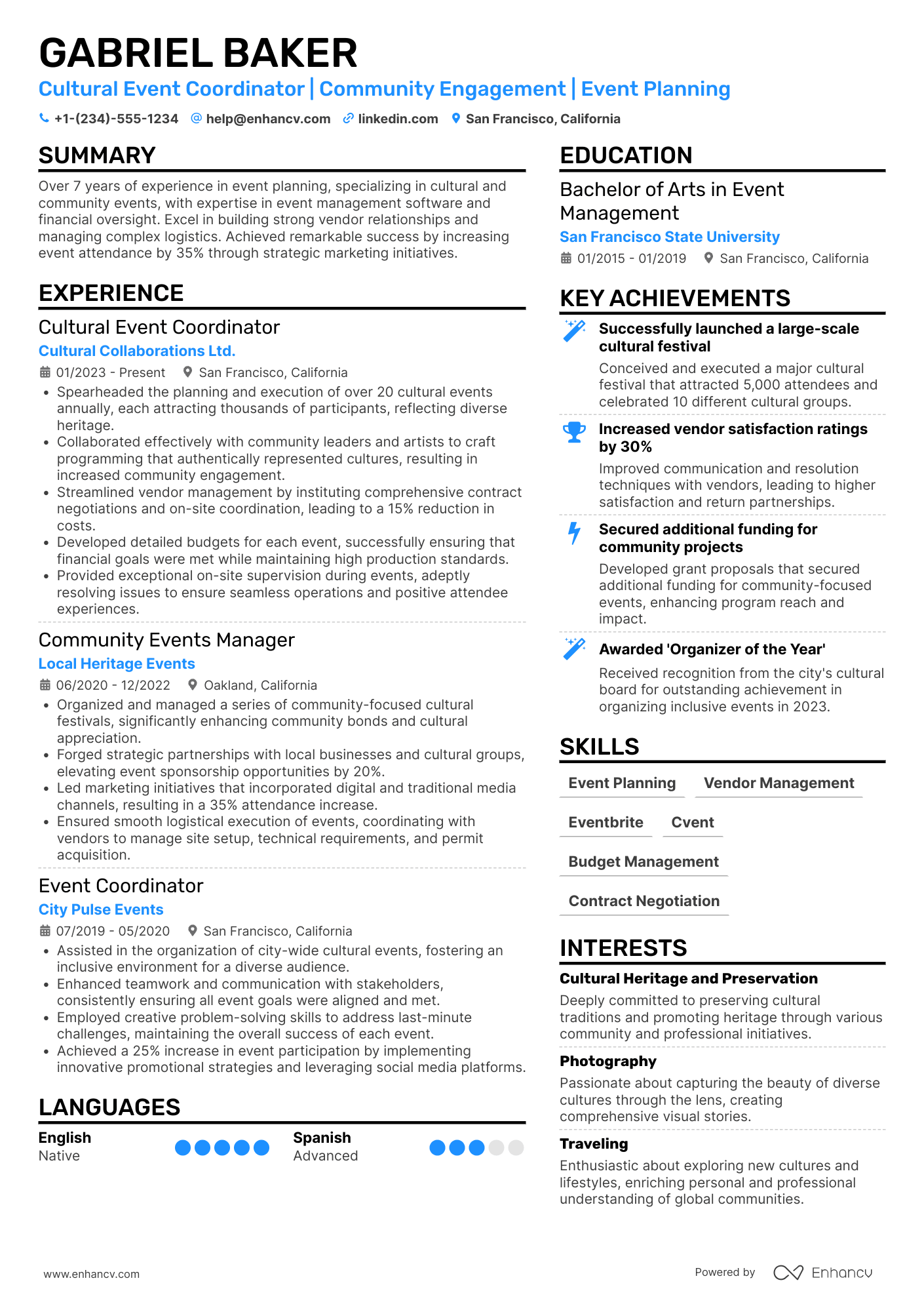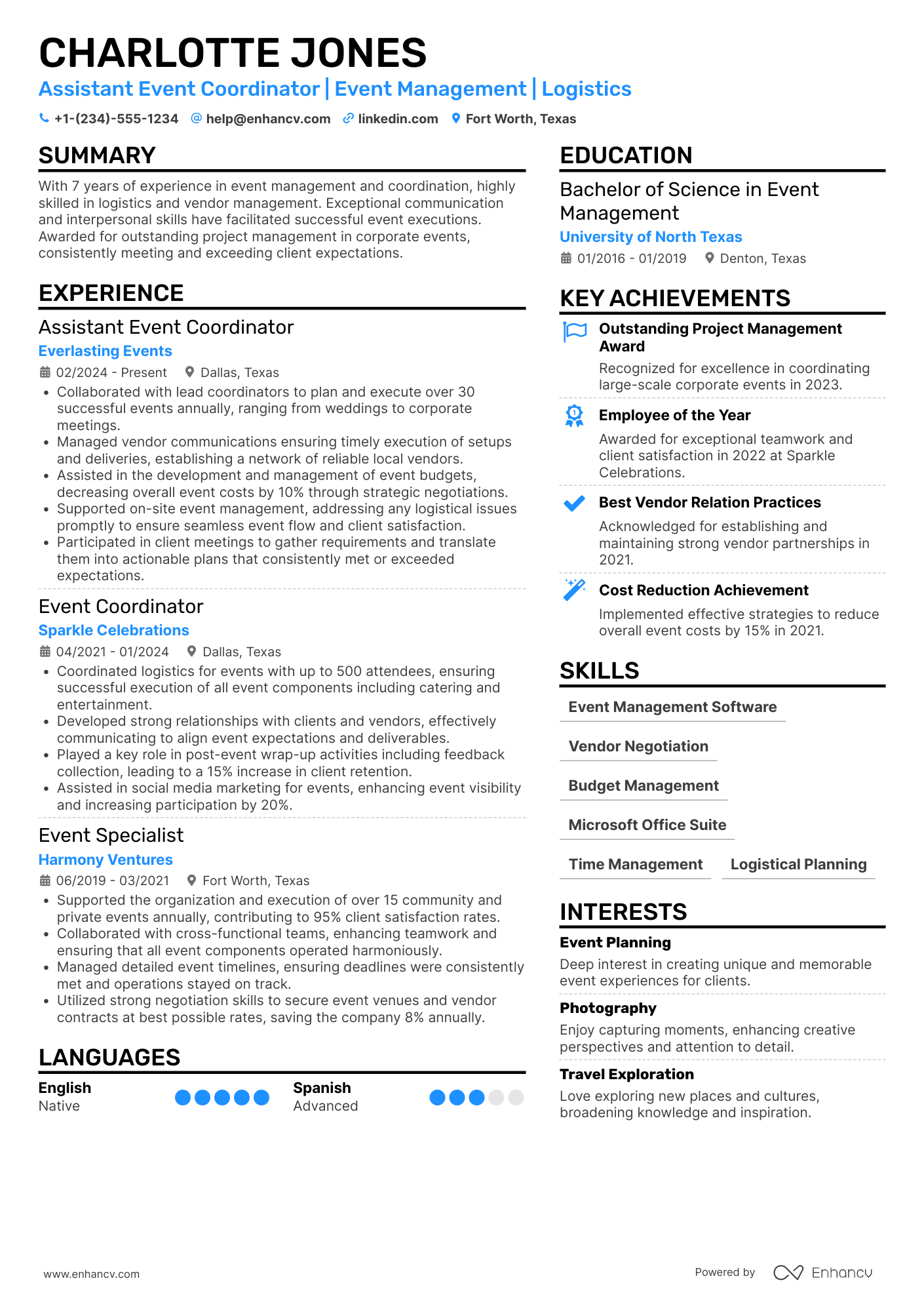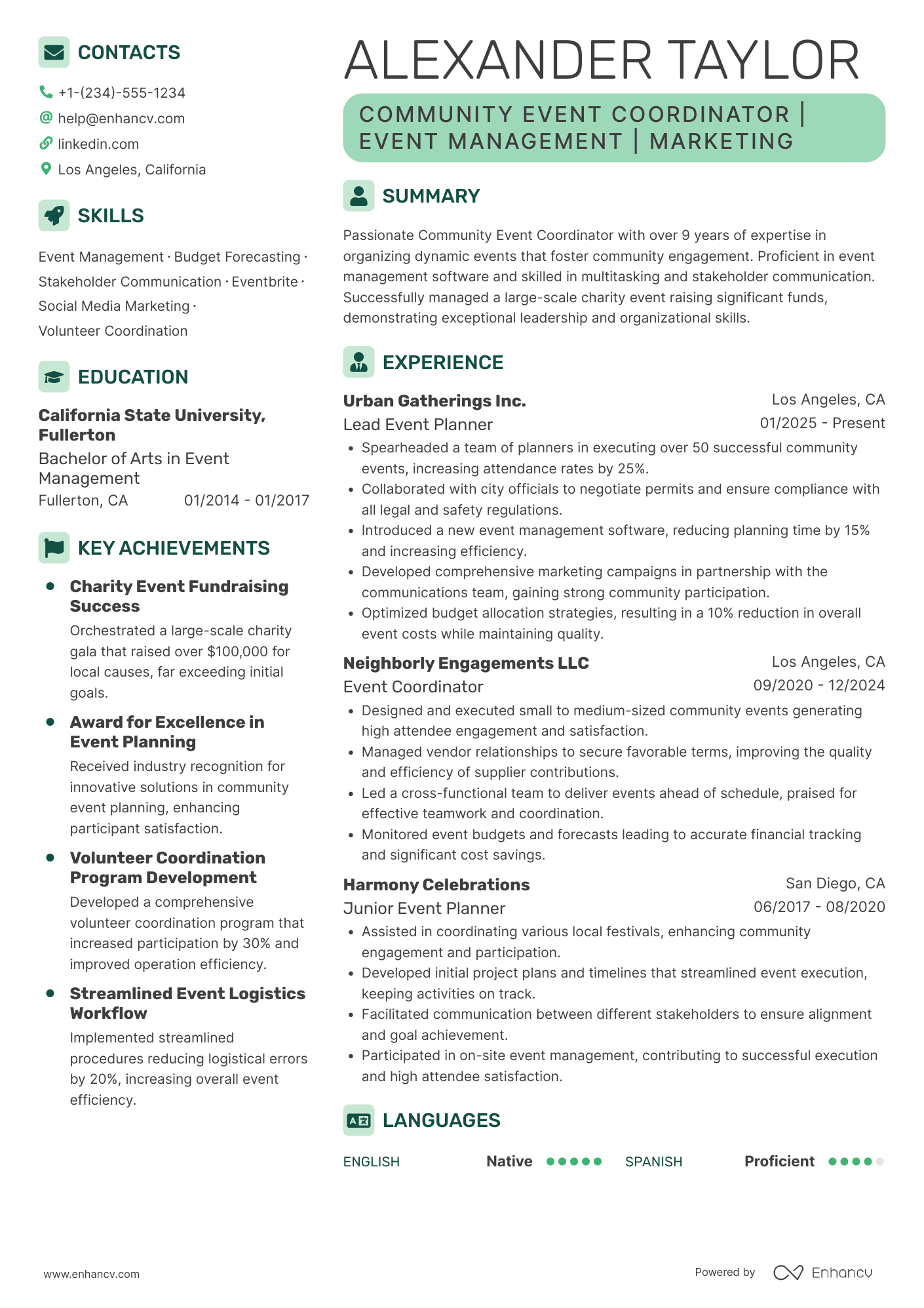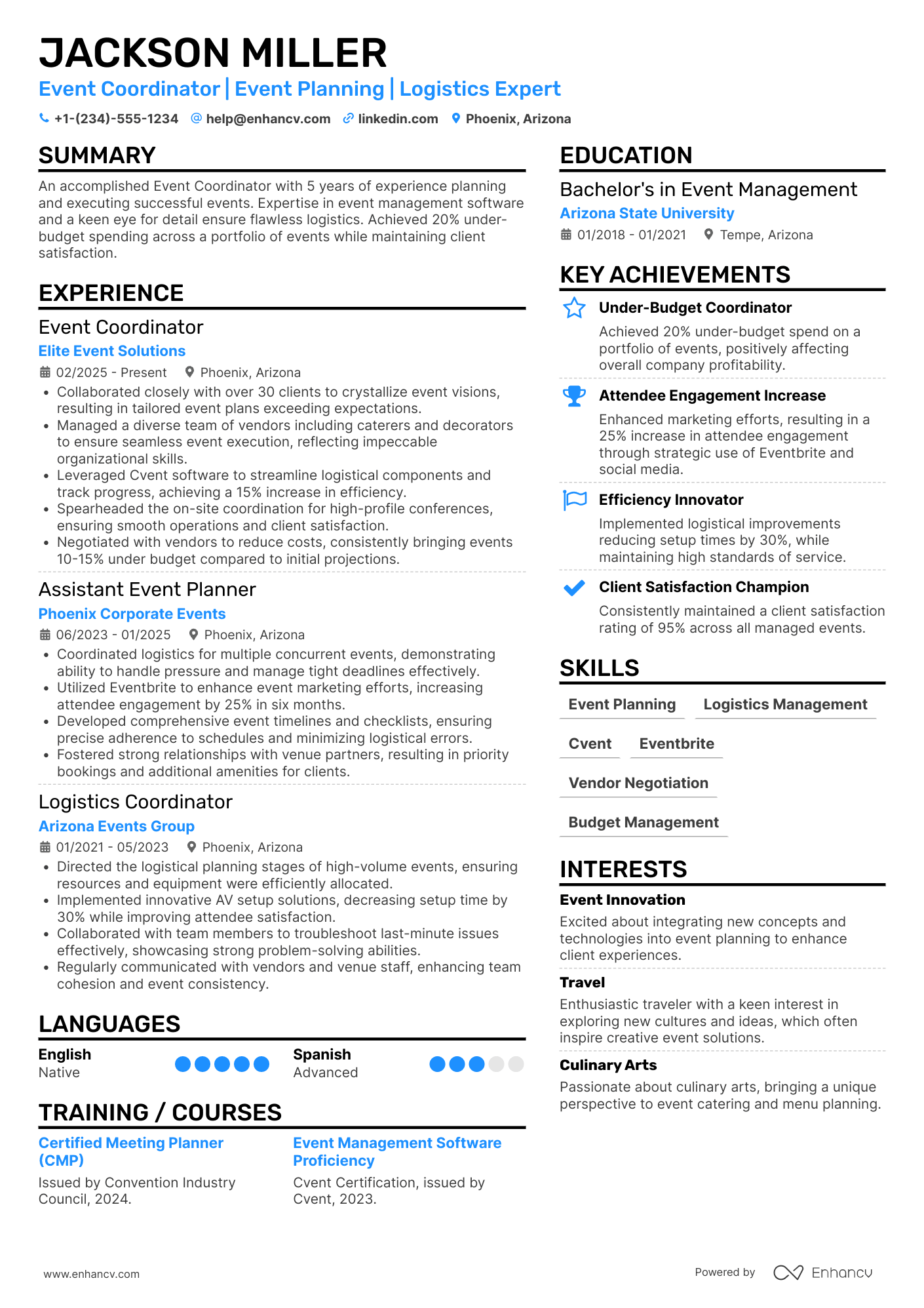


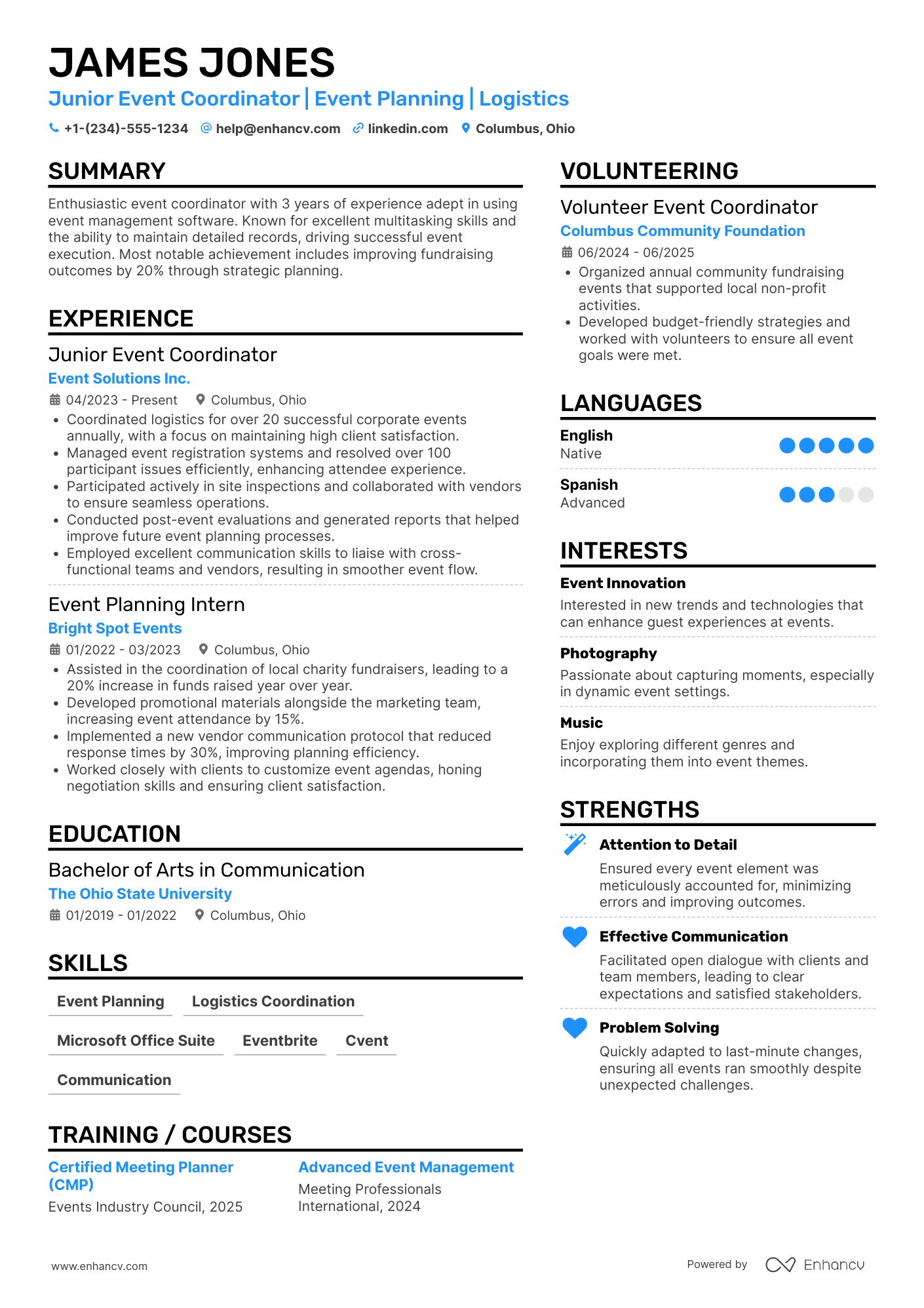
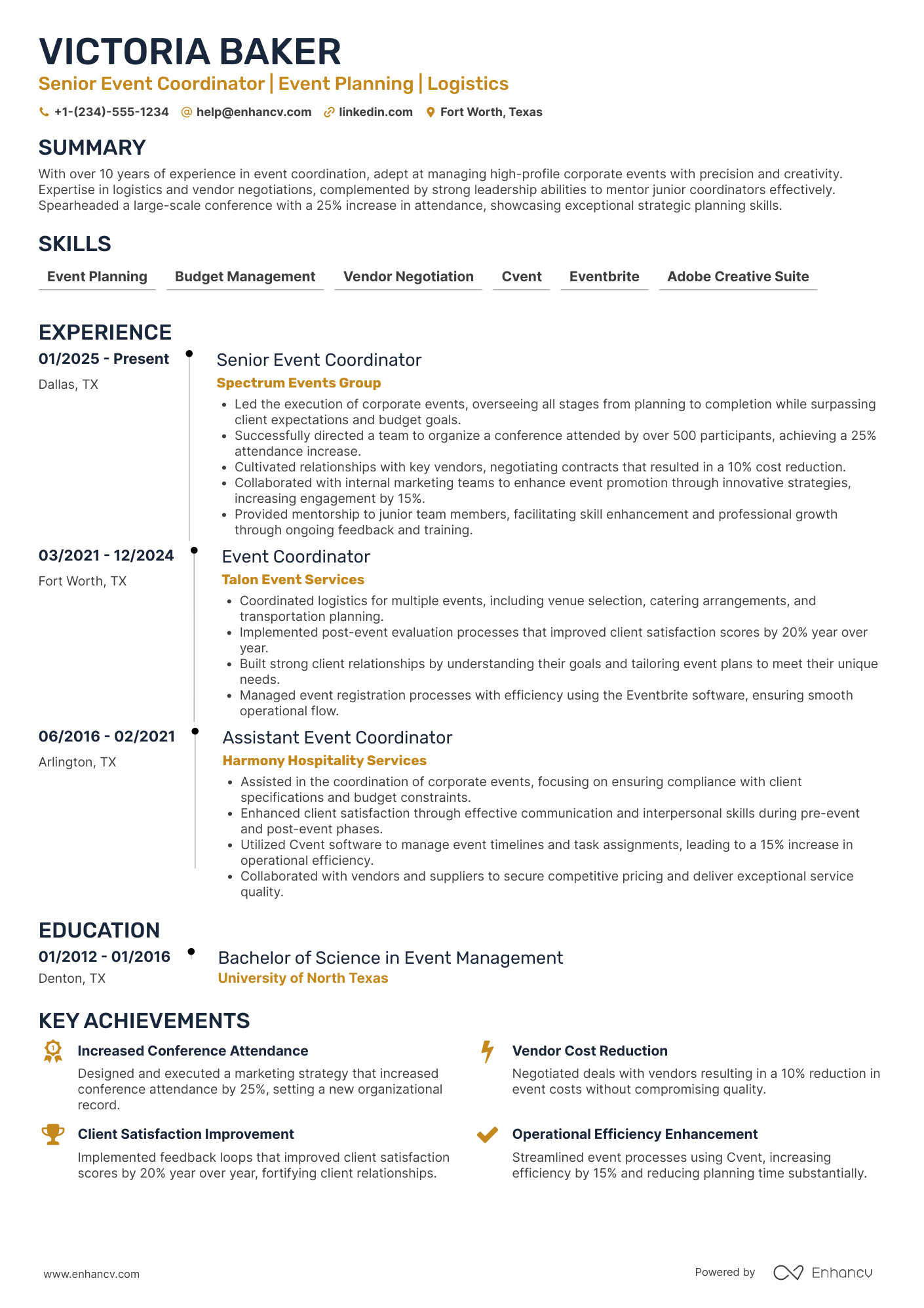
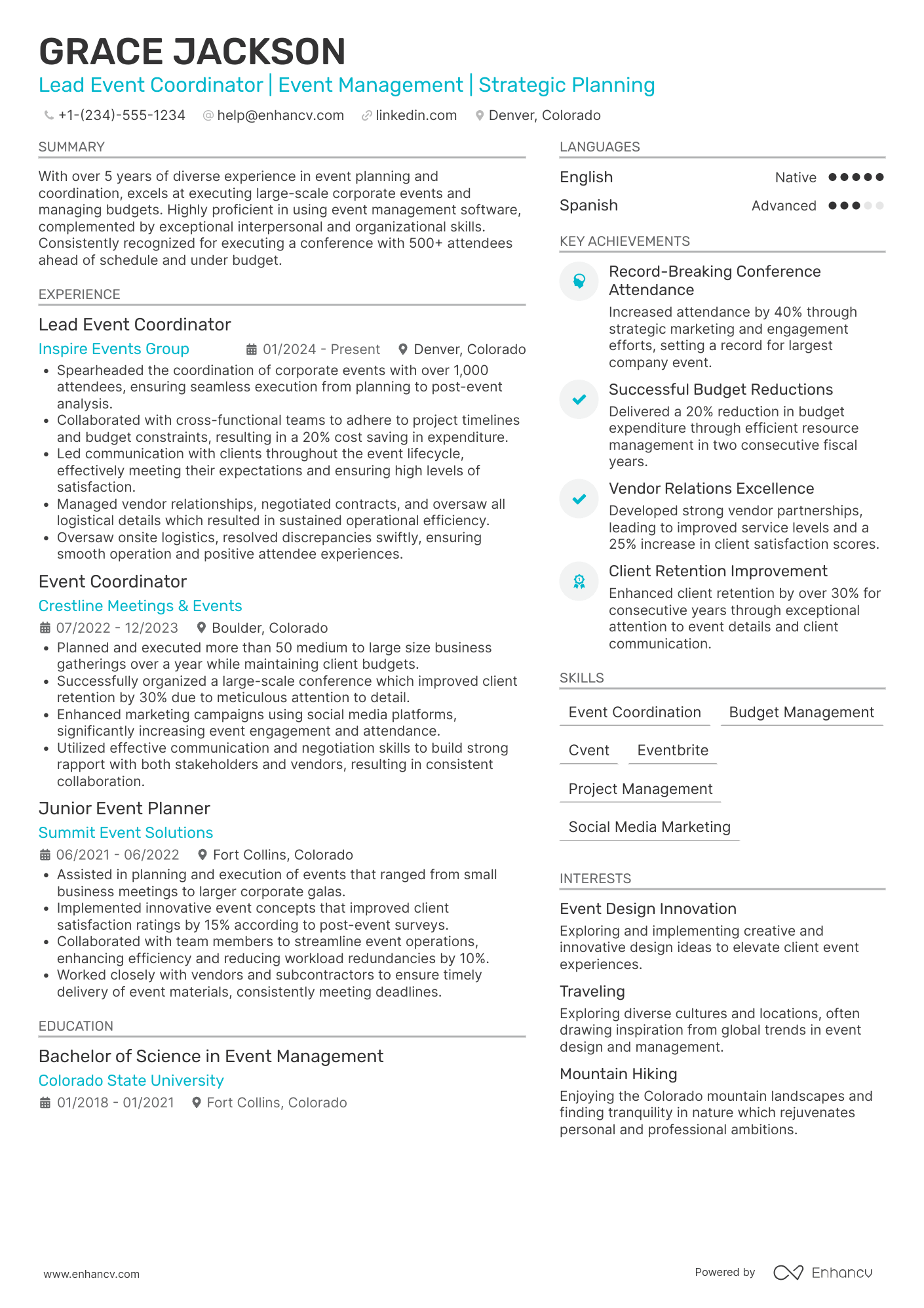
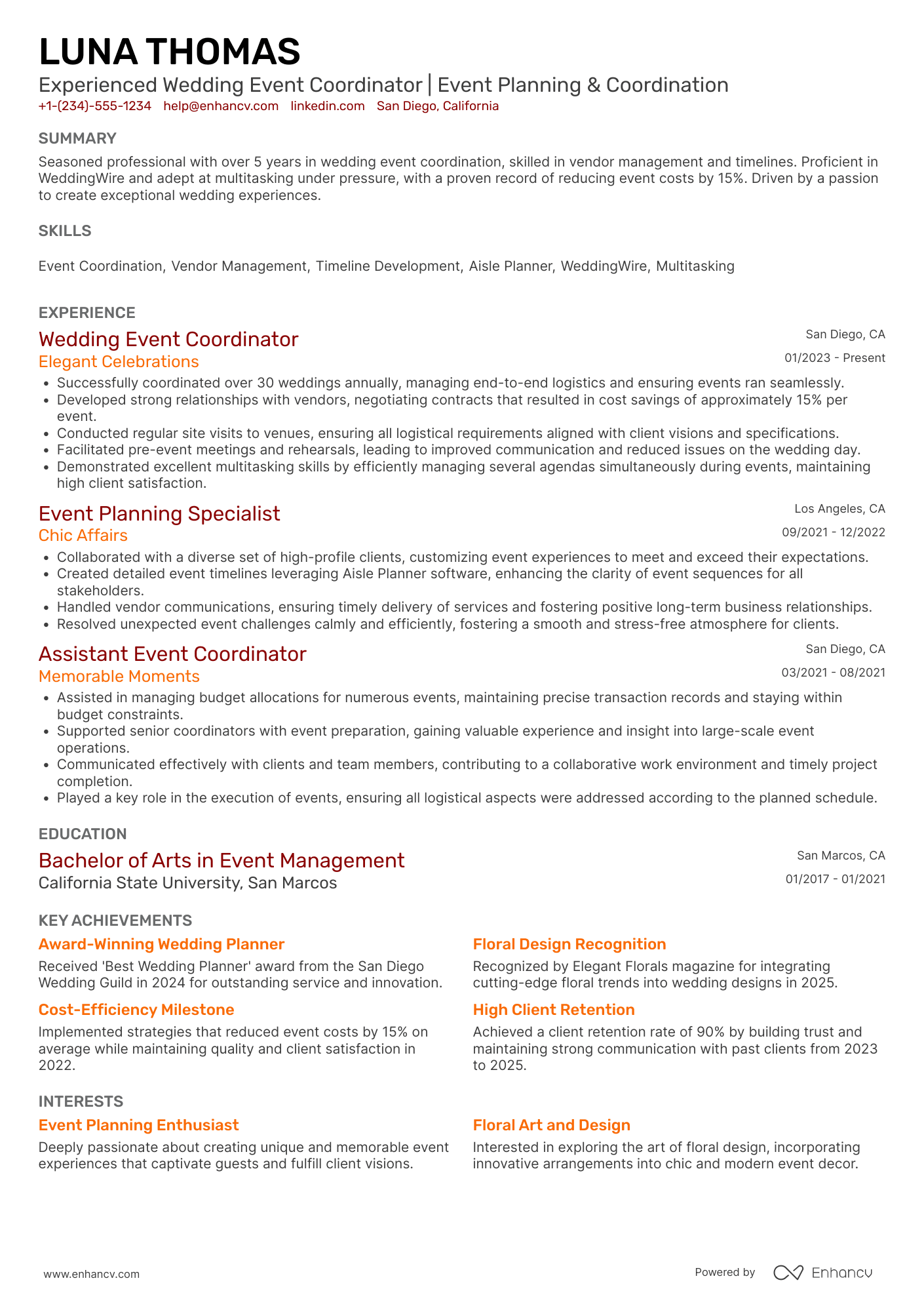
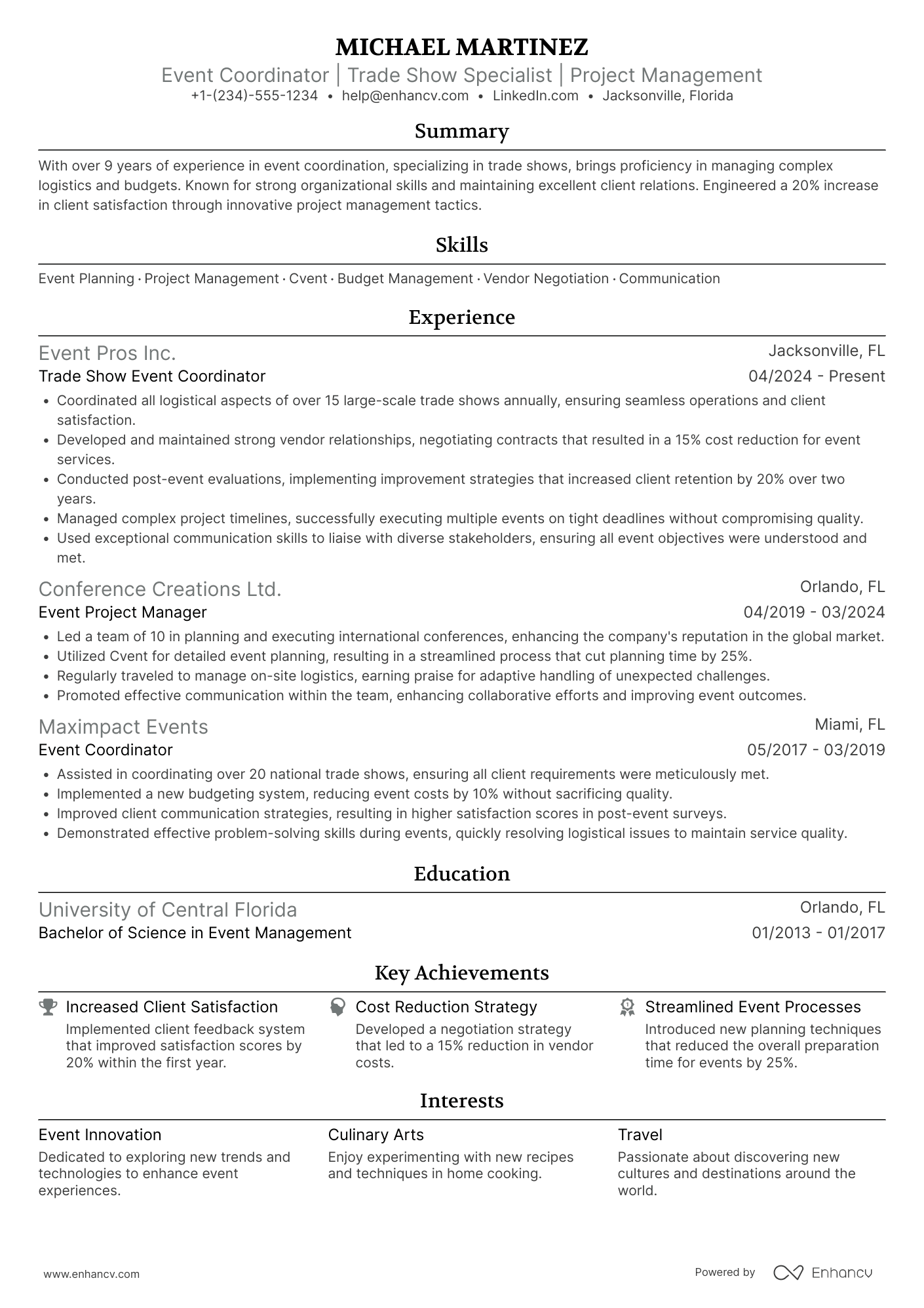
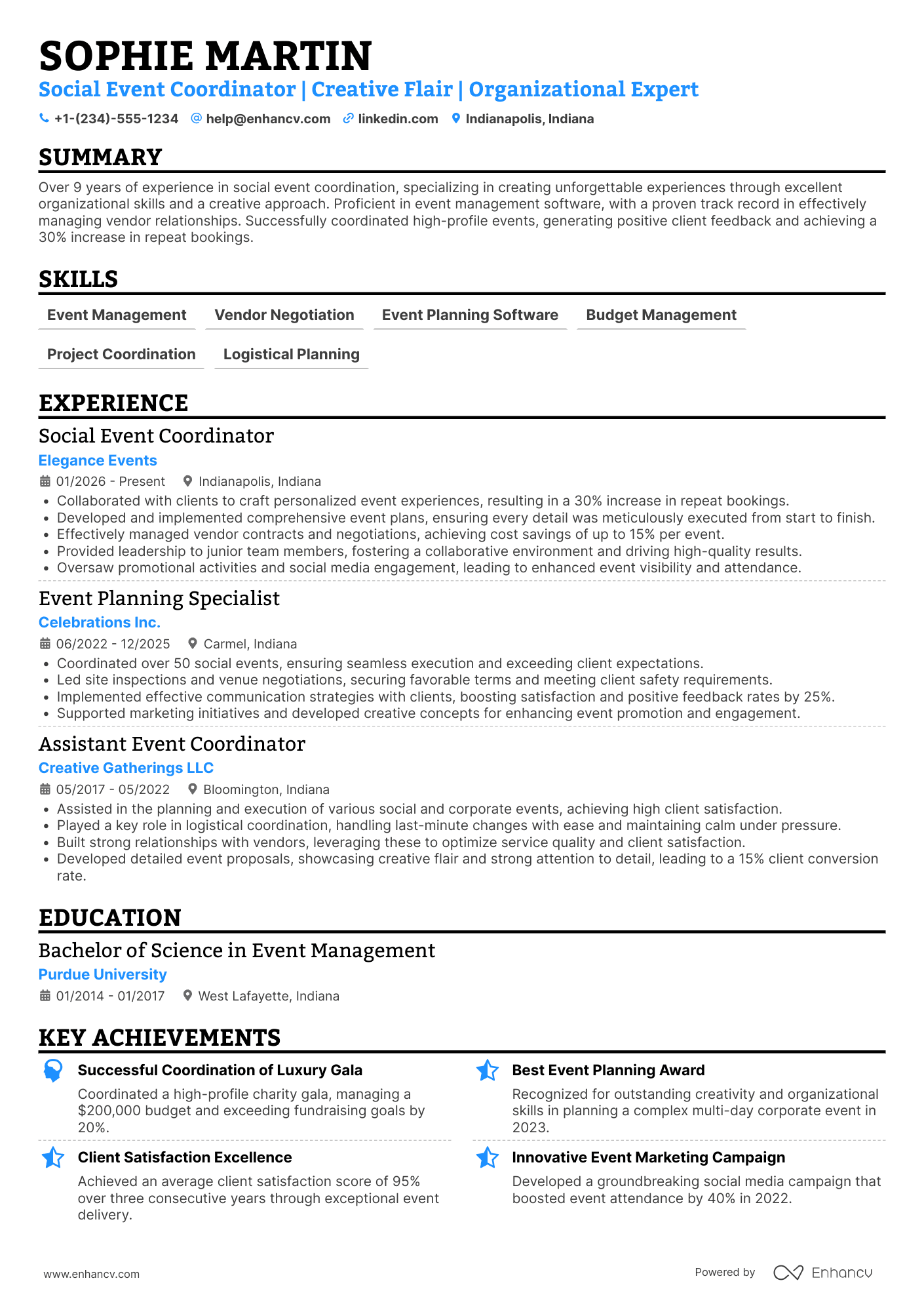
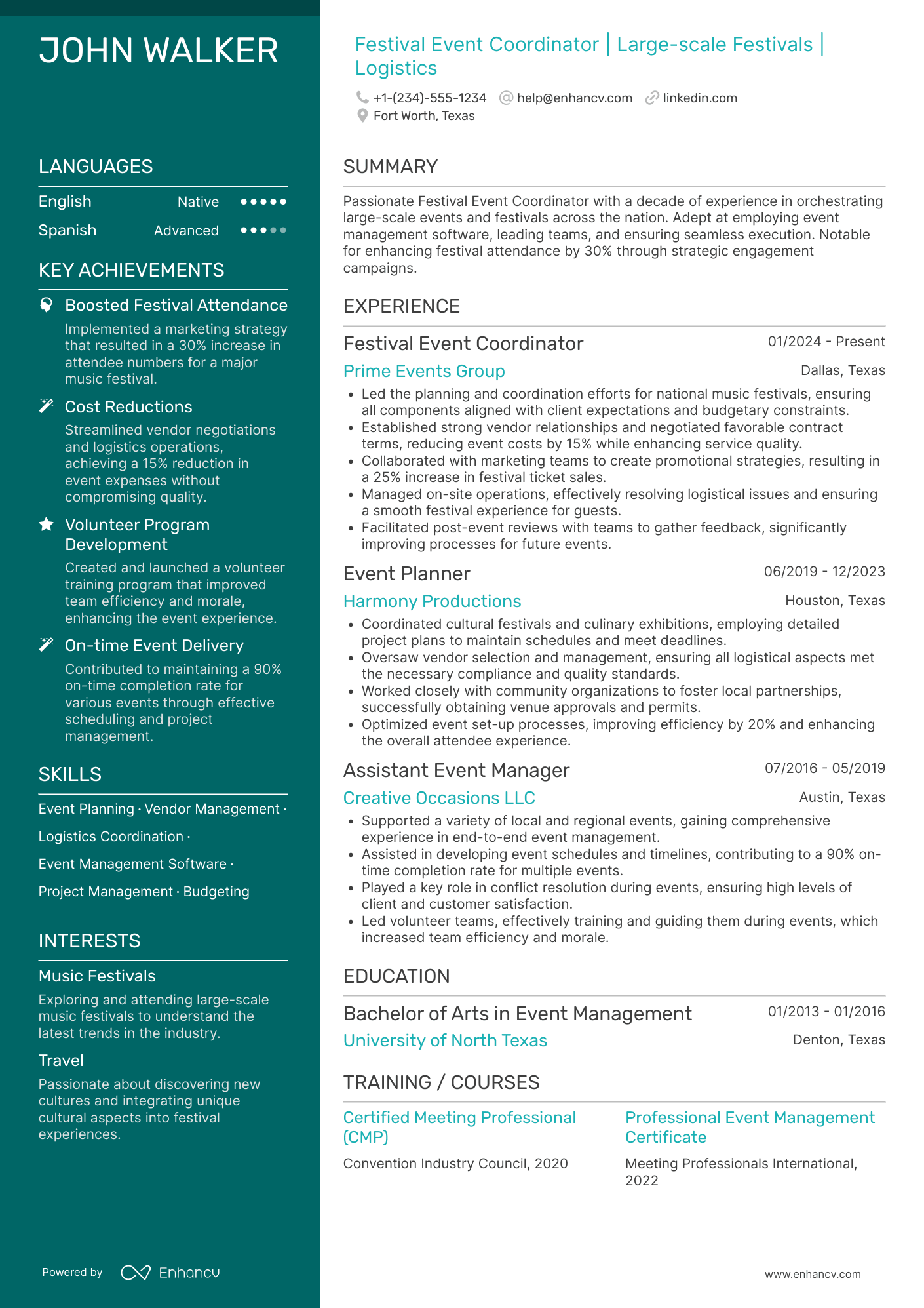
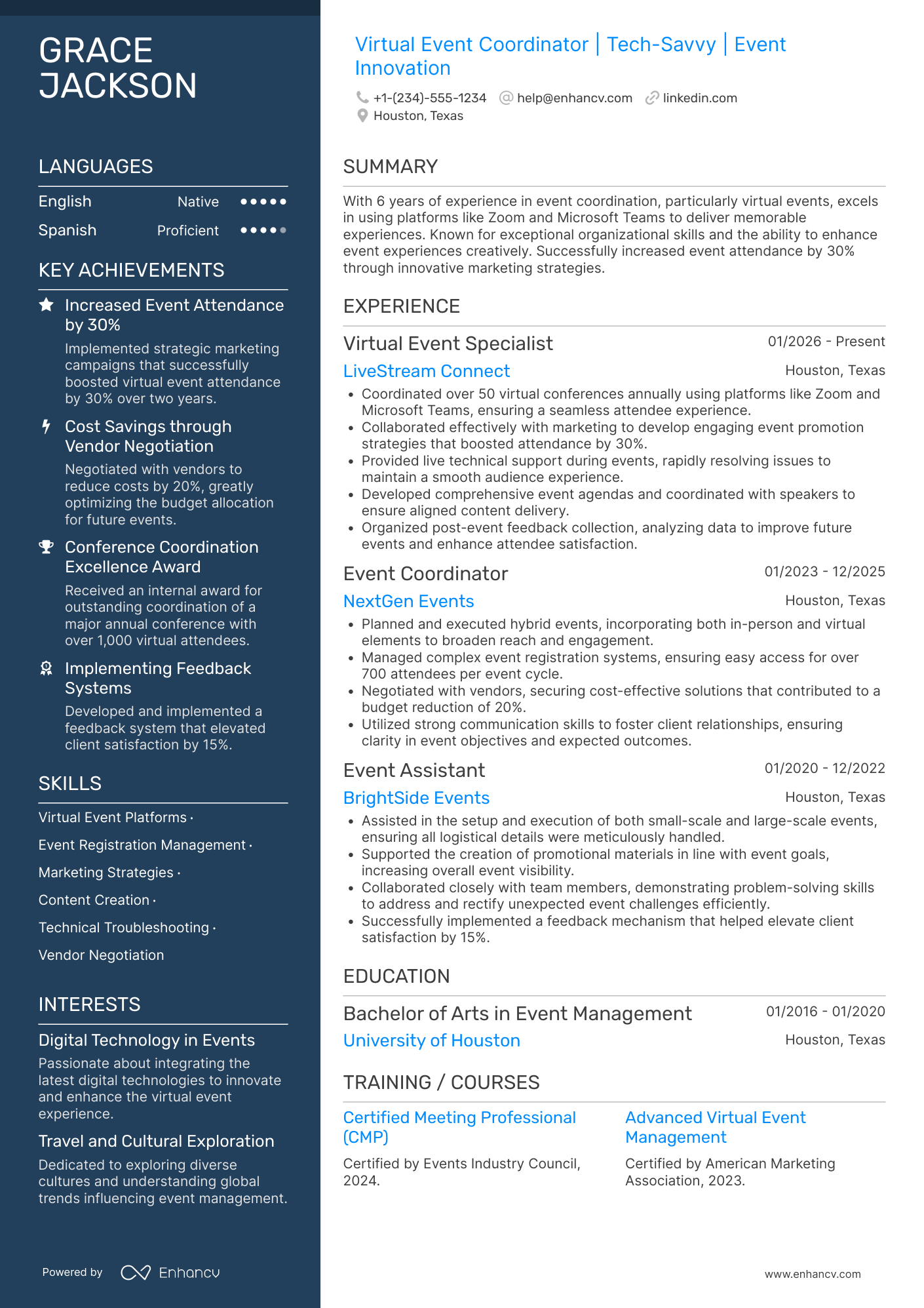
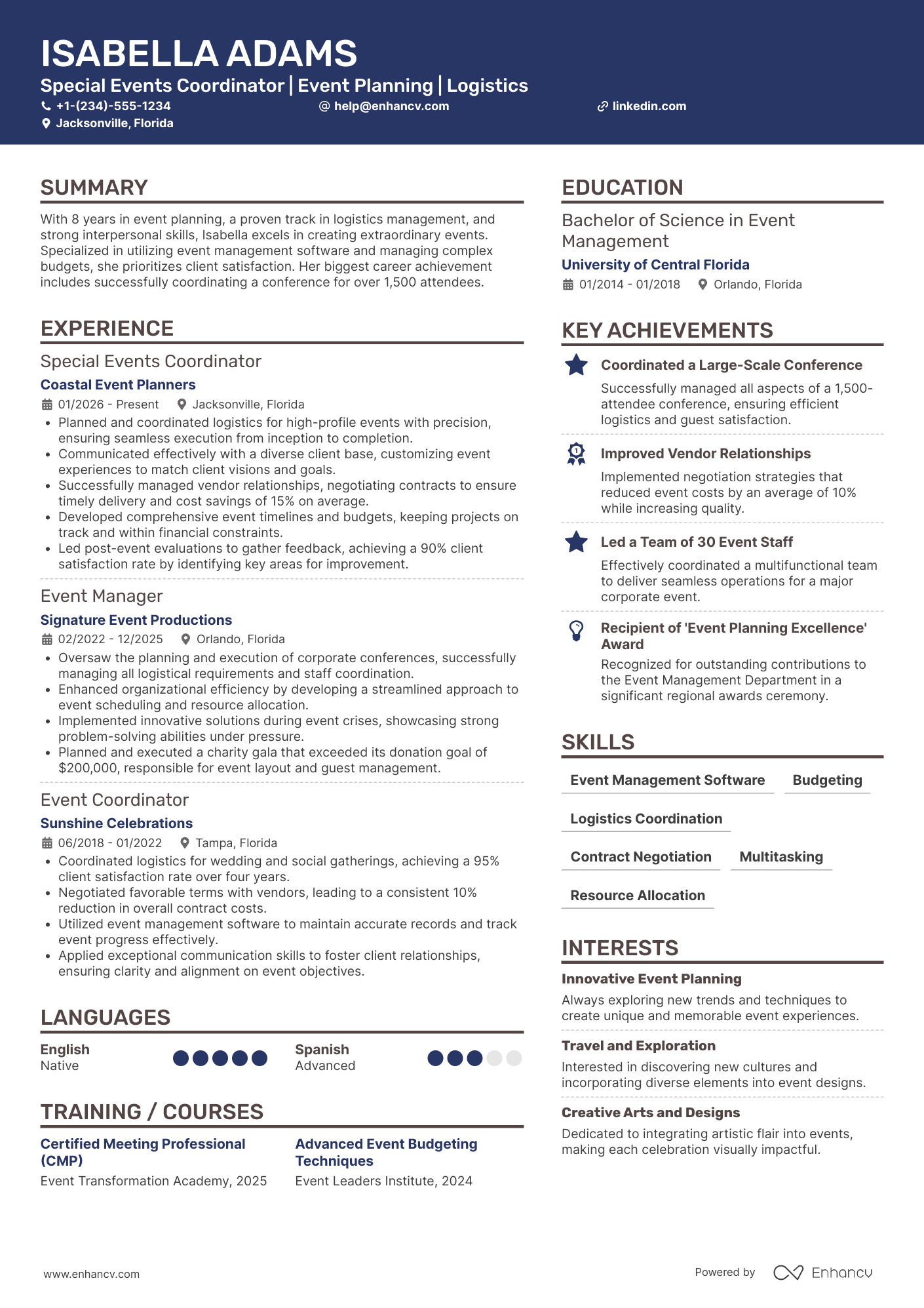
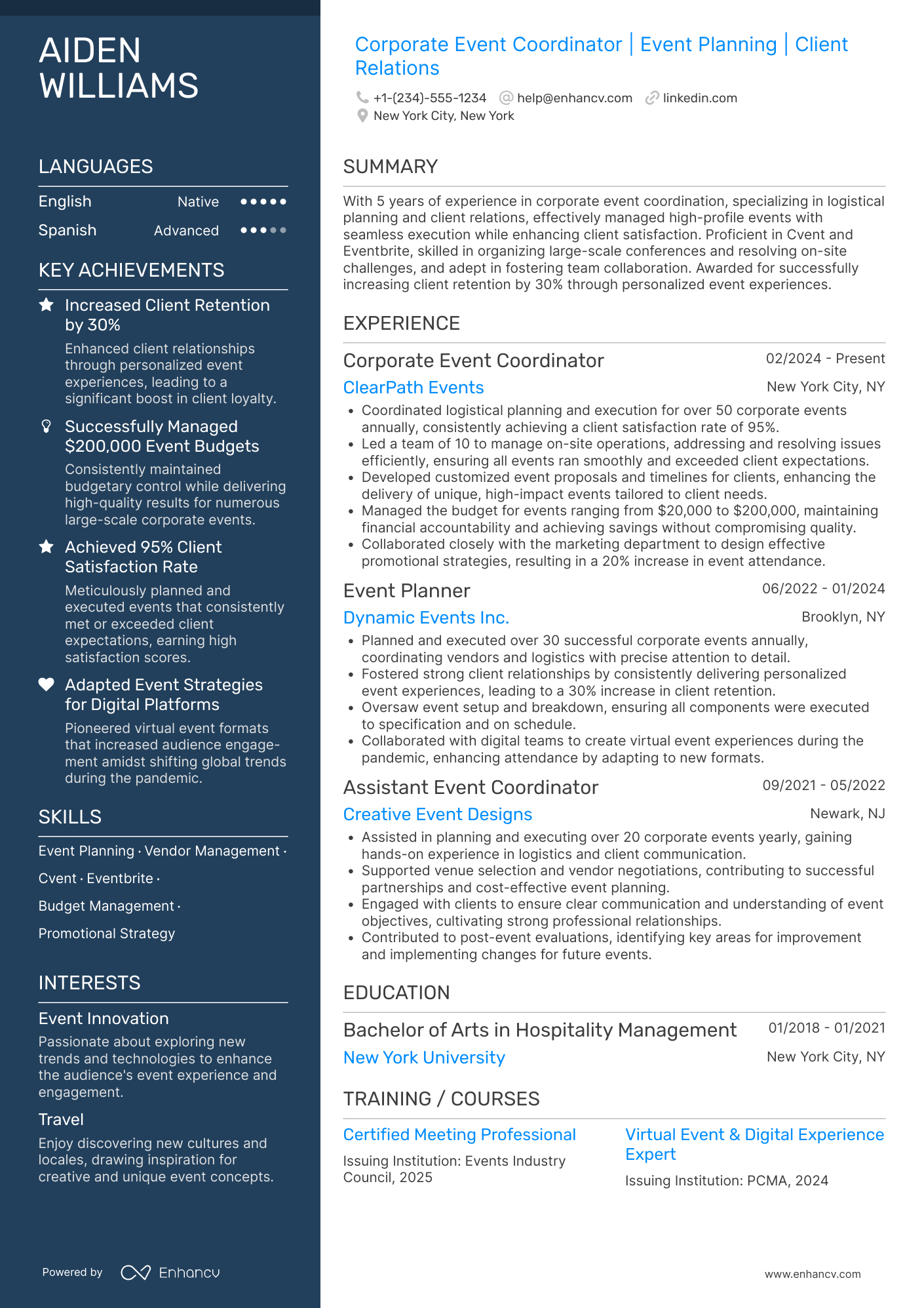
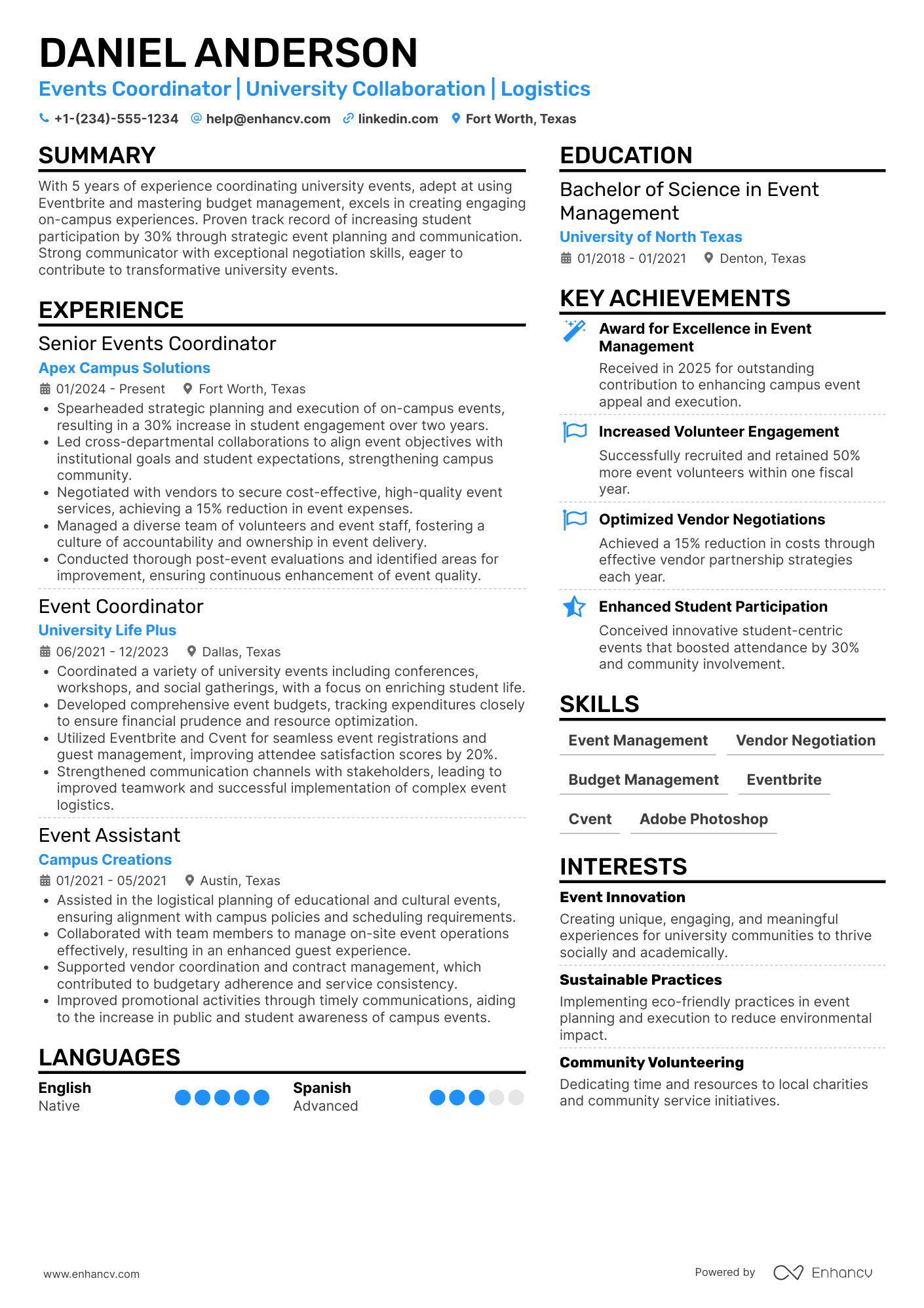
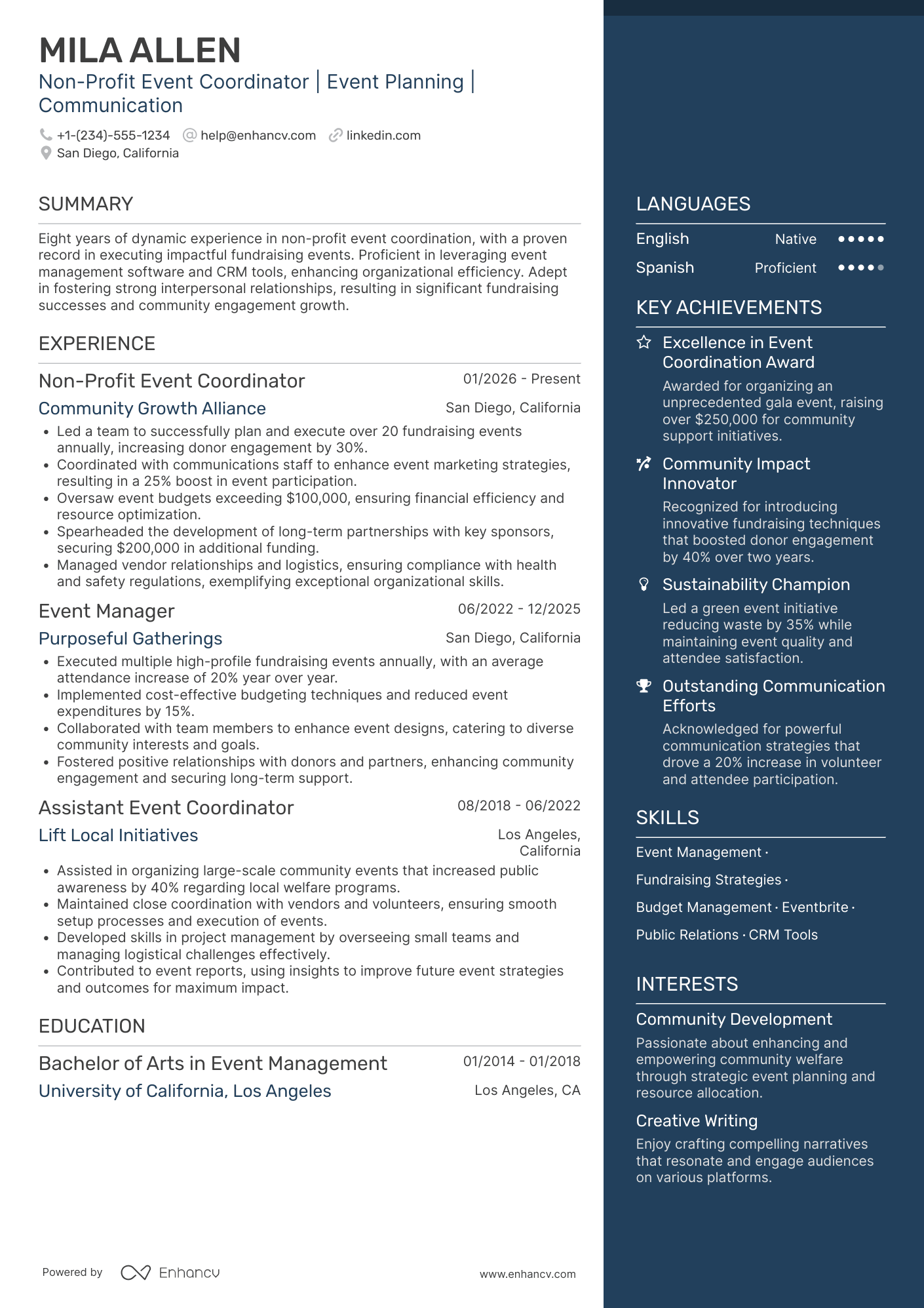
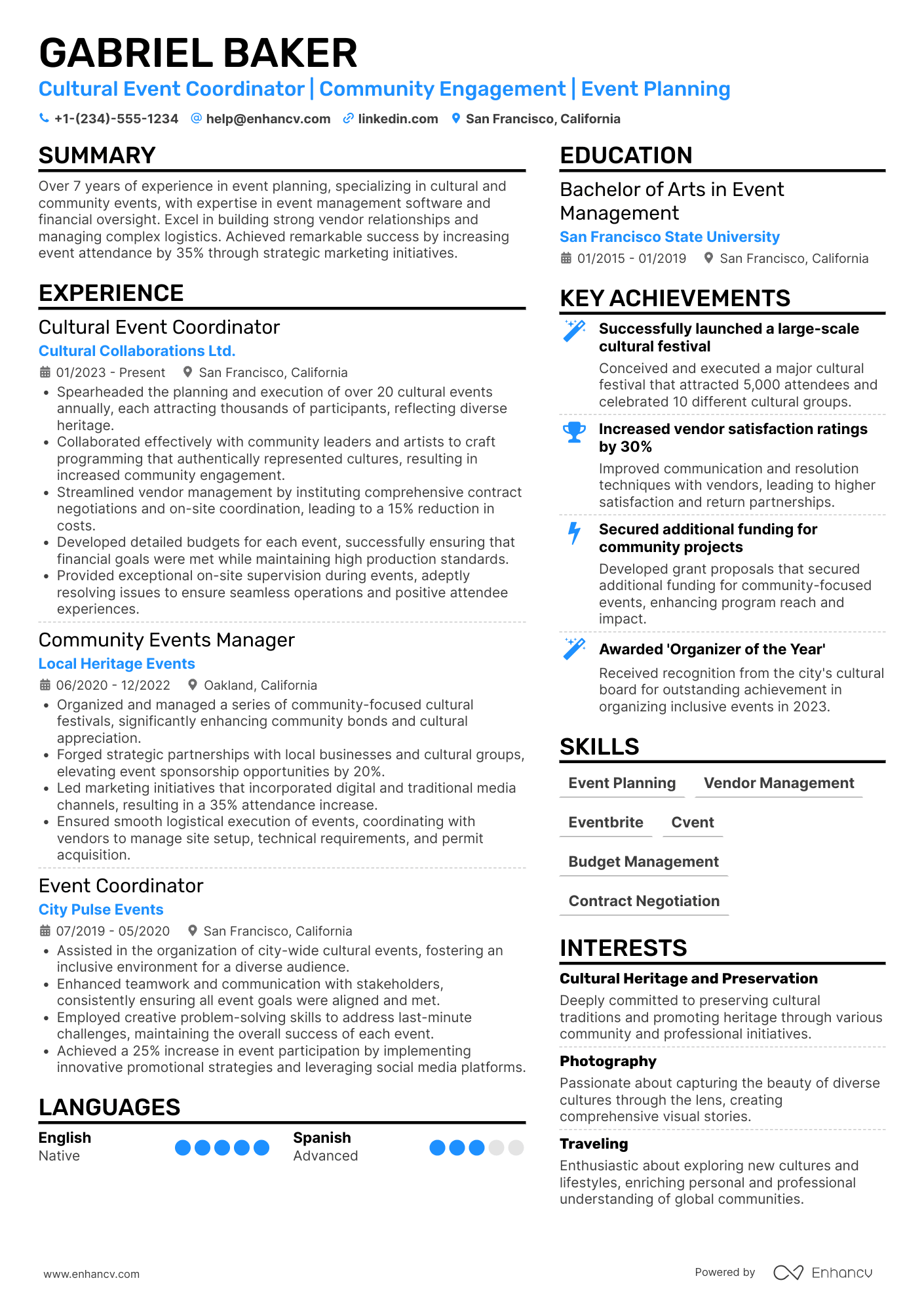
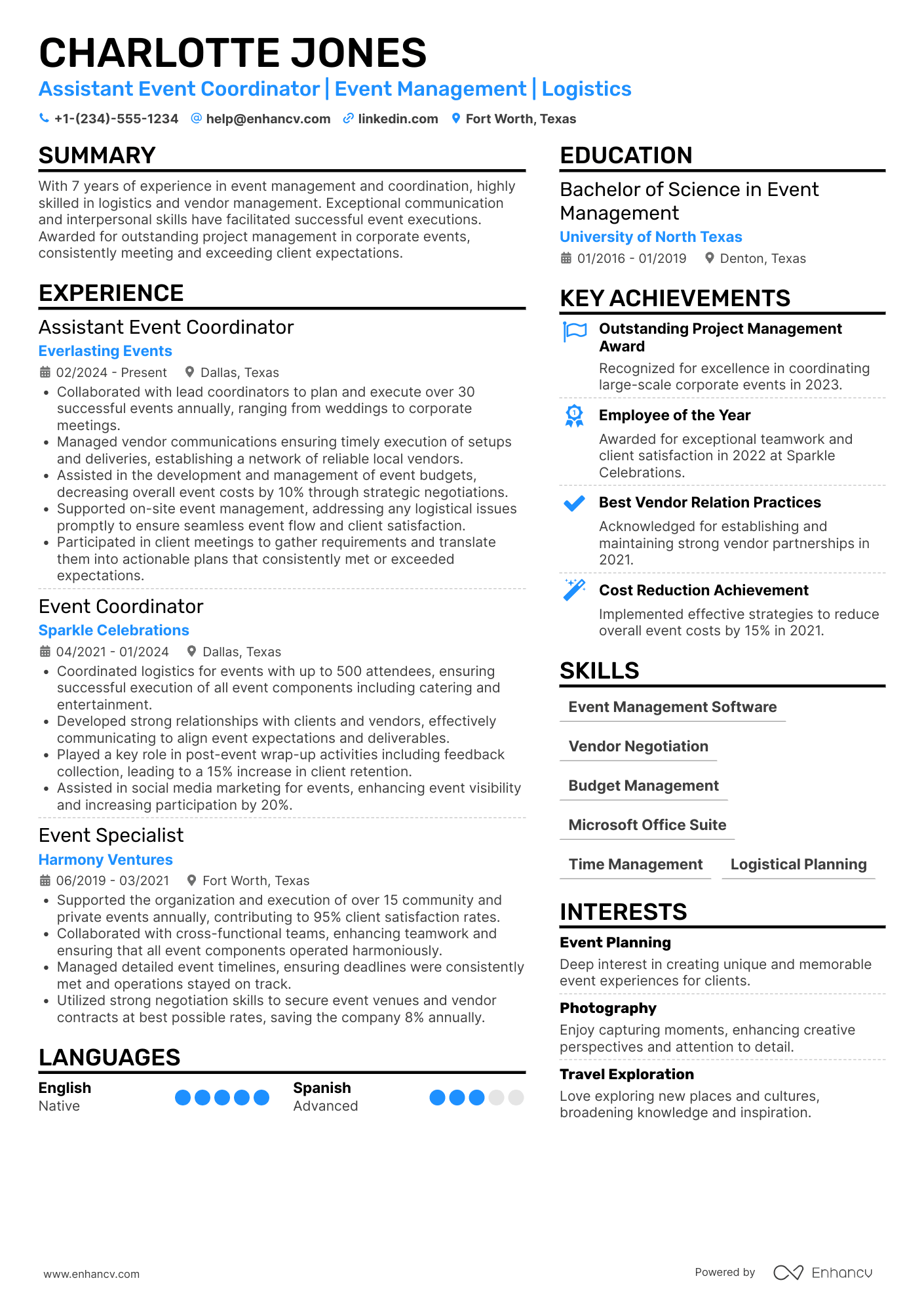
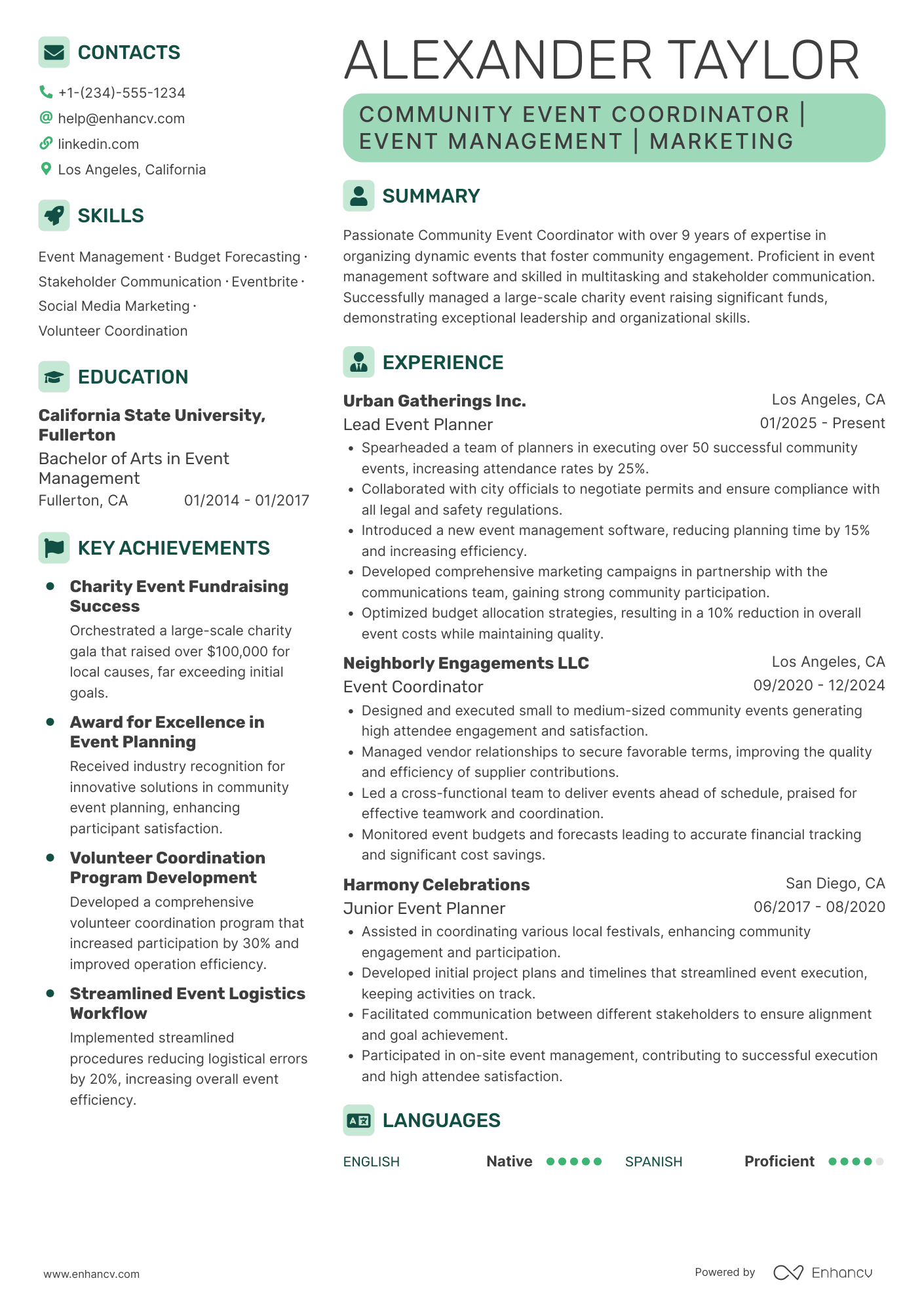
Many event coordinator resumes fail because they read like task lists and bury results, so recruiters can't see impact in a quick scan. This event coordinator resume guide shows how to surface proof fast for ATS screening and crowded applicant pools.
A strong resume shows what you delivered, not just what you used. Knowing how to write a resume that highlights attendance growth, budget savings, vendor performance, on-time launches, stakeholder satisfaction scores, sponsor revenue, and smooth execution across multi-day, multi-location events is what sets top candidates apart.

Key takeaways
- Quantify every experience bullet with metrics like attendance, budget savings, or satisfaction scores.
- Use reverse-chronological format for seasoned coordinators and hybrid format for career changers.
- Tailor each resume to the job posting's exact tools, event types, and KPIs.
- Place skills above experience if you're junior, below it if you're senior.
- Pair hard skills like Cvent and Asana with soft skills demonstrated through measurable outcomes.
- Use AI to tighten phrasing and align keywords, but stop before it inflates claims.
- Enhancv's bullet point generator helps turn vague duties into recruiter-ready, quantified statements.
Job market snapshot for event coordinators
We analyzed 451 recent event coordinator job ads across major US job boards. These numbers help you understand regional hotspots, salary landscape, employment type trends at a glance.
What level of experience employers are looking for event coordinators
| Years of Experience | Percentage found in job ads |
|---|---|
| 1–2 years | 14.9% (67) |
| 3–4 years | 9.3% (42) |
| 5–6 years | 1.6% (7) |
| 7–8 years | 0.7% (3) |
| 10+ years | 1.1% (5) |
| Not specified | 72.3% (326) |
Event coordinator ads by area of specialization (industry)
| Industry (Area) | Percentage found in job ads |
|---|---|
| Finance & Banking | 49.9% (225) |
| Education | 19.3% (87) |
| Retail & E-commerce | 11.8% (53) |
| Healthcare | 9.1% (41) |
| Government | 3.5% (16) |
Top companies hiring event coordinators
| Company | Percentage found in job ads |
|---|---|
| Michaels Stores | 23.1% (104) |
| Fooda | 7.8% (35) |
| Dave & Buster's, Inc. | 2.7% (12) |
Role overview stats
These tables show the most common responsibilities and employment types for event coordinator roles. Use them to align your resume with what employers expect and to understand how the role is structured across the market.
Day-to-day activities and top responsibilities for a event coordinator
| Responsibility | Percentage found in job ads |
|---|---|
| Microsoft office | 18.8% (85) |
| Excel | 10.2% (46) |
| Word | 6.7% (30) |
| Pos | 5.5% (25) |
| Powerpoint | 5.5% (25) |
| Outlook | 5.3% (24) |
| Canva | 5.1% (23) |
| Mobile app | 5.1% (23) |
| Point-of-sale | 5.1% (23) |
| Project management | 5.1% (23) |
| Microsoft word | 4.9% (22) |
| Customer service | 4.0% (18) |
Type of employment (remote vs on-site vs hybrid)
| Employment type | Percentage found in job ads |
|---|---|
| On-site | 89.6% (404) |
| Hybrid | 8.6% (39) |
| Remote | 1.8% (8) |
How to format a event coordinator resume
Recruiters evaluating event coordinator resumes prioritize organizational skills, vendor and budget management experience, and measurable event outcomes such as attendance growth or cost savings. Choosing the right resume format ensures these signals surface quickly during both a six-second recruiter scan and an applicant tracking system (ATS) parse. A clean, well-structured layout makes all the difference.

I have significant experience in this role—which format should I use?
Use the reverse-chronological format to present your deepest event coordination experience first and build a clear narrative of growing responsibility. Do:
- Lead with your most recent role, emphasizing the scope and ownership of events you managed—venue size, guest count, budget authority, and cross-functional teams coordinated.
- Highlight role-specific tools and domains such as Cvent, Eventbrite, budget tracking software, contract negotiation, and vendor relationship management.
- Anchor every bullet to a measurable outcome or business impact rather than a task description.
I'm junior or switching into this role—what format works best?
Use a hybrid format so you can lead with a focused skills section while still showing relevant experience in chronological order. Do:
- Place a skills section near the top that highlights core competencies like logistics coordination, timeline management, vendor sourcing, and budgeting.
- Include projects, volunteer events, or transitional experience—such as organizing fundraisers, campus events, or community programs—that demonstrate coordination ability.
- Connect every action to a clear result so recruiters see impact, not just participation.
Why not use a functional resume?
A functional resume strips away the timeline and context recruiters need to evaluate how, where, and when you applied your event coordination skills, making it harder to verify your experience and easier for an ATS to misread your qualifications.
- Edge case: A functional format may be acceptable if you're making a career change from hospitality or project management into event coordination, have limited direct work history, or need to address significant resume gaps—but only if every listed skill is tied to a specific project and a quantifiable outcome.
Once you've established a clean, readable format, the next step is filling it with the right sections to showcase your qualifications effectively.
What sections should go on a event coordinator resume
Recruiters expect your event coordinator resume to show you can plan, execute, and improve events through measurable results. Understanding which resume sections to include ensures maximum clarity.
Use this structure:
- Header
- Summary
- Experience
- Skills
- Projects
- Education
- Certifications
- Optional sections: Awards, Volunteering, Languages
Your strongest experience bullets should highlight event scale, budget ownership, vendor and stakeholder coordination, timelines delivered, attendee satisfaction, and quantified outcomes.
Is your resume good enough?
Drop your resume here or choose a file. PDF & DOCX only. Max 2MB file size.
Once you’ve organized your resume with the right core components, the next step is to write your event coordinator resume experience section so it clearly supports the role.
How to write your event coordinator resume experience
Your experience section should highlight the events you've planned and delivered, the coordination tools and methods you used, and the measurable outcomes those efforts produced. Hiring managers prioritize demonstrated impact—attendance growth, budget savings, client satisfaction scores—over descriptive task lists that simply catalog daily duties. Writing a targeted resume that aligns each bullet with the employer's priorities is the fastest way to stand out.
Each entry should include:
- Job title
- Company and location (or remote)
- Dates of employment (month and year)
Three to five concise bullet points showing what you owned, how you executed, and what outcomes you delivered:
- Ownership scope: the events, venues, vendor relationships, budgets, or client accounts you were directly accountable for as an event coordinator.
- Execution approach: the project management platforms, scheduling tools, vendor negotiation methods, or logistics frameworks you used to plan and deliver events on time and within budget.
- Value improved: changes to event quality, attendee experience, operational efficiency, timeline reliability, or cost management that resulted from your coordination work.
- Collaboration context: how you worked with clients, venues, caterers, AV teams, sponsors, marketing departments, or other cross-functional and external stakeholders to align on event goals and execution.
- Impact delivered: outcomes expressed through attendance results, revenue generated, client retention, budget performance, or brand visibility rather than a list of tasks completed.
Experience bullet formula
A event coordinator experience example
✅ Right example - modern, quantified, specific.
Event Coordinator
BrightWave Conferences | Austin, TX
2022–Present
B2B events agency producing multi-track conferences and client roadshows for tech and healthcare brands.
- Led end-to-end delivery of twelve conferences and twenty-six client activations annually (150–1,200 attendees), increasing sponsor revenue 18% by tightening run-of-show execution and onsite experience.
- Negotiated with venues and vendors using Cvent and Excel budget models, cutting per-event costs 12% while maintaining a 4.7/5 attendee satisfaction score.
- Built Airtable-based project plans and Slack workflows across sales, design, and production partners, reducing timeline slippage 30% and saving eight hours per event in status reporting.
- Managed speaker logistics for 90+ presenters per year using Google Workspace and Calendly, reducing last-minute schedule changes 40% and improving session start-time adherence to 98%.
- Implemented QR-code check-in via Eventbrite and Zapier integrations to Salesforce, cutting onsite registration time 55% and improving lead capture completeness from 82% to 96%.
Now that you've seen how to structure your experience with strong, results-driven bullet points, let's look at how to adapt that content to match the specific event coordinator role you're targeting.
How to tailor your event coordinator resume experience
Recruiters evaluate your event coordinator resume through applicant tracking systems and manual review, scoring how closely your experience matches the posting. Tailoring your resume to the job description ensures your qualifications surface during both screening stages.
Ways to tailor your event coordinator experience:
- Match event management platforms and registration tools named in the posting.
- Mirror the exact terminology used for vendor coordination or logistics processes.
- Reflect attendance figures or budget KPIs the employer highlights as priorities.
- Include relevant venue types or industry verticals the role specifically requires.
- Emphasize compliance with accessibility or safety standards when the posting mentions them.
- Highlight cross-functional collaboration with marketing or sales teams if referenced.
- Align your workflow descriptions with project management frameworks they specify.
- Feature sponsor relations or stakeholder engagement if the job description prioritizes them.
Tailoring means aligning your real accomplishments with each job's stated requirements, not forcing disconnected keywords into your experience section.
Resume tailoring examples for event coordinator
| Job description excerpt | Untailored | Tailored |
|---|---|---|
| Plan and execute corporate conferences for 500+ attendees using Cvent for registration, budgeting, and post-event reporting | Helped plan events and handled registration tasks | Planned and executed corporate conferences for 500–800 attendees, managing end-to-end registration, budgeting, and post-event reporting through Cvent |
| Coordinate with vendors, negotiate contracts, and manage event budgets up to $150K while ensuring alignment with brand guidelines | Worked with vendors and kept events on budget | Negotiated contracts with 20+ vendors per event cycle, managing budgets up to $150K and ensuring all deliverables aligned with established brand guidelines |
| Oversee hybrid event production including AV setup, live-streaming via Zoom Webinars, and on-site logistics for fundraising galas | Assisted with event logistics and technology setup | Oversaw hybrid fundraising gala production for 300 in-person and 1,200 virtual guests, directing AV setup and live-streaming execution via Zoom Webinars |
Once you’ve aligned your experience with the role’s priorities, the next step is to quantify your event coordinator achievements so hiring teams can see the impact behind that fit.
How to quantify your event coordinator achievements
Quantifying your achievements proves you drove results, not just activity. For event coordinators, focus on attendee volume, budget variance, vendor performance, satisfaction scores, timelines, and risk reduction.
Quantifying examples for event coordinator
| Metric | Example |
|---|---|
| Budget control | "Delivered a 450-attendee conference 6% under a $120,000 budget by renegotiating venue and catering contracts and tracking spend in Excel." |
| Delivery speed | "Cut planning cycle time from 10 weeks to eight by standardizing Asana templates, weekly stakeholder check-ins, and a shared run-of-show document." |
| Quality and satisfaction | "Raised post-event satisfaction from 4.2 to 4.7 out of five across 320 surveys by improving signage, session pacing, and on-site support coverage." |
| Revenue impact | "Increased sponsorship revenue 18% ($45,000 to $53,000) by packaging tiered benefits and managing outreach and follow-ups in HubSpot." |
| Risk reduction | "Reduced day-of incidents by 40% by running two full rehearsals, tightening vendor service-level agreements, and implementing a QR-based check-in backup plan." |
Turn vague job duties into measurable, recruiter-ready resume bullets in seconds with Enhancv's Bullet Point Generator.
With strong bullet points in place, the next step is ensuring your skills section highlights the right mix of hard and soft skills for an event coordinator role.
How to list your hard and soft skills on a event coordinator resume
Your skills section shows you can plan, execute, and troubleshoot events, and recruiters and an ATS (applicant tracking system) scan it to confirm role fit; aim for a balanced mix of hard skills like tools and technical proficiencies and execution-focused soft skills. event coordinator roles require a blend of:
- Product strategy and discovery skills.
- Data, analytics, and experimentation skills.
- Delivery, execution, and go-to-market discipline.
- Soft skills.
Your skills section should be:
- Scannable (bullet-style grouping).
- Relevant to the job post.
- Backed by proof in experience bullets.
- Updated with current tools.
Place your skills section:
- Above experience if you're junior or switching careers.
- Below experience if you're mid/senior with strong achievements.

Hard skills
- Event budgeting and forecasting
- Vendor sourcing and contracting
- Venue sourcing and site inspections
- Run of show development
- Registration platforms: Cvent, Eventbrite
- Project management tools: Asana, Trello, Monday.com
- Floor plans and seating charts
- Audio visual and staging coordination
- Catering and banquet event orders
- Risk assessments and contingency plans
- Post-event surveys and reporting
- Microsoft Excel, Google Sheets
Soft skills
- Stakeholder alignment and updates
- Vendor negotiation and follow-through
- On-site issue triage under pressure
- Clear timeline ownership
- Cross-functional coordination
- Prioritization across competing requests
- Calm, direct attendee communication
- Detail control without bottlenecks
- Decision-making with incomplete info
- Escalation judgment and speed
- Quality checks and final approvals
- Feedback collection and actioning
How to show your event coordinator skills in context
Skills shouldn't live only in a bulleted list on your resume. Explore resume skills examples to see how top candidates weave competencies throughout their documents.
They should be demonstrated in:
- Your summary (high-level professional identity)
- Your experience (proof through outcomes)
Here's what strong, skill-rich entries look like in practice.
Summary example
Event coordinator with eight years of experience producing corporate conferences and trade shows for Fortune 500 clients. Skilled in Cvent, vendor negotiation, and cross-functional logistics. Delivered 60+ events annually while reducing average planning costs by 18%.
- Reflects senior-level experience clearly
- Names industry-standard tools like Cvent
- Includes a concrete cost-reduction metric
- Highlights negotiation as a soft skill
Experience example
Senior Event Coordinator
Briarwood Hospitality Group | Chicago, IL
June 2019–Present
- Planned and executed 75+ annual corporate events using Cvent and Asana, increasing client satisfaction scores by 22%.
- Collaborated with marketing, catering, and AV teams to streamline day-of operations, cutting setup time by 30%.
- Managed vendor contracts and budget forecasting for events averaging $120K, consistently finishing 10% under budget.
- Every bullet includes a measurable outcome.
- Skills surface naturally through real achievements.
Once you’ve demonstrated your event coordination strengths through concrete examples and outcomes, the next step is applying that approach to building an event coordinator resume with no experience.
How do I write a event coordinator resume with no experience
Even without full-time experience, you can demonstrate readiness through transferable projects and volunteer work. Our guide on building a resume without work experience walks you through the process step by step. Consider highlighting:
- Campus event planning committees.
- Volunteer festival or race logistics.
- Student club speaker series coordination.
- Fundraiser registration and check-in.
- Venue setup and teardown crews.
- Vendor outreach for student events.
- Social media promotion for events.
- Budget tracking for club events.
Focus on:
- Clear event scope and outcomes.
- Tools used and proficiency.
- Budgets, timelines, and logistics.
- Vendor, venue, and attendee coordination.
Resume format tip for entry-level event coordinator
Use a combination resume format because it highlights event coordinator skills and measurable projects while still showing steady work history and reliability. Do:
- Add a "Projects" section near top.
- Quantify attendance, budget, and deadlines.
- List tools: Google Sheets, Eventbrite.
- Tailor bullets to each event type.
- Include logistics tasks: vendors, venues.
- Coordinated student club speaker series for 120 attendees using Eventbrite, Google Sheets, and run-of-show checklists, reducing check-in time by 30 percent.
Even without formal work experience, your education section can serve as a strong foundation for your event coordinator resume.
How to list your education on a event coordinator resume
Your education section helps hiring teams confirm you have foundational knowledge in areas like project management, communications, or hospitality—all critical to succeeding as an event coordinator.
Include:
- Degree name
- Institution
- Location
- Graduation year
- Relevant coursework (for juniors or entry-level candidates)
- Honors & GPA (if 3.5 or higher)
Skip month and day details—list only the graduation year for a cleaner look.
Here's a strong education entry tailored for an event coordinator resume.
Example education entry
Bachelor of Science in Hospitality Management
University of Central Florida, Orlando, FL
Graduated 2021
GPA: 3.7/4.0
- Relevant Coursework: Event Planning & Design, Budget Management, Vendor Relations, Marketing Communications
- Honors: Magna Cum Laude, Dean's List (six semesters)
How to list your certifications on a event coordinator resume
Certifications on your resume show your commitment to learning, your proficiency with event tools, and your industry relevance as an event coordinator. They also help employers trust your ability to plan, coordinate, and deliver successful events.
Include:
- Certificate name
- Issuing organization
- Year
- Optional: credential ID or URL
- Put certifications below education when they're older, broad, or less connected to your current event coordinator goals.
- Put certifications above education when they're recent, highly relevant, or required for the event coordinator roles you target.
Best certifications for your event coordinator resume
Certified Meeting Professional (CMP) Certified Special Events Professional (CSEP) Certified Government Meeting Professional (CGMP) Digital Event Strategist (DES) Certified Professional in Catering and Events (CPCE) Event Management Certificate (Events Industry Council)
Once you’ve highlighted the credentials that validate your event planning skills, use your event coordinator resume summary to frame them in a results-focused introduction.
How to write your event coordinator resume summary
Your resume summary is the first thing a recruiter reads, so it needs to earn their attention fast. A strong opening frames you as a capable event coordinator before they scan a single bullet point.
Keep it to three to four lines, with:
- Your title and total years of event coordination experience.
- The type of events, industries, or venues you've worked in.
- Core tools and skills like Cvent, budgeting, vendor negotiation, or logistics platforms.
- One or two measurable achievements, such as events delivered under budget or attendance growth.
- Soft skills tied to real outcomes, like stakeholder communication that reduced planning delays.

PRO TIP
At the coordinator level, emphasize specific skills, tools, and early wins that prove you can execute. Highlight the types and scale of events you've managed. Avoid vague phrases like "passionate team player" or "detail-oriented go-getter." Recruiters want proof, not personality descriptors.
Example summary for a event coordinator
Event coordinator with two years of experience planning corporate and nonprofit events for up to 500 attendees. Skilled in Cvent, vendor coordination, and on-site logistics. Reduced average event setup time by 20% through streamlined scheduling.
Optimize your resume summary and objective for ATS
Drop your resume here or choose a file.
PDF & DOCX only. Max 2MB file size.
Now that your summary captures your strongest qualifications, make sure the header above it presents your contact details correctly so recruiters can actually reach you.
What to include in a event coordinator resume header
A well-crafted resume header lists your key contact details and role focus, which boosts visibility, builds credibility, and helps recruiters screen your event coordinator fit fast.
Essential resume header elements
- Full name
- Tailored job title and headline
- Location
- Phone number
- Professional email
- GitHub link
- Portfolio link
A LinkedIn link helps recruiters verify your timeline, titles, and recommendations quickly during screening.
Don't include a photo on a event coordinator resume unless the role is explicitly front-facing or appearance-dependent.
Match your header title and headline to the job posting and include keywords like "event coordinator," "vendor management," and "on-site logistics."
Event coordinator resume header
Jordan Taylor
Event coordinator | Corporate events, vendor coordination, and on-site logistics
Austin, TX
(512) 555-01XX
your.name@enhancv.com
github.com/yourname
yourwebsite.com
linkedin.com/in/yourname
Once your contact details and role identifiers are set up for quick employer reference, add additional sections to highlight supporting qualifications that strengthen the rest of your resume.
Additional sections for event coordinator resumes
Extra resume sections help you stand out when your core experience doesn't fully capture your event coordination strengths or specialized expertise. For example, listing language skills can set you apart when coordinating international events or working with diverse vendor teams.
- Languages
- Certifications (CMP, CSEP, CGMP)
- Volunteer event coordination
- Professional affiliations (MPI, ILEA, NACE)
- Awards and recognition
- Hobbies and interests
- Publications or speaking engagements
Once you've strengthened your resume with well-chosen additional sections, the next step is pairing it with a cover letter that adds even more context to your candidacy.
Do event coordinator resumes need a cover letter
Event coordinator resumes don't always need a cover letter. But understanding what a cover letter is and when to use one helps in competitive roles, client-facing teams, or when hiring managers expect context. It can make a difference when your resume needs a clear story.
Use a cover letter to add details your resume can't:
- Explain role and team fit: Connect your planning style to their event types, vendors, timelines, and cross-functional partners.
- Highlight one or two relevant projects or outcomes: Name the event, scope, budget, attendance, and a measurable result like cost savings or satisfaction scores.
- Show understanding of the product, users, or business context: Reference their audience, brand voice, and goals, and how you'd support them through event execution.
- Address career transitions or non-obvious experience: Translate adjacent work into event coordinator skills, such as logistics, stakeholder management, and risk planning.
Drop your resume here or choose a file.
PDF & DOCX only. Max 2MB file size.
Even if you include a cover letter to add context beyond your resume, AI can help you strengthen your event coordinator resume faster and more consistently, which is why we’ll cover how to use it next.
Using AI to improve your event coordinator resume
AI can sharpen your resume's clarity, structure, and impact. It helps you find stronger phrasing and tighten loose bullets. But overuse strips authenticity fast. Once your content reads clearly and fits the role, step away from AI entirely. If you're wondering which AI is best for writing resumes, the answer depends on your specific needs and how much editing control you want.
Here are 10 practical prompts you can copy, paste, and use right now:
- Strengthen summary focus: "Rewrite my event coordinator resume summary to highlight my top three planning strengths and measurable results."
- Quantify experience bullets: "Add specific metrics like attendance numbers, budgets, or timelines to these event coordinator experience bullets."
- Tighten action verbs: "Replace weak or passive verbs in my event coordinator experience section with strong, industry-relevant action verbs."
- Align skills section: "Compare my event coordinator skills section against this job description and suggest missing relevant skills."
- Clarify project scope: "Rewrite this event coordinator project description to clearly define my role, the event scale, and the outcome."
- Refine education details: "Improve my education section to emphasize coursework and achievements most relevant to an event coordinator role."
- Spotlight certifications: "Rewrite my certifications section to show how each credential directly supports my event coordinator qualifications."
- Remove redundancy: "Identify and remove any repetitive phrasing across all sections of my event coordinator resume."
- Improve bullet consistency: "Restructure my event coordinator experience bullets so they follow a consistent action-result format throughout."
- Tailor for ATS: "Adjust my event coordinator resume wording to naturally incorporate keywords from this specific job posting."
Stop using AI once your resume sounds accurate, specific, and aligned with real experience. AI should never invent experience or inflate claims—if it didn't happen, it doesn't belong here.
Conclusion
A strong event coordinator resume shows measurable outcomes, role-specific skills, and a clear structure. Use metrics like budget savings, attendance growth, vendor performance, and on-time delivery. Highlight logistics, vendor management, stakeholder communication, and problem-solving.
Keep sections easy to scan, and align your experience with the role’s needs. This approach fits today’s hiring market and supports near-future expectations for speed, accuracy, and accountability. With clear results and focused skills, you’ll look ready to lead events.
Event Coordinator resume examples
By Experience
By Role