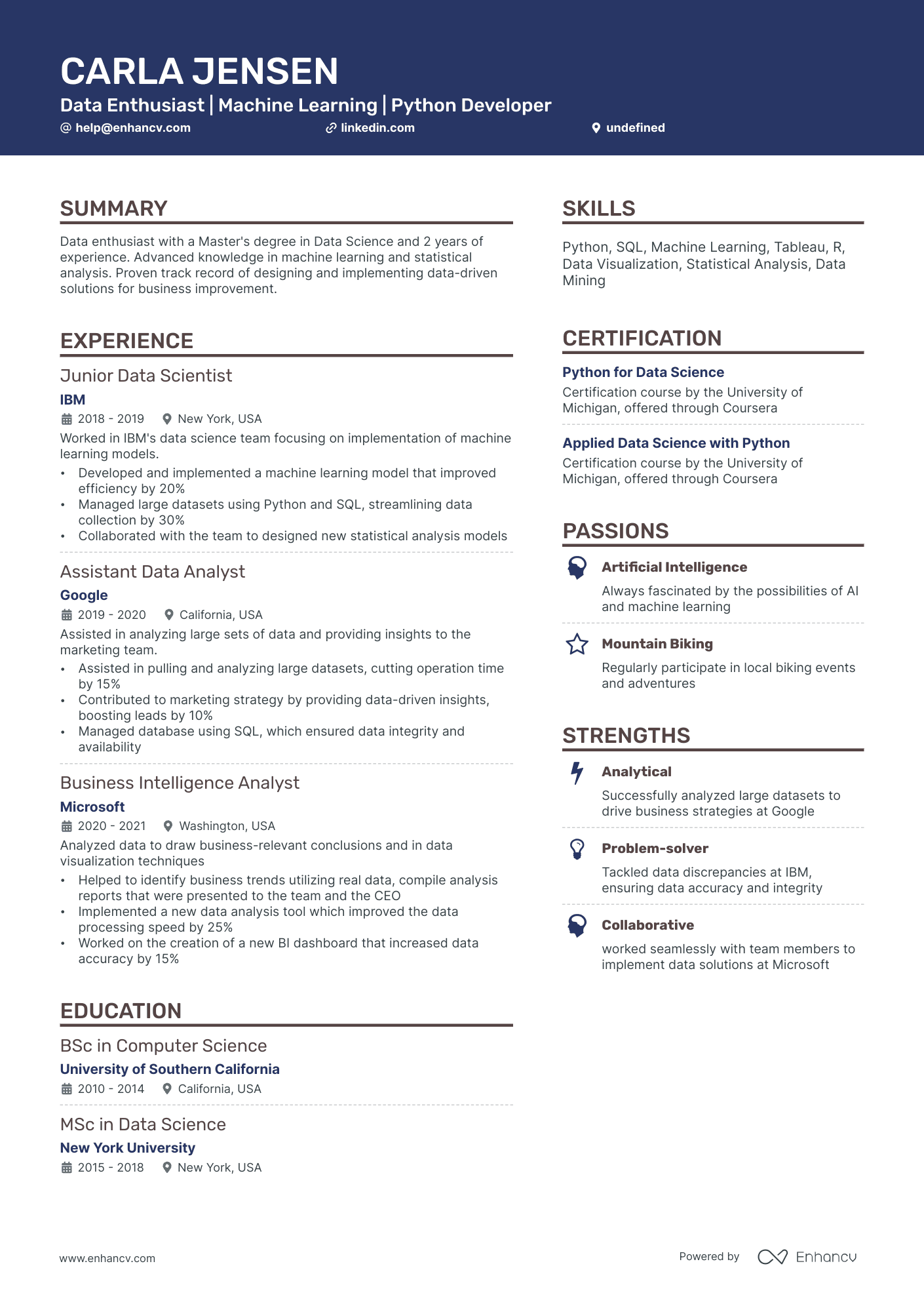
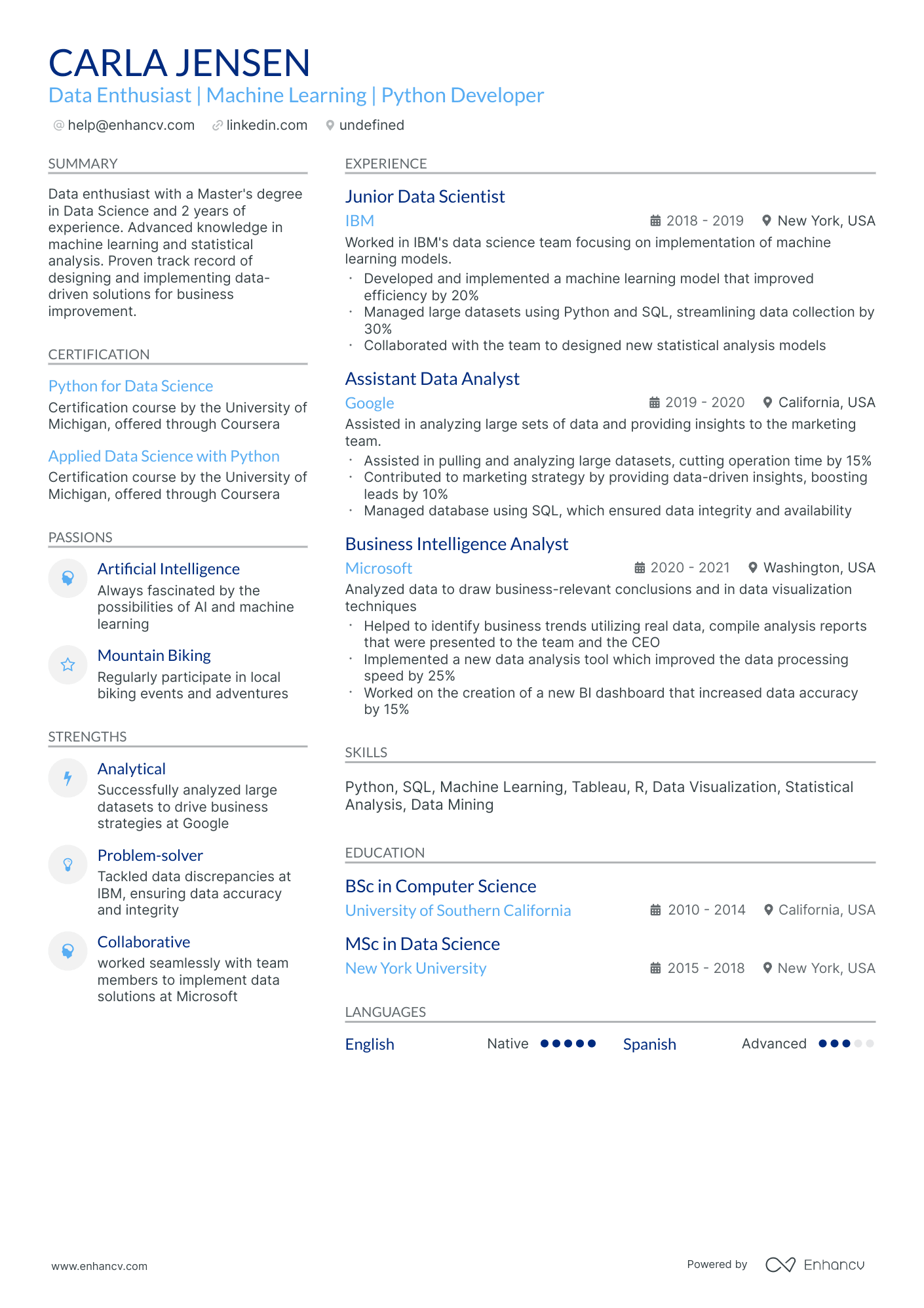
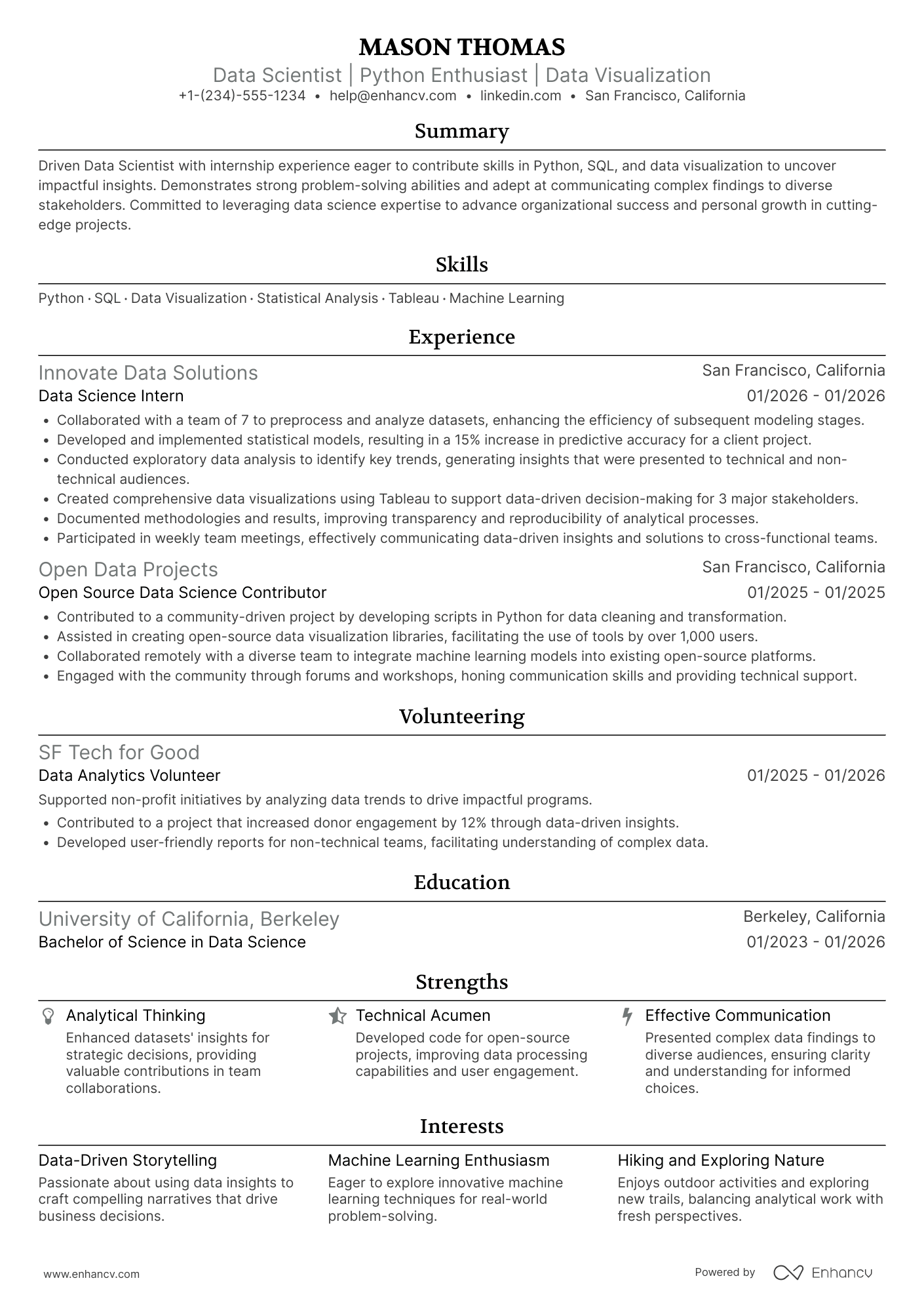
Most entry-level data scientist resumes fail because they read like coursework summaries and tool lists, not evidence of impact. That hurts in entry-level data scientist resume reviews, where ATS filters keywords and recruiters scan fast in a crowded pipeline.
A strong resume shows what you changed, not just what you used. Understanding how to make your resume stand out means highlighting accuracy gains, reduced processing time, validated lift in an experiment, model performance on real data, dashboards that drove decisions, and measurable cost, revenue, or retention impact.

Key takeaways
- Quantify every bullet with metrics like model accuracy, cost savings, or time reduced.
- Use a hybrid format if you lack full-time data science experience.
- Tailor each resume to mirror the job posting's exact tools and terminology.
- Anchor every listed skill to a specific project, result, or deliverable.
- Lead with a projects section when internships or work history are limited.
- Place certifications above education when they align more closely with the target role.
- Use Enhancv's Bullet Point Generator to turn vague duties into measurable, recruiter-ready statements.
How to format a entry-level data scientist resume
Recruiters screening entry-level data scientist resumes prioritize technical skills (Python, SQL, machine learning frameworks), relevant projects or internships, and evidence that you can translate data into actionable insights. Your resume format determines how quickly a hiring manager spots these signals—and whether an applicant tracking system (ATS) parses them correctly.

I have significant experience in this role—which format should I use?
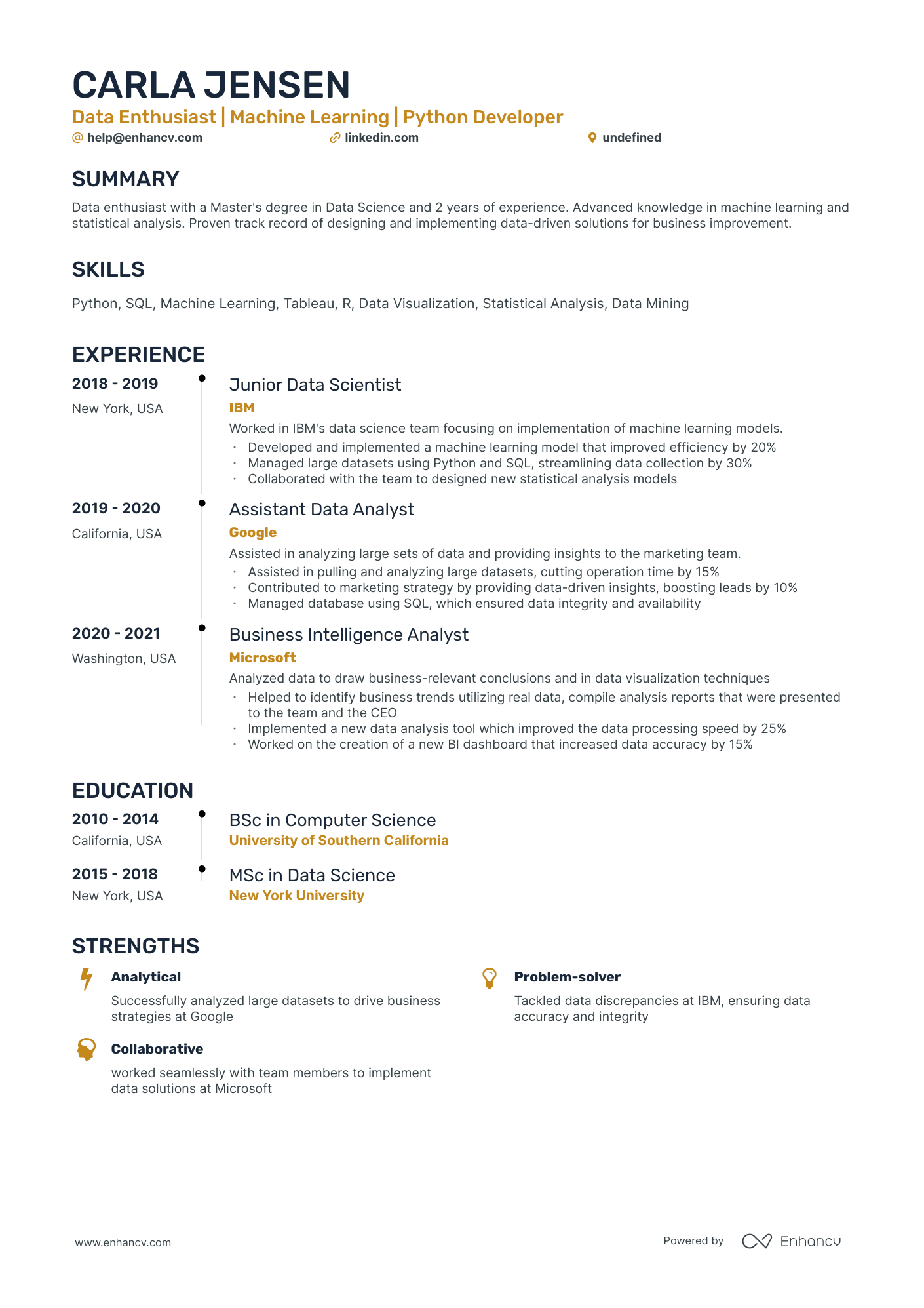
Use a reverse-chronological format to present your data science experience in a clear, linear timeline that highlights growing technical depth and impact. Do:
- Lead with your most recent role and emphasize scope of ownership—datasets managed, models deployed, stakeholders served.
- Feature role-specific tools and domains prominently (Python, R, TensorFlow, SQL, NLP, A/B testing, cloud platforms).
- Quantify outcomes tied to business value, such as accuracy improvements, cost reductions, or revenue impact.
I'm junior or switching into this role—what format works best?
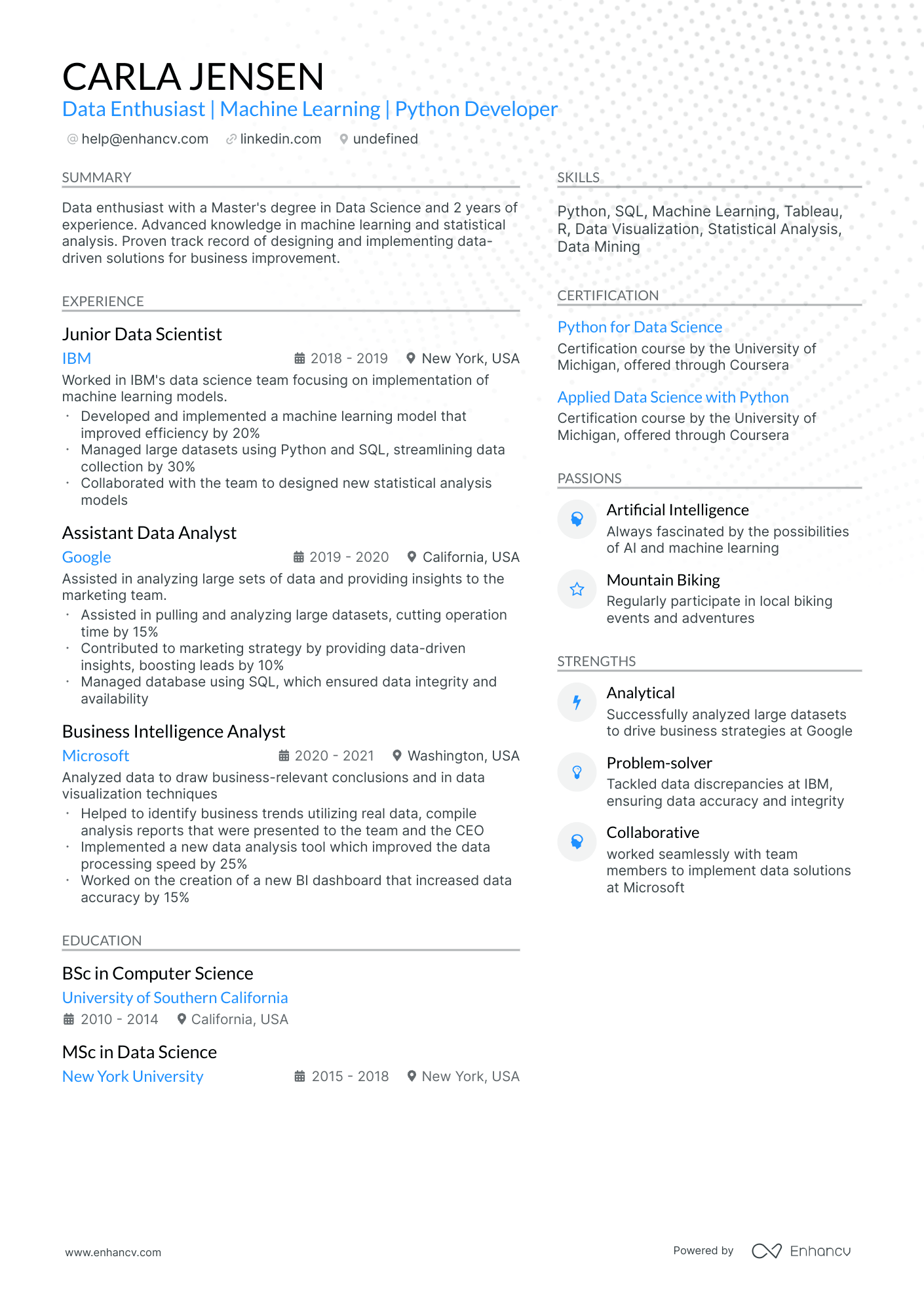
Use a hybrid format that leads with a strong technical skills section, then supports it with project experience, internships, or academic work in reverse-chronological order. Do:
- Place a dedicated skills section near the top listing programming languages, libraries, statistical methods, and visualization tools so ATS software and recruiters find them immediately.
- Highlight capstone projects, Kaggle competitions, research, or freelance work that demonstrates hands-on data science application.
- Connect every action to a measurable or observable result, even in academic or personal projects.
When does a functional resume make sense?
A functional format is rarely the best choice for entry-level data scientists, but it can work in a narrow set of circumstances:
- You're transitioning from a non-technical field (such as research science, finance, or academia) and need to reframe transferable analytical skills.
- You have a significant gap in your work history but have completed recent data science bootcamps, certifications, or portfolio projects.
- A functional format is acceptable when you're making a career change or have limited formal work experience, but only if every skill listed is anchored to a specific project, course, or measurable outcome rather than presented as a standalone claim.
With your resume's structure and layout in place, the next step is determining which sections to include so each one strengthens your candidacy.
What sections should go on a entry-level data scientist resume
Recruiters expect you to show you can apply statistics, programming, and machine learning to deliver measurable business results. Knowing what to put on a resume helps you prioritize the sections that matter most.
Use this structure for maximum clarity:
- Header
- Summary
- Experience
- Skills
- Projects
- Education
- Certifications
- Optional sections: Publications, Open-source work, Research
Strong experience bullets should emphasize measurable impact, the scope of your work, and results tied to models, analyses, and data pipelines you built or improved.
Is your resume good enough?
Drop your resume here or choose a file. PDF & DOCX only. Max 2MB file size.
Now that you’ve laid out the key building blocks of your entry-level data scientist resume, the next step is to write the experience section so it supports those elements with clear, role-relevant proof.
How to write your entry-level data scientist resume experience
Your experience section proves you can deliver real data science work—not just describe coursework or theoretical knowledge. Hiring managers prioritize demonstrated impact over descriptive task lists, so focus each entry on shipped analyses, role-relevant tools and methods, and measurable outcomes that show what your work actually changed.
Each entry should include:
- Job title
- Company and location (or remote)
- Dates of employment (month and year)
Three to five concise bullet points showing what you owned, how you executed, and what outcomes you delivered:
- Ownership scope: the datasets, models, pipelines, analytical projects, or reporting systems you were directly accountable for as an entry-level data scientist.
- Execution approach: the programming languages, statistical methods, machine learning frameworks, data visualization tools, or query languages you used to explore data and deliver insights.
- Value improved: changes to prediction accuracy, processing speed, data quality, reporting reliability, or decision-making efficiency that resulted from your data science contributions.
- Collaboration context: how you worked with engineers, product managers, business analysts, or other stakeholders to translate data findings into actionable recommendations tied to organizational goals.
- Impact delivered: outcomes framed as tangible results for the business or team—such as improvements in forecasting, reductions in manual effort, or contributions to product and strategy decisions—rather than a list of tasks you performed.
Experience bullet formula
A entry-level data scientist experience example
✅ Right example - modern, quantified, specific.
Data Scientist I
BrightCart | Austin, TX
2024–Present
E-commerce marketplace supporting one million monthly active users across web and mobile.
- Built a Python and SQL churn prediction model (XGBoost) with 0.84 area under the receiver operating characteristic curve, enabling targeted retention offers that reduced thirty-day churn by 6.8%.
- Developed an end-to-end feature pipeline in Databricks and dbt, cutting model refresh time from eight hours to forty-five minutes and improving data reliability with automated Great Expectations checks.
- Partnered with product managers and designers to run seven A/B tests in Optimizely; increased checkout conversion by 2.1% and added $420K in annualized gross merchandise value.
- Created a Looker dashboard and metric definitions for cohort retention and lifetime value; reduced weekly stakeholder reporting time by 70% and aligned KPIs across product and marketing.
- Deployed a recommendation ranking model via FastAPI and Docker with engineering; improved click-through rate by 4.3% while meeting a 150-millisecond p95 latency target.
Now that you've seen how to structure your experience section, let's look at how to tailor each bullet point to match the specific job posting you're applying for.
How to tailor your entry-level data scientist resume experience
Recruiters evaluate entry-level data scientist resumes through both human review and applicant tracking systems (ATS). Tailoring your resume to the job description increases your chances of passing both screenings.
Ways to tailor your entry-level data scientist experience:
- Match programming languages and tools listed in the job description.
- Mirror the exact statistical methods or modeling techniques mentioned.
- Use the same terminology for data pipelines or ETL processes referenced.
- Highlight experience with the specific visualization platforms they require.
- Include domain knowledge relevant to the company's industry focus.
- Reflect machine learning frameworks or libraries named in the posting.
- Emphasize data quality or validation practices when the role specifies them.
- Align collaboration references with cross-functional workflows they describe.
Tailoring means framing your real accomplishments in the language of the job posting, not forcing in keywords where they don't belong.
Resume tailoring examples for entry-level data scientist
| Job description excerpt | Untailored | Tailored |
|---|---|---|
| "Build and deploy predictive models using Python and scikit-learn to support product analytics decisions." | Worked on data projects and helped with analysis tasks. | Built predictive classification models in Python using scikit-learn to forecast user churn, improving product retention targeting accuracy by 18%. |
| "Collaborate with cross-functional teams to design A/B tests and analyze experiment results using SQL and statistical methods." | Assisted team members with various data-related tasks and reporting. | Partnered with product and marketing teams to design and analyze 12 A/B tests using SQL and hypothesis testing, delivering actionable insights that increased conversion rates by 9%. |
| "Clean, transform, and visualize large datasets using Pandas and Tableau to communicate findings to non-technical stakeholders." | Created charts and helped prepare data for presentations. | Transformed and cleaned datasets of 500K+ records using Pandas, then built interactive Tableau dashboards that reduced stakeholder reporting turnaround time from five days to one. |
Once your experience aligns with the role’s priorities, quantify your entry-level data scientist achievements to show the impact of that work.
How to quantify your entry-level data scientist achievements
Quantifying your achievements shows you delivered measurable results, not just analysis. Focus on model performance, data quality, pipeline speed, cost savings, and delivery outcomes that improved decisions, reduced errors, or shipped reliable features.
Quantifying examples for entry-level data scientist
| Metric | Example |
|---|---|
| Model performance | "Improved churn model ROC AUC from 0.74 to 0.82 using XGBoost and feature engineering on 120,000 customer records." |
| Data quality | "Reduced missing critical fields from 8.5% to 1.9% by adding Great Expectations checks and fixing three upstream extraction issues." |
| Pipeline throughput | "Cut daily training pipeline runtime from 55 minutes to 18 minutes by optimizing pandas joins and parallelizing preprocessing in Python." |
| Reliability | "Raised scheduled job success rate from 92% to 99.6% by adding retries, alerts, and idempotent writes in Airflow." |
| Delivery speed | "Shipped a forecasting dashboard in six business days, enabling weekly planning and replacing a manual spreadsheet process used by eight stakeholders." |
Turn vague job duties into measurable, recruiter-ready resume bullets in seconds with Enhancv's Bullet Point Generator.
With your experience clearly articulated in strong bullet points, the next step is ensuring your skills section effectively showcases the technical and interpersonal strengths that hiring managers expect from entry-level data scientists.
How to list your hard and soft skills on a entry-level data scientist resume
Your skills section matters because entry-level data scientists get screened fast by recruiters and an ATS (applicant tracking system) for role-fit keywords, and top resumes balance technical tools with business-facing execution and communication skills.
entry-level data scientist roles require a blend of:
- Product strategy and discovery skills
- Data, analytics, and experimentation skills
- Delivery, execution, and go-to-market discipline
- Soft skills
Your skills section should be:
- Scannable (bullet-style grouping).
- Relevant to the job post.
- Backed by proof in experience bullets.
- Updated with current tools.
Place your skills section:
- Above experience if you're junior or switching careers.
- Below experience if you're mid/senior with strong achievements.

Hard skills
Listing relevant hard skills demonstrates your technical capabilities:
- Python, pandas, NumPy
- SQL, window functions, joins
- scikit-learn, feature engineering
- Model evaluation, cross-validation
- Statistics, hypothesis testing
- Experiment design, A/B testing
- Data visualization, Tableau, Power BI
- Jupyter, Git, GitHub
- ETL pipelines, dbt, Airflow
- Cloud basics: AWS, GCP, Azure
- ML deployment basics, REST APIs
- Data quality checks, unit tests
Soft skills
Don't overlook soft skills that show how you work with teams and communicate insights:
- Translate business needs into metrics
- Communicate tradeoffs and assumptions
- Write clear analysis summaries
- Ask focused, clarifying questions
- Collaborate with product and engineering
- Prioritize work by impact and effort
- Document decisions and workflows
- Validate results before sharing
- Present findings to nontechnical audiences
- Take ownership of small deliverables
- Seek feedback and iterate quickly
- Manage stakeholders with regular updates
How to show your entry-level data scientist skills in context
Skills shouldn't live only in a bulleted list on your resume. Explore examples of resume skills to see how other candidates present them effectively.
They should be demonstrated in:
- Your summary (high-level professional identity)
- Your experience (proof through outcomes)
Here's what that looks like in practice.
Summary example
Entry-level data scientist with a statistics background in healthcare analytics. Built predictive models using Python and scikit-learn that improved patient readmission forecasts by 18%. Strong communicator skilled at translating complex findings for cross-functional teams.
- Reflects realistic entry-level experience
- Names specific tools and methods
- Leads with a measurable outcome
- Highlights communication as a soft skill
Experience example
Junior Data Scientist
Vantage Health Analytics | Remote
June 2023–April 2025
- Built a logistic regression model in Python that reduced false-positive patient flags by 22%, partnering with clinical operations to validate results.
- Automated weekly reporting dashboards using SQL and Tableau, saving the analytics team approximately five hours per week.
- Collaborated with product managers to design A/B tests that increased user engagement with the patient portal by 14%.
- Every bullet includes measurable proof
- Skills appear naturally through real outcomes
Once you’ve grounded your abilities in real examples and outcomes, the next step is learning how to write an entry-level data scientist resume with no experience so those details still come through clearly.
How do I write a entry-level data scientist resume with no experience
Even without full-time experience, you can demonstrate readiness. Writing a resume without work experience is possible through:
- Capstone data science course project
- Kaggle competition submissions and rankings
- Research assistant data analysis tasks
- Open-source data science contributions
- Internship analytics deliverables and dashboards
- Personal end-to-end machine learning project
- Data science blog with code
Focus on:
- Reproducible projects with Git links
- Clear metrics and business impact
- Solid SQL, Python, and statistics
- Model evaluation and validation rigor
Resume format tip for entry-level entry-level data scientist
Use a reverse-chronological resume format because it highlights recent projects, coursework, and internships while keeping your story easy to scan. Do:
- Lead with a Projects section.
- Link to GitHub and notebooks.
- Quantify results with clear metrics.
- Name datasets, tools, and methods.
- Add a compact technical skills list.
- Built a churn prediction model in Python using scikit-learn and SQL features, improving F1 score from 0.62 to 0.74 on a held-out test set.
Since your education often serves as your strongest qualification when you lack professional experience, presenting it effectively on your resume is essential.
How to list your education on a entry-level data scientist resume
Your education section helps hiring teams confirm you have the foundational knowledge needed for an entry-level data scientist role. It validates your technical training quickly.
Include:
- Degree name
- Institution
- Location
- Graduation year
- Relevant coursework (for juniors or entry-level candidates)
- Honors & GPA (if 3.5 or higher)
Skip month and day details—list the graduation year only.
Here's a strong education entry tailored for an entry-level data scientist resume:
Example education entry
Bachelor of Science in Statistics
University of Michigan, Ann Arbor, MI
2024 | GPA: 3.7/4.0
- Relevant Coursework: Machine Learning, Statistical Modeling, Data Mining, Linear Algebra, Python for Data Science
- Honors: Dean's List (six consecutive semesters), Phi Beta Kappa
How to list your certifications on a entry-level data scientist resume
Certifications on your resume show an entry-level data scientist's commitment to learning, proficiency with key tools, and alignment with industry expectations, especially when professional experience is limited.
Include:
- Certificate name
- Issuing organization
- Year
- Optional: credential ID or URL
- Place certifications below education when your degree is recent and directly relevant, and your certifications mainly support core coursework.
- Place certifications above education when they are more recent than your degree and closely match the entry-level data scientist role you target.
Best certifications for your entry-level data scientist resume
- Google Advanced Data Analytics Professional Certificate
- IBM Data Science Professional Certificate
- Microsoft Certified: Azure Data Scientist Associate
- AWS Certified Machine Learning—Specialty
- TensorFlow Developer Certificate
- SAS Certified Specialist: Base Programming Using SAS 9.4
- Databricks Certified Associate Developer for Apache Spark
Once you’ve placed your credentials where recruiters can spot them quickly, you can reinforce that value in your entry-level data scientist resume summary by tying them to your fit for the role.
How to write your entry-level data scientist resume summary
Your resume summary is the first thing a recruiter reads. A sharp, focused opening can set you apart from dozens of other entry-level data scientist applicants.
Keep it to three to four lines, with:
- Your title and relevant experience, including internships or academic projects.
- The domain or industry you've worked in, such as e-commerce, healthcare, or fintech.
- Core tools and technologies like Python, SQL, scikit-learn, or Tableau.
- One or two quantified achievements that show early impact.
- Soft skills tied to real outcomes, such as collaboration that shortened a project timeline.

PRO TIP
At the entry level, emphasize technical skills, relevant coursework, and any measurable contributions from internships or projects. Show recruiters you can apply your training to real problems. Avoid vague phrases like "passionate learner" or "motivated self-starter." Replace them with specific tools you've used and results you've delivered.
Example summary for a entry-level data scientist
Entry-level data scientist with hands-on experience in Python and SQL. Built a churn prediction model during an internship that improved customer retention rates by 14%. Strong collaborator across cross-functional analytics teams.
Optimize your resume summary and objective for ATS
Drop your resume here or choose a file.
PDF & DOCX only. Max 2MB file size.
Now that your summary captures your strongest qualifications at a glance, let's make sure your header presents the essential contact and professional details recruiters need to reach you.
What to include in a entry-level data scientist resume header
A resume header lists your key identifiers and contact details, which boosts visibility, builds credibility, and speeds recruiter screening for a entry-level data scientist.
Essential resume header elements
- Full name
- Tailored job title and headline
- Location
- Phone number
- Professional email
- GitHub link
- Portfolio link
A LinkedIn link lets recruiters verify experience quickly and supports screening.
Do not include photos on a entry-level data scientist resume unless the role is explicitly front-facing or appearance-dependent.
Keep your header to two lines, match the job title to the posting, and use links that open to active, public profiles.
Example
Entry-level data scientist resume header
Jordan Lee
Entry-level data scientist | Python, SQL, and machine learning projects
Austin, TX | (512) 555-01XX | jordan.lee@enhancv.com
github.com/jordanlee yourwebsite.com linkedin.com/in/jordanlee
Once your contact details and key identifiers are set at the top, add the following additional sections to round out your entry-level data scientist resume with relevant supporting information.
Additional sections for entry-level data scientist resumes
When your work experience is limited, additional sections help you stand out by showcasing relevant skills and passions unique to you. For example, listing language skills can demonstrate versatility and strengthen your candidacy for roles at global or multilingual organizations.
- Certifications
- Publications and research
- Kaggle competitions and hackathons
- Languages
- Professional affiliations
- Hobbies and interests
- Volunteer experience
Beyond strengthening your resume with well-chosen additional sections, pairing it with a targeted cover letter can further set you apart in a competitive applicant pool.
Do entry-level data scientist resumes need a cover letter
A cover letter isn't required for an entry-level data scientist, but it helps in competitive roles and teams with strict hiring expectations. If you're unsure what a cover letter is or when to use one, it can make a difference when your resume needs context, or when you want to show clear alignment fast.
Use these pointers to decide when to include one and what to say:
- Explain role or team fit: Connect your skills to the team's work, tools, and collaboration style, and name the problems you can help solve.
- Highlight one or two relevant projects or outcomes: Pick one project and one result, and state your contribution, method, and impact in plain terms.
- Show understanding of the product, users, or business context: Reference a key metric, user workflow, or constraint, and explain how you'd approach analysis or modeling.
- Address career transitions or non-obvious experience: Translate prior work into data science tasks, and clarify why your background supports this entry-level data scientist role.
Drop your resume here or choose a file.
PDF & DOCX only. Max 2MB file size.
Even if you decide to include a cover letter to add context beyond your resume, the next section shows how to use AI to strengthen your entry-level data scientist resume efficiently.
Using AI to improve your entry-level data scientist resume
AI can sharpen your resume's clarity, structure, and overall impact. It helps tighten language and highlight relevant strengths. But overuse often strips away authenticity. Once your content feels clear and role-aligned, step back from AI assistance. If you're wondering which AI is best for writing resumes, focus on tools that help you refine rather than generate from scratch.
Here are 10 practical prompts to strengthen specific sections of your entry-level data scientist resume:
Sharpen your summary
Quantify experience bullets
Align skills section
Strengthen project descriptions
Improve action verbs
Tighten education details
Refine certification entries
Remove filler language
Tailor to job posting
Check consistency throughout
Conclusion
A strong entry-level data scientist resume shows measurable outcomes, role-specific skills, and a clear structure. It highlights projects and experience with specific metrics, tools, and methods. It stays easy to scan, consistent, and focused on impact.
Keep your entry-level data scientist resume aligned with what employers hire for now and next. Show results, communicate clearly, and connect your skills to the role. That combination signals readiness and makes your application easier to trust.