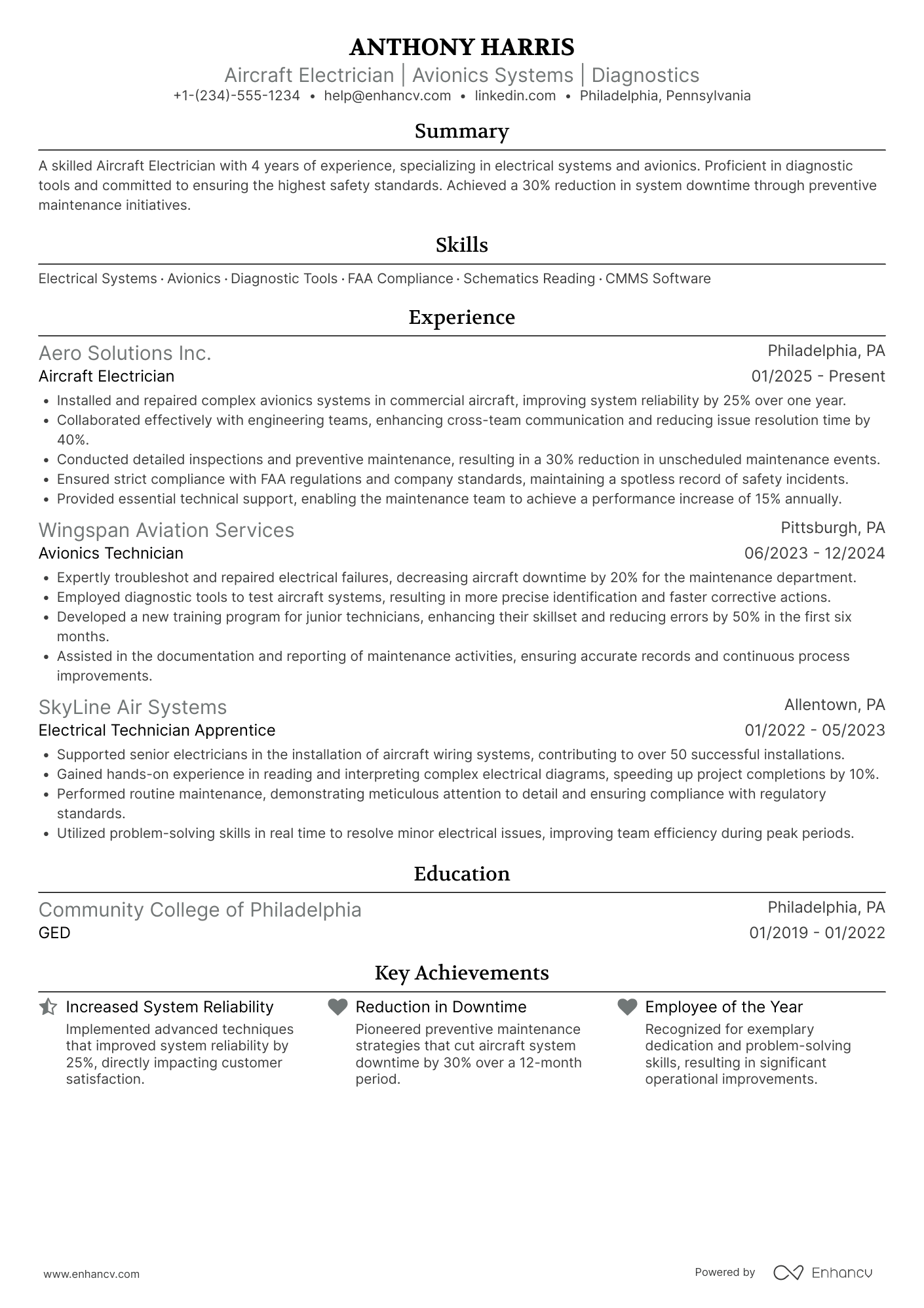
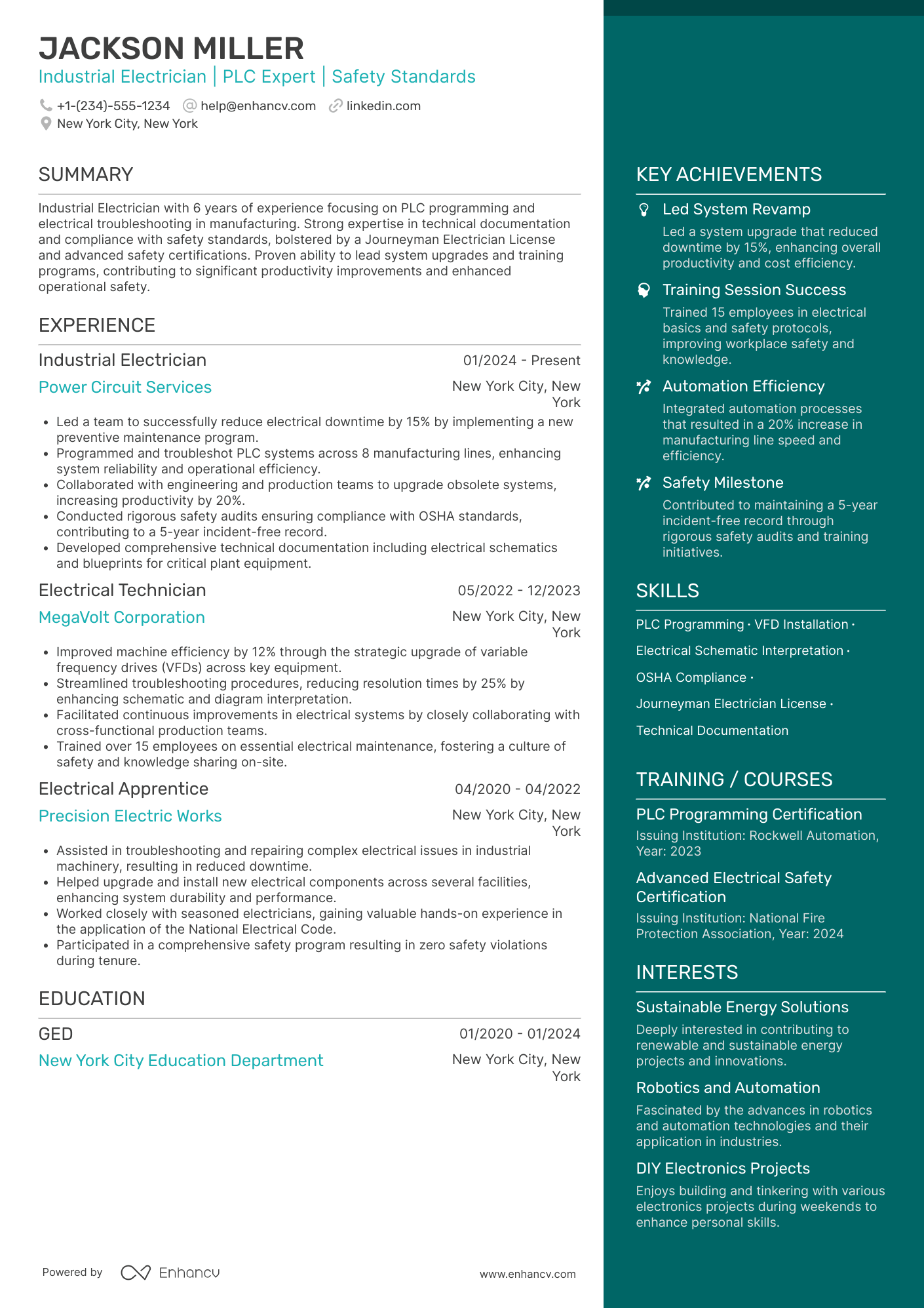
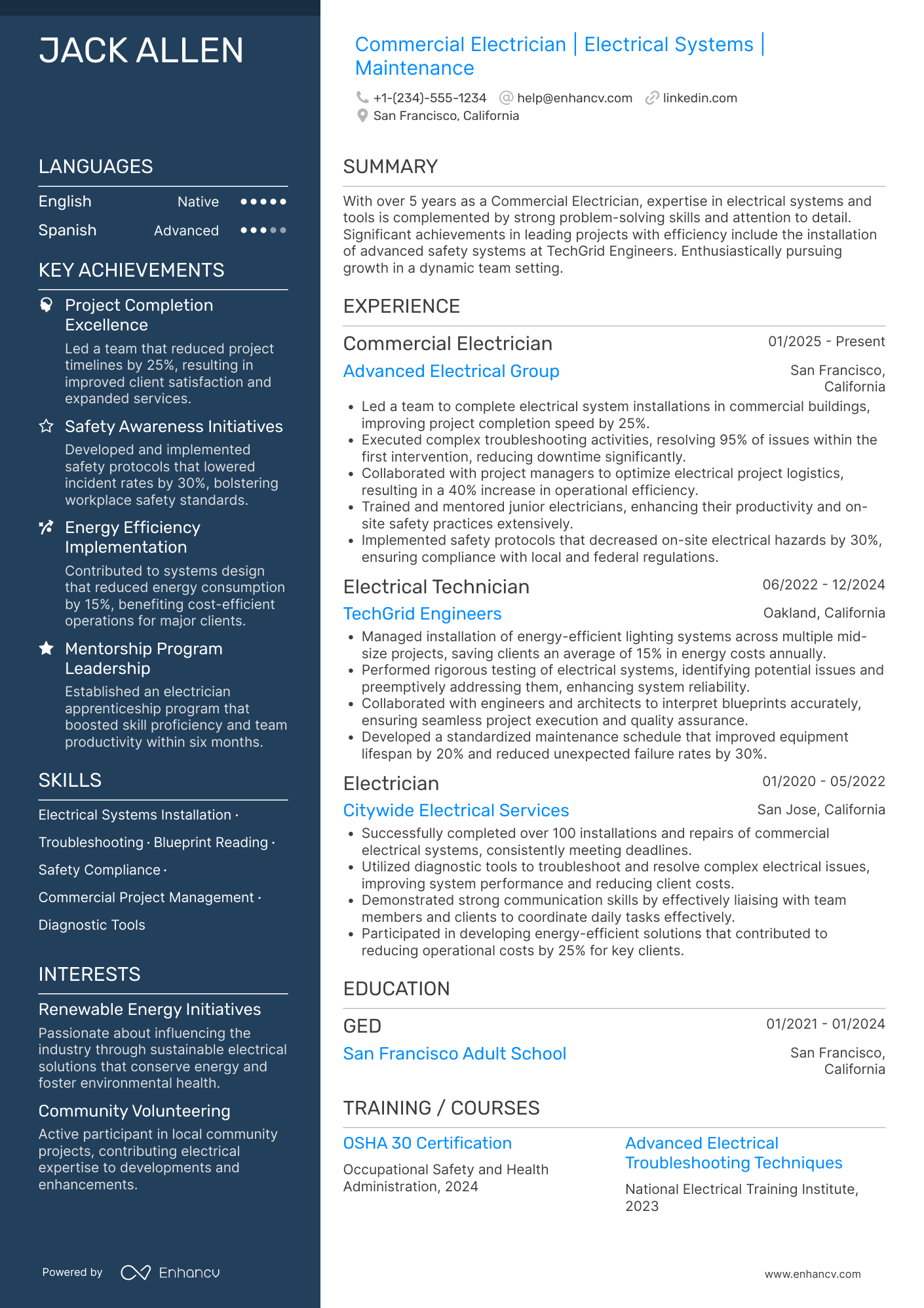
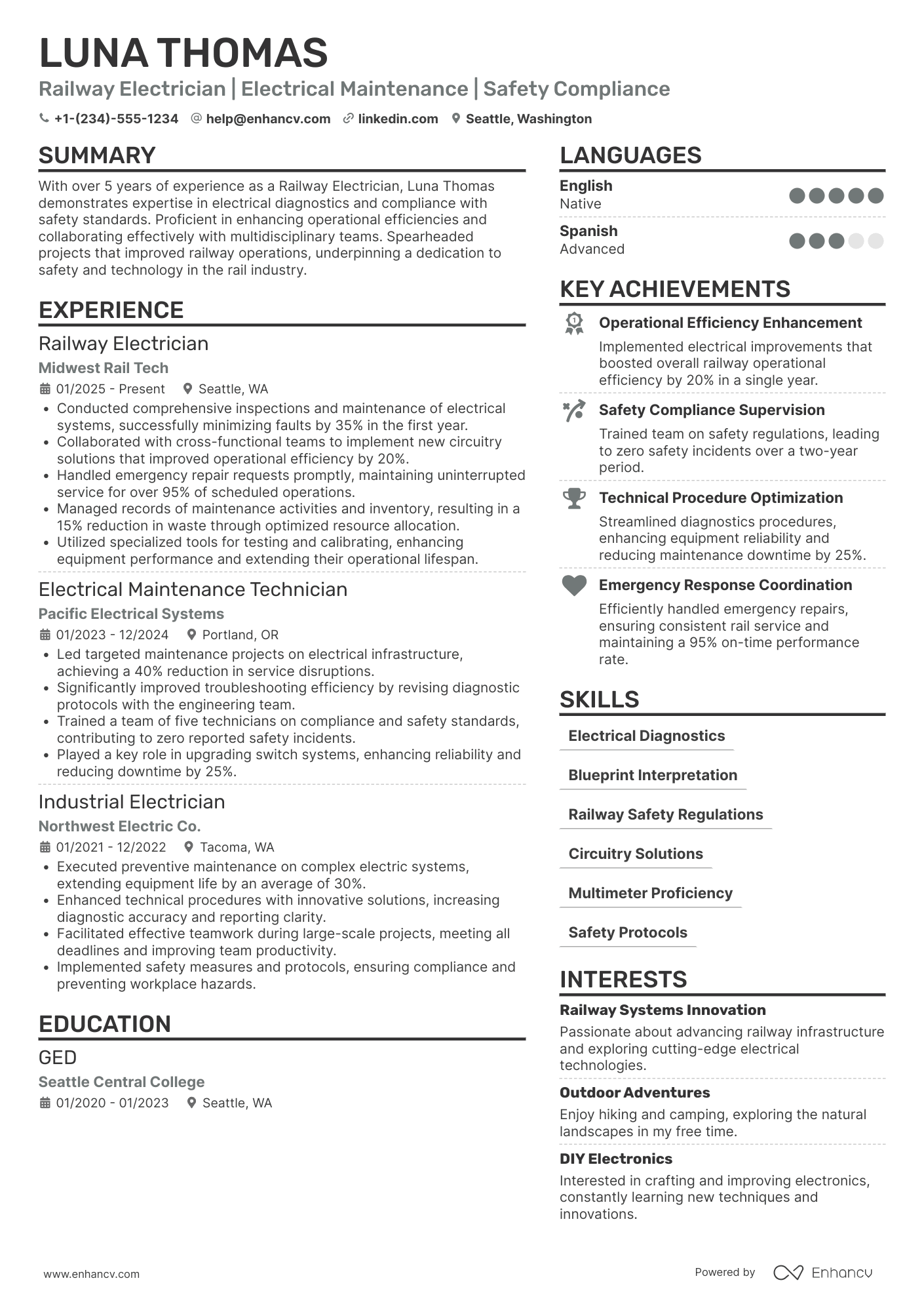
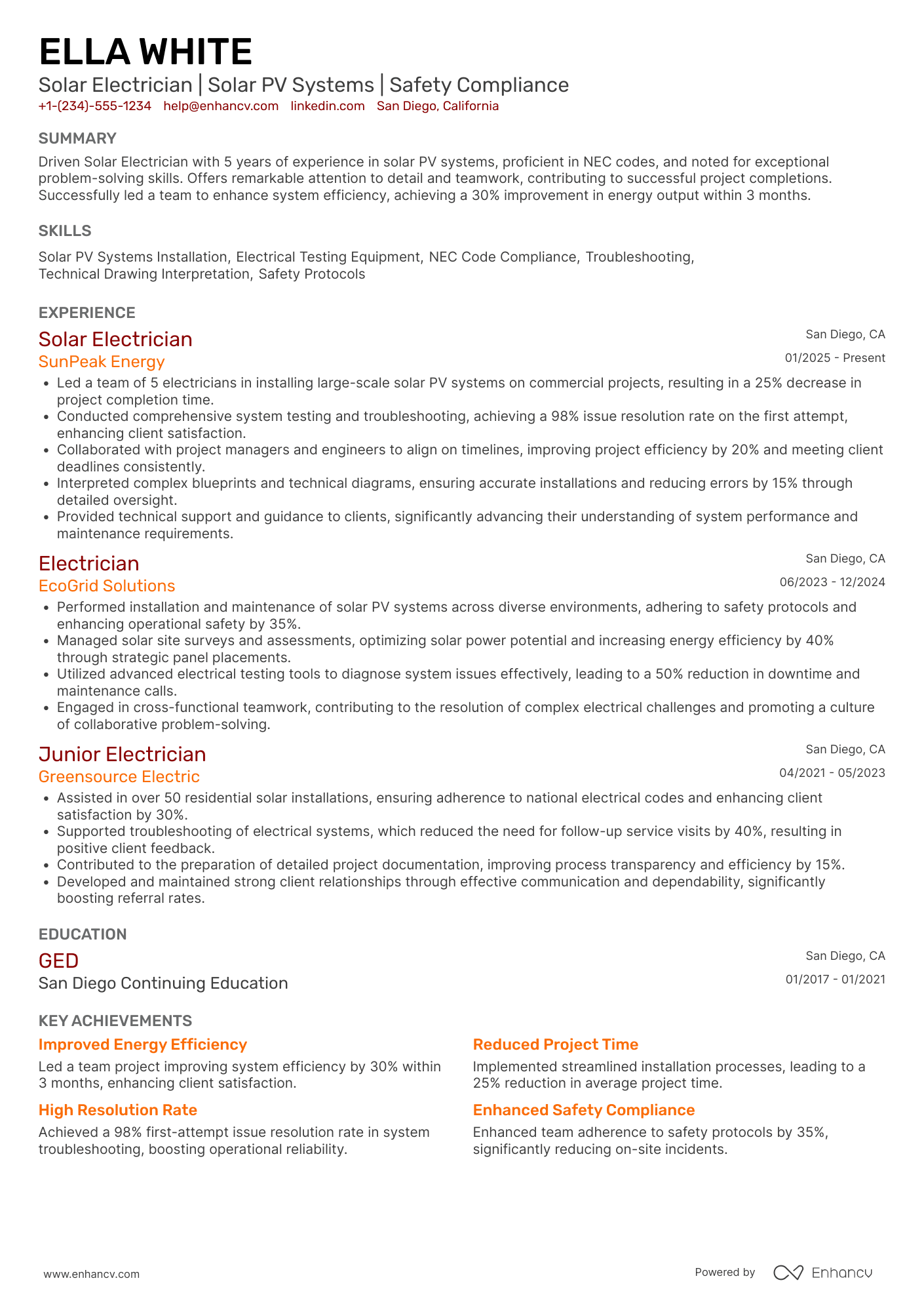
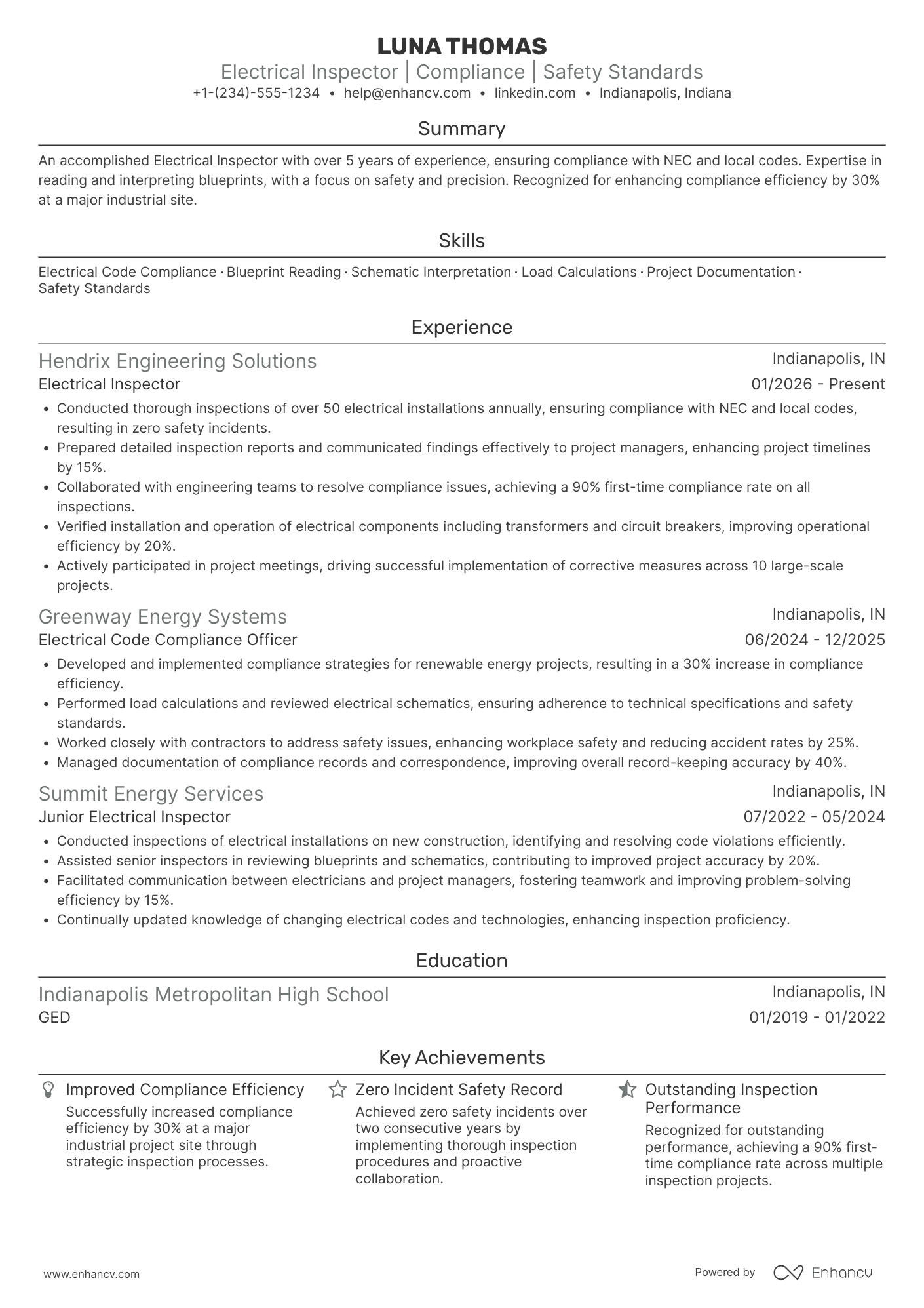
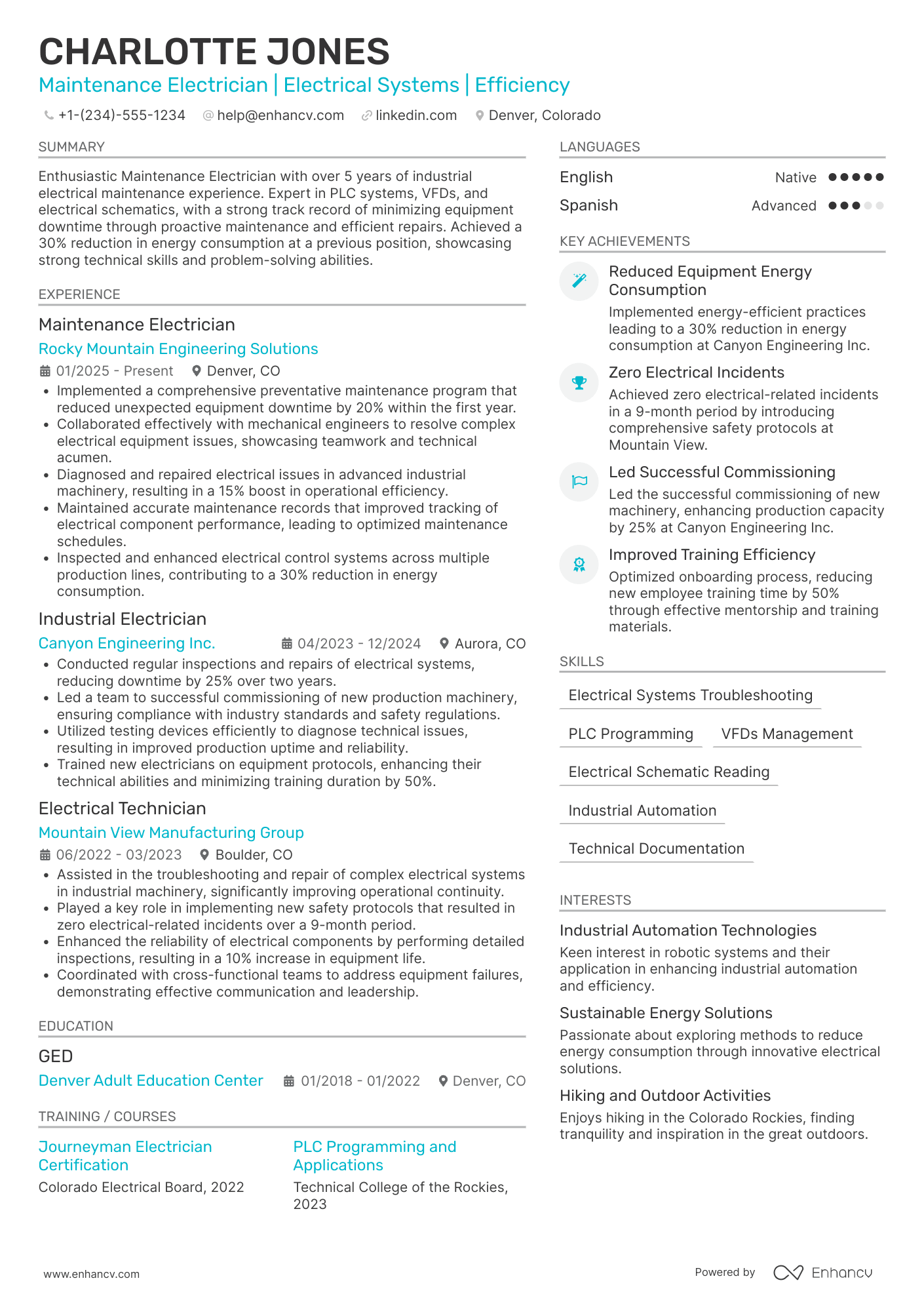
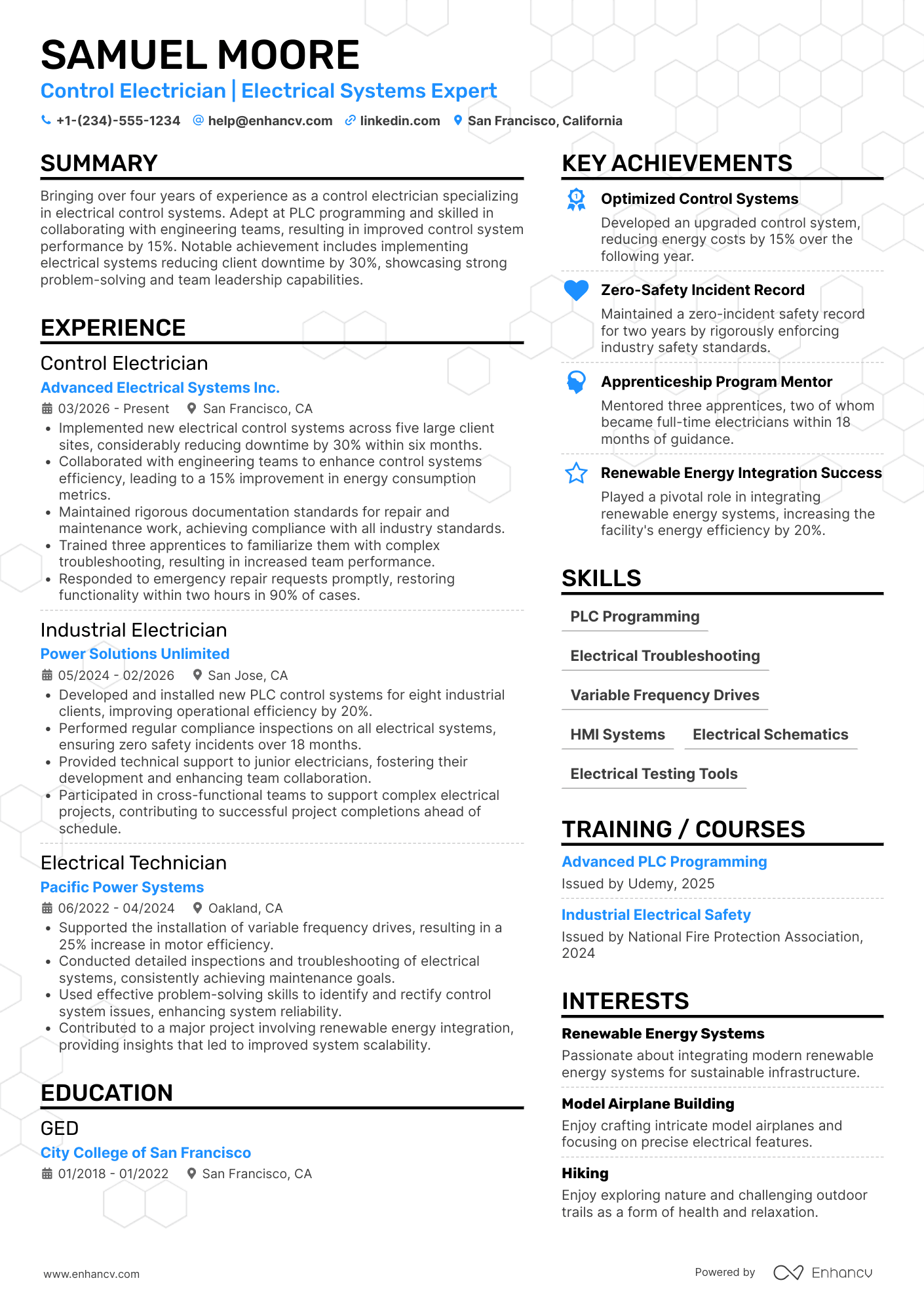
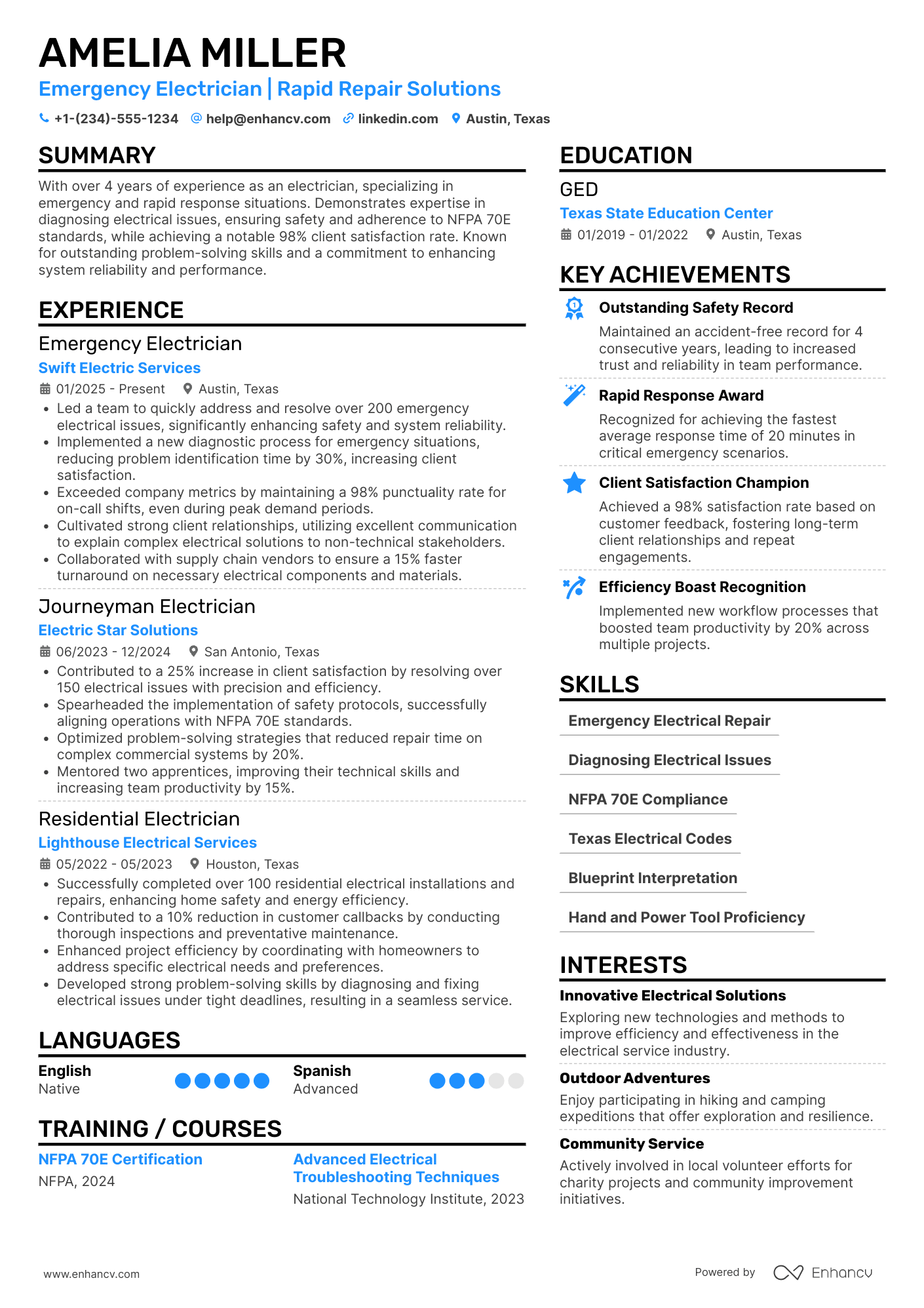
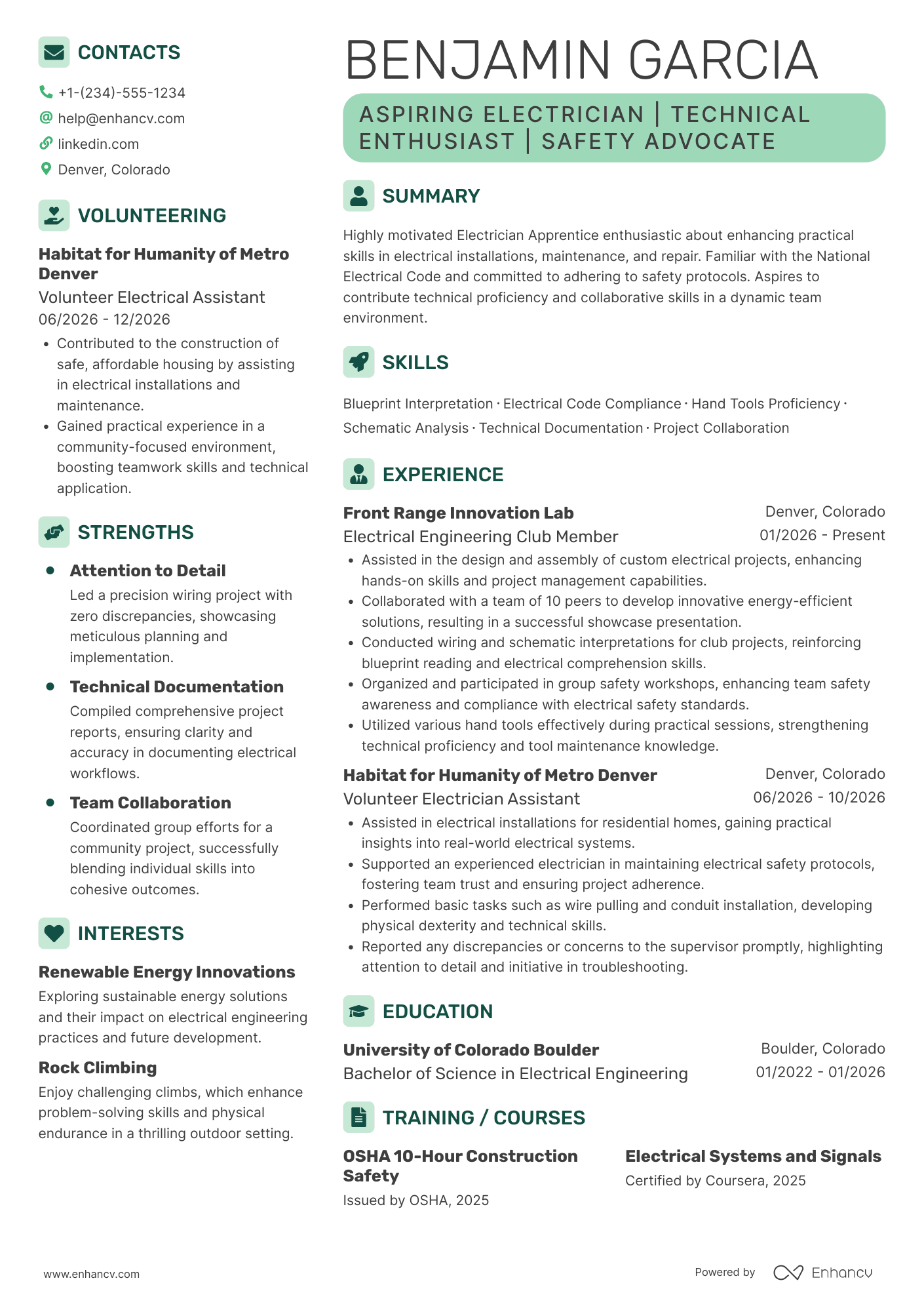
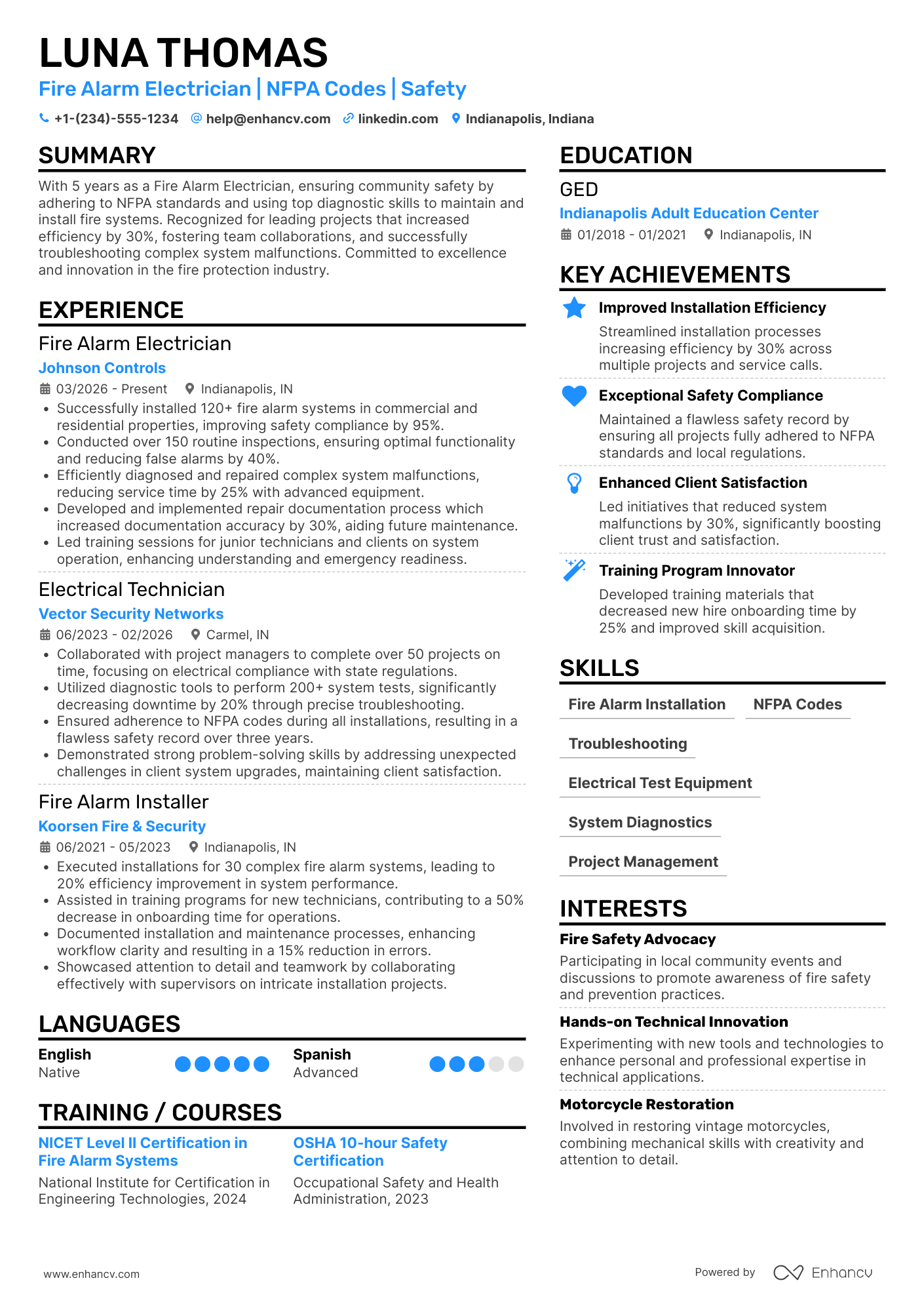
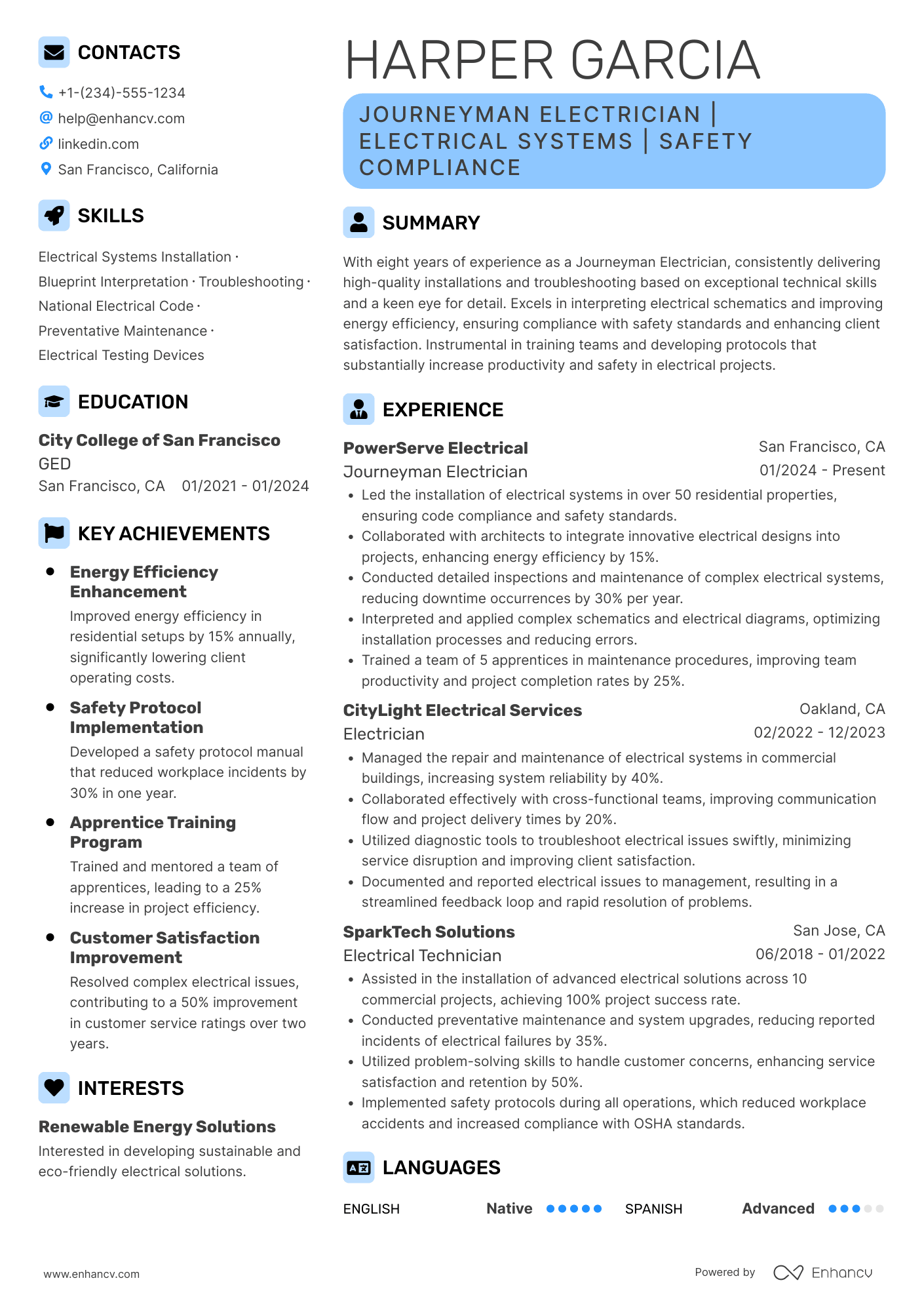
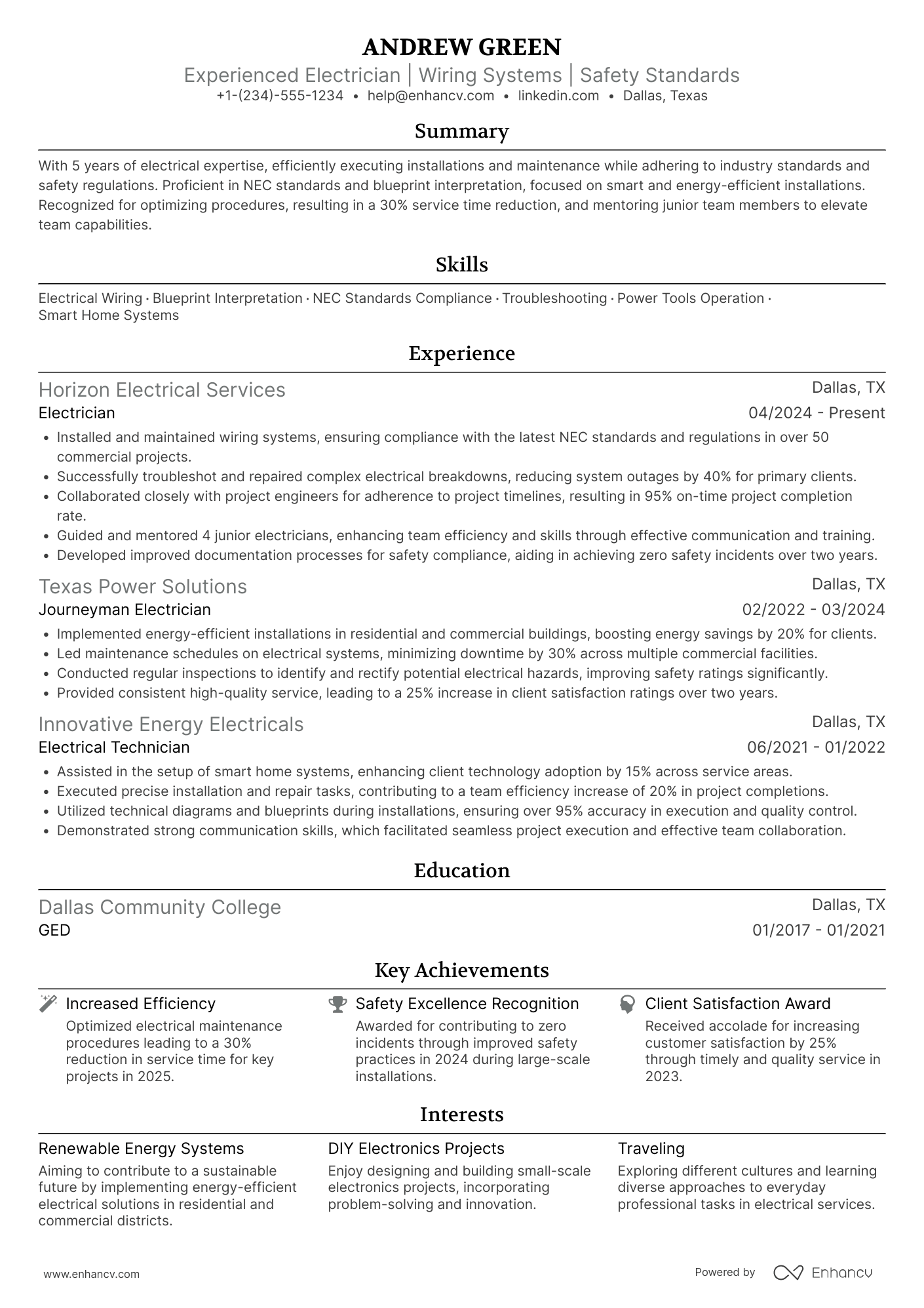
Most electrician resume drafts fail because they list duties and tools but skip proof of code-compliant results, so your impact disappears in seconds. That matters when an ATS (applicant tracking system) filters quickly and recruiters scan fast in a crowded market.
Once the resume shows the panels, voltages, and inspections that matter, our electrician cover letter guide covers how to tell the one job-site story — outage solved, retrofit shipped, inspection passed — that lands with a foreman.
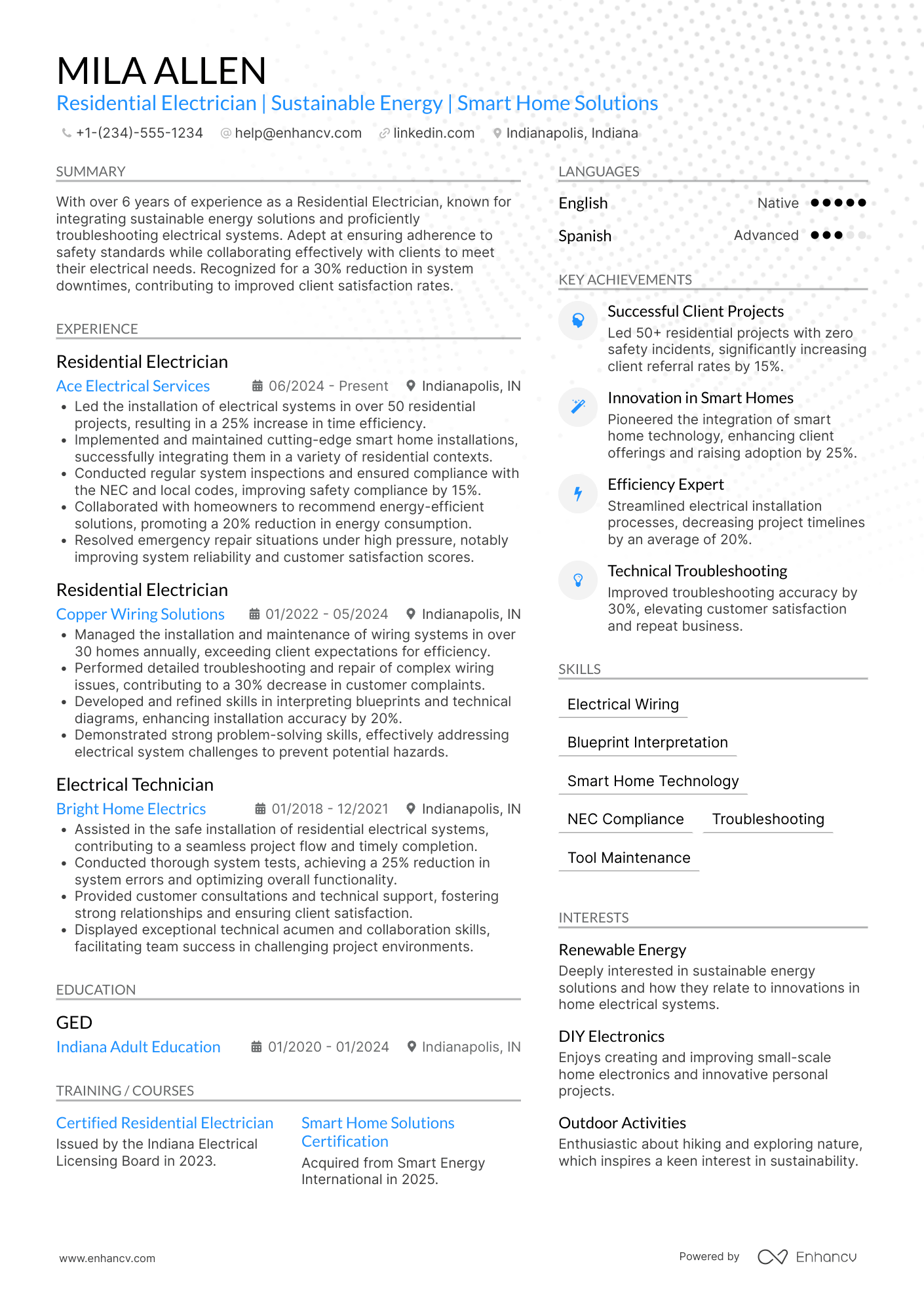
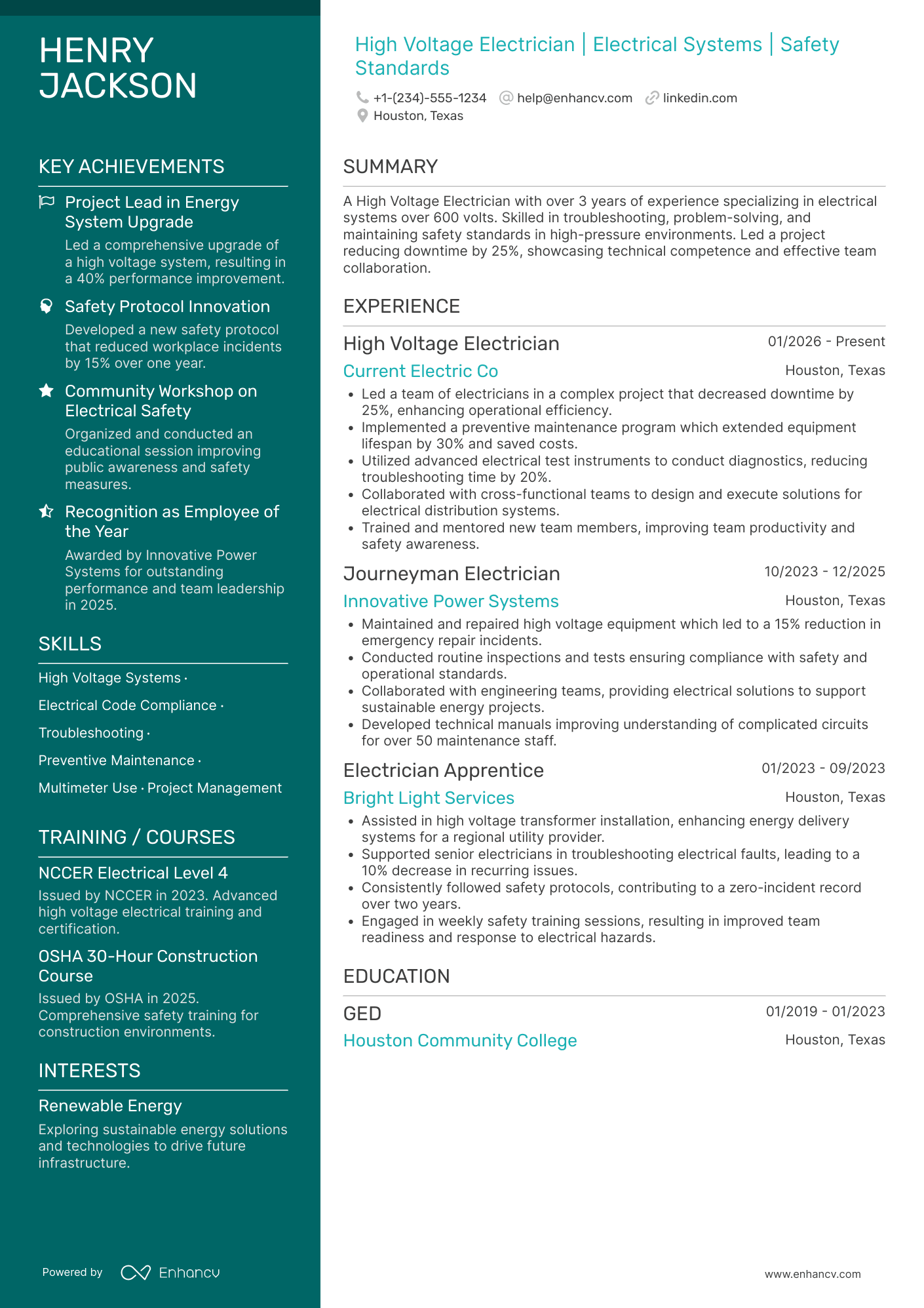
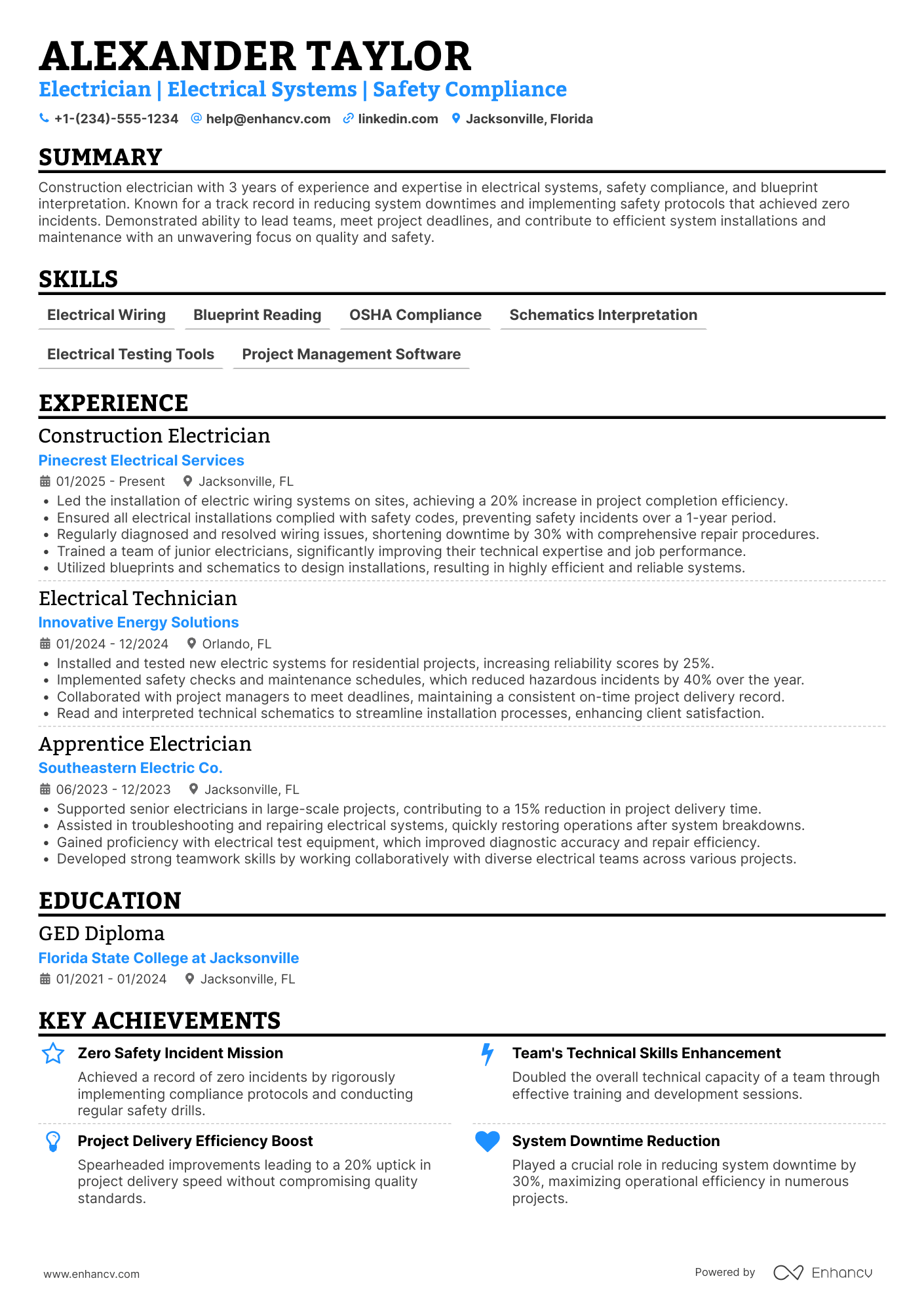
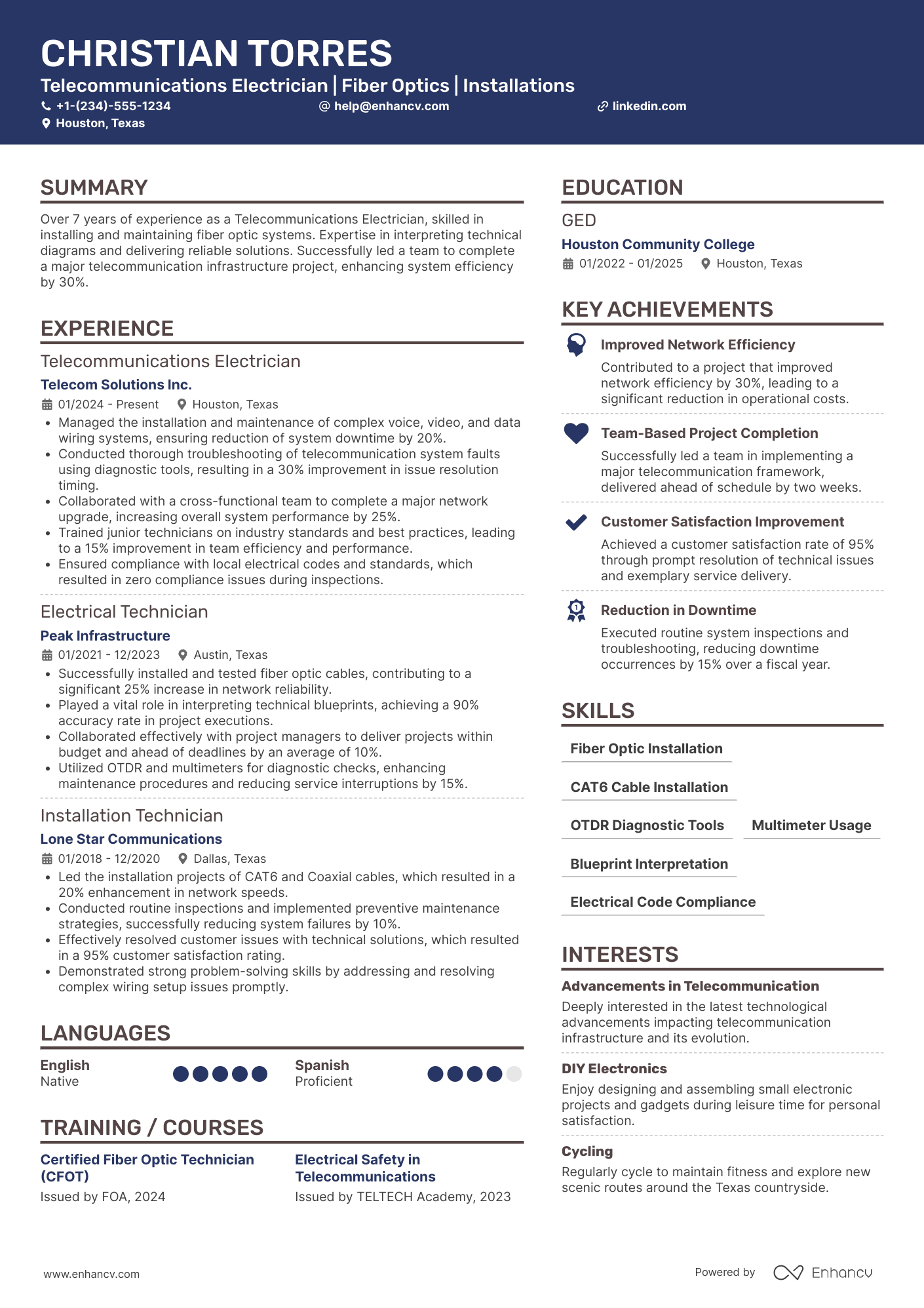
A strong resume shows what you delivered and how it improved safety, uptime, and cost. Knowing how to write a resume that highlights real results is essential. You should quantify panels upgraded, service calls closed per week, outage minutes reduced, rework avoided, inspections passed, and projects delivered on schedule and within budget.

Key takeaways
- Quantify outcomes like uptime restored, inspection pass rates, and cost savings on every bullet.
- Use reverse-chronological format for experienced electricians and hybrid format for career changers.
- Mirror the job posting's exact codes, tools, and voltage ranges in your experience section.
- Place certifications above education when they're required or define your electrician specialty.
- Demonstrate skills inside achievement bullets, not only in a standalone skills list.
- Keep your summary to four lines covering title, domain, core skills, and one measurable win.
- Use Enhancv's Bullet Point Generator to turn routine tasks into recruiter-ready, metric-driven bullets.
Job market snapshot for electricians
We analyzed 2,796 recent electrician job ads across major US job boards. These numbers help you understand employer expectations, career growth patterns, skills in demand at a glance.
What level of experience employers are looking for electricians
| Years of Experience | Percentage found in job ads |
|---|---|
| 1–2 years | 7.4% (206) |
| 3–4 years | 9.7% (270) |
| 5–6 years | 7.0% (197) |
| 7–8 years | 1.1% (30) |
| 9–10 years | 0.4% (10) |
| 10+ years | 2.7% (75) |
| Not specified | 71.9% (2011) |
Electrician ads by area of specialization (industry)
| Industry (Area) | Percentage found in job ads |
|---|---|
| Finance & Banking | 37.8% (1057) |
| Government | 20.4% (571) |
| Healthcare | 13.1% (366) |
| Manufacturing | 10.7% (298) |
| Education | 9.4% (264) |
| Energy | 3.2% (89) |
| Retail & E-commerce | 3.1% (86) |
| Real Estate & Construction | 2.0% (55) |
Top companies hiring electricians
| Company | Percentage found in job ads |
|---|---|
| State of Florida | 15.7% (438) |
| CCS | 4.9% (136) |
| JLL | 1.9% (53) |
| Sunrun Inc. | 1.8% (50) |
| EMCOR Group, Inc. | 1.4% (38) |
| Tradesmen International, LLC | 1.1% (32) |
| Tesla | 1.1% (30) |
| General Dynamics | 1.0% (28) |
| Wal-Mart | 1.0% (28) |
| OWL Services | 1.0% (27) |
Role overview stats
These tables show the most common responsibilities and employment types for electrician roles. Use them to align your resume with what employers expect and to understand how the role is structured across the market.
Day-to-day activities and top responsibilities for a electrician
| Responsibility | Percentage found in job ads |
|---|---|
| Blueprints | 26.0% (727) |
| Electrical systems | 24.4% (682) |
| Troubleshooting | 19.5% (544) |
| Hand tools | 15.6% (436) |
| Motors | 15.1% (421) |
| Power tools | 12.6% (353) |
| Schematics | 12.1% (338) |
| Plc | 11.6% (324) |
| Preventive maintenance | 10.8% (302) |
| Transformers | 9.6% (268) |
| Electrical maintenance | 9.5% (266) |
| Electrical wiring | 8.8% (245) |
How to format a electrician resume
Recruiters hiring electricians prioritize verifiable hands-on experience, relevant licenses and certifications, and a clear record of safe, code-compliant work across residential, commercial, or industrial settings. A clean, chronological format makes these signals easy to spot within the six to ten seconds a hiring manager typically spends on an initial scan. Choosing the right resume format is the first step toward making that time count.

I have significant experience as an electrician—which format should I use?
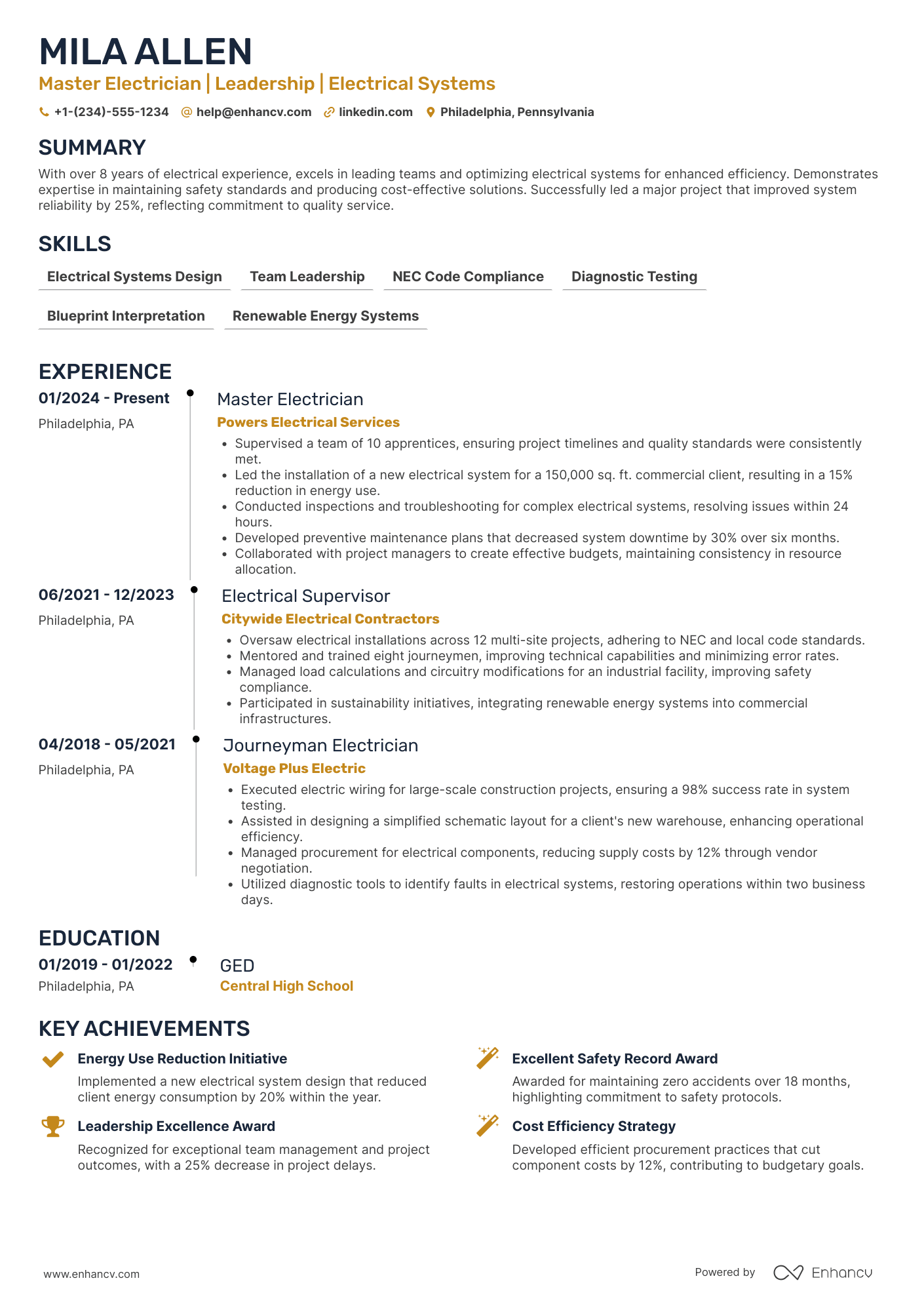
Use a reverse-chronological format to put your strongest and most recent field experience front and center. Do:
- Lead with your current or most recent role, highlighting the scope of projects you owned—crew size, facility type, voltage class, and contract value.
- Feature specific tools, systems, and code expertise (NEC compliance, conduit bending, PLC troubleshooting, blueprint reading, panel upgrades) in a dedicated skills section and within your bullet points.
- Quantify outcomes wherever possible—jobs completed ahead of schedule, cost savings, safety records, or inspection pass rates.
I'm junior or switching into an electrician role—what format works best?
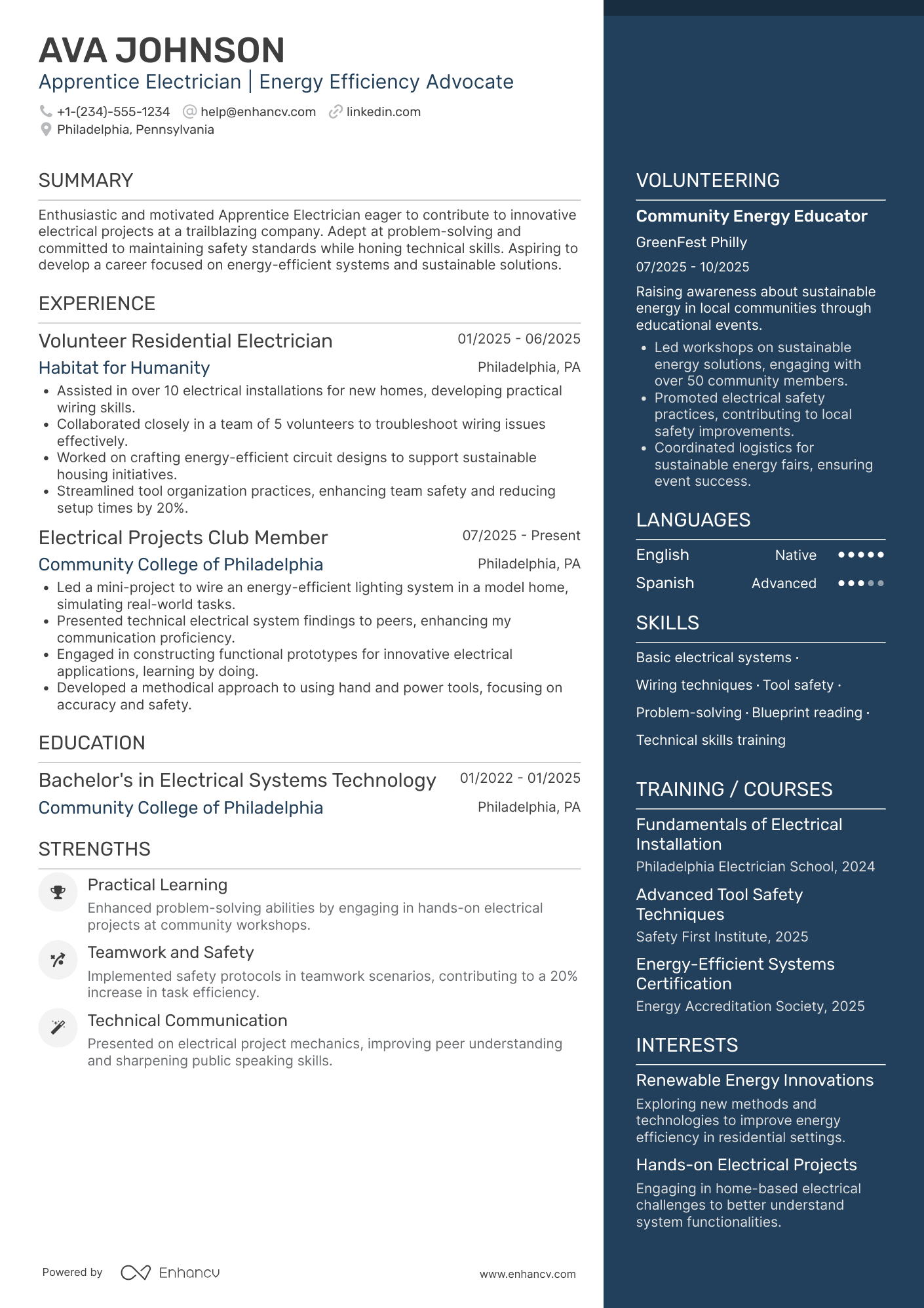
A hybrid format works best because it lets you lead with relevant skills and certifications while still showing a timeline of hands-on experience or apprenticeship hours. Do:
- Place a skills and certifications section near the top of the page, listing licenses (journeyman card, OSHA 10/30), technical competencies, and tools you're trained on.
- Include apprenticeship hours, vocational coursework, personal projects, or volunteer electrical work to demonstrate applied knowledge even without extensive employment history.
- Connect every skill to a concrete action and a measurable or observable result so hiring managers can see real capability, not just a keyword list.
Why not use a functional resume?
A functional format strips away the timeline of your experience, making it difficult for hiring managers to verify where, when, and how you developed your electrical skills—a critical concern in a licensed, safety-sensitive trade.
- Career changers with transferable technical skills: If you're moving from HVAC, plumbing, or general construction and hold relevant electrical certifications, a functional format can group applicable competencies (circuit testing, blueprint reading, conduit installation) to bridge the gap.
- Recent trade school graduates with limited employment history: If your work history is thin but you've completed a formal apprenticeship or accredited program, a functional layout can foreground certifications and hands-on training hours.
- Workers with significant resume gaps: If time away from the field makes a chronological layout look sparse, a functional format can redirect attention to maintained licenses and recent continuing education.
With your format set, the next step is filling it with the right sections to showcase your qualifications effectively.
What sections should go on a electrician resume
Recruiters expect to quickly find your licensing, safety compliance, and hands-on electrical work history. Understanding which resume sections to include ensures nothing critical gets overlooked.
Use this structure for maximum clarity:
- Header
- Summary
- Experience
- Skills
- Projects
- Education
- Certifications
- Optional sections: Awards, Leadership, Volunteering
Strong experience bullets should emphasize measurable results, job scope, safety record, and code-compliant outcomes delivered on time and on budget.
Is your resume good enough?
Drop your resume here or choose a file. PDF & DOCX only. Max 2MB file size.
Once you’ve organized your resume with the right sections, focus next on writing your electrician experience to show how your work supports each part.
How to write your electrician resume experience
Your experience section should highlight the electrical work you've completed, the tools and methods you used on the job, and the measurable outcomes you delivered—whether that's reduced downtime, improved safety compliance, or faster project completion. Hiring managers prioritize demonstrated impact over descriptive task lists, so focus on what you accomplished rather than simply listing daily duties. Building a targeted resume that aligns each bullet with the employer's priorities makes your experience far more compelling.
Each entry should include:
- Job title
- Company and location (or remote)
- Dates of employment (month and year)
Three to five concise bullet points showing what you owned, how you executed, and what outcomes you delivered:
- Ownership scope: the electrical systems, installations, service territories, job sites, or maintenance programs you were directly accountable for as an electrician.
- Execution approach: the wiring methods, diagnostic equipment, code standards, blueprint reading techniques, or safety protocols you applied to complete electrical work.
- Collaboration context: how you coordinated with general contractors, project managers, inspectors, apprentices, or facility teams to keep electrical projects on track and up to code.
- Value improved: changes to system reliability, energy efficiency, safety compliance, inspection pass rates, or operational uptime tied to your electrical expertise.
- Impact delivered: outcomes expressed through project scale, reduced service call frequency, cost savings, or compliance results rather than a generic description of tasks performed.
Experience bullet formula
A electrician experience example
✅ Right example - modern, quantified, specific.
Journeyman Electrician
BrightLine Electrical Services | Austin, TX
2021–Present
Commercial and light industrial electrical contractor supporting tenant buildouts, service calls, and preventative maintenance across active facilities.
- Installed and commissioned one hundred twenty-plus branch circuits, panels, and feeders using EMT, MC cable, and torque-verified terminations, cutting rework by 22% through standardized labeling and as-built updates.
- Diagnosed and resolved complex faults with Fluke multimeters, clamp meters, and insulation resistance testing, reducing repeat service calls by 28% and restoring power within two hours on average.
- Upgraded lighting to LED with occupancy sensors and daylight controls, delivering an average 18% reduction in monthly energy use across eight sites and improving light levels to spec per photometric readings.
- Coordinated lockout-tagout procedures and shutdown windows with facility managers, HVAC technicians, and client stakeholders, completing twenty-six after-hours cutovers with zero safety incidents and zero unplanned downtime.
- Led a two-electrician crew on a three-phase service upgrade (400A to 800A), verifying grounding and bonding, performing megger tests, and passing first inspection on all three phases, saving five days on the project schedule.
Now that you've seen how to structure your experience entries, let's focus on aligning them with the specific job posting you're targeting.
How to tailor your electrician resume experience
Recruiters evaluate your electrician resume through both manual review and applicant tracking systems, scanning for specific qualifications that match the posting. Tailoring your resume to the job description ensures your skills don't get overlooked.
Ways to tailor your electrician experience:
- Match specific tools and equipment listed in the job description.
- Mirror the exact electrical codes and standards the employer references.
- Use the same terminology for wiring methods or installation types.
- Highlight relevant license classifications the posting requires.
- Emphasize commercial or residential experience matching the job's domain.
- Include safety compliance protocols the employer specifically names.
- Reflect voltage ranges or system types described in the listing.
- Align your troubleshooting experience with their stated service workflows.
Tailoring means aligning your real accomplishments with the employer's stated priorities, not forcing unrelated keywords into your experience bullets.
Resume tailoring examples for electrician
| Job description excerpt | Untailored | Tailored |
|---|---|---|
| Install, maintain, and repair electrical wiring, conduit, and fixtures in commercial buildings per NEC standards | Performed electrical work on various projects. | Installed and repaired electrical wiring, EMT/rigid conduit, and lighting fixtures across 12 commercial buildings, ensuring full compliance with NEC 2023 standards. |
| Troubleshoot and diagnose electrical system failures using megohmmeters, circuit analyzers, and thermal imaging equipment | Used tools to find and fix electrical problems. | Diagnosed electrical system failures in industrial facilities using megohmmeters, Fluke circuit analyzers, and FLIR thermal imaging cameras, reducing equipment downtime by 30%. |
| Perform panel upgrades, load calculations, and 3-phase motor installations in warehouse and manufacturing environments | Helped with electrical installations and upgrades. | Completed 45+ panel upgrades (200A–600A) with full load calculations and installed 3-phase motors up to 50 HP in warehouse and manufacturing facilities. |
Once you’ve aligned your experience with the role’s requirements, the next step is to quantify your electrician achievements so employers can quickly see the impact of that work.
How to quantify your electrician achievements
Quantifying your achievements proves you deliver safe, reliable installs and fast repairs, not just tasks. Focus on numbers tied to uptime, rework, inspection pass rates, job cycle time, incidents, cost savings, and on-time delivery.
Quantifying examples for electrician
| Metric | Example |
|---|---|
| Uptime restored | "Restored power for a 120,000 sq ft warehouse in 2.5 hours by isolating a failed 400A breaker and re-terminating feeders, cutting downtime by 60%." |
| Quality first-pass | "Achieved a 98% first-pass inspection rate across 45 commercial rough-ins by following NEC checklists and torque-spec verification with a calibrated torque wrench." |
| Job cycle time | "Reduced panel change-out time from 6 hours to 4.5 hours on average by pre-labeling circuits and staging materials for 30+ service upgrades." |
| Safety risk | "Completed 1,200 labor hours with zero recordable incidents by enforcing lockout-tagout, arc-flash boundaries, and daily tailboard talks on every job." |
| Cost savings | "Cut material waste by 12% on a 200-unit multifamily project by standardizing conduit runs and optimizing wire pulls using pre-measured reels." |
Turn your everyday tasks into measurable, recruiter-ready resume bullets in seconds with Enhancv's Bullet Point Generator.
Once you've crafted strong bullet points for your experience section, you'll want to apply that same precision to presenting your hard and soft skills throughout your electrician resume.
How to list your hard and soft skills on a electrician resume
Your skills section matters for electricians because recruiters and an ATS (applicant tracking system) scan them to confirm code knowledge, installation capability, and safety habits—aim for a hard-skill-heavy mix supported by a smaller set of job-specific soft skills. electrician roles require a blend of:
- Product strategy and discovery skills.
- Data, analytics, and experimentation skills.
- Delivery, execution, and go-to-market discipline.
- Soft skills.
Your skills section should be:
- Scannable (bullet-style grouping).
- Relevant to the job post.
- Backed by proof in experience bullets.
- Updated with current tools.
Place your skills section:
- Above experience if you're junior or switching careers.
- Below experience if you're mid/senior with strong achievements.

Hard skills
- National Electrical Code compliance
- Conduit bending, EMT, rigid
- Panel upgrades, service installs
- Motor controls, VFD wiring
- Three-phase power distribution
- Troubleshooting with multimeter, clamp meter
- Blueprint reading, one-line diagrams
- Grounding and bonding systems
- GFCI, AFCI installation and testing
- Lockout tagout procedures
- Low-voltage systems, fire alarm
- OSHA safety standards
Soft skills
- Pre-task hazard assessments
- Clear jobsite handoffs
- Customer-ready explanations
- Strong permit and inspection coordination
- Prioritize safety over speed
- Document changes as-built
- Coordinate with other trades
- Escalate risks early
- Plan materials to avoid downtime
- Follow checklists under pressure
- Mentor apprentices on standards
- Maintain clean, organized work areas
How to show your electrician skills in context
Skills shouldn't live only in a dedicated skills list. Browse resume skills examples to see how electricians weave competencies into real achievements.
They should be demonstrated in:
- Your summary (high-level professional identity)
- Your experience (proof through outcomes)
Here's what that looks like in practice.
Summary example
Senior electrician with 12 years in commercial and industrial power systems. Skilled in conduit bending, PLC troubleshooting, and NEC compliance. Led a 15-member crew that completed a $4M hospital rewiring project 3 weeks ahead of schedule.
- Signals senior-level expertise immediately
- Names industry-specific tools and codes
- Leads with a measurable project outcome
- Highlights leadership as a soft skill
Experience example
Senior Electrician
Redline Industrial Services | Tampa, FL
March 2018–Present
- Installed and maintained switchgear across 6 manufacturing facilities using AutoCAD Electrical layouts, reducing unplanned downtime by 22%.
- Coordinated with project managers and HVAC teams to integrate building automation systems, finishing 90% of projects on schedule.
- Mentored 4 apprentice electricians on NEC code compliance and conduit installation, improving first-pass inspection rates by 35%.
- Every bullet contains measurable proof.
- Skills appear naturally within achievements.
Once you’ve demonstrated your electrical abilities through specific examples and results, the next step is to apply that approach to writing an electrician resume with no experience.
How do I write a electrician resume with no experience
Even without full-time experience, you can demonstrate readiness through training, projects, and volunteer work. Our guide on writing a resume without work experience walks you through this approach step by step. Consider highlighting:
- Electrical trade school lab wiring
- Apprenticeship or pre-apprenticeship hours
- OSHA 10 safety training
- Residential volunteer rewiring projects
- Low-voltage cabling installations
- Panel labeling and circuit mapping
- Conduit bending practice projects
Focus on:
- Safety training and documented hours
- Hands-on wiring and troubleshooting
- Code awareness and proper labeling
- Tool use with measurable results
Resume format tip for entry-level electrician
Use a combination resume format because it highlights skills and projects first, while still showing education and any related work history. Do:
- Put certifications and safety training first.
- List electrical projects with measurable results.
- Name tools used: multimeter, fish tape.
- Add relevant coursework: NEC basics, wiring.
- Quantify hours: labs, volunteer, training.
- Built and labeled a twelve-circuit training panel using a multimeter and wire strippers, mapped circuits, and cut troubleshooting time by 30%.
Even without hands-on experience, your education and training can demonstrate the foundational knowledge employers look for—so presenting them effectively on your resume is essential.
How to list your education on a electrician resume
Your education section helps hiring teams confirm you have the foundational knowledge needed for electrician work. It validates your technical training and academic background quickly.
Include:
- Degree name
- Institution
- Location
- Graduation year
- Relevant coursework (for juniors or entry-level candidates)
- Honors & GPA (if 3.5 or higher)
Skip month and day details—list the graduation year only.
Here's a strong education entry tailored for an electrician resume.
Example education entry
Associate of Applied Science in Electrical Technology
Eastern Gateway Community College, Steubenville, OH
Graduated 2021
GPA: 3.7/4.0
- Relevant coursework: Residential Wiring, Industrial Motor Controls, National Electrical Code, and Blueprint Reading
- Honors: Dean's List, 2020–2021
How to list your certifications on a electrician resume
Certifications on your resume show an electrician's commitment to learning, comfort with modern tools, and alignment with current codes and safety standards.
Include:
- Certificate name
- Issuing organization
- Year
- Optional: credential ID or URL
- Place certifications below education when your education is recent and the certifications support it, but do not define your electrician focus.
- Place certifications above education when they are recent, role-relevant, or required, and you want them to stand out for an electrician job.
Best certifications for your electrician resume
OSHA 10-Hour Construction Safety and Health OSHA 30-Hour Construction Safety and Health NFPA 70E Electrical Safety Certification NCCER Electrical Level 1 Certification NCCER Electrical Level 2 Certification EPA Section 608 Technician Certification First Aid and CPR Certification
Once you’ve placed your credentials where hiring managers can spot them quickly, use your electrician resume summary to highlight those qualifications upfront and set context for the rest of your experience.
How to write your electrician resume summary
Your resume summary is the first thing a recruiter reads. A strong one immediately signals you have the hands-on skills and credentials the job demands.
Keep it to three to four lines, with:
- Your title and total years of experience in electrical work.
- The domain you know best, such as residential, commercial, or industrial.
- Core tools and skills like conduit bending, circuit design, or NEC code compliance.
- One or two measurable achievements, such as projects completed or downtime reduced.
- A practical soft skill tied to a real outcome, like communication that improved crew coordination.

PRO TIP
At this level, emphasize technical skills, relevant certifications, and any early wins on the job. Avoid vague phrases like "hard worker" or "passionate professional." Recruiters want to see what you can do, not how you describe yourself.
Example summary for a electrician
Electrician with three years of residential and light commercial experience. Skilled in NEC-compliant wiring, panel upgrades, and conduit installation. Reduced material waste by 15% through improved layout planning across 40+ projects.
Optimize your resume summary and objective for ATS
Drop your resume here or choose a file.
PDF & DOCX only. Max 2MB file size.
Now that your summary captures your strongest qualifications, make sure the header above it presents your contact details correctly so hiring managers can actually reach you.
What to include in a electrician resume header
A resume header lists your key contact details and role, helping electricians improve visibility, build credibility, and pass recruiter screening faster.
Essential resume header elements
- Full name
- Tailored job title and headline
- Location
- Phone number
- Professional email
- GitHub link
- Portfolio link
A LinkedIn link helps recruiters verify your work history quickly and supports faster screening.
Don't include a photo on a electrician resume unless the role is explicitly front-facing or appearance-dependent.
Keep your header identical across your resume and application profiles so recruiters can match your electrician details without confusion.
Example
Electrician resume header
Jordan Taylor
Electrician | Journeyman Electrician specializing in commercial service and troubleshooting
Phoenix, AZ
(602) 555-01XX
jordan.taylor@enhancv.com
github.com/jordantaylor
jordantaylor.com
linkedin.com/in/jordantaylor
Once your contact details and role focus are clear at the top, add additional sections to highlight relevant qualifications and details that don’t fit in the header.
Additional sections for electrician resumes
Extra resume sections help you stand out when multiple electricians share similar qualifications and work histories.
They showcase unique strengths that hiring managers won't find in your standard experience or skills sections.
Choose sections that reinforce your hands-on expertise, safety commitment, or specialized training:
- Licenses and certifications
- Safety training and OSHA compliance
- Languages
- Professional affiliations and union memberships
- Volunteer work and community projects
- Continuing education and apprenticeships
- Hobbies and interests
Once you've strengthened your resume with relevant additional sections, it's worth pairing it with a cover letter to give hiring managers even more context about your qualifications.
Do electrician resumes need a cover letter
An electrician doesn't always need a cover letter. It helps when the role is competitive or the employer expects one. If you're unsure where to start, learn what a cover letter is and when it adds value. It can make a difference when your resume needs context or when you want to stand out for safety and reliability.
Use a cover letter to add details your electrician resume can't:
- Explain role and team fit: Match your experience to the site type, shift schedule, service model, and safety expectations.
- Highlight one or two relevant projects or outcomes: Cite a panel upgrade, retrofit, or troubleshooting win, plus measurable results like fewer callbacks.
- Show understanding of the business context: Reference the customer base, uptime needs, compliance requirements, and how your work supports them.
- Address transitions or non-obvious experience: Connect related work, gaps, or a move into electrician roles with specific training and supervised hours.
Drop your resume here or choose a file.
PDF & DOCX only. Max 2MB file size.
If you decide a cover letter won’t add meaningful value to your application, using AI to improve your electrician resume becomes the most direct way to strengthen your candidacy.
Using AI to improve your electrician resume
AI can sharpen your resume's clarity, structure, and impact. It helps tighten language and highlight relevant skills. But overuse strips authenticity. Once your content reads clearly and fits the role, step away from AI. For specific guidance, explore ChatGPT resume writing prompts tailored to trades like electrical work.
Here are 10 practical prompts to strengthen specific sections of your electrician resume:
- Strengthen your summary. "Rewrite my electrician resume summary to highlight my top skills, years of experience, and specialization in under four sentences."
- Quantify your work. "Add measurable results to these electrician experience bullets, such as project counts, timelines, or cost savings."
- Tailor to the job. "Compare this electrician job posting to my resume and suggest changes that better align my experience with the listed requirements."
- Sharpen experience bullets. "Rewrite these electrician experience bullets using strong action verbs and concise, specific language under 15 words each."
- Optimize your skills. "Review my electrician skills section and suggest missing technical skills based on current industry standards and this job description."
- Highlight certifications. "Reorganize my electrician certifications section to prioritize the most relevant licenses for a commercial electrical role."
- Improve project descriptions. "Rewrite my electrician project descriptions to clearly state scope, methods used, and outcomes achieved on each job."
- Refine education details. "Suggest how to present my electrician apprenticeship and trade school education to emphasize hands-on training and coursework."
- Remove weak phrasing. "Identify and replace vague or passive language in my electrician resume with direct, confident phrasing."
- Check for consistency. "Review my entire electrician resume for inconsistent formatting, tense shifts, and repeated phrases, then suggest corrections."
Stop using AI once your resume sounds accurate, specific, and aligned with real experience. AI should never invent experience or inflate claims—if it didn't happen, it doesn't belong here.
Conclusion
A strong electrician resume shows measurable outcomes, role-specific skills, and a clear structure. Use numbers to prove impact, list core electrical work skills, and keep sections easy to scan.
This approach matches today’s hiring market and stays relevant as requirements shift. A focused electrician resume helps employers quickly see your value, your safety mindset, and your readiness to contribute on day one.