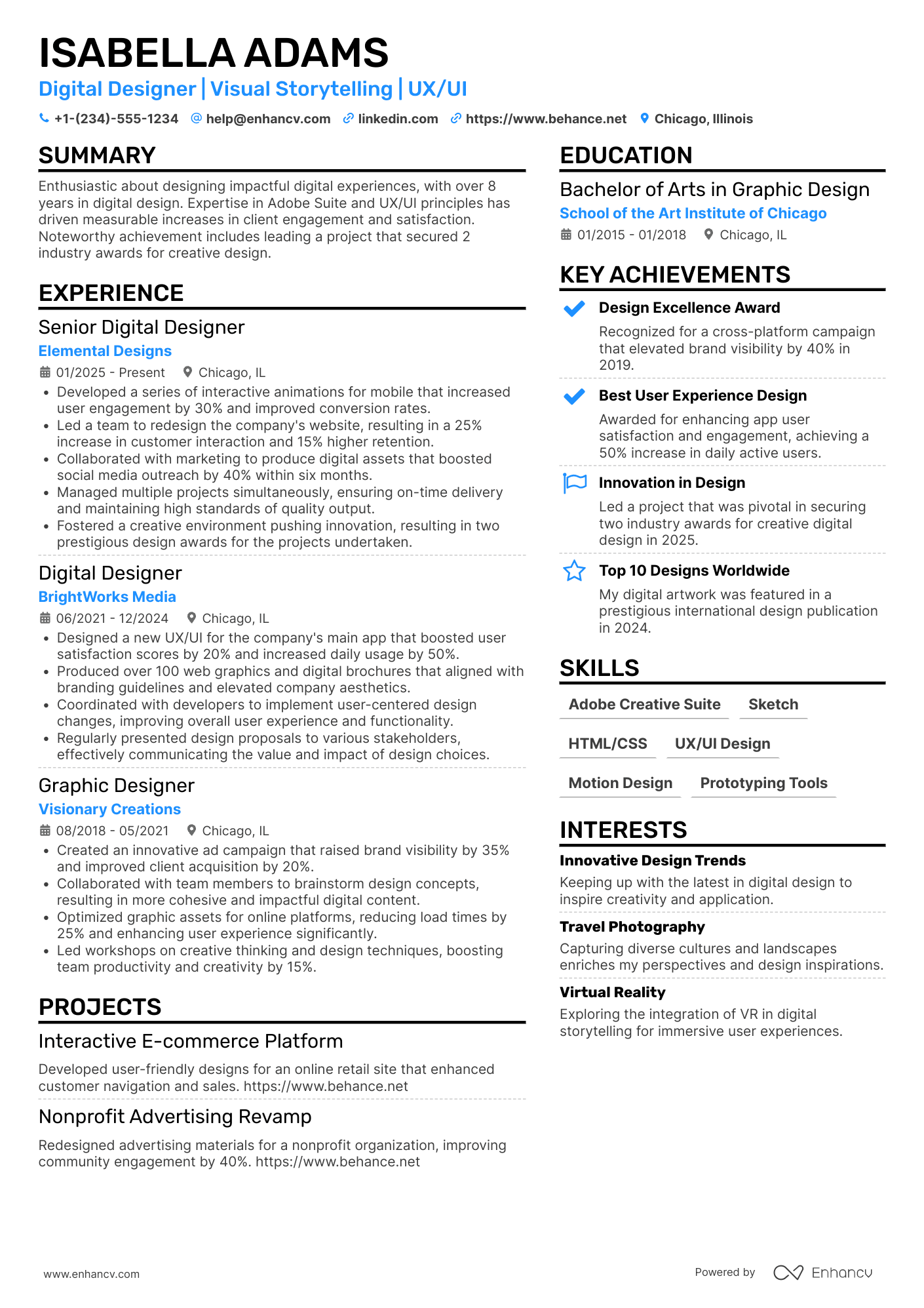

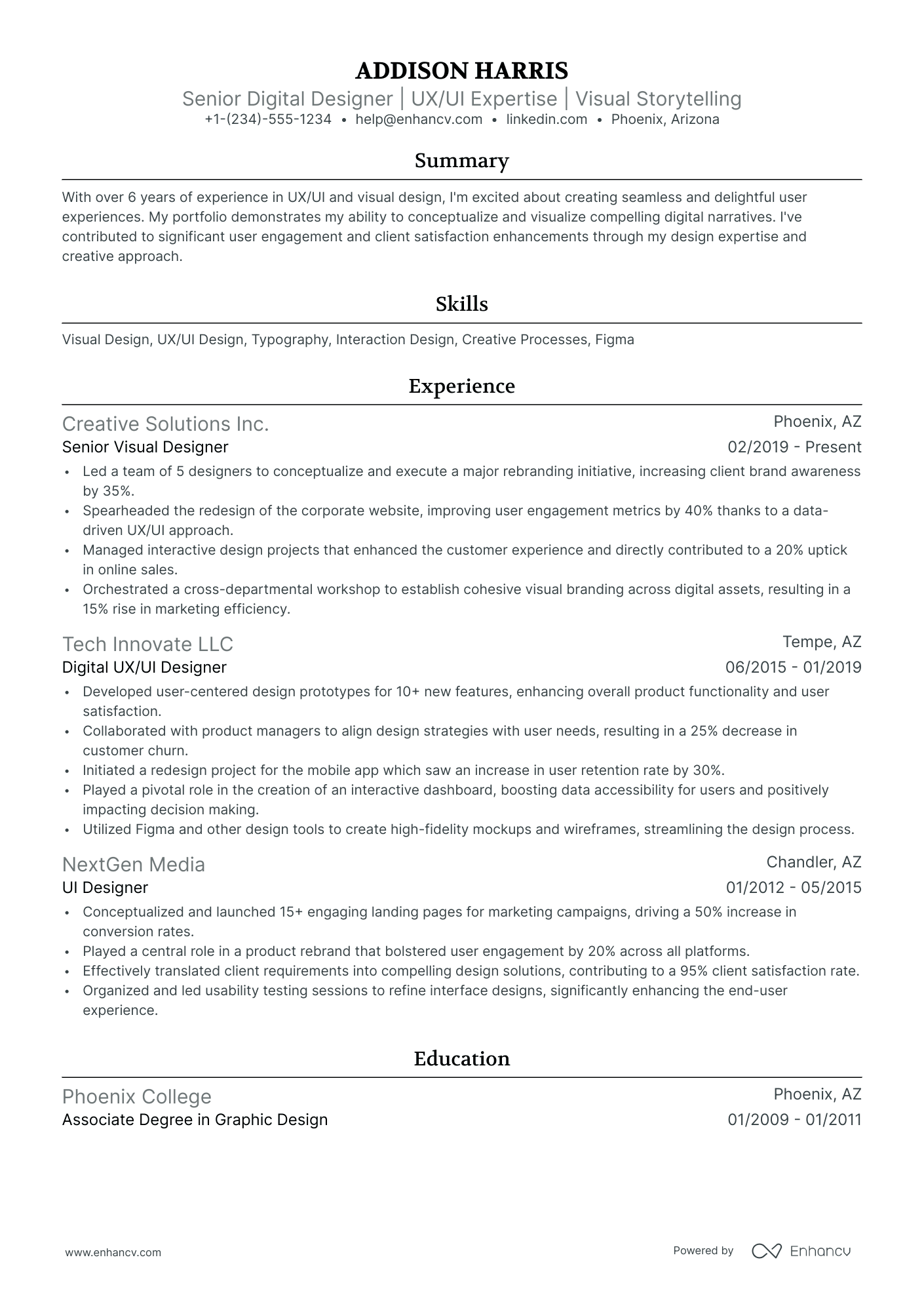
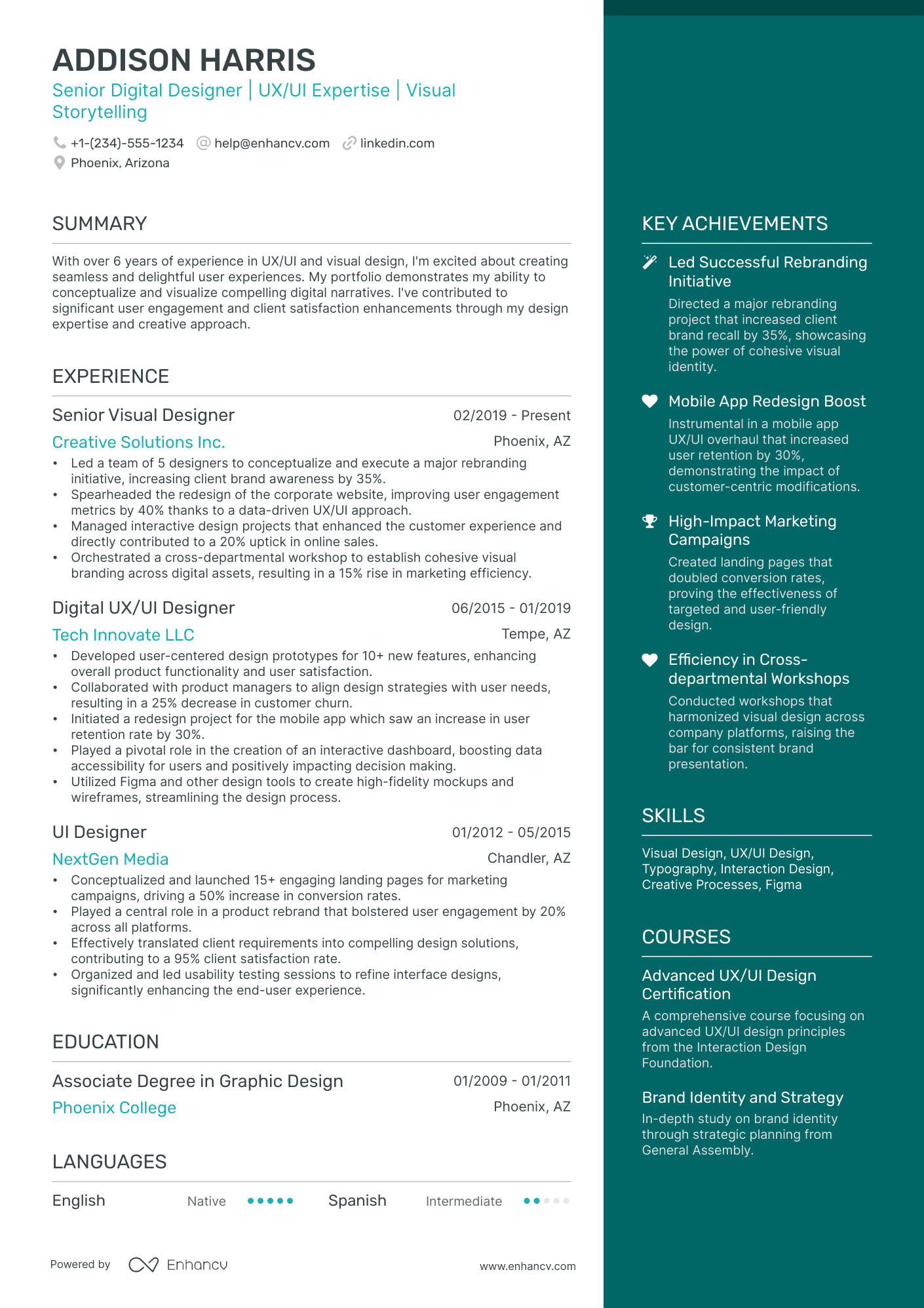
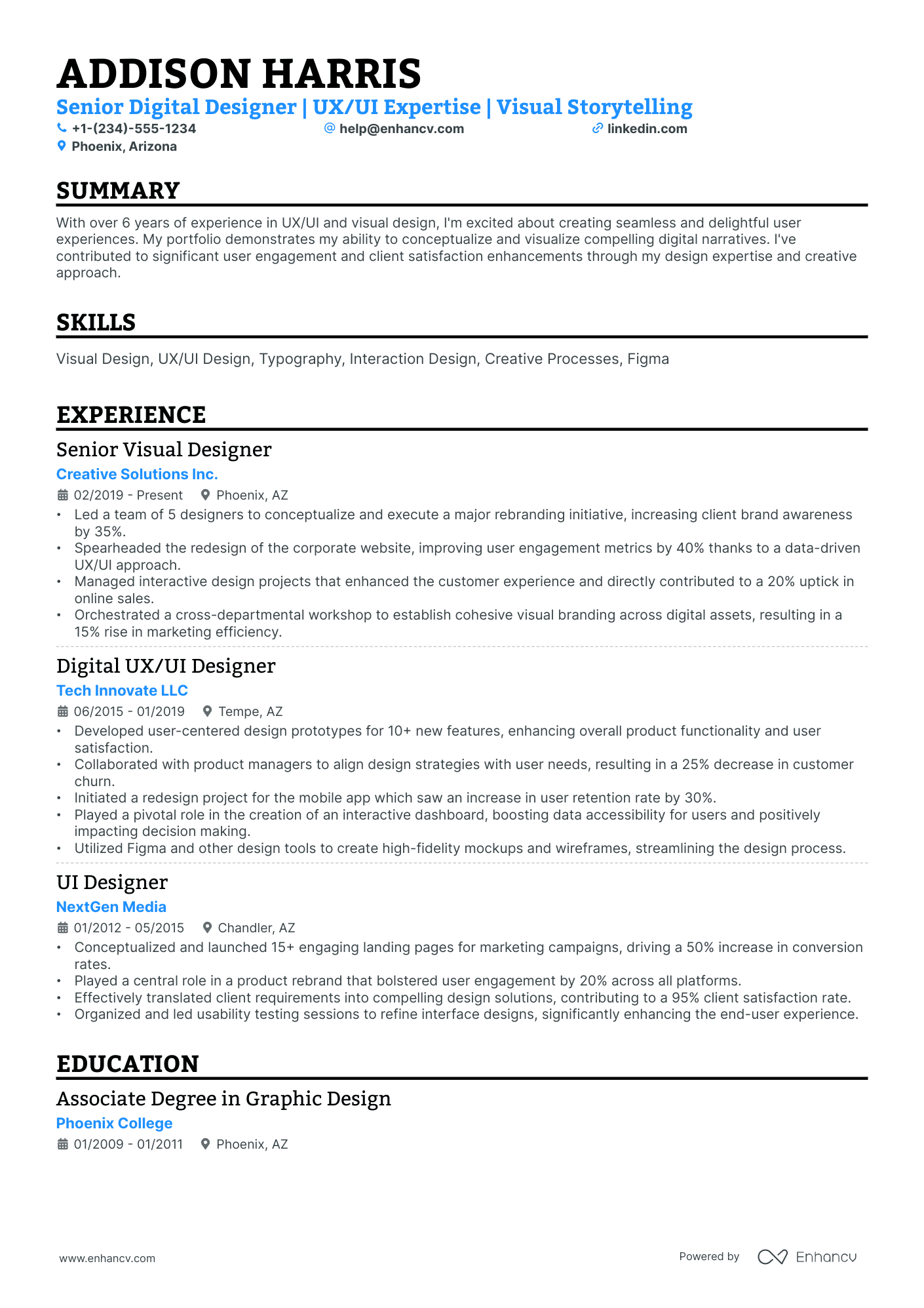
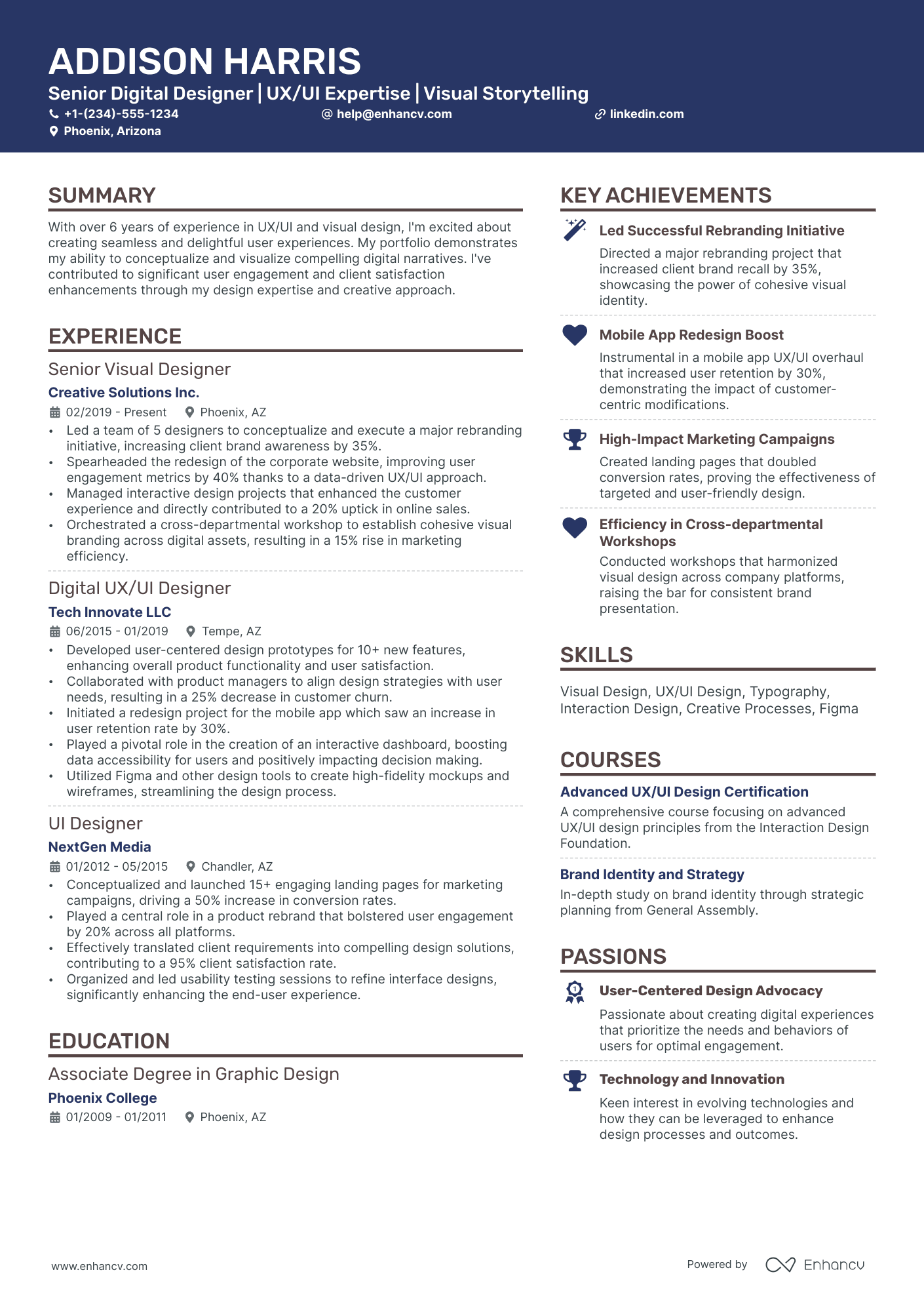
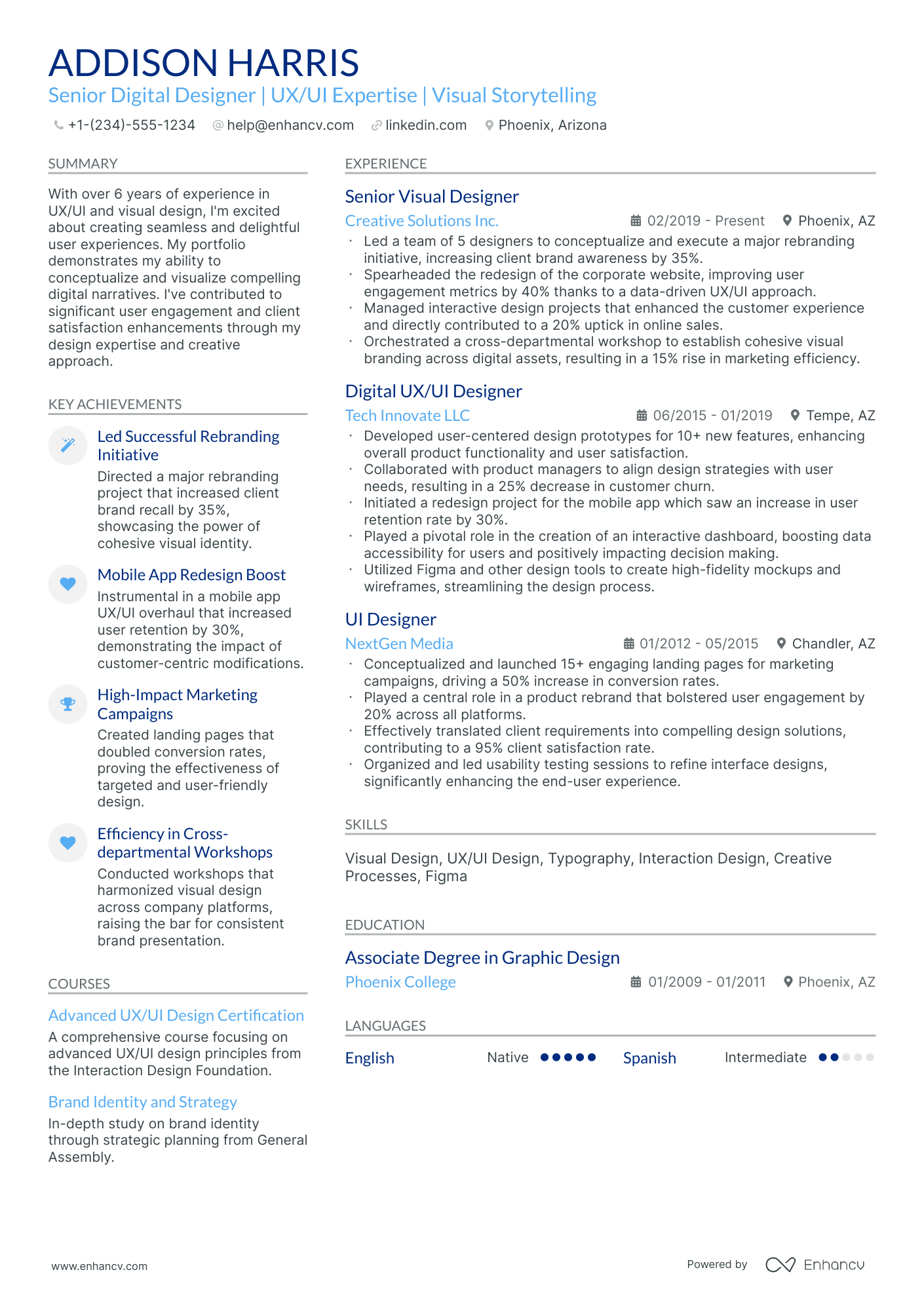
Most digital designer resume submissions fail because they read like portfolios in text form, with vague tool lists and no measurable impact. That hurts when ATS filters for relevant keywords and recruiters scan in seconds in a crowded market. If you're unsure where to begin, understanding how to write a resume that leads with impact rather than duties is the essential first step.
This guide shows you how to lead with outcomes: conversion lift from a landing page redesign, reduced onboarding drop-off, faster release cycles across multiple platforms, improved accessibility scores, higher task success rates, and fewer support tickets after launch.

Key takeaways
- Lead every experience bullet with a measurable outcome, not a task description.
- Choose reverse-chronological format for senior roles and hybrid format for career changers.
- Mirror the exact tools, methods, and terminology from each job posting you target.
- Place your portfolio link in the header so recruiters find your work immediately.
- Quantify achievements using conversion lift, usability scores, delivery speed, or defect reduction.
- Tie every listed skill to a specific project and result in your experience section.
- Use Enhancv's Bullet Point Generator to turn vague duties into recruiter-ready, metric-driven bullets.
Job market snapshot for digital designers
We analyzed 125 recent digital designer job ads across major US job boards. These numbers help you understand regional hotspots, employer expectations, industry demand at a glance.
What level of experience employers are looking for digital designers
| Years of Experience | Percentage found in job ads |
|---|---|
| 1–2 years | 11.2% (14) |
| 3–4 years | 8.8% (11) |
| 5–6 years | 11.2% (14) |
| 7–8 years | 8.0% (10) |
| 9–10 years | 6.4% (8) |
| 10+ years | 13.6% (17) |
| Not specified | 47.2% (59) |
Digital designer ads by area of specialization (industry)
| Industry (Area) | Percentage found in job ads |
|---|---|
| Finance & Banking | 42.4% (53) |
| Healthcare | 25.6% (32) |
| Education | 8.8% (11) |
| Retail & E-commerce | 8.0% (10) |
Top companies hiring digital designers
| Company | Percentage found in job ads |
|---|---|
| HDR, Inc. | 12.8% (16) |
| Parametrix | 12.8% (16) |
Role overview stats
These tables show the most common responsibilities and employment types for digital designer roles. Use them to align your resume with what employers expect and to understand how the role is structured across the market.
Day-to-day activities and top responsibilities for a digital designer
| Responsibility | Percentage found in job ads |
|---|---|
| Figma | 21.6% (27) |
| Photoshop | 16.0% (20) |
| Verilog | 16.0% (20) |
| After effects | 15.2% (19) |
| Autodesk civil 3d | 13.6% (17) |
| Microsoft office | 13.6% (17) |
| Bentley openroads designer | 12.8% (16) |
| Digital design | 11.2% (14) |
| Rtl | 11.2% (14) |
| Css | 10.4% (13) |
| Illustrator | 10.4% (13) |
| Windows | 10.4% (13) |
Type of employment (remote vs on-site vs hybrid)
| Employment type | Percentage found in job ads |
|---|---|
| On-site | 62.4% (78) |
| Hybrid | 30.4% (38) |
| Remote | 7.2% (9) |
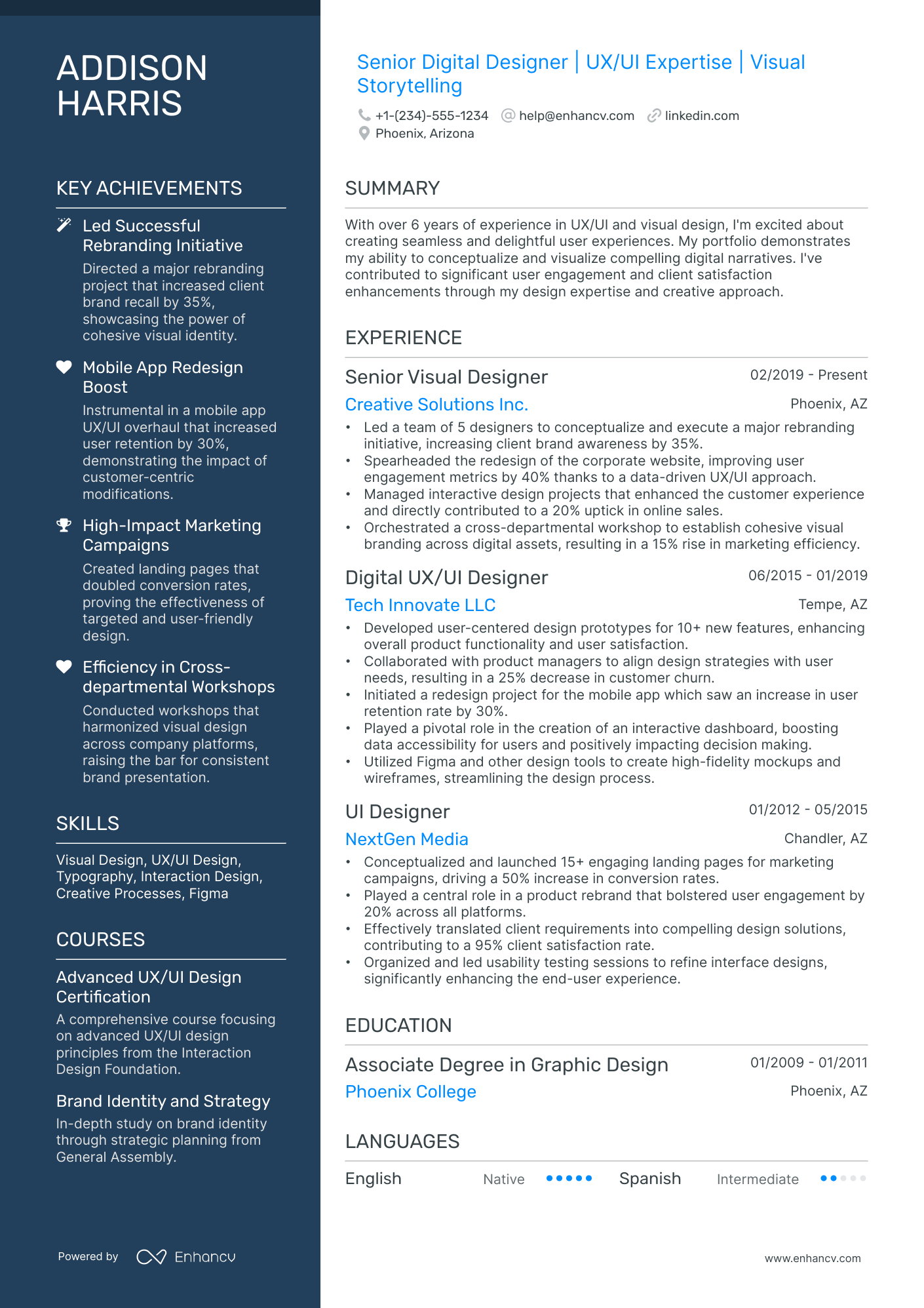
How to format a digital designer resume
Recruiters evaluating digital designer resumes prioritize a strong visual portfolio linkage, proficiency in industry-standard design tools, and evidence of user-centered problem-solving that drives measurable business outcomes. The right resume format ensures these signals surface quickly during both automated screening and the recruiter's initial scan, which typically lasts fewer than 10 seconds.

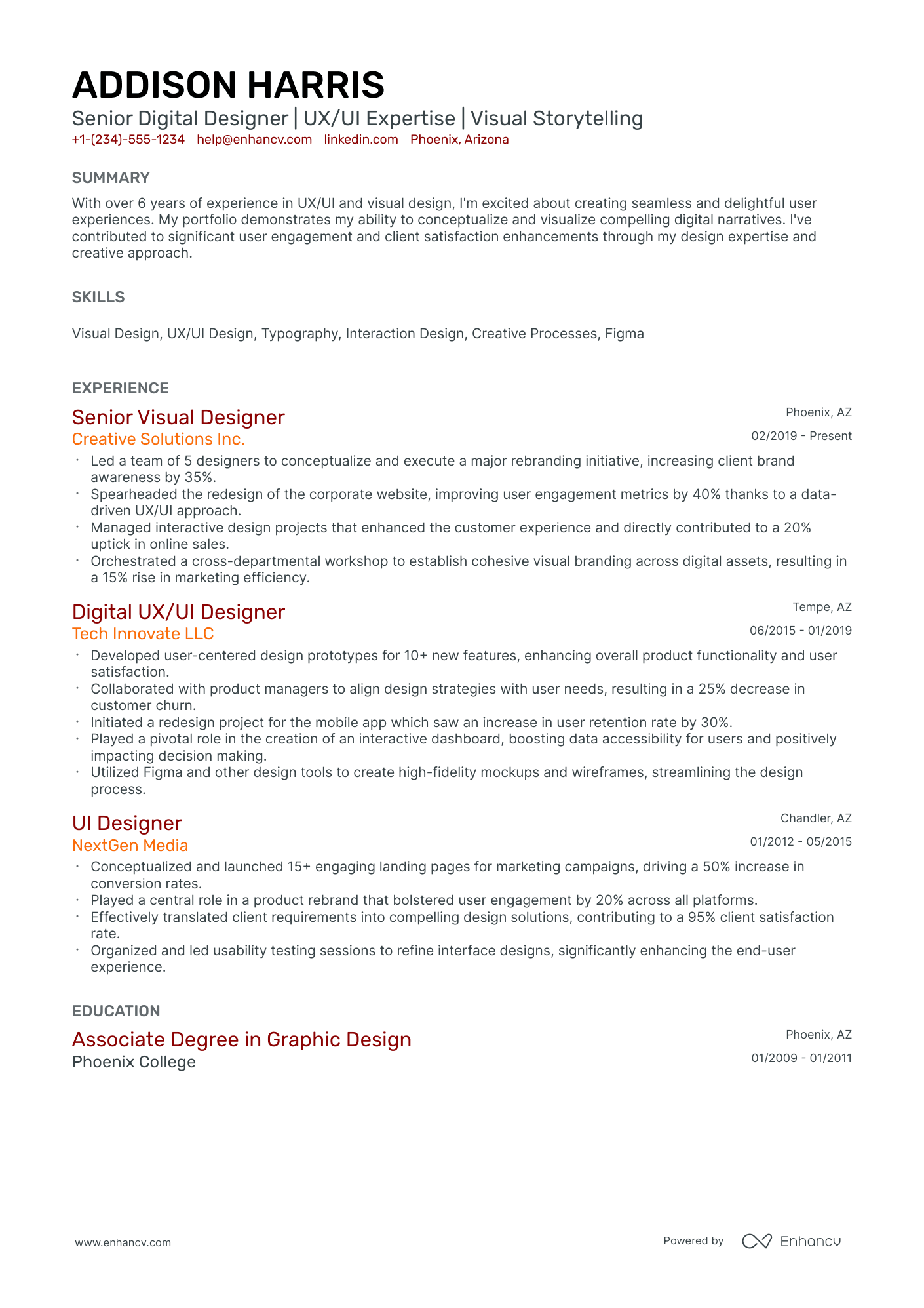
I have significant experience in this role—which format should I use?
Use a reverse-chronological format to showcase your deepening expertise and growing design ownership across projects and teams. Do:
- Lead each role entry with your scope of ownership—number of products supported, team size, or design systems managed.
- Highlight proficiency in role-specific tools and domains such as Figma, Adobe Creative Suite, prototyping platforms, design systems, responsive web design, and accessibility standards.
- Quantify outcomes tied to business or user impact, including conversion lifts, engagement metrics, reduced development cycles, or improved usability scores.
I'm junior or switching into this role—what format works best?
A hybrid format works best, letting you lead with a focused skills section while still providing a concise work history that gives recruiters timeline context. Do:
- Place a skills section near the top featuring core competencies like UI design, wireframing, responsive layout, Figma, and Adobe XD to pass applicant tracking system (ATS) filters early.
- Include freelance projects, bootcamp capstones, or cross-functional contributions from adjacent roles to demonstrate hands-on design experience.
- Connect every listed skill or project to a concrete action and a visible result so recruiters see capability, not just potential.
Why not use a functional resume?
A functional format strips away the timeline and context recruiters need to verify where and how you applied your design skills, making it harder to assess your readiness for the role.
- Career changers with no design work history: You have transferable skills from a related field (marketing, front-end development, or content strategy) but haven't held a design title yet.
- Bootcamp or self-taught designers with limited professional experience: Your strongest evidence comes from portfolio projects, certifications, or volunteer work rather than traditional employment.
- Candidates with extended resume gaps: You took time away from the workforce and need to foreground current, relevant skills over a fragmented timeline.
Once you've established a clean, readable format, the next step is filling it with the right sections to showcase your qualifications effectively.
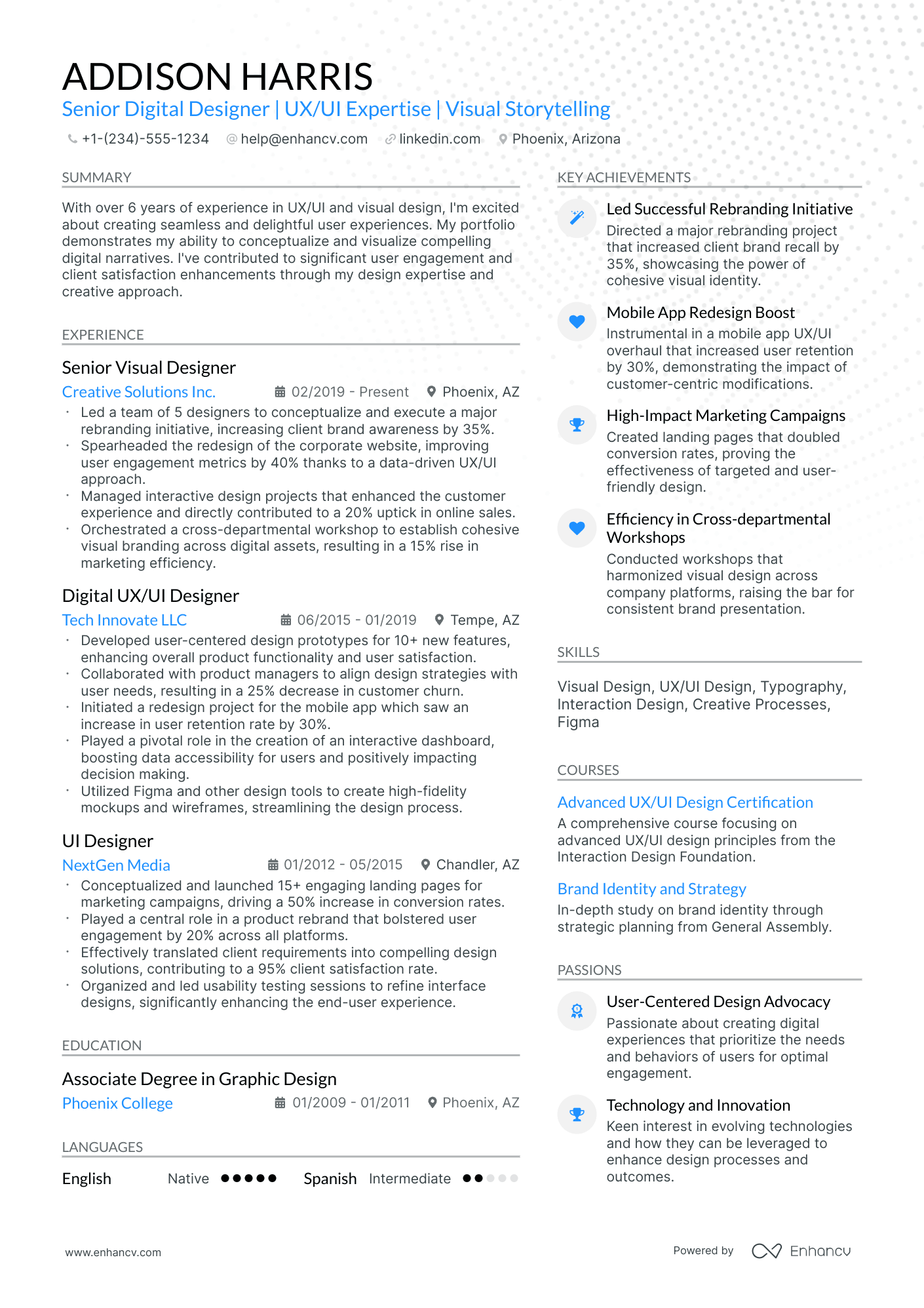
What sections should go on a digital designer resume
Recruiters expect a clean, easy-to-scan resume that shows your design impact, collaboration, and measurable outcomes. Knowing which resume sections to include—and in what order—ensures nothing important gets overlooked.
Use this structure for maximum clarity:
- Header
- Summary
- Experience
- Skills
- Projects
- Education
- Certifications
- Optional sections: Awards, Publications, Volunteering
Strong experience bullets should emphasize shipped work, business and user outcomes, scope, and measurable results.
Is your resume good enough?
Drop your resume here or choose a file. PDF & DOCX only. Max 2MB file size.
Once you’ve organized your resume with the right core sections, the next step is to write your digital designer resume experience in a way that fits that structure and highlights your impact.
How to write your digital designer resume experience
The experience section is where you prove you've shipped real digital work—across websites, apps, campaigns, or product interfaces—using role-relevant tools and methods that produced measurable outcomes. Hiring managers prioritize demonstrated impact over descriptive task lists, so every line should connect what you designed to the results it drove.
Each entry should include:
- Job title
- Company and location (or remote)
- Dates of employment (month and year)
Three to five concise bullet points showing what you owned, how you executed, and what outcomes you delivered:
- Ownership scope: the digital products, platforms, design systems, brand touchpoints, or user-facing experiences you were directly accountable for as a digital designer.
- Execution approach: the design tools, prototyping software, user research frameworks, interaction patterns, or creative workflows you applied to solve problems and deliver polished assets.
- Value improved: the specific gains in usability, visual consistency, page performance, accessibility compliance, conversion quality, or production efficiency your design work created.
- Collaboration context: how you partnered with product managers, developers, copywriters, marketing teams, or external clients to align digital design decisions with broader project goals.
- Impact delivered: the tangible outcomes your contributions produced, expressed through business results, audience reach, adoption scale, or stakeholder value rather than a list of completed tasks.
Experience bullet formula
A digital designer experience example
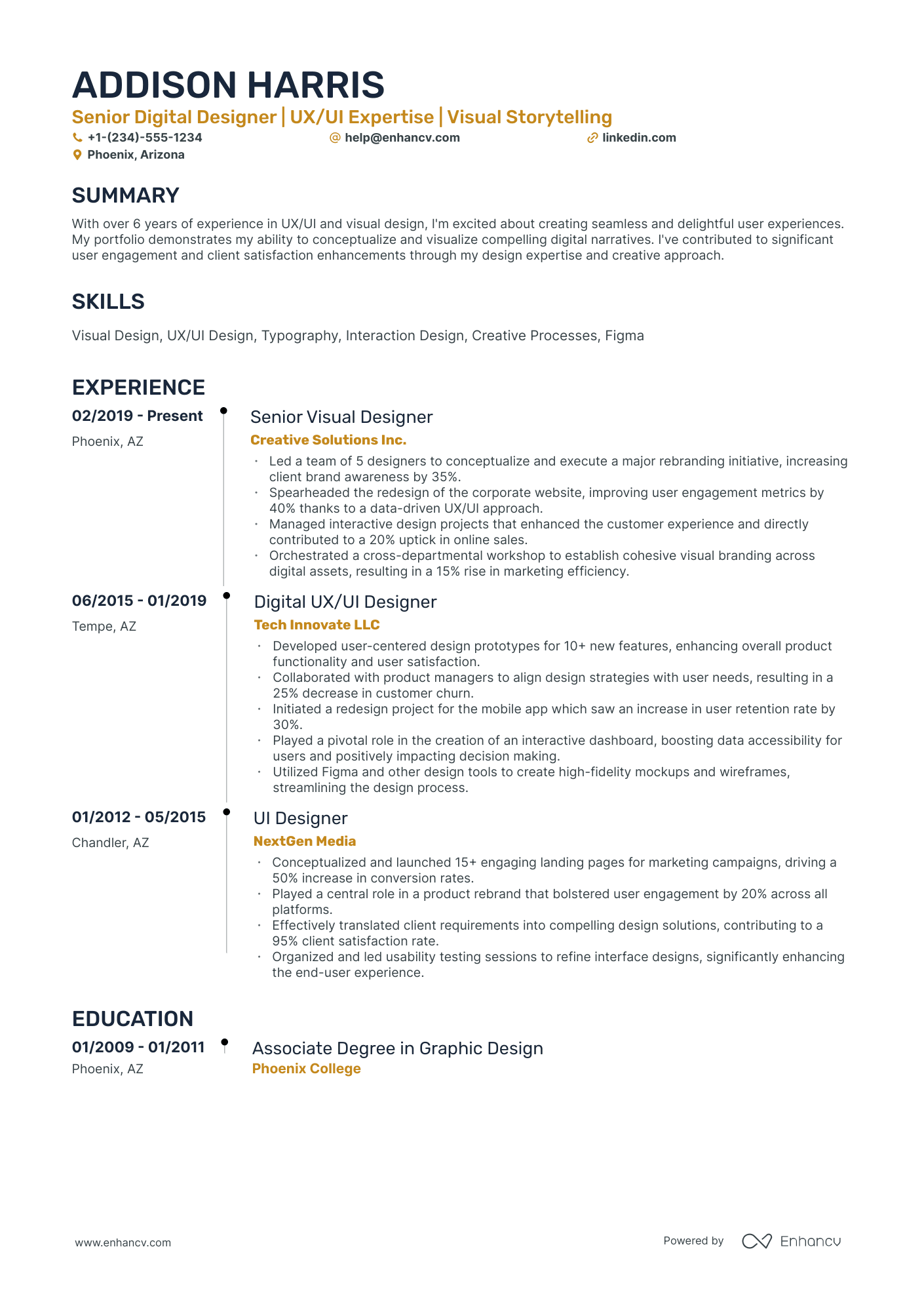
✅ Right example - modern, quantified, specific.
Senior Digital Designer
Nimbus Health | Remote
2022–Present
Telehealth platform serving two million patients annually across mobile and web.
- Led end-to-end redesign of the appointment booking flow in Figma using Auto Layout, variants, and prototyping—improved conversion by 18 percent and reduced drop-off by 12 percent in two releases.
- Built and maintained a design system in Figma and Storybook with design tokens and accessibility standards—cut UI build time by 25 percent and reduced visual defects by 30 percent in partnership with front-end engineers.
- Ran usability tests and unmoderated studies in Maze and UserTesting, then synthesized findings in FigJam—reduced task completion time by 22 percent and increased satisfaction score from 4.1 to 4.6.
- Collaborated with product managers and analysts to define hypotheses, event tracking, and dashboards in Amplitude—improved feature adoption by 14 percent and clarified success metrics across three squads.
- Produced motion and micro-interactions in After Effects and Lottie, then validated performance with Lighthouse—improved perceived load time by 10 percent and reduced support tickets tied to “confusing UI” by 16 percent.
Now that you've seen how a strong experience section comes together, let's look at how to adjust yours to match the specific job you're targeting.
How to tailor your digital designer resume experience
Recruiters evaluate digital designer resumes through both human review and applicant tracking systems, so tailoring your resume to the job description is essential. Tailoring ensures the tools, methods, and outcomes you highlight match what the hiring team is actively seeking.
Ways to tailor your digital designer experience:
- Mirror the exact design tools and software listed in the posting.
- Match terminology for design systems or component libraries referenced.
- Reflect accessibility standards or compliance requirements the role specifies.
- Highlight collaboration workflows with developers or product teams mentioned.
- Include industry or domain experience relevant to the company's sector.
- Use the same language for UX methodologies or research processes described.
- Emphasize performance metrics or KPIs the job description prioritizes.
- Reference prototyping or handoff frameworks the team currently uses.
Tailoring means aligning your real accomplishments with the role's stated requirements, not forcing keywords where they don't belong.
Resume tailoring examples for digital designer
| Job description excerpt | Untailored | Tailored |
|---|---|---|
| "Design responsive web and mobile interfaces in Figma, collaborating closely with product and engineering teams to ship features on a two-week sprint cycle." | Designed various digital assets for company projects. | Designed responsive web and mobile interfaces in Figma, partnering with product managers and engineers to ship 12 features across six two-week sprints. |
| "Create and maintain a scalable design system in Adobe XD that ensures brand consistency across our e-commerce platform, serving 2M+ monthly users." | Worked on branding and visual design tasks as needed. | Built and maintained a scalable design system in Adobe XD for an e-commerce platform, enforcing brand consistency across 40+ components serving 2M+ monthly users. |
| "Produce motion graphics and interactive prototypes using After Effects and Principle to validate UX concepts through usability testing before development handoff." | Created prototypes and animations for different teams. | Produced motion graphics in After Effects and interactive prototypes in Principle, validating UX concepts through usability testing that reduced post-handoff revision requests by 35%. |
Once you’ve aligned your experience with the role’s priorities, the next step is to quantify your digital designer achievements so hiring managers can see the impact of that work.
How to quantify your digital designer achievements
Quantifying your work proves business and user impact, not just visual taste. Focus on conversion, usability success rates, delivery speed, defect reduction, and performance improvements tied to specific screens, flows, and tools.
Quantifying examples for digital designer
| Metric | Example |
|---|---|
| Conversion lift | "Redesigned checkout UI in Figma and ran two A/B tests, increasing completed purchases from 2.8% to 3.4% (+21%) across 180,000 sessions." |
| Usability success | "Facilitated eight usability tests and iterated on navigation, raising task completion from 62% to 88% and cutting median time-on-task by 34%." |
| Delivery speed | "Built a design system in Figma with 45 components and variants, reducing new page design time from three days to one day per page." |
| Defect reduction | "Partnered with engineering to refine specs and token usage, reducing UI bugs in QA from 38 to 14 per release over three releases." |
| Performance impact | "Optimized image formats and responsive assets with WebP and SVG, reducing homepage load time from 2.9 seconds to 1.8 seconds on mobile." |
Turn vague job duties into measurable, recruiter-ready resume bullets in seconds with Enhancv's Bullet Point Generator.
With strong bullet points in place, the next step is ensuring your skills section showcases the right mix of hard and soft skills that digital design employers are looking for.
How to list your hard and soft skills on a digital designer resume
Your skills section shows you can design effective, on-brand digital experiences—recruiters and applicant tracking systems scan it to match role requirements quickly, so aim for a balanced mix of hard skills and job-specific soft skills. digital designer roles require a blend of:
- Product strategy and discovery skills.
- Data, analytics, and experimentation skills.
- Delivery, execution, and go-to-market discipline.
- Soft skills.
Your skills section should be:
- Scannable (bullet-style grouping).
- Relevant to the job post.
- Backed by proof in experience bullets.
- Updated with current tools.
Place your skills section:
- Above experience if you're junior or switching careers.
- Below experience if you're mid/senior with strong achievements.

Hard skills
- Figma, FigJam
- Adobe Creative Cloud
- Design systems, tokens
- UI component libraries
- Responsive web design
- Mobile-first design
- Typography, layout grids
- Accessibility, WCAG 2.2
- Prototyping, microinteractions
- Usability testing
- A/B testing, Optimizely
- HTML, CSS fundamentals
Soft skills
- Translate goals into flows
- Present design rationale
- Facilitate stakeholder alignment
- Partner with product managers
- Collaborate with engineers
- Incorporate user feedback fast
- Prioritize under constraints
- Make trade-off decisions
- Manage critique and iteration
- Maintain quality under deadlines
- Document decisions and specs
- Own handoff through launch
How to show your digital designer skills in context
Skills shouldn't live only in a dedicated skills list. Explore our curated collection of resume skills examples to see how top candidates present their abilities across different roles.
They should be demonstrated in:
- Your summary (high-level professional identity)
- Your experience (proof through outcomes)
Here's what that looks like in practice.
Summary example
Senior digital designer with 10 years in e-commerce, specializing in responsive UI design, Figma-based design systems, and user research. Led a cross-functional rebrand that boosted conversion rates by 34% across mobile and desktop.
- Signals senior-level expertise immediately
- Names role-relevant tools and methods
- Leads with a measurable business outcome
- Highlights cross-functional collaboration skills
Experience example
Senior Digital Designer
Relay Commerce | Remote
March 2020–August 2024
- Redesigned the checkout flow in Figma and Protopie, collaborating with product and engineering to reduce cart abandonment by 22%.
- Built a scalable design system with developers, cutting production time by 30% across 12 product teams.
- Led user research sessions and translated findings into wireframes, increasing task completion rates by 18%.
- Every bullet contains measurable proof.
- Skills appear naturally through real outcomes.
Once you’ve demonstrated your design abilities through relevant examples, the next step is learning how to write a digital designer resume with no experience so you can present that evidence effectively.
How do I write a digital designer resume with no experience
Even without full-time experience, you can demonstrate readiness through portfolio work and hands-on projects. Our guide on writing a resume without work experience walks you through the full approach. Consider showcasing:
- Portfolio case studies with process
- Volunteer nonprofit website redesigns
- Internship or apprenticeship deliverables
- Freelance landing page design
- Student capstone product design
- Design challenges with documented outcomes
- Open-source design contributions
- Personal brand identity projects
Focus on:
- Strong portfolio with clear outcomes
- Tool proficiency: Figma, Adobe Creative Cloud
- Design system and component work
- Research-backed decisions with artifacts
Resume format tip for entry-level digital designer
Use a combination resume format because it highlights portfolio projects and skills before work history, which keeps the focus on proof of design ability. Do:
- Put portfolio link in header.
- Lead with a Projects section.
- Write bullets with tools and outcomes.
- Include one design system example.
- Add research artifacts and metrics.
- Redesigned a nonprofit website in Figma, built a responsive component library, and improved mobile signup conversion by 18% based on usability test findings.
Even without professional experience, your education section can serve as the foundation of your resume—here's how to present it effectively.
How to list your education on a digital designer resume
Your education section helps hiring teams confirm you have foundational design knowledge. It validates your training in visual principles, digital tools, and creative problem-solving relevant to the digital designer role.
Include:
- Degree name
- Institution
- Location
- Graduation year
- Relevant coursework (for juniors or entry-level candidates)
- Honors & GPA (if 3.5 or higher)
Skip month and day details—list the graduation year only.
Here's a strong education entry tailored for a digital designer resume:
Example education entry
Bachelor of Fine Arts in Digital Design
Rhode Island School of Design, Providence, RI
Graduated 2021
GPA: 3.7/4.0
- Relevant Coursework: Interaction Design, Typography, UX Principles, Motion Graphics, Visual Communication
- Honors: Dean's List (six semesters), Outstanding Senior Portfolio Award
How to list your certifications on a digital designer resume
Certifications show a digital designer's commitment to learning, prove tool proficiency, and signal industry relevance to hiring teams in fast-changing design environments.
Include:
- Certificate name
- Issuing organization
- Year
- Optional: credential ID or URL
- Place certifications below education when your degree is recent and certifications add support, not the main proof of your current design skills.
- Place certifications above education when they're recent, role-relevant, and show in-demand tools or methods that match the digital designer job.
Best certifications for your digital designer resume
- Google UX Design Professional Certificate
- Adobe Certified Professional in Visual Design
- Nielsen Norman Group UX Certification
- Interaction Design Foundation Certificate
- Figma for UX Design Certification (Coursera)
- HubSpot Content Marketing Certification
- Meta Front-End Developer Professional Certificate
Once you’ve placed your certifications where they reinforce your qualifications, shift to your digital designer resume summary to highlight those credentials upfront and frame your value quickly.
How to write your digital designer resume summary
Your resume summary is the first thing a recruiter reads. A sharp, specific opening sets the tone and earns a closer look at the rest of your digital designer resume.
Keep it to three to four lines, with:
- Your title and total years of experience in digital design.
- The domain you work in, such as e-commerce, SaaS, or mobile apps.
- Core tools and skills like Figma, Adobe Creative Suite, or prototyping.
- One or two measurable achievements, such as improved engagement or faster delivery.
- A soft skill tied to a real outcome, like cross-team collaboration that streamlined workflows.

PRO TIP
At an early-career level, focus on relevant tools, transferable skills, and any measurable contributions from internships or projects. Avoid vague descriptors like "passionate" or "motivated self-starter." Recruiters want proof of what you can do, not aspirational statements about who you hope to become.
Example summary for a digital designer
Digital designer with two years of experience creating responsive web and mobile interfaces in Figma. Redesigned a SaaS onboarding flow that boosted user activation by 18%. Collaborates closely with developers to ship pixel-perfect designs on schedule.
Optimize your resume summary and objective for ATS
Drop your resume here or choose a file.
PDF & DOCX only. Max 2MB file size.
Now that your summary is ready to hook recruiters with a snapshot of your value, make sure the header above it presents your contact details and professional identity correctly.
What to include in a digital designer resume header
A resume header lists your key details at the top, and it boosts visibility, credibility, and recruiter screening for a digital designer.
Essential resume header elements
- Full name
- Tailored job title and headline
- Location
- Phone number
- Professional email
- GitHub link
- Portfolio link
A LinkedIn link helps recruiters verify your experience quickly and supports fast screening.
Don't include a photo on a digital designer resume unless the role is explicitly front-facing or appearance-dependent.
Keep your header to two lines, use consistent formatting, and match your job title to the posting's wording.
Example
Digital designer resume header
Jordan Lee
Digital designer | Product and marketing design
Austin, TX
(512) 555-01XX your.name@enhancv.com github.com/yourname yourwebsite.com linkedin.com/in/yourname
Once your contact details, portfolio link, and role focus are clear at the top, you can strengthen the rest of your application with additional sections that support the same narrative.
Additional sections for digital designer resumes
Extra resume sections help you stand out when your core qualifications match other digital designer candidates competing for the same role.
They add depth, showcase unique strengths, and build credibility beyond standard work experience and education.
Consider including these sections on your digital designer resume:
- Languages
- Design awards and recognitions
- Hobbies and interests
- Publications and case studies
- Speaking engagements and workshops
- Professional memberships
- Open-source or side projects
Once you've rounded out your resume with the right supplementary sections, it's worth turning your attention to the cover letter—a separate document that can reinforce and expand on everything your resume presents.
Do digital designer resumes need a cover letter
A cover letter isn't required for a digital designer, but it helps in competitive roles or when hiring managers expect one. If you're wondering what a cover letter is and when it matters, it can make a difference when your resume needs context or your fit is not obvious.
Use it to add details your portfolio and resume can't show:
- Explain role and team fit by naming the collaboration model, stakeholders, and how you work with product, engineering, and research.
- Highlight one or two relevant projects with clear outcomes, such as improved conversion, reduced support tickets, or faster task completion.
- Show you understand the product, users, and business context by referencing a key use case, constraint, or metric tied to the role.
- Address career transitions or non-obvious experience by connecting past work to digital designer skills, tools, and decision-making impact.
Drop your resume here or choose a file.
PDF & DOCX only. Max 2MB file size.
Whether you include a cover letter or not, using AI to improve your digital designer resume helps you strengthen the same core details recruiters evaluate.
Using AI to improve your digital designer resume
AI can sharpen your resume's clarity, structure, and overall impact. It helps refine language and highlight measurable results. However, overusing it risks making your resume sound generic. Once your content feels clear and role-aligned, step away from AI. If you're curious about where to start, check out these ChatGPT resume writing prompts for practical guidance.
Here are 10 practical prompts to strengthen specific sections of your digital designer resume:
- Sharpen your summary: "Rewrite my digital designer resume summary to highlight my core strengths, design specialties, and years of experience in under four sentences."
- Quantify your impact: "Add measurable results to these digital designer experience bullets, focusing on metrics like engagement, conversion rates, or project delivery timelines."
- Strengthen action verbs: "Replace weak or passive verbs in my digital designer experience section with strong, specific action verbs relevant to design work."
- Tailor your skills: "Compare my digital designer skills section against this job description and recommend which skills to add, remove, or reorder."
- Refine project descriptions: "Rewrite my digital designer project descriptions to clearly state the problem, my design approach, and the measurable outcome."
- Tighten bullet points: "Shorten each digital designer experience bullet to one concise line while preserving the specific contribution and its result."
- Align your education: "Rewrite my education section to emphasize coursework and achievements most relevant to a digital designer role."
- Highlight certifications: "Reorganize my digital designer certifications section to prioritize credentials most valued in current job postings for this role."
- Remove redundant phrasing: "Identify and eliminate filler words, clichés, or redundant phrases throughout my digital designer resume."
- Match job language: "Adjust my digital designer resume wording to naturally reflect terminology and priorities used in this specific job listing."
Stop using AI once your resume sounds accurate, specific, and aligned with real experience. AI should never invent experience or inflate claims—if it didn't happen, it doesn't belong here.
Conclusion
A strong digital designer resume shows measurable outcomes, role-specific skills, and a clear structure. It highlights impact with numbers, names the tools you use, and connects your work to user needs and business goals.
Keep it clean, easy to scan, and focused on your strongest work. This approach matches how teams hire today and supports what they will need next. It helps you present as a ready, reliable digital designer.