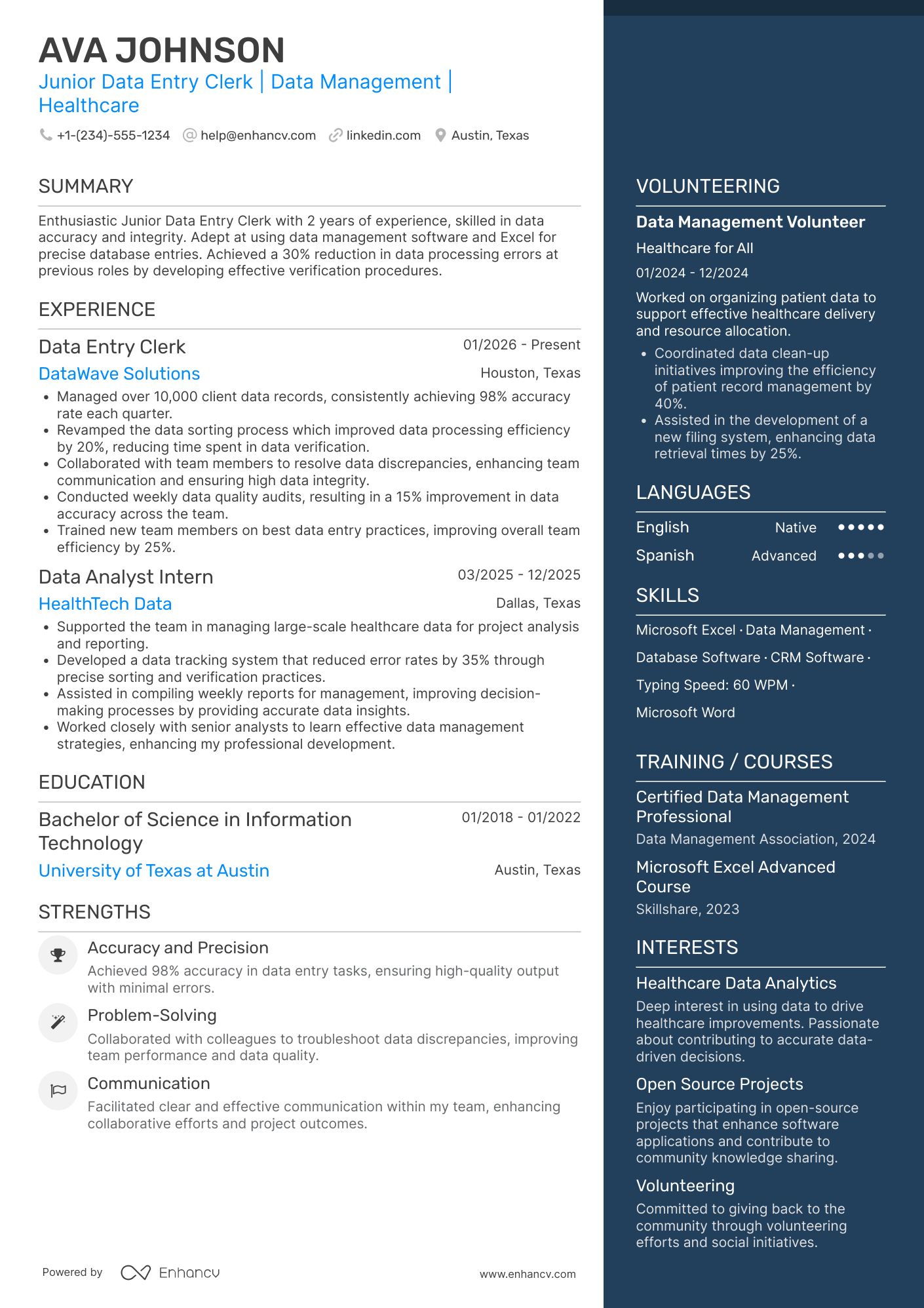
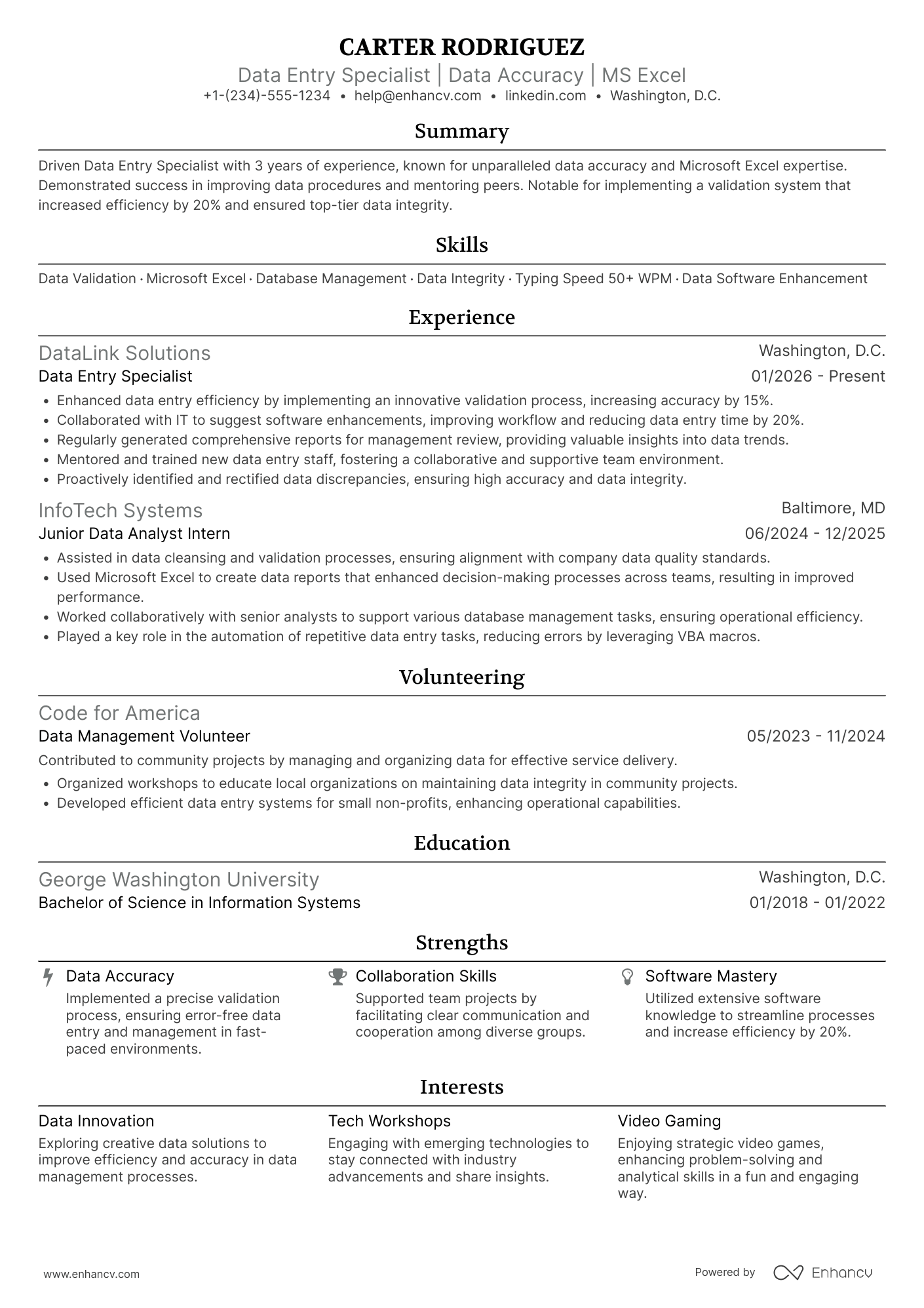
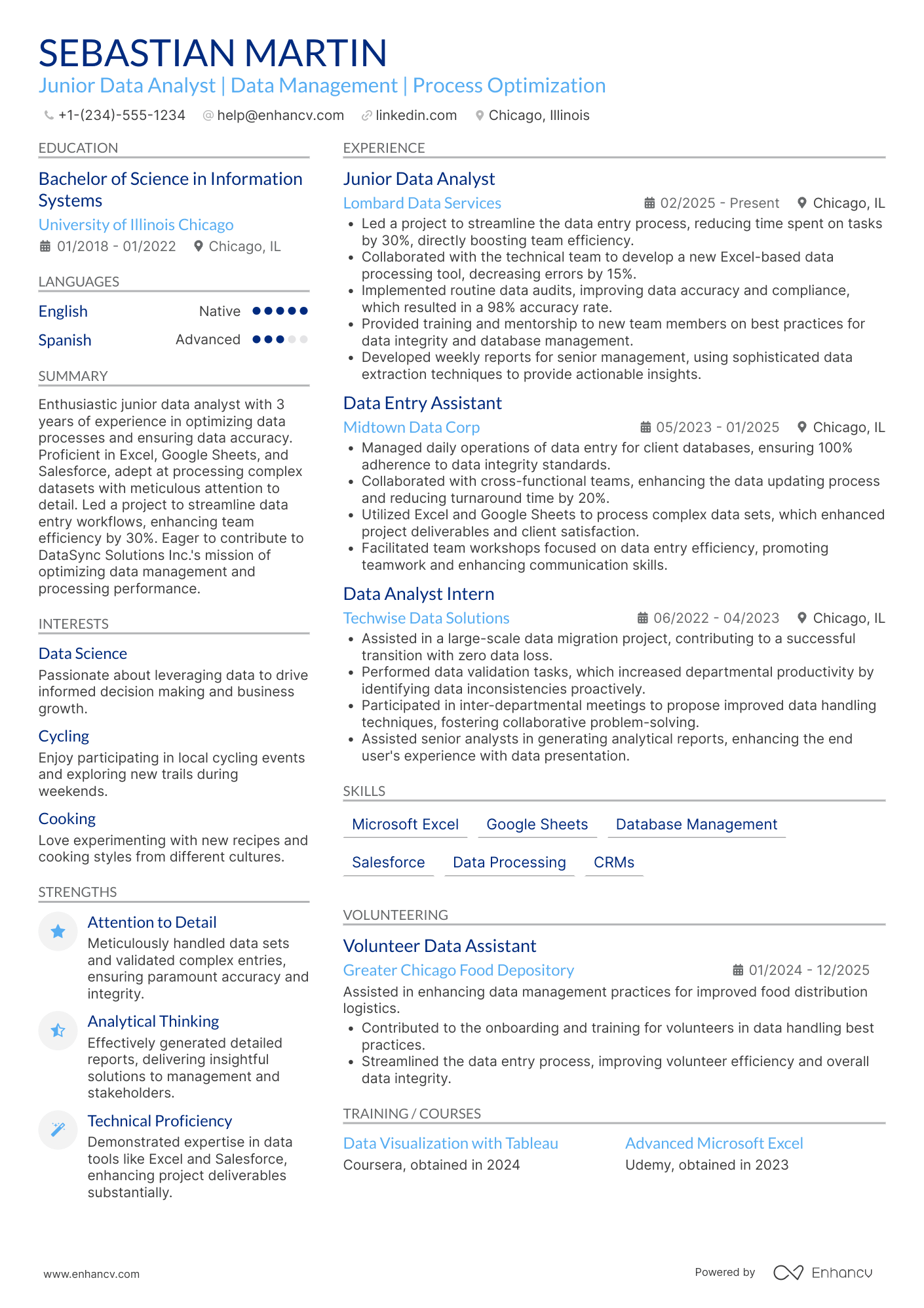
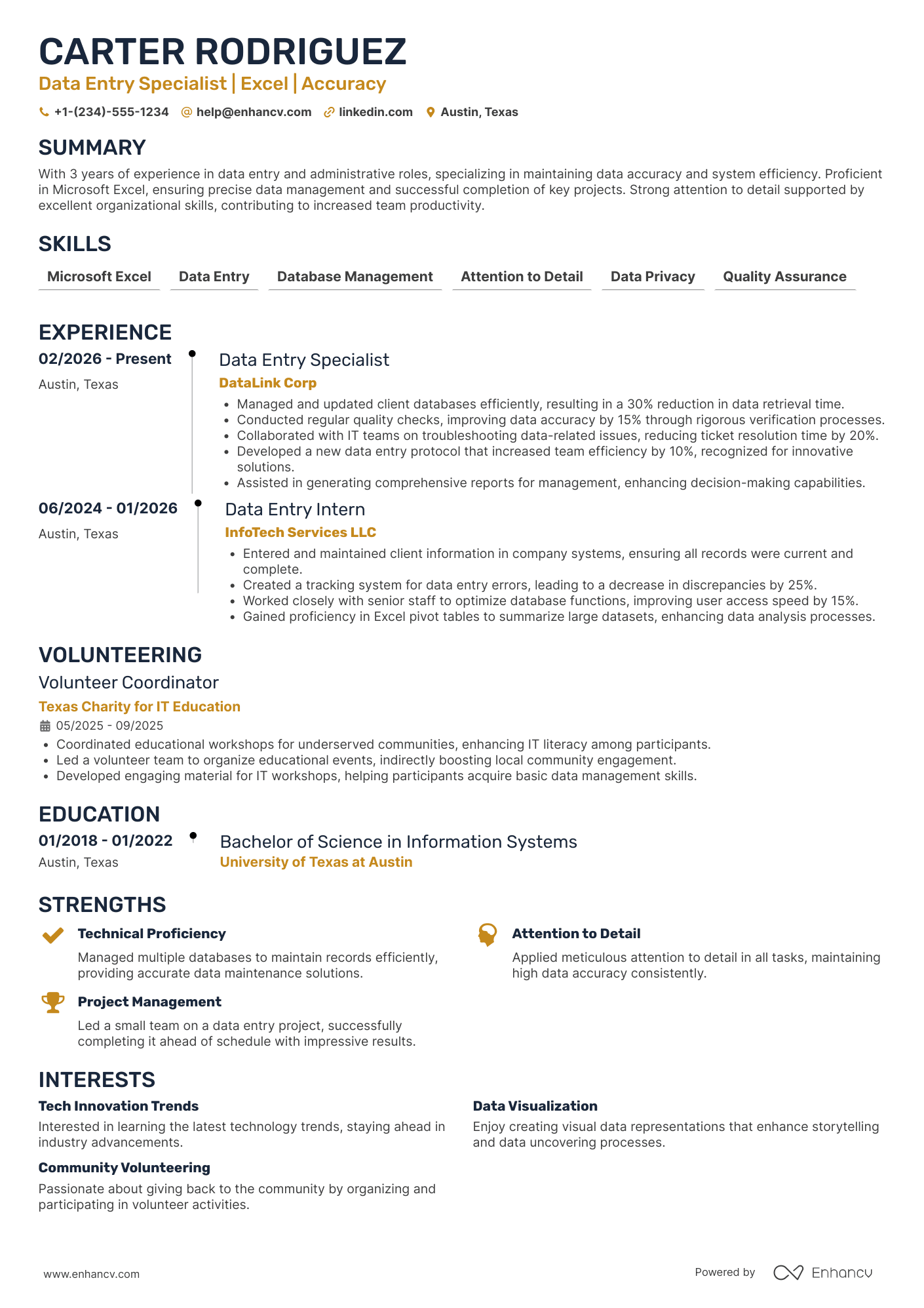
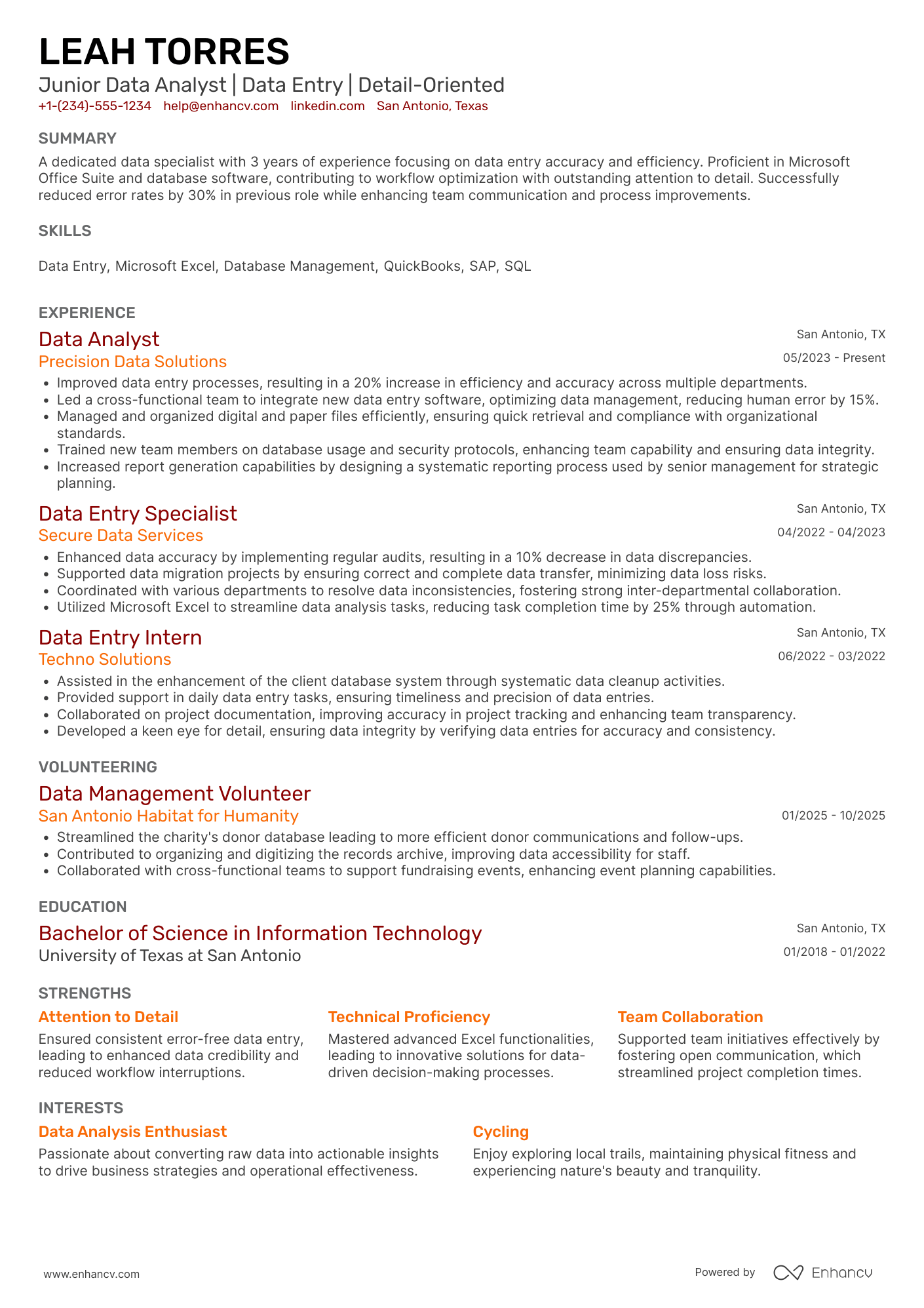
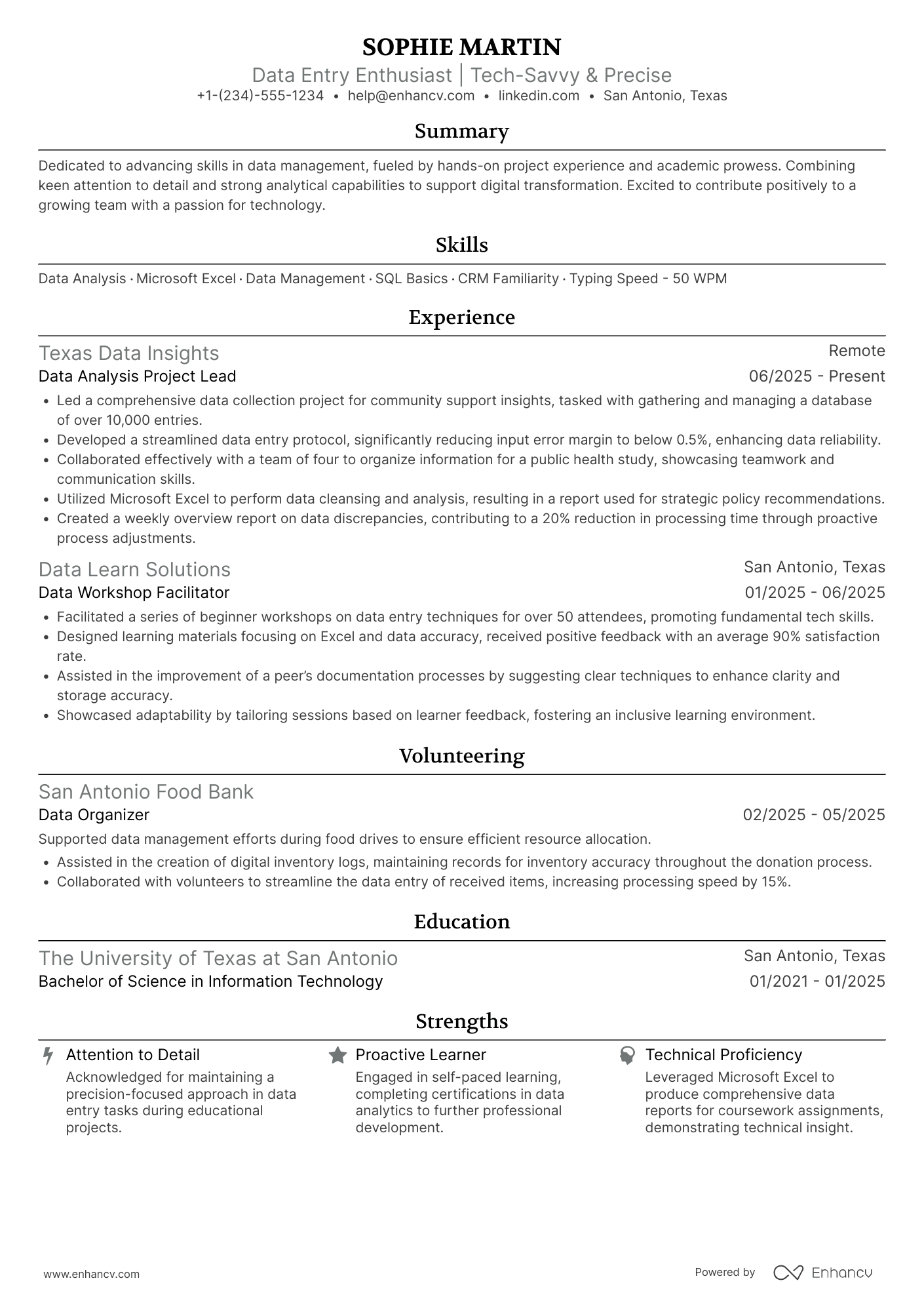
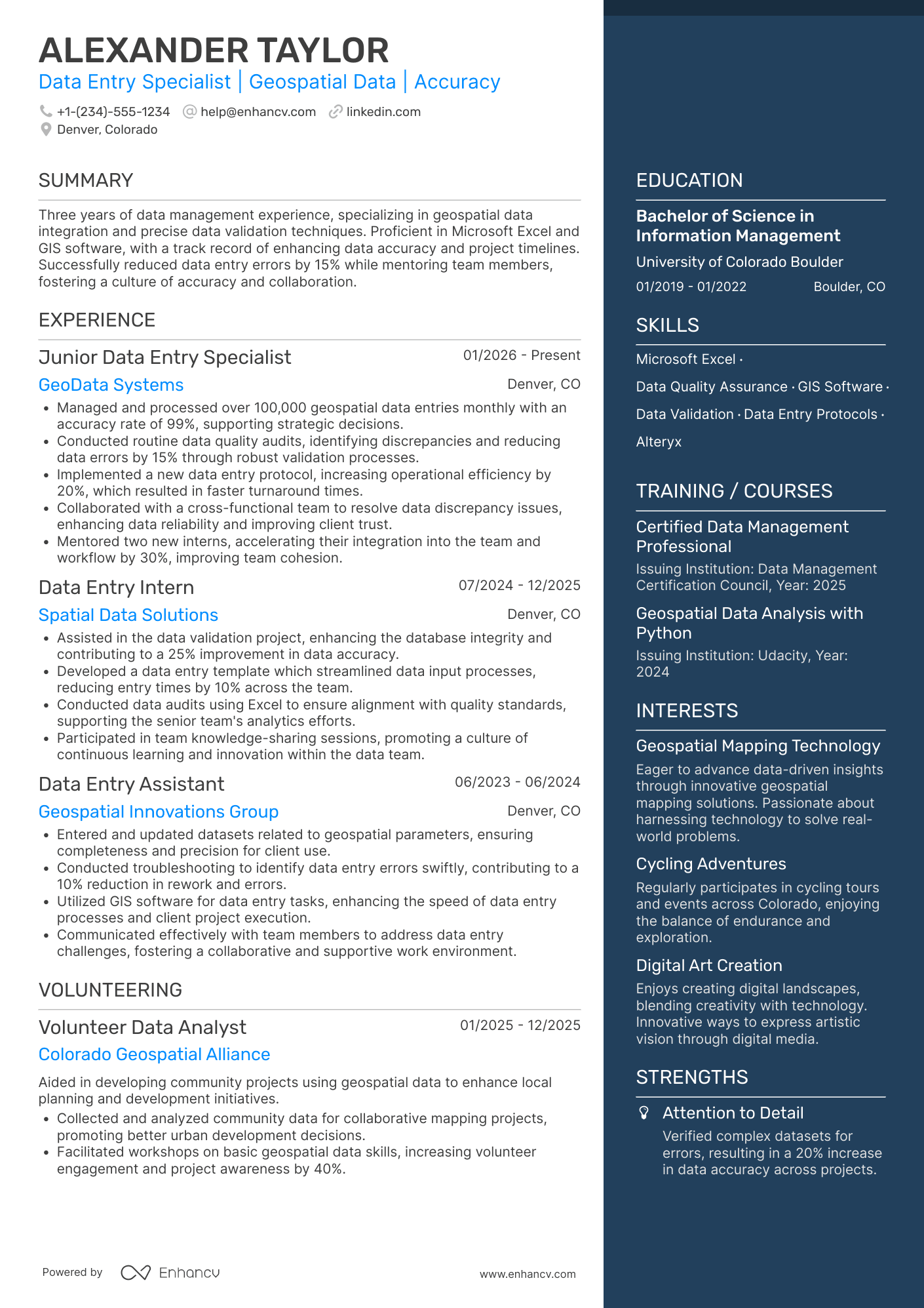
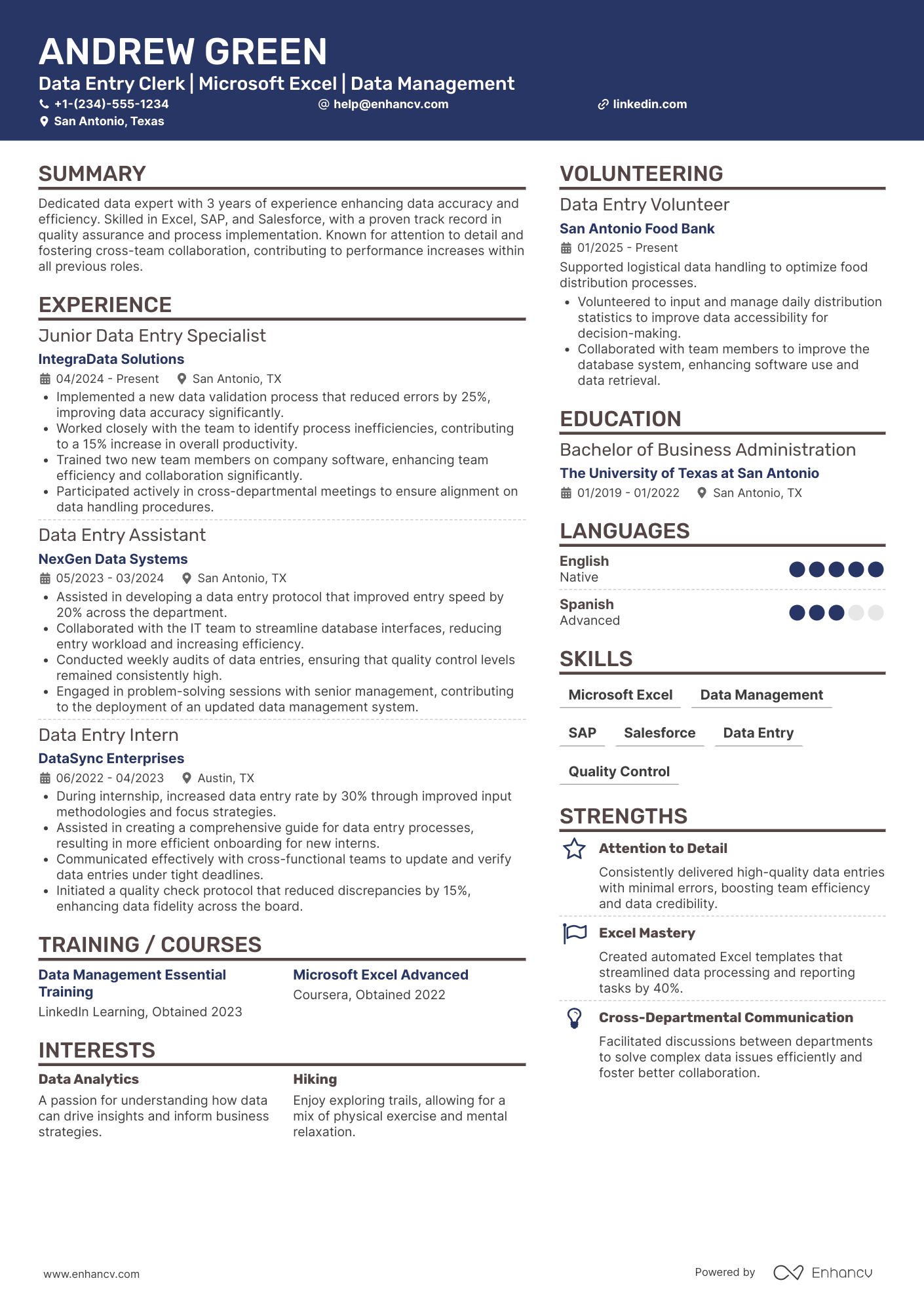
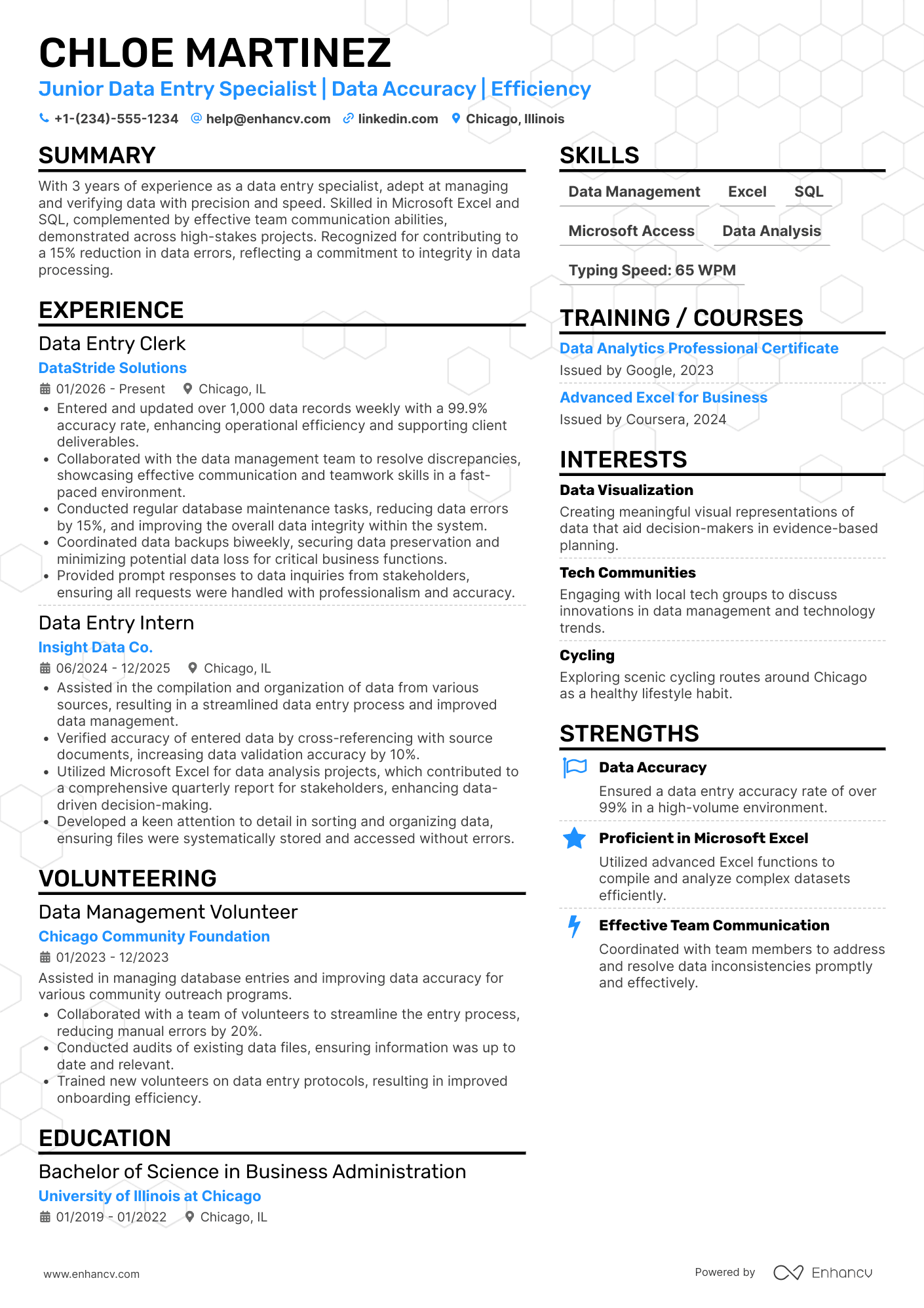
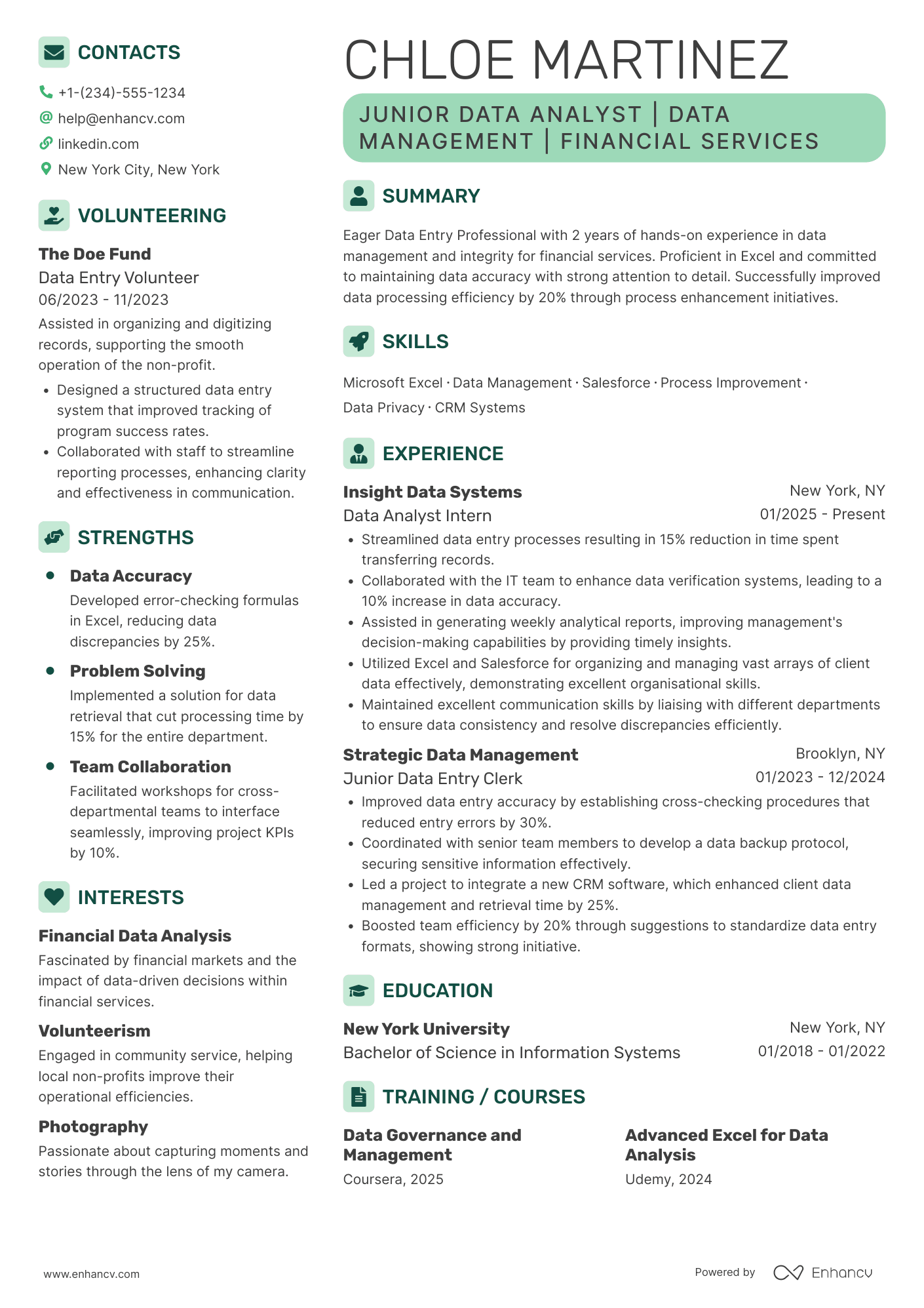
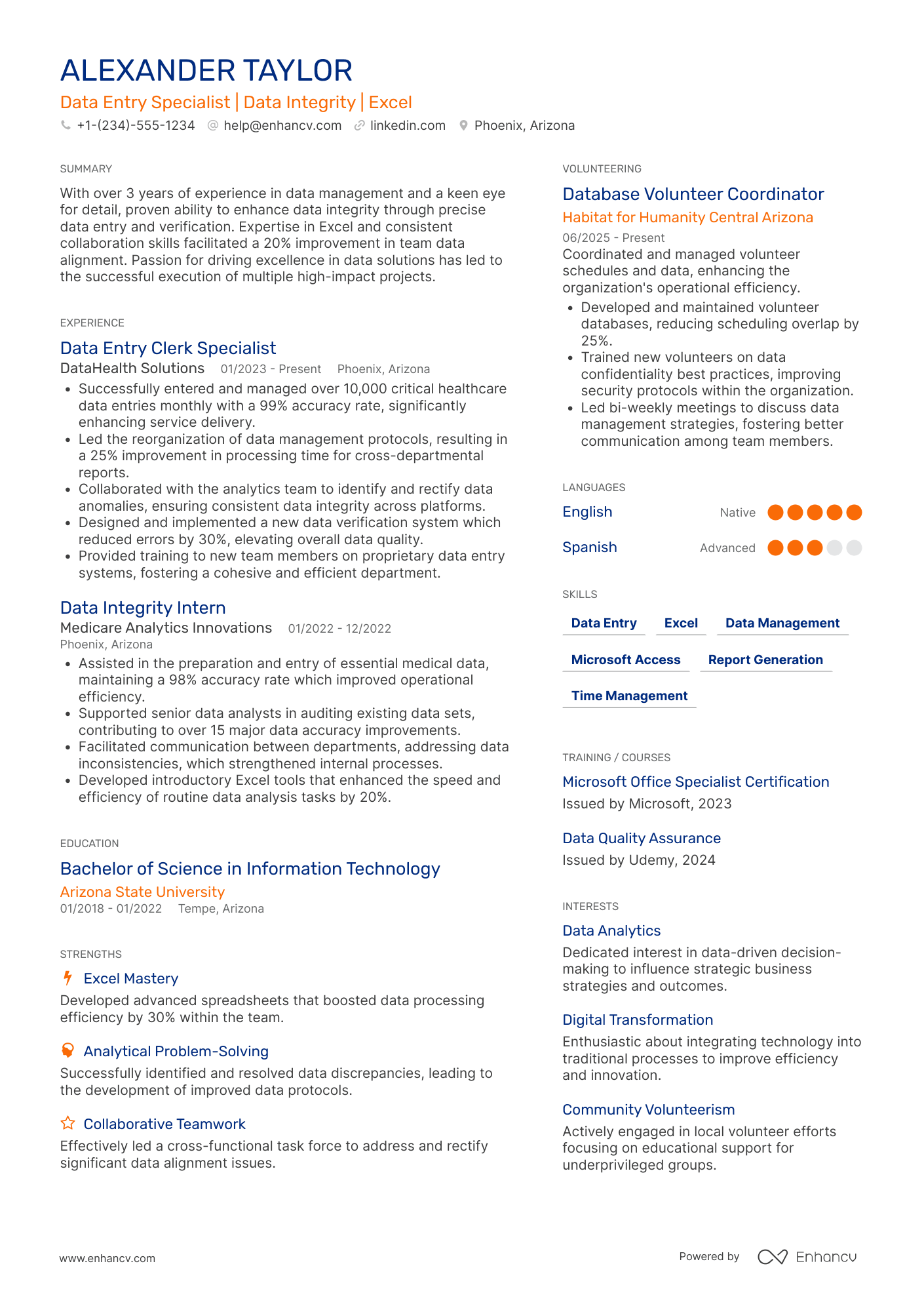
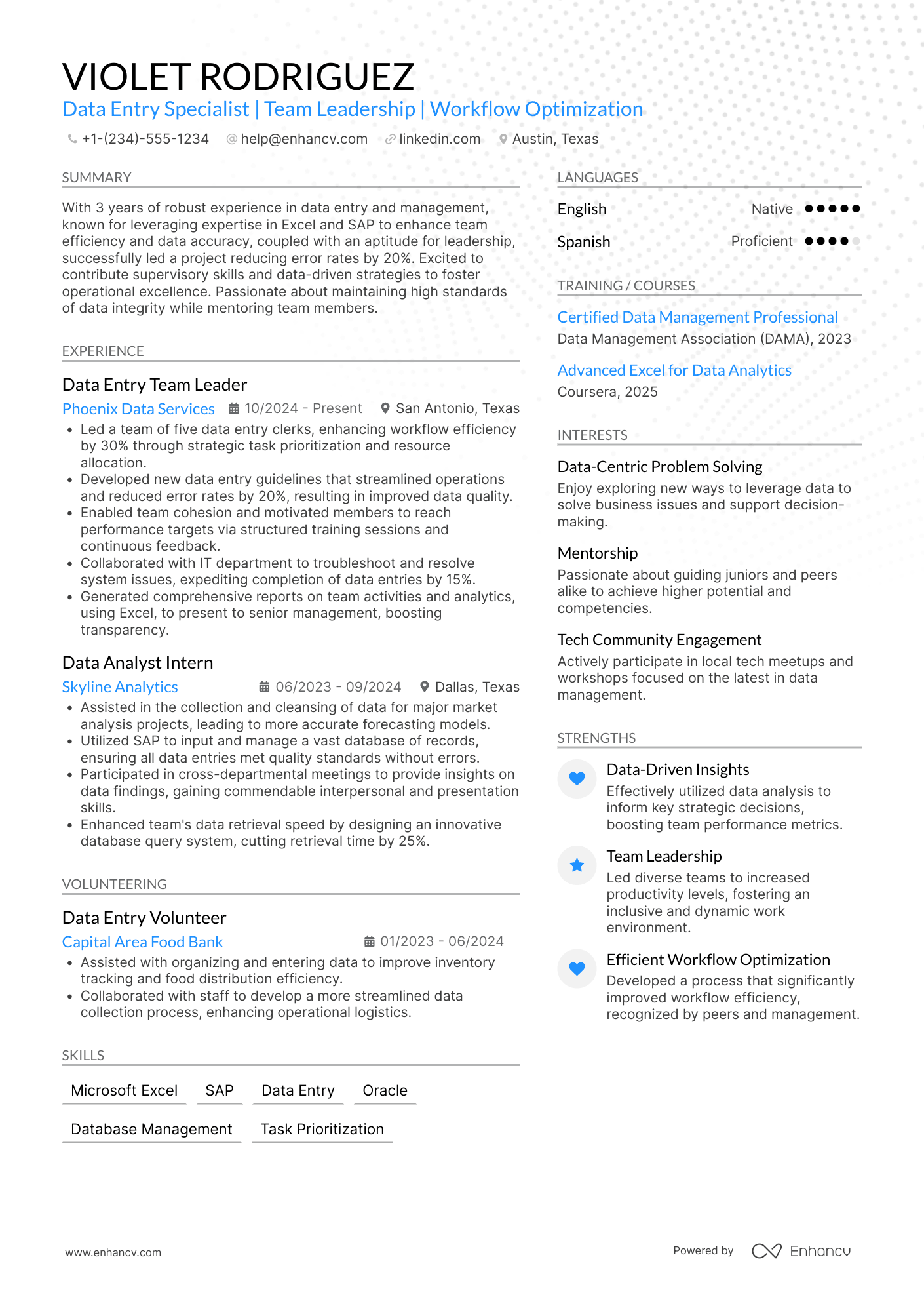
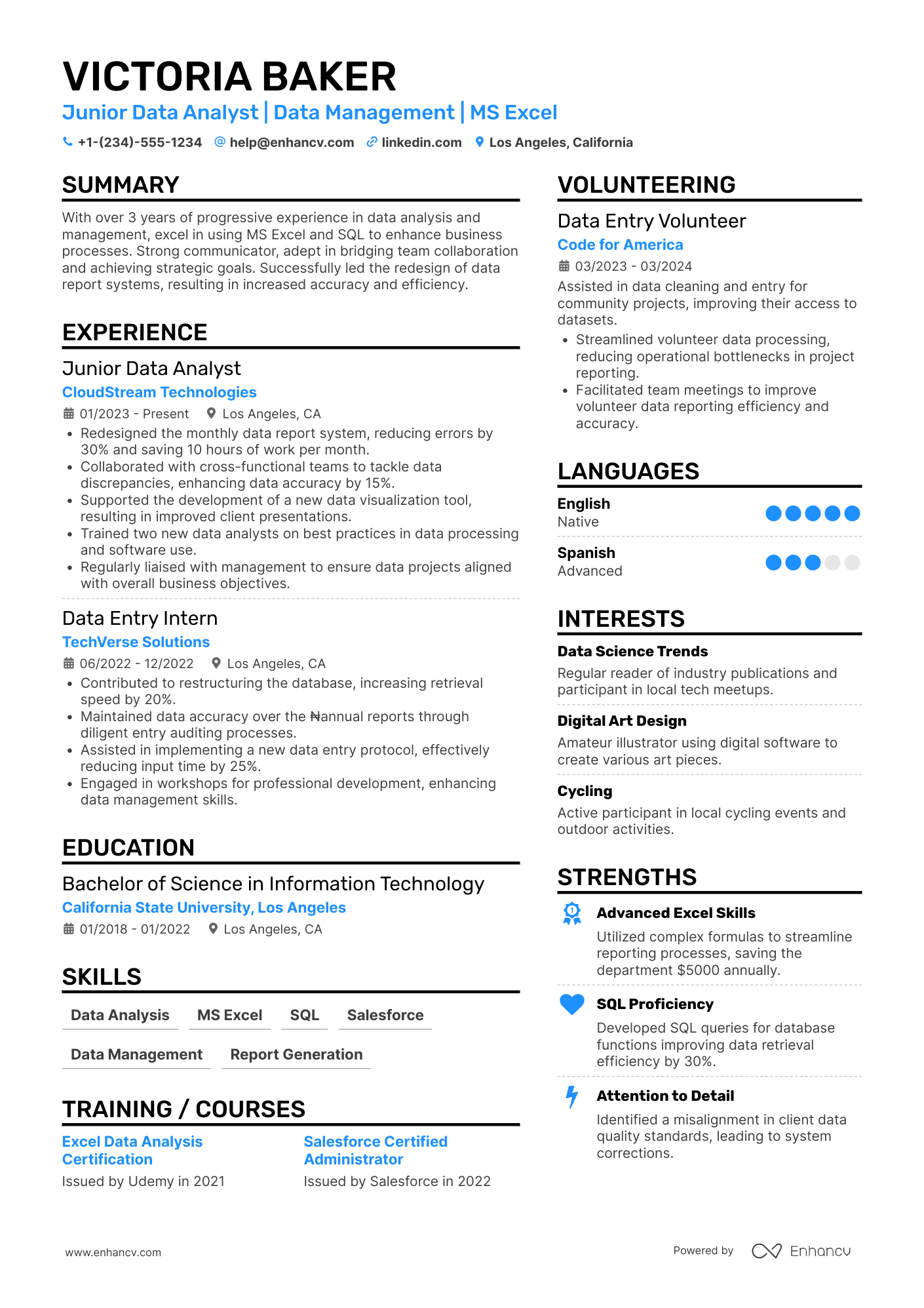
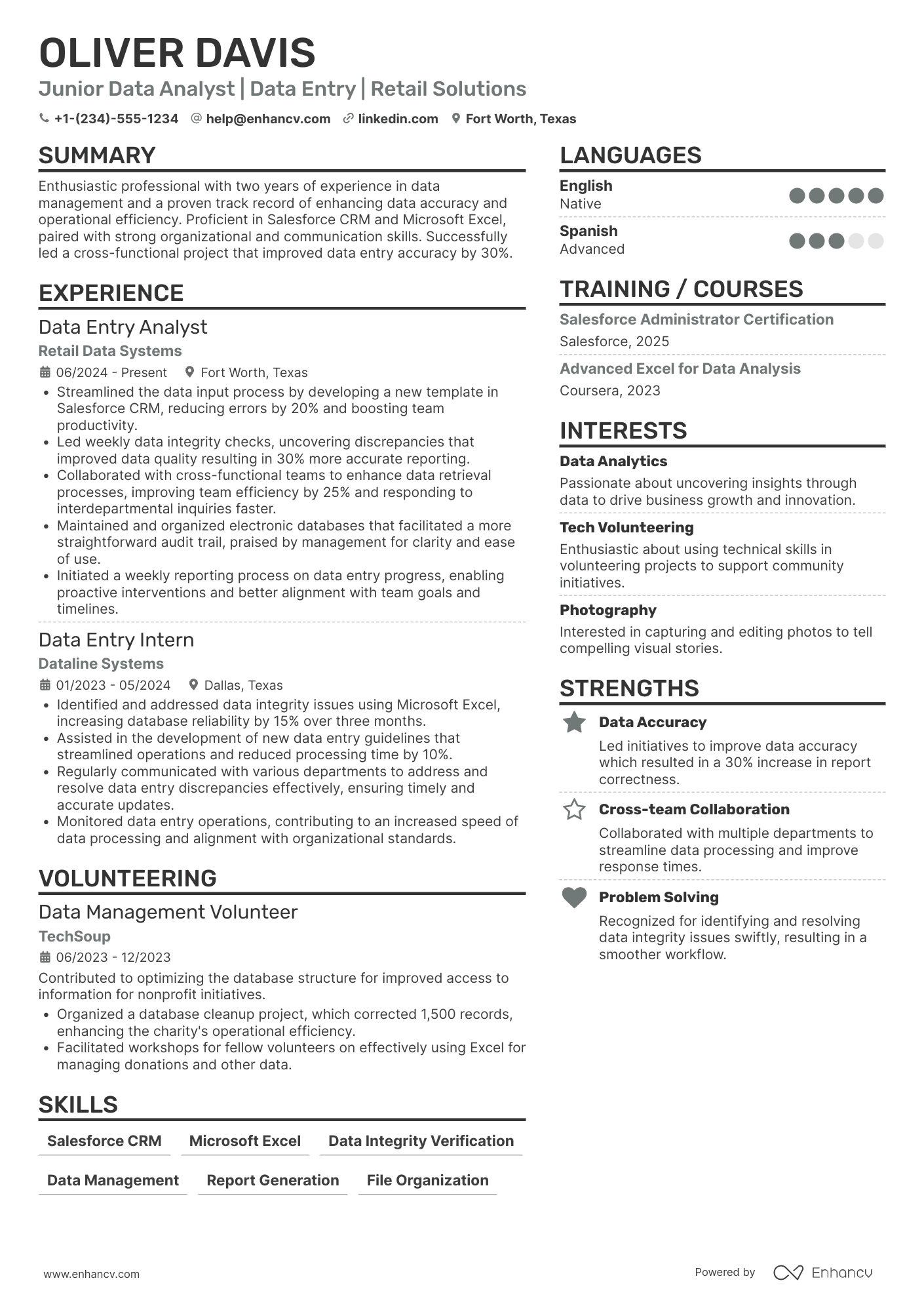
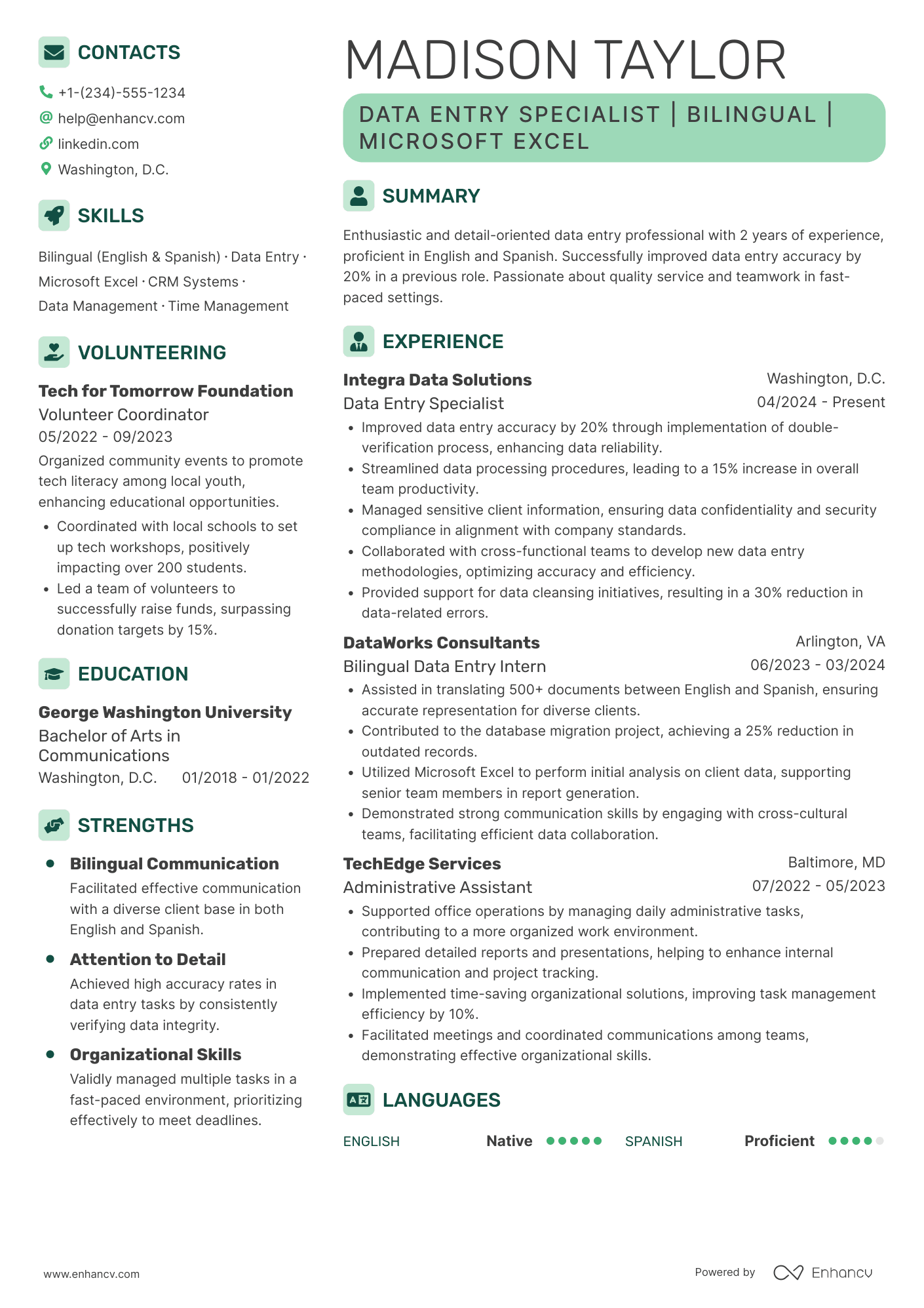
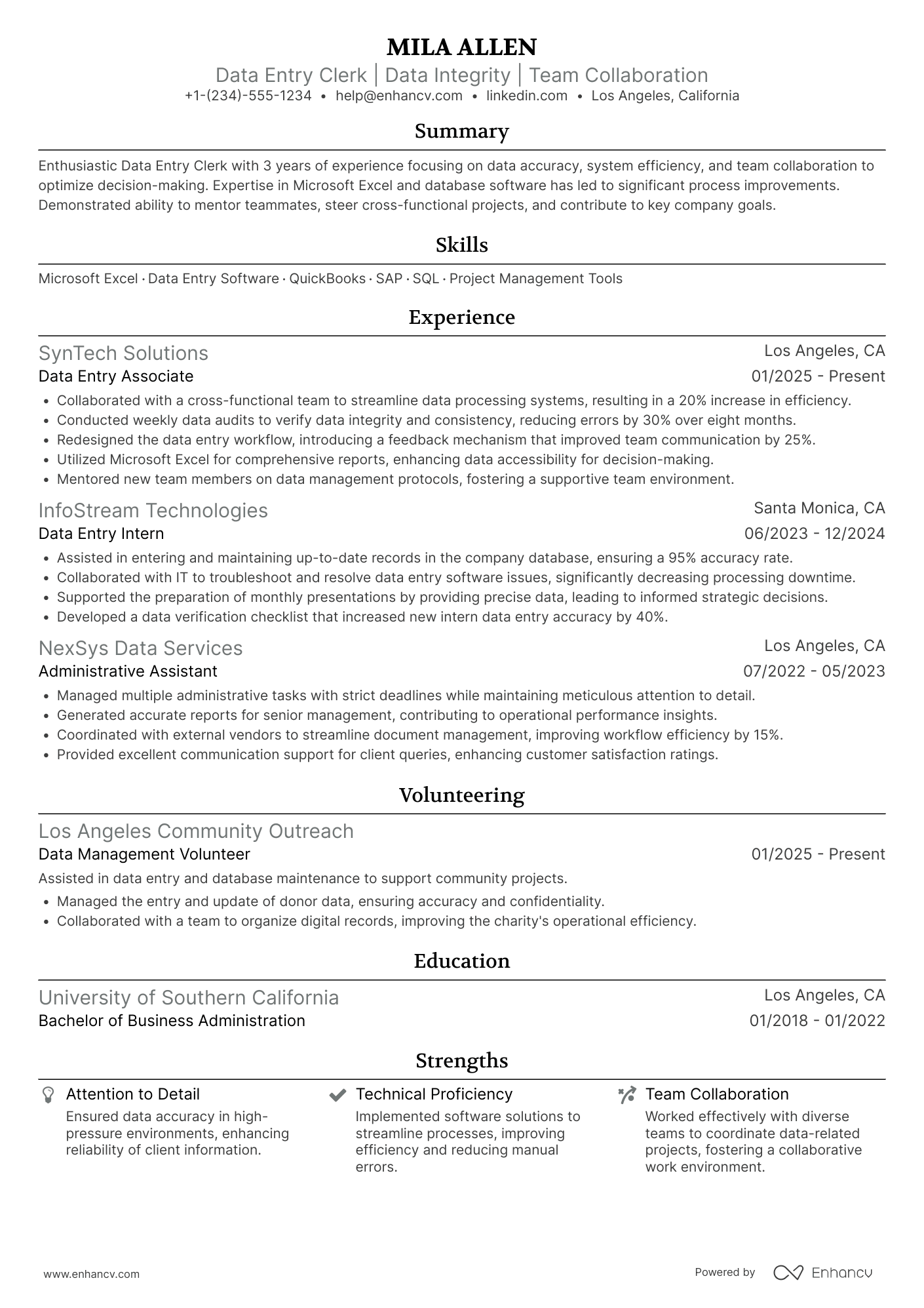
Most data entry clerk resume submissions fail because they read like task lists and bury accuracy, speed, and volume in dense formatting. That matters when an ATS filters by keywords and recruiters scan in seconds amid heavy competition. Understanding how to make your resume stand out is essential in such a competitive landscape.
A strong resume shows what you delivered, not just what you used. You should highlight records processed per day, error rate reductions, turnaround time improvements, backlog cleared, audit pass rates, and how your work improved billing accuracy or reporting reliability.

Key takeaways
- Quantify accuracy rates, processing volume, and turnaround time in every experience bullet.
- Match your resume's software names and terminology exactly to the job posting.
- Use reverse-chronological format if you have experience; use hybrid format if you're entry-level.
- Prove skills through measurable outcomes in your experience section, not just a skills list.
- Lead your summary with typing speed, core tools, and one specific achievement.
- Build entry-level credibility with class projects, volunteer data work, and typed accuracy scores.
- Use Enhancv's Bullet Point Generator to turn vague duties into recruiter-ready, results-driven bullets.
How to format a data entry clerk resume
Recruiters reviewing data entry clerk resumes prioritize accuracy metrics, typing speed, software proficiency, and the ability to handle high-volume workloads consistently. Choosing the right resume format ensures these signals appear early and clearly, improving both recruiter engagement and applicant tracking system (ATS) readability.

I have significant experience in this role—which format should I use?
Use a reverse-chronological format to place your strongest and most recent data entry experience at the top, giving recruiters immediate context for your skill level and reliability. Do:
- Lead with your most recent position and highlight the scope of your responsibilities, including volume of records managed, databases maintained, and level of independent ownership over data workflows.
- Feature role-specific tools and skills prominently—Microsoft Excel, SQL databases, ERP systems, optical character recognition (OCR) software, and 10-key proficiency.
- Quantify outcomes wherever possible, including error rates, processing speeds, and efficiency improvements tied to your work.
I'm junior or switching into this role—what format works best?
A hybrid format works best because it lets you lead with a focused skills section while still providing a chronological work history that shows how you've applied those skills. Do:
- Place a dedicated skills section near the top of your resume, listing typing speed (WPM), software proficiencies, and attention-to-detail competencies so ATS filters and recruiters find them immediately.
- Include relevant projects, internships, freelance work, or coursework that involved data handling, spreadsheet management, or database entry—even if these weren't formal data entry positions.
- Connect every listed skill to a specific action and a measurable or observable result so recruiters can assess your real capability.
Why not use a functional resume?
A functional resume removes the chronological context recruiters need to evaluate how consistently and recently you've applied your data entry skills, which makes it harder to verify your proficiency level and reliability.
- A functional format may be acceptable if you're making a career change from a role with transferable skills (such as administrative support or bookkeeping), have limited formal work history, or need to address a significant resume gap—but only if you tie every listed skill to a specific project, task, or outcome rather than presenting skills in isolation.
Now that your resume's structure is in place, it's time to fill each part with the right content—starting with knowing exactly which sections to include.
What sections should go on a data entry clerk resume
Recruiters expect a clean, easy-to-scan resume that proves you enter accurate data quickly, follow procedures, and protect sensitive information. Knowing which resume sections to include helps you present your qualifications with maximum clarity:
- Header
- Summary
- Experience
- Skills
- Projects
- Education
- Certifications
- Optional sections: Awards, Volunteering, Languages
Strong experience bullets should emphasize accuracy, speed, volume handled, error reduction, process improvements, and measurable results.
Is your resume good enough?
Drop your resume here or choose a file. PDF & DOCX only. Max 2MB file size.
Once you’ve organized the key resume components, focus next on writing your data entry clerk resume experience section to show how you delivered results in those roles.
How to write your data entry clerk resume experience
Your experience section should prove you can handle high-volume data tasks accurately and efficiently using the specific tools and processes each employer relies on. Hiring managers prioritize demonstrated impact—faster processing times, fewer errors, improved database integrity—over generic descriptions of daily duties.
Each entry should include:
- Job title
- Company and location (or remote)
- Dates of employment (month and year)
Three to five concise bullet points showing what you owned, how you executed, and what outcomes you delivered:
- Ownership scope: the databases, spreadsheets, records systems, or data pipelines you were directly responsible for maintaining, updating, or migrating.
- Execution approach: the software, validation techniques, or workflow methods—such as Excel, ERP platforms, optical character recognition tools, or double-entry verification—you relied on to process and verify data.
- Value improved: the measurable changes you drove in accuracy rates, turnaround speed, error reduction, data completeness, or compliance with formatting and quality standards.
- Collaboration context: how you coordinated with departments like finance, operations, customer service, or external vendors to source, reconcile, or distribute accurate data.
- Impact delivered: the tangible results your work produced—expressed through volume handled, process improvements, cost savings, or contributions to reporting reliability—rather than a list of tasks you performed.
Experience bullet formula
A data entry clerk experience example
✅ Right example - modern, quantified, specific.
Data Entry Clerk
NorthBridge Medical Billing | Phoenix, AZ
2022–2025
High-volume medical billing services firm supporting fifty-plus outpatient clinics across Arizona.
- Processed two hundred–three hundred patient billing records daily in Epic and Microsoft Excel, sustaining 99.7 percent accuracy verified by weekly quality audits.
- Standardized data validation rules in Microsoft Excel (XLOOKUP, conditional formatting) and reduced claim rework by 18 percent in partnership with the billing supervisor and compliance team.
- Automated intake tracking with Microsoft SharePoint lists and Power Automate reminders, cutting missing-document follow-ups by 32 percent and saving six hours per week across the front office.
- Reconciled payment and adjustment data between the clearinghouse portal and the accounting system, resolving ninety-plus discrepancies per month and reducing month-end close time by two days.
- Coordinated with clinic managers and patients to verify demographics and insurance details, improving first-pass claim acceptance by 11 percent and reducing denials tied to eligibility errors.
Now that you've seen how a strong experience section comes together, let's look at how to adjust yours to match a specific job posting.
How to tailor your data entry clerk resume experience
Recruiters evaluate your data entry clerk resume through both human review and applicant tracking systems (ATS). Tailoring your resume to the job description helps you pass both filters.
Ways to tailor your data entry clerk experience:
- Match the exact software and database platforms named in the posting.
- Mirror the data entry speed or accuracy standards listed.
- Use the same terminology for filing or recordkeeping processes.
- Highlight compliance or confidentiality protocols the employer specifies.
- Reference the specific industry or domain experience they require.
- Include quality assurance or verification workflows mentioned in the posting.
- Align your descriptions with their stated reporting or documentation standards.
- Emphasize team collaboration or workflow models they describe.
Tailoring means aligning your real accomplishments with what the role demands, not forcing keywords where they don't belong.
Resume tailoring examples for data entry clerk
| Job description excerpt | Untailored | Tailored |
|---|---|---|
| "Enter and verify patient demographic and insurance data in Epic EHR with 99% accuracy" | Entered data into computer systems accurately. | Entered and verified patient demographic and insurance records in Epic EHR, maintaining 99.2% accuracy across 300+ daily entries. |
| "Process invoices and purchase orders in SAP, reconciling discrepancies within 24-hour turnaround" | Handled invoices and did data entry for the company. | Processed 150+ invoices and purchase orders weekly in SAP, identifying and reconciling billing discrepancies within a 24-hour turnaround window. |
| "Maintain and update inventory records in Microsoft Access, coordinating with warehouse staff to resolve stock count errors" | Updated spreadsheets and kept records organized. | Updated and maintained 5,000+ SKU inventory records in Microsoft Access, coordinating with warehouse staff to resolve stock count errors and reduce discrepancies by 15%. |
Once you’ve aligned your experience with the role’s requirements, quantify your data entry clerk achievements to show the measurable impact of that work.
How to quantify your data entry clerk achievements
Numbers on your resume show how your work improves accuracy, speed, and compliance. Track records processed, turnaround time, error rates, audit results, and rework avoided, plus tools used like Microsoft Excel or an enterprise resource planning system.
Quantifying examples for data entry clerk
| Metric | Example |
|---|---|
| Volume handled | "Processed 1,200 to 1,500 customer records weekly in Salesforce, maintaining consistent throughput during peak intake periods." |
| Accuracy rate | "Reduced entry errors from 2.1% to 0.6% by adding Excel validation rules and standardizing lookup tables for product codes." |
| Turnaround time | "Cut average invoice entry turnaround from 48 hours to 18 hours by batching work, using keyboard shortcuts, and prioritizing aging queues." |
| Compliance risk | "Passed three internal audits with zero critical findings by enforcing HIPAA-safe document handling and maintaining complete access logs." |
| Cost savings | "Saved 10 hours per week by building an Excel macro that auto-formatted imports, eliminating manual cleanup for 600 rows daily." |
Turn vague job duties into measurable, recruiter-ready resume bullets in seconds with Enhancv's Bullet Point Generator.
With strong bullet points in place, the next step is highlighting the specific hard and soft skills that prove you're the right fit for the role.
How to list your hard and soft skills on a data entry clerk resume
Your skills section shows recruiters and applicant tracking system (ATS) software how fast and accurately you can enter, validate, and manage records, and most data entry clerk resumes balance role-specific hard skills with execution-focused soft skills. data entry clerk roles require a blend of:
- Product strategy and discovery skills.
- Data, analytics, and experimentation skills.
- Delivery, execution, and go-to-market discipline.
- Soft skills.
Your skills section should be:
- Scannable (bullet-style grouping).
- Relevant to the job post.
- Backed by proof in experience bullets.
- Updated with current tools.
Place your skills section:
- Above experience if you're junior or switching careers.
- Below experience if you're mid/senior with strong achievements.

Hard skills
- Microsoft Excel, Google Sheets
- Microsoft Word, Google Docs
- Data entry speed and accuracy
- Ten-key by touch
- Data validation, quality checks
- Data cleansing, deduplication
- CRM data entry (Salesforce)
- ERP data entry (SAP)
- Database updates, record maintenance
- PDF to Excel conversion
- Document scanning, OCR tools
- File naming, folder taxonomy
Soft skills
- Follow data governance rules
- Spot and resolve discrepancies
- Ask clarifying questions early
- Communicate status and blockers
- Prioritize high-volume queues
- Maintain focus in repetitive work
- Protect confidential information
- Collaborate with operations and HR
- Take ownership of assigned batches
- Escalate issues with context
- Meet daily productivity targets
- Adapt to changing workflows
How to show your data entry clerk skills in context
Skills shouldn't live only in a bulleted list on your resume. Explore resume skills examples to see how others present their abilities effectively.
They should be demonstrated in:
- Your summary (high-level professional identity)
- Your experience (proof through outcomes)
Here's what this looks like in practice.
Summary example
Detail-oriented data entry clerk with eight years in healthcare administration. Proficient in Epic EHR, Excel, and HIPAA-compliant records management. Reduced patient data errors by 34% through standardized verification workflows. Known for cross-team collaboration and meeting tight processing deadlines.
- Signals senior-level healthcare experience
- Names industry-specific tools
- Leads with a measurable outcome
- Highlights reliability and collaboration
Experience example
Senior Data Entry Clerk
Ridgeline Health Partners | Denver, CO
June 2019–March 2025
- Processed 500+ daily patient records in Epic EHR, maintaining a 99.6% accuracy rate across quarterly audits.
- Collaborated with billing and compliance teams to redesign data validation templates, cutting processing time by 22%.
- Trained four junior clerks on HIPAA protocols and Excel-based tracking systems, reducing onboarding time by two weeks.
- Every bullet includes measurable proof
- Skills appear naturally within achievements
Once you’ve demonstrated your abilities through specific tasks and outcomes, the next step is applying that same approach to building a data entry clerk resume when you don’t have formal experience.
How do I write a data entry clerk resume with no experience
Even without full-time experience, you can demonstrate readiness through building a resume without work experience that highlights transferable skills:
- Class projects using Excel data
- Volunteer database cleanup for nonprofits
- Personal budgeting spreadsheet tracking
- Retail inventory counts and logs
- Student records digitization for clubs
- Typing tests with recorded accuracy
- Online data entry simulations
- Customer order entry in POS
Focus on:
- Typing speed and accuracy metrics
- Excel and Google Sheets proficiency
- Data cleanup and validation examples
- Confidential data handling procedures
Resume format tip for entry-level data entry clerk
Use a combination resume format to highlight skills and projects first, then list any work history. It helps when your strongest proof comes from projects, coursework, and volunteer work. Do:
- Add a Skills section with tools.
- Include typing speed and accuracy.
- List projects with measurable results.
- Use keywords from the job posting.
- Show data validation steps you used.
- Entered and validated 1,200 survey responses in Excel using data validation and filters, reducing duplicates by 18% and achieving 99.5% accuracy.
Once you've structured your resume around transferable skills and relevant experiences, presenting your education effectively becomes the next step in building credibility for a data entry clerk role.
How to list your education on a data entry clerk resume
Your education section helps hiring teams confirm you have the foundational knowledge needed for a data entry clerk role. It validates your training in relevant skills quickly.
Include:
- Degree name
- Institution
- Location
- Graduation year
- Relevant coursework (for juniors or entry-level candidates)
- Honors & GPA (if 3.5 or higher)
Skip month and day details—list the graduation year only.
Here's a strong education entry tailored to a data entry clerk resume:
Example education entry
Associate of Applied Science in Office Administration
Sinclair Community College, Dayton, OH
Graduated 2022
GPA: 3.7/4.0
- Relevant coursework: Database Management, Business Communication, Spreadsheet Applications, Records and Information Management
- Honors: Dean's List, 2021–2022
How to list your certifications on a data entry clerk resume
Certifications on your resume show your commitment to learning, prove tool proficiency, and highlight industry relevance as a data entry clerk. They also reassure employers you can follow standards, protect data, and work efficiently.
Include:
- Certificate name
- Issuing organization
- Year
- Optional: credential ID or URL
- Place certifications below education when they're older, less relevant, or you already have recent, role-aligned education for a data entry clerk role.
- Place certifications above education when they're recent, highly relevant, or required, especially if they match the job posting and key tools.
Best certifications for your data entry clerk resume
Microsoft Office Specialist (MOS): Excel Associate Microsoft Office Specialist (MOS): Word Associate Microsoft Office Specialist (MOS): Access Associate IC3 Digital Literacy Certification CompTIA IT Fundamentals (ITF+) Certified Administrative Professional (CAP) Microsoft Office Specialist (MOS): Excel Expert
Once you’ve positioned your credentials to support the role, use them to inform a focused data entry clerk resume summary that highlights your most relevant strengths upfront.
How to write your data entry clerk resume summary
Your resume summary is the first thing a recruiter reads. A strong one instantly signals you have the speed, accuracy, and tools to handle high-volume data work.
Keep it to three to four lines, with:
- Your title and total years of data entry or administrative experience.
- The industry or domain you've worked in, such as healthcare, logistics, or finance.
- Core tools and skills like Microsoft Excel, Google Sheets, ERP systems, or specific databases.
- One or two measurable achievements, such as error rates reduced or records processed daily.
- Soft skills tied to real outcomes, like attention to detail that improved data quality scores.

PRO TIP
At the data entry clerk level, lead with your strongest technical skills and typing speed. Pair them with a specific result, like accuracy rates or volume handled. Avoid vague phrases like "hard worker" or "passionate about data." Recruiters want proof, not promises.
Example summary for a data entry clerk
Detail-oriented data entry clerk with two years of experience processing 500+ records daily in healthcare billing. Proficient in Excel and Epic EHR, maintaining a 99.6% accuracy rate across patient databases.
Optimize your resume summary and objective for ATS
Drop your resume here or choose a file.
PDF & DOCX only. Max 2MB file size.
Now that your summary is ready to capture a hiring manager's attention, make sure your header—the first thing they'll see—presents your contact details clearly and professionally.
What to include in a data entry clerk resume header
A resume header lists your key contact and profile details, helping recruiters spot you fast, trust your information, and screen you efficiently for data entry clerk roles.
Essential resume header elements
- Full name
- Tailored job title and headline
- Location
- Phone number
- Professional email
- GitHub link
- Portfolio link
A LinkedIn link helps recruiters confirm your work history quickly and supports faster screening.
Don't include a photo on a data entry clerk resume unless the role is explicitly front-facing or appearance-dependent.
Keep your header to two lines, use a professional email, and match your job title to the posting for consistent screening.
Example
Data entry clerk resume header
Jordan Lee
Data Entry Clerk | Accurate data entry, Excel, and CRM updates
Dallas, TX | (214) 555-01XX | your.name@enhancv.com | github.com/yourname | yourwebsite.com | linkedin.com/in/yourname
Once your contact details and role focus are clear at the top, you can strengthen the rest of your application with additional sections for data entry clerk resumes that highlight relevant qualifications.
Additional sections for data entry clerk resumes
When your core qualifications match other applicants, additional sections help you stand out by showcasing unique, role-relevant strengths.
- Languages
- Certifications
- Typing speed and accuracy scores
- Volunteer experience
- Professional development and training
- Hobbies and interests
Once you've rounded out your resume with relevant additional sections, the next step is pairing it with a strong cover letter to make an even greater impression.
Do data entry clerk resumes need a cover letter
A cover letter isn't required for a data entry clerk, but it helps when the role is competitive or the employer expects one. If you're unsure what a cover letter is or when to use one, it can make a difference when your resume doesn't fully show fit, accuracy habits, or workflow knowledge.
Use a cover letter to add context your resume can't:
- Explain role or team fit by matching your experience to the team's tools, pace, and quality checks.
- Highlight one or two relevant projects or outcomes, such as reducing errors, speeding up entry, or improving data validation.
- Show understanding of the product, users, or business context, including what the data supports and why accuracy matters.
- Address career transitions or non-obvious experience by connecting past work to data entry clerk tasks and measurable results.
Drop your resume here or choose a file.
PDF & DOCX only. Max 2MB file size.
Even if you decide to submit a cover letter to add context beyond your resume, the next section shows how to use AI to strengthen your data entry clerk resume itself.
Using AI to improve your data entry clerk resume
AI can sharpen your resume's clarity, structure, and impact. It helps refine phrasing and highlight measurable results. But overuse dulls authenticity. Once your content feels clear and role-aligned, step away from AI. If you're wondering which AI is best for writing resumes, the key is choosing tools that enhance rather than replace your voice.
Here are 10 practical prompts to strengthen specific sections of your data entry clerk resume:
Strengthen your summary
Quantify experience bullets
Trim wordy descriptions
Tailor skills section
Improve action verbs
Highlight relevant certifications
Refine education details
Showcase project results
Fix inconsistent formatting
Align with job posting
Conclusion
A strong data entry clerk resume proves accuracy, speed, and reliability with measurable outcomes. It highlights role-specific skills like typing, data validation, spreadsheet work, and database updates. It uses clear sections, clean formatting, and consistent job titles and dates.
This structure shows you can support quality, compliance, and fast turnaround in today’s hiring market. It also signals readiness for near-future needs, including higher data volumes and tighter audits. Keep each bullet focused on results and tools.