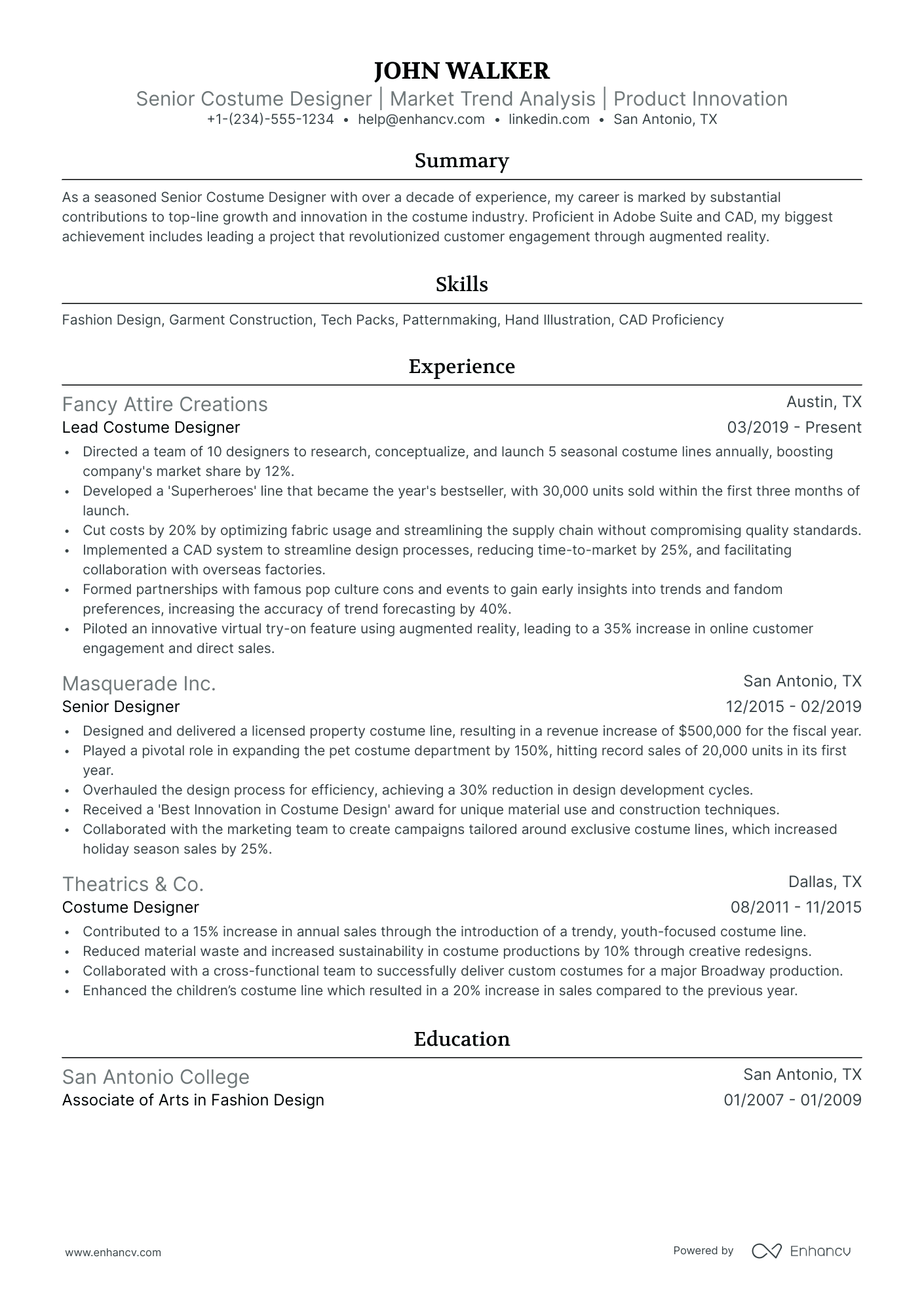
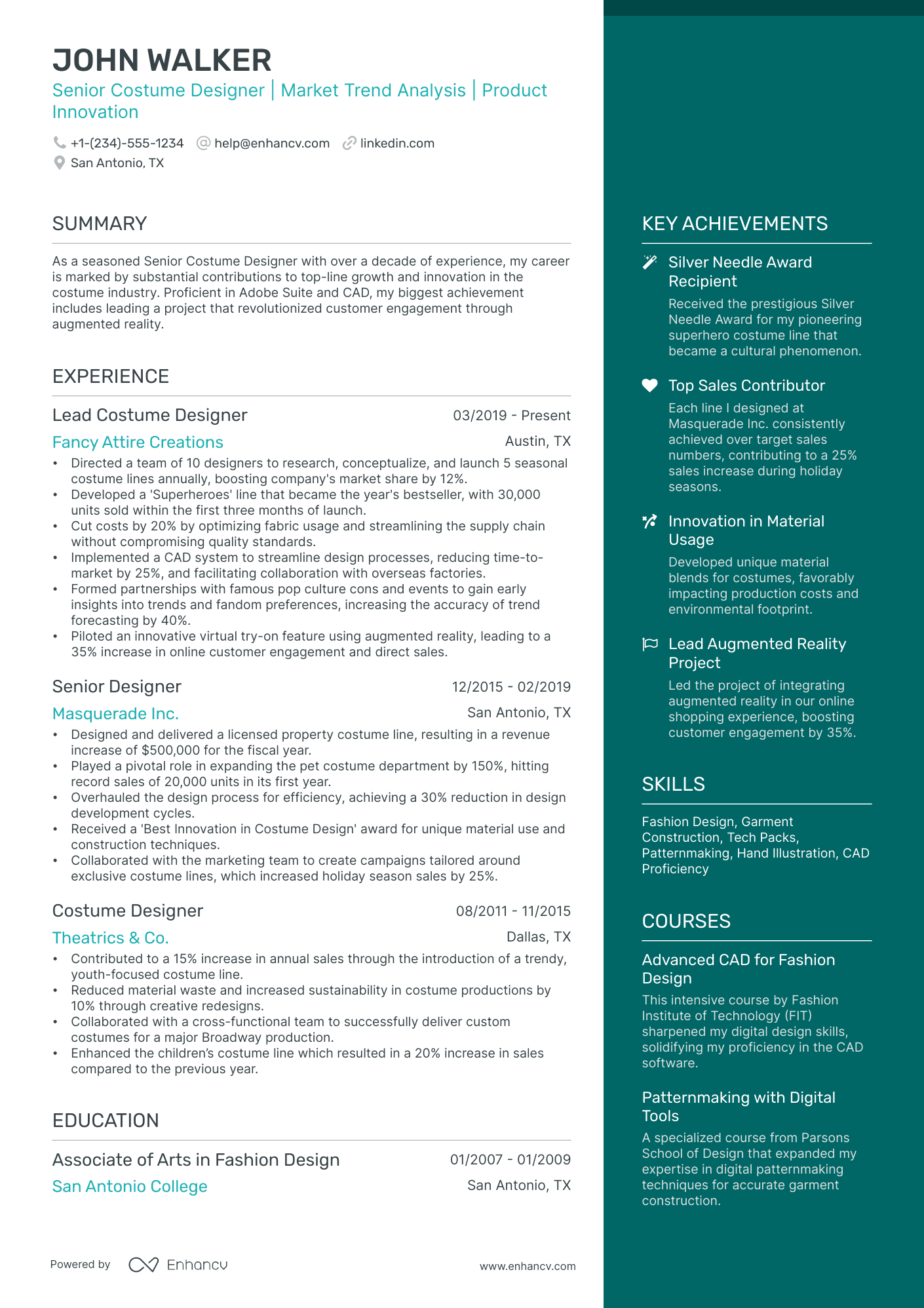
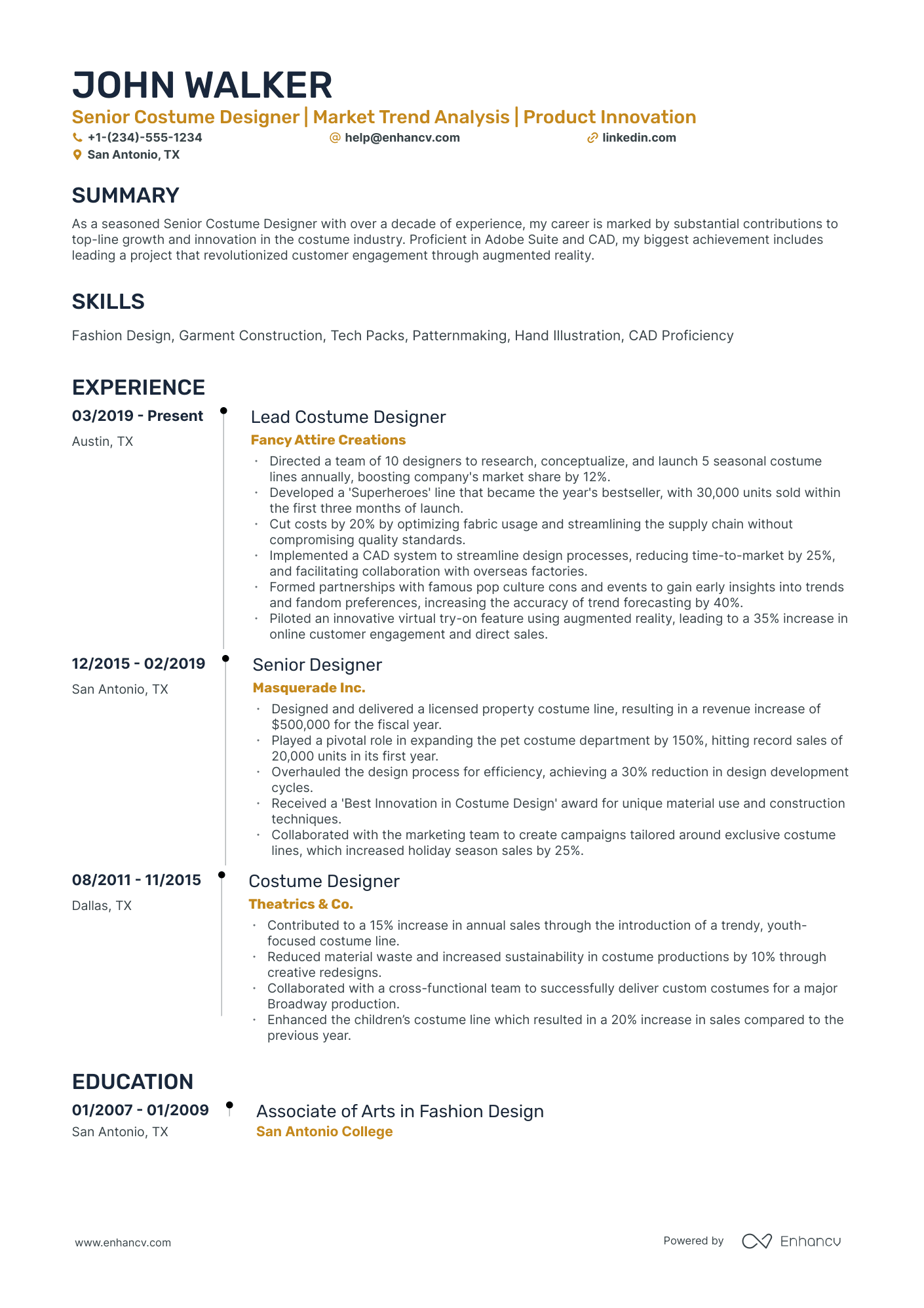
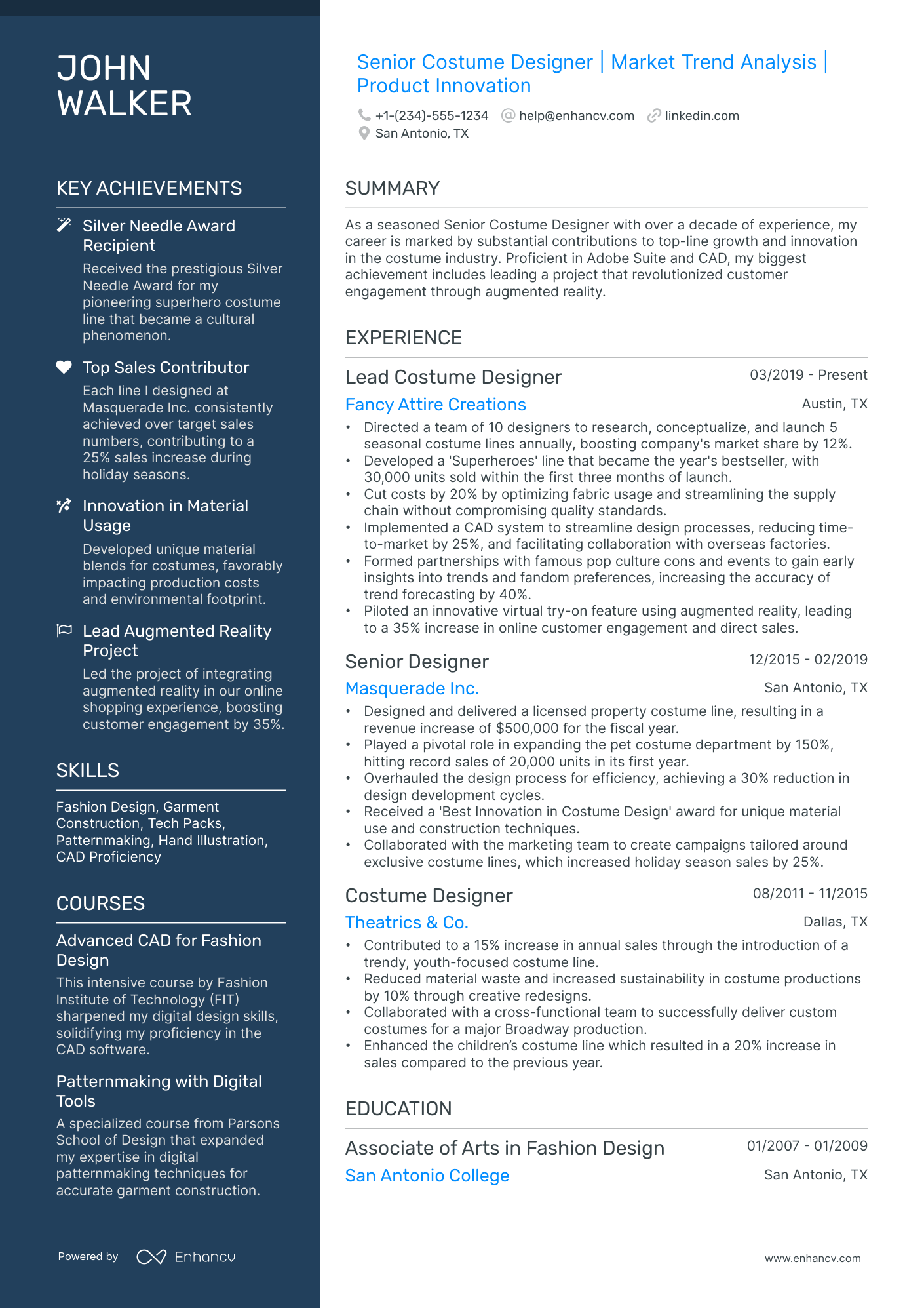
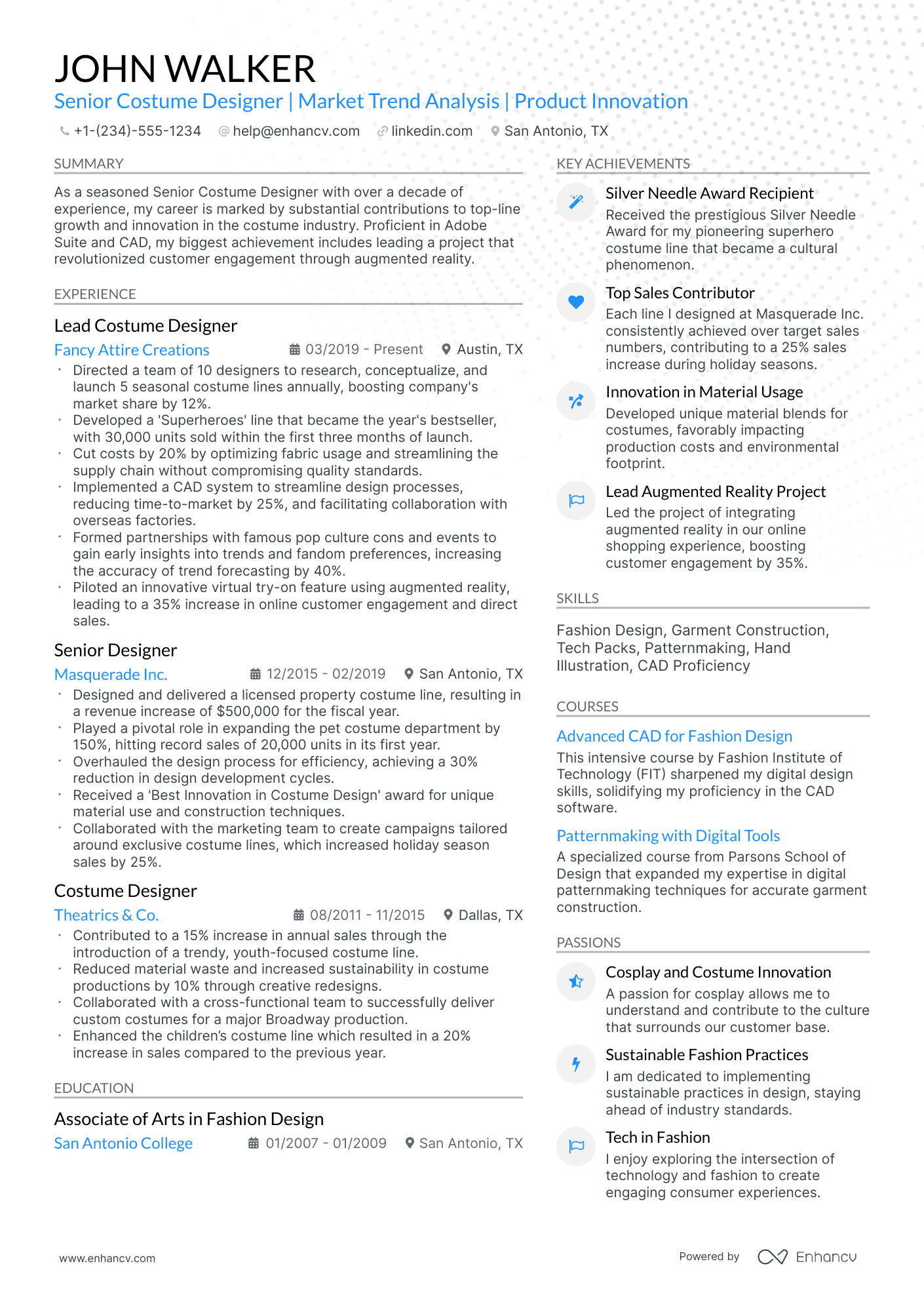
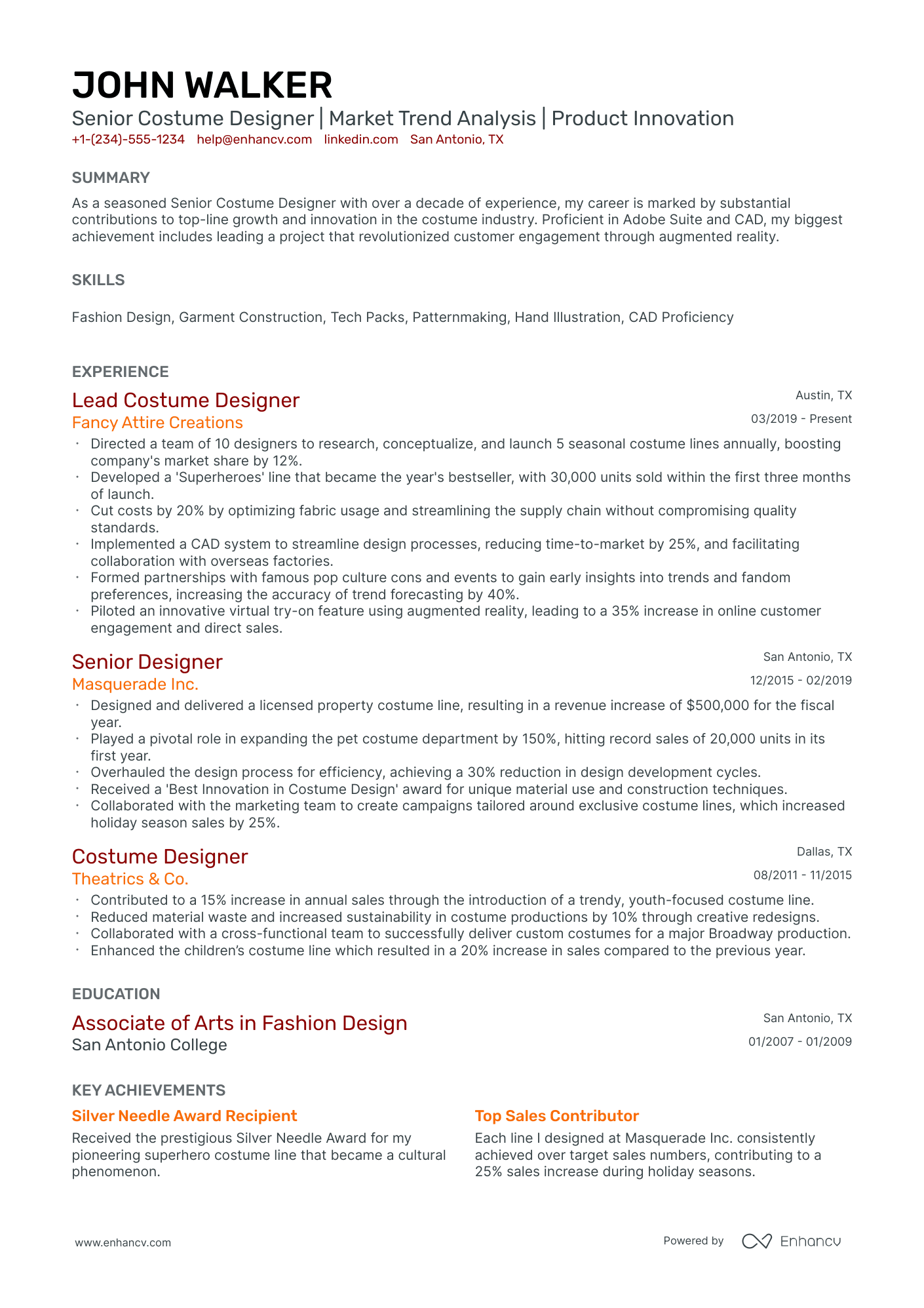
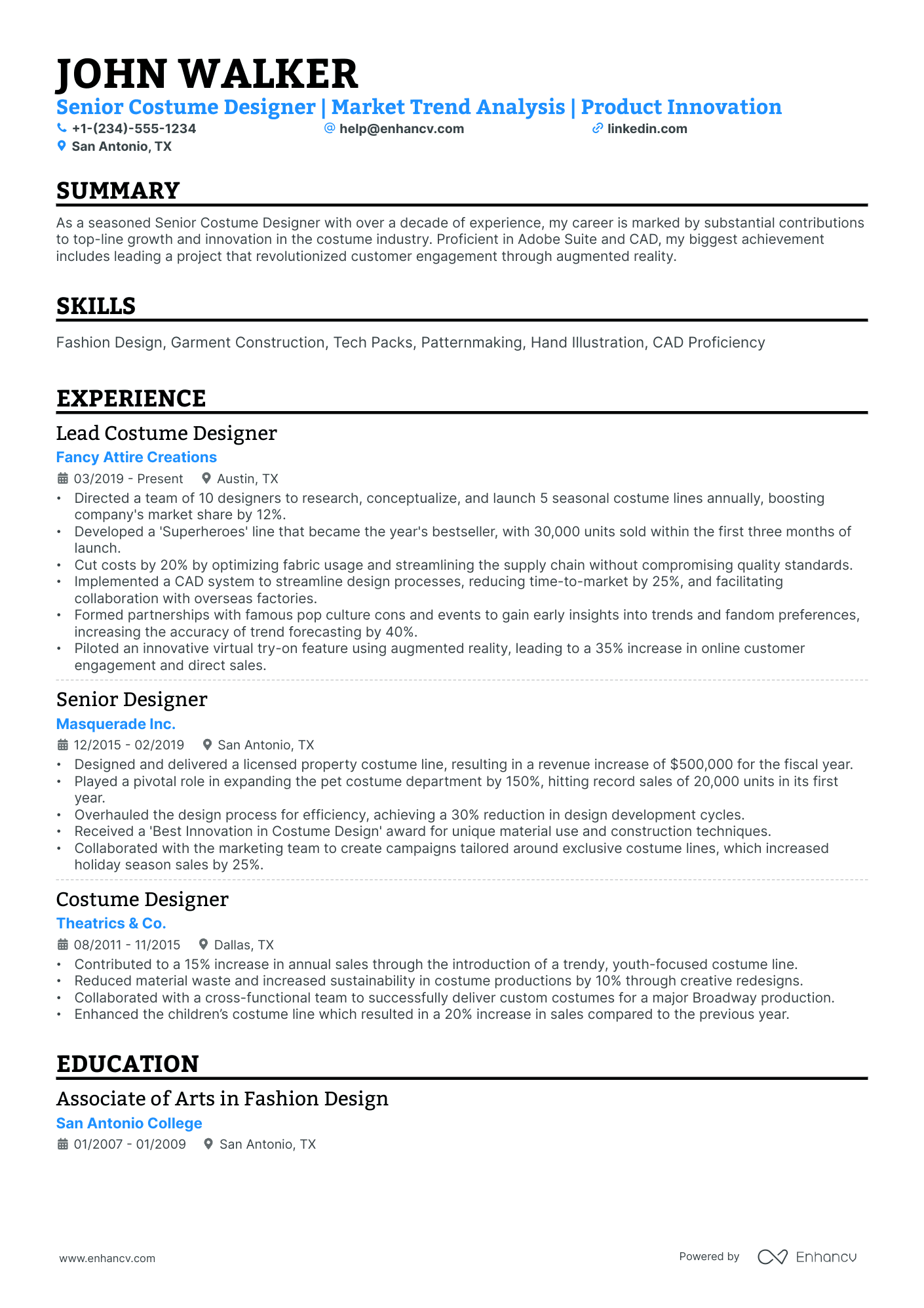
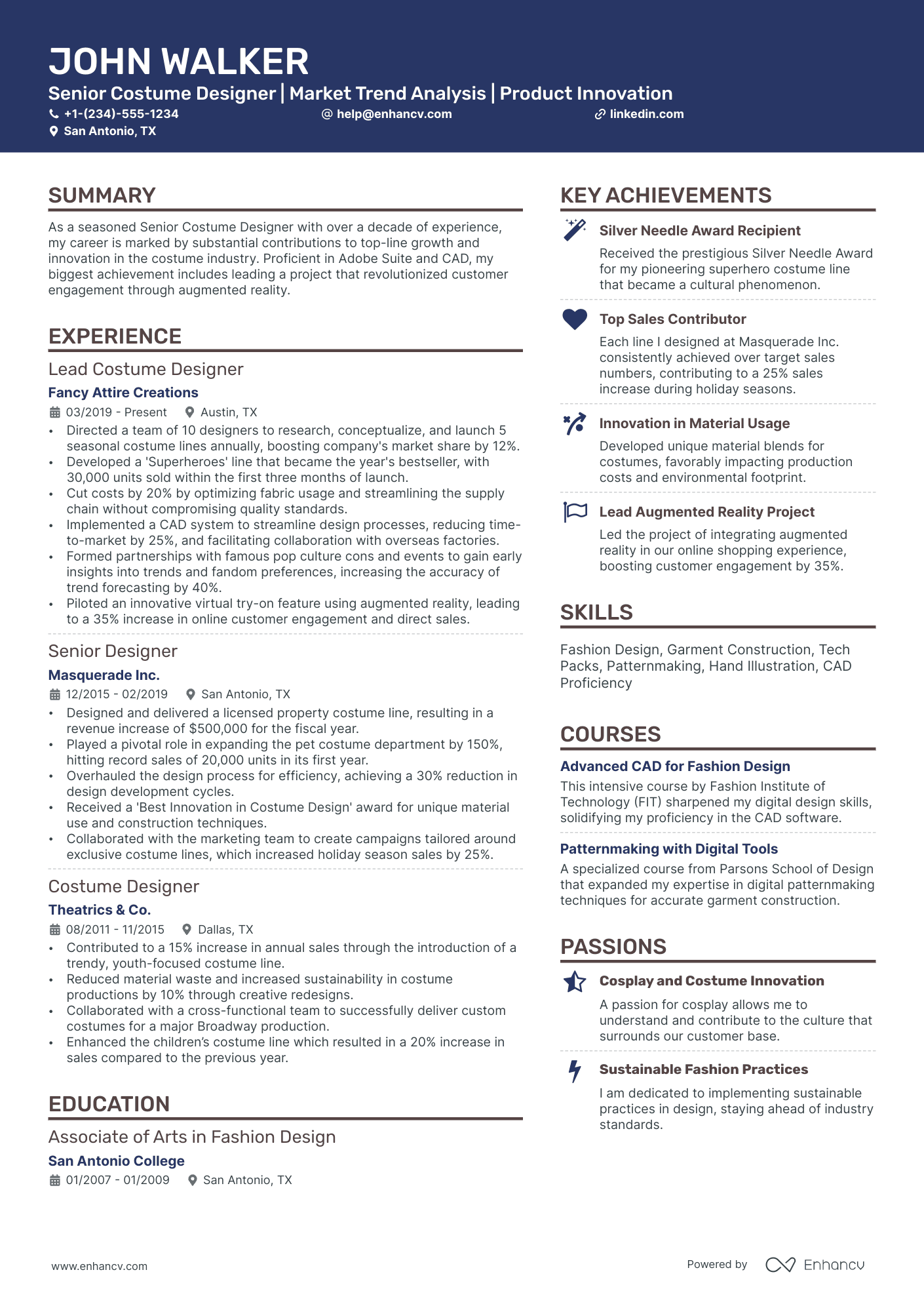
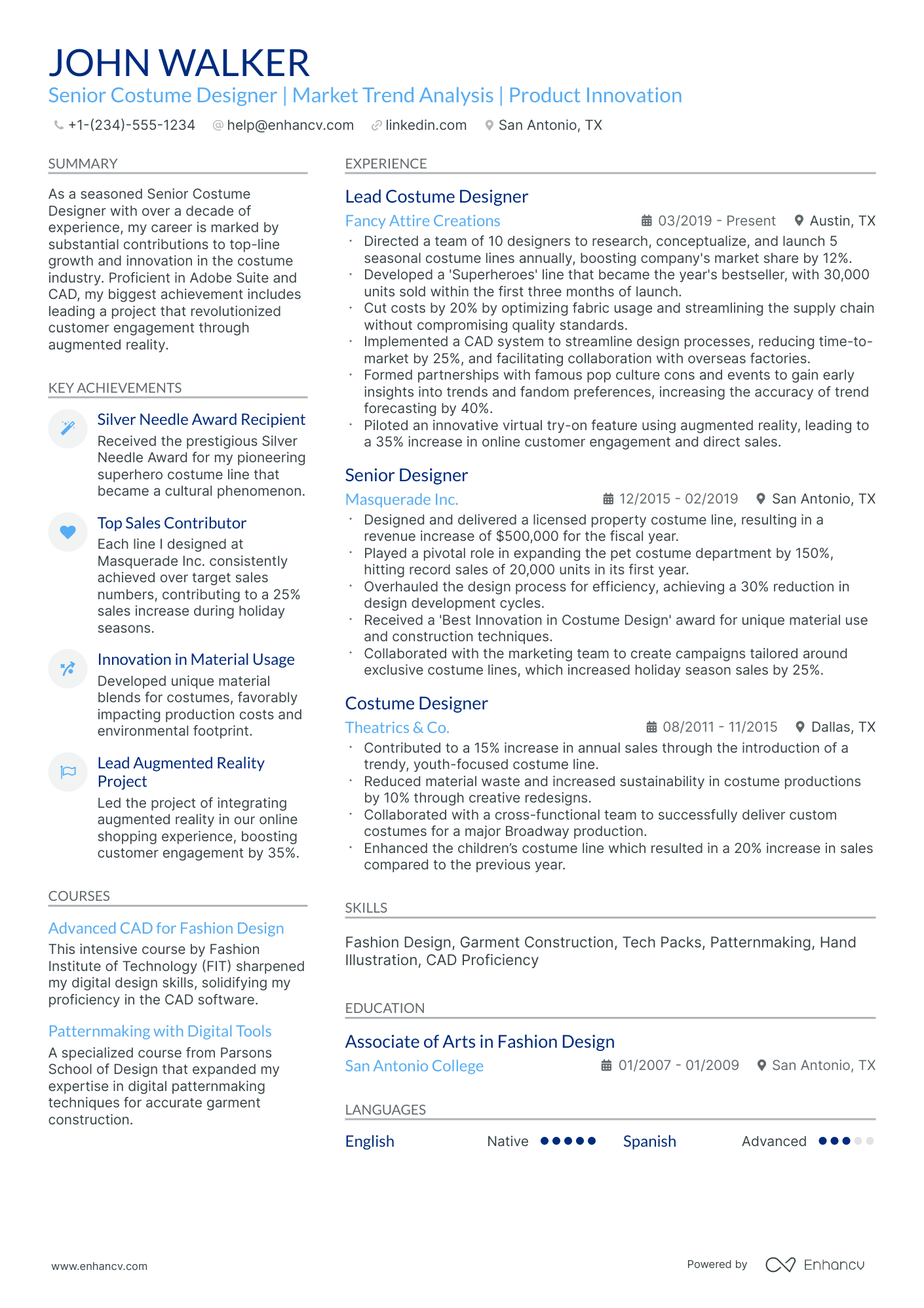
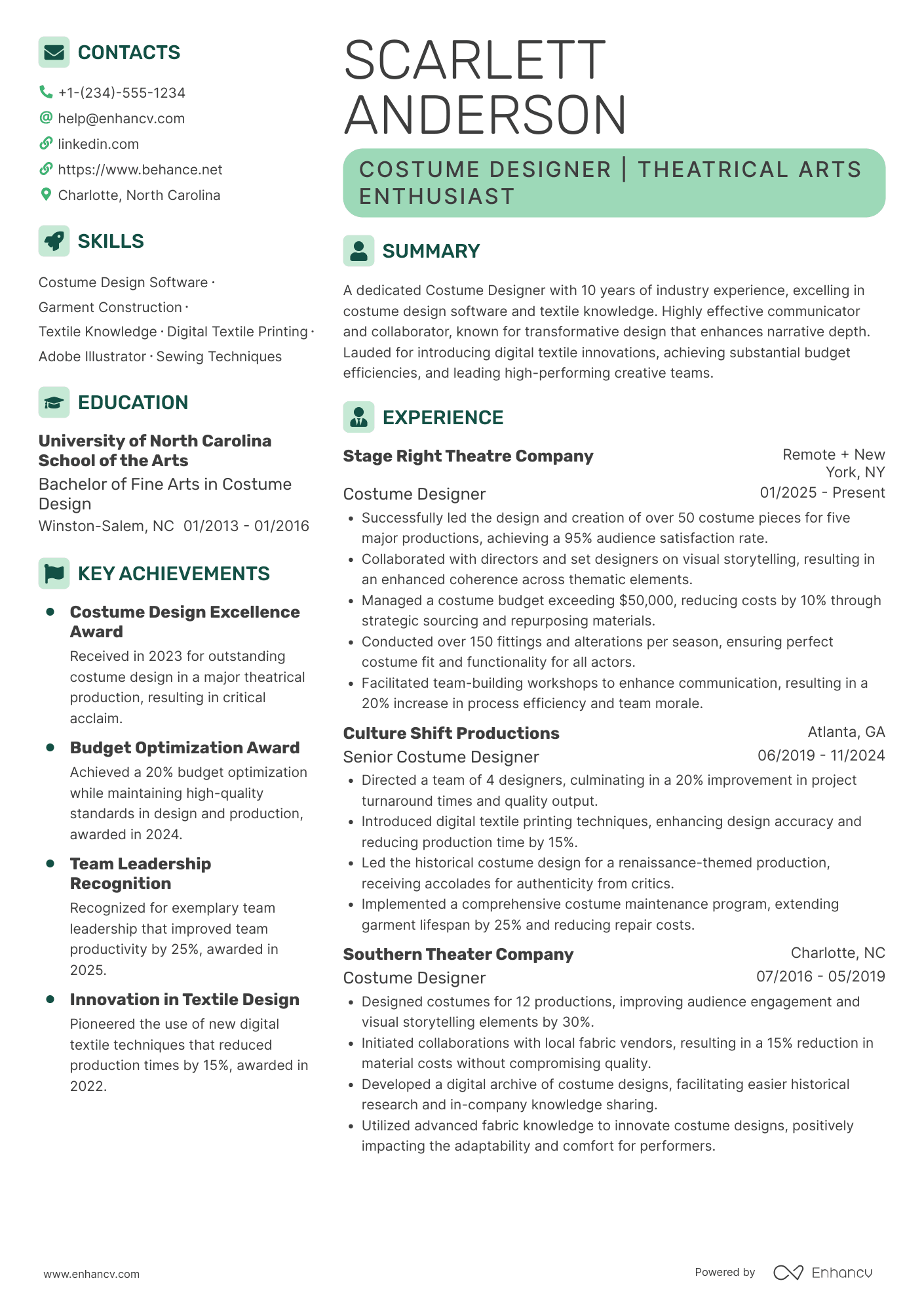
Many costume designer resume drafts fail because they read like a tool list and plot summary, not a record of visual decisions and results. In today's crowded hiring process, that format gets filtered by ATS keywords and missed in fast recruiter scans.
A strong resume shows what you delivered and why it worked. Knowing how to make your resume stand out means you should highlight productions supported, budget managed, quick-turn builds, fittings completed on schedule, continuity errors reduced, director approvals earned, and audience or box office impact.

Key takeaways
- Quantify every experience bullet with budgets, cast sizes, or turnaround improvements to prove measurable impact.
- Use reverse-chronological format if you have production credits; use hybrid format if you're entry-level.
- Tailor your resume to each posting by mirroring the job description's tools, techniques, and terminology.
- Demonstrate skills inside your experience and summary sections, not only in a standalone skills list.
- Include a projects section when you lack formal credits to showcase student, volunteer, or freelance work.
- Pair hard skills like draping and CLO 3D with soft skills like director collaboration and deadline management.
- Use Enhancv's tools to turn vague costume design duties into focused, results-driven resume bullets.
How to format a costume designer resume
Recruiters evaluating costume designer resumes prioritize a strong portfolio of productions, demonstrated collaboration with directors and production teams, and a clear progression across increasingly complex projects (film, television, theater, or commercial work). The right resume format ensures these signals—your creative range, technical skill set, and production credits—are immediately visible rather than buried under formatting that obscures your career trajectory.

I have significant experience in this role—which format should I use?
Use a reverse-chronological format to showcase your production history and growing creative responsibility in a clear, scannable timeline. Do:
- Lead each entry with the production title, your role scope, and the type of project (feature film, episodic television, regional theater, etc.) to establish creative ownership and scale.
- Highlight proficiency with industry-specific tools and domains—costume breakdowns, fabric sourcing, period research, fitting coordination, budget management, and software like Adobe Illustrator or CLO 3D.
- Quantify outcomes wherever possible, including budget sizes, cast counts, episode orders, or recognition such as award nominations tied to your costume work.
I'm junior or switching into this role—what format works best?
A hybrid format works best, letting you lead with relevant skills and training while still providing a concise timeline of any production experience or related work. Do:
- Place a skills section near the top featuring core costume design competencies—sketching, draping, textile knowledge, color theory, breakdown and aging techniques, and relevant software.
- Include academic projects, community theater credits, internships, or freelance wardrobe assist work as legitimate production experience, with specific details about your contributions.
- Connect every action to a visible result so hiring managers can assess your potential impact, even without extensive professional credits.
Why not use a functional resume?
A functional resume strips away the production-by-production context that costume design hiring managers rely on, making it impossible for them to evaluate the scale, genre, and collaborative demands of your actual work.
- A functional format may be acceptable if you're transitioning into costume design from a related field (fashion design, textile arts, or theatrical wardrobe) and have limited formal production credits—but only if you tie every listed skill directly to specific projects, coursework, or measurable outcomes rather than presenting skills in isolation.
Now that you've established a clean, readable layout, it's time to fill each part of your resume with the right content.
What sections should go on a costume designer resume
Recruiters expect a focused resume that proves you can design, build, and deliver costumes that support story, character, and production demands. Understanding what to put on a resume helps you prioritize the content that matters most to hiring teams.
Use this structure for maximum clarity:
- Header
- Summary
- Experience
- Skills
- Projects
- Education
- Certifications
- Optional sections: Awards, Publications, Languages
Strong experience bullets should emphasize production scope, creative and technical decisions, collaboration outcomes, budget and timeline performance, and measurable results on stage or screen.
Is your resume good enough?
Drop your resume here or choose a file. PDF & DOCX only. Max 2MB file size.
Once you’ve organized the key resume components, focus next on writing your costume designer experience section so you can show how your work supports the qualifications those sections highlight.
How to write your costume designer resume experience
The experience section is where you prove you've designed, built, and delivered costumes that served a production's creative vision—using role-relevant tools, techniques, and workflows to achieve measurable results. Hiring managers prioritize demonstrated impact over descriptive task lists, so every bullet should connect what you did to an outcome that mattered. Building a targeted resume ensures each entry speaks directly to what a specific employer needs.
Each entry should include:
- Job title
- Company and location (or remote)
- Dates of employment (month and year)
Three to five concise bullet points showing what you owned, how you executed, and what outcomes you delivered:
- Ownership scope: the productions, costume plots, wardrobe departments, budgets, or design teams you were directly accountable for as a costume designer.
- Execution approach: the tools, frameworks, and methods you used to deliver your work—such as draping, pattern drafting, dyeing techniques, digital rendering software, fitting processes, or sourcing strategies that shaped your design decisions.
- Value improved: changes you drove in production quality, turnaround time, budget efficiency, garment durability, performer comfort, or visual consistency across scenes and acts.
- Collaboration context: how you partnered with directors, production designers, hair and makeup departments, wardrobe supervisors, tailors, vendors, or performers to align costumes with the broader creative vision.
- Impact delivered: outcomes expressed through the scale of productions supported, audience or critical reception, budget targets met, costume longevity across runs, or contributions to a production's overall artistic success—rather than a list of daily tasks.
Experience bullet formula
A costume designer experience example
✅ Right example - modern, quantified, specific.
Costume Designer
Silverline Repertory Theatre | Chicago, IL
2022–2025
Regional repertory theatre producing eight to ten shows per season across drama, comedy, and new works.
- Designed and delivered costume builds for twelve mainstage productions per season using Procreate, Adobe Illustrator, and Google Workspace, reducing concept-to-approval cycle time by 25% through standardized render templates and review checkpoints with the director and production manager.
- Built and maintained a 1,200-item costume inventory in Airtable with barcode tracking, cutting lost-piece incidents by 40% and improving quick-change reliability during tech week across casts of twenty-five to thirty performers.
- Led fittings for 140+ actors annually and partnered with wardrobe, hair and makeup, and stage management to refine movement, durability, and quick-change plans, reducing onstage costume failures by 30% over two seasons.
- Managed a $85K seasonal costume budget and negotiated with seven vendors using purchase orders and cost tracking in Excel, delivering 8% under budget while maintaining period-accurate materials and build quality.
- Coordinated with lighting, scenic, and sound designers to test color, texture, and camera-read in dress rehearsals, improving audience satisfaction scores from 4.2 to 4.6 out of five and increasing subscription renewals by 6%.
Now that you've seen how a strong experience section comes together, let's break down how to adapt yours to match the specific role you're targeting.
How to tailor your costume designer resume experience
Recruiters evaluate your costume designer resume through applicant tracking systems and manual review, so tailoring your resume to the job description is essential. Tailoring ensures the skills, tools, and methods you highlight directly match what the hiring team is looking for.
Ways to tailor your costume designer experience:
- Match specific construction techniques or draping methods named in the posting.
- Mirror the exact costume software or design tools the employer lists.
- Reflect period or genre specializations referenced in the job description.
- Use the same terminology for fittings or alteration processes they describe.
- Highlight collaboration with directors or production departments they mention.
- Include union affiliations or industry standards the posting calls for.
- Emphasize budget management scope that aligns with their production scale.
- Reference fabric sourcing or sustainability practices when the role requires them.
Tailoring means aligning your real accomplishments with the language and priorities of each job posting, not forcing keywords where they don't belong.
Resume tailoring examples for costume designer
| Job description excerpt | Untailored | Tailored |
|---|---|---|
| "Design and construct period-accurate costumes for a regional theater's 8-show season, managing a $120K annual budget and a team of 4 stitchers." | Designed costumes for various theater productions and worked with a team. | Designed and constructed period-accurate costumes across an 8-show regional theater season, directing a team of four stitchers while managing a $120K annual costume budget. |
| "Collaborate with the director and production designer to develop character-driven looks for a streaming series, using CLO 3D for virtual fittings and rapid prototyping." | Created costumes for film and TV projects and collaborated with other departments. | Partnered with directors and production designers to develop character-driven costume concepts for a 10-episode streaming series, using CLO 3D to conduct virtual fittings that cut prototyping time by 30%. |
| "Source, alter, and maintain a rotating inventory of 500+ garments for a repertory company, ensuring quick-change readiness and compliance with Actors' Equity safety standards." | Managed wardrobe and handled costume changes during performances. | Sourced, altered, and maintained a rotating inventory of 500+ garments for a repertory company, building quick-change systems and ensuring full compliance with Actors' Equity safety standards across 6 concurrent productions. |
Once you’ve aligned your experience with the role’s requirements, quantify your costume designer achievements to show the measurable impact of that work.
How to quantify your costume designer achievements
Quantifying your achievements proves your designs delivered on time, on budget, and on brand. Track turnaround time, budget variance, reuse rates, fitting outcomes, and stakeholder approvals across productions, scenes, and performers.
Quantifying examples for costume designer
| Metric | Example |
|---|---|
| Budget control | "Managed a $45K costume budget for a 12-week run, finishing 3% under budget by reusing 28% of wardrobe and renegotiating vendor rates." |
| Turnaround time | "Cut build time from 10 days to 6 days per principal look by standardizing measurement sheets and using Trello to track fittings and alterations." |
| Fitting accuracy | "Achieved a 92% first-fit success rate across 38 performers by implementing a measurement checklist and scheduling two-minute pre-fit reviews with wardrobe staff." |
| Quality consistency | "Reduced onstage costume failures from eight to one per month by introducing a pre-show inspection log and reinforcing stress points with industrial stitching." |
| Approval cycle | "Shortened director approvals from five days to two by presenting three annotated options per character in Adobe Illustrator with fabric swatches and cost ranges." |
Turn vague job duties into measurable, recruiter-ready resume bullets in seconds with Enhancv's Bullet Point Generator.
With strong, results-driven bullet points in place, the next step is making sure your skills section highlights the right mix of hard and soft skills that costume design employers are looking for.
How to list your hard and soft skills on a costume designer resume
Your skills section shows you can translate a script into wearable looks, and recruiters and ATS scan this section to match you to production needs, so aim for a balanced mix of technical costume skills and role-specific collaboration skills.
costume designer roles require a blend of:
- Product strategy and discovery skills.
- Data, analytics, and experimentation skills.
- Delivery, execution, and go-to-market discipline.
- Soft skills.
Your skills section should be:
- Scannable (bullet-style grouping).
- Relevant to the job post.
- Backed by proof in experience bullets.
- Updated with current tools.
Place your skills section:
- Above experience if you're junior or switching careers.
- Below experience if you're mid/senior with strong achievements.

Hard skills
- Script breakdowns, character analysis
- Costume plotting, continuity tracking
- Costume illustration, rendering
- Mood boards, look books
- Fabric sourcing, trim sourcing
- Pattern drafting, draping
- Fittings, alteration notes
- Dyeing, distressing, aging techniques
- Budgeting, cost tracking
- Inventory management, pull lists
- Adobe Photoshop, Illustrator
- Excel, Google Sheets
Listing hard skills like these demonstrates the technical foundation hiring managers expect from costume designers.
Soft skills
- Translate story into wardrobe choices
- Align looks with director vision
- Collaborate with hair and makeup teams
- Coordinate with production design
- Lead and delegate to costume crew
- Run efficient fittings and notes
- Negotiate rentals and vendor terms
- Make fast decisions under deadlines
- Communicate changes across departments
- Protect continuity across shoot days
- Resolve on-set wardrobe issues
- Manage priorities across multiple characters
Including soft skills like collaboration and deadline management shows you can thrive in fast-paced production environments.
How to show your costume designer skills in context
Skills shouldn't live only in a bulleted list on your resume. Explore resume skills examples to see how designers present their abilities effectively.
They should be demonstrated in:
- Your summary (high-level professional identity)
- Your experience (proof through outcomes)
Here's what that looks like in practice.
Summary example
Senior costume designer with 12 years in film and theater, skilled in period research, draping, and CLO 3D. Led wardrobe departments of 15+ across seven feature productions, reducing fabric waste by 30% through strategic sourcing.
- Reflects senior-level expertise immediately
- Names industry-specific tools and methods
- Includes a measurable cost-saving outcome
- Signals leadership and collaboration strengths
Experience example
Senior Costume Designer
Meridian Films | Atlanta, GA
March 2019–June 2024
- Designed 200+ costumes across four feature films, collaborating with directors and cinematographers to ensure visual continuity and cut revision cycles by 25%.
- Implemented CLO 3D for digital prototyping, reducing physical mock-up costs by 18% while accelerating fittings for casts of 40+.
- Managed a $350K seasonal wardrobe budget, sourcing sustainable textiles with vendors and keeping every production under budget.
- Every bullet contains measurable proof.
- Skills appear naturally within achievements.
Once you’ve demonstrated your abilities through specific projects and results, the next step is to apply that same approach to a costume designer resume with no experience by highlighting relevant work in a way that meets hiring expectations.
How do I write a costume designer resume with no experience
Even without full-time experience, you can demonstrate readiness through building a resume without work experience that focuses on transferable projects and skills:
- Student film wardrobe builds.
- Community theater costume plots.
- Cosplay commissions and fittings.
- Wardrobe assistant volunteer shifts.
- Alterations and repairs portfolio.
- Fabric sourcing and budgeting logs.
- Costume renderings and mood boards.
Focus on:
- Portfolio links with labeled images.
- Measurable scope: looks, budget, hours.
- Tools: Illustrator, Procreate, Excel.
- Process: fittings, alterations, continuity.
Resume format tip for entry-level costume designer
Use a combination resume format. It highlights projects and technical skills first, while still showing relevant education and roles. Do:
- Lead with a "Projects" section.
- Add tools in each project.
- Quantify looks, budget, deadlines.
- Link portfolio and process photos.
- Name directors and production titles.
- Built and managed costumes for eight characters in a student film, using Illustrator flats, Excel budgets, and three fitting rounds, delivering zero continuity errors.
Even without formal work experience, your education section can serve as the foundation of your resume by showcasing relevant coursework, training, and skills that qualify you for costume design roles.
How to list your education on a costume designer resume
Your education section helps hiring teams confirm you have foundational training in design, textiles, and visual storytelling. It validates the academic knowledge behind your creative skills.
Include:
- Degree name
- Institution
- Location
- Graduation year
- Relevant coursework (for juniors or entry-level candidates)
- Honors & GPA (if 3.5 or higher)
Skip month and day details—list the graduation year only.
Here's a strong education entry tailored to a costume designer resume:
Example education entry
Bachelor of Fine Arts in Costume Design
Tisch School of the Arts, New York University, New York, NY
Graduated 2021
GPA: 3.7/4.0
- Relevant coursework: Textile Science, Period Costume Construction, Fashion Illustration, Draping Techniques, and Color Theory for Stage
- Honors: Dean's List, four consecutive semesters
How to list your certifications on a costume designer resume
Certifications on your resume show a costume designer's commitment to learning, proficiency with key tools, and alignment with industry standards for film, theater, and television. Include:
- Certificate name
- Issuing organization
- Year
- Optional: credential ID or URL
- List certifications below education when your education is recent and directly supports your costume designer focus.
- List certifications above education when they are more recent than your degree and tightly match the costume designer roles you target.
Best certifications for your costume designer resume
- Adobe Certified Professional in Photoshop
- Adobe Certified Professional in Illustrator
- CLO 3D Certification
- Browzwear VStitcher Certification
- OSHA 10-Hour General Industry
- First Aid, CPR, and AED Certification
Once you’ve positioned your credentials where hiring managers can spot them quickly, shift to your costume designer resume summary to connect those qualifications to the role in a clear, focused opening.
How to write your costume designer resume summary
Your resume summary is the first thing a recruiter reads, so it must immediately signal your fit for the role. A strong opening sets the tone and determines whether the rest of your resume gets attention.
Keep it to three to four lines, with:
- Your title and total years of experience in costume design.
- The domain you work in, such as film, television, theater, or commercial production.
- Core skills like fabric selection, period research, fitting coordination, or sketch rendering.
- One or two measurable achievements, such as productions completed or budgets managed.
- Soft skills tied to real outcomes, like collaboration that improved turnaround or communication that reduced revision cycles.

PRO TIP
At this level, focus on demonstrating relevant skills, tools, and early contributions rather than broad career aspirations. Highlight specific productions, techniques, or software you've used. Avoid vague phrases like "passionate creative" or "team player" without context. Ground every claim in something concrete you've done.
Example summary for a costume designer
Costume designer with three years of experience in independent film and regional theater. Skilled in period research, fabric sourcing, and digital sketching. Designed costumes for 12 productions, reducing material costs by 18% through strategic vendor sourcing.
Optimize your resume summary and objective for ATS
Drop your resume here or choose a file.
PDF & DOCX only. Max 2MB file size.
Now that your summary effectively highlights your design expertise and career strengths, make sure the header framing it presents your contact details clearly and professionally.
What to include in a costume designer resume header
A resume header lists your key contact details and role focus, helping a costume designer stand out in recruiter screening with clear visibility and credibility.
Essential resume header elements
- Full name
- Tailored job title and headline
- Location
- Phone number
- Professional email
- GitHub link
- Portfolio link
A LinkedIn link lets recruiters confirm your credits and timelines fast, which supports quick screening decisions.
Don't include a photo on a costume designer resume unless the role is explicitly front-facing or appearance-dependent.
Match your header to each posting by aligning your costume designer title, headline, and links with the production type and tools listed.
Costume designer resume header
Jordan Rivera
Costume Designer | Film and Television | Union and Non-Union Productions
Los Angeles, CA
(323) 555-01XX
your.name@enhancv.com
github.com/yourname
yourwebsite.com
linkedin.com/in/yourname
Once your contact details and professional identifiers are set at the top, add additional sections to highlight supporting qualifications that strengthen your costume designer resume.
Additional sections for costume designer resumes
When your core sections don't fully capture your expertise, additional sections help you stand out and build role-specific credibility. For example, listing language skills can be especially valuable for costume designers working on international productions or sourcing materials from global vendors.
- Languages
- Hobbies and interests
- Publications and features
- Professional affiliations and union memberships
- Awards and nominations
- Exhibitions and portfolio showcases
- Workshops and masterclasses
Once you've rounded out your resume with the right supplementary sections, it's time to pair it with a strong cover letter that brings your qualifications into sharper focus.
Do costume designer resumes need a cover letter
A cover letter isn't required for a costume designer, but it often helps in competitive roles or when hiring managers expect one. If you're unsure where to start, understanding what a cover letter is and how it complements your resume can clarify its value. It can make the difference when your resume needs context, your experience isn't linear, or the production has a specific aesthetic.
Use a cover letter to add context your resume can't:
- Explain role and team fit by matching your strengths to the production's genre, schedule, budget, and collaboration style.
- Highlight one or two relevant projects with measurable outcomes, like faster fittings, fewer alterations, or tighter continuity across scenes.
- Show you understand the product, users, or business context, such as audience expectations, brand guidelines, or the director's visual language.
- Address career transitions or non-obvious experience by connecting adjacent work to costume designer responsibilities and on-set realities.
Drop your resume here or choose a file.
PDF & DOCX only. Max 2MB file size.
Once you’ve decided whether to include a cover letter based on the role and application requirements, you can use AI to improve your costume designer resume by quickly refining its content and alignment.
Using AI to improve your costume designer resume
AI can sharpen your resume's clarity, structure, and overall impact. It helps tighten language, highlight results, and align content with specific roles. But overuse strips authenticity. Once your resume sounds clear and role-aligned, step away from AI. If you're exploring tools, learn which AI is best for writing resumes to find one suited to creative roles.
Here are 10 practical prompts to strengthen specific sections of your costume designer resume:
- Strengthen your summary. "Rewrite my costume designer resume summary to highlight my strongest skills, design specialties, and years of experience in two concise sentences."
- Quantify your impact. "Add measurable results to my costume designer experience bullets, such as number of productions, budget sizes, or team members managed."
- Tighten bullet points. "Edit each costume designer experience bullet to start with a strong action verb and stay under 15 words without losing key details."
- Align with postings. "Compare my costume designer resume experience section to this job description and suggest changes that better match the listed requirements."
- Refine your skills. "Review my costume designer skills section and remove vague entries, then suggest industry-specific replacements like draping, dyeing, or millinery."
- Improve project descriptions. "Rewrite my costume designer project entries to clearly state the production type, my specific role, and the final outcome."
- Clarify education details. "Reorganize my costume designer education section to emphasize relevant coursework, thesis topics, or studio concentrations in costume or textile design."
- Highlight certifications. "Format my costume designer certifications section to include issuing organizations, completion dates, and relevance to theatrical or film costuming."
- Remove redundancy. "Identify and eliminate repeated phrases or overlapping responsibilities across all sections of my costume designer resume."
- Check tone consistency. "Review my entire costume designer resume for inconsistent tone, passive voice, or filler words, and suggest direct, confident alternatives."
Stop using AI once your resume sounds accurate, specific, and aligned with real experience. AI should never invent experience or inflate claims—if it didn't happen, it doesn't belong here.
Conclusion
A strong costume designer resume shows measurable outcomes, role-specific skills, and clean structure. It highlights credits, budgets managed, deadlines met, and collaboration results. It lists design strengths like research, fittings, sourcing, construction, and continuity with clear, scannable headings.
Keep your experience focused and your results easy to verify. When your resume reads fast and proves impact, you look ready for today’s hiring market and upcoming production needs. A clear, confident costume designer resume helps hiring teams choose you quickly.