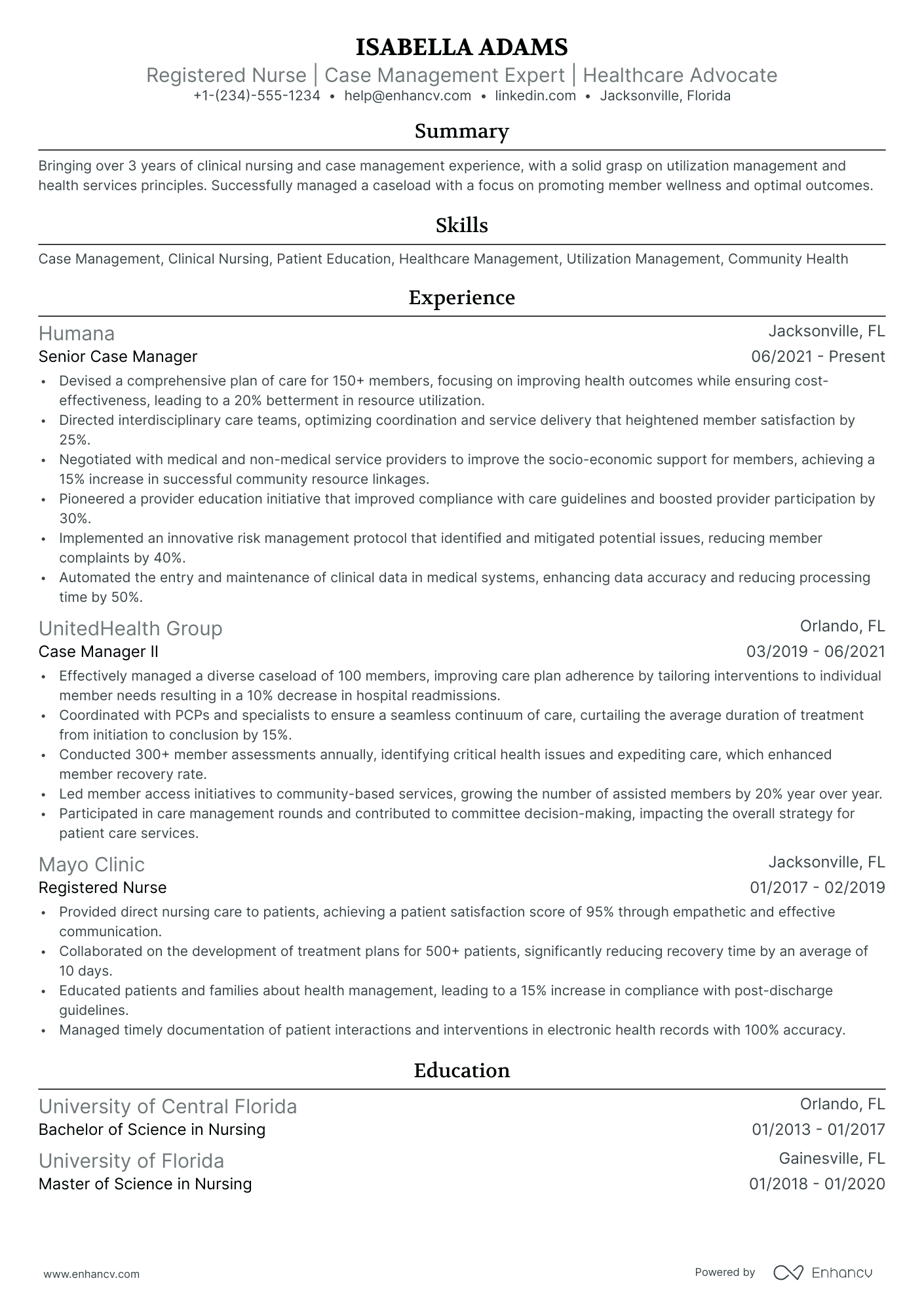
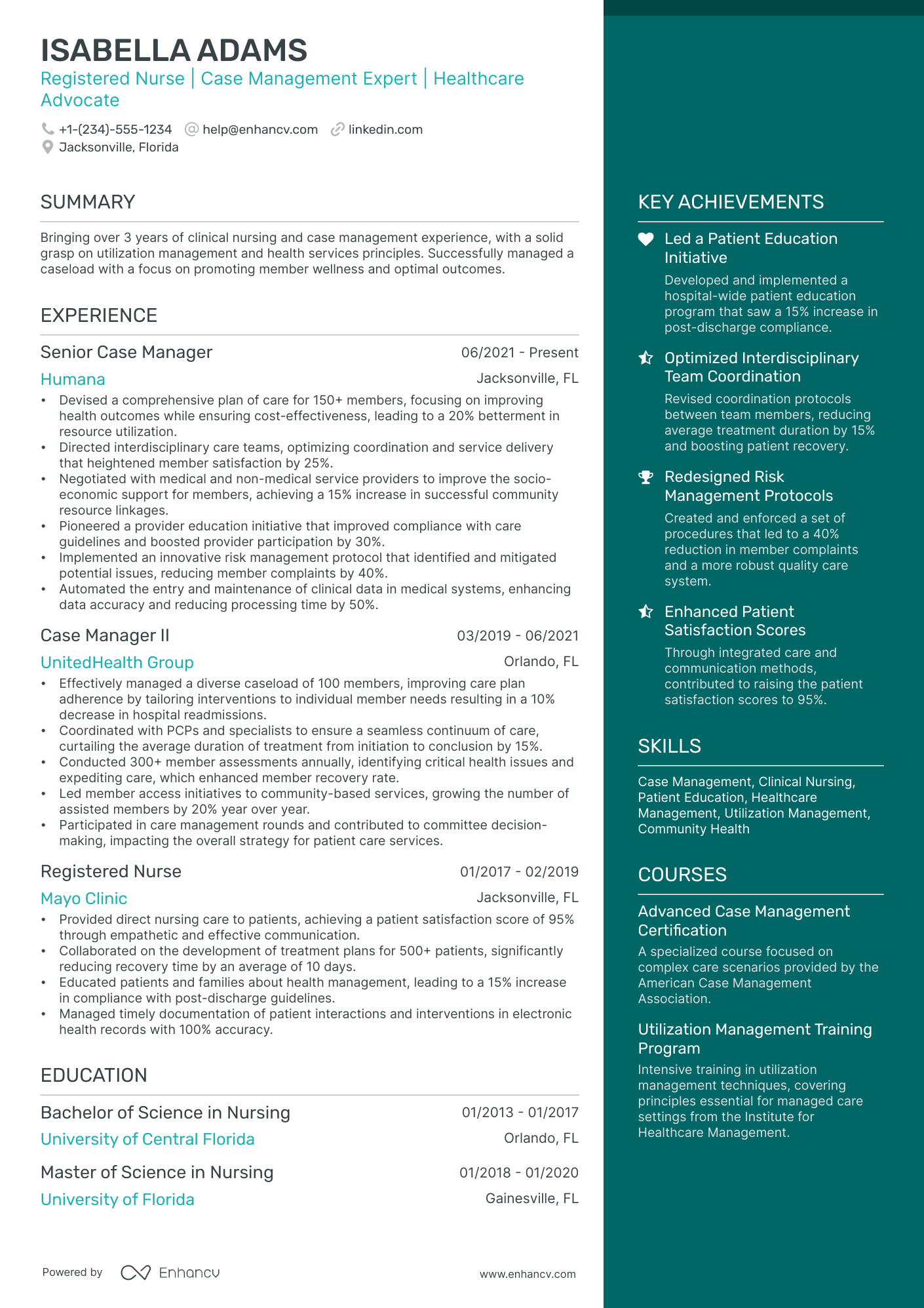
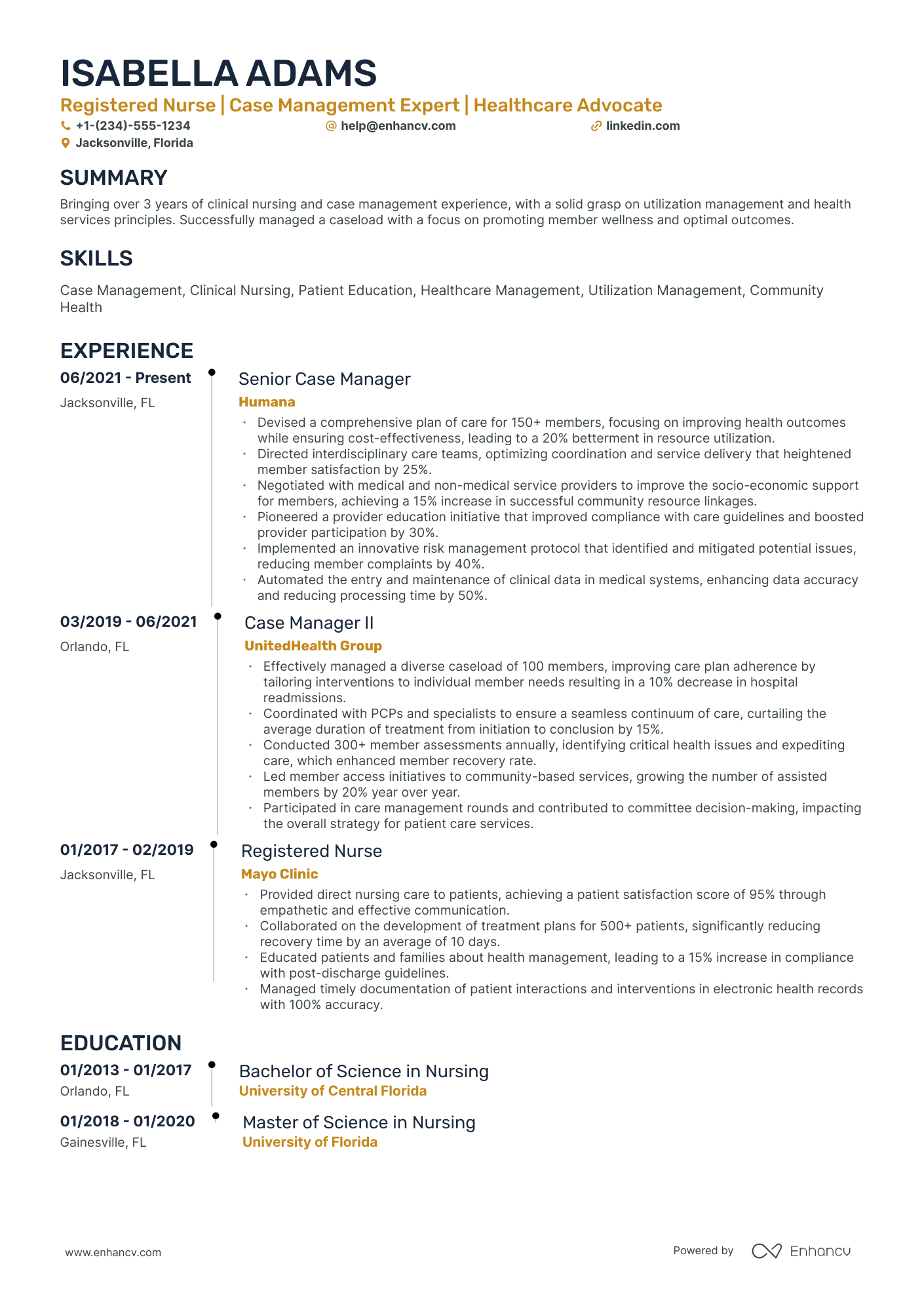
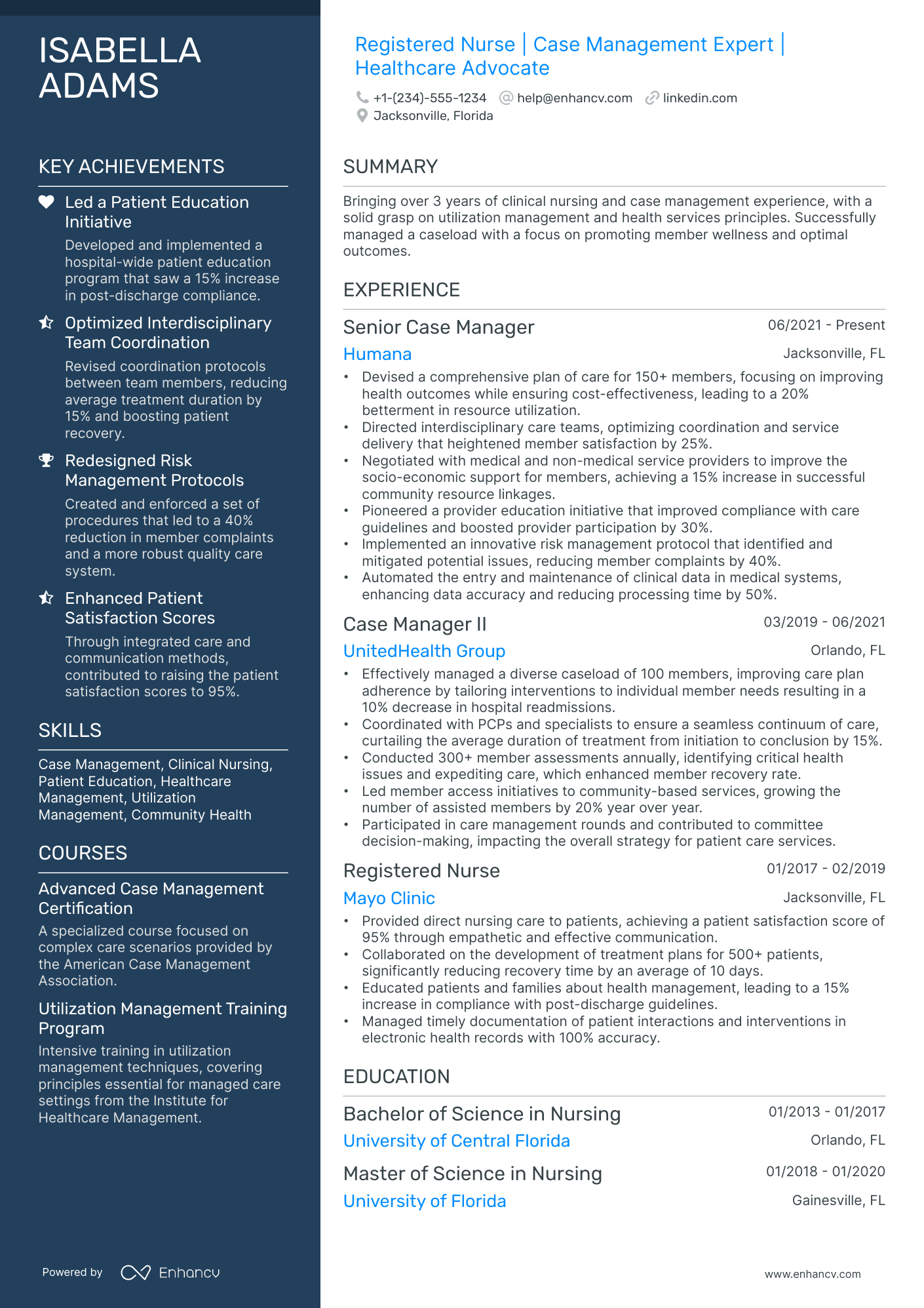
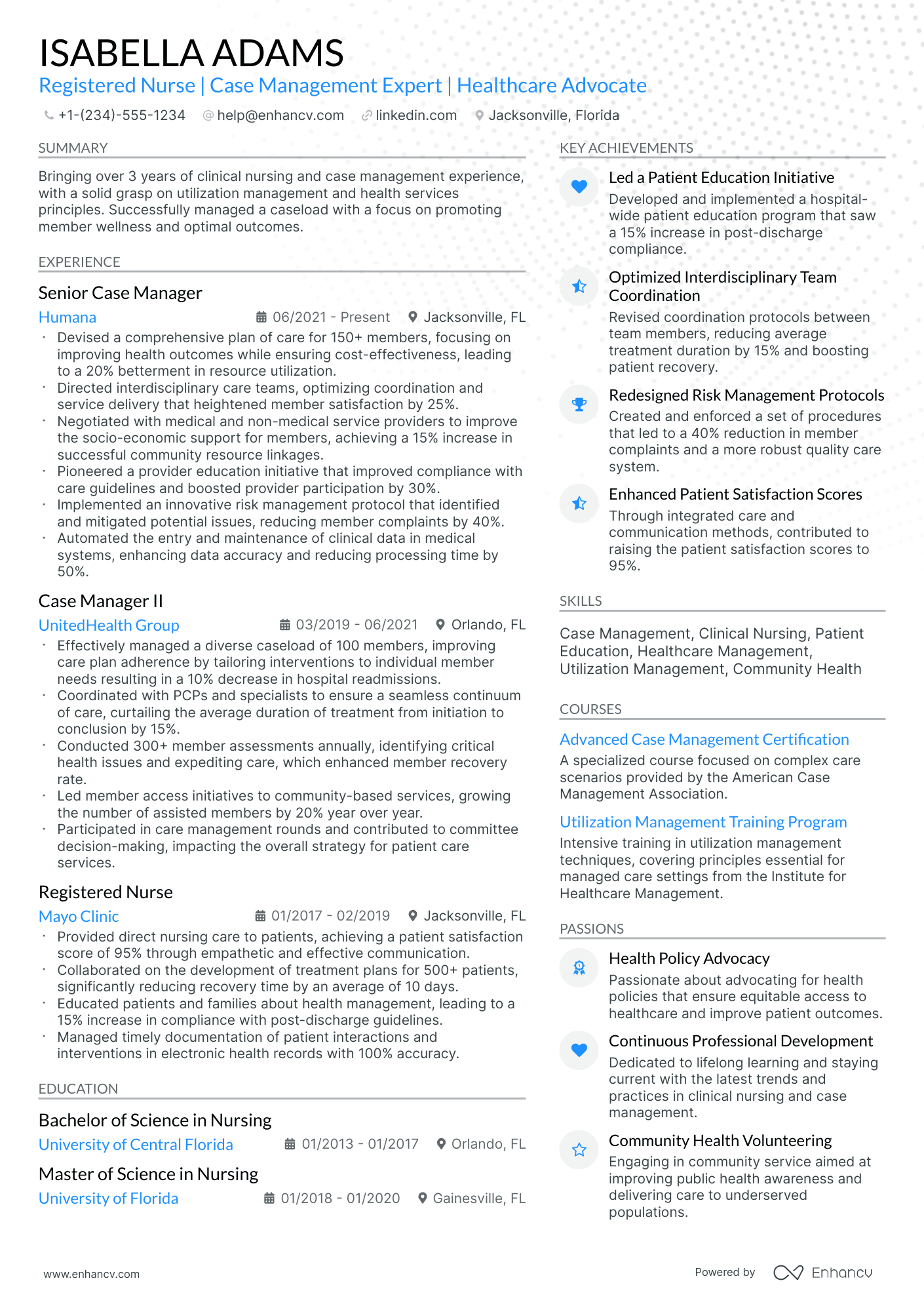
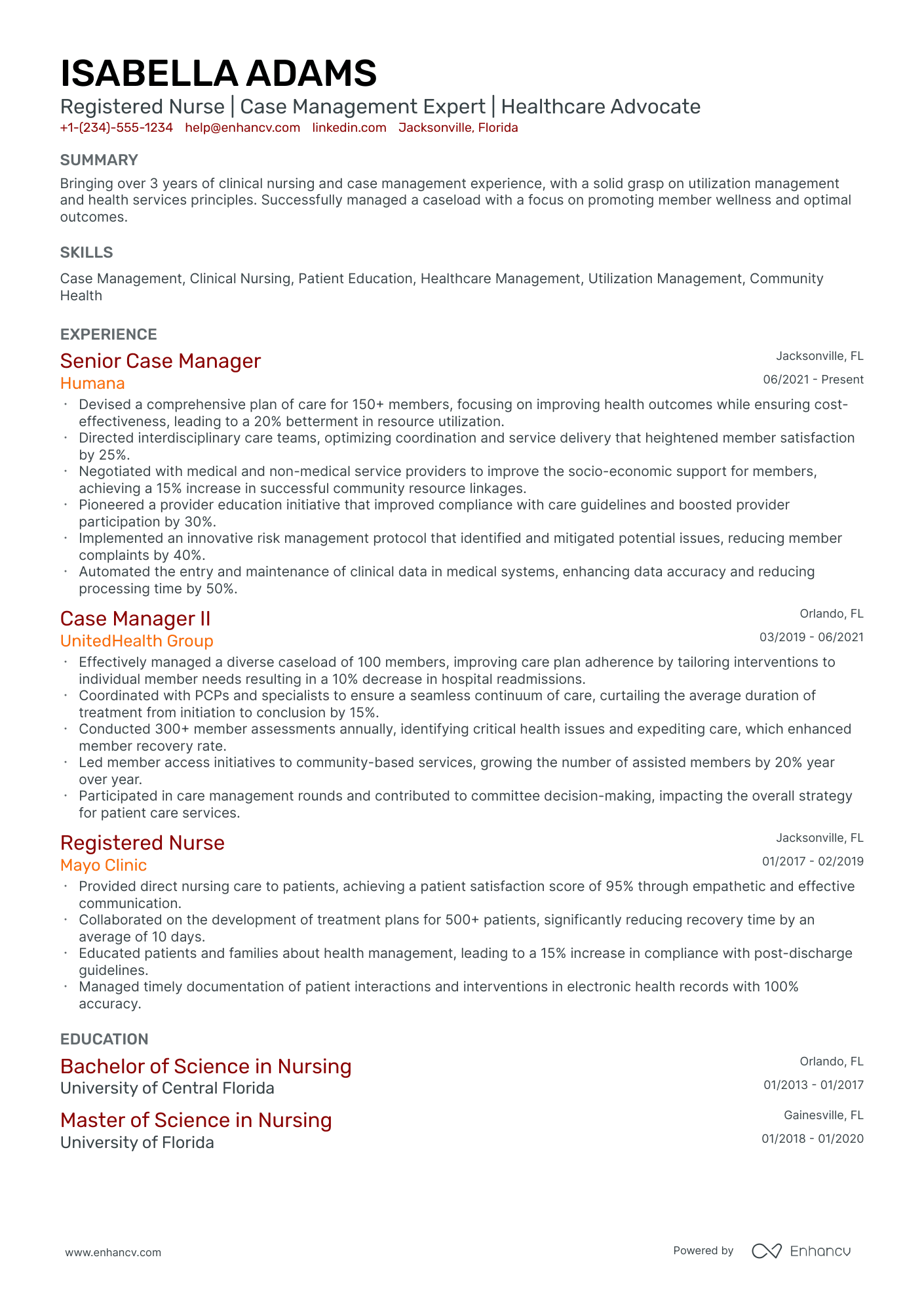
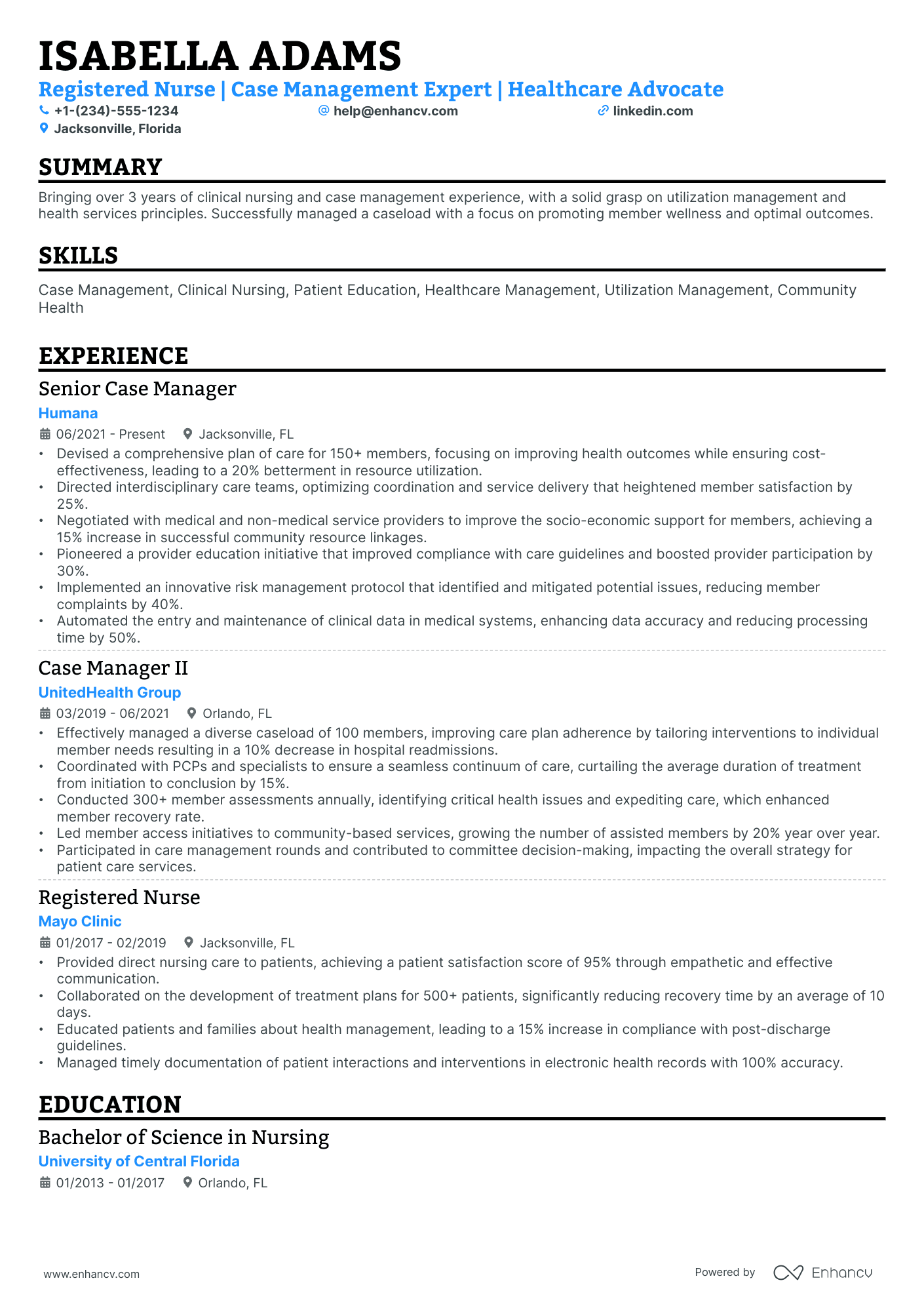
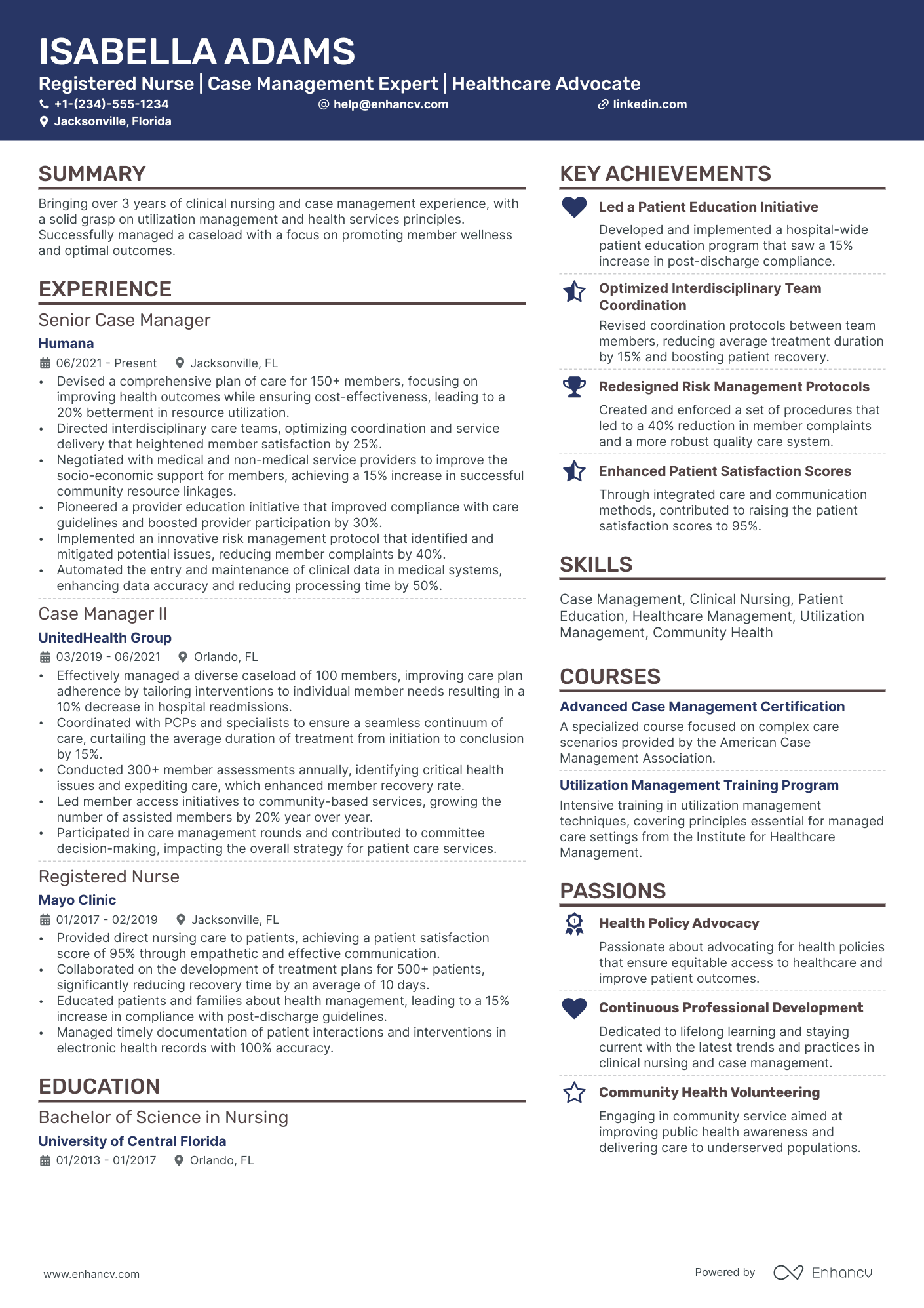
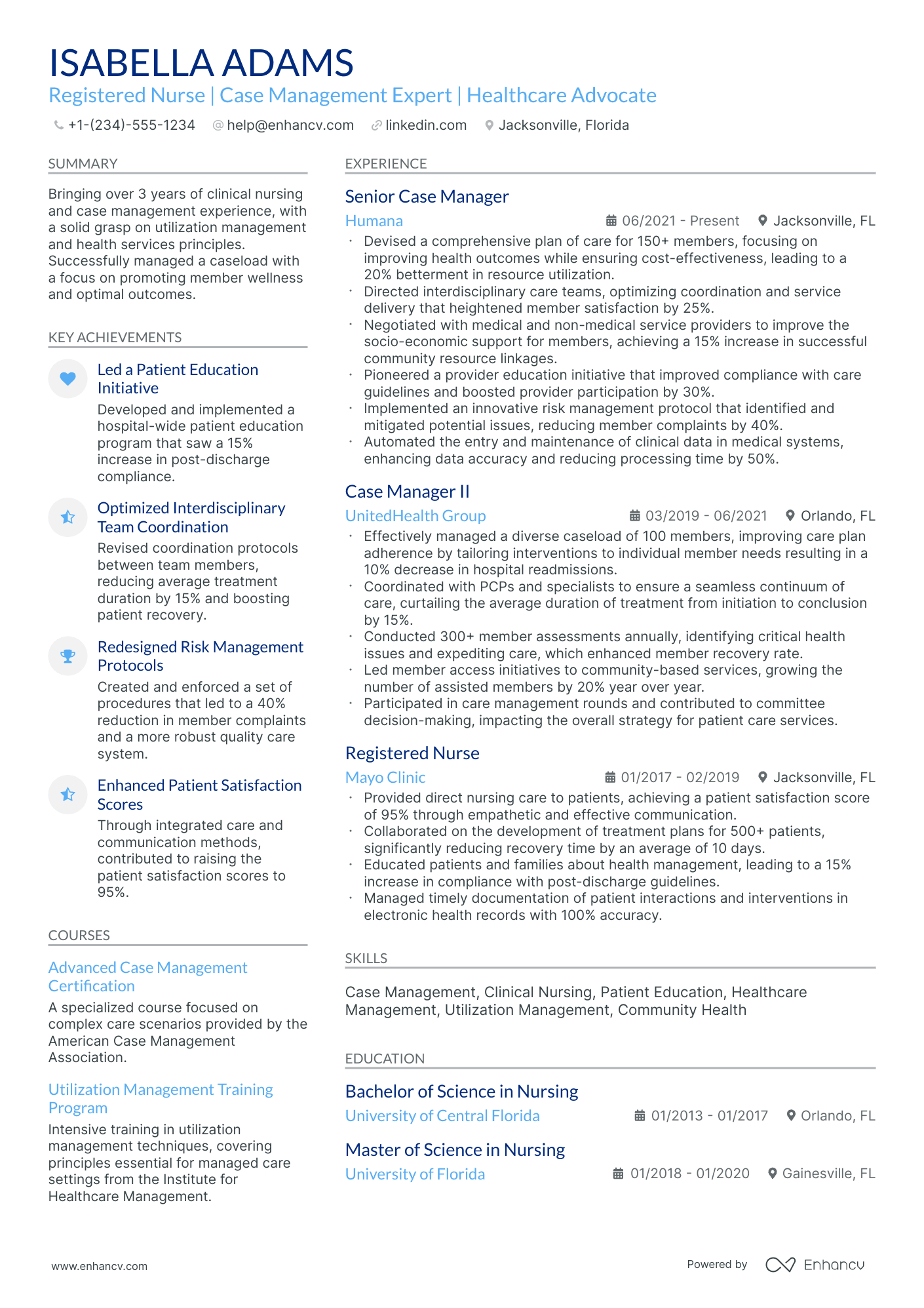
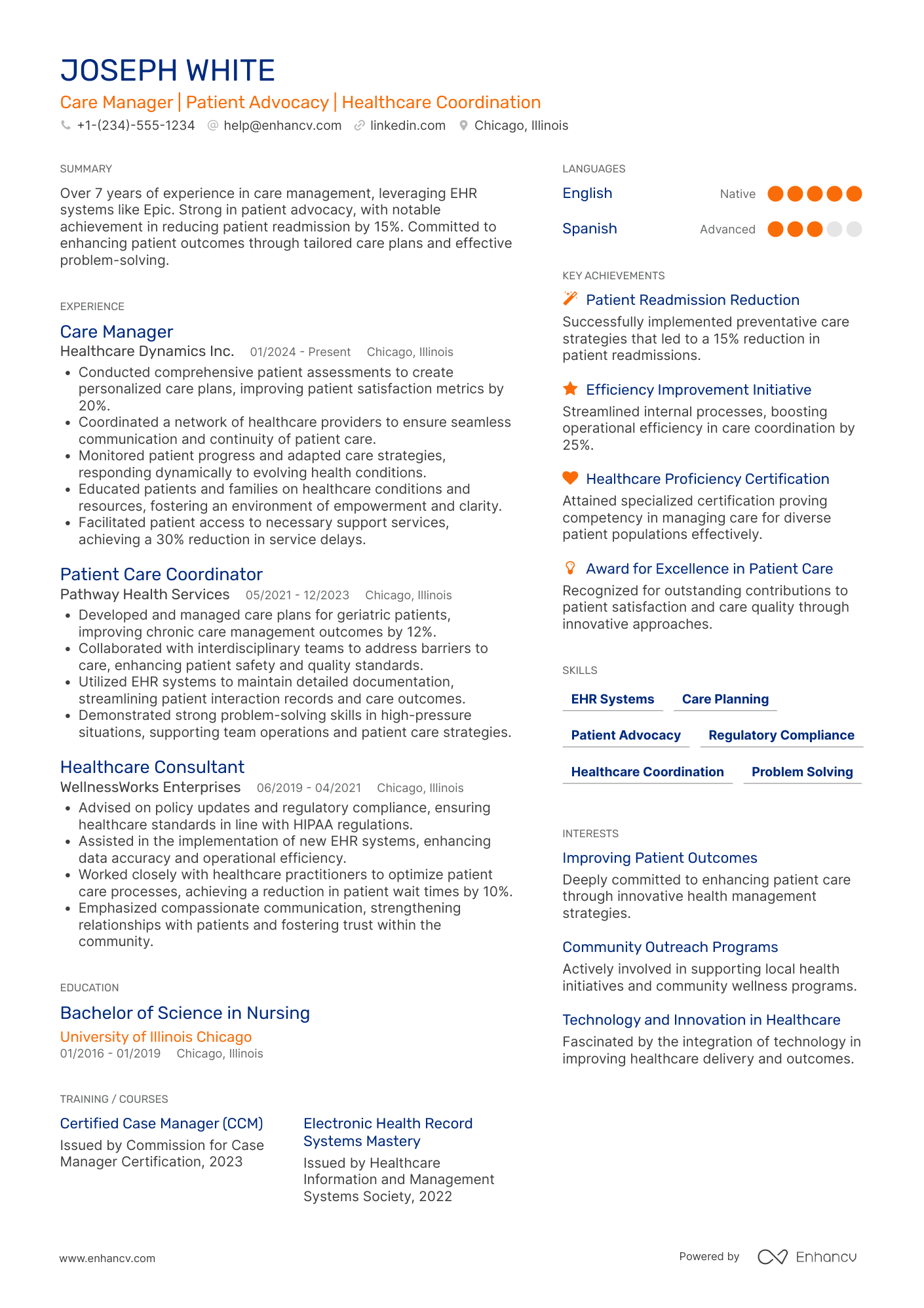
Many care manager resumes fail because they list tasks without showing patient outcomes, risk reduction, or care coordination impact. This care manager resume guide helps you compete in ATS screening and fast recruiter scans, where results and relevance decide interviews.
A strong resume shows what changed because of your work, not the tools you used. Understanding how to make your resume stand out starts with highlighting reduced readmissions, improved medication adherence, managed caseload size, shortened discharge timelines, raised patient satisfaction scores, and improved care plan completion rates across sites.

Key takeaways
- Quantify care outcomes like readmission reduction, adherence rates, and caseload volume in every experience bullet.
- Tailor each resume to the job posting by mirroring its exact tools, metrics, and terminology.
- Use a reverse-chronological format for experienced care managers and a hybrid format for career changers.
- Anchor every listed skill to a specific action and measurable patient outcome on your resume.
- Place certifications like CCM or ACM above education when they're recent or required for the role.
- Lead your summary with years of experience, your clinical specialty, and one standout achievement.
- Use Enhancv to turn routine care management tasks into measurable, recruiter-ready resume bullets faster.
Job market snapshot for care managers
We analyzed 2,307 recent care manager job ads across major US job boards. These numbers help you understand top companies hiring, employment type trends, skills in demand at a glance.
What level of experience employers are looking for care managers
| Years of Experience | Percentage found in job ads |
|---|---|
| 1–2 years | 37.6% (868) |
| 3–4 years | 8.6% (198) |
| 5–6 years | 2.7% (62) |
| 7–8 years | 0.4% (9) |
| 9–10 years | 0.2% (4) |
| 10+ years | 10.8% (249) |
| Not specified | 39.7% (916) |
Care manager ads by area of specialization (industry)
| Industry (Area) | Percentage found in job ads |
|---|---|
| Healthcare | 83.9% (1935) |
| Finance & Banking | 14.2% (328) |
| Education | 0.9% (20) |
| Government | 0.8% (18) |
Top companies hiring care managers
| Company | Percentage found in job ads |
|---|---|
| Molina Healthcare Inc. | 23.2% (535) |
| Sunrise Senior Living | 9.5% (220) |
| CVS Health | 4.3% (100) |
| Elevance Health | 3.6% (82) |
| UnitedHealth Group Inc. | 3.6% (82) |
| Centene Corporation | 3.0% (69) |
| Humana Inc. | 2.0% (45) |
| AdventHealth | 1.9% (44) |
| Providence Health & Services | 1.8% (42) |
| Gentiva Health Services | 1.5% (34) |
Role overview stats
These tables show the most common responsibilities and employment types for care manager roles. Use them to align your resume with what employers expect and to understand how the role is structured across the market.
Day-to-day activities and top responsibilities for a care manager
| Responsibility | Percentage found in job ads |
|---|---|
| Microsoft office | 33.9% (783) |
| Case management | 14.5% (334) |
| Databases | 10.5% (243) |
| Online portals | 10.4% (241) |
| Care management | 9.8% (225) |
| Excel | 8.7% (200) |
| Outlook | 7.4% (170) |
| Motivational interviewing | 7.1% (163) |
| Discharge planning | 6.4% (147) |
| Care coordination | 5.8% (134) |
| Nursing | 5.7% (132) |
| Documentation | 5.6% (130) |
Type of employment (remote vs on-site vs hybrid)
| Employment type | Percentage found in job ads |
|---|---|
| On-site | 75.2% (1736) |
| Hybrid | 16.3% (376) |
| Remote | 8.5% (195) |
How to format a care manager resume
Recruiters evaluating care manager resumes prioritize evidence of patient advocacy, interdisciplinary coordination, and measurable improvements in care outcomes. A clear, well-structured resume format ensures these signals surface quickly during both human review and applicant tracking system (ATS) screening.

I have significant experience in this role—which format should I use?
Use a reverse-chronological format to showcase your progression in care coordination, caseload management, and patient outcomes across successive roles. Do:
- Lead with your most recent position and emphasize scope—team size, caseload volume, and the populations you managed.
- Highlight proficiency in care management platforms (e.g., Epic, Netsmart, CareLogic), utilization review processes, and regulatory compliance frameworks.
- Quantify outcomes tied to patient satisfaction, readmission reduction, cost savings, or care plan adherence.
I'm junior or switching into this role—what format works best?
A hybrid format works best, allowing you to lead with relevant clinical or coordination skills while still presenting your work history in chronological order. Do:
- Place a skills section near the top featuring care coordination competencies, case documentation, motivational interviewing, and relevant certifications (e.g., CCM, ACM).
- Include clinical rotations, internships, volunteer case management, or community health projects that demonstrate hands-on patient interaction.
- Link every listed skill to a specific action and its outcome so recruiters see practical application, not just credentials.
Why not use a functional resume?
A functional format strips away the timeline and context recruiters need to evaluate your care management experience, making it harder to verify caseload responsibility, clinical settings, and professional growth. A functional resume may be acceptable if you're transitioning from a clinical role (e.g., nursing or social work) into care management with no direct job title match, but only if you anchor every listed skill to specific projects, patient populations, and measurable outcomes rather than presenting skills in isolation.
Once your resume's layout and structure are in place, the next step is filling it with the right sections to showcase your qualifications effectively.
What sections should go on a care manager resume
Recruiters expect a care manager resume to show patient-centered coordination, measurable outcomes, and strong cross-functional collaboration. Knowing what to put on a resume ensures you include the details that matter most.
Use this structure for maximum clarity:
- Header
- Summary
- Experience
- Skills
- Projects
- Education
- Certifications
- Optional sections: Awards, Leadership, Volunteering
Strong experience bullets should emphasize caseload scope, care plan outcomes, reduced readmissions, improved patient satisfaction, and measurable cost or utilization impact.
Is your resume good enough?
Drop your resume here or choose a file. PDF & DOCX only. Max 2MB file size.
Once you’ve organized your resume with the right structure, the next step is to write your care manager experience in a way that fits those sections and clearly shows your impact.
How to write your care manager resume experience
The experience section is where you prove you've delivered real results in care coordination, patient advocacy, and clinical oversight—not just performed routine duties. Hiring managers prioritize demonstrated impact through measurable outcomes, role-relevant tools and methods, and evidence of work you've shipped or delivered over descriptive task lists.
Each entry should include:
- Job title
- Company and location (or remote)
- Dates of employment (month and year)
Three to five concise bullet points showing what you owned, how you executed, and what outcomes you delivered:
- Ownership scope: the caseloads, patient populations, care programs, interdisciplinary teams, or service lines you were directly accountable for as a care manager.
- Execution approach: the clinical frameworks, assessment tools, electronic health record systems, evidence-based protocols, or care planning methodologies you used to guide decisions and deliver coordinated care.
- Value improved: changes to patient outcomes, care quality, readmission rates, treatment adherence, resource utilization, or risk mitigation that resulted from your direct involvement.
- Collaboration context: how you partnered with physicians, social workers, insurance providers, community organizations, or family members to align on treatment goals and resolve barriers to care.
- Impact delivered: outcomes expressed through tangible results—such as improvements in patient satisfaction, reductions in unnecessary hospitalizations, or gains in program efficiency—rather than descriptions of daily activity.
Experience bullet formula
A care manager experience example
✅ Right example - modern, quantified, specific.
Care Manager
Harmony Health Plan | Phoenix, AZ
2022–Present
Managed complex Medicaid and Medicare Advantage member populations in a high-volume, outcomes-driven care management program.
- Led longitudinal care plans for a 120-member complex caseload using Epic, Salesforce Health Cloud, and HEDIS (Healthcare Effectiveness Data and Information Set) measures, improving annual preventive screening adherence by 14%.
- Conducted telephonic and in-home biopsychosocial assessments using Motivational Interviewing and PHQ-9/GAD-7, reducing thirty-day hospital readmissions by 11% across a 6-month cohort.
- Coordinated transitions of care with hospital discharge planners, primary care providers, and pharmacy teams, closing 92% of post-discharge follow-ups within seven days and cutting care gaps by 18%.
- Built and maintained a high-risk registry in Excel and Power BI dashboards, standardizing risk stratification and saving eight hours per week in manual reporting for the care management team.
- Documented and audited care management notes in Epic and ensured HIPAA compliance, lowering documentation error rates by 23% and passing two internal quality reviews with zero critical findings.
Now that you've seen how a strong experience section comes together, let's look at how to adjust yours to match the specific role you're targeting.
How to tailor your care manager resume experience
Recruiters evaluate care manager resumes through both human review and applicant tracking systems, so tailoring your resume to the job description increases your chances of advancing. Tailoring means restructuring your bullets to reflect the specific language, priorities, and expectations outlined in the description.
Ways to tailor your care manager experience:
- Mirror care coordination models and workflows named in the posting.
- Match electronic health record systems or platforms the employer uses.
- Use the exact terminology for assessments or screening tools referenced.
- Reflect quality metrics or patient outcome KPIs the role prioritizes.
- Highlight interdisciplinary collaboration methods described in the listing.
- Include regulatory compliance standards or accreditation bodies mentioned.
- Emphasize population health or chronic disease management if specified.
- Reference discharge planning or transition of care processes when relevant.
Tailoring means aligning your real accomplishments with what the role demands, not forcing keywords where they don't belong.
Resume tailoring examples for care manager
| Job description excerpt | Untailored | Tailored |
|---|---|---|
| Coordinate individualized care plans for patients with chronic conditions using InterQual criteria and collaborate with interdisciplinary teams to ensure timely transitions of care. | Helped create care plans for patients and worked with other departments. | Developed and coordinated individualized care plans for a caseload of 85+ patients with chronic conditions, applying InterQual criteria to guide level-of-care decisions and reduce transition delays by 22%. |
| Conduct comprehensive biopsychosocial assessments, identify barriers to care, and connect Medicaid members to community resources, housing support, and behavioral health services. | Assessed patient needs and referred them to available resources. | Performed biopsychosocial assessments for 60+ Medicaid members monthly, identifying barriers such as housing instability and untreated behavioral health needs, and linking 90% of members to community-based services within 14 days. |
| Utilize electronic health records (Epic) to document patient interactions, track authorization requests, and ensure compliance with NCQA and state regulatory standards. | Documented patient information in the system and followed company policies. | Documented all patient interactions, authorization requests, and follow-ups in Epic, maintaining 100% compliance with NCQA accreditation standards and state regulatory requirements across quarterly audits. |
Once you’ve aligned your experience with the role’s priorities, quantify your care manager achievements to show the measurable impact of that work.
How to quantify your care manager achievements
Quantifying your achievements proves patient impact and program value. Focus on readmissions, follow-up speed, care plan adherence, risk reduction, and patient satisfaction—plus caseload volume and documentation accuracy.
Quantifying examples for care manager
| Metric | Example |
|---|---|
| Readmission reduction | "Reduced thirty-day readmissions from 14% to 10% across a 220-patient CHF panel by tightening post-discharge outreach and medication reconciliation in Epic." |
| Follow-up cycle time | "Cut average post-discharge contact time from forty-eight hours to twenty-four hours by using Salesforce Health Cloud task queues and same-day call blocks." |
| Care plan adherence | "Improved care plan completion from 72% to 89% for a 160-member high-risk cohort by standardizing SMART goals and weekly barrier reviews." |
| Risk and compliance | "Raised HEDIS (Healthcare Effectiveness Data and Information Set) diabetes A1C control documentation from 68% to 82% by closing gaps with PCP offices and auditing charts weekly." |
| Patient satisfaction | "Increased CAHPS (Consumer Assessment of Healthcare Providers and Systems) care coordination score from 3.8 to 4.3 in two quarters by adding teach-back scripts and bilingual follow-ups." |
Turn your everyday tasks into measurable, recruiter-ready resume bullets in seconds with Enhancv's Bullet Point Generator.
Once you've crafted strong bullet points that highlight your achievements, the next step is ensuring your resume also showcases the right mix of hard and soft skills employers look for in a care manager.
How to list your hard and soft skills on a care manager resume
Your skills section shows you can coordinate care safely and efficiently, and recruiters and an ATS (applicant tracking system) scan this section to match you to the job—aim for a balanced mix of clinical, care coordination, and communication skills. care manager roles require a blend of:
- Product strategy and discovery skills
- Data, analytics, and experimentation skills
- Delivery, execution, and go-to-market discipline
- Soft skills
Your skills section should be:
- Scannable (bullet-style grouping).
- Relevant to the job post.
- Backed by proof in experience bullets.
- Updated with current tools.
Place your skills section:
- Above experience if you're junior or switching careers.
- Below experience if you're mid/senior with strong achievements.

Hard skills
- Care plan development
- Utilization management, prior authorizations
- Interdisciplinary care coordination
- Transitions of care
- Chronic disease management
- Medication reconciliation
- Motivational interviewing
- Behavioral health screening
- Risk stratification, acuity scoring
- Electronic health records (Epic, Cerner)
- HIPAA compliance, documentation
- Quality measures: HEDIS, STAR ratings
Listing relevant hard skills like these demonstrates your clinical and technical competencies to hiring managers.
Soft skills
- Patient-centered communication
- Family and caregiver coaching
- Cross-functional collaboration
- Provider relationship management
- Clear escalation and handoffs
- Conflict de-escalation
- Prioritization under caseload pressure
- Clinical judgment and triage
- Barrier identification and problem-solving
- Follow-through on care gaps
- Stakeholder updates and alignment
- Cultural humility in care planning
Including soft skills like these shows you can build trust with patients, families, and interdisciplinary teams.
How to show your care manager skills in context
Skills shouldn't live only in a bulleted list on your resume. Explore examples of resume skills shown in context to see how top candidates weave competencies into real achievements.
They should be demonstrated in:
- Your summary (high-level professional identity)
- Your experience (proof through outcomes)
Here's what both look like in practice.
Summary example
Senior care manager with 10+ years in behavioral health, skilled in motivational interviewing, InterQual criteria, and cross-disciplinary coordination. Reduced hospital readmissions by 28% through proactive transition planning and patient-centered advocacy.
- Reflects senior-level experience clearly
- Names role-relevant tools and methods
- Includes a measurable clinical outcome
- Highlights empathy-driven soft skills
Experience example
Senior Care Manager
Covenant Health Partners | Remote
March 2019–Present
- Coordinated care for 85+ complex patients using InterQual and Epic, reducing avoidable ER visits by 22% over two years.
- Partnered with social workers, physicians, and pharmacists to build individualized care plans, improving medication adherence rates by 17%.
- Led motivational interviewing workshops for a 12-person team, strengthening patient engagement scores across three service lines.
- Every bullet contains measurable proof
- Skills appear naturally within achievements
Once you’ve anchored your abilities in real examples, the next step is to apply that approach to building a care manager resume when you don’t have direct experience.
How do I write a care manager resume with no experience
Even without full-time experience, you can demonstrate readiness through:
- Hospital or clinic volunteer shifts
- Case management practicum hours
- Community health outreach projects
- Care plan documentation coursework
- Patient intake and screening support
- Resource referral and follow-up logs
- HIPAA-compliant charting simulations
- Family caregiver coordination experience
If you're building a resume without work experience, focus on:
- Documented care plans and notes
- Referral workflows and follow-ups
- Compliance training and protocols
- Metrics: volume, time, outcomes
Resume format tip for entry-level care manager
Use a hybrid resume format because it highlights relevant skills and projects while still showing your work history, even if it is unrelated. Do:
- Lead with a targeted summary and keywords.
- Add a projects section with outcomes.
- List tools used: electronic health record systems.
- Quantify scope: patients, calls, referrals.
- Include relevant coursework and certifications.
- Built and tracked a 25-client referral log in Microsoft Excel, scheduled follow-ups within 48 hours, and improved documented connection-to-service rate by 20%.
Even without direct experience, your education section can demonstrate the foundational knowledge and relevant training that qualify you for a care manager role.
How to list your education on a care manager resume
Your education section helps hiring teams confirm you have the foundational knowledge needed for care management. It validates clinical training, case management principles, and relevant healthcare expertise.
Include:
- Degree name
- Institution
- Location
- Graduation year
- Relevant coursework (for juniors or entry-level candidates)
- Honors & GPA (if 3.5 or higher)
Skip month and day details—list the graduation year only.
Here's a strong education entry tailored to a care manager resume.
Example education entry
Bachelor of Science in Nursing
University of Michigan, Ann Arbor, MI
Graduated 2019
GPA: 3.7/4.0
- Relevant Coursework: Community Health Nursing, Case Management Strategies, Chronic Disease Management, Healthcare Ethics
- Honors: Magna Cum Laude, Dean's List (all semesters)
How to list your certifications on a care manager resume
Certifications show your commitment to learning, your proficiency with care management tools, and your relevance in healthcare settings as a care manager.
Include:
- Certificate name
- Issuing organization
- Year
- Optional: credential ID or URL
- Place certifications below education when they're older, less relevant, or supplemental to your core care manager qualifications.
- Place certifications above education when they're recent, highly relevant, or required for your target care manager role.
Best certifications for your care manager resume
- Certified Case Manager (CCM)
- Accredited Case Manager (ACM)
- Certified Care Manager (CMC)
- Certified Professional in Healthcare Quality (CPHQ)
- Certified in Healthcare Compliance (CHC)
- Certified Rehabilitation Registered Nurse (CRRN)
- Certified Professional in Patient Safety (CPPS)
Once you’ve positioned your credentials where hiring managers can spot them quickly, use your care manager resume summary to reinforce that expertise upfront.
How to write your care manager resume summary
Your resume summary is the first thing a recruiter reads, so it needs to earn their attention fast. A strong opening tells hiring managers you understand patient-centered coordination and can deliver results.
Keep it to three to four lines, with:
- Your title and total years of care management experience.
- The domain you specialize in, such as chronic disease, behavioral health, or geriatrics.
- Core tools and skills like electronic health records, motivational interviewing, or utilization review.
- One or two measurable achievements, such as reduced readmission rates or improved patient satisfaction scores.
- Soft skills tied to real outcomes, like cross-functional collaboration that shortened discharge timelines.

PRO TIP
At this level, lead with clinical coordination skills, relevant certifications, and early wins that show initiative. Quantify contributions even if they're small—numbers stand out. Avoid vague phrases like "passionate caregiver" or "team player" without context. Skip motivational language and focus on what you've actually done.
Example summary for a care manager
Care manager with three years of experience coordinating chronic disease cases across outpatient settings. Skilled in Epic EHR and motivational interviewing. Reduced 30-day hospital readmissions by 14% through proactive follow-up protocols.
Optimize your resume summary and objective for ATS
Drop your resume here or choose a file.
PDF & DOCX only. Max 2MB file size.
Now that your summary clearly communicates your value, make sure the header above it presents your contact details accurately so recruiters can easily reach you.
What to include in a care manager resume header
A resume header is the top section with your key identifiers, and it matters for care manager visibility, credibility, and fast recruiter screening.
Essential resume header elements
- Full name
- Tailored job title and headline
- Location
- Phone number
- Professional email
- GitHub link
- Portfolio link
A LinkedIn link helps recruiters verify experience quickly and supports screening.
Don't include a photo on a care manager resume unless the role is explicitly front-facing or appearance-dependent.
Match your header title to the job posting and keep every detail consistent with your application and LinkedIn profile.
Example
Care manager resume header
Jordan Taylor
Care Manager | RN, CCM | Transitional Care and Complex Case Management
Chicago, IL
(312) 555-78XX
your.name@enhancv.com
github.com/yourname
yourwebsite.com
linkedin.com/in/yourname
Once your header clearly presents your identity and key contact details, you can strengthen the rest of your resume with additional sections that support those essentials.
Additional sections for care manager resumes
When your core qualifications match other applicants, additional sections can set you apart by showcasing unique strengths relevant to care management. For example, listing language skills can demonstrate your ability to serve diverse patient populations effectively.
- Languages
- Certifications and licenses
- Professional affiliations
- Volunteer experience
- Publications
- Continuing education
- Awards and recognitions
Once you've strengthened your resume with relevant additional sections, it's worth pairing it with a well-crafted cover letter to make an even stronger impression.
Do care manager resumes need a cover letter
A cover letter isn't required for a care manager, but it often helps. If you're unsure what a cover letter is or how it complements your resume, it matters most in competitive roles or when hiring teams expect one. It can make a difference when your resume needs context or your fit isn't obvious.
Use a cover letter to add value in these situations:
- Explain role and team fit: Connect your care model, collaboration style, and caseload experience to the job's priorities.
- Highlight one or two outcomes: Share a project and results, such as reduced readmissions, improved adherence, or faster care coordination.
- Show business and user understanding: Reference the program goals, patient population, and constraints like access, utilization, or quality measures.
- Address transitions or non-obvious experience: Clarify a specialty change, employment gap, or transferable work that supports care manager responsibilities.
Drop your resume here or choose a file.
PDF & DOCX only. Max 2MB file size.
Even when you decide whether to include a cover letter, using AI to improve your care manager resume helps you tailor your content faster and more precisely for each role.
Using AI to improve your care manager resume
AI can sharpen your resume's clarity, structure, and impact. It helps refine language and highlight measurable results. But overuse strips authenticity. Once your content feels clear and role-aligned, step away from AI. If you're wondering which AI is best for writing resumes, start with tools that let you stay in control of your content.
Here are 10 practical prompts to strengthen specific sections of your care manager resume:
- Strengthen your summary. "Rewrite my care manager resume summary to highlight patient outcomes, team coordination, and years of relevant experience in two concise sentences."
- Quantify experience bullets. "Add measurable results to these care manager experience bullets, focusing on caseload size, patient satisfaction scores, and cost savings."
- Align skills to job posts. "Compare my care manager skills section against this job description and suggest missing keywords that match my actual experience."
- Tighten action verbs. "Replace weak or repetitive verbs in my care manager experience section with stronger, more specific action verbs."
- Clarify certifications. "Reformat my care manager certifications section so each entry includes the credential name, issuing body, and year earned."
- Refine project descriptions. "Rewrite this care manager project description to emphasize the problem addressed, my specific role, and the patient impact achieved."
- Remove redundancy. "Identify and eliminate redundant phrases across my care manager resume without losing important details or context."
- Improve education relevance. "Revise my education section to emphasize coursework, clinical rotations, or training directly relevant to care manager responsibilities."
- Tailor for applicant tracking. "Reorganize my care manager experience bullets so the most relevant accomplishments for this specific job posting appear first."
- Sharpen readability. "Simplify overly complex sentences throughout my care manager resume so each bullet is clear, direct, and under 20 words."
Stop using AI once your resume sounds accurate, specific, and aligned with real experience. AI should never invent experience or inflate claims—if it didn't happen, it doesn't belong here.
Conclusion
A strong care manager resume shows measurable outcomes, role-specific skills, and a clear structure. Use numbers to prove impact, and highlight care coordination, patient advocacy, documentation, and collaboration with clinical teams.
Keep sections easy to scan, with a focused summary, relevant experience, and targeted skills. This approach matches how hiring teams review resumes today and prepares you for near-future expectations.