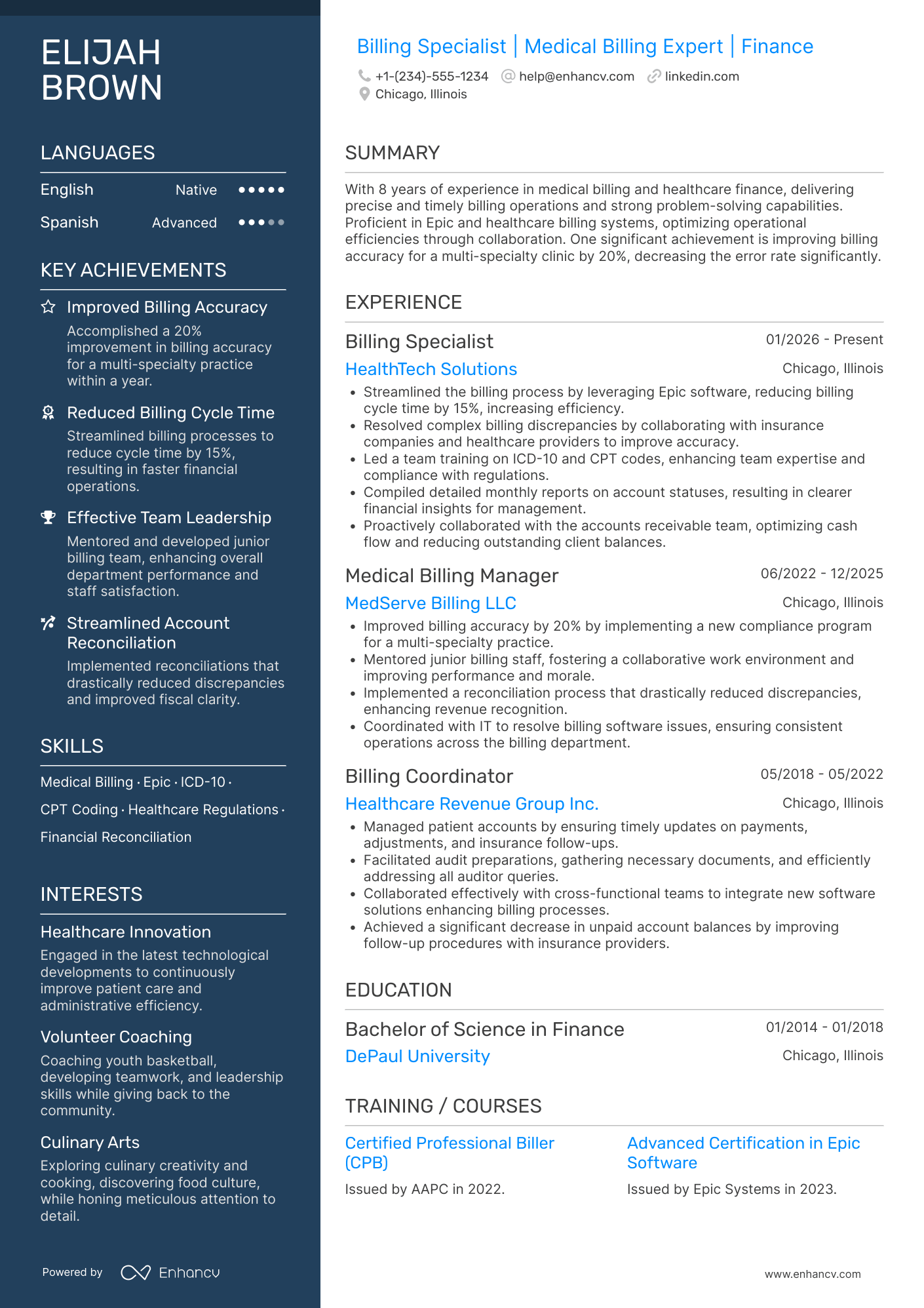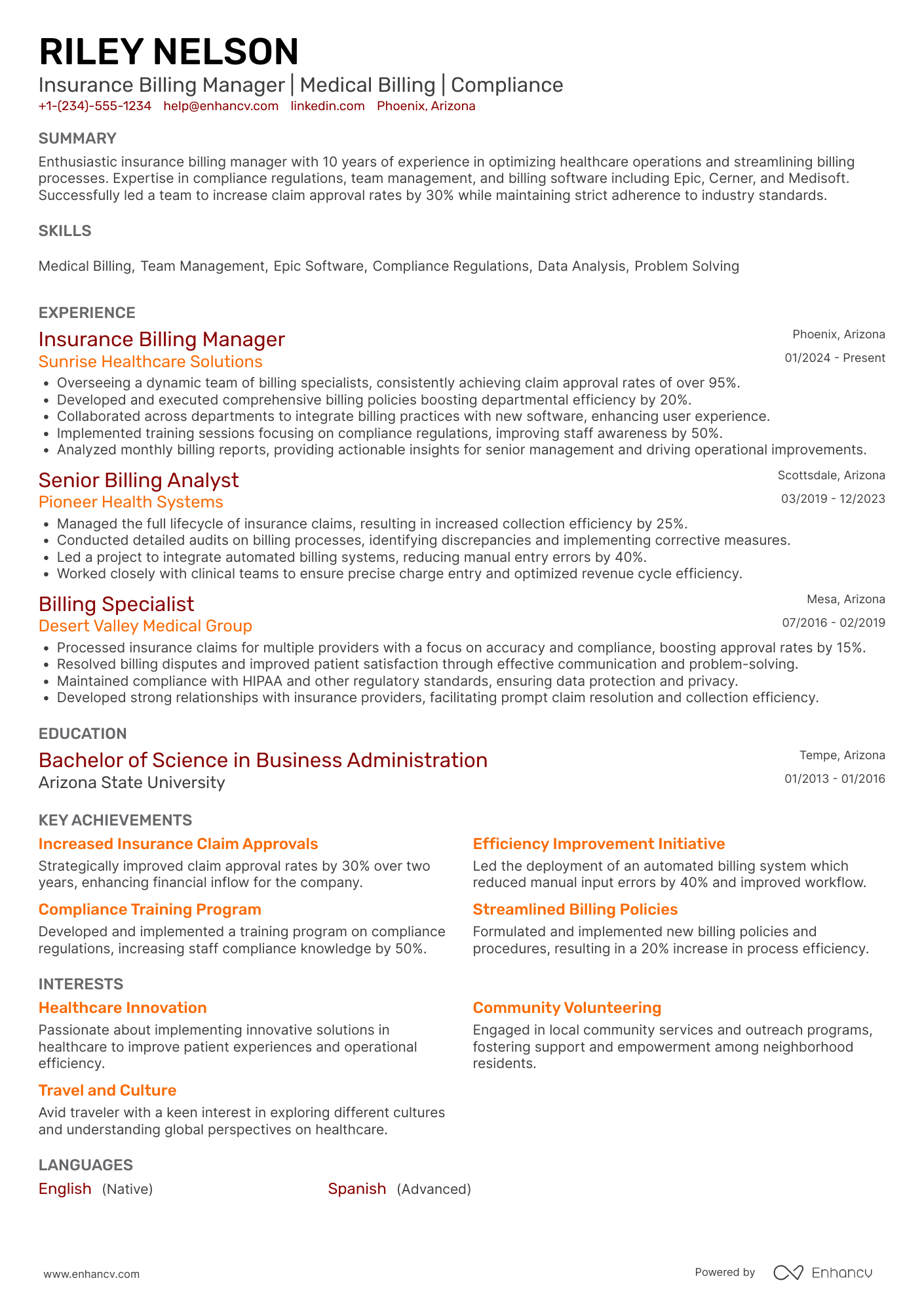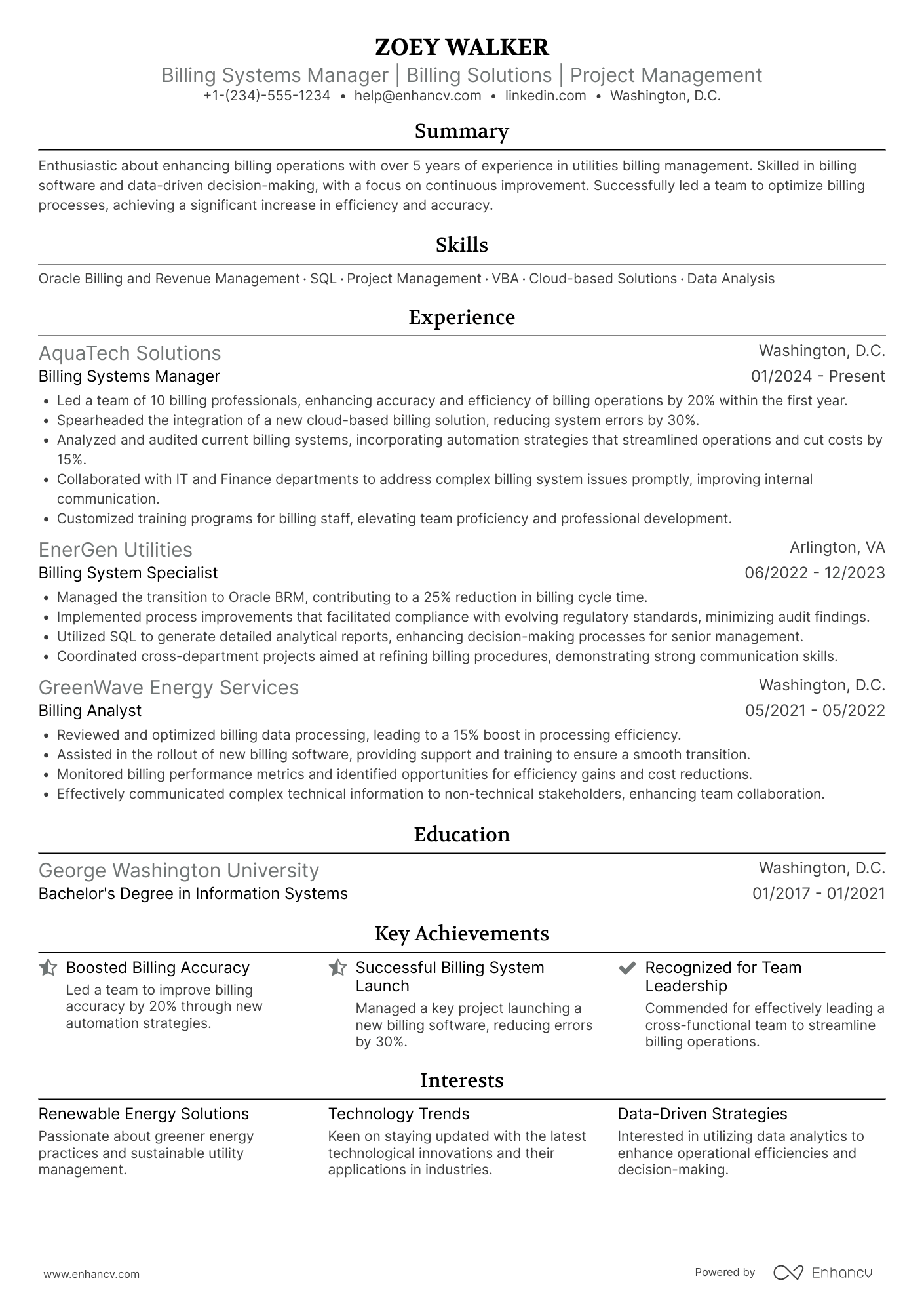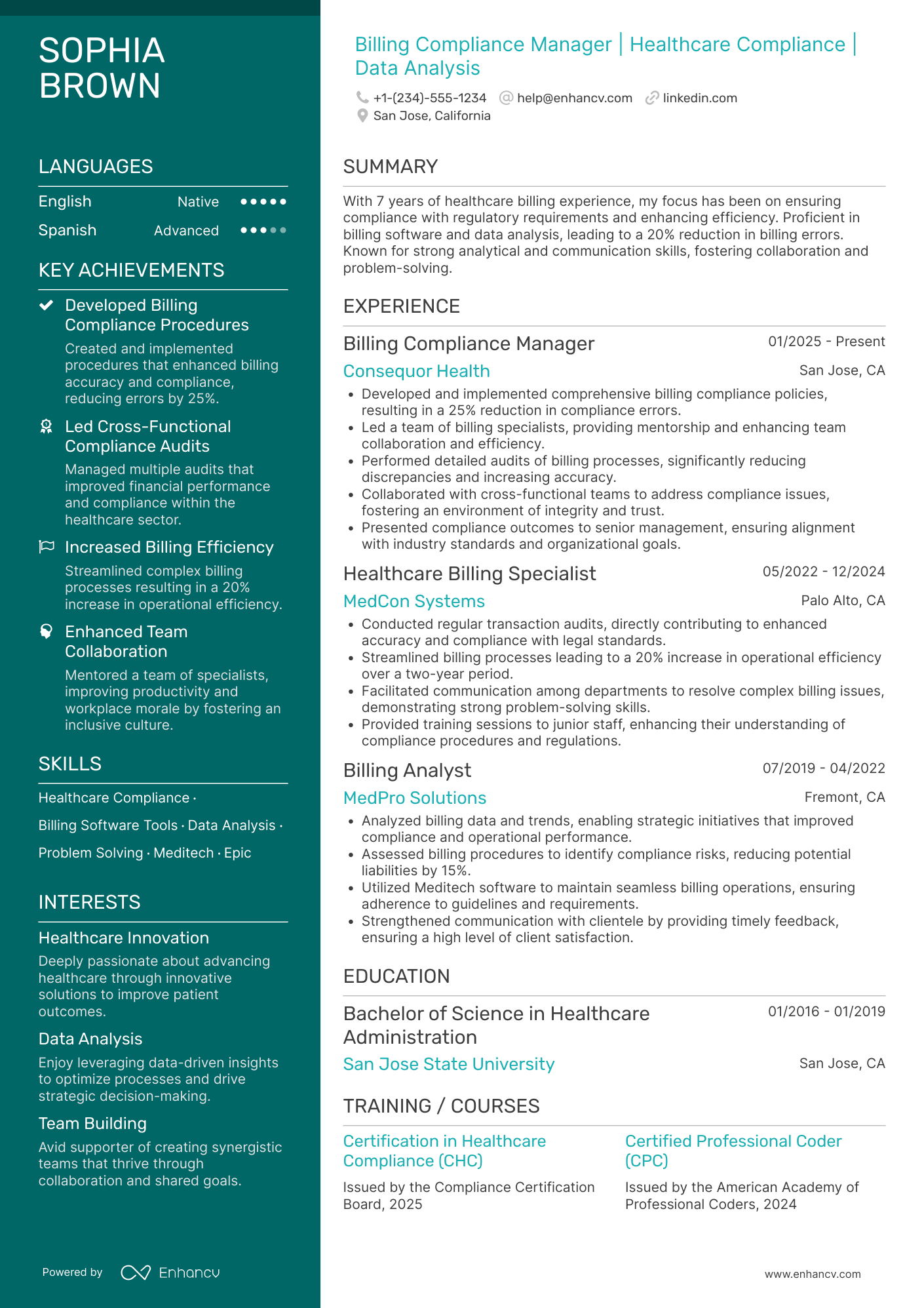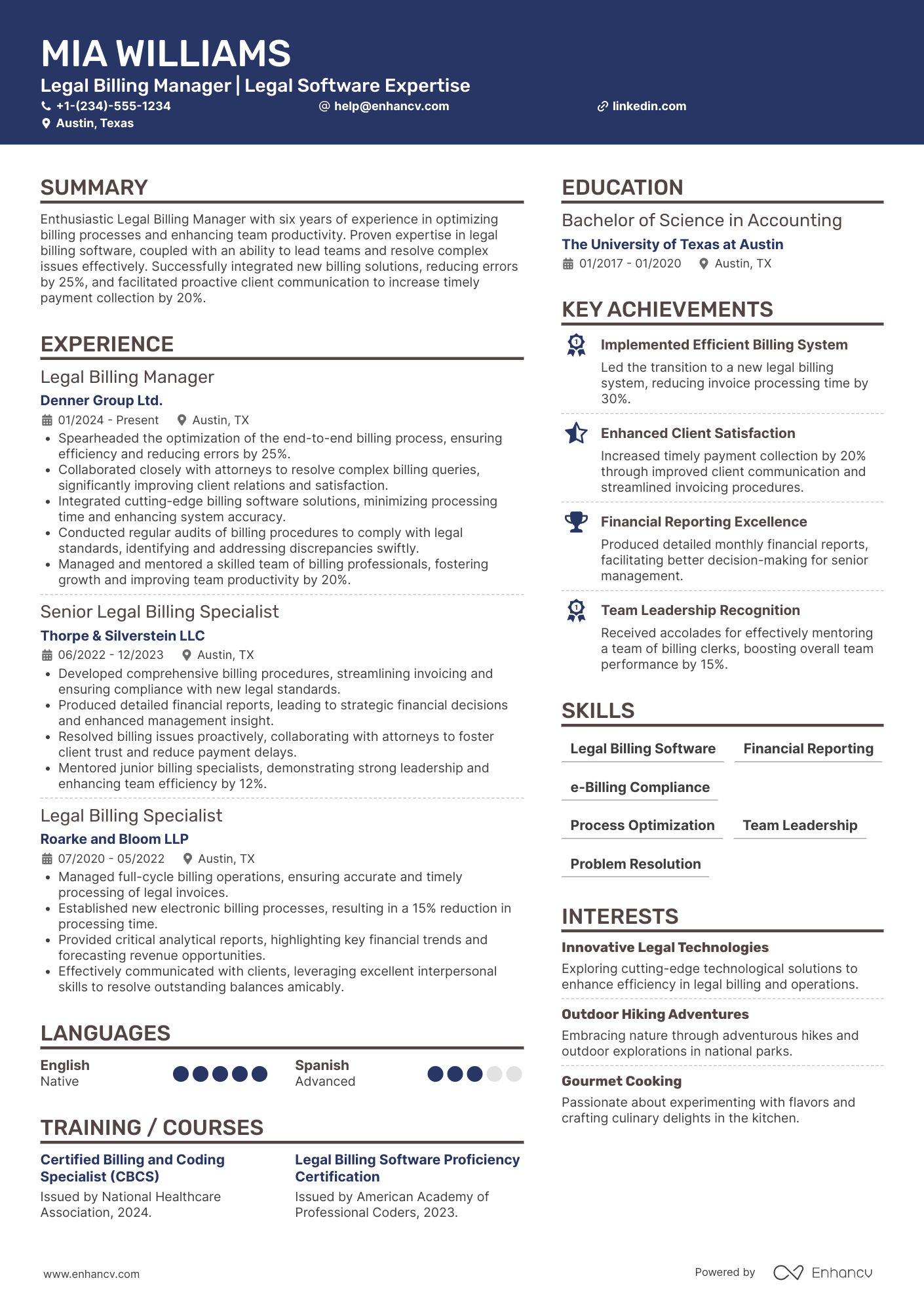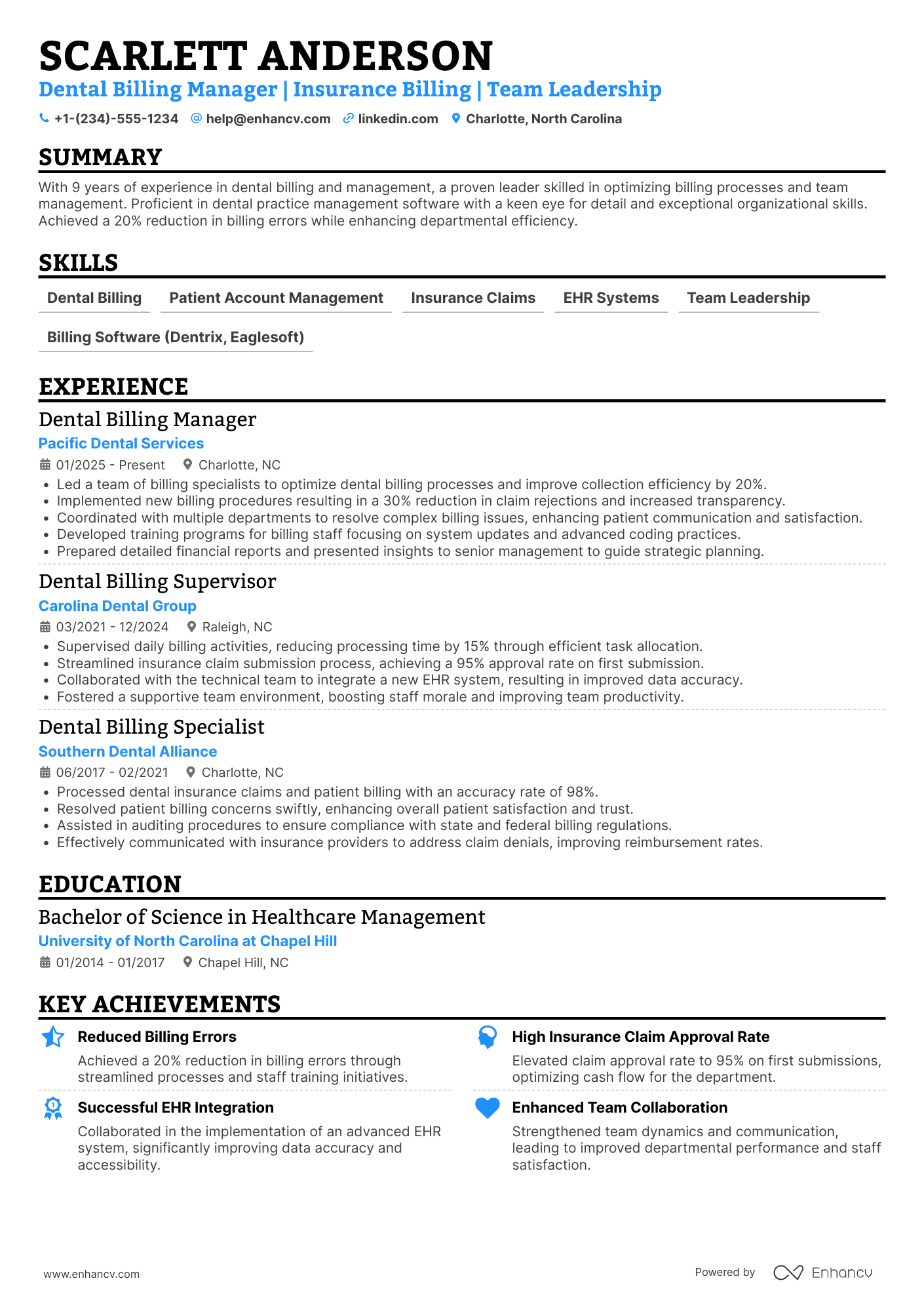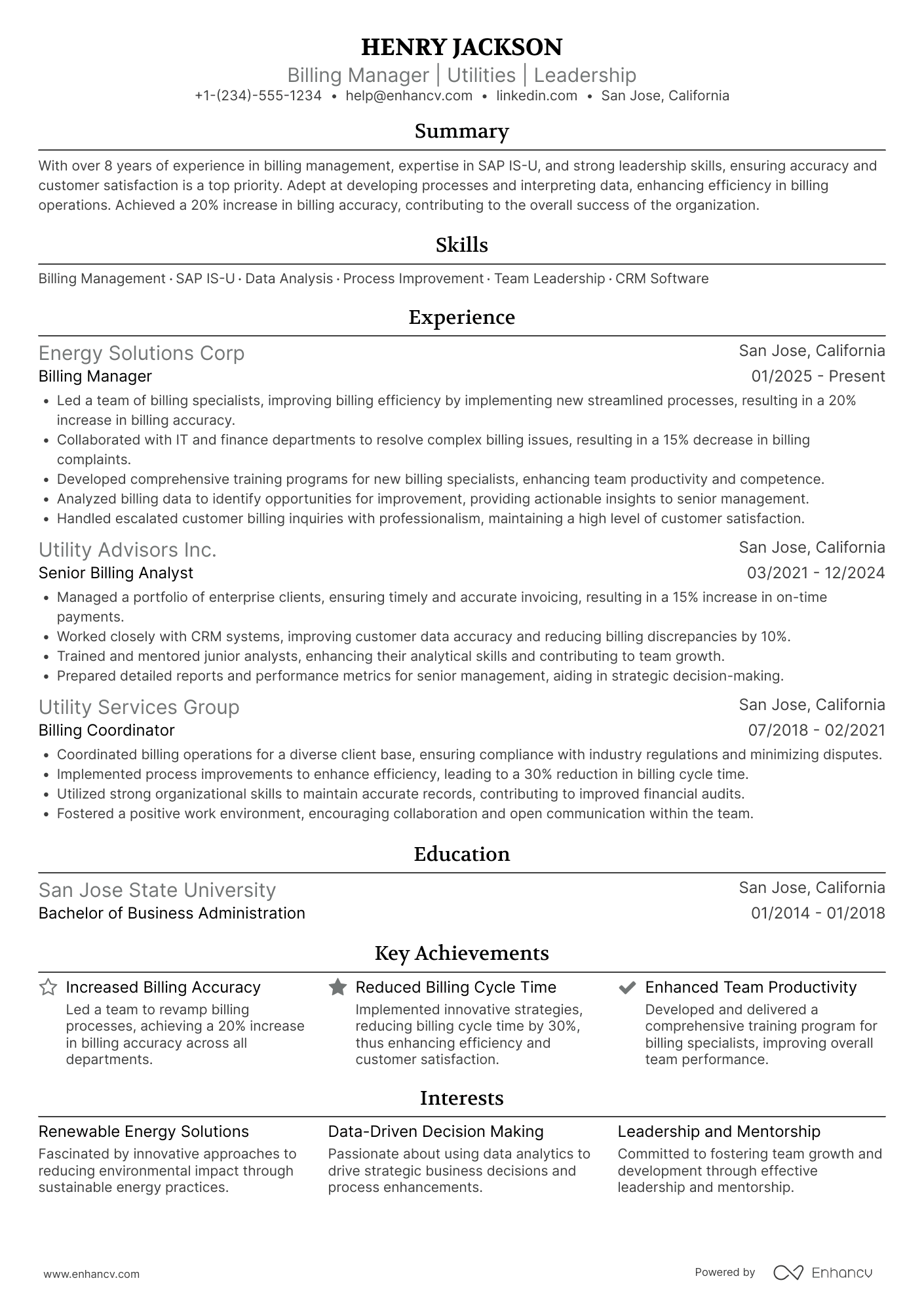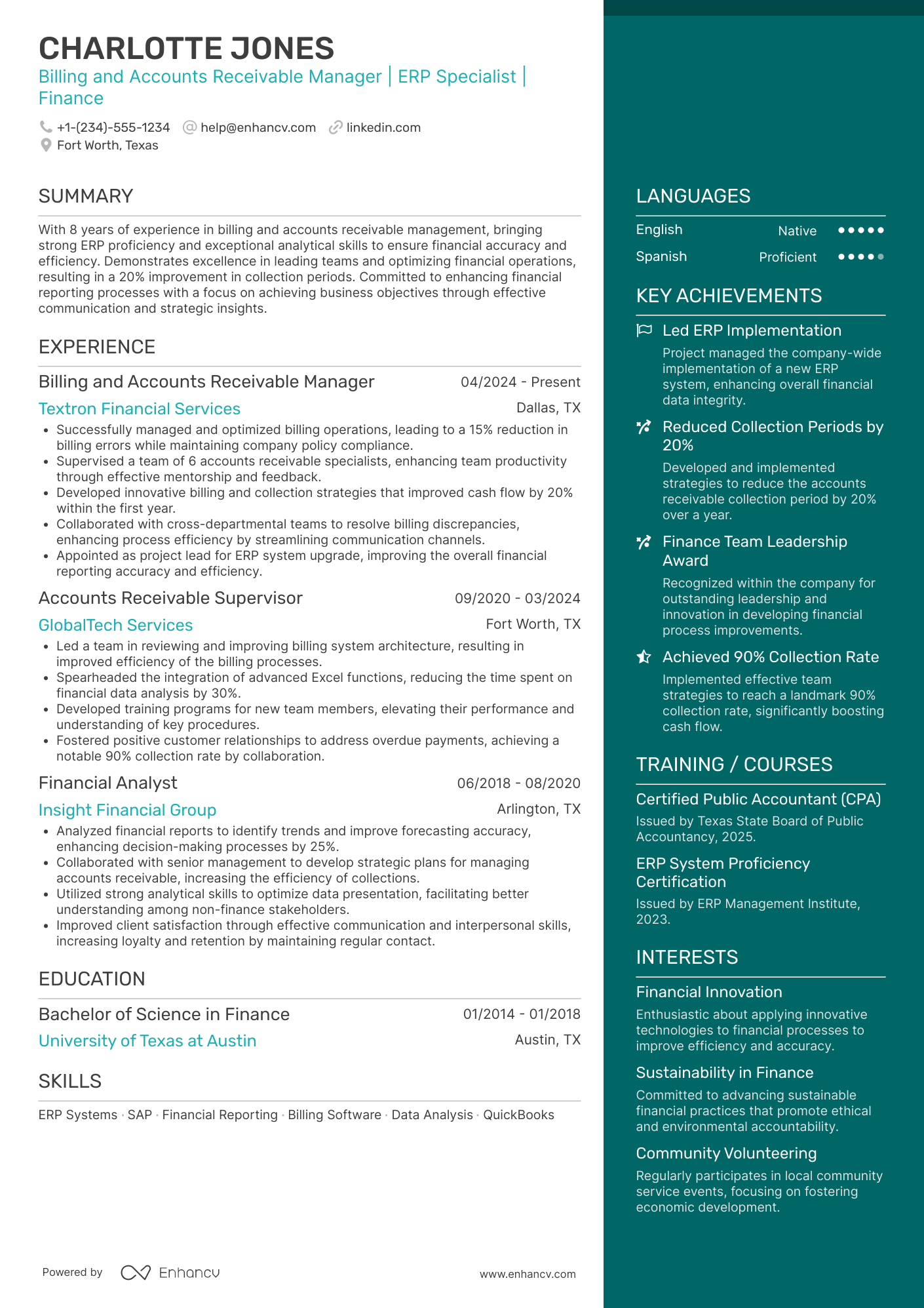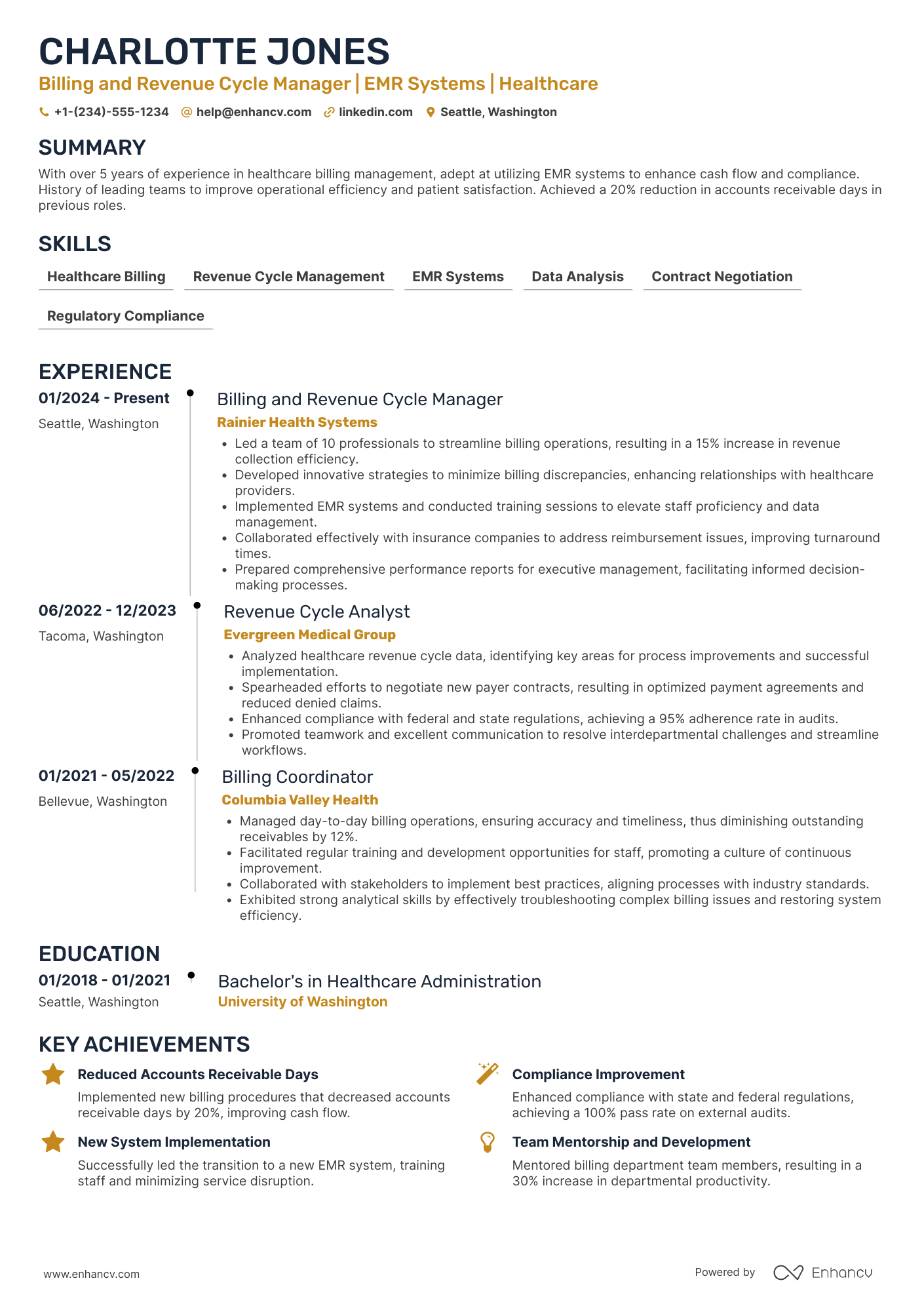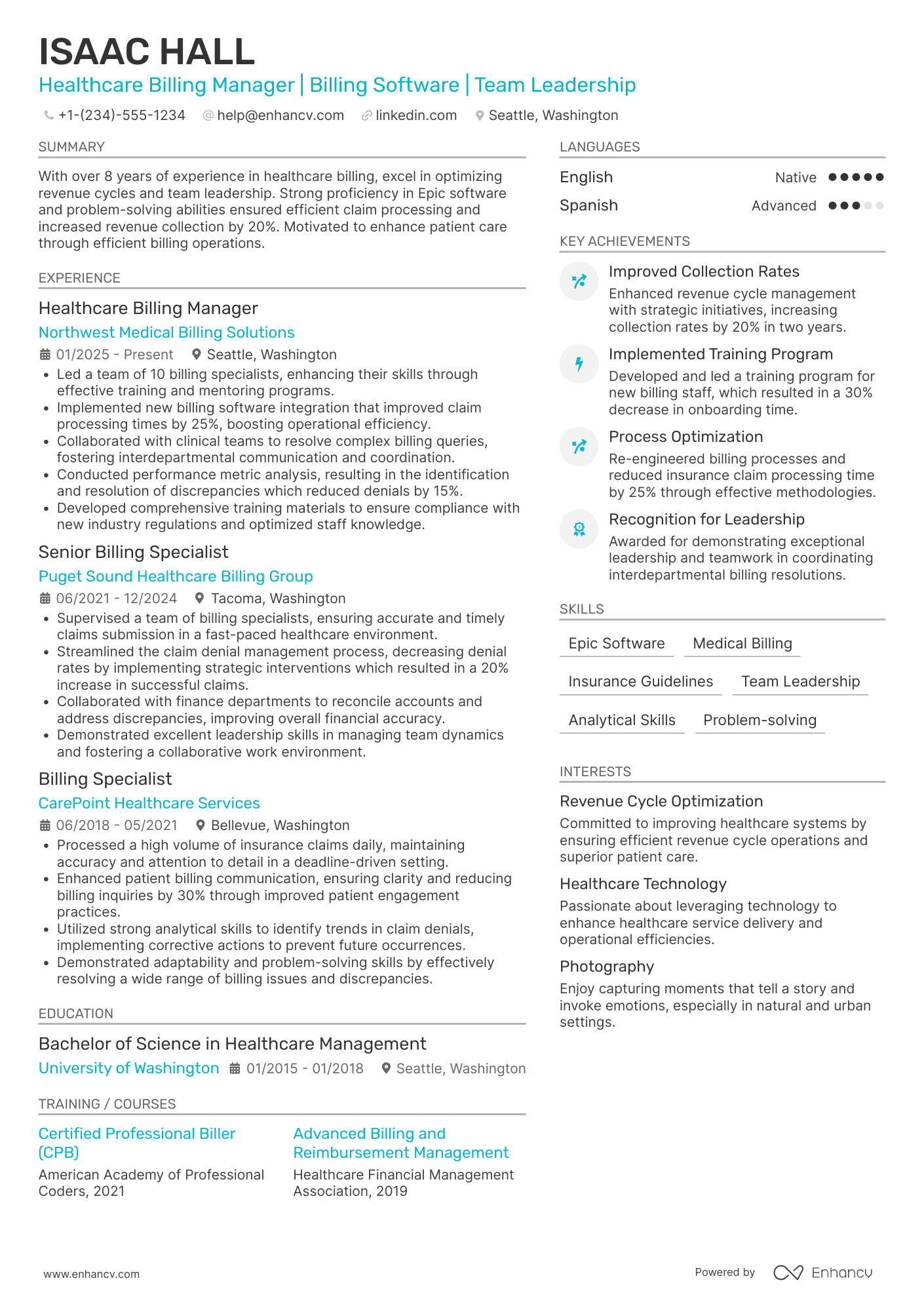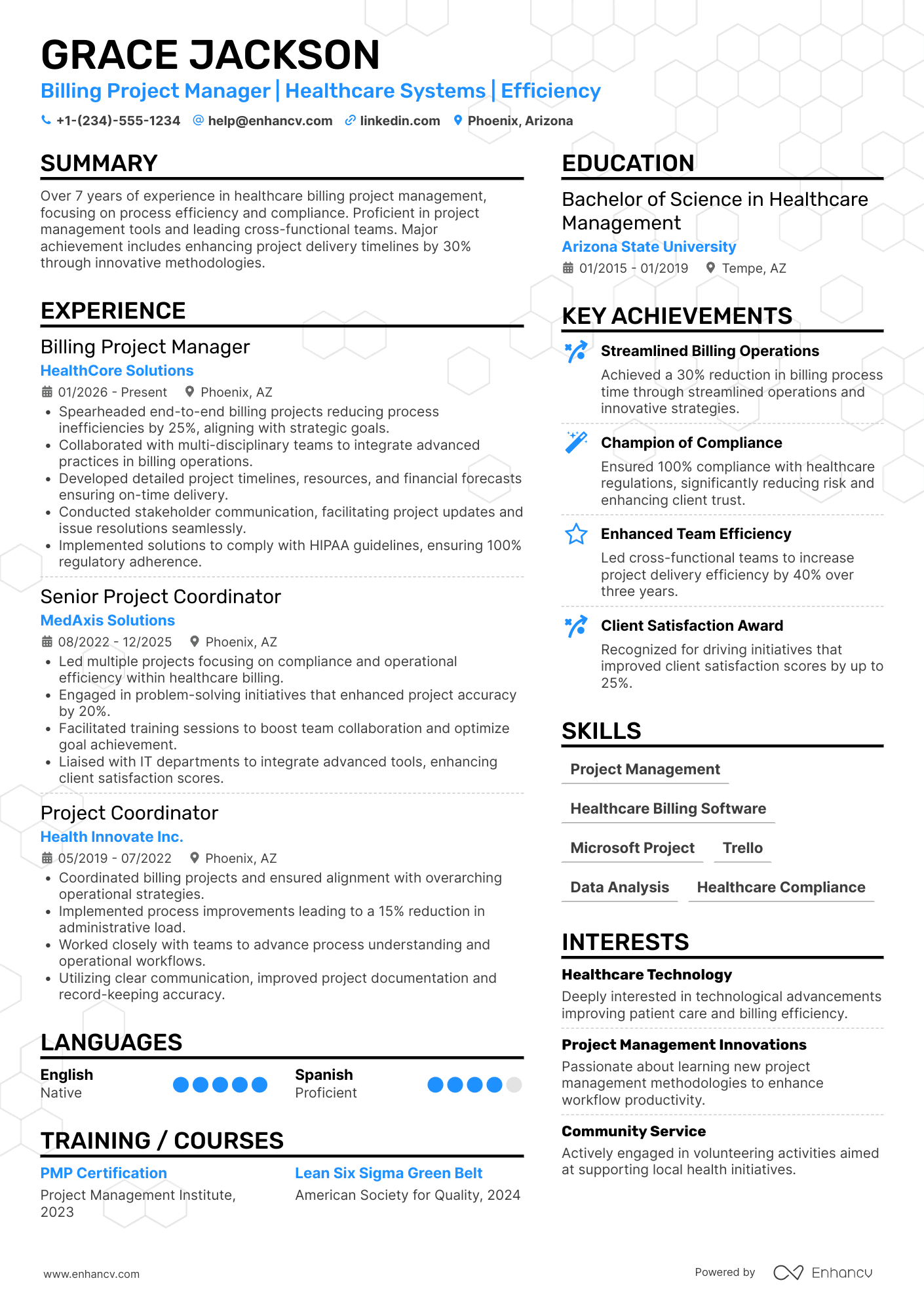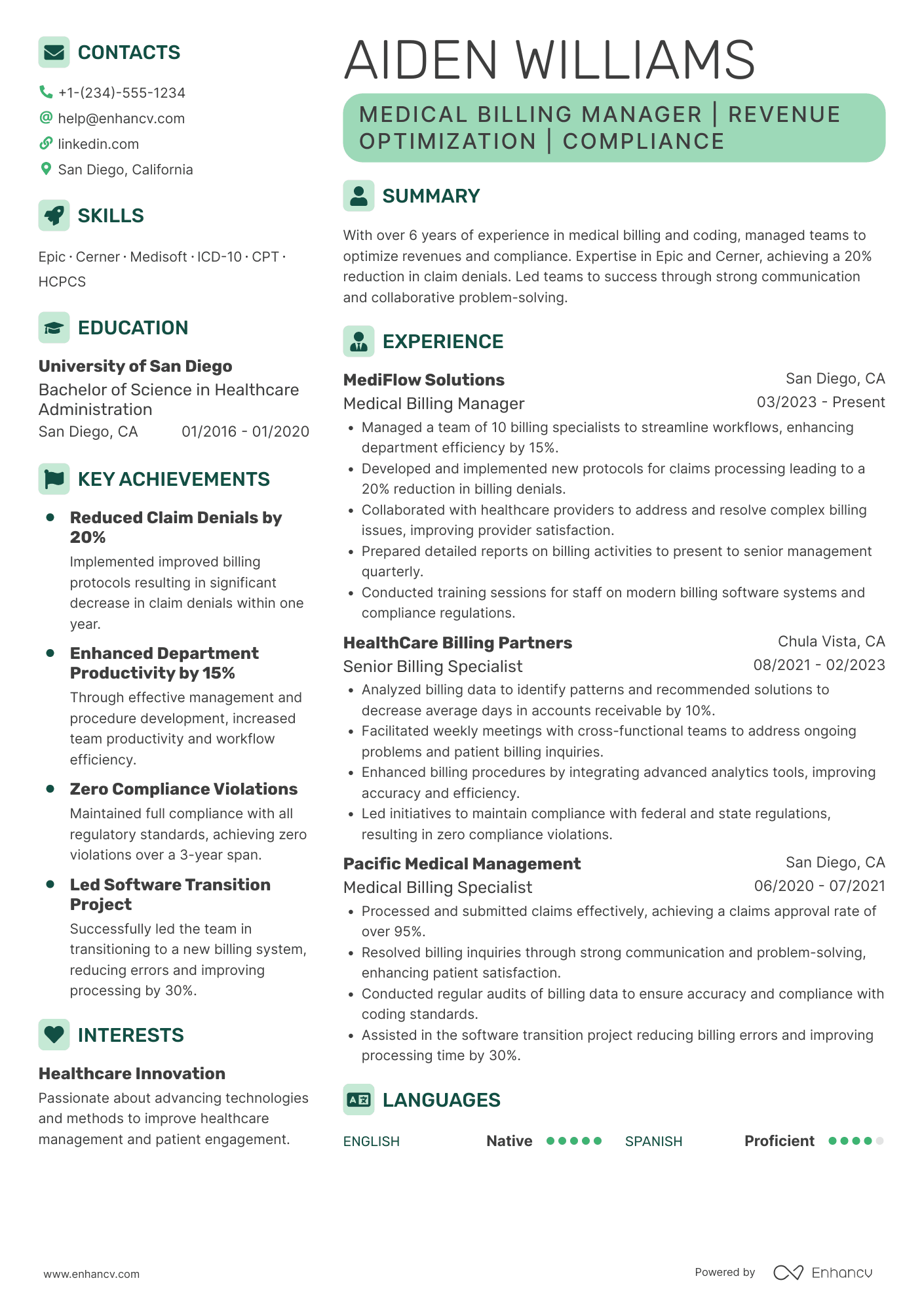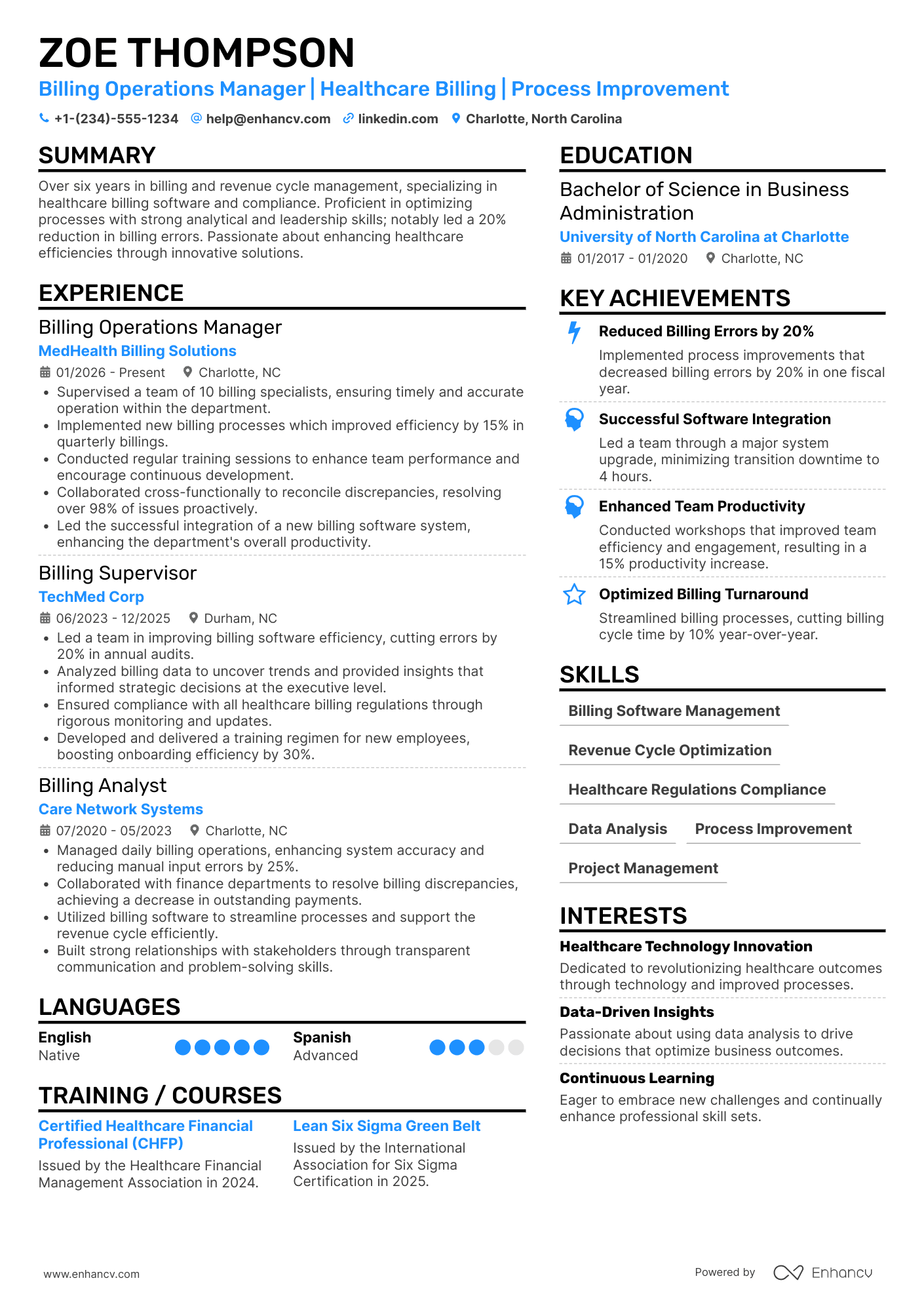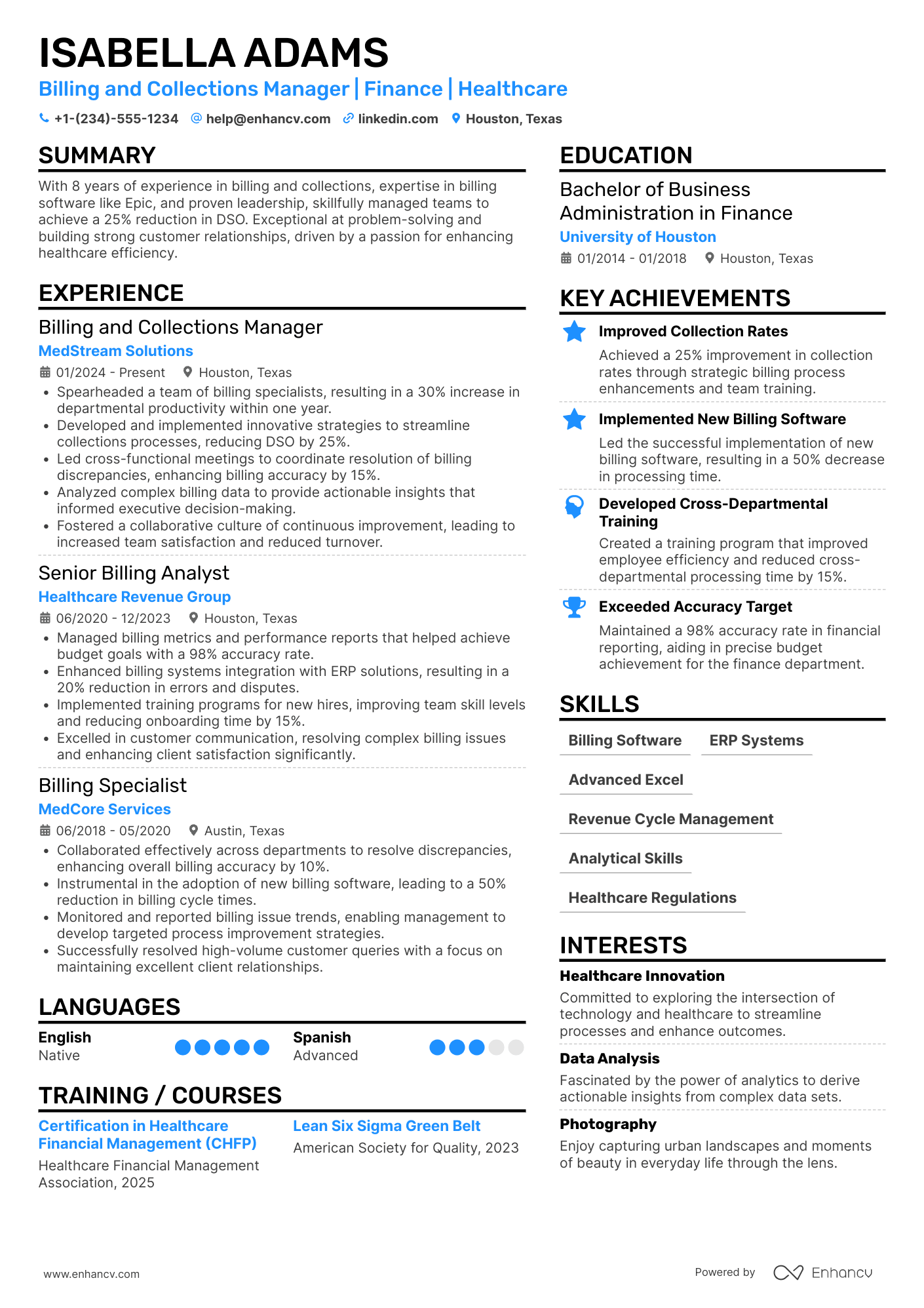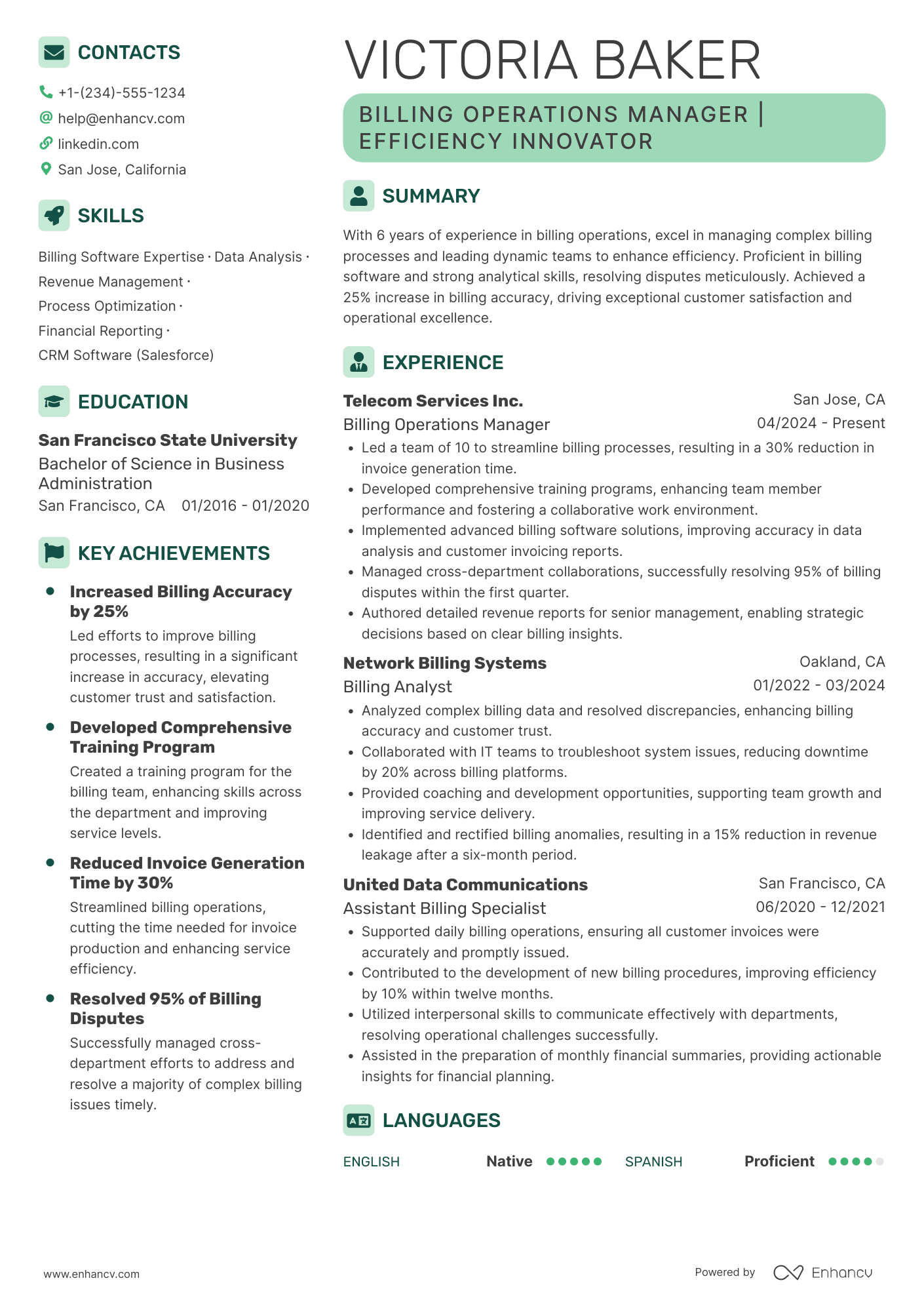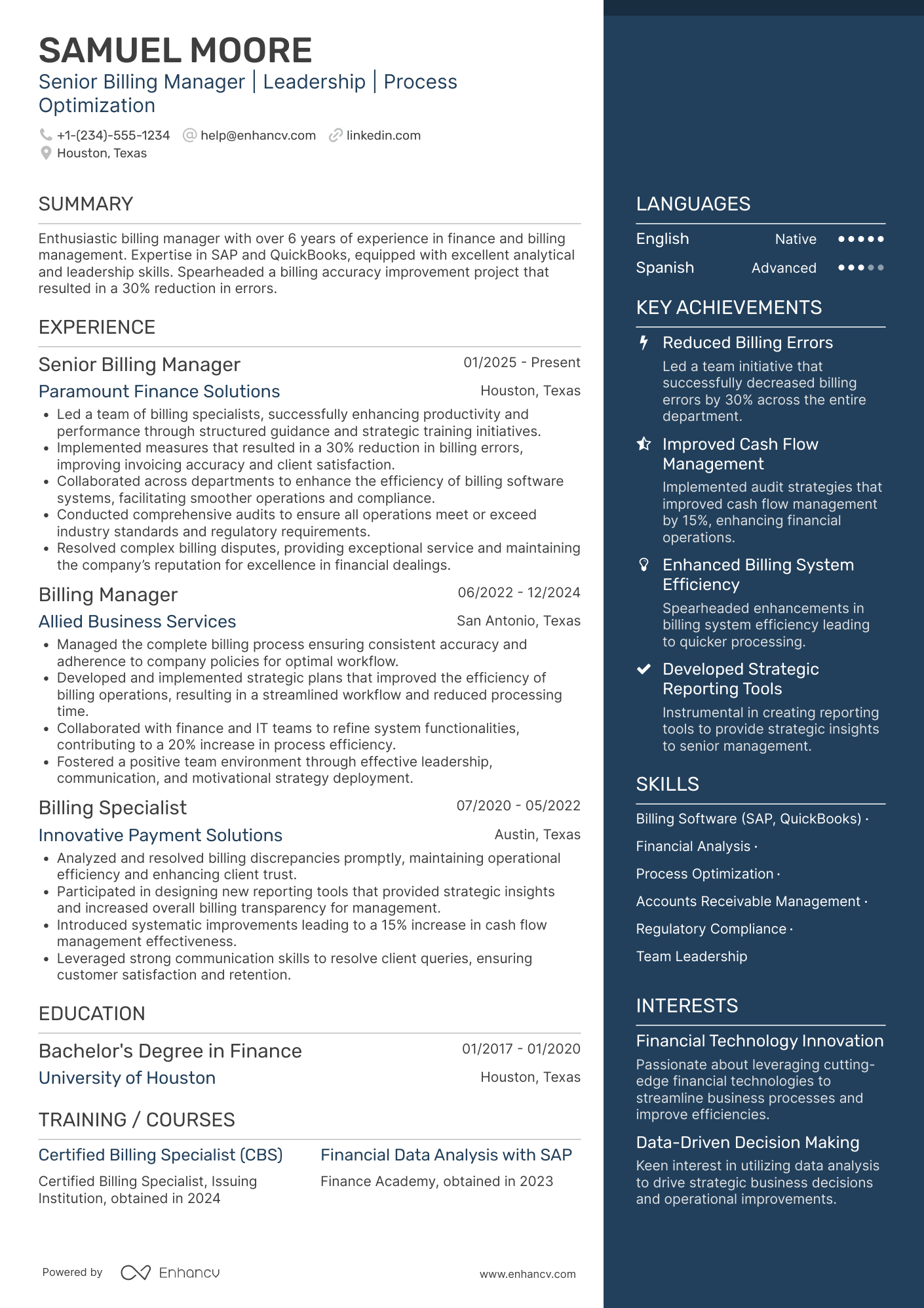
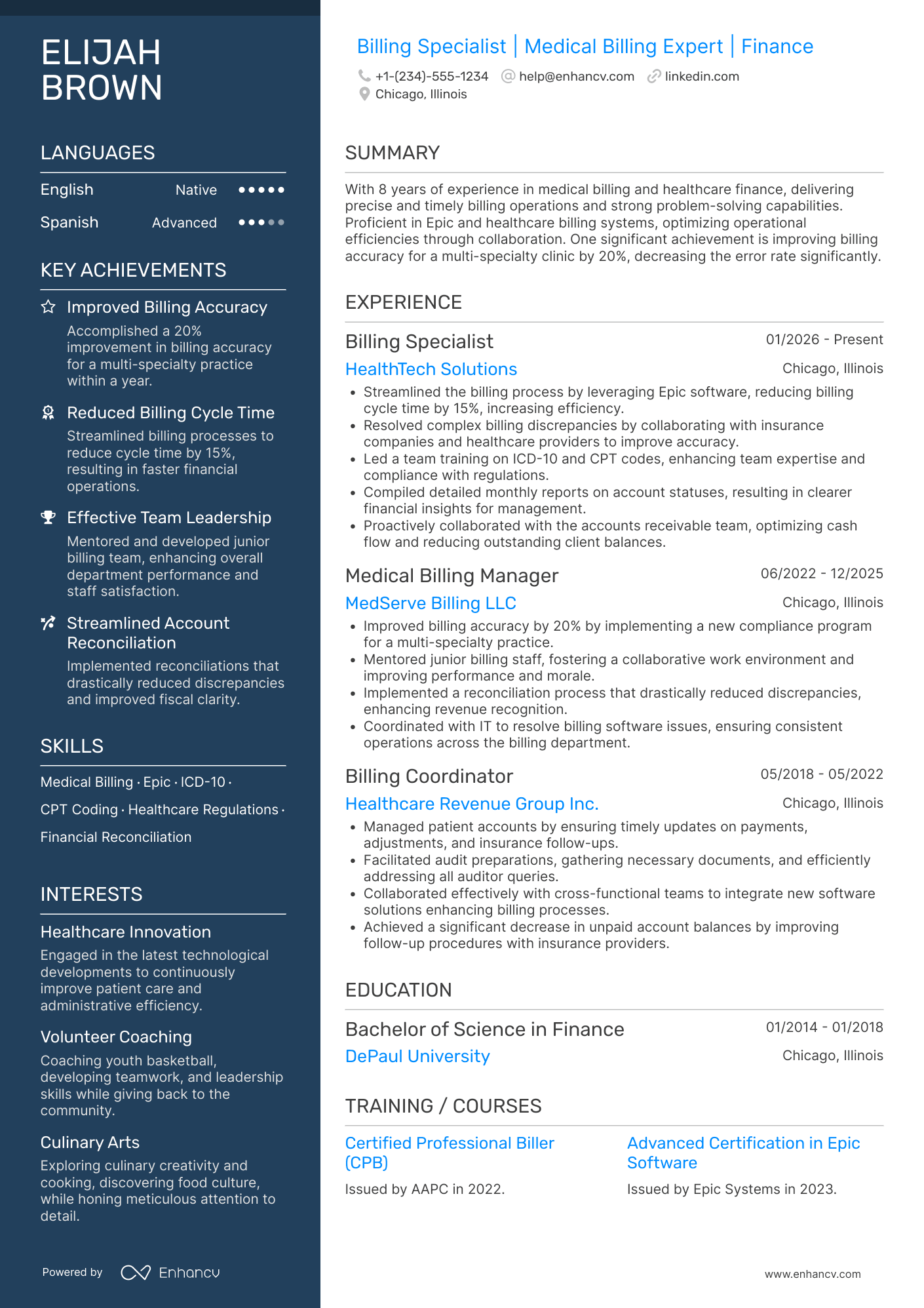
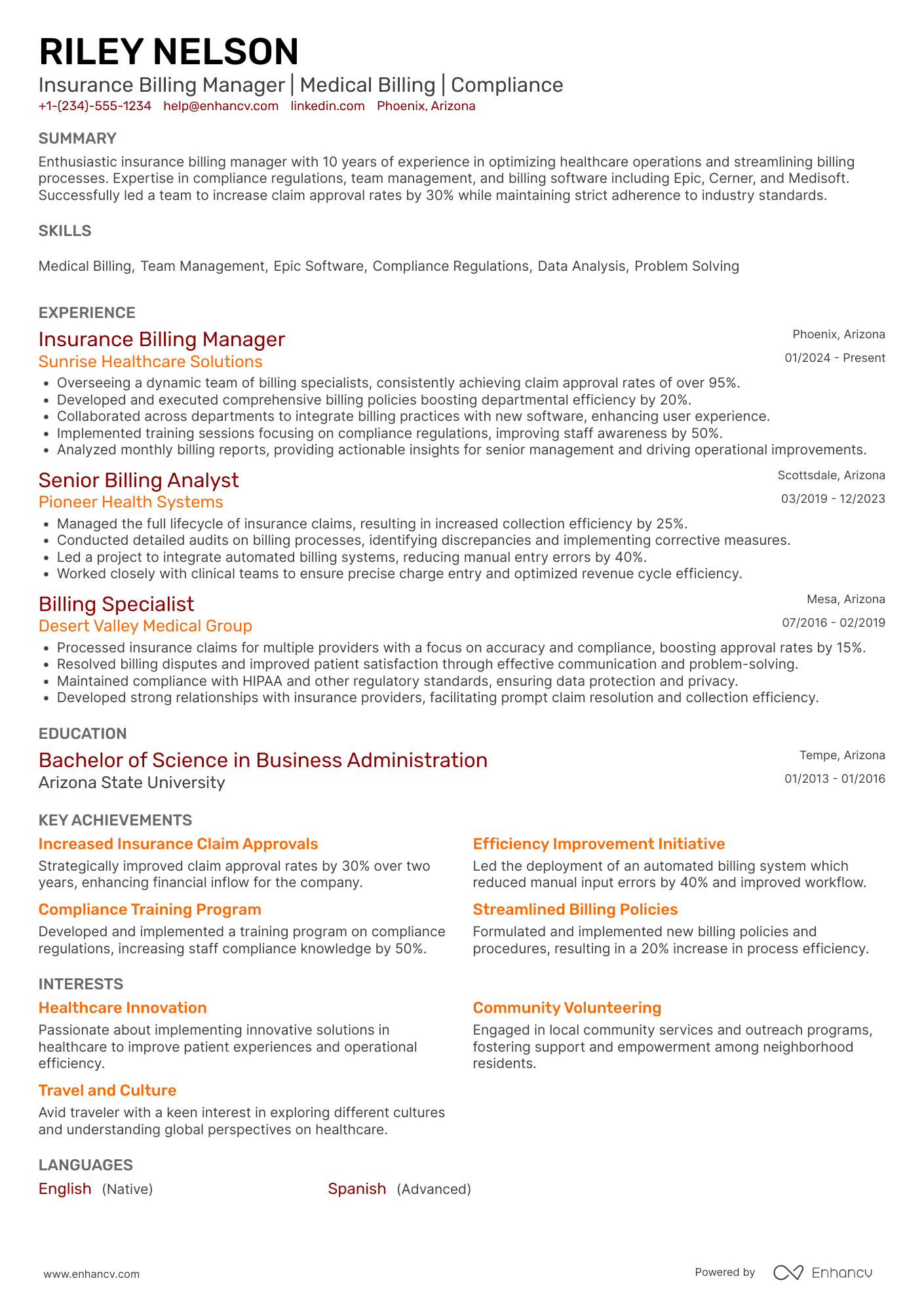
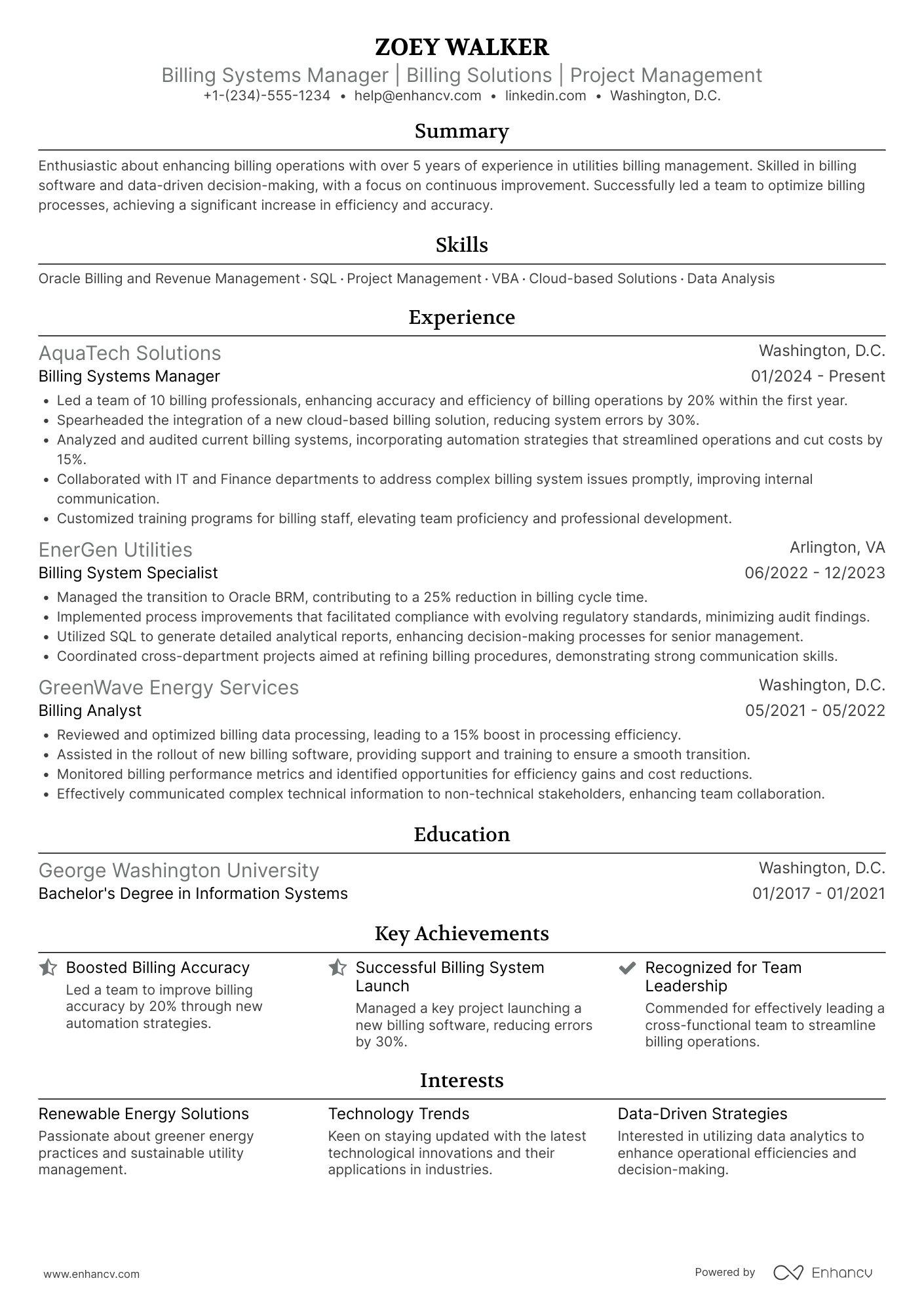
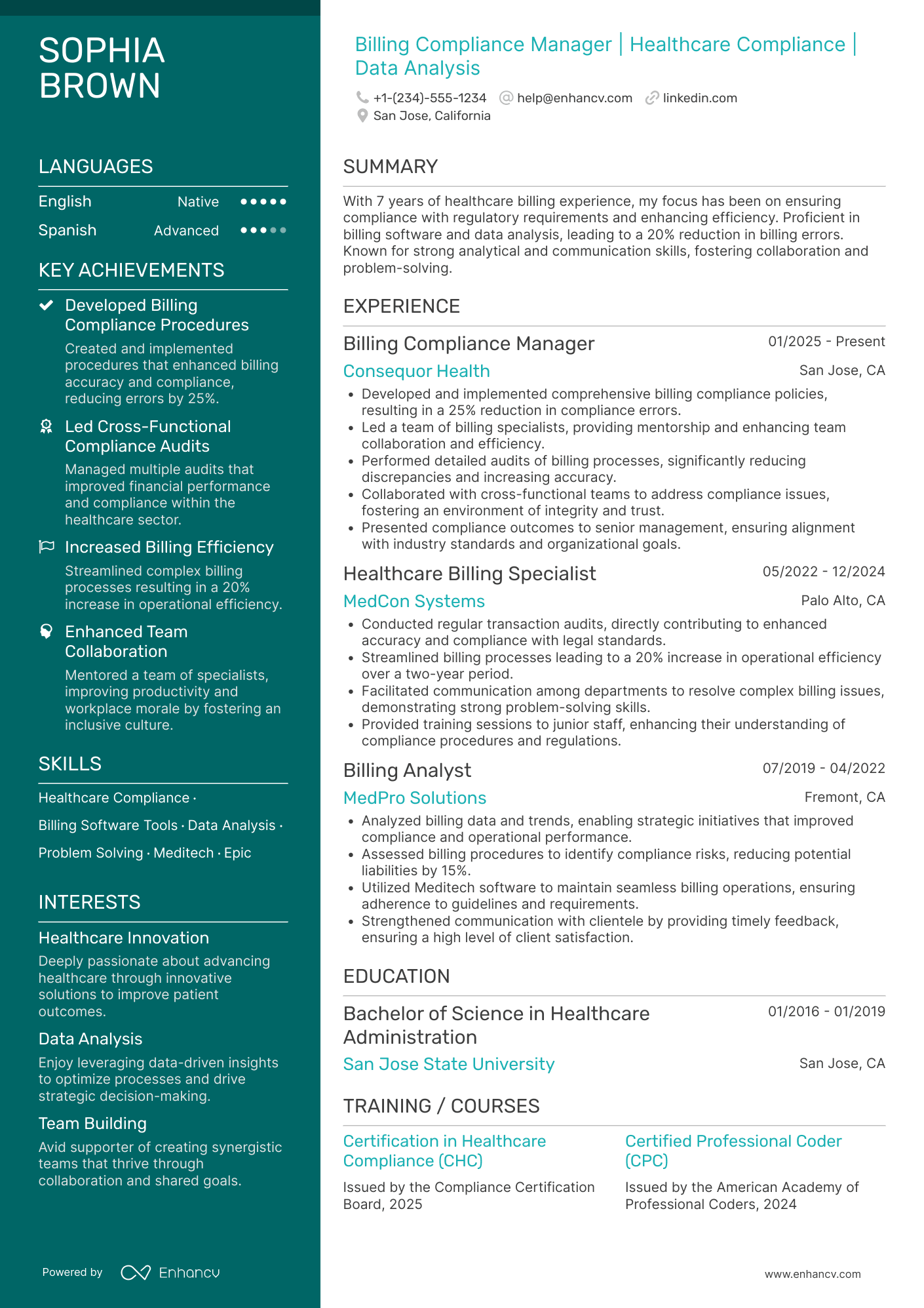
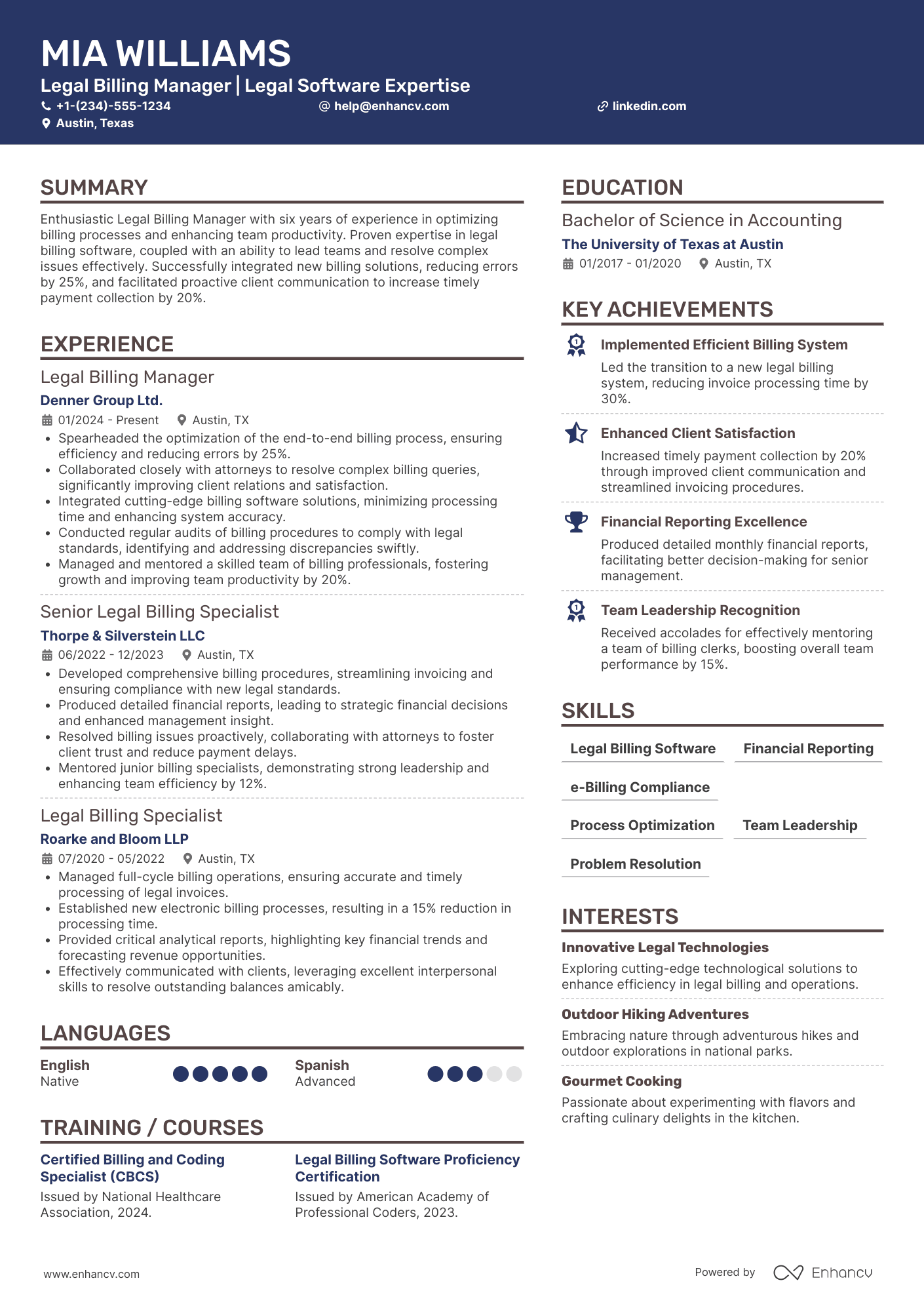
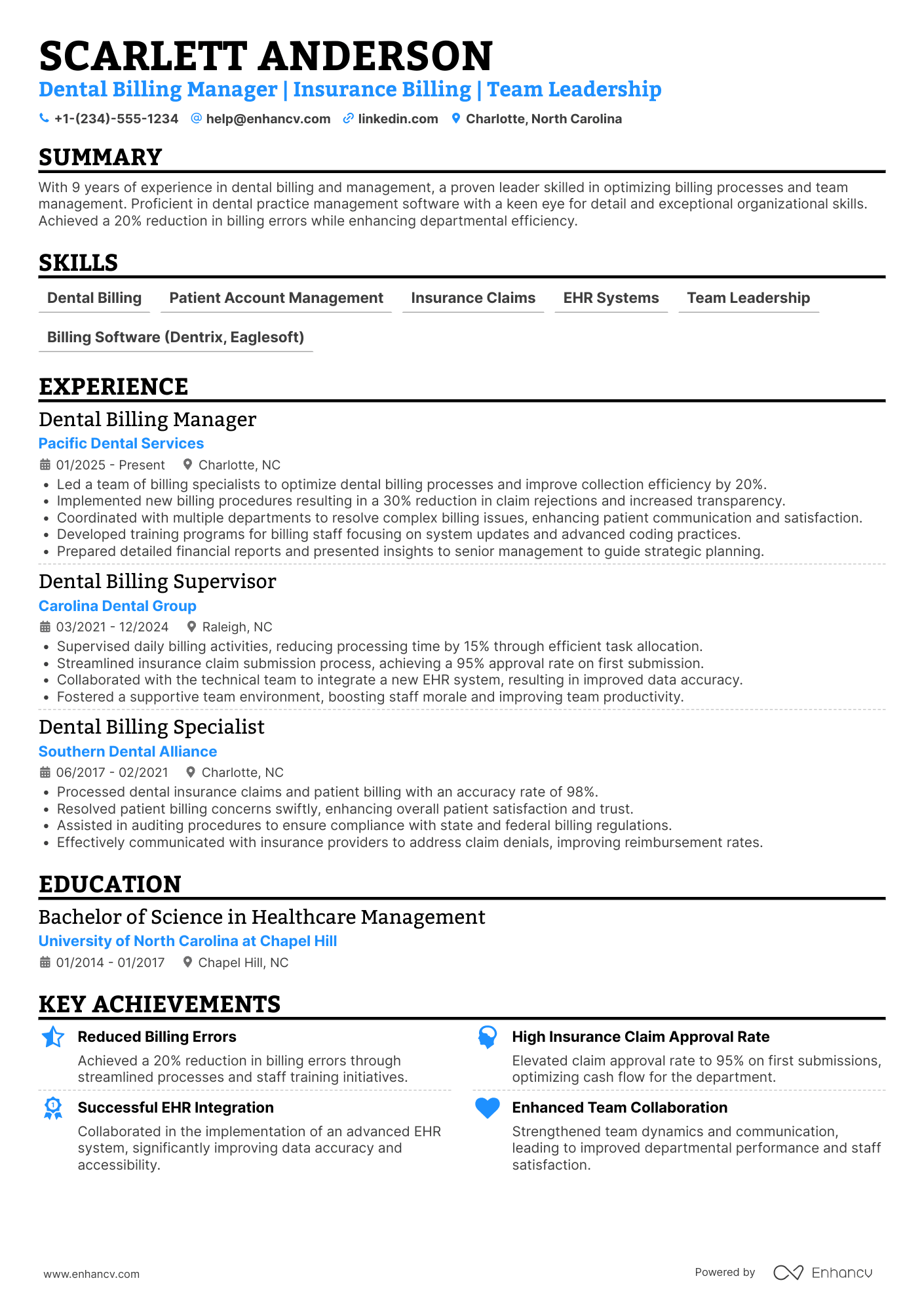
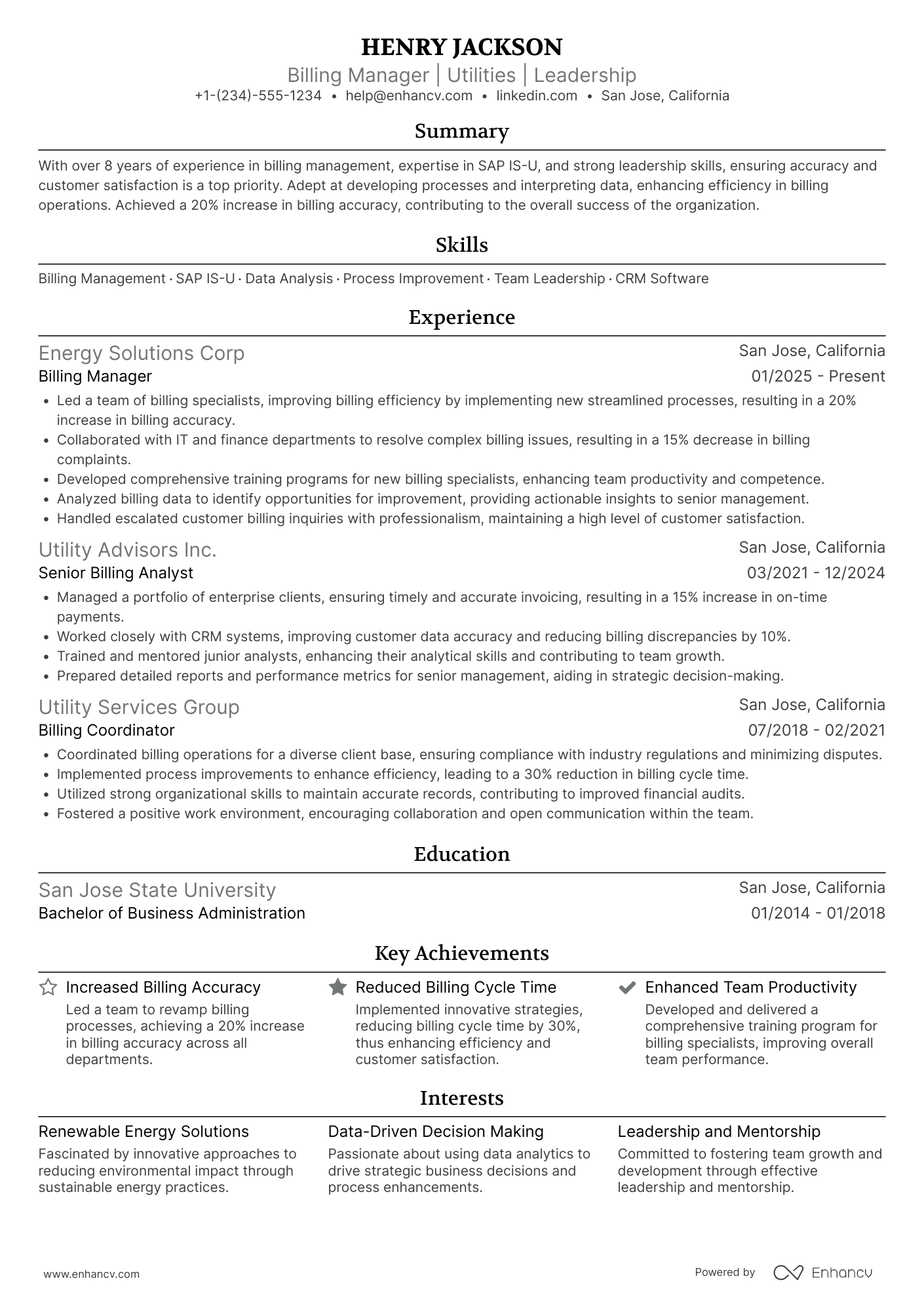
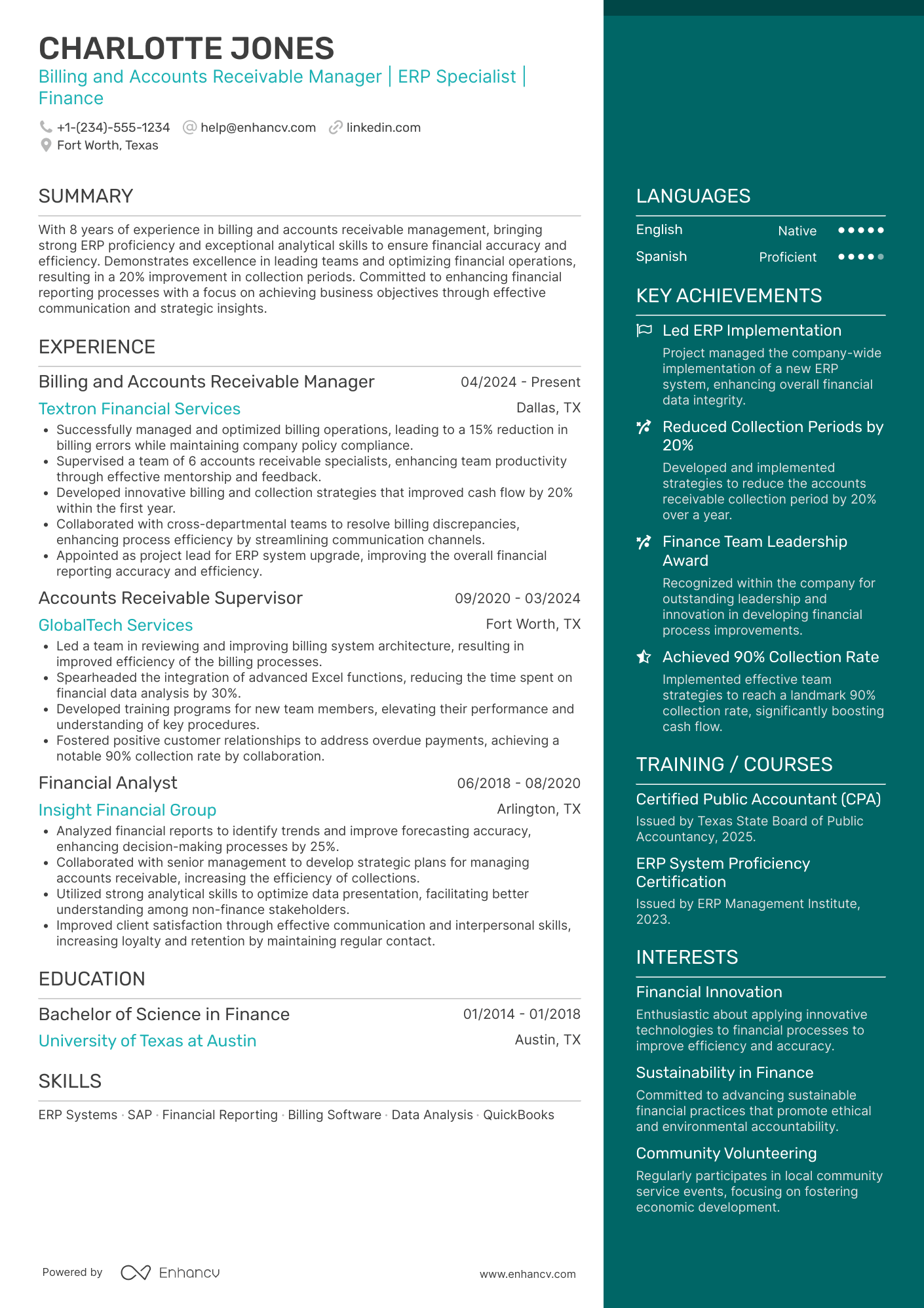
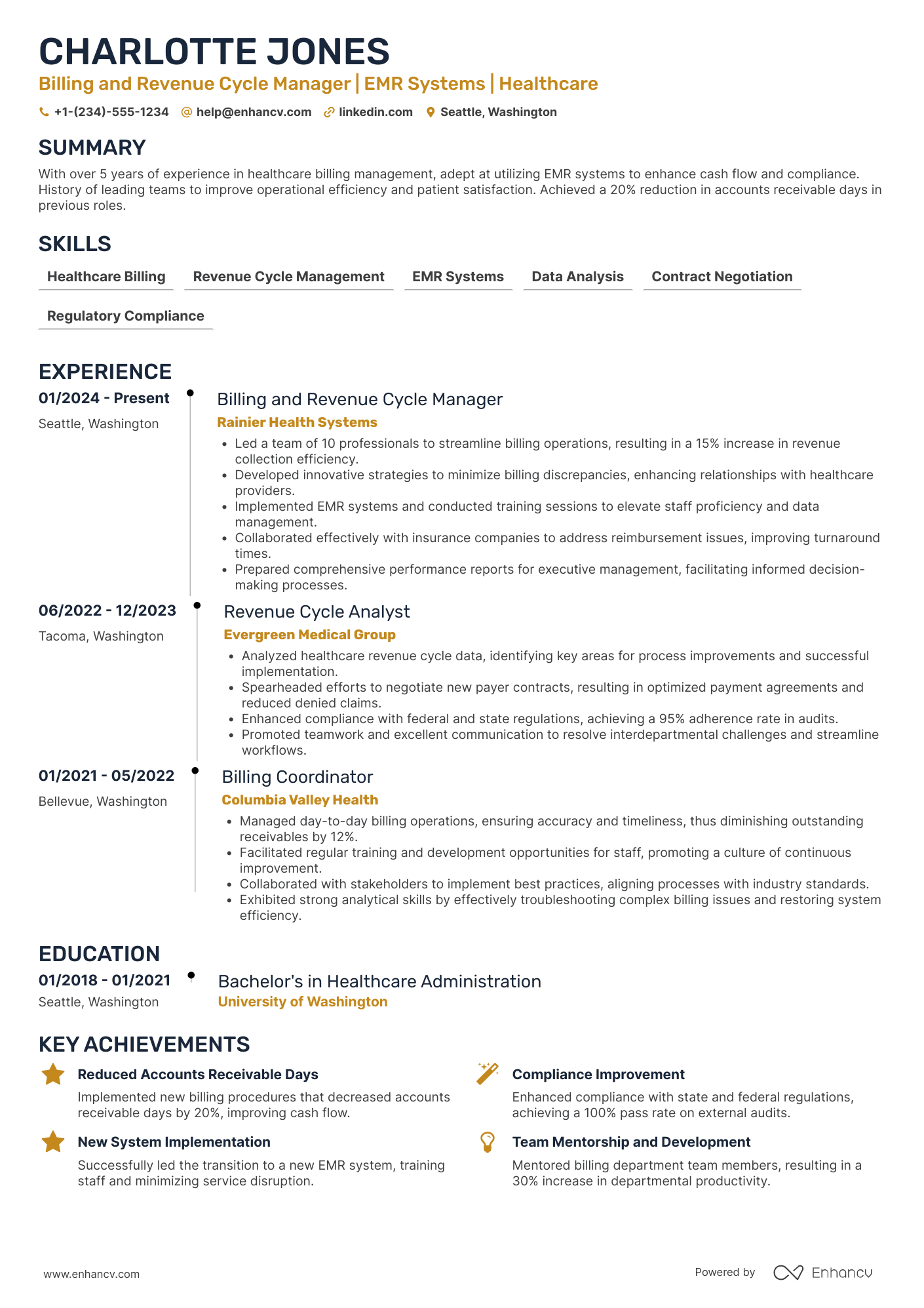
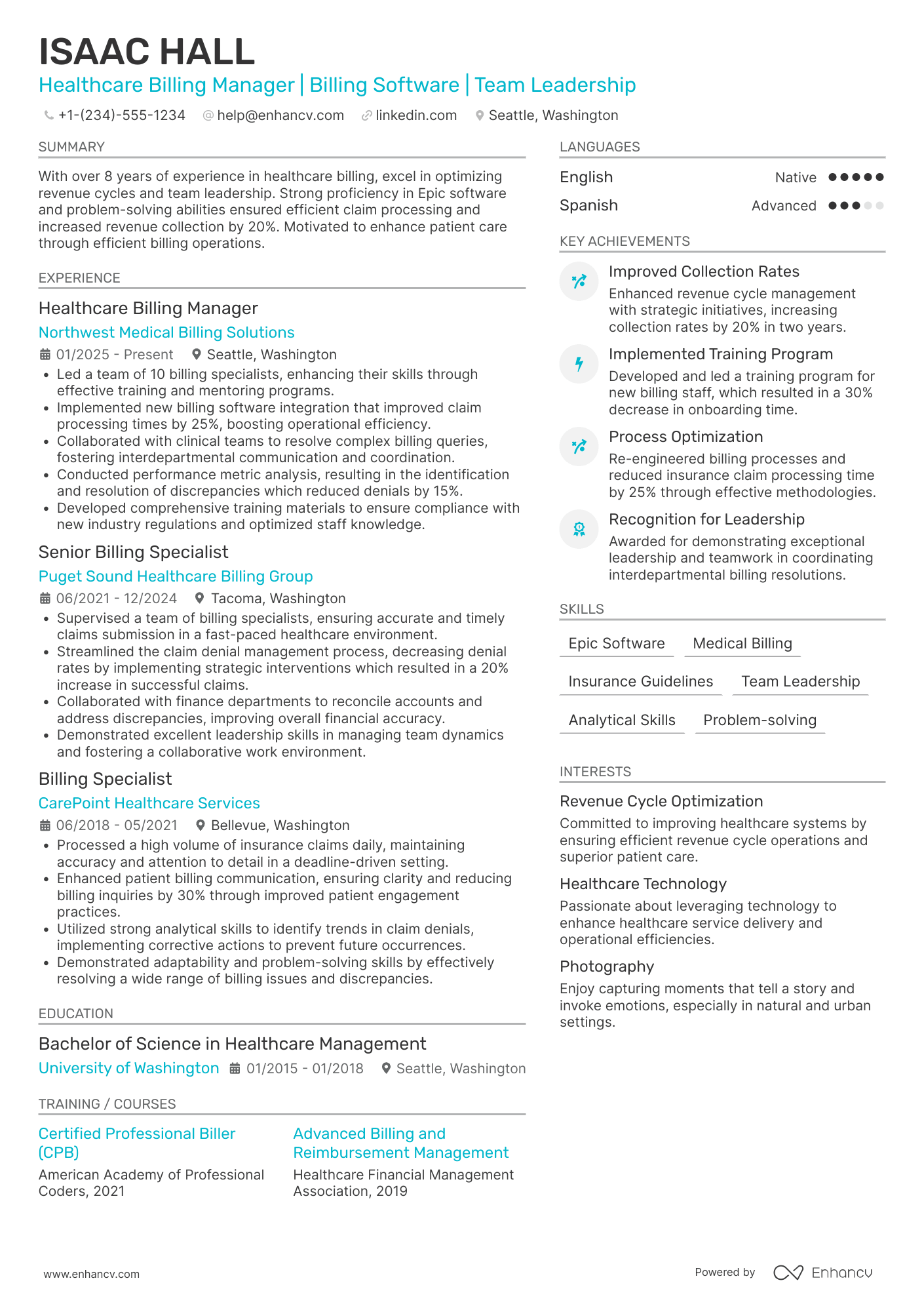
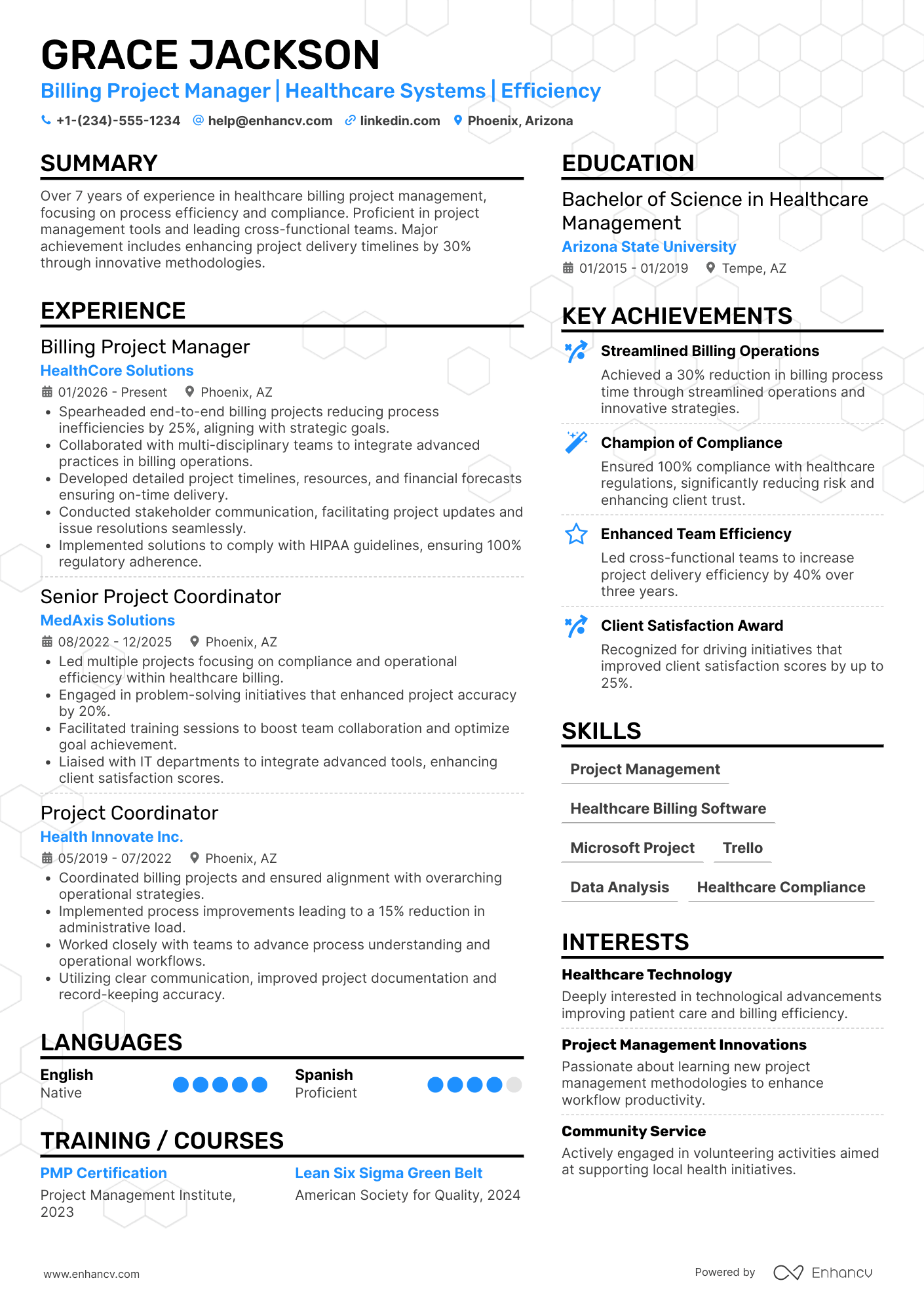
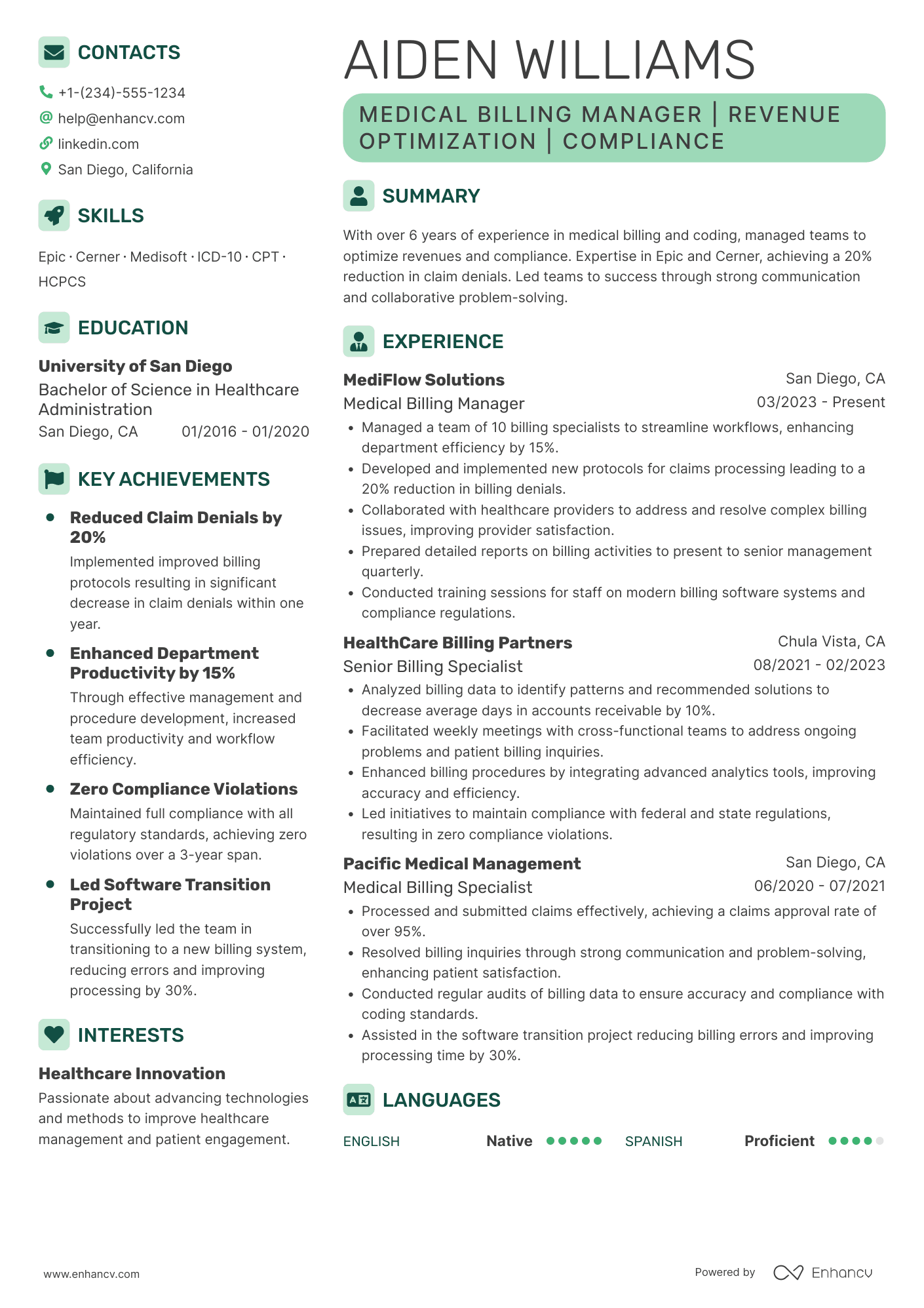
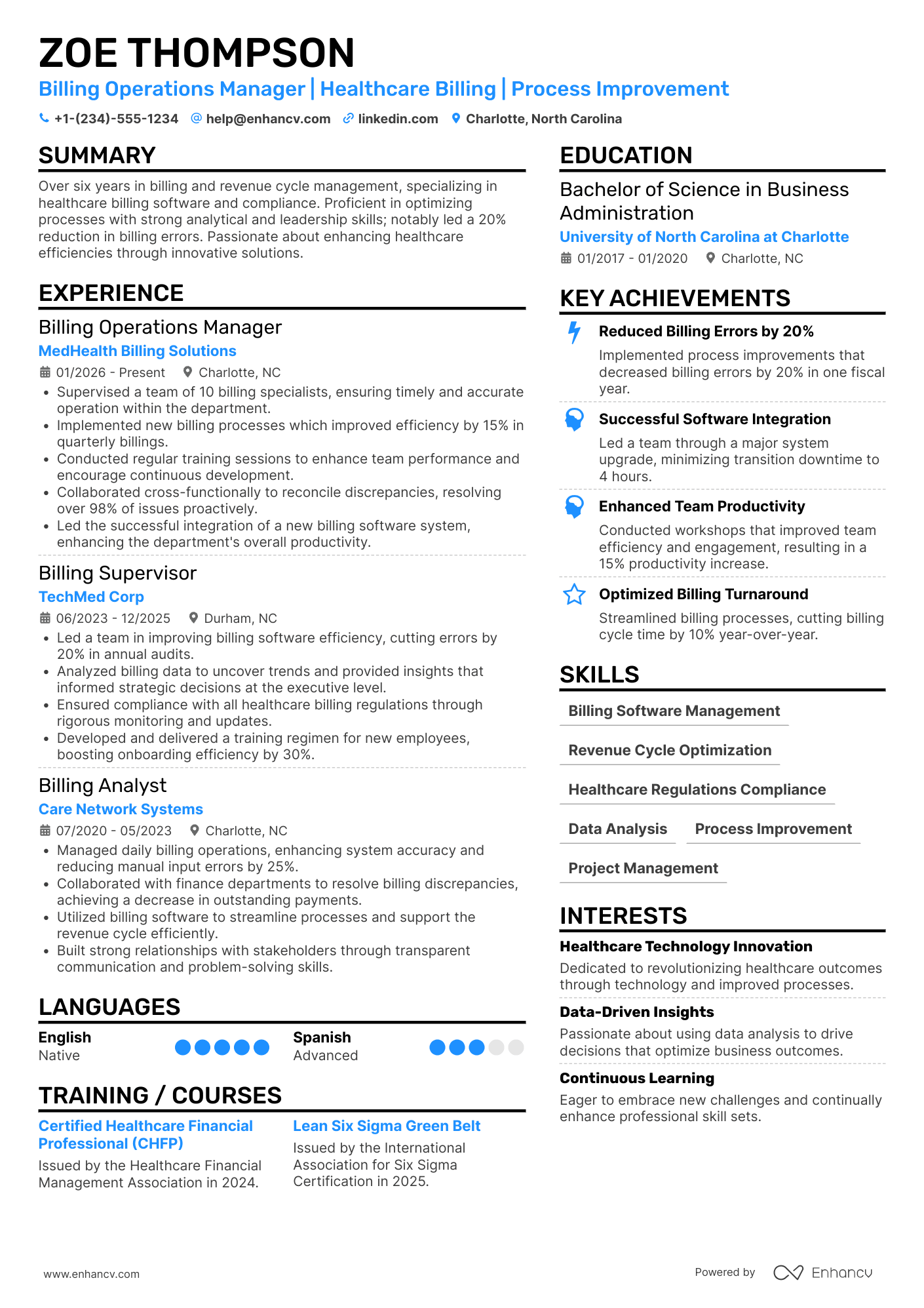
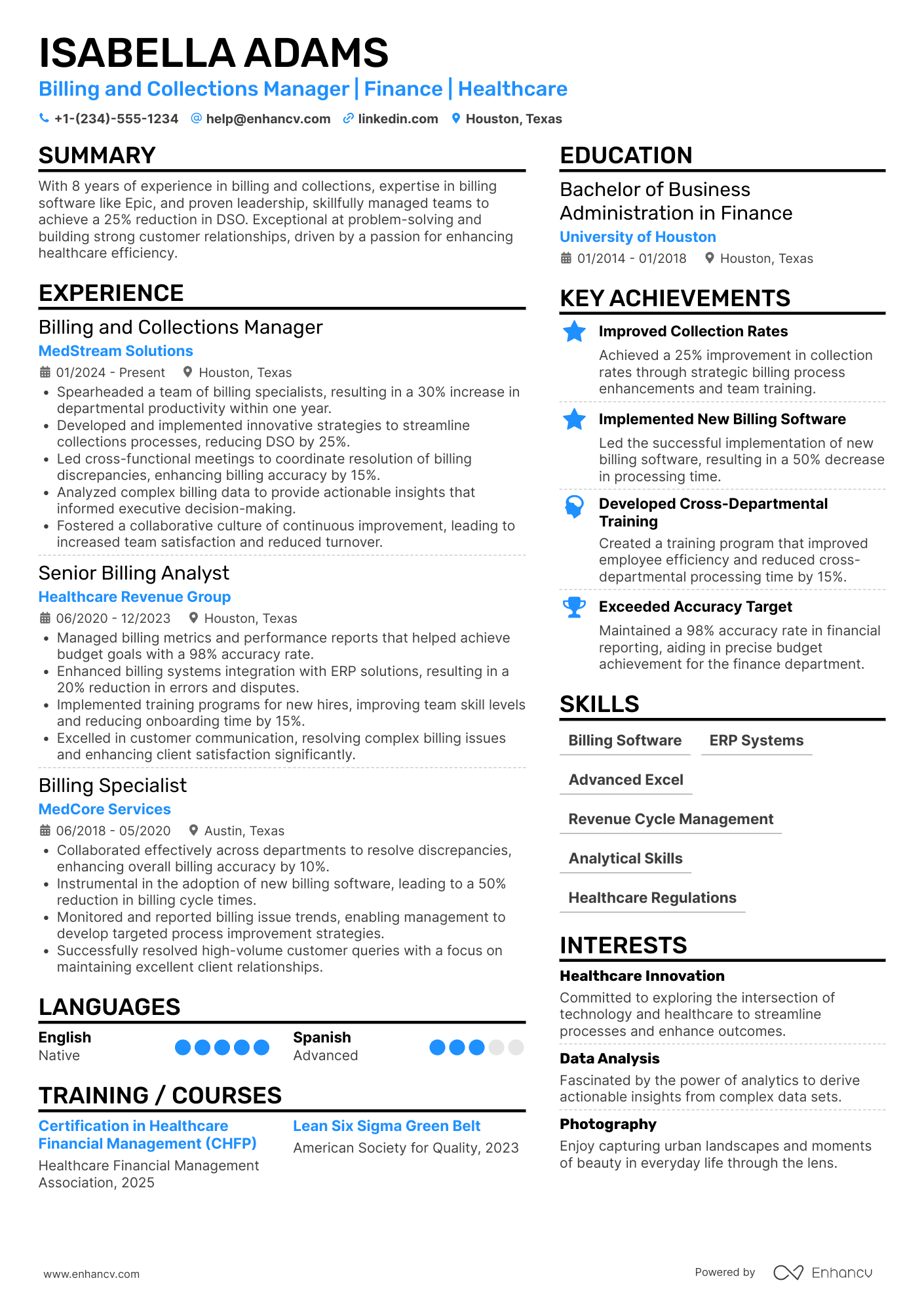
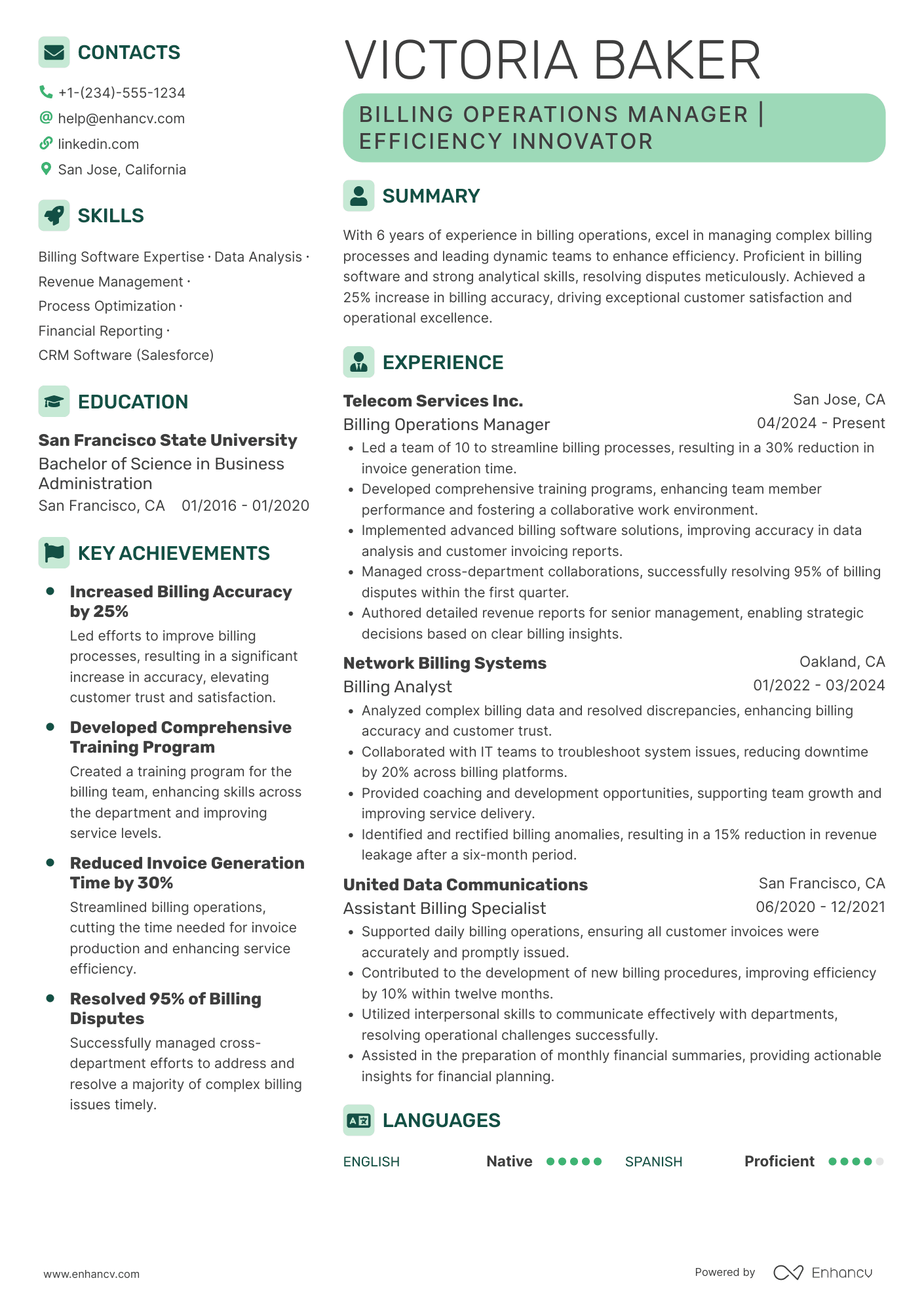
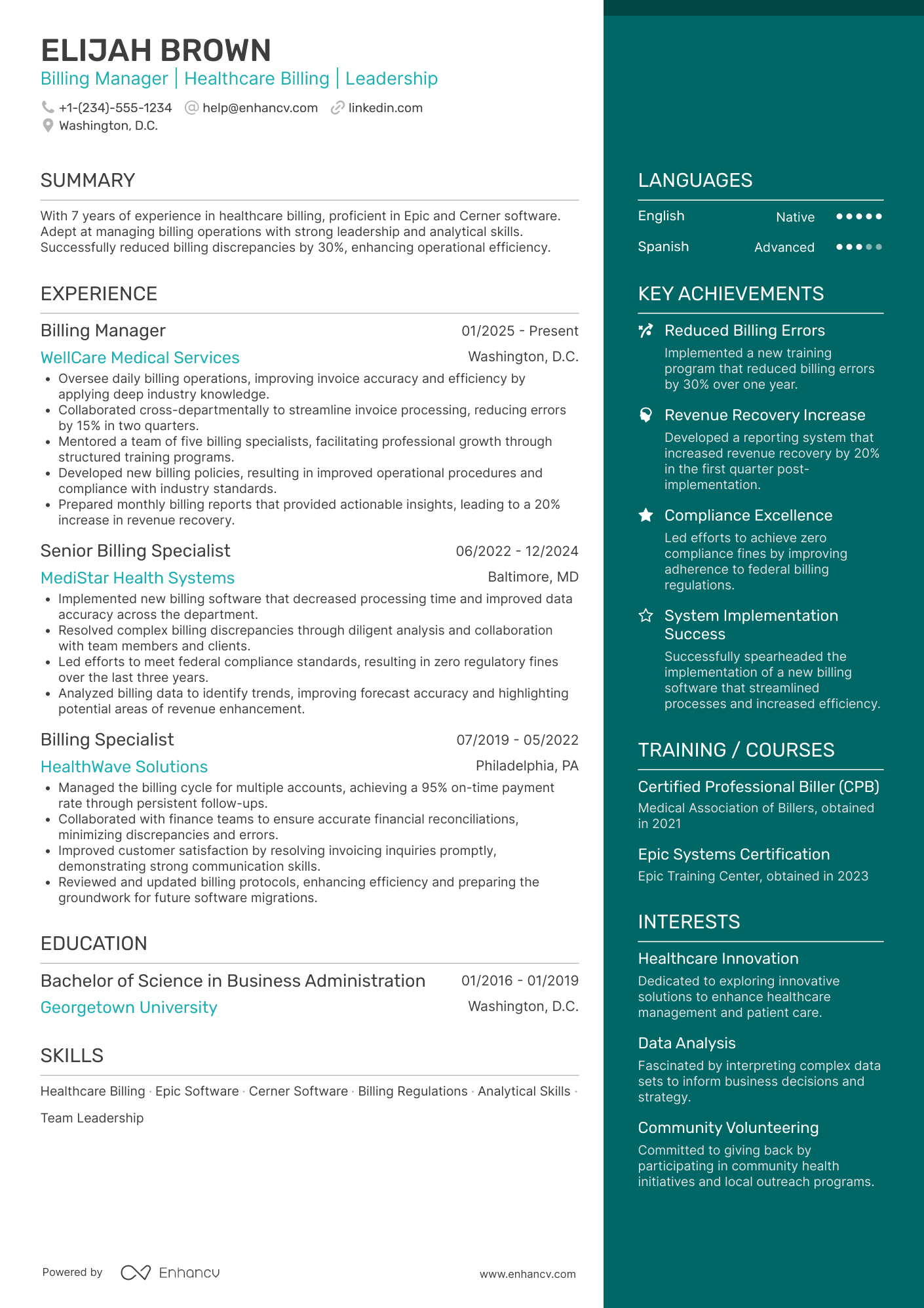
Most billing manager resume drafts fail because they read like job descriptions and bury results under software lists. That blocks you in ATS screening and fast recruiter scans, where high competition rewards clear outcomes.
A strong resume shows how you improved cash flow, accuracy, and speed. You should highlight reduced days sales outstanding, higher first-pass claim acceptance, fewer write-offs, cleaner audits, faster month-end close, and stronger team throughput. If you're unsure where to begin, learning how to write a resume with the right foundation will help you avoid the most common mistakes.

Key takeaways
- Quantify billing outcomes like days sales outstanding, denial rates, and collection improvements in every role.
- Use reverse-chronological format for experienced candidates and hybrid format for career changers.
- Tailor resume language to mirror each job posting's specific tools, KPIs, and compliance standards.
- Demonstrate skills through measurable results in your experience section, not just a standalone list.
- Place certifications above education when they're recent and directly relevant to billing management.
- Write a three- to four-line summary that names your industry, tools, and strongest metric.
- Use Enhancv to turn vague billing duties into concise, results-driven resume bullets faster.
How to format a billing manager resume
Recruiters evaluating billing manager candidates prioritize accuracy in financial operations, team oversight, and process improvement backed by measurable results. A clean, well-structured resume format ensures these signals surface quickly during both automated screening and manual review.

I have significant experience in this role—which format should I use?
Use a reverse-chronological format to present your billing management career in a clear, progression-driven timeline. Do:
- Lead with your most recent role and emphasize scope: team size, billing volume, and departmental accountability.
- Highlight proficiency in role-specific tools and domains such as ERP systems (SAP, Oracle), medical or commercial billing platforms, accounts receivable management, and compliance frameworks.
- Quantify outcomes tied to revenue recovery, error reduction, cycle time improvements, or cost savings.
I'm junior or switching into this role—what format works best?
A hybrid format works best, allowing you to lead with billing-relevant skills while supporting them with work history context. Do:
- Place a skills section near the top that highlights billing software proficiency, invoicing workflows, reconciliation, and regulatory knowledge.
- Include project-based experience or transitional roles where you handled billing tasks, even if billing wasn't your primary function.
- Connect every action to a measurable result so hiring managers can assess your real-world impact.
Why not use a functional resume?
A functional format strips away the timeline and context that hiring managers need to evaluate how your billing skills were applied in real work environments, weakening your candidacy even at the early-career level.
- A functional format may make sense if you're transitioning from a bookkeeping, accounting, or administrative role into billing management and lack a direct billing title on your resume.
- It can also work if you have a significant employment gap but completed relevant certifications (such as Certified Professional Biller) or freelance billing projects during that time.
Once your resume's format establishes a clean, readable structure, the next step is filling it with the right sections to showcase your qualifications effectively.
What sections should go on a billing manager resume
Recruiters expect a billing manager resume to clearly show billing leadership, revenue protection, compliance, and measurable improvements in accuracy and collections. Understanding what to put on a resume for this role ensures you include the sections that matter most.
Use this structure for maximum clarity:
- Header
- Summary
- Experience
- Skills
- Projects
- Education
- Certifications
- Optional sections: Awards, Leadership, Languages
Strong experience bullets should emphasize quantified impact, scope of responsibility, process improvements, compliance outcomes, and results tied to cash flow, accuracy, and cycle time.
Is your resume good enough?
Drop your resume here or choose a file. PDF & DOCX only. Max 2MB file size.
With the key resume components in place, focus next on writing your billing manager experience section to show how you’ve applied your skills and delivered results.
How to write your billing manager resume experience
The experience section is where you prove you've delivered real results—not just performed tasks. Hiring managers reviewing billing manager resumes prioritize demonstrated impact through revenue cycle improvements, collections outcomes, and proficiency with billing platforms over generic descriptions of daily responsibilities. Building a targeted resume that aligns your experience with each employer's priorities makes your application significantly stronger.
Each entry should include:
- Job title
- Company and location (or remote)
- Dates of employment (month and year)
Three to five concise bullet points showing what you owned, how you executed, and what outcomes you delivered:
- Ownership scope: the billing operations, revenue cycle segments, accounts receivable portfolios, payer categories, or teams you were directly accountable for as a billing manager.
- Execution approach: the billing software, EHR/EMR systems, coding frameworks, claims management platforms, or analytical methods you used to drive decisions and resolve issues.
- Collaboration context: how you partnered with finance, compliance, clinical departments, insurance carriers, or external vendors to align billing workflows with organizational goals.
- Value improved: changes to claim accuracy, denial rates, collection timelines, coding compliance, audit readiness, or operational efficiency that resulted from your leadership.
- Impact delivered: outcomes expressed through measurable business results—such as reductions in days in accounts receivable, improvements in clean claim rates, or recovered revenue—rather than a list of activities you performed.
Experience bullet formula
A billing manager experience example
✅ Right example - modern, quantified, specific.
Billing Manager
NorthBridge Health | Austin, TX
2021–Present
Multi-site healthcare services provider supporting one hundred fifty thousand+ patients annually across twelve clinics.
- Led month-end close for billing and accounts receivable in NetSuite, reducing close time from eight days to five days through standardized reconciliations, variance dashboards, and cutoff controls.
- Implemented automated claim status and denial workflows in Waystar and Excel Power Query, cutting denial rate from 9.8% to 7.1% and accelerating resubmissions by thirty percent.
- Partnered with revenue cycle, compliance, and engineering to integrate eligibility checks and charge capture rules via HL7 feeds, reducing preventable write-offs by $420K annually.
- Built payer performance scorecards in Power BI using EDI 835/837 data, improving first-pass resolution from 86% to 92% and increasing cash collections by 6.4% year over year.
- Managed and coached a team of seven billing specialists, introducing quality audits and call monitoring that lowered patient billing complaints by twenty-two percent while maintaining a 98% accuracy rate.
Now that you've seen how a strong experience section looks in practice, let's break down how to customize yours to match the specific billing manager role you're targeting.
How to tailor your billing manager resume experience
Recruiters evaluate billing manager resumes through both human review and applicant tracking systems, so tailoring your resume to the job description increases your chances of advancing. Tailoring means adjusting how you present your actual work to reflect the language and priorities each employer uses.
Ways to tailor your billing manager experience:
- Match billing software and ERP systems named in the job description.
- Mirror the exact terminology used for revenue cycle processes.
- Reflect specific KPIs like days sales outstanding or collection rates.
- Highlight compliance standards such as HIPAA or GAAP when referenced.
- Emphasize team leadership scope that aligns with the posted structure.
- Include industry experience relevant to the employer's sector.
- Reference audit preparation or internal controls if the role requires them.
- Align your workflow descriptions with frameworks the posting outlines.
Tailoring means framing your real accomplishments in the employer's language, not inserting keywords where they don't belong.
Resume tailoring examples for billing manager
| Job description excerpt | Untailored | Tailored |
|---|---|---|
| Oversee end-to-end billing operations using Epic and ensure compliance with CMS guidelines for a multi-specialty healthcare group. | Managed billing tasks and ensured accuracy of invoices. | Directed end-to-end billing operations across 12 specialties using Epic, maintaining 99.2% compliance with CMS guidelines and reducing claim denials by 18% year over year. |
| Lead a team of 15 billing specialists, conduct monthly audits of accounts receivable, and reduce days in A/R to under 35 using Meditech. | Supervised staff and helped improve department performance. | Led a team of 15 billing specialists in Meditech, conducting monthly A/R audits that cut average days in A/R from 48 to 32 within six months. |
| Develop and implement standardized billing workflows to support ICD-10 coding accuracy and reduce payer rejection rates below 5%. | Created processes to improve billing efficiency. | Designed standardized billing workflows that increased ICD-10 coding accuracy to 97.5%, driving payer rejection rates down from 9% to 3.8% across all contracted insurers. |
Once you’ve aligned your experience with the role’s requirements, the next step is to quantify your billing manager achievements so employers can see the measurable impact behind that fit.
How to quantify your billing manager achievements
Quantifying your achievements shows how your billing work protects revenue, reduces risk, and speeds cash flow. Focus on days sales outstanding, billing accuracy, denial and dispute rates, compliance outcomes, and invoice volume handled across systems.
Quantifying examples for billing manager
| Metric | Example |
|---|---|
| Cycle time | "Cut invoice turnaround from five days to two by standardizing approvals in NetSuite and automating reminders in Jira." |
| Accuracy rate | "Reduced billing errors from 2.1% to 0.6% by adding validation rules and a two-step review for high-value invoices." |
| Cash collection | "Improved days sales outstanding from 52 to 41 by tightening dispute workflows and running weekly aging reviews with Sales." |
| Compliance risk | "Passed two external audits with zero findings by updating revenue recognition controls and maintaining monthly reconciliation checklists." |
| Volume handled | "Managed 3,500 invoices per month across five entities while keeping backlog under one day during quarter-end close." |
Turn vague job duties into measurable, recruiter-ready resume bullets in seconds with Enhancv's Bullet Point Generator.
Once you've crafted strong bullet points to showcase your experience, the next step is ensuring your resume also highlights the right hard and soft skills that hiring managers expect from a billing manager.
How to list your hard and soft skills on a billing manager resume
Your skills section shows you can run accurate, compliant billing operations, and recruiters and an ATS (applicant tracking system) scan this section to match your fit quickly—aim for a hard-skills-heavy mix with role-specific soft skills that support execution. billing manager roles require a blend of:
- Product strategy and discovery skills.
- Data, analytics, and experimentation skills.
- Delivery, execution, and go-to-market discipline.
- Soft skills.
Your skills section should be:
- Scannable (bullet-style grouping).
- Relevant to the job post.
- Backed by proof in experience bullets.
- Updated with current tools.
Place your skills section:
- Above experience if you're junior or switching careers.
- Below experience if you're mid/senior with strong achievements.

Hard skills
- Billing operations management
- Accounts receivable, collections workflows
- Invoice accuracy and quality control
- Revenue recognition (ASC 606)
- Subscription billing, proration
- Chargebacks, disputes resolution
- Payment gateways, merchant services
- Enterprise resource planning systems
- NetSuite, SAP, Oracle
- Salesforce, billing integrations
- Microsoft Excel, pivot tables
- Month-end close support
Soft skills
- Own billing cycle outcomes
- Communicate invoice discrepancies fast
- Partner with sales on contracts
- Align with finance on close deadlines
- Coordinate with customer success on renewals
- Negotiate payment plans professionally
- Prioritize high-risk accounts
- Escalate issues with clear context
- Document processes for consistency
- Coach analysts on standards
- Lead cross-functional process changes
- Make decisions with incomplete data
How to show your billing manager skills in context
Skills shouldn't live only in a bulleted list on your resume. Explore resume skills examples to see how billing professionals weave competencies into real accomplishments.
They should be demonstrated in:
- Your summary (high-level professional identity)
- Your experience (proof through outcomes)
Here's what that looks like in practice.
Summary example
Billing manager with 10+ years in healthcare revenue cycle management. Skilled in Epic, CPT coding, and cross-departmental coordination. Reduced claim denial rates by 34% while leading a team of eight billing specialists.
- Signals senior-level experience immediately
- Names industry-relevant tools and systems
- Leads with a compelling metric
- Highlights leadership as a soft skill
Experience example
Senior Billing Manager
Crescent Health Partners | Richmond, VA
March 2019–Present
- Restructured invoice reconciliation workflows using SAP, cutting monthly close time by five days and saving $120K annually.
- Partnered with compliance and finance teams to audit 15,000+ accounts, recovering $430K in underpayments within one fiscal year.
- Trained 12 billing associates on updated ICD-10 coding standards, reducing documentation errors by 27% across all departments.
- Every bullet includes measurable proof
- Skills surface naturally through real outcomes
Once you’ve demonstrated your billing manager strengths through results-focused examples, the next step is adapting that approach to a billing manager resume when you don’t have direct experience.
How do I write a billing manager resume with no experience
How do I write a billing manager resume with no experience? Even without full-time experience, you can demonstrate readiness through:
- Billing or accounts receivable internship
- Student organization budget reconciliation
- Volunteer invoicing for a nonprofit
- Revenue cycle certificate course project
- Cash posting and payment matching
- Claims follow-up and denial tracking
- Spreadsheet-based billing audit project
If you're starting from scratch, this guide on writing a resume without work experience walks you through how to build credibility using projects, coursework, and transferable skills.
Focus on:
- Invoice accuracy and error reduction
- Payment posting and reconciliation results
- Compliance with billing policies
- Tools: Excel, QuickBooks, EHR
Resume format tip for entry-level billing manager
Use a combination resume format to highlight billing skills, tools, and projects first, while still showing related experience and education. Do:
- Lead with a summary of billing manager skills.
- Add a projects section with metrics.
- List tools used in each entry.
- Quantify accuracy, cycle time, and volume.
- Mirror keywords from the job posting.
- Built an Excel invoice audit tracker and reconciled 250 line items, cutting billing errors by 12% and documenting fixes aligned to billing policies.
Even without direct experience, your education section can demonstrate the foundational knowledge and relevant coursework that qualify you for a billing manager role.
How to list your education on a billing manager resume
Your education section helps hiring teams confirm you have the foundational knowledge needed. It validates your understanding of accounting principles, finance, and business operations relevant to the billing manager role.
Include:
- Degree name
- Institution
- Location
- Graduation year
- Relevant coursework (for juniors or entry-level candidates)
- Honors & GPA (if 3.5 or higher)
Skip month and day details—list the graduation year only.
Here's a strong education entry tailored for a billing manager resume:
Example education entry
Bachelor of Science in Accounting
University of Illinois at Chicago, Chicago, IL
Graduated 2019
GPA: 3.7/4.0
- Relevant Coursework: Financial Accounting, Managerial Accounting, Business Law, Revenue Cycle Management, and Data Analytics
- Honors: Magna Cum Laude, Dean's List (six semesters)
How to list your certifications on a billing manager resume
Certifications on your resume show a billing manager's commitment to learning, proficiency with billing tools, and knowledge of regulations that impact revenue, compliance, and patient experience.
Include:
- Certificate name
- Issuing organization
- Year
- Optional: credential ID or URL
- Place certifications below education when they're older, less role-specific, or you already have strong billing manager experience.
- Place certifications above education when they're recent, highly relevant to billing manager work, or required for the roles you target.
Best certifications for your billing manager resume
Certified Revenue Cycle Representative (CRCR) Certified Medical Reimbursement Specialist (CMRS) Certified Professional Biller (CPB) Certified Coding Specialist (CCS) Certified Healthcare Financial Professional (CHFP) Certified Healthcare Access Manager (CHAM) Certified Compliance and Ethics Professional (CCEP)
Once you’ve positioned your certifications to reinforce your qualifications, use them to inform how you write your billing manager resume summary.
How to write your billing manager resume summary
Your resume summary is the first thing a recruiter reads. A strong one instantly signals you're qualified for the billing manager role.
Keep it to three to four lines, with:
- Your title and total years of billing or finance experience.
- The industry or domain you've worked in, such as healthcare, SaaS, or utilities.
- Core tools and skills like ERP systems, medical billing software, or accounts receivable management.
- One or two measurable achievements, such as reducing billing errors or improving collection rates.
- Soft skills tied to real outcomes, like cross-department coordination that shortened invoice cycles.

PRO TIP
At the mid-level manager stage, emphasize process improvements, team oversight, and measurable financial outcomes. Highlight how you've streamlined billing workflows or reduced revenue leakage. Avoid vague descriptors like "detail-oriented professional" or "passionate leader" with no supporting results.
Example summary for a billing manager
Billing manager with eight years in healthcare revenue cycle management. Led a team of 12, reducing claim denials by 34% and accelerating collections by 15 days using Epic and SAP.
Optimize your resume summary and objective for ATS
Drop your resume here or choose a file.
PDF & DOCX only. Max 2MB file size.
Now that your summary is crafted to highlight your strongest qualifications, make sure the header above it presents your contact details correctly so recruiters can actually reach you.
What to include in a billing manager resume header
A resume header is the top section with your key contact details, and it drives visibility, credibility, and recruiter screening for a billing manager role.
Essential resume header elements
- Full name
- Tailored job title and headline
- Location
- Phone number
- Professional email
- GitHub link
- Portfolio link
A LinkedIn link helps recruiters verify experience quickly and supports screening.
Do not include photos on a billing manager resume unless the role is explicitly front-facing or appearance-dependent.
Match your header job title to the posting and keep every link current, professional, and easy to scan.
Billing manager resume header
Jordan Taylor
Billing Manager | Revenue Cycle, Invoicing, and Collections Leadership
Chicago, IL
(312) 555-01XX
your.name@enhancv.com
github.com/yourname
yourwebsite.com
linkedin.com/in/yourname
Once your contact details and role identifiers are in place at the top of your resume, you can strengthen the rest of the page with additional sections that support your billing manager qualifications.
Additional sections for billing manager resumes
When your core qualifications match other candidates, additional sections can set you apart by showcasing role-specific credibility and well-roundedness.
- Languages
- Professional affiliations (e.g., AAHAM, HFMA)
- Certifications and continuing education
- Software proficiencies
- Volunteer experience in financial literacy or nonprofit accounting
- Awards and recognitions
- Publications or conference presentations
Once you've rounded out your resume with the right supplementary sections, it's worth pairing it with a cover letter to strengthen your overall application.
Do billing manager resumes need a cover letter
A cover letter isn't required for a billing manager, but it helps in competitive searches or when hiring teams expect one. It can make a difference when your resume needs context, or when you want to show fit beyond keywords. If you're not sure where to start, understanding what a cover letter is and how it complements your resume will help you decide whether to include one.
Use a cover letter to add context your billing manager resume can't show:
- Explain role and team fit: Connect your billing manager experience to their billing workflows, stakeholders, and cross-functional partners.
- Highlight one or two outcomes: Share a project with measurable impact, like reducing days sales outstanding or improving invoice accuracy.
- Show business understanding: Reference their product, users, pricing model, or revenue cycle, and how billing supports retention and cash flow.
- Address transitions or gaps: Clarify a career change, industry shift, or non-obvious experience that still maps to billing manager work.
Drop your resume here or choose a file.
PDF & DOCX only. Max 2MB file size.
Even if you choose to skip a cover letter and let your resume carry the application, using AI can help you strengthen your billing manager resume faster and more precisely.
Using AI to improve your billing manager resume
AI can sharpen your resume's clarity, structure, and impact. It helps tighten language and highlight measurable results. But overuse strips away authenticity. Once your content is clear and role-aligned, step away from AI. For practical prompts and strategies, explore how ChatGPT can help with resume writing without sacrificing your authentic voice.
Here are 10 practical prompts to strengthen specific sections of your billing manager resume:
- Strengthen your summary: "Rewrite my billing manager resume summary to highlight leadership, revenue cycle expertise, and measurable billing outcomes in three sentences or fewer."
- Quantify experience bullets: "Add specific metrics like error reduction rates or collection percentages to these billing manager experience bullets without changing the core responsibilities described."
- Tighten action verbs: "Replace weak or passive verbs in my billing manager experience section with strong, precise action verbs that reflect hands-on billing leadership."
- Align skills strategically: "Compare my billing manager skills section against this job description and suggest missing hard or soft skills that match the role."
- Refine project descriptions: "Rewrite this billing manager project description to emphasize scope, team size, tools used, and measurable financial impact in two concise bullets."
- Improve certification entries: "Format my billing manager certifications section for clarity, listing credential names, issuing organizations, and dates in a consistent, scannable structure."
- Tailor education details: "Revise my education section to emphasize coursework, honors, or training directly relevant to a billing manager position."
- Eliminate redundant phrasing: "Identify and remove redundant or filler language across my entire billing manager resume while preserving meaning and tone."
- Clarify compliance experience: "Rewrite these billing manager experience bullets to clearly communicate HIPAA compliance responsibilities, audit involvement, and regulatory reporting contributions."
- Optimize for relevance: "Remove or condense any resume entries that don't directly support my candidacy for a billing manager role in a healthcare setting."
Stop using AI once your resume sounds accurate, specific, and aligned with real experience. AI should never invent experience or inflate claims—if it didn't happen, it doesn't belong here.
Conclusion
A strong billing manager resume shows measurable outcomes, role-specific skills, and a clear structure. Highlight improvements in days sales outstanding, cash collections, billing accuracy, and denial rates. Pair results with strengths in compliance, audits, forecasting, and cross-functional coordination.
Keep your billing manager resume easy to scan, consistent, and focused on impact. Use clean headings, tight bullets, and relevant keywords to match today’s screening tools and hiring needs. This approach signals readiness for current roles and near-future expectations.
Billing Manager resume examples
By Experience
By Role