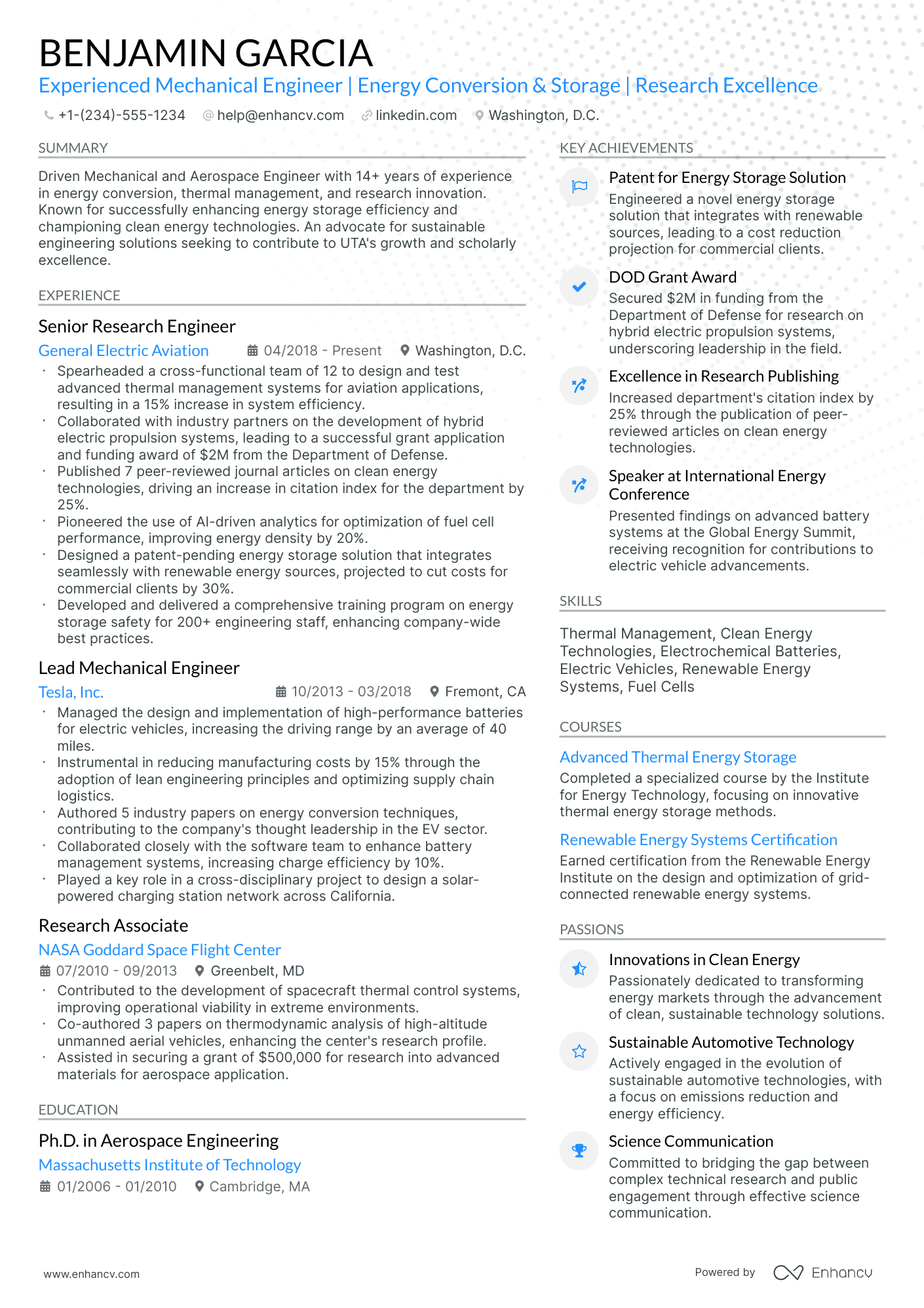
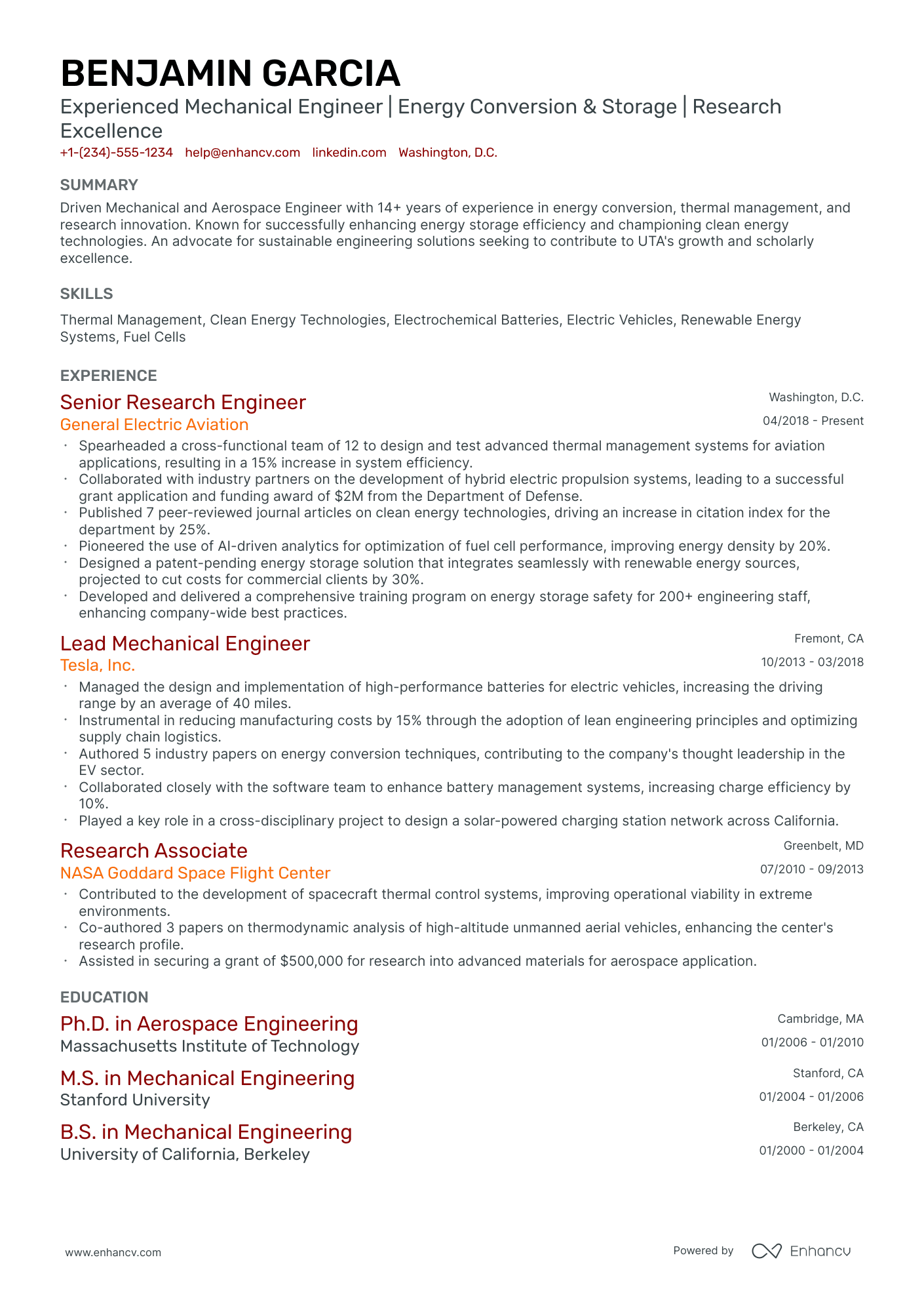
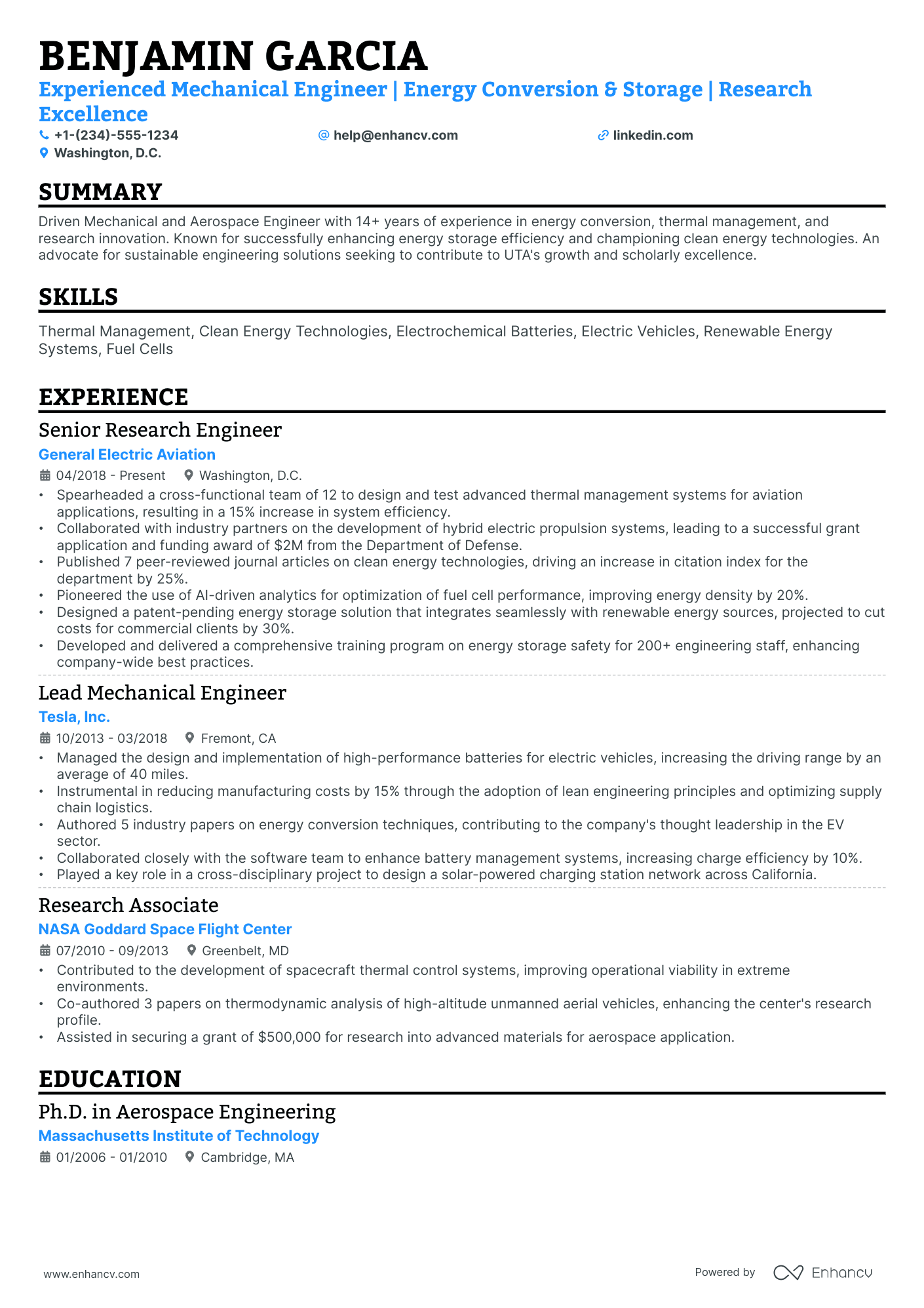
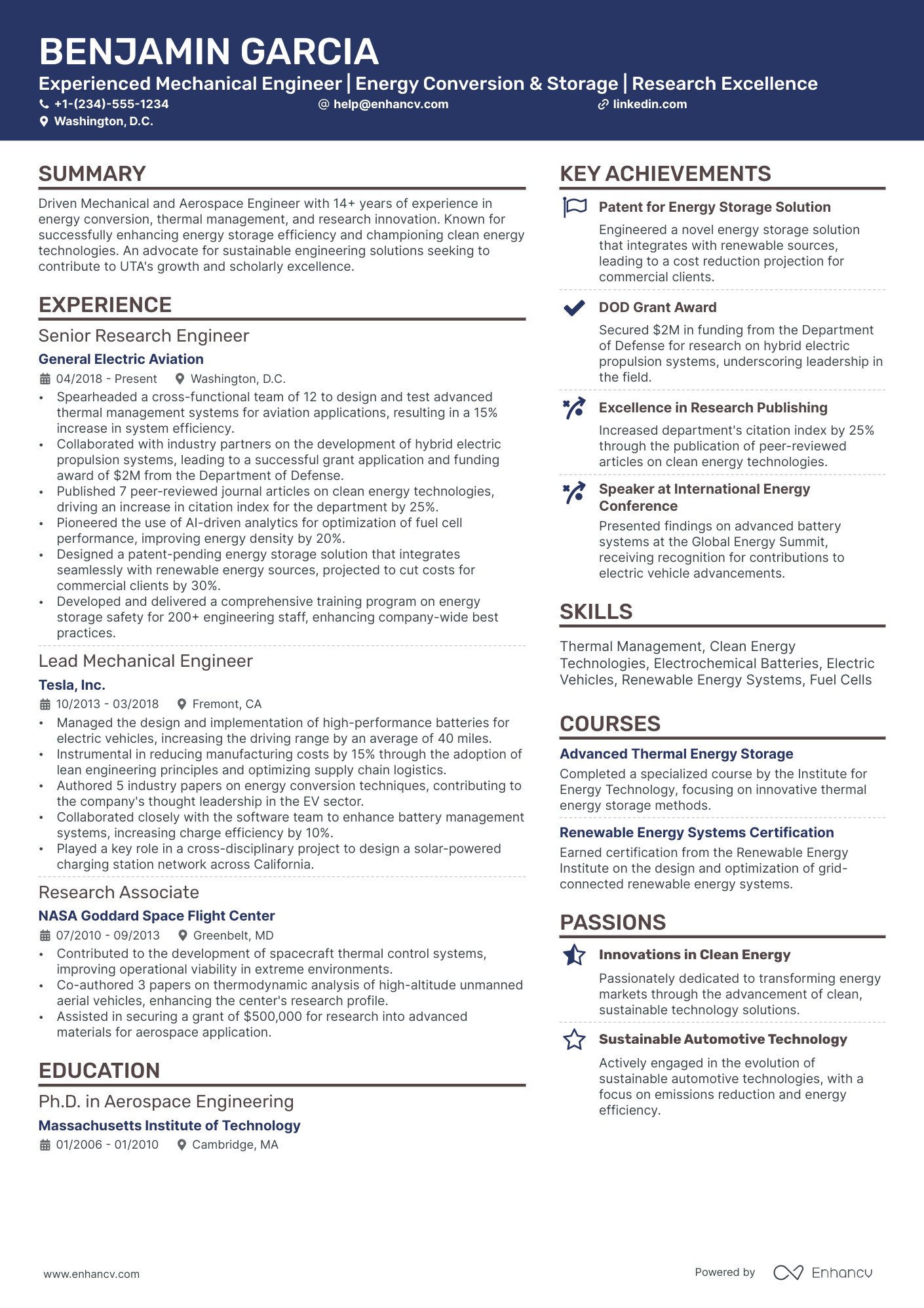
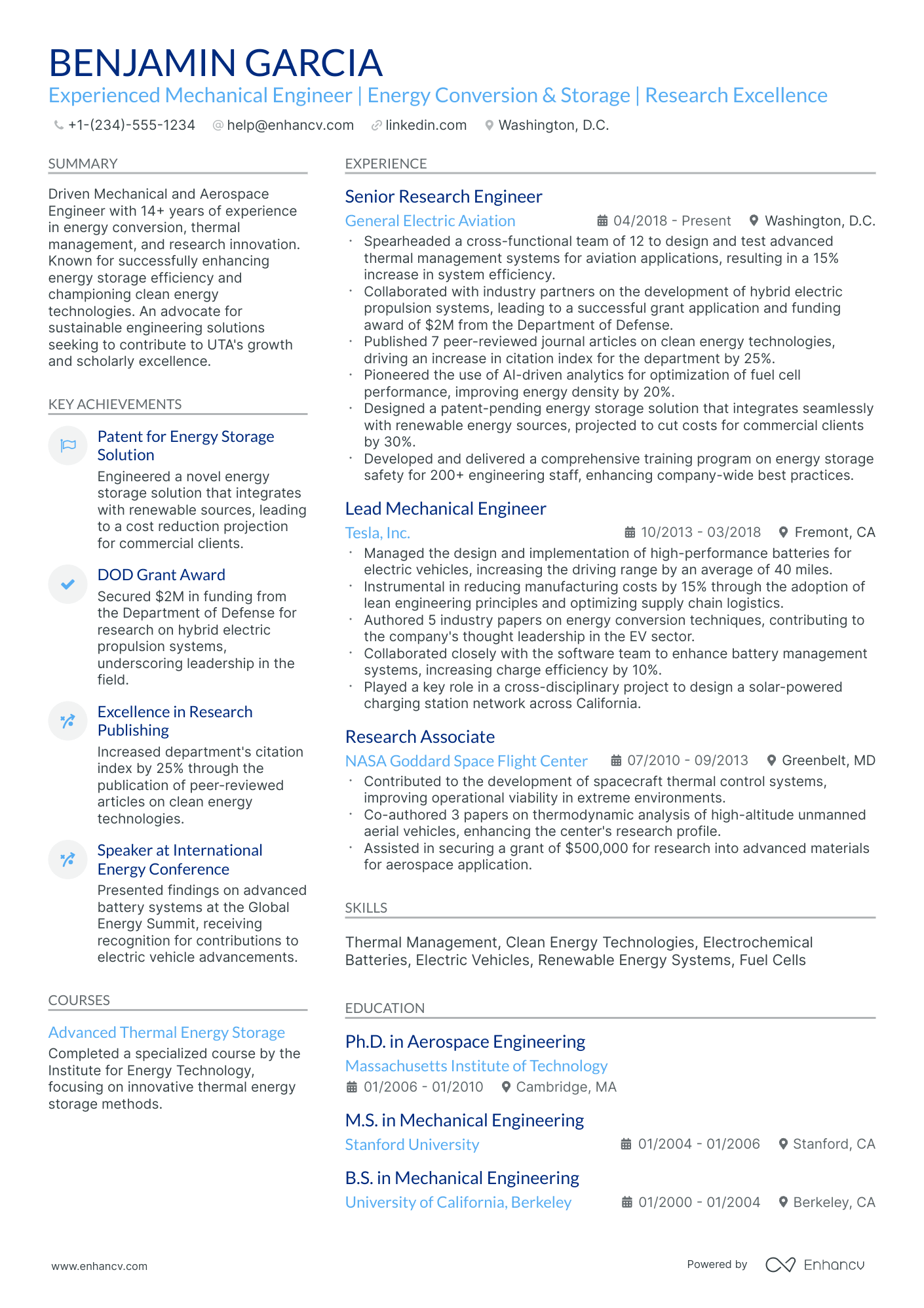
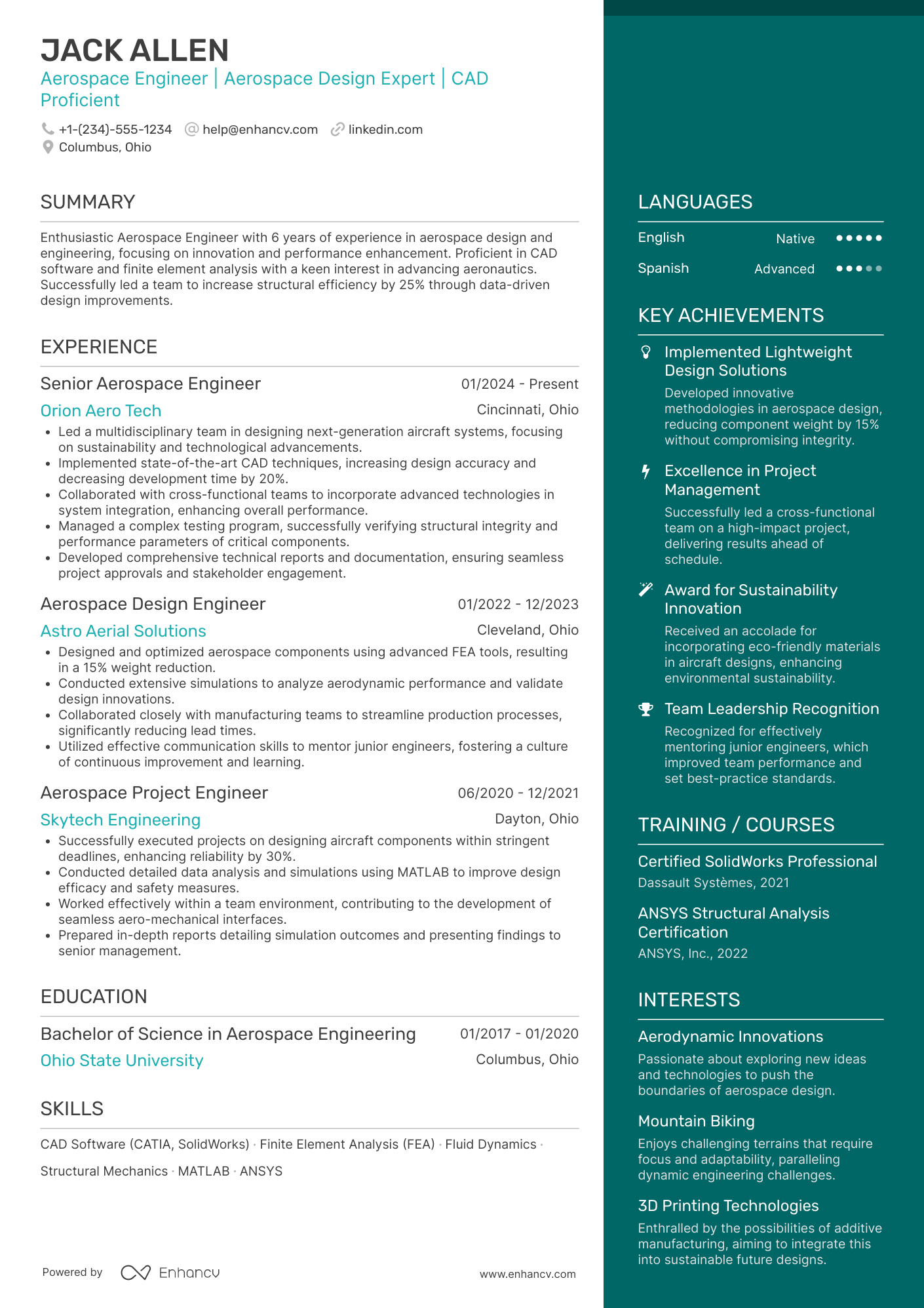
Most aerospace engineering resume submissions fail because they read like project logs and bury flight-critical results under dense jargon. In today's ATS screening and rapid recruiter scans, that makes your aerospace engineering resume blend in fast.
A strong resume shows outcomes first, so you prove impact in seconds. Knowing how to make your resume stand out means you highlight mass reduction, fuel burn improvements, defect escape rates, test pass yield, certification milestones, schedule recovery, and on-time delivery for flight hardware.

Key takeaways
- Lead every experience bullet with a quantified outcome, not a task description.
- Tailor tools, standards, and terminology to match each job posting exactly.
- Use reverse-chronological format for experienced roles and hybrid format for career changers.
- Place a skills section above experience if you're entry-level or switching fields.
- Replace vague summary phrases with specific tools, domains, and measurable achievements.
- Showcase capstone projects, research, and internships as substantive experience when job history is limited.
- Use Enhancv to turn routine job duties into measurable, recruiter-ready bullet points.
Job market snapshot for aerospace engineerings
We analyzed 86 recent aerospace engineering job ads across major US job boards. These numbers help you understand skills in demand, top companies hiring, salary landscape at a glance.
What level of experience employers are looking for aerospace engineerings
| Years of Experience | Percentage found in job ads |
|---|---|
| 1–2 years | 17.4% (15) |
| 3–4 years | 2.3% (2) |
| 5–6 years | 9.3% (8) |
| 7–8 years | 1.2% (1) |
| 9–10 years | 3.5% (3) |
| 10+ years | 4.7% (4) |
| Not specified | 64.0% (55) |
Aerospace engineering ads by area of specialization (industry)
| Industry (Area) | Percentage found in job ads |
|---|---|
| Education | 31.4% (27) |
| Government | 25.6% (22) |
| Finance & Banking | 24.4% (21) |
| Manufacturing | 14.0% (12) |
Top companies hiring aerospace engineerings
| Company | Percentage found in job ads |
|---|---|
| University of Missouri System | 17.4% (15) |
| Department of the Air Force | 16.3% (14) |
Role overview stats
These tables show the most common responsibilities and employment types for aerospace engineering roles. Use them to align your resume with what employers expect and to understand how the role is structured across the market.
Day-to-day activities and top responsibilities for a aerospace engineering
| Responsibility | Percentage found in job ads |
|---|---|
| Aerospace engineering | 43.0% (37) |
| Matlab | 15.1% (13) |
| Mechanical engineering | 15.1% (13) |
| Aerodynamics | 12.8% (11) |
| Computational fluid dynamics | 10.5% (9) |
| Instrumentation | 10.5% (9) |
| Flight mechanics | 9.3% (8) |
| Propulsion systems | 8.1% (7) |
| Aero-thermal wind tunnel testing | 7.0% (6) |
| Aerodynamic testing | 7.0% (6) |
| C++ | 7.0% (6) |
| Cfd | 7.0% (6) |
Type of employment (remote vs on-site vs hybrid)
| Employment type | Percentage found in job ads |
|---|---|
| On-site | 89.5% (77) |
| Hybrid | 9.3% (8) |
How to format a aerospace engineering resume
Recruiters evaluating aerospace engineering resumes prioritize technical depth in systems design, analysis, and testing alongside measurable project contributions—such as weight reductions, cost savings, or certification milestones. A clean, well-structured resume format ensures these signals surface quickly during both automated parsing and the initial human scan.

I have significant experience in this role—which format should I use?
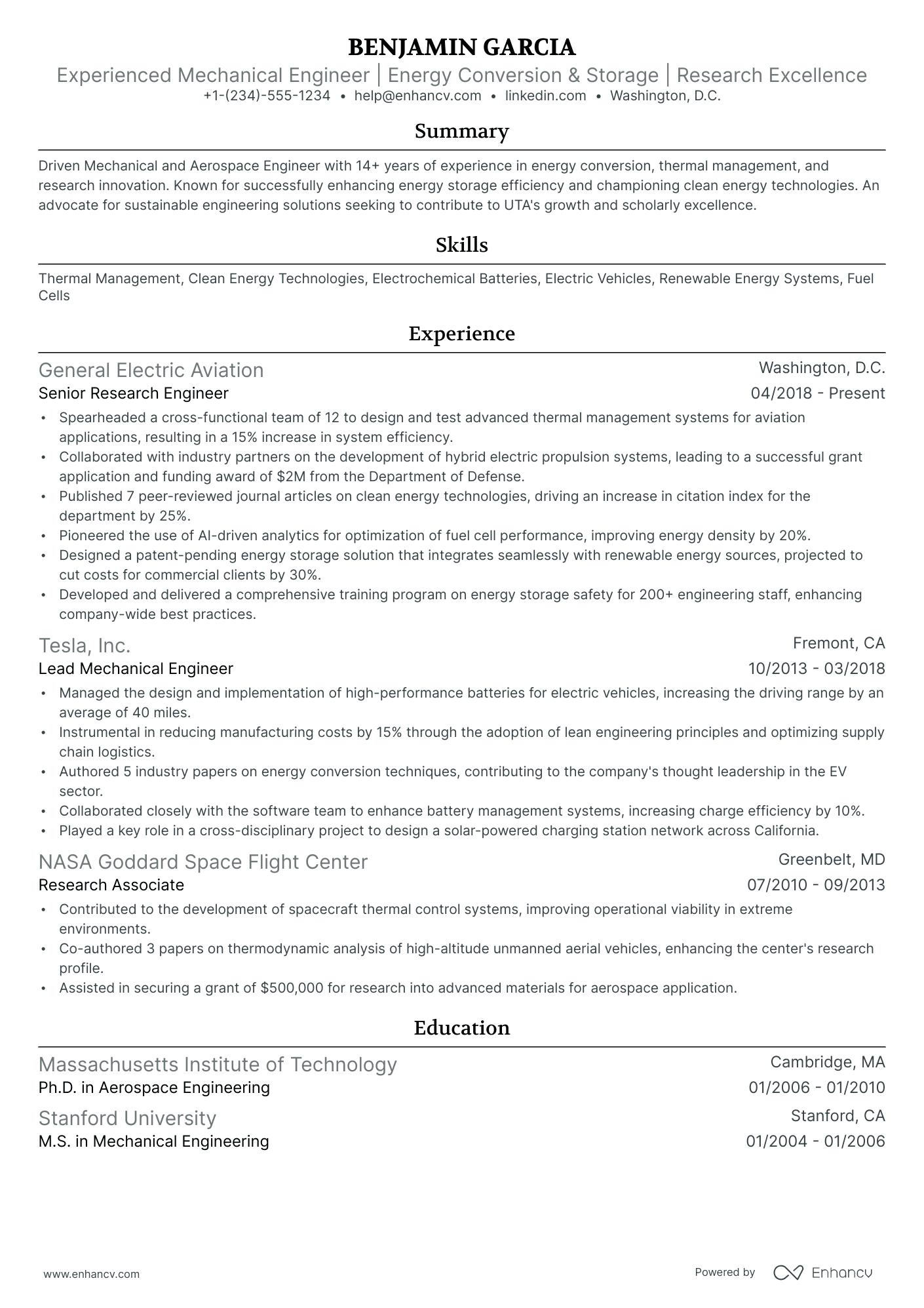
Use a reverse-chronological format to present your aerospace engineering career in a clear, linear progression of increasing technical responsibility. Do:
- Lead each role entry with your scope of ownership—aircraft systems, propulsion subsystems, structural assemblies, or full program-level oversight.
- Highlight proficiency in role-specific tools and domains such as CATIA, NASTRAN, MATLAB, GD&T, computational fluid dynamics, or DO-178C/DO-254 compliance.
- Quantify outcomes tied to performance, cost, schedule, or certification targets.
I'm junior or switching into this role—what format works best?
A hybrid format works best, allowing you to feature relevant technical skills and academic projects prominently while still providing a chronological work history. Do:
- Place a dedicated skills section near the top covering core competencies like finite element analysis, thermodynamics, CAD modeling, or aerospace materials science.
- Include capstone projects, internships, research assistantships, or competition entries (such as AIAA Design/Build/Fly) as substantive experience entries.
- Connect every action to a measurable or observable result, even in academic or project contexts.
Why not use a functional resume?
A functional format strips away the project timelines, team contexts, and progressive responsibility that aerospace hiring managers need to assess your readiness for engineering roles governed by strict regulatory and safety standards. A functional resume might be acceptable if you're transitioning from a related field—such as mechanical engineering or military aviation maintenance—and have no direct aerospace job titles, provided you still anchor every listed skill to a specific project, analysis, or outcome.
Now that you've established a clean, readable layout, it's time to fill it with the right sections that showcase your qualifications effectively.
What sections should go on a aerospace engineering resume
Recruiters expect you to present aerospace engineering experience that proves technical depth, compliance awareness, and measurable results. Understanding what to put on a resume helps you prioritize the most impactful information.
Use this structure for maximum clarity:
- Header
- Summary
- Experience
- Skills
- Projects
- Education
- Certifications
- Optional sections: Awards, Publications, Research
Strong experience bullets should emphasize quantified performance gains, test and verification results, safety and regulatory outcomes, and the scope of systems you owned end to end.
Is your resume good enough?
Drop your resume here or choose a file. PDF & DOCX only. Max 2MB file size.
Once you’ve organized your resume with the right components, the next step is writing your aerospace engineering experience section so it fits that structure and supports your application.
How to write your aerospace engineering resume experience
Your work experience section should demonstrate the aerospace systems, structures, or propulsion work you've shipped or delivered—highlighting the engineering tools, analysis methods, and design processes you applied to achieve measurable outcomes. Hiring managers in aerospace prioritize demonstrated impact on flight-ready hardware, validated simulations, or certified systems over descriptive task lists.
Each entry should include:
- Job title
- Company and location (or remote)
- Dates of employment (month and year)
Three to five concise bullet points showing what you owned, how you executed, and what outcomes you delivered:
- Ownership scope: the aircraft systems, spacecraft subsystems, propulsion components, avionics platforms, or structural assemblies you were directly accountable for across design, test, or production phases.
- Execution approach: the engineering tools, analysis frameworks, simulation software, or verification methods—such as finite element analysis, computational fluid dynamics, GD&T, or requirements management platforms—you used to drive technical decisions and deliver flight-qualified work.
- Value improved: the changes you made to structural integrity, aerodynamic performance, weight reduction, thermal efficiency, system reliability, or regulatory compliance that advanced the program's technical objectives.
- Collaboration context: how you coordinated with cross-functional teams—including stress analysts, systems engineers, manufacturing, quality assurance, certification authorities, or defense program offices—to resolve technical challenges and meet milestone deliverables.
- Impact delivered: the program-level or organizational outcomes your work produced, expressed through certification achievements, schedule acceleration, mass or cost savings, failure-rate reductions, or successful flight-test results rather than routine activity descriptions.
Experience bullet formula
A aerospace engineering experience example
✅ Right example - modern, quantified, specific.
Aerospace Structural Analysis Engineer
Orbital Dynamics Systems | Denver, CO
2022–2025
Supported rapid development of a reusable launch vehicle program with aggressive mass, reliability, and certification targets.
- Led finite element analysis in ANSYS Mechanical and NASTRAN (SOL 101/103/105) for primary composite structures, cutting predicted peak stress by 18% while meeting a 1.4 ultimate factor of safety.
- Built and validated MATLAB and Python sizing scripts tied to CAD (CATIA V5) mass properties, reducing preliminary design cycle time from five days to two days and improving weight estimates within 3% of as-built.
- Drove test-correlated model updates using strain gage and digital image correlation data from static load tests, improving correlation from 0.72 to 0.91 and reducing rework on second article by 25%.
- Partnered with manufacturing and materials engineering to resolve composite layup and cure deviations using nonconformance root cause analysis and statistical process control, lowering scrap rate from 6% to 3%.
- Authored and closed verification artifacts in DOORS and JAMA, aligning analyses with system requirements and flight readiness reviews, and reducing certification review findings by 40%.
Now that you've seen how a strong experience section comes together, let's look at how to adjust those details to match the specific role you're targeting.
How to tailor your aerospace engineering resume experience
Recruiters evaluate your aerospace engineering resume through both applicant tracking systems and human review. Tailoring your resume to each job description ensures your qualifications align directly with what the hiring team needs.
Ways to tailor your aerospace engineering experience:
- Match specific CAD or FEA tools listed in the job description.
- Mirror the exact propulsion or avionics systems the role requires.
- Use the same terminology for standards like AS9100 or DO-178C.
- Reflect flight test or structural analysis KPIs the posting highlights.
- Include relevant defense or commercial aviation domain experience.
- Emphasize compliance and reliability processes when the role specifies them.
- Highlight cross-functional collaboration with manufacturing or systems integration teams.
- Align your workflow references with Agile or model-based engineering frameworks mentioned.
Tailoring means aligning your real accomplishments with each job's stated requirements, not forcing keywords where they don't belong.
Resume tailoring examples for aerospace engineering
| Job description excerpt | Untailored | Tailored |
|---|---|---|
| Perform structural analysis of composite airframe components using NASTRAN and PATRAN, ensuring compliance with FAR 25 airworthiness standards. | Conducted analysis on various engineering projects using industry software. | Performed stress and fatigue analysis of composite fuselage and wing structures using MSC NASTRAN and PATRAN, verifying compliance with FAR 25 static and damage tolerance requirements across 12 airframe components. |
| Design and optimize propulsion system thermal management solutions for liquid-fueled rocket engines, collaborating with cross-functional teams through CDR milestones. | Worked with teams to improve engine designs and meet project deadlines. | Designed thermal management architectures for LOX/RP-1 rocket engine turbopump assemblies, reducing steady-state thermal gradients by 18% and delivering all analysis packages through CDR on a 9-month schedule. |
| Develop and validate GN&C algorithms for autonomous satellite rendezvous and proximity operations using MATLAB/Simulink, supporting mission assurance through Monte Carlo simulation campaigns. | Created algorithms and ran simulations to support spacecraft mission requirements. | Developed closed-loop GN&C algorithms in MATLAB/Simulink for autonomous rendezvous and proximity operations within 50 m of target satellites, executing 10,000-run Monte Carlo campaigns that verified 99.7% mission success probability across dispersed orbital conditions. |
Once you’ve aligned your experience with the role’s requirements, quantify your aerospace engineering achievements to show the impact of that work in clear, measurable terms.
How to quantify your aerospace engineering achievements
Quantifying your achievements shows how your designs and analyses improved mission performance and reduced risk. Focus on numbers tied to weight, thrust, drag, reliability, defect rates, test pass rates, cost, schedule, and safety compliance.
Quantifying examples for aerospace engineering
| Metric | Example |
|---|---|
| Performance gain | "Reduced aircraft drag by 3.2% by optimizing winglet geometry in ANSYS Fluent, improving cruise fuel burn by 1.1% across three flight conditions." |
| Reliability | "Increased actuator mean time between failures from 1,200 to 1,650 hours by updating tolerance stack-ups and validating fixes through 180-hour endurance testing." |
| Quality defects | "Cut nonconformance reports by 28% by tightening GD&T callouts and adding first-article inspection gates in AS9102 workflows for a 42-part assembly." |
| Delivery speed | "Shortened structural analysis turnaround time from five days to two by automating load-case setup with Python and standardizing NASTRAN decks for 30+ programs." |
| Cost reduction | "Saved $410K per year by redesigning a titanium bracket to an aluminum-lithium alternative, reducing unit cost by 22% while meeting fatigue margins." |
Turn vague job duties into measurable, recruiter-ready resume bullets in seconds with Enhancv's Bullet Point Generator.
Once you've crafted strong bullet points for your experience section, you'll want to apply that same precision to presenting your hard and soft skills throughout your aerospace engineering resume.
How to list your hard and soft skills on a aerospace engineering resume
Your skills section shows you can design, analyze, and certify safe aircraft and spacecraft, and recruiters and ATS scan this section for job-match keywords, so aim for a balanced mix of technical aerospace skills and execution-focused soft skills. aerospace engineering roles require a blend of:
- Product strategy and discovery skills.
- Data, analytics, and experimentation skills.
- Delivery, execution, and go-to-market discipline.
- Soft skills.
Your skills section should be:
- Scannable (bullet-style grouping).
- Relevant to the job post.
- Backed by proof in experience bullets.
- Updated with current tools.
Place your skills section:
- Above experience if you're junior or switching careers.
- Below experience if you're mid/senior with strong achievements.

Hard skills
Your hard skills demonstrate the technical tools and methods you bring to aerospace engineering work:
- Aerodynamics, CFD
- ANSYS Fluent, CFX
- MATLAB, Simulink
- Python, NumPy, SciPy
- Finite element analysis (FEA)
- ANSYS Mechanical, Abaqus
- Structural loads and stress
- Composite structures, lamination theory
- Flight mechanics, GNC
- Model-based systems engineering (MBSE)
- DO-178C, DO-254
- Configuration management, Git
Soft skills
Your soft skills show how you collaborate, communicate, and deliver under aerospace engineering constraints:
- Translate requirements into testable specs
- Communicate tradeoffs with data
- Run design reviews and close actions
- Collaborate with manufacturing and quality
- Write clear verification documentation
- Escalate risks early and propose mitigations
- Coordinate cross-functional integration work
- Prioritize safety and compliance decisions
- Manage interfaces across subsystems
- Drive root cause and corrective actions
- Align stakeholders on technical decisions
- Deliver to milestones under constraints
How to show your aerospace engineering skills in context
Your skills shouldn't live only in a dedicated skills list. Explore resume skills examples to see how top candidates weave competencies throughout their applications.
They should be demonstrated in:
- Your summary (high-level professional identity)
- Your experience (proof through outcomes)
Here's how that looks in practice.
Summary example
Senior aerospace engineer with 12 years in propulsion system design and thermal analysis. Skilled in ANSYS, CATIA, and cross-functional team leadership. Reduced turbine component testing cycles by 30% through optimized simulation workflows at a major defense contractor.
- Reflects senior-level experience clearly
- Names industry-standard tools directly
- Includes a measurable efficiency gain
- Highlights cross-functional leadership ability
Experience example
Senior Propulsion Engineer
Meridian Aerospace Systems | Huntsville, AL
June 2018–Present
- Led a nine-person team redesigning turbopump assemblies, cutting production costs by 18% using CATIA V5 and FEA validation.
- Collaborated with thermal analysts and test engineers to streamline combustion chamber simulations, reducing iteration time by 25%.
- Developed ANSYS-based fatigue life models adopted across three propulsion programs, improving failure prediction accuracy by 40%.
- Every bullet includes measurable proof.
- Skills appear naturally within achievements.
Once you’ve tied your aerospace engineering strengths to real coursework, projects, and outcomes, the next step is to structure a resume that highlights those details even if you don’t have formal experience.
How do I write a aerospace engineering resume with no experience
Even without full-time experience, you can demonstrate readiness through academic and project work. Building a resume without work experience is common for new aerospace engineering graduates, and these entries can carry real weight:
- Capstone aircraft design project
- Wind tunnel lab experiments
- Computational fluid dynamics simulations
- Finite element analysis coursework
- Student rocketry team builds
- Unmanned aerial vehicle prototypes
- Aerospace research assistant role
- Internship-style industry sponsored project
Focus on:
- Results with quantified performance metrics
- Tools: MATLAB, SolidWorks, ANSYS
- Analysis methods: CFD, FEA
- Documentation: requirements, test reports
Resume format tip for entry-level aerospace engineering
Use a reverse-chronological resume that leads with projects and education. It highlights recent, relevant aerospace engineering work when job history is limited. Do:
- Put projects above work history.
- Quantify results: lift, drag, mass.
- List tools next to each project.
- Add a link to a portfolio.
- Match keywords from job postings.
- Modeled and simulated a NACA 2412 wing in ANSYS Fluent, reducing predicted drag by 12% through geometry tweaks validated across three mesh refinements.
Even without professional experience, your education section can carry significant weight on your resume—so presenting it effectively is essential.
How to list your education on a aerospace engineering resume
Your education section lets hiring teams confirm you have the technical foundation aerospace engineering demands. It validates core knowledge in areas like propulsion, aerodynamics, and structural analysis.
Include:
- Degree name
- Institution
- Location
- Graduation year
- Relevant coursework (for juniors or entry-level candidates)
- Honors & GPA (if 3.5 or higher)
Skip month and day details—list the graduation year only.
Here's a strong education entry tailored for an aerospace engineering resume:
Example education entry
Bachelor of Science in Aerospace Engineering
Georgia Institute of Technology, Atlanta, GA
Graduated 2023
GPA: 3.7/4.0
- Relevant Coursework: Orbital Mechanics, Compressible Aerodynamics, Flight Vehicle Structures, Propulsion Systems, Control Theory
- Honors: Magna Cum Laude, Dean's List (six semesters)
How to list your certifications on a aerospace engineering resume
Certifications on your resume show your commitment to learning, confirm tool proficiency, and signal industry relevance in aerospace engineering, especially when your experience doesn't cover every required system or standard.
Include:
- Certificate name
- Issuing organization
- Year
- Optional: credential ID or URL
- Place certifications below education when they're older, less relevant, or supplemental to your aerospace engineering degree.
- Place certifications above education when they're recent, directly relevant, or required for the aerospace engineering role.
Best certifications for your aerospace engineering resume
- Project Management Professional (PMP)
- Certified Systems Engineering Professional (CSEP)
- Lean Six Sigma Green Belt
- ASQ Certified Quality Engineer (CQE)
- FAA Part 107 Remote Pilot Certificate
- Certified Associate in Project Management (CAPM)
- INCOSE ASEP (Associate Systems Engineering Professional)
Once you’ve positioned your credentials where they’re easy to verify, you can write your aerospace engineering resume summary to highlight those qualifications upfront and tie them to the role.
How to write your aerospace engineering resume summary
Your resume summary is the first thing a recruiter reads. A strong opening tied to aerospace engineering signals relevance and expertise in seconds.
Keep it to three to four lines, with:
- Your title and total years of aerospace engineering experience.
- Domain focus, such as propulsion, avionics, structural analysis, or spacecraft systems.
- Core tools and technologies like CATIA, MATLAB, ANSYS, or GD&T.
- One to two measurable achievements that show your engineering impact.
- Soft skills connected to real outcomes, such as cross-functional collaboration or technical communication.

PRO TIP
At the entry level, emphasize relevant technical skills, tools, and any early project contributions. Highlight coursework, internships, or co-ops that demonstrate hands-on aerospace work. Avoid vague phrases like "passionate engineer" or "fast learner." Replace them with specific skills and results.
Example summary for a aerospace engineering
Aerospace engineering graduate with internship experience in structural analysis using ANSYS and CATIA. Reduced component weight by 12% during a capstone satellite project through topology optimization.
Optimize your resume summary and objective for ATS
Drop your resume here or choose a file.
PDF & DOCX only. Max 2MB file size.
Now that your summary is ready to capture a recruiter's attention, make sure the header above it presents your contact details clearly so employers can actually reach you.
What to include in a aerospace engineering resume header
A resume header is the top section with your identity and contact details, and it drives visibility, credibility, and recruiter screening for aerospace engineering roles.
Essential resume header elements
- Full name
- Tailored job title and headline
- Location
- Phone number
- Professional email
- GitHub link
- Portfolio link
A LinkedIn link helps recruiters verify experience quickly and supports screening.
Do not include a photo on a aerospace engineering resume unless the role is explicitly front-facing or appearance-dependent.
Match your header job title to the posting and include aerospace engineering keywords that reflect your specialty and clearance status.
Example
Aerospace engineering resume header
Jordan Taylor
Aerospace Engineer | Structures and Stress Analysis
Seattle, WA
(206) 555-01XX
jordan.taylor@enhancv.com
github.com/jordantaylor
jordantaylor.com
linkedin.com/in/jordantaylor
Once you’ve set clear contact details and a targeted professional title at the top, add relevant additional sections to reinforce your qualifications and provide hiring managers with more context.
Additional sections for aerospace engineering resumes
Beyond core credentials, additional sections help you stand out when competing against equally qualified aerospace engineering candidates for specialized roles.
Choose sections that reinforce technical depth, industry credibility, or mission-relevant expertise:
- Security clearances and certifications
- Publications and technical papers
- Patents
- Professional affiliations (AIAA, SAE International)
- Languages
- Conference presentations
- Relevant hobbies and interests (private pilot license, rocketry, RC aircraft)
Once you've rounded out your resume with the right supplementary sections, it's worth ensuring your application is equally strong by pairing it with a well-crafted cover letter.
Do aerospace engineering resumes need a cover letter
A cover letter isn't required for most aerospace engineering roles, but it helps in competitive postings or when hiring managers expect one. If you're unsure what a cover letter is or when to use one, it can make a difference when your resume needs context on fit, scope, or impact.
Use a cover letter to add value in these situations:
- Explain role or team fit by linking your experience to the group's mission, tools, and development process.
- Highlight one or two relevant projects or outcomes, and quantify results like mass reduction, reliability gains, or test pass rates.
- Show you understand the product, users, or business context, such as certification constraints, safety margins, cost targets, or schedule risk.
- Address career transitions or non-obvious experience by mapping skills to aerospace engineering work, and clarifying your timeline and training.
Drop your resume here or choose a file.
PDF & DOCX only. Max 2MB file size.
Even when you decide a separate letter won’t add value, using AI to improve your aerospace engineering resume helps you strengthen your application’s message and alignment.
Using AI to improve your aerospace engineering resume
AI can sharpen your resume's clarity, structure, and impact. It helps refine phrasing and highlight measurable results. But overuse risks making your resume sound generic. If you're wondering which AI is best for writing resumes, start with tools that let you control the output. Once your content is clear and role-aligned, step away from AI.
Here are 10 practical prompts to strengthen specific sections of your aerospace engineering resume:
- Strengthen your summary. "Rewrite my aerospace engineering resume summary to highlight relevant technical expertise and years of experience in under four sentences."
- Quantify experience bullets. "Add measurable outcomes to these aerospace engineering experience bullets, focusing on cost savings, efficiency gains, or project timelines."
- Align skills section. "Compare my skills section against this aerospace engineering job description and suggest missing technical keywords."
- Sharpen project descriptions. "Rewrite this aerospace engineering project entry to emphasize my specific role, tools used, and final deliverables."
- Improve action verbs. "Replace weak verbs in my aerospace engineering experience section with stronger, industry-specific action verbs."
- Tailor education details. "Highlight the most relevant coursework and research from my education section for this aerospace engineering role."
- Refine certifications list. "Reorder and describe my certifications to show their direct relevance to this aerospace engineering position."
- Tighten bullet length. "Shorten each aerospace engineering experience bullet to one concise line without losing technical detail or impact."
- Remove redundancy. "Identify and eliminate repeated phrases or overlapping content across all sections of my aerospace engineering resume."
- Check tone consistency. "Review my aerospace engineering resume for inconsistent tone and adjust everything to sound confident and professional."
Stop using AI once your resume sounds accurate, specific, and aligned with real experience. AI should never invent experience or inflate claims—if it didn't happen, it doesn't belong here.
Conclusion
A strong aerospace engineering resume proves impact with measurable outcomes, role-specific skills, and a clear structure. Use metrics to show results in design, analysis, testing, manufacturing, and flight operations. Keep each section focused, readable, and easy to scan.
Today’s aerospace engineering hiring market rewards candidates who link technical strengths to real results. When your accomplishments are quantified, your tools and methods are specific, and your layout is consistent, you look ready to deliver now and adapt next.