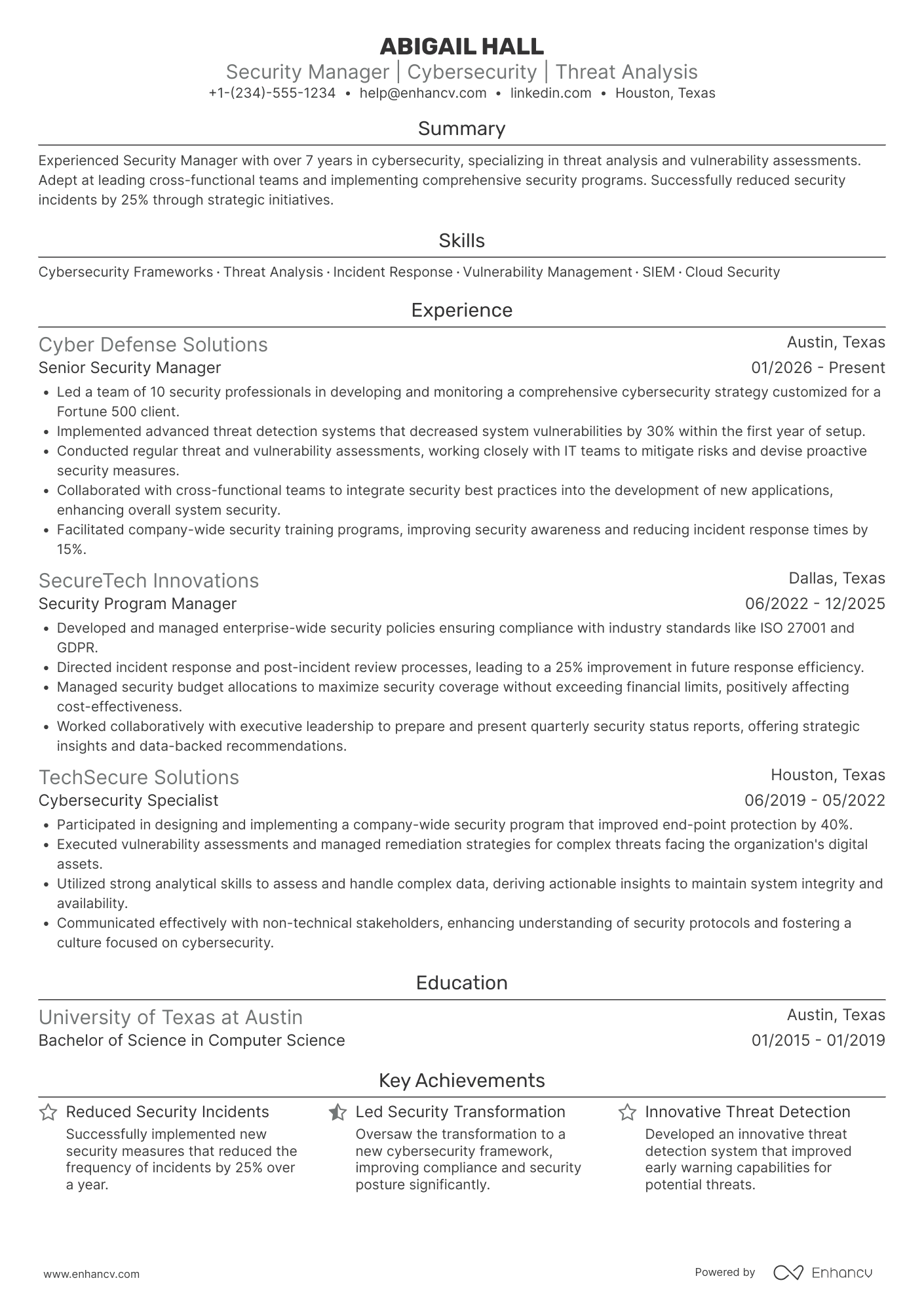
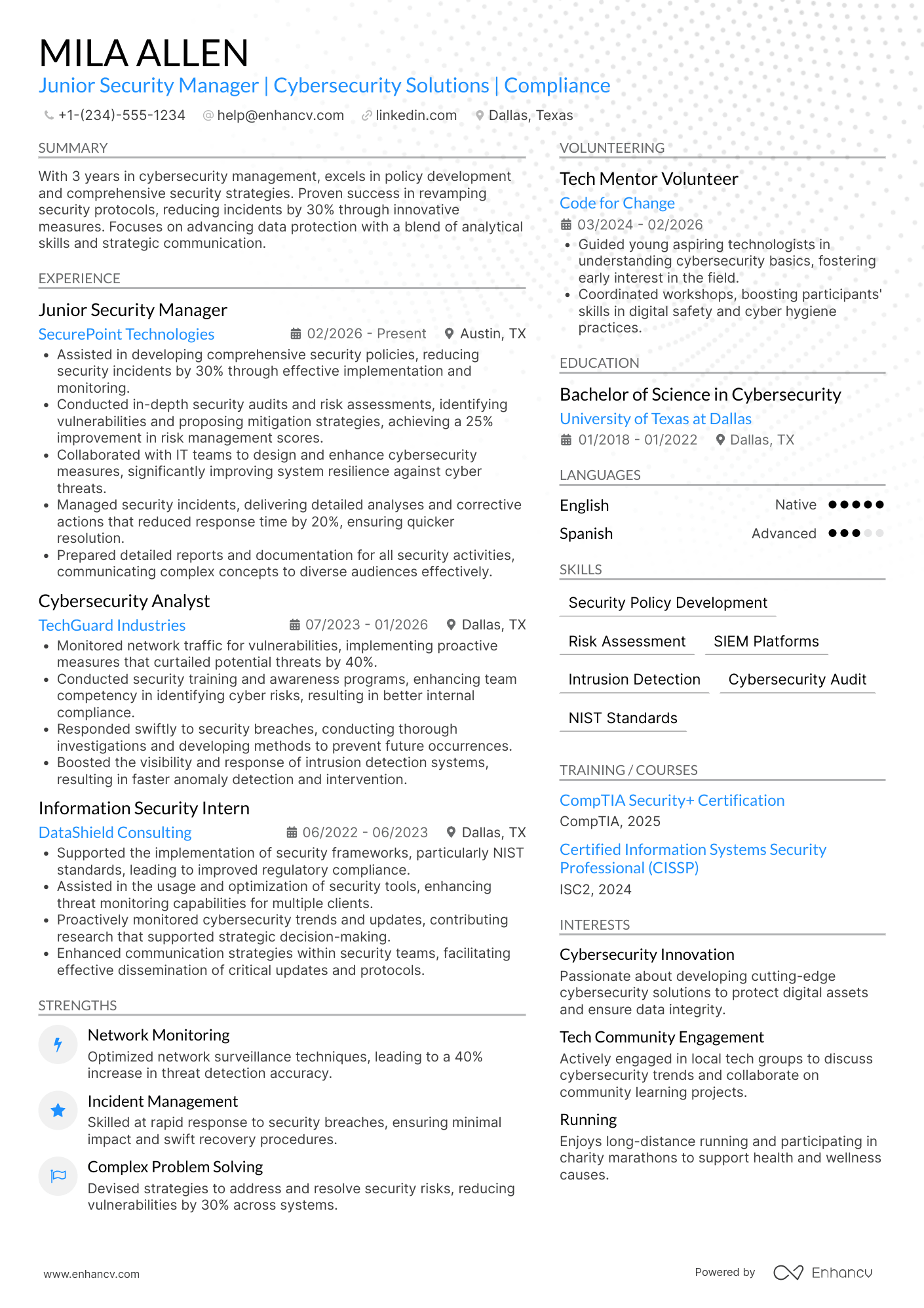
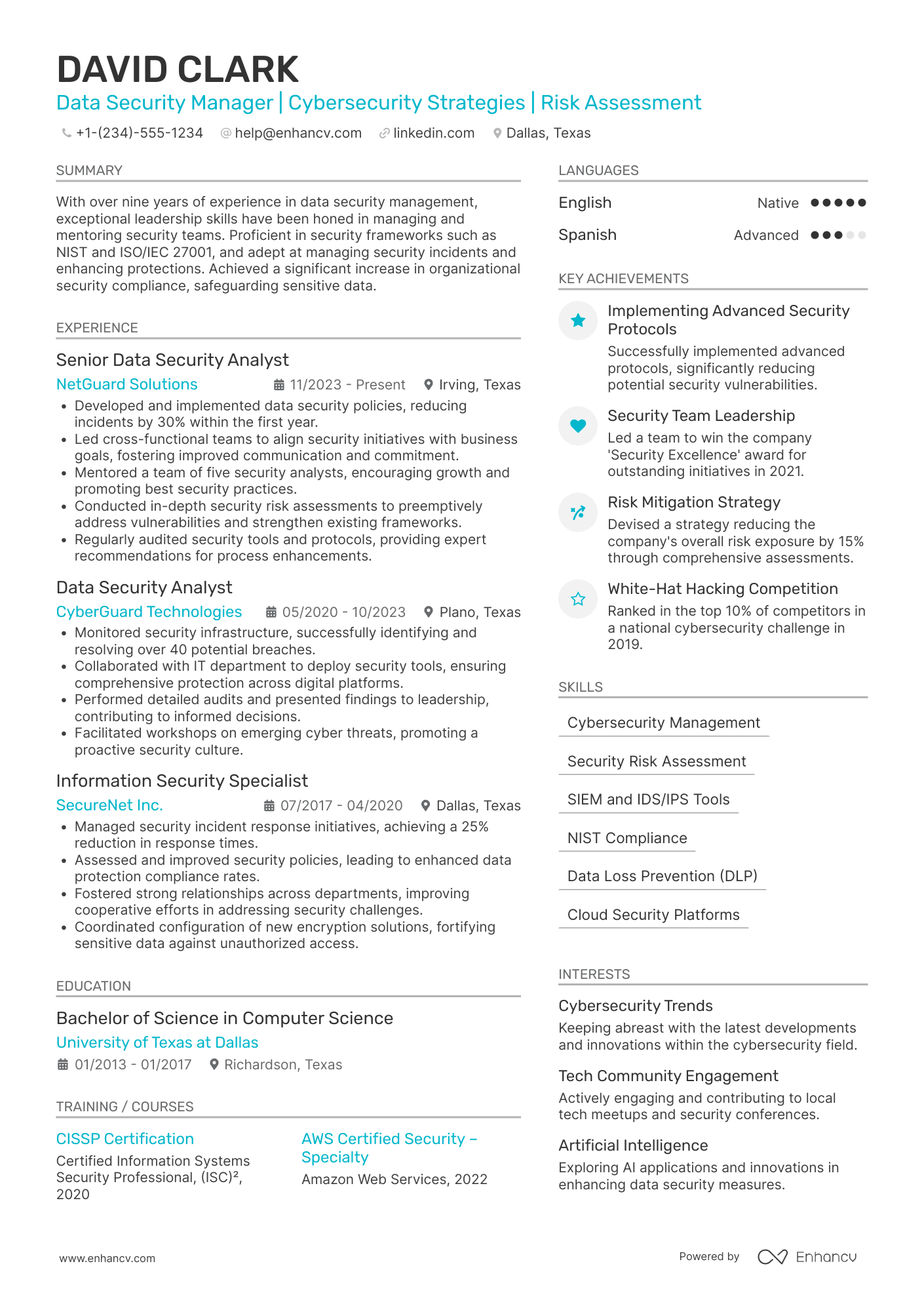
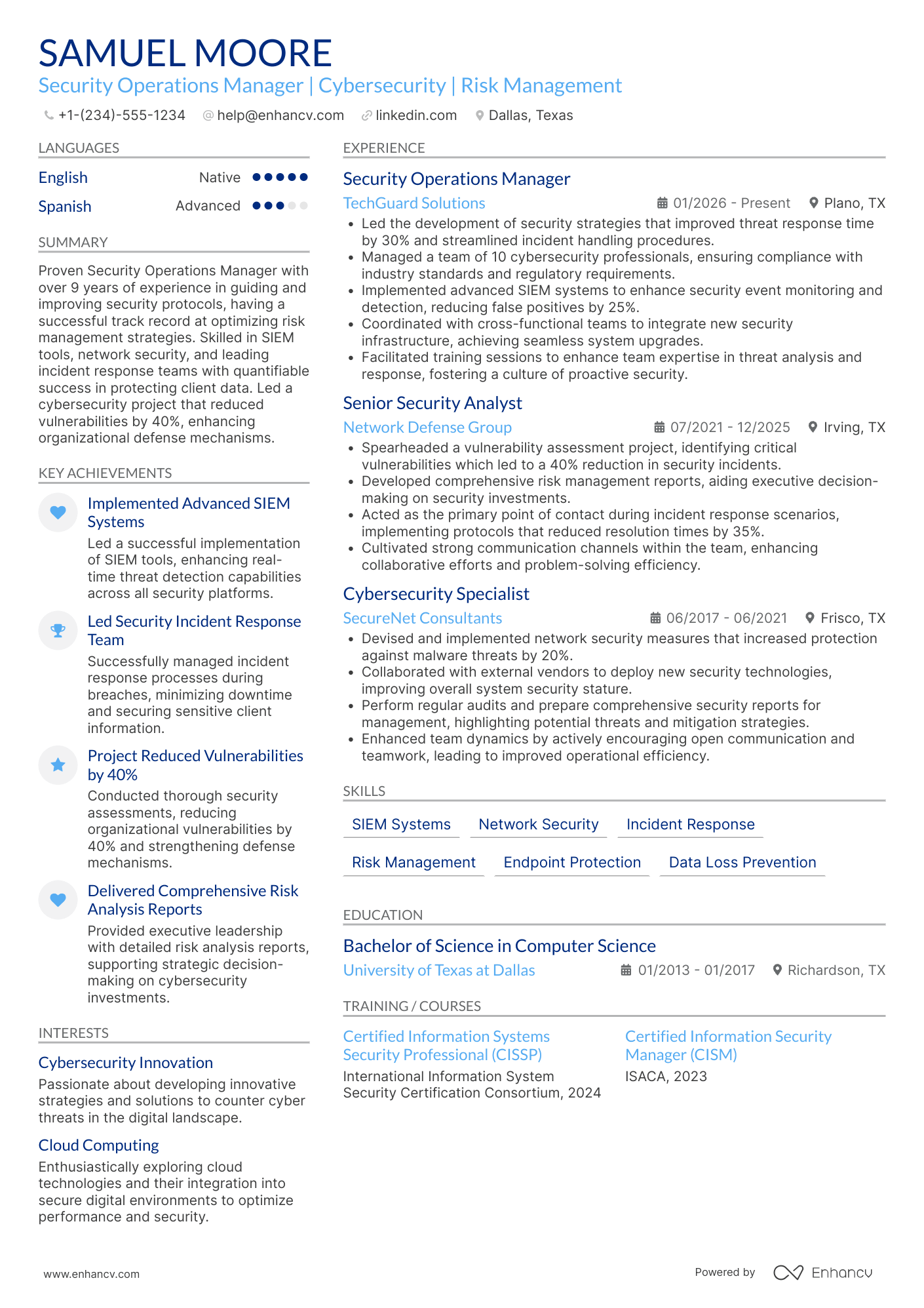
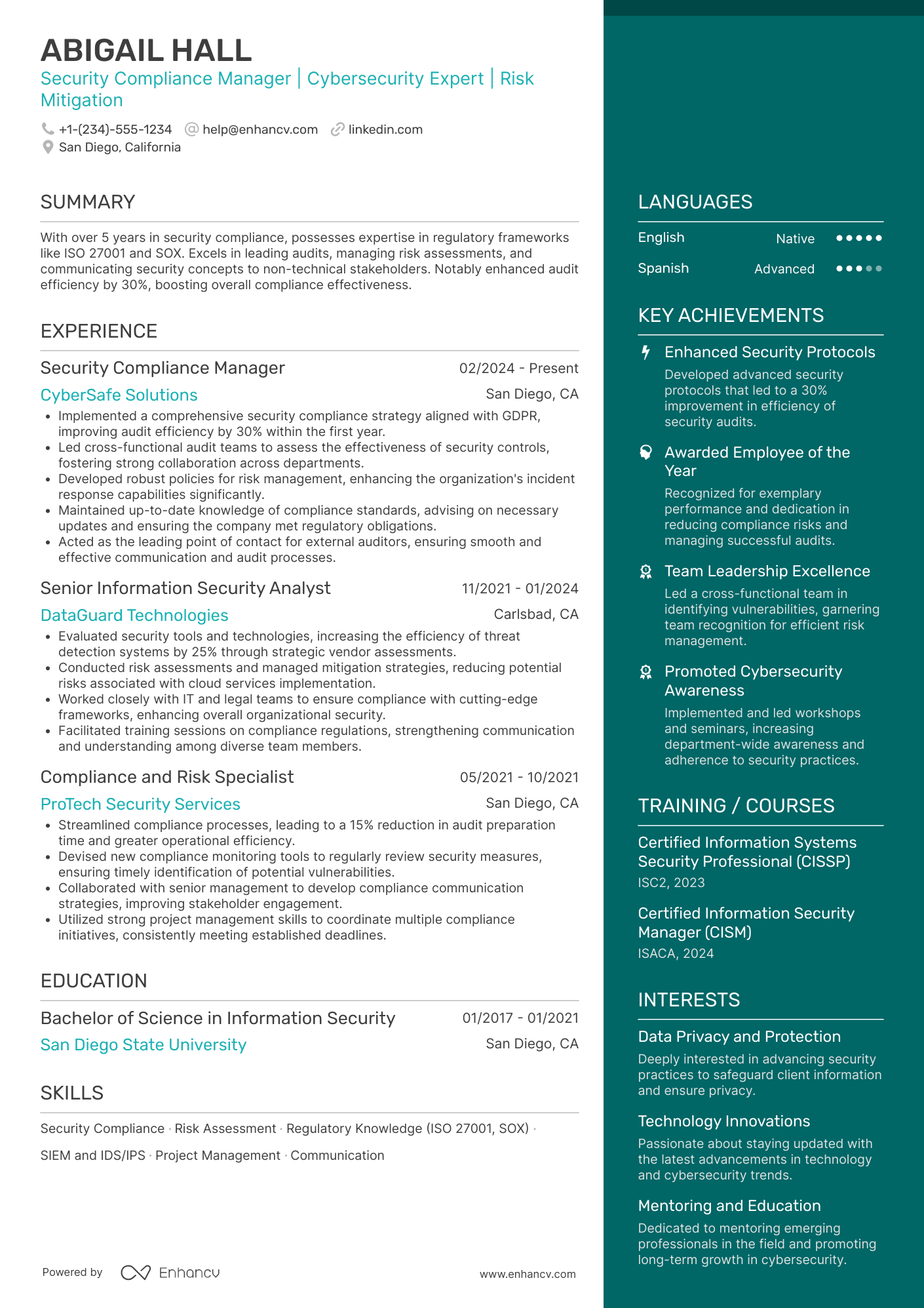
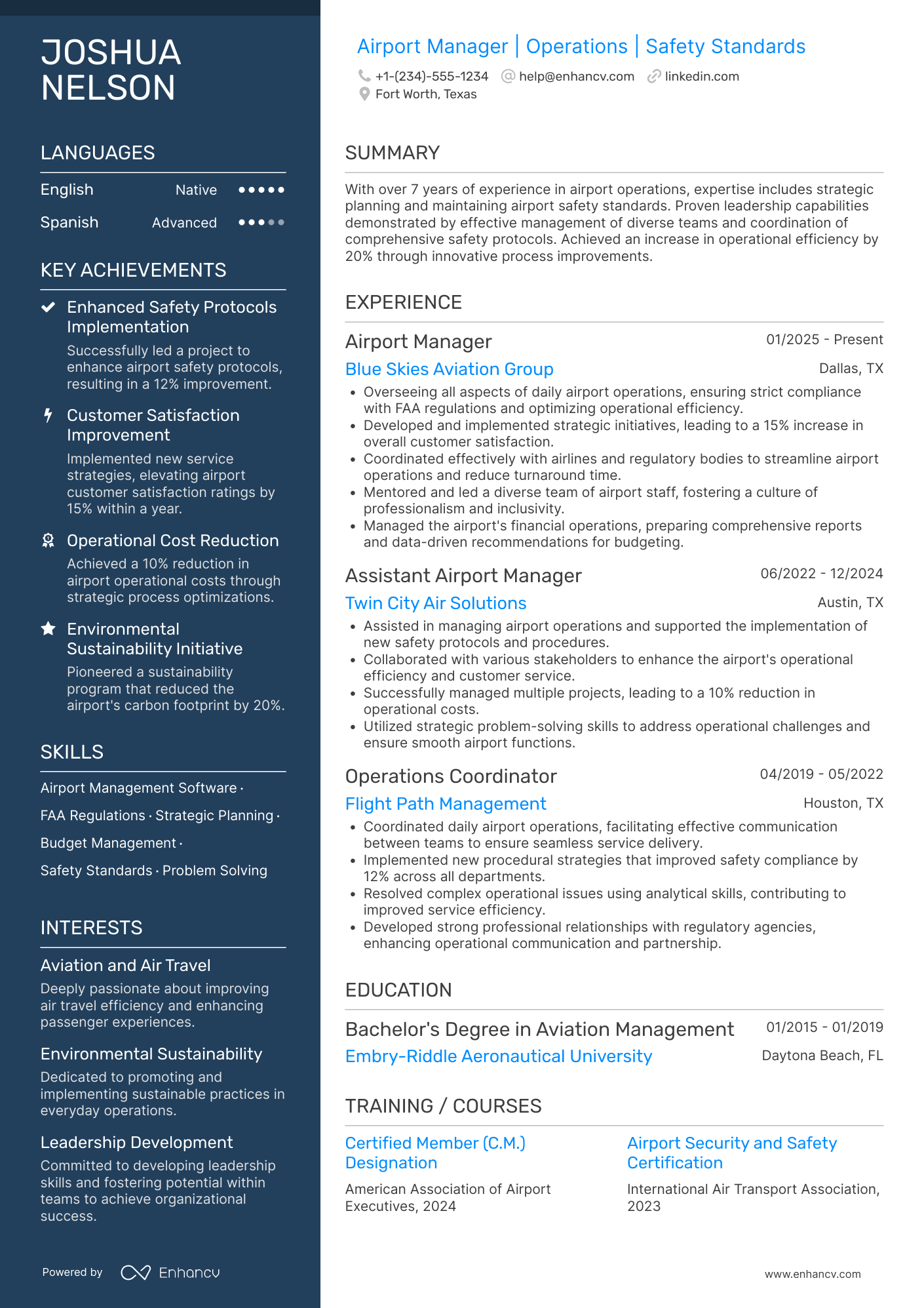
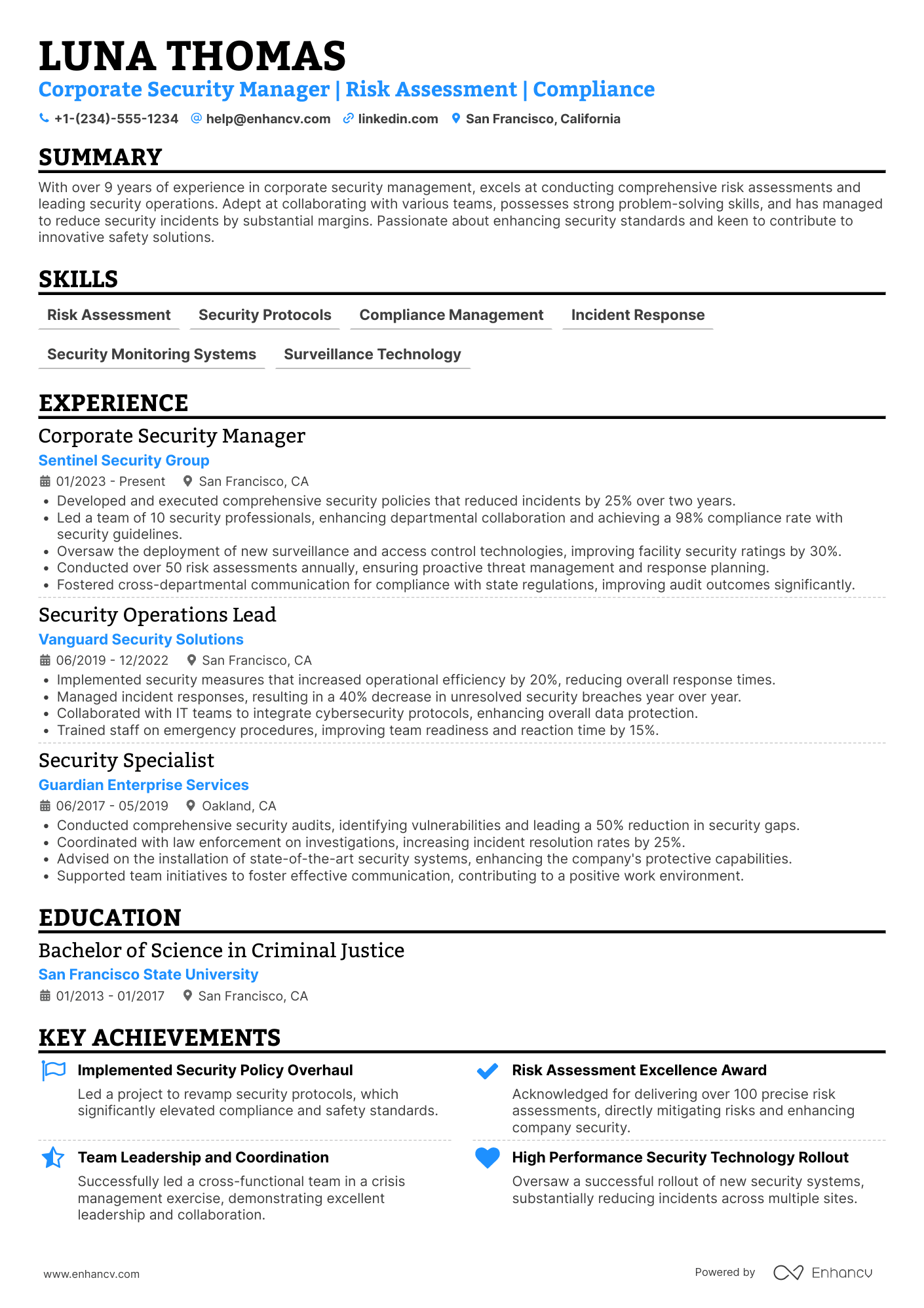
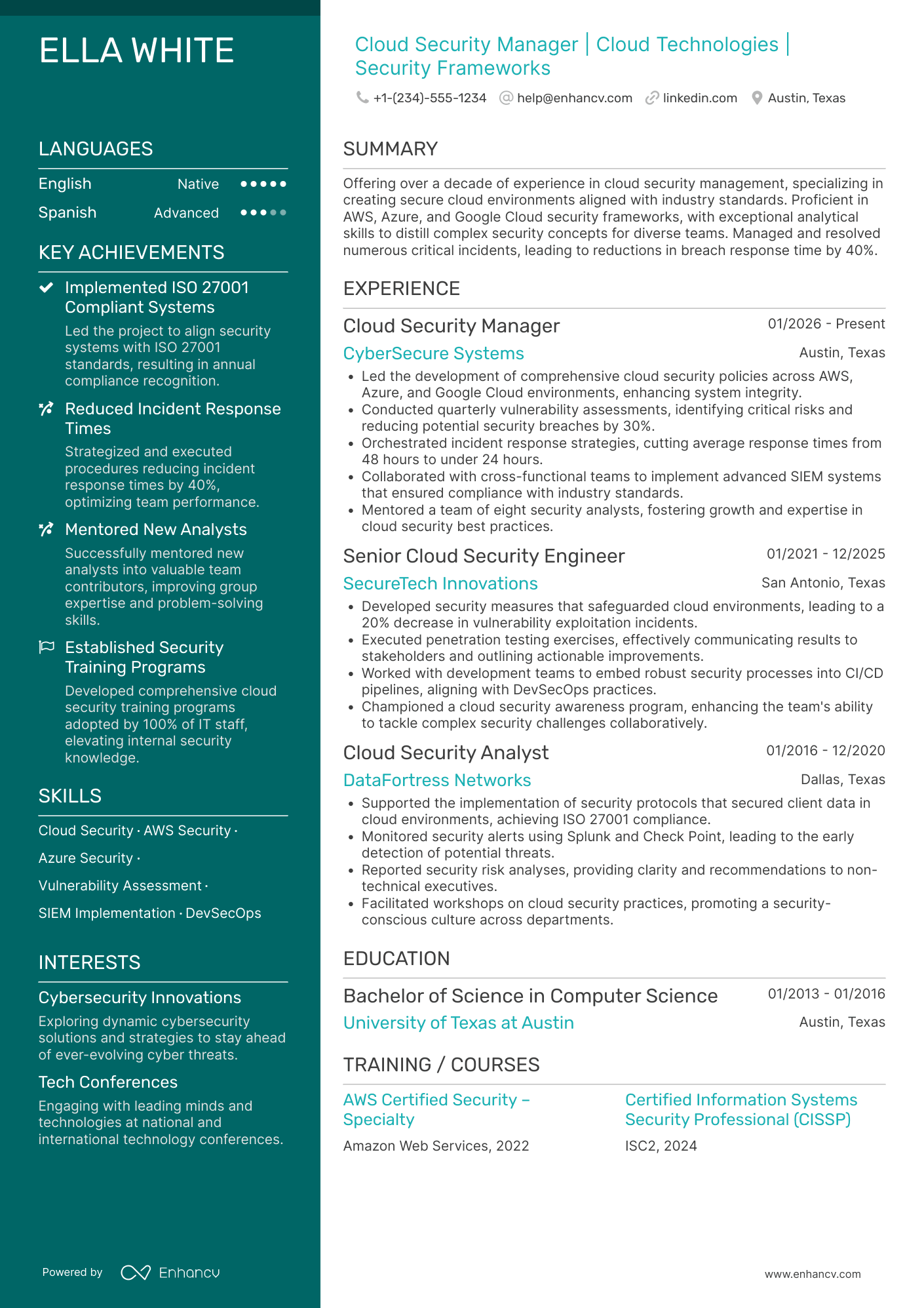
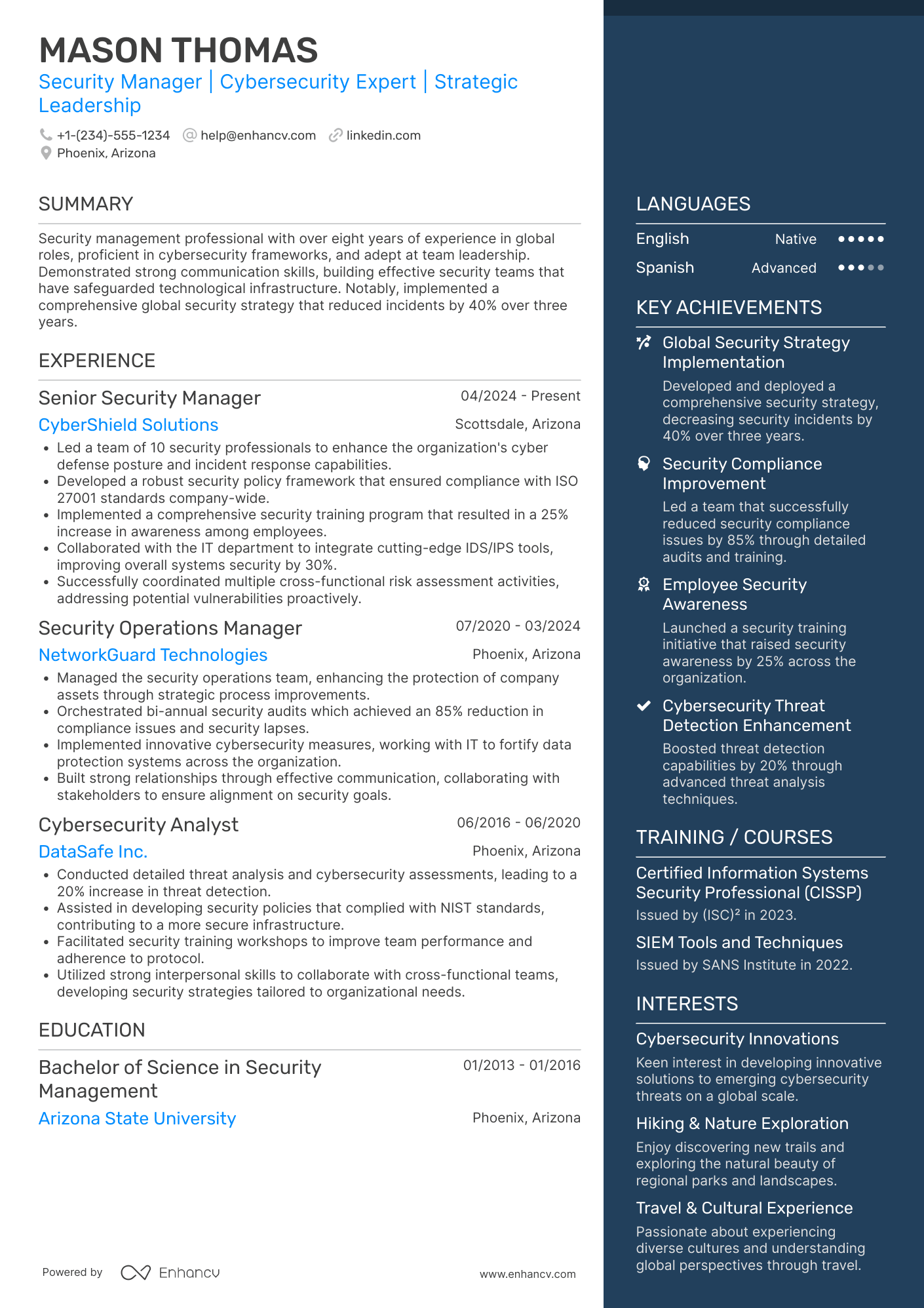
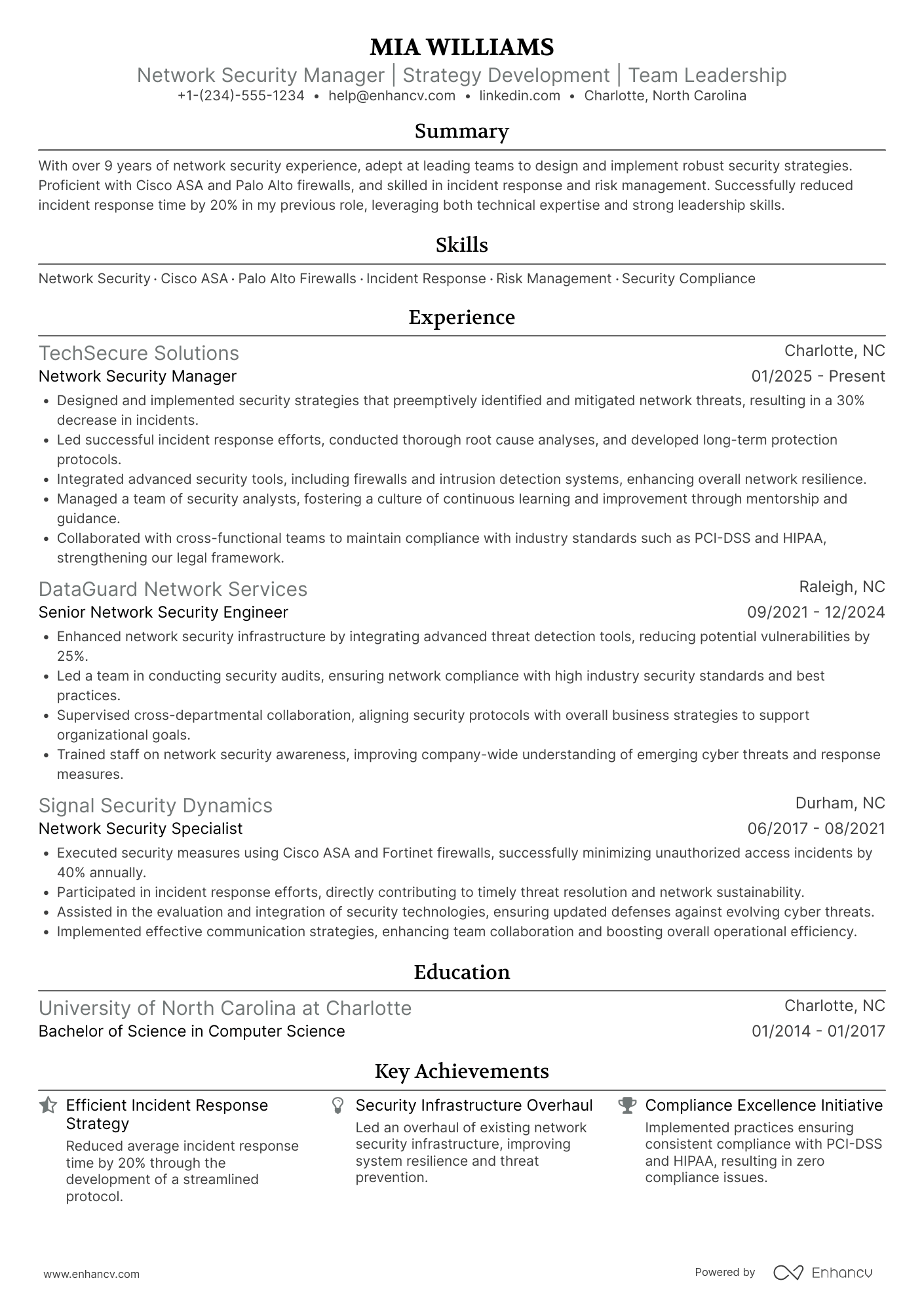
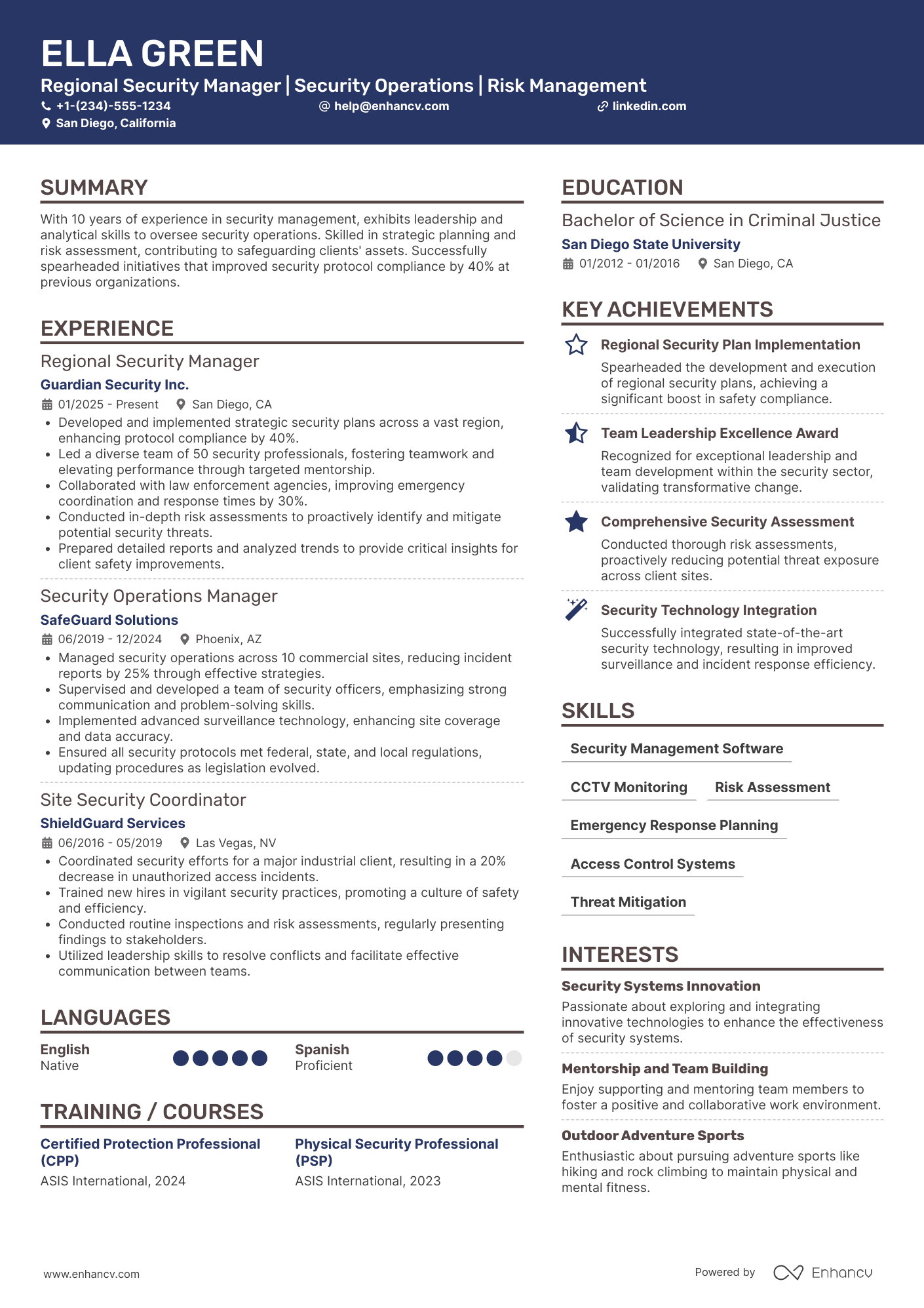
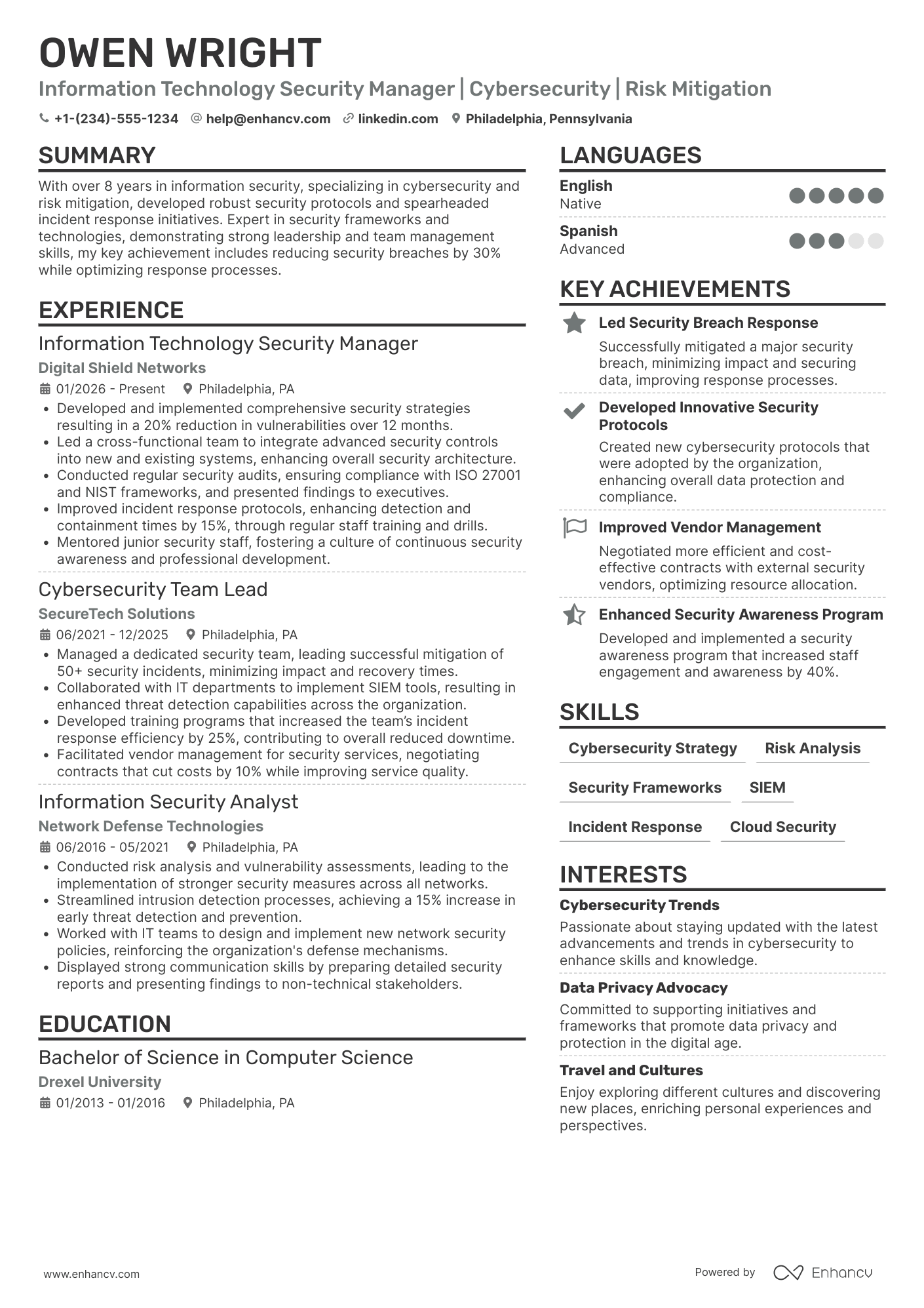
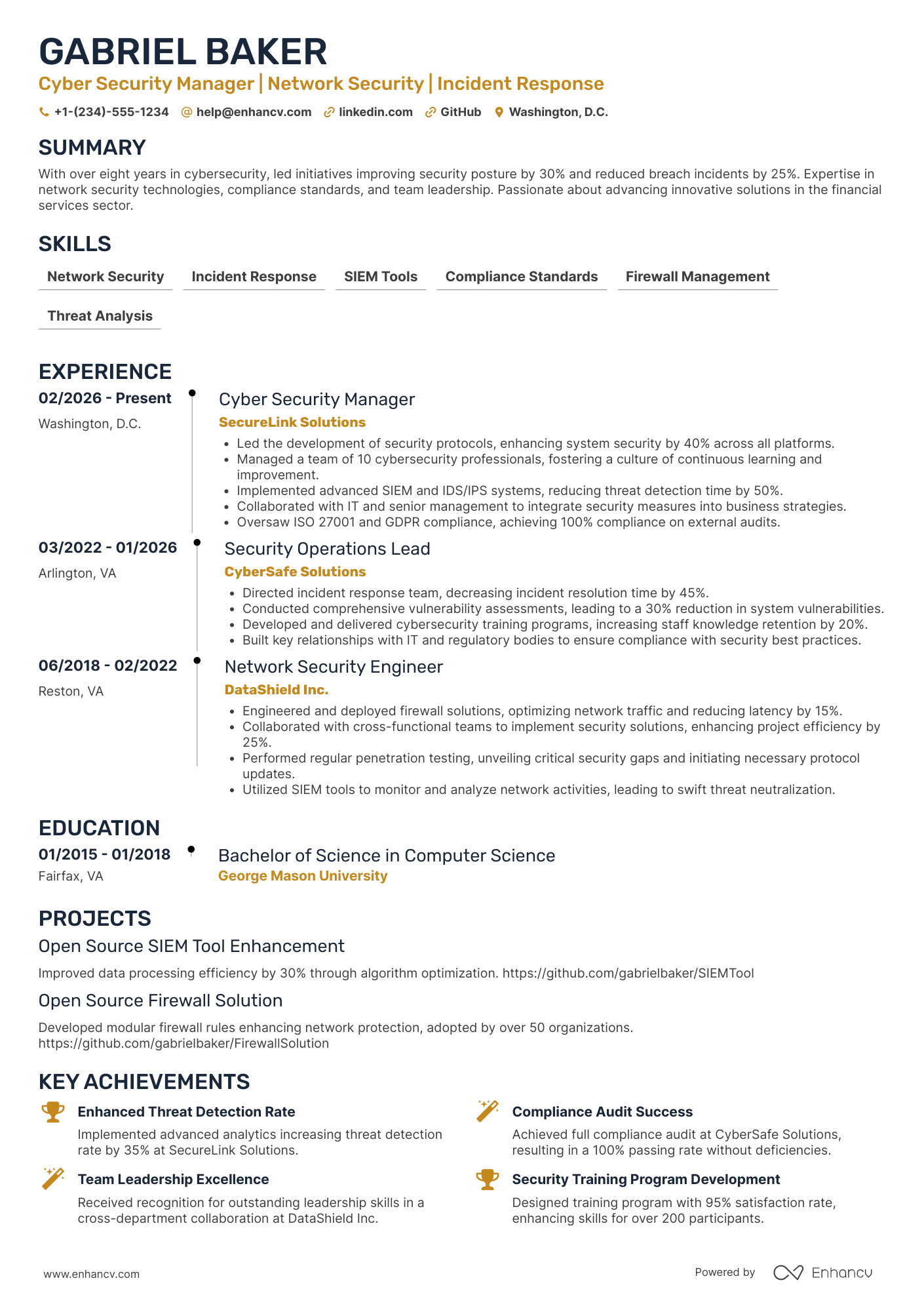
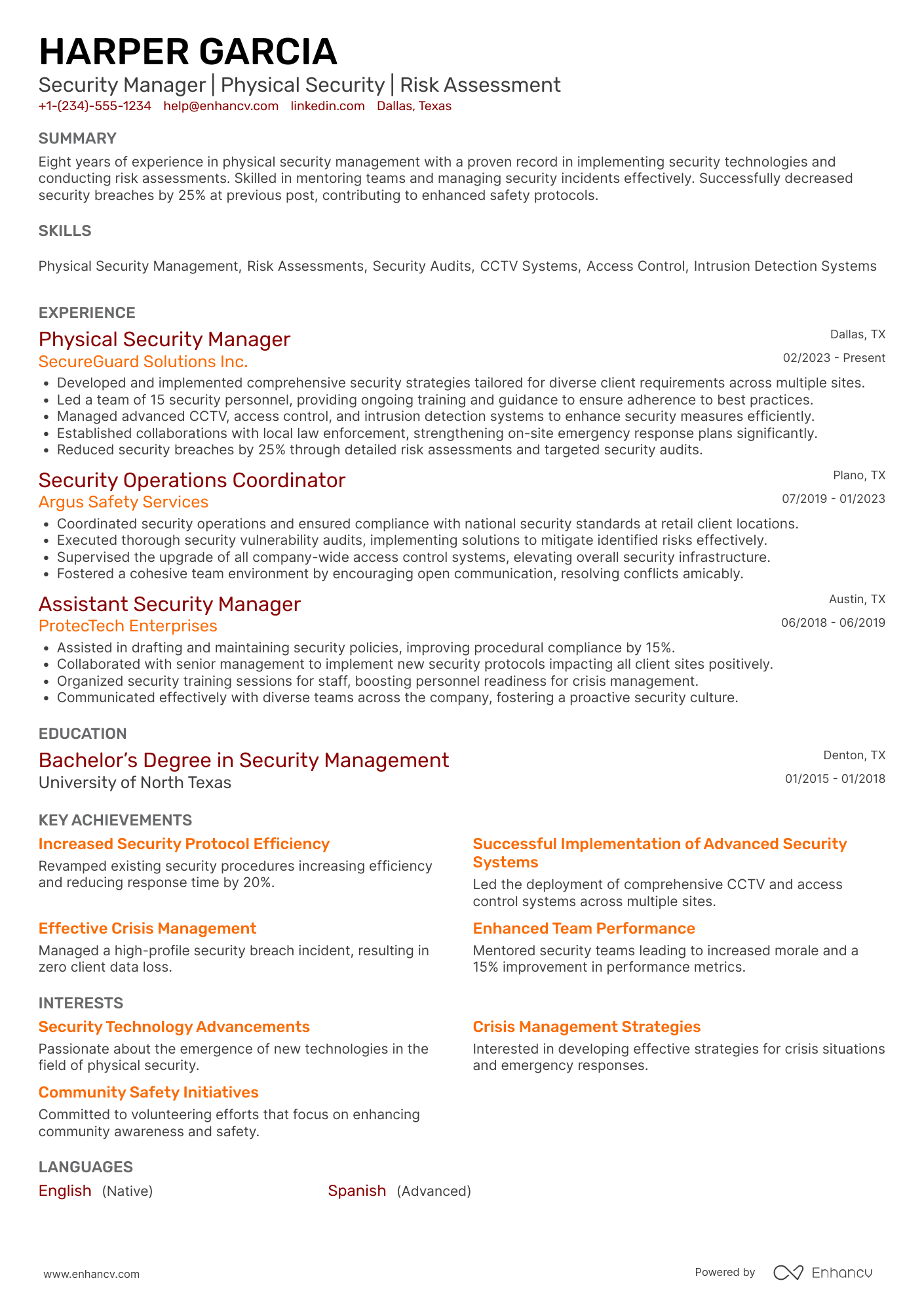
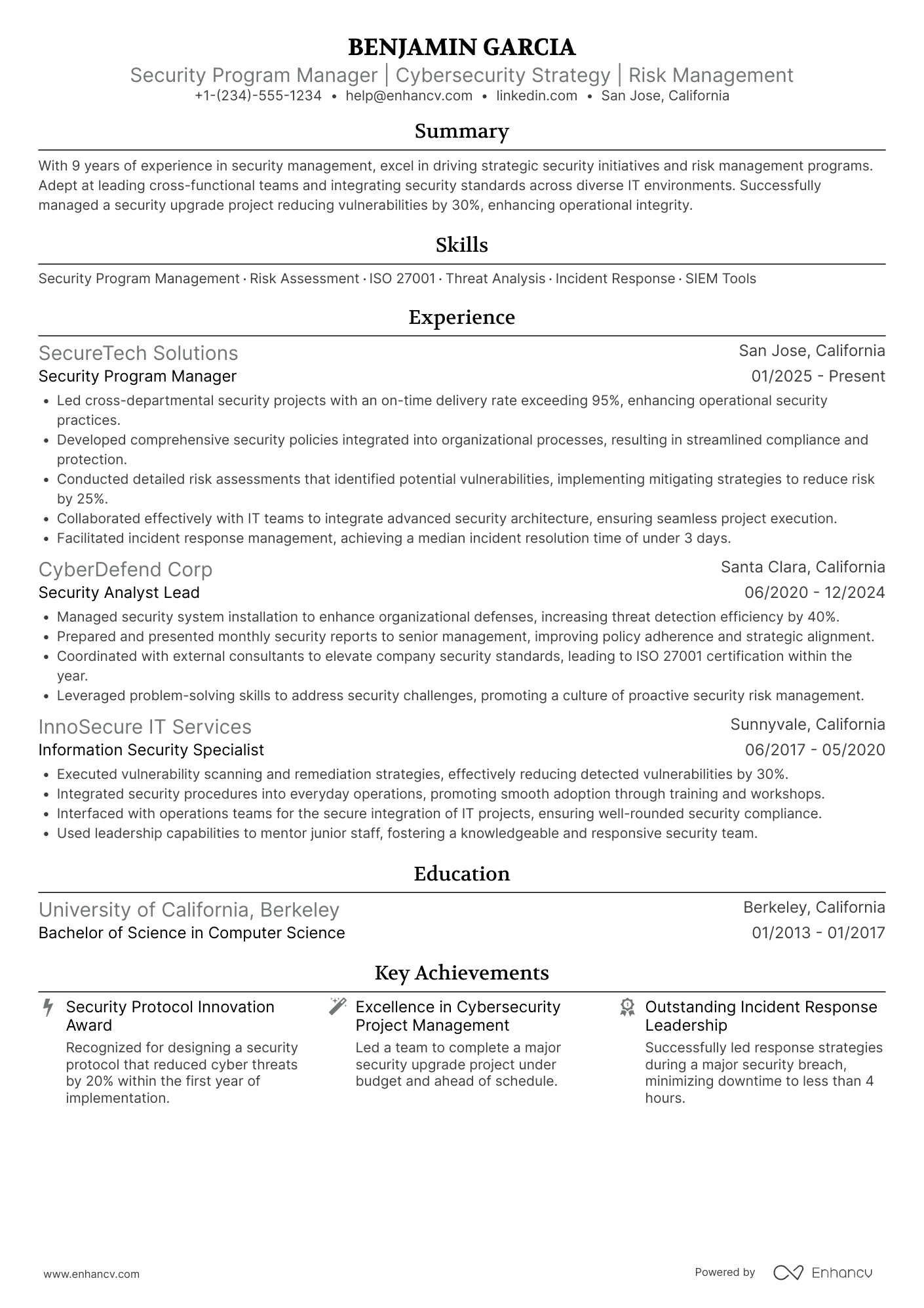
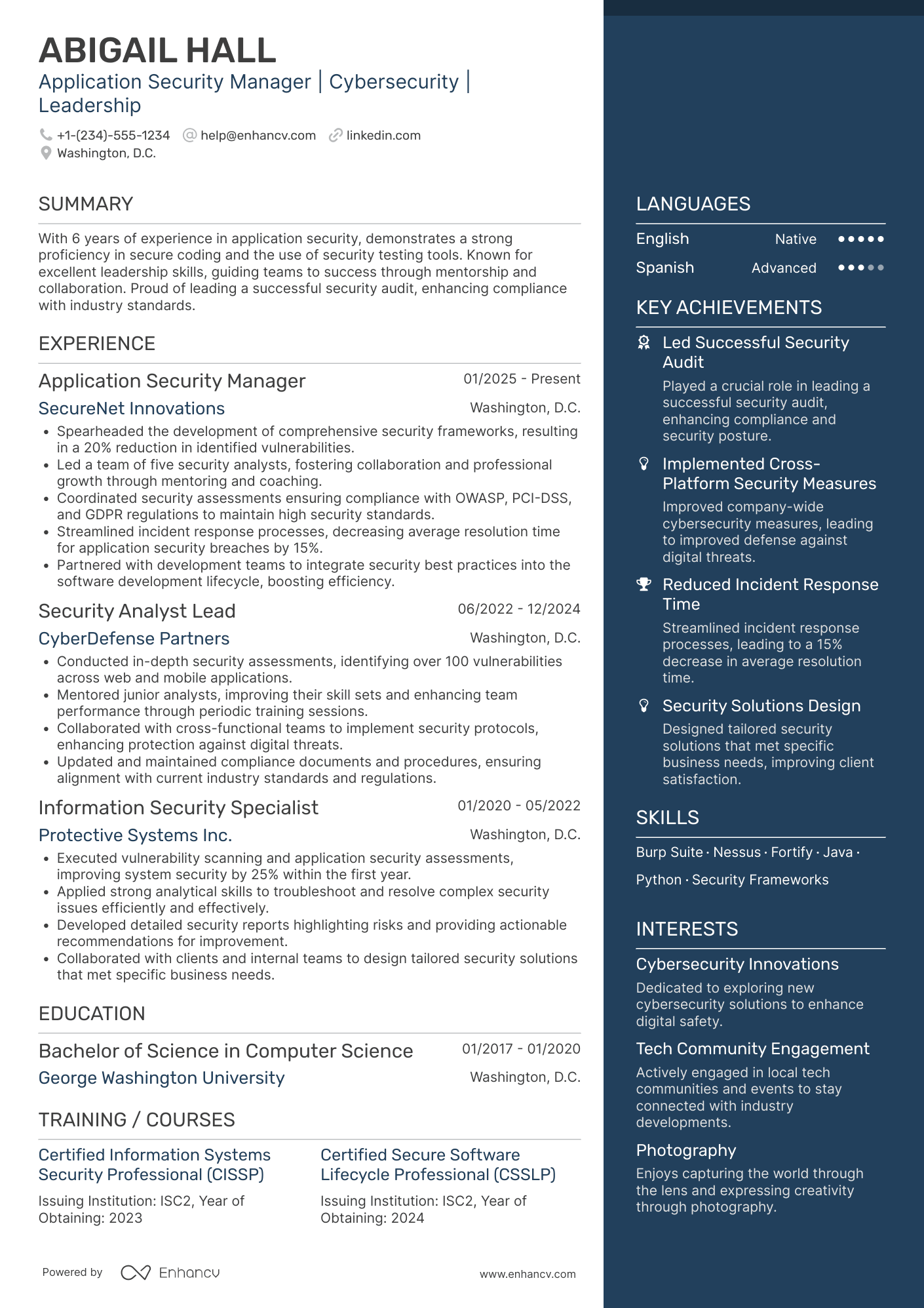
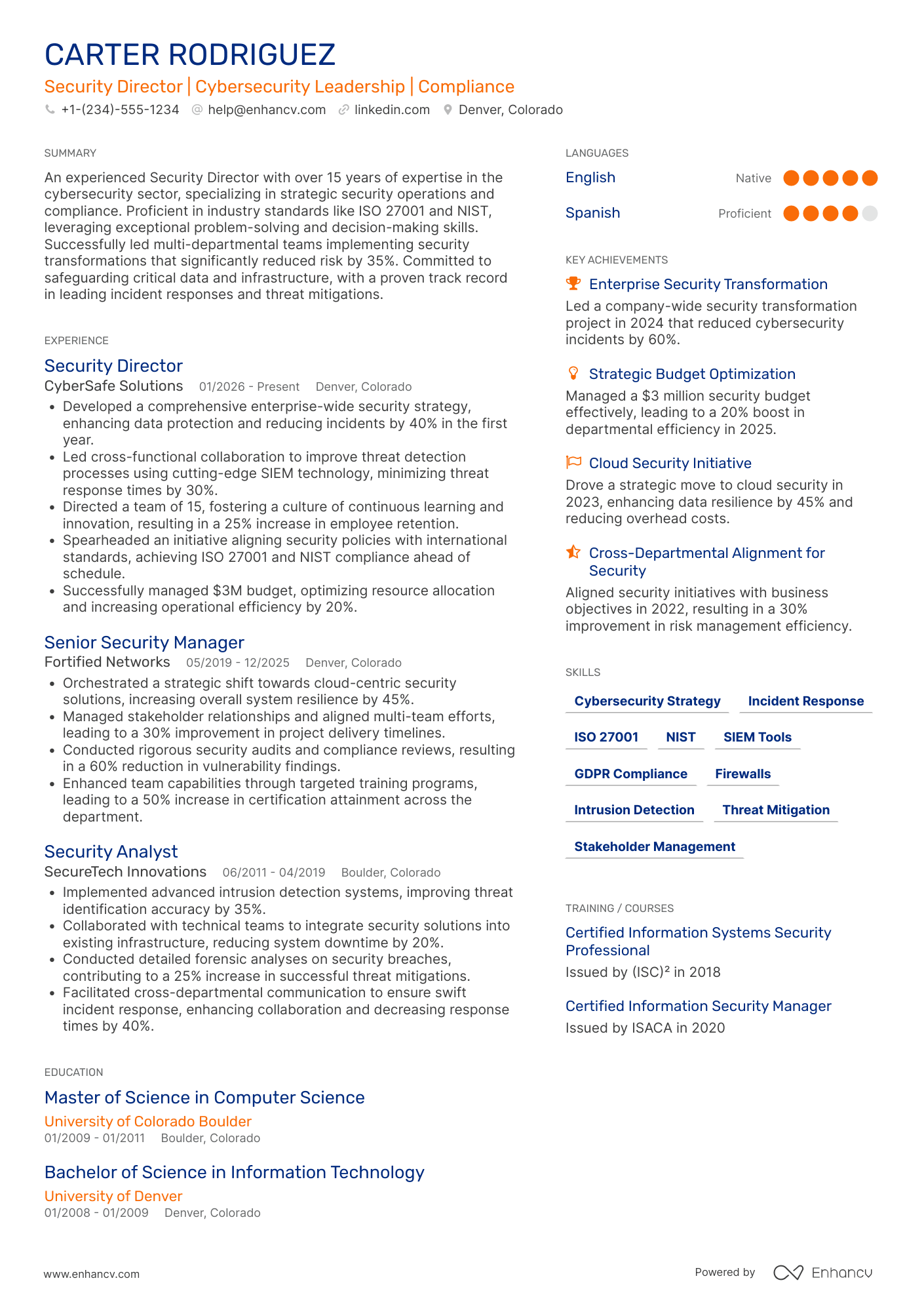
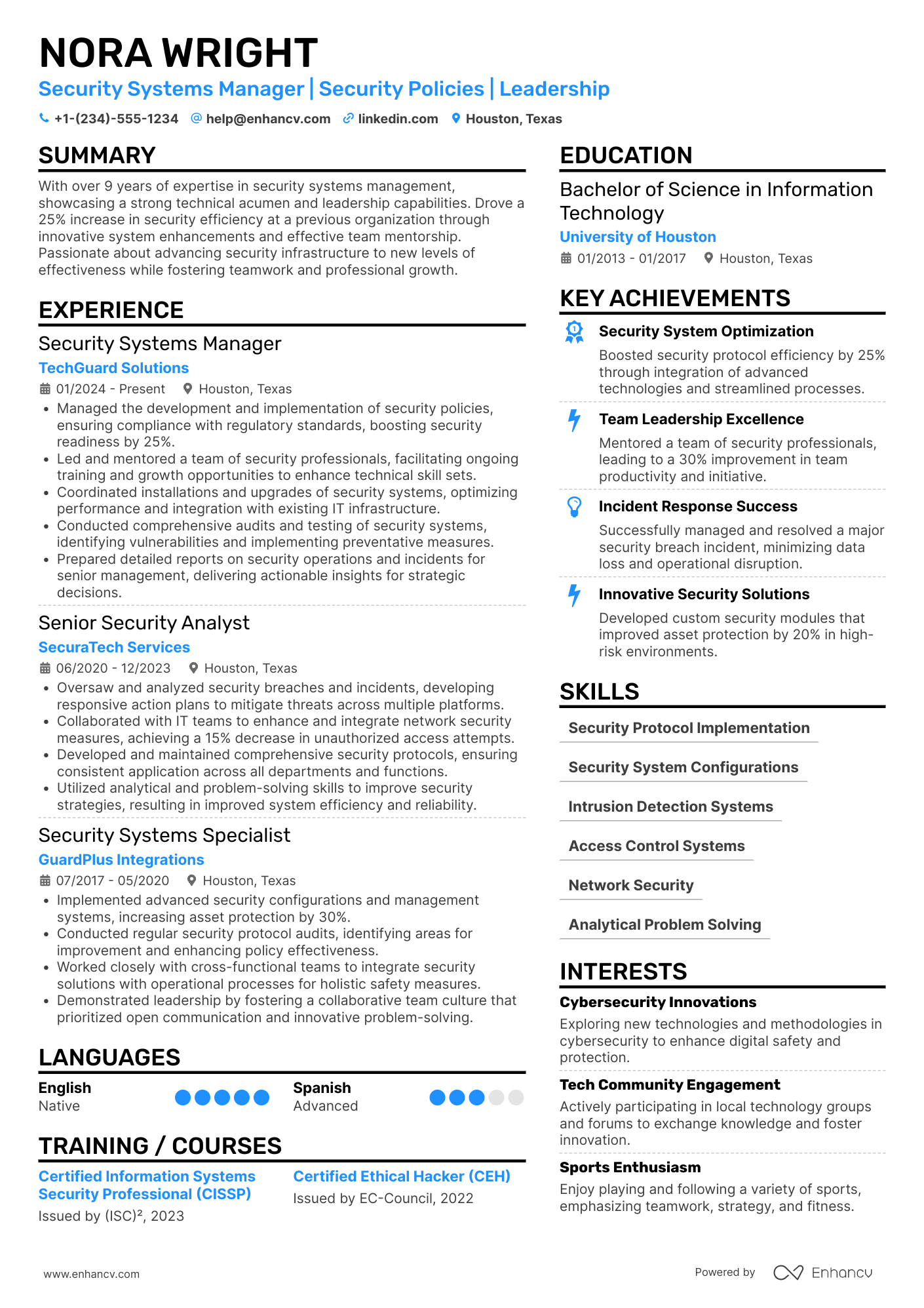
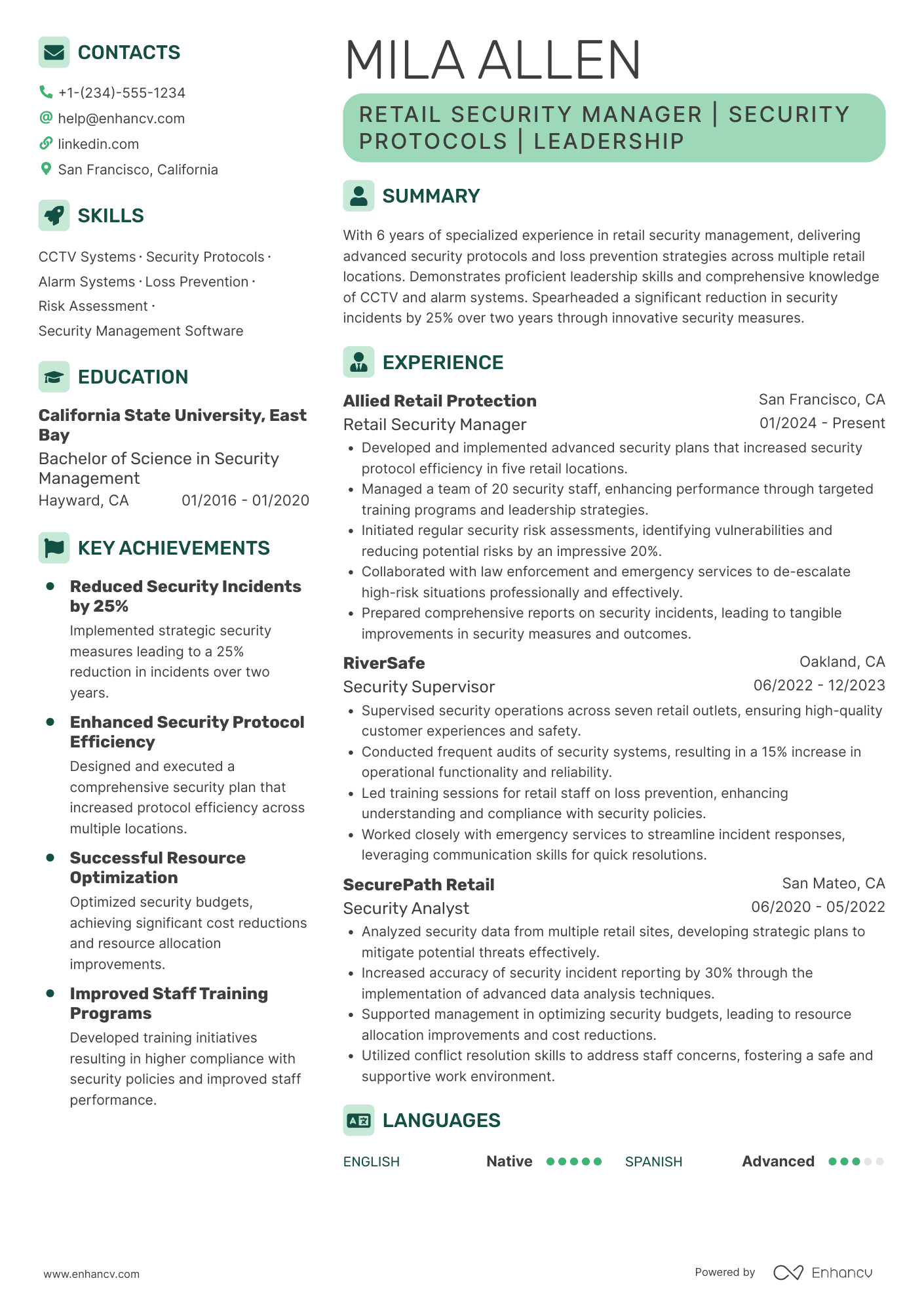
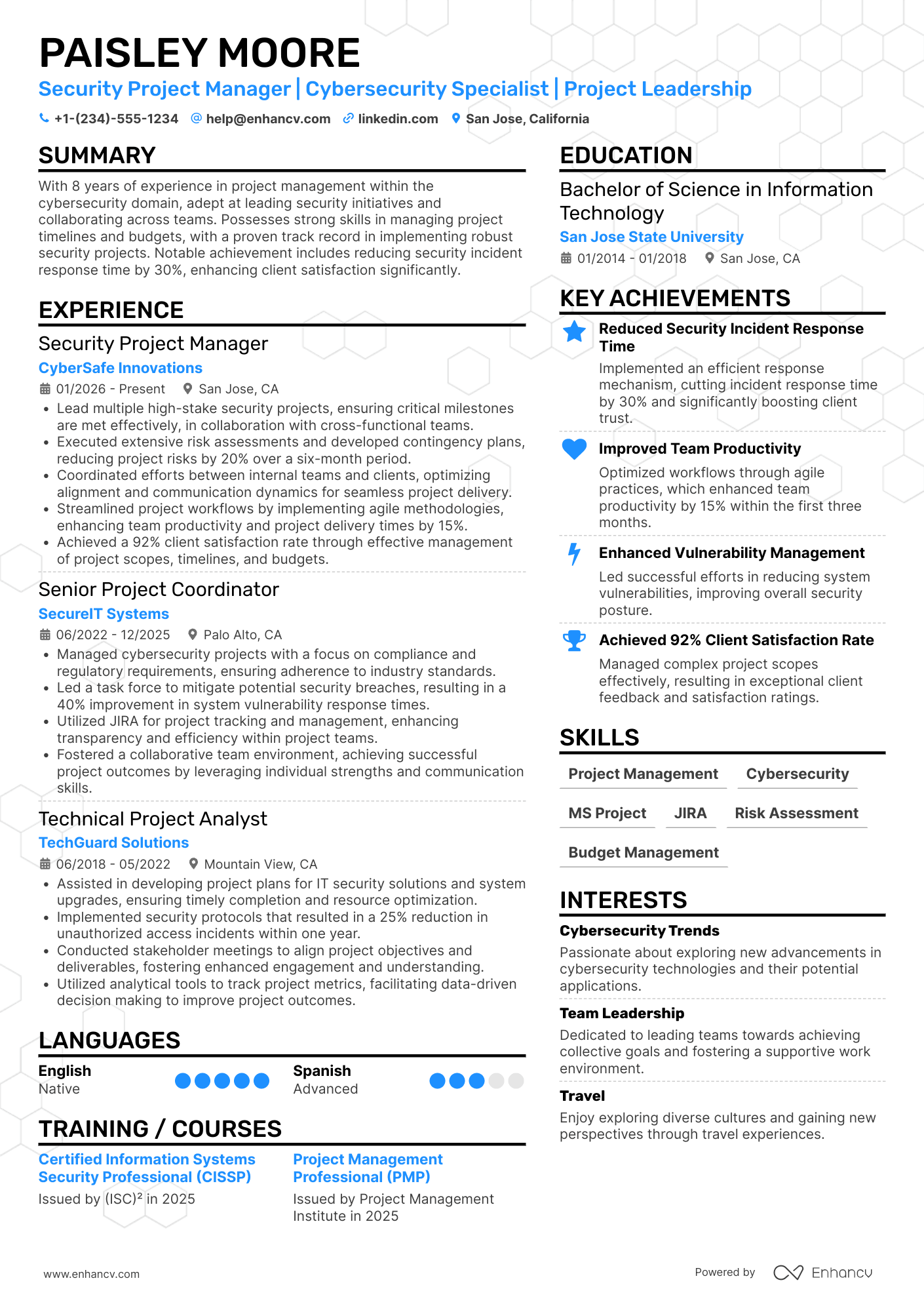
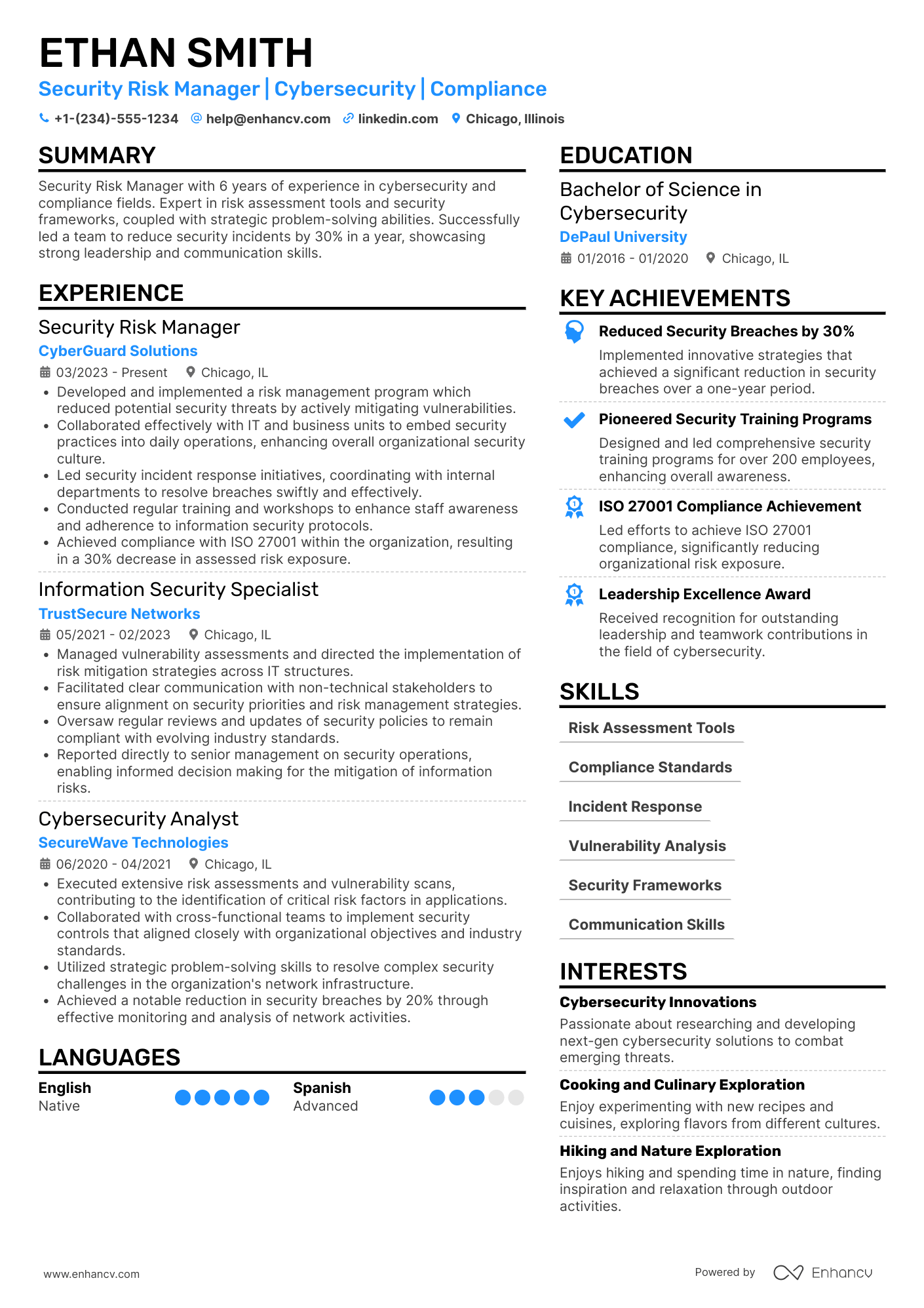
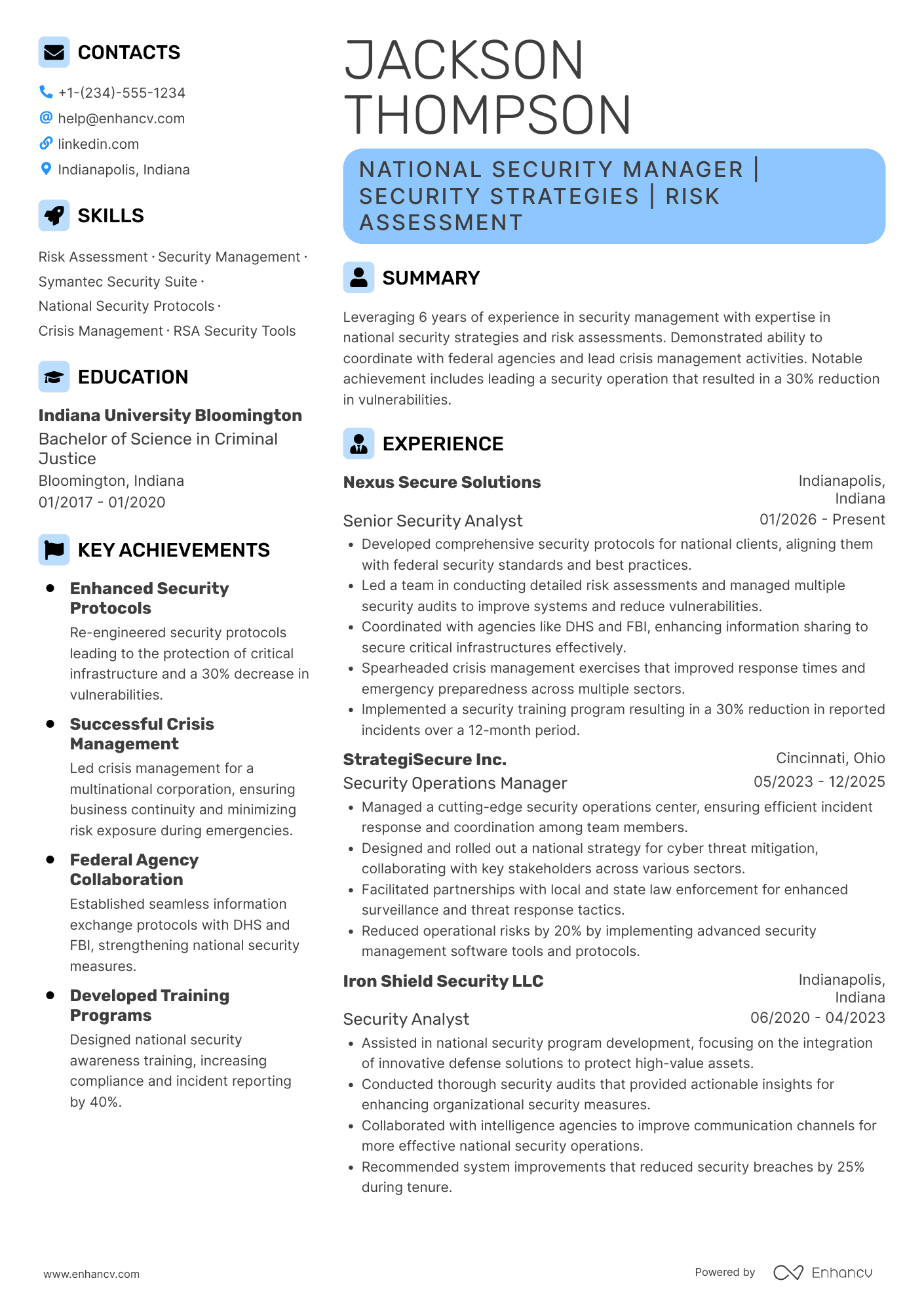
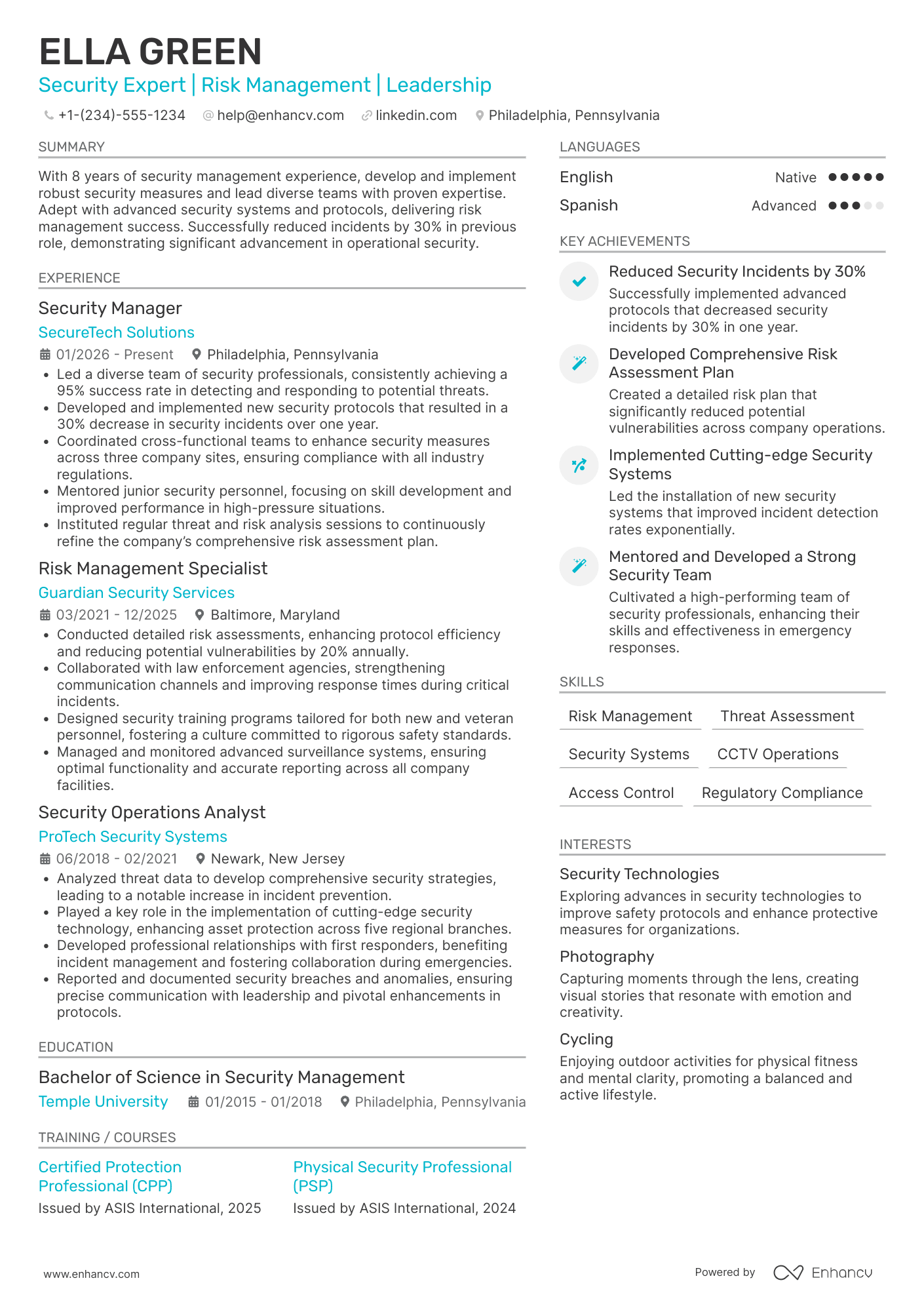
Most security manager resume drafts fail because they read like duty logs and bury risk decisions in generic language. That hurts when an ATS (applicant tracking system) filters fast and recruiters scan in seconds in a crowded field.
A resume that lists the frameworks and certs gets the call; what tends to decide it is the security manager cover letter beside it, where program maturity, board-level communication, and how you handle a real incident actually come through.
A strong resume shows what you changed and why it mattered. Knowing how to make your resume stand out is critical in this competitive field. You should quantify risk reduction, incident response time improvements, audit pass rates, coverage across sites, budget stewardship, and fewer critical findings. Emphasize business continuity gains and measurable compliance outcomes.

Key takeaways
- Quantify risk reduction, response times, and audit results instead of listing routine duties.
- Use reverse-chronological format for senior roles to show progressive leadership clearly.
- Mirror the job posting's platforms, frameworks, and compliance language in your experience bullets.
- Anchor every listed skill to a specific action and measurable outcome.
- Place certifications like CPP or CISSP near your education to strengthen recruiter confidence.
- Use AI to tighten language and add metrics, but stop before it invents experience.
- Build a scannable, results-led resume faster with Enhancv to match current hiring expectations.
Job market snapshot for security managers
We analyzed 379 recent security manager job ads across major US job boards. These numbers help you understand regional hotspots, role specialization trends, top companies hiring at a glance.
What level of experience employers are looking for security managers
| Years of Experience | Percentage found in job ads |
|---|---|
| 1–2 years | 4.0% (15) |
| 3–4 years | 6.3% (24) |
| 5–6 years | 36.7% (139) |
| 7–8 years | 7.1% (27) |
| 9–10 years | 6.9% (26) |
| 10+ years | 11.3% (43) |
| Not specified | 34.6% (131) |
Security manager ads by area of specialization (industry)
| Industry (Area) | Percentage found in job ads |
|---|---|
| Finance & Banking | 45.9% (174) |
| Healthcare | 30.3% (115) |
| Education | 11.9% (45) |
| Manufacturing | 4.0% (15) |
Top companies hiring security managers
| Company | Percentage found in job ads |
|---|---|
| Accenture | 21.1% (80) |
| Boeing | 4.7% (18) |
| RTX Corporation | 3.4% (13) |
Role overview stats
These tables show the most common responsibilities and employment types for security manager roles. Use them to align your resume with what employers expect and to understand how the role is structured across the market.
Day-to-day activities and top responsibilities for a security manager
| Responsibility | Percentage found in job ads |
|---|---|
| Cissp | 28.2% (107) |
| Cism | 17.7% (67) |
| Cisa | 16.1% (61) |
| Cybersecurity | 13.5% (51) |
| Incident response | 13.5% (51) |
| Rmf | 11.1% (42) |
| Security analytics | 10.3% (39) |
| Nextlabs | 9.8% (37) |
| Onapsis | 9.8% (37) |
| Pathlock | 9.8% (37) |
| Sap grc | 9.8% (37) |
| Automated external application scanning | 9.5% (36) |
Type of employment (remote vs on-site vs hybrid)
| Employment type | Percentage found in job ads |
|---|---|
| On-site | 86.5% (328) |
| Hybrid | 10.3% (39) |
| Remote | 3.2% (12) |
How to format a security manager resume
Recruiters evaluating security manager candidates prioritize evidence of progressive responsibility, risk management expertise, and measurable improvements to organizational security posture. Choosing the right resume format ensures these signals surface quickly during both automated screening and manual review.

I have significant experience in this role—which format should I use?
Use a reverse-chronological format to present your security management career in a clear, progression-driven timeline. Do:
- Lead with your most recent role and emphasize scope of oversight—team size, facility count, budget authority, and reporting structure.
- Highlight domain-specific expertise such as physical security systems, access control platforms, incident management frameworks, regulatory compliance (ASIS, OSHA), and vendor contract oversight.
- Quantify outcomes tied to risk reduction, cost savings, incident response improvements, or audit results.
I'm junior or switching into this role—what format works best?
A hybrid format works best, allowing you to lead with relevant security skills and certifications while still presenting your work history in chronological order. Do:
- Place a dedicated skills section near the top featuring core competencies like surveillance systems, threat assessment, emergency response, and loss prevention.
- Include project-based experience, military service, law enforcement assignments, or internship work that demonstrates transferable security knowledge.
- Connect every listed skill or project to a specific action and a measurable or observable result.
Why hybrid and functional resumes don't work for senior roles
Hybrid and functional formats fragment your career timeline, making it difficult for hiring managers to evaluate how your leadership scope, decision-making authority, and accountability expanded across roles. For a security manager, these formats dilute critical signals like team growth, budget escalation, and the progression from tactical execution to strategic oversight. Avoid hybrid and functional formats entirely if you have five or more years of continuous security management experience with clear upward movement.
- A functional format may be acceptable if you're transitioning into security management from a related field such as law enforcement, military operations, or corporate risk consulting—but only if every listed skill is anchored to a specific project, deployment, or outcome rather than presented in isolation.
Once your layout and formatting choices are set, the next step is deciding which sections to include on your resume.
What sections should go on a security manager resume
Recruiters expect a security manager resume to show clear leadership, risk reduction, and measurable improvements in security operations. Understanding which resume sections to include ensures you present your qualifications in the most effective order.
Use this structure for maximum clarity:
- Header
- Summary
- Experience
- Skills
- Projects
- Education
- Certifications
- Optional sections: Awards, Leadership, Volunteering
Your strongest experience bullets should emphasize scope, outcomes, and measurable impact on risk, incident response, compliance, and team performance.
Is your resume good enough?
Drop your resume here or choose a file. PDF & DOCX only. Max 2MB file size.
Once you’ve organized your resume with the right components in place, the next step is to write your security manager resume experience section to show impact within that structure.
How to write your security manager resume experience
The experience section is where you prove you've delivered real security outcomes—not just occupied a role. Hiring managers reviewing security manager resumes prioritize demonstrated impact through risk mitigation, incident response, compliance enforcement, and program leadership over generic task descriptions.
Each entry should include:
- Job title
- Company and location (or remote)
- Dates of employment (month and year)
Three to five concise bullet points showing what you owned, how you executed, and what outcomes you delivered:
- Ownership scope: the security programs, physical or cyber defense systems, compliance frameworks, facility operations, or teams you were directly accountable for.
- Execution approach: the threat assessment methodologies, surveillance technologies, access control platforms, incident management protocols, or regulatory standards you applied to drive decisions and deliver work.
- Value improved: the measurable changes you created in vulnerability reduction, response time, policy compliance rates, audit readiness, operational continuity, or overall organizational risk posture.
- Collaboration context: how you partnered with law enforcement agencies, IT departments, executive leadership, facilities teams, legal counsel, or external vendors to align security strategy with broader organizational goals.
- Impact delivered: the tangible outcomes your work produced, framed through threat prevention results, regulatory compliance achievements, budget optimization, team development milestones, or enterprise-wide security posture improvements rather than routine activity.
Experience bullet formula
A security manager experience example
✅ Right example - modern, quantified, specific.
Security Manager
Northbridge Health Systems | Austin, TX
2021–Present
Multi-site healthcare provider supporting eight hospitals and thirty outpatient clinics with twenty-four seven operations and regulated patient data.
- Led an enterprise risk assessment and remediation program using NIST Cybersecurity Framework and ISO 27001 controls, reducing high-risk findings by 43% and cutting audit prep time by 35% in partnership with compliance and IT.
- Implemented Microsoft Sentinel (security information and event management) with automated playbooks in Microsoft Defender and ServiceNow, improving mean time to detect from fourteen hours to forty minutes and mean time to respond by 52% across endpoints and cloud workloads.
- Directed a Zero Trust rollout across Microsoft Entra ID, conditional access, and multifactor authentication, increasing phishing-resistant authentication coverage from 18% to 86% and reducing account takeover incidents by 61%.
- Managed third-party security reviews for one hundred twenty vendors using SIG questionnaires and contract security addenda, removing or mitigating ninety-two critical data-handling gaps and preventing an estimated $1.1M in downstream remediation costs.
- Ran quarterly tabletop exercises and incident response drills aligned to NIST 800-61 with legal, HR, engineering, and executive stakeholders, cutting escalation time by 47% and improving post-incident corrective action closure rate to 95% within thirty days.
Now that you've seen how to structure a strong experience entry, let's focus on customizing it to match the specific job you're targeting.
How to tailor your security manager resume experience
Recruiters evaluate your security manager resume through both applicant tracking systems and manual review. Tailoring your resume to the job description ensures your qualifications connect directly with what hiring teams prioritize.
Ways to tailor your security manager experience:
- Match specific security platforms and access control systems named in the posting.
- Mirror the exact compliance frameworks and regulatory standards the employer references.
- Align your incident response terminology with the language used in the description.
- Reflect the risk assessment methodologies or threat analysis approaches they mention.
- Include relevant industry experience such as healthcare or financial sector security.
- Emphasize physical security or cybersecurity focus depending on the role's scope.
- Highlight team leadership structures and cross-departmental collaboration models they describe.
- Quantify results using the same performance metrics or KPIs the posting prioritizes.
Tailoring means aligning your real accomplishments with the employer's stated priorities, not artificially inserting keywords where they don't belong.
Resume tailoring examples for security manager
| Job description excerpt | Untailored | Tailored |
|---|---|---|
| "Oversee physical security operations across multiple facilities, including access control systems (Lenel OnGuard), CCTV monitoring, and guard force management for 500+ employees." | Managed security operations for a company. | Directed physical security operations across four facilities using Lenel OnGuard access control, managed a 30-person guard force, and maintained CCTV surveillance coverage for 500+ employees with zero unauthorized breaches over two years. |
| "Conduct risk assessments aligned with ASIS standards, develop threat mitigation strategies, and coordinate with local law enforcement to maintain emergency response readiness." | Performed risk assessments and worked with outside agencies. | Conducted quarterly risk assessments aligned with ASIS standards across all corporate sites, developed threat mitigation strategies that reduced incident response times by 35%, and established a joint emergency response protocol with three local law enforcement agencies. |
| "Manage a $2M annual security budget, negotiate vendor contracts for security technology upgrades, and ensure compliance with OSHA and state regulatory requirements." | Handled the security budget and vendor relationships. | Managed a $2M annual security budget, negotiated vendor contracts for security technology upgrades—including IP camera migration and intrusion detection systems—saving $180K over three years while maintaining full OSHA and state regulatory compliance. |
Once you’ve aligned your experience with the role’s priorities, quantify your security manager achievements to show the measurable impact of that work.
How to quantify your security manager achievements
Quantifying your achievements shows how you reduced risk, improved compliance, and strengthened operations. Focus on incident reduction, audit results, response times, training completion, and cost savings from smarter controls.
Quantifying examples for security manager
| Metric | Example |
|---|---|
| Incident reduction | "Cut security incidents by 32% in twelve months by deploying CrowdStrike and tightening privileged access reviews across 1,200 endpoints." |
| Response time | "Reduced mean time to respond from 4 hours to 55 minutes by implementing PagerDuty runbooks and a seven-person on-call rotation." |
| Compliance outcomes | "Achieved ISO 27001 surveillance audit with zero major nonconformities by closing 48 control gaps and standardizing evidence collection in Jira." |
| Vulnerability risk | "Lowered critical vulnerability backlog from 210 to 28 in nine weeks by enforcing SLA-based patching and weekly Nessus reporting." |
| Cost efficiency | "Saved $180,000 annually by consolidating three security tools into Microsoft Defender and negotiating enterprise licensing for 900 users." |
Turn vague job duties into measurable, recruiter-ready resume bullets in seconds with Enhancv's Bullet Point Generator.
Once you've crafted strong bullet points to showcase your experience, the next step is ensuring your resume highlights the right mix of hard and soft skills that security manager roles demand.
How to list your hard and soft skills on a security manager resume
Your skills section shows hiring teams and an ATS (applicant tracking system) that you can prevent incidents, manage risk, and lead security operations, so use this section to mirror the job post with role-specific hard skills and a smaller set of execution-focused soft skills. security manager roles require a blend of:
- Product strategy and discovery skills.
- Data, analytics, and experimentation skills.
- Delivery, execution, and go-to-market discipline.
- Soft skills.
Your skills section should be:
- Scannable (bullet-style grouping).
- Relevant to the job post.
- Backed by proof in experience bullets.
- Updated with current tools.
Place your skills section:
- Above experience if you're junior or switching careers.
- Below experience if you're mid/senior with strong achievements.

Hard skills
- Security risk assessments
- Physical security operations
- Access control systems, badge management
- Video surveillance systems, CCTV
- Incident response, investigations
- Threat and vulnerability management
- Security audits, compliance controls
- Business continuity, crisis management
- Security policy and SOP development
- Guard force management, post orders
- Vendor management, contract SLAs
- Security metrics, KPI reporting
Soft skills
- Lead cross-functional incident response
- De-escalate conflicts under pressure
- Communicate risk to executives
- Write clear, enforceable policies
- Make time-critical decisions
- Coach and hold teams accountable
- Coordinate with law enforcement
- Conduct fair, thorough interviews
- Prioritize high-impact mitigations
- Negotiate with vendors and partners
- Deliver concise status updates
- Drive continuous process improvement
How to show your security manager skills in context
Skills shouldn't live only in a standalone list. Explore resume skills examples to see how security professionals integrate competencies throughout their resumes.
They should be demonstrated in:
- Your summary (high-level professional identity)
- Your experience (proof through outcomes)
Here's what this looks like in practice.
Summary example
Security manager with 12 years in enterprise risk mitigation, skilled in SIEM platforms, threat modeling, and cross-functional incident response. Led vulnerability remediation programs that reduced critical exposures by 64% across global infrastructure.
- Reflects senior-level experience clearly
- Names specific tools and methods
- Leads with a measurable outcome
- Signals leadership and collaboration ability
Experience example
Senior Security Manager
Colbridge Financial Group | Chicago, IL
March 2019–Present
- Deployed CrowdStrike and Splunk SIEM across 14 offices, cutting mean detection time from 72 hours to under six.
- Partnered with IT, legal, and compliance teams to redesign the incident response framework, reducing breach containment costs by 41%.
- Led a 10-person security operations team through SOC 2 Type II certification with zero critical findings on first audit.
- Every bullet includes measurable proof
- Skills surface naturally through real outcomes
Once you’ve anchored your security manager strengths in real examples and measurable outcomes, the next step is translating that approach into a resume when you don’t have direct experience.
How do I write a security manager resume with no experience
Even without full-time experience, you can demonstrate readiness through building a resume without work experience that highlights transferable skills:
- Campus security team leadership
- Volunteer event security coordination
- Security audits for student groups
- Incident report writing practice
- Access control system administration
- Emergency response tabletop exercises
- Safety training facilitation certificates
- Internship in facilities operations
Focus on:
- Incident prevention and response metrics
- Access control and badge workflows
- Policy writing with compliance mapping
- Audit logs and documentation quality
Resume format tip for entry-level security manager
Use a hybrid resume format because it highlights security-relevant projects and certifications while still showing steady work history and leadership roles. Do:
- Lead with a targeted summary and keywords.
- List tools, systems, and standards used.
- Quantify outcomes: incidents, coverage, time.
- Add a projects section above experience.
- Include policies, reports, and audits.
- Administered campus access control in LenelS2, audited two hundred badge records, and reduced unauthorized entry alerts by twenty percent through updated role-based permissions.
Even without direct experience, your educational background can strengthen your candidacy—here's how to present it effectively on your security manager resume.
How to list your education on a security manager resume
Your education section helps hiring teams confirm you have the foundational knowledge needed for a security manager role. It validates your academic background quickly and efficiently.
Include:
- Degree name
- Institution
- Location
- Graduation year
- Relevant coursework (for juniors or entry-level candidates)
- Honors & GPA (if 3.5 or higher)
Avoid listing specific months or days for graduation. Use the year only to keep things clean and concise.
Here's a strong education entry tailored for a security manager resume.
Example education entry
Bachelor of Science in Criminal Justice
George Mason University, Fairfax, VA
Graduated 2018
GPA: 3.7/4.0
- Relevant coursework: Risk Assessment, Emergency Management, Corporate Security Planning, Criminology
- Honors: Magna Cum Laude, Dean's List (six semesters)
How to list your certifications on a security manager resume
Certifications on your resume show a security manager's commitment to continuous learning, hands-on tool proficiency, and current industry knowledge. They also help hiring teams verify specialized training beyond on-the-job experience.
Include:
- Certificate name
- Issuing organization
- Year
- Optional: credential ID or URL
- Put certifications below education when your degrees are recent and more relevant than certifications for the security manager role.
- Put certifications above education when they are recent, role-critical, or stronger signals than older education for a security manager.
Best certifications for your security manager resume
Certified Information Systems Security Professional (CISSP) Certified Information Security Manager (CISM) Certified Protection Professional (CPP) Physical Security Professional (PSP) Certified Information Systems Auditor (CISA) GIAC Security Essentials (GSEC) Project Management Professional (PMP)
Once you’ve positioned your credentials where they’re easy to verify, you can write your security manager resume summary to reinforce that expertise upfront and set context for the rest of your resume.
How to write your security manager resume summary
Your resume summary is the first thing a recruiter reads. A strong one immediately signals you're qualified for a security manager role and worth a closer look.
Keep it to three to four lines, with:
- Your title and total years of experience in security management.
- Domain focus, such as corporate security, physical security, or risk management.
- Core skills like threat assessment, access control systems, or incident response.
- One or two measurable achievements, such as reduced incidents or improved compliance rates.
- Soft skills tied to real outcomes, like cross-department coordination that streamlined emergency protocols.

PRO TIP
At the mid-level security manager stage, emphasize hands-on leadership and operational results. Highlight team oversight, budget management, and measurable risk reduction. Avoid vague phrases like "passionate leader" or "dedicated professional." Replace them with specifics that prove your impact.
Example summary for a security manager
Security manager with eight years of experience leading corporate security operations. Reduced workplace incidents by 34% through upgraded access control and staff training. Skilled in risk assessment, vendor management, and emergency response coordination.
Optimize your resume summary and objective for ATS
Drop your resume here or choose a file.
PDF & DOCX only. Max 2MB file size.
Now that your summary is crafted to highlight your most compelling qualifications, make sure the header above it presents your contact details correctly so recruiters can actually reach you.
What to include in a security manager resume header
A resume header is the top section with your key identity and contact details, and it drives visibility, credibility, and fast recruiter screening for a security manager.
Essential resume header elements
- Full name
- Tailored job title and headline
- Location
- Phone number
- Professional email
- GitHub link
- Portfolio link
A LinkedIn link helps recruiters verify experience quickly and supports screening.
Do not include a photo on a security manager resume unless the role is explicitly front-facing or appearance-dependent.
Match your header title to the job posting and keep every link current, professional, and easy to scan.
Example
Security manager resume header
Jordan Blake
Security manager | Corporate Security Operations & Risk Management
Austin, TX
(512) 555-01XX
your.name@enhancv.com
github.com/yourname
yourwebsite.com
linkedin.com/in/yourname
Once your contact details and role identifiers are in place, add relevant additional sections to round out your security manager resume with supporting context.
Additional sections for security manager resumes
When your core sections don't fully capture your qualifications, additional sections can strengthen your credibility and set you apart from other security manager candidates.
- Languages
- Professional affiliations and memberships
- Security clearances
- Publications and presentations
- Volunteer experience in public safety
- Awards and commendations
- Hobbies and interests
Once you've strengthened your resume with relevant extra sections, the next step is pairing it with a cover letter that adds even more context to your candidacy.
Do security manager resumes need a cover letter
A cover letter isn't required for a security manager, but it often helps. If you're unsure what a cover letter is and when it adds value, it can matter most in competitive searches or when hiring teams expect a narrative. It also helps when your resume alone doesn't show fit or context.
Use a cover letter to add details your resume can't:
- Explain role and team fit by connecting your scope to the company's security needs and how you partner with engineering, IT, and leadership.
- Highlight one or two relevant projects or outcomes, using clear metrics like reduced incident response time or improved audit readiness.
- Show understanding of the product, users, and business context by naming key risks, compliance needs, and operational constraints you've managed.
- Address career transitions or non-obvious experience by mapping transferable skills to security manager responsibilities and clarifying your progression.
Drop your resume here or choose a file.
PDF & DOCX only. Max 2MB file size.
Even when you decide a cover letter adds value for your application, the next logical step is using AI to improve your security manager resume so it matches the role’s requirements with less manual effort.
Using AI to improve your security manager resume
AI can sharpen your resume's clarity, structure, and impact. It helps refine bullet points, tighten language, and highlight results. But overuse strips authenticity. Once your content reads clearly and aligns with your target role, step away from the tool. For practical starting points, explore these ChatGPT resume writing prompts designed to strengthen specific sections.
Here are 10 practical prompts you can copy and paste to strengthen specific sections of your security manager resume:
- Strengthen your summary: "Rewrite my security manager resume summary to highlight leadership scope, team size, and measurable risk-reduction outcomes in three sentences or fewer."
- Quantify experience bullets: "Add specific metrics—like incident reduction percentages or budget figures—to these security manager experience bullets without changing the core facts."
- Align skills with job posts: "Compare my skills section against this security manager job description and identify which relevant skills are missing from my resume."
- Tighten wordy bullets: "Shorten each of these security manager experience bullets to one concise line while preserving the action, scope, and result."
- Improve action verbs: "Replace weak or repeated verbs in my security manager experience section with strong, specific action verbs appropriate for security leadership."
- Refine project descriptions: "Rewrite this security manager project entry to clearly state the objective, my specific role, tools used, and the measurable outcome."
- Tailor education entries: "Suggest how to reframe my education section to emphasize coursework and achievements most relevant to a security manager role."
- Showcase certifications: "Reorganize my certifications section so the most impactful credentials for a security manager position appear first, with context for each."
- Remove filler language: "Identify and remove vague phrases, clichés, or unnecessary filler words throughout my entire security manager resume."
- Check role alignment: "Review my full security manager resume and flag any bullet points that don't clearly connect to security operations, risk management, or team leadership."
Stop using AI once your resume sounds accurate, specific, and aligned with real experience. AI should never invent experience or inflate claims—if it didn't happen, it doesn't belong here.
Conclusion
A strong security manager resume proves impact with measurable outcomes, shows role-specific skills, and follows a clear structure. Use metrics that reflect risk reduction, incident response results, compliance performance, and team leadership.
Keep your sections easy to scan, and align your experience with current security manager hiring needs. A focused, results-led resume shows you can protect people, assets, and operations now and as expectations evolve.