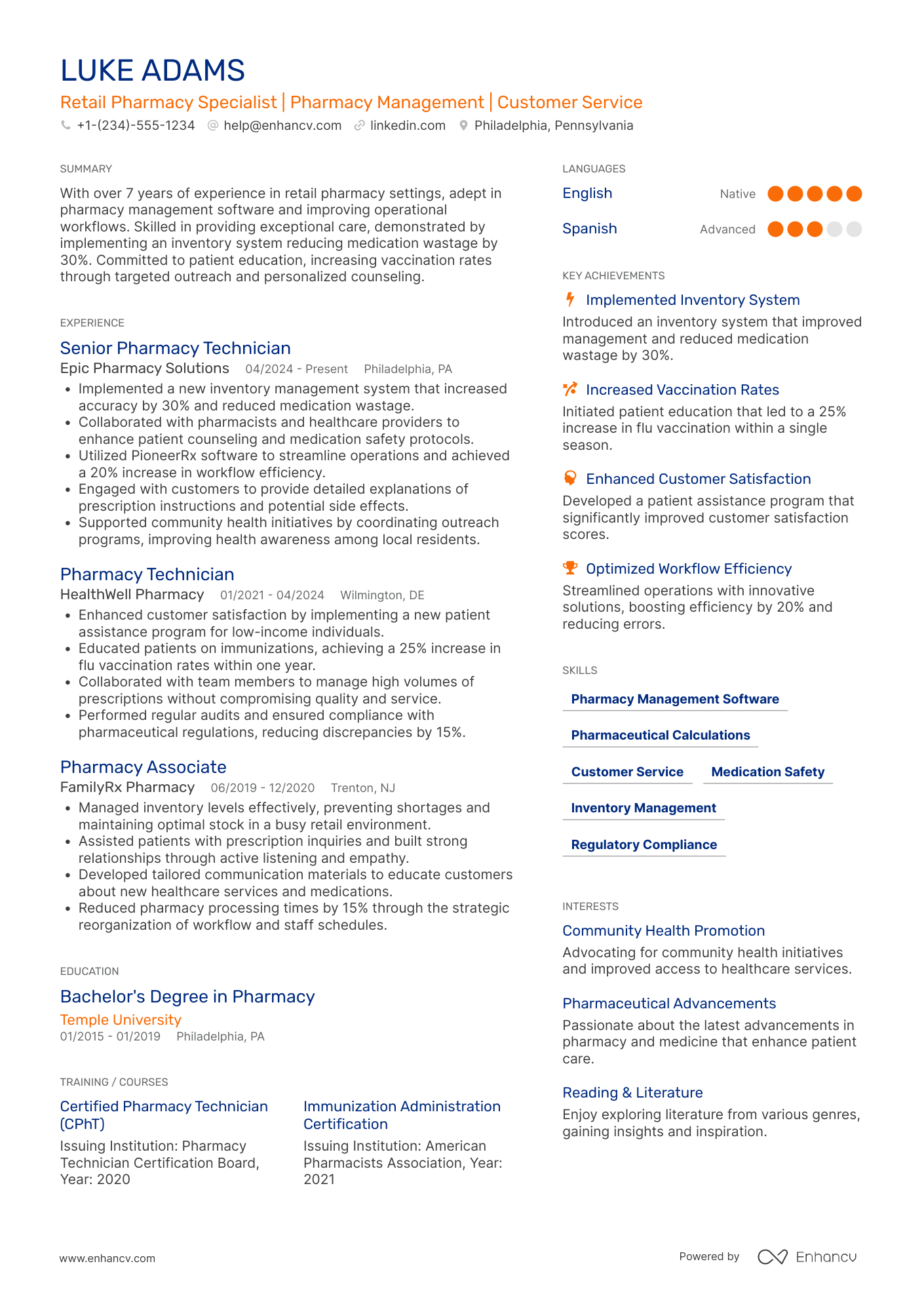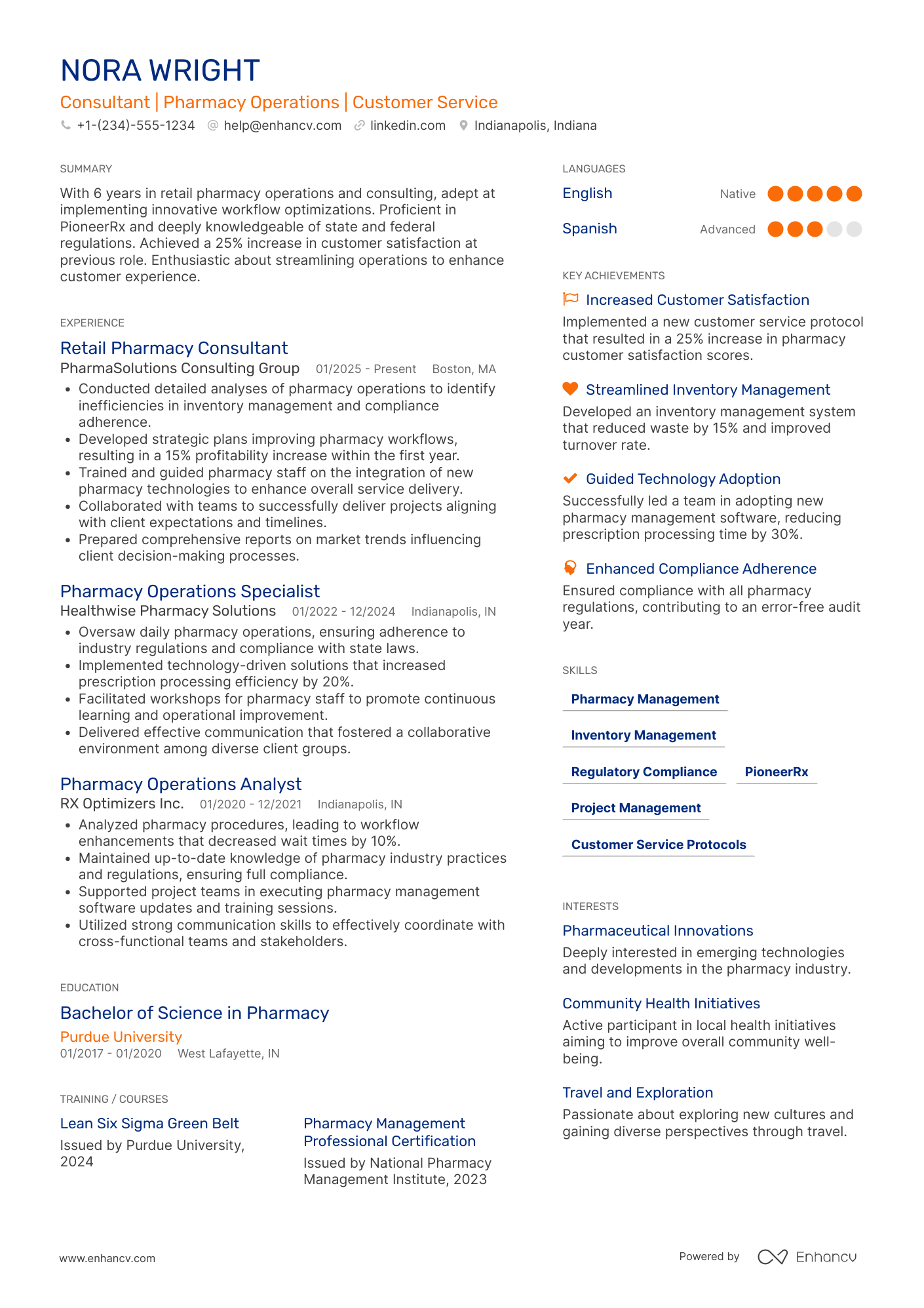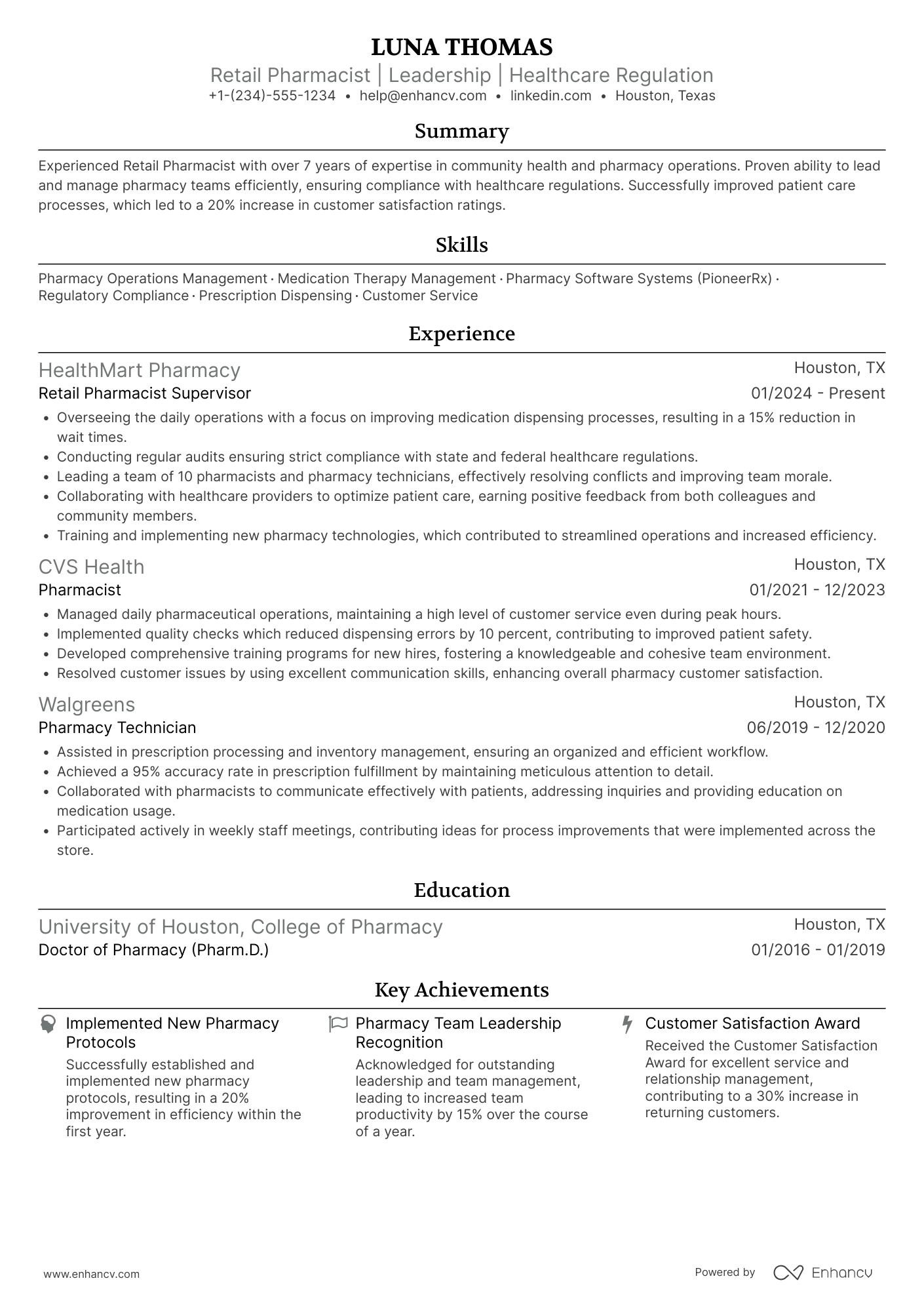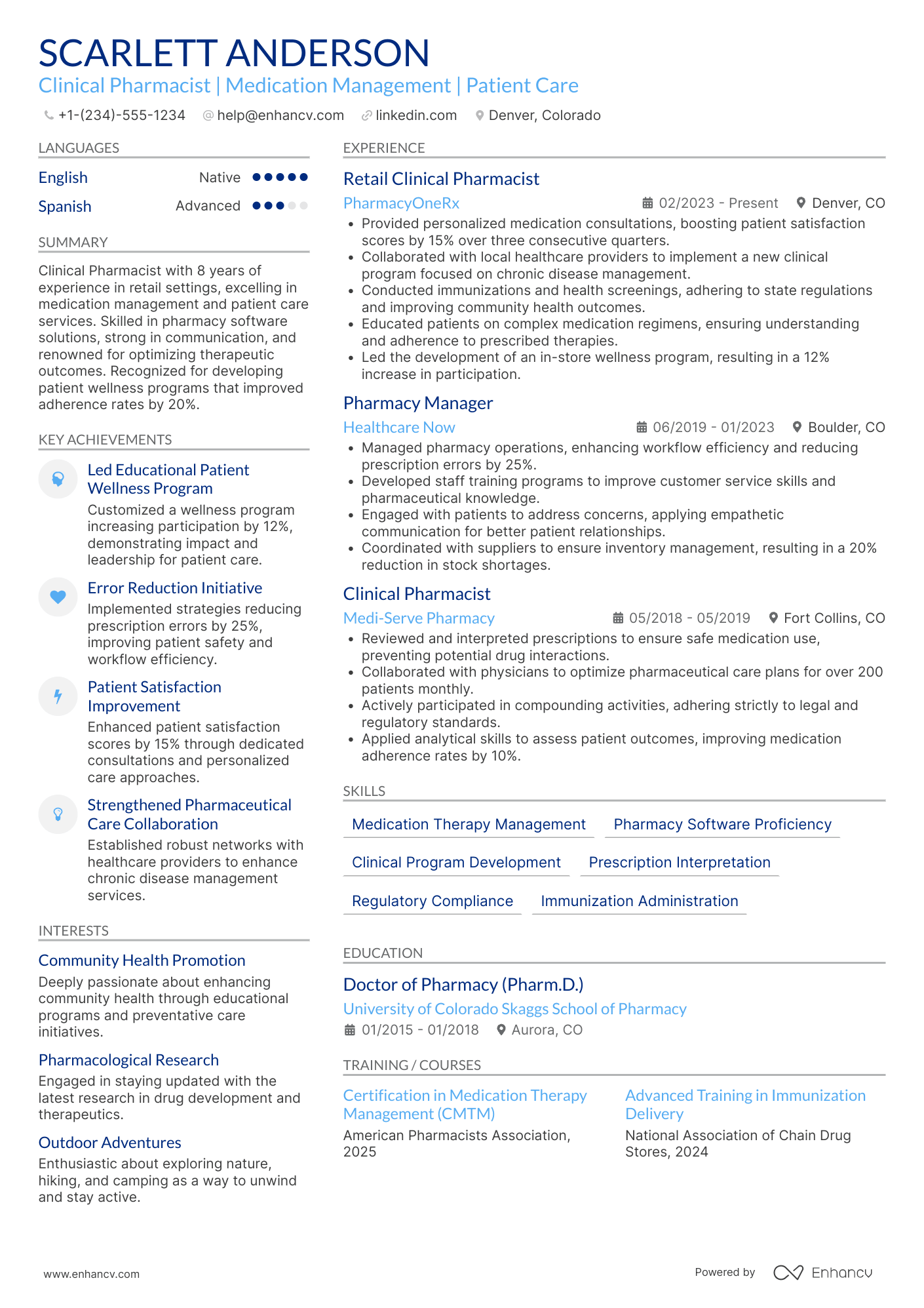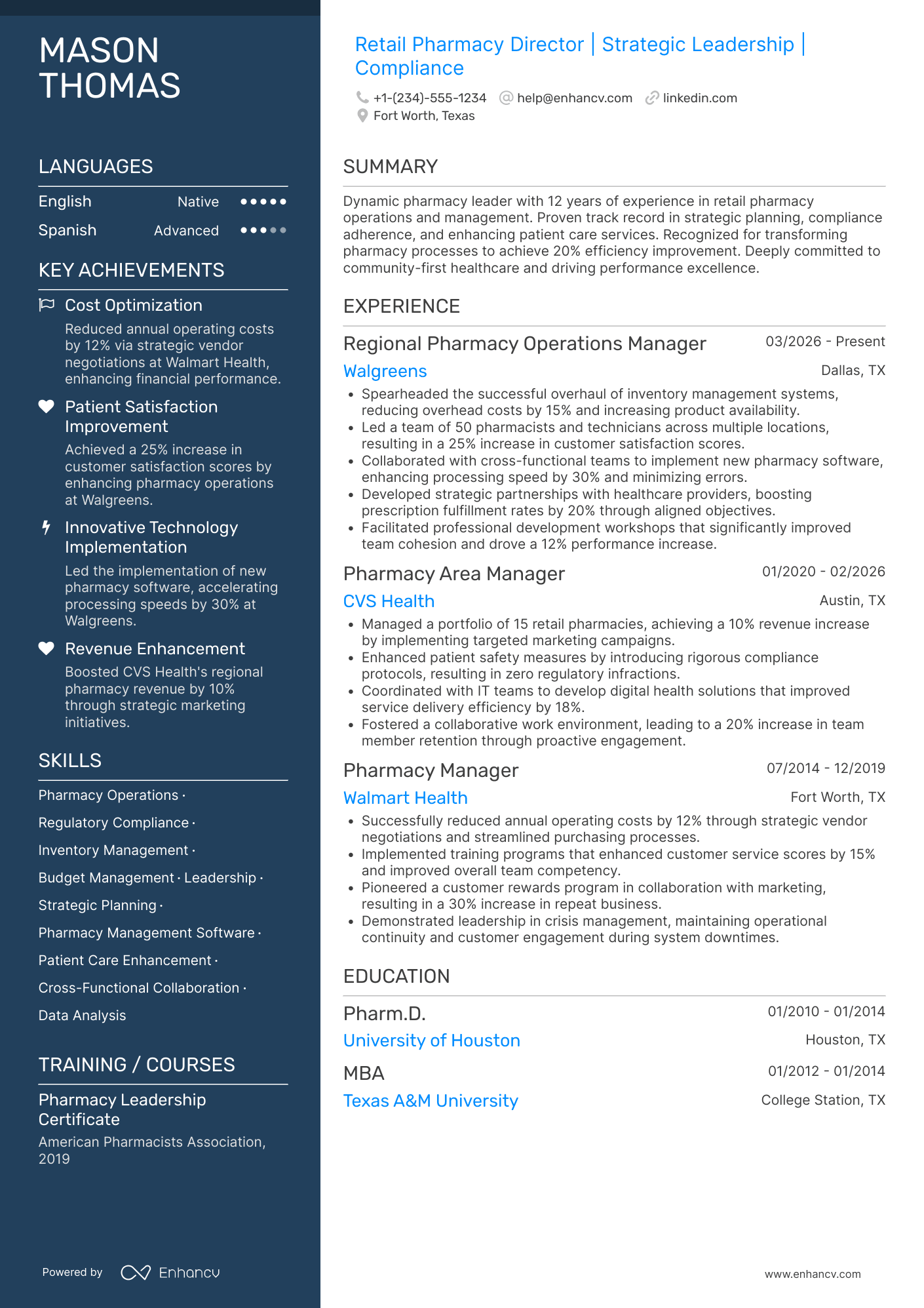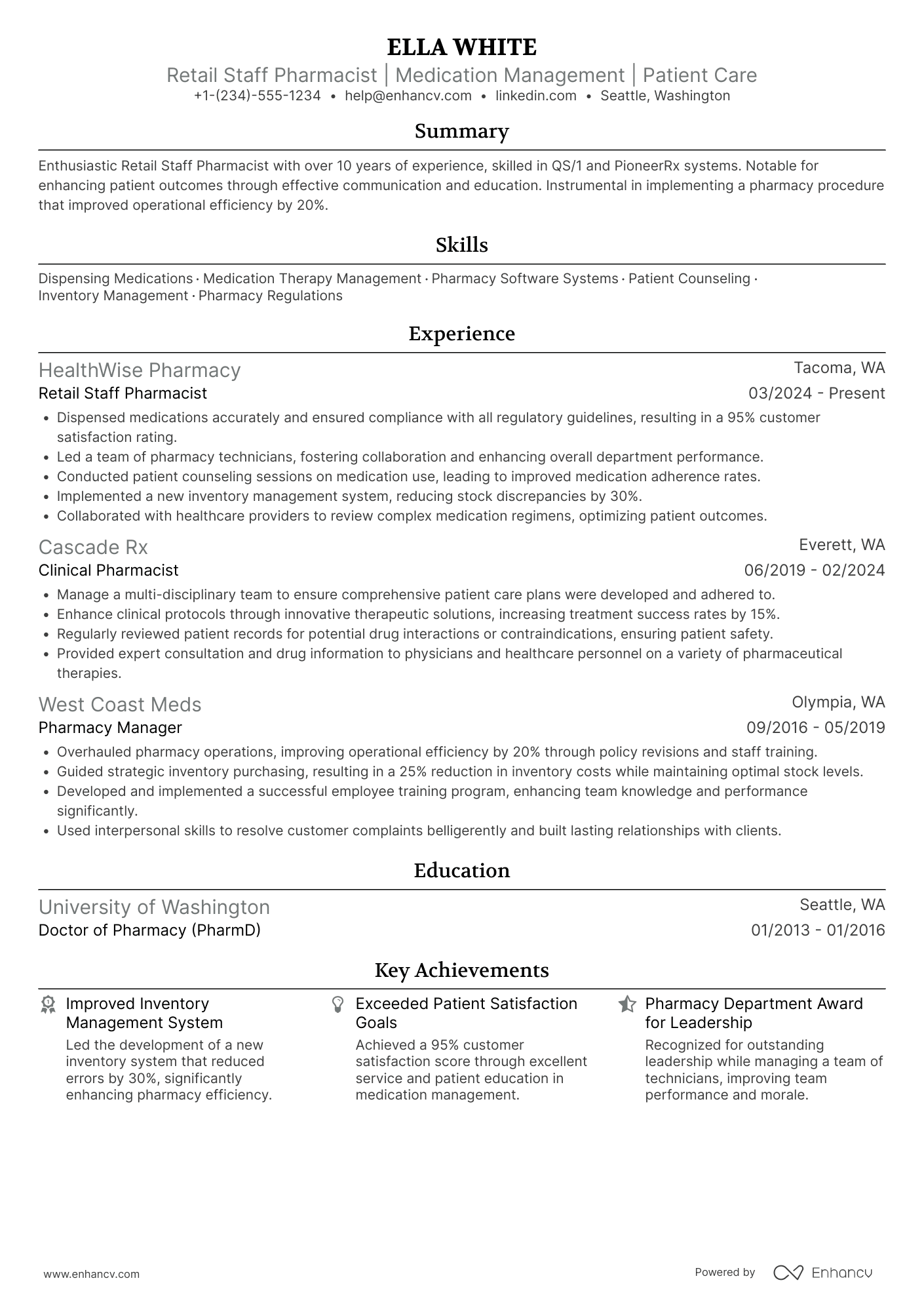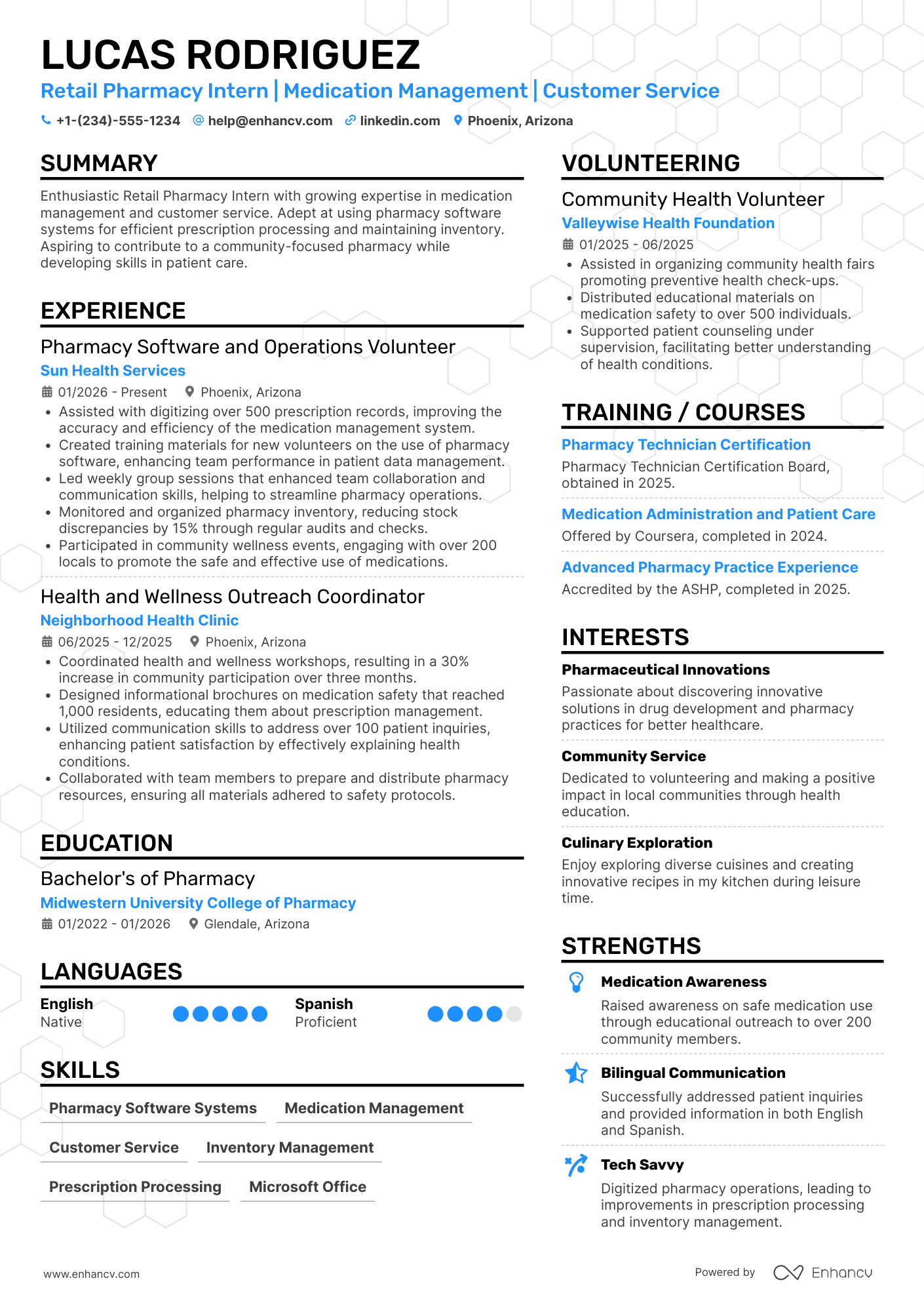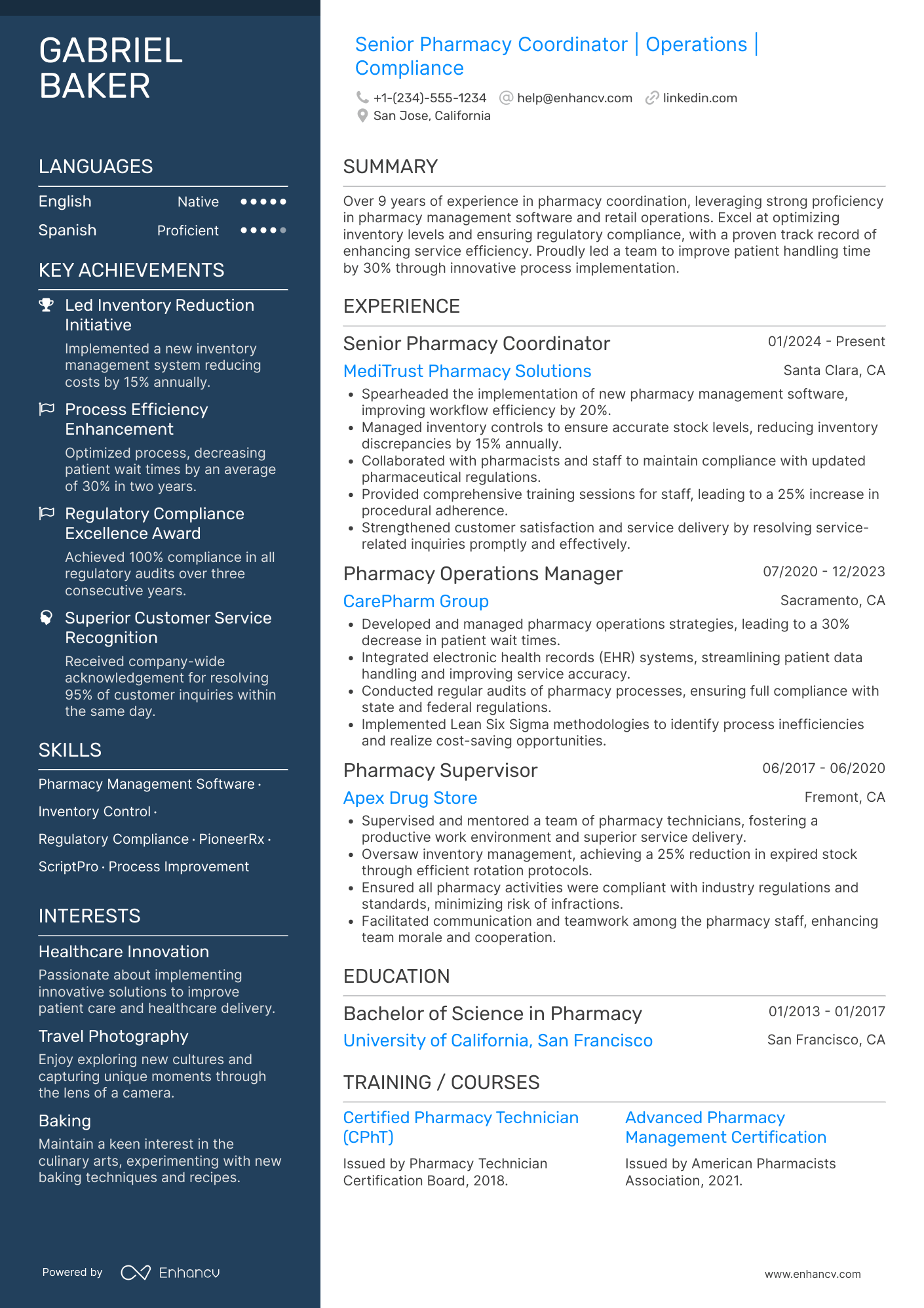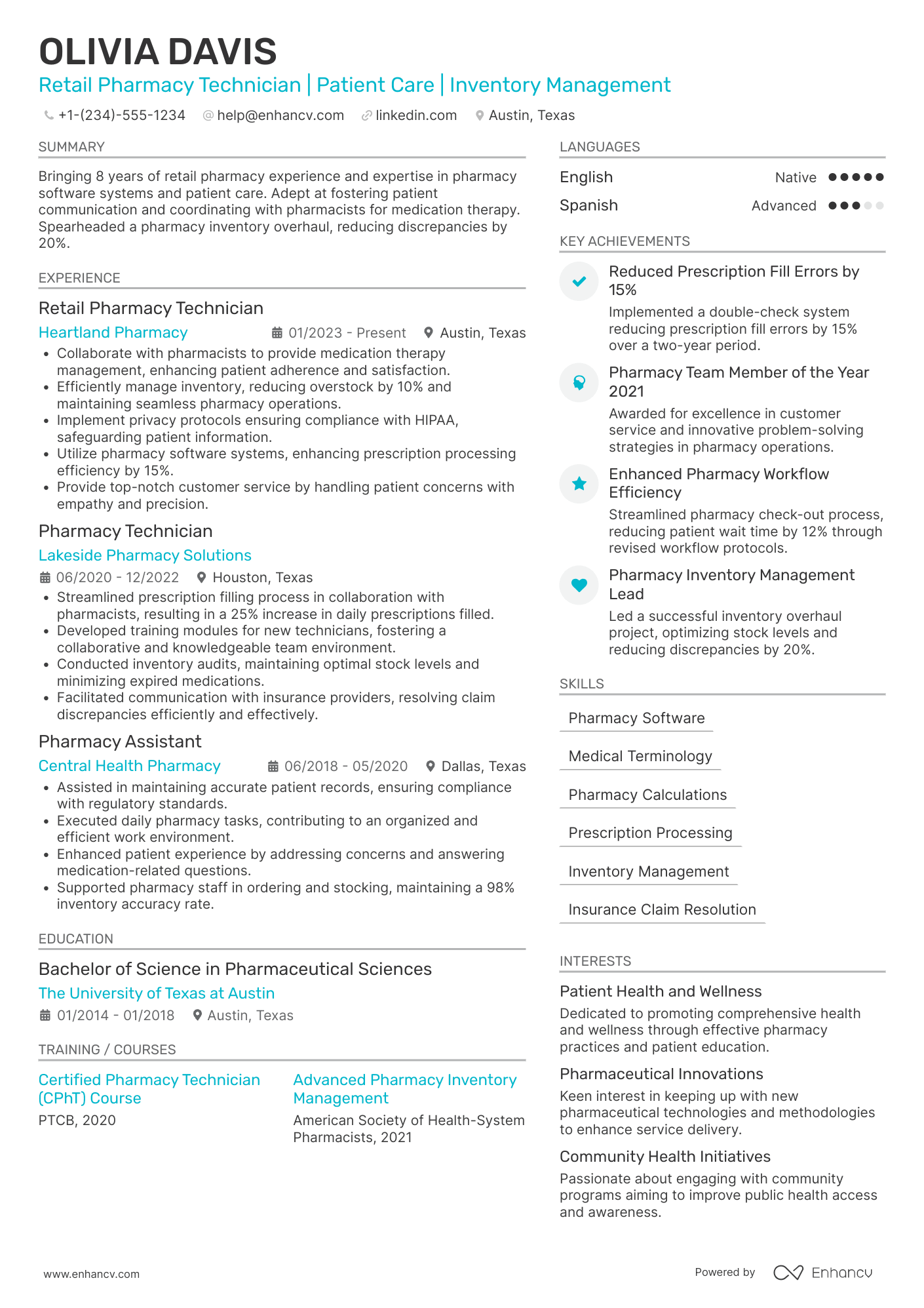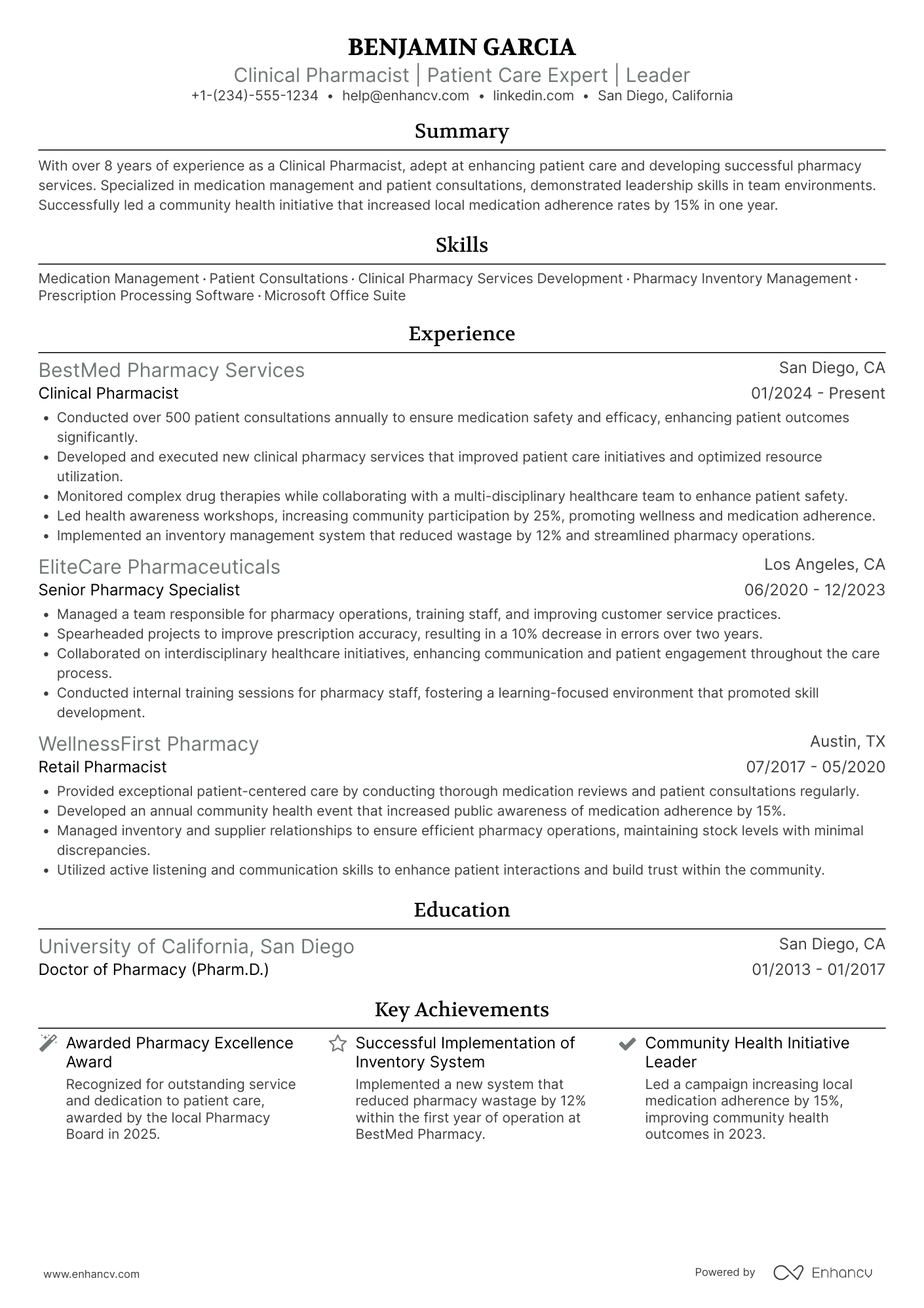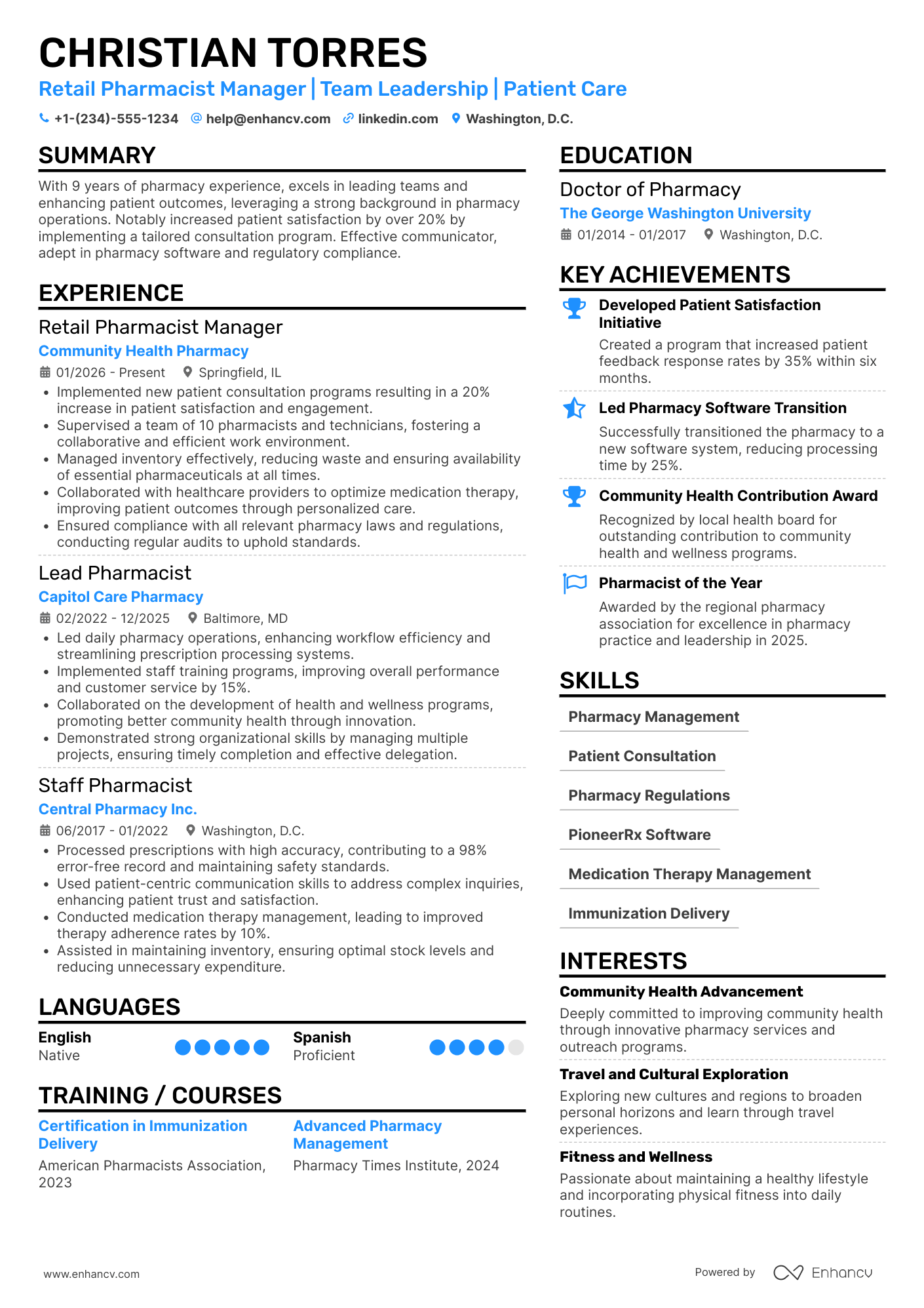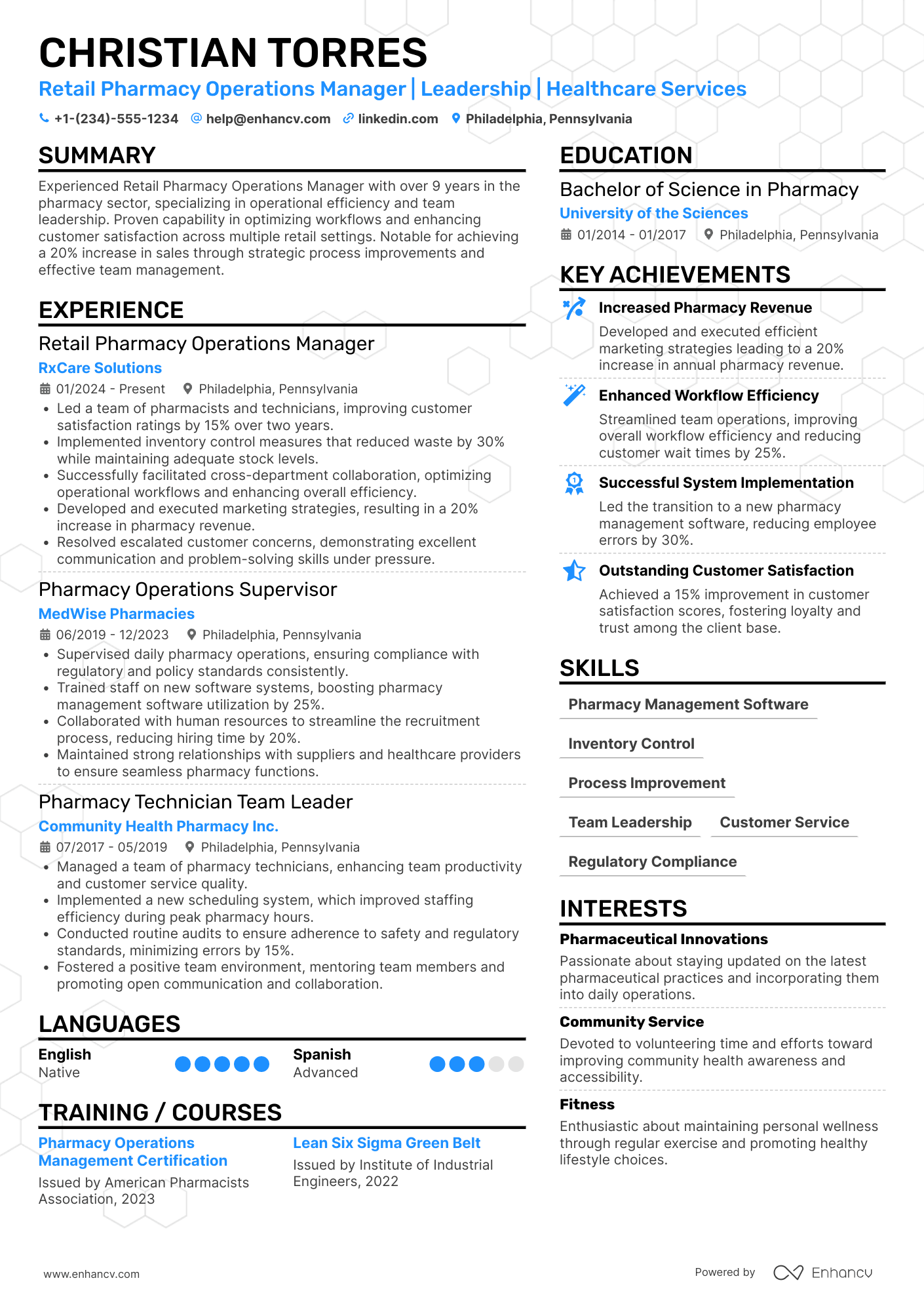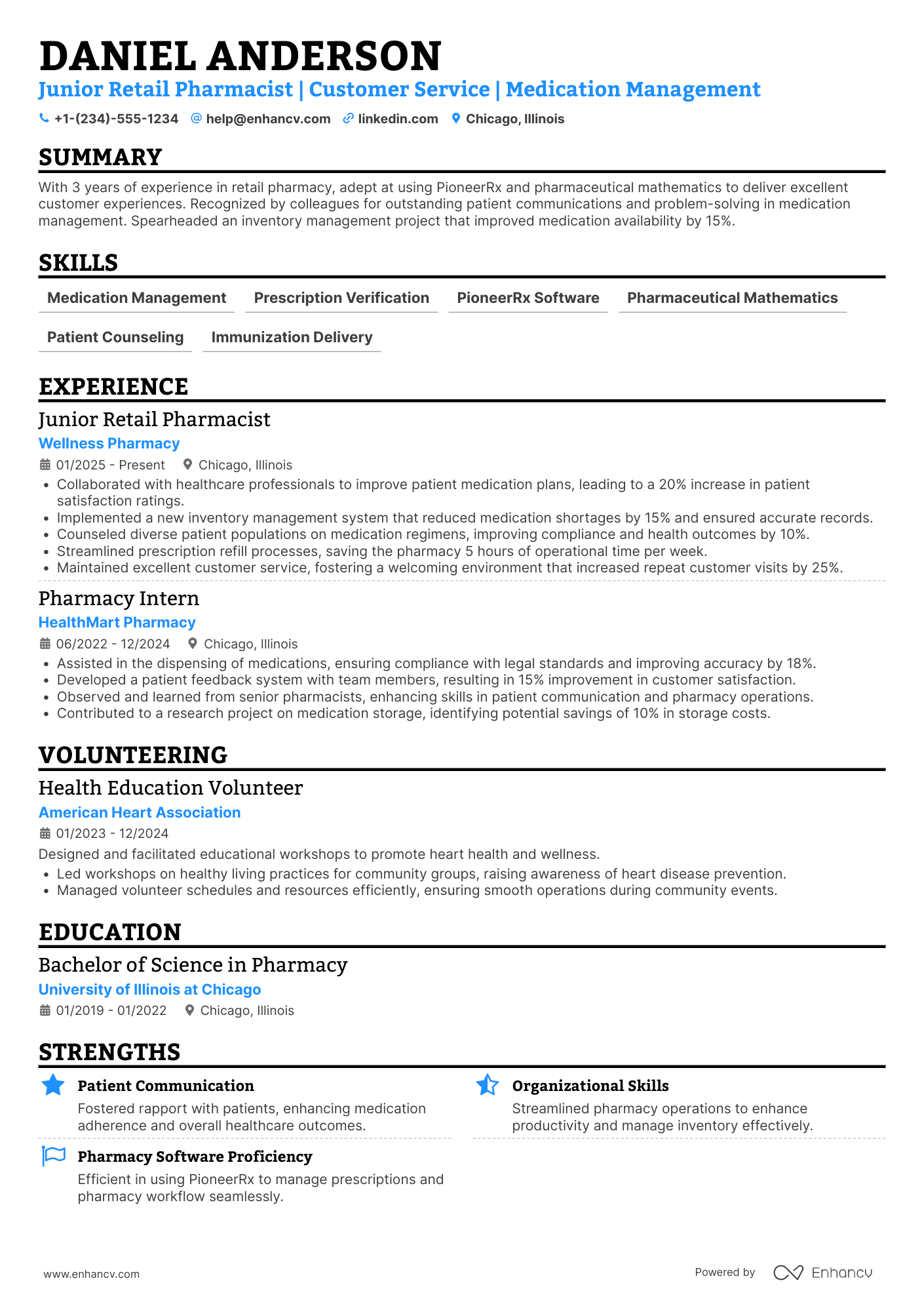
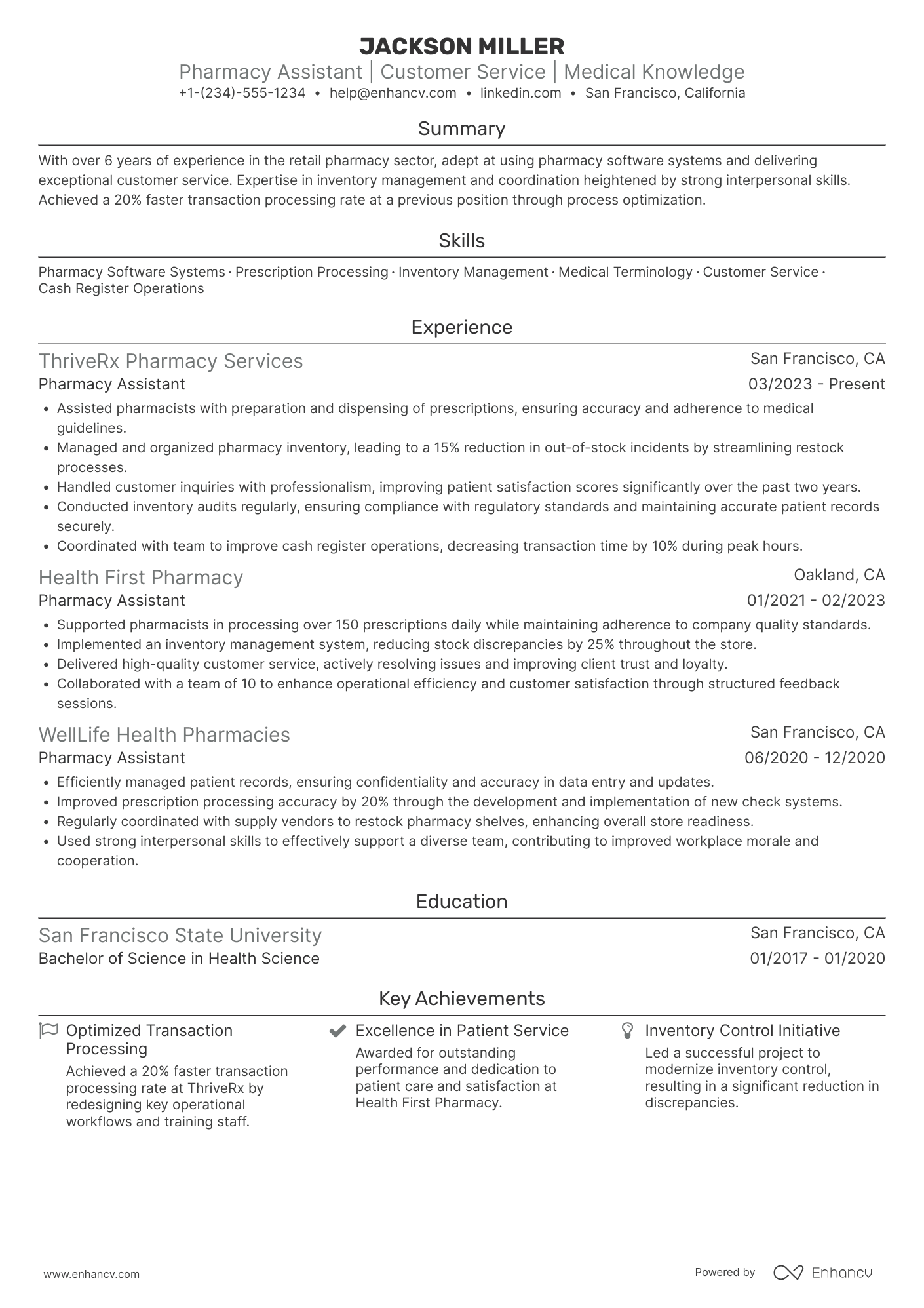
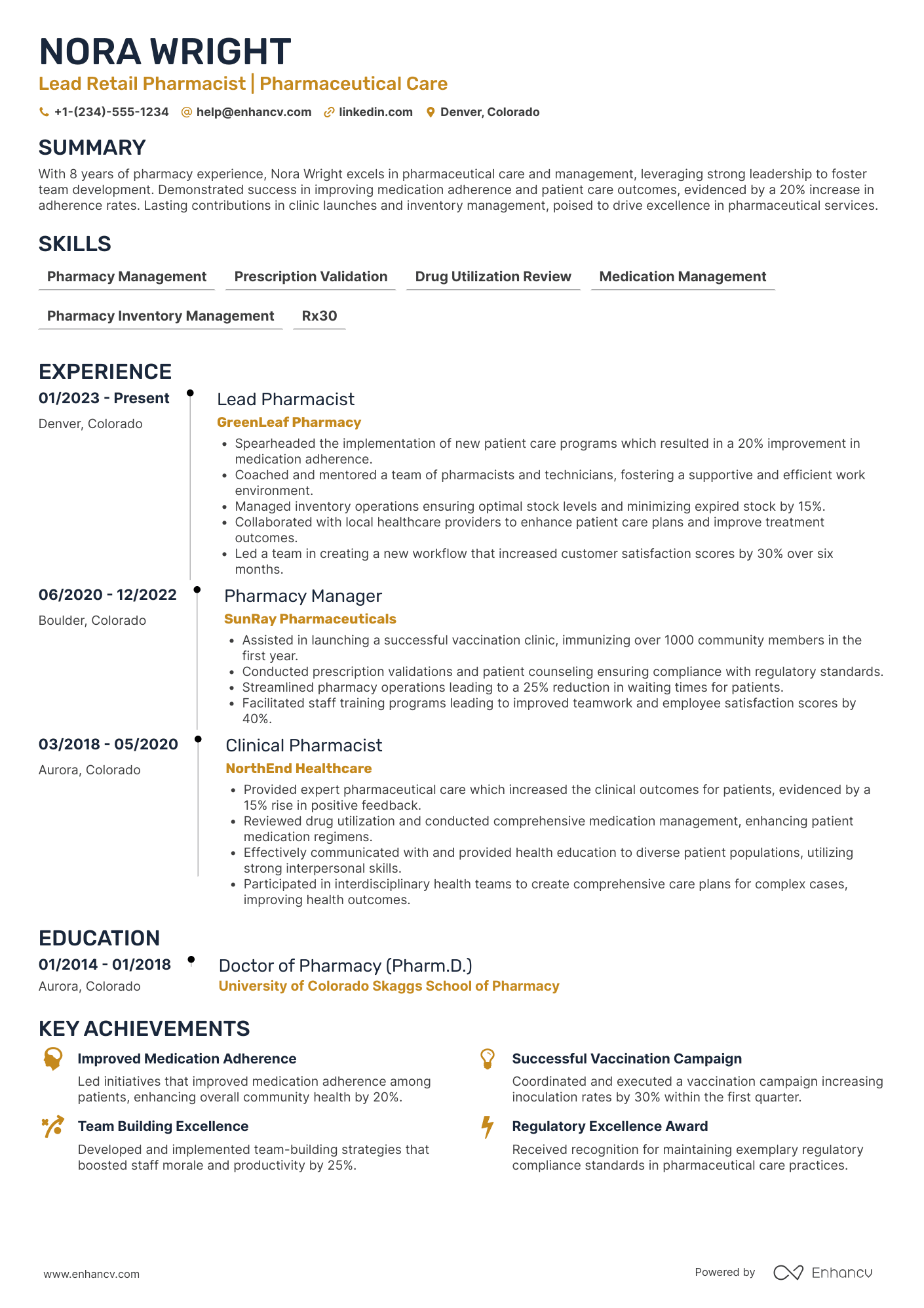
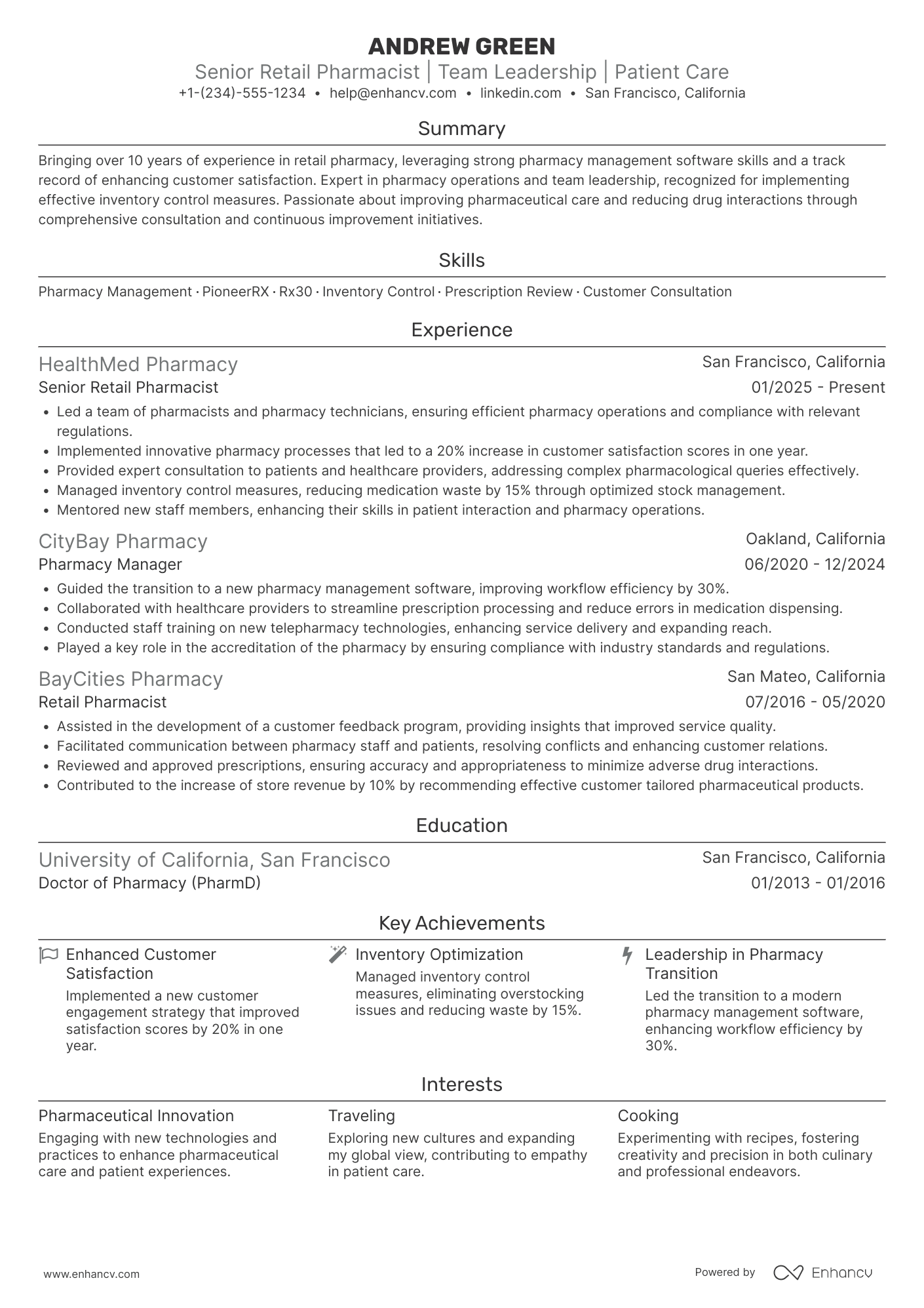
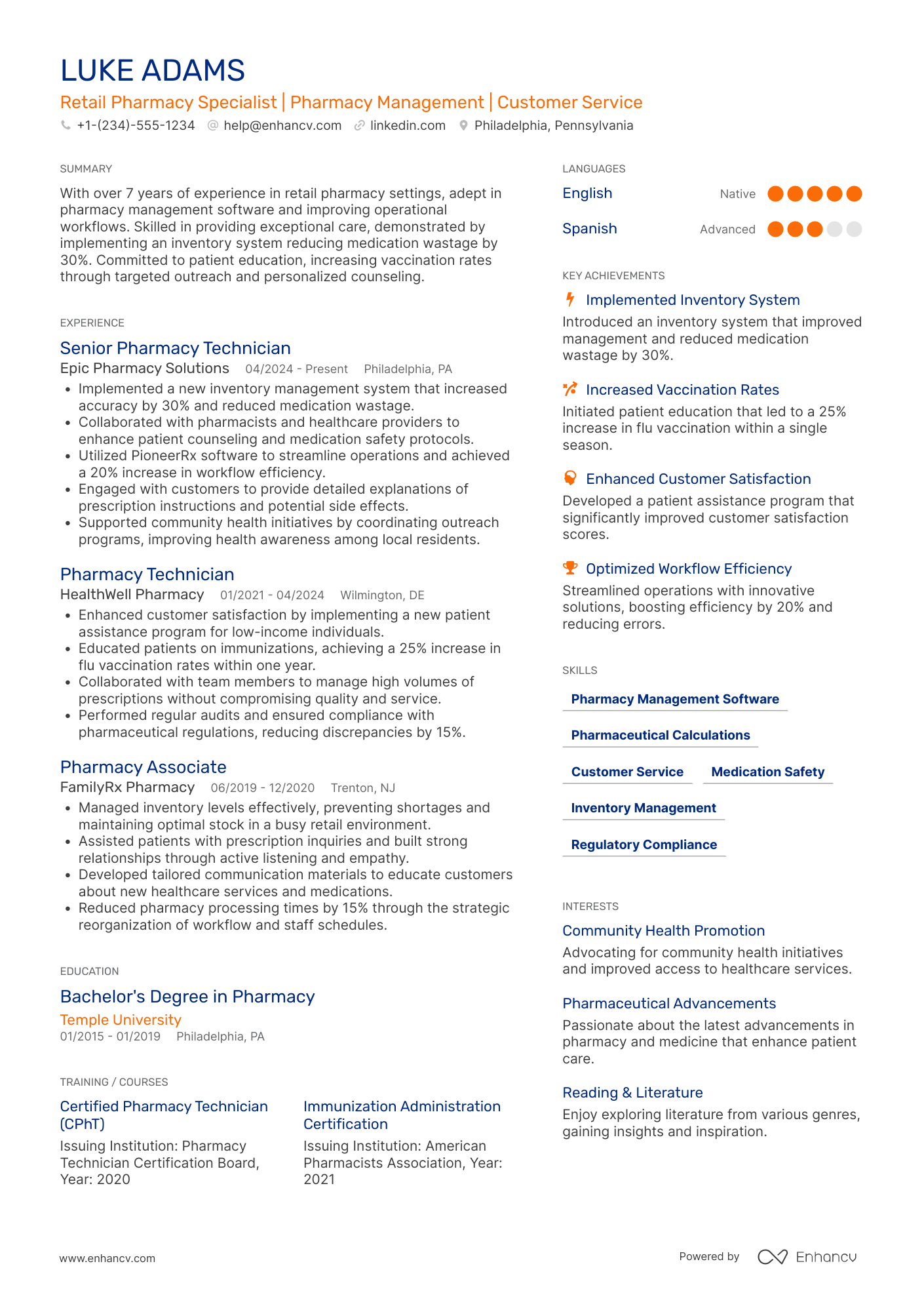
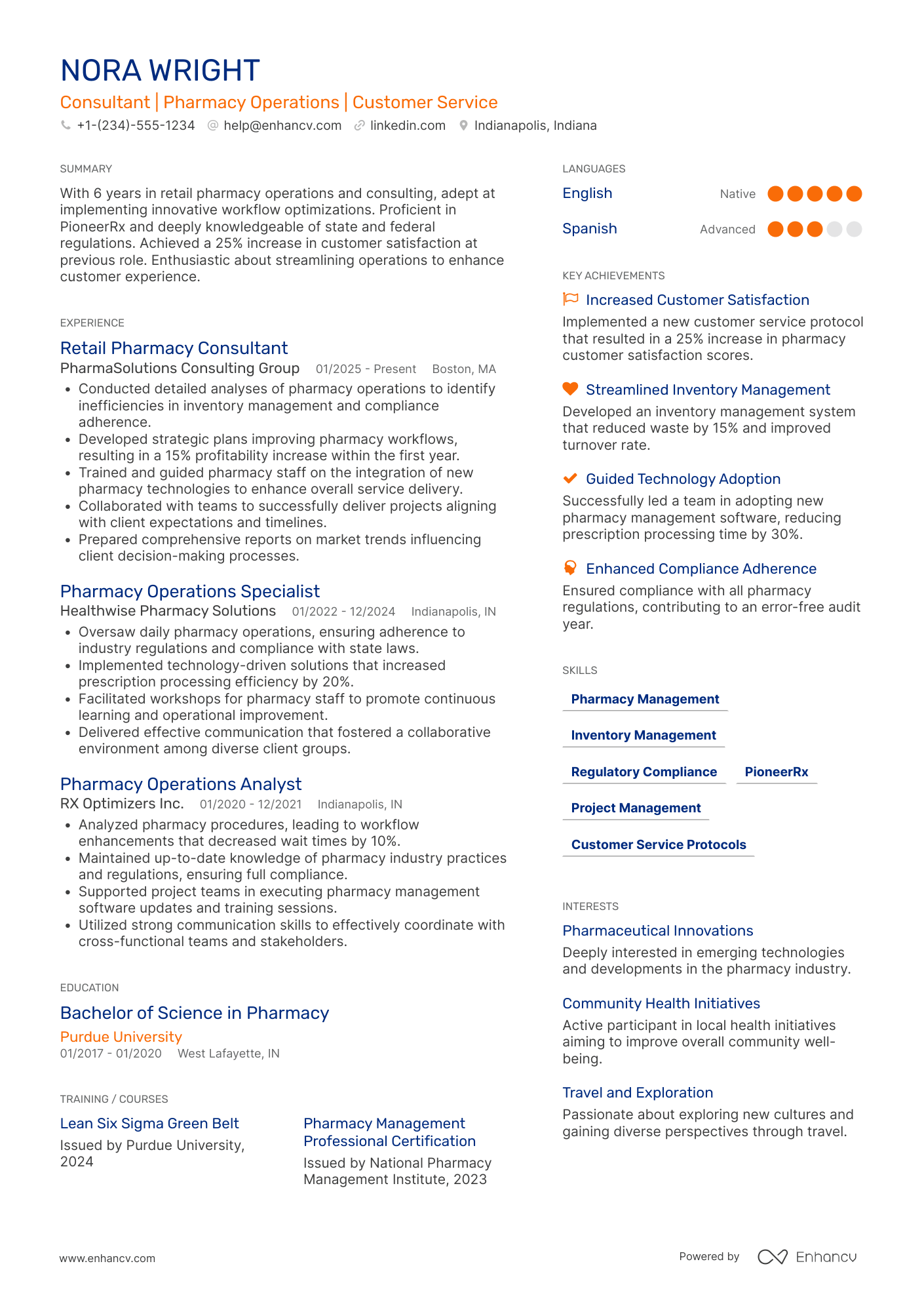
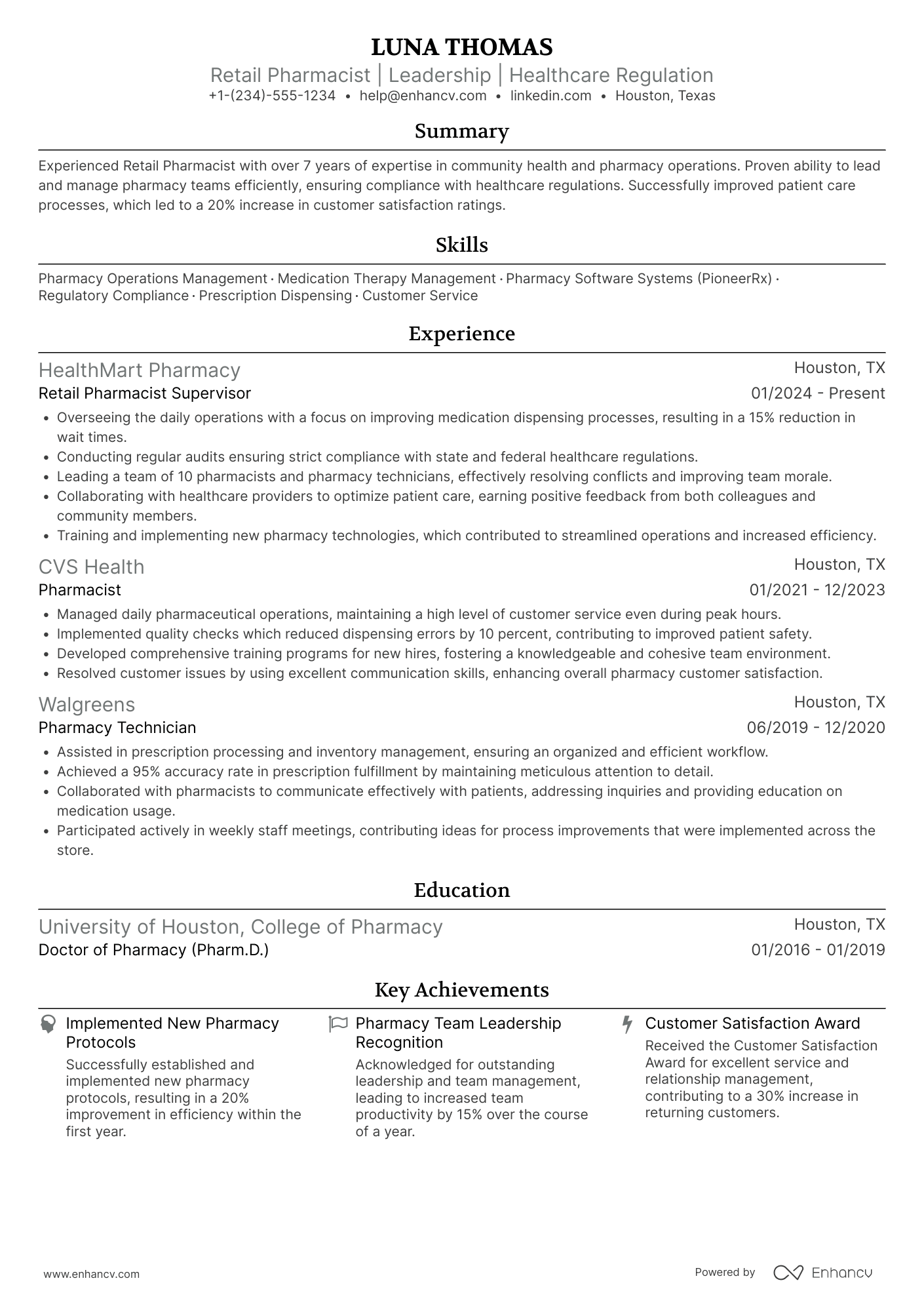
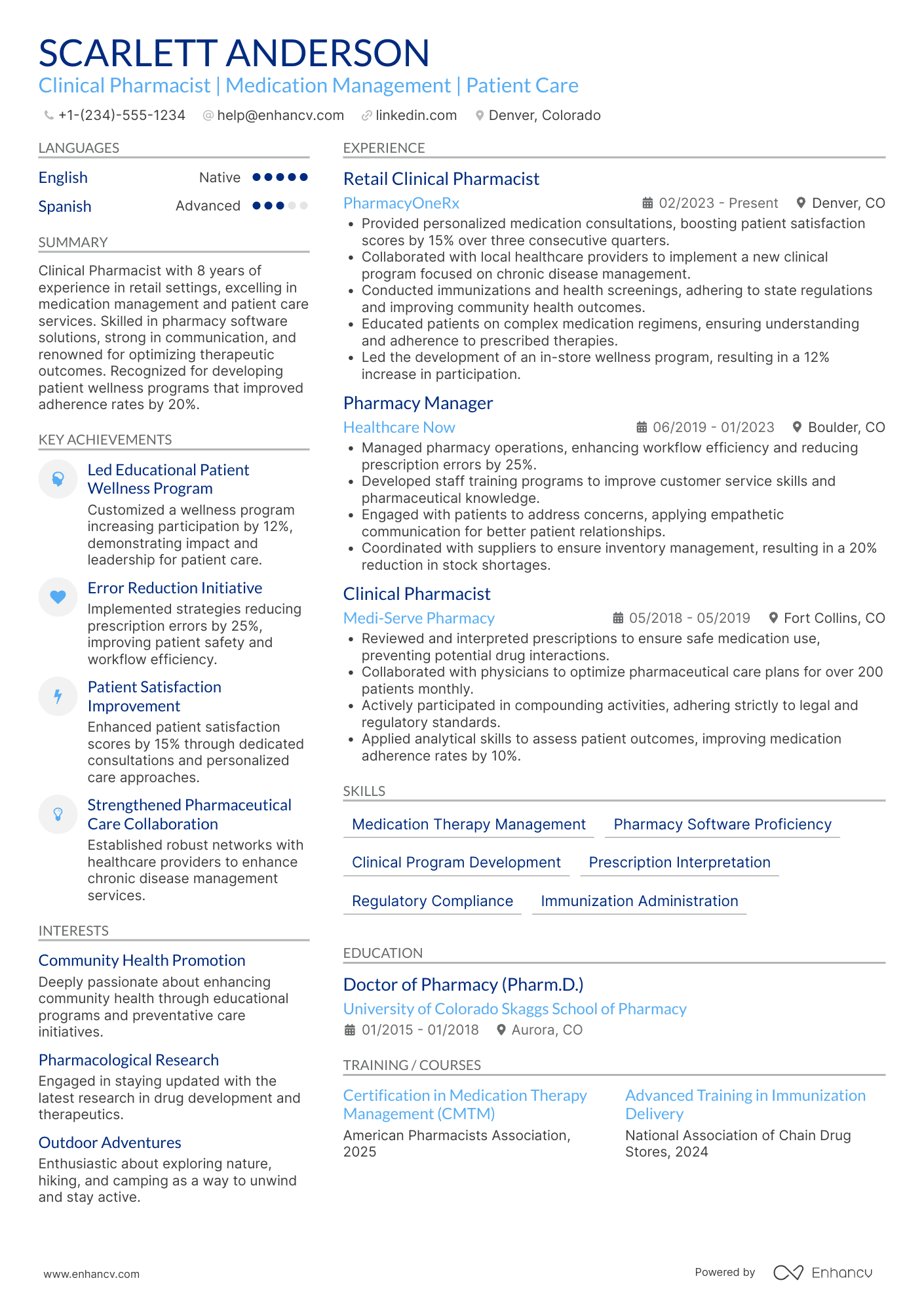
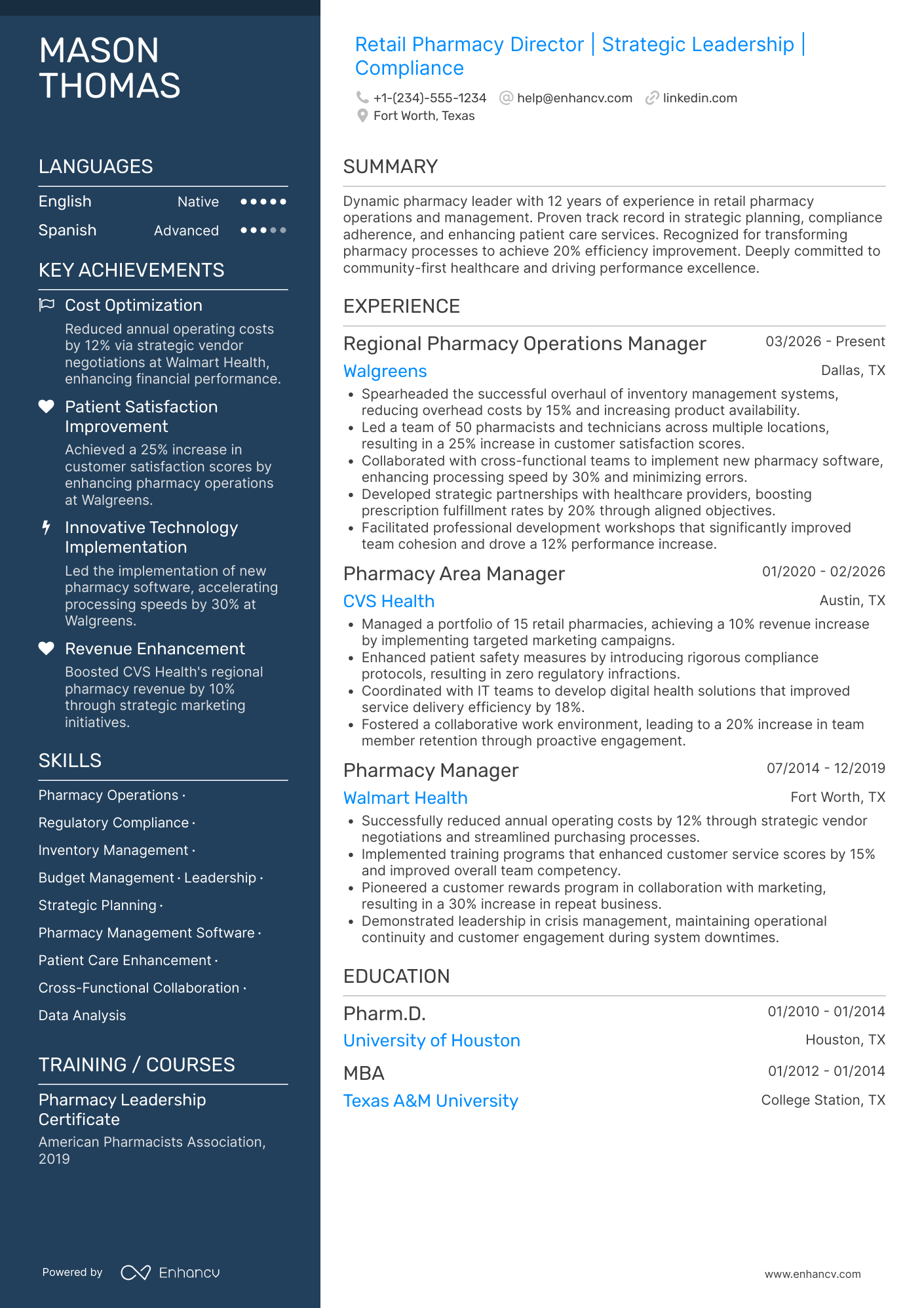
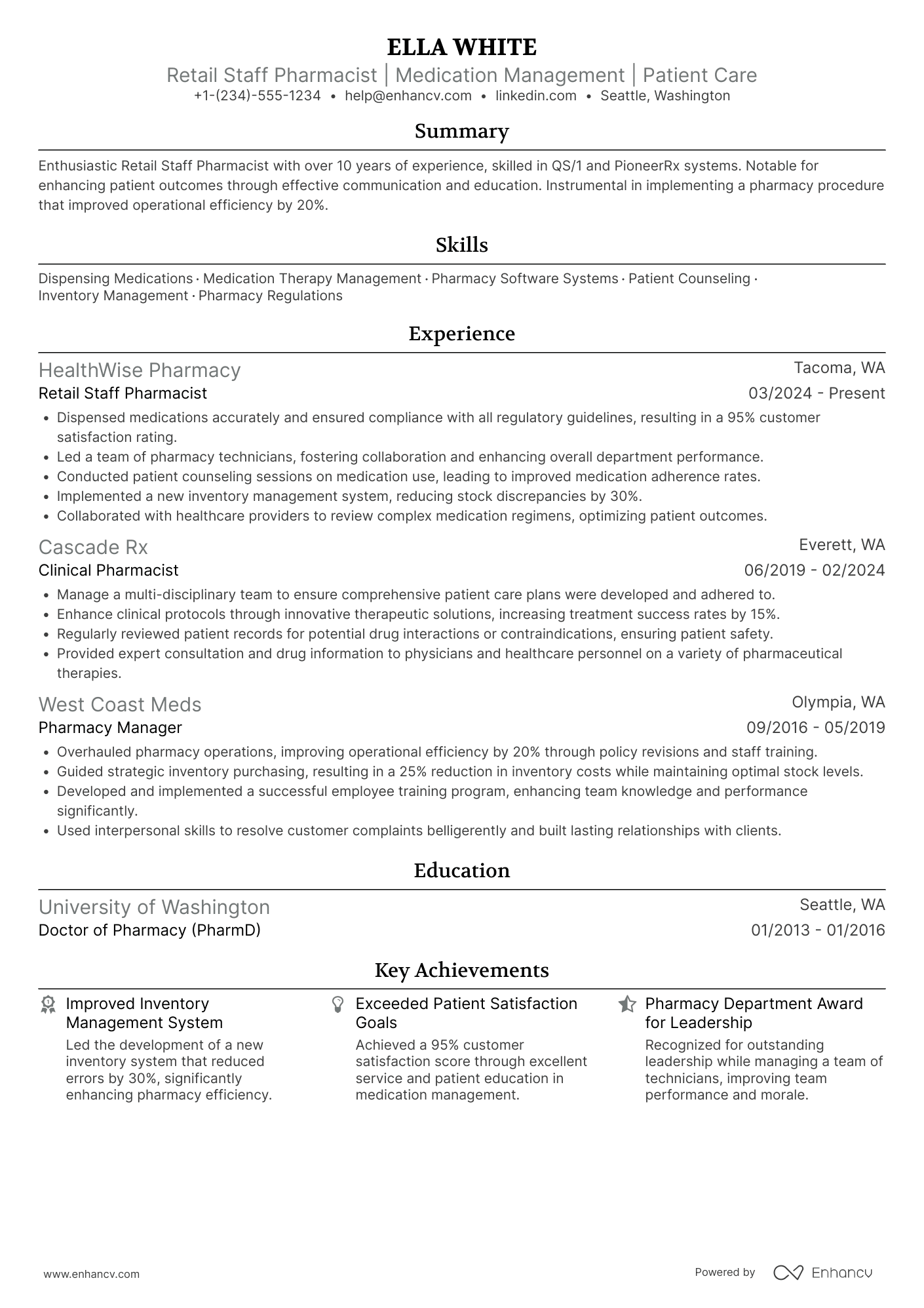
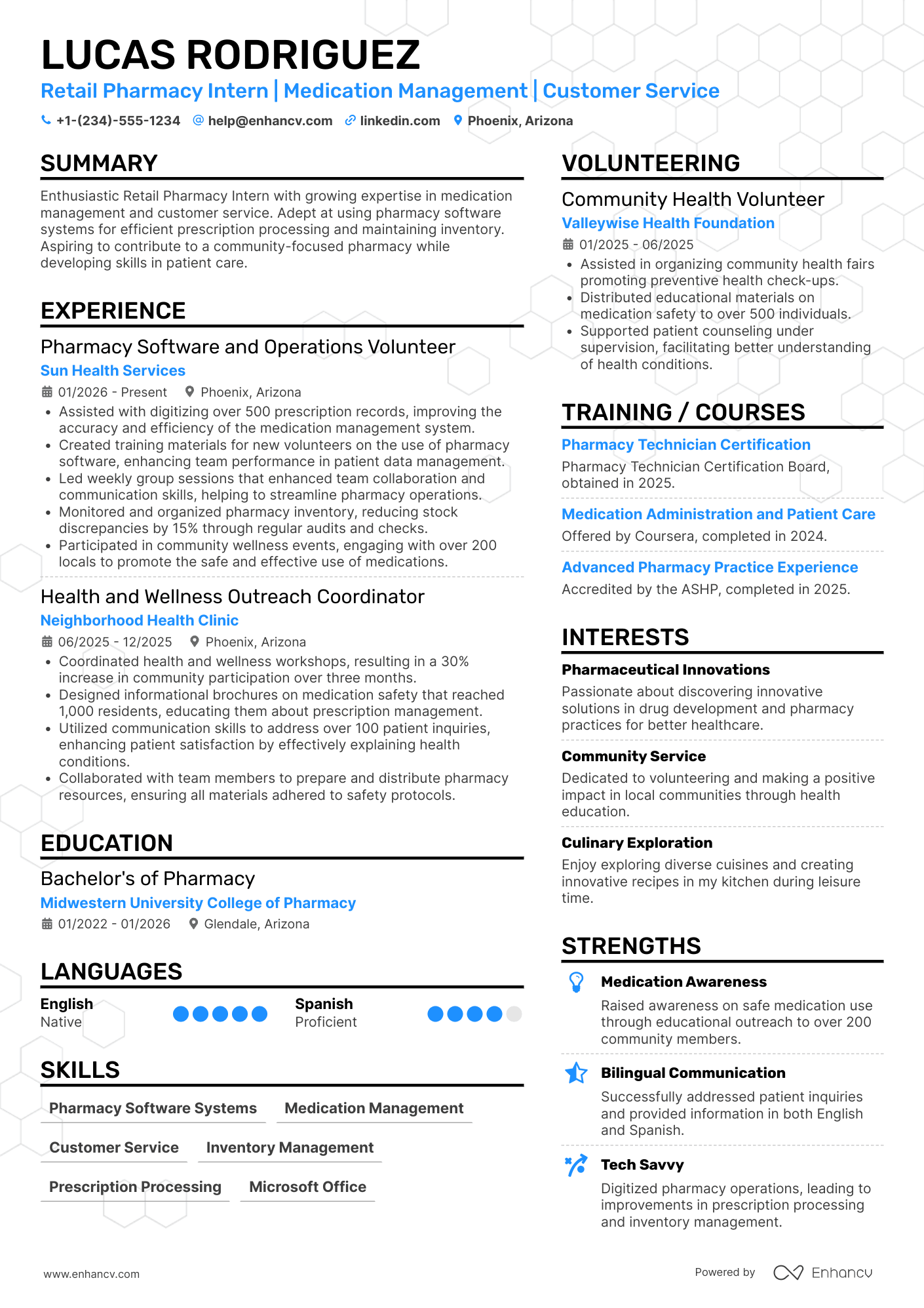
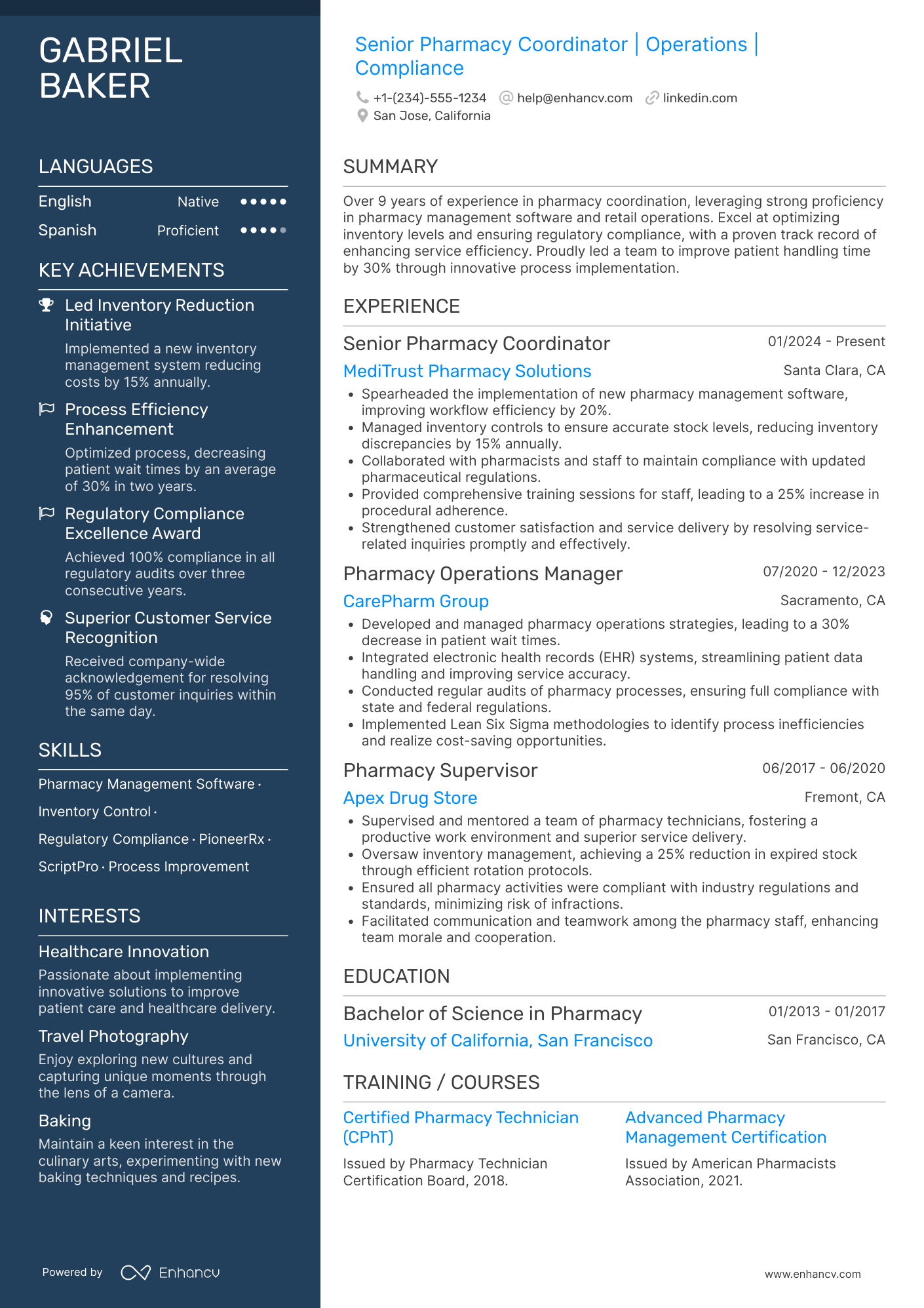
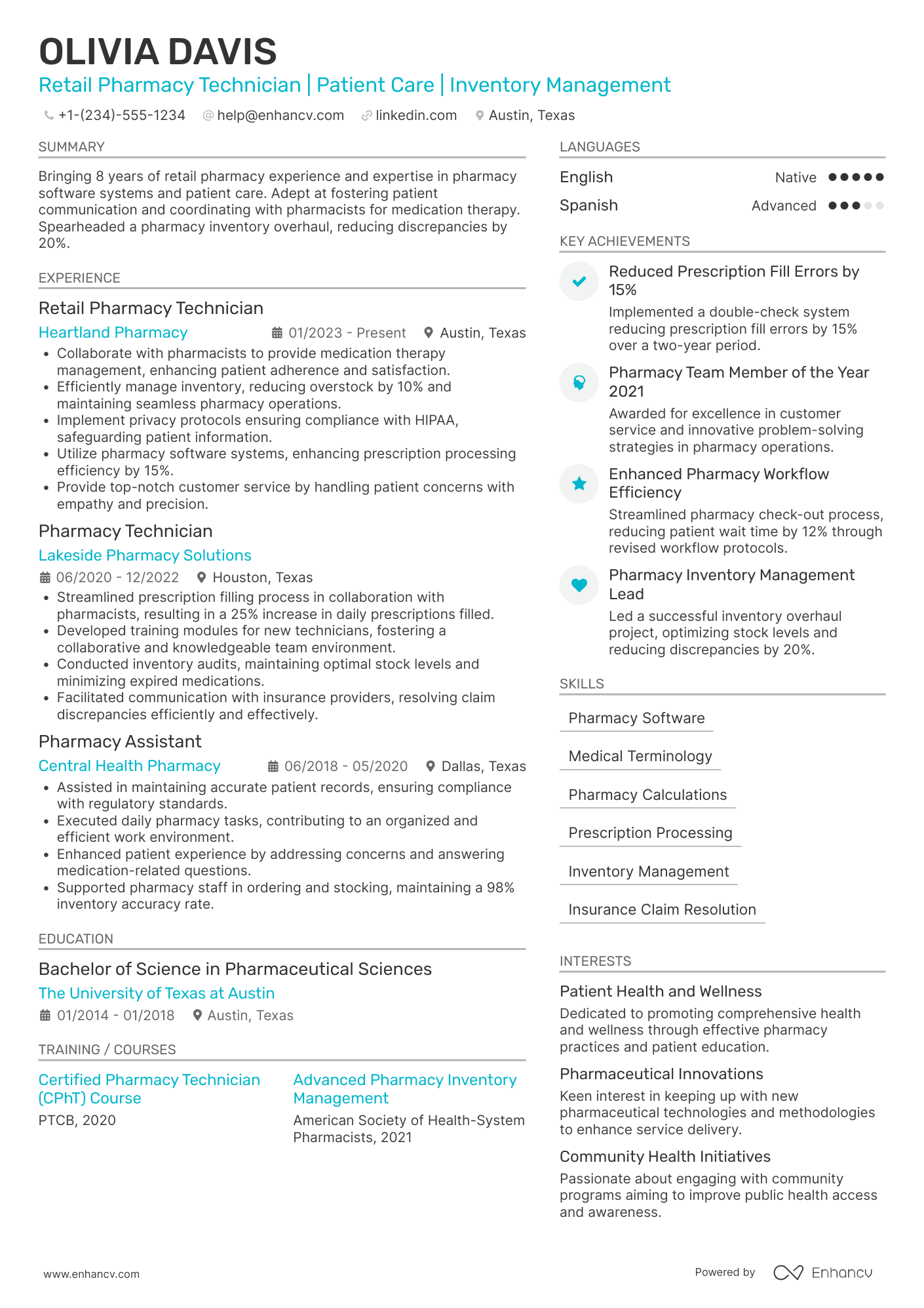
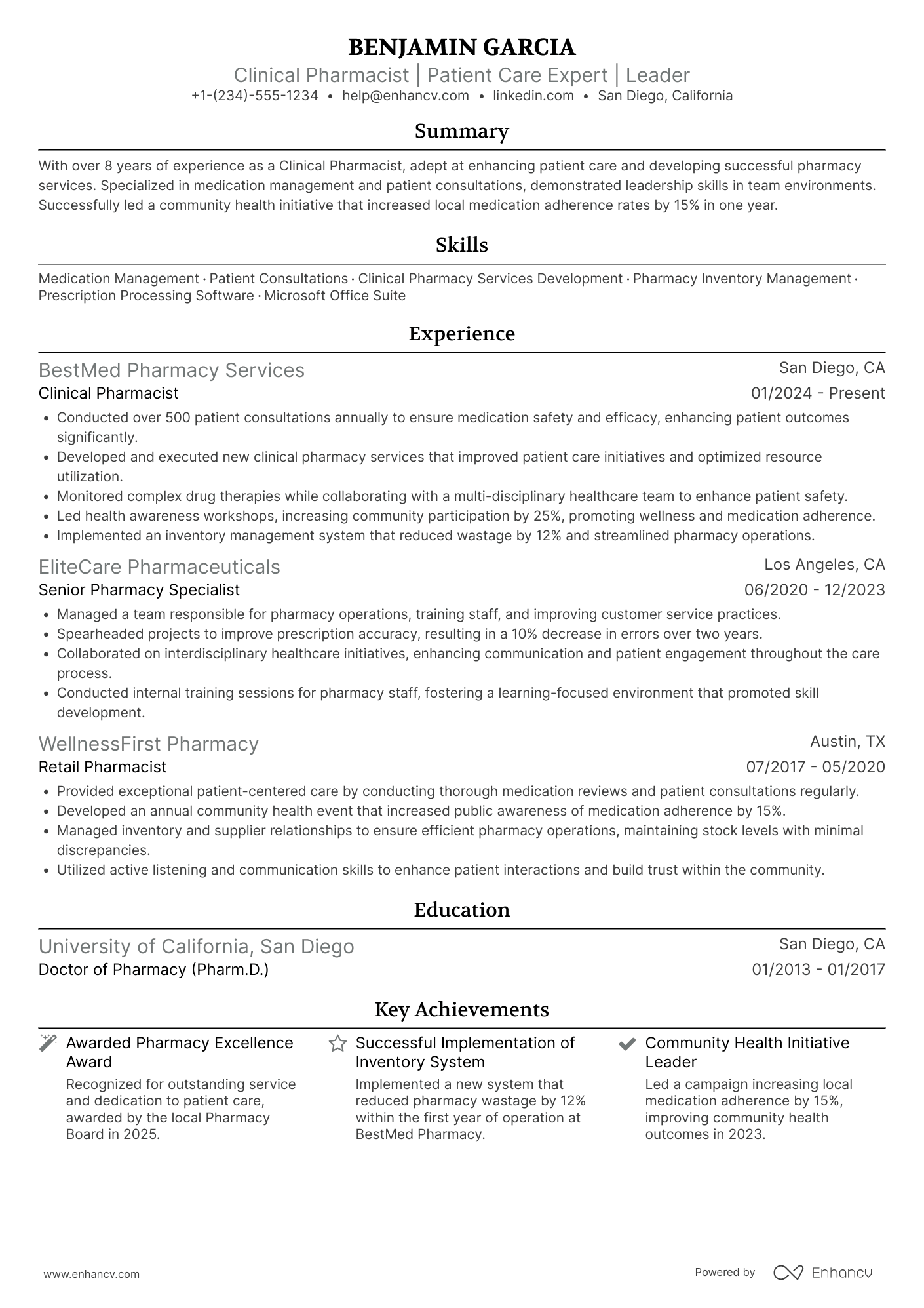
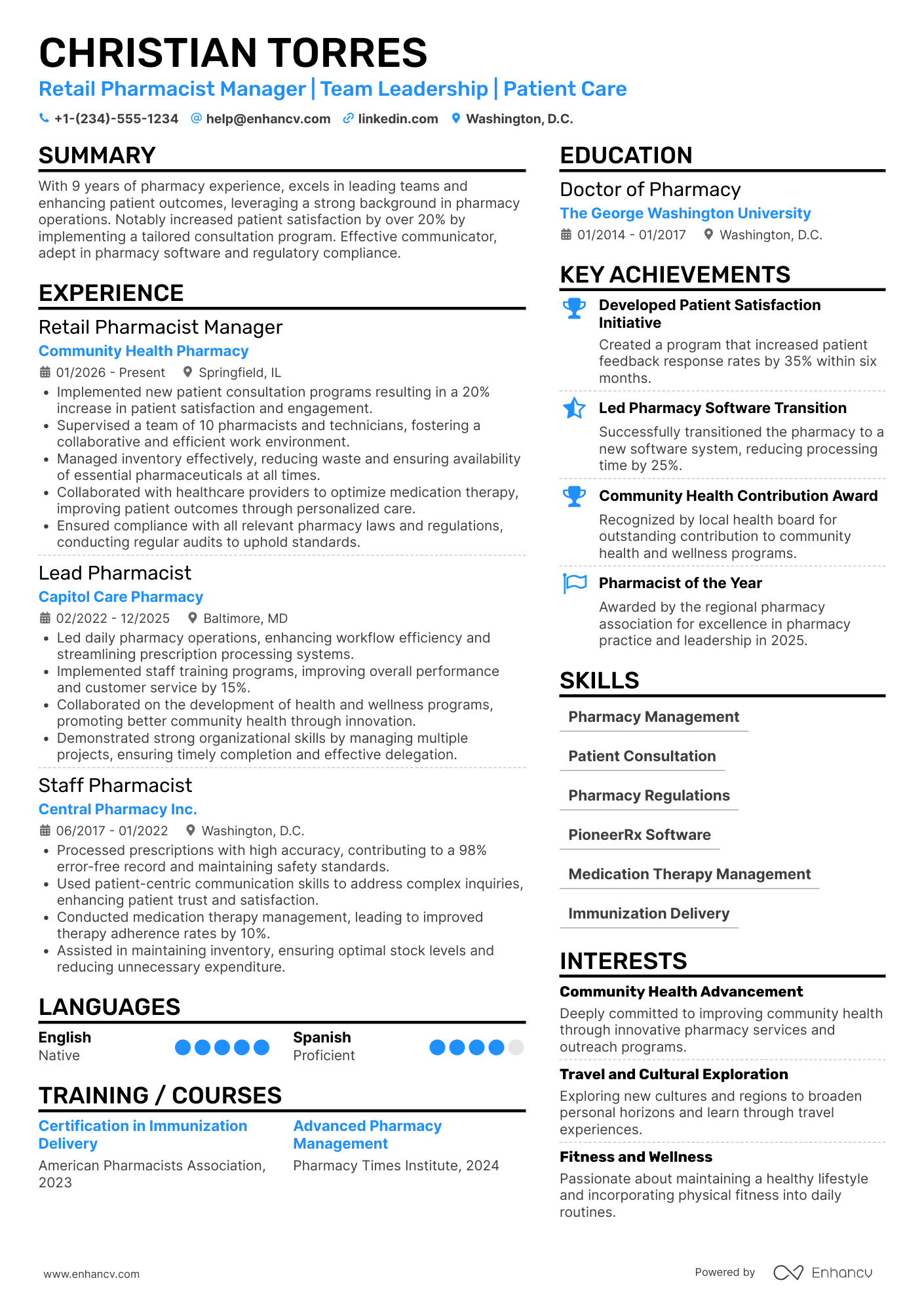
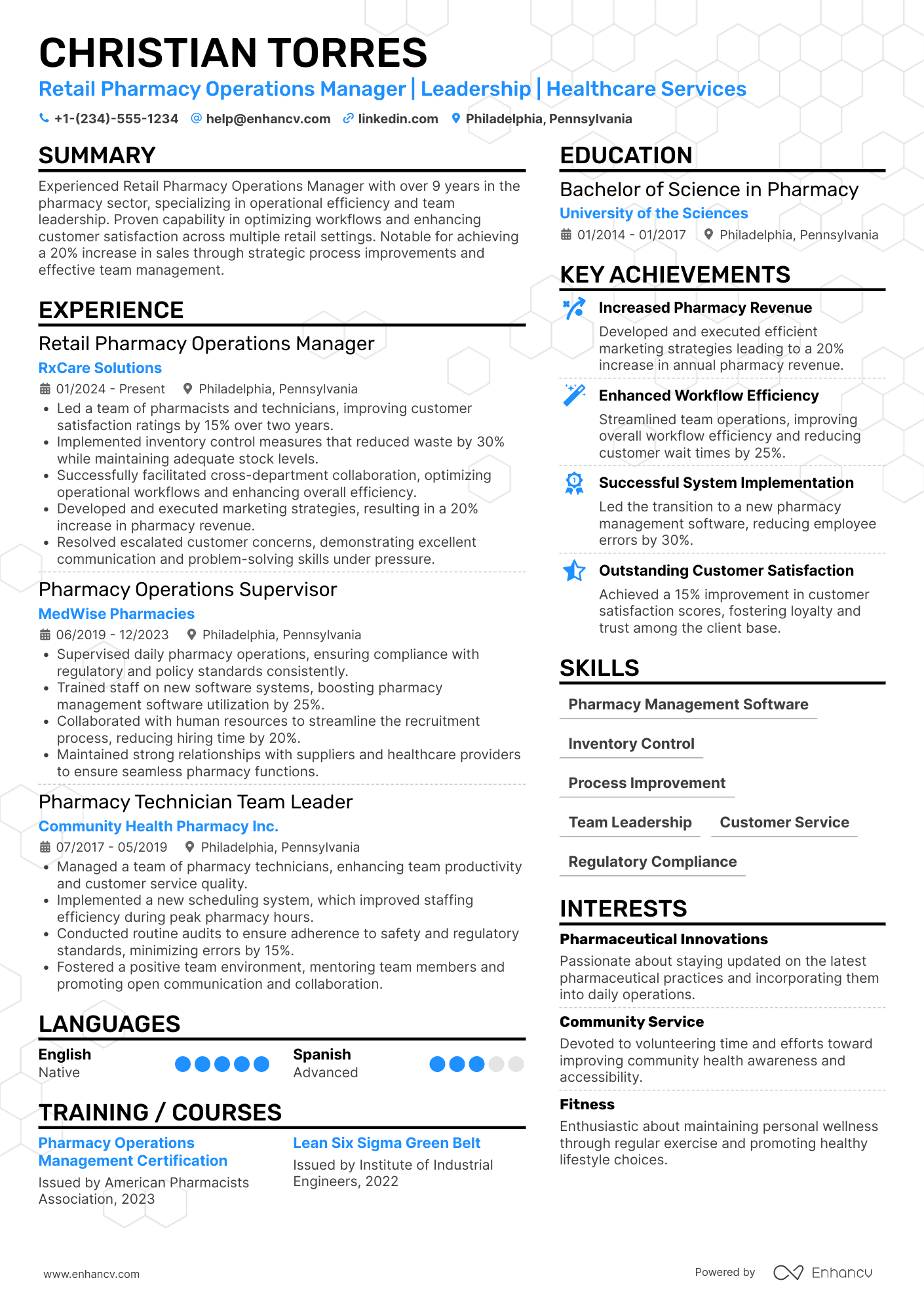
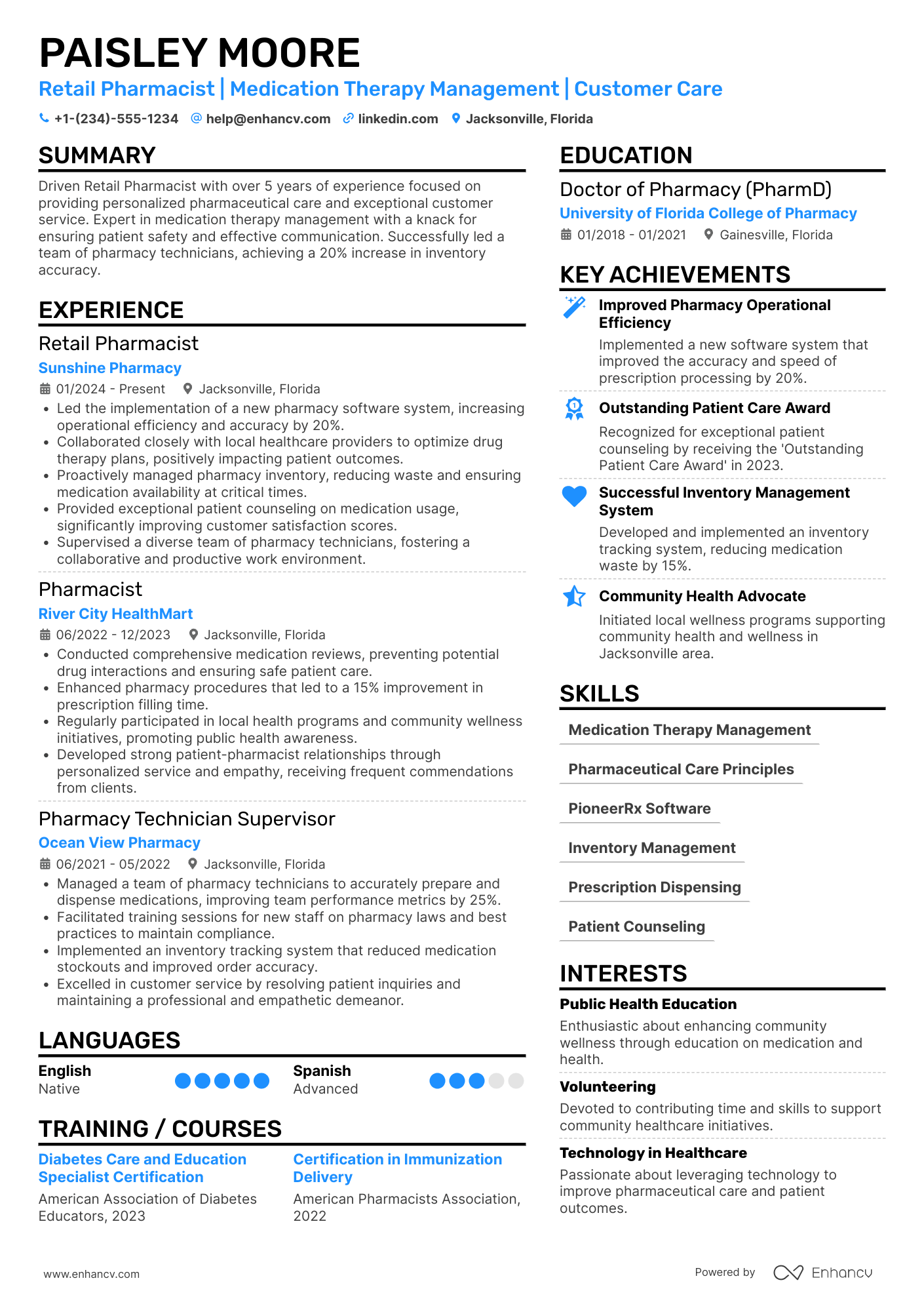
Most retail pharmacist resume drafts fail because they read like task lists and miss proof of impact, so the ATS and recruiters can't quickly match you to the role. With high applicant volume, vague bullets get filtered out or skipped.
A strong resume shows what changed because you were there. Knowing how to make your resume stand out starts with highlighting prescription volume handled per shift, error-rate reductions, immunizations delivered, audit results, patient wait-time improvements, and revenue or adherence gains. You also show scope, like staff trained and peak-hours coverage.

Key takeaways
- Quantify prescription volume, accuracy rates, and wait-time improvements instead of listing routine duties.
- Use reverse-chronological format if experienced; use a hybrid format if junior or switching careers.
- Tailor every experience bullet to mirror the job posting's systems, terminology, and compliance standards.
- Place licensure and certifications prominently—they're often mandatory for retail pharmacist roles.
- Ground each listed skill in a measurable outcome from your experience or rotations.
- Write a three- to four-line summary highlighting patient volume, clinical accuracy, and one key metric.
- Use Enhancv's tools to refine bullet points and eliminate vague language before submitting your resume.
Job market snapshot for retail pharmacists
We analyzed 60 recent retail pharmacist job ads across major US job boards. These numbers help you understand industry demand, employer expectations, salary landscape at a glance.
What level of experience employers are looking for retail pharmacists
| Years of Experience | Percentage found in job ads |
|---|---|
| 1–2 years | 8.3% (5) |
| 3–4 years | 10.0% (6) |
| 9–10 years | 1.7% (1) |
| 10+ years | 18.3% (11) |
| Not specified | 60.0% (36) |
Retail pharmacist ads by area of specialization (industry)
| Industry (Area) | Percentage found in job ads |
|---|---|
| Healthcare | 65.0% (39) |
| Education | 28.3% (17) |
Top companies hiring retail pharmacists
| Company | Percentage found in job ads |
|---|---|
| University of Kentucky | 26.7% (16) |
| Cardinal Health | 20.0% (12) |
Role overview stats
These tables show the most common responsibilities and employment types for retail pharmacist roles. Use them to align your resume with what employers expect and to understand how the role is structured across the market.
Day-to-day activities and top responsibilities for a retail pharmacist
| Responsibility | Percentage found in job ads |
|---|---|
| Pharmacy | 41.7% (25) |
| 340b | 20.0% (12) |
| Dispensing | 11.7% (7) |
| Customer service | 10.0% (6) |
| Patient counseling | 8.3% (5) |
| Basic life support | 6.7% (4) |
| Clinical skills | 6.7% (4) |
| Communication | 6.7% (4) |
| Pharmaceutical care | 6.7% (4) |
| Billing | 5.0% (3) |
| Bls | 5.0% (3) |
| Bls certification | 5.0% (3) |
How to format a retail pharmacist resume
Recruiters hiring retail pharmacists prioritize clinical accuracy, customer service aptitude, prescription volume management, and state licensure compliance. A clean, well-structured resume format ensures these signals surface quickly during both automated screening and the brief manual reviews that typically determine interview callbacks. Paying attention to your resume layout is equally important for readability and professional presentation.

I have significant experience in this role—which format should I use?
Use a reverse-chronological format to lead with your most recent and relevant retail pharmacy experience. Do:
- Highlight your scope of responsibility, including prescription volume, team size, and store-level oversight of pharmacy operations.
- Feature role-specific competencies such as drug utilization review, immunization administration, insurance adjudication, and pharmacy management systems like QS/1 or PioneerRx.
- Quantify outcomes tied to patient safety, efficiency, or business performance.
I'm junior or switching into this role—what format works best?
A hybrid format works best, letting you lead with relevant skills and certifications while still showing your work history in chronological order. Do:
- Place licensure, certifications (PharmD, state license, immunization certification), and core clinical skills in a prominent section above your experience.
- Include pharmacy rotations, externships, or retail-adjacent roles that demonstrate patient-facing and dispensing experience.
- Connect each listed skill to a concrete action and a measurable or observable result.
Why not use a functional resume?
A functional format strips away the timeline and context that hiring managers need to verify your dispensing experience, licensure history, and regulatory compliance track record.
- Career changers from hospital or clinical pharmacy who have transferable skills in patient counseling, medication therapy management, or inventory control but no direct retail pharmacy employment.
- Recent PharmD graduates with strong rotation experience but limited paid retail positions.
- Candidates with employment gaps due to relocation, family leave, or licensure transfers between states.
- A functional format is acceptable only when you have no direct retail pharmacy work history, and even then, every listed skill should be tied to a specific rotation, project, or outcome rather than stated in isolation.
With your format in place, the next step is filling it with the right sections to give hiring managers exactly what they're looking for.
What sections should go on a retail pharmacist resume
Recruiters expect to see a clean, compliance-focused resume that proves you can deliver safe, efficient, high-volume pharmacy operations and strong patient care. Understanding what to put on a resume helps you prioritize the most impactful content.
Use this structure for maximum clarity:
- Header
- Summary
- Experience
- Skills
- Projects
- Education
- Certifications
- Optional sections: Awards, Volunteering, Languages
Strong experience bullets should emphasize measurable impact, patient safety outcomes, prescription volume, immunization delivery, clinical interventions, and operational improvements.
Is your resume good enough?
Drop your resume here or choose a file. PDF & DOCX only. Max 2MB file size.
Now that you’ve outlined the key parts of your resume, the next step is to write your retail pharmacist experience section so it supports each one with clear, results-focused details.
How to write your retail pharmacist resume experience
The work experience section is where you prove your value as a retail pharmacist by showcasing the prescriptions you've processed, the clinical tools and dispensing systems you've used, and the measurable outcomes you've achieved in patient care and pharmacy operations. Hiring managers prioritize demonstrated impact—improved accuracy rates, reduced wait times, enhanced patient satisfaction—over descriptive task lists that simply restate your job description.
Each entry should include:
- Job title
- Company and location (or remote)
- Dates of employment (month and year)
Three to five concise bullet points showing what you owned, how you executed, and what outcomes you delivered:
- Ownership scope: the prescription volume, pharmacy departments, inventory categories, patient populations, or technician teams you were directly accountable for managing in the retail setting.
- Execution approach: the pharmacy management systems, drug utilization review protocols, clinical screening tools, compounding techniques, or regulatory compliance frameworks you applied to ensure safe and efficient dispensing.
- Value improved: the changes you drove in prescription accuracy, medication adherence, patient counseling quality, workflow efficiency, inventory shrinkage, or regulatory compliance across your pharmacy.
- Collaboration context: how you partnered with physicians, insurance providers, pharmacy technicians, store management, or public health organizations to resolve medication issues, streamline prior authorizations, or expand clinical service offerings.
- Impact delivered: the outcomes you produced expressed through patient health improvements, operational throughput gains, cost reductions, error rate decreases, or immunization program growth rather than routine dispensing activity.
Experience bullet formula
A retail pharmacist experience example
✅ Right example - modern, quantified, specific.
Retail Pharmacist
CVS Pharmacy | Austin, TX
2022–Present
High-volume community pharmacy serving 2,800+ prescriptions weekly with integrated immunization and clinical services.
- Verified and dispensed 2,800+ prescriptions weekly using CVS RxConnect, reducing average wait time by 18% through queue triage and optimized workflow handoffs with pharmacy technicians.
- Implemented DUR (drug utilization review) and PDMP (prescription drug monitoring program) checks for 100% of controlled substances, cutting dispensing errors by 27% and preventing twelve high-risk interactions per month on average.
- Expanded immunization throughput using CDC schedules and IMZ registry reporting, increasing vaccinations by 32% year over year while maintaining 98% on-time documentation in the electronic health record.
- Resolved 45–60 third-party rejections weekly in real time using adjudication tools and payer portals, improving first-pass claim acceptance from 84% to 93% and accelerating patient pickup by twelve minutes on average.
- Partnered with prescribers and clinic staff via e-prescribing and secure fax to convert 110 prescriptions per month to cost-effective therapeutic alternatives, lowering patient out-of-pocket costs by 21% and improving adherence by 9%.
Now that you've seen how a strong experience section comes together, let's look at how to adjust yours to match the specific job you're applying for.
How to tailor your retail pharmacist resume experience
Recruiters evaluate your retail pharmacist resume through both applicant tracking systems and manual review. Tailoring your resume to the job description ensures your qualifications stand out in both screening stages.
Ways to tailor your retail pharmacist experience:
- Match pharmacy software and dispensing systems named in the posting.
- Mirror the exact terminology used for prescription verification processes.
- Reflect patient counseling or medication therapy management methods listed.
- Include state and federal compliance standards the employer specifies.
- Highlight immunization administration or clinical services they prioritize.
- Use their language for inventory management or loss prevention workflows.
- Emphasize collaborative care models referenced in the job description.
- Align your metrics with the KPIs or performance goals they mention.
Tailoring means aligning your real accomplishments with the employer's stated requirements, not forcing keywords where they don't belong.
Resume tailoring examples for retail pharmacist
| Job description excerpt | Untailored | Tailored |
|---|---|---|
| "Process and verify 300+ prescriptions daily using QS/1 pharmacy management software, ensuring accuracy and compliance with state and federal regulations." | Processed prescriptions and helped customers at the pharmacy counter. | Processed and verified an average of 320 prescriptions daily using QS/1, maintaining a 99.8% accuracy rate and full compliance with state Board of Pharmacy and DEA regulations. |
| "Administer immunizations including flu, COVID-19, and shingles vaccines while providing patient counseling on drug interactions and side effects." | Provided patient care and administered medications as needed. | Administered 40+ immunizations weekly—including flu, COVID-19, and Shingrix—and counseled patients on potential drug interactions, contraindications, and side effect management. |
| "Manage pharmacy inventory using perpetual inventory systems, reduce shrinkage, and coordinate with wholesalers such as McKesson to maintain optimal stock levels." | Helped with inventory and made sure the pharmacy had enough stock. | Managed perpetual inventory for 2,500+ SKUs, coordinated weekly orders through McKesson, and reduced shrinkage by 15% over 12 months through cycle counts and expiration audits. |
Once you’ve aligned your experience with the role’s priorities, quantify your retail pharmacist achievements to show the measurable impact of that work.
How to quantify your retail pharmacist achievements
Quantifying achievements shows how you improved safety, speed, and business results. Focus on prescription volume, verification accuracy, wait times, immunization throughput, adherence programs, audit outcomes, and prevented losses tied to controlled substances.
Quantifying examples for retail pharmacist
| Metric | Example |
|---|---|
| Volume handled | "Processed and verified 320 to 380 prescriptions per shift while maintaining workflow in PioneerRx and meeting same-day fill targets." |
| Accuracy rate | "Reduced dispensing errors from 0.18% to 0.07% by tightening DUR (drug utilization review) checks and standardizing barcode scan steps." |
| Cycle time | "Cut average customer wait time from 22 minutes to 14 minutes by redesigning queue triage and batching verification during peak hours." |
| Revenue growth | "Increased weekly immunizations from 35 to 70 by expanding appointment slots, training technicians, and partnering with nearby clinics for referrals." |
| Compliance risk | "Achieved zero controlled-substance audit findings across four quarterly inspections by reconciling perpetual inventory daily and closing report variances within 24 hours." |
Turn vague job duties into measurable, recruiter-ready resume bullets in seconds with Enhancv's Bullet Point Generator.
With strong bullet points in place, the next step is ensuring your skills section effectively showcases the hard and soft skills that hiring managers expect from a retail pharmacist.
How to list your hard and soft skills on a retail pharmacist resume
Your skills section shows you can dispense safely, manage workflow, and support patient outcomes, and recruiters and an ATS (applicant tracking system) scan this section to confirm fit fast; aim for a pharmacy-heavy mix of hard skills with role-specific soft skills.
retail pharmacist roles require a blend of:
- Product strategy and discovery skills.
- Data, analytics, and experimentation skills.
- Delivery, execution, and go-to-market discipline.
- Soft skills.
Your skills section should be:
- Scannable (bullet-style grouping).
- Relevant to the job post.
- Backed by proof in experience bullets.
- Updated with current tools.
Place your skills section:
- Above experience if you're junior or switching careers.
- Below experience if you're mid/senior with strong achievements.

Hard skills
- Prescription verification, DUR
- Immunization administration protocols
- MTM, CMR documentation
- Controlled substance compliance, DEA
- State board pharmacy regulations
- Pharmacy management systems, workflow queues
- E-prescribing, EHR integration
- Third-party adjudication, prior authorizations
- Inventory management, perpetual counts
- Cold chain, vaccine storage handling
- Medication synchronization programs
- Point-of-care testing (CLIA-waived)
Soft skills
- Patient counseling in plain language
- De-escalation with upset customers
- Triage and prioritize clinical tasks
- Clear handoffs to technicians
- Escalate safety risks immediately
- Coordinate with prescribers and nurses
- Coach technicians on workflow
- Stay calm under peak volume
- Document decisions and follow-ups
- Balance speed with accuracy
- Own outcomes for patient issues
- Communicate shortages and alternatives
How to show your retail pharmacist skills in context
Skills shouldn't live only in a dedicated skills list. Explore resume skills examples to see how pharmacists integrate competencies throughout their documents.
They should be demonstrated in:
- Your summary (high-level professional identity)
- Your experience (proof through outcomes)
Here's what strong, skill-rich entries look like in practice.
Summary example
Senior retail pharmacist with 12 years of experience in high-volume community pharmacy settings. Skilled in clinical consultation, immunization delivery, and inventory optimization using QS/1. Reduced medication errors by 34% through enhanced verification protocols and patient counseling workflows.
- Reflects senior-level expertise clearly
- Names role-specific tools like QS/1
- Quantifies impact with a strong metric
- Highlights patient-facing soft skills
Experience example
Senior Retail Pharmacist
Clearview Pharmacy | Portland, OR
March 2018–Present
- Streamlined prescription verification workflows using PioneerRx, cutting average fill time by 22% across 400+ daily prescriptions.
- Partnered with pharmacy technicians and store leadership to launch an immunization program that administered 3,100+ vaccines annually.
- Counseled patients on chronic disease management protocols, improving medication adherence scores by 18% over two years.
- Every bullet includes measurable proof.
- Skills surface naturally through outcomes.
Once you’ve grounded your strengths in real pharmacy situations, the next step is learning how to build a retail pharmacist resume with no experience that still highlights those strengths clearly.
How do I write a retail pharmacist resume with no experience
Even without full-time experience, you can demonstrate readiness through:
- Pharmacy school lab compounding hours
- Clinical or community pharmacy rotations
- Immunization training and clinics
- Medication therapy management casework
- Pharmacy technician or cashier shifts
- Prescription processing simulations
- Quality improvement or safety audits
- Volunteer health screenings and counseling
If you're building a resume without work experience, focus on:
- Licensure status and graduation date
- Rotation scope and prescription volume
- Immunization authority and certifications
- Systems used and error rates
Resume format tip for entry-level retail pharmacist
Use a hybrid resume format. It highlights pharmacy training and projects first while still showing work history, even if it is limited. Do:
- Put licensure, exams, and certifications first.
- Quantify rotation workload, volume, and outcomes.
- List pharmacy systems used, with context.
- Add relevant coursework tied to retail pharmacist duties.
- Include compliance, safety, and documentation examples.
- Processed 250 simulated prescriptions in an applicant tracking system (applicant tracking system) training lab, achieving 99 percent accuracy and zero HIPAA documentation errors.
Even without hands-on experience, your academic background can demonstrate the knowledge and competencies employers need—so presenting your education effectively is essential.
How to list your education on a retail pharmacist resume
Your education section lets hiring teams confirm you hold the required pharmacy credentials. It validates foundational clinical knowledge and regulatory training essential for any retail pharmacist role.
Include:
- Degree name
- Institution
- Location
- Graduation year
- Relevant coursework (for juniors or entry-level candidates)
- Honors & GPA (if 3.5 or higher)
Skip month and day details—list the graduation year only.
Here's a strong education entry tailored to a retail pharmacist resume.
Example education entry
Doctor of Pharmacy (PharmD)
University of North Carolina at Chapel Hill, Chapel Hill, NC
Graduated 2021
GPA: 3.8/4.0
- Relevant Coursework: Pharmacotherapy, Community Pharmacy Practice, Drug Interactions, Patient Counseling Techniques, Pharmacy Law and Ethics
- Honors: Magna Cum Laude, Rho Chi Pharmacy Honor Society
How to list your certifications on a retail pharmacist resume
Certifications on your resume show your commitment to learning, proficiency with pharmacy tools and workflows, and current industry relevance as a retail pharmacist.
Include:
- Certificate name
- Issuing organization
- Year
- Optional: credential ID or URL
- Place certifications below education when they are older, less relevant to retail pharmacist work, or secondary to your degree and licensure.
- Place certifications above education when they are recent, highly relevant to retail pharmacist responsibilities, or help you stand out for a specific opening.
Best certifications for your retail pharmacist resume
- Immunization Delivery Certification (APhA)
- Medication Therapy Management Certificate Training Program (APhA)
- Basic Life Support (American Heart Association)
- CPR and AED Certification (American Red Cross)
- Diabetes Care Certificate Program (American Pharmacists Association)
- Sterile Compounding Certificate (ASHP)
Once you’ve placed your credentials where hiring managers can quickly verify them, use your retail pharmacist resume summary to highlight the value those qualifications bring.
How to write your retail pharmacist resume summary
Your resume summary is the first thing a recruiter reads. A strong one immediately signals you're qualified for the retail pharmacist role.
Keep it to three to four lines, with:
- Your title and total years of pharmacy experience.
- Retail pharmacy setting or specific store format you've worked in.
- Core skills like prescription processing, medication therapy management, or immunization delivery.
- One or two measurable achievements, such as prescriptions filled daily or error reduction rates.
- Interpersonal strengths tied to real results, like patient counseling that improved adherence scores.

PRO TIP
As a retail pharmacist, focus on clinical accuracy, patient volume, and customer-facing outcomes. Highlight specific metrics like scripts per day or satisfaction scores. Avoid vague phrases like "passionate team player" or "dedicated professional." Recruiters want proof, not personality summaries.
Example summary for a retail pharmacist
Retail pharmacist with four years of experience processing 250+ prescriptions daily. Reduced dispensing errors by 18% through workflow optimization. Skilled in immunization administration and patient counseling across high-volume chain pharmacy settings.
Optimize your resume summary and objective for ATS
Drop your resume here or choose a file.
PDF & DOCX only. Max 2MB file size.
Now that your summary captures your professional value, make sure the header above it presents your contact details correctly so recruiters can actually reach you.
What to include in a retail pharmacist resume header
A resume header lists your identity and contact details, and it matters for a retail pharmacist because it boosts visibility, credibility, and recruiter screening speed.
Essential resume header elements
- Full name
- Tailored job title and headline
- Location
- Phone number
- Professional email
- GitHub link
- Portfolio link
A LinkedIn link helps recruiters verify experience quickly and supports screening.
Do not include photos on a retail pharmacist resume unless the role is explicitly front-facing or appearance-dependent.
Keep your header consistent across your resume and profiles, and match your retail pharmacist title to the job posting for faster review.
Example
Retail pharmacist resume header
Jordan Lee
Retail pharmacist | Community pharmacy, immunizations, medication therapy management
Phoenix, AZ
(602) 555-01XX
jordan.lee@enhancv.com github.com/jordanlee yourwebsite.com linkedin.com/in/jordanlee
Once your contact details and professional identifiers are set at the top, add additional sections to highlight relevant strengths that don’t fit in the header.
Additional sections for retail pharmacist resumes
When your core qualifications match other applicants, well-chosen additional sections can set your retail pharmacist resume apart with relevant credibility. For example, listing language skills can be a strong differentiator in pharmacies serving diverse patient populations.
- Languages
- Certifications and licenses
- Professional affiliations
- Volunteer experience
- Continuing education
- Publications
- Community health initiatives
Once you've rounded out your resume with the right supplementary sections, it's worth pairing it with a strong cover letter to make an even greater impression.
Do retail pharmacist resumes need a cover letter
A cover letter isn't required for a retail pharmacist, but it often helps. Understanding what is a cover letter and when to use one matters most when the role is competitive or the employer expects one. It can make a difference when your resume doesn't show fit at a glance.
Use a cover letter to add context your retail pharmacist resume can't:
- Explain role or team fit: Connect your workflow, communication style, and shift preferences to how that store operates.
- Highlight one or two outcomes: Share a specific project, metric, or process change, such as reducing wait times or improving adherence outreach.
- Show business and user understanding: Reference the pharmacy's patient mix, immunization goals, or service model, and how you'll support them.
- Address transitions or non-obvious experience: Clarify a move from hospital, industry, or a career gap, and translate skills into retail pharmacist impact.
Drop your resume here or choose a file.
PDF & DOCX only. Max 2MB file size.
Even if you choose to submit a cover letter to add context beyond your resume, using AI to improve your retail pharmacist resume helps you strengthen the document employers review first.
Using AI to improve your retail pharmacist resume
AI can sharpen your resume's clarity, structure, and impact. It helps refine phrasing and highlight relevant achievements. But overuse strips away authenticity. Once your content feels clear and aligned with the retail pharmacist role, step back. If you're curious about which AI is best for writing resumes, focus on tools that enhance specificity without replacing your real experience.
Here are 10 practical prompts to strengthen specific sections of your retail pharmacist resume:
- Strengthen your summary. "Rewrite my retail pharmacist resume summary to highlight patient care expertise and prescription volume in under four sentences."
- Quantify experience bullets. "Add measurable outcomes to these retail pharmacist experience bullets, focusing on prescription accuracy rates and daily volume."
- Tailor skills relevance. "Review my skills section and remove entries irrelevant to a retail pharmacist role. Suggest replacements tied to pharmacy operations."
- Improve action verbs. "Replace weak or repetitive verbs in my retail pharmacist experience section with strong, specific action verbs."
- Align with job postings. "Compare my retail pharmacist resume bullets against this job description. Identify missing keywords and suggest edits."
- Clarify certification details. "Reformat my retail pharmacist certifications section for consistency. Include license type, issuing body, and expiration date."
- Refine education entries. "Simplify my education section to highlight coursework and honors most relevant to a retail pharmacist position."
- Tighten project descriptions. "Shorten my retail pharmacist project descriptions to one bullet each. Emphasize outcomes and pharmacy workflow improvements."
- Remove filler language. "Identify and delete vague or redundant phrases across my entire retail pharmacist resume. Keep only specific, concrete language."
- Check role alignment. "Review my full retail pharmacist resume. Flag any bullet that doesn't directly support readiness for a retail pharmacy role."
Stop using AI once your resume sounds accurate, specific, and rooted in real experience. If it didn't happen, it doesn't belong here.
Conclusion
A strong retail pharmacist resume highlights measurable outcomes, role-specific skills, and a clear, scannable structure. It shows how you improve patient safety, accuracy, workflow speed, and customer experience through real results.
Keep your content focused on what hiring teams track today and will keep tracking next year. When your resume stays organized and evidence-based, it signals you’re ready to deliver on day one as a retail pharmacist.
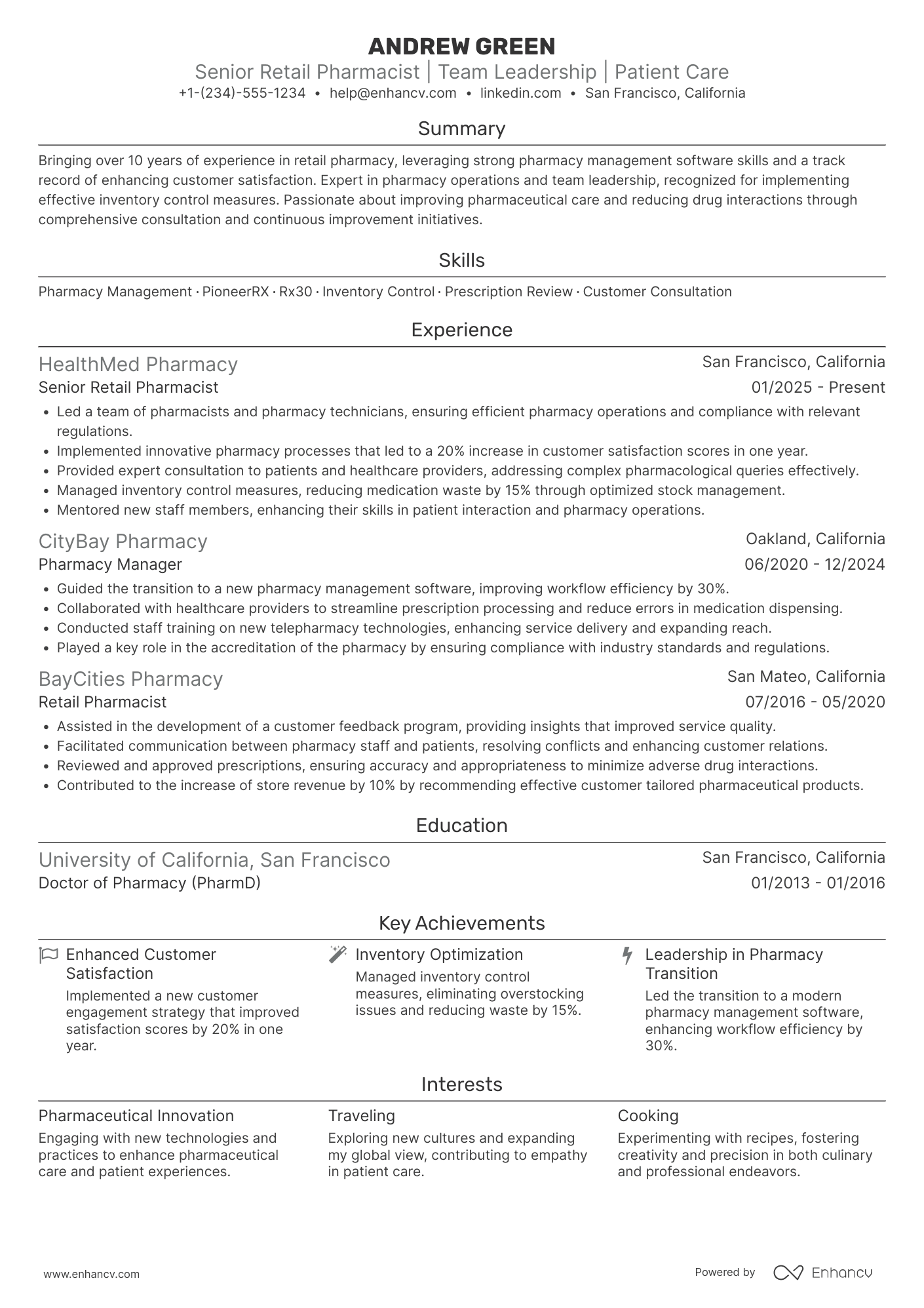
Retail Pharmacist resume examples
By Experience
By Role