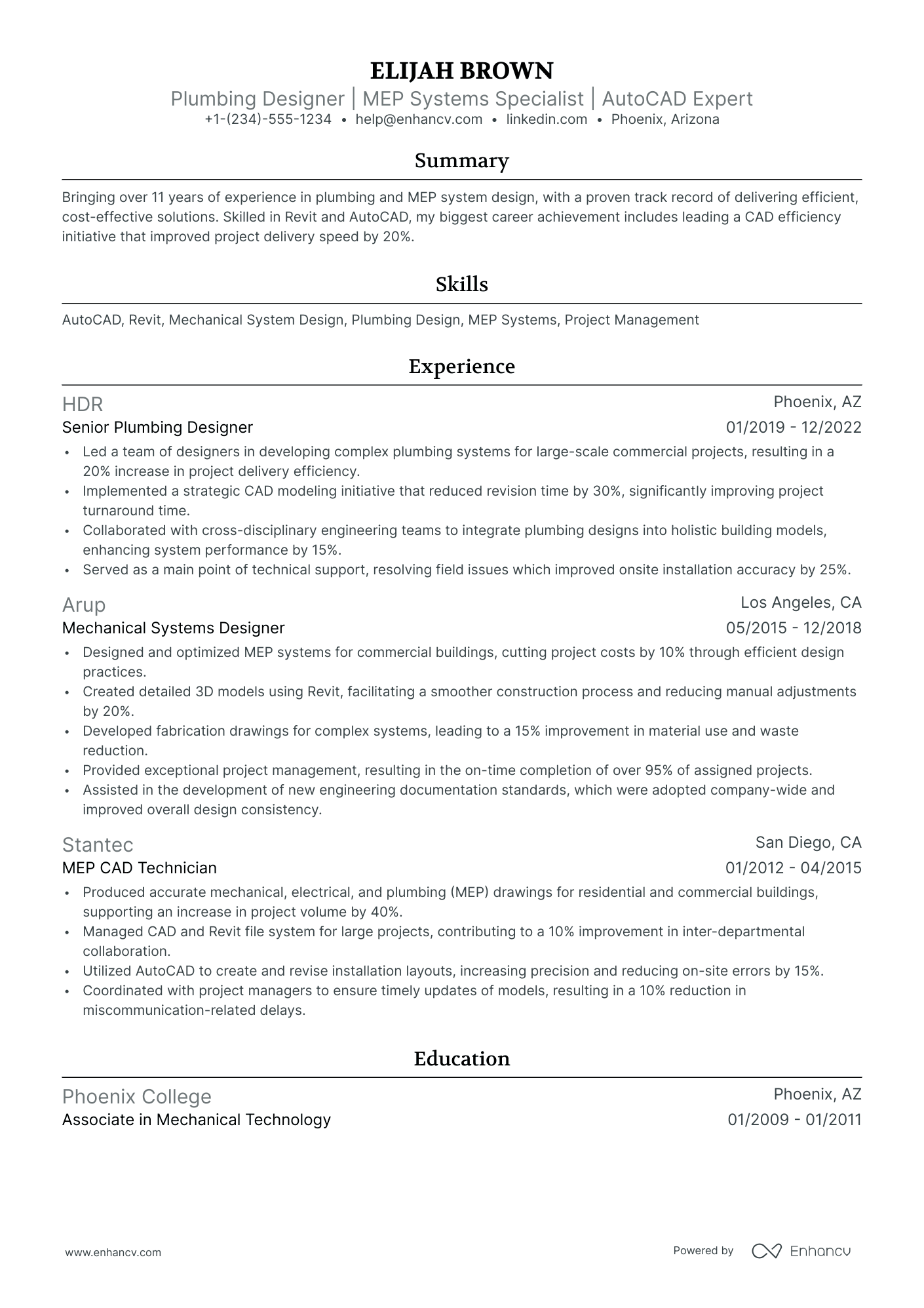
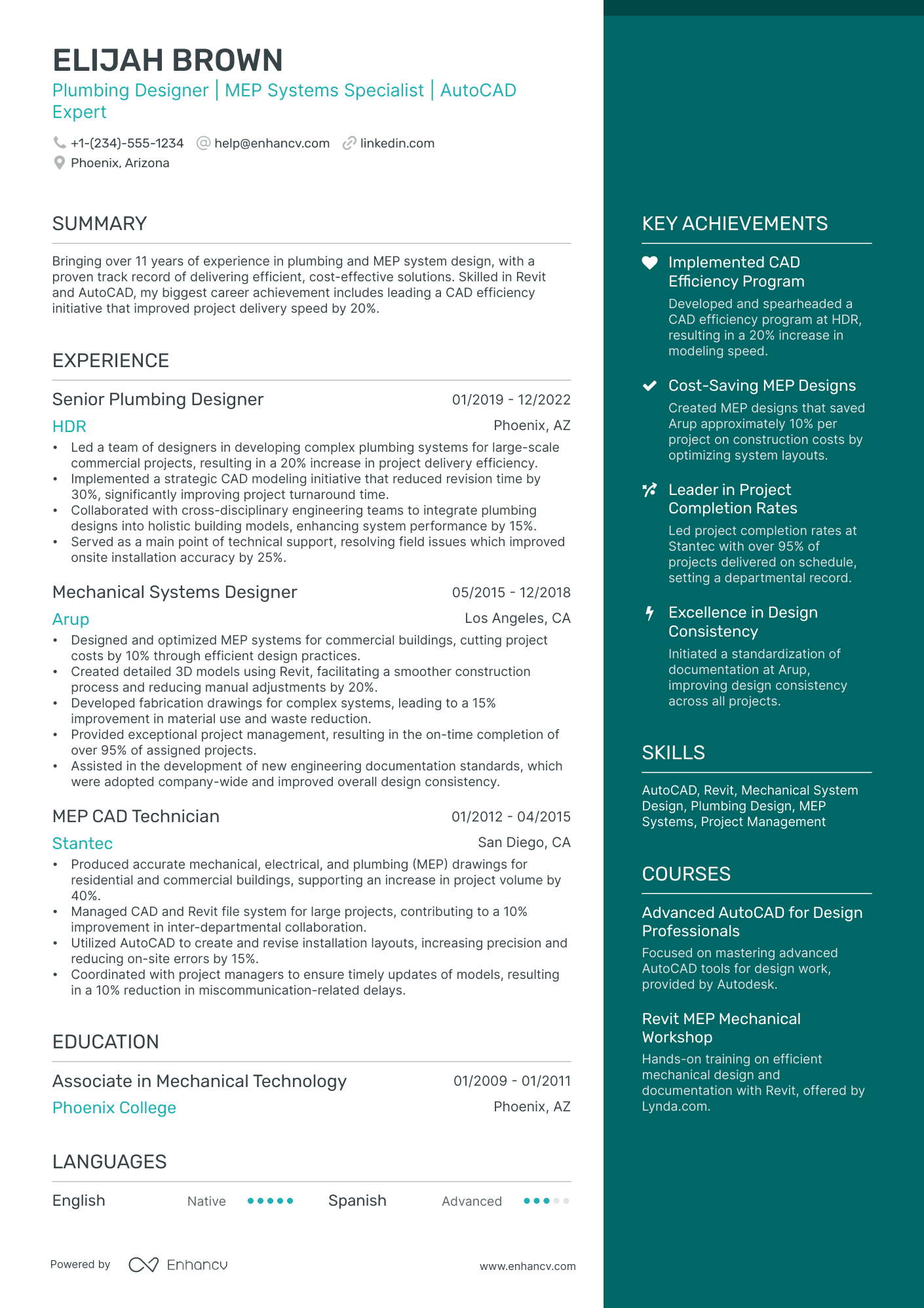
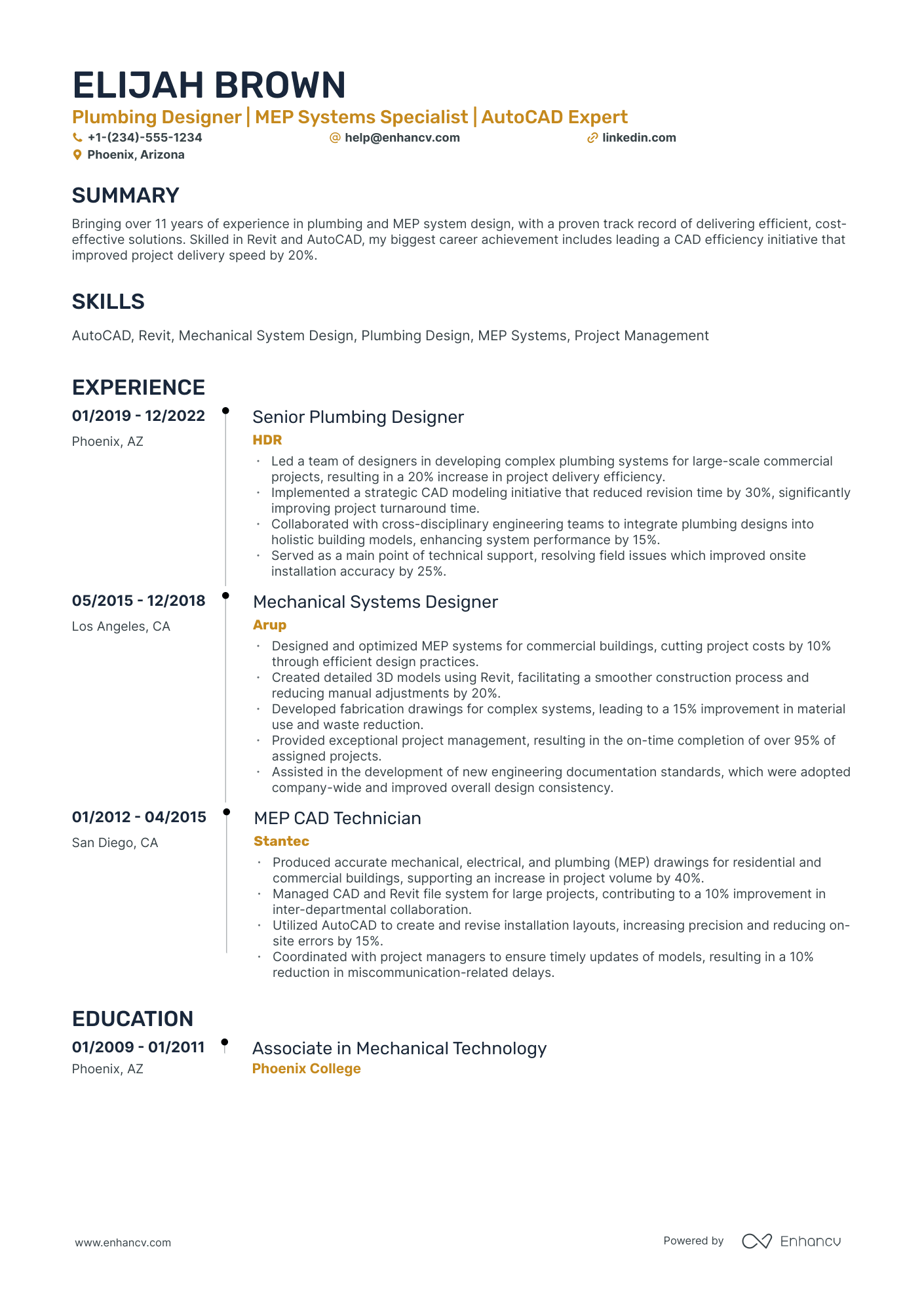
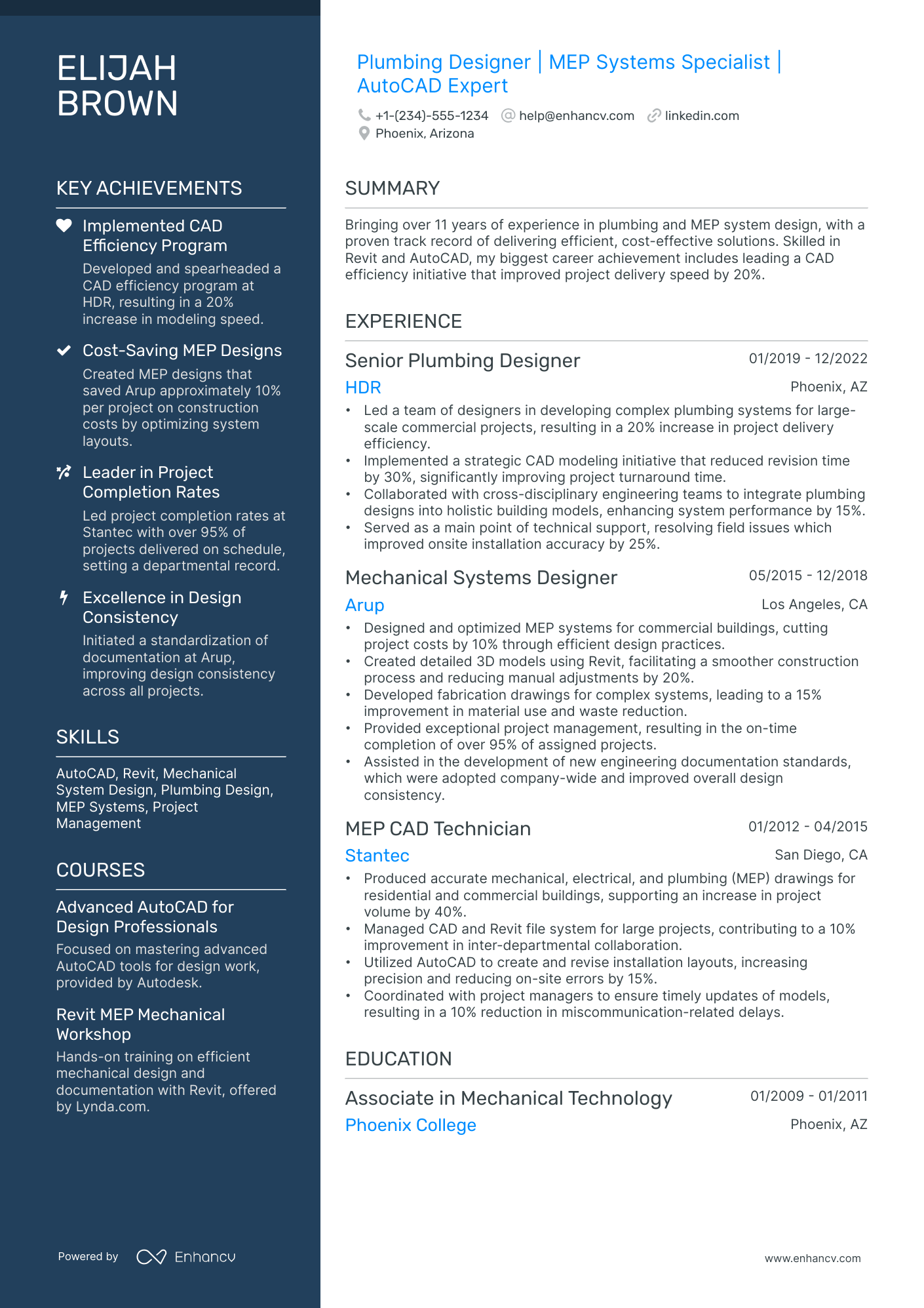
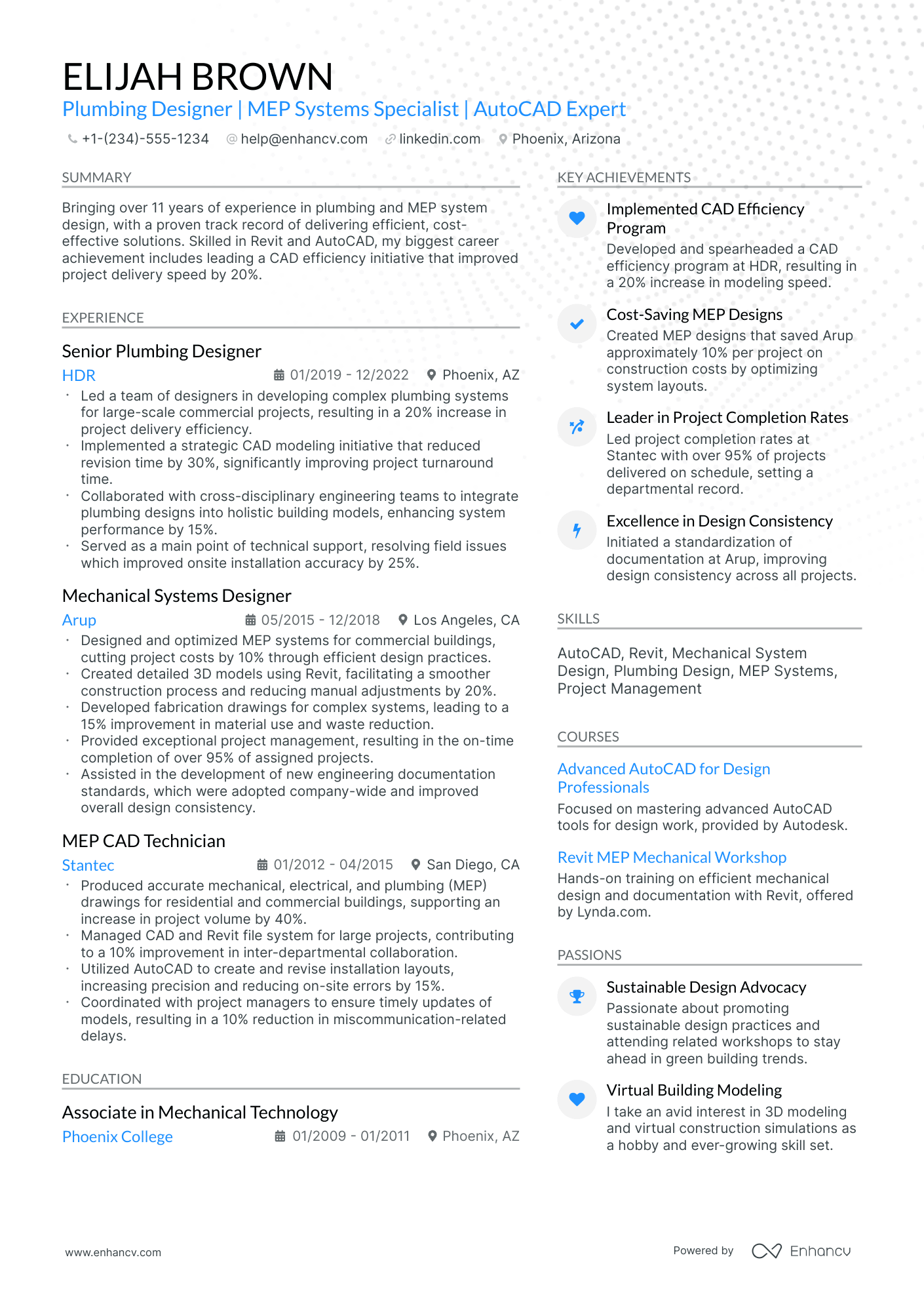
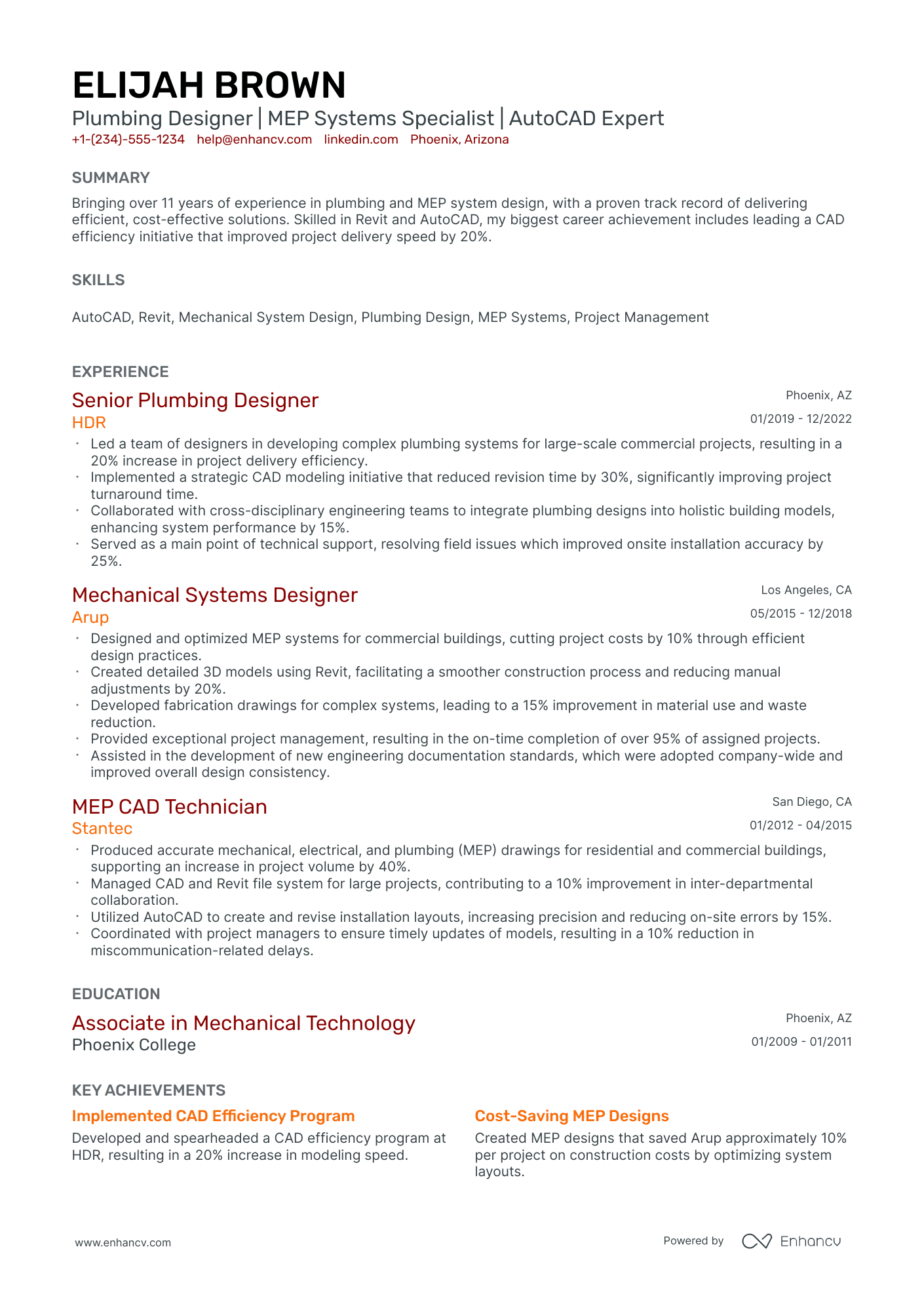
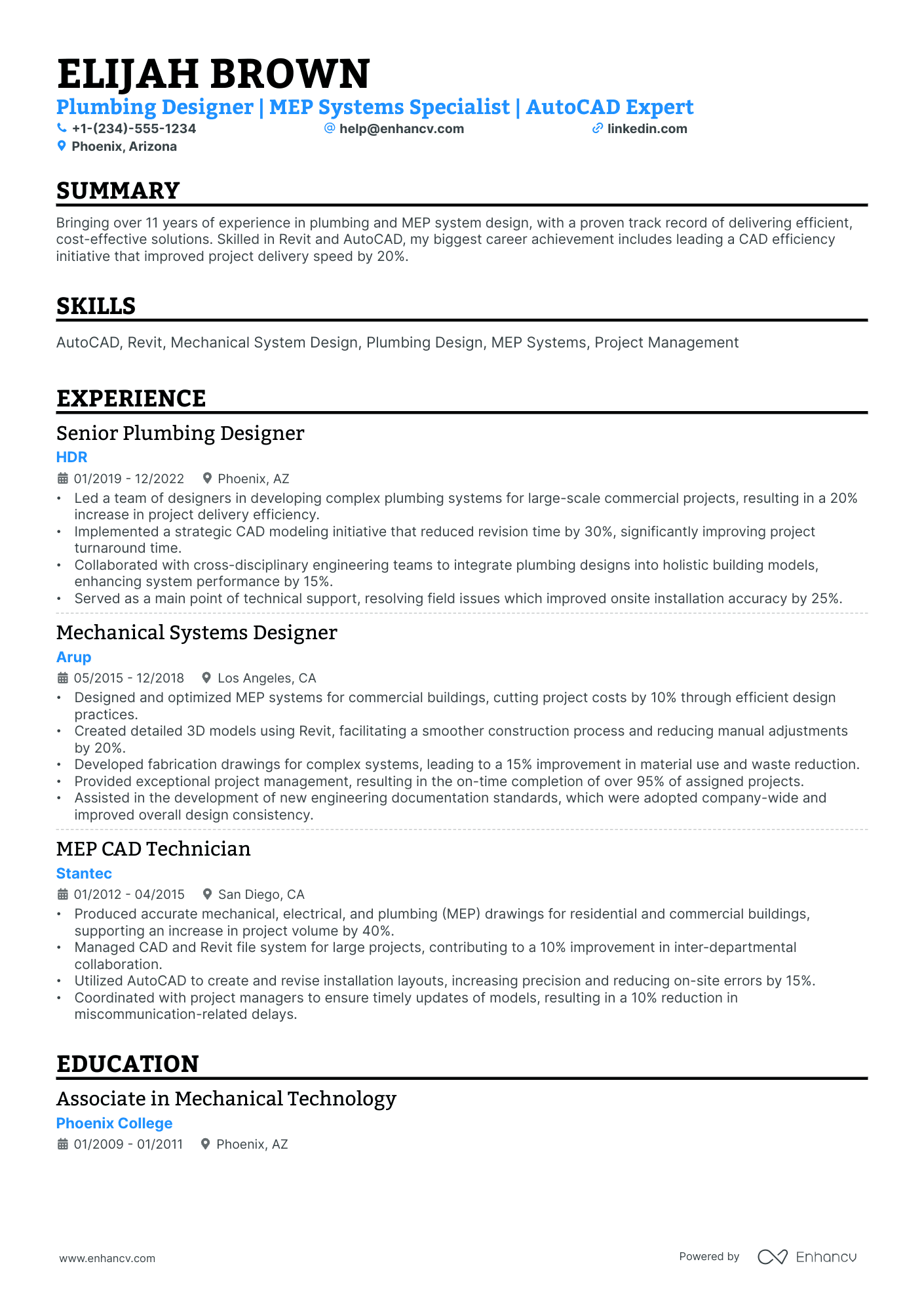
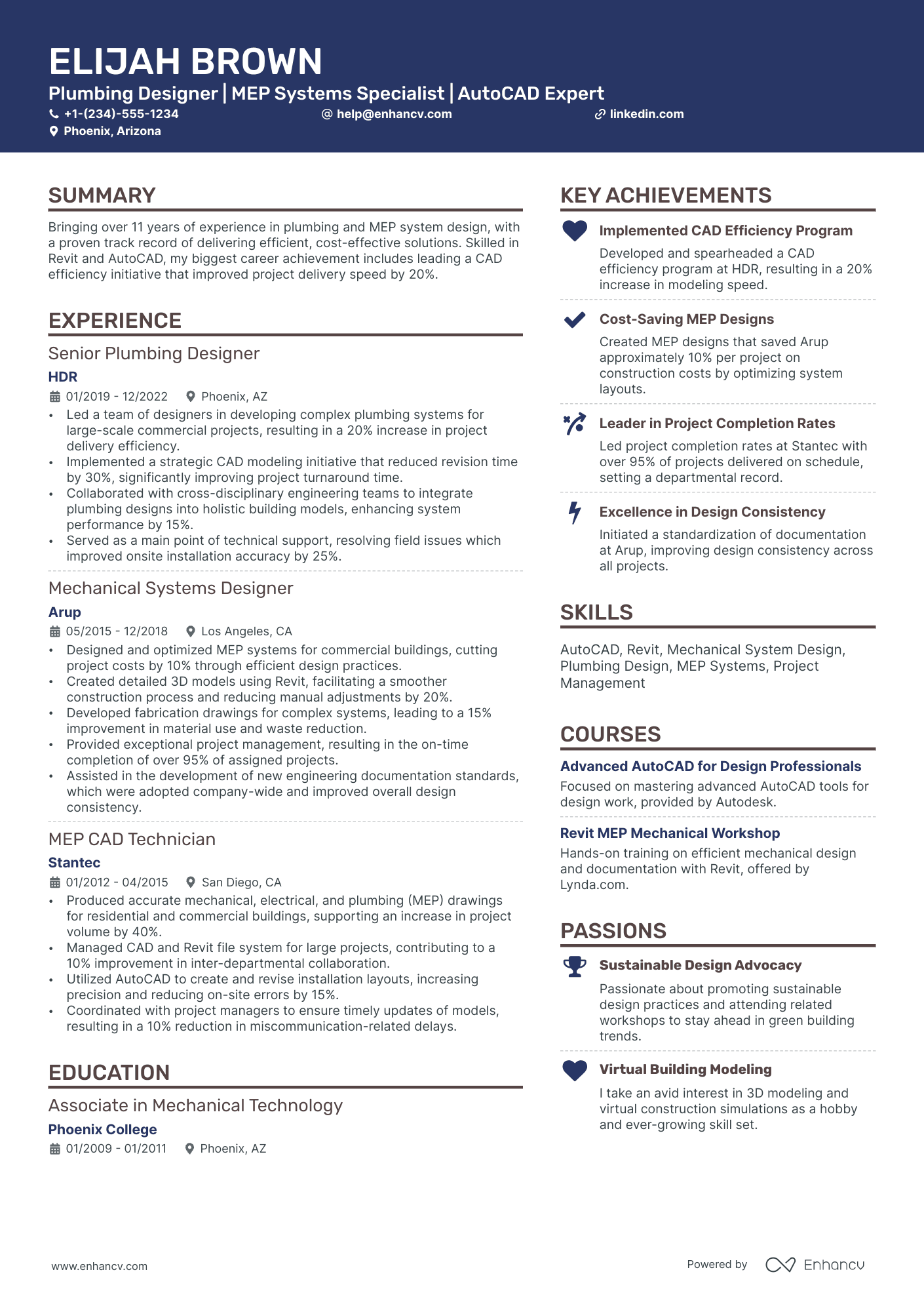
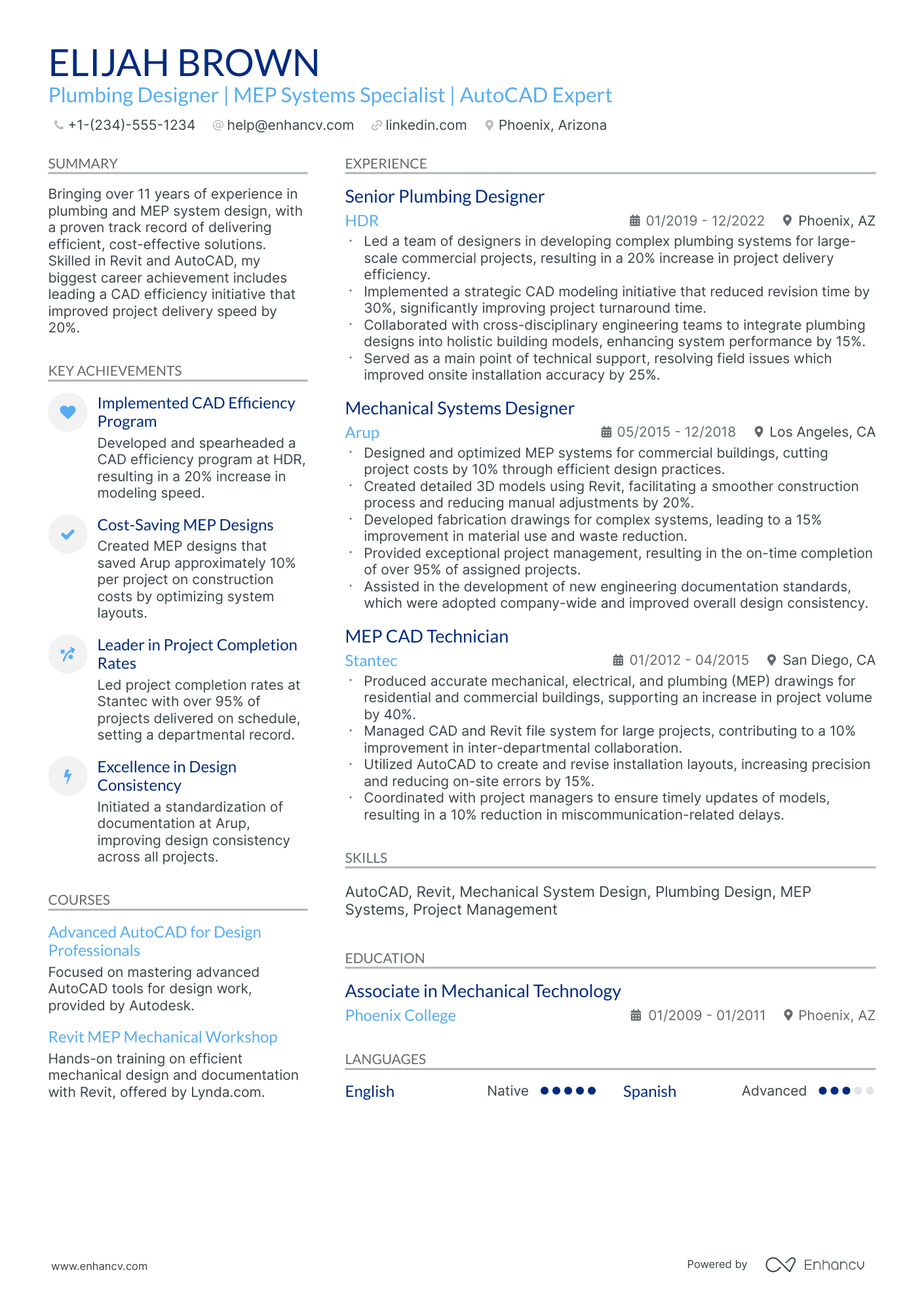
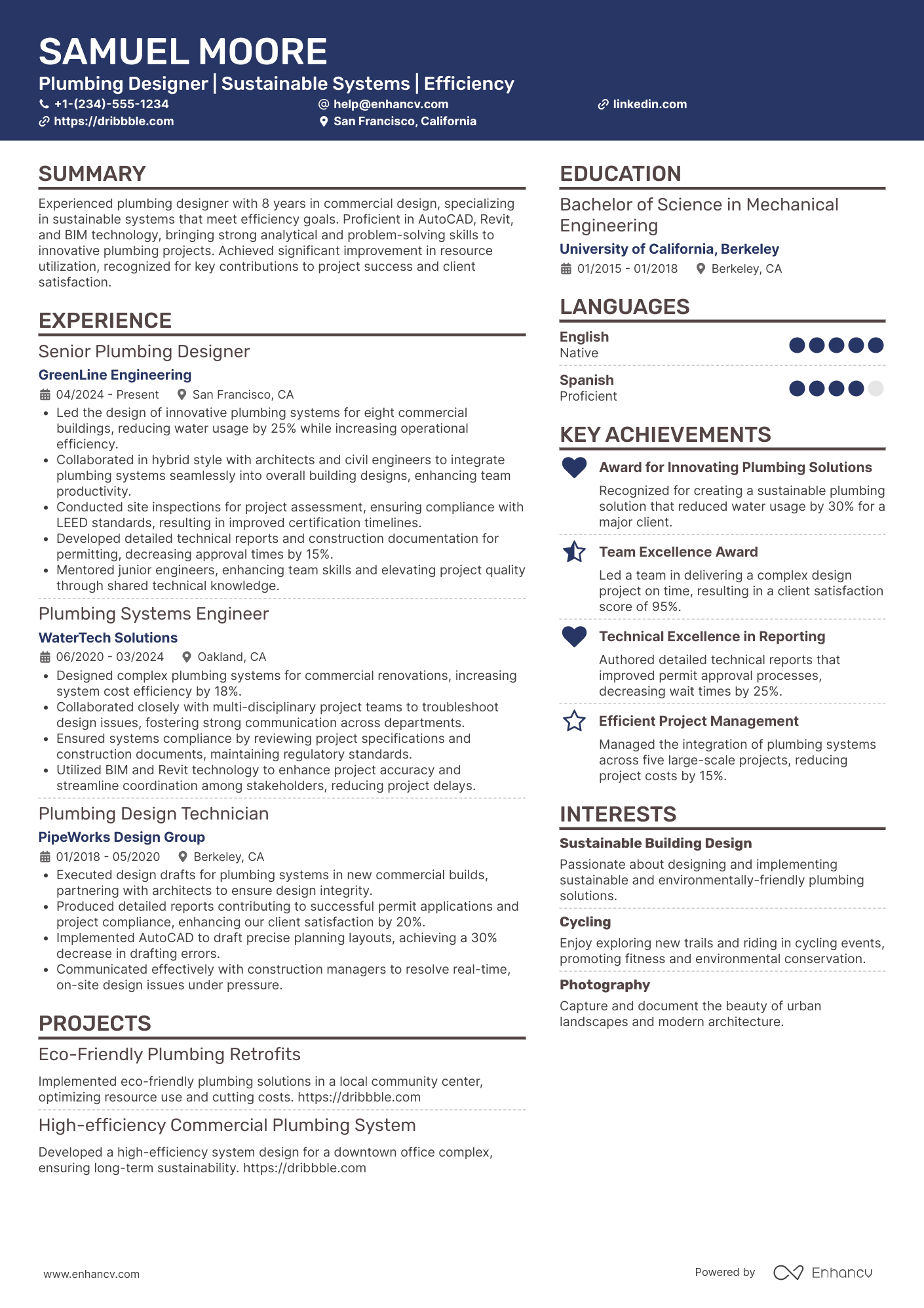
Most plumbing designer resume drafts fail because they bury code compliance and coordinated construction details under tool lists. That hurts when an ATS screens fast and recruiters scan in seconds amid heavy competition.
A strong resume shows what you delivered and why it mattered. Knowing how to make your resume stand out means you should highlight coordinated floor counts, clash reductions, permit approval speed, on-time submittals, fewer field changes, budget protection, and documented compliance across multi-trade teams.

Key takeaways
- Quantify plumbing design outcomes like clash reductions, cost savings, and permit approval rates in every bullet.
- Use reverse-chronological format for experienced designers and hybrid format for career changers.
- Tailor each resume to the job posting's exact codes, tools, and project types.
- Demonstrate skills in context through your summary and experience, not just a standalone list.
- Place certifications like CPD or CPDT where they'll reinforce your strongest, most recent credentials.
- Lead your summary with years of experience, core tools, and one measurable achievement.
- Use Enhancv to turn routine job duties into focused, results-driven resume bullets faster.
How to format a plumbing designer resume
Recruiters reviewing plumbing designer resumes prioritize technical proficiency with design software, knowledge of plumbing codes and standards, and the ability to produce accurate, constructible drawings that support project timelines. Choosing the right resume format ensures these signals surface quickly during both manual review and applicant tracking system (ATS) scans.

I have significant experience in this role—which format should I use?
Use a reverse-chronological format to put your deepest and most relevant plumbing design experience front and center. Do:
- Lead with your most recent role and clearly define your scope: project types, system complexity, team coordination, and ownership of deliverables.
- Highlight proficiency in role-specific tools and domains such as AutoCAD MEP, Revit MEP, plumbing code compliance (IPC/UPC), and fixture/riser diagram development.
- Quantify outcomes wherever possible—reduced revision cycles, projects delivered on schedule, cost savings from value-engineering, or square footage/units designed.
- Designed domestic water, sanitary, and storm drainage systems for a 220,000 sq. ft. mixed-use development in Revit MEP, reducing coordination RFIs by 35% through early clash detection with structural and HVAC models.
I'm junior or switching into this role—what format works best?
A hybrid format works best because it lets you lead with relevant technical skills while still showing a clear work or project timeline. Do:
- Place a dedicated skills section near the top of your resume featuring plumbing design tools (AutoCAD, Revit), relevant codes (IPC, UPC), and calculation methods (fixture unit sizing, pipe sizing).
- Include academic projects, internships, or cross-discipline experience—such as HVAC or fire protection drafting—that demonstrates transferable design and coordination ability.
- Connect every action to a result: show what you did, with what tool or method, and what it achieved for the project or team.
Why not use a functional resume?
A functional format strips away the project context, timeline, and employer association that hiring managers rely on to verify your actual design experience and technical depth.
- Edge-case exception: A functional format may be acceptable if you're transitioning from a related field (such as plumbing contracting or mechanical drafting) or have a significant gap in your work history—but only if you tie every listed skill directly to a specific project, tool, or measurable outcome rather than presenting skills in isolation.
With your format established, the next step is filling it with the right sections to give hiring managers a complete picture of your qualifications.
What sections should go on a plumbing designer resume
Recruiters expect a plumbing designer resume to show clear design responsibility, code compliance, and coordination across disciplines. Understanding which resume sections to include ensures maximum clarity.
Use this structure for maximum clarity:
- Header
- Summary
- Experience
- Skills
- Projects
- Education
- Certifications
- Optional sections: Awards, leadership, and volunteering
Strong experience bullets should emphasize measurable impact, project scope, coordination outcomes, and code-compliant results delivered on schedule and within budget.
Is your resume good enough?
Drop your resume here or choose a file. PDF & DOCX only. Max 2MB file size.
Once you’ve organized your resume with the right core components, the next step is to write your plumbing designer resume experience section so it supports that structure with relevant, results-focused detail.
How to write your plumbing designer resume experience
Your experience section should prove you've delivered functional plumbing designs—using industry-standard tools and methods—that met code requirements, project timelines, and measurable performance benchmarks. Hiring managers prioritize demonstrated impact on real projects over descriptive task lists that simply catalog daily responsibilities. Building a targeted resume means each entry should focus on what matters most to the specific role.
Each entry should include:
- Job title
- Company and location (or remote)
- Dates of employment (month and year)
Three to five concise bullet points showing what you owned, how you executed, and what outcomes you delivered:
- Ownership scope: the plumbing systems, building types, project phases, or design packages you were directly accountable for—whether domestic water supply, sanitary drainage, stormwater management, or medical gas layouts across residential, commercial, or institutional projects.
- Execution approach: the design software, calculation methods, code standards, and coordination workflows you relied on to produce and validate your work, such as Revit MEP, AutoCAD, pipe-sizing calculations, or Building Information Modeling coordination processes.
- Value improved: the specific gains your designs contributed to in areas like water efficiency, code compliance, constructability, material optimization, system reliability, or reduction of field conflicts during construction.
- Collaboration context: how you coordinated with mechanical engineers, architects, structural teams, general contractors, plumbing subcontractors, or local authorities having jurisdiction to align your designs with broader project requirements.
- Impact delivered: the tangible results your work produced, framed through project completion, system performance, cost outcomes, permit approvals, or reduction of requests for information and change orders—rather than a simple list of tasks you performed.
Experience bullet formula
A plumbing designer experience example
✅ Right example - modern, quantified, specific.
Plumbing Designer
ArcLine MEP Engineers | Phoenix, AZ
2021–Present
MEP consulting firm delivering plumbing and fire protection design for healthcare, life sciences, and high-rise commercial projects across the Southwest.
- Designed domestic water, sanitary, storm, and natural gas systems in Revit MEP and AutoCAD for twenty-plus projects totaling 1.8 million square feet, reducing RFI volume by 28% through tighter coordination and clearer details.
- Modeled and coordinated above-ceiling routing using Navisworks Manage clash detection with structural and mechanical teams, cutting field rework by 22% and saving an estimated $190K across three hospital renovations.
- Sized piping, pumps, and water heaters using IPC, UPC, and ASPE methods, optimizing fixture unit assumptions and reducing calculated peak demand by 12% without compromising performance.
- Produced permit-ready plans, riser diagrams, and specifications (CSI MasterFormat) and led weekly coordination with architects, project managers, and contractors, improving first-pass permit approval from 70% to 92%.
- Standardized Revit families, view templates, and calculation spreadsheets, shortening design cycle time by 15% and improving drawing consistency across a six-designer team.
Now that you've seen how a strong experience section comes together, let's look at how to adjust yours to match the specific job posting you're targeting.
How to tailor your plumbing designer resume experience
Recruiters evaluate plumbing designer resumes through both human review and applicant tracking systems. Tailoring your resume to the job description increases your chances of passing both.
Ways to tailor your plumbing designer experience:
- Match plumbing design software and BIM tools listed in the posting.
- Use the exact code references like UPC or IPC from the description.
- Mirror the project types such as commercial or residential they specify.
- Highlight experience with the pipe sizing methods they reference.
- Reflect their language for coordination workflows with other trades.
- Include relevant experience with sustainable or LEED plumbing systems.
- Emphasize quality assurance processes that align with their standards.
- Reference fixture scheduling or load calculation methods they mention.
Tailoring means aligning your real accomplishments with the role's requirements, not forcing keywords where they don't belong.
Resume tailoring examples for plumbing designer
| Job description excerpt | Untailored | Tailored |
|---|---|---|
| Design domestic water, sanitary waste, and storm drainage systems for commercial buildings using AutoCAD MEP and Revit MEP per IPC and local code requirements. | Worked on plumbing designs for various building projects. | Designed domestic water, sanitary waste, and storm drainage systems for 12 commercial buildings using AutoCAD MEP and Revit MEP, ensuring full compliance with IPC and local plumbing codes. |
| Perform fixture unit calculations, pipe sizing, and hydraulic analysis for multi-story residential developments; coordinate with mechanical and structural teams through BIM 360. | Helped with plumbing calculations and coordinated with other departments. | Performed fixture unit calculations, pipe sizing, and hydraulic analysis for multi-story residential developments up to 24 floors, coordinating cross-discipline reviews with mechanical and structural teams through BIM 360. |
| Prepare plumbing construction documents, specifications, and submittals for healthcare facility projects; ensure compliance with ASSE standards and infection-control backflow prevention requirements. | Created plumbing documents and specifications for different types of buildings. | Prepared plumbing construction documents, specifications, and submittals for three healthcare facilities totaling 450,000 sq. ft., ensuring compliance with ASSE standards and infection-control backflow prevention requirements. |
Once you’ve aligned your experience with the role’s priorities, quantify your plumbing designer achievements to show the measurable impact behind those choices.
How to quantify your plumbing designer achievements
Quantifying your achievements proves your designs perform in the field, not just on paper. Focus on numbers tied to rework reduction, code compliance, material cost, clash resolution, and on-time issuance of coordinated drawings.
Quantifying examples for plumbing designer
| Metric | Example |
|---|---|
| Delivery speed | "Issued 120-sheet plumbing drawing set two weeks early by standardizing Revit templates and automating schedules with Dynamo." |
| Clash reduction | "Cut Navisworks clashes by 38% (from 210 to 130) by tightening coordination with HVAC and structural before the 90% review." |
| Cost savings | "Value-engineered domestic water and sanitary layouts to reduce pipe length by 12% and saved $85,000 in material on a 22-story tower." |
| Code compliance | "Achieved zero plumbing plan-check comments across three permit submittals by aligning designs to IPC 2021 and local amendments." |
| Rework rate | "Reduced field RFIs tied to plumbing routing by 25% (from 48 to 36) by adding 3D details and riser diagrams in Revit." |
Turn vague job duties into measurable, recruiter-ready resume bullets in seconds with Enhancv's Bullet Point Generator.
With strong, action-driven bullet points in place, the next step is making sure your skills section highlights the right mix of hard and soft skills for a plumbing designer role.
How to list your hard and soft skills on a plumbing designer resume
Your skills section shows you can produce code-compliant, coordinated plumbing designs, and recruiters and ATS scan this section for role keywords and tools—aim for a balanced mix of hard skills (codes, software, calculations) and soft skills (coordination, documentation). plumbing designer roles require a blend of:
- Product strategy and discovery skills.
- Data, analytics, and experimentation skills.
- Delivery, execution, and go-to-market discipline.
- Soft skills.
Your skills section should be:
- Scannable (bullet-style grouping).
- Relevant to the job post.
- Backed by proof in experience bullets.
- Updated with current tools.
Place your skills section:
- Above experience if you're junior or switching careers.
- Below experience if you're mid/senior with strong achievements.

Hard skills
- Revit, BIM 360
- AutoCAD, AutoCAD MEP
- Navisworks clash detection
- Plumbing fixture schedules
- Domestic water sizing
- Sanitary, vent systems design
- Storm drainage design
- Hydraulic calculations, head loss
- Pipe routing, coordination drawings
- NFPA, IPC, UPC compliance
- Shop drawing review, submittals
- BIM coordination, model QA/QC
Soft skills
- Coordinate with architects, engineers
- Resolve clashes with trades
- Translate code into design decisions
- Document assumptions and constraints
- Run focused design reviews
- Manage RFIs and responses
- Prioritize constructability and access
- Communicate changes with impact
- Own deadlines and deliverables
- Present options and tradeoffs
- Align stakeholders on scope
- Maintain clear revision control
How to show your plumbing designer skills in context
Skills shouldn't live only in a dedicated skills list. Browse examples of resume skills used in context to see how top candidates integrate them naturally.
They should be demonstrated in:
- Your summary (high-level professional identity)
- Your experience (proof through outcomes)
Here's how that looks in practice.
Summary example
Senior plumbing designer with 12 years of experience in commercial healthcare projects. Proficient in Revit MEP and AutoCAD, I've reduced system design errors by 30% through coordinated BIM workflows and cross-discipline collaboration.
- Reflects senior-level expertise clearly
- Names industry-standard design tools
- Includes a measurable performance outcome
- Highlights cross-discipline collaboration skills
Experience example
Senior Plumbing Designer
Greystone Mechanical Engineers | Denver, CO
March 2018–Present
- Designed domestic water and sanitary systems in Revit MEP for 15 healthcare facilities, cutting rework requests by 25%.
- Collaborated with mechanical and fire protection engineers to resolve coordination clashes, reducing RFIs by 40% across projects.
- Developed standardized piping templates using AutoCAD and Navisworks, shortening design phase timelines by three weeks on average.
- Every bullet contains measurable proof.
- Skills appear naturally within achievements.
Once you’ve demonstrated your plumbing designer abilities through relevant projects and results, the next step is learning how to structure a plumbing designer resume with no experience so those examples still stand out.
How do I write a plumbing designer resume with no experience
Even without full-time experience, you can demonstrate readiness through building a resume without work experience that highlights transferable projects and technical training:
- Technical coursework in plumbing design
- Revit MEP or AutoCAD projects
- Internship or job shadowing hours
- Permit-ready plan set exercises
- Plumbing fixture schedule assignments
- Hydraulics calculations using spreadsheets
- Field measurements and as-built drawings
- Code research using IPC
Focus on:
- CAD and BIM deliverables
- Code-based sizing calculations
- Coordination with architectural backgrounds
- Clear, quantifiable project outputs
Resume format tip for entry-level plumbing designer
Use a skills-based resume format because it highlights CAD, code knowledge, and project work when you lack full-time plumbing designer experience. Do:
- Lead with a plumbing designer skills section.
- List tools: Revit MEP, AutoCAD, Excel.
- Add two to three project bullets.
- Include IPC-based calculations and assumptions.
- Quantify plan sheets, fixtures, or areas.
- Built a Revit MEP domestic water layout for a 6,500-square-foot office, sized pipes per IPC, and reduced fixture conflicts from eight to two.
Once you've structured your resume around transferable skills and relevant projects, presenting your education effectively becomes the next key step in reinforcing your qualifications.
How to list your education on a plumbing designer resume
Your education section helps hiring teams confirm you have the technical foundation for plumbing designer work. It validates your training in hydraulics, building codes, and system design.
Include:
- Degree name
- Institution
- Location
- Graduation year
- Relevant coursework (for juniors or entry-level candidates)
- Honors & GPA (if 3.5 or higher)
Skip month and day details—list the graduation year only.
Here's a strong education entry tailored to a plumbing designer resume:
Example education entry
Bachelor of Science in Mechanical Engineering Technology
Purdue University, West Lafayette, IN
Graduated 2021
GPA: 3.7/4.0
- Relevant Coursework: Fluid Mechanics, Plumbing System Design, Building Codes and Standards, HVAC Fundamentals, CAD for MEP Systems
- Honors: Dean's List, magna cum laude
How to list your certifications on a plumbing designer resume
Certifications on a resume show a plumbing designer's commitment to learning, proficiency with current tools, and alignment with industry standards that employers trust.
Include:
- Certificate name
- Issuing organization
- Year
- Optional: credential ID or URL
- Place certifications below education when your most relevant credentials are older, and your degree is the strongest, most recent qualification.
- Place certifications above education when they are recent, role-relevant, or required, and they match the plumbing designer role you target.
Best certifications for your plumbing designer resume
- Certified Plumbing Design Technician (CPDT)
- Certified in Plumbing Design (CPD)
- LEED Green Associate
- OSHA 30-Hour Construction Safety
- Autodesk Certified Professional: AutoCAD for Design and Drafting
- Autodesk Certified Professional: Revit for Architectural Design
- ASPE Backflow Prevention Certification
Once you’ve positioned your credentials where hiring managers will see them, move to your plumbing designer resume summary to highlight those qualifications upfront and set context for the rest of your resume.
How to write your plumbing designer resume summary
Your resume summary is the first thing a recruiter reads. A strong one instantly frames you as qualified for the plumbing designer role.
Keep it to three to four lines, with:
- Your title and total years of plumbing design experience.
- Domain focus, such as commercial, residential, or industrial plumbing systems.
- Core tools and skills like AutoCAD, Revit MEP, or plumbing code compliance.
- One or two quantified achievements that show project impact.
- Soft skills tied to real outcomes, such as coordination that reduced RFIs.

PRO TIP
At this level, emphasize technical proficiency, relevant software skills, and early project contributions. Highlight measurable results, even from internships or entry-level roles. Avoid vague phrases like "passionate team player" or "hardworking self-starter." Recruiters want proof of capability, not motivation statements.
Example summary for a plumbing designer
Plumbing designer with three years of experience in commercial building systems using Revit MEP and AutoCAD. Designed plumbing layouts for 12 projects, reducing material waste by 15% through precise coordination with mechanical teams.
Optimize your resume summary and objective for ATS
Drop your resume here or choose a file.
PDF & DOCX only. Max 2MB file size.
Now that your summary captures your professional value, make sure your header presents the essential contact and identification details recruiters need to reach you.
What to include in a plumbing designer resume header
Your resume header lists your key contact and professional details, helping plumbing designer candidates boost visibility, build credibility, and pass recruiter screening fast.
Essential resume header elements.
- Full name
- Tailored job title and headline
- Location
- Phone number
- Professional email
- GitHub link
- Portfolio link
A LinkedIn link helps recruiters verify experience quickly and supports screening with consistent dates, titles, and project details.
Don't include a photo on a plumbing designer resume unless the role is explicitly front-facing or appearance-dependent.
Keep your header to two lines, match the plumbing designer job title to the posting, and use links that open to your best, most relevant work.
Example
Plumbing designer resume header
Jordan Taylor
Plumbing designer | Revit MEP and AutoCAD piping layouts
Denver, CO | (303) 555-01XX | your.name@enhancv.com
github.com/yourname yourwebsite.com linkedin.com/in/yourname
Once your contact details and role identifiers are clear at the top, you can strengthen the rest of the document by adding relevant additional sections for plumbing designer resumes.
Additional sections for plumbing designer resumes
Adding extra sections helps you stand out when your core qualifications match other candidates. They showcase unique strengths relevant to plumbing design work. For example, listing language skills on your resume can be valuable if you work on projects with multilingual teams or international code standards.
- Languages
- Certifications and licenses
- Professional affiliations (e.g., ASPE membership)
- Publications or technical presentations
- Continuing education and training
- Software proficiencies
- Volunteer or pro bono design projects
Once your resume's additional sections showcase the full scope of your qualifications, pairing it with a tailored cover letter can strengthen your application even further.
Do plumbing designer resumes need a cover letter
A cover letter isn't required for a plumbing designer, but it helps in competitive searches or when hiring managers expect one. If you're unsure what a cover letter is or when to include one, it can make a difference when your resume needs context, or when your fit for the team isn't obvious.
Use a cover letter to add context your resume can't:
- Explain role and team fit: Match your experience to the project type, delivery model, and tools the plumbing designer role uses.
- Highlight one or two outcomes: Reference a project with clear results, like reduced clashes, faster permitting, or fewer field changes.
- Show business and user context: Connect your work to building use, maintenance needs, safety, and cost constraints that affect plumbing design decisions.
- Address transitions or gaps: Explain a shift in discipline, industry, or seniority, and translate non-obvious experience into plumbing designer value.
Drop your resume here or choose a file.
PDF & DOCX only. Max 2MB file size.
Even when you decide a cover letter adds value for certain applications, AI tools can help you strengthen your plumbing designer resume faster and more consistently, which is why the next section focuses on using AI to improve it.
Conclusion
A strong plumbing designer resume shows measurable outcomes, role-specific skills, and a clear structure. Highlight design accuracy, coordination results, and schedule or cost impacts. Use concise bullets, consistent formatting, and an easy-to-scan layout.
Keep your plumbing designer resume focused on what hiring teams need now and next. Align your skills and results with current project demands, codes, and workflows. With clear sections and proven impact, you show readiness to contribute on day one.