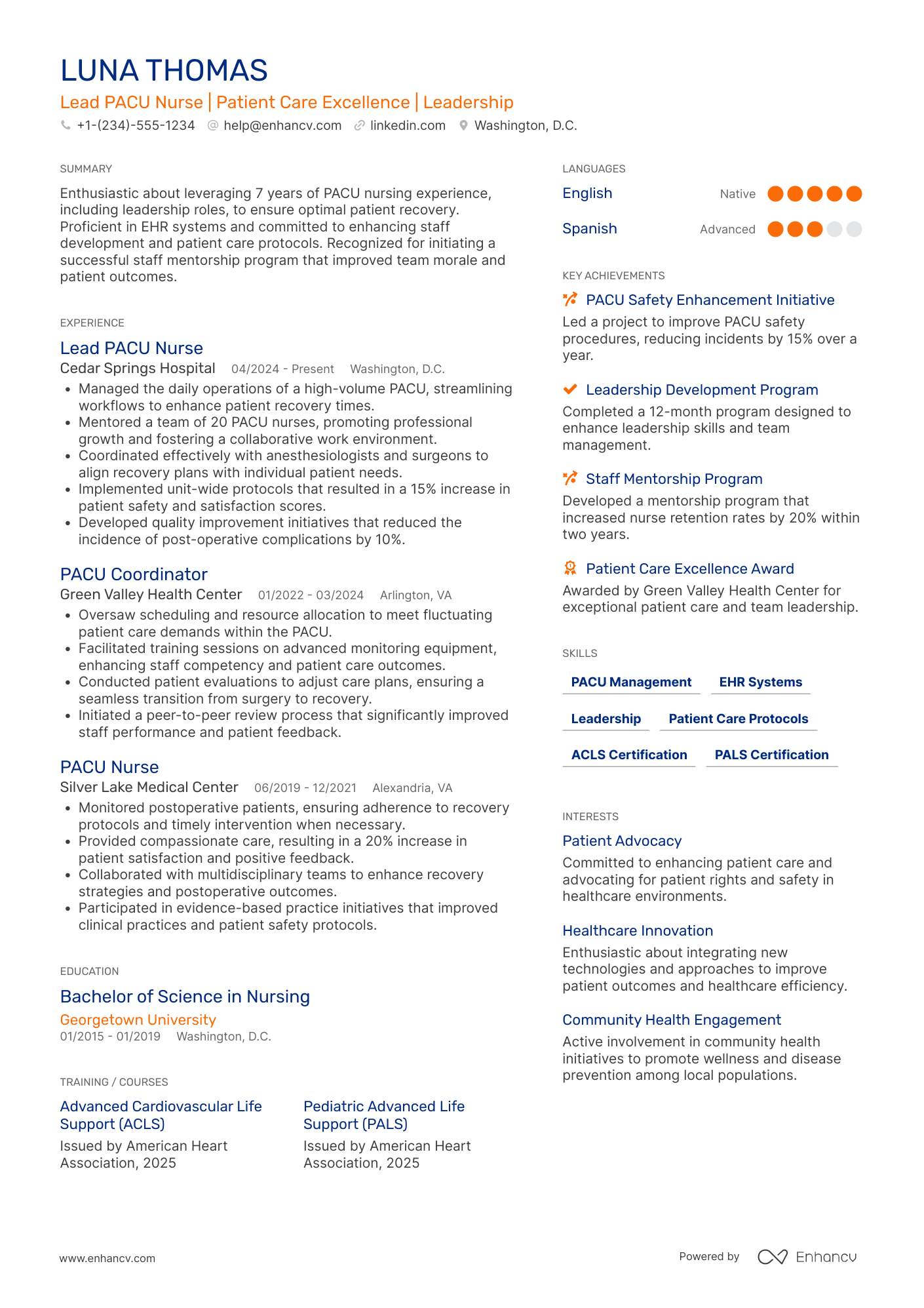
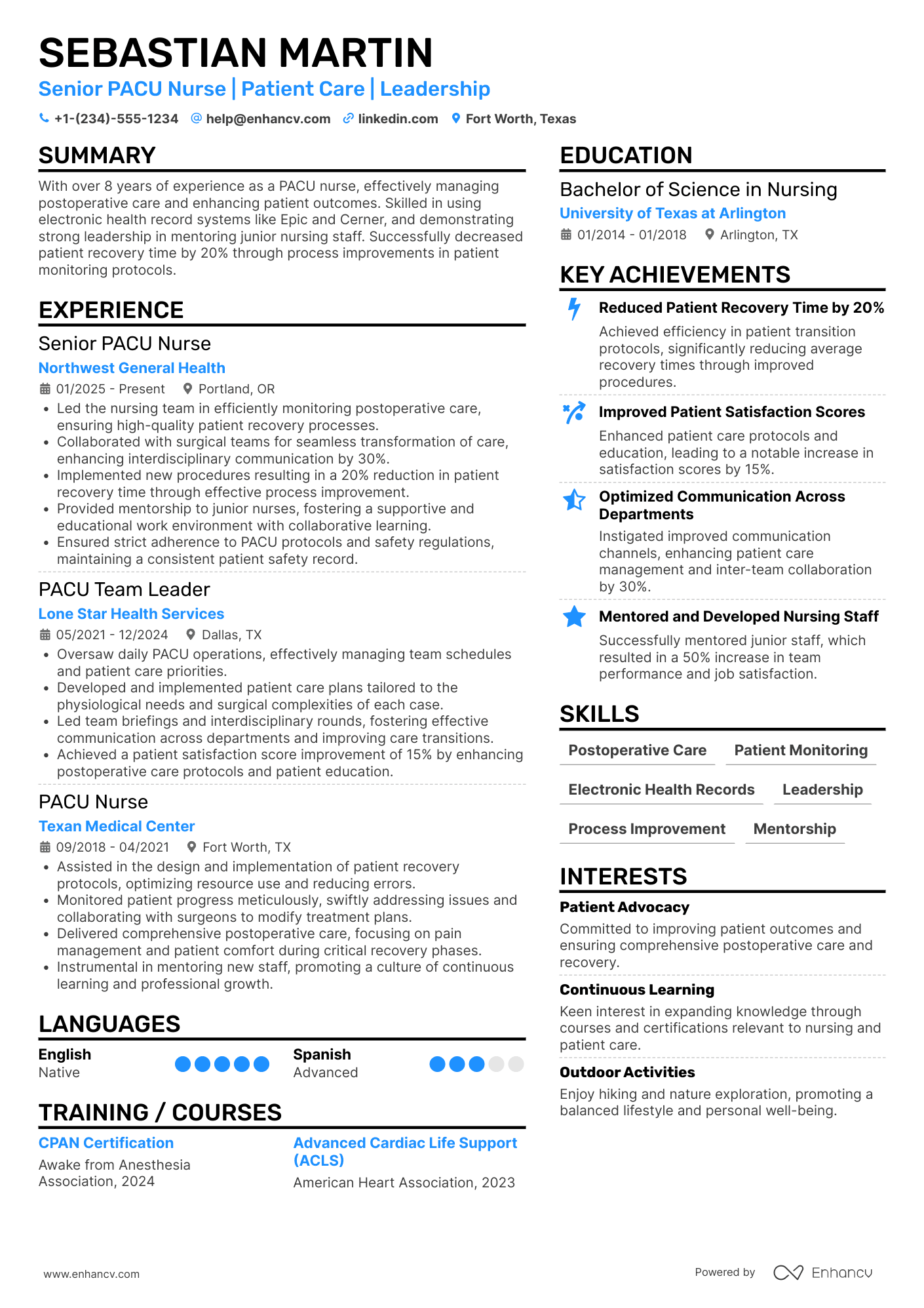
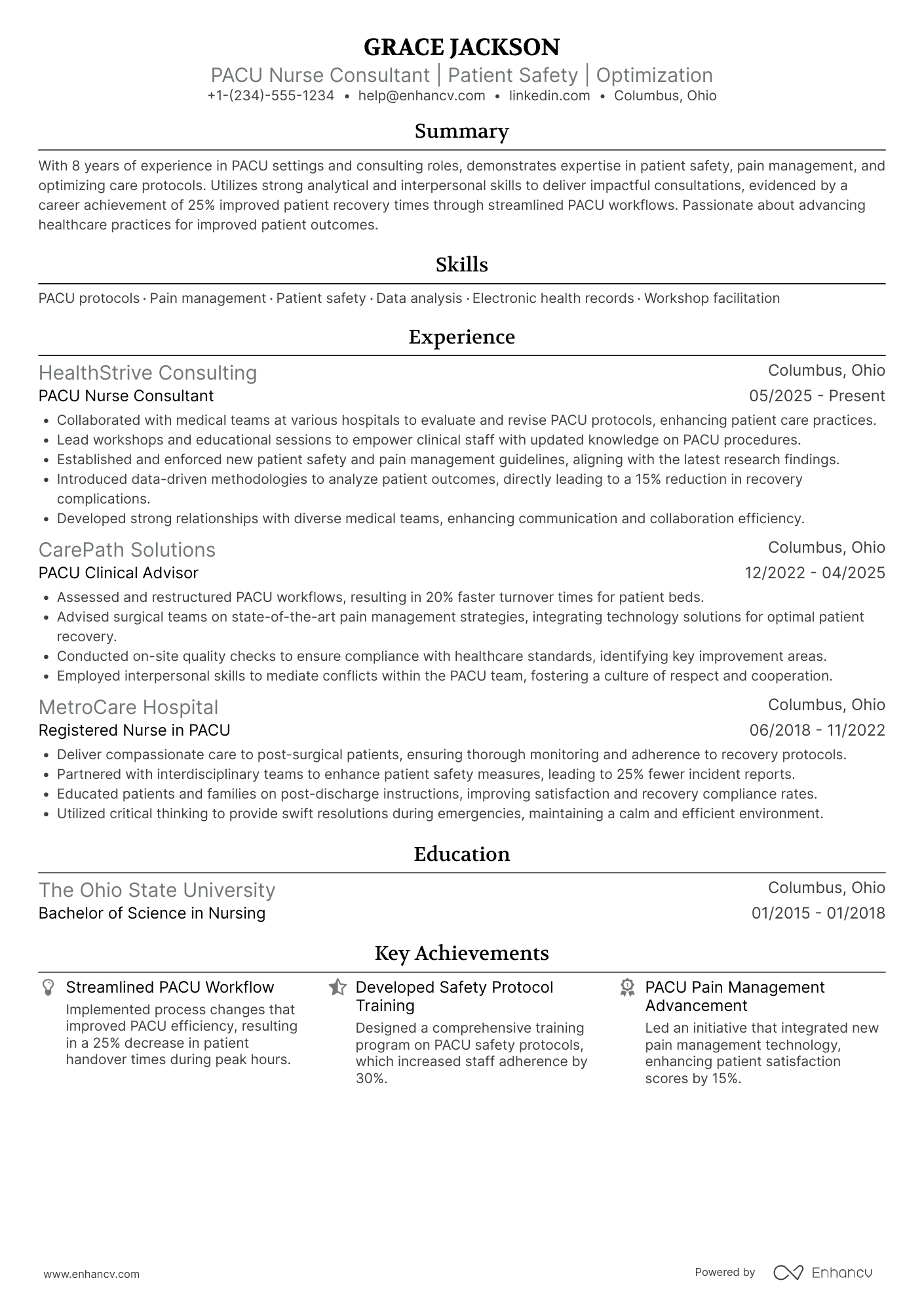
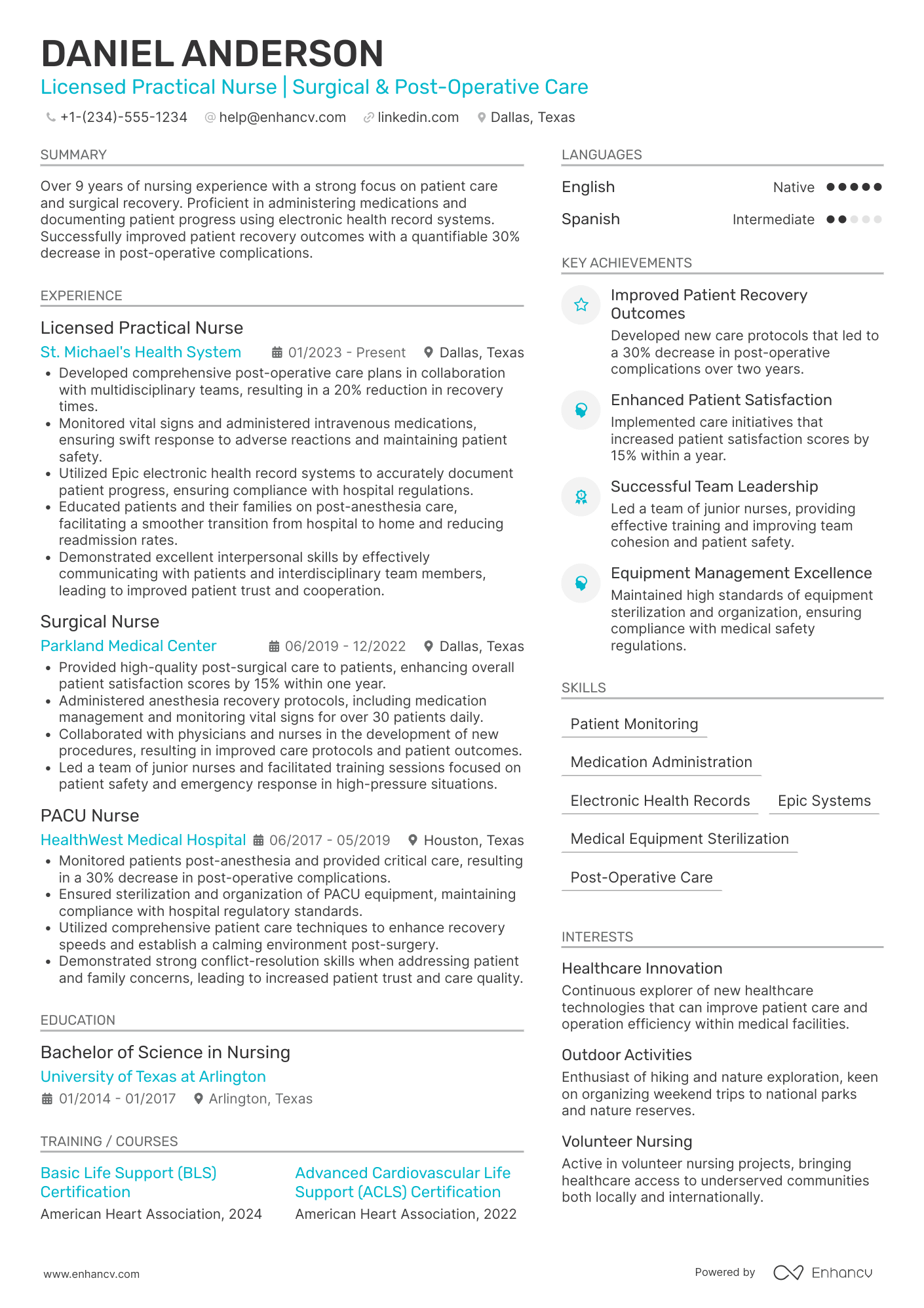
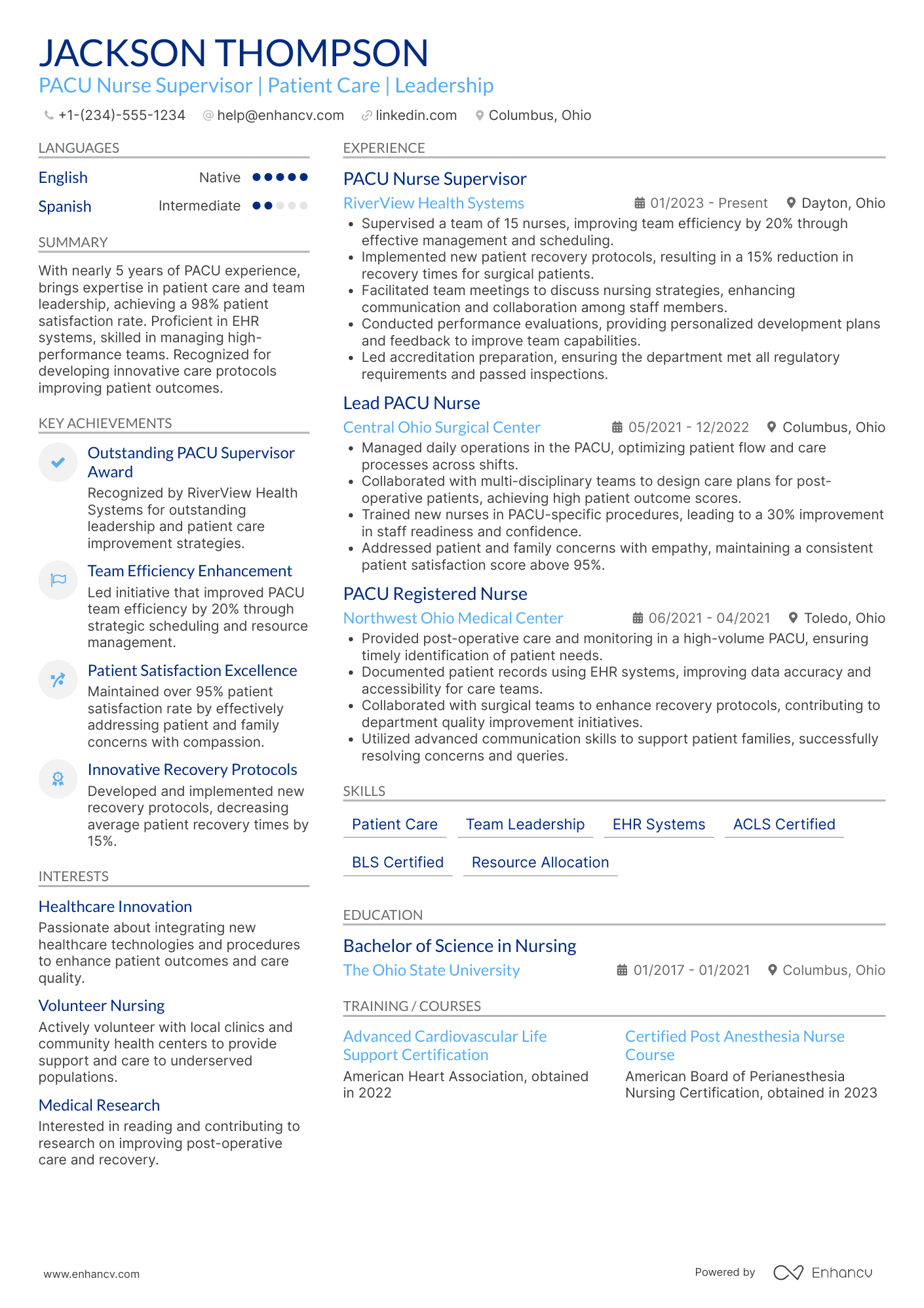
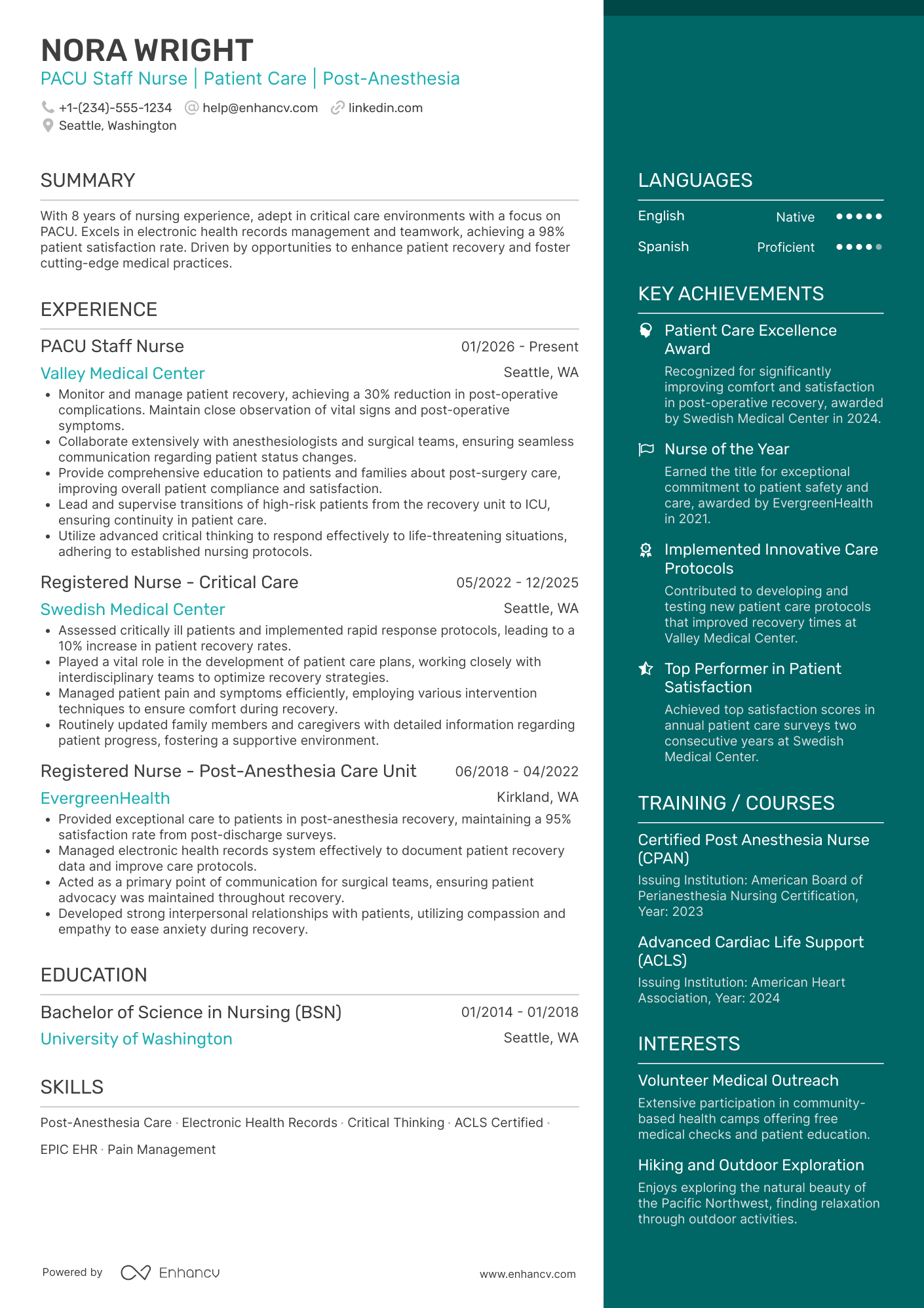
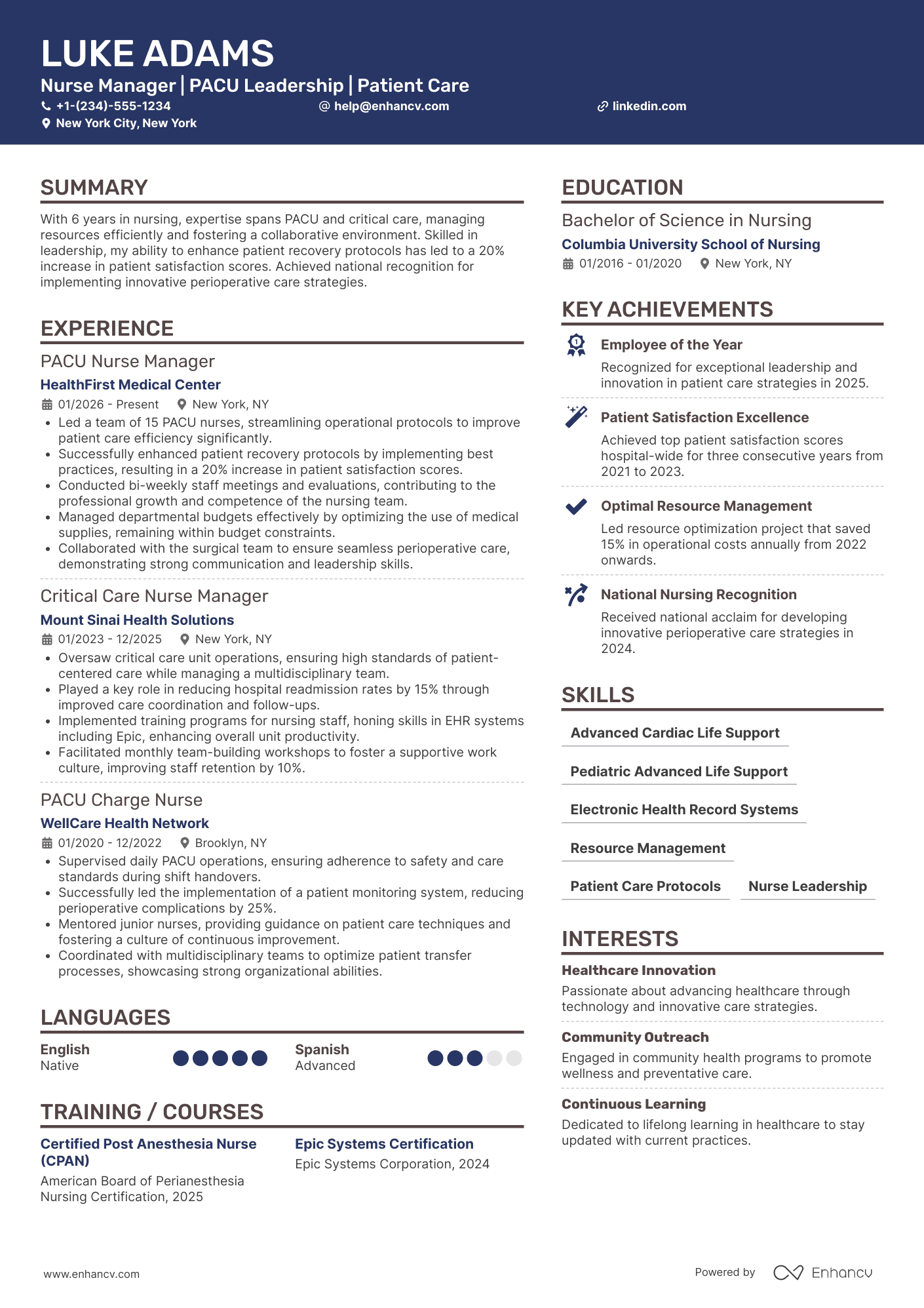
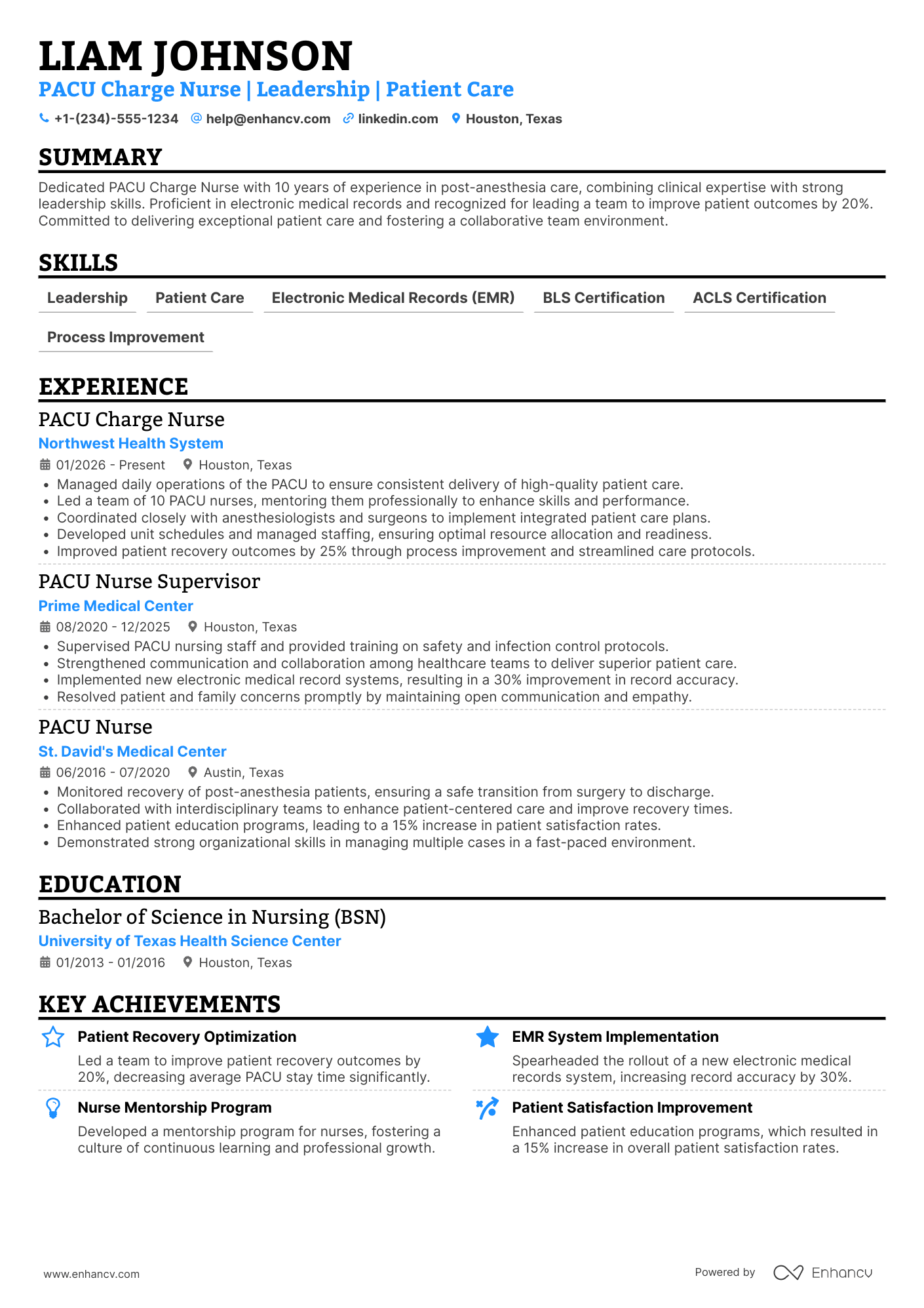
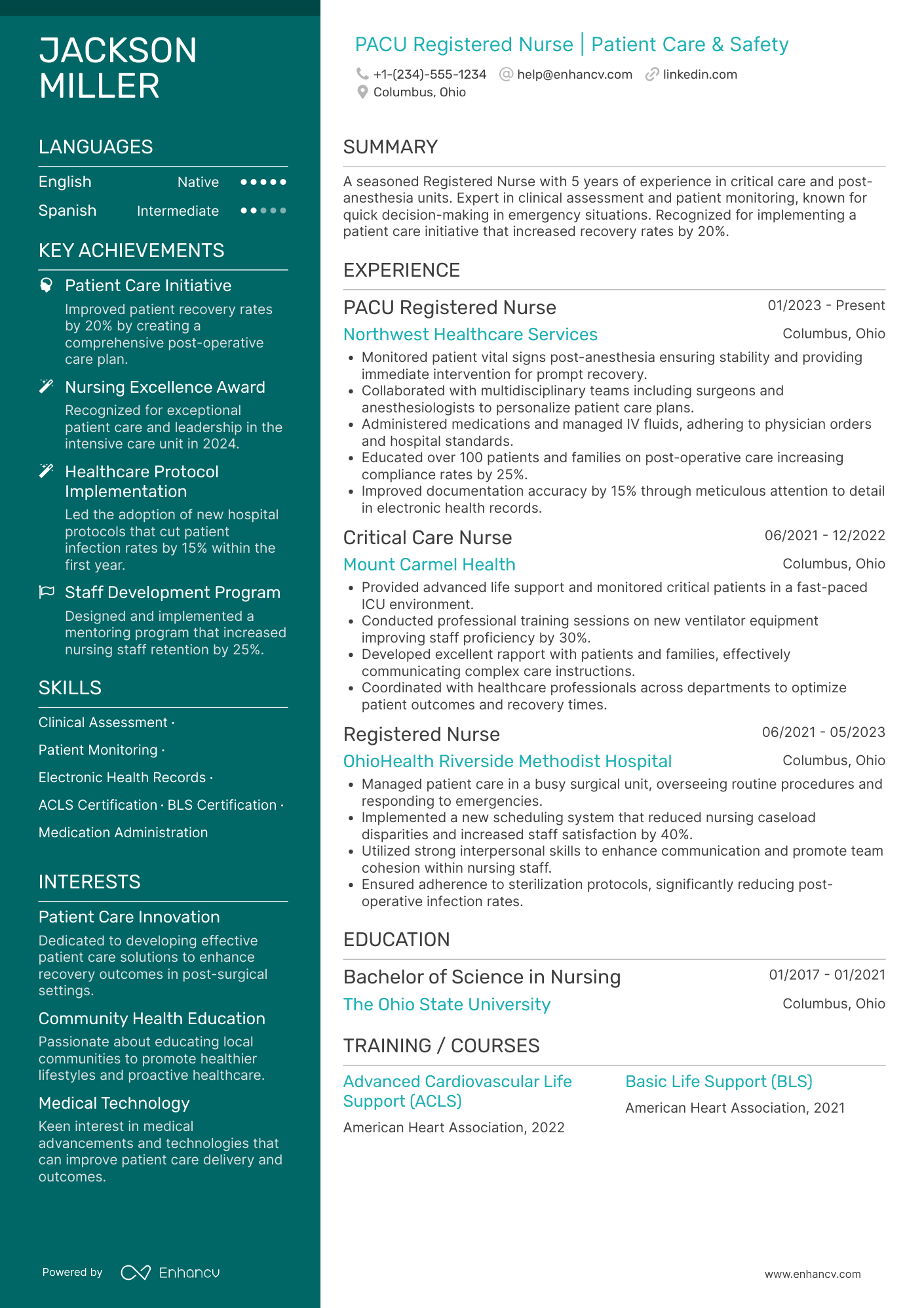
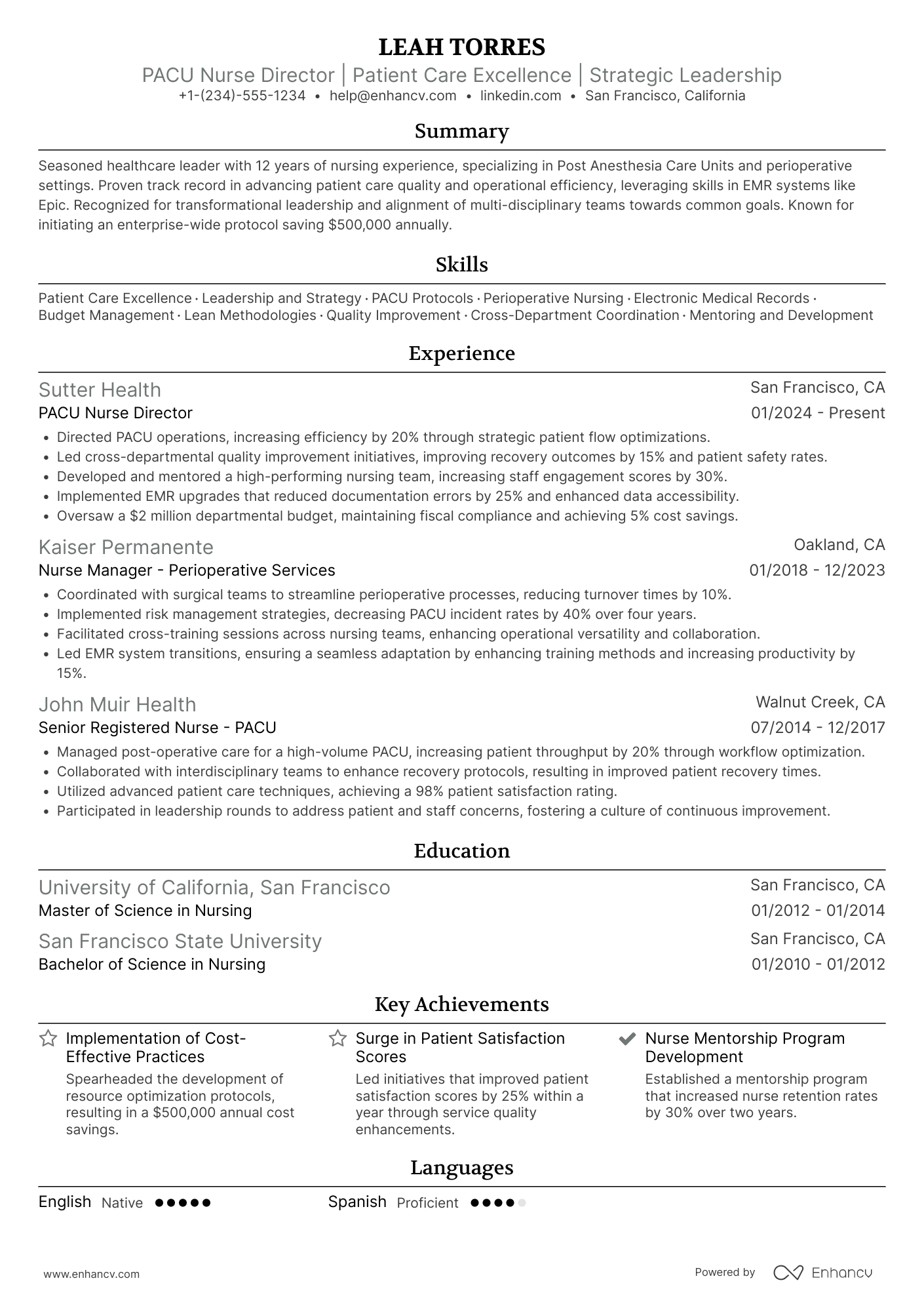
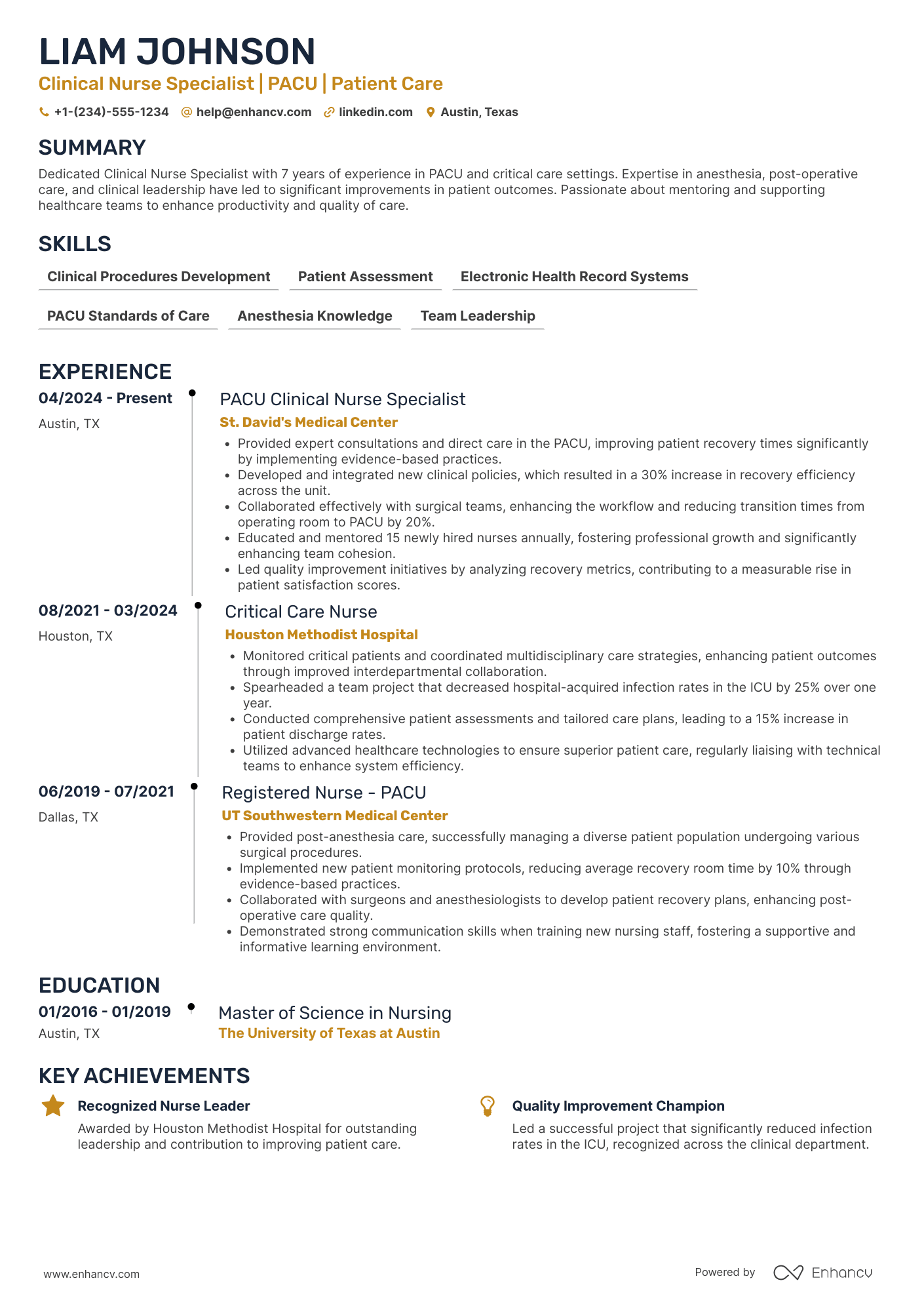
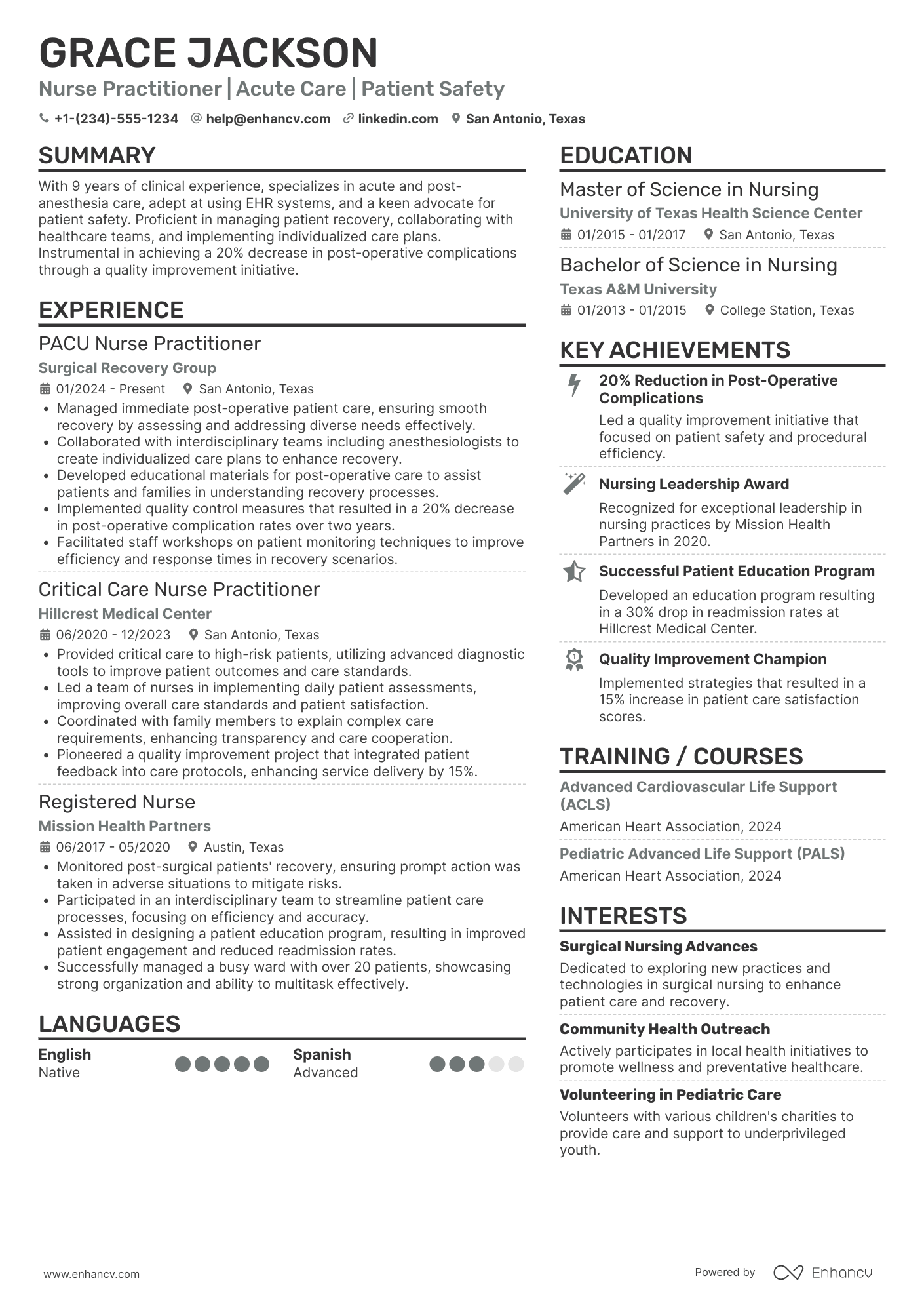
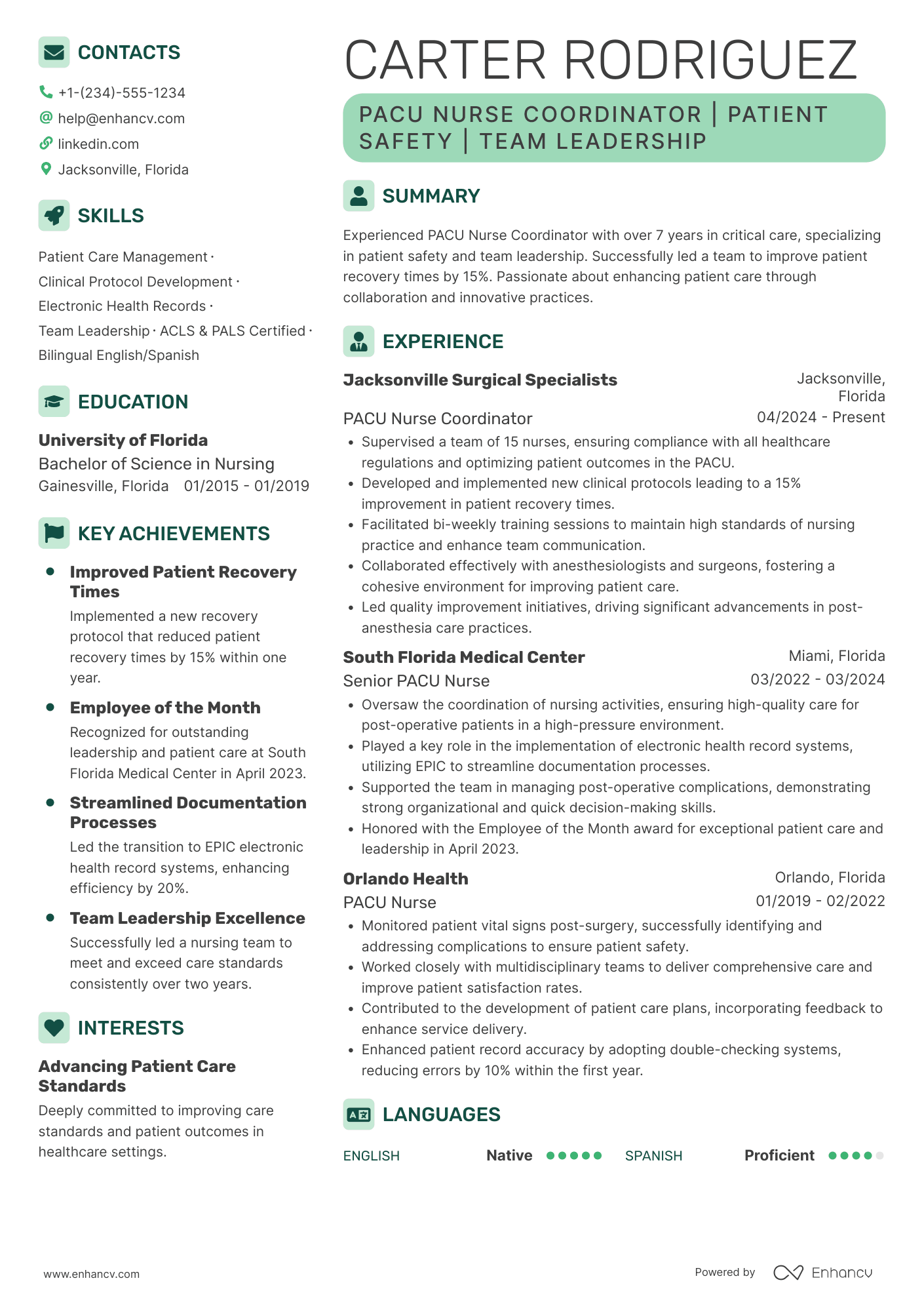
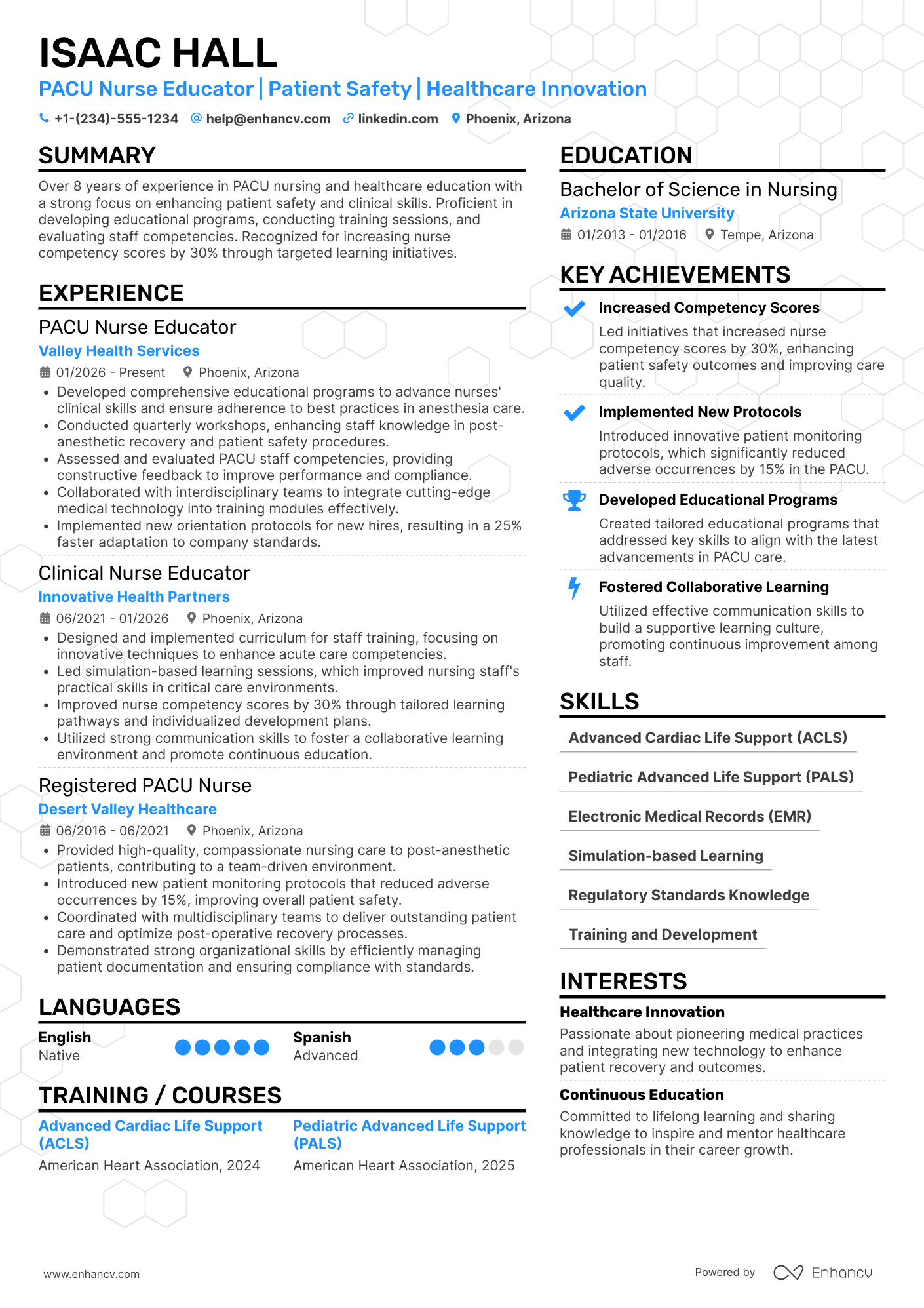
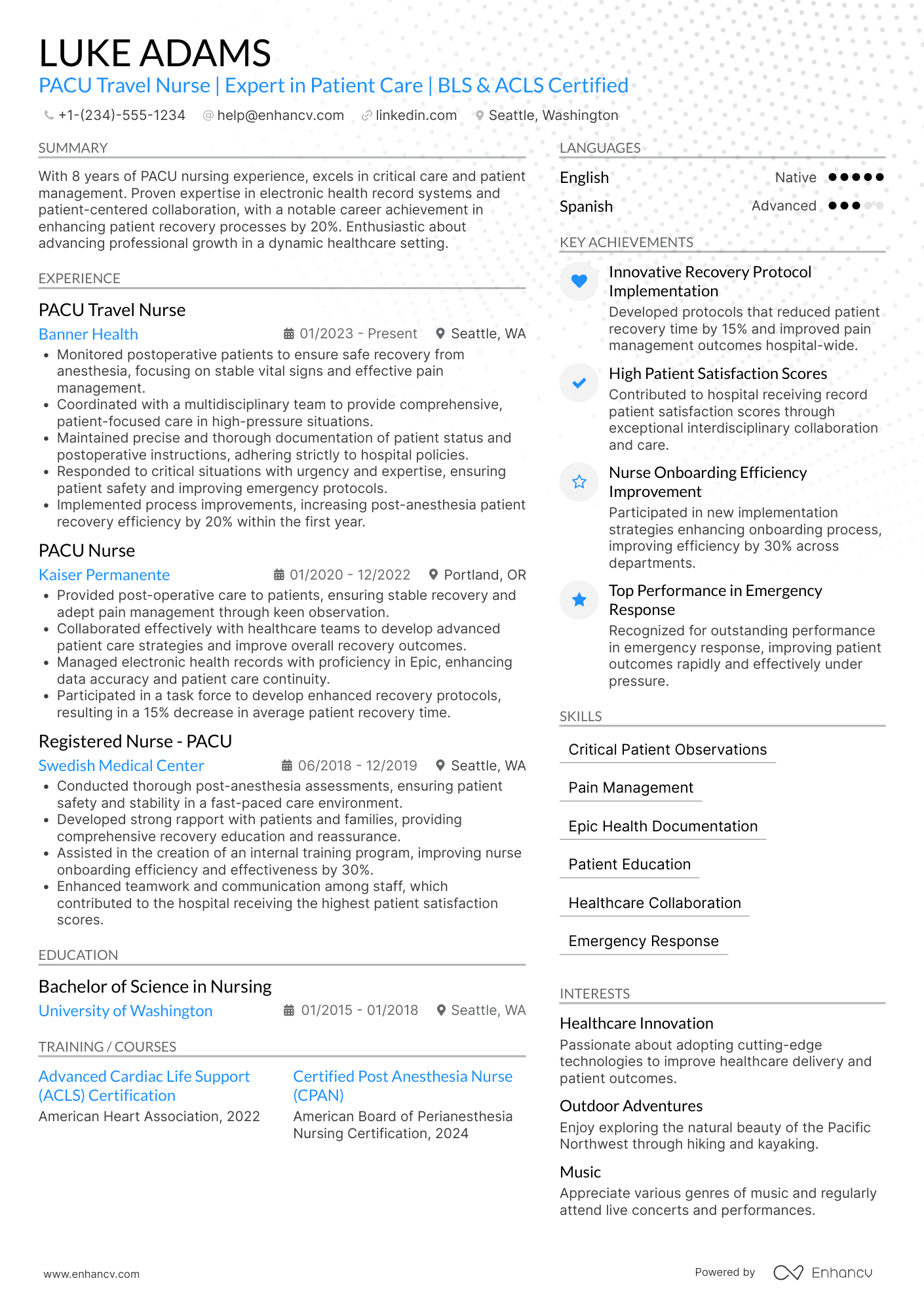
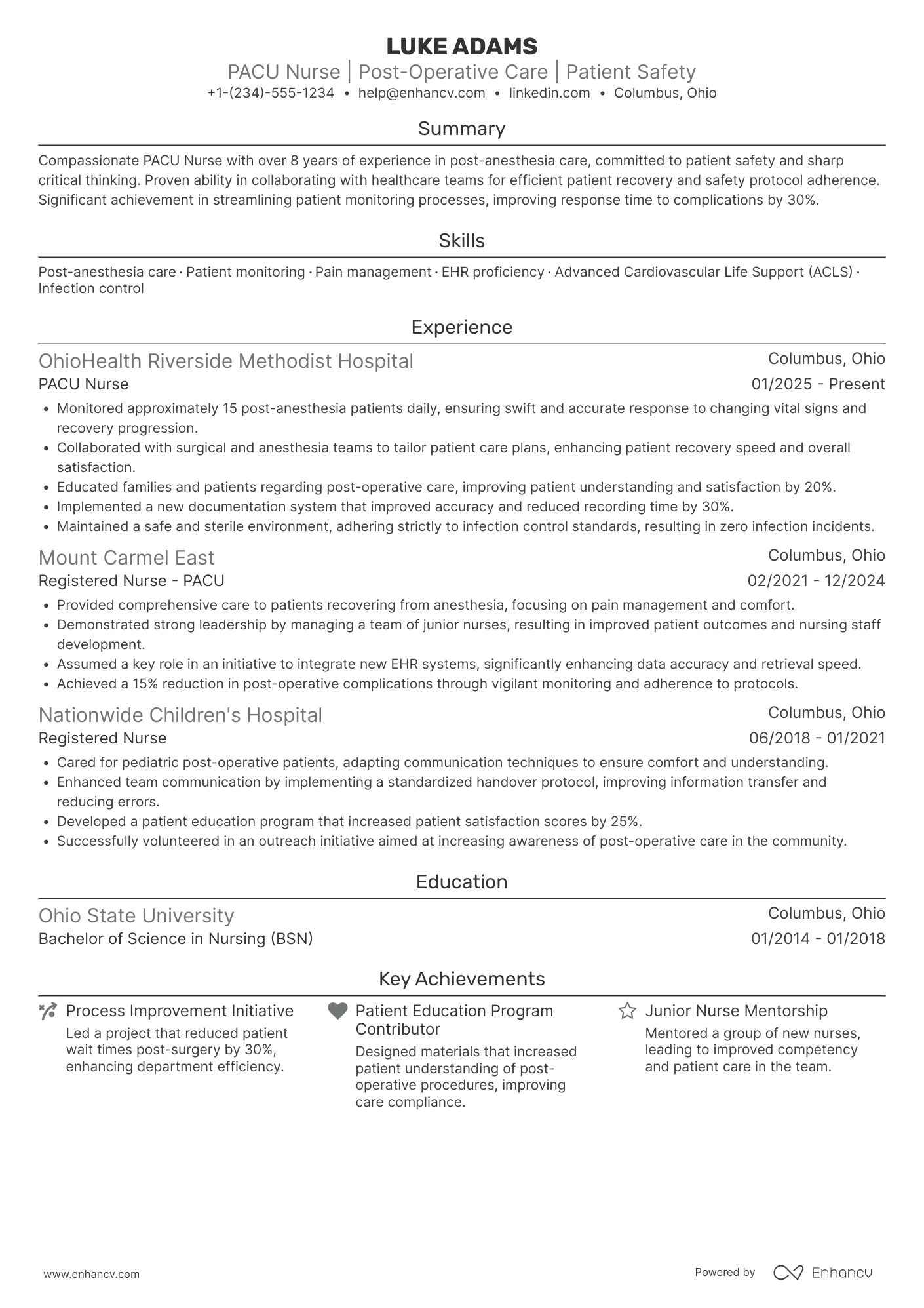
Many PACU nurse resume drafts fail because they read like shift reports, not proof of impact. That buries key achievements during applicant tracking system screening and six-second recruiter scans, especially when perioperative roles draw strong competition.
A strong resume shows what changed because of you. Knowing how to make your resume stand out starts with highlighting outcomes like reduced post-op nausea rates, faster discharge readiness, fewer pain escalations, lower unplanned ICU transfers, higher patient satisfaction scores, and safe recovery volume per shift.

Key takeaways
- Quantify outcomes like recovery times, complication rates, and patient satisfaction instead of listing duties.
- Use reverse-chronological format for experienced nurses and hybrid format for career changers.
- Mirror exact keywords, tools, and scoring systems from the job posting in your experience bullets.
- Place certifications like CPAN and ACLS above education when they're recent or role-required.
- Tie every listed skill to a measurable result in your experience or summary section.
- Enhancv's Bullet Point Generator helps turn routine responsibilities into recruiter-ready, metric-driven bullets.
- Stop using AI once your resume accurately reflects real experience—never fabricate claims or inflate results.
How to format a PACU nurse resume
Recruiters hiring PACU nurses prioritize clinical competency in post-anesthesia recovery, patient monitoring skills, and the ability to manage acute changes in patient status. A clean, well-organized resume format ensures these critical signals—certifications, relevant experience, and patient outcomes—are immediately visible to both hiring managers and applicant tracking systems.

I have significant experience in this role—which format should I use?
Use a reverse-chronological format to present your PACU nursing experience with the most recent and relevant positions first. Do:
- Lead with your most recent PACU or critical care role, clearly showing unit type, patient volume, and scope of responsibility (e.g., Phase I vs. Phase II recovery).
- Highlight role-specific competencies such as hemodynamic monitoring, ventilator management, sedation scoring (Aldrete/PADSS), and EHR systems like Epic or Cerner.
- Quantify clinical outcomes and contributions wherever possible, including patient ratios, complication reduction, or process improvements.
I'm junior or switching into this role—what format works best?
Use a hybrid format that leads with a targeted skills section followed by your clinical experience in reverse-chronological order. Do:
- Place a skills section near the top featuring PACU-relevant competencies such as airway management, post-operative assessment, pain management protocols, and cardiac monitoring.
- Include clinical rotations, preceptorships, ICU or med-surg experience, and any PACU-adjacent float assignments to demonstrate transferable critical care exposure.
- Connect each experience entry to a specific action and measurable result so recruiters can see your readiness for the PACU environment.
Why not use a functional resume?
A functional format strips away the clinical timeline recruiters need to verify where and when you developed PACU-critical skills like sedation recovery, airway management, and acute post-operative assessment, making it harder to trust your readiness for this high-acuity role. A functional format should be avoided entirely unless you have a specific circumstance that makes chronological or hybrid layouts impractical.
- A functional resume may be acceptable if you're a nurse re-entering the workforce after an extended gap or transitioning from an unrelated specialty (e.g., outpatient clinic to acute care), but even then, every listed skill should be tied to a specific clinical project, patient scenario, or measurable outcome to maintain credibility.
With your format establishing a clean, readable structure, the next step is filling it with the right sections to showcase your PACU nursing qualifications.
What sections should go on a PACU nurse resume
Recruiters expect a PACU nurse resume to show safe post-anesthesia recovery care, strong monitoring skills, and clear clinical results. Understanding which resume sections to include helps you present these qualifications effectively.
Use this structure for maximum clarity:
- Header
- Summary
- Experience
- Skills
- Projects
- Education
- Certifications
- Optional sections: Awards, Leadership, Volunteering
Strong experience bullets should emphasize measurable patient outcomes, acuity and case volume, rapid complication recognition and response, and coordination with anesthesia and surgical teams.
Is your resume good enough?
Drop your resume here or choose a file. PDF & DOCX only. Max 2MB file size.
Once you’ve organized your resume with the right components, the next step is to write your PACU nurse resume experience section so your qualifications come through clearly.
How to write your PACU nurse resume experience
Your experience section should demonstrate the clinical work you've delivered in post-anesthesia care, the monitoring tools and recovery protocols you've applied, and the patient outcomes you've achieved. Hiring managers prioritize demonstrated impact—improved recovery metrics, reduced complications, and efficient patient throughput—over descriptive task lists.
Each entry should include:
- Job title
- Company and location (or remote)
- Dates of employment (month and year)
Three to five concise bullet points showing what you owned, how you executed, and what outcomes you delivered:
- Ownership scope: the patient populations, recovery bays, post-anesthesia phases, or unit workflows you were directly accountable for as a PACU nurse.
- Execution approach: the hemodynamic monitoring systems, pain management protocols, airway management techniques, sedation scoring tools, or electronic health record platforms you used to assess patients and guide clinical decisions.
- Value improved: changes to patient recovery times, pain control effectiveness, complication rates, discharge readiness, or adherence to post-anesthesia care standards that resulted from your interventions.
- Collaboration context: how you coordinated with anesthesiologists, surgeons, respiratory therapists, charge nurses, or pharmacy staff to ensure seamless transitions from the operating room through discharge.
- Impact delivered: outcomes expressed through patient safety improvements, reduced PACU length of stay, faster bed turnover, lower readmission rates, or contributions to unit-wide quality initiatives rather than routine task completion.
Experience bullet formula
A PACU nurse experience example
✅ Right example - modern, quantified, specific.
PACU Registered Nurse (RN)
Riverside Regional Medical Center | Richmond, VA
2021–Present
Thirty-bed post-anesthesia care unit supporting high-volume inpatient and outpatient surgery across multiple specialties.
- Stabilized post-op patients using Aldrete scoring, continuous telemetry, and capnography; reduced PACU length of stay by twelve minutes per patient while maintaining a 98% on-time discharge rate.
- Titrated analgesia and sedation with smart-pump guardrails (IV PCA, ketamine, dexmedetomidine) and end-tidal carbon dioxide monitoring; decreased opioid-related adverse events by 22% over twelve months.
- Executed rapid airway and hemodynamic interventions (BiPAP/CPAP, high-flow oxygen, arterial line monitoring) and led three code blue responses; improved time-to-first-vasopressor by 18% through closed-loop communication with anesthesia and pharmacy.
- Streamlined handoffs using SBAR in Epic (electronic health record) with standardized post-op order sets and allergy reconciliation; cut documentation time by 15% and reduced handoff-related clarifications by 30% with surgeons and anesthesiologists.
- Partnered with perioperative leadership and quality to implement a PONV pathway (Apfel scoring, multimodal antiemetics) tracked in Epic dashboards; lowered unplanned admissions from ambulatory surgery by 9% and improved patient satisfaction scores by 0.4 points.
Now that you've seen what a strong experience section looks like in practice, let's break down how to customize yours for each specific PACU nurse role you're targeting.
How to tailor your PACU nurse resume experience
Recruiters evaluate your PACU nurse resume through applicant tracking systems and manual review. Tailoring your resume to the job description ensures your qualifications stand out in both screening methods.
Ways to tailor your PACU nurse experience:
- Match specific monitoring equipment and EMR platforms listed in the posting.
- Use the exact sedation scoring scales referenced in the job description.
- Mirror patient-to-nurse ratios or acuity levels the employer specifies.
- Highlight post-anesthesia recovery protocols that align with their standards.
- Include relevant certifications like CPAN or CAPA when the posting requires them.
- Reflect the discharge criteria or assessment tools the facility uses.
- Emphasize pain management approaches consistent with their described practices.
- Reference interdisciplinary collaboration models outlined in the job requirements.
Tailoring means aligning your real clinical achievements with the employer's stated requirements rather than forcing disconnected keywords into your experience.
Resume tailoring examples for PACU nurse
| Job description excerpt | Untailored | Tailored |
|---|---|---|
| "Monitor post-anesthesia patients using Aldrete scoring, manage airways, and titrate IV sedation per physician orders in a 12-bed Phase I PACU." | Monitored patients after surgery and helped with recovery. | Assessed and scored post-anesthesia patients using the Aldrete scale in a 12-bed Phase I PACU, managing airway interventions and titrating IV sedation per physician orders for 8–10 patients per shift. |
| "Collaborate with anesthesiologists and surgical teams to manage pain using multimodal protocols, including nerve block monitoring and PCA pump administration." | Worked with doctors to help patients with pain management. | Partnered with anesthesiologists and surgical teams to execute multimodal pain management protocols, monitoring nerve block efficacy and programming PCA pumps to reduce average patient-reported pain scores by 30%. |
| "Recognize and respond to post-operative complications such as malignant hyperthermia, respiratory depression, and hemodynamic instability using ACLS protocols." | Responded to patient emergencies and followed hospital procedures. | Identified and intervened in post-operative complications—including respiratory depression and hemodynamic instability—using ACLS protocols, contributing to a unit rapid-response time under four minutes. |
Once your experience aligns with the PACU role’s priorities, quantify your PACU nurse achievements to show the measurable impact behind those responsibilities.
How to quantify your PACU nurse achievements
Quantifying your achievements shows how you improve safety, flow, and patient experience in the post-anesthesia care unit. Focus on recovery time, pain and nausea control, discharge readiness, complication rates, and compliance with protocols and documentation.
Quantifying examples for PACU nurse
| Metric | Example |
|---|---|
| Throughput | "Reduced average Phase I recovery time from 78 to 62 minutes by standardizing Aldrete scoring and using a discharge readiness checklist." |
| Patient safety | "Cut post-op respiratory events requiring rapid response from six to two per quarter by tightening capnography monitoring and escalating per protocol." |
| Quality of care | "Improved post-op pain control, increasing patients at pain ≤3 within 30 minutes from 68% to 84% using multimodal analgesia and reassessment timers." |
| Compliance | "Raised on-time antibiotic redosing documentation from 85% to 98% by building an electronic health record reminder and auditing twenty charts weekly." |
| Cost avoidance | "Prevented twelve unplanned admissions in six months by early nausea and hypotension interventions, saving an estimated $36,000 in bed and staffing costs." |
Turn vague job duties into measurable, recruiter-ready resume bullets in seconds with Enhancv's Bullet Point Generator.
Once you've crafted strong bullet points for your experience section, you'll want to apply the same level of precision to showcasing your hard and soft skills throughout your PACU nurse resume.
How to list your hard and soft skills on a PACU nurse resume
Your skills section shows you can deliver safe post-anesthesia care, and recruiters and an ATS (applicant tracking system) scan this section to confirm clinical fit fast; aim for a mix weighted toward hard clinical skills with targeted soft skills.
PACU nurse roles require a blend of:
- Post-anesthesia assessment and recovery skills.
- Monitoring, documentation, and quality improvement skills.
- Patient flow, discharge readiness, and escalation discipline.
- Soft skills.
Your skills section should be:
- Scannable (bullet-style grouping).
- Relevant to the job post.
- Backed by proof in experience bullets.
- Updated with current tools.
Place your skills section:
- Above experience if you're junior or switching careers.
- Below experience if you're mid/senior with strong achievements.

Hard skills
- Phase I and Phase II PACU care
- Aldrete and PADSS scoring
- Airway management, suctioning
- Post-op pain management protocols
- Multimodal analgesia administration
- PONV prophylaxis and treatment
- Hemodynamic monitoring, ECG interpretation
- SpO2, capnography monitoring
- IV therapy, infusion pumps
- PACU emergency response, ACLS
- Wound, drain, and dressing care
- EHR charting, Epic
Soft skills
- Rapid patient prioritization
- Closed-loop communication in handoffs
- Clear SBAR escalation
- Calm decision-making under pressure
- Patient and family education
- Coordination with anesthesia and surgery
- Assertive advocacy for patient safety
- Meticulous reassessment and follow-through
- Documentation discipline under time constraints
- Situational awareness during recovery
- Conflict de-escalation at bedside
- Ownership of discharge readiness planning
How to show your PACU nurse skills in context
Skills shouldn't live only in a bulleted list on your resume. Explore resume skills examples to see how other professionals present their competencies effectively.
They should be demonstrated in:
- Your summary (high-level professional identity)
- Your experience (proof through outcomes)
Here's what that looks like in practice.
Summary example
Senior PACU nurse with 11 years of post-anesthesia recovery experience. Skilled in hemodynamic monitoring, Aldrete scoring, and airway management. Reduced stage-two recovery transfers by 18% through standardized discharge protocols and interdisciplinary communication.
- Reflects senior-level clinical authority
- Names role-specific tools and methods
- Includes a concrete performance metric
- Highlights communication as a soft skill
Experience example
Senior PACU Registered Nurse
Piedmont Athens Regional Medical Center | Athens, GA
March 2018–Present
- Monitored post-anesthesia recovery for 12+ patients daily using Aldrete assessments, cutting adverse airway events by 22% over two years.
- Collaborated with anesthesiologists and surgical teams to refine pain management protocols, improving patient satisfaction scores by 15%.
- Trained eight new PACU nurses on hemodynamic monitoring and EHR documentation in Epic, reducing onboarding time by three weeks.
- Every bullet contains a measurable outcome.
- Skills appear naturally within real achievements.
Once you’ve tied your post-anesthesia care unit nursing strengths to specific clinical situations, the next step is learning how to write a post-anesthesia care unit nurse resume with no experience so you can present those strengths without a work history.
How do I write a PACU nurse resume with no experience
Even without full-time experience, you can demonstrate readiness through clinical training and relevant projects. Our guide on building a resume without work experience covers strategies that apply directly to entry-level PACU candidates.
Consider highlighting:
- PACU clinical rotation patient care
- Precepted post-anesthesia assessments documented
- Capstone on post-op airway management
- Simulation lab: code blue scenarios
- Volunteer in perioperative recovery unit
- Senior practicum in surgical services
- ACLS (Advanced Cardiac Life Support) training
Focus on:
- PACU assessments and documentation accuracy
- Airway, hemodynamic monitoring basics
- Medication safety and pain protocols
- EHR charting with audit-ready notes
Resume format tip for entry-level PACU nurse
Use a hybrid resume format to lead with clinical skills and relevant training, while still showing education and rotations clearly. Do:
- Put clinical rotations first under education.
- List PACU nurse skills with proof.
- Add certifications with dates and status.
- Quantify patient volume and outcomes.
- Mirror keywords from the job post.
- Completed PACU clinical rotation, monitored vitals and pain scores, documented in Epic, and achieved 98% chart-completeness across thirty post-op recoveries.
Even without direct PACU experience, your education section can demonstrate the clinical knowledge and credentials that qualify you for the role.
How to list your education on a PACU nurse resume
Your education section lets hiring teams confirm you hold the clinical foundation a PACU nurse needs. It validates your nursing knowledge, patient care training, and readiness for post-anesthesia responsibilities.
Include:
- Degree name
- Institution
- Location
- Graduation year
- Relevant coursework (for juniors or entry-level candidates)
- Honors & GPA (if 3.5 or higher)
Skip month and day details—list the graduation year only.
Here's a strong education entry tailored for a PACU nurse resume:
Example education entry
Bachelor of Science in Nursing
University of Florida, Gainesville, FL
Graduated 2021
GPA: 3.7/4.0
- Relevant Coursework: Pharmacology, Advanced Pathophysiology, Perioperative Nursing, Pain Management, and Critical Care Nursing
- Honors: Magna Cum Laude, Sigma Theta Tau International Honor Society
How to list your certifications on a PACU nurse resume
Certifications on your resume show a PACU nurse's commitment to ongoing learning, proficiency with clinical tools and protocols, and alignment with current perioperative standards and patient safety expectations. Include:
- Certificate name
- Issuing organization
- Year
- Optional: credential ID or URL
- Place certifications below education when they're older, less relevant to PACU nurse work, or you already have strong recent PACU experience.
- Place certifications above education when they're recent, required for the role, or directly strengthen your PACU nurse qualifications.
Best certifications for your PACU nurse resume
- Post Anesthesia Care Nurse Certification (CPAN)
- Certified Ambulatory Perianesthesia Nurse (CAPA)
- Basic Life Support (BLS)
- Advanced Cardiovascular Life Support (ACLS)
- Pediatric Advanced Life Support (PALS)
- Trauma Nursing Core Course (TNCC)
- Critical Care Registered Nurse (CCRN)
Once your credentials are placed where hiring managers will spot them quickly, use your PACU nurse resume summary to reinforce that value upfront.
How to write your PACU nurse resume summary
Your resume summary is the first thing a recruiter reads. A strong one immediately signals you're qualified for the PACU nurse role.
Keep it to three to four lines, with:
- Your title and total years of nursing experience.
- Specialty area, such as post-anesthesia care or surgical recovery.
- Core skills like hemodynamic monitoring, airway management, and pain assessment.
- One or two measurable achievements, such as reduced recovery times or complication rates.
- Soft skills tied to outcomes, like patient communication that improved satisfaction scores.

PRO TIP
As a PACU nurse, focus on clinical skills, certifications, and early patient outcomes you've contributed to. Highlight hands-on competencies like ventilator weaning or post-surgical assessment. Avoid vague phrases like "passionate caregiver" or "team player" without connecting them to real results.
Example summary for a PACU nurse
PACU nurse with three years of experience in post-anesthesia recovery and hemodynamic monitoring. Reduced average patient recovery time by 15% through standardized airway management protocols across a 20-bed unit.
Optimize your resume summary and objective for ATS
Drop your resume here or choose a file.
PDF & DOCX only. Max 2MB file size.
Now that you've crafted a summary that highlights your critical care expertise, make sure your resume header presents your contact details clearly so recruiters can actually reach you.
What to include in a PACU nurse resume header
A resume header lists your identifying and contact details, and it matters for a PACU nurse because it boosts visibility, credibility, and recruiter screening speed.
Essential resume header elements
- Full name
- Tailored job title and headline
- Location
- Phone number
- Professional email
- GitHub link
- Portfolio link
A LinkedIn link helps recruiters verify experience quickly and supports screening.
Do not include photos on a PACU nurse resume unless the role is explicitly front-facing or appearance-dependent.
Match your header title to the posting and keep formatting consistent so recruiters can scan it in seconds.
PACU nurse resume header
Jordan M. Taylor, RN, BSN
PACU nurse | Post-anesthesia recovery | Phase I and Phase II care
Austin, TX
(512) 555-01XX
jordan.taylor@enhancv.com github.com/yourname yourwebsite.com linkedin.com/in/yourname
Once your contact details and credentials are clearly presented at the top, add the following additional sections to strengthen your PACU nurse resume and support the information above.
Additional sections for PACU nurse resumes
When your core qualifications match other applicants, well-chosen additional sections can highlight specialized expertise and set your PACU nurse resume apart. For example, listing language skills on your resume can demonstrate your ability to communicate with diverse patient populations in the PACU.
- Languages
- Certifications and licenses
- Professional affiliations
- Continuing education and training
- Volunteer experience in clinical settings
- Publications or research contributions
Once your resume sections are finalized, pairing them with a strong cover letter can further strengthen your application.
Do PACU nurse resumes need a cover letter
A cover letter isn't required for every PACU nurse role, but it helps when the job is competitive or the hospital expects one. If you're unsure where to start, learn what a cover letter is and how it complements your resume. It can make a difference when your resume needs context or you want to show unit-specific fit.
Use a cover letter to add detail your resume can't:
- Explain role or team fit: Match your experience to the unit's case mix, shift needs, and handoff style between anesthesia, surgery, and PACU nursing.
- Highlight one or two relevant projects or outcomes: Share a specific result, like reducing post-op nausea and vomiting rates or improving discharge readiness documentation.
- Show understanding of the hospital's context: Reference patient population, service lines, quality priorities, or throughput goals, and connect them to how you work in PACU.
- Address career transitions or non-obvious experience: Clarify moves from ICU, emergency department, or med-surg, and translate skills into PACU nurse priorities.
Drop your resume here or choose a file.
PDF & DOCX only. Max 2MB file size.
Once you’ve decided whether to include a cover letter based on the role and application requirements, you can use AI to improve your PACU nurse resume more efficiently and consistently.
Using AI to improve your PACU nurse resume
AI can sharpen your resume's clarity, structure, and impact. It helps you articulate clinical skills and achievements more precisely. However, overusing it risks making your resume sound robotic. Once your content is clear and role-aligned, step away from AI. If you're curious about tools, explore which AI is best for writing resumes to find the right fit for your needs.
Here are 10 prompts you can copy and paste to strengthen specific sections of your resume:
- Strengthen your summary: "Rewrite my PACU nurse resume summary to highlight post-anesthesia recovery expertise and patient monitoring skills in three concise sentences."
- Quantify experience bullets: "Add measurable outcomes to these PACU nurse experience bullets, focusing on patient recovery times, caseloads, and complication reduction rates."
- Tailor skills to the role: "Review this skills section and remove anything irrelevant to a PACU nurse position. Suggest missing clinical competencies."
- Improve action verbs: "Replace weak verbs in my PACU nurse experience bullets with strong, specific action verbs tied to post-anesthesia patient care."
- Refine certification details: "Reorganize my PACU nurse certifications section so the most relevant credentials—like CPAN and CAPA—appear first with clear formatting."
- Clarify education entries: "Rewrite my education section to emphasize coursework and clinical rotations directly relevant to a PACU nurse career path."
- Eliminate redundancy: "Identify and remove repetitive language across my PACU nurse resume while preserving each bullet's unique contribution."
- Align with job postings: "Compare my PACU nurse resume against this job description and flag missing keywords or qualifications I should address."
- Highlight project contributions: "Rewrite this project description to clearly show my PACU nurse role in implementing a post-operative pain management protocol."
- Tighten bullet length: "Shorten each PACU nurse experience bullet to one line maximum without losing clinical specificity or measurable impact."
Stop using AI once your resume sounds accurate, specific, and aligned with real experience. AI should never invent experience or inflate claims—if it didn't happen, it doesn't belong here.
Conclusion
A strong PACU nurse resume highlights measurable outcomes, role-specific skills, and a clear structure. Use metrics like recovery times, complication rates, pain control results, and patient satisfaction to show impact.
Keep your PACU nurse resume easy to scan and consistent in format. This approach supports today’s hiring needs and near-future expectations, and it shows you’re ready to step in and deliver safe care.