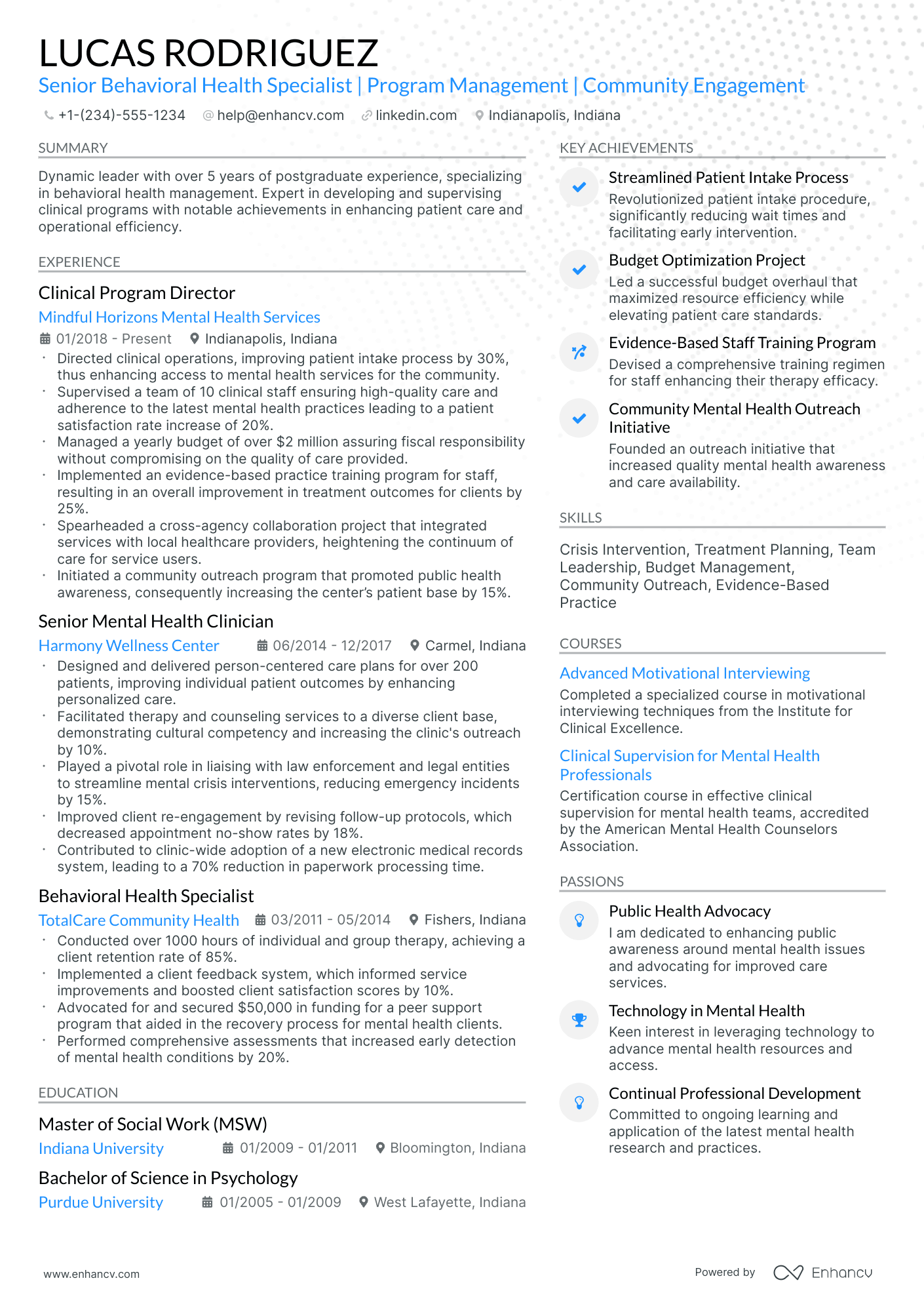
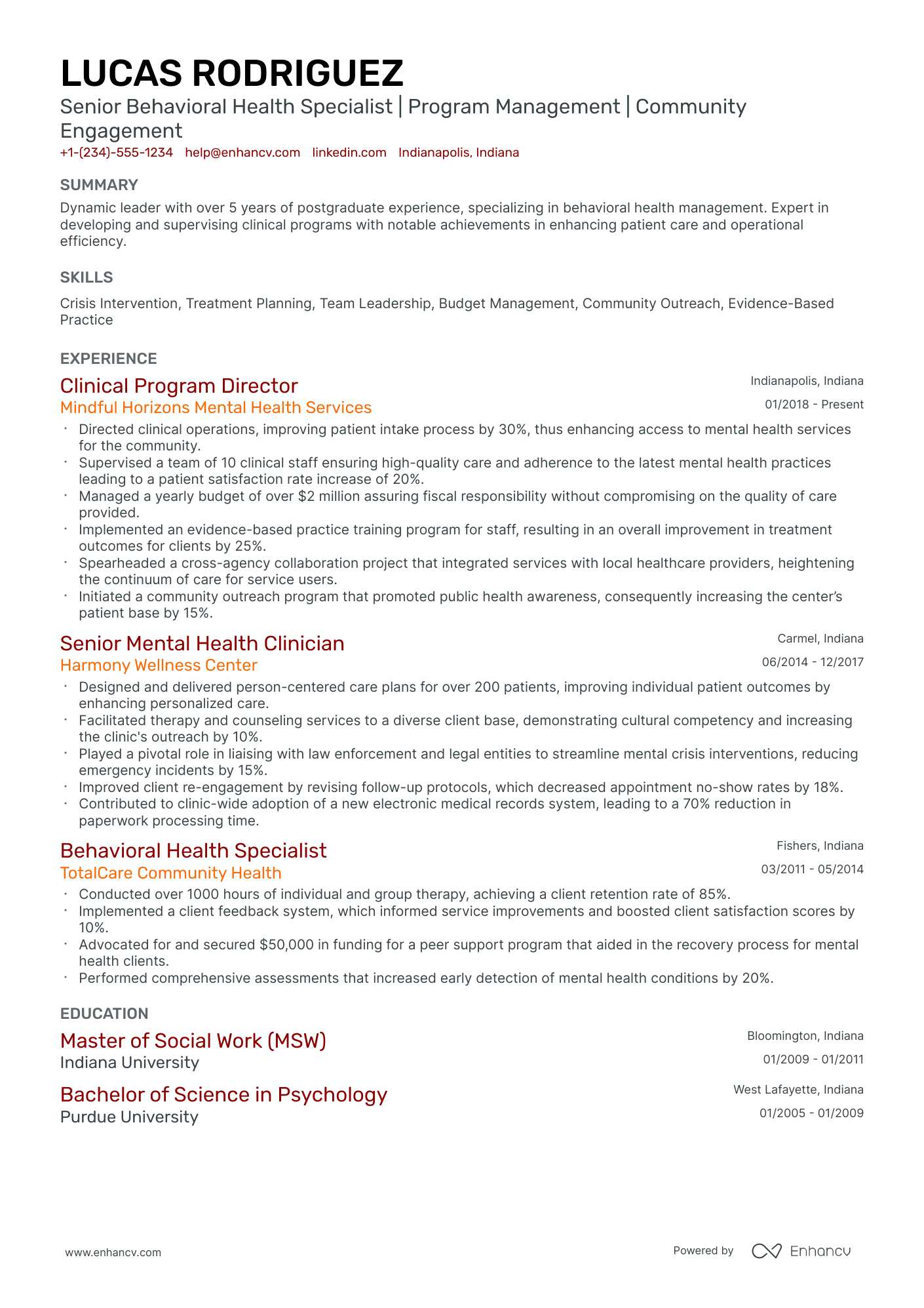
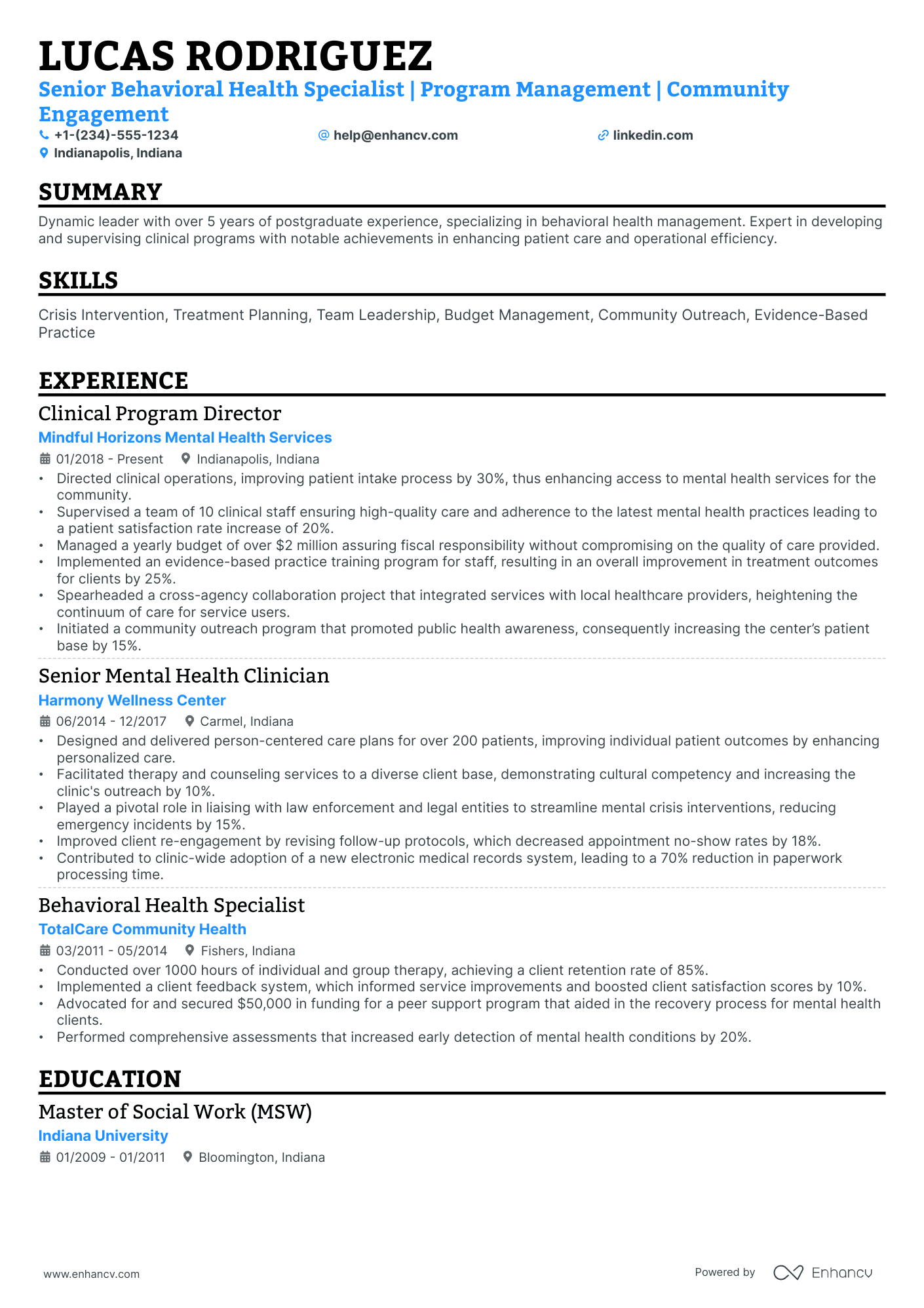
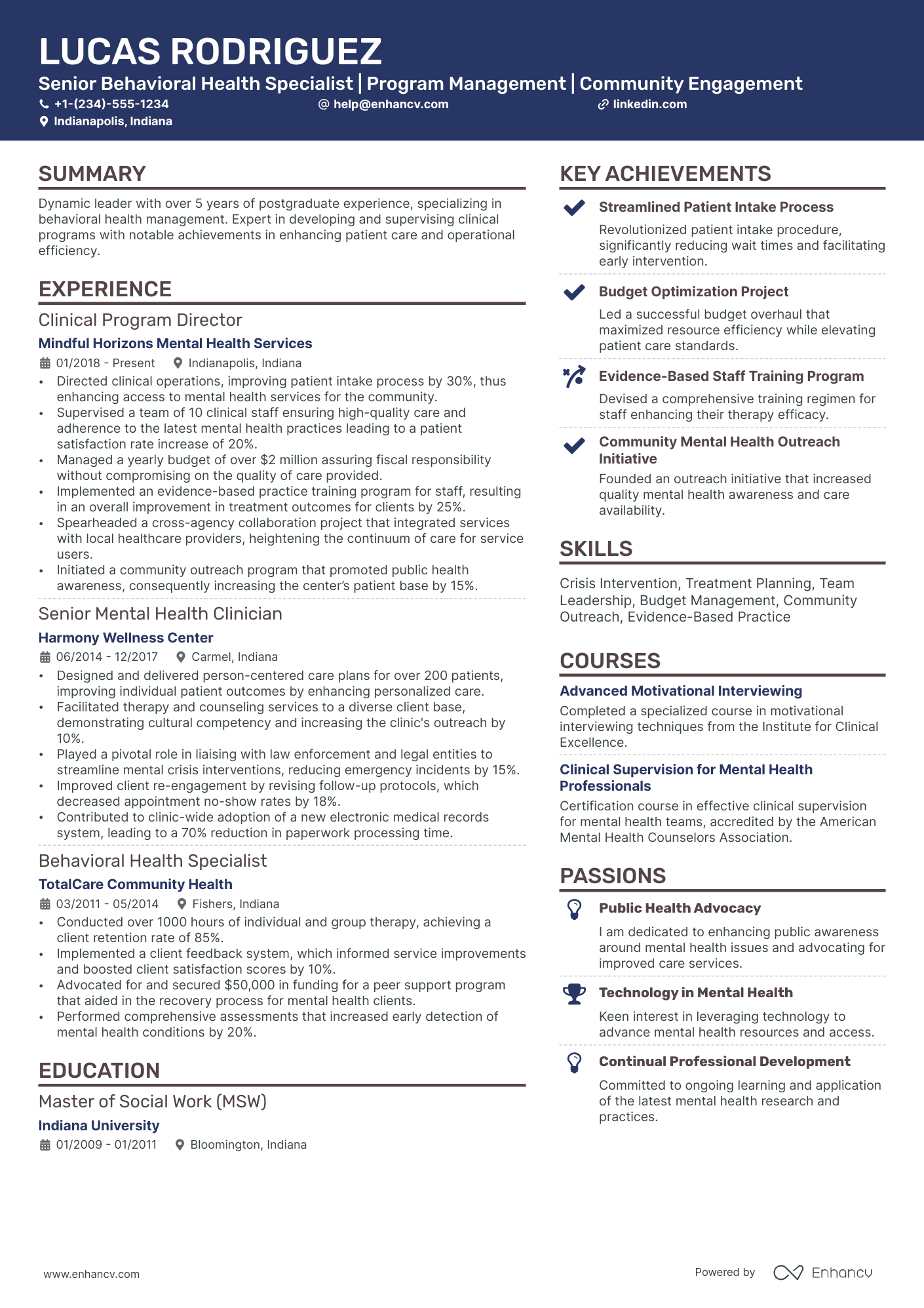
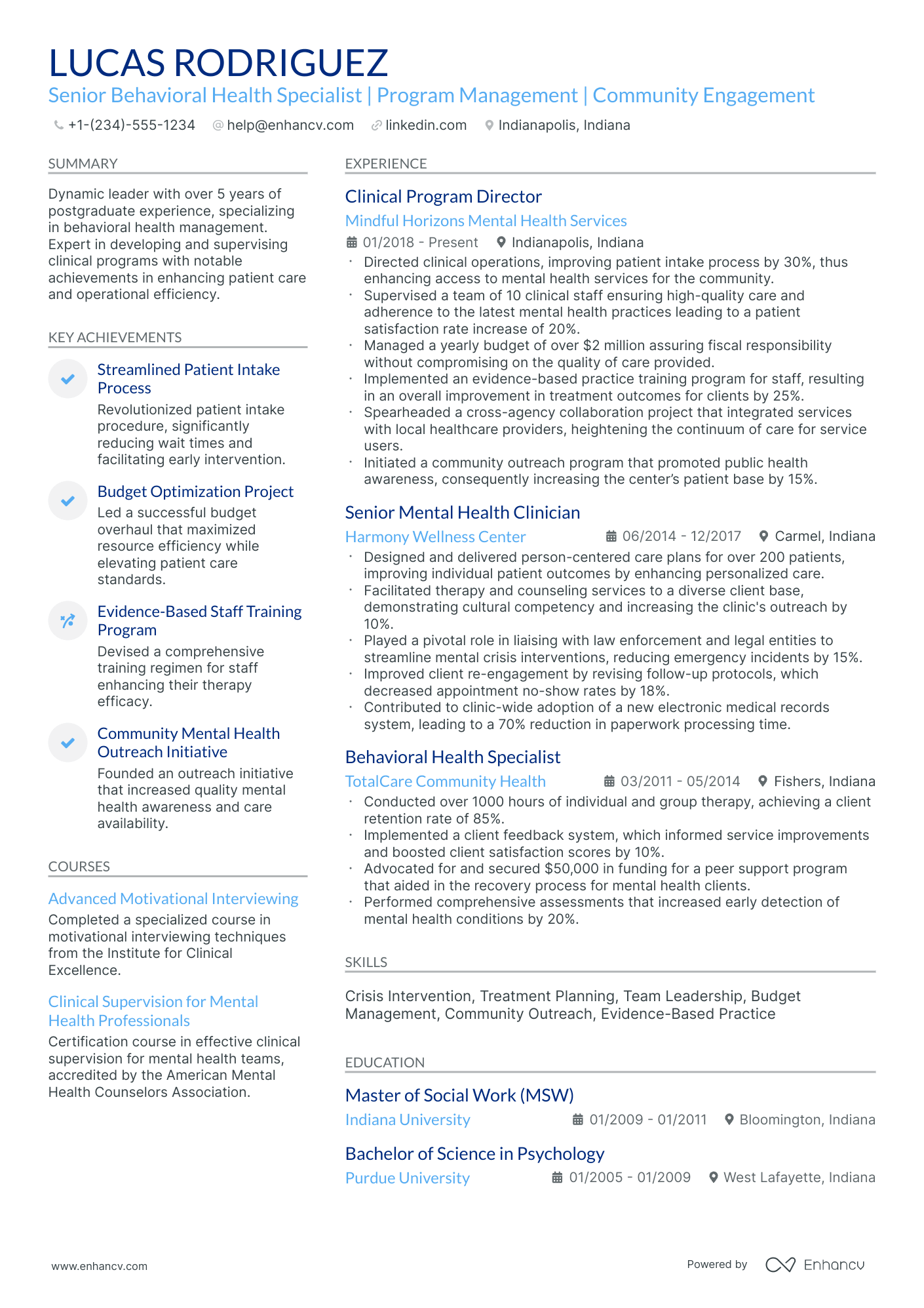
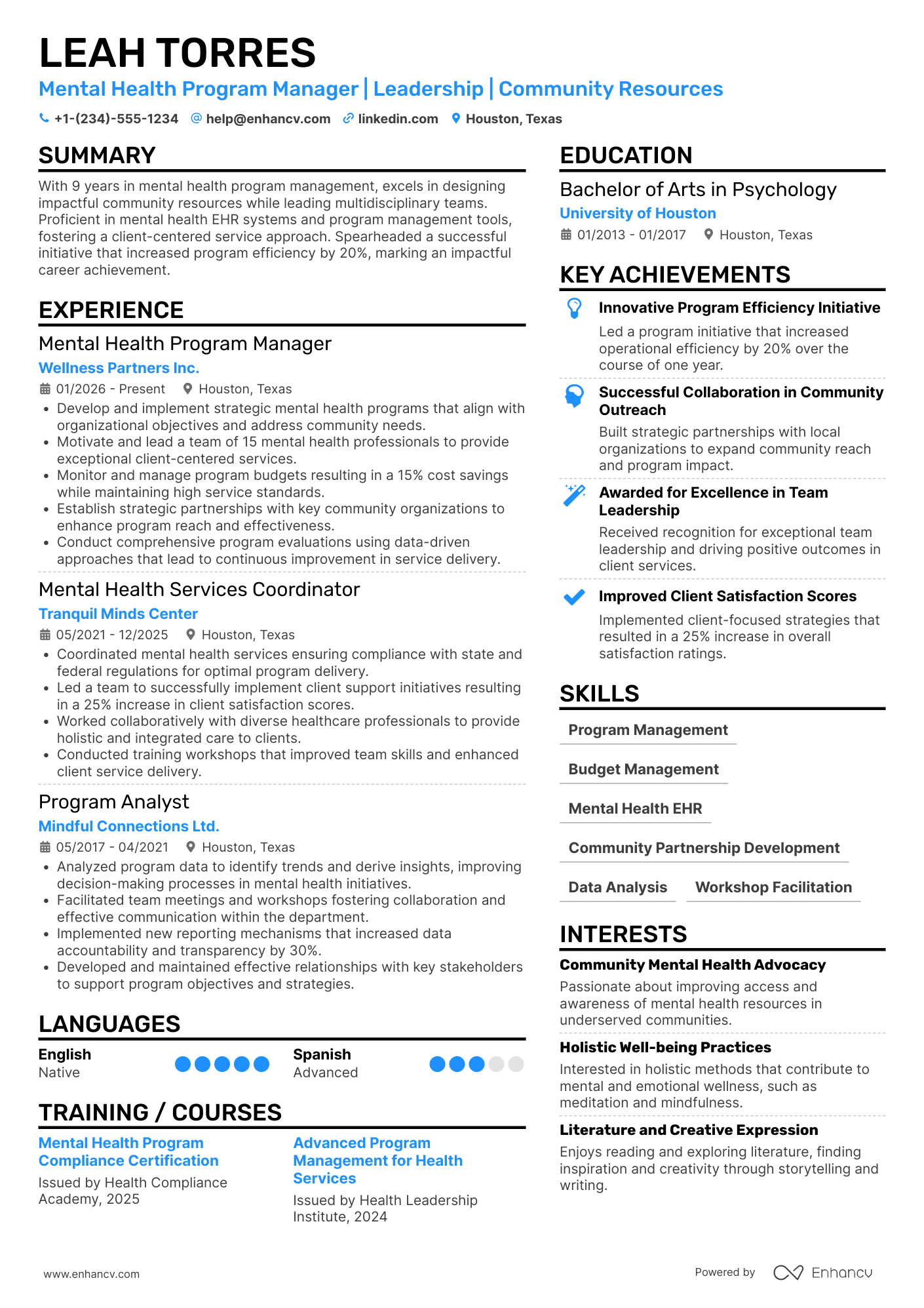
A mental health program manager resume often fails because it reads like a job description, not proof of impact. That gets missed in applicant tracking system filters and fast recruiter scans, especially when competition is high. Understanding how to make your resume stand out starts with rethinking what you emphasize.
A strong resume shows outcomes you drove, not tools you used. You should highlight reduced wait times, higher engagement and retention, improved clinical quality scores, on-time launches across sites, budget savings, grant wins, and measurable equity gains.

Key takeaways
- Quantify program outcomes like wait times, retention rates, and budget savings in every experience bullet.
- Use reverse-chronological format for senior roles and hybrid format for career changers.
- Tailor your resume language to mirror the job posting's tools, frameworks, and populations.
- Demonstrate skills through measurable achievements in your summary and experience, not just a skills list.
- Include certifications like PMP, CCM, or CPHQ to validate clinical and operational expertise.
- Enhancv can help you turn vague duties into focused, metric-driven resume bullets faster.
- Stop using AI once your resume accurately reflects real experience—never fabricate or inflate claims.
How to format a mental health program manager resume
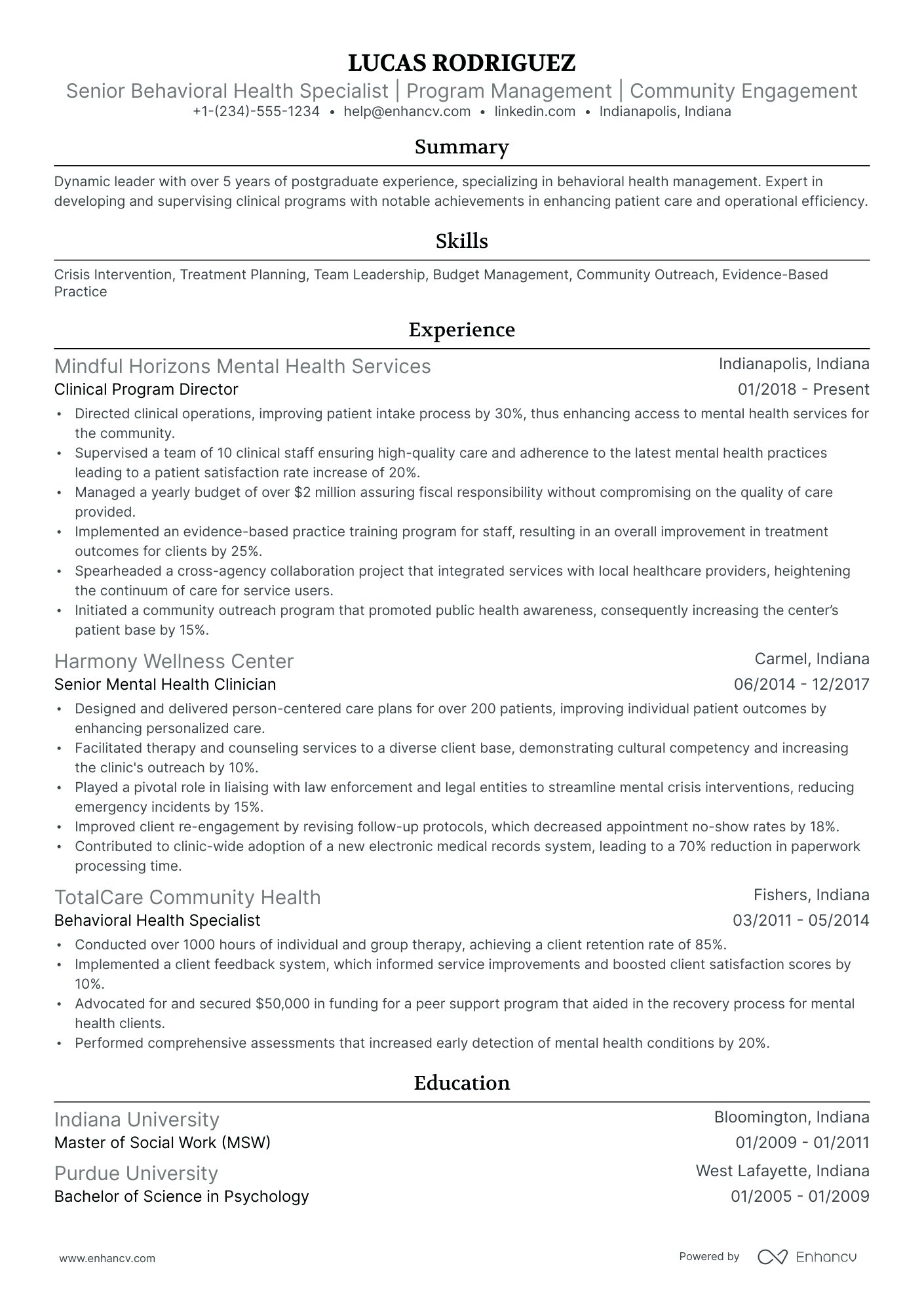
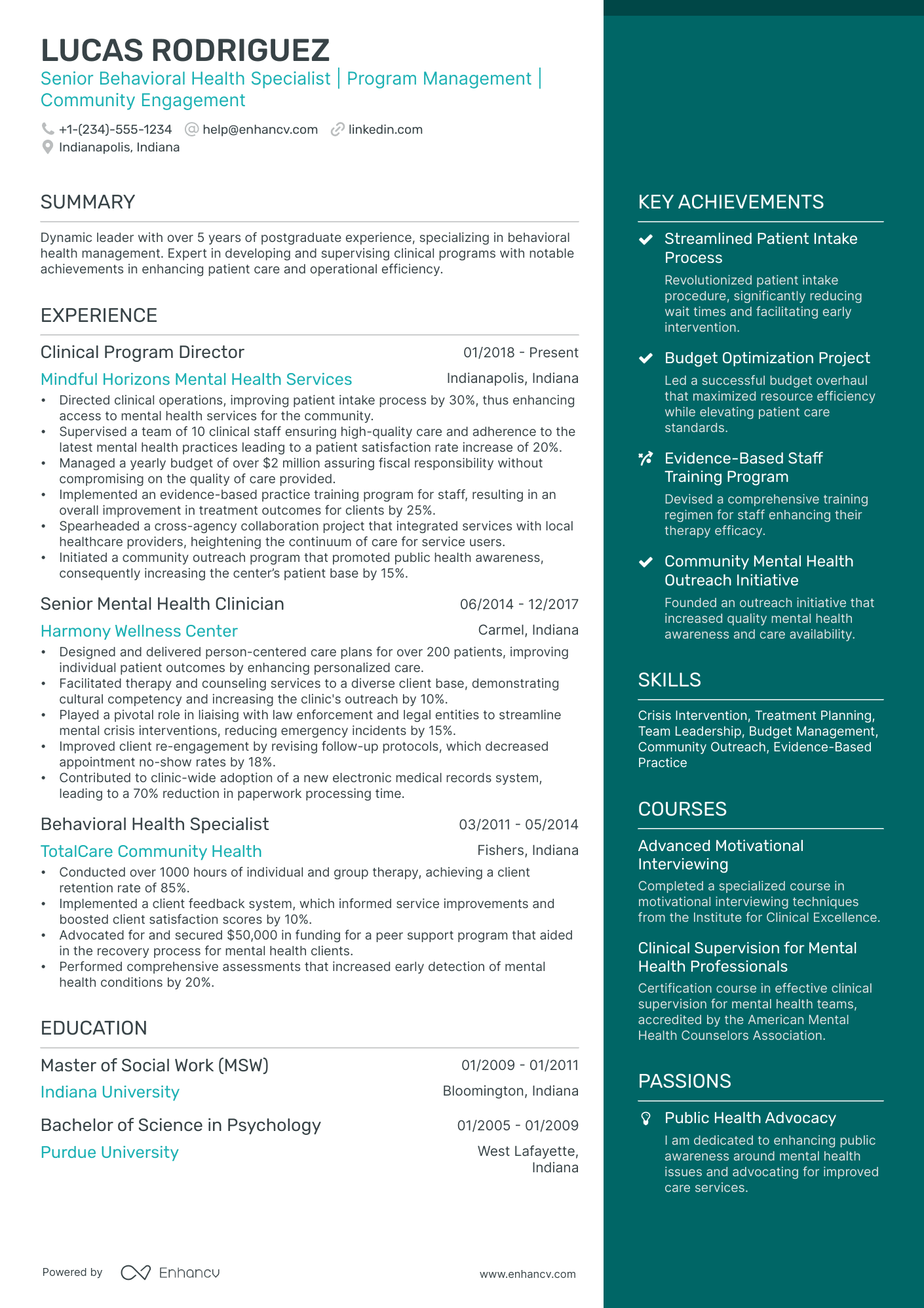
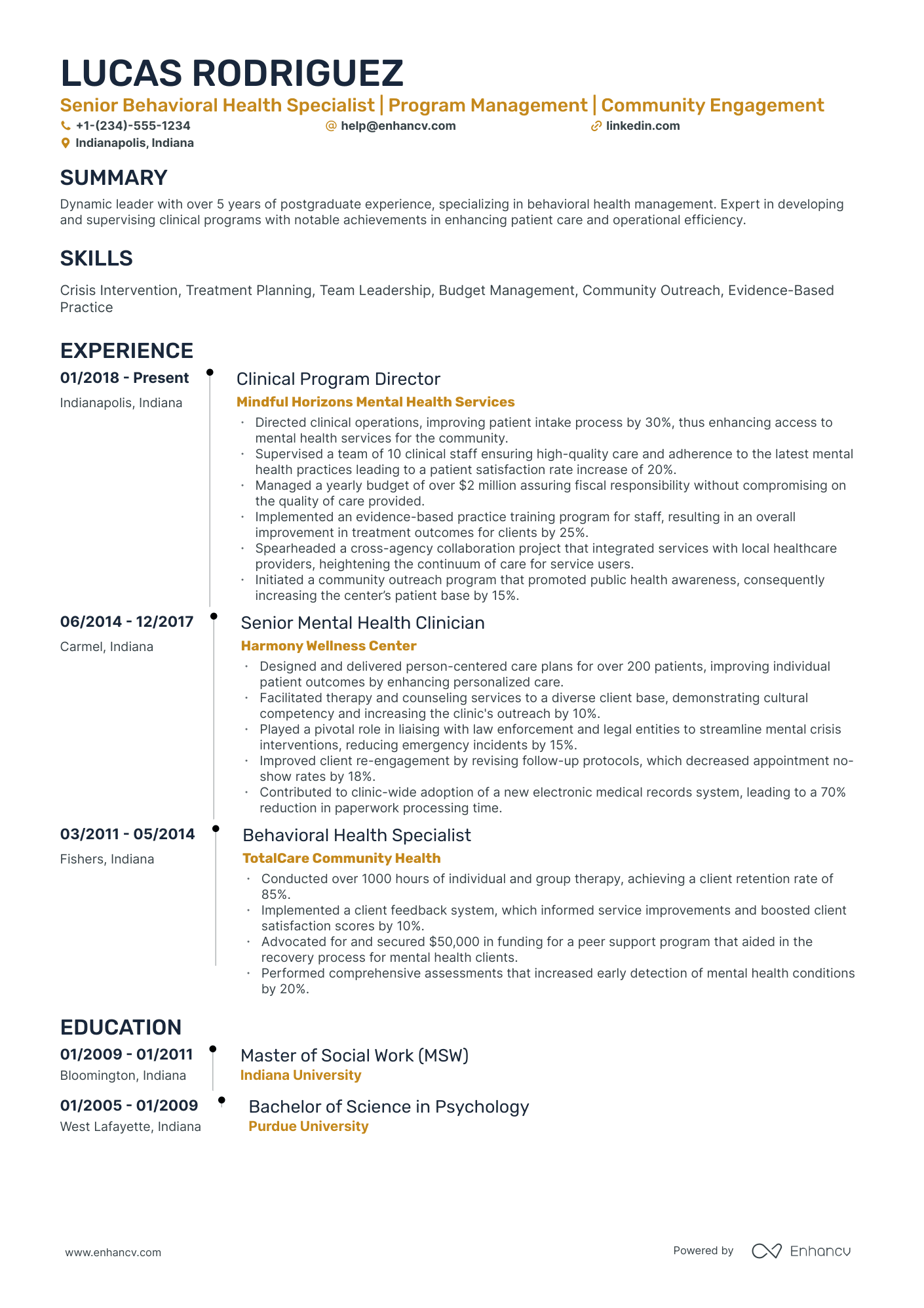
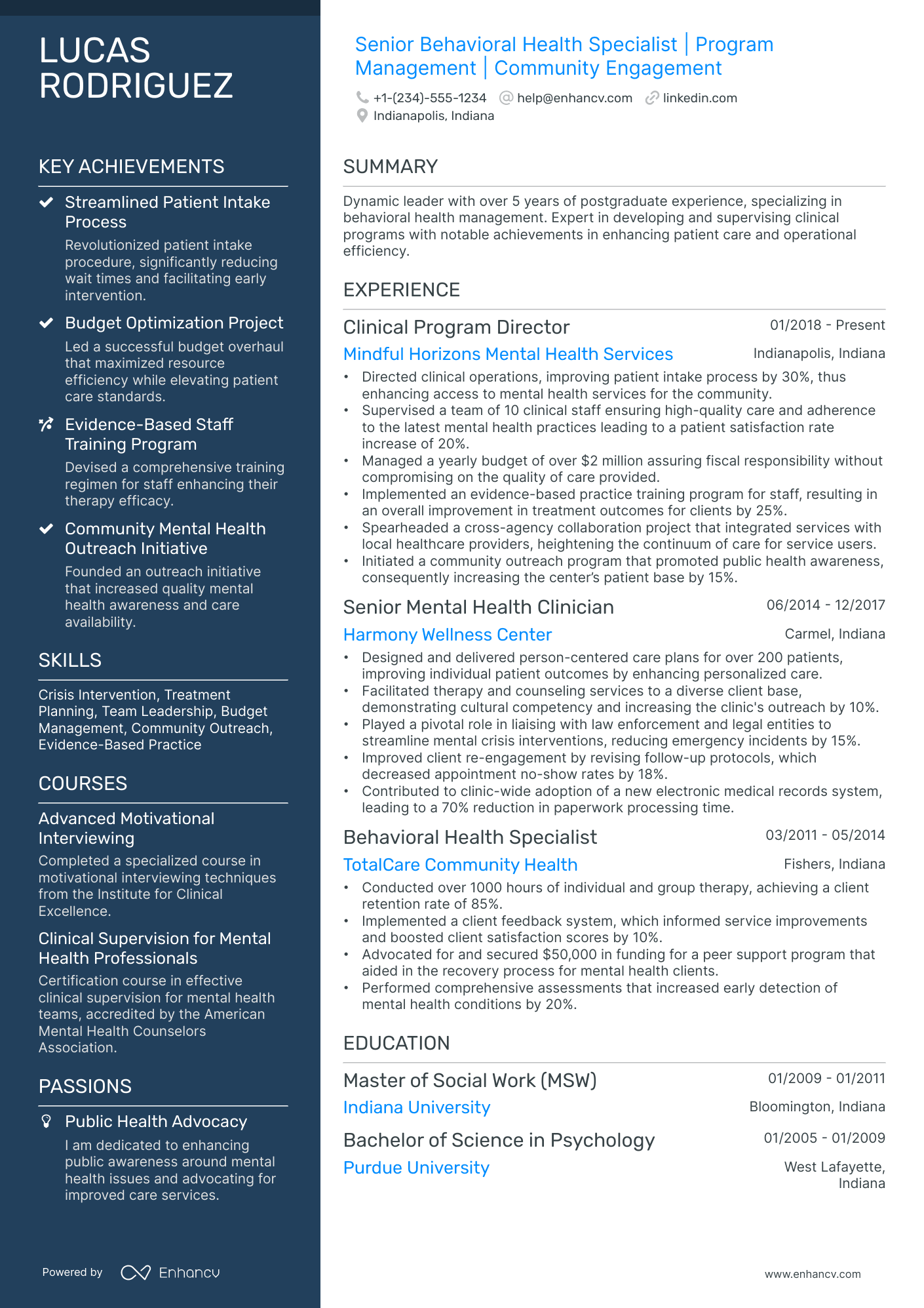
Recruiters evaluating mental health program manager candidates prioritize evidence of clinical program oversight, cross-functional team leadership, outcome measurement, and compliance with behavioral health regulations. Choosing the right resume format ensures these signals surface quickly during both human review and applicant tracking system (ATS) screening. A clean resume layout further supports readability across both screening methods.

I have significant experience in this role—which format should I use?
Use a reverse-chronological format to showcase your deepening scope of program leadership, clinical oversight, and operational accountability. Do:
- Lead with your most recent role and emphasize scope—number of programs managed, team size, budget authority, and population served.
- Highlight domain-specific expertise such as evidence-based treatment models, electronic health record (EHR) systems, grant management, and regulatory compliance (HIPAA, CARF, Joint Commission).
- Quantify business and clinical impact through metrics like client retention rates, program expansion outcomes, cost reductions, or improved access to care.
I'm junior or switching into this role—what format works best?
A hybrid format works best, allowing you to lead with relevant clinical and program coordination skills while still showing a clear work history. Do:
- Place a focused skills section near the top that highlights competencies like crisis intervention, program evaluation, grant writing, or data-driven outcome tracking.
- Feature project-based experience—such as practicum placements, volunteer program coordination, or quality improvement initiatives—that demonstrates hands-on program involvement.
- Connect every action to a measurable or observable result so recruiters can assess your readiness for program-level responsibility.
Why not use a functional resume?
A functional format strips away the timeline and context that hiring managers need to evaluate your growth into program management responsibilities, making it harder to verify your readiness for oversight, compliance, and team leadership.
- A functional format may be acceptable if you're transitioning from direct clinical practice into program management with limited formal management titles, but only if you tie every listed skill to a specific project, measurable outcome, or supervisory responsibility.
Once your formatting establishes a clean, readable structure, the next step is deciding which sections to include so every part of your resume serves a clear purpose.
What sections should go on a mental health program manager resume
Recruiters expect a clear snapshot of your program leadership, clinical operations oversight, and measurable outcomes in mental health services. Knowing what to put on a resume helps you prioritize the right content for this role.
Use this structure for maximum clarity:
- Header
- Summary
- Experience
- Skills
- Projects
- Education
- Certifications
- Optional sections: Awards, Publications, Volunteering
Strong experience bullets should emphasize program impact, client outcomes, budget and team scope, compliance performance, and results against key metrics.
Is your resume good enough?
Drop your resume here or choose a file. PDF & DOCX only. Max 2MB file size.
Once you’ve organized your resume with the right structure and supporting sections, focus next on writing your mental health program manager resume experience to show impact within that framework.
How to write your mental health program manager resume experience
Your work experience section should demonstrate the clinical programs, behavioral health initiatives, and service delivery models you've built, managed, or improved—along with the measurable outcomes those efforts produced. Hiring managers prioritize demonstrated impact over descriptive task lists, so focus on what you delivered rather than what you were assigned.
Each entry should include:
- Job title
- Company and location (or remote)
- Dates of employment (month and year)
Three to five concise bullet points showing what you owned, how you executed, and what outcomes you delivered:
- Ownership scope: the mental health programs, clinical service lines, treatment populations, grant-funded initiatives, or staff teams you were directly accountable for managing and growing.
- Execution approach: the evidence-based practices, clinical frameworks, compliance protocols, data tracking systems, or quality assurance methods you used to guide program decisions and deliver care effectively.
- Value improved: changes to client outcomes, treatment accessibility, service capacity, regulatory compliance, staff retention, crisis response times, or risk reduction tied to your program leadership.
- Collaboration context: how you coordinated with licensed clinicians, community partners, funding agencies, executive leadership, or government entities to align program goals with broader organizational and public health priorities.
- Impact delivered: outcomes expressed through program growth, population reach, funding secured, accreditation achieved, or clinical performance benchmarks met—framed as results rather than activities.
Experience bullet formula
A mental health program manager experience example
✅ Right example - modern, quantified, specific.
Mental Health Program Manager
HarborWell Behavioral Health | Seattle, WA
2021–Present
Multi-site outpatient and tele-mental health provider serving adults and adolescents across Washington.
- Launched measurement-based care across eight clinics using Epic, REDCap, and PHQ-9/GAD-7 workflows, increasing standardized outcome capture from 22% to 91% in six months.
- Implemented an intake-to-first-appointment redesign with Jira, Miro, and Lean Six Sigma tools, cutting median wait time from fourteen days to seven days while maintaining a 95% documentation compliance rate.
- Built a Power BI dashboard integrating Epic Clarity extracts and Twilio appointment data, reducing no-show rates from 18% to 12% and improving therapist utilization by nine percentage points.
- Negotiated value-based reporting with two payer partners and aligned clinical, finance, and data teams on HEDIS measures, improving follow-up after hospitalization within seven days from 62% to 78%.
- Led a cross-functional rollout of suicide risk protocols using Columbia-Suicide Severity Rating Scale and Safety Planning Intervention, reducing high-risk follow-up delays by 40% and passing joint commission audits with zero findings.
Now that you've seen what a strong experience section looks like in practice, let's break down how to adapt yours to match a specific job posting.
How to tailor your mental health program manager resume experience
Recruiters evaluate your mental health program manager resume through both human review and applicant tracking systems. Tailoring your resume to the job description ensures your qualifications stand out in both screening methods.
Ways to tailor your mental health program manager experience:
- Match clinical tools or EHR systems named in the job description.
- Mirror terminology for evidence-based treatment models or therapeutic frameworks.
- Reflect program outcome metrics or KPIs the posting prioritizes.
- Highlight experience with specific populations or service settings mentioned.
- Emphasize compliance with state licensing and accreditation standards referenced.
- Align your language with grant management or funding processes listed.
- Reference collaborative care models or interdisciplinary workflows described.
- Include quality improvement or program evaluation methods the role requires.
Tailoring means aligning your real accomplishments with the employer's stated requirements, not forcing disconnected keywords into your experience.
Resume tailoring examples for mental health program manager
| Job description excerpt | Untailored | Tailored |
|---|---|---|
| "Oversee implementation of evidence-based practices (EBPs) including CBT and DBT across outpatient behavioral health programs" | Managed various therapy programs for clients in a clinical setting. | Directed implementation of CBT and DBT protocols across four outpatient behavioral health programs, increasing EBP fidelity scores by 30% over 18 months. |
| "Coordinate with county agencies and managed care organizations to ensure compliance with SAMHSA grant requirements and Medicaid billing standards" | Worked with external partners on funding and compliance tasks. | Coordinated with three county agencies and two managed care organizations to maintain full compliance with SAMHSA grant deliverables and Medicaid billing standards, managing a $1.2M annual budget. |
| "Supervise a multidisciplinary team of licensed clinicians, case managers, and peer support specialists serving adults with serious mental illness (SMI)" | Led a team of staff members providing mental health services. | Supervised a multidisciplinary team of 14—including LCSWs, case managers, and certified peer support specialists—delivering integrated services to a caseload of 200+ adults with serious mental illness. |
Once you’ve aligned your experience with the role’s priorities, the next step is to quantify your achievements so hiring teams can quickly see the results you delivered.
How to quantify your mental health program manager achievements
Quantifying your achievements proves outcomes, not effort. Focus on program reach, clinical and operational quality, cycle time, compliance risk, and cost efficiency across referrals, access, care coordination, and vendor performance.
Quantifying examples for mental health program manager
| Metric | Example |
|---|---|
| Access time | "Reduced average intake wait time from fourteen days to seven by adding a centralized triage queue in Salesforce and standardizing referral criteria." |
| Program reach | "Expanded the employee assistance program from two to five sites, increasing monthly active participants from 180 to 310 within six months." |
| Care quality | "Improved follow-up completion within seven days from 62% to 84% by implementing a care coordinator checklist and weekly case reviews." |
| Compliance risk | "Achieved 100% audit pass rate for HIPAA (Health Insurance Portability and Accountability Act) documentation across 420 charts by retraining staff and adding EMR templates." |
| Cost efficiency | "Cut per-member-per-month vendor costs by 12% ($48,000 annually) by renegotiating contracts and shifting low-acuity cases to group sessions." |
Turn vague job duties into measurable, recruiter-ready resume bullets in seconds with Enhancv's Bullet Point Generator.
Once you've crafted strong bullet points for your experience section, you'll want to apply that same precision to presenting your hard and soft skills throughout your mental health program manager resume.
How to list your hard and soft skills on a mental health program manager resume
Your skills section shows you can design, deliver, and improve mental health programs, and recruiters and an ATS (applicant tracking system) scan this section to confirm role fit fast; aim for a balanced mix of hard skills and job-specific soft skills. mental health program manager roles require a blend of:
- Product strategy and discovery skills.
- Data, analytics, and experimentation skills.
- Delivery, execution, and go-to-market discipline.
- Soft skills.
Your skills section should be:
- Scannable (bullet-style grouping).
- Relevant to the job post.
- Backed by proof in experience bullets.
- Updated with current tools.
Place your skills section:
- Above experience if you're junior or switching careers.
- Below experience if you're mid/senior with strong achievements.

Hard skills
- Program design and implementation
- Measurement-based care workflows
- Evidence-based modalities: CBT, DBT
- Clinical documentation standards
- EHR platforms, Epic, Cerner
- HIPAA compliance and privacy
- Quality improvement, PDSA cycles
- Outcome metrics, KPI dashboards
- Grant management and reporting
- Budgeting, forecasting, cost control
- Vendor management and contracting
- Crisis response protocols
Soft skills
- Cross-functional stakeholder alignment
- Clinical and operational translation
- Clear escalation and risk communication
- Prioritization under constraints
- Structured problem-solving
- Data-informed decision-making
- Change management with clinicians
- Facilitation of multidisciplinary meetings
- Conflict resolution and de-escalation
- Ownership of deliverables and timelines
- Coaching and performance feedback
- Client-centered service orientation
How to show your mental health program manager skills in context
Skills shouldn't live only in a bulleted list on your resume. Browse examples of resume skills in action to see how other professionals weave competencies into their experience.
They should be demonstrated in:
- Your summary (high-level professional identity)
- Your experience (proof through outcomes)
Here's what that looks like in practice.
Summary example
Senior mental health program manager with 12 years leading community behavioral health initiatives. Skilled in trauma-informed care, EHR systems, and SAMHSA grant compliance. Directed crisis intervention programs serving 4,000+ clients annually while mentoring multidisciplinary clinical teams.
- Reflects senior-level expertise immediately
- Names specific tools and frameworks
- Leads with a measurable client outcome
- Highlights mentorship and leadership skills
Experience example
Senior Mental Health Program Manager
Compass Behavioral Health Partners | Denver, CO
March 2019–Present
- Redesigned intake workflows using Apricot case management software, reducing client wait times by 34% across three outpatient sites.
- Partnered with county health departments and school districts to launch a youth crisis program, increasing early intervention referrals by 52%.
- Implemented standardized outcome tracking with the PHQ-9 and GAD-7, improving treatment plan accuracy and boosting program funding retention by 20%.
- Every bullet contains measurable proof
- Skills surface naturally through achievements
Once you’ve tied your relevant abilities to real outcomes and responsibilities, the next step is structuring a resume that highlights those strengths when you don’t have direct mental health program manager experience.
How do I write a mental health program manager resume with no experience
Even without full-time experience, you can demonstrate readiness through:
- Graduate capstone program evaluation
- Public health internship program support
- Crisis hotline shift lead duties
- Community outreach event coordination
- Grant proposal writing for nonprofits
- Volunteer case management coordination
- Quality improvement data dashboard project
- Research assistant outcomes tracking
If you're starting out, our guide on writing a resume without work experience offers additional strategies for showcasing your qualifications.
Focus on:
- Measurable outcomes and key metrics
- Program operations and workflow design
- Budget, grants, and vendor coordination
- Compliance, privacy, and documentation
Resume format tip for entry-level mental health program manager
Use a combination resume format to highlight projects and relevant experience substitutes before work history. It helps you show program management impact without full-time roles. Do:
- Lead with a "Projects" section.
- Add metrics to every bullet.
- Name tools like Excel and REDCap.
- Include compliance tasks like HIPAA.
- Match keywords from the job posting.
- Built an Excel dashboard to track PHQ-9 and GAD-7 outcomes for a campus counseling pilot, improving weekly reporting accuracy by 30%.
Even without direct experience, your educational background can strengthen your candidacy—here's how to present it effectively.
How to list your education on a mental health program manager resume
Your education section helps hiring teams confirm you hold the foundational knowledge required for a mental health program manager role. It quickly validates relevant academic training.
Include:
- Degree name
- Institution
- Location
- Graduation year
- Relevant coursework (for juniors or entry-level candidates)
- Honors & GPA (if 3.5 or higher)
Skip month and day details—list the graduation year only.
Here's a strong education entry tailored to a mental health program manager resume:
Example education entry
Master of Science in Clinical Mental Health Counseling
University of North Carolina at Charlotte, Charlotte, NC
Graduated 2019
GPA: 3.8/4.0
- Relevant coursework: Program Evaluation, Crisis Intervention, Behavioral Health Policy, and Community Mental Health Systems
- Honors: Graduated summa cum laude, inducted into Chi Sigma Iota Counseling Honor Society
How to list your certifications on a mental health program manager resume
Certifications on your resume show your commitment to learning, tool proficiency, and industry relevance as a mental health program manager, helping employers trust your clinical, operational, and compliance skills. Include:
- Certificate name
- Issuing organization
- Year
- Optional: credential ID or URL
- Place certifications below education when your degree is recent and directly aligned with mental health program manager requirements.
- Place certifications above education when they are recent, highly relevant, or required for the mental health program manager role.
Best certifications for your mental health program manager resume
- Project Management Professional (PMP)
- Certified Associate in Project Management (CAPM)
- Certified Professional in Healthcare Quality (CPHQ)
- Lean Six Sigma Green Belt
- Certified Case Manager (CCM)
- Mental Health First Aid Certification
- Certified Professional Coder (CPC)
Once you’ve positioned your credentials where recruiters can spot them quickly, shift to your mental health program manager resume summary to tie those qualifications to your leadership impact in a few lines.
How to write your mental health program manager resume summary
Your resume summary is the first thing a recruiter reads. A strong one immediately signals you're qualified for the mental health program manager role.
Keep it to three to four lines, with:
- Your title and total years of experience in behavioral health or program management.
- The domain you specialize in, such as community mental health, clinical operations, or integrated care.
- Core skills like program evaluation, grant management, evidence-based practice implementation, or EHR systems.
- One or two measurable achievements, such as client outcomes improved or programs scaled.
- Soft skills tied to real results, like cross-functional collaboration that reduced service gaps.

PRO TIP
At this mid-level role, emphasize hands-on program oversight and measurable client or operational outcomes. Highlight your ability to manage teams, budgets, and compliance requirements. Avoid vague phrases like "passionate about helping others" or "strong communicator." Replace them with specific results.
Example summary for a mental health program manager
Mental health program manager with six years leading community behavioral health initiatives. Expanded outpatient services across three counties, increasing client retention by 34%. Skilled in Medicaid compliance, trauma-informed care frameworks, and cross-agency coordination.
Optimize your resume summary and objective for ATS
Drop your resume here or choose a file.
PDF & DOCX only. Max 2MB file size.
Now that your summary captures your professional value, make sure your resume header presents the essential contact and identification details hiring managers need to reach you.
What to include in a mental health program manager resume header
A resume header is the top section with your identity and contact details, and it improves visibility, credibility, and recruiter screening for a mental health program manager.
Essential resume header elements
- Full name
- Tailored job title and headline
- Location
- Phone number
- Professional email
- GitHub link
- Portfolio link
A LinkedIn link helps recruiters verify experience quickly and supports screening.
Don't include a photo on a mental health program manager resume unless the role is explicitly front-facing or appearance-dependent.
Match your header job title to the posting and keep links and contact details consistent across every platform.
Mental health program manager resume header
Jordan Lee
Mental health program manager | Community-based care coordination and outcomes tracking
Austin, TX
(512) 555-01XX
your.name@enhancv.com
github.com/yourname
yourwebsite.com
linkedin.com/in/yourname
Once your contact details and professional identifiers are clearly presented at the top, add the following optional sections to provide supporting details that strengthen the rest of your resume.
Additional sections for mental health program manager resumes
Adding extra sections helps you stand out when your core qualifications match other candidates and you need role-specific credibility. For example, listing language skills on your resume can demonstrate your ability to serve diverse client populations.
- Languages
- Publications and research
- Professional affiliations and memberships
- Licenses and certifications
- Conference presentations and speaking engagements
- Volunteer work in behavioral health
- Grants and funded projects
Once you've strengthened your resume with relevant additional sections, it's worth pairing it with a well-crafted cover letter to maximize your impact.
Do mental health program manager resumes need a cover letter
A cover letter isn't required for a mental health program manager, but it often helps. If you're unsure where to start, learn what a cover letter is and how it complements your resume. It can make a difference in competitive searches or organizations with strict hiring expectations. Skip it only when the posting says not to include one or the application limits uploads.
Use a cover letter to add context your resume can't:
- Explain role and team fit by matching your program scope to their setting, population, and care model.
- Highlight one or two projects with outcomes, such as reduced no-show rates, faster intake, or improved clinical quality measures.
- Show you understand their product, users, or business context, including referral flow, payer requirements, and privacy constraints.
- Address career transitions or non-obvious experience by connecting transferable skills to mental health program manager responsibilities.
Drop your resume here or choose a file.
PDF & DOCX only. Max 2MB file size.
Even if you decide not to include a cover letter, using AI to improve your mental health program manager resume helps you strengthen the same qualifications and alignment your application needs.
Using AI to improve your mental health program manager resume
AI can sharpen your resume's clarity, structure, and impact. It helps tighten language and highlight relevant accomplishments. But overuse strips authenticity. Once your content is clear and role-aligned, step away from AI. For practical prompt ideas, explore our guide on ChatGPT resume writing.
Here are 10 practical prompts to strengthen specific sections of your mental health program manager resume:
Strengthen your summary
Quantify experience bullets
Align skills to job posting
Sharpen action verbs
Refine project descriptions
Trim redundant language
Improve certification formatting
Tailor education details
Clarify leadership scope
Eliminate jargon overload
Conclusion
A strong mental health program manager resume proves impact with measurable outcomes, role-specific skills, and a clear structure. Lead with results like access gains, reduced no-show rates, improved outcomes, and budget control. Show strengths in program design, compliance, staff leadership, and stakeholder communication.
Keep each section focused, scannable, and consistent, so hiring teams can assess fit fast. A results-first summary, targeted experience, and relevant credentials show you’re ready for today’s hiring market and near-future expectations.