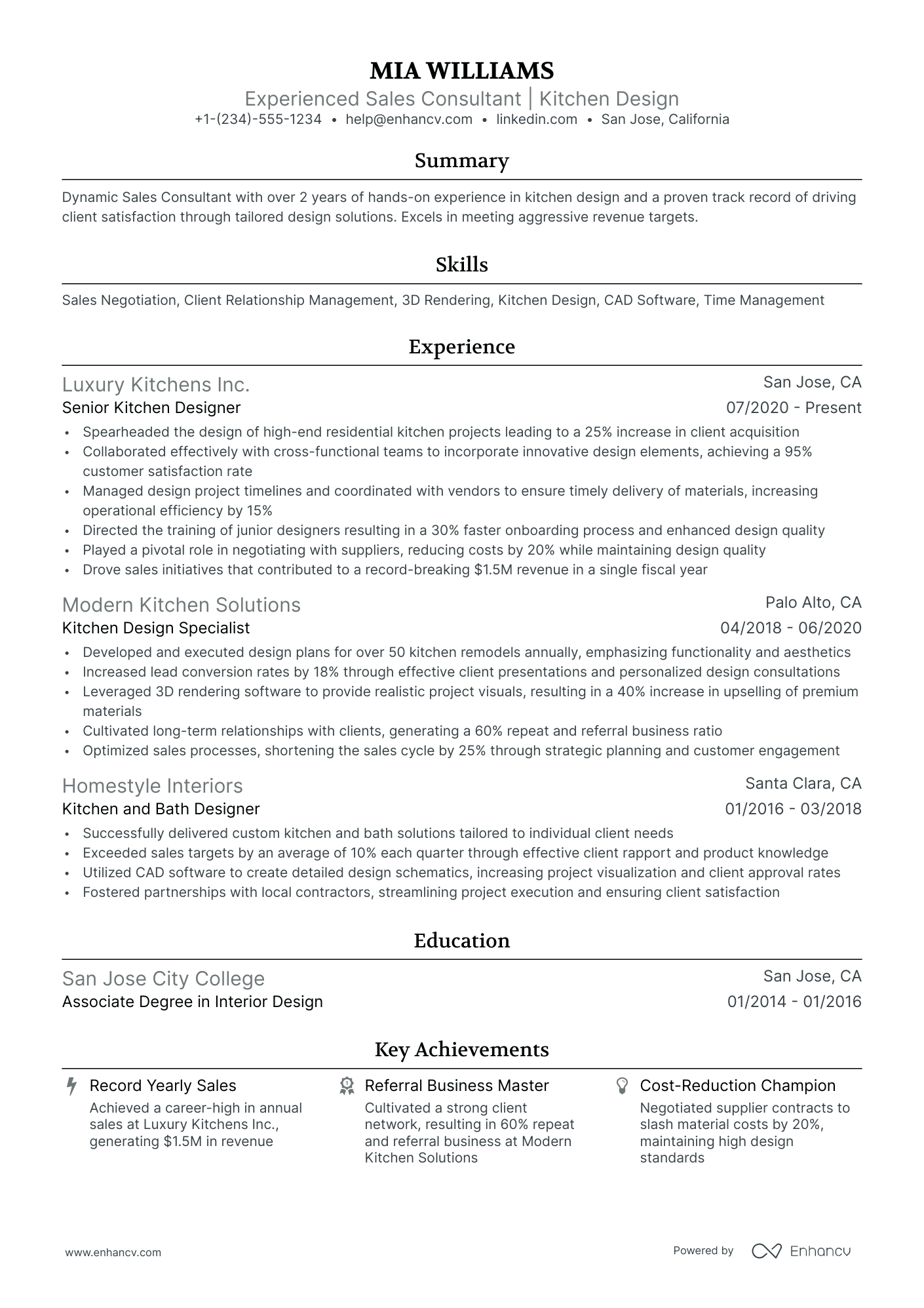
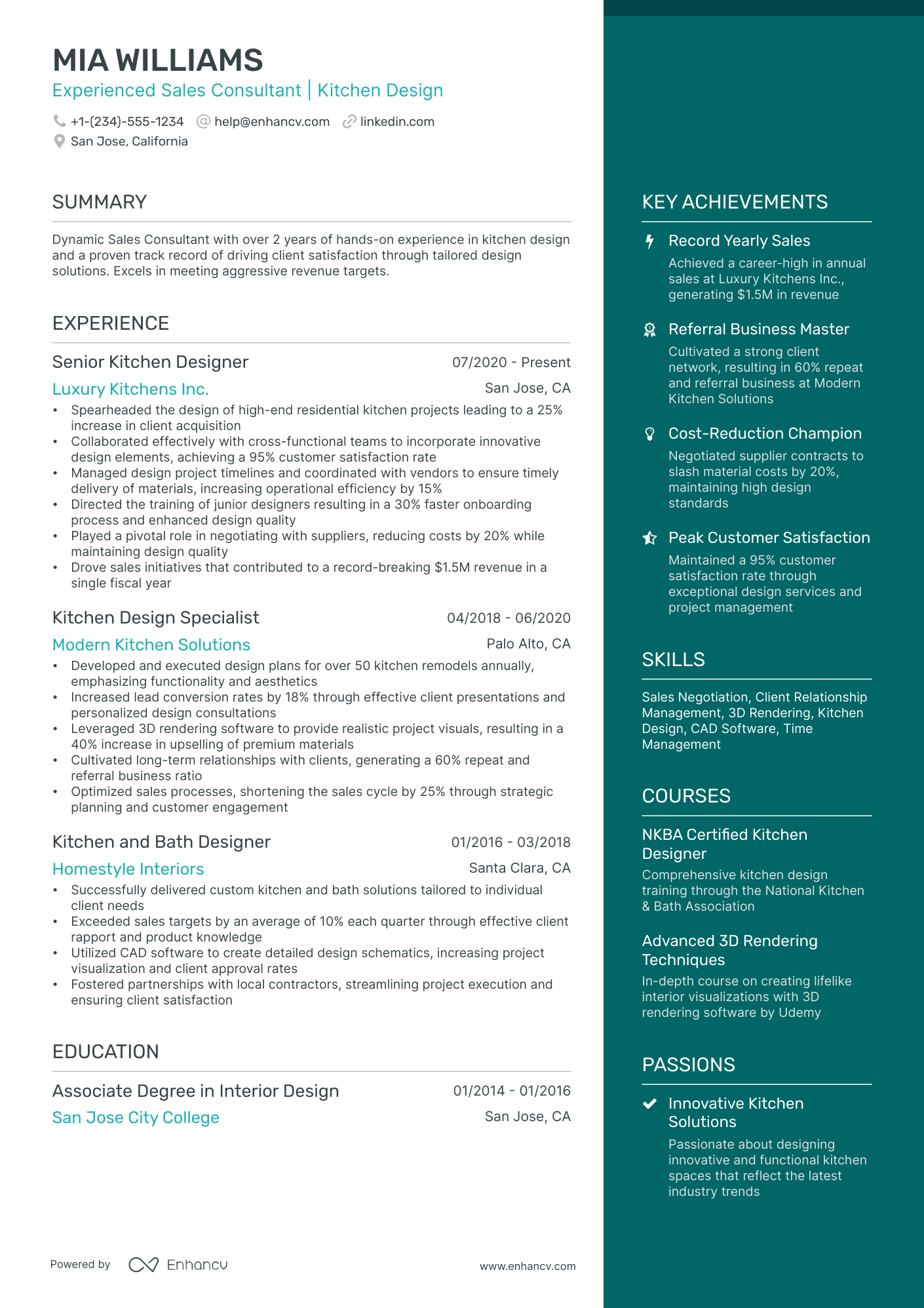
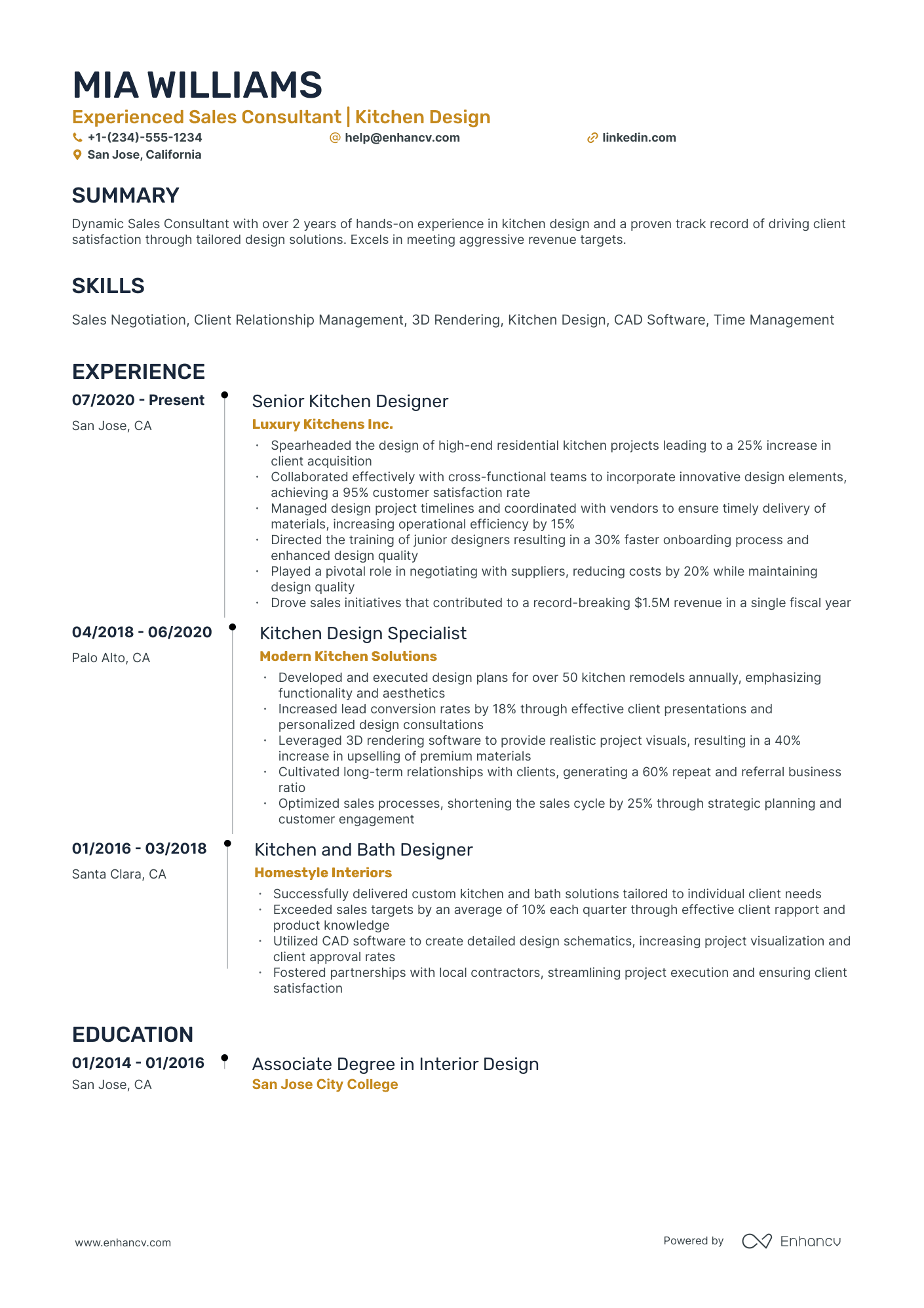
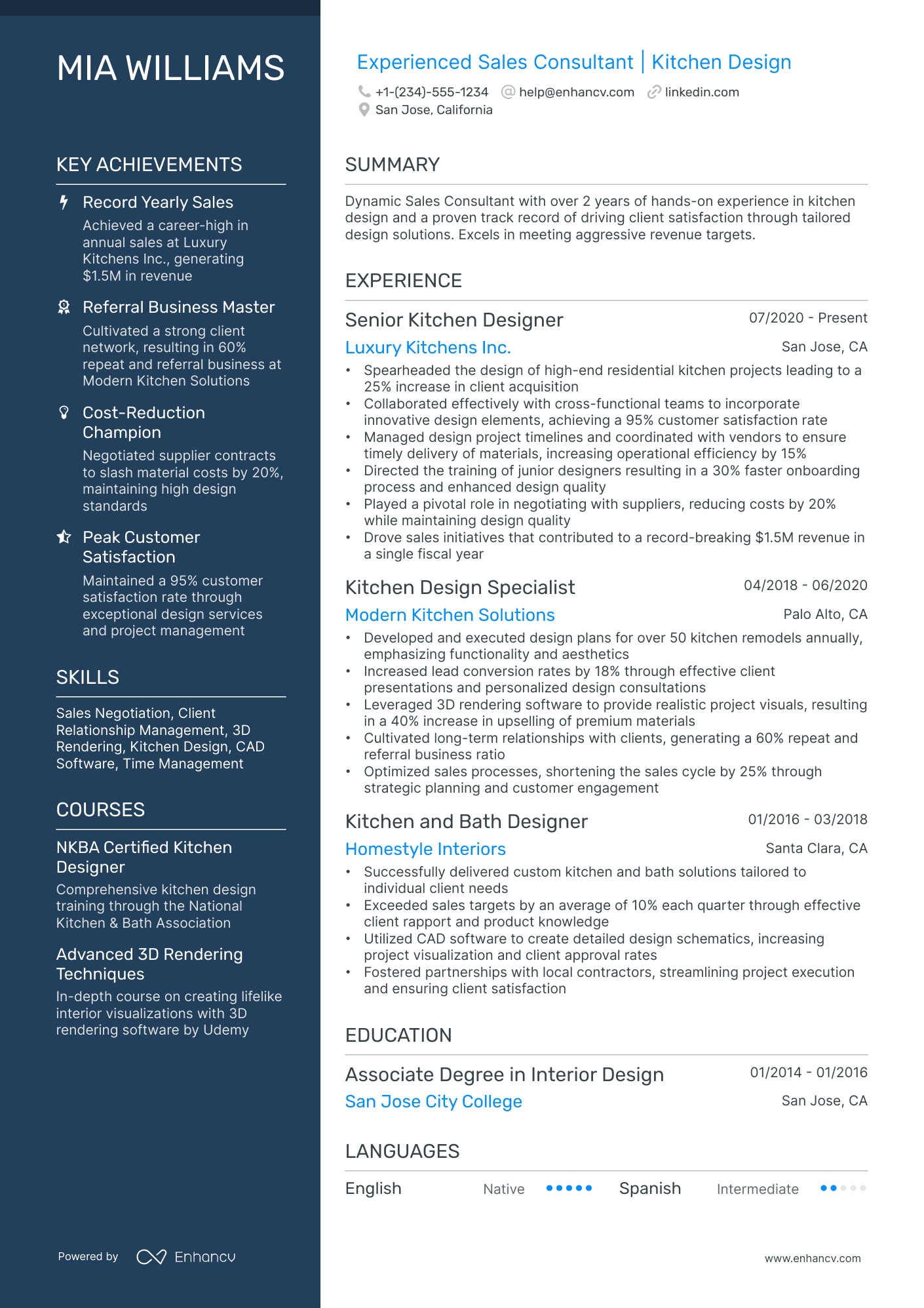
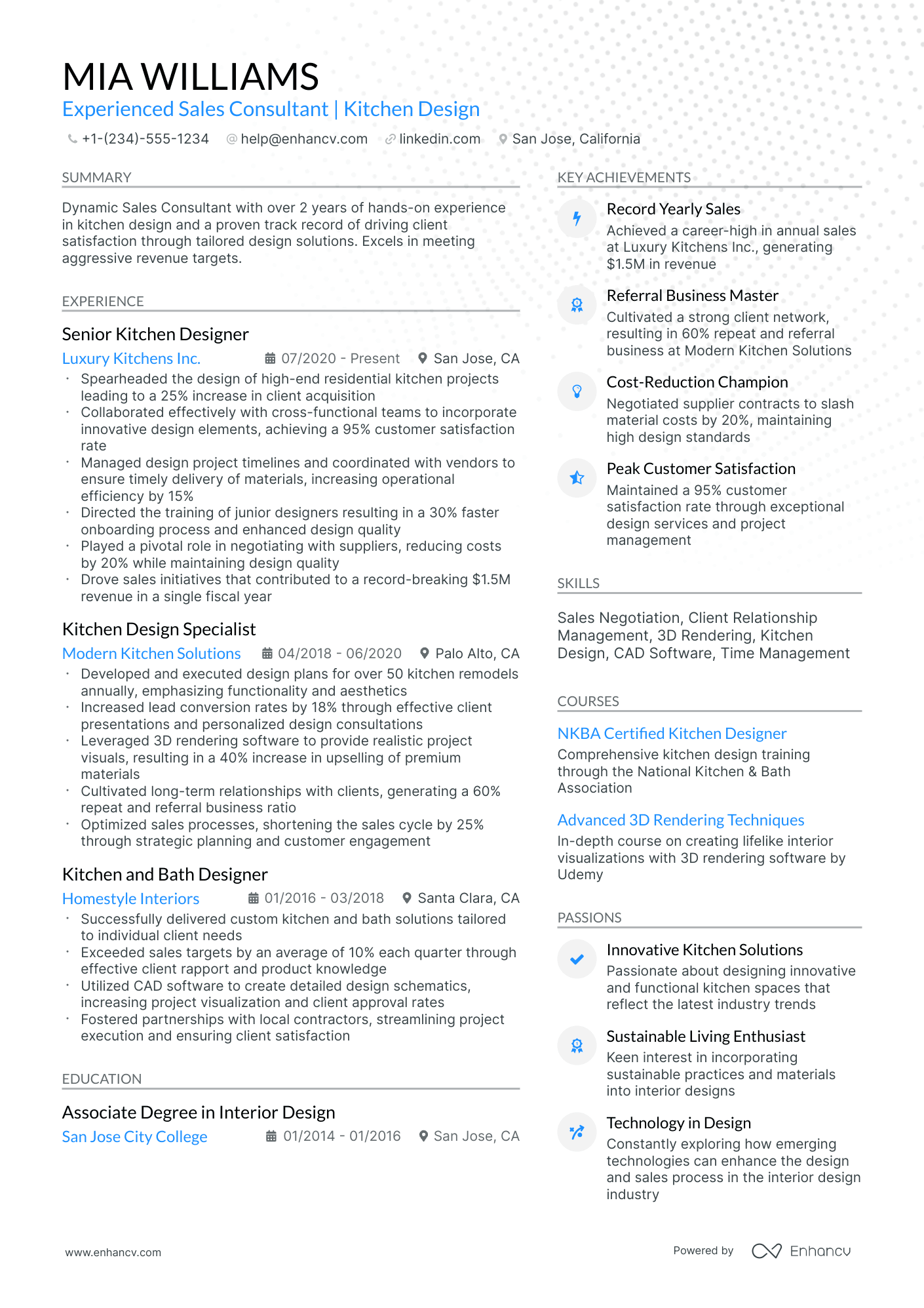
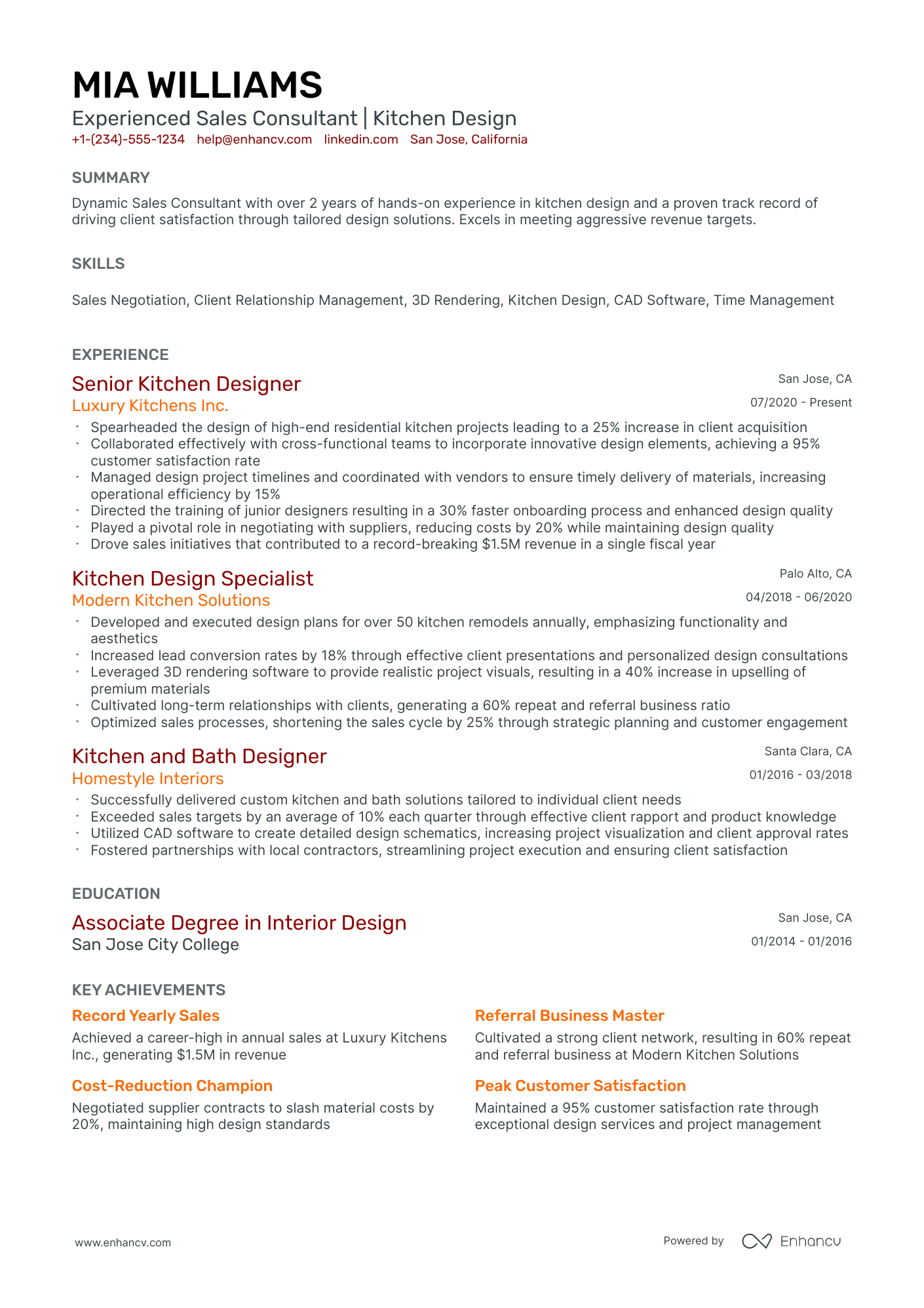
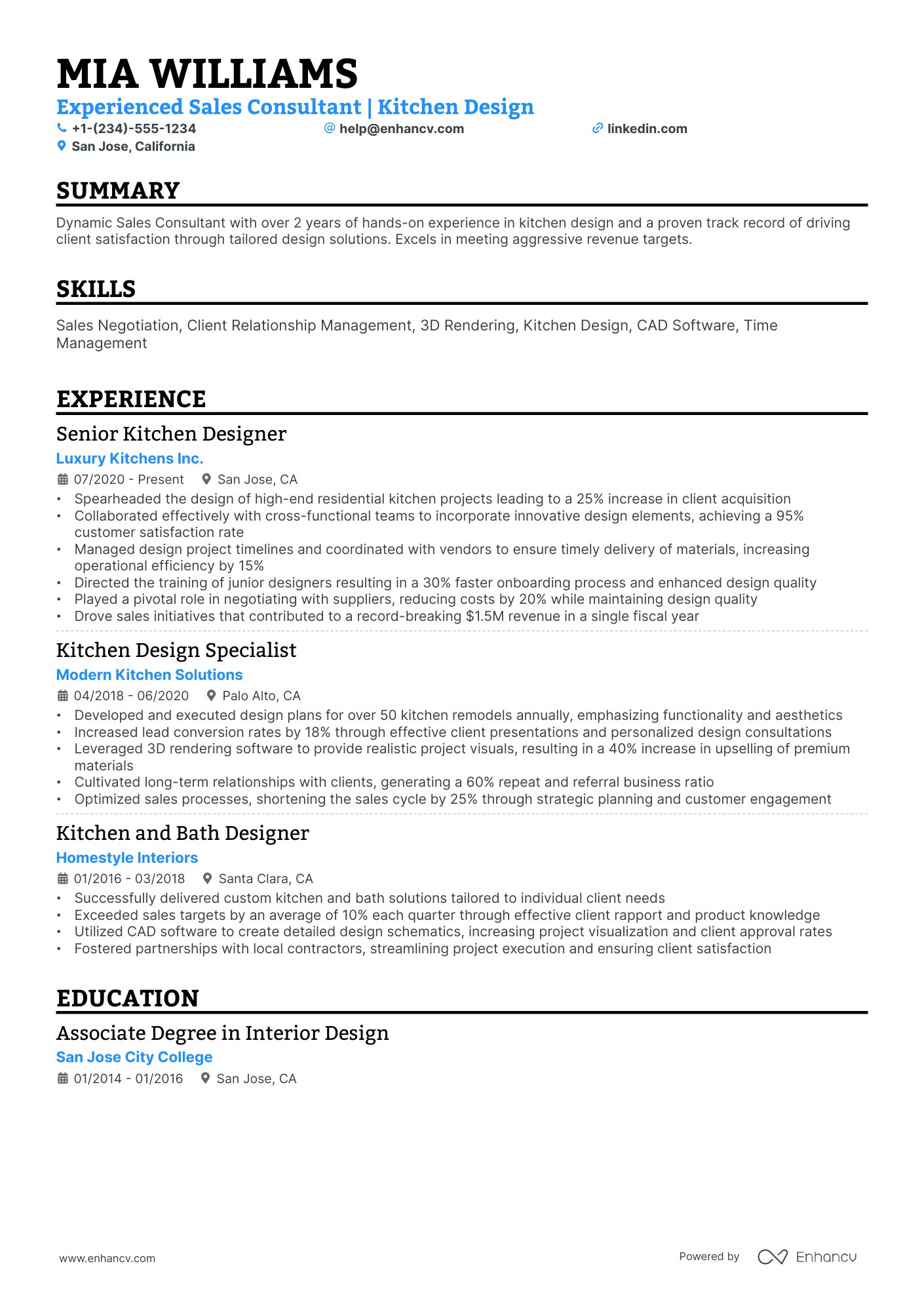
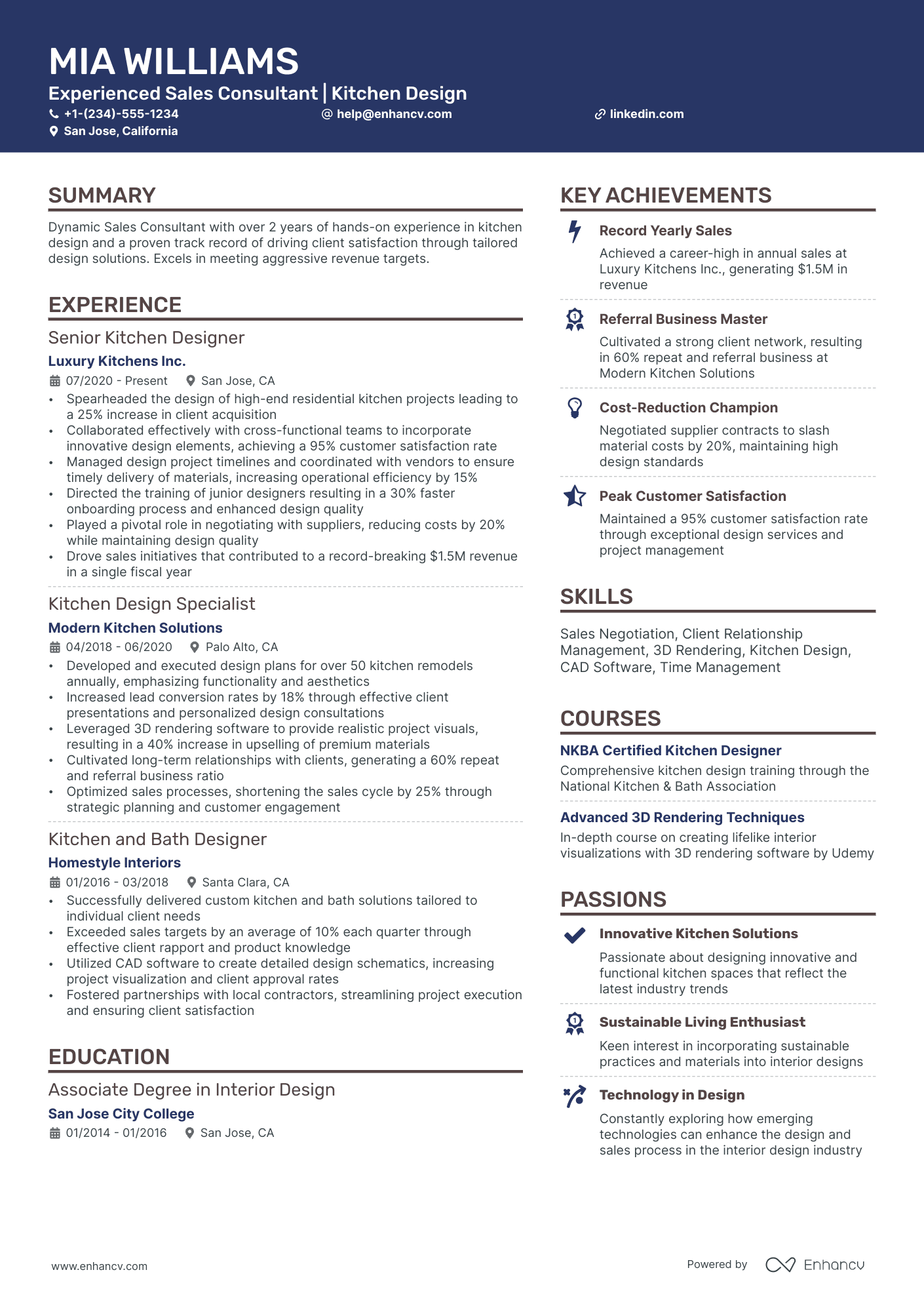
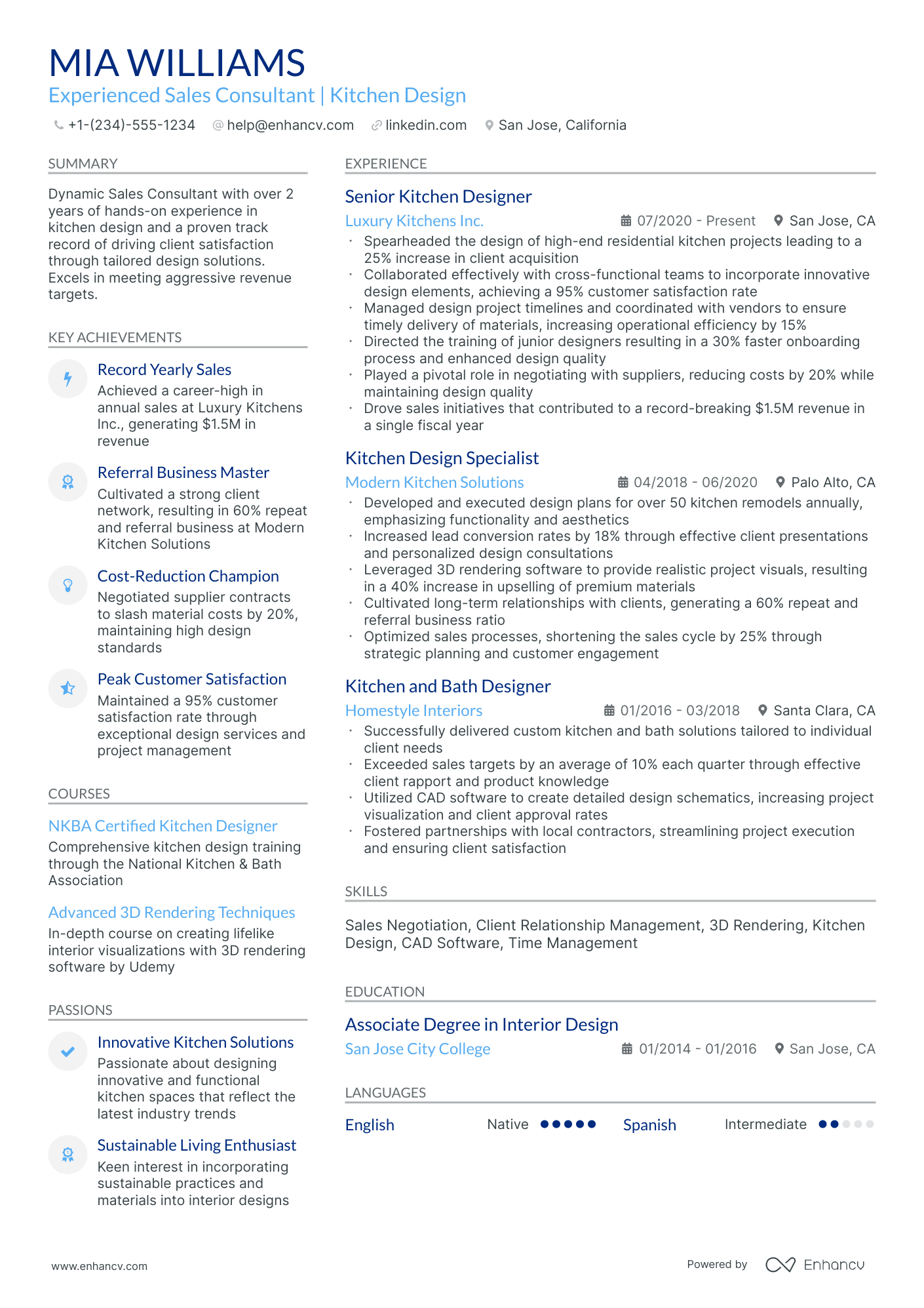
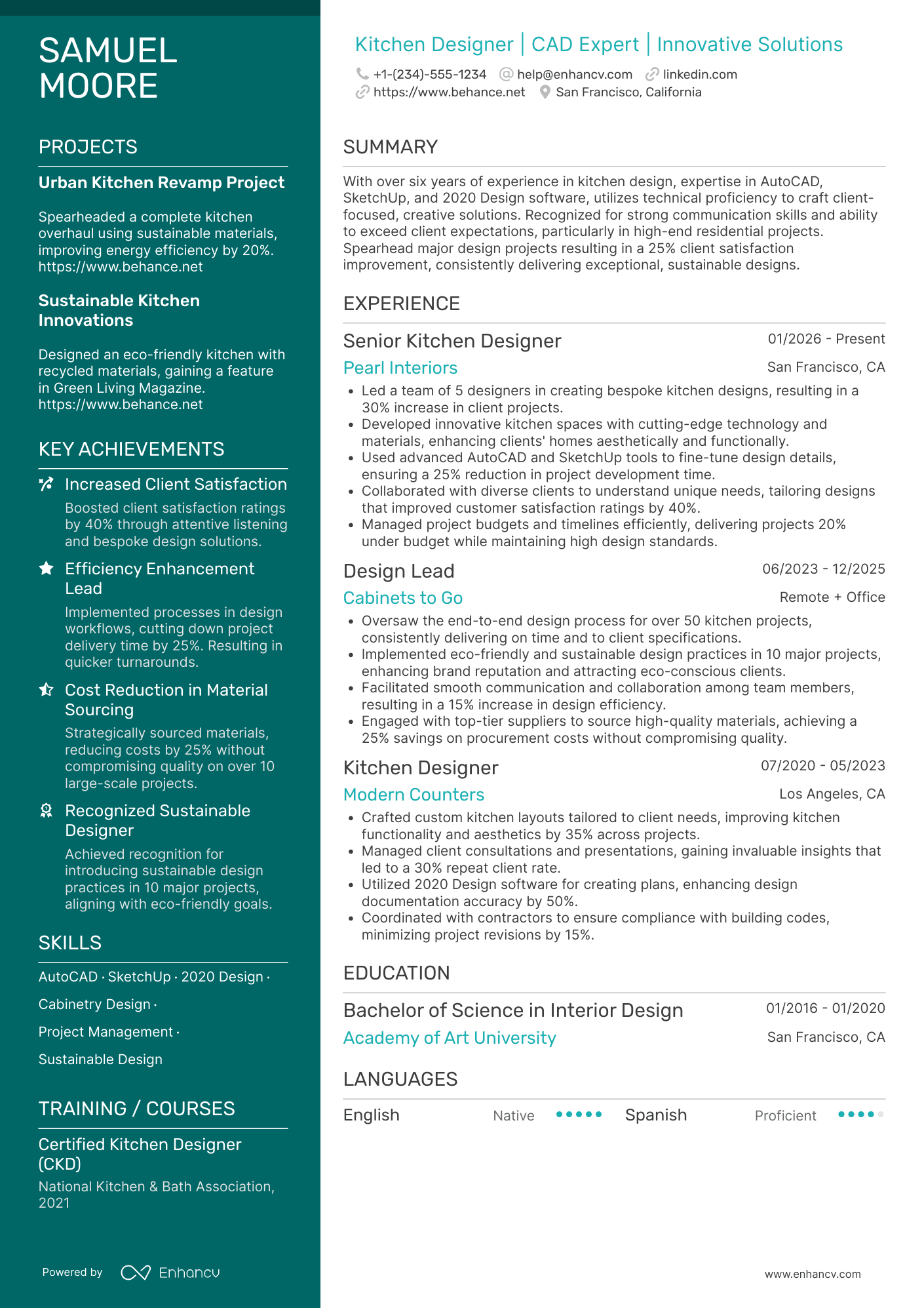
Kitchen designer resume drafts often fail because they read like project diaries and bury measurable results under software lists. That hurts in a kitchen designer resume review, where applicant tracking system filters and fast recruiter scans decide quickly.
A strong resume shows what you delivered and why it mattered, not just what you used. Knowing how to make your resume stand out means you should highlight budget managed, timelines met, change orders reduced, and client satisfaction scores. Include cabinet layouts approved on first review, square footage planned, and profit improved through value engineering.

Key takeaways
- Quantify project outcomes like revenue, cycle time, and client satisfaction on every resume bullet.
- Use reverse-chronological format if you have direct kitchen design experience.
- Choose a hybrid format when entering the field or switching from an adjacent role.
- Mirror the job posting's exact software, product lines, and terminology in your experience section.
- Place certifications above education when they're recent or required by the posting.
- Write a three- to four-line summary featuring your tools, specialization, and one measurable win.
- Use Enhancv's Bullet Point Generator to turn vague duties into specific, results-driven statements.
How to format a kitchen designer resume
Recruiters evaluating kitchen designer resumes prioritize a clear portfolio of design skills, proficiency with industry-standard tools like 2020 Design or AutoCAD, and evidence of successful client-facing project delivery. Choosing the right resume format ensures these signals—technical ability, project scope, and client satisfaction—surface quickly during both human review and ATS screening.

I have significant experience in this role—which format should I use?
Use a reverse-chronological format to lead with your strongest, most recent kitchen design projects and show steady growth in project complexity and client management. Do:
- Highlight the scope and ownership of your projects, including budget ranges, number of concurrent designs, and client types (residential, commercial, showroom).
- Feature role-specific tools and domains prominently—2020 Design, SketchUp, AutoCAD, KCD Software, cabinetry specification, material sourcing, and building code compliance.
- Quantify outcomes tied to business impact, such as client satisfaction scores, sales conversion rates, revenue generated, or project timelines met.
I'm junior or switching into this role—what format works best?
A hybrid format works best, placing a strong skills section at the top while still including a concise work history that demonstrates relevant experience or transferable abilities. Do:
- Position core competencies—space planning, material knowledge, design software proficiency—near the top of the resume so recruiters and ATS systems capture them immediately.
- Include academic design projects, freelance renovations, internships, or related roles (interior design, retail kitchen sales, architectural drafting) to bridge experience gaps.
- Connect every action to an outcome, even in transitional roles, to show you understand the results-driven nature of kitchen design work.
Why not use a functional resume?
A functional format strips away the project timelines, client context, and progressive skill development that hiring managers need to evaluate a kitchen designer's real-world capability.
- Career changers from adjacent fields (interior design, architecture, retail kitchen sales) who have relevant transferable skills but no formal kitchen design job titles.
- Recent graduates with strong academic portfolios or certifications (such as NKBA) but limited professional experience.
- Candidates with resume gaps who completed freelance projects or relevant coursework during time away from traditional employment.
Now that your resume's format is set, it's time to fill each part with the right content—starting with knowing exactly which sections to include.
What sections should go on a kitchen designer resume
Recruiters expect a kitchen designer resume to show clear design expertise, client-facing experience, and measurable project results. Understanding which resume sections to include helps you organize this information effectively.
Use this structure for maximum clarity:
- Header
- Summary
- Experience
- Skills
- Projects
- Education
- Certifications
- Optional sections: Awards, Leadership, Languages
Your experience bullets should emphasize project scope, design and budget outcomes, timeline performance, and client satisfaction.
Is your resume good enough?
Drop your resume here or choose a file. PDF & DOCX only. Max 2MB file size.
Now that you’ve organized the key resume components, focus on writing your kitchen designer resume experience to show how you delivered results in each role.
How to write your kitchen designer resume experience
The experience section of your kitchen designer resume should spotlight the projects you've delivered, the design tools and methods you've applied, and the measurable outcomes your work produced—from client satisfaction improvements to reduced revision cycles. Hiring managers prioritize demonstrated impact over descriptive task lists, so every bullet you include should prove you moved a project forward rather than simply participated in one. Building a targeted resume ensures each entry speaks directly to what the employer needs.
Each entry should include:
- Job title
- Company and location (or remote)
- Dates of employment (month and year)
Three to five concise bullet points showing what you owned, how you executed, and what outcomes you delivered:
- Ownership scope: the kitchen projects, client accounts, product lines, showroom portfolios, or design teams you were directly accountable for.
- Execution approach: the CAD software, rendering platforms, material specification methods, space-planning frameworks, or building-code standards you used to make design decisions and deliver finished plans.
- Value improved: changes to design accuracy, project turnaround time, material waste reduction, client retention, functional accessibility, or code compliance that resulted from your work.
- Collaboration context: how you coordinated with contractors, cabinetry fabricators, appliance vendors, architects, sales teams, or homeowners to align vision with structural and budgetary realities.
- Impact delivered: outcomes expressed through completed installations, revenue influenced, client referrals generated, or efficiency gains realized—framed as results rather than activities.
Experience bullet formula
A kitchen designer experience example
✅ Right example - modern, quantified, specific.
Senior Kitchen Designer
Hearth & Harbor Kitchens | Austin, TX
2021–Present
Custom and semi-custom kitchen design studio delivering end-to-end remodels for homeowners and multi-unit builders.
- Led discovery, space planning, and 3D design in 2020 Design and SketchUp, cutting client revision cycles by 28% and improving first-presentation approvals to 62% across 140+ projects.
- Produced permit-ready plan sets in AutoCAD—layouts, elevations, electrical, plumbing, and lighting—reducing contractor change orders by 19% through tighter tolerances and clearer installation notes.
- Specified cabinetry, hardware, countertops, and appliances using 2020 Design catalogs and vendor price books, increasing average project margin by 6.5% by optimizing material alternates without changing performance or aesthetics.
- Coordinated with contractors, plumbers, electricians, and stone fabricators via Procore and weekly site walks, shortening install timelines by nine days on average and maintaining a 98% on-time close rate.
- Standardized a measurement and quality-control checklist in Google Workspace and integrated it with the customer relationship management system (HubSpot), cutting measurement-related rework by 35% and reducing countertop template delays by 22%.
Now that you've seen how a strong experience section comes together, let's look at how to adjust yours to match the specific job you're targeting.
How to tailor your kitchen designer resume experience
Recruiters evaluate your kitchen designer resume through both manual review and applicant tracking systems, scanning for alignment with posted requirements. Tailoring your resume to the job description by mirroring the posting's specific language and priorities increases your chances of passing both screenings.
Ways to tailor your kitchen designer experience:
- Match design software like 2020 Design or SketchUp listed in the posting.
- Mirror the exact cabinet lines or product brands the employer specifies.
- Use the same terminology for layout planning or space optimization processes.
- Reflect project volume or client consultation metrics the role prioritizes.
- Include experience with specific building codes or NKBA standards when referenced.
- Highlight collaboration with contractors or installers if the posting mentions coordination.
- Emphasize material selection workflows that align with the employer's design approach.
- Reference showroom or client presentation methods described in the job description.
Each tailored bullet should reflect your genuine accomplishments and skills, rephrased to align naturally with what the employer has asked for.
Resume tailoring examples for kitchen designer
| Job description excerpt | Untailored | Tailored |
|---|---|---|
| Design custom kitchen layouts using 2020 Design software, ensuring compliance with NKBA guidelines and local building codes. | Created kitchen designs for various clients using design software. | Produced 15+ custom kitchen layouts per month in 2020 Design, ensuring full compliance with NKBA guidelines and local building codes across residential remodel projects. |
| Collaborate with contractors, architects, and clients to select cabinetry, countertops, and fixtures within established project budgets. | Helped customers choose materials and products for their kitchen projects. | Partnered with contractors, architects, and homeowners to specify cabinetry, countertops, and fixtures for 40+ kitchen projects annually, maintaining a 97% on-budget delivery rate. |
| Present photorealistic 3D renderings to clients, revise designs based on feedback, and manage projects from concept through final installation. | Worked on kitchen projects from start to finish and handled client communication. | Delivered photorealistic 3D renderings in Chief Architect to clients, managed an average of eight concurrent projects from initial concept through installation, and reduced revision cycles by 30% through structured feedback sessions. |
Once your experience aligns with the role’s priorities, quantify your kitchen designer achievements to show the impact behind that fit.
How to quantify your kitchen designer achievements
Quantifying your achievements proves you drive revenue, accuracy, and smooth installations. Focus on close rate, average project value, design-to-install cycle time, change-order rate, and customer satisfaction scores.
Quantifying examples for kitchen designer
| Metric | Example |
|---|---|
| Sales revenue | "Generated $1.2M in annual cabinet and countertop sales across 48 projects by improving showroom consultations and presenting three-tier package options." |
| Design cycle time | "Cut design-to-quote turnaround from five days to two by standardizing 2020 Design templates and reusing appliance and cabinet libraries." |
| Accuracy rate | "Reduced measurement and specification errors from 9% to 2% by adding a two-step site measure checklist and peer review before ordering." |
| Change orders | "Lowered post-order change orders by 30% by confirming appliance cut sheets, plumbing rough-ins, and electrical plans during the final client sign-off." |
| Customer satisfaction | "Improved customer satisfaction from 4.3 to 4.8 out of five across 25 completed kitchens by setting weekly updates and resolving issues within 24 hours." |
Turn vague job duties into measurable, recruiter-ready resume bullets in seconds with Enhancv's Bullet Point Generator.
With strong bullet points in place, the next step is making sure your skills section clearly presents the right mix of hard and soft skills for a kitchen designer role.
How to list your hard and soft skills on a kitchen designer resume
Your skills section shows you can translate client needs into code-compliant, buildable kitchen plans, and recruiters and ATS scan this section for role keywords and tool matches, so aim for a mix of hard skills and job-specific soft skills. kitchen designer roles require a blend of:
- Product strategy and discovery skills.
- Data, analytics, and experimentation skills.
- Delivery, execution, and go-to-market discipline.
- Soft skills.
Your skills section should be:
- Scannable (bullet-style grouping).
- Relevant to the job post.
- Backed by proof in experience bullets.
- Updated with current tools.
Place your skills section:
- Above experience if you're junior or switching careers.
- Below experience if you're mid/senior with strong achievements.

Hard skills
- 2020 Design, Compusoft Winner
- AutoCAD, SketchUp, Revit
- 3D rendering, photorealistic visuals
- Space planning, workflow layout
- NKBA guidelines, design standards
- Cabinetry specification, door styles
- Countertop, backsplash material selection
- Appliance integration, clearances
- Lighting plans, electrical layouts
- Plumbing layouts, fixture selection
- Building codes, ADA compliance
- Takeoffs, cost estimating
Soft skills
- Lead client discovery meetings
- Translate needs into layouts
- Present concepts and revisions
- Manage trade partner coordination
- Negotiate scope and budget
- Set expectations and timelines
- Resolve site issues quickly
- Document decisions and changes
- Prioritize options with clients
- Communicate constraints clearly
- Own projects end to end
- Follow up to close decisions
How to show your kitchen designer skills in context
Skills shouldn't live only in a bulleted list on your resume. Explore examples of resume skills in action to see how top candidates weave abilities into their achievements.
They should be demonstrated in:
- Your summary (high-level professional identity)
- Your experience (proof through outcomes)
Here's what that looks like in practice.
Summary example
Senior kitchen designer with 12 years of experience crafting high-end residential spaces using 2020 Design and AutoCAD. Led 200+ renovation projects averaging 30% improved workflow efficiency through ergonomic layouts and client-centered design.
- Signals senior-level expertise immediately
- Names industry-standard design tools
- Quantifies project scope and impact
- Highlights client collaboration strengths
Experience example
Senior Kitchen Designer
Hartwell & Cole Interiors | Portland, OR
March 2019–Present
- Designed 85+ custom kitchen layouts in 2020 Design, increasing client approval rates by 40% through detailed 3D renderings and material presentations.
- Collaborated with contractors and architects to streamline installations, reducing average project timelines by three weeks across 60 residential builds.
- Conducted on-site consultations using ergonomic planning methods, boosting post-project client satisfaction scores to 97%.
- Every bullet includes measurable proof.
- Skills appear naturally within achievements.
Once you’ve framed your kitchen design abilities through concrete examples and outcomes, the next step is to apply that approach to writing a kitchen designer resume with no experience so you can build credibility without a work history.
How do I write a kitchen designer resume with no experience
Even without full-time experience, you can demonstrate readiness through creative approaches. Our guide on writing a resume without work experience covers the full strategy, but here are kitchen-designer-specific ideas:
- Kitchen design school projects
- Portfolio of rendered layouts
- Cabinetry showroom shadowing hours
- Retail design consultations logged
- Freelance space planning for friends
- Online kitchen designer certifications
- Measured site visits and sketches
- Vendor quotes and specification sheets
Focus on:
- CAD drawings and renderings
- Accurate measurements and plans
- Material selections with spec sheets
- Budgeted quotes and itemized estimates
Resume format tip for entry-level kitchen designer
Use a hybrid resume format because it highlights projects and tools first, while still showing education and related work history. Do:
- Lead with a project-based summary section.
- List software: 2020 Design, SketchUp, AutoCAD.
- Show measurement methods and tolerances used.
- Attach a portfolio link near the header.
- Quantify outcomes: cost, time, revisions.
- Built a 2020 Design kitchen designer layout with three revisions, produced plan and render set, and reduced cabinet cost by 12% using vendor quotes.
Even without direct work experience, your educational background can demonstrate the foundational knowledge and skills that qualify you for a kitchen designer role.
How to list your education on a kitchen designer resume
Your education section helps hiring teams confirm you have foundational training in design principles, spatial planning, and materials. It validates your readiness for kitchen designer responsibilities.
Include:
- Degree name
- Institution
- Location
- Graduation year
- Relevant coursework (for juniors or entry-level candidates)
- Honors & GPA (if 3.5 or higher)
Skip month and day details—list the graduation year only.
Here's a strong education entry tailored for a kitchen designer resume.
Example education entry
Bachelor of Fine Arts in Interior Design
Savannah College of Art and Design, Savannah, GA
Graduated 2021
GPA: 3.7/4.0
- Relevant coursework: Residential Space Planning, Kitchen & Bath Design, CAD Modeling, Materials and Finishes
- Honors: Dean's List, magna cum laude
How to list your certifications on a kitchen designer resume
Certifications show your commitment to learning, proficiency with design tools, and relevance to current kitchen designer standards and codes. Listing certifications on your resume properly ensures recruiters can verify your credentials at a glance.
Include:
- Certificate name
- Issuing organization
- Year
- Optional: credential ID or URL
- Place certifications below education when they are older, less relevant, or secondary to your degree for kitchen designer roles.
- Place certifications above education when they are recent, highly relevant, or required for the kitchen designer job posting.
Best certifications for your kitchen designer resume
- National Kitchen and Bath Association (NKBA) Certified Kitchen Designer (CKD)
- National Kitchen and Bath Association (NKBA) Associate Kitchen and Bath Designer (AKBD)
- National Kitchen and Bath Association (NKBA) Certified Bath Designer (CBD)
- National Council for Interior Design Qualification (NCIDQ) Certification
- LEED Green Associate
- Autodesk Certified Professional: AutoCAD for Design and Drafting
- SketchUp Pro Certification
Once you’ve positioned your credentials so they’re easy to verify, focus on your kitchen designer resume summary to connect those qualifications to the value you deliver.
How to write your kitchen designer resume summary
Your resume summary is the first thing a recruiter reads. A strong one immediately signals you have the right skills and experience for a kitchen designer role.
Keep it to three to four lines, with:
- Your title and relevant years of hands-on kitchen design experience.
- Domain focus, such as residential remodels, luxury kitchens, or commercial projects.
- Core tools like 2020 Design, AutoCAD, SketchUp, or KCD Software.
- One or two measurable wins, like projects completed or client satisfaction rates.
- Soft skills tied to outcomes, such as client communication that reduced revision cycles.

PRO TIP
At this level, emphasize practical skills, relevant tools, and early results that prove you can contribute. Avoid vague phrases like "passionate designer" or "hard worker." Instead, show what you did and the result it produced.
Example summary for a kitchen designer
Kitchen designer with two years of experience creating residential layouts in 2020 Design and SketchUp. Completed 45+ projects with a 96% client approval rate on first presentations.
Optimize your resume summary and objective for ATS
Drop your resume here or choose a file.
PDF & DOCX only. Max 2MB file size.
Now that your summary captures your strongest qualifications, make sure your header presents your contact details correctly so recruiters can actually reach you.
What to include in a kitchen designer resume header
A well-structured resume header lists your key contact details and role focus, helping a kitchen designer stand out in searches, build credibility, and pass recruiter screening fast.
Essential resume header elements
- Full name
- Tailored job title and headline
- Location
- Phone number
- Professional email
- GitHub link
- Portfolio link
A LinkedIn link helps recruiters verify experience quickly and supports screening.
Don't include photos on a kitchen designer resume unless the role is explicitly front-facing or appearance-dependent.
Use a job-matched headline and keep contact links readable so recruiters can confirm your work in seconds.
Kitchen designer resume header
Jordan Lee
Kitchen designer | Residential kitchen layouts, cabinetry specs, and client presentations
Austin, TX
(512) 555-01XX
jordan.lee@enhancv.com
github.com/jordanlee
jordanleedesign.com
linkedin.com/in/jordanlee
Once your contact details and role branding are clear at the top, add targeted additional sections to reinforce your qualifications and strengthen the rest of the resume.
Additional sections for kitchen designer resumes
Extra resume sections help you stand out when your core experience doesn't fully capture your design expertise or industry involvement.
Consider adding these sections to strengthen your kitchen designer resume:
- Languages
- Certifications and licenses
- Professional affiliations (e.g., NKBA membership)
- Awards and design competitions
- Continuing education and workshops
- Hobbies and interests
- Publications or featured projects
Once you've strengthened your resume with relevant extra sections, pairing it with a well-crafted cover letter can further set your application apart.
Do kitchen designer resumes need a cover letter
A cover letter isn't required for a kitchen designer, but it helps in competitive roles or firms that expect one. If you're unsure what a cover letter is or when to include one, it can make a difference when your resume needs context or when the hiring team compares many similar portfolios.
Use a cover letter to add details your resume can't:
- Explain why you fit the role and team, including your workflow with sales, installers, and project managers.
- Highlight one or two relevant projects, including outcomes like fewer change orders, faster approvals, or improved client satisfaction.
- Show you understand the company's product lines, target users, and business constraints, like budget tiers, lead times, and installation standards.
- Address career transitions or non-obvious experience, and connect past work to kitchen designer responsibilities and tools.
Drop your resume here or choose a file.
PDF & DOCX only. Max 2MB file size.
Once you’ve decided whether to include a cover letter based on the role and employer expectations, the next step is using AI to improve your kitchen designer resume so it aligns with the job and highlights your value efficiently.
Using AI to improve your kitchen designer resume
AI can sharpen your resume's clarity, structure, and impact. It helps refine language and highlight measurable results. But overuse strips away authenticity. Once your content feels clear and role-aligned, step away from AI. If you're wondering which AI is best for writing resumes, the answer depends on how much control you want over the output.
Here are 10 practical prompts to strengthen specific sections of your kitchen designer resume:
- Strengthen your summary. "Rewrite my kitchen designer resume summary to highlight my design specialties, years of experience, and client-facing strengths in three concise sentences."
- Quantify project results. "Add measurable outcomes to these kitchen designer experience bullets, focusing on project timelines, budgets managed, and client satisfaction rates."
- Sharpen skills relevance. "Review my skills section and remove any entries that aren't directly relevant to a kitchen designer role. Suggest stronger replacements."
- Improve action verbs. "Replace weak or repetitive verbs in my kitchen designer experience bullets with specific action verbs tied to design, planning, and installation."
- Tailor to postings. "Compare my kitchen designer resume to this job description and identify missing keywords or qualifications I should address."
- Clarify project descriptions. "Rewrite my kitchen designer project descriptions to clearly state scope, materials specified, square footage, and final outcomes."
- Refine education details. "Edit my education section to emphasize coursework and training most relevant to a kitchen designer career path."
- Highlight certifications. "Reorganize my certifications section to prioritize credentials most valued for a kitchen designer, like NKBA or AKBD."
- Eliminate filler language. "Remove vague or filler phrases from my kitchen designer resume and replace them with specific, results-driven language."
- Fix formatting consistency. "Review my kitchen designer resume for inconsistent formatting in dates, bullet structure, and section headings. Suggest corrections."
Stop using AI once your resume sounds accurate, specific, and aligned with real experience. AI should never invent experience or inflate claims—if it didn't happen, it doesn't belong here.
Conclusion
A strong kitchen designer resume shows measurable outcomes, role-specific skills, and a clear structure that’s easy to scan. Lead with results, support them with project details, and highlight the tools and methods you use every day.
Keep your experience focused, your numbers specific, and your sections consistent. This approach proves you’re ready for today’s hiring market and the near-future demand for efficient, client-ready kitchen designer work.