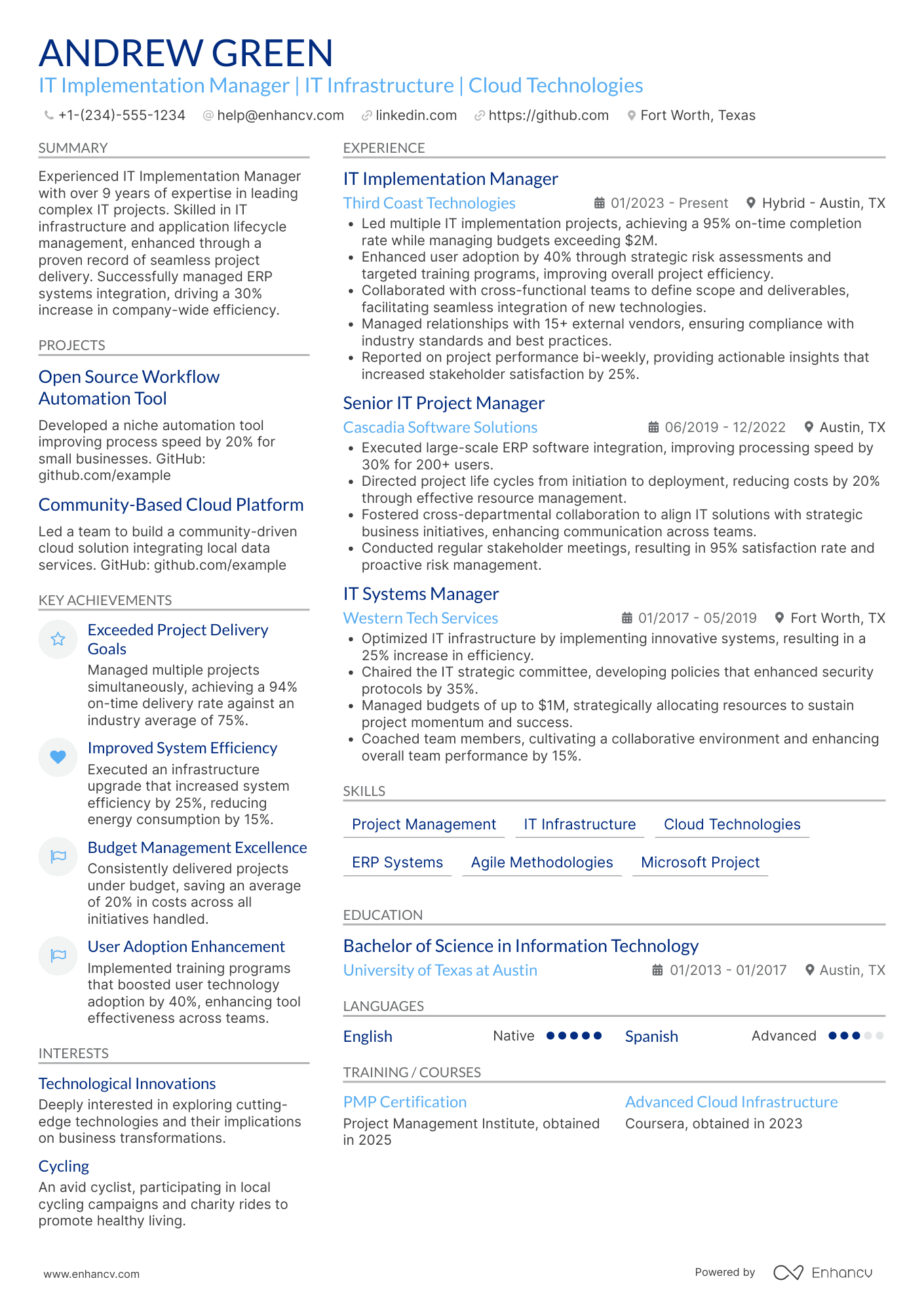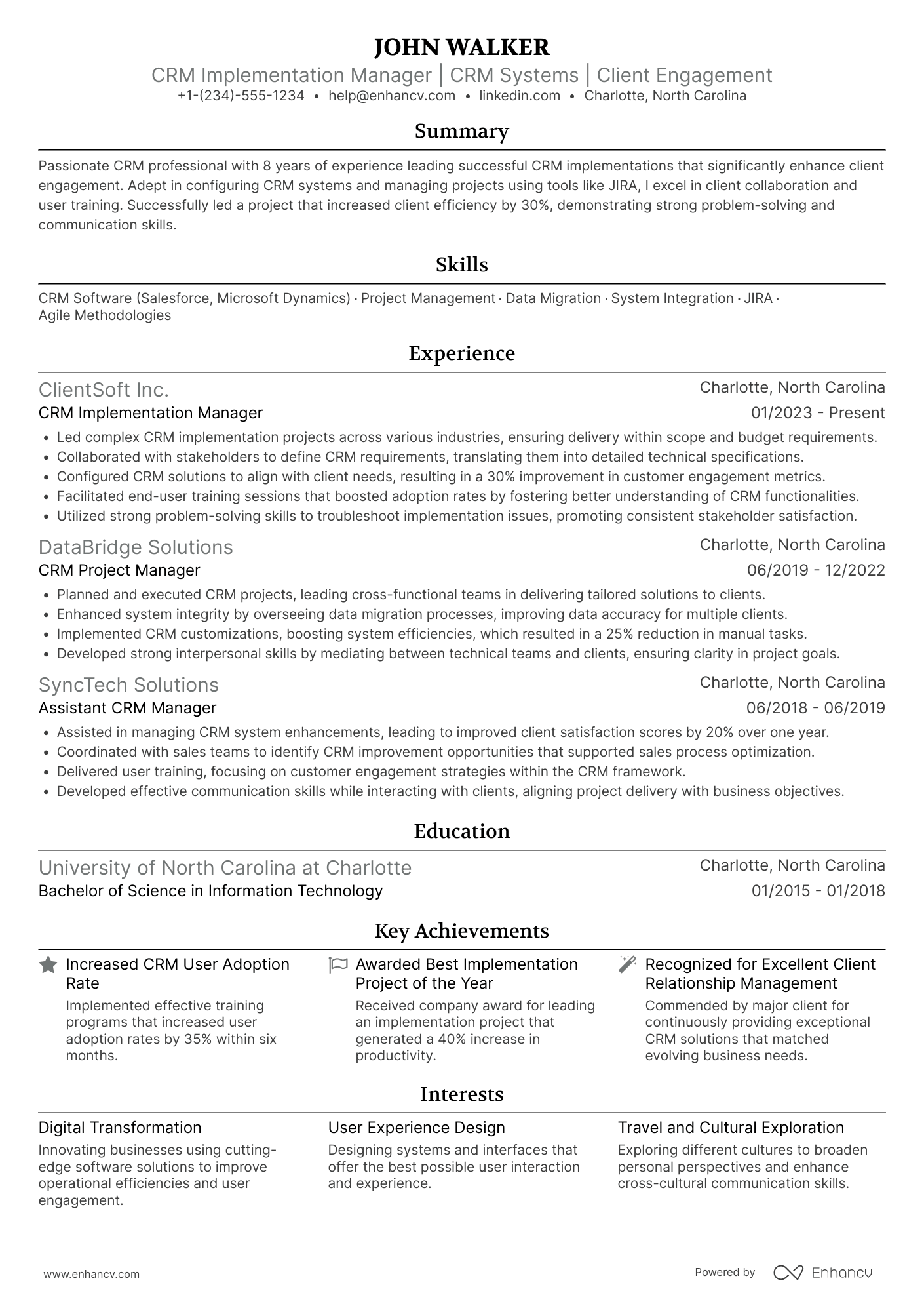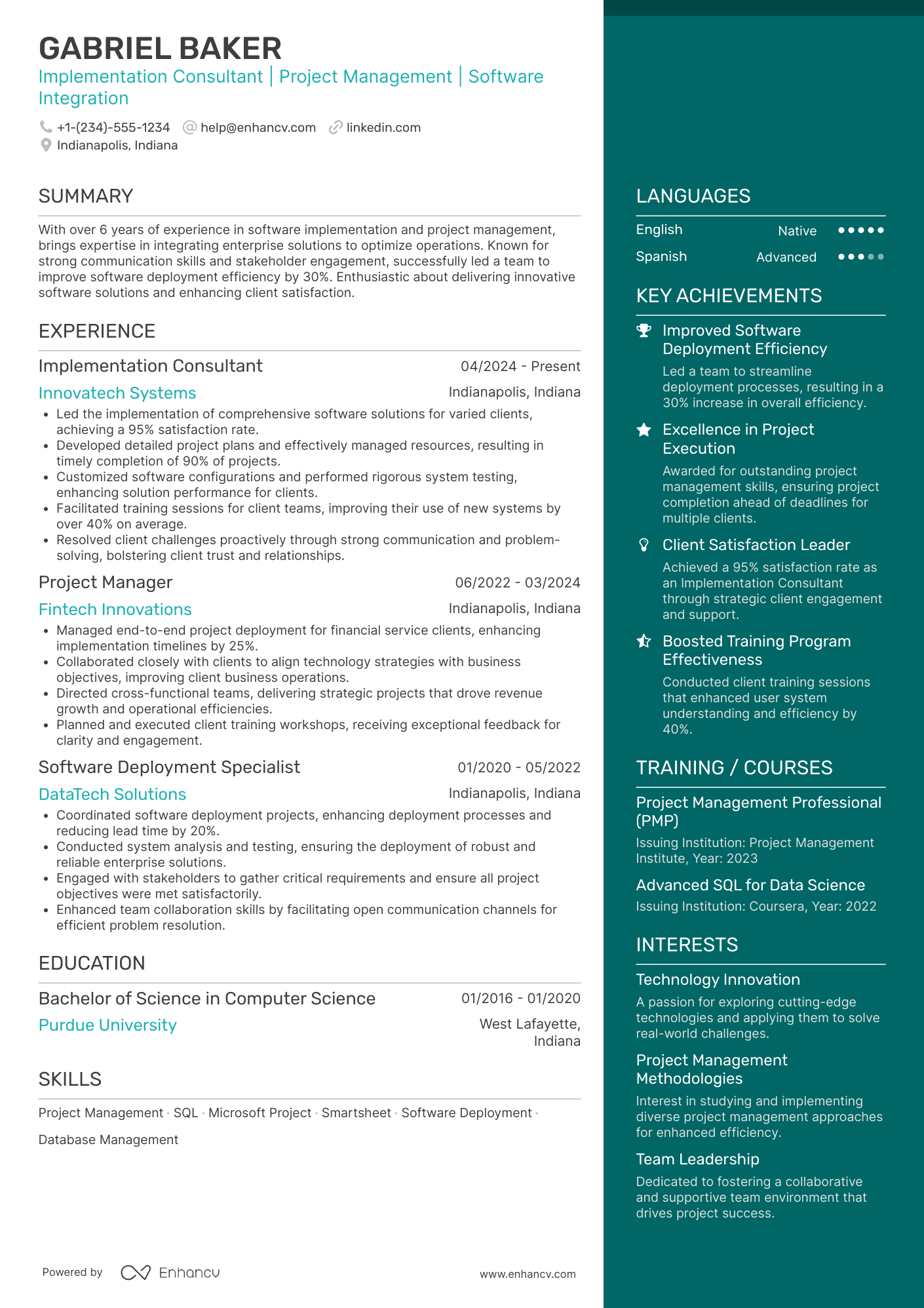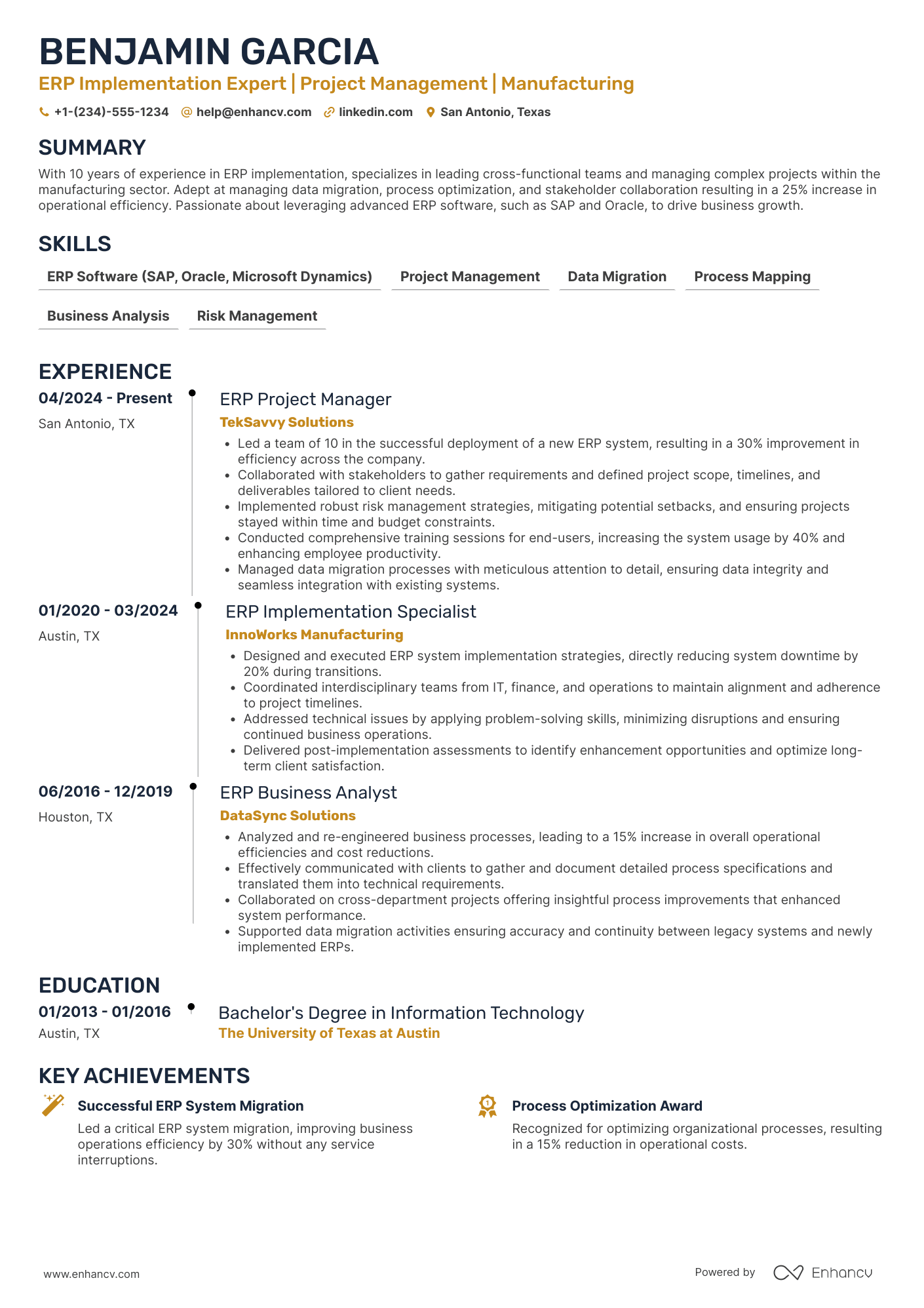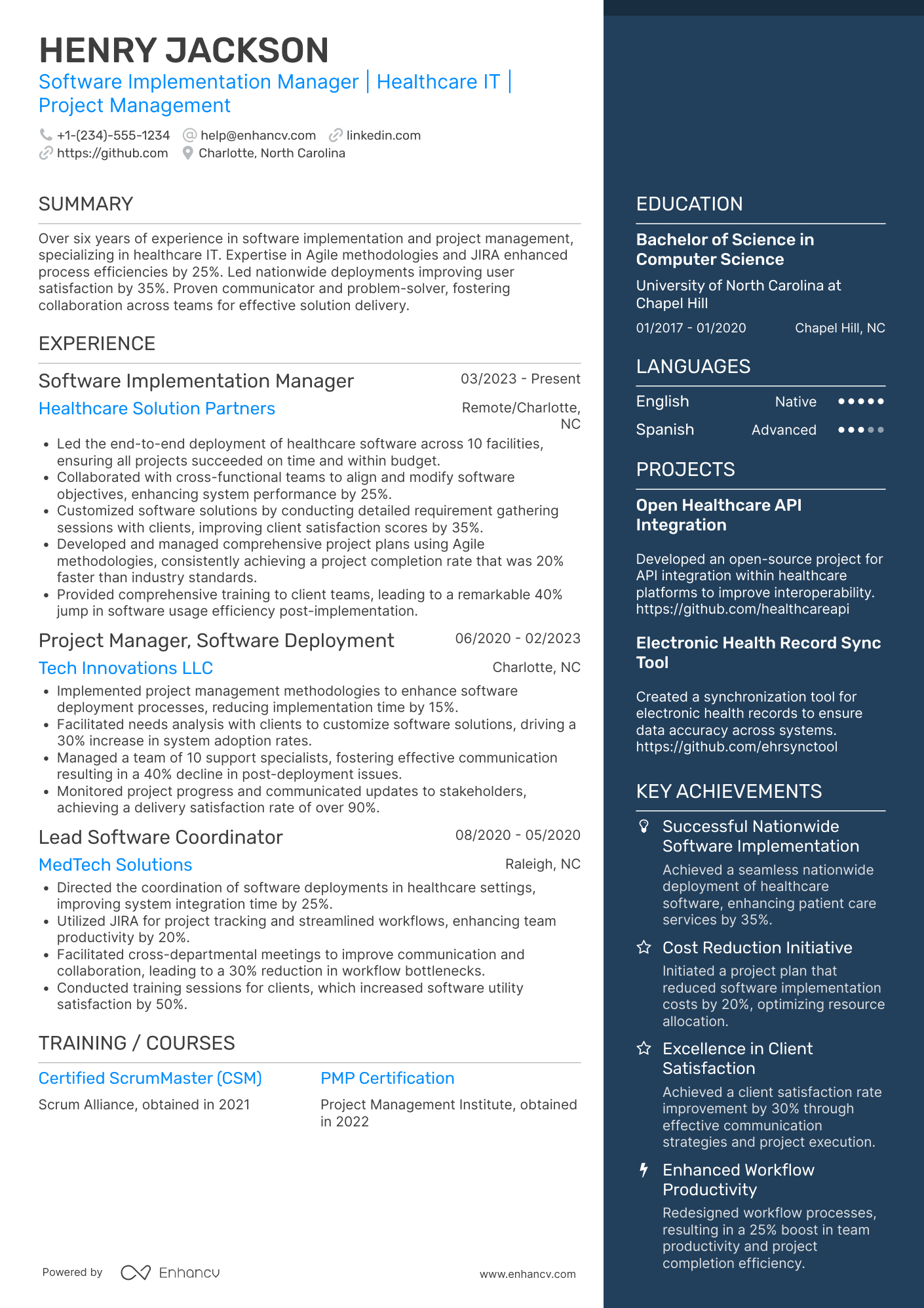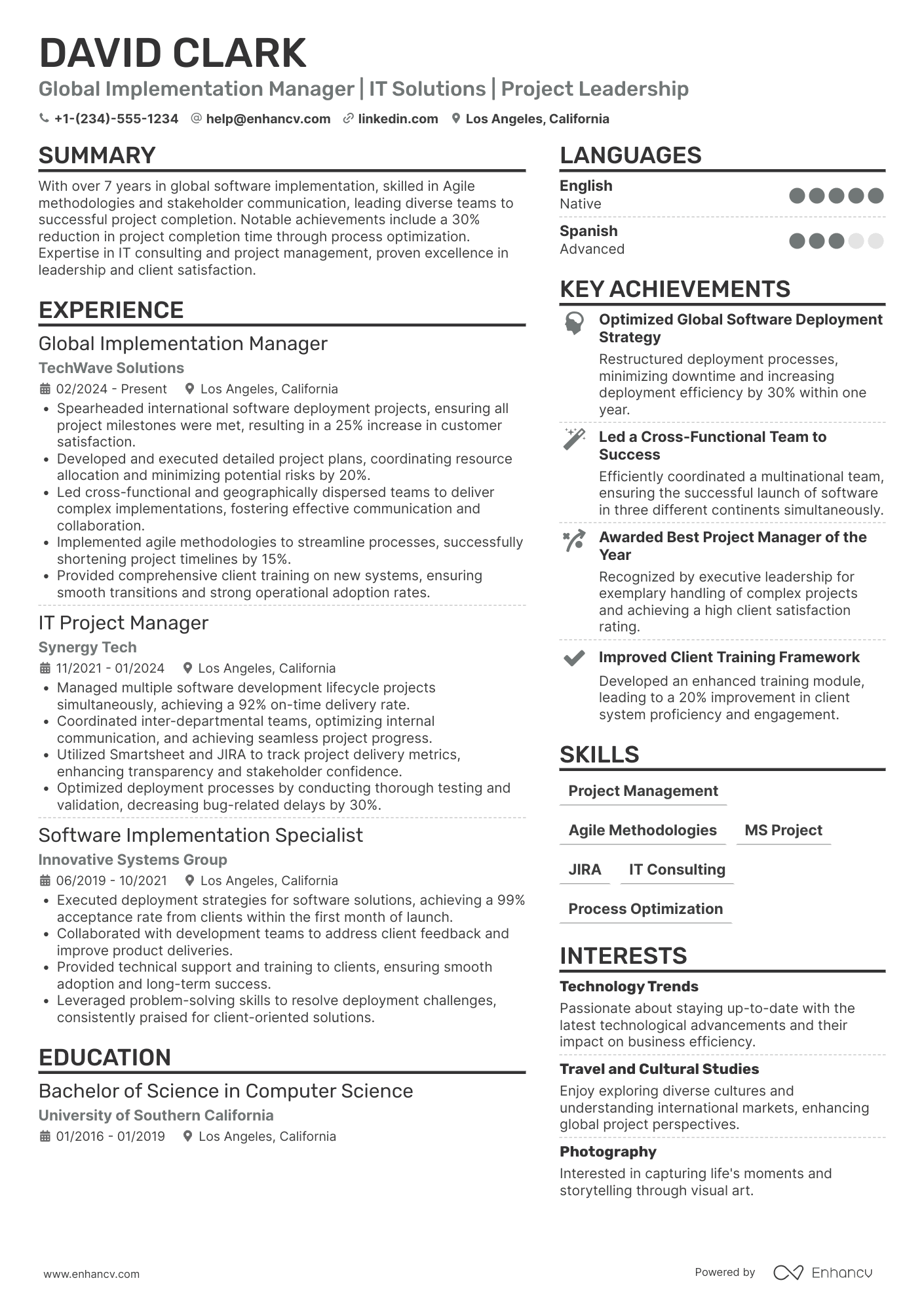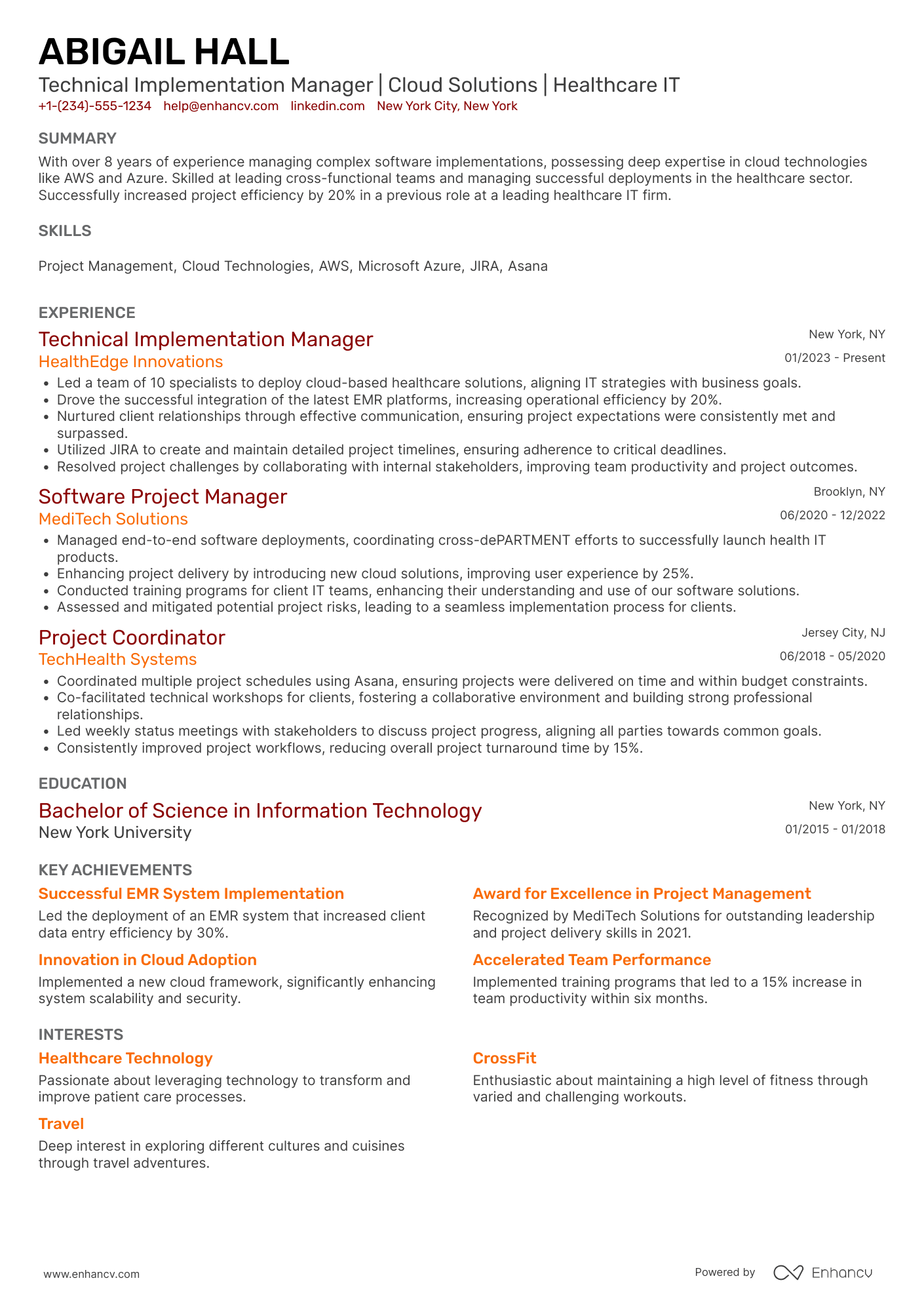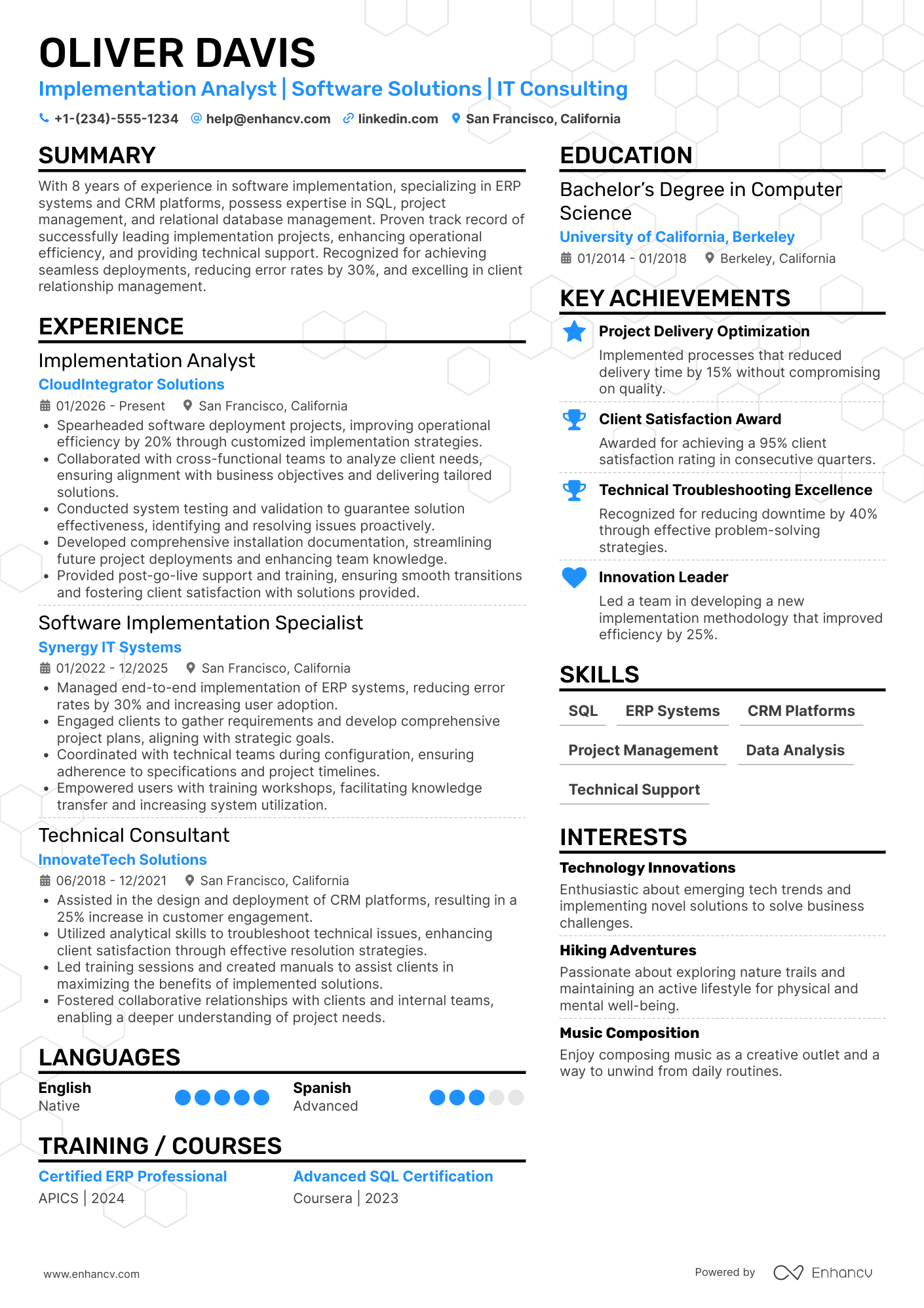
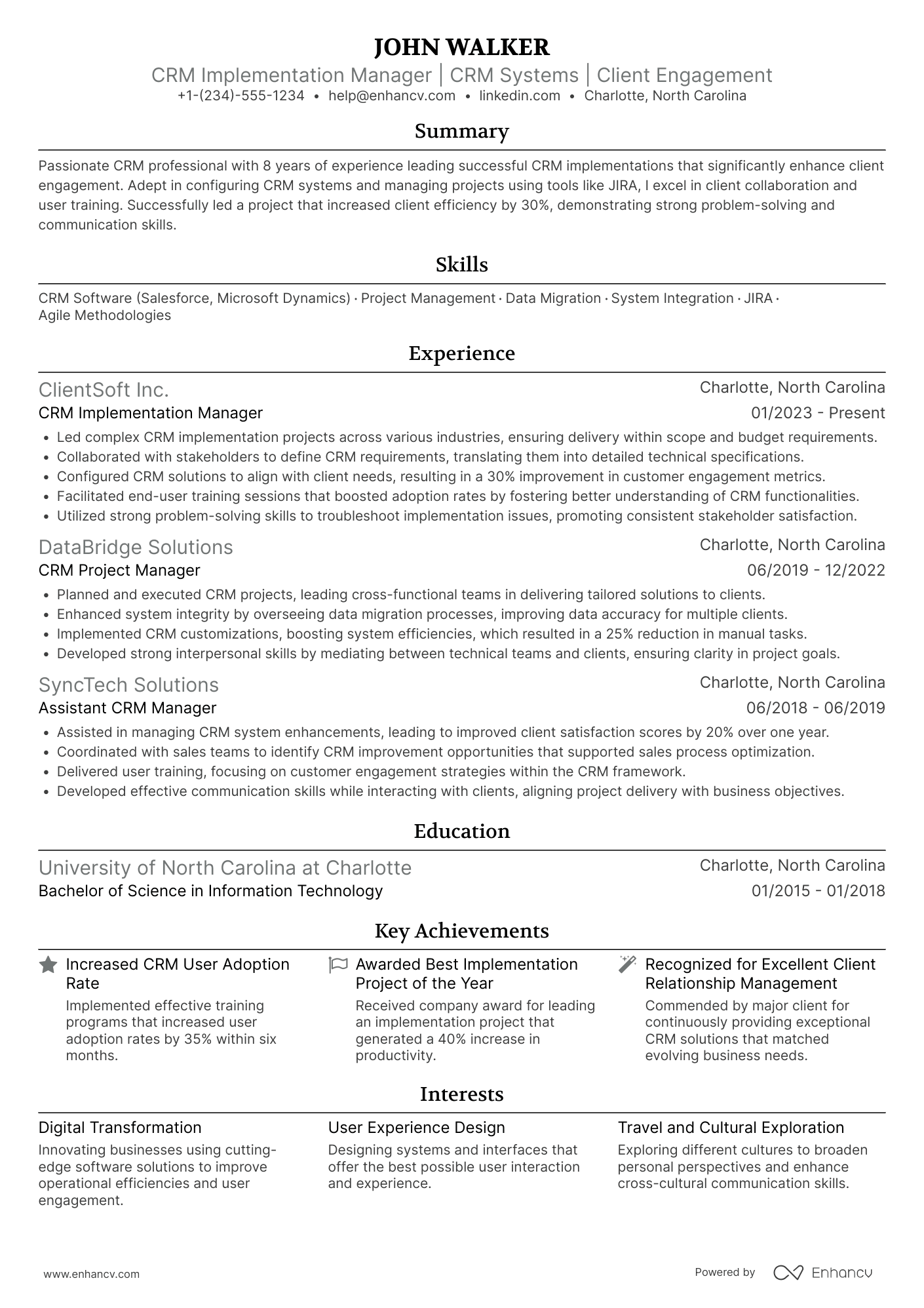
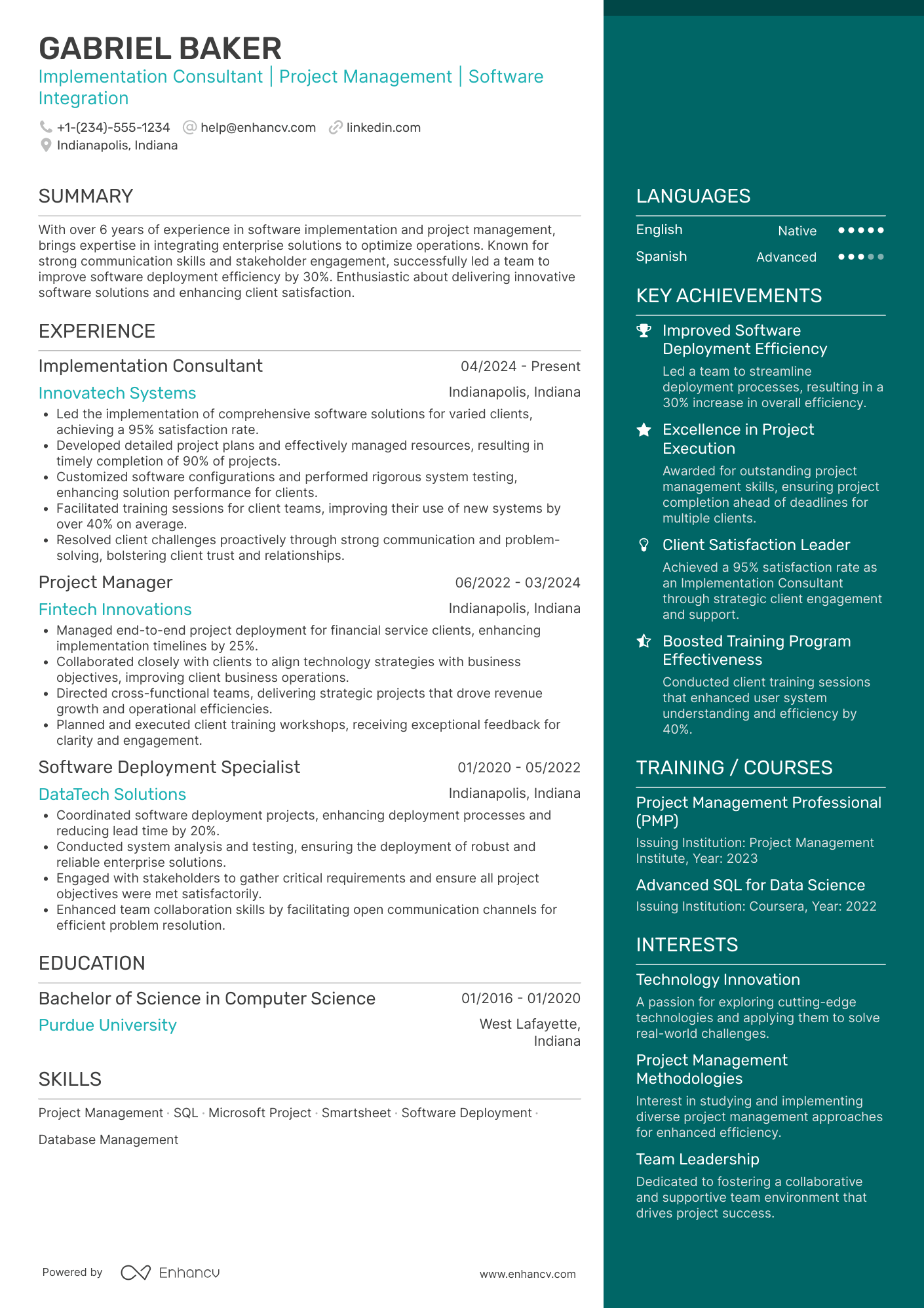
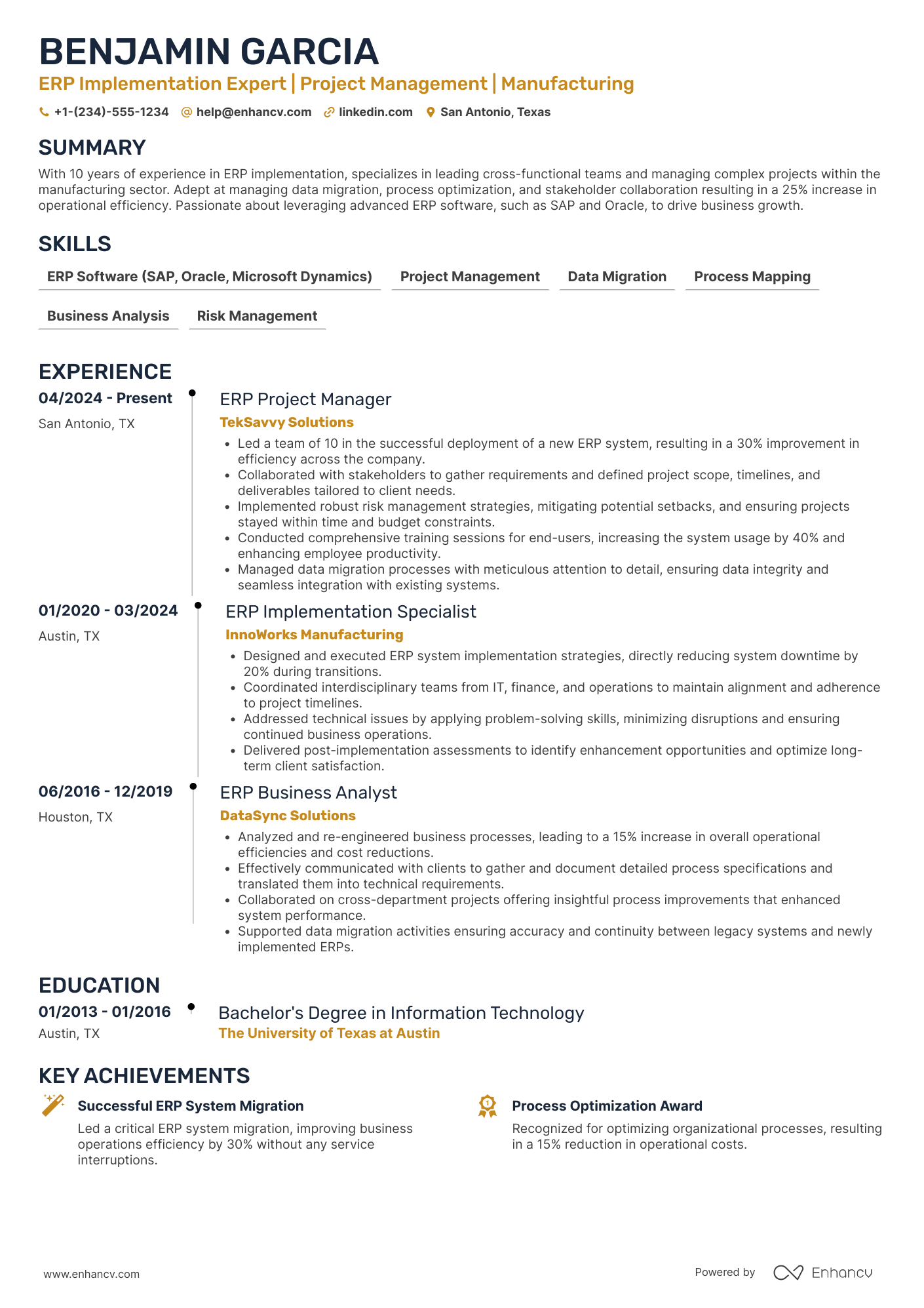
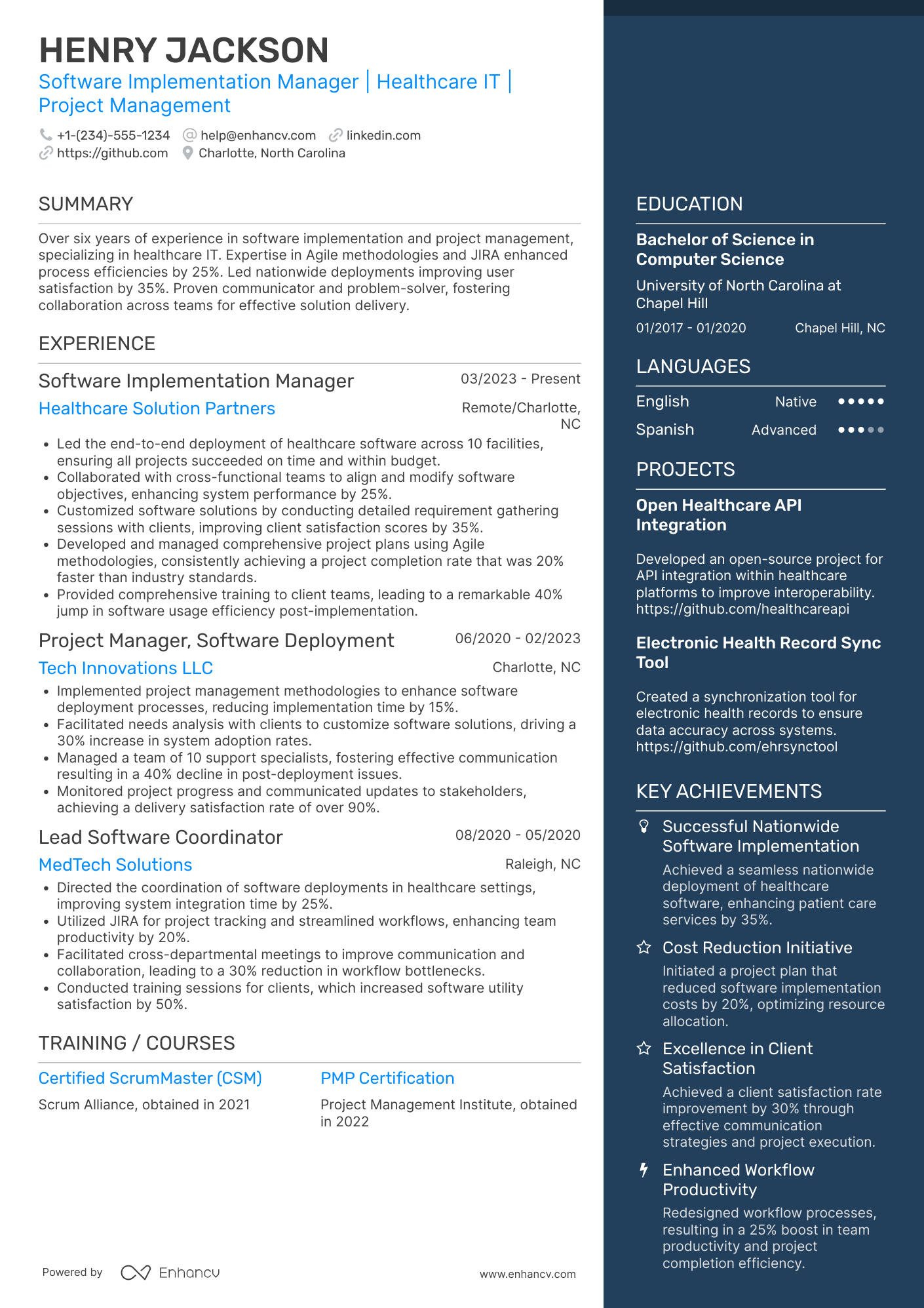
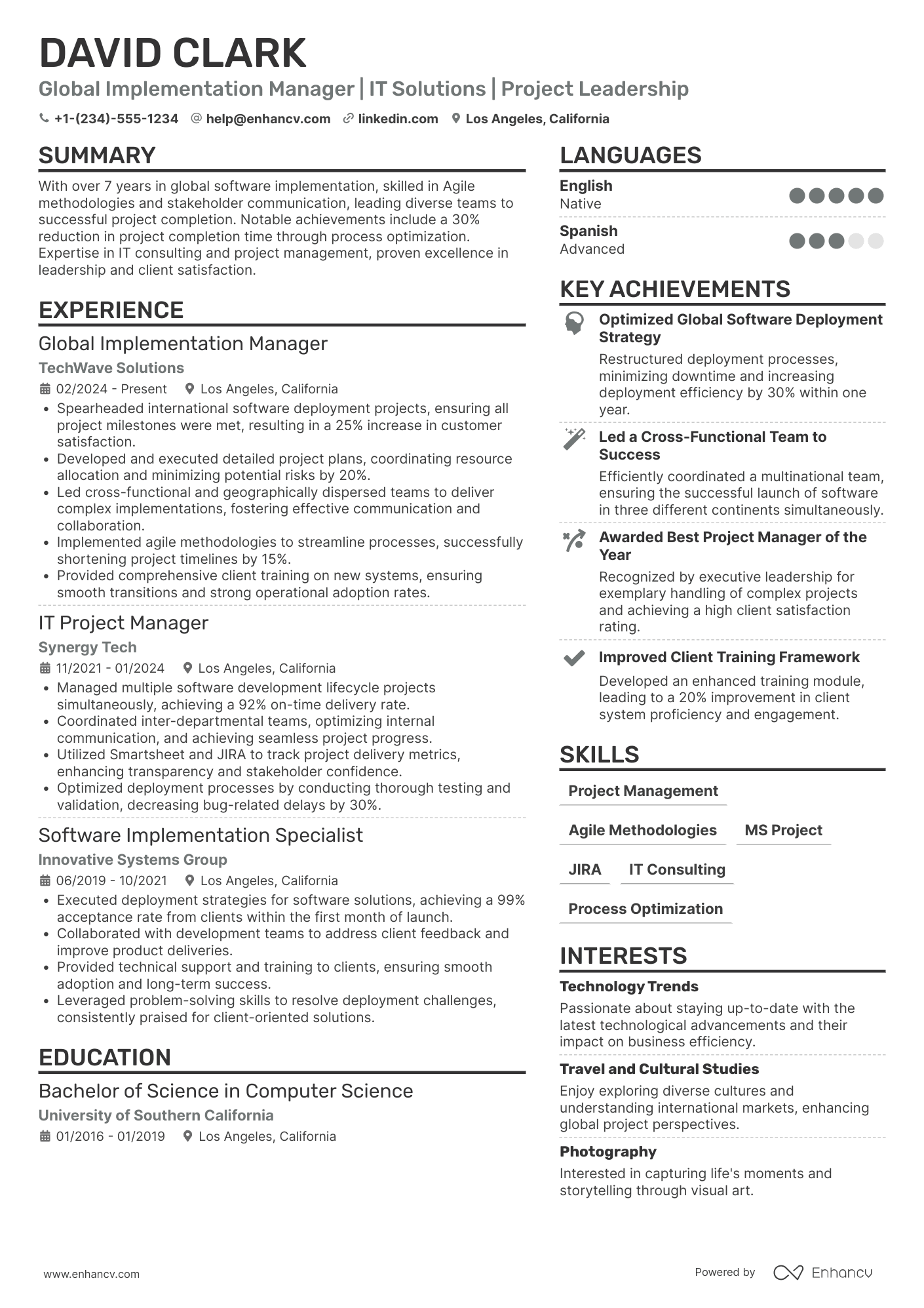
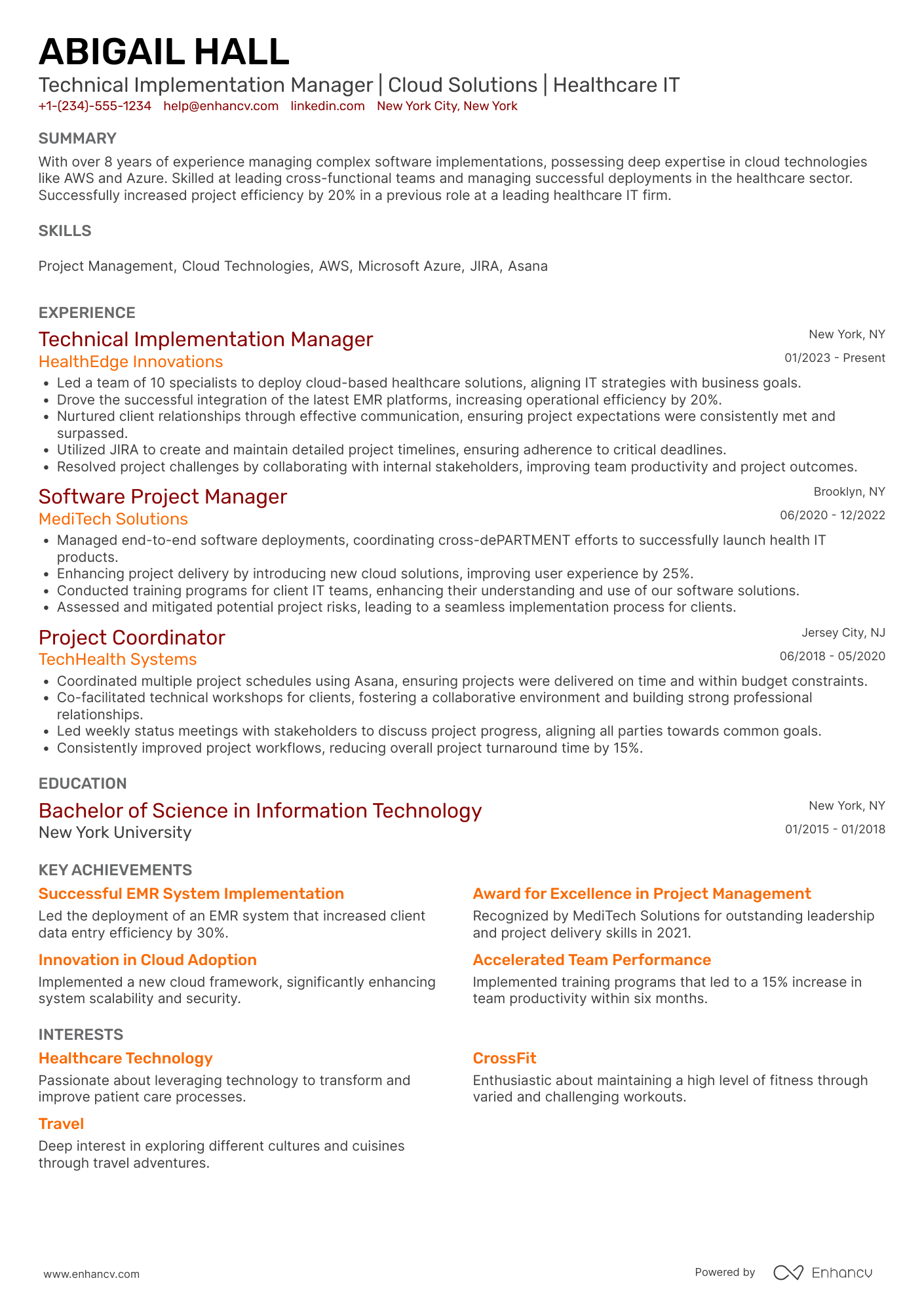
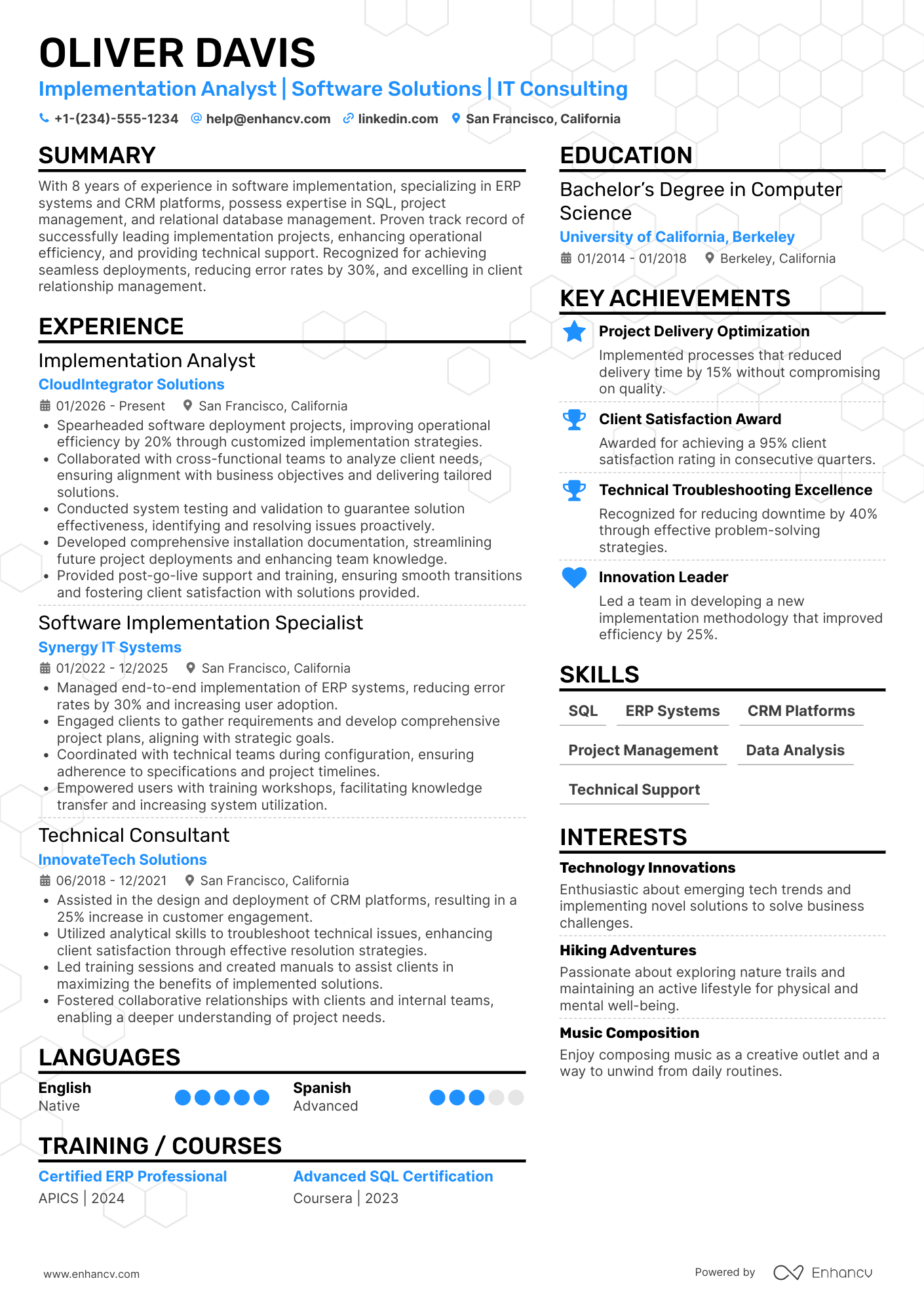
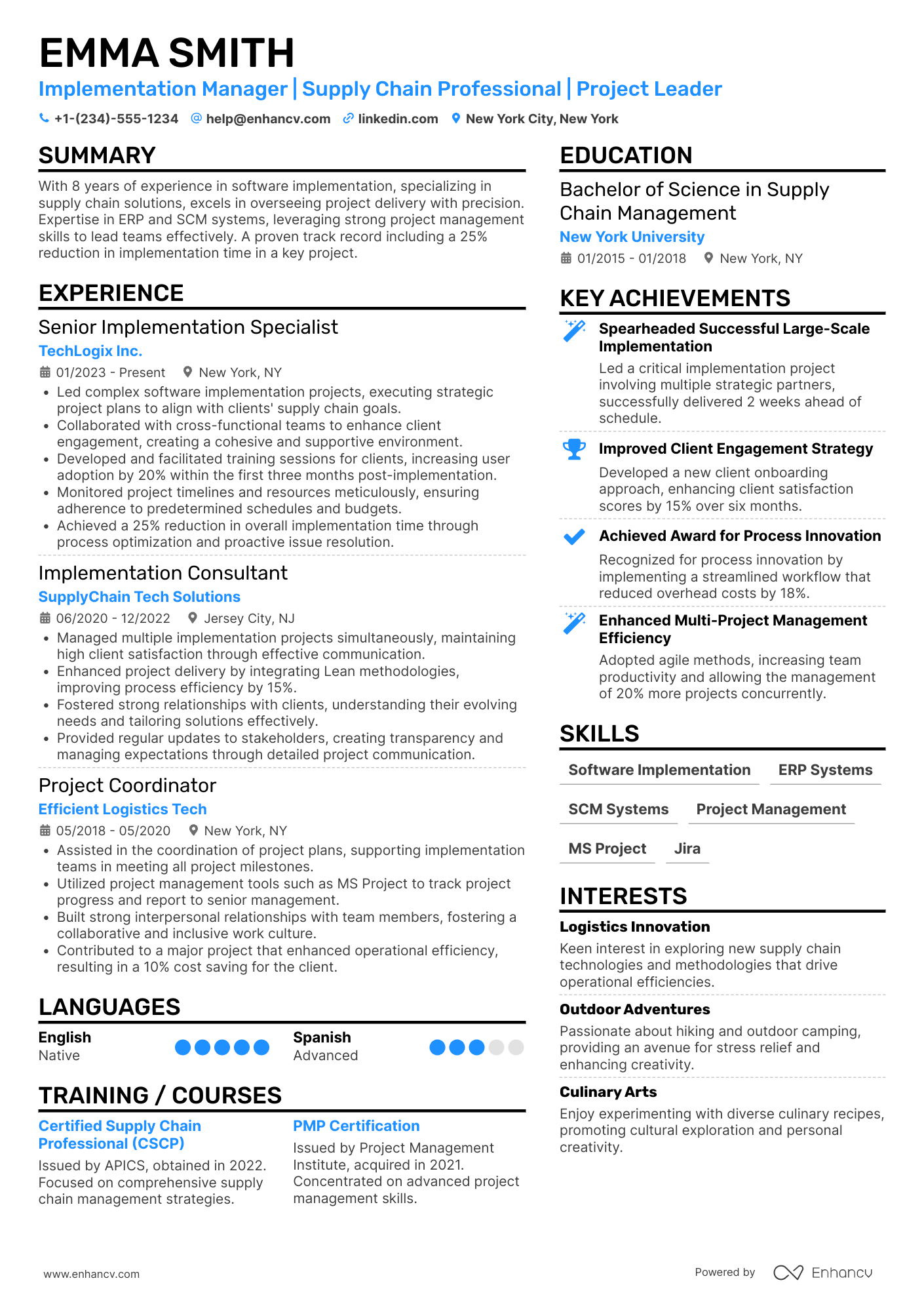
Many implementation manager resume drafts fail because they describe tasks instead of delivery outcomes, so your impact disappears in ATS screening and fast recruiter scans. In a crowded market, that gap costs interviews even when your projects succeeded.
A strong resume shows what changed because you led the rollout. Knowing how to make your resume stand out means highlighting time-to-go-live improvements, adoption rates, reduced churn, fewer defects, on-time delivery across regions, stakeholder satisfaction, and revenue protected or unlocked. Quantify scope, risk mitigation, and post-launch stability.

Key takeaways
- Quantify every implementation outcome—go-live speed, adoption rates, defect reduction, and retained revenue.
- Use reverse-chronological format for experienced candidates and hybrid format for career switchers.
- Tailor each experience bullet to mirror the job posting's tools, methodologies, and success metrics.
- Embed skills in your summary and experience sections, not just in a standalone list.
- Place certifications like PMP or CSM near education to reinforce methodology expertise fast.
- Showcase project ownership from kickoff through go-live, not task descriptions without results.
- Use Enhancv to build structured, ATS-ready bullets that highlight measurable implementation impact.
Job market snapshot for implementation managers
We analyzed 203 recent implementation manager job ads across major US job boards. These numbers help you understand employment type trends, top companies hiring, experience requirements at a glance.
What level of experience employers are looking for implementation managers
| Years of Experience | Percentage found in job ads |
|---|---|
| 1–2 years | 26.1% (53) |
| 3–4 years | 16.7% (34) |
| 5–6 years | 9.9% (20) |
| 7–8 years | 6.4% (13) |
| 9–10 years | 2.0% (4) |
| 10+ years | 5.4% (11) |
| Not specified | 35.5% (72) |
Implementation manager ads by area of specialization (industry)
| Industry (Area) | Percentage found in job ads |
|---|---|
| Finance & Banking | 54.2% (110) |
| Healthcare | 33.5% (68) |
Top companies hiring implementation managers
| Company | Percentage found in job ads |
|---|---|
| CVS Health | 17.2% (35) |
Role overview stats
These tables show the most common responsibilities and employment types for implementation manager roles. Use them to align your resume with what employers expect and to understand how the role is structured across the market.
Day-to-day activities and top responsibilities for a implementation manager
| Responsibility | Percentage found in job ads |
|---|---|
| Project management | 43.8% (89) |
| Salesforce | 23.6% (48) |
| Saas | 12.3% (25) |
| Jira | 8.4% (17) |
| Microsoft office | 7.4% (15) |
| Agile | 6.4% (13) |
| Data analysis | 5.4% (11) |
| Excel | 5.4% (11) |
| Change management | 4.9% (10) |
| Reporting | 4.9% (10) |
| Supply chain | 4.9% (10) |
| Microsoft excel | 4.4% (9) |
Type of employment (remote vs on-site vs hybrid)
| Employment type | Percentage found in job ads |
|---|---|
| On-site | 52.2% (106) |
| Hybrid | 25.6% (52) |
| Remote | 22.2% (45) |
How to format a implementation manager resume
Recruiters evaluating implementation manager resumes look for clear evidence of project delivery, cross-functional coordination, client-facing ownership, and the ability to drive adoption across complex systems or platforms. A clean, well-structured resume format ensures these signals surface quickly during both human review and applicant tracking system (ATS) parsing.

I have significant experience in this role—which format should I use?
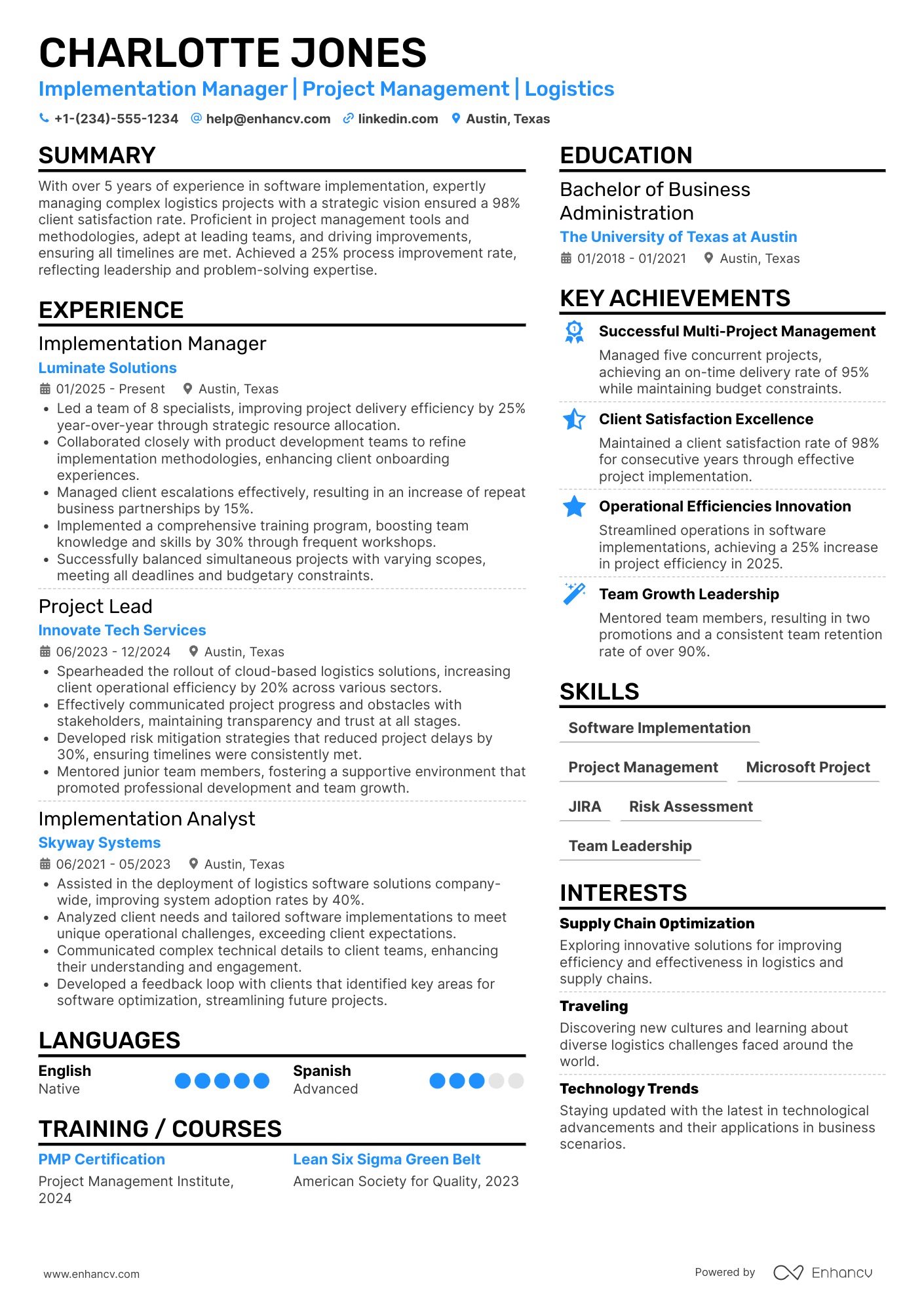
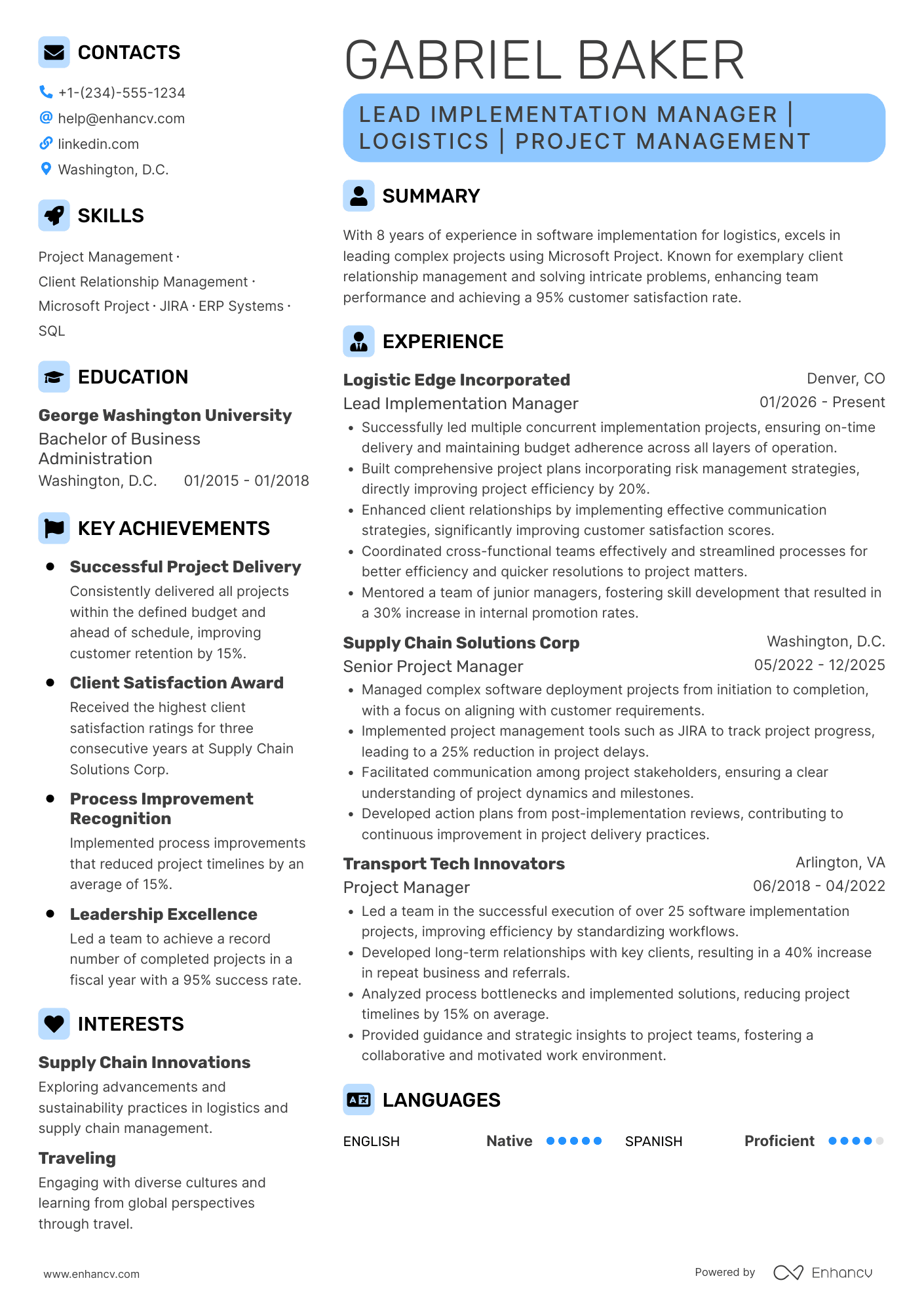
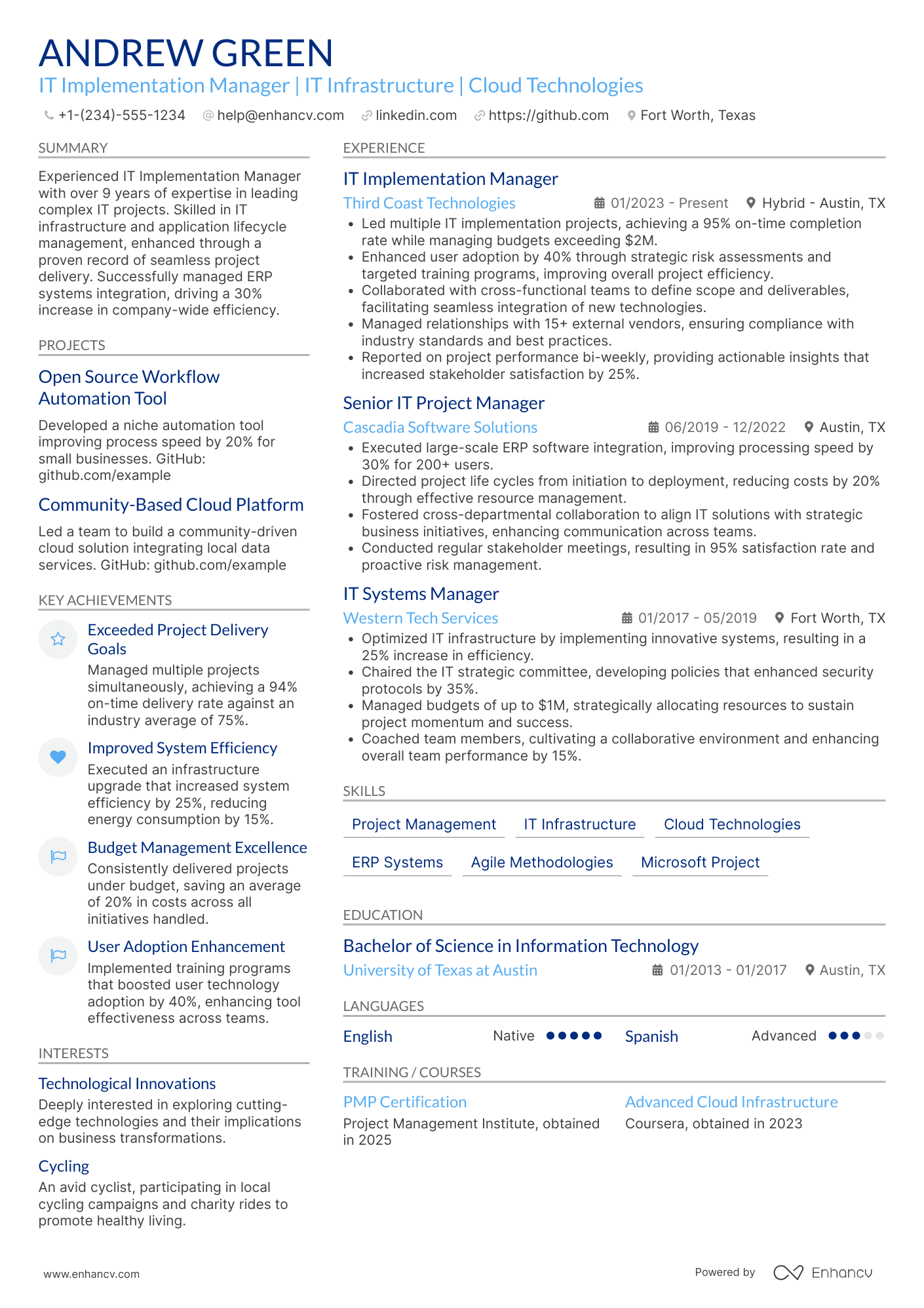
Use a reverse-chronological format to put your deepest and most recent implementation work front and center. Do:
- Lead each role entry with the scope of your implementations—number of accounts, team size, project budgets, and stakeholder tiers you managed directly.
- Highlight platform-specific expertise (Salesforce, Workday, SAP, or industry-vertical tools) alongside methodologies like Agile, waterfall, or hybrid delivery frameworks.
- Quantify business impact for every major engagement, including time-to-value, adoption rates, revenue influenced, and client retention tied to your implementations.
I'm junior or switching into this role—what format works best?
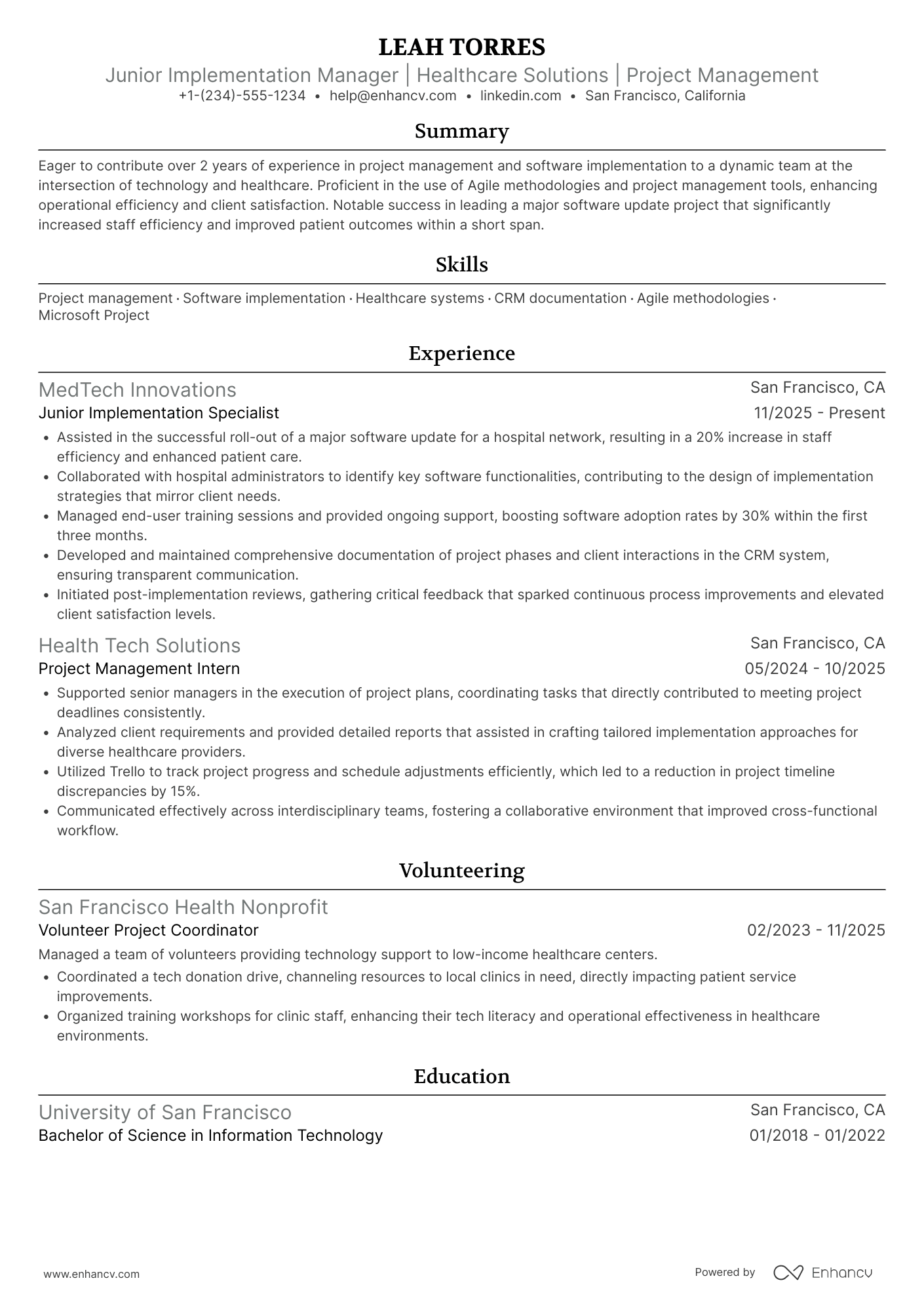
A hybrid format works best, letting you feature transferable skills prominently while still showing a concise work history. Do:
- Place a skills section near the top that highlights project coordination, technical troubleshooting, client communication, and any implementation-adjacent tools you've used.
- Include project-based entries—such as system migrations, software rollouts, or onboarding initiatives—even if they came from adjacent roles like customer success, IT support, or consulting.
- Connect every action to a measurable result so hiring managers can see your implementation-readiness, not just your intent.
Why not use a functional resume?
A functional format strips away the timeline and context hiring managers need to evaluate how you've managed implementations from kickoff through go-live, making it harder to assess your project ownership and delivery track record.
- A functional resume may be acceptable if you're pivoting from a role like technical support or customer success into implementation management and have limited direct implementation titles—but only if you tie every listed skill to a specific project, client outcome, or deployment result.
Now that you've established a clean, readable layout, it's time to fill it with the right sections that highlight your qualifications as an implementation manager.
What sections should go on a implementation manager resume
Recruiters expect a clean, role-specific resume that shows how you lead implementations from kickoff through adoption and measurable results. Understanding what to put on a resume helps you prioritize the right content for this role.
Use this structure for maximum clarity:
- Header
- Summary
- Experience
- Skills
- Projects
- Education
- Certifications
- Optional sections: Awards, Leadership, Languages
Your experience bullets should emphasize implementation outcomes, customer impact, delivery scope, cross-functional leadership, and on-time, on-budget results.
Is your resume good enough?
Drop your resume here or choose a file. PDF & DOCX only. Max 2MB file size.
Now that you’ve organized the key resume components to include, focus next on writing your implementation manager experience section to show how you delivered results in those roles.
How to write your implementation manager resume experience
The experience section is where you prove you can take a project from kickoff to go-live—and that you've done it before. Hiring managers prioritize demonstrated impact over descriptive task lists, so center every bullet on shipped implementations, the tools and methodologies you used to deliver them, and the measurable outcomes that followed.
Each entry should include:
- Job title
- Company and location (or remote)
- Dates of employment (month and year)
Three to five concise bullet points showing what you owned, how you executed, and what outcomes you delivered:
- Ownership scope: the specific products, platforms, or client accounts you were responsible for implementing, including the size and complexity of each engagement.
- Execution approach: the project management frameworks, implementation methodologies, configuration tools, or change management practices you relied on to keep deployments on track.
- Value improved: the gains you drove in go-live speed, adoption rates, client satisfaction, system reliability, or risk reduction as a direct result of your implementation work.
- Collaboration context: how you coordinated with engineering, sales, customer success, product, and external client stakeholders to align requirements, resolve blockers, and ensure smooth handoffs.
- Impact delivered: the business outcomes your implementations produced—expressed through client retention, revenue influence, time-to-value compression, or portfolio scale rather than a list of activities performed.
Experience bullet formula
A implementation manager experience example
✅ Right example - modern, quantified, specific.
Implementation Manager
VantaFlow | Remote
2022–Present
B2B software-as-a-service platform helping mid-market finance teams automate billing, revenue recognition, and reporting across one hundred plus integrations.
- Led forty-two enterprise implementations end-to-end using Jira, Smartsheet, and Salesforce, cutting average time-to-live from twelve weeks to eight weeks and improving on-time go-live rate from 78% to 94%.
- Built a repeatable onboarding playbook in Confluence and a template-driven project plan, reducing client meeting time by 25% and increasing first-month feature adoption by 18% across new accounts.
- Partnered with product managers and engineers to scope API and single sign-on requirements, validating data mappings with Postman and SQL and reducing integration defects by 32% at launch.
- Implemented a risk and change-control process with weekly stakeholder readouts and a RACI (responsible, accountable, consulted, informed) matrix, decreasing scope creep by 20% and preventing an estimated $180,000 in rework.
- Trained client administrators and internal customer success teams through live enablement sessions and Loom walkthroughs, improving customer satisfaction score from 4.3 to 4.7 and reducing post-launch support tickets by 28%.
Now that you've seen how a strong experience section comes together, let's look at how to customize yours to match a specific job posting.
How to tailor your implementation manager resume experience
Recruiters evaluate your resume through applicant tracking systems and manual review, both scanning for alignment with the specific role. Tailoring your resume to the job description by mirroring the posting's language and priorities increases your chances of passing both filters.
Ways to tailor your implementation manager experience:
- Match implementation tools and platforms listed in the job description.
- Mirror the deployment methodologies or frameworks the posting references.
- Use the exact terminology for project phases and deliverables mentioned.
- Highlight client onboarding or stakeholder management if the role requires it.
- Emphasize cross-functional coordination models described in the listing.
- Include relevant industry or domain experience when the posting specifies it.
- Reflect the KPIs or success criteria the employer uses to measure outcomes.
- Reference compliance or quality standards the job description prioritizes.
Every tailored bullet should connect a real achievement to a stated job requirement, not force keywords into sentences where they don't belong.
Resume tailoring examples for implementation manager
| Job description excerpt | Untailored | Tailored |
|---|---|---|
| Lead end-to-end SaaS platform implementations for enterprise clients using Salesforce, managing cross-functional teams through discovery, configuration, UAT, and go-live phases. | Managed software implementation projects for various clients. | Led end-to-end Salesforce implementations for 12 enterprise clients, coordinating cross-functional teams of 15 through discovery, configuration, UAT, and go-live—delivering 90% of projects on or ahead of schedule. |
| Develop and maintain project plans, status reports, and risk logs using Smartsheet, ensuring stakeholder alignment and on-time delivery across concurrent implementations. | Kept track of project timelines and provided updates to stakeholders. | Built and maintained project plans, risk logs, and weekly status reports in Smartsheet across eight concurrent implementations, reducing timeline slippage by 25% through proactive risk escalation and stakeholder alignment. |
| Drive client adoption by designing training programs, creating user documentation, and tracking post-launch KPIs to ensure measurable ROI within 90 days of go-live. | Helped clients use the new system after it was set up. | Designed role-based training programs and user documentation for each client deployment, tracking post-launch KPIs that demonstrated measurable ROI within 90 days of go-live for 95% of accounts. |
Once you’ve aligned your experience with the role’s priorities, quantify your implementation manager achievements to show the measurable impact behind that fit.
How to quantify your implementation manager achievements
Quantifying your work proves you drive outcomes, not just tasks. Focus on delivery speed, adoption, quality, reliability, and risk reduction across launches, migrations, and integrations.
Quantifying examples for implementation manager
| Metric | Example |
|---|---|
| Delivery speed | "Cut average go-live time from 10 weeks to seven by standardizing Jira workflows and rollout checklists across eight enterprise implementations." |
| Adoption | "Increased active user adoption from 62% to 84% within 60 days by running role-based enablement in LMS and in-app walkthroughs in Pendo." |
| Quality | "Reduced post-launch defect rate by 35% by adding UAT entry criteria, test case templates, and weekly triage with QA and product teams." |
| Reliability | "Improved integration success rate from 92% to 99.3% by implementing API monitoring in Datadog and tightening retry and timeout policies." |
| Risk reduction | "Lowered security and compliance findings from 12 to three per implementation by enforcing SOC 2-aligned controls and pre-launch access reviews." |
Turn your everyday tasks into measurable, recruiter-ready resume bullets in seconds with Enhancv's Bullet Point Generator.
Once you've crafted strong bullet points that showcase your achievements, the next step is ensuring your resume also highlights the right mix of hard and soft skills employers expect from an implementation manager.
How to list your hard and soft skills on a implementation manager resume
Your skills section shows you can drive onboarding, integrations, and adoption; recruiters and an ATS (applicant tracking system) scan them to match your fit fast, so aim for a balanced mix of hard skills and role-specific soft skills. implementation manager roles require a blend of:
- Product strategy and discovery skills.
- Data, analytics, and experimentation skills.
- Delivery, execution, and go-to-market discipline.
- Soft skills.
Your skills section should be:
- Scannable (bullet-style grouping).
- Relevant to the job post.
- Backed by proof in experience bullets.
- Updated with current tools.
Place your skills section:
- Above experience if you're junior or switching careers.
- Below experience if you're mid/senior with strong achievements.

Hard skills
- Implementation planning, runbooks
- Requirements gathering, user stories
- Stakeholder mapping, RACI
- Project plans, critical path
- Agile, Scrum, Kanban
- Jira, Confluence, Asana
- Salesforce, HubSpot, Gainsight
- API integrations, webhooks
- SQL, data validation
- SSO, SAML, OAuth
- UAT, defect triage
- KPI tracking, adoption metrics
Soft skills
- Lead kickoff and alignment
- Translate needs into scope
- Set expectations and boundaries
- Drive decisions with tradeoffs
- Manage risks and escalations
- Coordinate cross-functional handoffs
- Run executive-ready status updates
- Negotiate timelines and resources
- De-escalate customer friction
- Hold owners accountable
- Document decisions and changes
- Close projects with retrospectives
How to show your implementation manager skills in context
Skills shouldn't live only in a dedicated skills list. You can explore common resume skills by role to see how top candidates present theirs.
They should be demonstrated in:
- Your summary (high-level professional identity)
- Your experience (proof through outcomes)
Here's what strong, skill-rich content looks like in practice.
Summary example
Implementation manager with 10+ years leading enterprise SaaS deployments across healthcare and fintech. Skilled in Jira, Smartsheet, and cross-functional stakeholder alignment. Reduced average go-live timelines by 30% through standardized onboarding frameworks and proactive risk mitigation.
- Reflects senior-level experience clearly
- Names industry-relevant tools directly
- Includes a specific measurable outcome
- Highlights communication and leadership ability
Experience example
Senior Implementation Manager
Vantage Health Solutions | Remote
March 2019–January 2024
- Led 45+ enterprise EHR implementations using Smartsheet and Confluence, achieving a 97% on-time delivery rate across all client accounts.
- Partnered with product, engineering, and customer success teams to redesign the onboarding workflow, cutting client time-to-value by 25%.
- Built a scalable risk-tracking framework in Jira that reduced post-launch escalations by 40% within the first year of adoption.
- Every bullet includes measurable proof.
- Skills appear through real achievements naturally.
Once you’ve tied your implementation manager strengths to real outcomes and situations, the next step is to apply that same approach to writing an implementation manager resume with no experience.
How do I write a implementation manager resume with no experience
Even without full-time experience, you can demonstrate readiness through:
- Internship implementation support work
- Capstone software rollout project
- Volunteer nonprofit system migration
- Certification-based sandbox implementations
- University IT deployment project
- Freelance onboarding and training deliverables
- Customer support escalation ownership
- Process documentation and playbooks
If you're building a resume without work experience, focus on:
- End-to-end rollout steps and artifacts
- Requirements, scope, and change control
- Risk, issue, and dependency tracking
- Metrics: adoption, time, defects
Resume format tip for entry-level implementation manager
Use a hybrid resume format because it highlights implementation manager projects and tools while still showing steady education and work history. Do:
- Lead with a projects section.
- Include tools like Jira and Salesforce.
- Show scope, timeline, and deliverables.
- Quantify adoption, time saved, or defects.
- Match keywords from the job post.
- Led a volunteer nonprofit system migration using Jira and Salesforce, built a rollout plan and training, and reached ninety percent user adoption within four weeks.
Even without direct experience, your education section can demonstrate the foundational knowledge and relevant skills that make you a strong implementation manager candidate.
How to list your education on a implementation manager resume
Your education section helps hiring teams confirm you have the foundational knowledge needed for the role. It validates relevant training in business, technology, or project management.
Include:
- Degree name
- Institution
- Location
- Graduation year
- Relevant coursework (for juniors or entry-level candidates)
- Honors & GPA (if 3.5 or higher)
Avoid listing specific months or days for graduation. Use the year only to keep formatting clean.
Here's a strong education entry tailored to an implementation manager resume.
Example education entry
Bachelor of Science in Business Information Systems
University of Illinois at Chicago, Chicago, IL
Graduated 2019
GPA: 3.7/4.0
- Relevant Coursework: Systems Analysis, Project Management, Enterprise Software Integration, Business Process Optimization
- Honors: Magna Cum Laude, Dean's List (six semesters)
How to list your certifications on a implementation manager resume
Certifications show an implementation manager's commitment to learning, proficiency with core tools, and alignment with current industry standards. They also help hiring teams assess your readiness for complex rollouts and stakeholder management.
Include:
- Certificate name
- Issuing organization
- Year
- Optional: credential ID or URL
- Place certifications below education when your degree is recent or stronger than your credentials for the implementation manager role.
- Place certifications above education when they are recent, role-relevant, or required for the implementation manager job you want.
Best certifications for your implementation manager resume
Project Management Professional (PMP) Certified ScrumMaster (CSM) PRINCE2 Practitioner ITIL 4 Foundation Salesforce Certified Administrator Prosci Change Management Certification Microsoft Certified: Dynamics 365 Fundamentals (CRM)
Once you’ve positioned your credentials where recruiters will notice them, shift to writing your implementation manager resume summary to connect those qualifications to the value you deliver at a glance.
How to write your implementation manager resume summary
Your resume summary is the first thing a recruiter reads. A strong one instantly signals you're qualified for the implementation manager role.
Keep it to three to four lines, with:
- Your title and total years of implementation or project management experience.
- The domain you work in, such as SaaS, healthcare, fintech, or enterprise software.
- Core tools and skills like Jira, Salesforce, SQL, or stakeholder management.
- One or two measurable achievements, such as reduced onboarding time or improved client retention.
- Soft skills tied to real outcomes, like cross-functional communication that shortened delivery cycles.

PRO TIP
At the mid-level implementation manager stage, emphasize hands-on delivery skills and measurable client outcomes. Highlight tools you've used and processes you've improved. Avoid vague phrases like "passionate team player" or "results-driven professional." Show what you did and what changed because of it.
Example summary for a implementation manager
Implementation manager with five years of experience deploying SaaS platforms for enterprise clients. Led 30+ implementations using Jira and Salesforce, reducing average onboarding time by 28%. Skilled in cross-functional coordination and client training.
Optimize your resume summary and objective for ATS
Drop your resume here or choose a file.
PDF & DOCX only. Max 2MB file size.
Now that your summary captures the value you bring, make sure your resume header presents the essential contact and professional details recruiters need to reach you.
What to include in a implementation manager resume header
A resume header is the top section with your identity and contact details, and it drives visibility, credibility, and recruiter screening for a implementation manager.
Essential resume header elements
- Full name
- Tailored job title and headline
- Location
- Phone number
- Professional email
- GitHub link
- Portfolio link
A LinkedIn link helps recruiters verify your experience quickly and supports screening.
Do not include a photo on a implementation manager resume unless the role is explicitly front-facing or appearance-dependent.
Match your header title to the job posting and align your headline with the implementation manager scope, including industry, systems, and delivery focus.
Example
Implementation manager resume header
Jordan Lee
Implementation Manager | SaaS Onboarding, Integrations, and Client Delivery
Austin, TX
(512) 555-78XX
jordan.lee@enhancv.com
github.com/jordanlee
jordanlee.com
linkedin.com/in/jordanlee
Once your contact details and role-specific headline set the context at the top, add targeted additional sections to reinforce your fit with relevant skills and achievements.
Additional sections for implementation manager resumes
When your core sections don't fully capture your qualifications, additional sections help you stand out as a well-rounded implementation manager candidate. For example, listing language skills can be especially valuable if the role involves global implementations or multilingual client teams.
- Languages
- Certifications and professional development
- Industry conferences and speaking engagements
- Technical proficiencies and platform expertise
- Volunteer project management experience
- Professional affiliations and memberships
- Publications or case studies
Once you've finalized every section of your resume, pair it with a tailored cover letter to give hiring managers deeper context behind your implementation expertise.
Do implementation manager resumes need a cover letter
No, most implementation manager resumes don't require a cover letter. But understanding what a cover letter is and when to use one helps when the role is competitive, the hiring manager expects one, or your fit needs context. It can make a difference when your resume can't show alignment quickly.
Use a cover letter to add value in these situations:
- Explain role and team fit by matching your implementation approach to their customer profile, timelines, and cross-functional workflow.
- Highlight one or two relevant projects or outcomes, including scope, stakeholders, and measurable results like adoption, retention, or time-to-value.
- Show you understand the product, users, and business context by naming key use cases, integration needs, and success metrics that matter.
- Address career transitions or non-obvious experience by connecting prior work to implementation manager responsibilities, tools, and customer-facing execution.
Drop your resume here or choose a file.
PDF & DOCX only. Max 2MB file size.
Even if you choose to include a cover letter to add context beyond your resume, the next section shows how AI can help you strengthen your implementation manager resume faster and more consistently.
Using AI to improve your implementation manager resume
AI can sharpen your resume's clarity, structure, and impact. It helps refine phrasing and highlight measurable results. But overuse kills authenticity. If you're curious about which AI is best for writing resumes, start with tools that let you stay in control of your content. Once your content feels clear and role-aligned, step away from AI tools.
Here are 10 practical prompts to strengthen specific sections of your implementation manager resume:
- Sharpen your summary. "Rewrite my resume summary to highlight my experience as an implementation manager, focusing on client onboarding success and cross-functional leadership."
- Quantify experience bullets. "Add specific metrics and measurable outcomes to these implementation manager experience bullets without inventing any data I haven't provided."
- Align skills strategically. "Review this implementation manager job description and reorder my skills section to prioritize the most relevant technical and soft skills."
- Strengthen action verbs. "Replace weak or repetitive verbs in my implementation manager experience section with stronger, more precise action verbs."
- Refine project descriptions. "Rewrite my project section to clearly show scope, tools used, and results delivered in my implementation manager role."
- Tighten education details. "Edit my education section to emphasize coursework and achievements most relevant to an implementation manager career path."
- Highlight certifications clearly. "Reorganize my certifications section so the most valuable credentials for an implementation manager position appear first with context."
- Remove filler language. "Identify and remove vague or unnecessary words from my implementation manager resume while preserving meaning and tone."
- Tailor for ATS. "Incorporate keywords from this implementation manager job posting naturally into my experience and skills sections without keyword stuffing."
- Improve bullet consistency. "Ensure all experience bullets on my implementation manager resume follow parallel structure, consistent tense, and similar length."
Stop using AI once your resume sounds accurate, specific, and aligned with real experience. AI should never invent experience or inflate claims—if it didn't happen, it doesn't belong here.
Conclusion
A strong implementation manager resume proves impact with measurable outcomes, role-specific skills, and a clear structure. Lead with results like faster go-lives, higher adoption, fewer escalations, and better retention, backed by numbers.
Keep each section focused and easy to scan, so hiring teams find what matters fast. When you show ownership, cross-functional leadership, and clean execution, you’ll look ready for today’s market and the next hiring cycle.
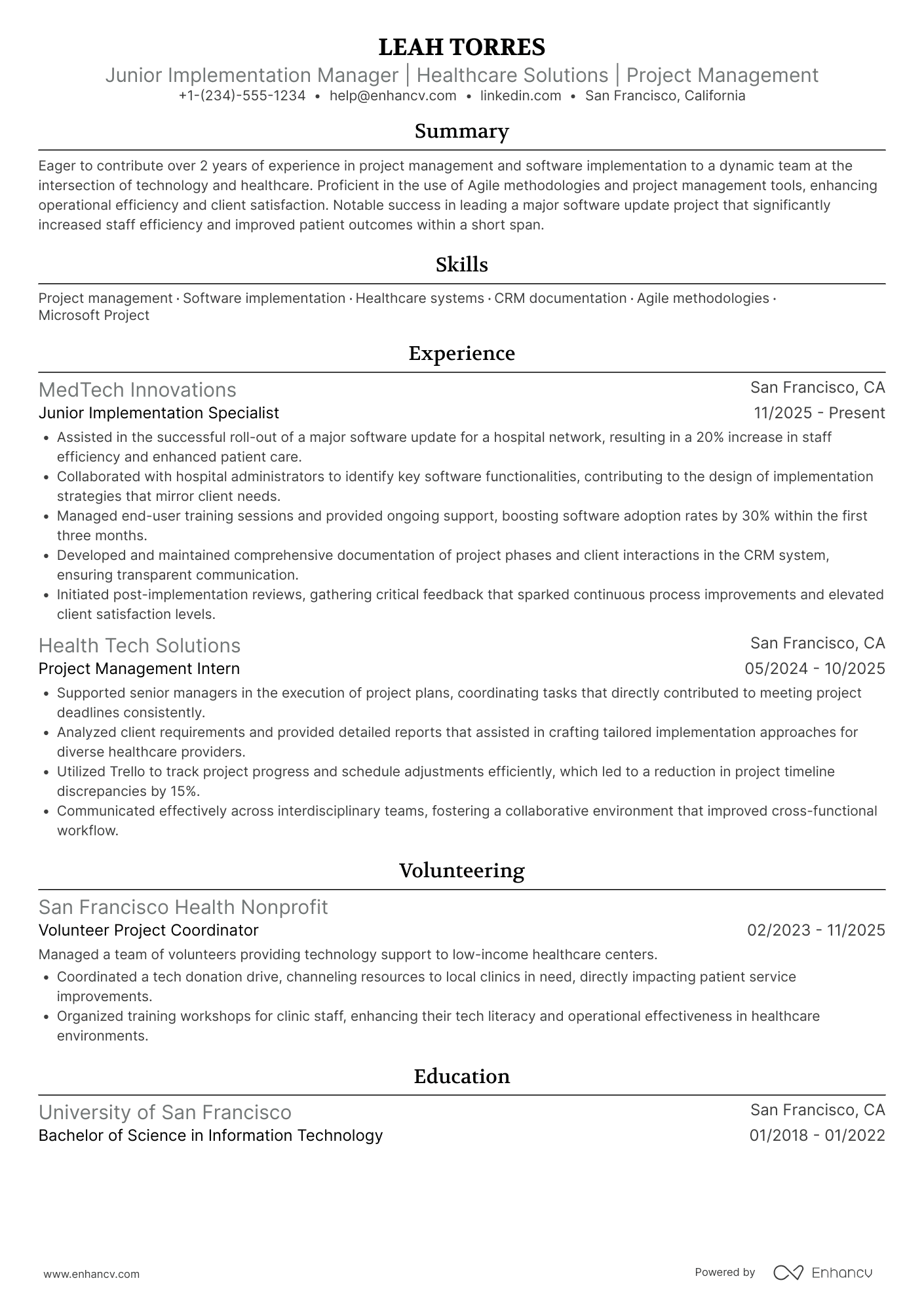
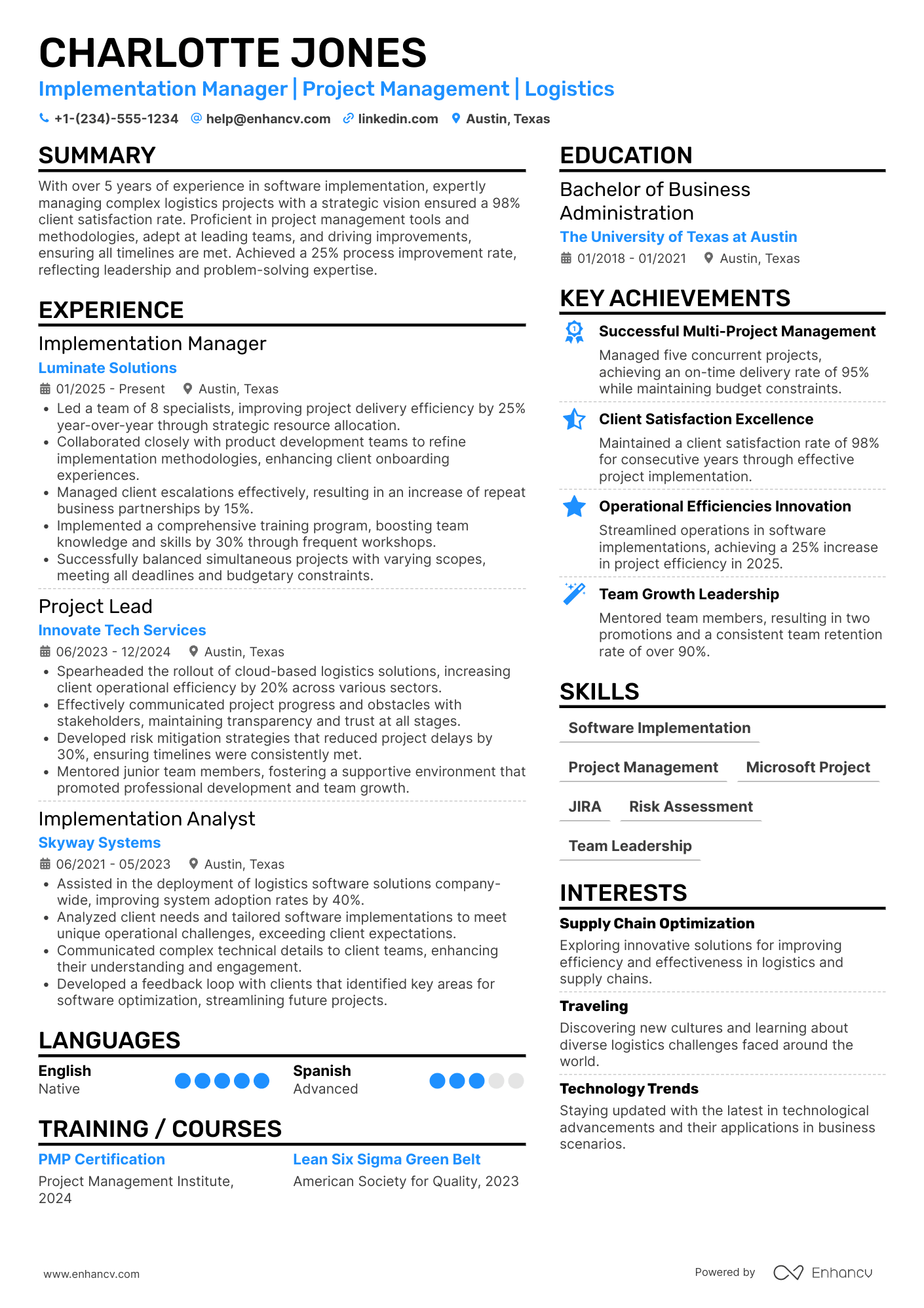
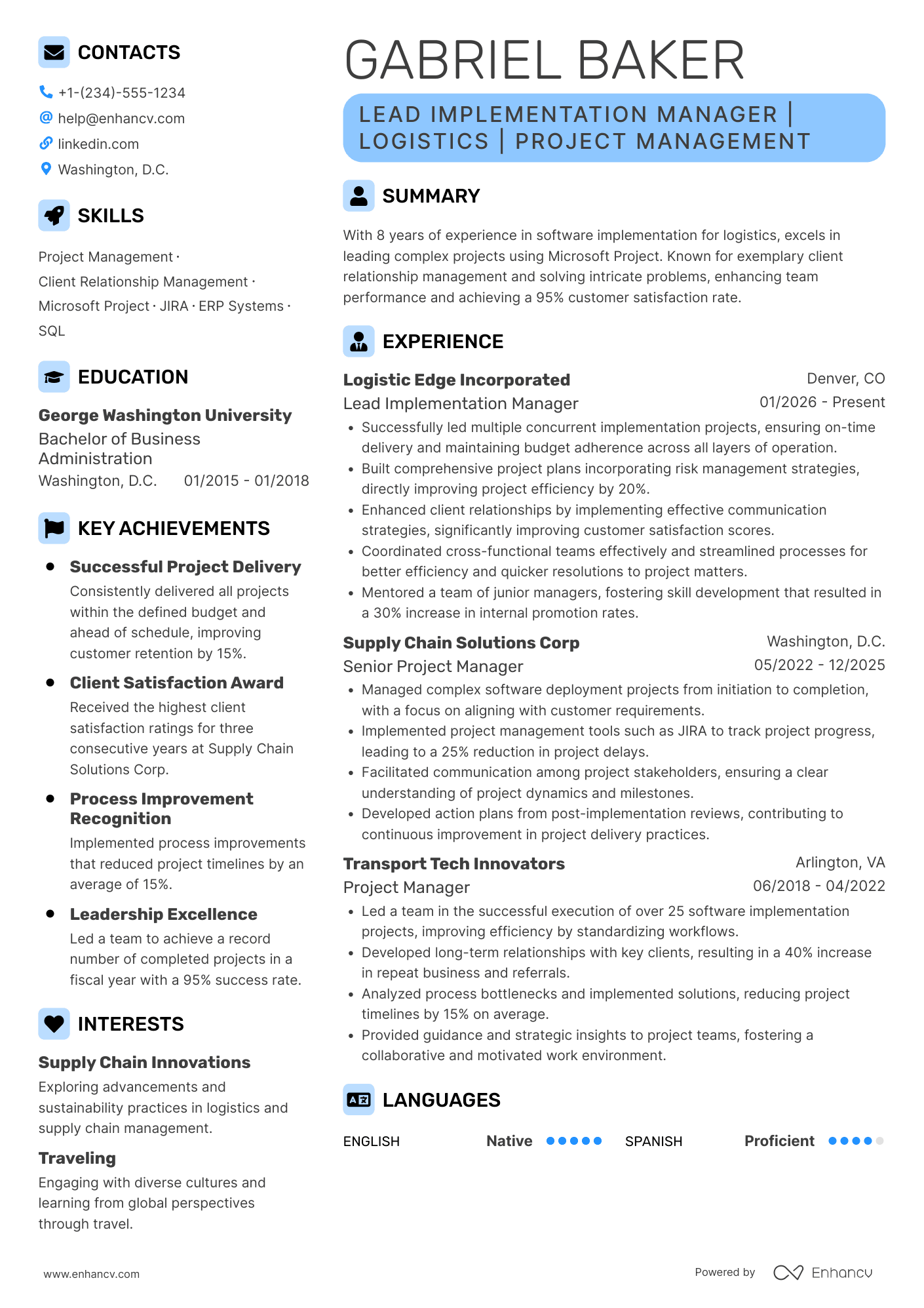
Implementation Manager resume examples
By Experience
By Role