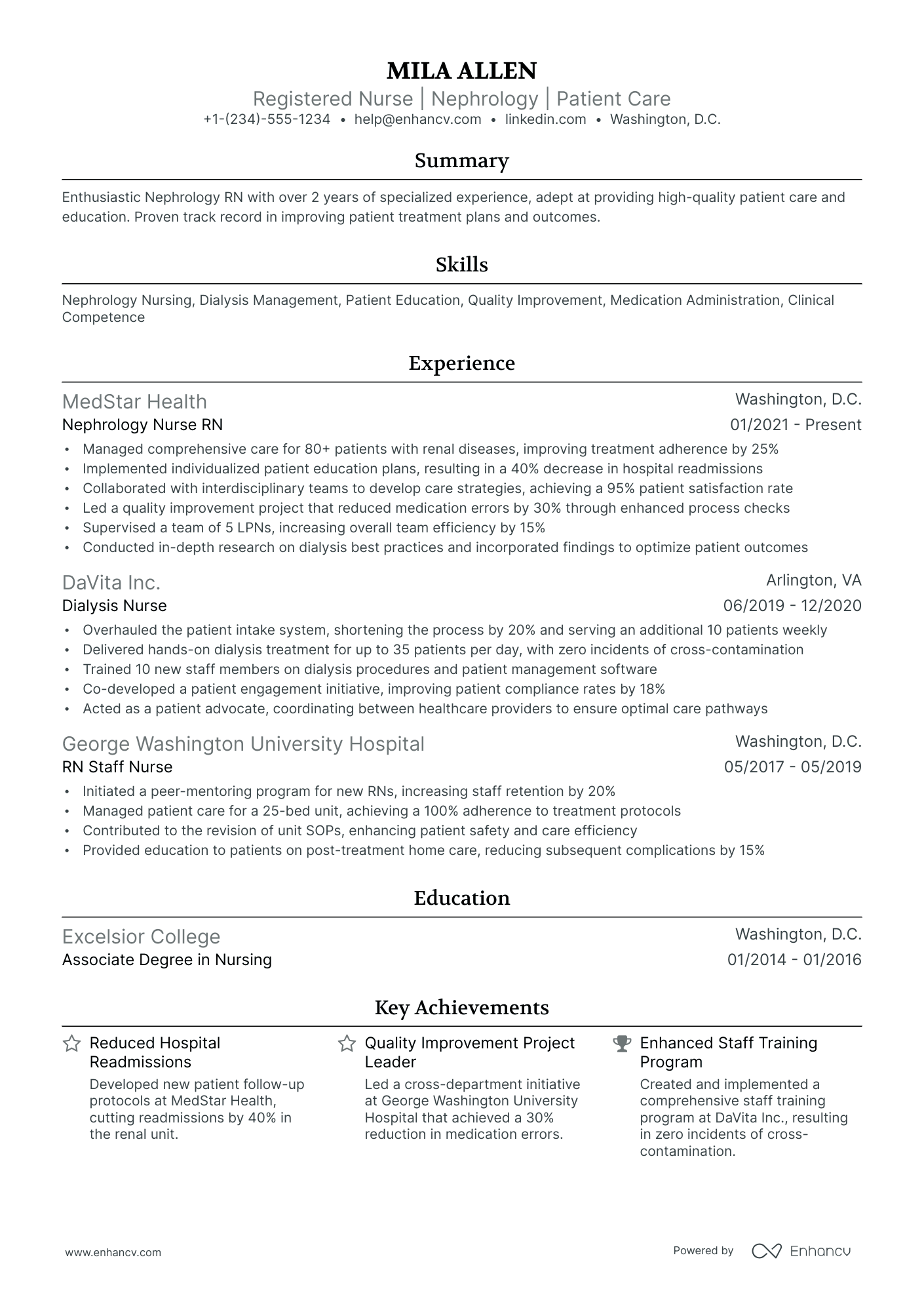
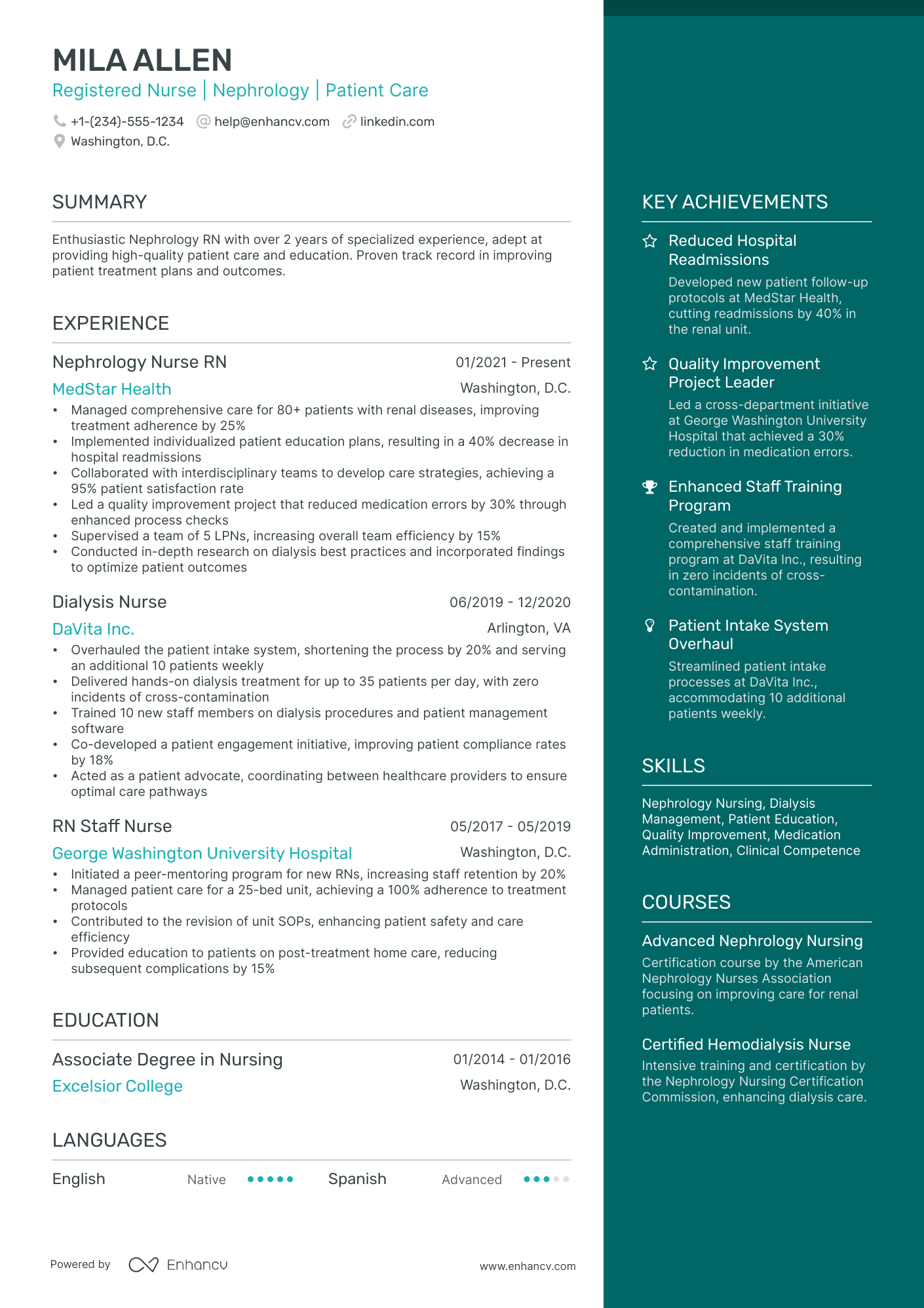
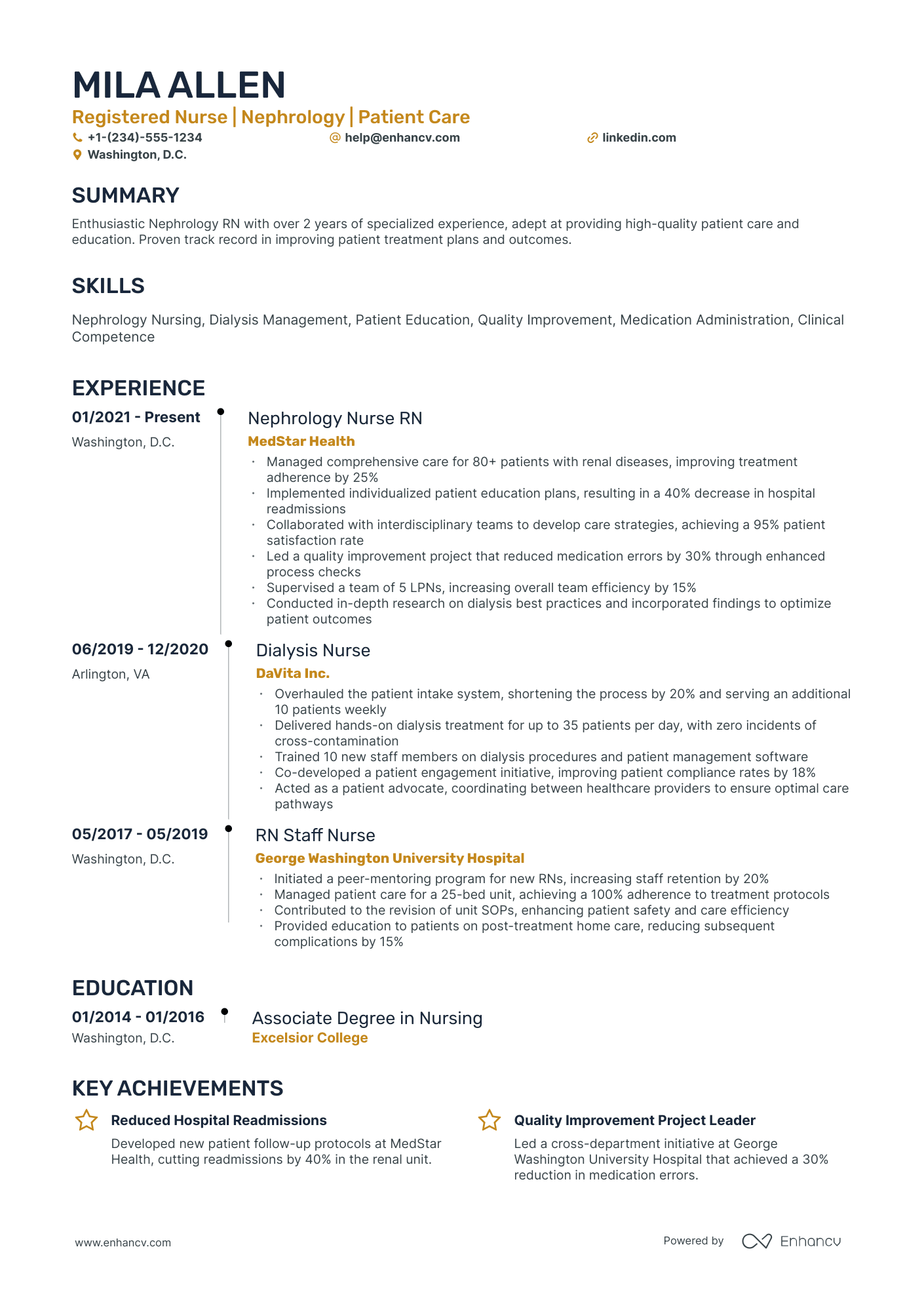
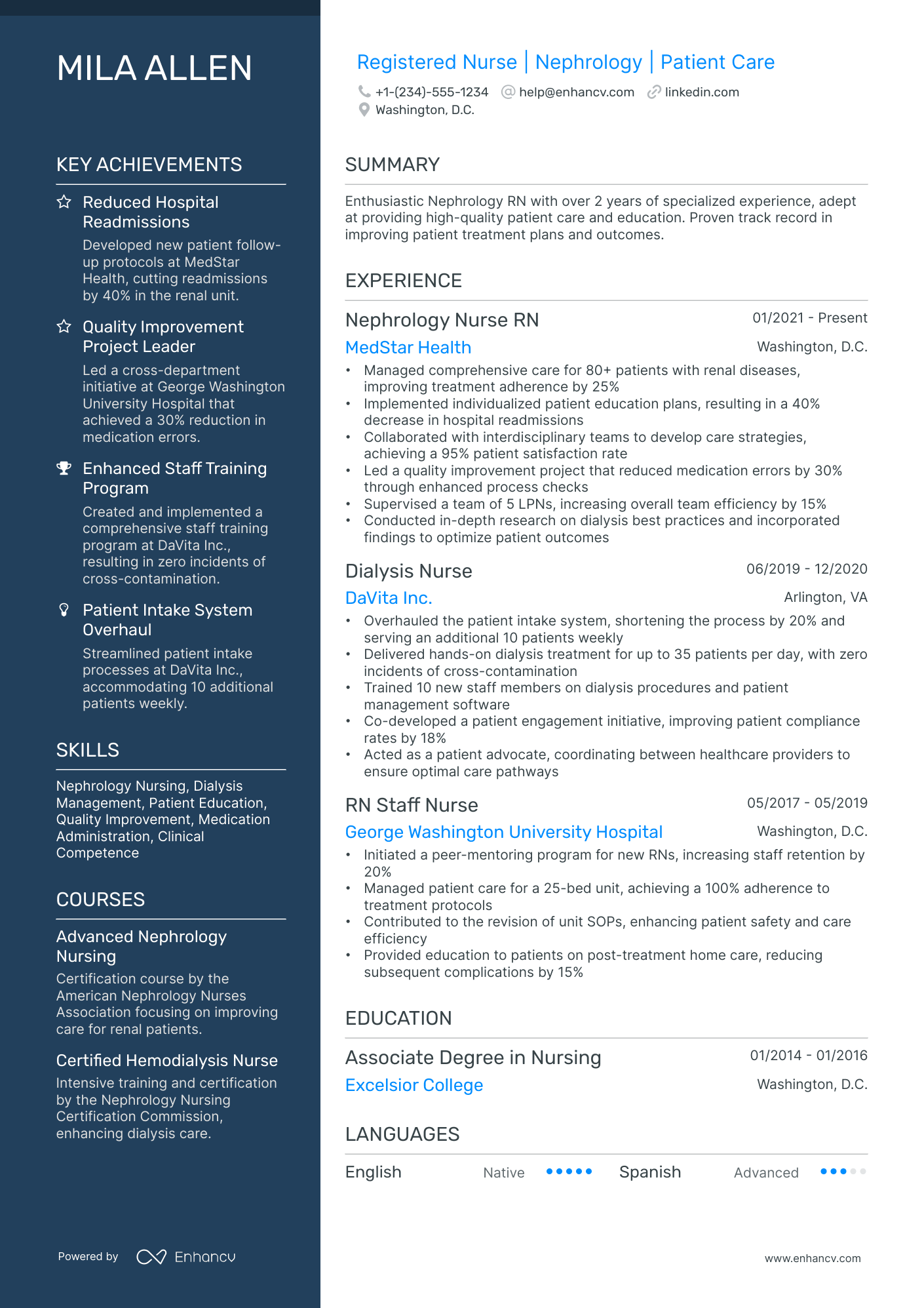
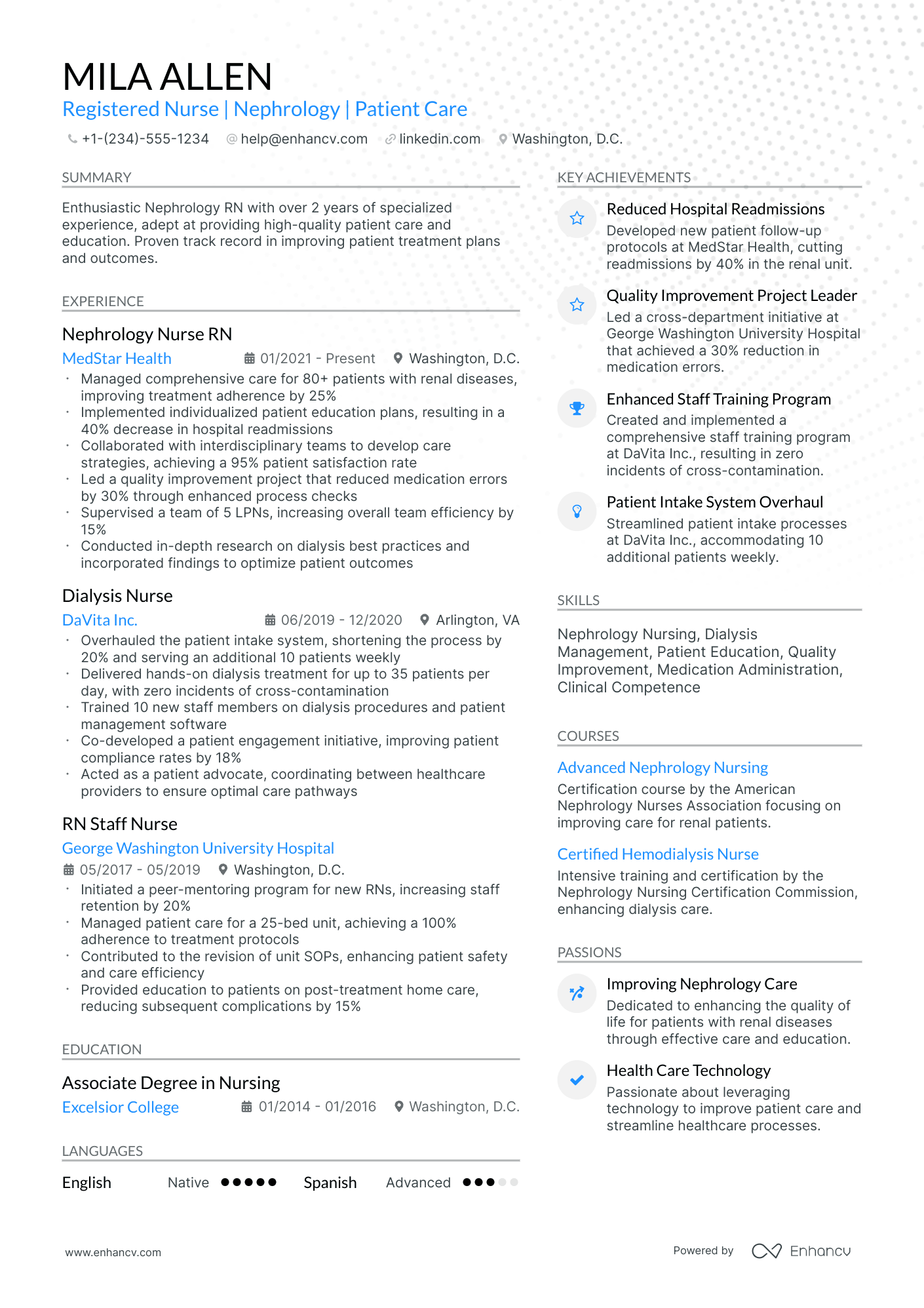
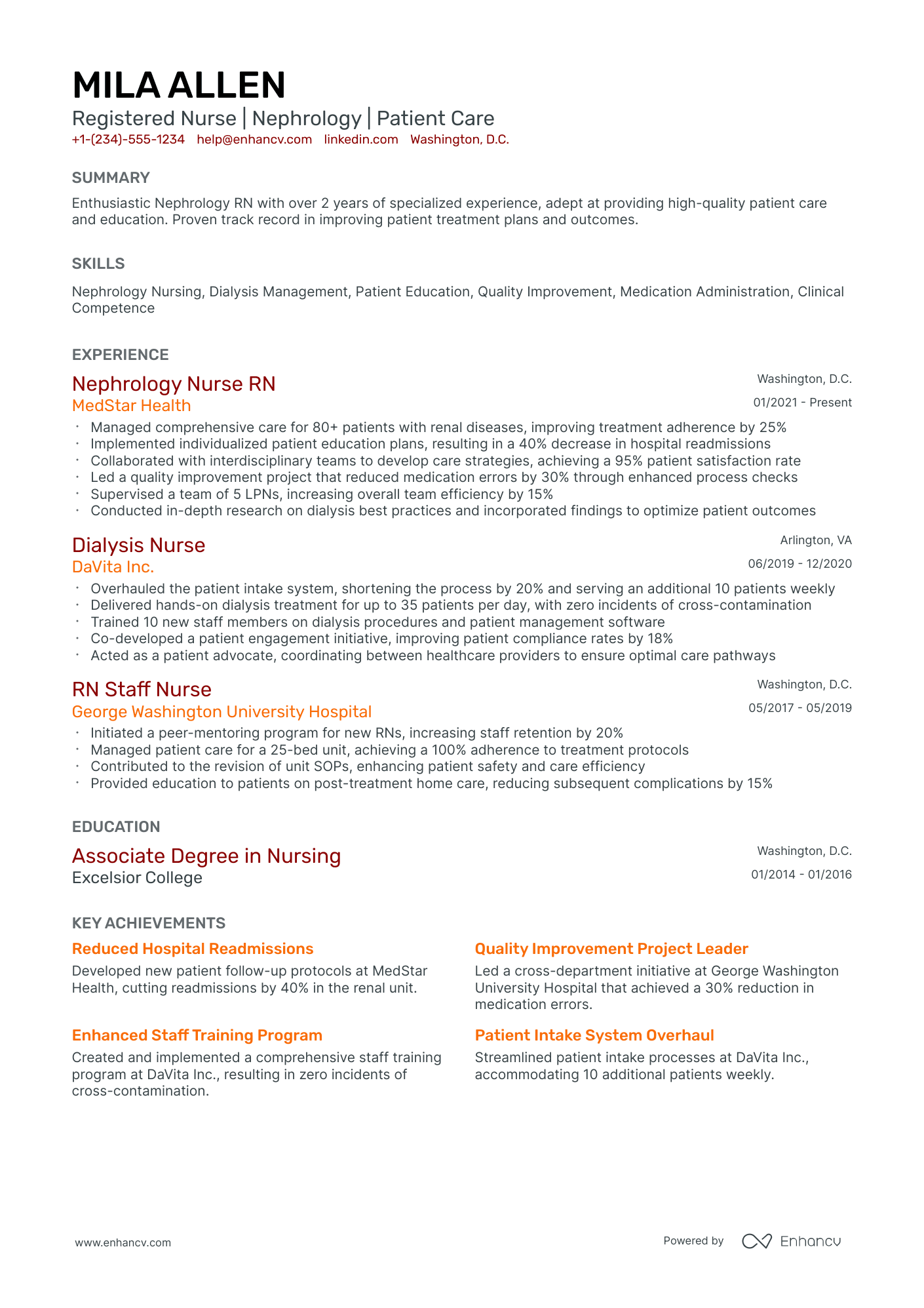
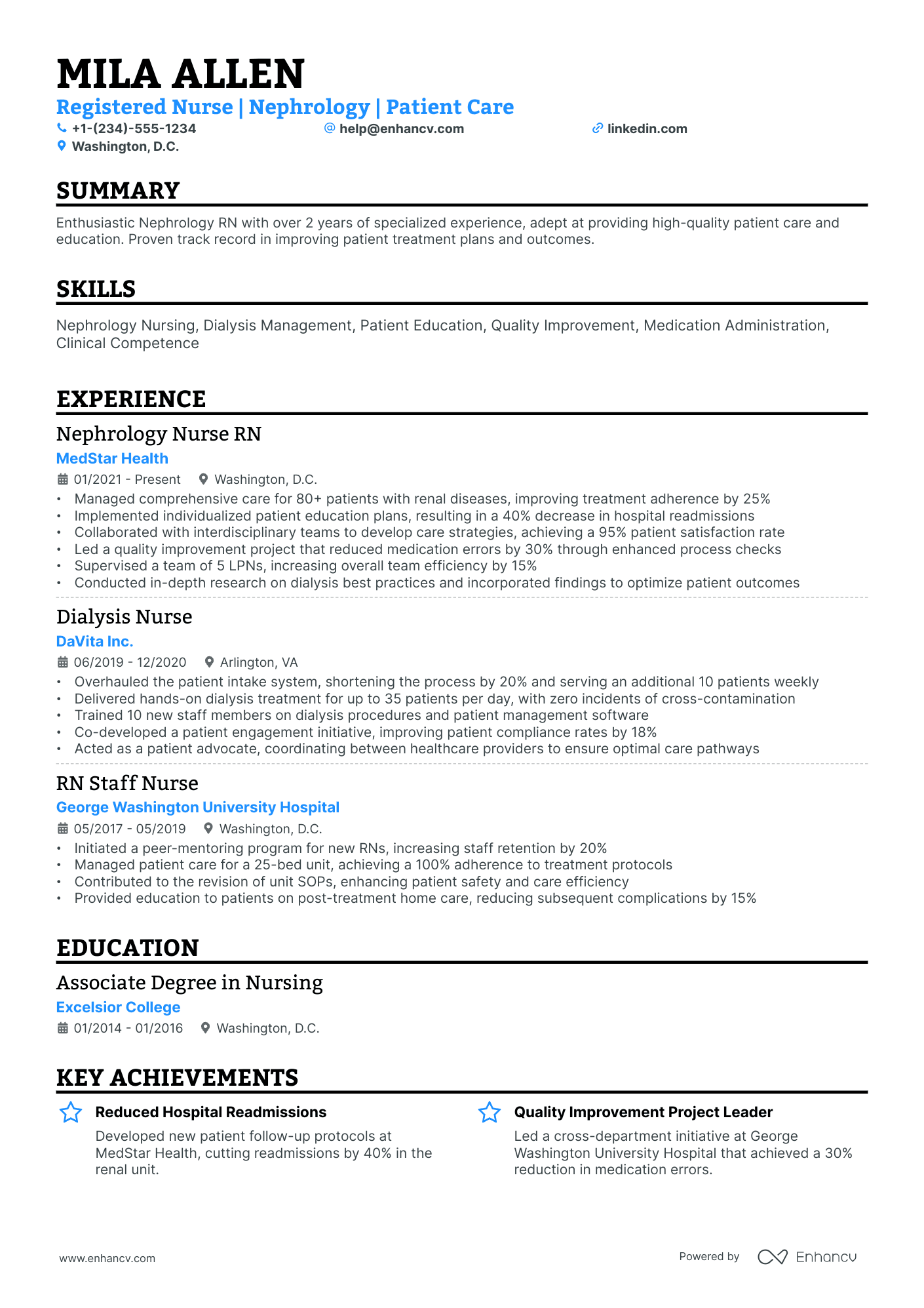
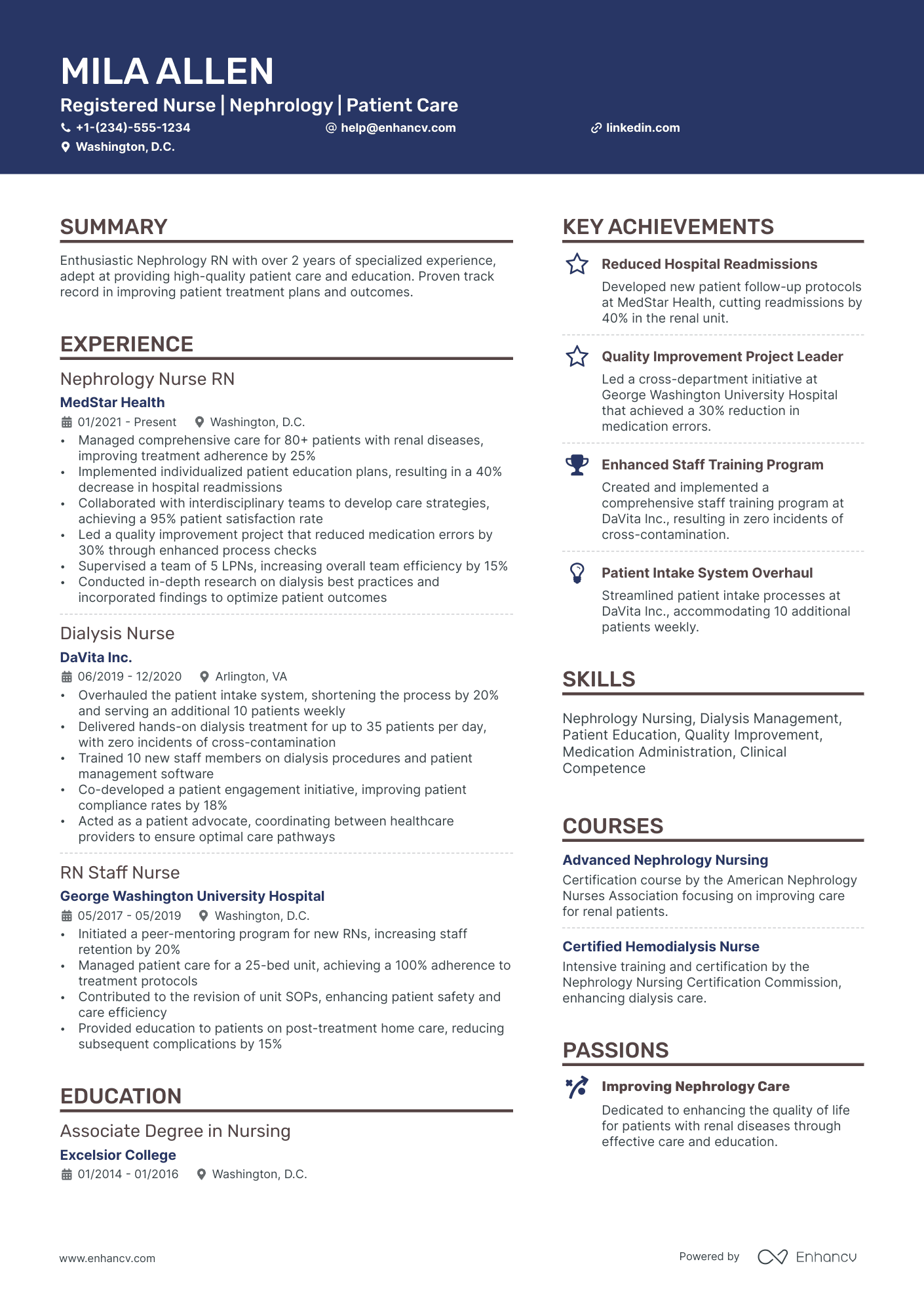
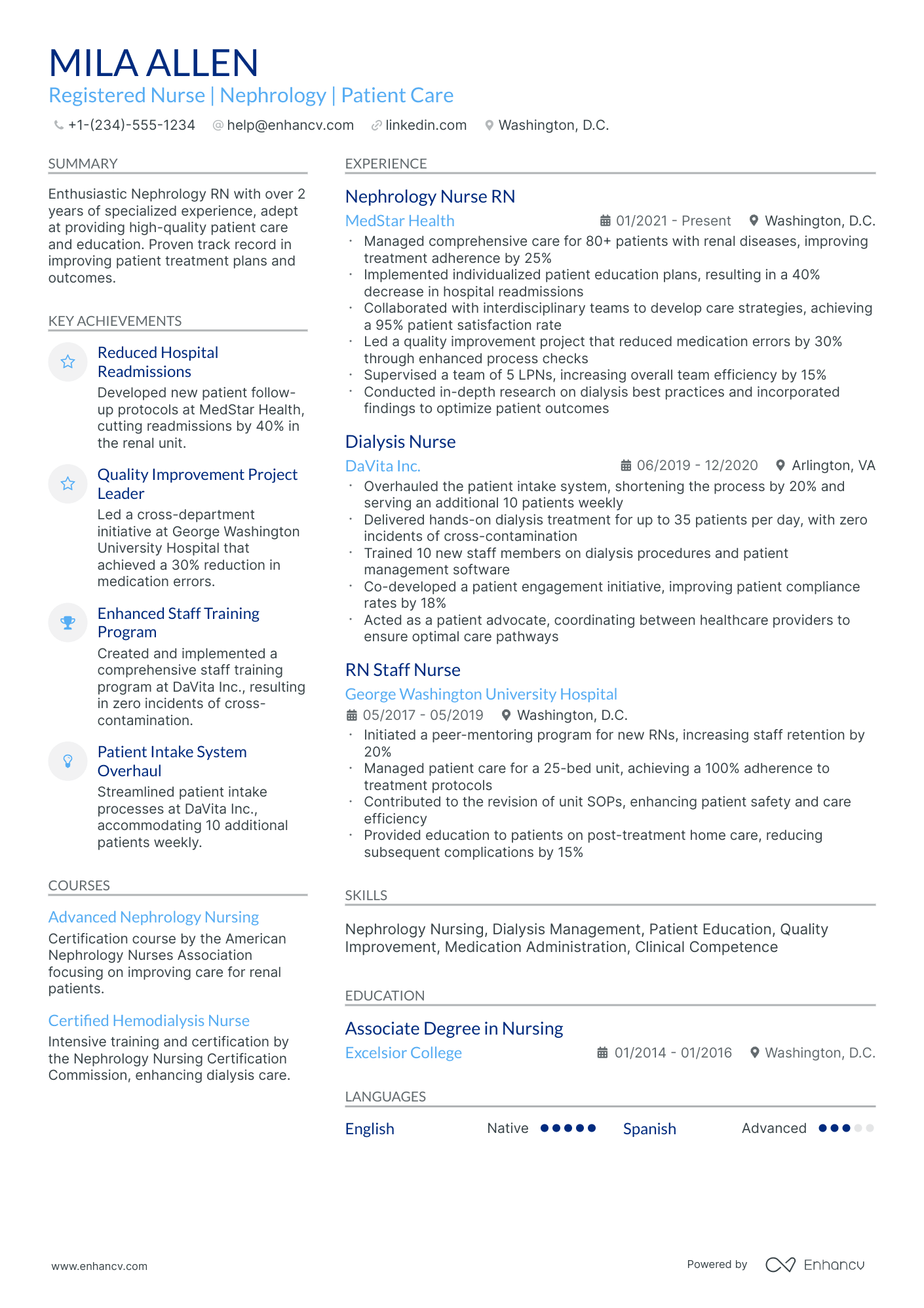
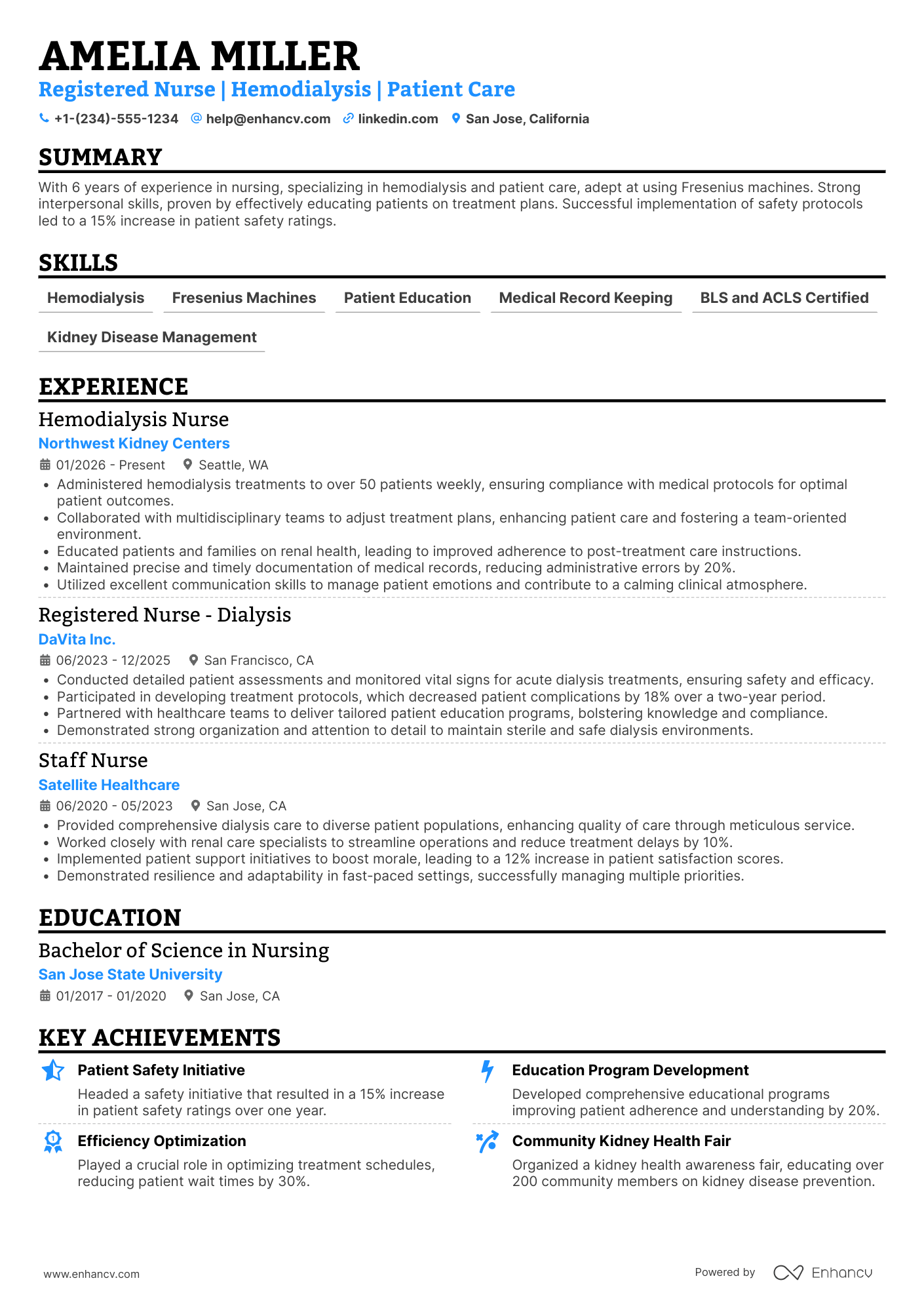
Many hemodialysis nurse resume drafts fail because they read like task lists and bury outcomes under long clinical descriptions. That hurts in hemodialysis nurse resume searches because ATS screening and fast recruiter scans reward clear, role-specific impact.
A strong resume shows what improved because you were on the unit. Knowing how to make your resume stand out starts with highlighting reduced treatment delays, higher Kt/V or URR achievement, fewer access complications, better infection control results, safe management of high daily treatment volume, and stronger patient adherence.

Key takeaways
- Quantify dialysis outcomes like infection rates, Kt/V targets, and treatment volume in every experience bullet.
- Use reverse-chronological format for experienced nurses and hybrid format for career changers.
- Tailor resume language to mirror each job posting's specific machines, protocols, and EHR systems.
- Back every listed skill with a measurable result in your experience or summary section.
- Place certifications like CDN and CNN above education when they're recent and role-relevant.
- Write a resume summary in three to four lines connecting your clinical setting, skills, and top achievement.
- Build stronger resume bullets faster using Enhancv's tools to turn duties into measurable outcomes.
How to format a hemodialysis nurse resume
Recruiters reviewing hemodialysis nurse resumes prioritize clinical competencies in dialysis modalities, patient assessment skills, and experience with vascular access management. Choosing the right resume format ensures these qualifications are immediately visible rather than buried beneath formatting that obscures your hands-on nursing experience.

I have significant experience as a hemodialysis nurse—which format should I use?
Use a reverse-chronological format to showcase your depth of dialysis nursing experience and professional growth across clinical settings. Do:
- Lead each role entry with your scope of responsibility, including patient caseload size, unit type (acute vs. chronic), and any charge nurse or preceptor duties.
- Highlight proficiency with role-specific tools and domains such as dialysis machines (Fresenius, NxStage, Baxter), water treatment systems, vascular access assessment, and electronic health records like Epic or DaVita Clinical.
- Quantify outcomes tied to patient safety, treatment adherence, and unit performance metrics.
I'm junior or switching into this role—what format works best?
A hybrid format works best because it lets you lead with relevant clinical skills while still providing a clear timeline of your nursing or healthcare experience. Do:
- Place a skills section near the top of your resume featuring dialysis-specific competencies such as fluid and electrolyte management, arteriovenous fistula cannulation, and patient education on renal diet compliance.
- Include clinical rotations, nephrology-related projects, certifications (CDN, CNN), or transitional experience from med-surg, ICU, or other acute care settings that demonstrate transferable patient care abilities.
- Connect each action to a measurable or observable result so hiring managers can assess your impact even without extensive dialysis-specific tenure.
Why not use a functional resume?
A functional format removes the timeline context that hiring managers need to verify where and when you applied your dialysis nursing skills, which raises concerns about experience gaps or credential authenticity.
- A functional format may be acceptable if you're a registered nurse transitioning from a non-clinical role, returning from an extended career break, or have limited direct patient care history—but only if you tie every listed skill to a specific project, clinical rotation, or measurable patient outcome.
With your format established, the next step is filling it with the right sections to present your qualifications effectively.
What sections should go on a hemodialysis nurse resume
Recruiters expect a hemodialysis nurse resume to show safe, outcomes-driven dialysis care, strong patient management, and reliable compliance with clinical protocols. Understanding which resume sections to include ensures maximum clarity:
- Header
- Summary
- Experience
- Skills
- Projects
- Education
- Certifications
- Optional sections: Awards, Leadership, Volunteering
Strong experience bullets should emphasize measurable patient outcomes, treatment volume and acuity, safety and infection-control results, and improvements you delivered across the dialysis workflow.
Is your resume good enough?
Drop your resume here or choose a file. PDF & DOCX only. Max 2MB file size.
Once you’ve organized your resume with the right core components, the next step is to write your hemodialysis nurse experience section so it supports each part with specific, relevant details.
How to write your hemodialysis nurse resume experience
Your experience section should prove you've delivered skilled, patient-centered dialysis care—not just list duties you performed. Building a targeted resume means hiring managers see demonstrated impact, including the clinical tools you've operated, the protocols you've followed, and the measurable improvements you've driven in patient outcomes, treatment efficiency, or safety compliance.
Each entry should include:
- Job title
- Company and location (or remote)
- Dates of employment (month and year)
Three to five concise bullet points showing what you owned, how you executed, and what outcomes you delivered:
- Ownership scope: the patient caseloads, dialysis units, treatment schedules, or care coordination responsibilities you were directly accountable for as a hemodialysis nurse.
- Execution approach: the dialysis machines, vascular access techniques, fluid management protocols, electronic health record systems, or evidence-based nursing methods you used to deliver and monitor treatments.
- Value improved: changes to patient safety, treatment adherence, infection rates, fluid balance accuracy, or regulatory compliance that resulted from your clinical decisions and interventions.
- Collaboration context: how you partnered with nephrologists, vascular surgeons, dietitians, social workers, or interdisciplinary care teams to develop and adjust individualized dialysis treatment plans.
- Impact delivered: outcomes framed around patient health improvements, reduced complications, stronger compliance metrics, or operational gains within the dialysis unit—expressed as results rather than activities.
Experience bullet formula
A hemodialysis nurse experience example
✅ Right example - modern, quantified, specific.
Hemodialysis Registered Nurse (RN)
Fresenius Kidney Care | Austin, TX
2021–Present
Outpatient dialysis clinic delivering chronic hemodialysis services across two shifts, six days per week.
- Coordinated safe, on-time treatments for an average of twenty-four patients per day using Fresenius 2008T machines and the NxStage System One, cutting late starts by 18% through standardized pre-treatment workflows.
- Reduced catheter-related bloodstream infections by 22% year over year by enforcing aseptic technique, chlorhexidine protocols, and central venous catheter care bundles, partnering with infection prevention and the medical director on monthly audits.
- Improved adequacy outcomes by increasing Kt/V target attainment from 88% to 95% through individualized ultrafiltration profiling, dialysate adjustments, and real-time monitoring of Crit-Line and transmembrane pressure trends.
- Strengthened medication safety by reconciling epoetin alfa, iron sucrose, and heparin orders in Epic (electronic health record), decreasing documentation errors by 30% after implementing barcode scanning and double-checks with pharmacists.
- Accelerated vascular access escalation by triaging abnormal bruit, thrill, and venous pressure alarms, coordinating same-week duplex ultrasound and interventional radiology referrals, and reducing access-related missed treatments by 15%.
Now that you've seen how a strong experience section comes together, let's break down how to tailor each element to match the specific hemodialysis nurse role you're targeting.
How to tailor your hemodialysis nurse resume experience
Recruiters evaluate hemodialysis nurse resumes through both human review and applicant tracking systems (ATS), filtering for specific qualifications and clinical skills. Tailoring your resume to the job description ensures your relevant expertise stands out in both screening methods.
Ways to tailor your hemodialysis nurse experience:
- Match dialysis machine brands and vascular access devices listed in the posting.
- Mirror the exact terminology used for renal care protocols and standards.
- Reflect patient outcome metrics or quality indicators the employer prioritizes.
- Highlight experience with the electronic health record system they specify.
- Emphasize CMS compliance and infection control practices when mentioned.
- Include interdisciplinary collaboration with nephrologists and dietitians if referenced.
- Align your documentation practices with their stated regulatory frameworks.
- Reference fluid management or blood chemistry monitoring workflows they describe.
Tailoring means aligning your genuine clinical achievements with the employer's stated requirements, not forcing disconnected keywords into your experience.
Resume tailoring examples for hemodialysis nurse
| Job description excerpt | Untailored | Tailored |
|---|---|---|
| Administer hemodialysis treatments per physician orders using Fresenius 2008K machines, monitor patient vitals, and document in NxStage or equivalent EMR systems. | Provided patient care and operated medical equipment in a clinical setting. | Administered hemodialysis treatments on Fresenius 2008K machines for 15+ patients daily, monitoring vitals and documenting assessments in NxStage EMR per physician protocols. |
| Perform cannulation of AV fistulas and grafts, assess vascular access sites, and respond to complications including infiltration, clotting, and hypotension during treatments. | Assisted with dialysis procedures and handled patient issues as they came up. | Performed cannulation of AV fistulas and grafts with a 97% successful stick rate, assessing access sites each session and intervening promptly for infiltration, clotting, and intradialytic hypotension. |
| Educate patients on fluid restrictions, renal diet, and home care between treatments while coordinating with nephrologists, dietitians, and social workers on individualized care plans. | Educated patients and worked with other team members on care planning. | Delivered one-on-one patient education on fluid restrictions, renal diet compliance, and home care routines, collaborating with nephrologists, dietitians, and social workers to update individualized care plans for a caseload of 60 chronic kidney disease patients. |
Once you’ve aligned your experience with the role’s needs, the next step is to quantify your hemodialysis nurse achievements so hiring managers can see the impact of your work.
How to quantify your hemodialysis nurse achievements
Quantifying your achievements shows how you improved patient safety, treatment quality, and clinic flow. Focus on numbers tied to adherence to protocols, complication rates, treatment times, patient volume, and documentation accuracy.
Quantifying examples for hemodialysis nurse
| Metric | Example |
|---|---|
| Patient volume | "Managed twelve to fourteen hemodialysis patients per shift across two pods, maintaining on-time starts for 95% of scheduled treatments." |
| Access complication rate | "Reduced infiltration events from 3.2% to 1.1% in three months by standardizing cannulation technique and coaching four new nurses." |
| Infection control compliance | "Sustained 100% audit pass rate on central line dressing changes for eight consecutive weeks using a checklist and real-time peer checks." |
| Treatment efficiency | "Cut average turnover time between patients from twenty-eight to nineteen minutes by reorganizing supply carts and coordinating transport with unit clerks." |
| Documentation accuracy | "Improved same-day documentation completion from 82% to 98% within six weeks by optimizing Epic templates and batching post-treatment charting." |
Turn vague job duties into measurable, recruiter-ready resume bullets in seconds with Enhancv's Bullet Point Generator.
With your experience clearly articulated in strong bullet points, the next step is ensuring your resume also highlights the right mix of hard and soft skills that hemodialysis nursing roles demand.
How to list your hard and soft skills on a hemodialysis nurse resume
Your skills section shows recruiters and an ATS (applicant tracking system) you can deliver safe dialysis care, operate unit workflows, and meet compliance standards, so balance role-specific hard skills with job-relevant soft skills, typically in an even split. hemodialysis nurse roles require a blend of:
- Product strategy and discovery skills.
- Data, analytics, and experimentation skills.
- Delivery, execution, and go-to-market discipline.
- Soft skills.
Your skills section should be:
- Scannable (bullet-style grouping).
- Relevant to the job post.
- Backed by proof in experience bullets.
- Updated with current tools.
Place your skills section:
- Above experience if you're junior or switching careers.
- Below experience if you're mid/senior with strong achievements.

Hard skills
- Hemodialysis machine setup
- Dialyzer reprocessing protocols
- Water treatment monitoring, RO systems
- Vascular access assessment (AV fistula, AVG, CVC)
- Cannulation techniques, buttonhole
- Anticoagulation management, heparin
- Intradialytic complication management
- Dry weight and UF profiling
- Medication administration, IV iron, ESAs
- Infection prevention, CLABSI prevention
- Patient assessment and documentation
- Electronic health records, dialysis EMR
Soft skills
- Patient education and teach-back
- Clear handoffs and shift reports
- Rapid clinical prioritization
- Escalation to nephrologist promptly
- Calm de-escalation during adverse events
- Cross-functional teamwork with technicians
- Coaching patients on adherence barriers
- Closed-loop communication under pressure
- Ownership of safety checks and timeouts
- Conflict resolution with patients and families
- Precepting and mentoring new staff
- Attention to workflow and throughput
How to show your hemodialysis nurse skills in context
Skills shouldn't live only in a bulleted list on your resume. Browse examples of resume skills in action to see how top candidates present their abilities.
They should be demonstrated in:
- Your summary (high-level professional identity)
- Your experience (proof through outcomes)
Here's what that looks like in practice.
Summary example
Senior hemodialysis nurse with 10+ years of vascular access management and patient education in outpatient dialysis centers. Skilled in Fresenius machines, interdisciplinary collaboration, and fluid management protocols. Reduced catheter-related infections by 30% through evidence-based nursing interventions.
- Reflects senior-level expertise clearly
- Names role-specific tools and methods
- Includes a measurable clinical outcome
- Highlights patient-centered soft skills
Experience example
Senior Hemodialysis Nurse
DaVita Kidney Care | Phoenix, AZ
March 2018–Present
- Managed vascular access care for 60+ chronic dialysis patients, reducing access-related complications by 25% over two years.
- Collaborated with nephrologists and dietitians to individualize fluid management plans, improving patient adherence rates by 18%.
- Trained 12 new nurses on Fresenius 2008K machine operation and emergency dialysis protocols, cutting onboarding time by three weeks.
- Every bullet includes measurable proof
- Skills appear naturally within achievements
Once you’ve backed up your hemodialysis nursing abilities with specific examples, the next step is applying that same approach to a hemodialysis nurse resume with no experience so you can highlight relevant strengths without relying on prior roles.
How do I write a hemodialysis nurse resume with no experience
Even without full-time experience, you can demonstrate readiness. Writing a resume without work experience means showcasing relevant training and clinical preparation through:
- Hemodialysis clinical rotation hours
- Precepted shifts in outpatient dialysis
- Capstone on vascular access care
- Simulation lab: machine setup
- IV insertion and blood draws
- Electronic health record documentation practice
- BLS and ACLS certifications
- Volunteer patient transport in nephrology
Focus on:
- Dialysis machine setup and safety
- Vascular access assessment and care
- Infection control and water quality
- Documentation accuracy and compliance
Resume format tip for entry-level hemodialysis nurse
Use a hybrid resume format because it highlights dialysis-relevant skills and training first, while still showing clinical rotations and certifications clearly. Do:
- Put licenses and certifications first.
- List clinical rotations with hours.
- Add dialysis-specific skills and tools.
- Quantify outcomes from clinical work.
- Include relevant coursework and capstone.
- Completed 120 hemodialysis clinical rotation hours, set up Fresenius 2008T, verified dialysate conductivity and temperature, and maintained zero documentation errors across 20 charts.
Even without direct experience, your education section can demonstrate the clinical knowledge and credentials that qualify you for a hemodialysis nursing role.
How to list your education on a hemodialysis nurse resume
Your education section helps hiring teams confirm you hold the nursing credentials required for safe, competent hemodialysis nurse practice. It validates your clinical foundation quickly.
Include:
- Degree name
- Institution
- Location
- Graduation year
- Relevant coursework (for juniors or entry-level candidates)
- Honors & GPA (if 3.5 or higher)
Skip month and day details—list the graduation year only.
Here's a strong education entry tailored to a hemodialysis nurse resume:
Example education entry
Bachelor of Science in Nursing
University of Florida, Gainesville, FL
Graduated: 2021
GPA: 3.7/4.0
- Relevant Coursework: Renal Pathophysiology, Pharmacology for Chronic Illness, Advanced Patient Assessment, Clinical Practicum in Nephrology Nursing
- Honors: Magna Cum Laude, Dean's List (six semesters)
How to list your certifications on a hemodialysis nurse resume
Certifications on your resume show a hemodialysis nurse stays committed to learning, uses dialysis tools safely, and meets current standards across renal care settings.
Include:
- Certificate name
- Issuing organization
- Year
- Optional: credential ID or URL
- Place certifications below education when your education is recent and your certifications are older or less relevant to hemodialysis nurse work.
- Place certifications above education when they are recent, highly relevant, or required for the hemodialysis nurse role you want.
Best certifications for your hemodialysis nurse resume
- Certified Dialysis Nurse (CDN)
- Certified Nephrology Nurse (CNN)
- Basic Life Support (BLS)
- Advanced Cardiovascular Life Support (ACLS)
- Certified in Infection Prevention and Control (CIC)
- Pediatric Advanced Life Support (PALS)
- Certified Clinical Hemodialysis Technician (CCHT)
Once you’ve positioned your credentials where hiring managers can spot them quickly, shift to your hemodialysis nurse resume summary to connect those qualifications to your impact in a few lines.
How to write your hemodialysis nurse resume summary
Your resume summary is the first thing a recruiter reads. A strong one immediately connects your dialysis nursing skills to what the hiring team needs.
Keep it to three to four lines, with:
- Your title and total years of hemodialysis or nephrology nursing experience.
- Clinical setting, such as acute care, outpatient dialysis center, or in-hospital unit.
- Core skills like vascular access management, water treatment systems, and patient assessment.
- One or two measurable achievements, such as reduced catheter infection rates or improved patient throughput.
- Soft skills tied to real outcomes, like patient education that improved treatment adherence.

PRO TIP
At this level, emphasize clinical competencies, relevant certifications, and early wins that show you deliver results. Highlight hands-on dialysis skills and familiarity with specific equipment or electronic health records. Avoid vague phrases like "passionate caregiver" or "team player" without supporting evidence.
Example summary for a hemodialysis nurse
Hemodialysis nurse with three years of outpatient dialysis experience. Skilled in vascular access care, fluid management, and patient education. Reduced catheter-related infections by 18% through improved aseptic protocols.
Optimize your resume summary and objective for ATS
Drop your resume here or choose a file.
PDF & DOCX only. Max 2MB file size.
With your summary crafted to highlight your dialysis expertise and patient care strengths, make sure your resume header presents your contact details clearly so hiring managers can easily reach you.
What to include in a hemodialysis nurse resume header
A well-structured resume header lists your key contact details and role, helping your hemodialysis nurse application gain visibility, build credibility, and pass recruiter screening.
Essential resume header elements
- Full name
- Tailored job title and headline
- Location
- Phone number
- Professional email
- GitHub link
- Portfolio link
A LinkedIn link helps recruiters verify experience quickly and supports screening.
Do not include a photo on a hemodialysis nurse resume unless the role is explicitly front-facing or appearance-dependent.
Keep the header simple, accurate, and consistent with your application profile details to reduce screening delays.
Example
Hemodialysis nurse resume header
Jordan Taylor
Hemodialysis Nurse | Chronic and Acute Dialysis Care
Houston, TX
(713) 555-01XX
your.name@enhancv.com
github.com/yourname
yourwebsite.com
linkedin.com/in/yourname
Once your contact details and role identifier are set up for quick employer reference, add targeted additional sections to round out your hemodialysis nurse resume with relevant supporting information.
Additional sections for hemodialysis nurse resumes
Adding extra sections helps you stand out when your core qualifications match other candidates. They showcase unique strengths relevant to dialysis patient care. For example, listing volunteering on your resume can highlight compassion and community involvement that resonates with healthcare employers.
- Languages
- Certifications and licenses
- Continuing education
- Professional affiliations
- Volunteer experience
- Publications
- Awards and recognitions
Once you've strengthened your resume with relevant extra sections, it's worth pairing it with a well-crafted cover letter to make an even stronger impression.
Do hemodialysis nurse resumes need a cover letter
A cover letter isn't required for a hemodialysis nurse, but it often helps. If you're unsure about the basics, learn what a cover letter is and when it matters most—especially in competitive roles, hospital systems with strict hiring steps, or when the posting asks for one. It can also help when your resume doesn't tell the full story.
Use a cover letter to add context and make your fit easy to see:
- Explain role and team fit: Match your dialysis setting experience to the unit's patient mix, shift structure, and collaboration with nephrologists and technicians.
- Highlight one or two outcomes: Share a specific improvement, such as reducing access complications, improving adherence, or supporting better fluid management education.
- Show you understand the context: Reference the facility's dialysis model, patient population, safety priorities, and quality metrics that guide daily work.
- Address transitions or non-obvious experience: Connect med-surg, ICU, home health, or clinic work to hemodialysis nurse skills and explain your training path.
Drop your resume here or choose a file.
PDF & DOCX only. Max 2MB file size.
Even if you decide to include a cover letter to add context beyond your resume, using AI to improve your hemodialysis nurse resume is the next step because it helps you refine and tailor what hiring teams see first.
Using AI to improve your hemodialysis nurse resume
AI can sharpen your resume's clarity, structure, and impact. It helps refine bullet points, tighten language, and highlight measurable results. But overuse strips authenticity. Once your content is clear and role-aligned, step away from AI. Explore ChatGPT resume writing prompts to get started with targeted improvements.
Here are 10 practical prompts to strengthen specific sections of your hemodialysis nurse resume:
Sharpen your summary
Quantify patient care
Strengthen action verbs
Tailor to postings
Tighten bullet points
Highlight certifications
Refine technical skills
Improve education details
Clarify project contributions
Remove redundancy
Conclusion
A strong hemodialysis nurse resume highlights measurable outcomes, role-specific skills, and a clear structure. Use metrics like treatment volume, access complication rates, and infection control results. Show expertise in dialysis machine setup, vascular access care, patient education, and emergency response.
Keep sections easy to scan, with focused bullets and consistent formatting. Tie each achievement to safe, efficient care and strong teamwork. This approach shows you’re ready for today’s hiring market and near-future expectations.