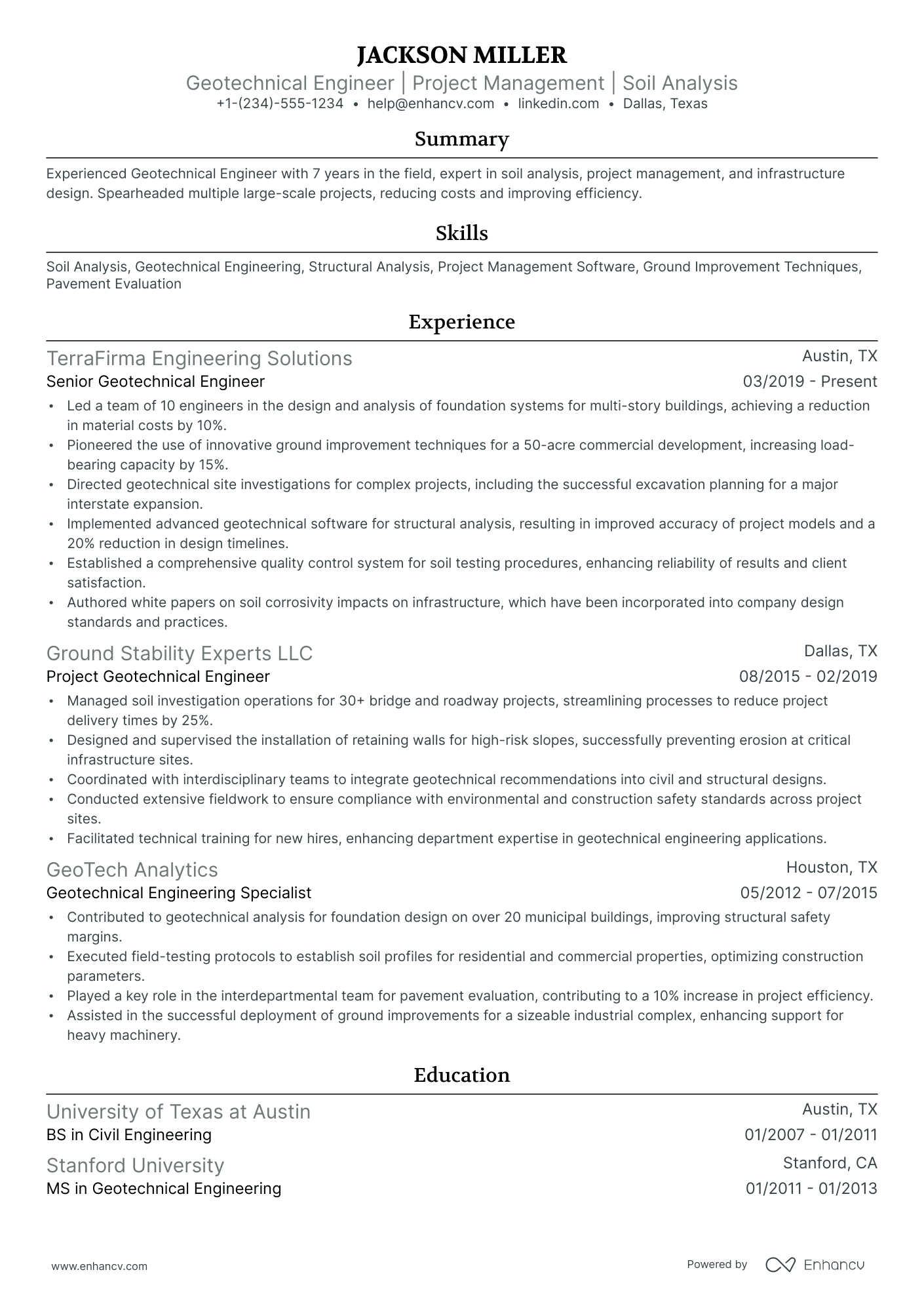
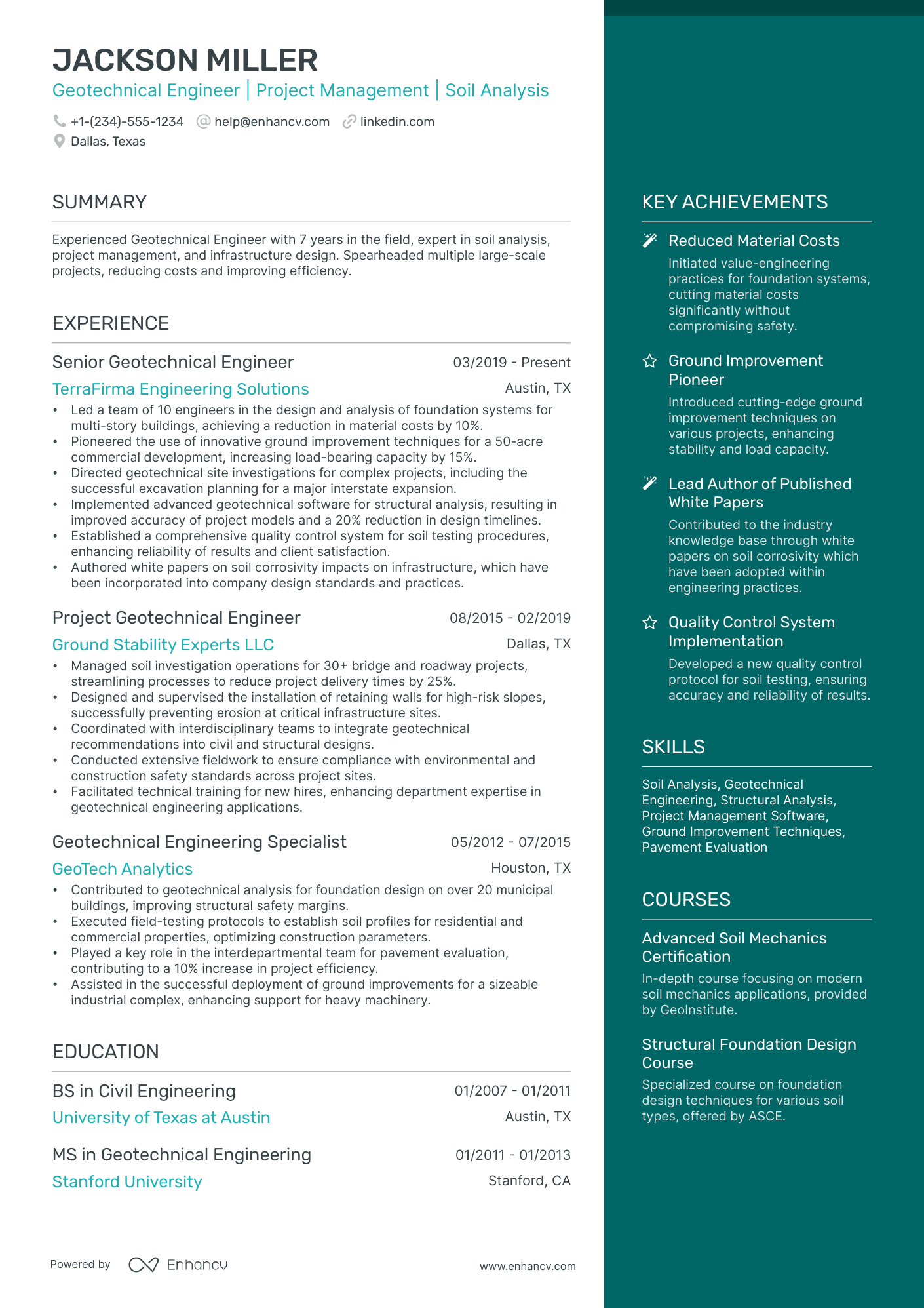
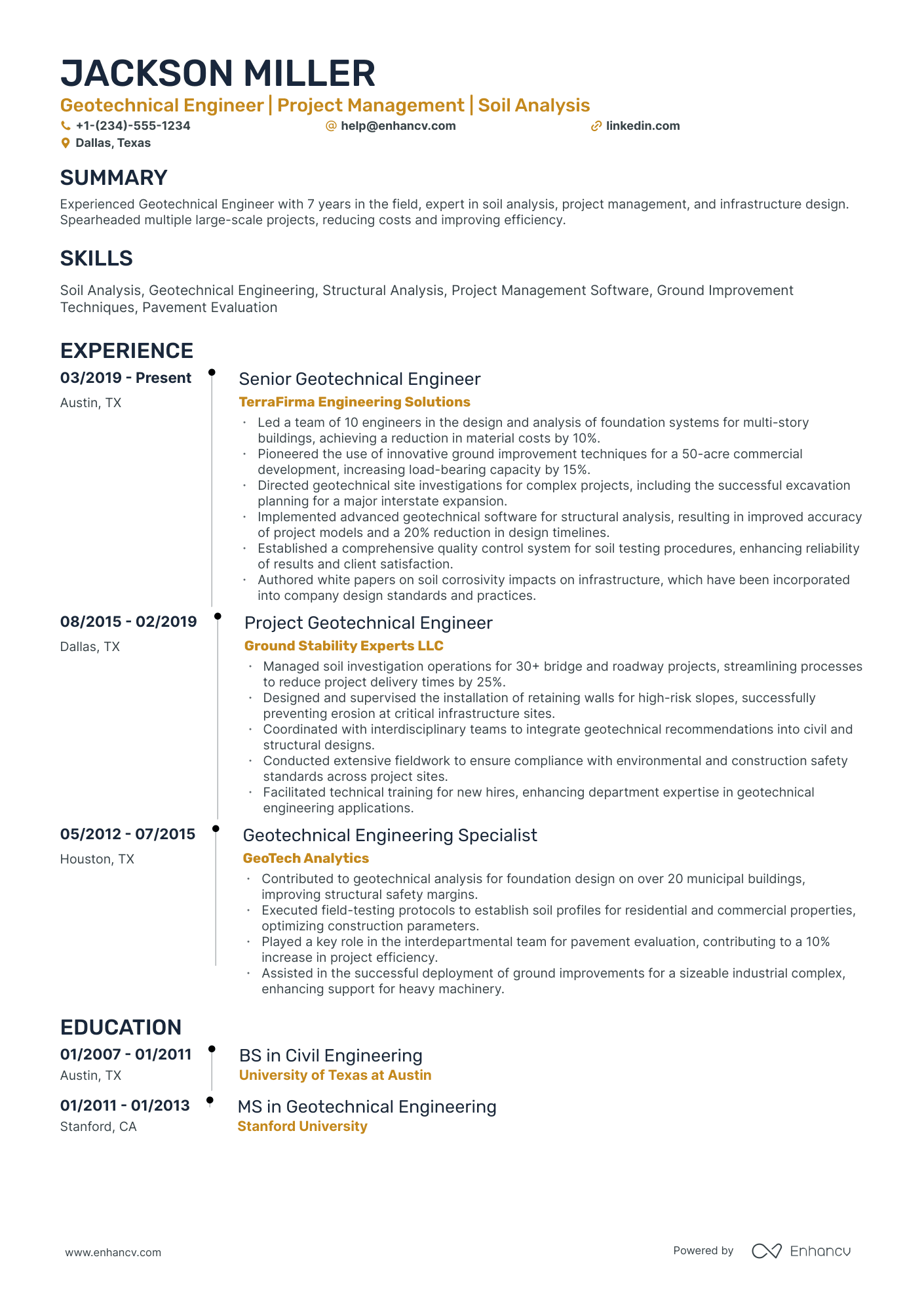
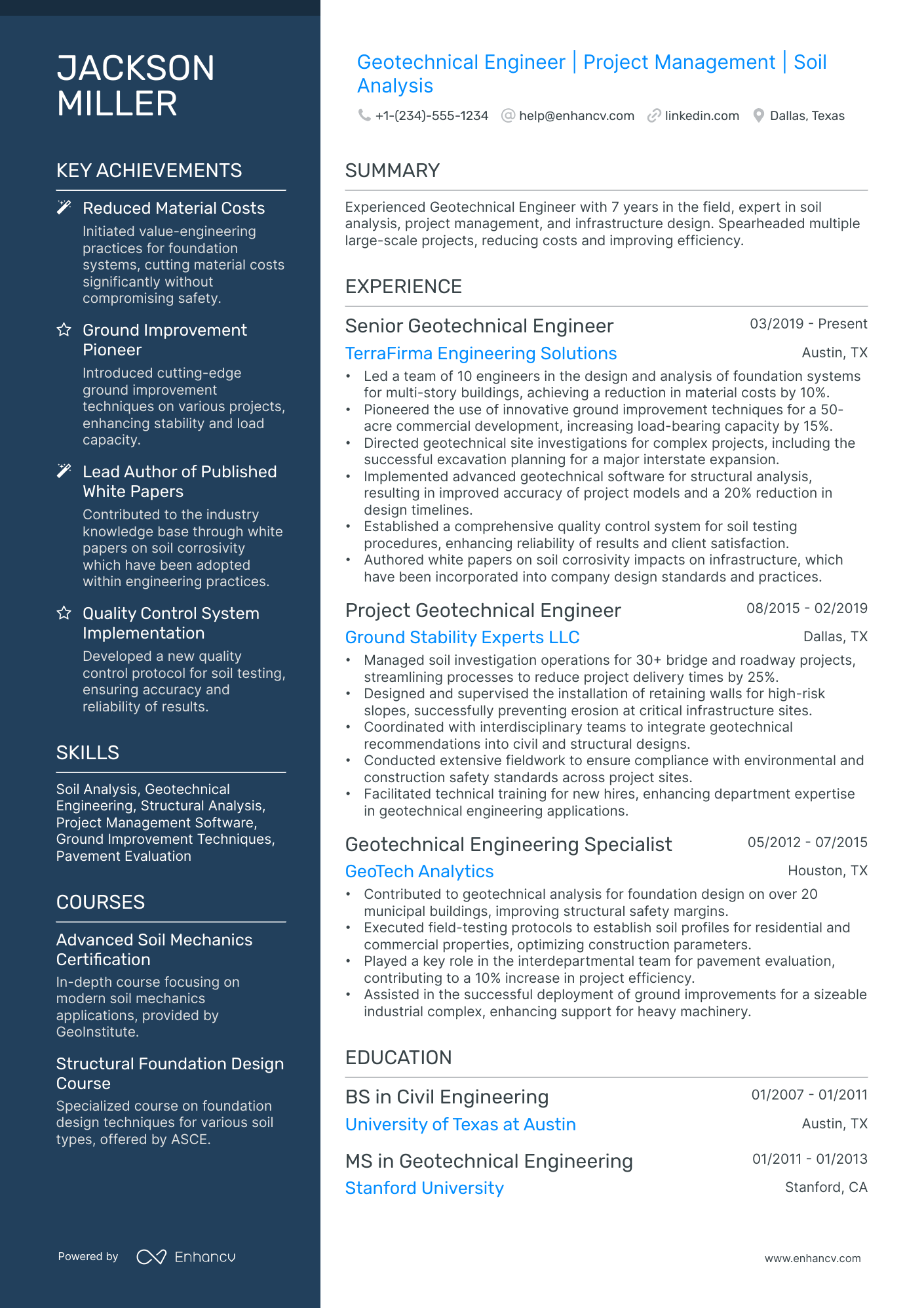
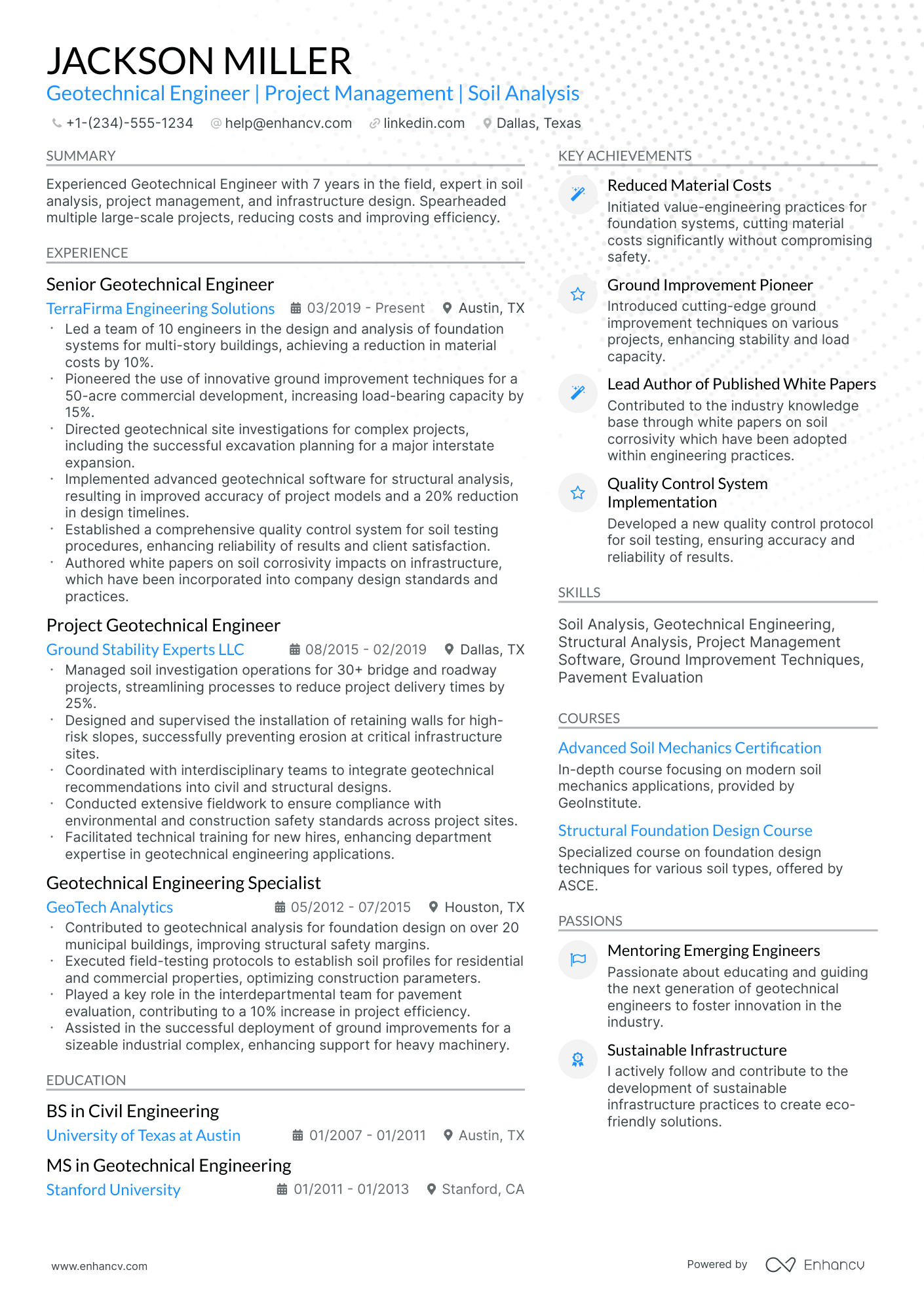
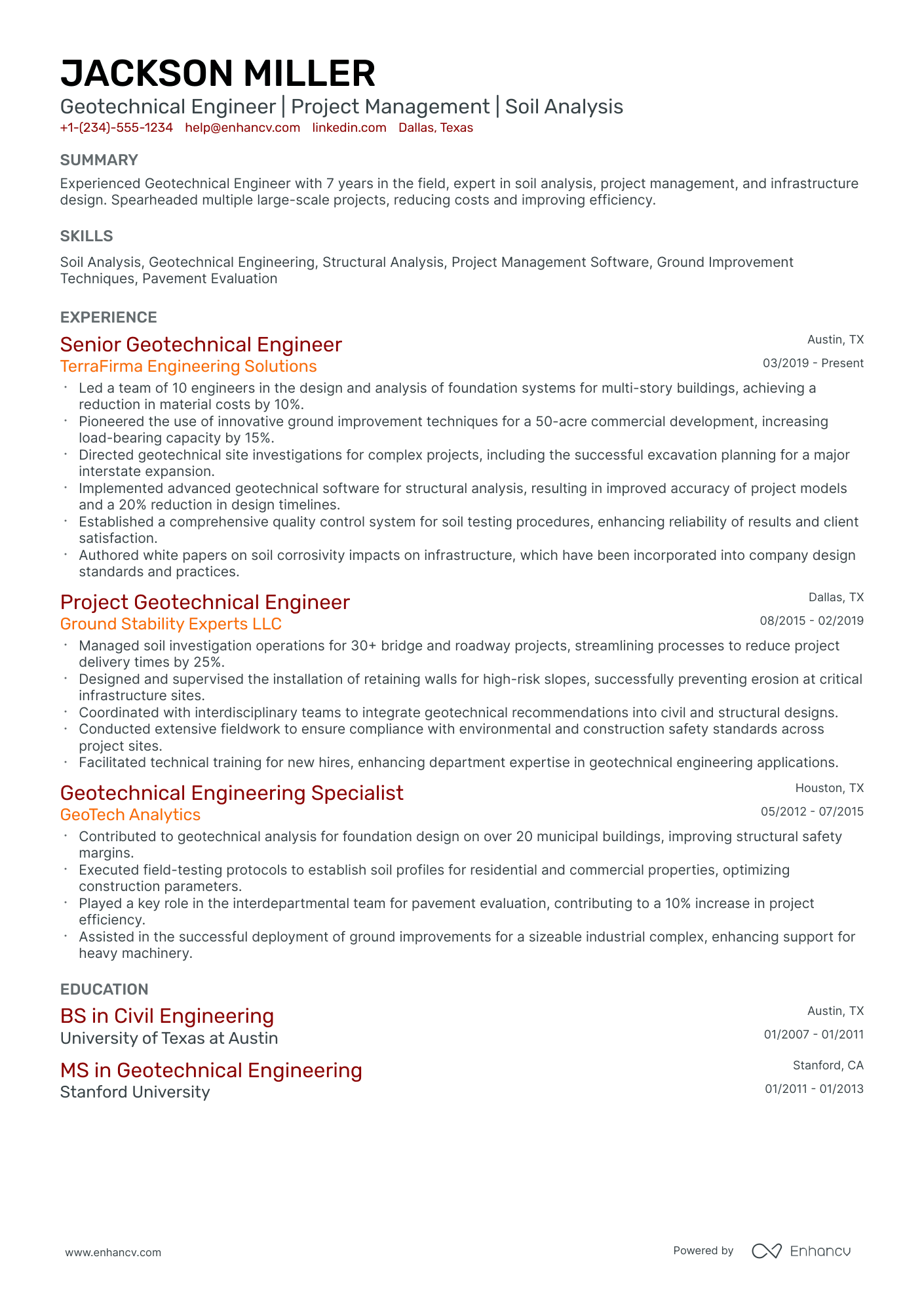
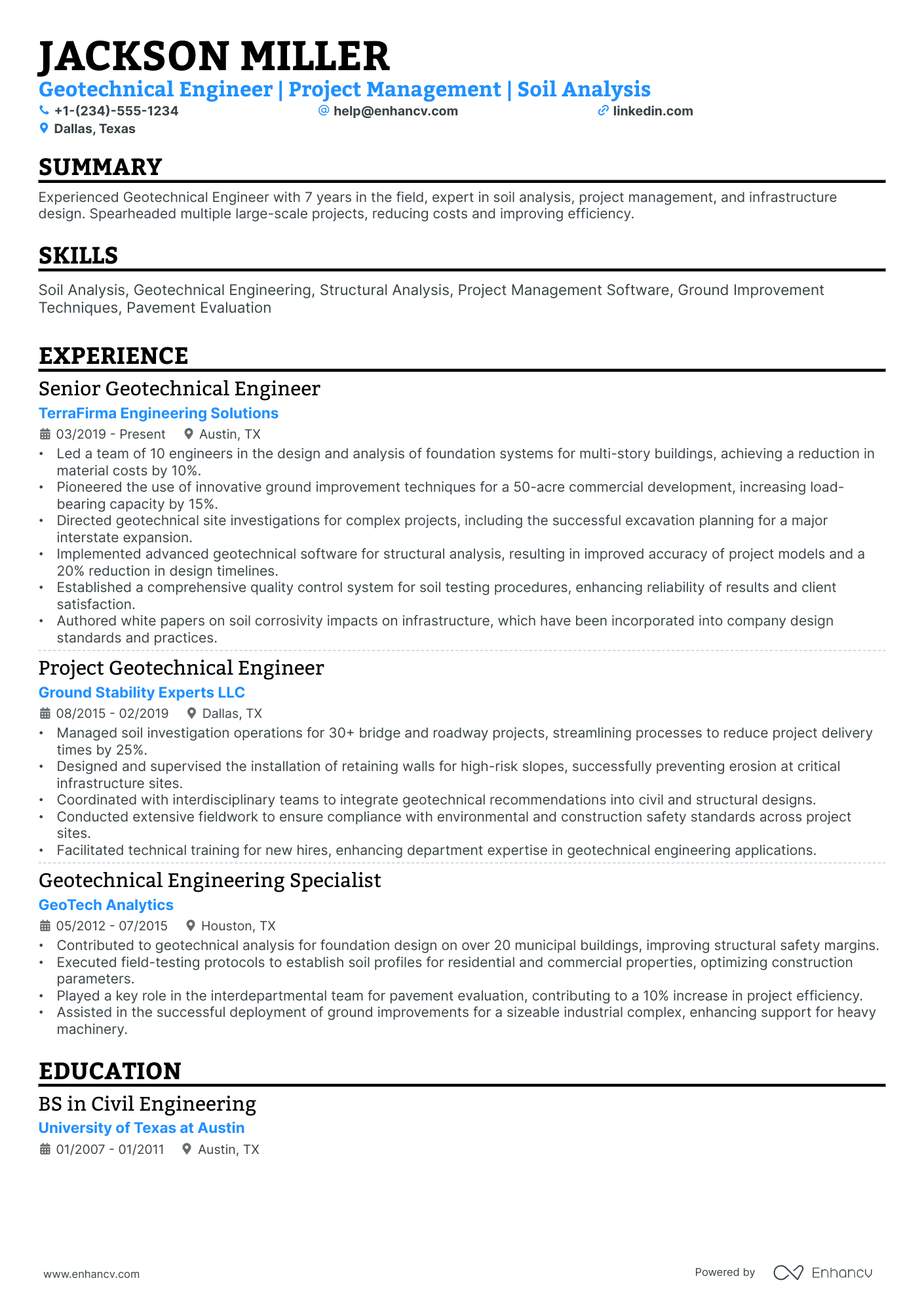
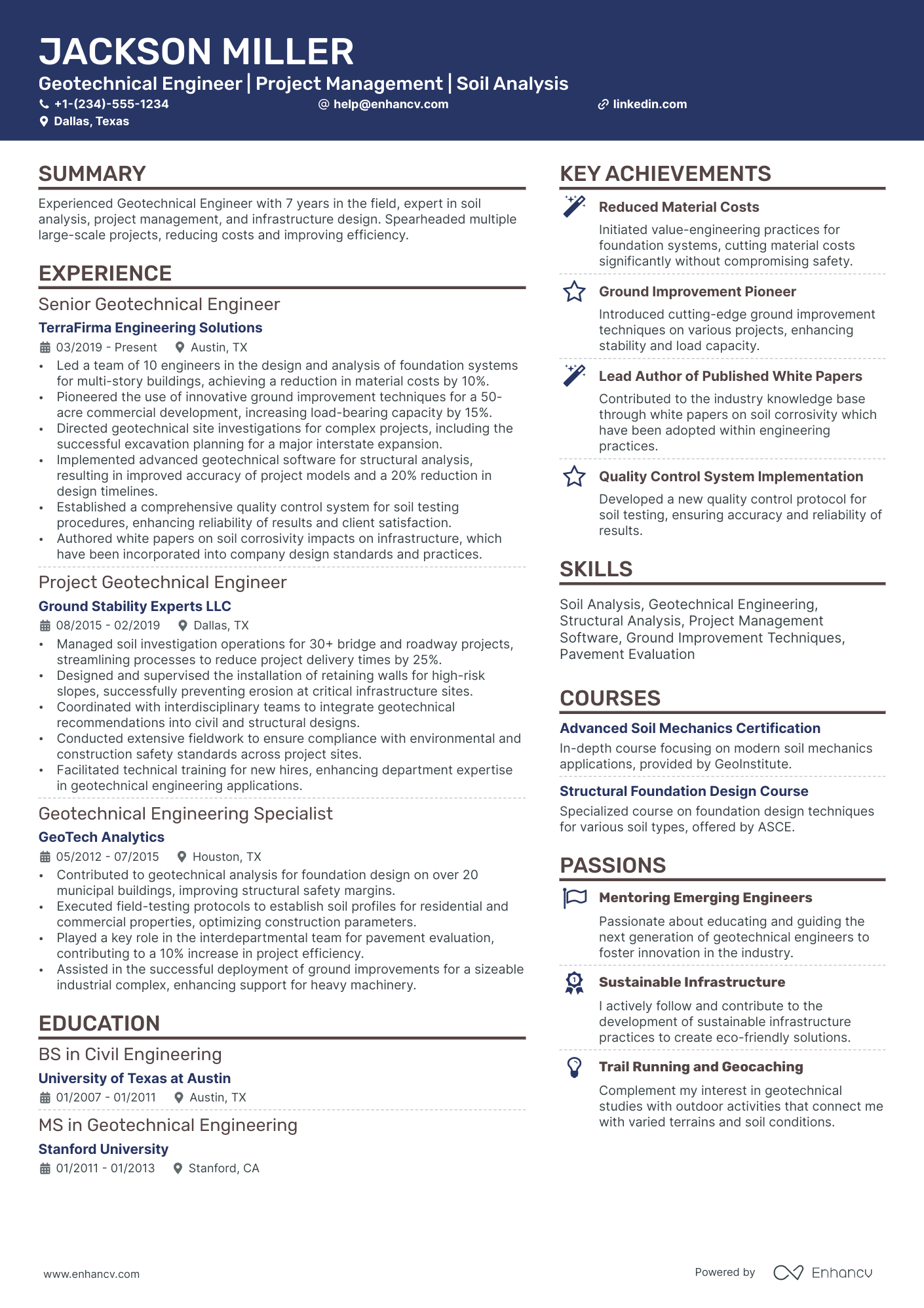
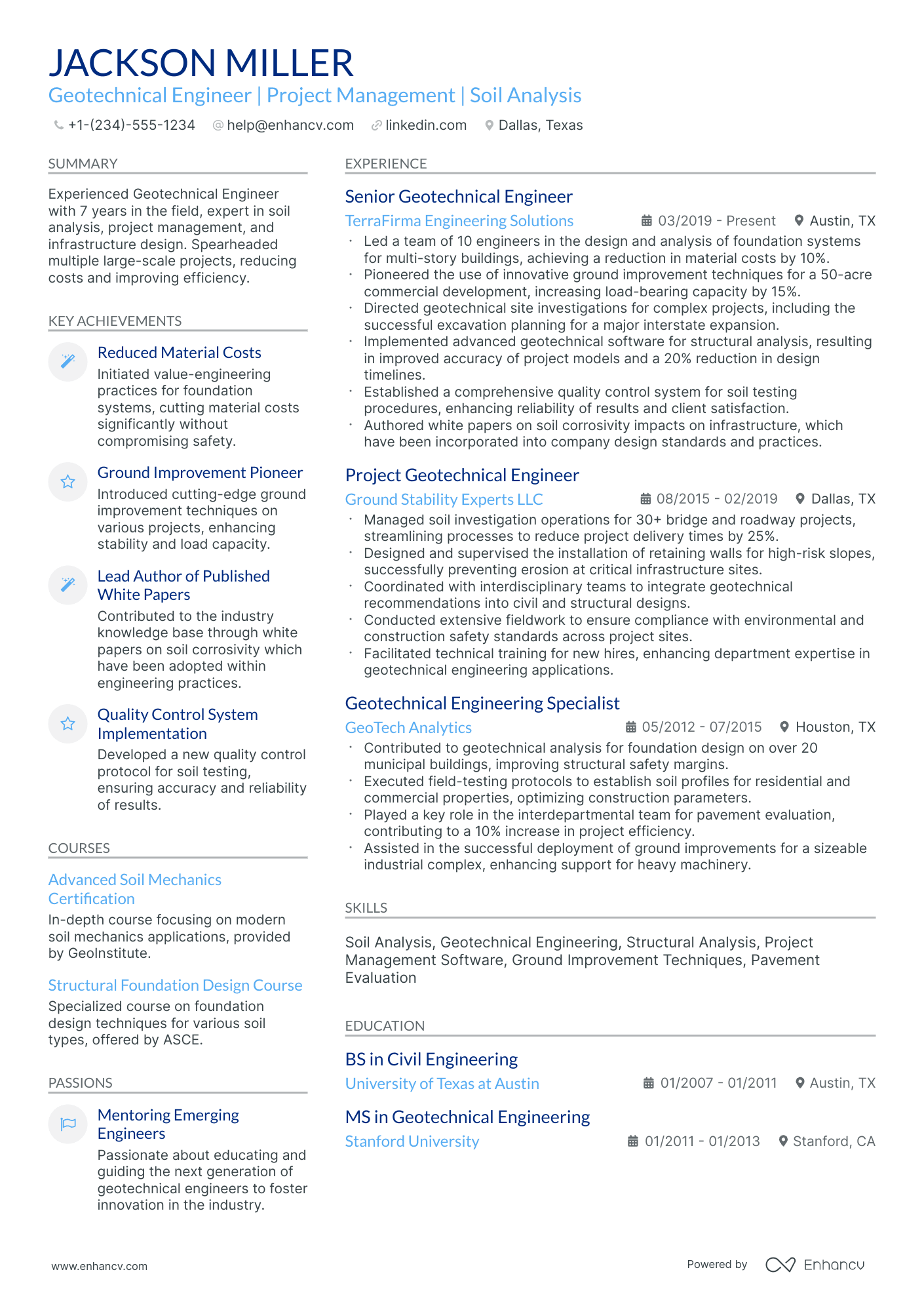
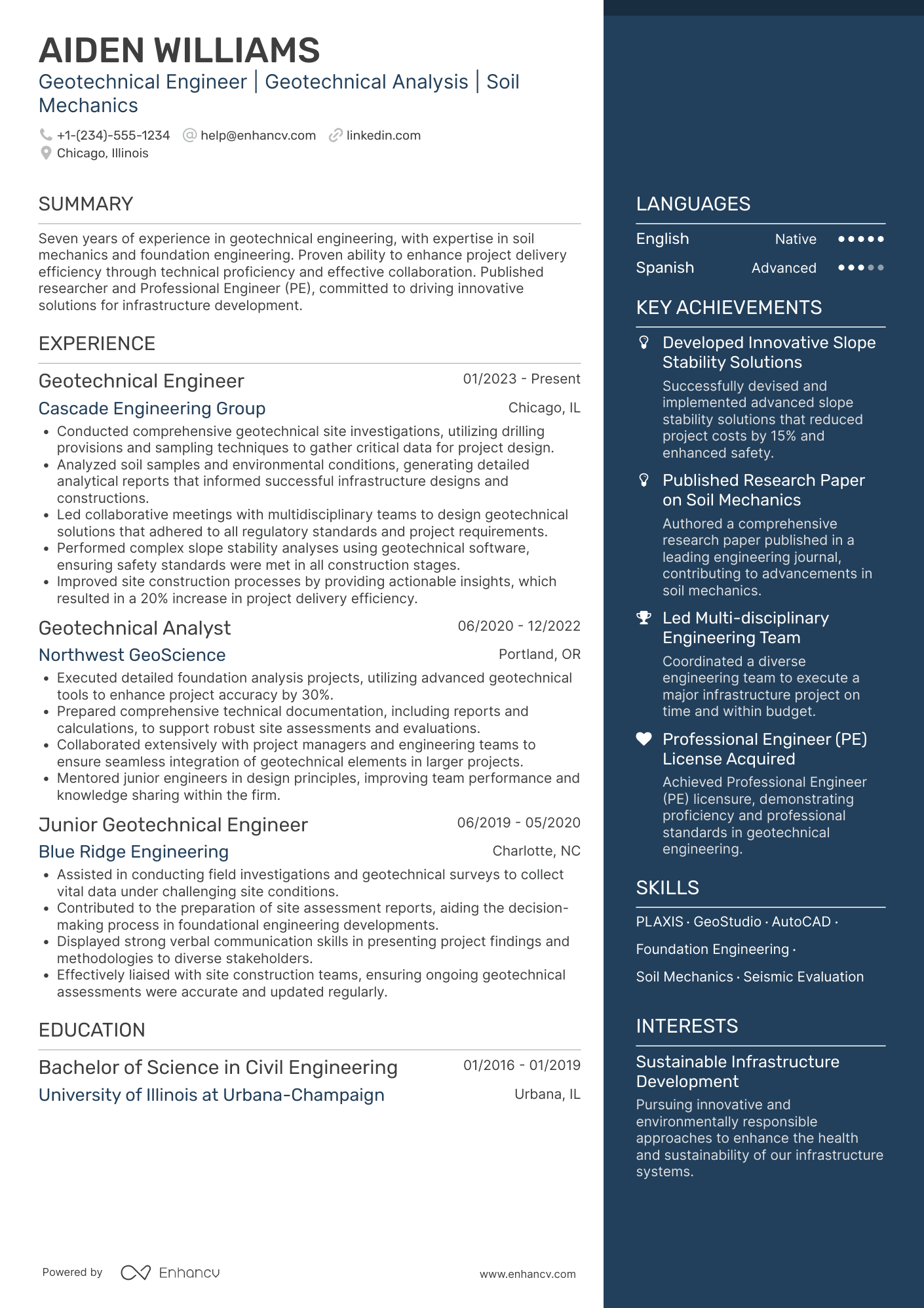
Most geotechnical resumes fail because they bury project outcomes under dense soil test details and generic duties. A geotechnical engineering resume must pass ATS keyword checks and win a fast recruiter scan in a crowded market. Understanding how to make your resume stand out is essential in this competitive field.
This guide shows you how to lead with results: reduced settlement risk, improved factor of safety, and cut change orders. You'll highlight value through scope, budgets, schedules, and measurable quality gains, such as fewer RFIs and faster permit approvals.

Key takeaways
- Lead every experience bullet with measurable outcomes like cost savings, risk reduction, or schedule gains.
- Tailor resume keywords to each job posting's specific software, codes, and soil testing methods.
- Use reverse-chronological format for experienced engineers and hybrid format for career changers or juniors.
- Quantify achievements with concrete metrics—foundation costs cut, change orders reduced, report turnaround shortened.
- Demonstrate skills in context within your summary and experience bullets, not just in isolated lists.
- Pair geotechnical certifications like PE or EIT with education to strengthen recruiter credibility checks.
- Use Enhancv's tools to turn vague duty statements into sharp, results-driven bullet points.
Job market snapshot for geotechnical engineerings
We analyzed 235 recent geotechnical engineering job ads across major US job boards. These numbers help you understand career growth patterns, employment type trends, role specialization trends at a glance.
What level of experience employers are looking for geotechnical engineerings
| Years of Experience | Percentage found in job ads |
|---|---|
| 1–2 years | 2.6% (6) |
| 3–4 years | 3.8% (9) |
| 5–6 years | 8.5% (20) |
| 7–8 years | 7.7% (18) |
| 9–10 years | 6.4% (15) |
| 10+ years | 11.1% (26) |
| Not specified | 60.0% (141) |
Geotechnical engineering ads by area of specialization (industry)
| Industry (Area) | Percentage found in job ads |
|---|---|
| Finance & Banking | 57.0% (134) |
| Healthcare | 24.3% (57) |
| Professional Services | 6.0% (14) |
Top companies hiring geotechnical engineerings
| Company | Percentage found in job ads |
|---|---|
| WSP | 8.9% (21) |
| Actalent | 7.7% (18) |
| Terracon | 6.0% (14) |
| Langan | 5.5% (13) |
| Tetra Tech, Inc. | 5.5% (13) |
| Engineering Consulting Services, Ltd. | 4.7% (11) |
| Gannett Fleming | 4.7% (11) |
| HDR, Inc. | 4.3% (10) |
Role overview stats
These tables show the most common responsibilities and employment types for geotechnical engineering roles. Use them to align your resume with what employers expect and to understand how the role is structured across the market.
Day-to-day activities and top responsibilities for a geotechnical engineering
| Responsibility | Percentage found in job ads |
|---|---|
| Geotechnical engineering | 64.3% (151) |
| Civil engineering | 36.6% (86) |
| Project management | 26.4% (62) |
| Autocad | 17.4% (41) |
| Microsoft office | 11.1% (26) |
| Gint | 10.6% (25) |
| Foundation design | 10.2% (24) |
| Civil 3d | 9.4% (22) |
| Lpile | 8.9% (21) |
| Slope stability | 8.9% (21) |
| Excel | 8.5% (20) |
| Plaxis | 7.7% (18) |
Type of employment (remote vs on-site vs hybrid)
| Employment type | Percentage found in job ads |
|---|---|
| On-site | 78.3% (184) |
| Hybrid | 17.0% (40) |
| Remote | 4.7% (11) |
How to format a geotechnical engineering resume
Recruiters hiring for geotechnical engineering roles prioritize technical competency in soil mechanics, foundation design, and site investigation alongside demonstrated project experience and clear problem-solving outcomes. Your resume format determines how quickly a reviewer can identify these signals, so choosing the right structure ensures your strongest qualifications surface within the first few seconds of screening.

I have significant experience in this role—which format should I use?
Use a reverse-chronological format to present your geotechnical engineering career in a clear, linear progression that highlights growing project scope and technical responsibility. Do:
- Lead each position with your scope of ownership—project scale, team size, client type, and the geotechnical domains you managed (slope stability, deep foundations, ground improvement, seismic hazard analysis).
- Highlight proficiency in role-specific tools and methodologies such as PLAXIS, GeoStudio, LPILE, gINT, cone penetration testing interpretation, and geotechnical report authorship.
- Quantify outcomes tied to cost savings, risk mitigation, schedule performance, or design optimization so reviewers can measure your direct impact on project delivery.
I'm junior or switching into this role—what format works best?
A hybrid format works best because it lets you lead with relevant geotechnical skills and academic training while still showing your work or project history in chronological order. Do:
- Place a dedicated skills section near the top of your resume featuring core geotechnical competencies—soil classification, laboratory testing (Atterberg limits, triaxial, consolidation), and software like SLOPE/W or Settle3D.
- Include academic capstone projects, internships, or fieldwork placements that involved subsurface investigation, geotechnical report writing, or earthwork monitoring, even if they weren't formal employment.
- Connect each experience entry to a clear action and result so hiring managers see how your contributions led to tangible project outcomes.
Why not use a functional resume?
A functional resume strips away the project timelines and employer context that geotechnical hiring managers rely on to verify where and how you applied your technical skills.
- Career changers from adjacent fields (civil engineering, geology, environmental science) who have transferable skills in site investigation, soil testing, or geotechnical software but lack a direct geotechnical job title.
- Recent graduates with gaps between graduation and employment who completed relevant thesis research, field practicums, or EIT-level project work that demonstrates applied geotechnical knowledge.
- A functional format is acceptable only when you have no direct geotechnical employment history but can tie every listed skill to a specific project, lab outcome, or fieldwork result that proves applied competency.
With your format established, the next step is filling it with the right sections to present your qualifications effectively.
What sections should go on a geotechnical engineering resume
Recruiters expect to see clear evidence of your field and office geotechnical work, technical scope, and project outcomes. Knowing what to put on a resume helps you prioritize the most impactful information for hiring managers.
Use this structure for maximum clarity:
- Header
- Summary
- Experience
- Skills
- Projects
- Education
- Certifications
- Optional sections: Publications, Research, Professional affiliations
Strong experience bullets should emphasize measurable impact, project scope, key deliverables, and results tied to safety, schedule, cost, and constructability.
Is your resume good enough?
Drop your resume here or choose a file. PDF & DOCX only. Max 2MB file size.
Once you’ve organized your resume with the right structure and supporting sections, focus next on writing your experience entries to show impact within that framework.
How to write your geotechnical engineering resume experience
Your work experience section should highlight the geotechnical projects you've delivered, the investigative and analytical methods you applied, and the measurable outcomes your work produced—such as cost savings, risk reductions, or foundation performance improvements. Hiring managers prioritize demonstrated impact on real-world site conditions and engineering solutions over descriptive task lists of routine duties.
Each entry should include:
- Job title
- Company and location (or remote)
- Dates of employment (month and year)
Three to five concise bullet points showing what you owned, how you executed, and what outcomes you delivered:
- Ownership scope: the subsurface investigations, foundation design programs, slope stability analyses, earthwork projects, or client portfolios you were directly accountable for.
- Execution approach: the geotechnical software, field testing methods, laboratory procedures, numerical modeling platforms, or engineering standards you used to evaluate soil and rock conditions and inform design recommendations.
- Value improved: changes to structural reliability, construction safety, design efficiency, project risk profiles, or remediation effectiveness that resulted from your geotechnical analyses and recommendations.
- Collaboration context: how you coordinated with structural engineers, environmental consultants, construction managers, regulatory agencies, or clients to integrate geotechnical findings into broader project delivery.
- Impact delivered: outcomes expressed through project scale, foundation performance, schedule adherence, cost optimization, or hazard mitigation rather than a summary of tasks performed.
Experience bullet formula
A geotechnical engineering experience example
✅ Right example - modern, quantified, specific.
Geotechnical Engineer
TerraPoint Geotechnical | Austin, TX
2022–Present
Consulting firm delivering geotechnical investigations and foundation recommendations for transportation and commercial developments across Central Texas.
- Led subsurface investigations for twelve DOT and private projects using SPT, CPT, and pressuremeter testing; cut field time by 18% by optimizing boring layouts in gINT and coordinating drillers and survey crews.
- Modeled settlement and bearing capacity in PLAXIS 2D and GEO5 using lab results (triaxial, consolidation, Atterberg limits); reduced conservative overdesign by 10% and saved $420K in foundation costs across three sites.
- Designed and reviewed deep foundation and slope stabilization packages (drilled shafts, micropiles, MSE walls) in accordance with AASHTO and local codes; lowered construction change orders by 22% through early constructability reviews with structural and civil engineers.
- Implemented geotechnical instrumentation and monitoring plans (inclinometers, piezometers, settlement plates) with automated dashboards; improved risk detection lead time by two weeks and prevented one potential excavation instability incident.
- Authored forty-five geotechnical reports and geologic hazard memos with clear recommendations and QA checks; improved first-pass client acceptance to 96% by standardizing templates and aligning deliverables with project managers and permitting reviewers.
Now that you've seen how to structure a strong experience entry, let's focus on adjusting it to match the specific job posting you're targeting.
How to tailor your geotechnical engineering resume experience
Recruiters evaluate geotechnical engineering resumes through both human review and applicant tracking systems (ATS), screening for specific qualifications before scheduling interviews. Tailoring your resume to the job description ensures your most relevant work rises to the top.
Ways to tailor your geotechnical engineering experience:
- Match soil testing methods and software listed in the posting.
- Mirror the exact geotechnical standards or codes they reference.
- Use their terminology for site investigation or subsurface exploration.
- Highlight foundation design work relevant to their project types.
- Emphasize slope stability or seismic analysis if the role requires it.
- Include specific soil or rock classification systems they mention.
- Reflect their collaboration structure with structural or civil teams.
- Reference field instrumentation or monitoring tools from the description.
Tailoring means aligning your real project achievements with the role's stated requirements, not forcing disconnected keywords into your experience bullets.
Resume tailoring examples for geotechnical engineering
| Job description excerpt | Untailored | Tailored |
|---|---|---|
| Perform slope stability analyses using SLOPE/W and develop geotechnical recommendations for grading plans in mountainous terrain. | Conducted various analyses and provided recommendations for engineering projects. | Performed slope stability analyses using SLOPE/W for 12 residential grading projects in mountainous terrain, delivering geotechnical recommendations that reduced cut-slope failures by 30%. |
| Design deep foundation systems, including drilled shafts and driven piles, using LPILE and APILE software for transportation infrastructure. | Assisted with foundation design tasks and prepared engineering reports. | Designed drilled shaft and driven pile foundations for three highway bridge projects using LPILE and APILE, sizing over 200 deep foundation elements to meet AASHTO load and settlement criteria. |
| Conduct subsurface investigations, supervise drilling operations, and prepare geotechnical reports with soil bearing capacity recommendations for commercial developments. | Participated in fieldwork and wrote technical documents for clients. | Supervised 15 subsurface investigations using hollow-stem auger and mud rotary drilling methods, interpreting SPT and CPT data to develop soil bearing capacity recommendations for commercial developments up to 250,000 square feet. |
Once you’ve aligned your experience with the role’s geotechnical priorities, quantify your geotechnical engineering achievements to show the scale and impact of that work.
How to quantify your geotechnical engineering achievements
Quantifying your achievements proves your designs and recommendations reduced risk, improved constructability, and protected budgets and schedules. Focus on safety factors, settlement predictions, change orders prevented, testing throughput, cost savings, schedule gains, and claims avoided.
Quantifying examples for geotechnical engineering
| Metric | Example |
|---|---|
| Risk reduction | "Lowered liquefaction risk by updating CPT-based triggering analysis in GeoStudio, raising minimum factor of safety from 1.05 to 1.25 across twelve building pads." |
| Cost savings | "Saved $420,000 by optimizing drilled shaft lengths using LPILE and load test data, cutting average embedment by six feet on forty-eight shafts." |
| Delivery speed | "Cut geotechnical report turnaround from fifteen to nine business days by standardizing boring logs in gINT and automating lab result imports." |
| Quality accuracy | "Reduced settlement prediction error from ±25% to ±10% by calibrating PLAXIS 2D models with oedometer data and field plate load tests." |
| Testing throughput | "Increased field investigation throughput by 30% by coordinating two drill rigs and a CPT truck, completing 110 borings and 60 CPTs in six weeks." |
Turn vague job duties into measurable, recruiter-ready resume bullets in seconds with Enhancv's Bullet Point Generator.
Once you've crafted strong, results-driven bullet points for your experience section, it's equally important to strategically present your technical expertise and interpersonal strengths in a dedicated skills section.
How to list your hard and soft skills on a geotechnical engineering resume
Your skills section shows you can evaluate subsurface risk and deliver buildable recommendations, and recruiters and applicant tracking systems scan this section for job-match keywords and tools; aim for a balanced mix of hard skills and job-specific soft skills.
geotechnical engineering roles require a blend of:
- Product strategy and discovery skills
- Data, analytics, and experimentation skills
- Delivery, execution, and go-to-market discipline
- Soft skills
Your skills section should be:
- Scannable (bullet-style grouping).
- Relevant to the job post.
- Backed by proof in experience bullets.
- Updated with current tools.
Place your skills section:
- Above experience if you're junior or switching careers.
- Below experience if you're mid/senior with strong achievements.

Hard skills
- Subsurface investigation planning
- Soil classification, USCS
- SPT, CPT, DCP interpretation
- Laboratory testing, ASTM standards
- Slope stability analysis
- Settlement and bearing capacity
- Seepage and dewatering design
- Liquefaction triggering analysis
- Retaining wall design
- Deep foundations, drilled shafts
- PLAXIS, GeoStudio, gINT
Soft skills
- Write clear geotechnical reports
- Translate data into design actions
- Present risk and contingencies
- Coordinate with civil and structural teams
- Align recommendations to code and scope
- Lead field staff and drillers
- Resolve RFIs with evidence
- Prioritize safety and quality controls
- Manage schedules and submittals
- Document assumptions and limitations
- Defend recommendations to reviewers
- Escalate issues early and clearly
How to show your geotechnical engineering skills in context
Skills shouldn't appear only in isolated lists on your resume. Explore curated examples of resume skills to see how professionals in various fields present their competencies effectively.
They should be demonstrated in:
- Your summary (high-level professional identity)
- Your experience (proof through outcomes)
Here's how that looks in practice.
Summary example
Senior geotechnical engineer with 12 years of experience in foundation design and slope stability analysis. Skilled in PLAXIS, GeoStudio, and subsurface investigation programs. Reduced project redesign rates by 30% through improved site characterization workflows and cross-disciplinary coordination.
- Reflects senior-level expertise clearly
- Names industry-standard tools directly
- Quantifies a meaningful project outcome
- Highlights collaboration as a strength
Experience example
Senior Geotechnical Engineer
Terravant Consulting Group | Denver, CO
March 2018–Present
- Led PLAXIS-based finite element analyses for deep foundation projects, cutting design revision cycles by 25% across eight major builds.
- Collaborated with structural and environmental teams to develop slope remediation plans, reducing landslide risk ratings by 40% at two critical sites.
- Directed subsurface exploration programs using CPT and SPT methods, improving soil characterization accuracy and saving $180K in unnecessary foundation overdesign.
- Every bullet includes measurable proof
- Skills appear naturally within achievements
Once you’ve tied your geotechnical engineering strengths to real coursework, lab work, and project outcomes, the next step is applying that same approach to building a geotechnical engineering resume when you don’t have professional experience.
How do I write a geotechnical engineering resume with no experience
Even without full-time experience, you can demonstrate readiness through:
- Senior design capstone geotechnical report
- Soil mechanics lab testing results
- Site investigation fieldwork coursework
- Internship with drilling contractor
- Undergraduate research on soil stabilization
- GIS mapping for subsurface data
- AutoCAD cross-sections for borings
- ASTM-standard lab procedures practice
Our guide on building a resume without work experience covers additional strategies for showcasing your qualifications when you lack formal employment history.
Focus on:
- Soil classification and lab methods
- Boring logs and field notes
- Geotechnical calculations and software
- Clear, quantified project results
Resume format tip for entry-level geotechnical engineering
Use a skills-forward hybrid resume format because it highlights geotechnical engineering projects, coursework, and tools before limited work history. Do:
- Put "Projects" above "Experience."
- List lab tests you ran and standards used.
- Name tools like gINT and GeoStudio.
- Quantify scope: samples, borings, depths.
- Add relevant coursework with deliverables.
- Built gINT boring logs from three CPT soundings and six SPT borings, flagged two liquefiable layers, and reduced footing settlement estimate by 18%.
Even without professional experience, your academic background can carry significant weight—here's how to present it effectively.
How to list your education on a geotechnical engineering resume
Your education section helps hiring teams confirm you hold the foundational knowledge geotechnical engineering demands. It validates your technical training in soil mechanics, geology, and structural analysis.
Include:
- Degree name
- Institution
- Location
- Graduation year
- Relevant coursework (for juniors or entry-level candidates)
- Honors & GPA (if 3.5 or higher)
List your graduation year only. Avoid adding specific months or days.
Example education entry
Here's a strong education entry tailored to geotechnical engineering:
Master of Science in Civil Engineering (Geotechnical Concentration)
Virginia Polytechnic Institute and State University, Blacksburg, VA
Graduated 2022 | GPA: 3.8/4.0
- Relevant Coursework: Soil Mechanics, Foundation Engineering, Earth Retaining Structures, Engineering Geology, Slope Stability Analysis
- Honors: Dean's List (all semesters), Outstanding Graduate Research Award in Geotechnical Engineering
How to list your certifications on a geotechnical engineering resume
Certifications on your resume show your commitment to learning, proficiency with geotechnical engineering tools and methods, and alignment with current industry standards and safety expectations.
Include:
- Certificate name
- Issuing organization
- Year
- Optional: credential ID or URL
- Place certifications below education when your degree is recent and your certifications add secondary support.
- Place certifications above education when they are recent, highly relevant to geotechnical engineering, or required for the role.
Best certifications for your geotechnical engineering resume
Professional Engineer (PE) License Engineer in Training (EIT) Certification OSHA 30-Hour Construction Safety Certification ACI Concrete Field Testing Technician—Grade I NICET Geotechnical Engineering Technology Certification Certified Floodplain Manager (CFM) Envision Sustainability Professional (ENV SP)
Once you’ve positioned your credentials where hiring teams can verify them quickly, shift to your geotechnical engineering resume summary to connect those qualifications to the value you deliver.
How to write your geotechnical engineering resume summary
Your resume summary is the first thing a recruiter reads. A strong opening tied to geotechnical engineering signals immediate relevance and earns a closer look.
Keep it to three to four lines, with:
- Your title and years of experience in geotechnical engineering.
- Domain focus such as foundation design, slope stability, or site characterization.
- Core tools like PLAXIS, GeoStudio, LPILE, or finite element analysis software.
- One or two quantified achievements showing project impact or cost savings.
- Soft skills tied to real outcomes, such as cross-discipline coordination or client communication.

PRO TIP
At the entry level, emphasize technical tools, relevant coursework, and early project contributions. Highlight specific software proficiency and fieldwork experience. Avoid vague phrases like "passionate learner" or "hard worker." Replace them with concrete skills and measurable results from internships or academic projects.
Example summary for a geotechnical engineering
Geotechnical engineer with two years of experience in foundation design and site investigation. Proficient in PLAXIS and GeoStudio. Reduced soil testing turnaround by 15% through streamlined lab workflows across three commercial projects.
Optimize your resume summary and objective for ATS
Drop your resume here or choose a file.
PDF & DOCX only. Max 2MB file size.
Before your summary can make an impact, recruiters need to find your contact details quickly—which is why a well-structured header sits at the very top of your resume.
What to include in a geotechnical engineering resume header
Your resume header lists your key contact and professional details, helping geotechnical engineering recruiters find you, trust your profile, and screen you fast.
Essential resume header elements
- Full name
- Tailored job title and headline
- Location
- Phone number
- Professional email
- GitHub link
- Portfolio link
A LinkedIn link helps recruiters confirm your experience quickly and supports faster screening.
Don't include a photo on a geotechnical engineering resume unless the role is explicitly front-facing or appearance-dependent.
Match your header title to the job posting and highlight geotechnical engineering specialties like site investigation, slope stability, and foundation design.
Example
Geotechnical engineering resume header
Jordan M. Rivera
Geotechnical Engineer | Site Investigation, Foundation Design, Slope Stability
Denver, CO
(303) 555-01XX
your.name@enhancv.com
github.com/yourname
yourwebsite.com
linkedin.com/in/yourname
Once your contact details and role identifiers are set up clearly at the top, add the optional sections that strengthen your geotechnical engineering resume and provide supporting context.
Additional sections for geotechnical engineering resumes
Additional sections help you stand out when your core qualifications match other candidates. They signal deeper expertise, professional involvement, and real-world credibility specific to geotechnical engineering.
- Publications and technical papers
- Professional certifications and licenses
- Conference presentations
- Languages — listing language skills on your resume can be especially valuable for firms with international projects or multilingual teams.
- Professional affiliations and memberships
- Fieldwork and site investigation experience
- Software proficiencies
Once you've rounded out your resume with relevant additional sections, it's worth ensuring your application package is complete by pairing it with a strong cover letter.
Do geotechnical engineering resumes need a cover letter
A cover letter isn't required for most geotechnical engineering roles, but it helps in competitive openings or when hiring managers expect one. If you're unsure where to start, learning what a cover letter is and how it complements your resume can clarify when to include one. It can make a difference when your resume doesn't clearly show fit, impact, or context.
Use a cover letter to add details your resume can't:
- Explain role and team fit by linking your site, lab, and design experience to the job's typical deliverables and workflows.
- Highlight one or two relevant projects with outcomes, such as reduced settlement risk, fewer change orders, or faster field decisions.
- Show understanding of the business context, including the client, project constraints, schedule risk, and how geotechnical engineering supports design and construction.
- Address career transitions or non-obvious experience by clarifying why your background maps to geotechnical engineering responsibilities and tools.
Drop your resume here or choose a file.
PDF & DOCX only. Max 2MB file size.
Whether you include a cover letter or not, using AI to improve your geotechnical engineering resume follows because it helps you strengthen the document that hiring teams review first.
Using AI to improve your geotechnical engineering resume
AI can sharpen your resume's clarity, structure, and impact. It helps reframe experience into stronger, more targeted language. But overuse strips authenticity. Once your content reads clearly and aligns with your target role, step away from AI. For specific prompt ideas, check out our guide on ChatGPT resume writing prompts.
Here are practical prompts you can copy and paste to strengthen specific sections of your geotechnical engineering resume:
- Strengthen summary — "Rewrite my geotechnical engineering resume summary to highlight relevant specializations, years of experience, and core technical strengths in under four lines."
- Quantify experience — "Add measurable outcomes to these geotechnical engineering experience bullets, focusing on project scope, soil conditions analyzed, and cost or time savings."
- Tailor to job posting — "Compare my geotechnical engineering resume experience section against this job description and suggest edits to improve keyword alignment."
- Clarify technical skills — "Organize my geotechnical engineering skills section into clear categories like software, field testing methods, lab analysis, and design standards."
- Improve project descriptions — "Rewrite these geotechnical engineering project descriptions to emphasize my specific role, methods used, and measurable results delivered."
- Refine education section — "Improve my geotechnical engineering education section by highlighting relevant coursework, thesis work, and academic achievements that support this role."
- Highlight certifications — "Reformat my geotechnical engineering certifications section to clearly show credential name, issuing body, and relevance to the target position."
- Remove weak phrasing — "Identify and replace vague or passive language in my geotechnical engineering resume bullets with direct, action-driven alternatives."
- Focus accomplishments — "Turn these geotechnical engineering job duty statements into accomplishment-driven bullets that show impact on project quality or safety outcomes."
- Trim redundancy — "Find and remove repeated or redundant content across my geotechnical engineering resume without losing important technical details or achievements."
Stop using AI once your resume sounds accurate, specific, and aligned with real experience. AI should never invent experience or inflate claims—if it didn't happen, it doesn't belong here.
Conclusion
A strong geotechnical engineering resume proves impact with measurable outcomes, role-specific skills, and a clean structure. Lead with results like reduced risk, faster approvals, lower costs, and fewer change orders. Back them with concrete numbers, tools, methods, and standards.
Keep each section easy to scan, and align your experience to the role’s needs. Clear project scope, soil and rock testing, field oversight, analysis, and reporting show readiness for today’s hiring market. This approach also supports near-future roles as requirements and timelines tighten.