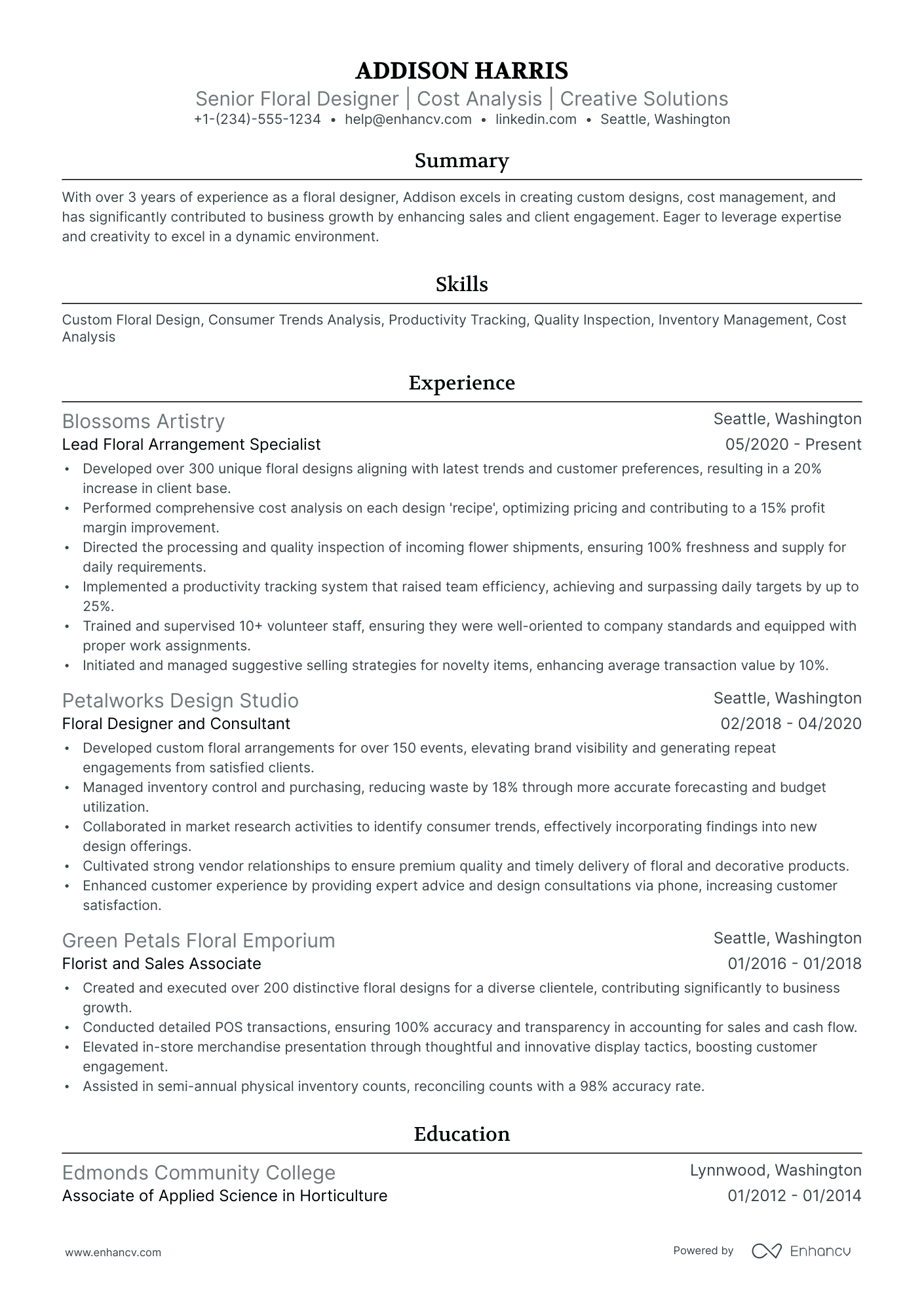
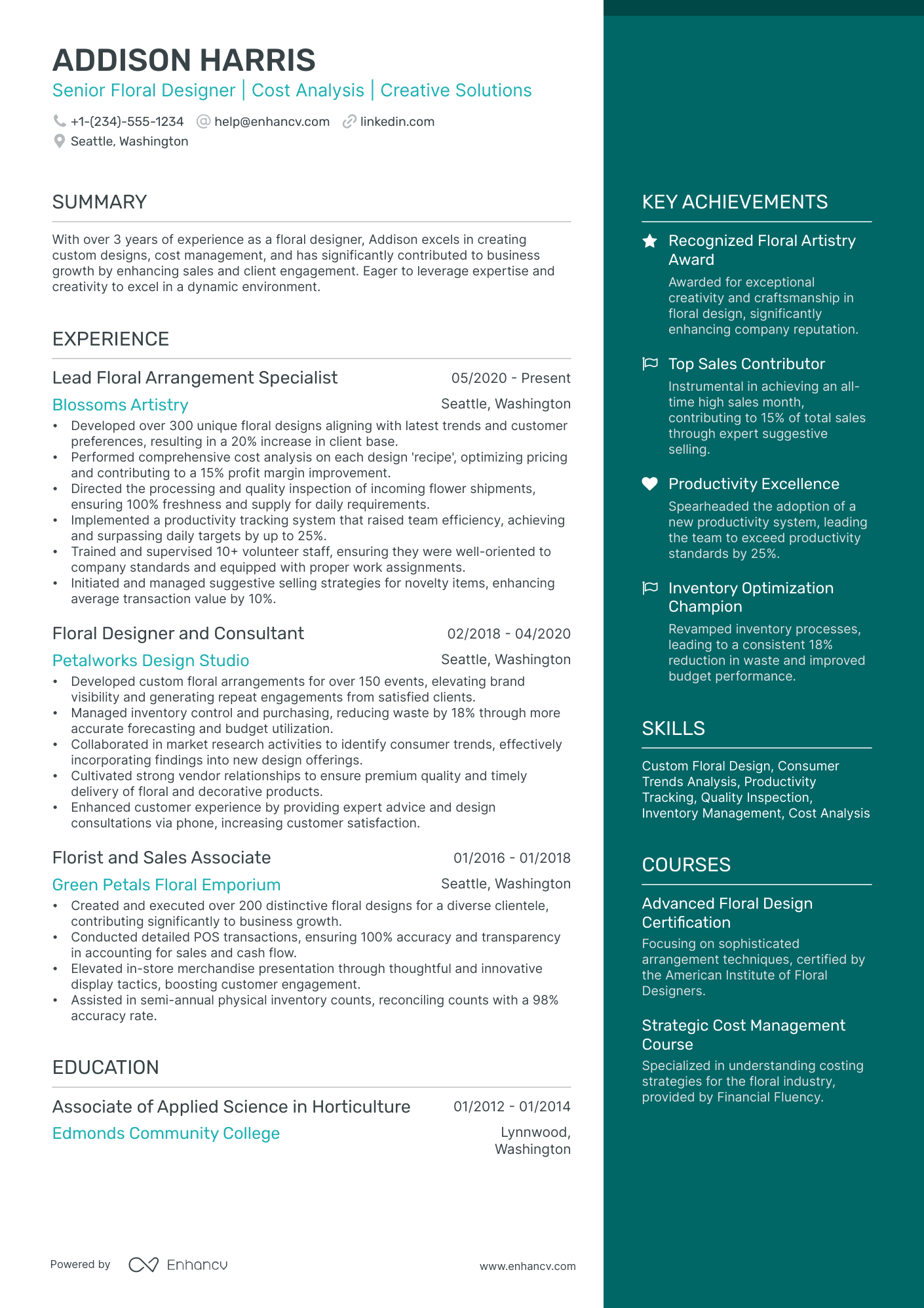
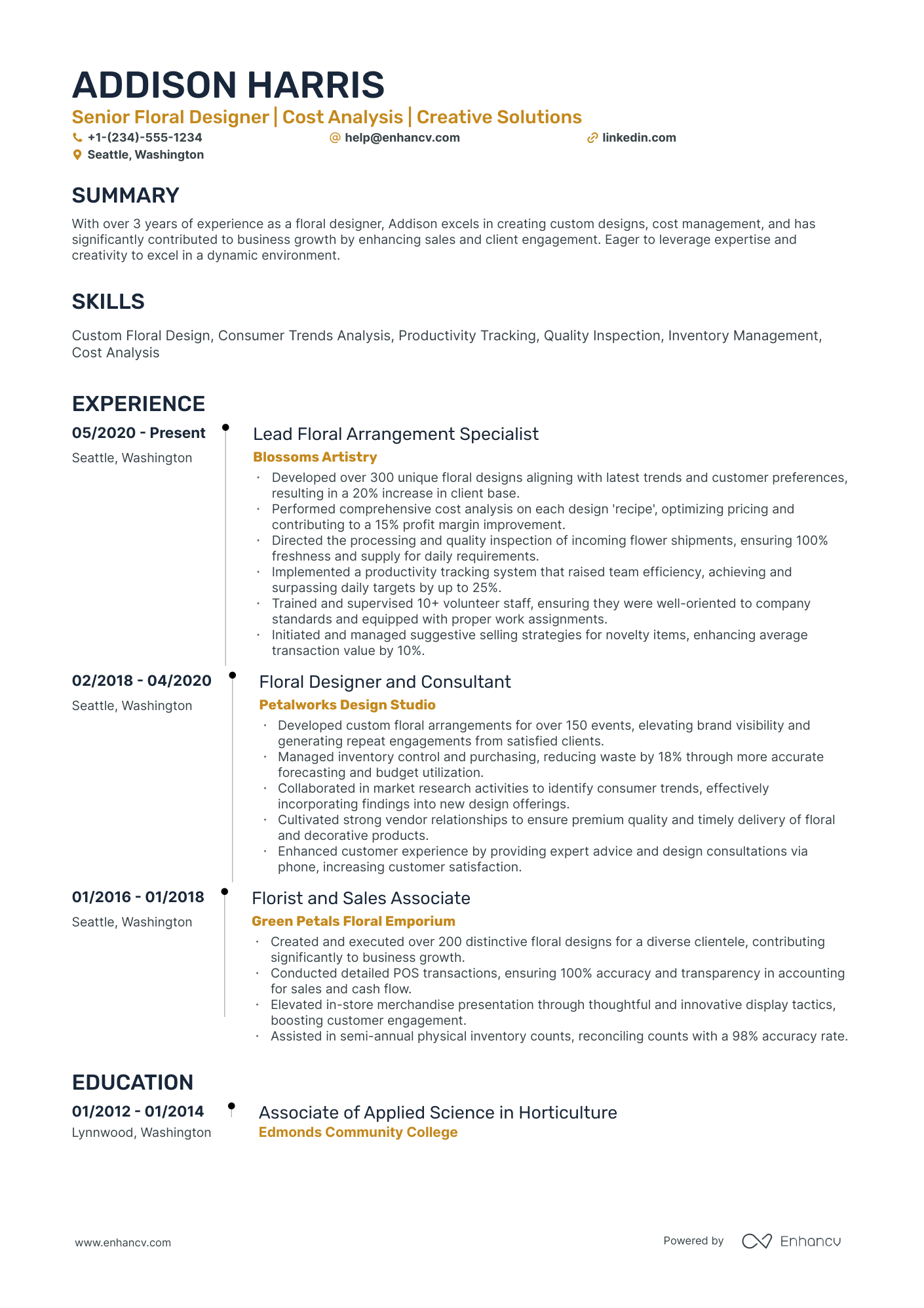
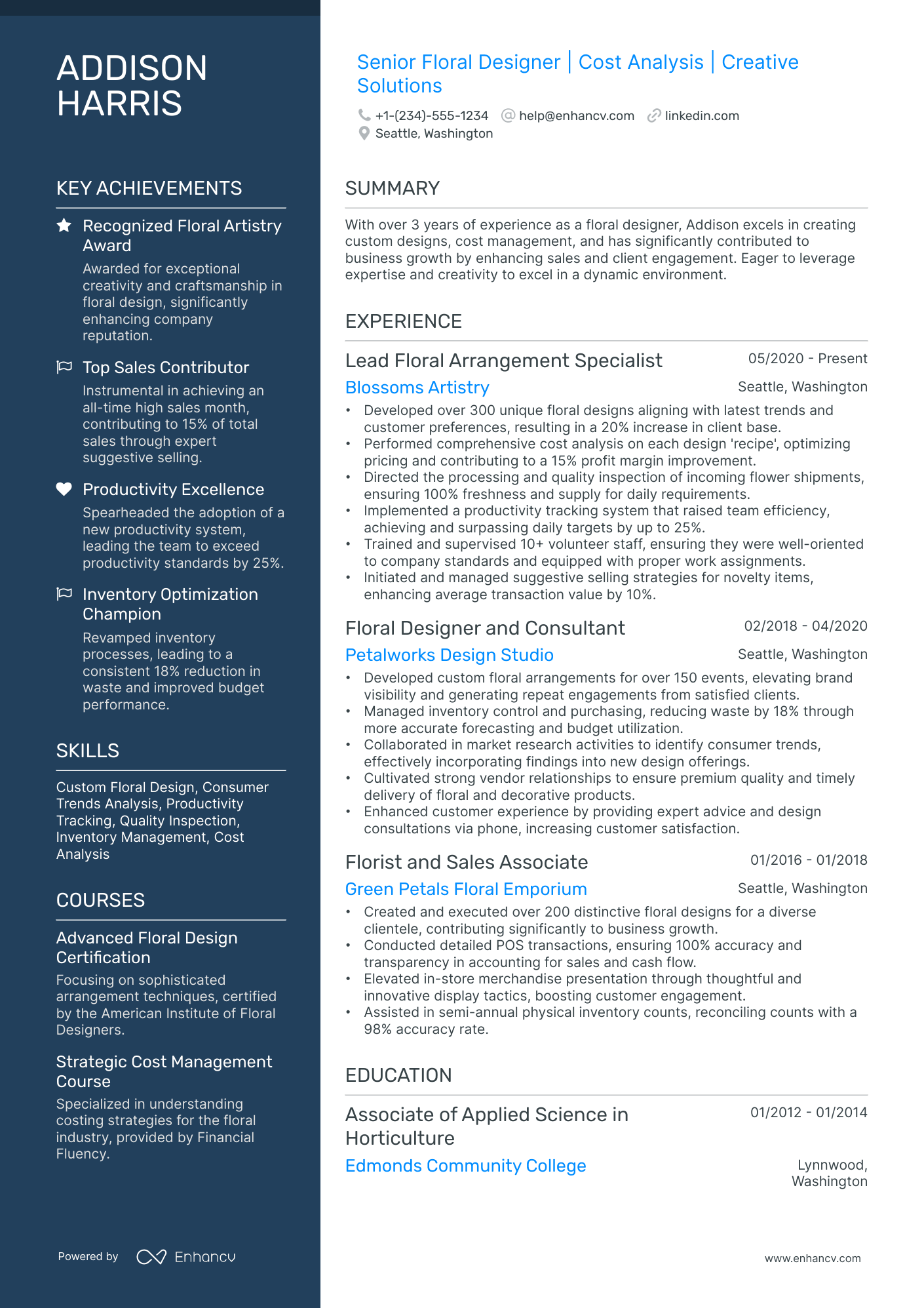
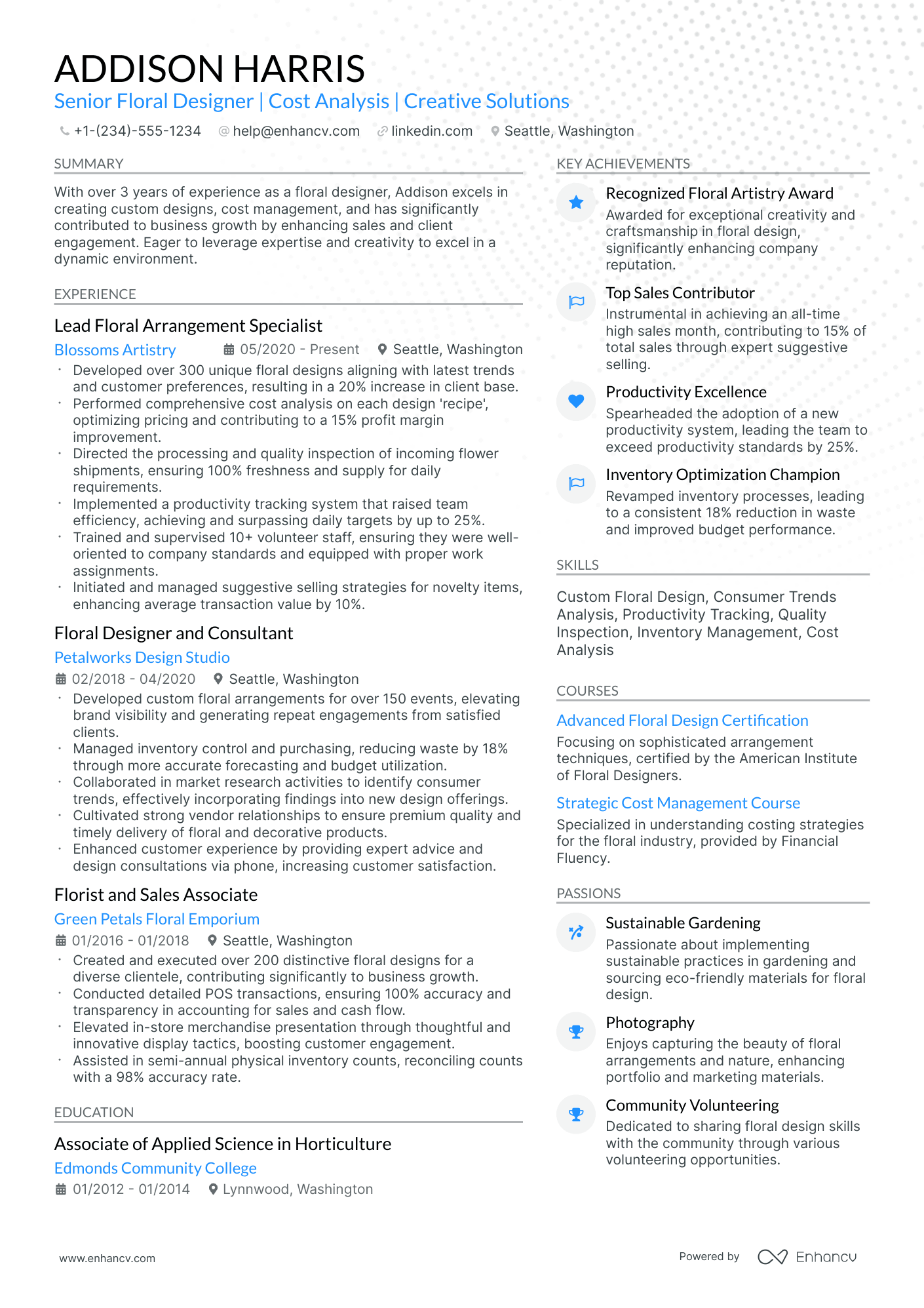
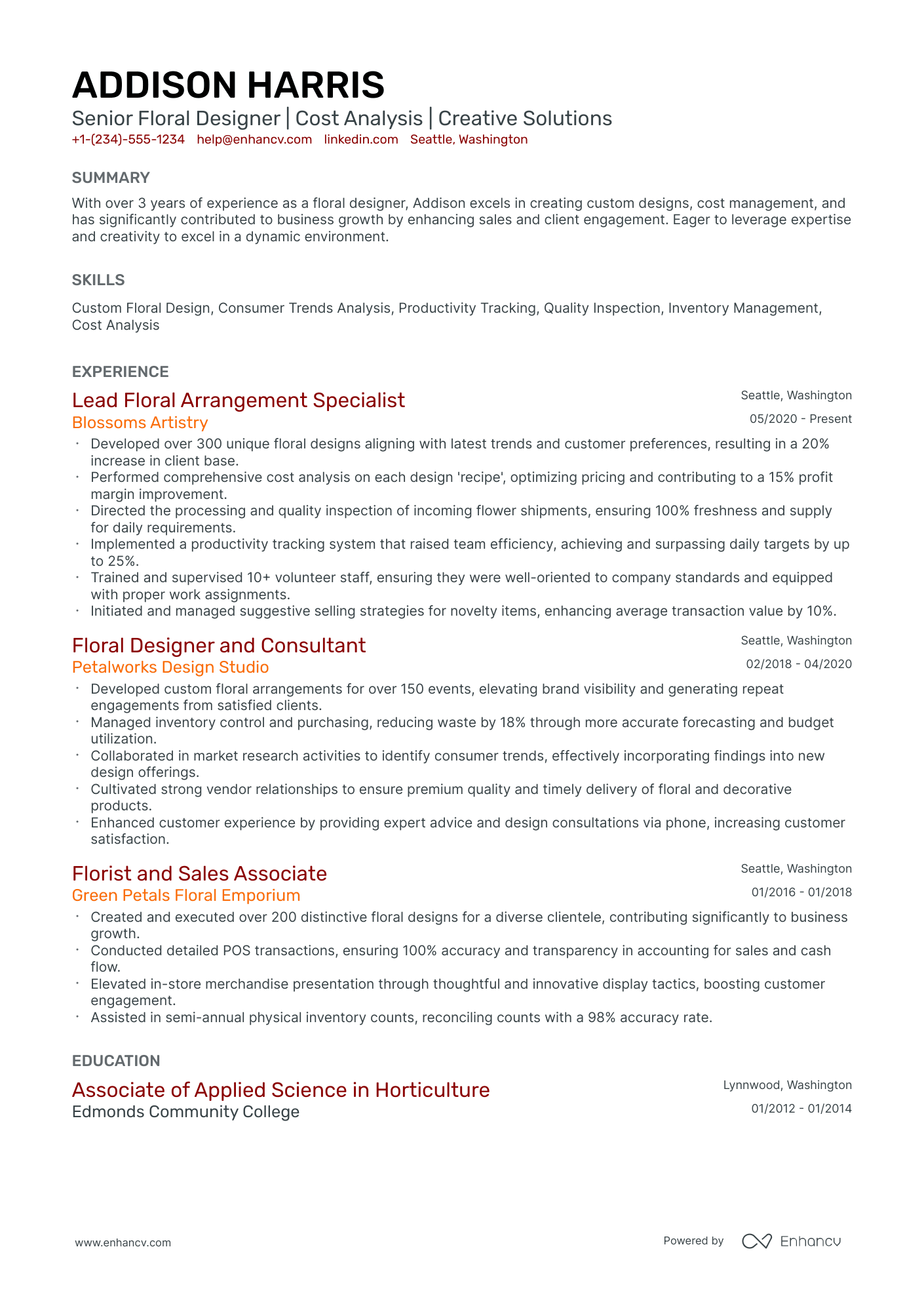
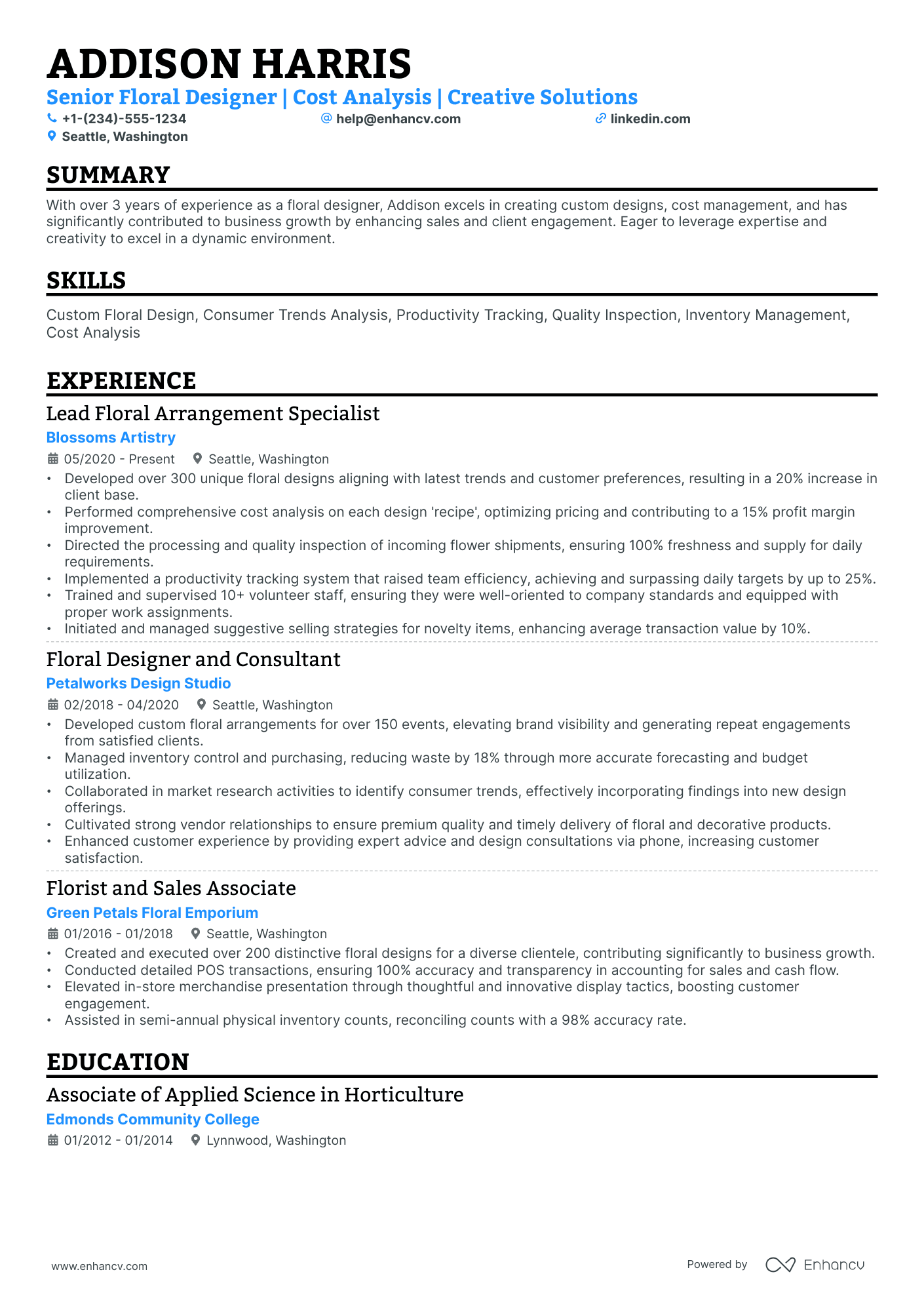
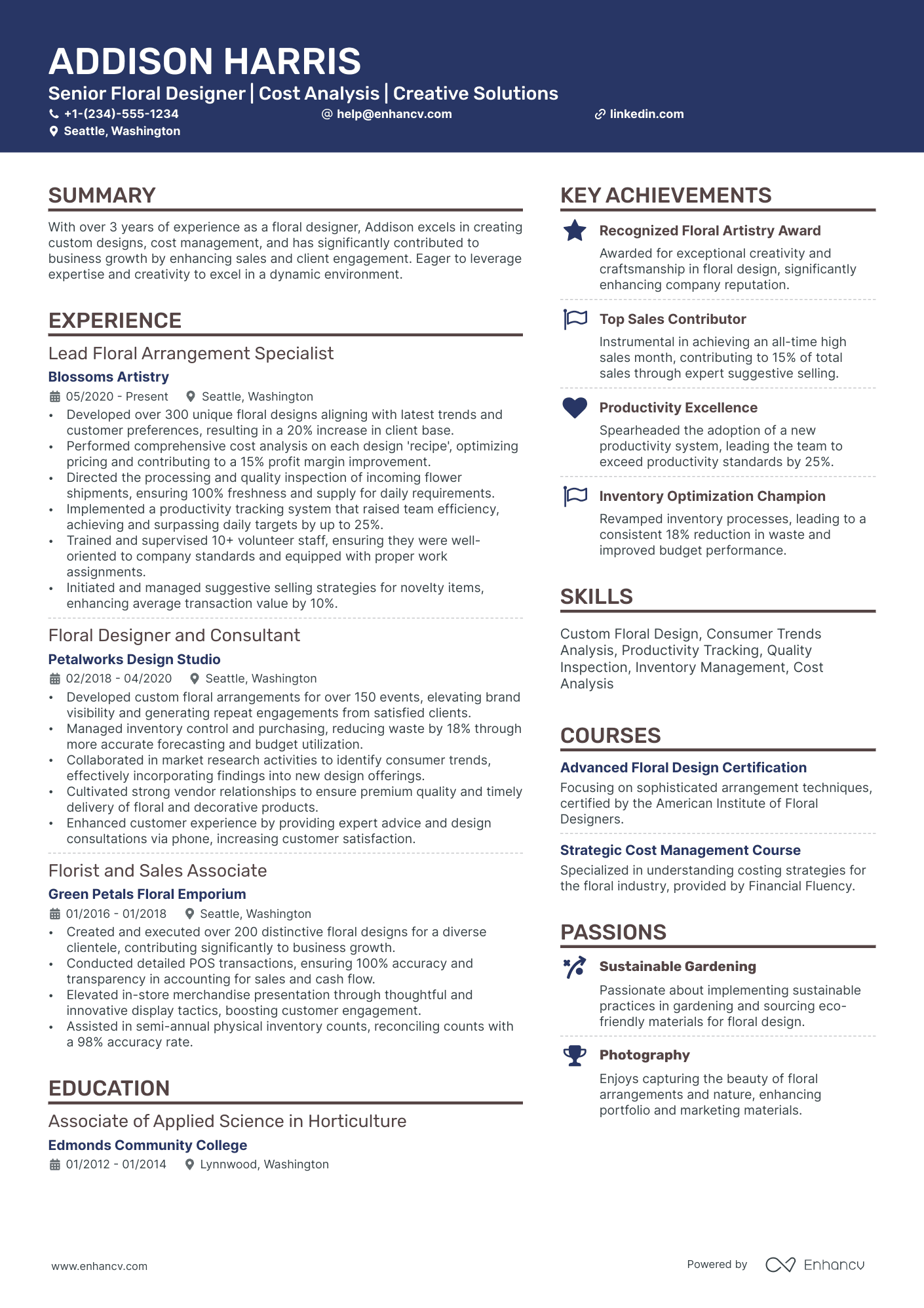
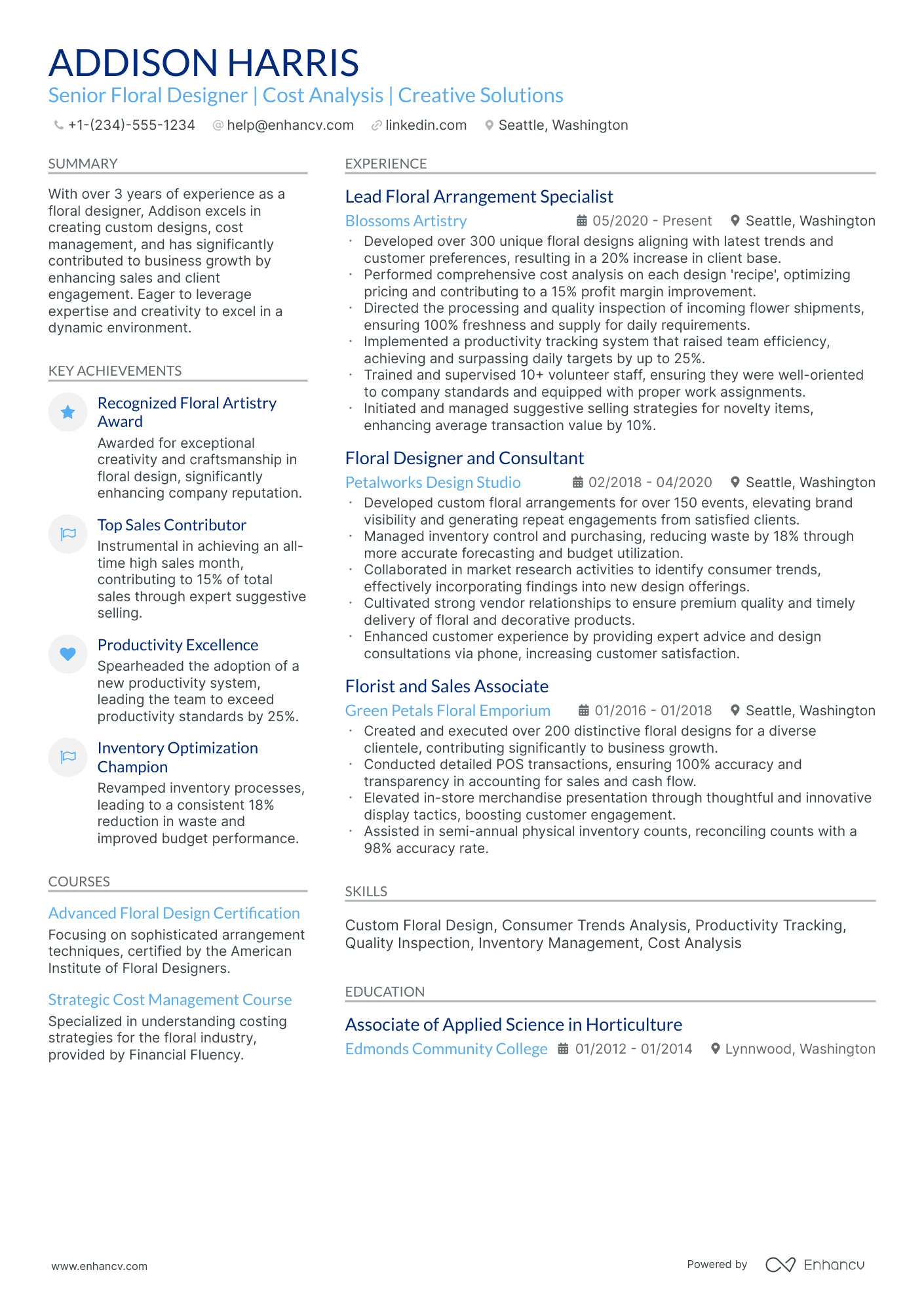
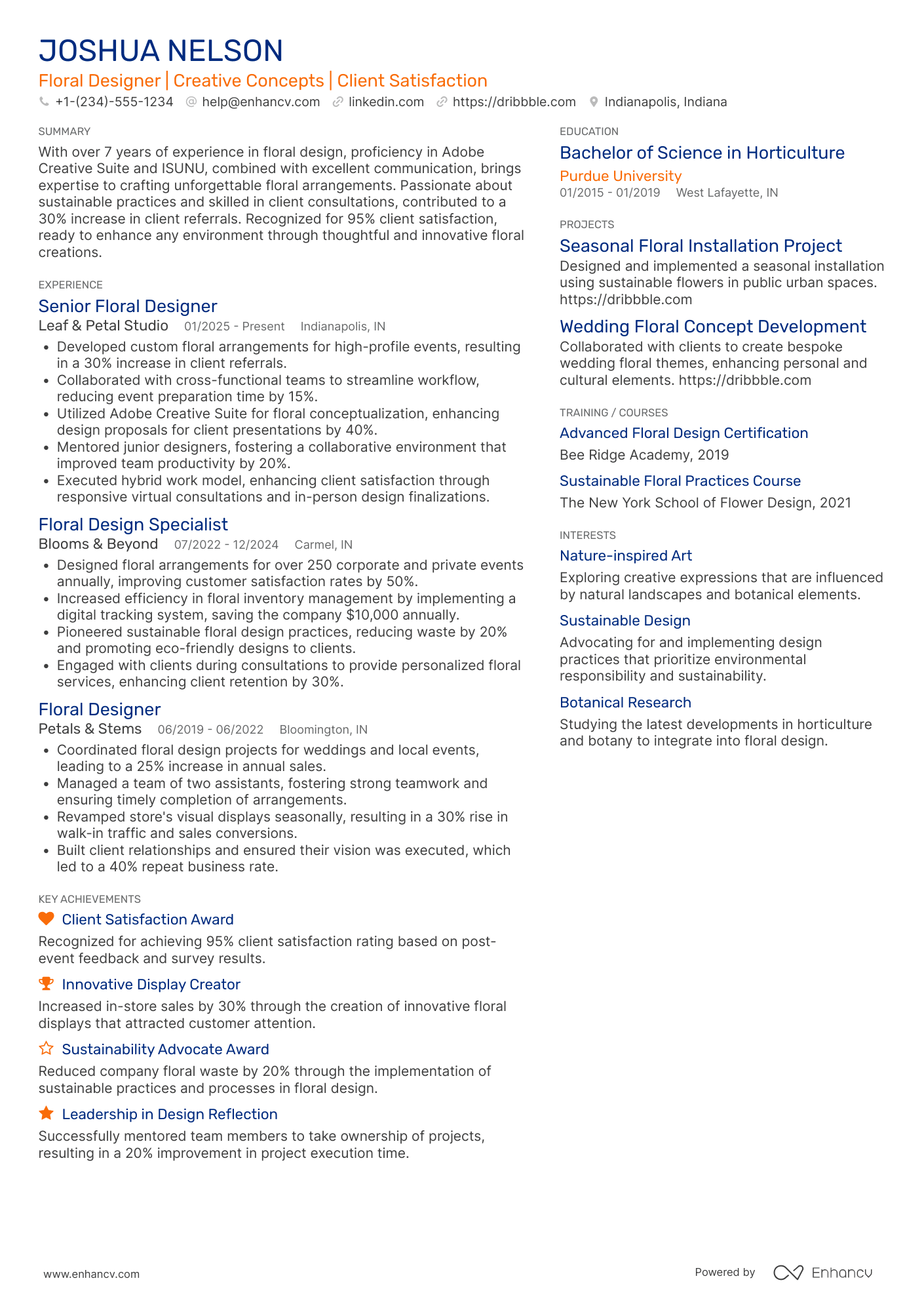
Most floral designer resume drafts fail because they read like task lists and bury results under tool names and generic duties. That hurts when an applicant tracking system filters keywords and recruiters scan in seconds amid tight competition.
A strong resume shows what you delivered and why it mattered, not just what you used. If you're unsure where to begin, learning how to write a resume from scratch can set the right foundation. You should highlight repeat-event bookings, increased average order value, reduced waste, on-time installs for large weddings, and consistent five-star reviews.

Key takeaways
- Quantify achievements like event volume, waste reduction, and repeat bookings instead of listing duties.
- Use reverse-chronological format if experienced; use a hybrid format when switching careers.
- Mirror the job posting's exact language for tools, techniques, and event types.
- Place skills above experience on junior resumes and below experience on senior ones.
- Tie every listed skill to a measurable outcome in your experience bullets.
- Include certifications like CFD or AIFD to strengthen credibility for competitive roles.
- Use Enhancv's Bullet Point Generator to turn vague duties into recruiter-ready, quantified bullets.
Job market snapshot for floral designers
We analyzed 52 recent floral designer job ads across major US job boards. These numbers help you understand employer expectations, industry demand, career growth patterns at a glance.
What level of experience employers are looking for floral designers
| Years of Experience | Percentage found in job ads |
|---|---|
| 1–2 years | 5.8% (3) |
| 5–6 years | 1.9% (1) |
| 10+ years | 9.6% (5) |
| Not specified | 82.7% (43) |
Floral designer ads by area of specialization (industry)
| Industry (Area) | Percentage found in job ads |
|---|---|
| Healthcare | 65.4% (34) |
| Finance & Banking | 26.9% (14) |
Top companies hiring floral designers
| Company | Percentage found in job ads |
|---|---|
| Hy-Vee | 30.8% (16) |
| Albertsons Company Inc. | 19.2% (10) |
Role overview stats
These tables show the most common responsibilities and employment types for floral designer roles. Use them to align your resume with what employers expect and to understand how the role is structured across the market.
Day-to-day activities and top responsibilities for a floral designer
| Responsibility | Percentage found in job ads |
|---|---|
| Computer | 26.9% (14) |
| Customer service | 26.9% (14) |
| Register system | 26.9% (14) |
| Telephone | 26.9% (14) |
| Floral design | 25.0% (13) |
| Knives | 25.0% (13) |
| Pricing gun | 25.0% (13) |
| Scissors | 25.0% (13) |
| Dosetron | 19.2% (10) |
| Helium tank | 19.2% (10) |
| Pick machine | 19.2% (10) |
| Point-of-sale systems | 19.2% (10) |
How to format a floral designer resume
Recruiters hiring floral designers prioritize a portfolio-driven skill set, hands-on design experience, and the ability to manage client relationships and event timelines. The right resume format ensures these signals aren't buried, making it easy for both hiring managers and applicant tracking systems to identify your strongest qualifications quickly.

I have significant experience in this role—which format should I use?
Use a reverse-chronological format to lead with your most recent and relevant floral design positions, giving recruiters immediate context for your growth and capabilities. Do:
- Highlight the scope and ownership of your work—types of events managed, client volume, and budget responsibility.
- Feature role-specific tools and domains such as floral design software (e.g., Details Flowers, BloomNation), vendor sourcing, color theory, and seasonal availability expertise.
- Quantify outcomes and business impact wherever possible, including revenue generated, client retention rates, or event volumes.
I'm junior or switching into this role—what format works best?
A hybrid format works best, placing a focused skills section at the top while still presenting your work history in reverse-chronological order. Do:
- Position core floral design skills—such as arrangement techniques, color coordination, and plant care—prominently near the top of your resume.
- Include freelance projects, volunteer arrangements, floral design coursework, or apprenticeships as transitional experience that demonstrates hands-on ability.
- Link every action to a clear result so hiring managers can see the impact of your work, even if it comes from non-traditional settings.
Why not use a functional resume?
A functional format strips away the timeline and context of your experience, making it harder for recruiters to verify your growth, consistency, and hands-on design capability in real work settings.
- Career changers with no floral experience: If you're transitioning from a related creative field and have completed a floral design certification or significant project work, a functional format can help spotlight transferable skills—but only if every skill listed is tied to a specific project, arrangement, or measurable outcome.
- Candidates with resume gaps: If extended time away from work included informal floral work, freelance commissions, or relevant coursework, a functional format lets you organize these experiences by skill category rather than date.
Once you've established a clean, professional layout, the next step is filling it with the right sections to showcase your qualifications effectively.
What sections should go on a floral designer resume
Recruiters expect you to present your floral design expertise, customer-facing experience, and ability to deliver consistent results under deadlines. Knowing what to put on a resume helps you prioritize the most impactful information.
Use this structure for maximum clarity:
- Header
- Summary
- Experience
- Skills
- Projects
- Education
- Certifications
- Optional sections: Awards, Volunteering, Languages
Strong experience bullets should emphasize measurable outcomes, event and order volume, on-time delivery, upsell revenue, repeat-client rates, and quality standards you maintained.
Is your resume good enough?
Drop your resume here or choose a file. PDF & DOCX only. Max 2MB file size.
Once you’ve organized your resume with the right components, the next step is to write your floral designer experience section so it fits that structure and shows your impact.
How to write your floral designer resume experience
The work experience section is where you prove you can do the work—designing arrangements, sourcing botanicals, managing event installations, and delivering finished pieces that meet client expectations on time and on budget. Hiring managers prioritize demonstrated impact over descriptive task lists, so every bullet should connect what you did to a result that mattered.
Each entry should include:
- Job title
- Company and location (or remote)
- Dates of employment (month and year)
Three to five concise bullet points showing what you owned, how you executed, and what outcomes you delivered:
- Ownership scope: the arrangement styles, event types, retail displays, seasonal collections, or client accounts you were directly accountable for as a floral designer.
- Execution approach: the design techniques, preservation methods, sourcing strategies, POS systems, or inventory tools you used to plan and complete your work.
- Value improved: changes to arrangement quality, waste reduction, fulfillment speed, client satisfaction, or design consistency that resulted from your efforts.
- Collaboration context: how you coordinated with event planners, venue managers, wholesale suppliers, delivery teams, or clients to align on creative direction and logistics.
- Impact delivered: outcomes expressed through client retention, revenue contribution, production volume, or event scale rather than a simple list of daily tasks.
Experience bullet formula
A floral designer experience example
✅ Right example - modern, quantified, specific.
Lead Floral Designer
Juniper & Pine Floral Studio | Austin, TX
2022–Present
High-volume wedding and event studio producing custom installations and daily retail arrangements for corporate and private clients.
- Designed and produced one hundred fifty-plus weddings and three hundred-plus event arrangements annually using Floranext (customer relationship management) and Adobe Illustrator mockups, increasing proposal-to-booking conversion by 18%.
- Standardized recipes, stem counts, and mechanics (chicken wire, floral foam, and armature techniques) in Airtable inventory templates, cutting weekly waste by 12% and reducing rush stem purchases by 22%.
- Built a procurement workflow with wholesalers via EDI ordering and color-grade checklists, improving on-time fulfillment from 90% to 97% and lowering hard-reject stems by 15%.
- Led a four-person production team with Trello run-of-show boards and timed prep sheets, reducing build time per large installation by 25% while maintaining a 4.9 out of five client satisfaction average.
- Partnered with planners, photographers, and venue operations to execute thirty-plus complex installs per year, preventing day-of layout changes and avoiding an estimated $18,000 in rework and replacement costs.
Now that you've seen how a strong experience section comes together, let's break down how to adapt yours based on the specific job you're targeting.
How to tailor your floral designer resume experience
Recruiters evaluate your floral designer resume through both applicant tracking systems and manual review. Tailoring your resume to the job description helps you pass both screenings by mirroring the posting's language and priorities.
Ways to tailor your floral designer experience:
- Match specific design software or POS systems named in the posting.
- Mirror floral arrangement styles or techniques the employer highlights.
- Use the same terminology for event types the role supports.
- Reflect cold storage or flower care standards the job description mentions.
- Include wedding or corporate event experience when the role requires it.
- Emphasize inventory management or vendor sourcing if listed as duties.
- Highlight client consultation workflows referenced in the posting.
- Align your seasonal design knowledge with the employer's product focus.
Tailoring means aligning your real accomplishments with what the employer asks for, not forcing keywords where they don't belong.
Resume tailoring examples for floral designer
| Job description excerpt | Untailored | Tailored |
|---|---|---|
| Design and execute floral arrangements for high-volume weddings (150+ guests) using seasonal blooms, ensuring alignment with client mood boards and color palettes. | Created floral arrangements for various events and occasions. | Designed and executed 40+ wedding floral installations annually for events of 150–300 guests, sourcing seasonal blooms and translating client mood boards into cohesive arrangements that matched approved color palettes. |
| Maintain cooler inventory using POS floral management software (FloristWare), process daily orders, and reduce waste by monitoring bloom shelf life and rotation schedules. | Managed inventory and handled day-to-day shop operations. | Tracked cooler inventory and processed 25+ daily orders through FloristWare, implementing a shelf-life rotation schedule that reduced bloom waste by 18% over six months. |
| Collaborate with event planners and venue coordinators to create large-scale installations, including ceremony arches, suspended arrangements, and tablescapes, within agreed budgets. | Worked with clients and team members on floral projects. | Partnered with event planners and venue coordinators to build large-scale installations—ceremony arches, suspended arrangements, and tablescapes—for 60+ events per year, consistently delivering within client budgets averaging $5,000–$15,000. |
Once you’ve aligned your experience with the role’s priorities, the next step is to quantify your floral designer achievements so hiring managers can see the impact of your work.
How to quantify your floral designer achievements
Quantifying your achievements proves your designs drove sales, speed, and customer satisfaction, not just aesthetics. Track order volume, on-time delivery, upsell revenue, waste reduction, and quality outcomes like remake rate and customer ratings.
Quantifying examples for floral designer
| Metric | Example |
|---|---|
| Order volume | "Designed and produced 35–50 custom arrangements per shift, maintaining consistent style standards during holiday rush weeks." |
| Turnaround time | "Cut average wedding consultation-to-proposal time from three days to one day using HoneyBook templates and a standardized stem matrix." |
| Revenue growth | "Increased add-on sales by 18% by bundling candles and premium vases at checkout, averaging $12 more per order." |
| Waste reduction | "Reduced stem waste by 22% by tightening par levels, tracking spoilage in a weekly log, and rotating inventory by delivery date." |
| Quality accuracy | "Lowered remake rate from 6% to 2% by adding a photo approval step and a ribbon-and-card checklist before delivery." |
Turn vague job duties into measurable, recruiter-ready resume bullets in seconds with Enhancv's Bullet Point Generator.
Once you've crafted strong bullet points for your experience section, you'll want to apply that same precision to presenting your hard and soft skills on a floral designer resume.
How to list your hard and soft skills on a floral designer resume
Your skills section shows you can design, produce, and deliver sellable arrangements, and recruiters and an ATS (applicant tracking system) scan this section to confirm role fit fast—aim for a balanced mix of technical design and production skills plus job-specific soft skills. floral designer roles require a blend of:
- Product strategy and discovery skills
- Data, analytics, and experimentation skills
- Delivery, execution, and go-to-market discipline
- Soft skills
Your skills section should be:
- Scannable (bullet-style grouping).
- Relevant to the job post.
- Backed by proof in experience bullets.
- Updated with current tools.
Place your skills section:
- Above experience if you're junior or switching careers.
- Below experience if you're mid/senior with strong achievements.

Hard skills
Your hard skills demonstrate the technical abilities employers need to see:
- Floral design principles, color theory
- Hand-tied bouquets, vase arrangements
- Wedding and event floral production
- Sympathy and funeral florals
- Mechanics: foam, chicken wire, tape
- Fresh flower conditioning, hydration
- Stem counting, recipe costing
- Inventory rotation, cold chain handling
- Wholesale ordering, vendor management
- Point-of-sale systems, order entry
- Delivery routing, packing for transport
- Hand tools: clippers, knives, wire
Soft skills
Your soft skills show how you work with clients and teams:
- Consult clients on budget and style
- Translate briefs into recipes
- Prioritize orders under deadlines
- Communicate substitutions clearly
- Coordinate with event planners
- Collaborate with sales and delivery teams
- Maintain quality under peak volume
- Resolve issues at pickup or delivery
- Manage time across production blocks
- Follow brand standards consistently
- Take ownership of reworks and fixes
- Stay calm in fast-paced service
How to show your floral designer skills in context
Skills shouldn't live only in a dedicated skills list. Explore resume skills examples to see how top candidates weave abilities throughout their documents.
They should be demonstrated in:
- Your summary (high-level professional identity)
- Your experience (proof through outcomes)
Here's how that looks in practice.
Summary example
Senior floral designer with 10 years of experience crafting large-scale event installations and boutique arrangements. Skilled in sustainable sourcing, color theory, and client consultations. Increased repeat bookings by 35% through personalized design presentations using Canva and mood-boarding techniques.
- Reflects senior-level expertise clearly
- Names specific tools and methods
- Includes a measurable business outcome
- Highlights client-facing soft skills
Experience example
Senior Floral Designer
Bloom & Thistle Studio | Portland, OR
March 2019–Present
- Designed 200+ wedding installations annually using sustainable mechanics, boosting client referrals by 40% through consistent five-star reviews.
- Collaborated with event planners and venue coordinators to execute themed arrangements, reducing day-of setup time by 25%.
- Trained four junior designers on advanced wiring techniques and seasonal sourcing, improving team production efficiency by 30%.
- Every bullet includes measurable proof
- Skills appear naturally through outcomes
Once you’ve demonstrated your floral design abilities through specific examples and results, the next step is to apply that same approach to building a floral designer resume when you don’t have formal experience.
How do I write a floral designer resume with no experience
Even without full-time experience, you can demonstrate readiness. Building a resume without work experience is entirely possible when you focus on transferable projects and training:
- Floristry course capstone arrangements
- Wedding or event volunteer florals
- Farmers market bouquet sales
- Retail visual merchandising projects
- Studio assistant or internship tasks
- Portfolio of seasonal designs
- Community fundraiser centerpiece donations
- Botanical garden workshop participation
Focus on:
- Portfolio photos with design notes
- Flower care and conditioning steps
- Pricing, recipes, and stem counts
- Tools used and safety practices
Resume format tip for entry-level floral designer
Use a combination resume format because it highlights floral designer skills and projects first, while still showing work history and reliability. Do:
- Lead with a floral designer portfolio link.
- Add three to five project bullets.
- List tools: floral knife, clippers.
- Include recipes, stem counts, costs.
- Name flowers, mechanics, and techniques.
- Created fifteen market bouquets using spiral technique, floral tape, and clippers; tracked stem counts and pricing, selling out in two hours at a $180 total.
Even without formal work experience, your education section can demonstrate relevant knowledge and training that strengthens your candidacy—here's how to present it effectively.
How to list your education on a floral designer resume
Your education section helps hiring teams confirm you have foundational knowledge in design, botany, or horticulture. It quickly validates your training and readiness for the floral designer role.
Include:
- Degree name
- Institution
- Location
- Graduation year
- Relevant coursework (for juniors or entry-level candidates)
- Honors & GPA (if 3.5 or higher)
Skip month and day details—list the graduation year only.
Example education entry
Here's a strong education entry tailored to a floral designer.
Associate of Applied Science in Floral Design
Scottsdale Community College, Scottsdale, AZ
Graduated 2021
GPA: 3.7/4.0
- Relevant Coursework: Botanical Illustration, Color Theory, Sustainable Floral Design, Event Styling, Plant Science
- Honors: Dean's List, 2020–2021
How to list your certifications on a floral designer resume
Certifications on a resume show a floral designer's commitment to learning, proficiency with tools and techniques, and relevance to current industry standards, especially for weddings, events, and retail work. Include:
- Certificate name
- Issuing organization
- Year
- Optional: credential ID or URL
- Place certifications below education when your degree is recent and your certifications are older or less relevant to floral designer roles.
- Place certifications above education when they are recent, highly relevant, or required for the floral designer jobs you target.
Best certifications for your floral designer resume
- Certified Floral Designer (CFD)
- AIFD Certified Floral Designer (AIFD-CFD)
- Floriculture Certificate
- Floral Design Certificate
- Wedding and Event Floral Design Certificate
- Sustainable Floristry Certificate
- Floral Business and Merchandising Certificate
Once you’ve placed your credentials where hiring managers can spot them, use your floral designer resume summary to connect those qualifications to the value you deliver.
How to write your floral designer resume summary
Your resume summary is the first thing a recruiter reads. A strong one instantly connects your skills and style to the floral designer role.
Keep it to three to four lines, with:
- Your title and total years of hands-on floral design experience.
- The domain you work in, such as event floristry, retail, or wedding design.
- Core skills like arrangement techniques, color theory, and POS systems.
- One or two measurable wins, such as revenue increases or client retention rates.
- Soft skills tied to outcomes, like client communication that drove repeat bookings.

PRO TIP
At an entry or mid-level role, lead with your strongest technical skills and relevant training. Highlight early results like satisfied clients or efficiency gains. Avoid vague phrases like "passionate creative" or "hard worker." Every word should prove you can do this specific job.
Example summary for a floral designer
Detail-oriented floral designer with three years of experience in wedding and event floristry. Skilled in seasonal sourcing, color theory, and client consultations. Increased repeat bookings by 25% through personalized arrangement proposals and reliable delivery timelines.
Optimize your resume summary and objective for ATS
Drop your resume here or choose a file.
PDF & DOCX only. Max 2MB file size.
Now that your summary captures your design expertise and value, make sure the header framing it presents your contact details correctly so recruiters can actually reach you.
What to include in a floral designer resume header
A resume header lists your key contact and professional links so recruiters can find you fast, trust your details, and screen you accurately.
Essential resume header elements
- Full name
- Tailored job title and headline
- Location
- Phone number
- Professional email
- GitHub link
- Portfolio link
A LinkedIn link helps recruiters verify experience quickly and supports screening.
Don't include a photo on a floral designer resume unless the role is explicitly front-facing or appearance-dependent.
Match your header job title to the posting and keep all links short, consistent, and easy to copy.
Floral designer resume header
Jordan Lee
Floral designer | Wedding and event arrangements, retail display, and client consultations
Austin, TX
(512) 555-01XX
your.name@enhancv.com
github.com/yourname
yourwebsite.com
linkedin.com/in/yourname
Once your contact details and role information are clear at the top, you can strengthen the rest of your resume by adding the additional sections that hiring managers expect to see for floral designers.
Additional sections for floral designer resumes
Adding extra sections helps you stand out when your core qualifications match other candidates, giving hiring managers more reasons to choose you. For example, listing language skills can be especially valuable if you serve diverse clientele or work with international vendors.
- Languages
- Hobbies and interests
- Certifications and workshops
- Awards and competitions
- Professional affiliations
- Volunteer experience
- Publications and featured work
Once you've rounded out your resume with sections that highlight your full range of qualifications, the next step is pairing it with a cover letter that ties everything together for hiring managers.
Do floral designer resumes need a cover letter
A cover letter isn't required for a floral designer, but it often helps. Understanding what a cover letter is and when to use one matters most for competitive roles, high-end studios, or when hiring managers expect a personalized introduction.
Use this guidance to decide when to include one:
- Explain fit with the role and team: match your style, pace, and service standards to the shop's workflow and clientele.
- Highlight one or two relevant projects or outcomes: cite event scale, on-time delivery, repeat clients, or reduced waste through smarter sourcing.
- Show you understand the product, users, or business context: speak to the shop's aesthetic, price points, seasonal demand, and customer occasions.
- Address career transitions or non-obvious experience: connect retail, hospitality, or design work to floral designer responsibilities and customer service.
Drop your resume here or choose a file.
PDF & DOCX only. Max 2MB file size.
Once you’ve decided whether to include a cover letter to support your floral designer resume, you can use AI tools to strengthen your resume’s content and presentation efficiently.
Using AI to improve your floral designer resume
AI can sharpen your resume's clarity, structure, and impact. It helps refine wording and highlight measurable results. But overuse strips authenticity. Once your content feels clear and role-aligned, step away from AI. If you're curious about which AI is best for writing resumes, explore the options before committing to one tool.
Here are 10 practical prompts to strengthen specific sections of your floral designer resume:
- Strengthen your summary. "Rewrite my floral designer resume summary to highlight my top three skills and years of relevant experience in under four sentences."
- Quantify your results. "Add measurable outcomes to these floral designer experience bullets, such as event counts, client retention rates, or revenue figures."
- Tighten bullet points. "Edit these floral designer experience bullets to start with strong action verbs and stay under 15 words each."
- Align with postings. "Compare my floral designer resume skills section to this job posting and suggest missing keywords I should add."
- Refine technical skills. "Organize my floral designer skills into two categories: design techniques and business operations, removing any irrelevant entries."
- Improve project descriptions. "Rewrite this floral designer project description to emphasize the client's goal, my design approach, and the final result."
- Clarify certifications. "Format my floral designer certifications section to include the credential name, issuing organization, and date earned."
- Upgrade education details. "Revise my floral designer education section to highlight coursework and training directly related to floral design."
- Remove filler language. "Identify and remove vague or redundant phrases from my floral designer resume without changing the core meaning."
- Tailor the tone. "Adjust the tone of my floral designer resume to sound confident and professional without exaggerating any responsibilities."
Stop using AI once your resume sounds accurate, specific, and aligned with real experience. AI should never invent experience or inflate claims—if it didn't happen, it doesn't belong here.
Conclusion
A strong floral designer resume shows measurable outcomes, role-specific skills, and a clear structure. It highlights sales growth, event volume, on-time delivery, and low waste, using numbers. It lists design techniques, product knowledge, and customer service, with clean formatting.
This approach shows you’re ready for today’s hiring market and upcoming changes. It helps employers scan fast, trust your results, and see your fit for the role. Keep it focused, consistent, and easy to read.