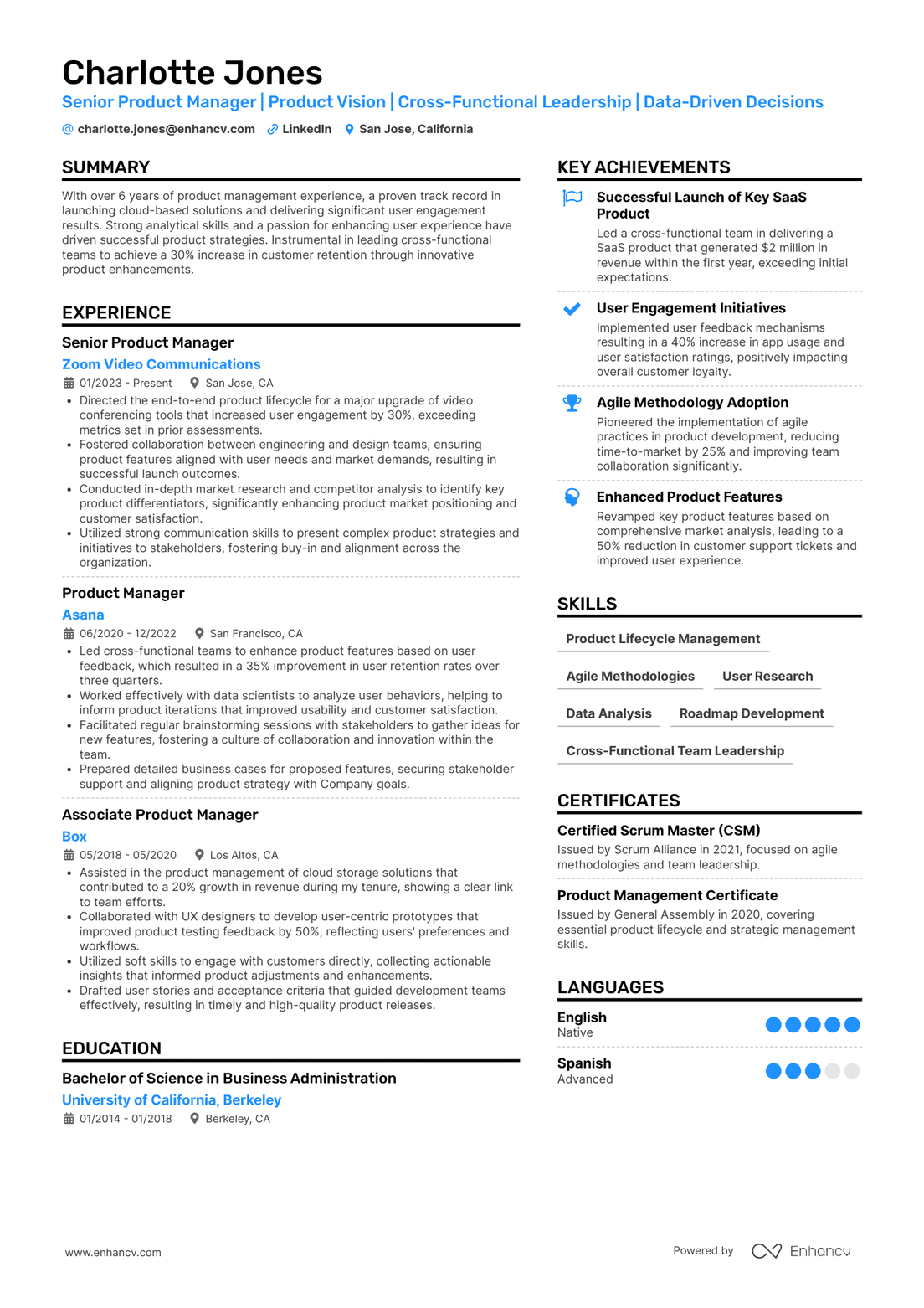
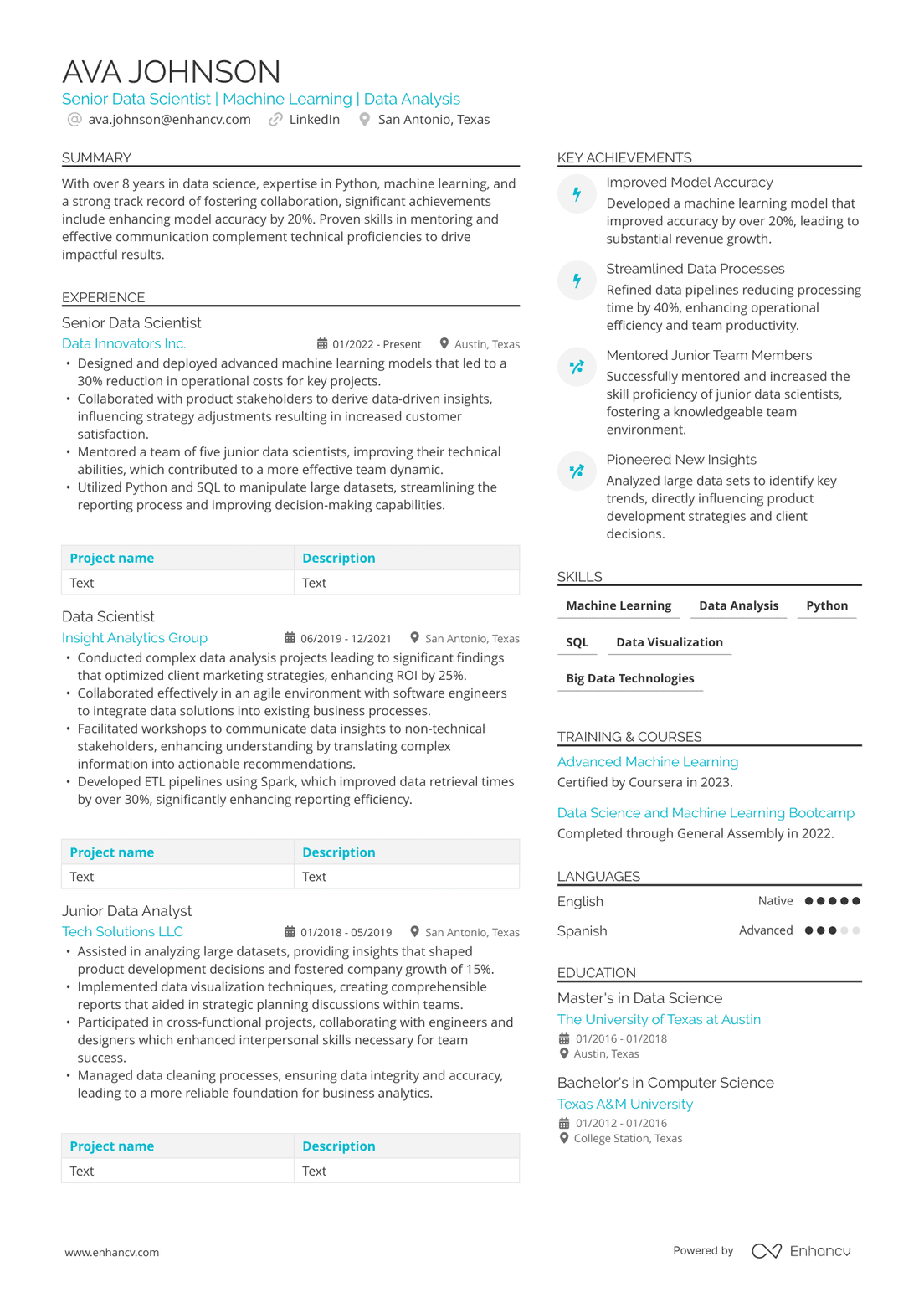
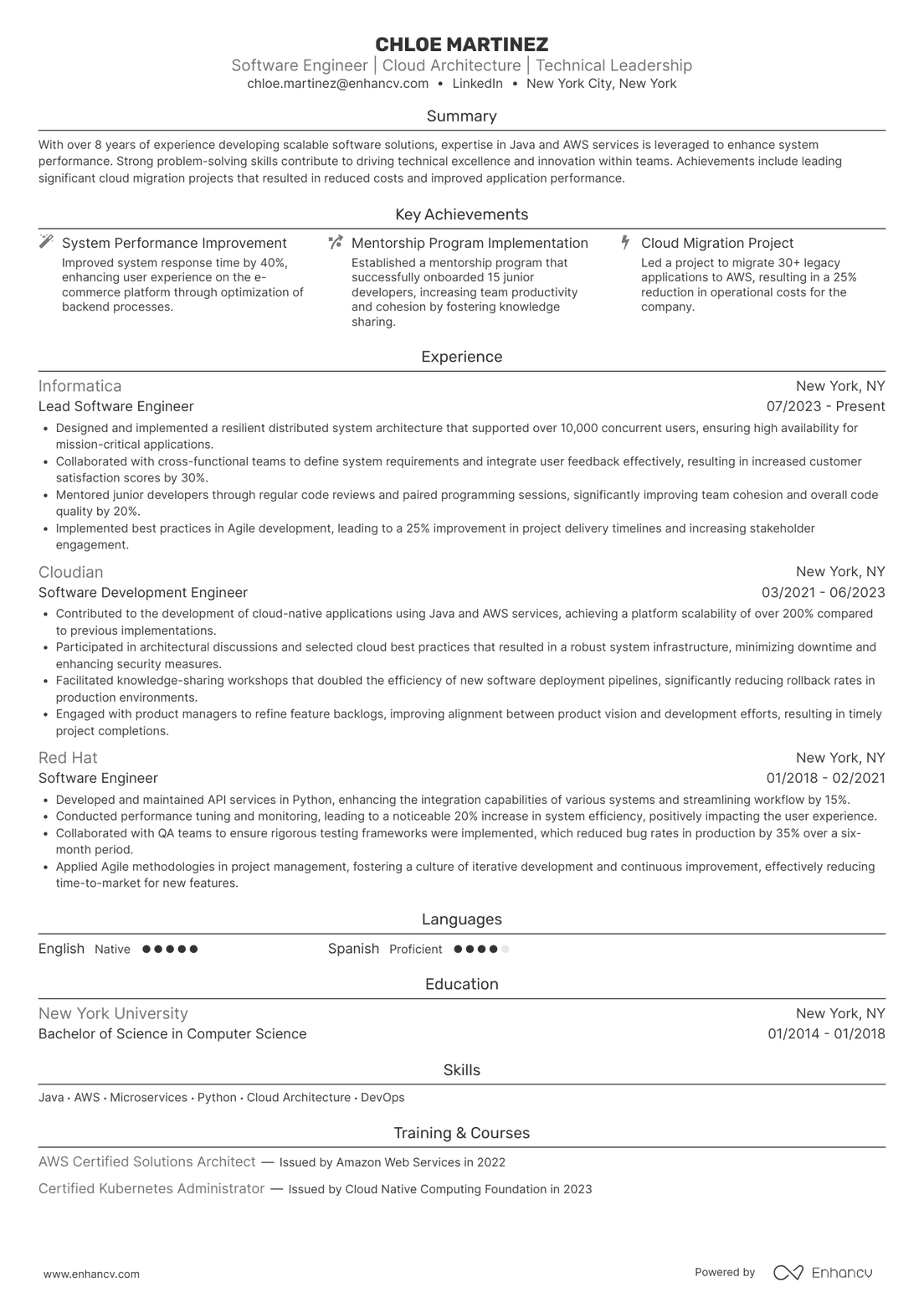
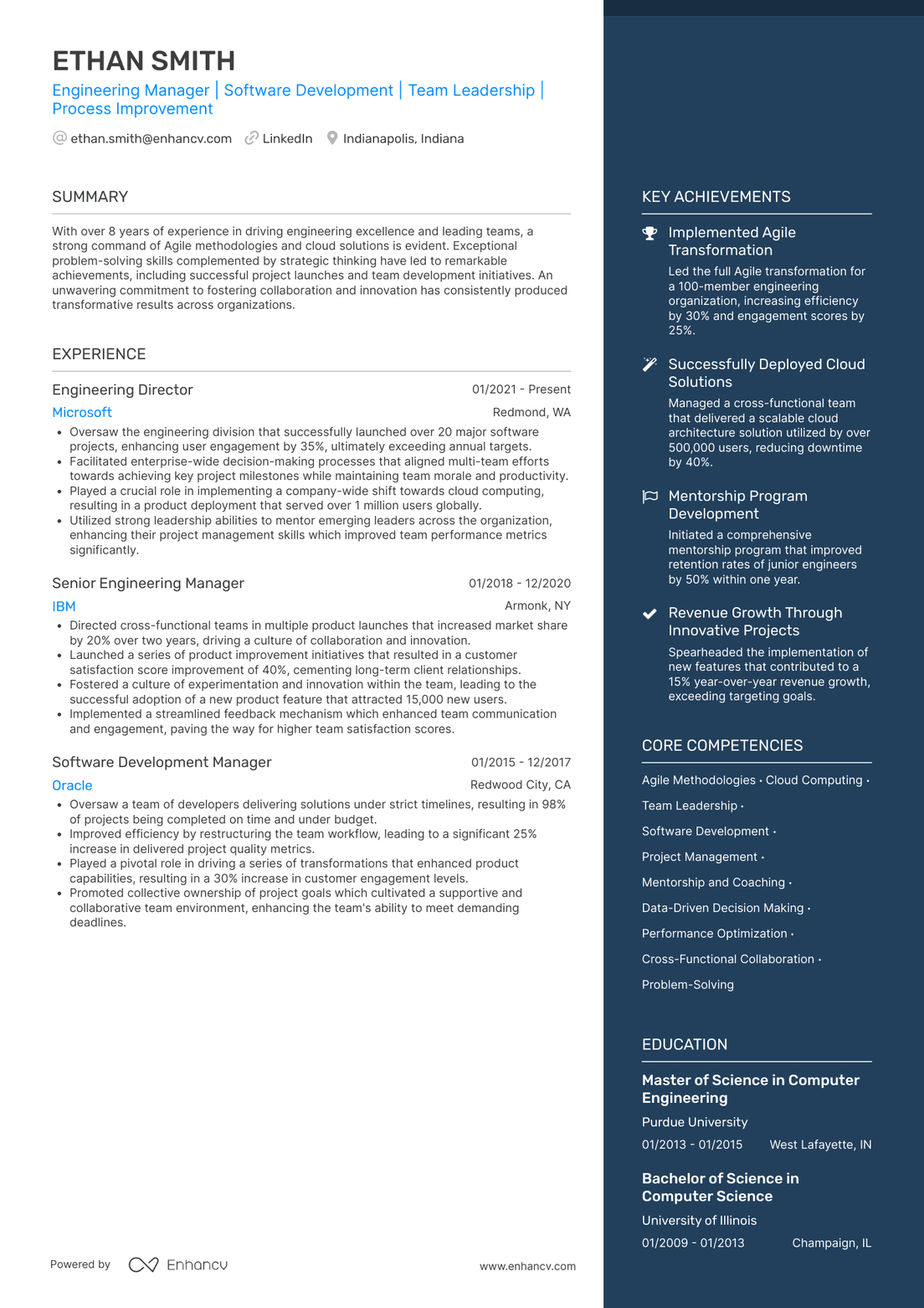
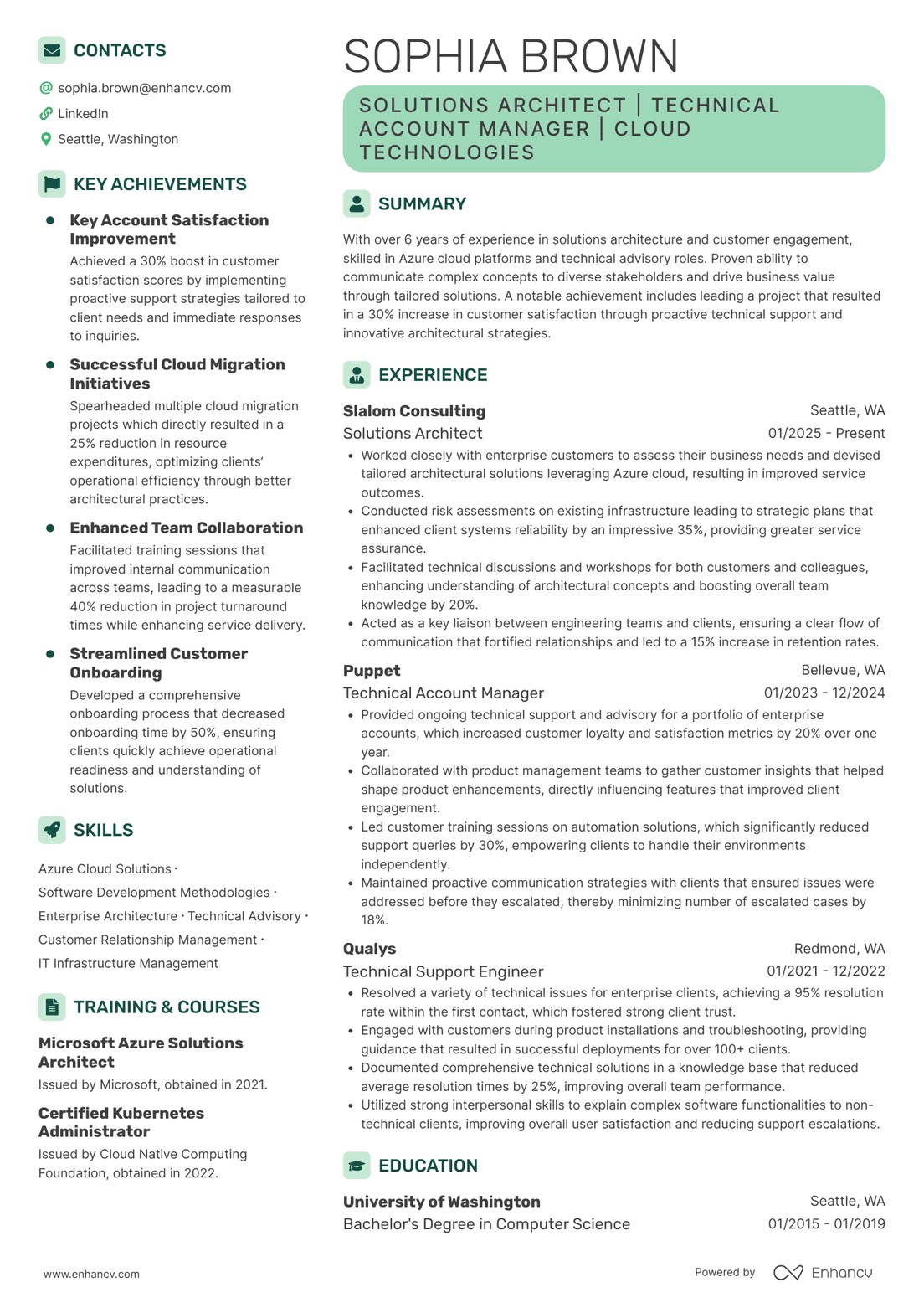
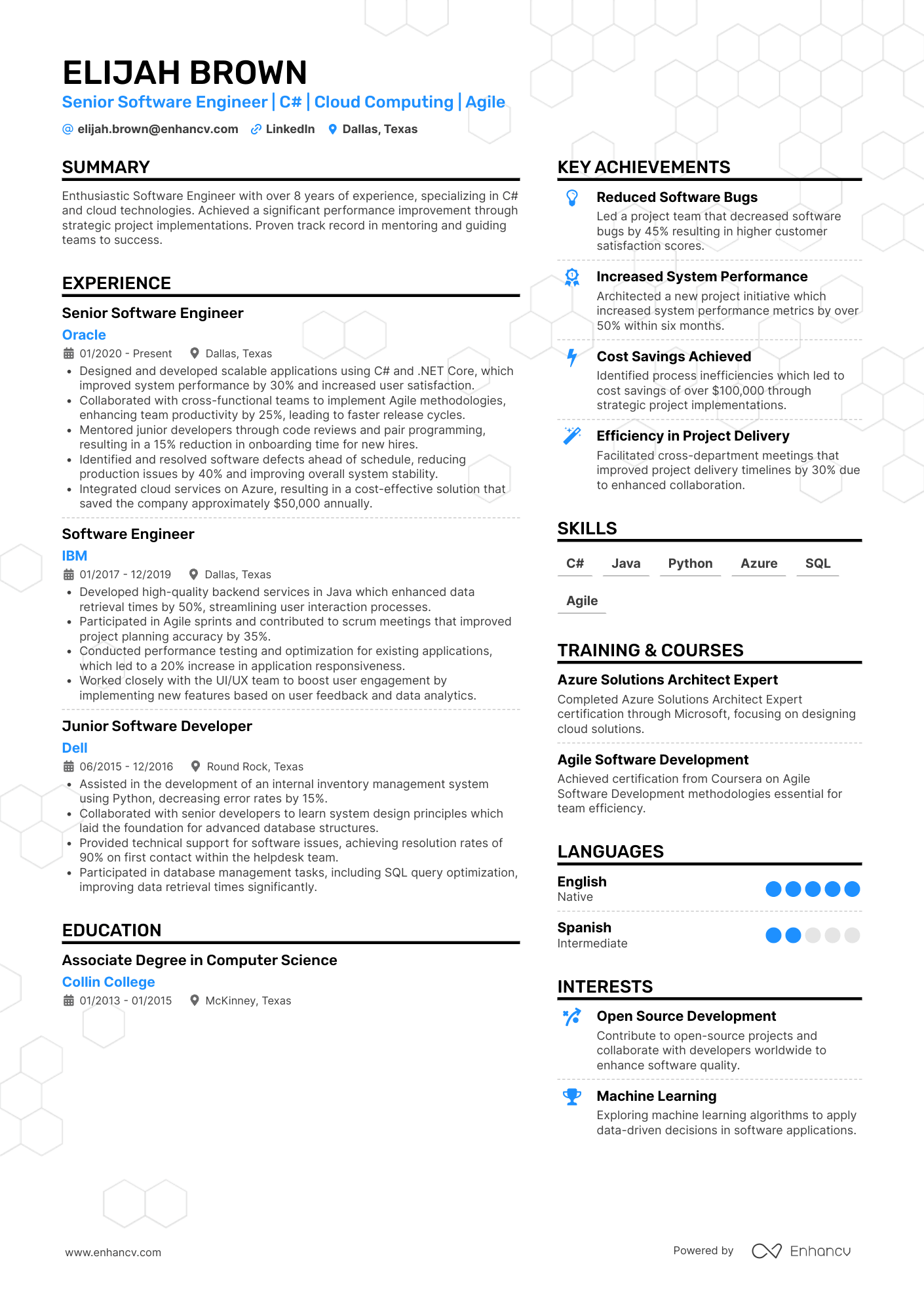
FAANG (now often referred to as MAANG) stands for Meta, Amazon, Apple, Netflix, and Google. It’s one of the most demanding hiring and engineering bars in the global tech industry. Writing a resume they wouldn’t dismiss is no easy feat.
The recruiters at these tech giants care about the scope you operated at, what you personally owned, and the numbers that describe your impact. The competition is absolutely brutal. So how do you build a resume that leaves a lasting impression? One that even Zuck himself could read and go “Wow!”
Here we’ll take a look at a few FAANG resume examples and unpack what makes them work. We’ll also consider what each tech giant values so you can reflect that in your application.

Key takeaways
- FAANG resume screens reward mostly come down to scope and measured outcomes.
- Your experience section is the most important part. Present it in reverse-chronological order.
- Google's X-Y-Z formula (accomplished X, as measured by Y, by doing Z) is the most portable bullet structure across all five companies.
- Tailor your company according to the job listing and each company’s most cherished values.
- Quantify with the metrics your team owned, such as latency, requests per second, revenue, adoption, cost, and incident count.
- Education is a big factor in landing a role, but it’s not a total dealbreaker if you haven’t graduated from a prestigious school.
Which resume format should a FAANG candidate use?
A reverse-chronological resume is the only viable option because the recruiters at these companies need to quickly understand your timeline. It’s the best way to present your experience. So lead with your most recent role. Make sure each first bullet talks about your strongest achievement.
What sections should go on a FAANG resume?
You’d want to build a very classic resume with standard section headings:
- Header: name, target title, city and state, email, phone, GitHub or portfolio, LinkedIn.
- Summary: three or four lines with your level, domain, and two quantified wins.
- Experience: three to six bullets per role, achievements only.
- Skills and technologies: languages, frameworks, cloud platforms, and tools, grouped.
- Education: degree, school, year.
If you have accomplished something in your career that truly stands out and needs a little more context, then you can have a brief dedicated achievements section.
How to write your FAANG resume experience
Your work experience section is where the decision to call you in for an interview will be made. Yes, your dream career hinges on a dozen bullet points in a PDF file.
Every job entry should have:
- Job title and company, with the internal level if you have one (E5, L4, SDE II). Big tech reviewers know these fluently, so no need to explain the abbreviation.
- Dates in a consistent format, featuring month and year.
- Location, or "Remote" if that was the arrangement.
- Three to six bullets covering system scale (users, requests, data volume, budget), the technologies you used, what you owned end to end, and the measured result.
Start each bullet with a strong action verb and put the number early, because reviewers skim the left edge of the page first.
Here’s a popular bullet point formula you can resort to:

Google's X-Y-Z bullet formula
Accomplished [X] as measured by [Y], by doing [Z].
Example:
“Cut image-upload failures by 38% (X and Y) by adding client-side retry with exponential backoff (Z)”
It's a Google recruiting rule of thumb, and it travels well to the other four companies.
However, it should be pointed out that each company weighs that formula slightly differently.
Here's what to lead with for each.
What each FAANG company wants to see first in your bullet points
| Company | What to lead with |
|---|---|
| Meta | Product impact and speed. Show what you shipped, how many people it reached, and how fast you got it out. |
| Amazon | Ownership and data. Frame bullets so a Bar Raiser can map them to the 16 Leadership Principles, with the metric stated outright. |
| Apple | Craft and depth. Fewer projects, described precisely, with the technical judgment call you made and why. |
| Netflix | Judgment without supervision. Show the decisions you made alone and the context you had when you made them. |
| Scale and systems thinking. Requests per second, data volume, and the design tradeoff behind the number. |
Here’s an example:
Good example of a FAANG experience section
Senior Software Engineer (E5)
Meta | Menlo Park, CA
March 2021 - Present
- Cut p99 latency on the feed ranking service from 180ms to 96ms by rewriting the feature-fetch path in C++, on a service handling 2.1B daily requests.
- Led four engineers through a migration of 340 microservices onto a shared config platform, removing 11 recurring on-call escalation sources.
- Shipped an A/B tested ranking change that lifted session time 3.4%, validated against a 40M-user holdout over two weeks.
- Wrote the feature-store access design doc now adopted as the standard by six teams in the org.
- Mentored three engineers through promotion to E4 and rebuilt the team's onboarding rotation.
However, your experience bullet points will have an even greater impact if they’re tailored to the company you’re applying at.
How to tailor your FAANG resume experience
If you’re applying at, say, Google or Meta, you might want to put a little more effort into your application. Creating a super-specific targeted resume is just table stakes at this level.
Ways to tailor a FAANG resume:
- Use the exact language of the posting for languages, frameworks, and platforms (write “Go”, not “Golang”, if that's what they wrote).
- Match the system scale in the posting, so a role asking for high-throughput work leads with your throughput numbers.
- Mirror the ownership level ("designed and owned" for a senior posting, "contributed to" only where that's accurate).
- Pull the resume keywords out of the responsibilities section.
- Reorder bullets inside each role so the one matching the posting sits first.
Here’s how tailoring a resume for FAANG looks like at the bullet point level.
Untailored vs. tailored bullet points
| Job description excerpt | Untailored bullet | Tailored bullet |
|---|---|---|
| Experience designing distributed systems at scale, with proficiency in C++, Java, or Go. | Worked on backend services for a large web application. | Designed a Go sharding layer for a 40TB user-events store, cutting read latency 62% at 1.2M QPS. |
| Ability to dive deep into data and earn trust across engineering, design, and operations. | Managed the product roadmap and worked with engineering. | Dug through 18 months of returns data to isolate a $4.2M defect driver, then aligned three engineering teams on the fix and shipped it in one quarter. |
| Proven ability to take machine learning models from research to production with minimal supervision. | Built machine learning models for the recommendations team. | Took a two-tower retrieval model from notebook to production solo, raising title discovery rate 7.8% across 12M profiles. |
Tailoring every single application is mentally draining and time-consuming. Enhancv's One-Click Tailoring Tool takes the job posting and updates your bullets, skills, title, and summary to match it. And yes, the version you send to Meta will come out different from the one you send to Amazon.
How to quantify your experience on a FAANG resume
Numbers in your resume tell the reviewer what level you operated at. Here are five ways to quantify your experience for a big tech application.
Quantified achievements for FAANG application
| How to quantify | Example bullet point |
|---|---|
| State the scale of the system you owned. | Owned the checkout fraud service handling 9,400 requests per second across 14 markets. |
| Put a “before and after” on performance. | Reduced Android cold-start time from 2.4s to 1.1s by deferring 23 initialization calls. |
| Translate infrastructure work into money. | Cut annual compute spend by $2.8M by right-sizing 610 over-provisioned instances. |
| Tie a shipped change to a business metric. | Launched a ranking experiment that lifted 28-day retention 2.1% across 40M users. |
| Connect leadership to results. | Led six engineers across two time zones and cleared an on-call backlog from 140 tickets to 19. |
If you need help quantifying your work history, Enhancv's Bullet Point Generator turns a plain description of what you did into a structured, quantified bullet you can edit down.
How to list skills on a FAANG resume
The skills section has two jobs on a FAANG resume. It matches you to the posting in the first ATS screen. Then it tells the hiring manager which part of the stack you'll be productive in after orientation day.
Hard skills are the things you can be tested on. Those are your technical skills, like languages, frameworks, cloud platforms, and query tools. Put them in a dedication section after your experience. You can play around with how you group them, too, depending on what makes sense to meet the expectations pointed out in the job posting.

Best hard skills for your FAANG resume
- Python
- C++
- Java
- Go
- SQL
- Distributed systems design
- Kubernetes
- Docker
- AWS, GCP, or Azure
- Artificial intelligence
- TensorFlow or PyTorch
- A/B testing and experiment design
- Data modeling and ETL
- CI/CD and infrastructure as code
- System design and architecture
- Observability and on-call operations
Meanwhile, the so-called soft skills are how you work with other people and make decisions.
Best soft skills for your FAANG resume
- Problem solving
- Communication
- Ownership
- Decision making
- Critical thinking
- Cross-functional collaboration
- Mentoring
- Written communication (design docs and memos)
- Adaptability
- Influence without authority
The right approach with soft skills is to show rather than tell. Put them inside your experience bullets and summary, where they come with evidence attached. For example, instead of saying you’re a problem solver, detail one or two instances of solved problems in your summary.
Summary
Senior product manager with eight years in consumer marketplaces, four of them at Amazon owning a $240M GMV category. Works backward from customer complaints and brings the data before the recommendation. Shipped three launches through orgs that disagreed at the start, including a returns overhaul that cut defect cost $4.2M. Mentored four APMs, two promoted within 18 months.
This summary implies ownership, backbone, and mentoring. None of them are named. Each one is proven by something the candidate did.
How to list your education on your FAANG resume
Your education section should include the degree, the school, and the graduation year. Skip the month, since only the year matters for a career timeline. Add a concentration if it's relevant to the role. Keep GPA on your resume only if you graduated within the last three years and it's 3.5 or above.
Education entry sample
B.S. Computer Science
Carnegie Mellon University | Pittsburgh, PA | 2019
- Concentration in machine learning, GPA 3.8
- Teaching assistant for Distributed Systems (15-440), two semesters
Certifications on your resume matter less at FAANG than at most employers, since these companies weigh shipped work above credentials. They still help in two situations: when you're moving into cloud or ML from an adjacent role, and when the posting names the platform.
Best certifications for your FAANG resume
- AWS Certified Solutions Architect (Amazon Web Services)
- Google Cloud Professional Cloud Architect (Google Cloud)
- Google Cloud Professional Machine Learning Engineer (Google Cloud)
- Certified Kubernetes Administrator, CKA (Cloud Native Computing Foundation)
- TensorFlow Developer Certificate (Google)
- Microsoft Certified: Azure Solutions Architect Expert (Microsoft)
List certifications with the issuing body and the year, and don’t even bother with anything that has expired.
How to write your FAANG resume summary
Your resume summary is probably the only part of the page a reviewer reads in full sentences. All you need is three to five lines to establish why you’re good for the role.
A strong FAANG summary should:
- Open with your current title and years of experience.
- Name the domain and the scale you work at.
- Include two quantified wins, one technical and one business-facing.
- Name the languages or platforms central to the posting.
- Close with what you want to do next, pointed at this specific company.
Let’s put that in writing.
Example summary
Software engineer with 7 years on high-traffic backend systems, including 4 at Stripe on payments infrastructure serving 1.4M requests per minute. Owns services from design doc through on-call. Cut checkout p99 latency by 47% and reduced annual infrastructure spend by $2.8M. Looking for a systems role at Google where reliability work carries that same blast radius.
Get a resume summary that proves you can ship at scale
Drop your resume here or choose a file.
PDF & DOCX only. Max 2MB file size.
It’s easy to write a resume summary confidently when you’re an experienced professional. But what if you’re not?
How to write a FAANG resume with no experience
You need to build your no-experience resume around evidence you can actually do the work you’ll be expected to do. New-grad pipelines at all five are designed to read exactly that.
What to put on your document:
- Projects with a repo link, the stack, and numbers (users, latency, dataset size). This is the single strongest section you have.
- Open-source contributions, named by project and the specific change you merged.
- Internships, written with the same achievement bullets you'd use for a full-time role.
- Coursework in systems, algorithms, distributed computing, or machine learning, plus any teaching assistant work.
- Competitions and hackathons, with your placement and the size of the field.
- Research, including publications, posters, and the lab you worked in.
Best resume format for entry-level FAANG applicants
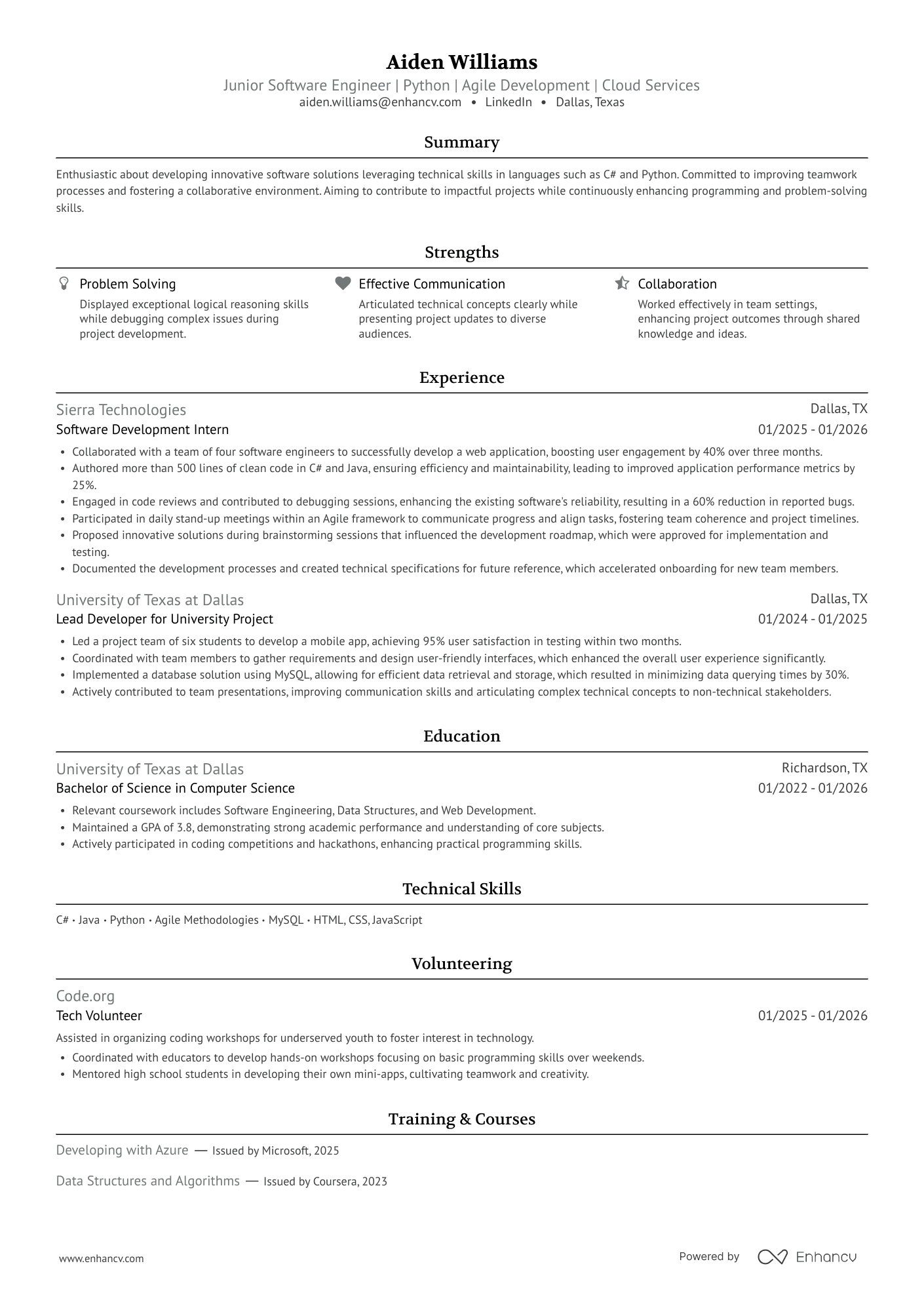
Use a hybrid resume because it puts a projects and skills block above your short work history, which is the right structure when your strongest evidence is code you shipped rather than jobs you held. It keeps the timeline visible, unlike a functional resume, so the recruiter can still place where you are in your career.
Here’s an example:
And if you need help creating your application, give our AI-powered Resume Builder a try.
Frequently asked questions about FAANG applications
To complete this guide, let’s go over some of the most common questions FAANG candidates usually have.
What should a FAANG resume header include?
Name, target title, city and state (or "Remote, US"), email, phone, and two links: either GitHub or a portfolio, and LinkedIn. Reviewers at these companies do open the GitHub link, so make sure your pinned repos are the ones you'd want seen.
(Leave the photo off for US applications. )
How long should a FAANG resume be?
If you’re entry-level, then one page is all you need. But our internal product usage data shows that around eight years of experience is where two-page resumes become prevalent. The takeaway here is that you shouldn’t be afraid to go into a second page if you need to. It’s better than having a cramped wall of text.
What resume layout and formatting work best for a FAANG application?
What actually matters here is readability. Adjusting the layout and formatting of your document can come in handy in situations where the resume length itself becomes an issue.
For example, if you’re using a single-column resume layout and you’ve exhausted all possible space on page one, so your education section is pushed to page two. Now you’re left with a second page that’s mostly empty. That would look awkward.
If you can’t fill up at least 1/3 of the second page with content, then consider switching to a double-column layout. This way, you might be able to neatly balance all the content on one page.
However, the opposite logic is also true. If you’re using a double-column layout and your resume looks too cramped, with dense bullet points and paragraphs set to a tiny font size, then switch to a single column.
How much does education on your resume matter to land FAANG interviews?
Your education section carries real weight at FAANG companies—more than most candidates realize. The university name itself is a strong signal. Meta, Google, Amazon, Apple, and Netflix hire from a narrower set of schools at a higher density than the market at large, and that school name can definitely open a few doors for you.
Stanford, MIT, CMU, Berkeley, Caltech, Carnegie Mellon, UT Austin, Georgia Tech. These signal rigor and access to networks that FAANG values. Meanwhile, for new grads, education is your primary credential. For mid-career and senior hires, a top-tier degree still matters.
Despite all this, education is not a blocker. Strong experience, shipping real systems, and demonstrated impact can outweigh university prestige. But if you have the degree, claim it fully because every advantage you can muster counts.
Do FAANG companies even hire candidates with no experience?
FAANG does hire new grads and interns, but the bar is actually significantly higher than for mid-career roles. If you're competing as a new grad with only coursework and a generic resume, your success rate is low (probably under 1% without a strong differentiator).
What actually works is this: candidates who get offers are typically those who've done one or more of the following:
- Internships at tier-1 companies ( FAANG, Stripe, Databricks, Jane Street, etc.) are the strongest signal.
- Competitive programming (LeetCode contests, Codeforces, ICPC) because it demonstrates algorithmic thinking at scale.
- Shipped projects with real users or impact (not course projects; something you built and deployed).
- Open-source contributions that got merged into significant projects.
- Research or academic papers published or under review.
Do FAANG recruiters read cover letters?
According to word of mouth, recruiters rarely read cover letters for engineering roles, but they do it more often for product, design, and program management. None of the five companies require one for most postings. Write one when the posting asks, when you're switching domains, or when a referral wants context they can forward internally. Enhancv's AI Cover Letter Generator can draft one for you in seconds.
Is a referral worth chasing?
Yes. A referral routes your resume to a recruiter who has to look at it, rather than into a queue. It doesn't lower the bar at any of the five, so the resume still has to carry the scope and the numbers.
What if you were laid off from a big tech job in the past?
Ah, the elephant in the room. Simply put the end date and move on. Layoffs across the sector since 2022 are common knowledge inside these companies, and an end date in 2023 or 2024 doesn't read as a performance signal. Keep "laid off" off the page and save the context for the recruiter screen, where you can say it in one sentence and change the subject.
In conclusion
A FAANG resume comes down to scope and alignment. You must convey well that you understand what these tech giants are all about and convince them you’ll fit right in.
Just like we obsess over customers, we obsess over our candidates.
Michelle Jackson, Senior Client Lead Recruiter, Global Specialty Fulfillment at Amazon
Yes, it can feel intimidating. But that’s just one of the harsh realities of the tech industry you have to push through. It’s hard but not impossible.