

Half of the workers we surveyed say they've done something to keep their politics out of sight while looking for a job. On the other side of the hiring table, about a third of HR professionals say a candidate's political views have counted against them at least once.
Enhancv ran two surveys in November 2026, one of 738 U.S. workers and job seekers and one of 319 HR professionals and hiring managers. We asked about what workers share and hide, what employers check, and how political views factor into hiring.

Key takeaways
- 50.1% of workers surveyed did at least one thing to keep their political views out of view before or during a job search. Among those who applied or interviewed in the past three years, it's 59.5%.
- 54.3% of HR pros always or usually review a candidate's online presence before a hiring decision. Among HR pros who review candidates online at all, 63.9% check Facebook and 49.3% check LinkedIn.
- 44.5% of HR pros say their organization uses AI or automated tools that scan candidates' online presence.
- 43.5% of HR pros say a candidate's political views, posts, or perceived affiliation have influenced a hiring decision. 34.7% say views have counted against a candidate at least once, and 30% say they've helped one.
- 20.5% of workers believe their political views or social media activity hurt their chances in a job application or interview.
- 57.1% of workers with political campaign, advocacy, or volunteer experience leave it off their resume. 59.0% of HR pros say they view that experience as neutral and judge it on skills and results.
- 35.1% of workers and 35.9% of HR pros believe federal law protects private-sector job applicants from being rejected over their political views. No general federal law does.
- 47.3% of HR pros say their company has no written policy on considering candidates' political views or social media in hiring.
- 33.7% of workers say a company's perceived political stance stopped them from applying or accepting an offer.
How do workers keep their politics out of view, and what does HR check?
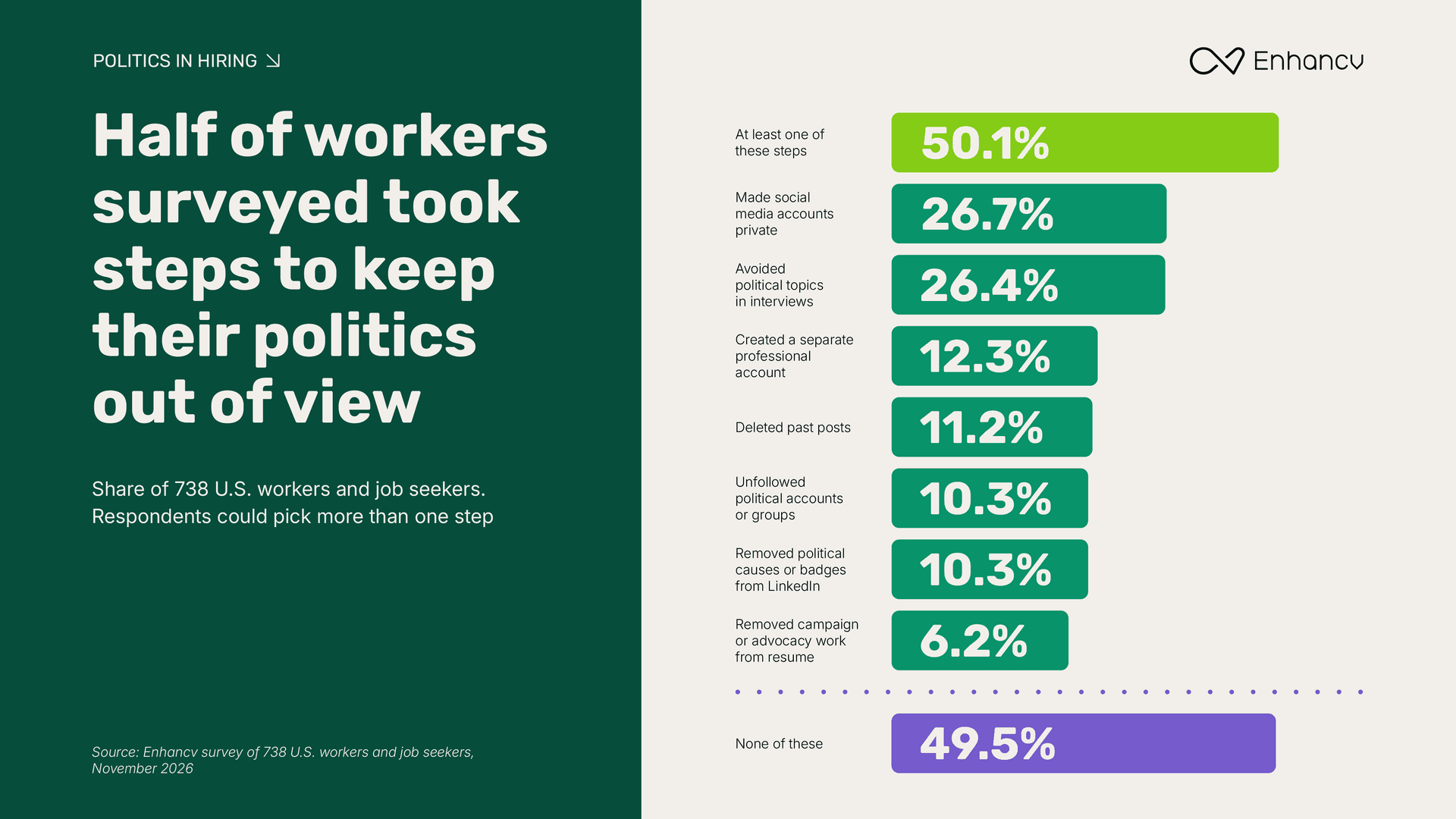
Half of workers surveyed (50.1%) say they did at least one thing to keep their political views under wraps before or during a job search. The share rises to 59.5% among workers who applied or interviewed for a job in the past three years.
The most common step was making social media accounts private, followed closely by avoiding political topics in interviews.
On the hiring side, 54.3% of HR pros say they always or usually review a candidate's online presence before making a hiring decision. Another 34.1% do so sometimes or rarely, and 11.7% never do.
Where HR pros look
Among HR pros who review candidates online at least rarely, Facebook is the most common place they check (63.9%), ahead of LinkedIn (49.3%).
Here’s the full breakdown:
- Facebook: 63.9%
- LinkedIn: 49.3%
- Instagram: 47.5%
- TikTok: 36.1%
- A general web search: 30.4%
- X or Threads: 23.2%
- A third-party or AI background screening tool: 18.2%
- Reddit: 12.5%
Employers must protect their businesses, but ‘protecting the brand’ can become a cover for personal bias... Apply consistent standards, verify context, require human review of automated flags and let applicants correct errors.
George Carrillo, Founder and President of HireMe and CEO of the Hispanic Construction Council
Separately, 44.5% of HR pros say their organization uses AI or automated tools that scan candidates' online presence. 47.9% say it doesn't, and 7.6% aren't sure.

Where HR pros notice a candidate's politics
Social media is just one way politics comes up. HR pros say they've noticed a candidate's political views through social media posts (53.2%) about as often as through comments in interviews or small talk (51.3%).
They've also picked them up from resume affiliations or volunteer roles (33.9%), clothing, pins, or other visible items (29.1%), references (26.3%), and news or public records (18.7%).
Once an interviewer knows how someone votes, it’s very hard to un-know it.
Jesse Wright, Co-Founder of Talentige
How often do political views factor into hiring decisions?
Among surveyed HR professionals, 43.5% report that a candidate's political views, posts, or perceived affiliation have influenced a hiring decision. Another 52.1% say this has never happened, and 4.4% preferred not to say.
Have a candidate's political views influenced your hiring decision?
| Answer | Share of HR respondents |
|---|---|
| No, never | 52.1% |
| Yes, both at different times | 21.1% |
| Yes, against the candidate | 13.6% |
| Yes, in the candidate’s favor | 8.8% |
| Prefer not to say | 4.4% |
We also asked HR pros how often this happens around them. In their own industry, 52.7% say it's common for hiring managers to factor in a candidate's political views, with 11.0% calling it very common and 41.6% somewhat common. Another 37.5% see it as uncommon, and 9.8% aren't sure.
HR pros at organizations that use AI tools to scan candidates' online presence were more likely to say political views have influenced a hiring decision (55.3%) than those at organizations that don't use them (34.9%). The survey shows that the two go together, but it doesn't show that one causes the other.
Workplace conflict and team fit top HR's concerns, and 1 in 5 workers say their politics hurt their chances
When a candidate's views seem to differ from the team's, HR managers most often worry about potential workplace conflict (39.7%), fit with the team (39.1%), and how clients or customers might react (37.2%). Another 27.8% mention the company's reputation, and 29.7% say they have no concerns.
On the worker side, one in five (20.5%) believe their political views, affiliations, or social media activity hurt their chances in a job application or interview, including 8.3% who say it definitely did. Among workers who applied or interviewed in the past three years, the share rises to 27.2%. And 17.8% say an interviewer has asked about their political views, either directly (6.5%) or indirectly (11.2%).
It’s not necessary for everyone in a workplace to support the same candidates or policies for them to work together toward a common business goal.
Jon Hill, Chairman & CEO of The Energists
Do workers list political experience on their resume?
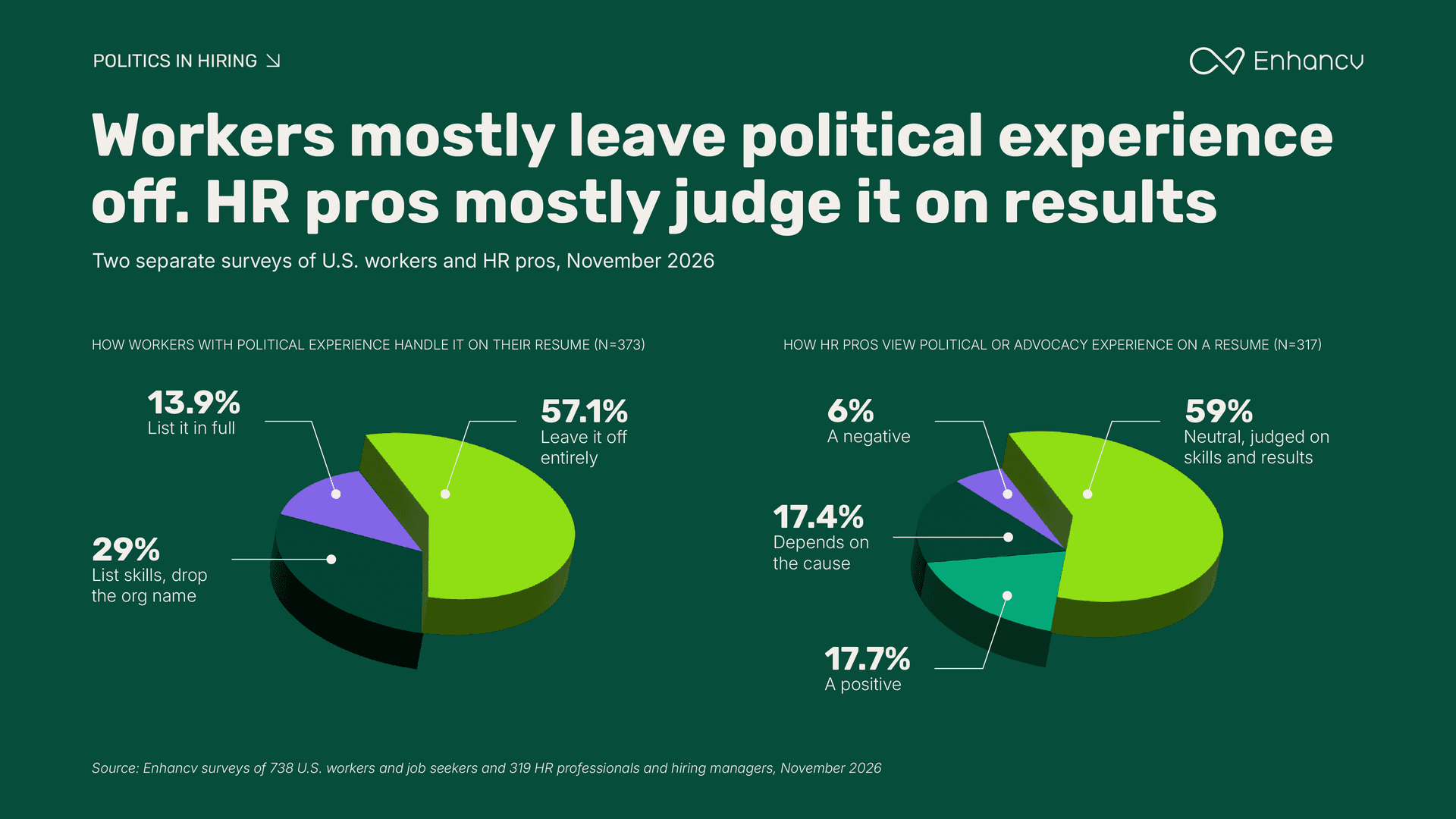
When it comes to resumes, campaign work, advocacy, and political volunteering mostly stay off the page. Of workers who have this kind of experience, 57.1% leave it off their resume entirely, another 29.0% list the skills and results but drop the organization's name, and 13.9% list it in full.
A resume is a list of greatest hits, not a full career history.
Maria Simon, Founder and Managing Partner of Simon Search Partners
Across all workers surveyed, 49.5% say they don't have this kind of experience.
How HR pros say they view it
Most HR pros say they'd read it on its merits: 59.0% view political campaign or advocacy experience as neutral and judge it on skills and results. Another 17.7% see it as a positive, 17.4% say it depends on the cause or organization, and 6.0% see it as a negative.
Taken together, 23.3% of HR pros either see this experience as a negative or say their view depends on the cause.
Here's how workers' choices and HR pros' views stack up side by side.
What do workers and HR know about the law?
On this one, workers and HR staff land in almost the same place. About a third of each group believes federal law protects private-sector job applicants from being rejected over their political views (35.1% of workers and 35.9% of HR pros). In fact, there's no general federal law that does, though D.C. and some states offer limited protections.
Overall, 32.8% of workers and 45.1% of HR pros picked an accurate answer ("no" or "it depends on the state").
What the law says
According to employment law firm Littler, political speech isn't covered by Title VII, and private employers can generally refuse to hire or fire at-will employees over their political views.
A decision based on politics can still be unlawful if it's shown to be based on a protected characteristic, such as religion or race.
As of 2024, at least 11 states have laws that limit employers from disciplining employees over their political views or activity: California, Colorado, Connecticut, Illinois, Louisiana, Michigan, Nevada, New York, North Dakota, South Carolina, and Utah. The scope of these laws varies by state.
Most of these laws protect current employees, and coverage for job applicants varies.
Title VII covers race, color, religion, sex, and national origin, not politics... Write down what you are looking for before anyone looks, such as threats, harassment, violence, or leaks of confidential information. Political opinions stay off that list.
Todd Nurick, Business Attorney and Fractional General Counsel, Law Office of Todd B. Nurick
Inside companies, the rules are often unwritten:
- 47.3% of HR professionals report that their company has no written policy on considering candidates' political views or social media in hiring.
- Another 30.2% describe a policy that sets limits on what can be considered.
- 13.0% note that their company's policy prohibits considering them.
- 9.5% aren't sure.
There’s still a risk of a discrimination lawsuit if they consistently screen out a certain demographic that coincides with that political affiliation... it could be a potential Title VII disparate impact claim.
Stacy Kemp Ferrari, Founder of Kemp Law Group (overseeing hiring for the firm)
Federal law offers no blanket protection for political views in private hiring. State and local protections vary, and government hiring has different rules. Screening can still violate antidiscrimination laws... Where discrimination is unlawful, unequal treatment and inconsistent explanations can support a claim without an admission.
George Carrillo, Founder and President of HireMe and CEO of the Hispanic Construction Council
Should employers be allowed to consider political views?
When we asked both groups the same question, workers drew a firmer line. About half of them (49.2%) say employers should never be allowed to consider a candidate's political views, compared with 34.0% of HR representatives.
Between the two ends are the conditional answers. Of workers, 22.1% say considering political views in hiring is acceptable only when the role itself is political, such as a campaign or advocacy job, compared with 25.1% of HR pros.
Another 16.0% of workers and 23.5% of HR pros would allow it only based on public conduct, like threats or harassment online.
At the permissive end, HR pros are more than twice as likely as workers to say employers should be allowed to consider political views for any role (14.9% vs. 6.0%).
On the uncertain side, 6.8% of workers weren't sure, compared with 2.5% of HR pros.
Does a company's political stance affect where people apply?
Candidates screen employers, too.
A third of workers (33.7%) say a company's perceived political stance kept them from applying or accepting an offer. That includes 18.6% who skipped the application, 5.6% who turned down an offer, and 9.6% who did both, so 15.2% in total have said no to a job offer over it. Another 10.2% thought about walking away but went ahead anyway.
When workers size up where a company stands, they look to the top first. CEO and leadership statements are the most-used signal (45.3%), while 30.4% don't factor in a company's stance at all.
Signals workers use to judge a company's political stance
| Signals workers use | Share of workers |
|---|---|
| Statements by the CEO or leadership | 45.3% |
| Its stance on diversity, equity, and inclusion programs | 39.4% |
| The company's political donations | 39.3% |
| The company's social media posts | 38.2% |
| Employee reviews on sites like Glassdoor | 23.3% |
| News coverage | 22.2% |
| Its customers, products, or partners | 21.1% |
| I don't consider this | 30.4% |
Values can come with a price tag, too. Nearly half of workers (46.2%) would take a pay cut to work somewhere that shares their values. Most would keep it small: 29.9% would accept up to 5% less, 11.5% would go to 6–10% less, and 4.7% would go beyond 10%. This question asked about values in general, not politics specifically.
Methodology
Enhancv ran two separate online surveys of U.S. adults through a SurveyMonkey panel on November 2–3, 2026.
- Workers and job seekers ("Applying for Jobs Today"): U.S. adults who are employed or looking for work. 75.9% are employed full-time, 19.0% part-time, and 5.1% are unemployed and looking. 62.2% applied or interviewed for a job in the past three years.
- HR professionals and hiring managers ("Candidate Screening in Today's Workplace"): U.S. adults whose panel job function is human resources. 25.1% are in HR leadership, 24.5% are HR business partners or generalists, 19.4% are hiring managers outside HR, 16.9% work in talent acquisition, and 14.1% hold other roles.
Quality screening
We removed responses that finished in under 60 seconds (a little under half the median completion time), or that picked the first answer option on five or more core questions.
- Workers: 1,008 completed surveys. We removed 158 that finished in under 60 seconds and 112 that picked the first answer option on five or more core questions, for a final sample of 738.
- HR professionals: 418 completed surveys. We removed 44 that finished in under 60 seconds and 55 that picked the first answer option on five or more core questions, for a final sample of 319.
Reporting
Percentages are unweighted and based on everyone who answered each question, so some figures use a slightly smaller base. Most HR figures are based on 317 respondents, and the questions on the law, policy, and whether employers should be allowed to consider political views use 315.
Where HR pros look online is based on the 280 who review candidates' online presence at least rarely.
Resume figures for workers with political experience are based on 373 respondents, and recent-applicant figures on 459.
Answers to multi-select questions add up to more than 100%.
Figures may not sum due to rounding.
Margin of error
At the 95% confidence level, the margin of error is ±3.6 percentage points for the worker sample and ±5.5 percentage points for the HR sample. Smaller groups have wider margins, for example, ±4.6 points for recent applicants and ±5.9 points for HR professionals who review candidates online. Both surveys used an opt-in online panel, so margins of error are an approximation.
The two surveys are separate samples. Comparisons between groups, such as HR pros at organizations with and without AI screening tools, show association, not cause.
Make one that's truly you.