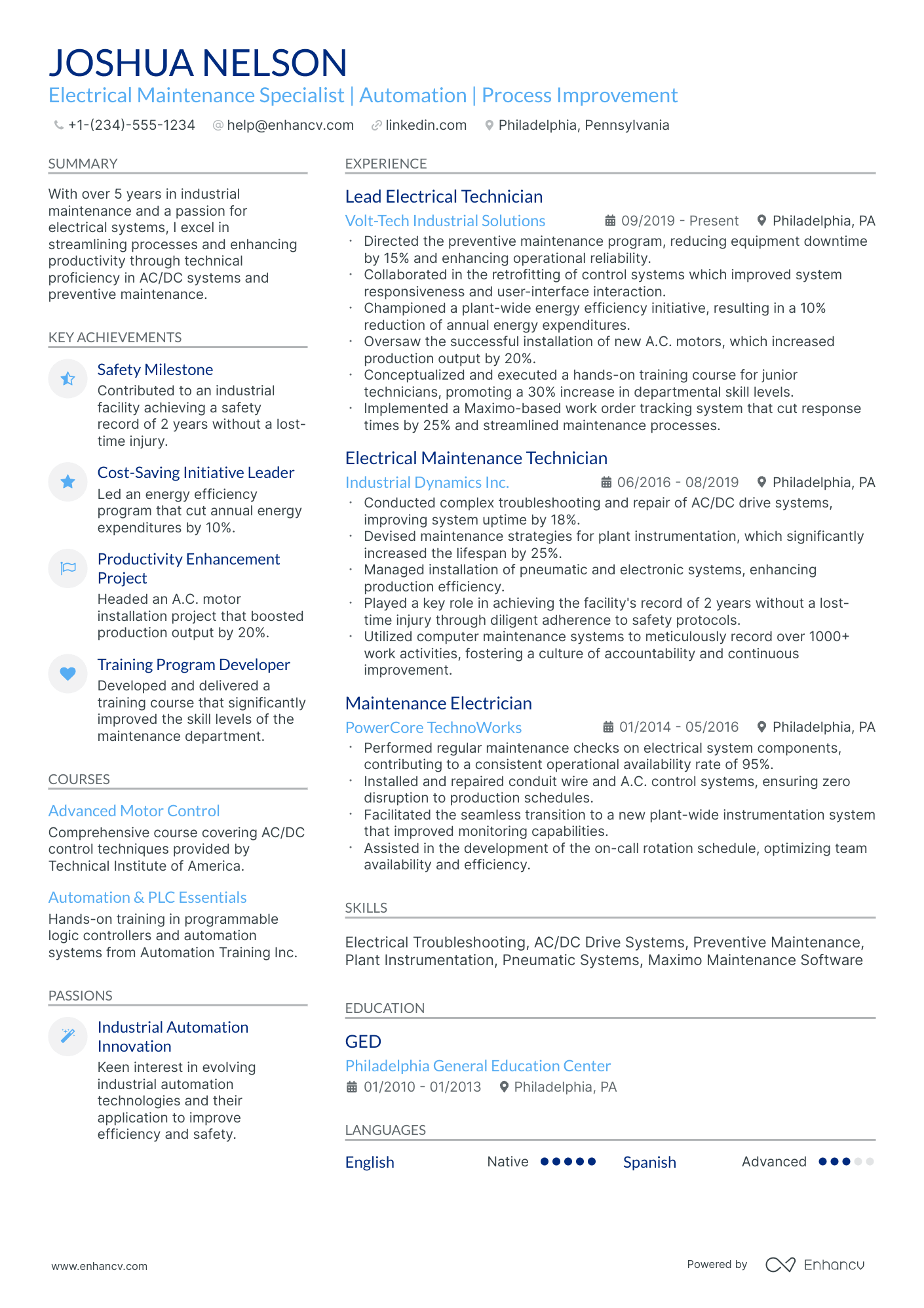
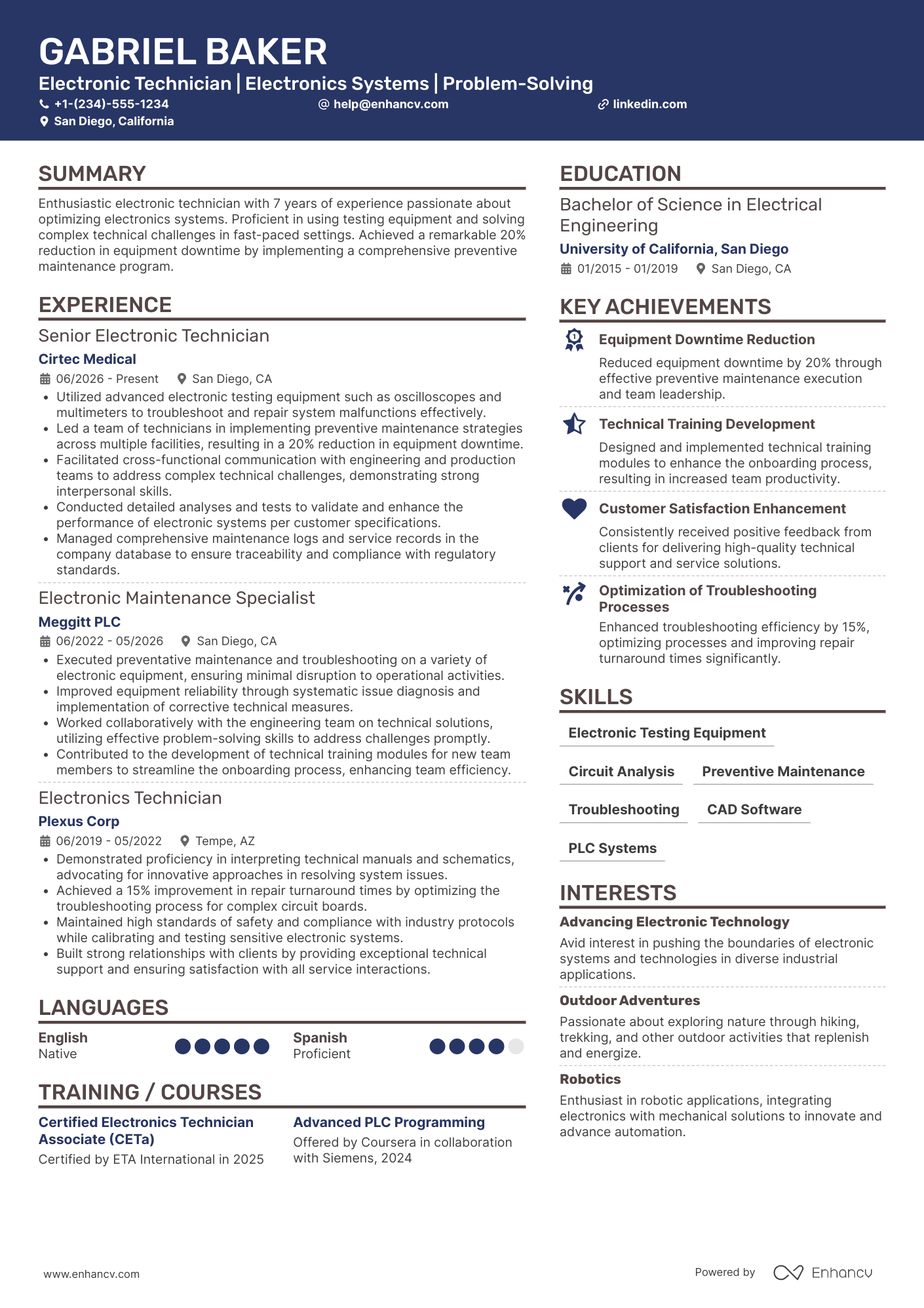
Many electronic technician resume submissions fail because they list tools and tasks without tying them to measurable results or verified compliance. That makes them easy to miss in ATS screening and fast recruiter scans, especially when competition is high.
A strong resume shows what you improved and delivered, not just what you touched. Knowing how to make your resume stand out means you should highlight reduced downtime, faster fault isolation, higher first-pass yield, tighter calibration tolerance, fewer returns, on-time field installs, and clear documentation that passed audits.

Key takeaways
- Tie every repair and troubleshooting task to a measurable result like downtime reduced or yield improved.
- Use a reverse-chronological format for experienced technicians and a hybrid format for career changers.
- Mirror the job posting's exact tool names, standards, and performance metrics in your experience bullets.
- Place certifications like IPC J-STD-001 or CET prominently—they influence hiring decisions as much as degrees.
- Quantify achievements using mean time to repair, first-pass yield, cost savings, or calibration compliance rates.
- Demonstrate soft skills through outcomes, not labels—show how you communicated, escalated, or coordinated.
- Use Enhancv to turn routine electronic technician tasks into focused, recruiter-ready resume bullets.
Job market snapshot for electronic technicians
We analyzed 932 recent electronic technician job ads across major US job boards. These numbers help you understand employer expectations, industry demand, salary landscape at a glance.
What level of experience employers are looking for electronic technicians
| Years of Experience | Percentage found in job ads |
|---|---|
| 1–2 years | 6.3% (59) |
| 3–4 years | 7.2% (67) |
| 5–6 years | 2.7% (25) |
| 7–8 years | 0.1% (1) |
| 9–10 years | 0.2% (2) |
| 10+ years | 0.8% (7) |
| Not specified | 82.9% (773) |
Electronic technician ads by area of specialization (industry)
| Industry (Area) | Percentage found in job ads |
|---|---|
| Government | 51.2% (477) |
| Finance & Banking | 29.2% (272) |
| Healthcare | 6.8% (63) |
| Education | 6.7% (62) |
| Manufacturing | 5.3% (49) |
Top companies hiring electronic technicians
| Company | Percentage found in job ads |
|---|---|
| State of Florida | 45.4% (423) |
| M.C. Dean, Inc. | 12.4% (116) |
| Actalent | 2.4% (22) |
| Amentum | 2.4% (22) |
| Eaton Corporation | 1.5% (14) |
| Parsons Commercial Technology Group Inc. | 1.2% (11) |
| Vectrus (V2X) | 1.1% (10) |
Role overview stats
These tables show the most common responsibilities and employment types for electronic technician roles. Use them to align your resume with what employers expect and to understand how the role is structured across the market.
Day-to-day activities and top responsibilities for a electronic technician
| Responsibility | Percentage found in job ads |
|---|---|
| Cctv systems | 45.9% (428) |
| Electronic systems | 44.4% (414) |
| Electrical systems | 43.5% (405) |
| Communications systems | 43.2% (403) |
| Electrical infrastructure | 20.1% (187) |
| Testing equipment | 19.1% (178) |
| Troubleshooting | 17.4% (162) |
| Ms excel | 12.8% (119) |
| Ms word | 12.4% (116) |
| Electronics | 11.8% (110) |
| Bosch bvms | 11.5% (107) |
| Aiphone intercom systems | 11.4% (106) |
How to format a electronic technician resume
Recruiters hiring electronic technicians prioritize hands-on technical skills, troubleshooting ability, and familiarity with specific equipment, schematics, and industry standards like IPC or J-STD. Your resume format determines how quickly a hiring manager can locate these signals, so choosing the right structure ensures your qualifications aren't buried beneath a layout that fights against applicant tracking systems.

I have significant experience in this role—which format should I use?
Use a reverse-chronological format to present your deepest technical experience in a clear, progression-driven timeline. Do:
- Lead each position with your scope of responsibility—types of systems serviced, facility size, or team coordination duties.
- List role-specific tools and domains prominently, including oscilloscopes, multimeters, PCB rework stations, PLC systems, and relevant compliance standards.
- Quantify outcomes wherever possible, such as reduction in equipment downtime, units repaired per cycle, or cost savings from preventive maintenance programs.
I'm junior or switching into this role—what format works best?
A hybrid format works best because it lets you lead with a strong technical skills section while still providing a work history that shows practical application. Do:
- Place a dedicated skills section near the top of your resume featuring relevant competencies like soldering, schematic reading, ESD handling, and diagnostic software.
- Include academic projects, lab coursework, internships, or personal electronics builds that demonstrate hands-on experience with real components and systems.
- Connect every action to a clear result, even in non-professional settings, to show you understand how technical work drives measurable outcomes.
When does a functional resume make sense?
A functional format is a fit only in narrow circumstances where a traditional timeline would raise more questions than it answers:
- You're transitioning from a related field (such as electrician, HVAC technician, or IT hardware support) and need to foreground transferable diagnostic and repair skills.
- You have a significant gap in employment but continued building relevant skills through certifications, personal projects, or volunteer repair work.
- You have limited formal work history but hold credentials like an associate degree in electronics technology or an IPC certification.
- A functional format is acceptable when you genuinely lack professional electronic technician experience, but you should still tie every listed skill to a specific project, certification lab, or measurable outcome to prevent your resume from reading as a disconnected list of keywords.
Once you've established a clean, readable format, the next step is deciding which sections to include so each one reinforces your qualifications.
What sections should go on a electronic technician resume
Recruiters expect a clean, complete resume that shows you can troubleshoot, repair, test, and document electronic systems safely and accurately. Understanding what to put on a resume helps you prioritize the right information. Use this structure for maximum clarity:
- Header
- Summary
- Experience
- Skills
- Projects
- Education
- Certifications
- Optional sections: Awards, Leadership, Volunteering
Strong experience bullets should emphasize measurable results, equipment and system scope, diagnostic methods, quality and safety compliance, and improvements to uptime, yield, or turnaround time.
Is your resume good enough?
Drop your resume here or choose a file. PDF & DOCX only. Max 2MB file size.
With your resume’s key components in place, the next step is to write your electronic technician resume experience section so employers can see how you’ve applied them on the job.
How to write your electronic technician resume experience
Your work experience section should highlight the diagnostic work, repairs, and system installations you've shipped—along with the tools, instruments, and methods you used to deliver them. Hiring managers prioritize demonstrated impact over descriptive task lists, so focus on measurable outcomes like reduced downtime, improved circuit performance, or faster turnaround on equipment servicing.
Each entry should include:
- Job title
- Company and location (or remote)
- Dates of employment (month and year)
Three to five concise bullet points showing what you owned, how you executed, and what outcomes you delivered:
- Ownership scope: the specific equipment, circuits, control systems, or facility infrastructure you were directly accountable for maintaining, testing, or repairing as an electronic technician.
- Execution approach: the diagnostic instruments, schematics, soldering techniques, testing protocols, or calibration methods you relied on to troubleshoot faults and complete repairs.
- Value improved: the changes you drove in equipment uptime, signal accuracy, component reliability, safety compliance, or mean time to repair across the systems you serviced.
- Collaboration context: how you coordinated with engineers, production teams, vendors, or facility managers to align on repair priorities, parts sourcing, or system upgrade timelines.
- Impact delivered: the tangible results your work produced—expressed through reduced failure rates, extended equipment life cycles, cost savings on replacement parts, or improvements in operational throughput rather than a list of tasks performed.
Experience bullet formula
A electronic technician experience example
✅ Right example - modern, quantified, specific.
Electronic Technician
Apex Industrial Controls | Columbus, OH
2021–Present
Supported high-mix electronics manufacturing and field service for industrial sensor and control assemblies used across automotive and food processing plants.
- Diagnosed board-level failures using oscilloscopes, logic analyzers, and digital multimeters, cutting mean time to repair by 28% and improving first-pass yield by 6%.
- Reworked surface-mount technology and through-hole assemblies with hot air rework stations, soldering irons, and X-ray inspection, reducing scrap costs by $42K annually.
- Executed automated functional test plans using LabVIEW, Python scripts, and custom test fixtures, increasing test coverage by 18% and lowering escapes to customers by 35%.
- Collaborated with electrical engineers and quality engineers to implement electrostatic discharge controls and root cause analysis (8D), decreasing electrostatic discharge-related defects by 40%.
- Managed calibration and preventive maintenance for 60+ test instruments in the calibration management system, achieving 99% on-time calibration compliance and avoiding production delays.
Now that you've seen how a strong experience section comes together, let's look at how to adjust those details to match the specific job you're applying for.
How to tailor your electronic technician resume experience
Recruiters evaluate your electronic technician resume through applicant tracking systems and manual review, scanning for alignment with specific job requirements. Tailoring your resume to the job description increases your chances of passing both filters.
Ways to tailor your electronic technician experience:
- Match specific test equipment like oscilloscopes or multimeters named in the posting.
- Use the exact terminology for soldering or circuit board repair standards.
- Mirror performance metrics such as repair turnaround times or uptime goals.
- Include experience with industry-specific systems like PLCs or SCADA platforms.
- Emphasize compliance with IPC or ESD standards when the posting requires them.
- Highlight calibration or preventive maintenance workflows referenced in the description.
- Reflect collaboration with engineering or production teams if cross-functional work applies.
- Reference relevant domain experience such as manufacturing or telecommunications environments.
Tailoring means aligning your real accomplishments with what the employer asks for, not forcing disconnected keywords into your experience.
Resume tailoring examples for electronic technician
| Job description excerpt | Untailored | Tailored |
|---|---|---|
| Perform diagnostic testing and troubleshooting on PCB assemblies using oscilloscopes, multimeters, and signal generators to ensure compliance with IPC-A-610 standards. | Tested and repaired various electronic components. | Diagnosed and troubleshot PCB assemblies using oscilloscopes, multimeters, and signal generators, maintaining 99.2% compliance with IPC-A-610 Class 3 acceptability standards across 1,200+ units annually. |
| Install, calibrate, and maintain industrial control systems including PLCs, HMIs, and variable frequency drives in a manufacturing environment with minimal downtime requirements. | Worked on control systems and performed routine maintenance tasks. | Installed, calibrated, and maintained PLC, HMI, and variable frequency drive systems across 14 production lines, reducing unplanned downtime by 30% through preventive maintenance scheduling and root cause analysis. |
| Read and interpret schematics, wiring diagrams, and technical manuals to repair and modify RF communication equipment, including transceivers and antenna systems, per MIL-STD specifications. | Fixed communication equipment and followed technical documentation. | Interpreted schematics, wiring diagrams, and technical manuals to repair and modify RF transceivers and antenna systems, completing 95% of work orders within MIL-STD specification tolerances and ahead of scheduled turnaround times. |
Once you’ve aligned your experience with the role’s requirements, the next step is to quantify your electronic technician achievements so hiring managers can quickly see the impact of your work.
How to quantify your electronic technician achievements
Numbers prove your fixes improved uptime, quality, and delivery speed, not just that you stayed busy. Quantifying your achievements means focusing on mean time to repair, first-pass yield, defect rates, calibration accuracy, downtime avoided, rework reduced, and parts cost saved.
Quantifying examples for electronic technician
| Metric | Example |
|---|---|
| Reliability | "Cut unplanned line downtime by 22% by replacing failing relays and re-terminating loose connectors, improving mean time between failures from 180 to 230 hours." |
| Repair speed | "Reduced mean time to repair from 95 to 60 minutes by standardizing troubleshooting steps and using a Fluke 87V and oscilloscope to isolate faults faster." |
| Quality yield | "Improved first-pass yield from 92% to 97% by tightening soldering and inspection controls on PCB rework using IPC-A-610 criteria." |
| Cost savings | "Lowered parts spend by $18,000 annually by repairing power supplies at component level and validating replacements with load testing instead of full-unit swaps." |
| Safety risk | "Reduced electrical safety incidents to zero over twelve months by enforcing lockout/tagout checks and adding insulation resistance testing on high-voltage assemblies." |
Turn your everyday tasks into measurable, recruiter-ready resume bullets in seconds with Enhancv's Bullet Point Generator.
Once you've crafted strong bullet points for your experience section, the next step is ensuring your skills section effectively showcases the technical and interpersonal abilities that reinforce those accomplishments.
How to list your hard and soft skills on a electronic technician resume
Your skills section shows you can troubleshoot, repair, and verify electronic systems, and recruiters and ATS scan this section for job-match keywords, so aim for a balance of role-specific hard skills and execution-focused soft skills. electronic technician roles require a blend of:
- Product strategy and discovery skills.
- Data, analytics, and experimentation skills.
- Delivery, execution, and go-to-market discipline.
- Soft skills.
Your skills section should be:
- Scannable (bullet-style grouping).
- Relevant to the job post.
- Backed by proof in experience bullets.
- Updated with current tools.
Place your skills section:
- Above experience if you're junior or switching careers.
- Below experience if you're mid/senior with strong achievements.

Hard skills
- Schematic reading, wiring diagrams
- PCB rework, soldering, hot air
- Oscilloscope, DMM, logic analyzer
- Signal tracing, fault isolation
- ESD controls, IPC-610
- Preventive maintenance, calibration
- Test fixtures, functional test
- Root cause analysis, 8D
- PLC basics, I/O troubleshooting
- Serial protocols: I2C, SPI, UART
- CMMS work orders, maintenance logs
- ISO 9001 documentation
Soft skills
- Write clear repair notes
- Communicate test results to engineers
- Escalate risks with evidence
- Follow lockout-tagout procedures
- Prioritize downtime-critical repairs
- Coordinate with production and QA
- Ask targeted troubleshooting questions
- Validate fixes before release
- Manage parts and tool control
- Maintain focus in high-noise environments
- Train operators on basic checks
- Own issues through closure
How to show your electronic technician skills in context
Skills shouldn't live only in a bulleted list on your resume. Explore our resume skills resource to see how top candidates integrate abilities throughout their documents.
They should be demonstrated in:
- Your summary (high-level professional identity)
- Your experience (proof through outcomes)
Here's what that looks like in practice.
Summary example
Senior electronic technician with 12 years in aerospace avionics. Skilled in PCB troubleshooting, oscilloscope diagnostics, and IPC-A-610 compliance. Reduced board failure rates by 31% through root-cause analysis and cross-functional collaboration with design engineering teams.
- Signals senior-level expertise immediately
- Names industry-specific tools and standards
- Quantifies impact with a clear metric
- Highlights collaboration as a soft skill
Experience example
Senior Electronic Technician
Helios Avionics Systems | Tucson, AZ
March 2018–January 2024
- Diagnosed and repaired 1,200+ PCB assemblies annually using oscilloscopes and spectrum analyzers, maintaining a 98.5% first-pass yield rate.
- Partnered with design engineers to revise schematics for radar modules, cutting rework cycles by 22% over two fiscal years.
- Calibrated and maintained 45 pieces of test equipment per MIL-STD-883 standards, achieving zero compliance findings across three consecutive audits.
- Every bullet contains measurable proof
- Skills appear naturally within achievements
Once you’ve demonstrated your technical abilities through specific examples and outcomes, the next step is to apply that approach when writing an electronic technician resume with no experience so you can present transferable skills clearly and credibly.
How do I write a electronic technician resume with no experience
Even without full-time experience, you can demonstrate readiness through:
- Electronics lab coursework and reports
- Capstone electronics repair project
- Personal bench troubleshooting builds
- Volunteer device repair events
- Internship or co-op shadowing
- Technical club competition builds
- Soldering and rework practice logs
- Test equipment calibration exercises
If you're building a resume without work experience, focus on:
- Multimeter, oscilloscope, power supply use
- Soldering, rework, ESD compliance
- Schematics reading and circuit troubleshooting
- Documented results and measured metrics
Resume format tip for entry-level electronic technician
Use a hybrid resume format because it highlights skills and projects first, while still showing education and any related work history. Do:
- Put a Skills section above Experience.
- List tools you've used in labs.
- Add two to four projects.
- Quantify results with measurements.
- Match keywords from the job post.
- Diagnosed and repaired a nonfunctional Arduino power circuit using a multimeter, oscilloscope, and soldering station, restoring stable 5V output within ±0.1V.
Even without hands-on work history, your education section can carry significant weight on your resume—so presenting it strategically is essential.
How to list your education on a electronic technician resume
Your education section helps hiring teams confirm you have the technical foundation needed. It validates your knowledge of circuits, electronics theory, and hands-on skills relevant to the electronic technician role.
Include:
- Degree name
- Institution
- Location
- Graduation year
- Relevant coursework (for juniors or entry-level candidates)
- Honors & GPA (if 3.5 or higher)
Skip month and day details—list the graduation year only.
Here's a strong education entry tailored for an electronic technician resume.
Example education entry
Associate of Applied Science in Electronics Technology
Mesa Community College, Mesa, AZ
Graduated 2021
GPA: 3.7/4.0
- Relevant Coursework: Circuit Analysis, Digital Electronics, Microprocessor Systems, Industrial Controls, and Soldering Techniques
- Honors: Dean's List (four consecutive semesters)
How to list your certifications on a electronic technician resume
Certifications on your resume show your commitment to learning, hands-on tool proficiency, and industry relevance as an electronic technician, especially when they match your daily responsibilities and equipment.
Include:
- Certificate name
- Issuing organization
- Year
- Optional: credential ID or URL
- Place certifications below education when your training is recent and your certifications add support rather than lead your qualifications.
- Place certifications above education when they are recent, role-relevant, or required, and they strengthen your candidacy faster than schooling details.
Best certifications for your electronic technician resume
- IPC J-STD-001 Certification
- IPC-A-610 Certification
- Certified Electronics Technician (CET)
- CompTIA A+
- OSHA 10-Hour General Industry
- ETA Fiber Optics Technician (FOT)
Once your credentials are clearly presented to validate your technical qualifications, you can write your electronic technician resume summary to highlight them upfront and set context for the rest of your experience.
How to write your electronic technician resume summary
Your resume summary is the first thing a recruiter reads, so it sets the tone for everything that follows. A strong summary quickly signals you have the skills and hands-on experience the role demands.
Keep it to three to four lines, with:
- Your title and total years of relevant experience.
- The domain or industry you've worked in, such as manufacturing or telecommunications.
- Core tools and technologies like oscilloscopes, multimeters, soldering stations, or PCB diagnostics.
- One or two measurable achievements that prove your impact.
- Soft skills tied to real outcomes, such as troubleshooting under tight deadlines.

PRO TIP
At the entry or mid level, emphasize technical skills, certifications, and early contributions that show you can deliver results. Avoid vague phrases like "passionate team player" or "eager self-starter." Instead, ground every claim in a specific tool, task, or outcome.
Example summary for a electronic technician
Electronic technician with three years of experience in PCB diagnostics and circuit repair for consumer electronics manufacturing. Reduced equipment downtime by 18% through preventive maintenance scheduling using oscilloscopes and thermal imaging tools.
Optimize your resume summary and objective for ATS
Drop your resume here or choose a file.
PDF & DOCX only. Max 2MB file size.
Now that your summary captures your strongest qualifications at a glance, make sure your resume header provides the essential contact details recruiters need to actually reach you.
What to include in a electronic technician resume header
A resume header lists your key identification and contact details, helping electronic technician applications stand out in searches, build credibility, and pass recruiter screening fast.
Essential resume header elements
- Full name
- Tailored job title and headline
- Location
- Phone number
- Professional email
- GitHub link
- Portfolio link
A LinkedIn link helps recruiters confirm your work history quickly and supports faster screening decisions.
Do not include a photo on a electronic technician resume unless the role is explicitly front-facing or appearance-dependent.
Match your header job title to the posting and keep your contact details consistent across your resume, LinkedIn, and any public profiles.
Example
Electronic technician resume header
Jordan Lee
Electronic Technician | PCB Rework, Troubleshooting, and Test Equipment
Austin, TX
(512) 555-01XX
your.name@enhancv.com
github.com/yourname
yourwebsite.com
linkedin.com/in/yourname
Once your contact details and role identifiers are in place at the top, add targeted additional sections to reinforce your qualifications and support the rest of your resume.
Additional sections for electronic technician resumes
When your core qualifications match other candidates, additional resume sections help you stand out by showcasing unique, role-relevant strengths.
- Certifications and licenses
- Technical training and workshops
- Languages
- Professional affiliations and memberships
- Hobbies and interests
- Publications
Once you've strengthened your resume with relevant extra sections, pairing it with a well-crafted cover letter can further set your application apart.
Do electronic technician resumes need a cover letter
A cover letter isn't required for an electronic technician, but it helps in competitive searches or when hiring managers expect one. If you're wondering what is a cover letter and how it can support your application, it can make a difference when your resume needs context, or when the role demands close team and process alignment.
Use a cover letter to add value in these situations:
- Explain team fit by matching your troubleshooting approach, documentation habits, and safety practices to the role's workflow and standards.
- Highlight one or two relevant projects or outcomes, such as reducing rework, improving test yield, or speeding root cause analysis.
- Show you understand the product and users by referencing the device environment, reliability needs, compliance constraints, and service expectations.
- Address career transitions or non-obvious experience by connecting adjacent skills, such as calibration, quality work, or field service, to the electronic technician role.
Drop your resume here or choose a file.
PDF & DOCX only. Max 2MB file size.
Even if you decide a cover letter won’t add value for your application, using AI to improve your electronic technician resume helps you strengthen the document employers review first.
Using AI to improve your electronic technician resume
AI can sharpen your resume's clarity, structure, and impact. It helps refine bullet points and align content with job descriptions. But overuse strips authenticity. Once your resume is clear and role-aligned, step away from AI. If you're curious about which AI is best for writing resumes, start with tools that focus on structure and keyword alignment rather than generating content from scratch.
Here are 10 practical prompts to strengthen your electronic technician resume:
- Sharpen your summary. "Rewrite my electronic technician resume summary to highlight my top technical skills and years of hands-on experience in under four sentences."
- Quantify repair work. "Add measurable results to these electronic technician experience bullets, focusing on repair turnaround times, equipment uptime, or cost savings."
- Align with postings. "Compare my electronic technician resume skills section against this job description and identify missing keywords I should add."
- Strengthen action verbs. "Replace weak or repeated verbs in my electronic technician experience section with precise, industry-specific action verbs."
- Trim redundant bullets. "Remove repetitive or low-impact bullet points from my electronic technician resume and keep only the strongest accomplishments."
- Highlight certifications. "Reorganize my electronic technician certifications section so the most relevant and current credentials appear first."
- Clarify technical skills. "Group and reformat my electronic technician skills list into clear categories like tools, equipment, software, and testing methods."
- Improve project descriptions. "Rewrite my electronic technician project entries to emphasize scope, technical challenges solved, and measurable outcomes."
- Refine education details. "Edit my electronic technician education section to highlight relevant coursework, lab experience, and technical training programs."
- Tighten formatting consistency. "Review my electronic technician resume for inconsistent tense, punctuation, or formatting across all sections and suggest corrections."
Stop using AI once your resume sounds accurate, specific, and aligned with real experience. AI should never invent experience or inflate claims—if it didn't happen, it doesn't belong here.
Conclusion
A strong electronic technician resume shows measurable outcomes, role-specific skills, and a clear structure. It highlights troubleshooting, testing, calibration, soldering, and documentation, backed by metrics like reduced downtime, improved yield, or faster repair cycles.
Keep each section easy to scan, with focused bullets that match the job requirements. This approach proves you can deliver reliable results now and adapt to today’s and near-future hiring market.