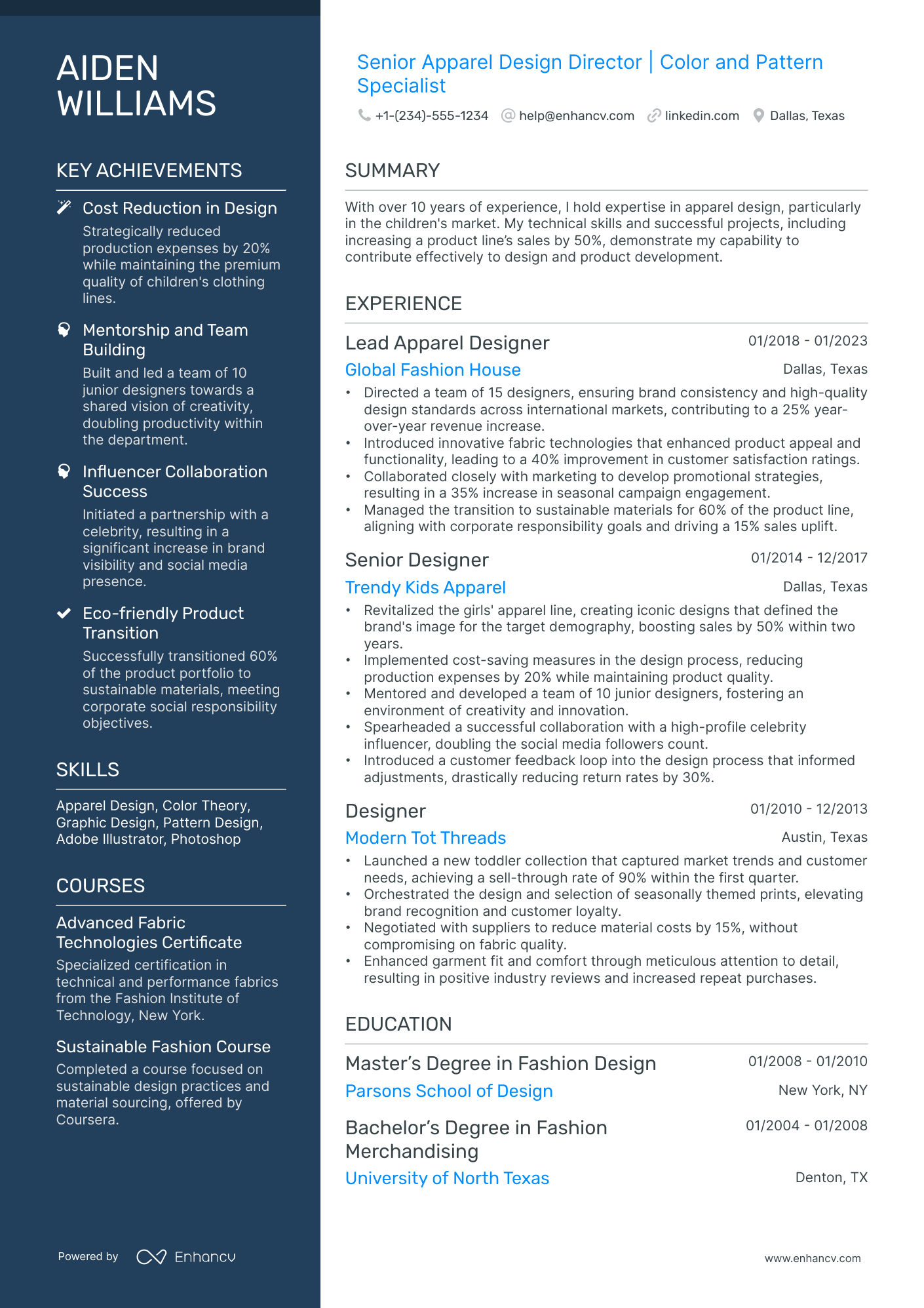
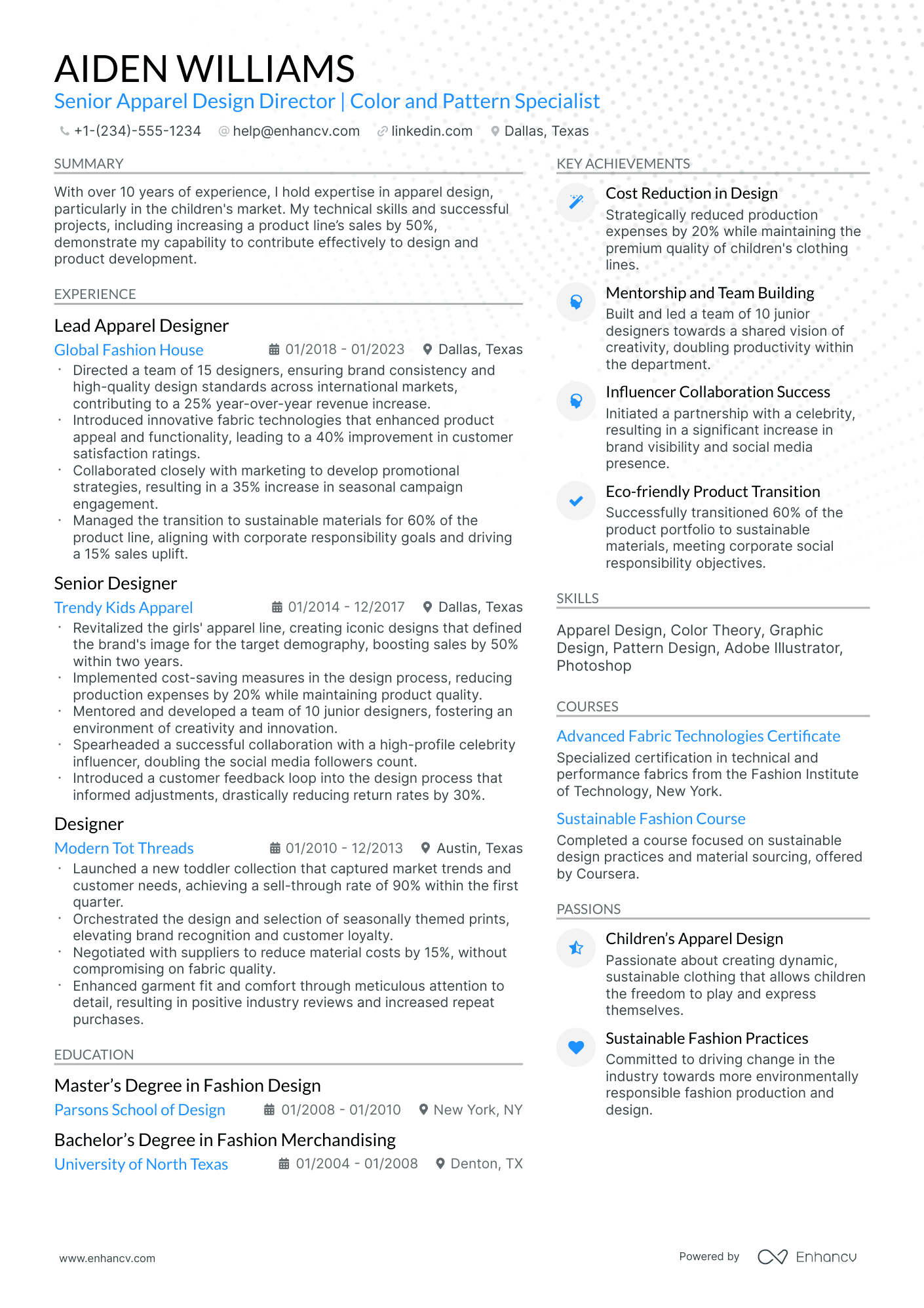
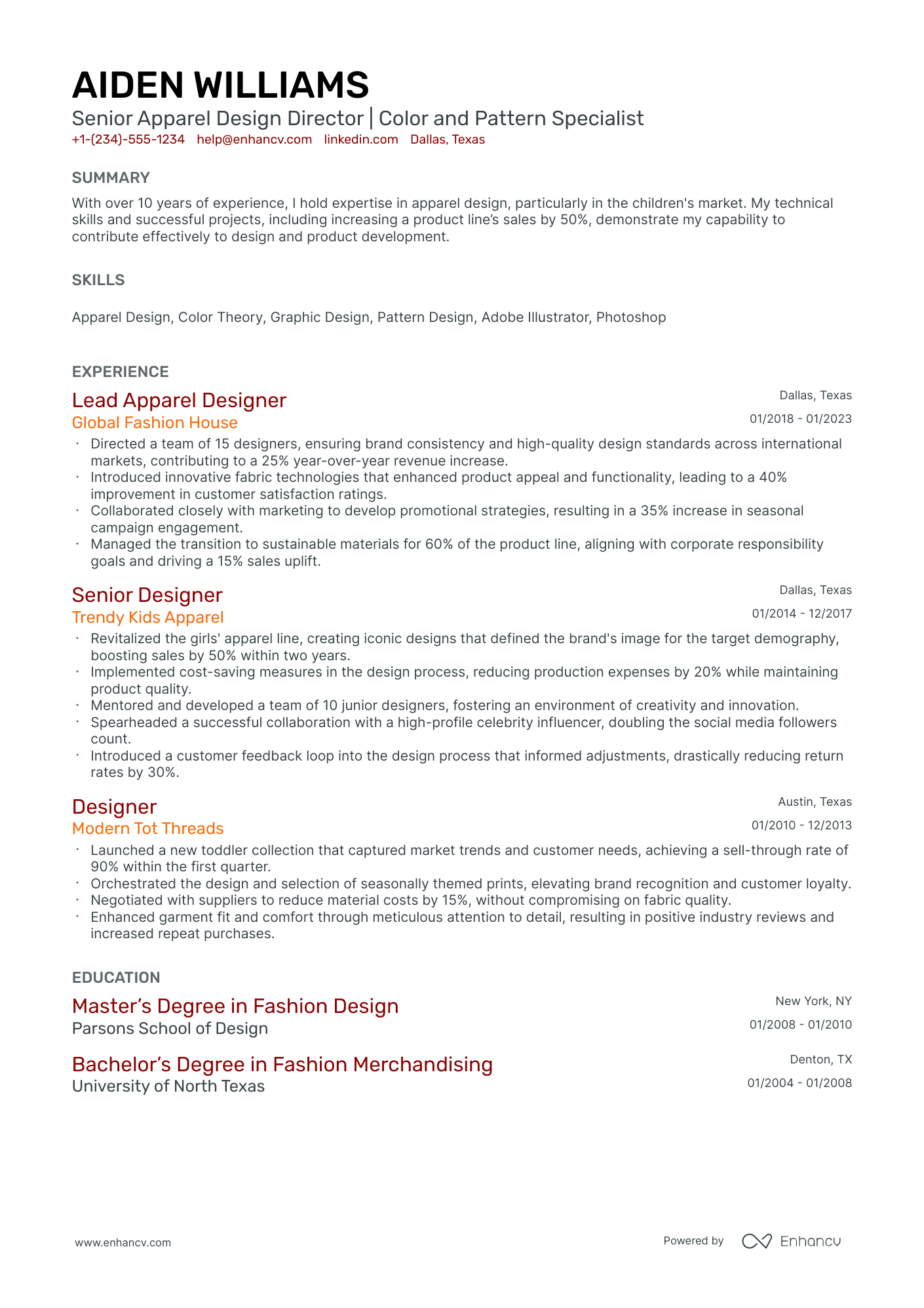
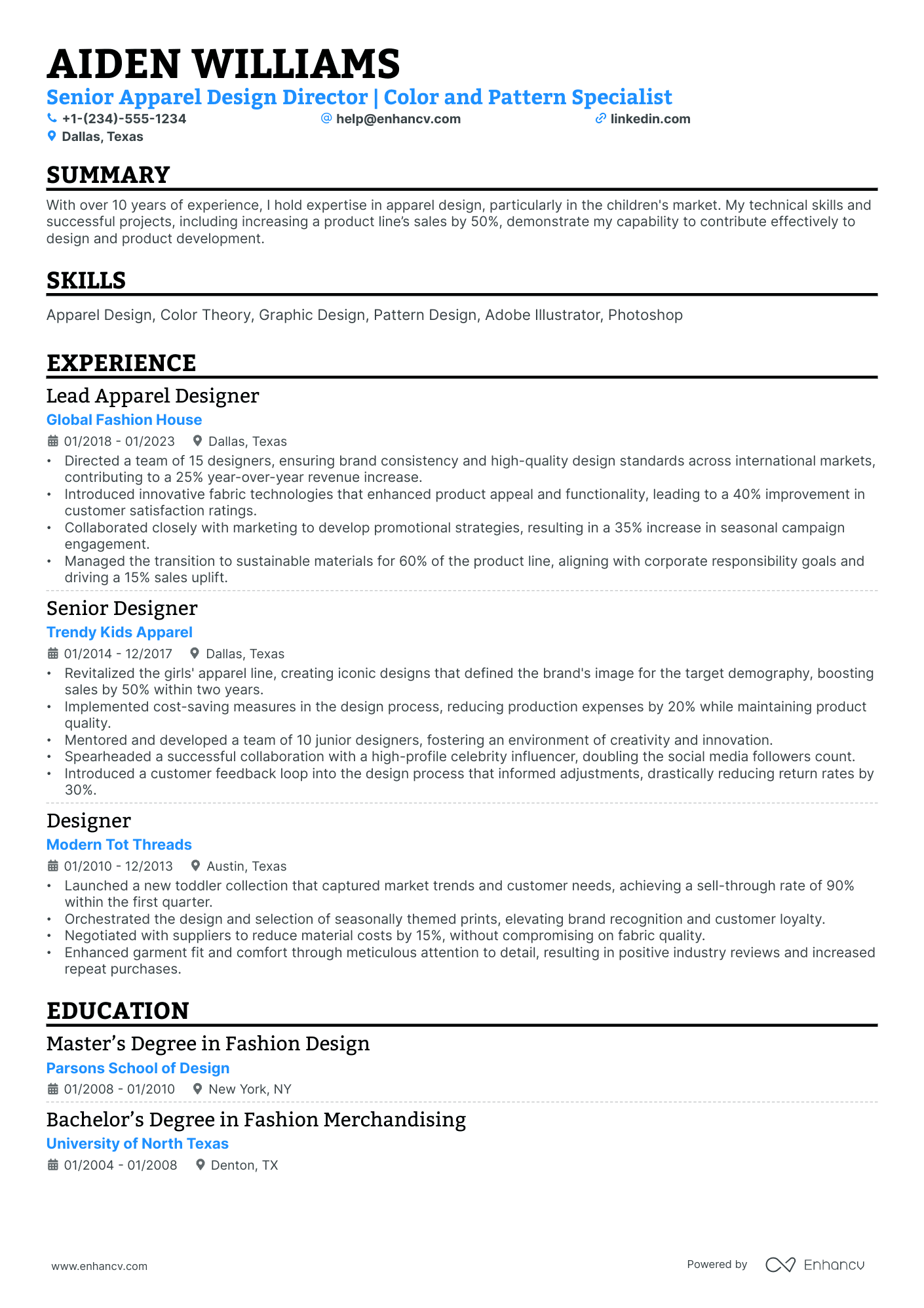
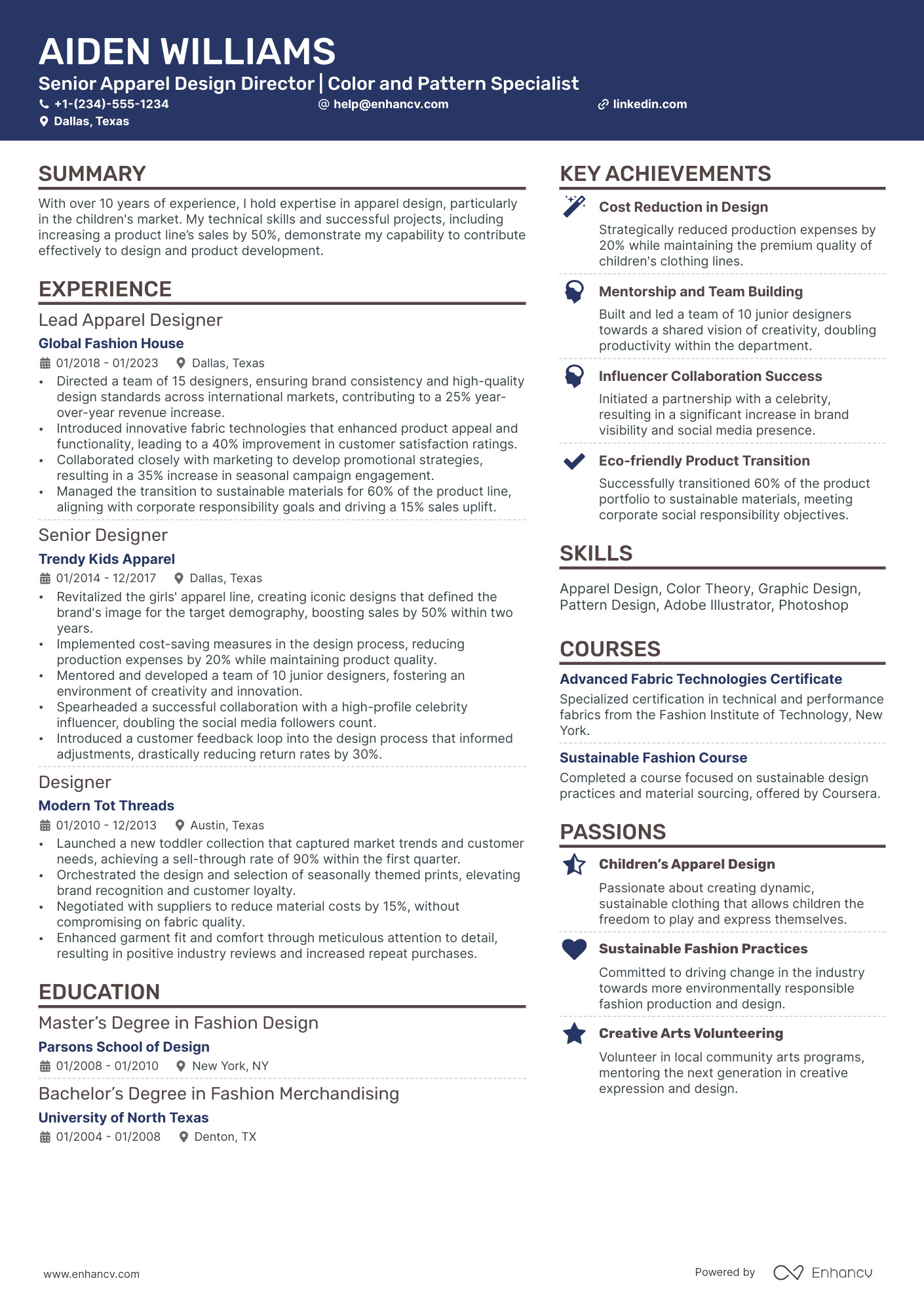
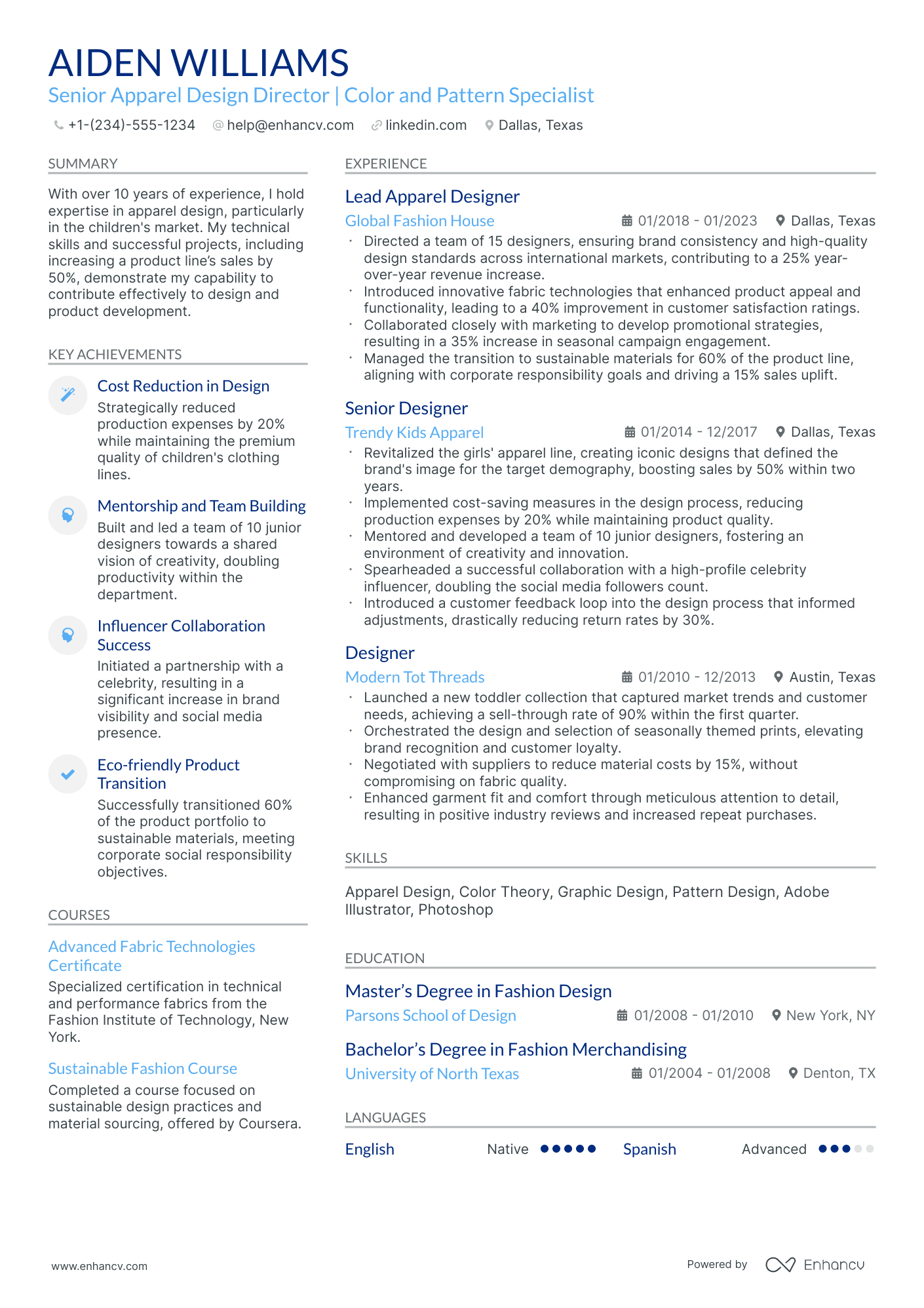
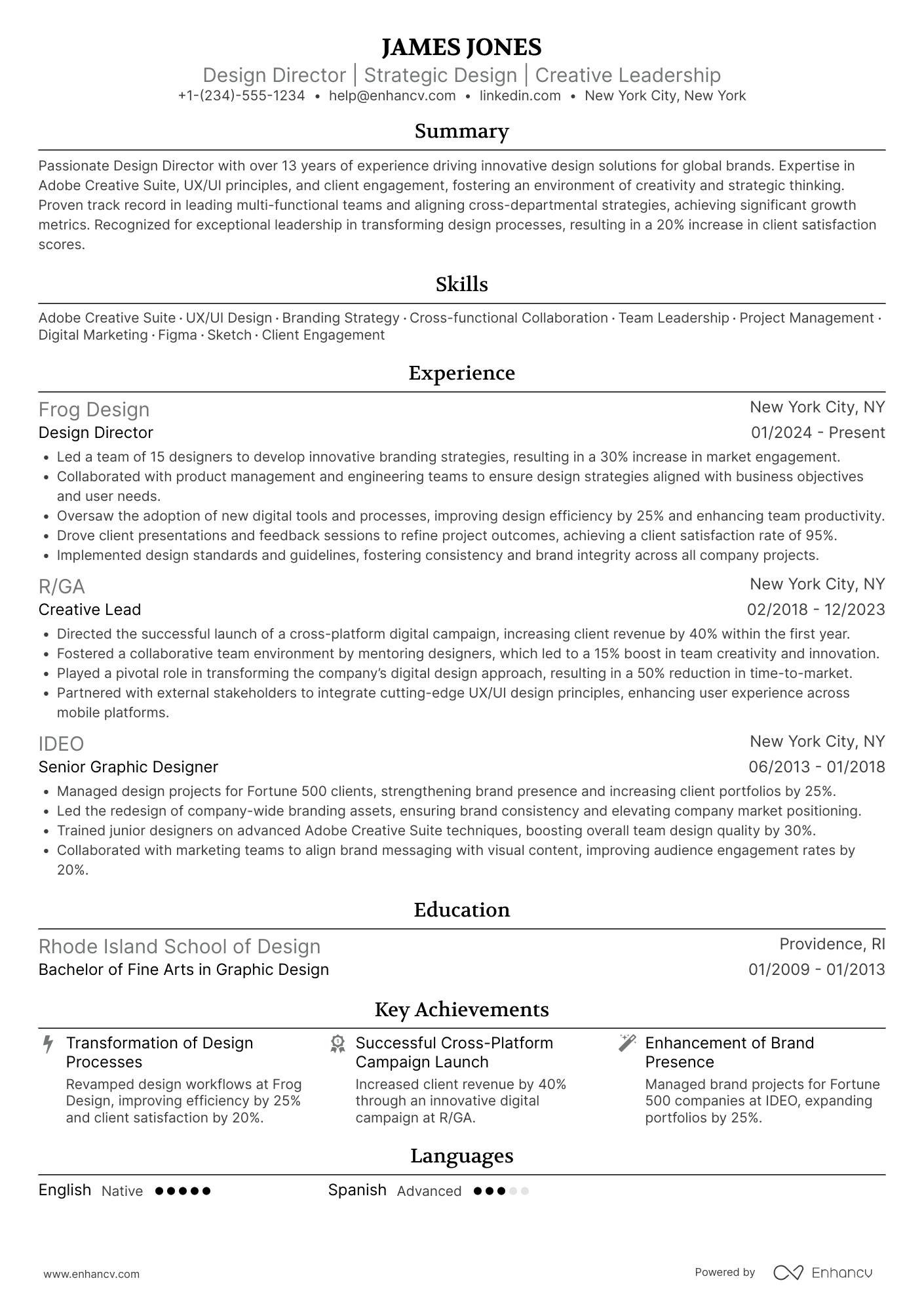
Many design director resume drafts fail because they read like tool lists and team org charts, not evidence of leadership impact. That matters when ATS screening filters keywords and recruiters scan in seconds amid intense competition.
A strong resume shows what you delivered and what changed because of your leadership. Knowing how to make your resume stand out is critical at this level. You should highlight revenue impact, conversion lifts, launch velocity, design system adoption, accessibility gains, team scale, budget ownership, and measurable quality improvements.

Key takeaways
- Use reverse-chronological format to show growing leadership scope and strategic accountability.
- Quantify every achievement with metrics like revenue impact, delivery speed, or adoption rates.
- Tailor experience bullets to mirror each job posting's exact terminology and priorities.
- Demonstrate skills through measurable outcomes in your summary and experience, not just a skills list.
- Pair hard skills like design systems and analytics with leadership-focused soft skills.
- Use AI to tighten language and surface stronger accomplishments, but stop before it overrides authenticity.
- Build your resume faster with Enhancv to ensure clear structure and recruiter-ready formatting.
Job market snapshot for design directors
We analyzed 93 recent design director job ads across major US job boards. These numbers help you understand skills in demand, industry demand, employer expectations at a glance.
What level of experience employers are looking for design directors
| Years of Experience | Percentage found in job ads |
|---|---|
| 7–8 years | 9.7% (9) |
| 9–10 years | 3.2% (3) |
| 10+ years | 8.6% (8) |
| Not specified | 81.7% (76) |
Design director ads by area of specialization (industry)
| Industry (Area) | Percentage found in job ads |
|---|---|
| Healthcare | 54.8% (51) |
| Finance & Banking | 29.0% (27) |
Top companies hiring design directors
| Company | Percentage found in job ads |
|---|---|
| Accenture | 47.3% (44) |
Role overview stats
These tables show the most common responsibilities and employment types for design director roles. Use them to align your resume with what employers expect and to understand how the role is structured across the market.
Day-to-day activities and top responsibilities for a design director
| Responsibility | Percentage found in job ads |
|---|---|
| Ux | 54.8% (51) |
| Digital product design | 46.2% (43) |
| Product strategy | 46.2% (43) |
| Prototyping tools | 46.2% (43) |
| User research | 20.4% (19) |
| Figma | 15.1% (14) |
| Product design | 10.8% (10) |
| Visual design | 9.7% (9) |
| Architecture | 6.5% (6) |
| Design system | 6.5% (6) |
| Photoshop | 6.5% (6) |
| Ui | 6.5% (6) |
Type of employment (remote vs on-site vs hybrid)
| Employment type | Percentage found in job ads |
|---|---|
| On-site | 80.6% (75) |
| Hybrid | 15.1% (14) |
How to format a design director resume
Recruiters evaluating design director candidates prioritize evidence of leadership scope, creative vision at scale, and measurable business impact driven by design strategy. The resume format you choose determines how quickly these signals surface during the six-to-ten-second initial scan and whether an applicant tracking system (ATS) can parse your progression accurately.

I have significant experience in this role—which format should I use?
Use a reverse-chronological format—it's the only structure that clearly communicates the leadership trajectory, growing scope, and strategic accountability a design director role demands. Do:
- Lead each role entry with scope and ownership: team size, budget authority, number of products or brands overseen, and reporting structure.
- Highlight role-specific expertise across design systems, creative operations, UX strategy, brand architecture, and cross-functional collaboration with product, engineering, and marketing leadership.
- Quantify outcomes tied to business impact—revenue influence, user engagement lifts, efficiency gains, or successful product launches you directed.
Why hybrid and functional resumes don't work for senior roles
Hybrid formats fragment your career narrative by pulling key accomplishments out of their timeline context, making it harder for reviewers to evaluate how your leadership scope and decision-making authority expanded over time. Functional formats are even more problematic—they eliminate role-by-role accountability entirely, obscuring the progression from individual contributor to design leader and diluting the strategic impact that defines director-level candidacy. Avoid hybrid and functional formats entirely when applying to design director positions, as hiring committees at this level specifically look for a clear, unbroken record of increasing responsibility and organizational influence.
- A functional format may be acceptable only if you're transitioning into design leadership from a closely adjacent discipline (such as creative direction in advertising or UX leadership in consulting), have a significant resume gap, or lack traditional in-house titles—but even then, every listed skill must be anchored to specific projects, teams led, and measurable outcomes.
With your format establishing a clean, scannable structure, the next step is filling it with the right sections to showcase your qualifications effectively.
What sections should go on a design director resume
What sections should go on a design director resume?
Recruiters expect to see clear evidence of leadership, design strategy, and measurable business impact. Understanding which resume sections to include ensures your qualifications are presented in the most effective order.
Use this structure for maximum clarity:
- Header
- Summary
- Experience
- Skills
- Projects
- Education
- Certifications
- Optional sections: Awards, Publications, Languages
Your experience bullets should emphasize outcomes, scope, cross-functional leadership, and measurable impact on product and business results.
Is your resume good enough?
Drop your resume here or choose a file. PDF & DOCX only. Max 2MB file size.
Once you’ve organized your resume with the right components, focus next on writing your design director experience section so those elements clearly show your impact and leadership.
How to write your design director resume experience
The experience section is where you prove you've shipped meaningful design work—not just managed it. Hiring managers scanning design director resumes prioritize demonstrated impact through delivered products, strategic design methods, and measurable outcomes over descriptive task lists. Building a targeted resume for each opportunity ensures that your most relevant leadership accomplishments surface first.
Each entry should include:
- Job title
- Company and location (or remote)
- Dates of employment (month and year)
Three to five concise bullet points showing what you owned, how you executed, and what outcomes you delivered:
- Ownership scope: the products, design systems, platforms, brand experiences, or creative teams you were directly accountable for as a design director.
- Execution approach: the design frameworks, research methodologies, prototyping tools, or strategic planning processes you used to guide decisions and deliver work across your organization.
- Value improved: the specific changes you drove in design quality, user experience performance, brand consistency, accessibility compliance, or operational efficiency within your design function.
- Collaboration context: how you partnered with product leadership, engineering, marketing, executive stakeholders, or external agencies to align design direction with broader business objectives.
- Impact delivered: the outcomes your design leadership produced, expressed through business results, product scale, team growth, or customer experience improvements rather than a list of activities you performed.
Experience bullet formula
A design director experience example
✅ Right example - modern, quantified, specific.
Design Director
AtlasPay | Austin, TX
2021–Present
B2B payments platform serving 2,500+ mid-market companies, processing $18B+ annually across web and mobile.
- Led a team of 12 product designers and two design program managers; implemented a Figma design system with tokens and accessibility standards, cutting design-to-dev handoff time by 30% and reducing UI defects by 22% in Jira.
- Drove end-to-end redesign of onboarding and KYB (know your business) flows using service blueprints, journey mapping, and usability testing in UserTesting and Maze; improved activation rate by 14% and reduced time-to-first-transaction by 18%.
- Partnered with product managers and engineering leads to establish a quarterly research and experimentation cadence; shipped 40+ A/B tests in Optimizely, increasing self-serve plan upgrades by 9% and adding $1.6M in annual recurring revenue.
- Standardized design quality reviews and accessibility audits (WCAG 2.2 AA) with designers and front-end engineers; increased accessibility pass rate from 62% to 95% and lowered compliance review cycles from three weeks to eight days.
- Built an executive-ready design performance dashboard in Looker using product analytics from Amplitude; improved roadmap prioritization and reduced rework by 17% through clearer success metrics and stakeholder alignment.
Now that you've seen how a strong experience section comes together, let's look at how to adjust those details to match the specific role you're targeting.
How to tailor your design director resume experience
Recruiters evaluate design director resumes through both human review and applicant tracking systems, so tailoring your resume to the job description is critical. Tailoring ensures your most relevant leadership, strategy, and design accomplishments surface immediately.
Ways to tailor your design director experience:
- Match design tools and platforms named in the job description.
- Mirror the exact terminology used for design systems or standards.
- Reflect leadership scope like team size or cross-functional oversight.
- Include domain experience when the role specifies an industry focus.
- Highlight accessibility or inclusive design work if the posting requires it.
- Align your KPIs with the success metrics the employer defines.
- Reference collaboration frameworks like design sprints or agile workflows mentioned.
- Emphasize brand strategy or creative direction if listed as priorities.
Tailoring means aligning your real achievements with what the employer values—not forcing keywords where they don't belong.
Resume tailoring examples for design director
| Job description excerpt | Untailored | Tailored |
|---|---|---|
| "Lead a cross-functional design team of 15+ across brand, product, and UX disciplines to deliver cohesive visual systems for enterprise SaaS products." | Led a team of designers on various projects across the company. | Directed a 17-person cross-functional design team spanning brand, product, and UX, delivering a unified visual design system adopted across four enterprise SaaS products and reducing design inconsistencies by 40%. |
| "Own the end-to-end creative vision for our consumer health platform, partnering with product and engineering leadership to drive design strategy using Figma and prototyping tools." | Worked on creative strategy and collaborated with other departments. | Owned creative vision for a consumer health platform serving 2M+ users, partnering directly with VP of Product and engineering leads to shape design strategy—building and maintaining a Figma component library that cut prototype turnaround time by 30%. |
| "Mentor and grow a high-performing design org, establish design critique processes, and define quality benchmarks that raise the bar for craft across mobile and web experiences." | Helped improve team performance and provided feedback on design work. | Built and scaled a 12-person design organization, establishing weekly structured design critique sessions and defining craft quality benchmarks for mobile and web that increased design QA pass rates from 68% to 94% over two quarters. |
Once you’ve aligned your experience with the role’s priorities, quantify your design director achievements to prove the impact behind those choices.
How to quantify your design director achievements
Quantifying your achievements proves business impact beyond aesthetics. Focus on delivery speed, quality, adoption, revenue influence, and risk reduction across products, teams, and systems.
Quantifying examples for design director
| Metric | Example |
|---|---|
| Delivery speed | "Cut design-to-dev handoff from 12 to seven days by standardizing Figma libraries, Jira workflows, and weekly design reviews across three product squads." |
| Quality | "Reduced usability defects found in QA by 35% by adding accessibility checklists, design linting in Figma, and component acceptance criteria." |
| Adoption | "Increased design system adoption from 40% to 85% of new UI work by migrating 120 components and publishing usage guidance in Zeroheight." |
| Revenue impact | "Improved checkout conversion by 1.8% by redesigning mobile payment flows, running five moderated tests, and partnering with product analytics on funnel tracking." |
| Risk reduction | "Lowered accessibility compliance risk by achieving 95% WCAG AA coverage on top twenty screens after auditing, remediating, and training fifty designers and engineers." |
Turn vague job duties into measurable, recruiter-ready resume bullets in seconds with Enhancv's Bullet Point Generator.
With strong, well-crafted bullet points in place, the next step is making sure your skills section highlights the right mix of hard and soft skills for a design director role.
How to list your hard and soft skills on a design director resume
Your skills section shows you can lead end-to-end design strategy and execution, and recruiters and applicant tracking systems (ATS) scan this section to match keywords fast, so aim for a balanced mix of role-specific hard skills and leadership-focused soft skills. design director roles require a blend of:
- Product strategy and discovery skills.
- Data, analytics, and experimentation skills.
- Delivery, execution, and go-to-market discipline.
- Soft skills.
Your skills section should be:
- Scannable (bullet-style grouping).
- Relevant to the job post.
- Backed by proof in experience bullets.
- Updated with current tools.
Place your skills section:
- Above experience if you're junior or switching careers.
- Below experience if you're mid/senior with strong achievements.

Hard skills
- Design systems governance
- Figma, FigJam, Zeplin
- Adobe Creative Cloud
- Prototyping, interaction design
- Information architecture
- User research planning
- Journey mapping, service blueprints
- Accessibility, WCAG compliance
- Usability testing methods
- A/B testing, experiment design
- Product analytics, Amplitude, Mixpanel
- Agile delivery, sprint planning
Soft skills
- Set design vision and priorities
- Align stakeholders on tradeoffs
- Lead cross-functional decision-making
- Coach and develop design leaders
- Run critiques and raise quality
- Communicate strategy to executives
- Negotiate scope, timeline, and resourcing
- Drive clarity in ambiguous problems
- Partner tightly with product and engineering
- Hold teams accountable to outcomes
- Resolve conflicts and unblock delivery
- Influence without formal authority
How to show your design director skills in context
Skills shouldn't live only in a dedicated skills list. Explore resume skills examples to see how top candidates weave competencies throughout their documents.
They should be demonstrated in:
- Your summary (high-level professional identity)
- Your experience (proof through outcomes)
Here's what that looks like in practice.
Summary example
Design director with 12 years leading brand and product design teams in healthcare technology. Skilled in Figma, design systems, and cross-functional strategy. Grew design team output by 35% while reducing cycle times through streamlined creative operations.
- Reflects senior-level experience clearly
- Names role-relevant tools and methods
- Includes a measurable performance outcome
- Signals leadership and strategic soft skills
Experience example
Design Director
Verdant Health Systems | Remote
March 2019–January 2024
- Directed a 14-person design team using Figma and Abstract, shipping 40+ features that increased user engagement by 28%.
- Partnered with product, engineering, and marketing to unify the design system, cutting design-to-development handoff time by 33%.
- Introduced structured design critiques and mentorship programs, improving team retention by 45% over three years.
- Every bullet includes measurable proof.
- Skills appear naturally within achievements.
Once you’ve grounded your leadership and design impact in real outcomes, the next step is applying that same approach to a design director resume when you don’t have direct experience.
How do I write a design director resume with no experience
Even without full-time experience, you can demonstrate readiness through transferable projects and leadership moments. Our guide on writing a resume without work experience covers strategies that apply directly to aspiring design directors.
- Volunteer design leadership for nonprofits
- Capstone product redesign with research
- Freelance brand system for startups
- Open-source design system contributions
- Internship leading cross-functional design sprint
- University lab UX research program
- Hackathon product team design lead
- Pro bono accessibility audit and fixes
Focus on:
- Portfolio with end-to-end outcomes
- Design systems and governance examples
- Research, testing, and iteration proof
- Metrics tied to business impact
Resume format tip for entry-level design director
Use a combination resume format because it highlights leadership projects, design director methods, and results before limited work history. Do:
- Lead with a portfolio link and highlights.
- Add a "Selected Leadership Projects" section.
- Quantify impact with before-and-after metrics.
- Name tools and methods used per project.
- Match keywords to each job posting.
- Led a volunteer design leadership for a nonprofit, building a Figma design system and running usability tests that cut donation drop-offs by 18%.
Even without direct experience, your educational background can strengthen your design director resume—here's how to present it effectively.
How to list your education on a design director resume
Your education section helps hiring teams confirm you have the foundational knowledge in design principles, leadership, and creative strategy expected of a design director.
Include:
- Degree name
- Institution
- Location
- Graduation year
- Relevant coursework (for juniors or entry-level candidates)
- Honors & GPA (if 3.5 or higher)
Skip month and day details—list the graduation year only.
Here's a strong education entry tailored for a design director resume:
Example education entry
Master of Fine Arts in Graphic Design
Rhode Island School of Design, Providence, RI
Graduated 2015
GPA: 3.8/4.0
- Relevant coursework: Advanced Typography, Design Systems, Brand Strategy, UX Research Methods, Creative Leadership
- Honors: Graduated with Distinction, recipient of the RISD Graduate Merit Scholarship
How to list your certifications on a design director resume
Certifications on your resume show a design director's commitment to continuous learning, hands-on tool proficiency, and current industry relevance—especially when they align with leadership, research, and delivery standards.
Include:
- Certificate name
- Issuing organization
- Year
- Optional: credential ID or URL
- Place certifications below education when they're older, less relevant, or mainly reinforce a strong academic background.
- Place certifications above education when they're recent, highly relevant, or required for the design director role you're targeting.
Best certifications for your design director resume
- Nielsen Norman Group UX Certification
- IDEO U Foundations in Design Thinking Certificate
- Google UX Design Professional Certificate
- Certified Scrum Product Owner (CSPO)
- Professional Scrum Master (PSM I)
- Human Factors International Certified Usability Analyst (CUA)
- Adobe Certified Professional (ACP)
Once you’ve placed your credentials where they add the most value, focus next on writing your design director resume summary to reinforce those qualifications up front.
How to write your design director resume summary
Your resume summary is the first thing a recruiter reads. A strong one immediately signals you have the leadership depth and creative vision this role demands.
Keep it to three to four lines, with:
- Your title and total years of experience in design leadership.
- The domain or industry you've led design in, such as SaaS, e-commerce, or consumer products.
- Core competencies like design systems, brand strategy, user research, or cross-functional team leadership.
- One or two measurable achievements, such as revenue impact, team growth, or product adoption gains.
- Soft skills tied to real outcomes, like mentoring designers who earned promotions or aligning stakeholders to ship faster.

PRO TIP
At the director level, lead with scope of ownership, team size, and business outcomes you drove. Avoid listing individual tools unless they're strategic. Skip generic phrases like "passionate leader" or "design enthusiast"—recruiters want proof of impact, not motivation.
Example summary for a design director
Design director with 12 years of experience leading product design teams across B2B SaaS. Built and managed a 15-person team that increased platform engagement by 34%. Skilled in design strategy, cross-functional alignment, and executive stakeholder communication.
Optimize your resume summary and objective for ATS
Drop your resume here or choose a file.
PDF & DOCX only. Max 2MB file size.
Now that your summary captures the value you bring, make sure your header presents the essential contact and professional details recruiters need to reach you.
What to include in a design director resume header
A resume header is the top section that lists your identity and contact details, helping design director candidates stay visible, credible, and easy to screen.
Essential resume header elements
- Full name
- Tailored job title and headline
- Location
- Phone number
- Professional email
- GitHub link
- Portfolio link
A LinkedIn link lets recruiters confirm titles, dates, and scope fast, which speeds screening and reduces back-and-forth.
Don't include a photo on a design director resume unless the role is explicitly front-facing or appearance-dependent.
Keep your header to two lines, use a clear job title, and match your links and name across every platform.
Example
Design director resume header
Jordan Lee
Design Director | Product Design Leadership
Austin, TX | (512) 555-13XX | jordan.lee@enhancv.com | github.com/jordanlee | jordanlee.com | linkedin.com/in/jordanlee
Once your header clearly identifies who you are and how to reach you, add targeted additional sections to reinforce your qualifications and support the rest of your resume.
Additional sections for design director resumes
Beyond core sections, additional resume entries help a design director stand out by showcasing unique qualifications and creative leadership credibility. For example, listing language skills can differentiate you when applying to global or multilingual design teams.
- Languages
- Design awards and recognitions
- Publications and speaking engagements
- Professional affiliations and design organizations
- Hobbies and interests
- Portfolio exhibitions and installations
Once you've rounded out your resume with sections that highlight your full professional profile, the next step is pairing it with a cover letter that brings those details to life.
Do design director resumes need a cover letter
A cover letter isn't required for a design director, but it often helps in competitive searches or when hiring managers expect leadership context. If you're unsure where to start, understanding what a cover letter is and how it complements your resume can clarify when one adds value. It can make a difference when your resume doesn't fully explain fit, scope, or impact.
Use a cover letter to add context your resume can't:
- Explain role or team fit by linking your leadership style to the org structure, design maturity, and cross-functional partners.
- Highlight one or two relevant projects or outcomes, focusing on measurable results and how you led strategy, execution, and stakeholders.
- Show understanding of the product, users, and business context by naming key user needs and the metrics the team should move.
- Address career transitions or non-obvious experience by clarifying your narrative, scope changes, or industry shift, without overexplaining.
Drop your resume here or choose a file.
PDF & DOCX only. Max 2MB file size.
Whether you include a cover letter or not, using AI to improve your design director resume helps you strengthen the document that hiring teams review first.
Using AI to improve your design director resume
AI can sharpen your resume's clarity, structure, and impact. It helps tighten language and surface stronger accomplishments. But overuse strips authenticity fast. Once your content feels clear and role-aligned, step away from AI. If you're exploring tools, our comparison of which AI is best for writing resumes can help you choose the right one.
Here are 10 practical prompts to strengthen specific sections of your design director resume:
- Strengthen your summary. "Rewrite my design director resume summary to emphasize leadership scope, team size, and measurable business outcomes in three sentences or fewer."
- Quantify experience bullets. "Review my design director experience bullets and suggest specific metrics, percentages, or revenue figures I could add to each accomplishment."
- Tighten action verbs. "Replace weak or passive verbs in my design director experience section with strong, leadership-focused action verbs."
- Align skills strategically. "Compare my design director skills section against this job description and recommend which skills to add, remove, or reorder."
- Clarify project impact. "Rewrite my design director project descriptions to clearly state the problem, my specific role, and the measurable result."
- Improve education relevance. "Edit my education section to highlight coursework, honors, or thesis work most relevant to a design director position."
- Refine certification descriptions. "Rewrite my certifications section to briefly explain how each credential supports my qualifications as a design director."
- Eliminate redundant phrasing. "Identify and remove redundant or filler phrases across my entire design director resume without losing any meaningful content."
- Target industry language. "Adjust the tone and terminology throughout my design director resume to match the expectations of this specific industry and company."
- Sharpen bullet structure. "Restructure each design director experience bullet to follow a consistent 'action + context + result' format with no bullet exceeding two lines."
Stop using AI once your resume sounds accurate, specific, and aligned with real experience. AI should never invent experience or inflate claims—if it didn't happen, it doesn't belong here.
Conclusion
A strong design director resume proves impact with measurable outcomes, role-specific skills, and a clear structure. It shows how you led teams, shaped strategy, improved customer experience, and delivered results on time and within budget.
Keep each section easy to scan, with focused bullets and consistent formatting. This clarity signals readiness for today’s hiring market and near-future needs, and it helps hiring teams trust your leadership fast.