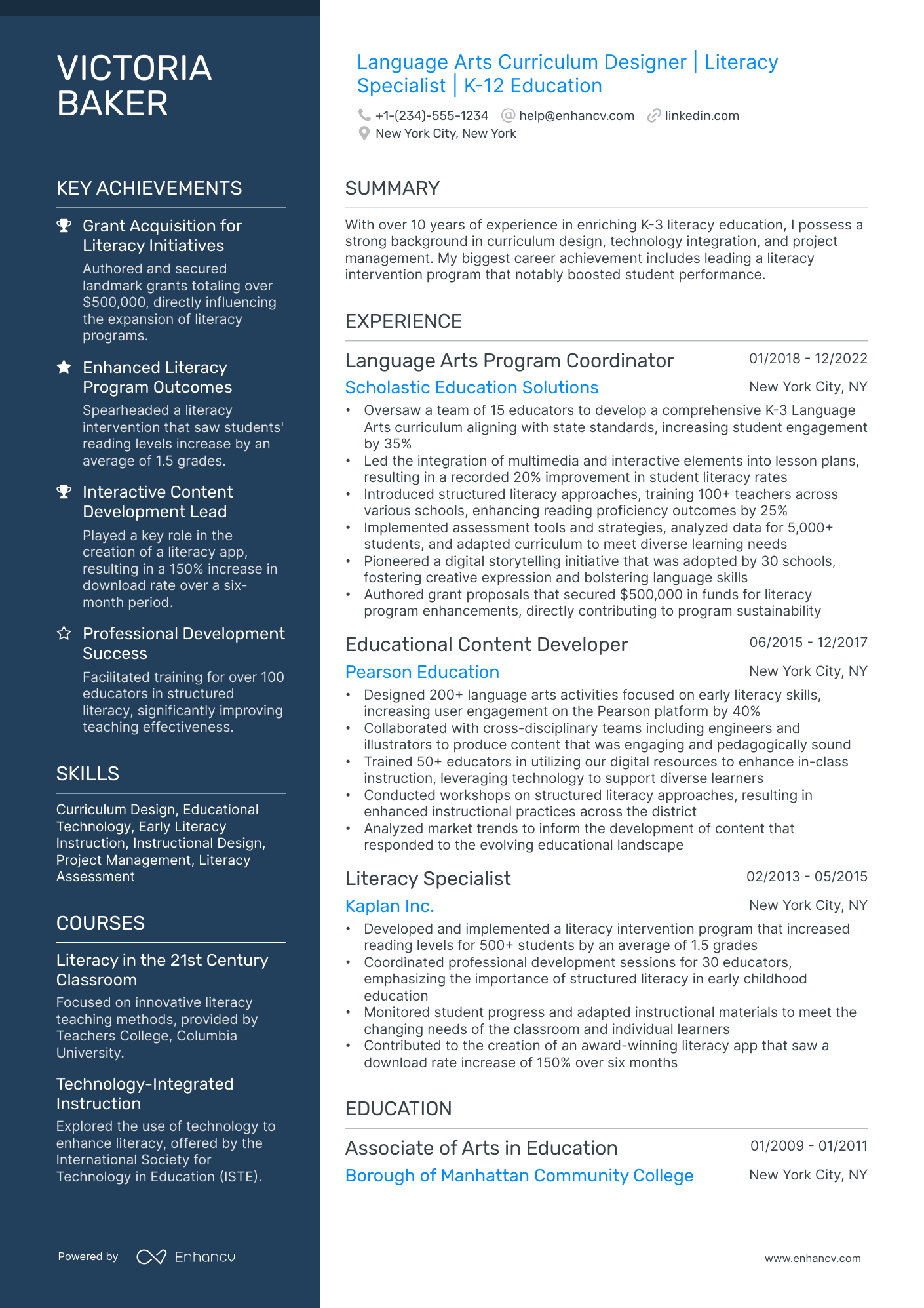
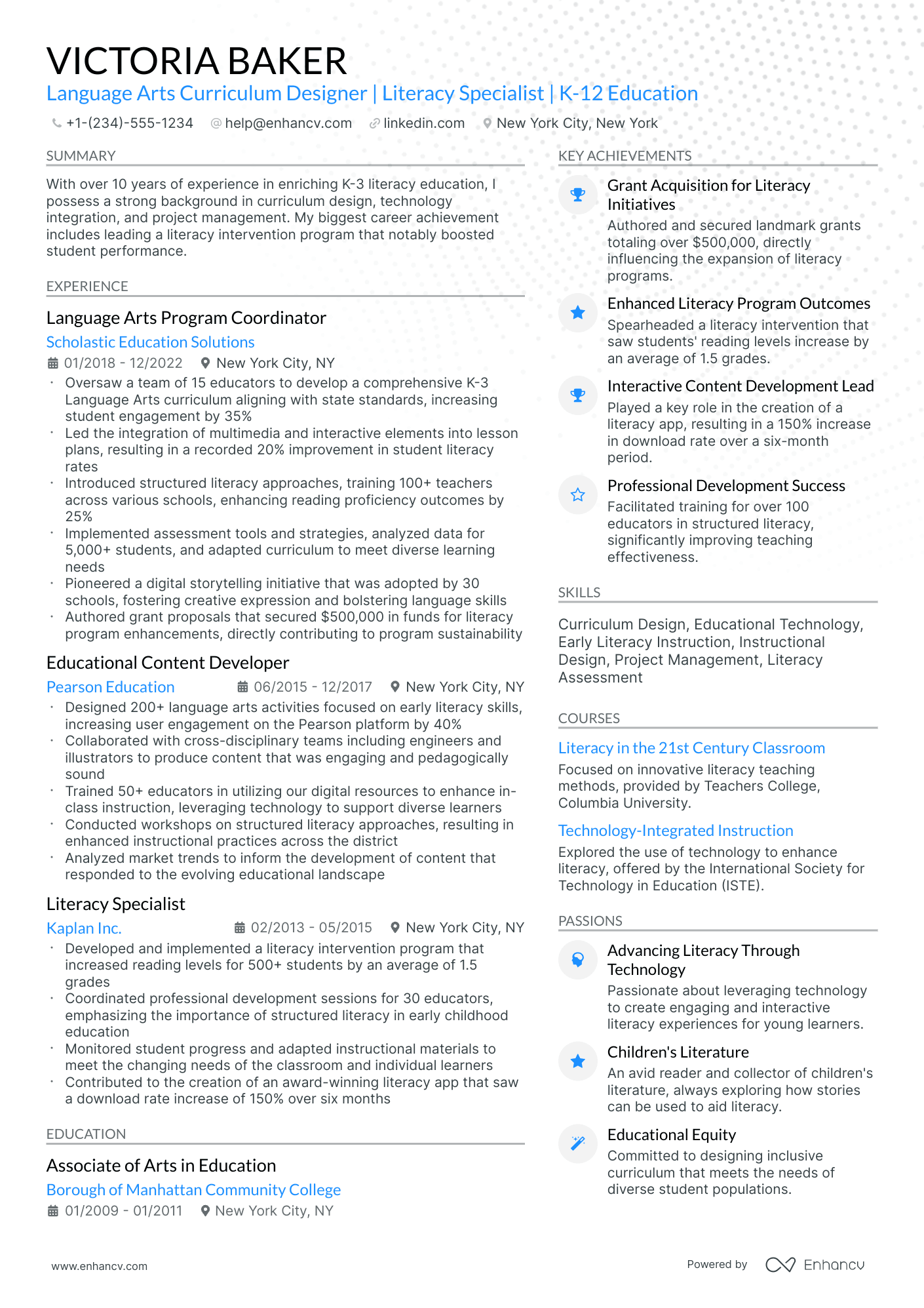
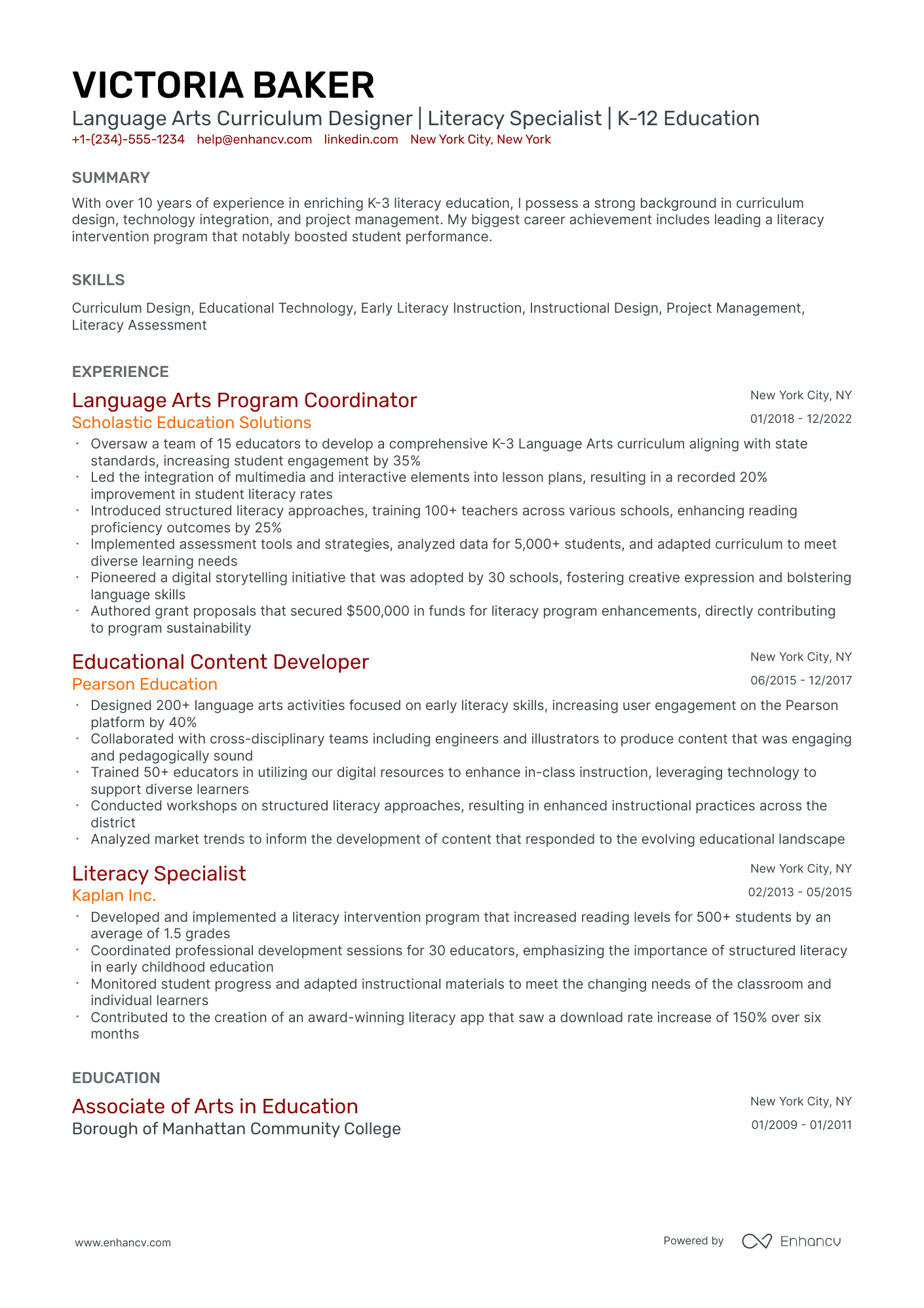
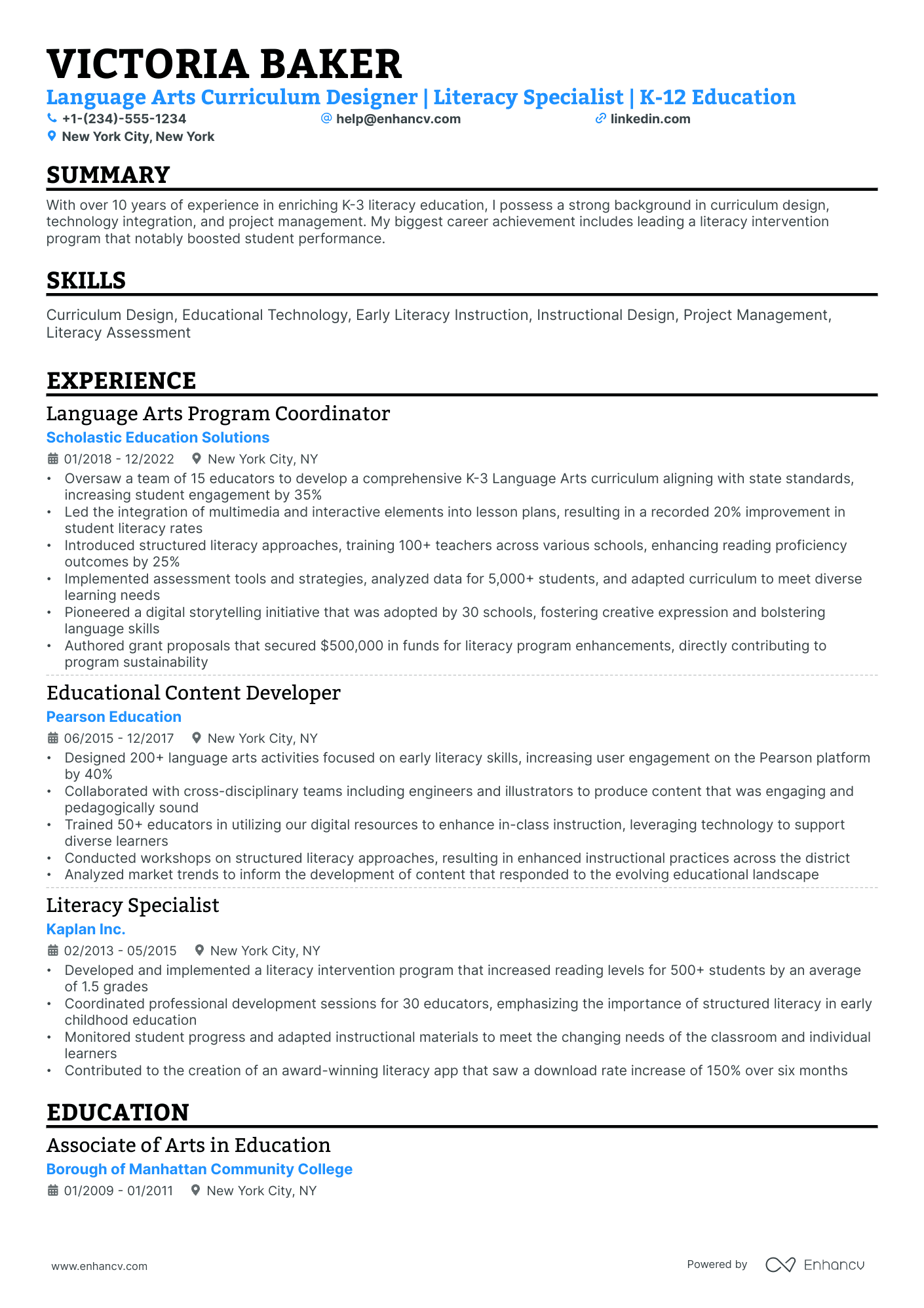
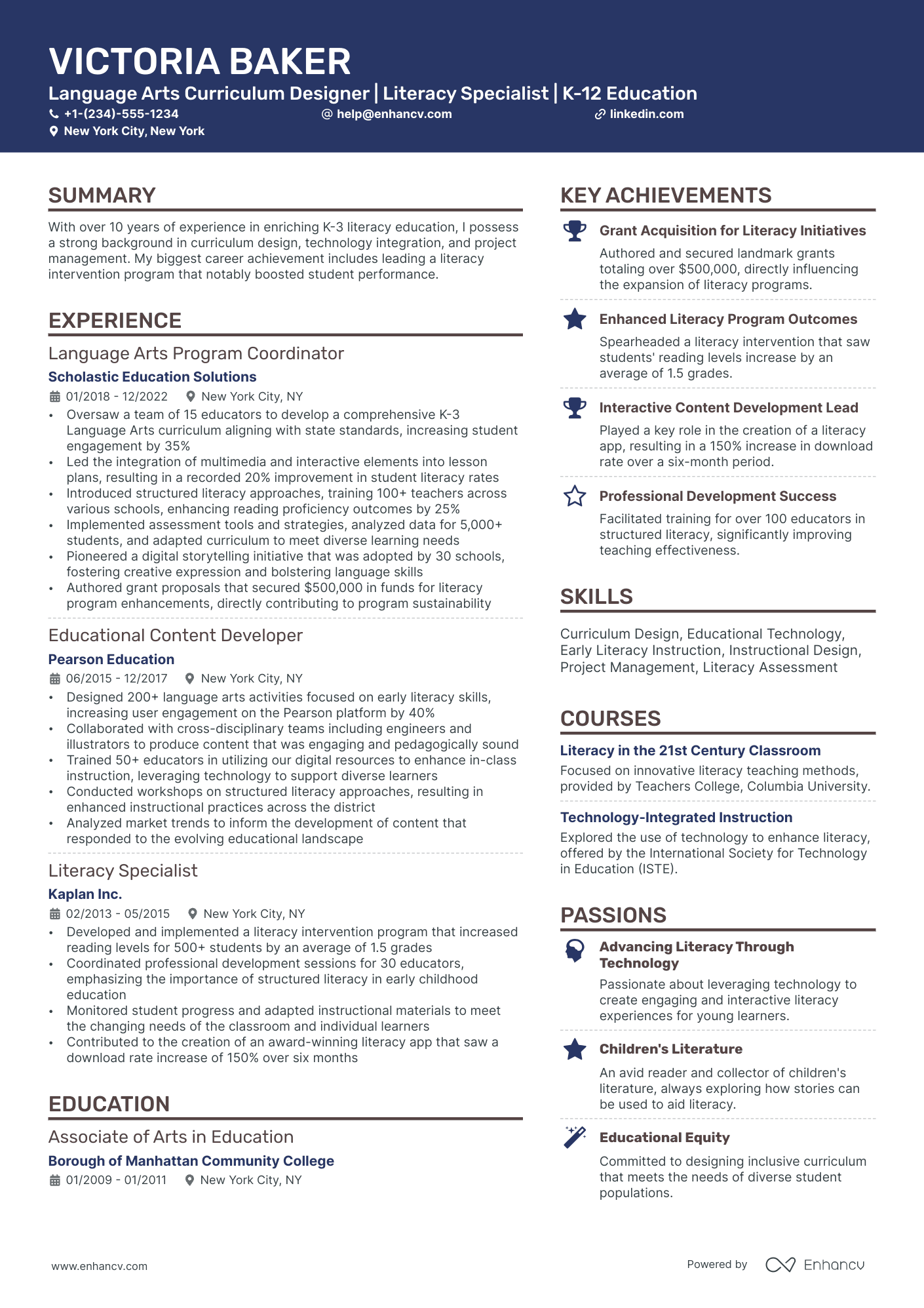
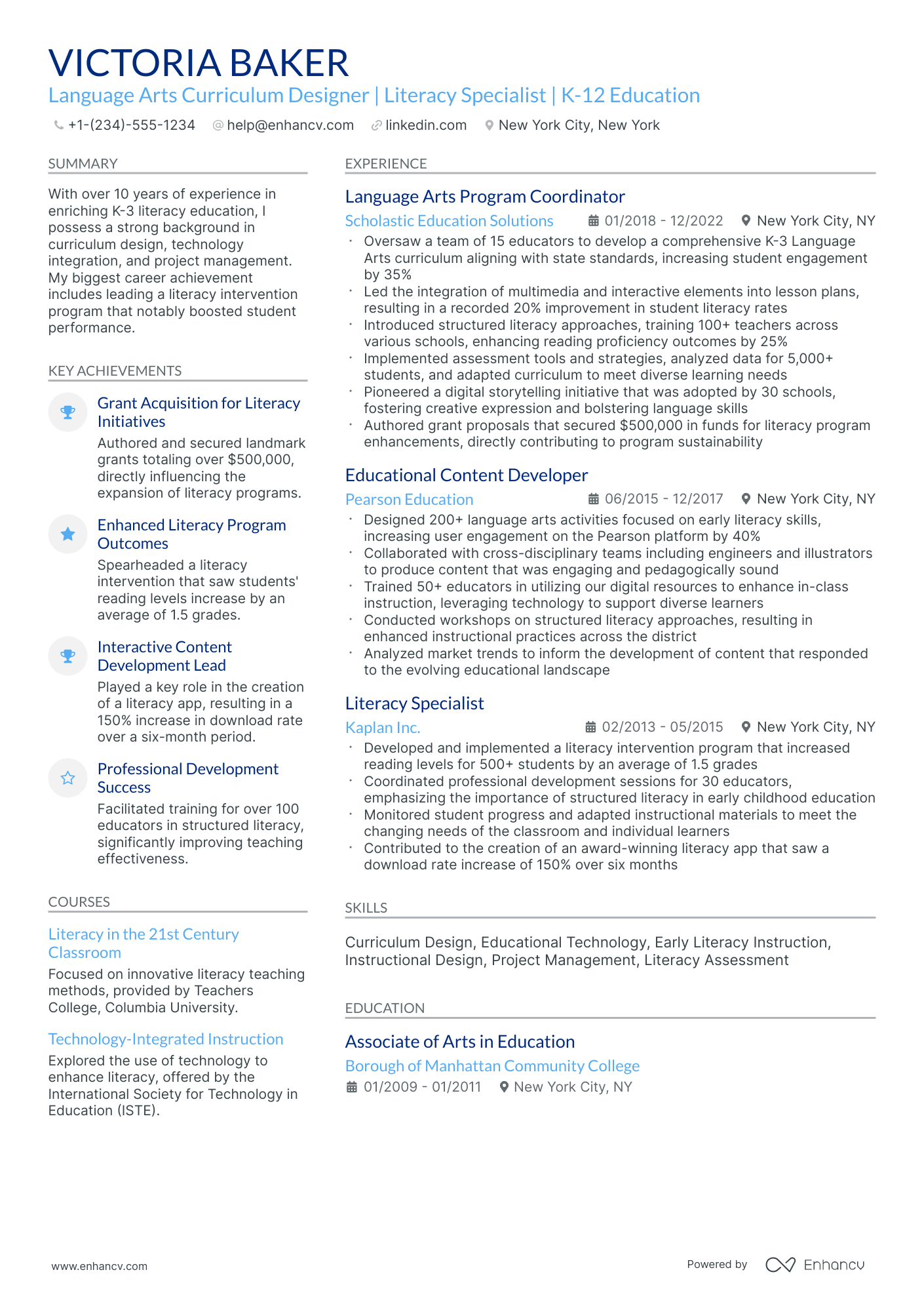
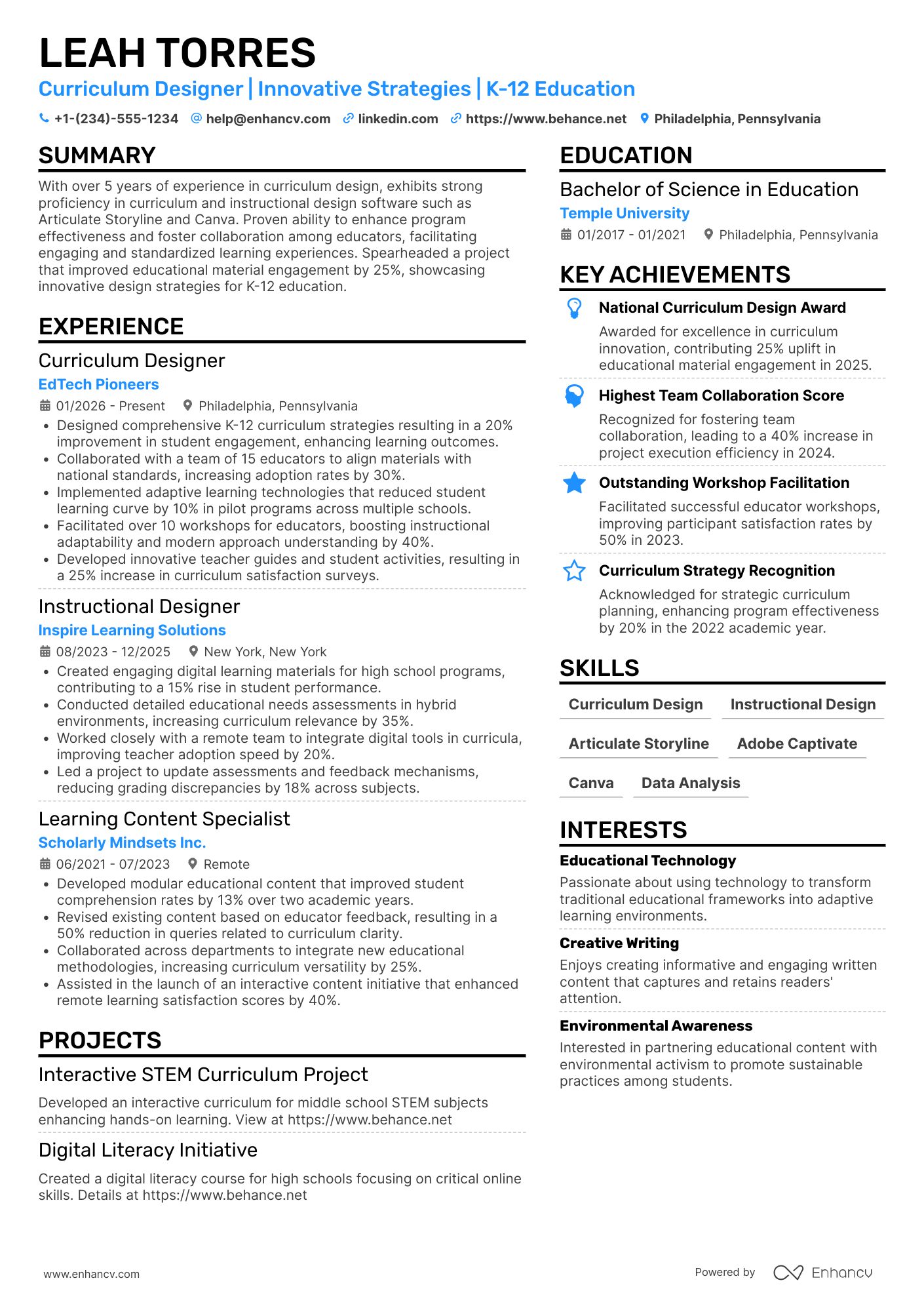
Most curriculum designer resumes fail because they read like task lists and bury impact under tools and jargon. This curriculum designer resume guide helps you pass ATS screening, win fast recruiter scans, and stand out in a crowded applicant pool.
A strong resume shows outcomes and instructional results, not just responsibilities. You should quantify learner gains, curriculum scope, delivery speed, assessment quality, adoption rates, and stakeholder satisfaction across programs, grades, or departments. Include evidence like completion rates, proficiency increases, and reduced revision cycles.

Key takeaways
- Quantify learner outcomes, delivery speed, and adoption rates in every experience bullet.
- Use reverse-chronological format with significant experience; use hybrid format when switching careers.
- Tailor each resume bullet to mirror the job posting's exact language and priorities.
- Lead your skills section with hard skills and back each one with proof in experience entries.
- Write a three- to four-line summary featuring your domain, core tools, and a measurable achievement.
- Leverage AI prompts to tighten language and add metrics, but stop before it invents experience.
- Use Enhancv to turn routine curriculum tasks into measurable, recruiter-ready bullet points fast.
How to format a curriculum designer resume
Recruiters evaluating curriculum designer resumes prioritize evidence of instructional design methodology, learning outcomes improvement, and the ability to develop cohesive curricula across subjects or programs. A clean, well-structured format ensures these signals surface quickly during both human review and applicant tracking system (ATS) scans. Choosing the right resume format is the first step toward making that happen.

I have significant experience in this role—which format should I use?
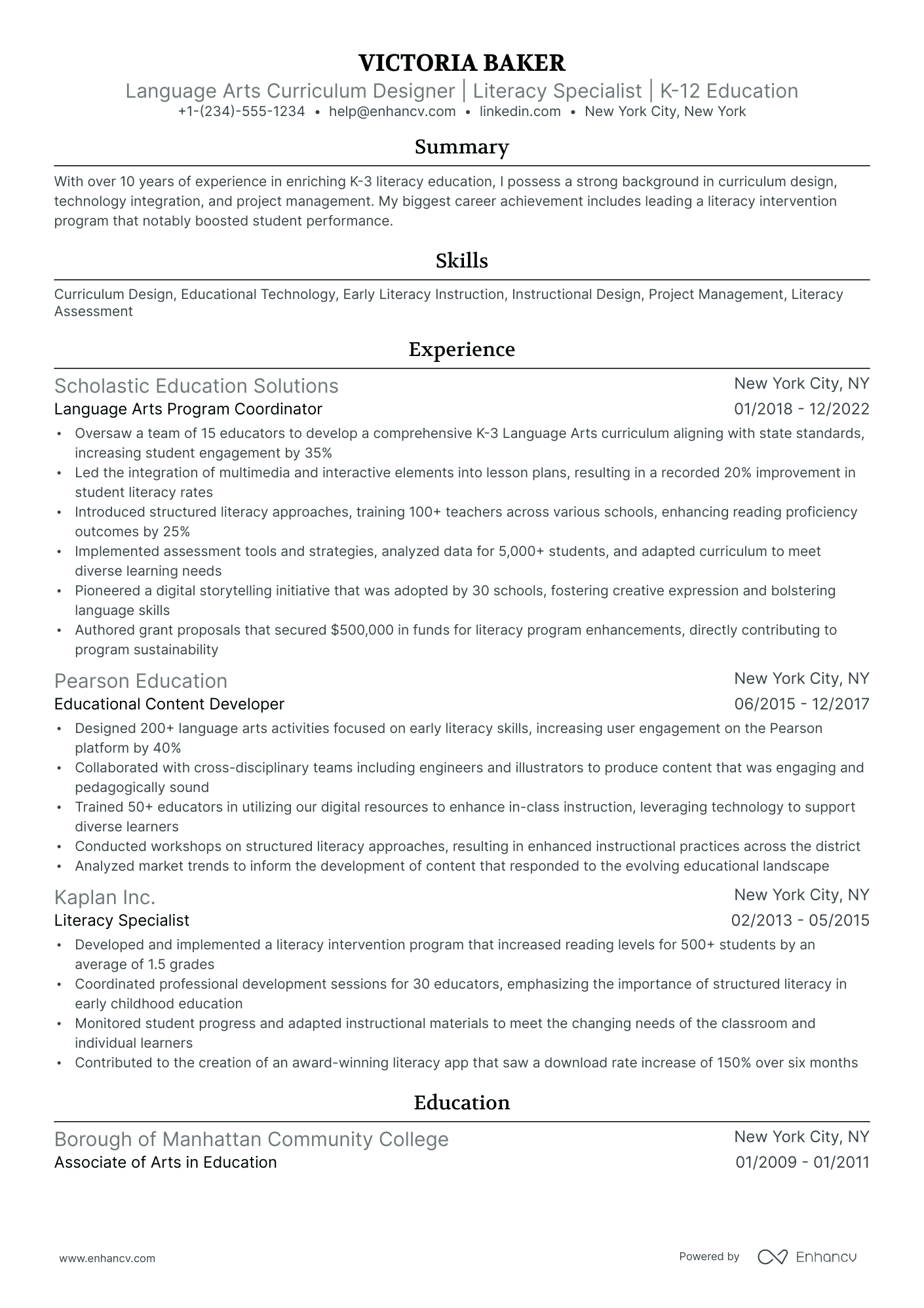
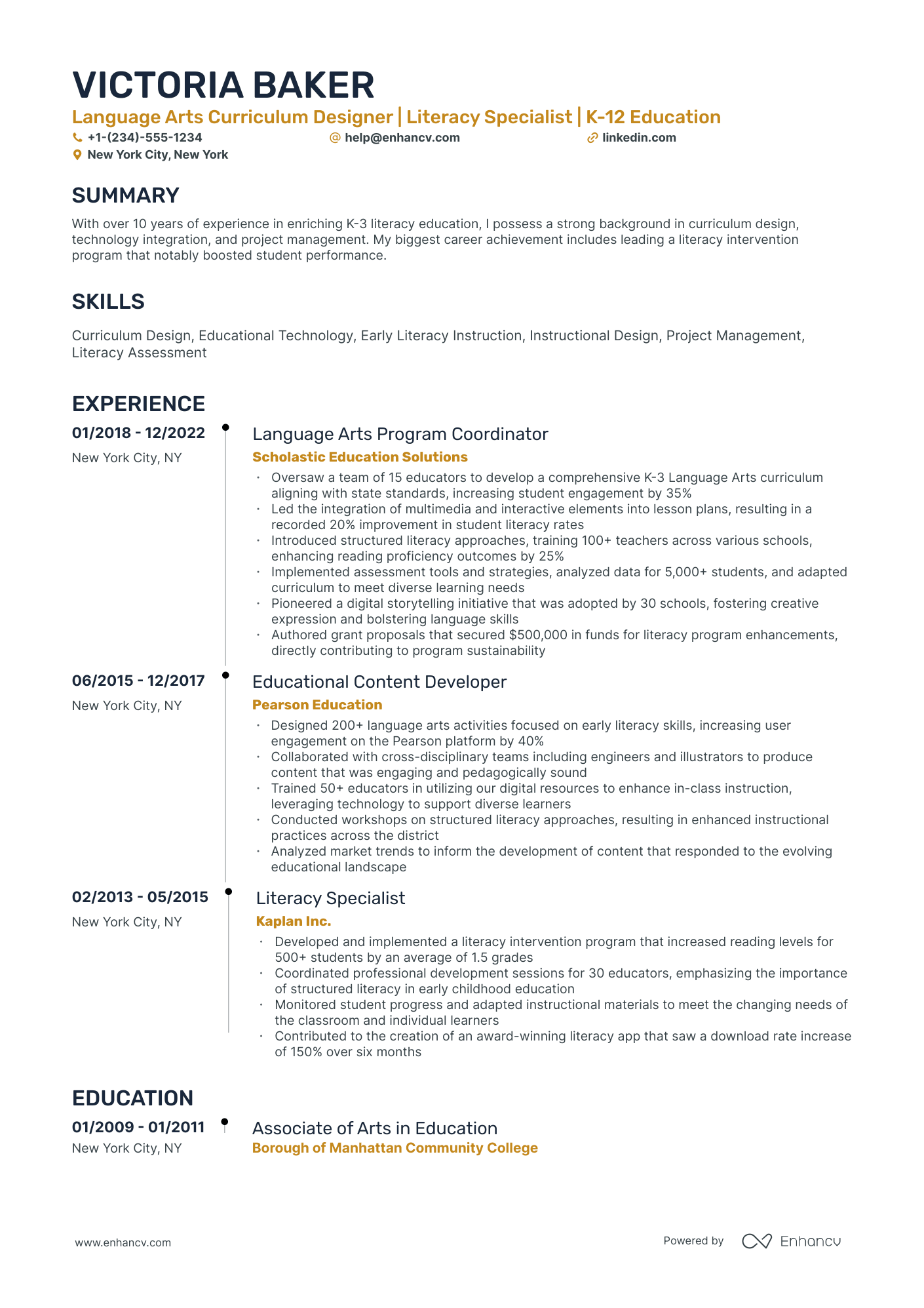
Use a reverse-chronological format to present your curriculum design experience in a clear, progressive timeline that highlights growing responsibility and impact. Do:
- Lead with your most recent role and emphasize the scope of programs, grade levels, or departments you designed curricula for.
- Feature instructional design frameworks, learning management systems (LMS), standards alignment expertise, and assessment development prominently within each role.
- Quantify outcomes tied to learner performance, adoption rates, program rollouts, or stakeholder satisfaction.
I'm junior or switching into this role—what format works best?
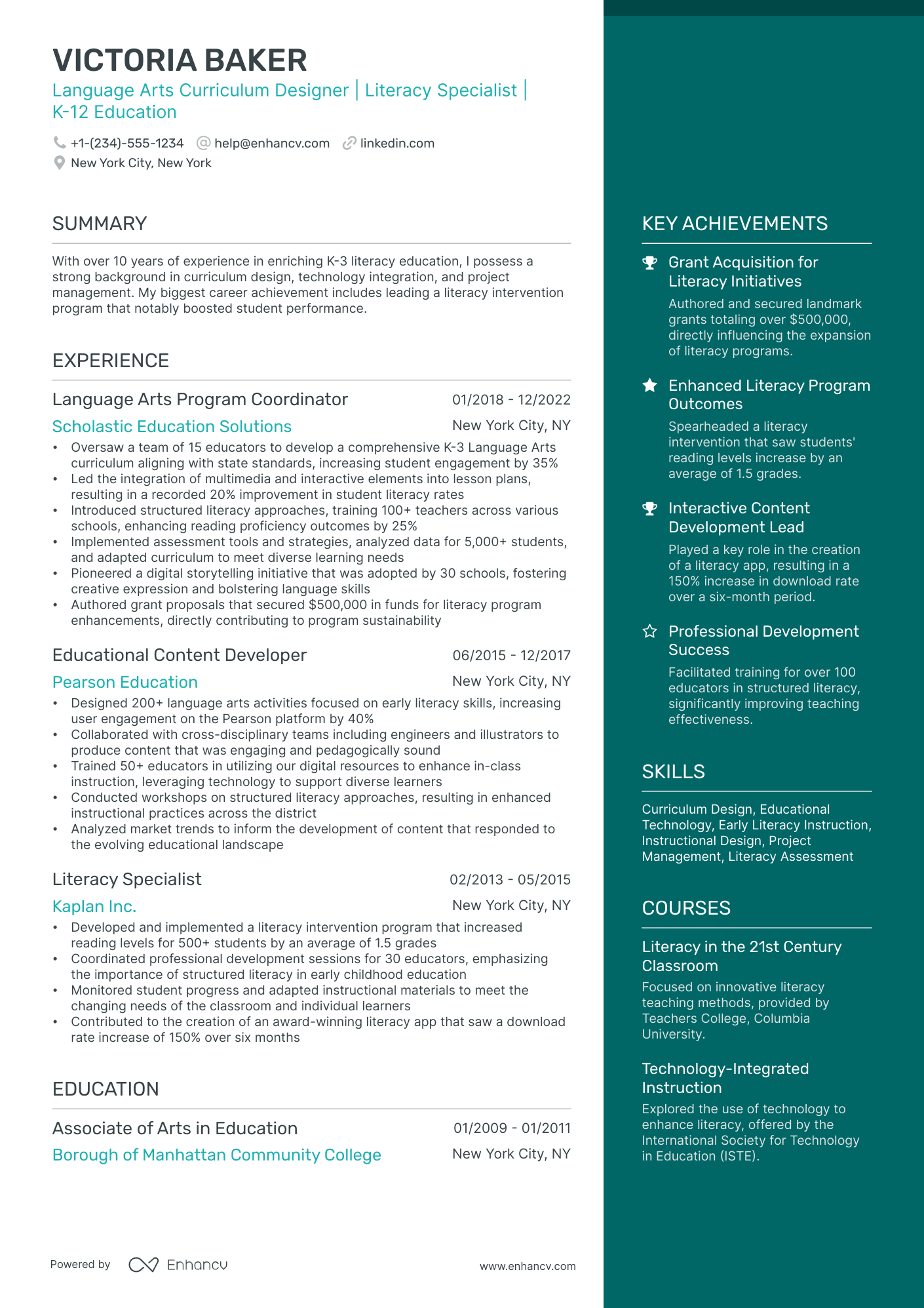
A hybrid format works best, letting you lead with relevant skills and projects before a concise work history section. Do:
- Place a skills section near the top highlighting instructional design models (ADDIE, backward design), content authoring tools, and standards frameworks relevant to curriculum work.
- Include academic projects, volunteer curriculum work, or cross-functional experience that demonstrates your ability to plan, develop, and evaluate learning materials.
- Connect every listed skill or project to a specific action and a measurable or observable result.
Why not use a functional resume?
A functional format strips away the timeline and context recruiters need to evaluate where, when, and how you applied your curriculum design skills, making it harder to assess your readiness for the role.
- A functional format may be acceptable if you're transitioning from classroom teaching into curriculum design with no formal design titles, but only if each listed skill is tied directly to a project, deliverable, or measurable learning outcome.
Once you've established a clean, readable format, the next step is deciding which sections to include so each one reinforces your qualifications.
What sections should go on a curriculum designer resume
Recruiters expect a curriculum designer resume to show how you design, build, and improve learning experiences that drive measurable outcomes. Understanding what to put on a resume ensures every section reinforces your qualifications.
Use this structure for maximum clarity:
- Header
- Summary
- Experience
- Skills
- Projects
- Education
- Certifications
- Optional sections: Awards, Publications, Volunteering
Your experience bullets should emphasize learning impact, measurable outcomes, program scope, stakeholder collaboration, and results tied to learner performance and business goals.
Is your resume good enough?
Drop your resume here or choose a file. PDF & DOCX only. Max 2MB file size.
Once you’ve organized your resume with the right structure and supporting details, the next step is writing your curriculum designer resume experience section to show how you’ve applied those elements in real work.
How to write your curriculum designer resume experience
The experience section is where you prove you can ship curriculum that works—showing the instructional design frameworks, authoring tools, and learning methodologies you've used to deliver measurable learner outcomes. Hiring managers prioritize demonstrated impact over descriptive task lists, so every line should connect what you built to the results it produced.
Each entry should include:
- Job title
- Company and location (or remote)
- Dates of employment (month and year)
Three to five concise bullet points showing what you owned, how you executed, and what outcomes you delivered:
- Ownership scope: the curriculum programs, course catalogs, learning platforms, learner populations, or content systems you were directly accountable for as a curriculum designer.
- Execution approach: the instructional design models, learning management systems, assessment frameworks, authoring tools, or research methods you used to make design decisions and deliver finished curriculum.
- Value improved: changes to learner performance, course completion, content accessibility, assessment validity, instructional consistency, or development cycle efficiency resulting from your curriculum work.
- Collaboration context: how you partnered with subject matter experts, faculty, instructional technologists, program managers, accessibility specialists, or external vendors to align curriculum with organizational learning goals.
- Impact delivered: outcomes expressed through learner results, adoption scale, program reach, or institutional performance rather than a list of tasks you performed in the curriculum design process.
Experience bullet formula
A curriculum designer experience example
✅ Right example - modern, quantified, specific.
Senior Curriculum Designer
BrightPath Learning | Remote
2021–Present
B2B education technology company serving mid-market and enterprise customers with skills training for customer support and sales teams.
- Led a backward design rebuild of a twelve-course onboarding pathway in Articulate 360 and Adobe Captivate, improving assessment pass rates from 78% to 91% and reducing time-to-proficiency by 18% across 2,400 learners.
- Built a competency framework and item bank in Google Sheets and Airtable, aligning objectives to Bloom’s taxonomy and streamlining quarterly content updates from ten days to six days.
- Partnered with product managers, subject matter experts, and UX designers to storyboard and prototype interactive scenarios in Figma, increasing lesson completion rates by 14% and boosting learner satisfaction from 4.1 to 4.6 out of five.
- Implemented SCORM and xAPI tracking in the learning management system (Docebo) and analyzed Tableau dashboards to identify drop-off points, cutting module abandonment by 22% through targeted microlearning revisions.
- Standardized accessibility and quality assurance workflows using WCAG 2.1 AA checklists and a review rubric in Confluence, reducing post-launch defects by 35% and ensuring 100% compliance for enterprise client audits.
Now that you've seen how a strong experience section looks in practice, let's break down how to customize yours based on the specific job you're targeting.
How to tailor your curriculum designer resume experience
Recruiters evaluate your curriculum designer resume through applicant tracking systems and manual review, scoring how closely your experience matches the posting. Tailoring your resume to the job description by reflecting its specific language and priorities increases your chances of passing both screenings.
Ways to tailor your curriculum designer experience:
- Mirror the learning design models or frameworks named in the posting.
- Match instructional technologies and authoring tools the employer specifies.
- Use the exact terminology the job listing applies to curriculum standards.
- Reflect assessment strategies or evaluation methods the role prioritizes.
- Highlight relevant subject matter or grade-level expertise when requested.
- Incorporate accessibility or compliance language the posting emphasizes.
- Align collaboration structures such as cross-functional team references mentioned.
- Echo the specific learner outcomes or performance indicators the employer values.
Tailoring means aligning your real accomplishments with what the employer asked for, not forcing disconnected keywords into your bullets.
Resume tailoring examples for curriculum designer
| Job description excerpt | Untailored | Tailored |
|---|---|---|
| "Design and implement competency-based curricula for adult learners using backward design principles in partnership with subject matter experts across healthcare programs." | Developed curriculum for various programs and worked with team members on content. | Designed 12 competency-based curricula for adult learners across five healthcare programs, applying backward design principles and collaborating with subject matter experts to align learning outcomes with clinical competency standards. |
| "Create interactive e-learning modules using Articulate Storyline and Rise, ensuring alignment with Section 508 accessibility standards and ADDIE methodology." | Built online training materials and helped make courses accessible for learners. | Created 30+ interactive e-learning modules in Articulate Storyline and Rise following the ADDIE methodology, achieving full Section 508 compliance and reducing learner support tickets by 40%. |
| "Lead curriculum audits and revision cycles for K–12 STEM programs, using data from state assessment results and teacher feedback to drive instructional improvements." | Reviewed and updated curriculum based on feedback and assessment data. | Led biannual curriculum audits for K–12 STEM programs serving 8,000 students, analyzing state assessment results and structured teacher feedback to prioritize revisions that contributed to a 15% increase in math proficiency scores. |
Once you’ve aligned your experience with the role’s priorities, quantify your curriculum designer achievements to show the impact of that work with measurable results.
How to quantify your curriculum designer achievements
Quantifying your work proves your curriculum changed learning outcomes, sped delivery, and reduced risk. Focus on completion rates, assessment gains, time-to-launch, stakeholder approval time, and compliance or audit results. Using numbers on your resume transforms vague responsibilities into compelling proof of impact.
Quantifying examples for curriculum designer
| Metric | Example |
|---|---|
| Learning outcomes | "Raised post-assessment scores by 18% across six cohorts (240 learners) by redesigning quizzes and adding spaced-retrieval practice in Canvas." |
| Delivery speed | "Cut course development cycle time from eight weeks to five by standardizing storyboards in Google Docs and reusing Articulate Rise templates." |
| Engagement | "Improved course completion from 62% to 81% for new-hire onboarding by adding scenario-based modules and weekly nudges in Microsoft Teams." |
| Quality accuracy | "Reduced content errors by 45% by implementing a two-step SME review checklist and version control in SharePoint for 120 lessons." |
| Compliance risk | "Achieved 100% on a compliance audit by mapping learning objectives to policy requirements and maintaining an evidence log for 30 regulated topics." |
Turn your everyday tasks into measurable, recruiter-ready resume bullets in seconds with Enhancv's Bullet Point Generator.
With strong bullet points in place, the next step is ensuring your skills section presents the right mix of hard and soft skills that reinforce your qualifications.
How to list your hard and soft skills on a curriculum designer resume
Your skills section shows how you design instruction and measure learning impact, and recruiters and an ATS (applicant tracking system) scan this section to match keywords to the job post—aim for mostly hard skills with a smaller set of role-specific soft skills. curriculum designer roles require a blend of:
- Product strategy and discovery skills
- Data, analytics, and experimentation skills
- Delivery, execution, and go-to-market discipline
- Soft skills
Your skills section should be:
- Scannable (bullet-style grouping).
- Relevant to the job post.
- Backed by proof in experience bullets.
- Updated with current tools.
Place your skills section:
- Above experience if you're junior or switching careers.
- Below experience if you're mid/senior with strong achievements.

Hard skills
- Backward design, UBD
- ADDIE, SAM methodologies
- Bloom's taxonomy alignment
- Learning objectives, outcomes mapping
- Assessment design, item writing
- SCORM, xAPI standards
- Learning management systems: Canvas, Moodle, Blackboard
- Authoring tools: Articulate 360, Rise, Storyline
- eLearning development: Adobe Captivate, Camtasia
- Accessibility: WCAG, Section 508
- Learning analytics: Google Analytics, Power BI
- Curriculum mapping, scope and sequence
Soft skills
- Stakeholder alignment and buy-in
- SME interviewing and synthesis
- Clear learning documentation
- Cross-functional collaboration
- Prioritization under constraints
- Feedback-driven iteration
- Facilitation of design workshops
- Quality control and consistency checks
- Risk identification and escalation
- Learner-centered decision-making
- Managing scope and timelines
- Presenting recommendations to leaders
How to show your curriculum designer skills in context
Skills shouldn't live only in a bulleted list on your resume. Explore examples of resume skills shown in context to see how top candidates integrate them throughout their documents.
They should be demonstrated in:
- Your summary (high-level professional identity)
- Your experience (proof through outcomes)
Here's what both look like in practice.
Summary example
Senior curriculum designer with 10+ years in K–12 education, specializing in backward design and LMS integration. Led a district-wide standards alignment initiative that boosted student proficiency scores by 18%. Skilled in cross-functional collaboration and data-driven instructional improvement.
- Reflects senior-level expertise immediately
- Names specific tools and methods
- Leads with a measurable outcome
- Highlights collaboration as a strength
Experience example
Senior Curriculum Designer
Brightpath Learning Solutions | Remote
June 2019–Present
- Redesigned a 40-course onboarding curriculum using backward design, reducing new-hire ramp-up time by 25% across three departments.
- Partnered with SMEs and instructional technologists to migrate 120+ modules to Articulate Rise, improving learner completion rates by 32%.
- Conducted quarterly needs analyses using Kirkpatrick's framework, delivering data-informed recommendations that shaped company-wide training strategy.
- Every bullet contains measurable proof
- Skills surface naturally through accomplishments
Once you’ve demonstrated your curriculum design strengths through relevant examples and outcomes, the next step is to apply that approach to writing a curriculum designer resume when you have no experience.
How do I write a curriculum designer resume with no experience
Even without full-time experience, you can demonstrate readiness through:
- Student teaching curriculum unit plans
- Instructional design course capstones
- Volunteer training materials for nonprofits
- LMS course builds and updates
- Standards-aligned lesson plan portfolios
- Tutoring programs with documented outcomes
- Micro-credential projects in e-learning
If you're in this situation, learning how to write a resume without work experience can help you structure these elements effectively.
Focus on:
- Standards alignment and assessment design
- LMS builds and content updates
- Data-backed learning outcome improvements
- Accessible, inclusive curriculum designer deliverables
Resume format tip for entry-level curriculum designer
Use a hybrid resume format because it highlights projects and skills first, while still showing education and relevant roles. Do:
- Lead with a projects section.
- Include tools like Articulate 360.
- Quantify outcomes with pre-post data.
- Link to a curriculum designer portfolio.
- Match keywords to the job post.
- Built a Canvas mini-course with Articulate Storyline and Bloom's-aligned quizzes for a tutoring program, improving average pre-post scores by 18% across 30 learners.
Even without formal experience, your educational background can serve as a strong foundation for your curriculum designer resume—so presenting it effectively matters.
How to list your education on a curriculum designer resume
Your education section helps hiring teams confirm you have the foundational knowledge needed. It validates your training in instructional theory, learning design, and pedagogy—core areas every curriculum designer must master.
Include:
- Degree name
- Institution
- Location
- Graduation year
- Relevant coursework (for juniors or entry-level candidates)
- Honors & GPA (if 3.5 or higher)
Skip month and day details—list the graduation year only.
Here's a strong education entry tailored for a curriculum designer resume:
Example education entry
Master of Education in Curriculum and Instruction
University of Virginia, Charlottesville, VA
Graduated 2021
GPA: 3.8/4.0
- Relevant Coursework: Instructional Design Theory, Learning Assessment Methods, Educational Technology Integration, Differentiated Curriculum Development
- Honors: Dean's List, Kappa Delta Pi International Honor Society in Education
How to list your certifications on a curriculum designer resume
Certifications show your commitment to learning, prove tool proficiency, and confirm industry relevance as a curriculum designer in fast-changing education and training environments. Include:
- Certificate name
- Issuing organization
- Year
- Optional: credential ID or URL
- Place certifications below education when they are older, less relevant, or supplemental to your formal degree and core curriculum designer qualifications.
- Place certifications above education when they are recent, highly relevant, or required for the curriculum designer role or the tools you use daily.
Best certifications for your curriculum designer resume
- Certified Professional in Learning and Performance (CPLP)
- Associate Professional in Talent Development (APTD)
- Certified Instructional Designer/Developer (CIDD)
- Google Project Management: Professional Certificate
- Certified ScrumMaster (CSM)
- Adobe Certified Professional in Adobe Captivate
- Articulate Storyline Certification
Once you’ve positioned your credentials to support your qualifications, shift to your curriculum designer resume summary to highlight that value upfront.
How to write your curriculum designer resume summary
Your resume summary is the first thing a recruiter reads. A strong one instantly signals you're qualified and worth a closer look for the curriculum designer role.
Keep it to three to four lines, with:
- Your title and total years of experience in curriculum design or instructional roles.
- The domain you specialize in, such as K–12, higher education, corporate training, or edtech.
- Core tools and skills like backward design, LMS platforms, ADDIE, or SCORM authoring tools.
- One or two measurable achievements, such as learner outcomes improved or programs launched.
- Soft skills tied to real results, like cross-functional collaboration that shortened development timelines.

PRO TIP
At this level, focus on specific tools you've used, subject areas you've designed for, and early wins that show initiative. Avoid vague phrases like "passionate learner" or "team player." Recruiters want proof of what you've built, not personality descriptors.
Example summary for a curriculum designer
Curriculum designer with three years of experience building SCORM-compliant e-learning modules for corporate onboarding. Redesigned new-hire training using Articulate 360, cutting ramp-up time by 25%.
Optimize your resume summary and objective for ATS
Drop your resume here or choose a file.
PDF & DOCX only. Max 2MB file size.
Now that your summary captures the value you bring, make sure your header presents the essential contact and professional details recruiters need to reach you.
What to include in a curriculum designer resume header
A resume header lists your key identifying and contact details, helping curriculum designer candidates boost visibility, build credibility, and pass recruiter screening fast.
Essential resume header elements
- Full name
- Tailored job title and headline
- Location
- Phone number
- Professional email
- GitHub link
- Portfolio link
A LinkedIn link helps recruiters verify your experience quickly and supports faster screening decisions.
Do not include a photo on a curriculum designer resume unless the role is explicitly front-facing or appearance-dependent.
Match your header title to the job posting and align your links to relevant curriculum samples, learning assets, and documented outcomes.
Example
Curriculum designer resume header
Jordan Taylor
Curriculum Designer | K–12 and Adult Learning Programs
Austin, TX
(512) 555-01XX
jordan.taylor@enhancv.com
github.com/jordantaylor
jordantaylor.com
linkedin.com/in/jordantaylor
Once your contact details and role-specific identifiers are in place, add optional resume sections to reinforce your qualifications and provide supporting context.
Additional sections for curriculum designer resumes
Extra resume sections help you stand out when your core qualifications match other candidates and you need role-specific credibility. For example, listing language skills can demonstrate your ability to design curricula for multilingual learner populations.
- Languages
- Publications
- Professional affiliations
- Conferences and presentations
- Certifications and continuing education
- Volunteer work in education
- Hobbies and interests
Once you've strengthened your resume with relevant additional sections, the next step is pairing it with a cover letter that gives your application a competitive edge.
Do curriculum designer resumes need a cover letter
A cover letter isn't required for a curriculum designer, but it often helps. If you're unsure what a cover letter is or when it adds value, it matters most for competitive roles or teams that expect strong writing. It can also tip decisions when several resumes look similar.
Use a cover letter to add context your resume can't show:
- Explain team and role fit by linking your approach to their learners, stakeholders, and delivery model.
- Highlight one or two curriculum designer projects with outcomes, such as completion rates, assessment gains, or faster onboarding.
- Show you understand the product, users, or business context by referencing a specific audience, constraint, or success metric.
- Address career transitions or non-obvious experience by connecting prior work to curriculum design tasks and tools.
Drop your resume here or choose a file.
PDF & DOCX only. Max 2MB file size.
Even if you decide to include a cover letter to add context beyond your resume, AI can help you strengthen the resume itself by improving clarity, relevance, and impact.
Using AI to improve your curriculum designer resume
AI can sharpen your resume's clarity, structure, and impact. It helps tighten language and highlight results. But overuse kills authenticity. Once your content feels clear and aligned with the curriculum designer role, step away from AI. If you're curious about which AI is best for writing resumes, start with targeted prompts rather than full rewrites.
Here are 10 practical prompts you can copy, paste, and adapt right now:
- Strengthen summary focus: "Rewrite my curriculum designer resume summary to emphasize instructional design expertise, measurable student outcomes, and alignment with K–12 or higher education settings."
- Quantify experience bullets: "Add specific metrics to these curriculum designer experience bullets, focusing on learner performance gains, adoption rates, or project completion timelines."
- Tighten action verbs: "Replace weak or passive verbs in my curriculum designer experience section with strong, precise action verbs relevant to instructional development."
- Align skills section: "Reorganize my curriculum designer skills section to prioritize competencies mentioned in this job description, removing irrelevant or redundant entries."
- Clarify project descriptions: "Rewrite my curriculum designer projects section so each entry clearly states the goal, my role, the approach, and the measurable result."
- Improve education relevance: "Revise my education section to highlight coursework, research, or capstone projects directly relevant to a curriculum designer position."
- Refine certification details: "Rewrite my certifications section to clarify how each credential supports my qualifications as a curriculum designer."
- Remove filler language: "Identify and remove vague or redundant phrases from my curriculum designer resume without losing important meaning or context."
- Target audience alignment: "Adjust the tone and terminology across my curriculum designer resume to match expectations in [K–12/corporate/higher education] hiring."
- Spotlight collaboration impact: "Rewrite these curriculum designer experience bullets to better demonstrate cross-functional collaboration with teachers, SMEs, or administrators and its outcomes."
Stop using AI once your resume sounds accurate, specific, and aligned with real experience. AI should never invent experience or inflate claims—if it didn't happen, it doesn't belong here.
Conclusion
A strong curriculum designer resume proves impact with measurable outcomes, highlights role-specific skills, and follows a clear structure. Use concise summaries, focused experience, and aligned keywords to show how your work improved learning results and delivery.
Today’s hiring market rewards curriculum designers who present evidence, clarity, and consistency. When your resume is easy to scan and backed by results, it shows you’re ready to deliver value now and adapt to what comes next.