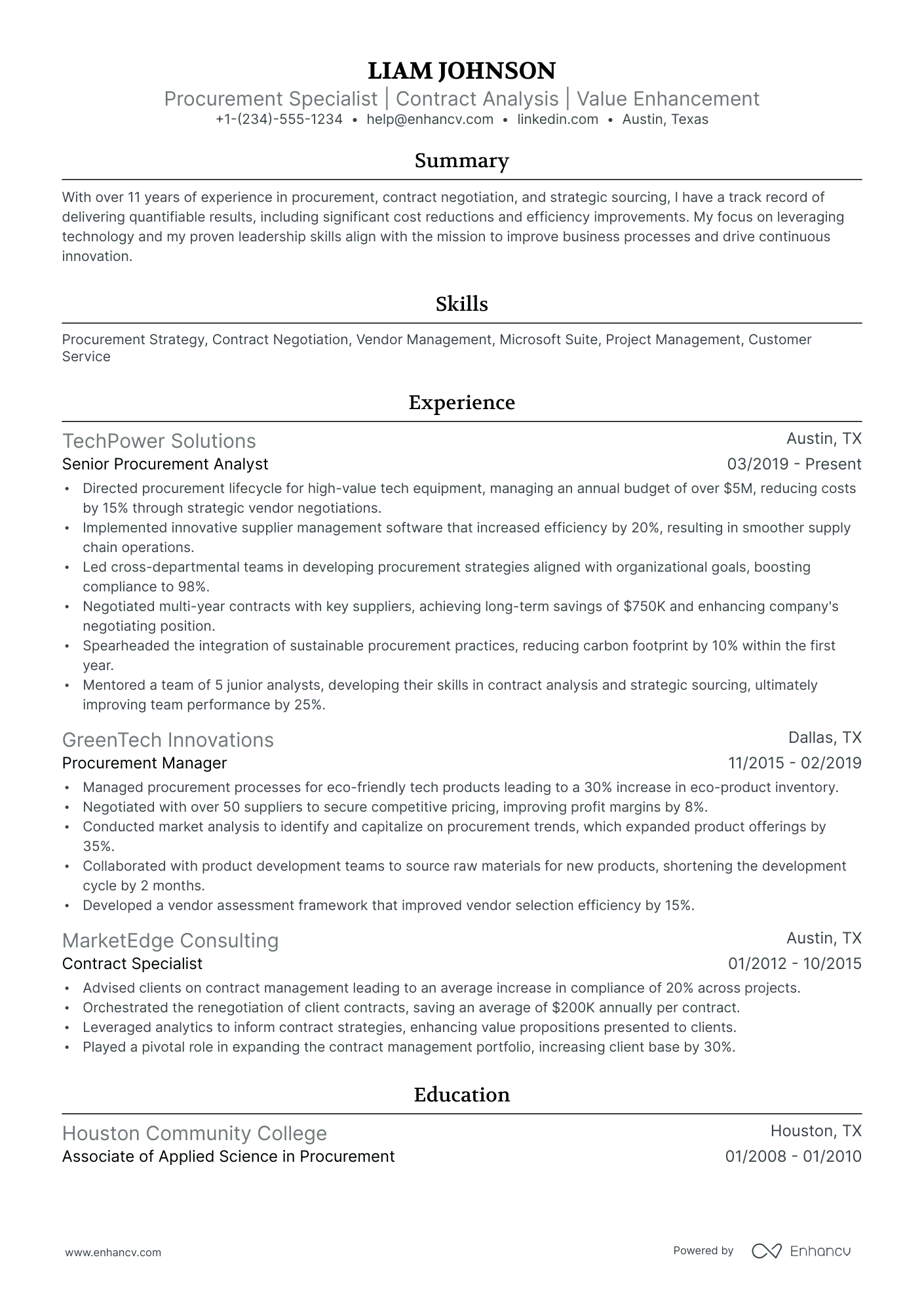
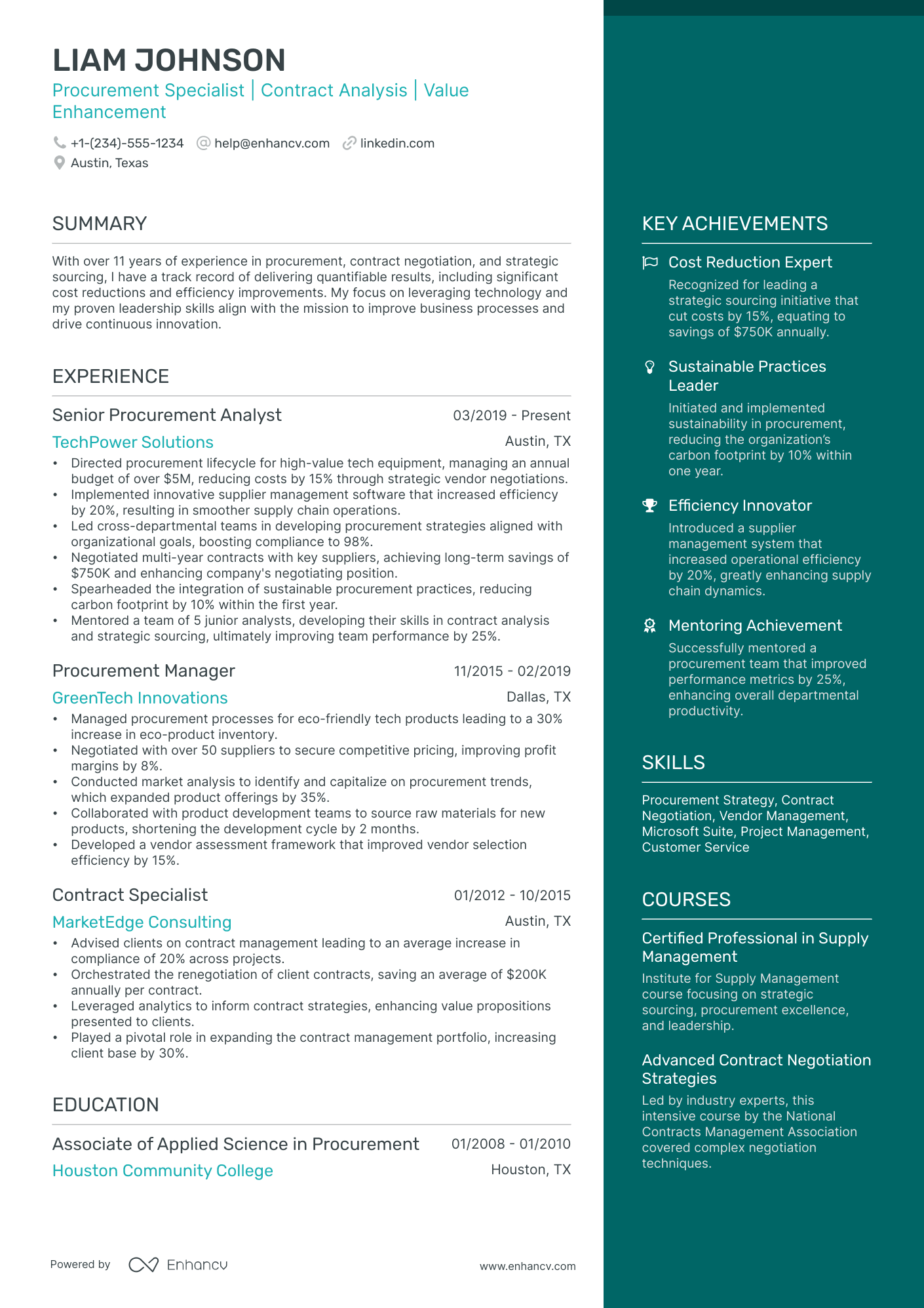
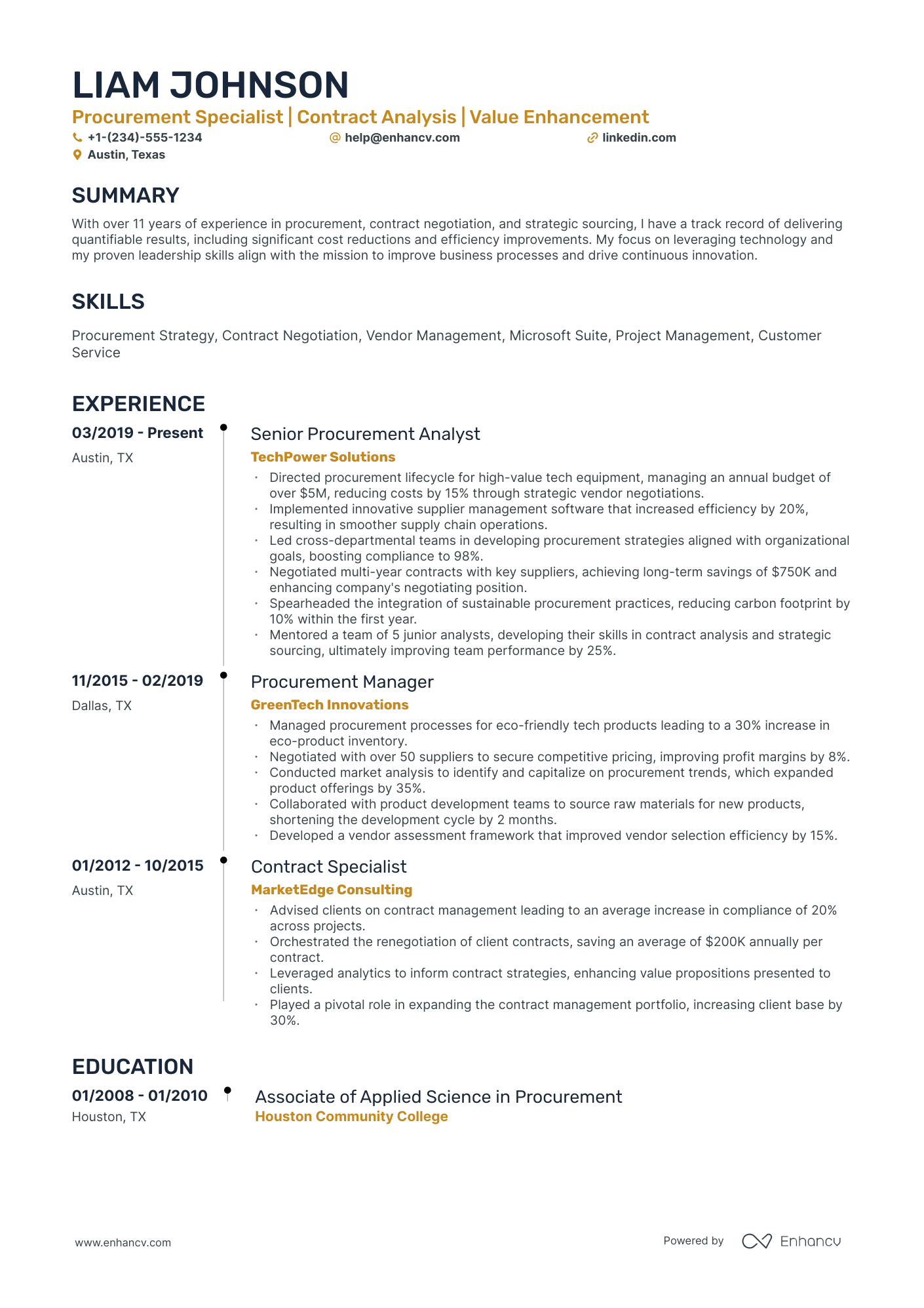
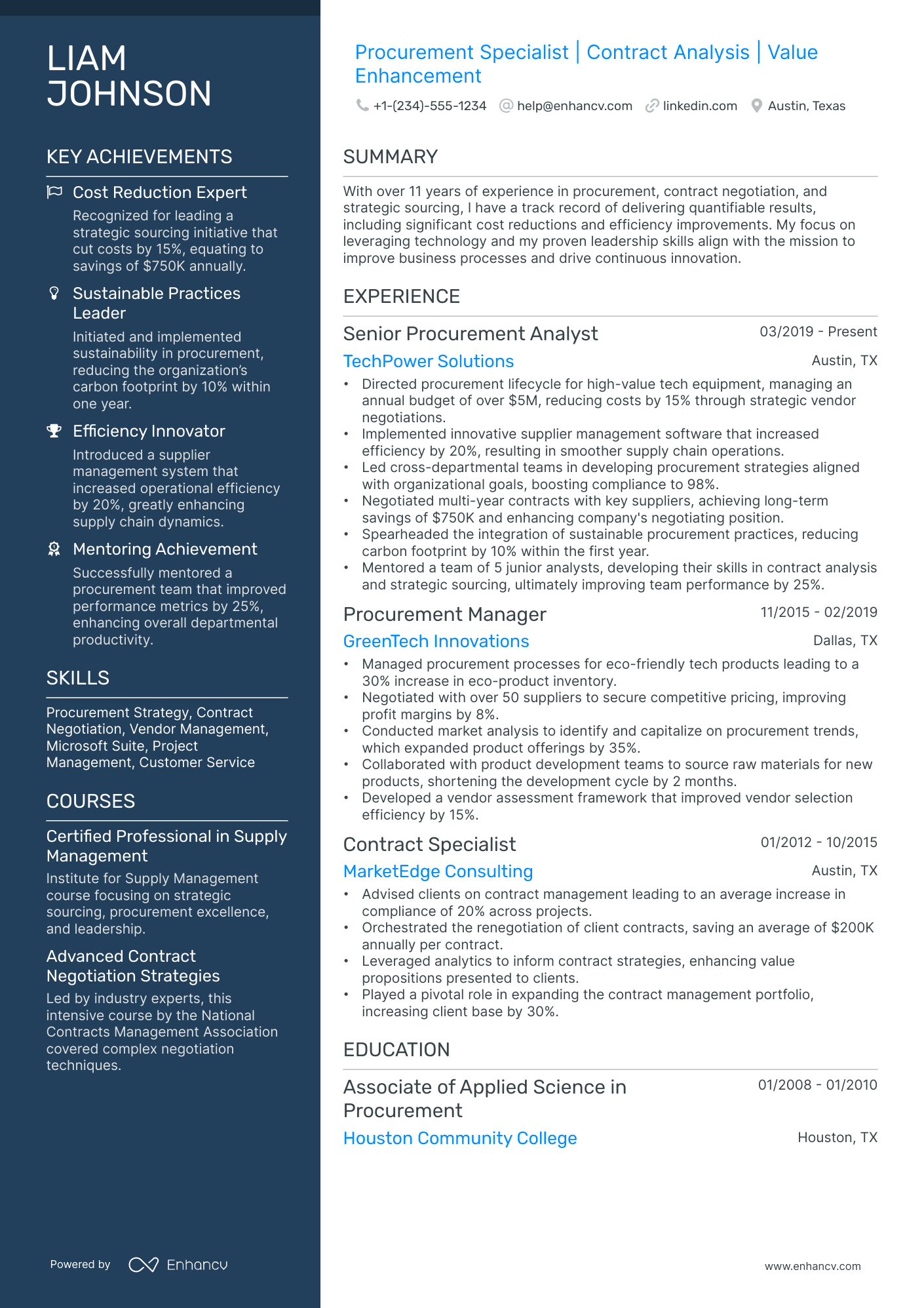
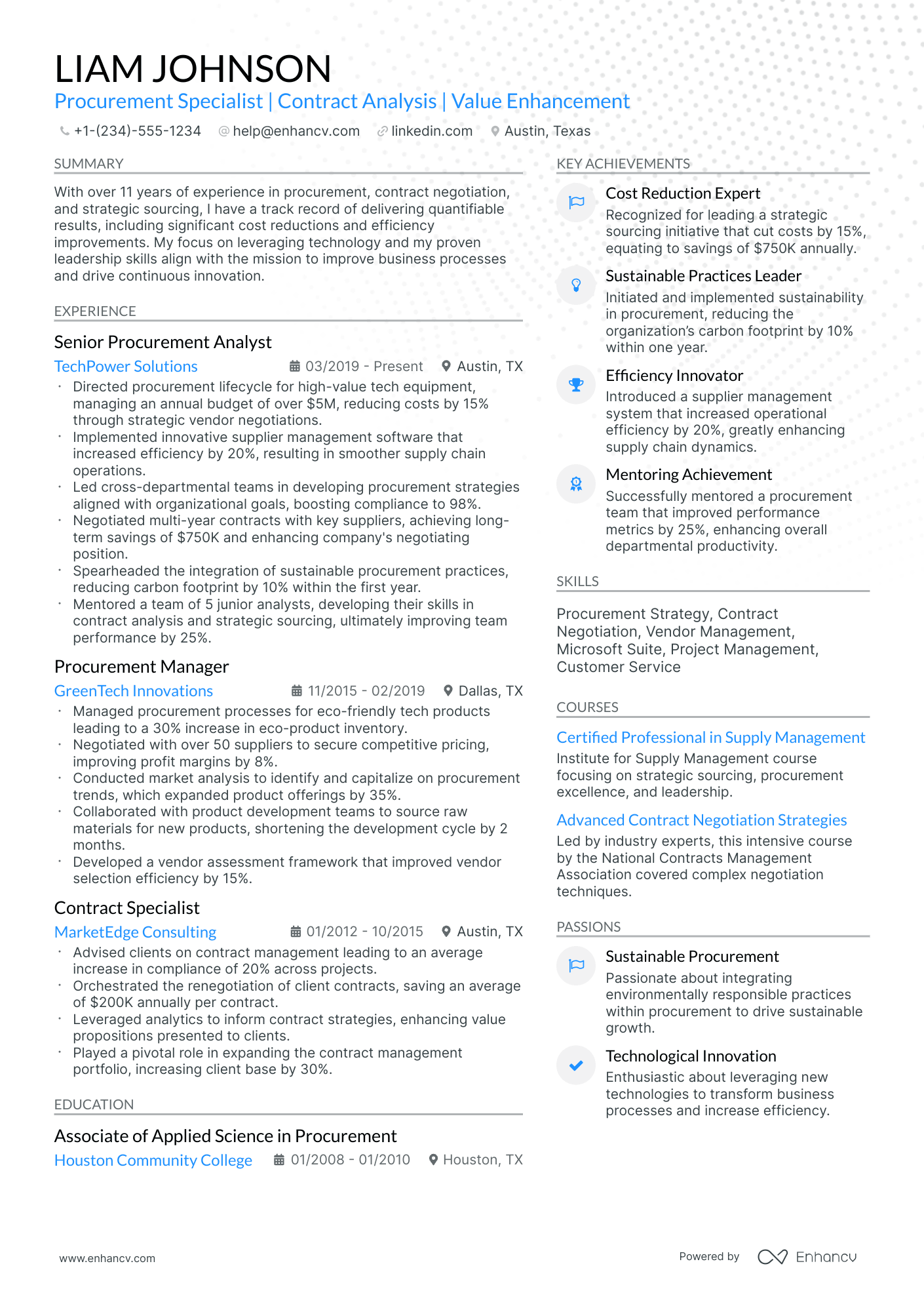
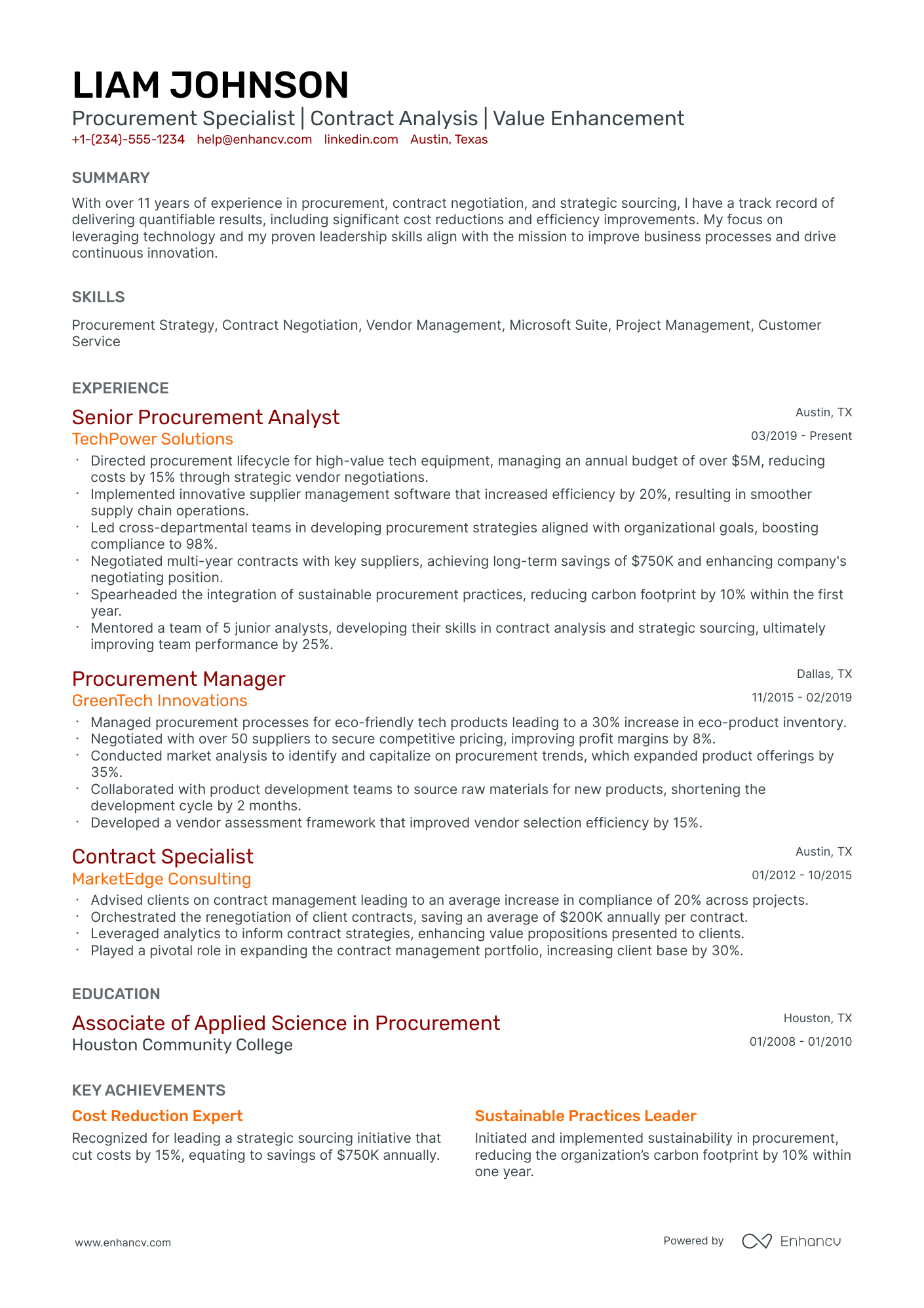
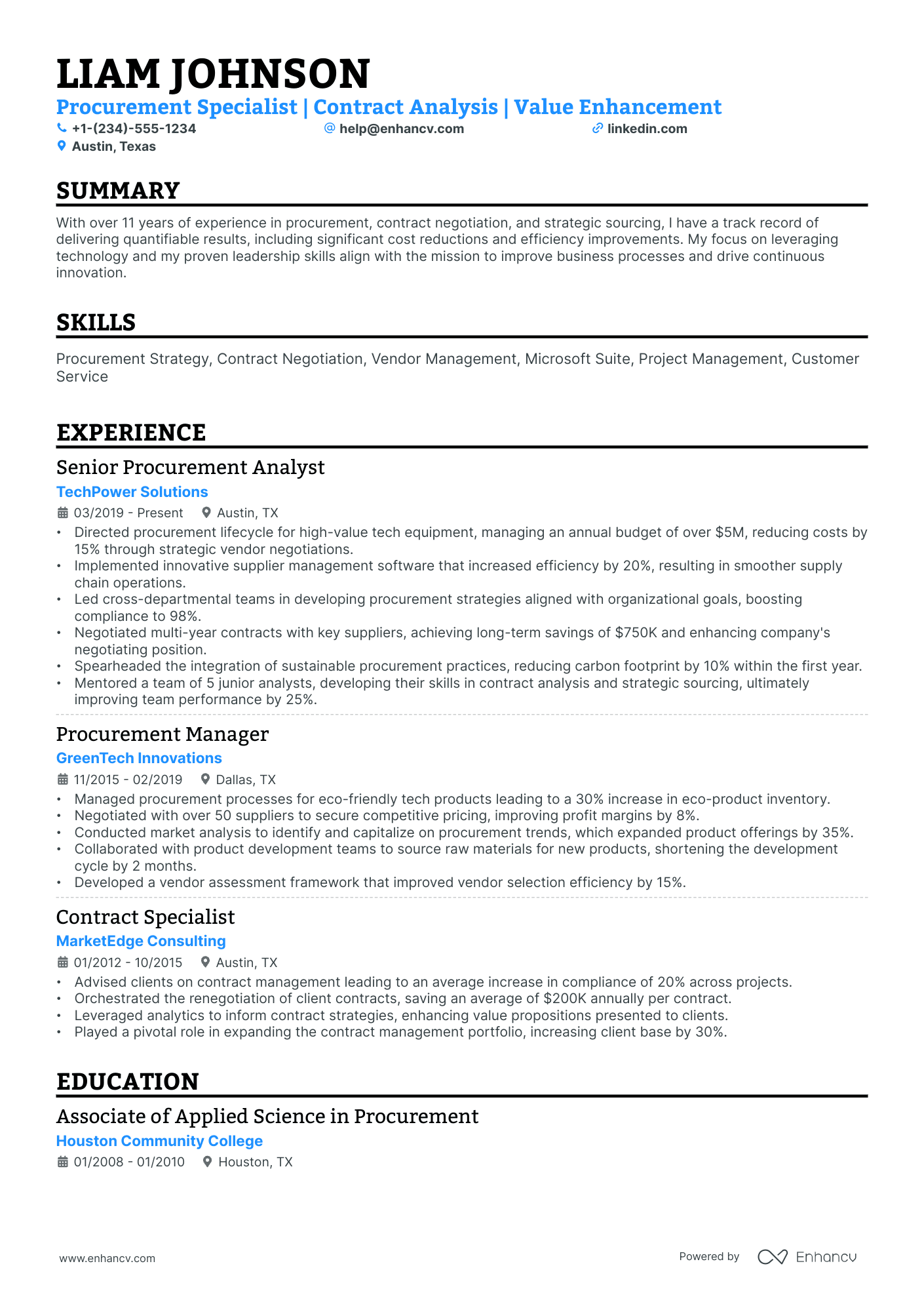
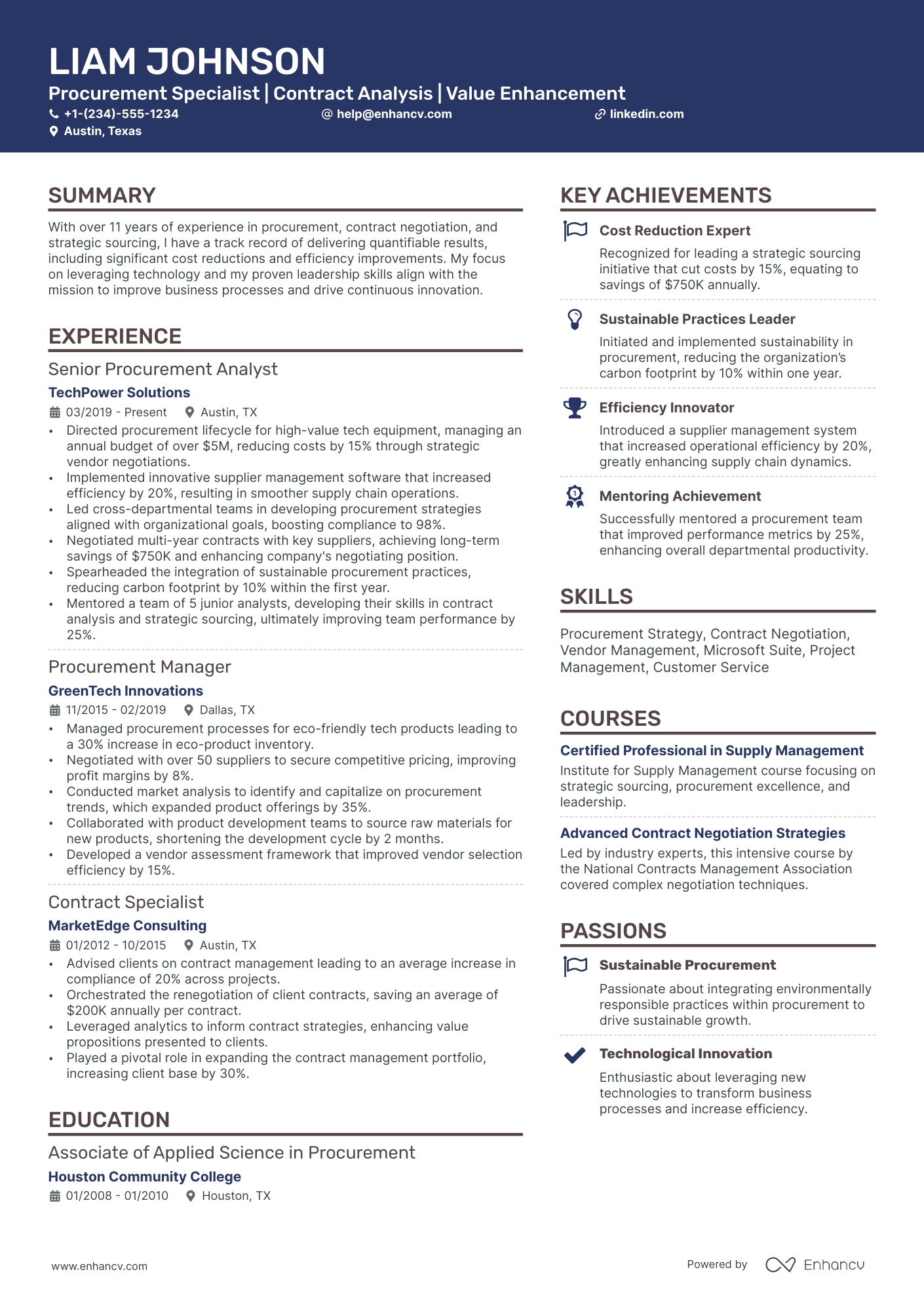
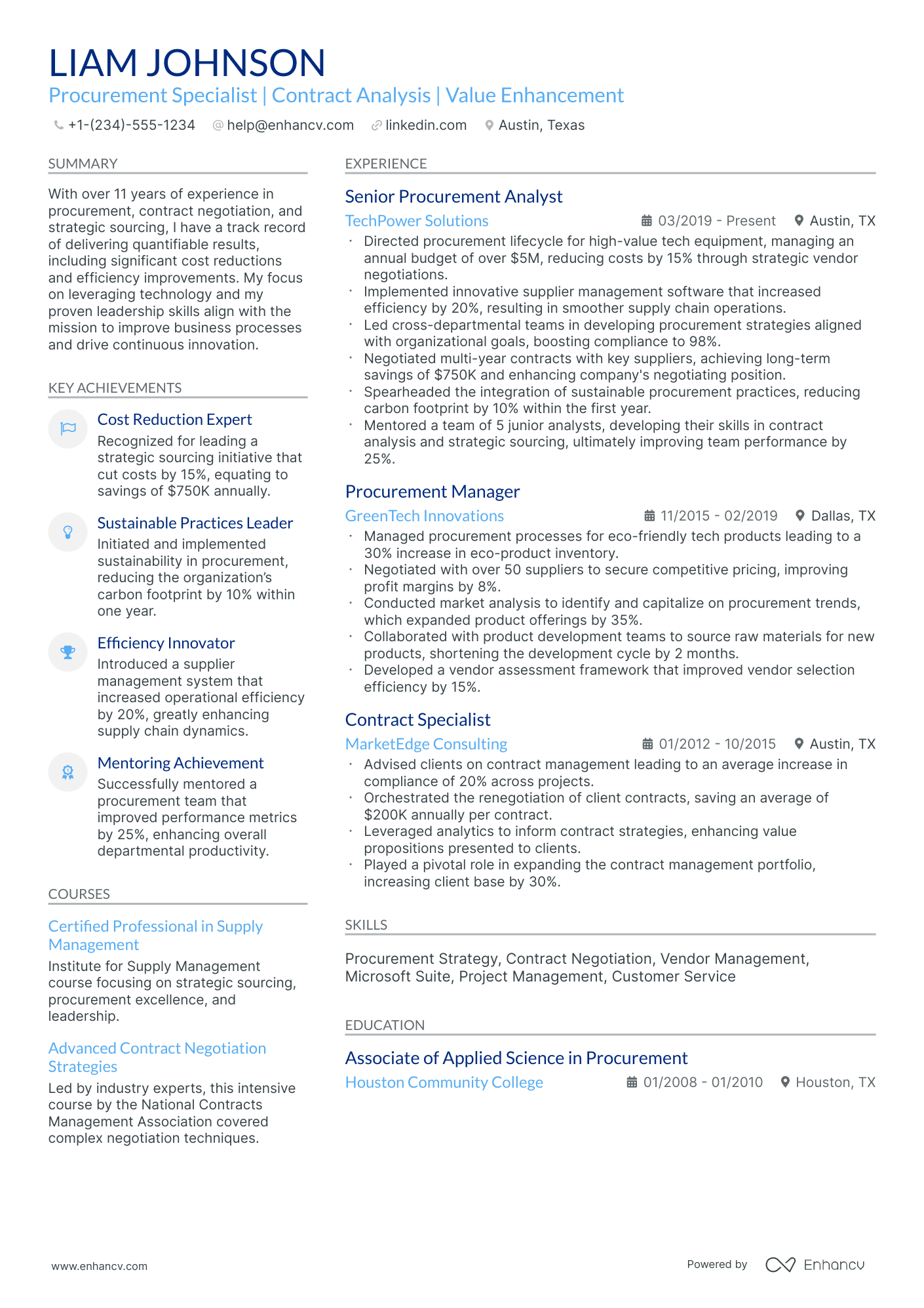
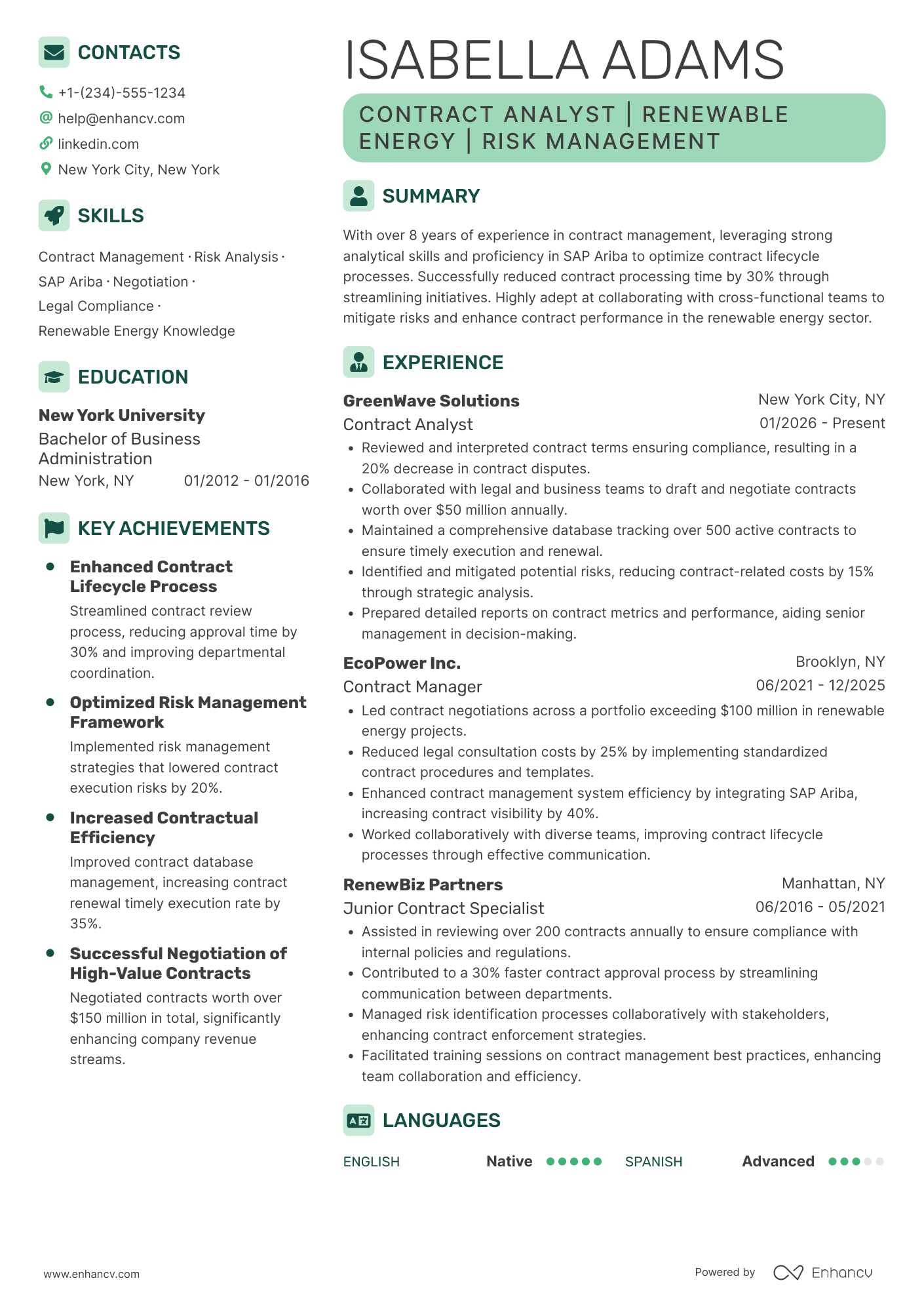
Contract analyst resume submissions often fail because they bury contract outcomes under dense legal language and generic duties. That hurts when an applicant tracking system filters keywords and recruiters scan fast in a crowded pipeline.
A strong resume shows what you delivered and improved, so you stand out. Knowing how to make your resume stand out starts with highlighting cycle-time reductions, dollars negotiated, risk exposure lowered, compliance audit pass rates, contract volume managed, turnaround time, stakeholder satisfaction, and fewer redlines.

Key takeaways
- Quantify contract outcomes using dollars, cycle time, error rates, and compliance percentages in every experience bullet.
- Structure your resume with clear sections so recruiters and applicant tracking systems can scan it fast.
- Balance hard skills like contract lifecycle management tools with execution-focused soft skills such as stakeholder alignment.
- Showcase entry-level readiness through class projects, mock redlines, and internship work tied to measurable results.
- Place certifications above or below education based on their relevance and recency to the target role.
- Write a cover letter when you need to explain career transitions or highlight fit beyond keywords.
- Use Enhancv to strengthen your contract analyst resume with consistent structure and results-driven language.
Job market snapshot for contract analysts
We analyzed 144 recent contract analyst job ads across major US job boards. These numbers help you understand experience requirements, salary landscape, career growth patterns at a glance.
What level of experience employers are looking for contract analysts
| Years of Experience | Percentage found in job ads |
|---|---|
| 1–2 years | 17.4% (25) |
| 3–4 years | 12.5% (18) |
| 5–6 years | 3.5% (5) |
| 7–8 years | 6.9% (10) |
| 10+ years | 0.7% (1) |
| Not specified | 44.4% (64) |
Contract analyst ads by area of specialization (industry)
| Industry (Area) | Percentage found in job ads |
|---|---|
| Finance & Banking | 63.9% (92) |
| Healthcare | 19.4% (28) |
| Education | 8.3% (12) |
Top companies hiring contract analysts
| Company | Percentage found in job ads |
|---|---|
| Medtronic Inc. | 13.2% (19) |
| Holland & Knight | 11.8% (17) |
Role overview stats
These tables show the most common responsibilities and employment types for contract analyst roles. Use them to align your resume with what employers expect and to understand how the role is structured across the market.
Day-to-day activities and top responsibilities for a contract analyst
| Responsibility | Percentage found in job ads |
|---|---|
| Excel | 22.9% (33) |
| Microsoft office | 16.0% (23) |
| Contract management | 13.9% (20) |
| Analytical skills | 11.8% (17) |
| Compliance | 9.7% (14) |
| Contract lifecycle management | 9.0% (13) |
| Contract drafting | 8.3% (12) |
| Data analysis | 8.3% (12) |
| Negotiation | 8.3% (12) |
| Project management | 7.6% (11) |
| Reporting | 7.6% (11) |
| Salesforce | 7.6% (11) |
Type of employment (remote vs on-site vs hybrid)
| Employment type | Percentage found in job ads |
|---|---|
| On-site | 65.3% (94) |
| Hybrid | 22.2% (32) |
| Remote | 12.5% (18) |
What sections should go on a contract analyst resume
Recruiters expect a contract analyst resume to show contract lifecycle expertise, risk awareness, and measurable business impact. Understanding which resume sections to include helps you present these qualifications clearly.
Use this structure for maximum clarity:
- Header
- Summary
- Experience
- Skills
- Projects
- Education
- Certifications
- Optional sections (Awards, Publications, Languages)
Strong experience bullets should emphasize negotiated value, risk reduction, cycle time improvements, compliance outcomes, and the scope of contracts you supported.
Is your resume good enough?
Drop your resume here or choose a file. PDF & DOCX only. Max 2MB file size.
Now that you’ve organized the key resume components, focus next on writing your contract analyst resume experience section to show how your work supports those details with clear, results-driven examples.

Experience bullet formula
A contract analyst experience example
✅ Right example - modern, quantified, specific.
Contract Analyst
Northbridge Medical Devices | Austin, TX
2022–Present
Mid-sized medical device manufacturer supporting hospital systems across the US with regulated products and complex vendor agreements.
- Streamlined contract intake and triage in Ironclad (contract lifecycle management) and Salesforce, cutting average request-to-assignment time from three days to one day and improving on-time legal review from 78% to 93%.
- Redlined and negotiated 120+ supplier and service agreements annually in Microsoft Word, enforcing playbook positions and fallback clauses that reduced indemnity exposure by 30% and avoided $450K in projected liability.
- Built a clause library and deviation tracker in SharePoint and Power BI, increasing template adoption from 55% to 88% and reducing non-standard terms by 22% across procurement and sales workflows.
- Partnered with procurement, finance, and engineering to align statements of work and deliverables, cutting change orders by 18% and improving acceptance-cycle time by 25% for implementation projects.
- Audited renewals and obligations in SAP Ariba and DocuSign, flagging 40 at-risk renewals and preventing $310K in auto-renew spend while improving compliance with notice periods to 98%.
Once you’ve aligned your experience with the role’s priorities, the next step is to quantify your contract analyst achievements so hiring teams can see the impact of that work.
How to quantify your contract analyst achievements
Quantifying your work proves business impact beyond "reviewed contracts." Track cycle time, accuracy, compliance, risk exposure, and savings from better terms. Use counts, dollars, days, and error rates tied to negotiation, review, and approval workflows.
Quantifying examples for contract analyst
| Metric | Example |
|---|---|
| Cycle time | "Cut contract turnaround from nine to five business days by rebuilding the intake tracker in Excel and standardizing clause playbooks for Sales." |
| Accuracy rate | "Reduced redline errors from 3.2% to 1.1% by adding a two-step QA checklist and version control in SharePoint for 200+ agreements." |
| Compliance | "Improved policy compliance from 86% to 97% by enforcing required data privacy addenda and routing exceptions through Legal in the contract lifecycle system." |
| Risk reduction | "Lowered high-risk clause findings by 28% by updating limitation of liability templates and training eight stakeholders on approved fallback language." |
| Cost savings | "Saved $145,000 annually by renegotiating auto-renewal notice periods and eliminating duplicate software terms across 35 vendor contracts." |
How to list your hard and soft skills on a contract analyst resume
Your skills section shows you can review, negotiate, and manage contracts accurately—recruiters scan them fast, and an ATS (applicant tracking system) matches them to keywords—so aim for a balanced mix of contract hard skills and execution-focused soft skills. contract analyst roles require a blend of:
- Product strategy and discovery skills.
- Data, analytics, and experimentation skills.
- Delivery, execution, and go-to-market discipline.
- Soft skills.
Your skills section should be:
- Scannable (bullet-style grouping).
- Relevant to the job post.
- Backed by proof in experience bullets.
- Updated with current tools.
Place your skills section:
- Above experience if you're junior or switching careers.
- Below experience if you're mid/senior with strong achievements.

Hard skills
- Contract lifecycle management (CLM) systems
- Redlining and version control
- Contract negotiation support
- Terms and conditions analysis
- Vendor and customer agreements
- Service-level agreement tracking
- Statement of work review
- Pricing and rate card validation
- Risk assessment and mitigation
- Compliance: SOX, GDPR, HIPAA
- Microsoft Excel, SharePoint
- Salesforce, DocuSign
Soft skills
- Translate legal terms for stakeholders
- Clarify scope and acceptance criteria
- Ask targeted questions early
- Document decisions and assumptions
- Prioritize contract risks by impact
- Align sales, legal, and finance
- Manage timelines and approvals
- Escalate blockers with options
- Negotiate tradeoffs without friction
- Maintain audit-ready organization
- Communicate changes with precision
- Own follow-through to signature
Once you’ve tied your contract analyst strengths to real outcomes, the next step is applying that same approach to build a contract analyst resume when you don’t have direct experience.
How do I write a contract analyst resume with no experience
Even without full-time experience, you can demonstrate readiness through building a strong resume without work experience that highlights transferable skills:
- Contract review class projects
- Legal clinic contract intake work
- Internship supporting contract lifecycle
- Procurement or vendor onboarding tasks
- Compliance documentation and audits
- Research memos on contract clauses
- Mock redlines using Microsoft Word
- Volunteer grant agreement administration
Focus on:
- Clause analysis with cited sources
- Clear redlines and version control
- Contract lifecycle documentation accuracy
- Metrics tied to contract outcomes
Resume format tip for entry-level contract analyst
Use a hybrid resume format because it highlights contract analyst skills and projects first, while still showing education and any related work history. Do:
- Lead with contract analyst projects.
- List tools: Microsoft Word, Excel.
- Add clause keywords in bullets.
- Quantify volume, time, or errors.
- Mirror job posting contract terms.
- Drafted and tracked twenty mock redlines in Microsoft Word, standardizing clause comments and cutting review time by 25% in a contract review class project.
How to list your certifications on a contract analyst resume
Certifications on your resume show your commitment to learning, proficiency with contract tools, and alignment with industry standards as a contract analyst.
Include:
- Certificate name
- Issuing organization
- Year
- Optional: credential ID or URL
- Place certifications below education when your degree is recent and your certifications add support rather than primary proof of skill.
- Place certifications above education when they are recent, highly relevant, or required and they strengthen your contract analyst qualifications immediately.
Best certifications for your contract analyst resume
Certified Professional Contracts Manager (CPCM) Certified Federal Contracts Manager (CFCM) Certified Commercial Contracts Manager (CCCM) Certified Contract Management Associate (CCMA) Certified Regulatory Compliance Manager (CRCM) Project Management Professional (PMP) Certified Professional in Supply Management (CPSM)
Once you’ve positioned your credentials where hiring managers can spot them, shift to your contract analyst resume summary to tie those qualifications to your value in a few lines.
What to include in a contract analyst resume header
A resume header lists your key contact details and role identity, helping contract analyst candidates stand out in recruiter screening with clear visibility and credibility.
Essential resume header elements
- Full name
- Tailored job title and headline
- Location
- Phone number
- Professional email
- GitHub link
- Portfolio link
A LinkedIn link helps recruiters verify your work history fast and supports screening with consistent dates, titles, and keywords.
Don't include a photo on a contract analyst resume unless the role is explicitly front-facing or appearance-dependent.
Use a tailored contract analyst headline that matches the job posting and place all links on one line to reduce scanning time.
Example
Contract analyst resume header
Jordan Lee
Contract Analyst | Contract lifecycle management, compliance, and vendor negotiations
Austin, TX
(512) 555-01XX
your.name@enhancv.com github.com/yourname yourwebsite.com linkedin.com/in/yourname
Once your contact details and role identifiers are clear and accurate at the top, add the following optional resume sections to further support your contract analyst qualifications.
Additional sections for contract analyst resumes
When your core qualifications match other applicants, well-chosen additional sections can set your contract analyst resume apart with role-specific credibility. For example, listing language skills can be especially valuable if you work with international vendors or multilingual contract terms.
- Languages
- Certifications
- Professional affiliations
- Publications
- Continuing education
- Volunteer experience
- Awards and honors
Do contract analyst resumes need a cover letter
A cover letter isn't required for a contract analyst, but it helps when roles are competitive or hiring teams expect one. If you're unsure where to start, understanding what a cover letter is and how it complements your resume can clarify when to include one. It can make a difference when your resume needs context, or when you must show fit beyond keywords.
Use a cover letter to add details your resume can't:
- Explain role and team fit by matching your contract analyst experience to the contract types, stakeholders, and workflows in the posting.
- Highlight one or two relevant projects or outcomes, such as reducing cycle time, improving compliance, or resolving risk issues with clear results.
- Show understanding of the product, users, or business context by connecting contract terms to revenue, procurement, customer impact, or regulatory needs.
- Address career transitions or non-obvious experience by explaining how adjacent work supports contract analyst responsibilities and tools.
Drop your resume here or choose a file.
PDF & DOCX only. Max 2MB file size.
Even if you choose to apply without a cover letter, using AI to improve your contract analyst resume helps you strengthen the document employers review first.
Conclusion
A strong contract analyst resume shows measurable outcomes, role-specific skills, and a clear structure. It highlights contract review, risk assessment, compliance support, and stakeholder collaboration. It uses clean headings, focused bullets, and metrics that prove impact.
This approach signals readiness for today’s hiring market and the near-future one. It helps hiring teams quickly see how you protect revenue, reduce risk, and improve turnaround times. Keep it direct, consistent, and easy to scan.