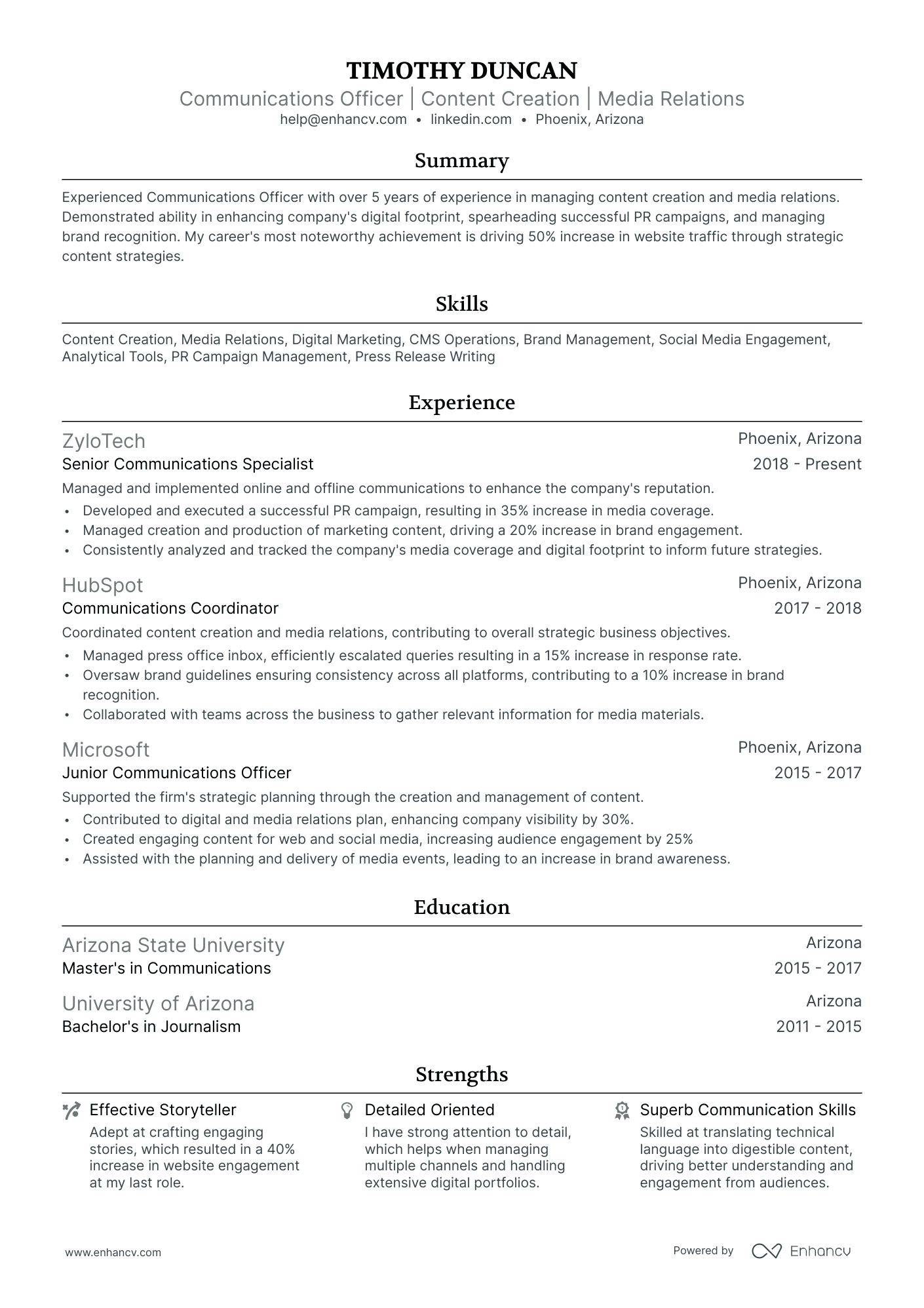
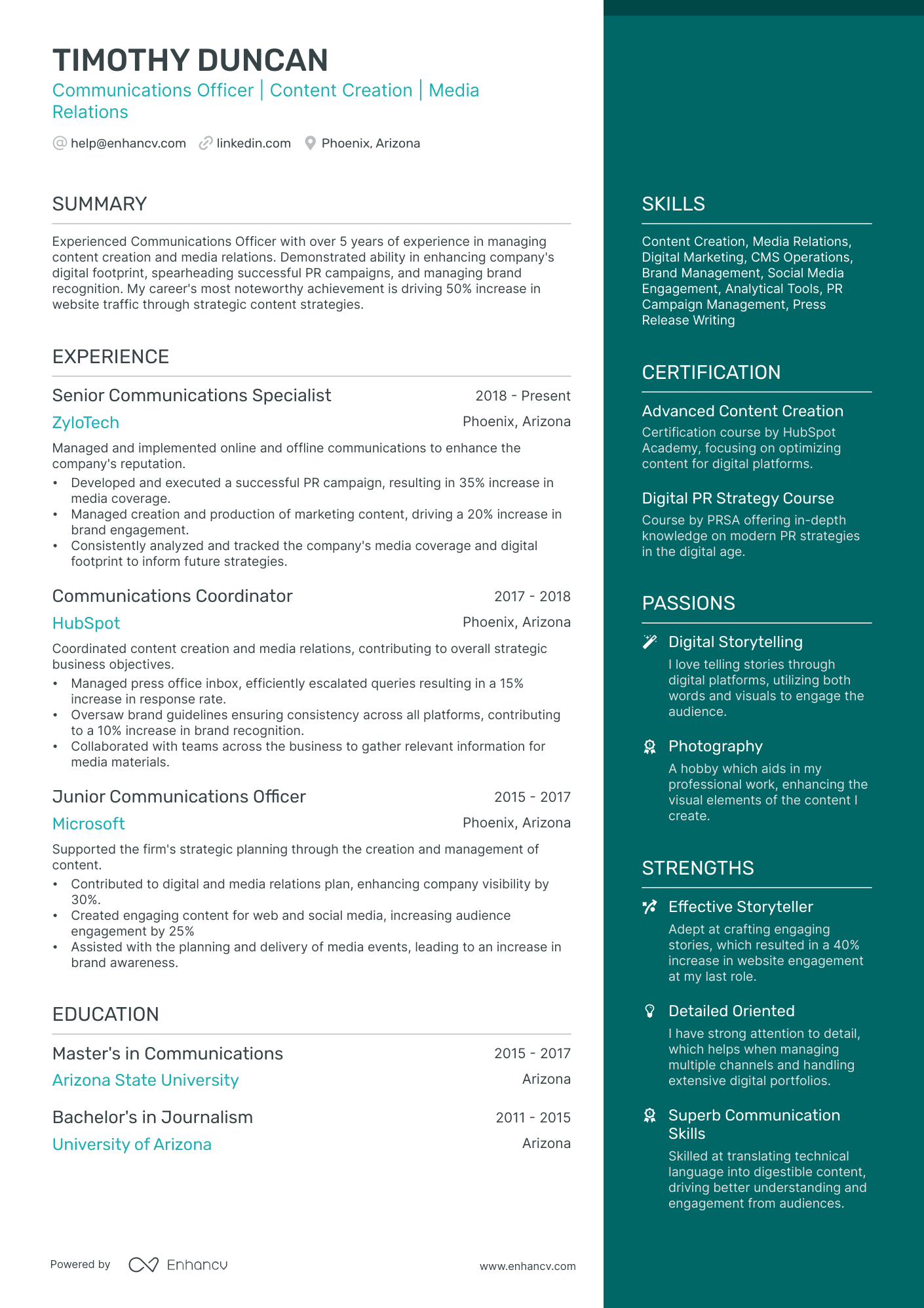
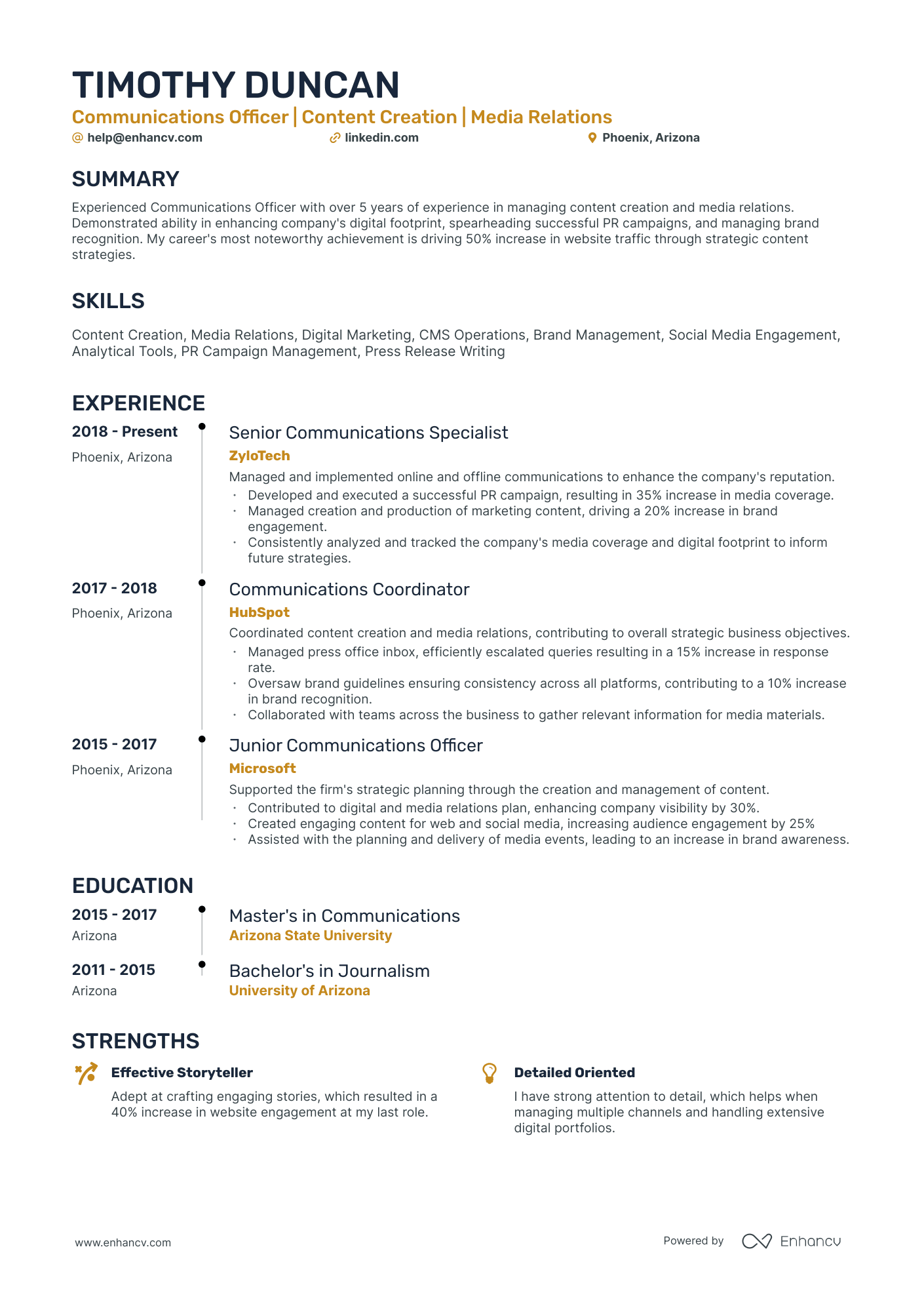
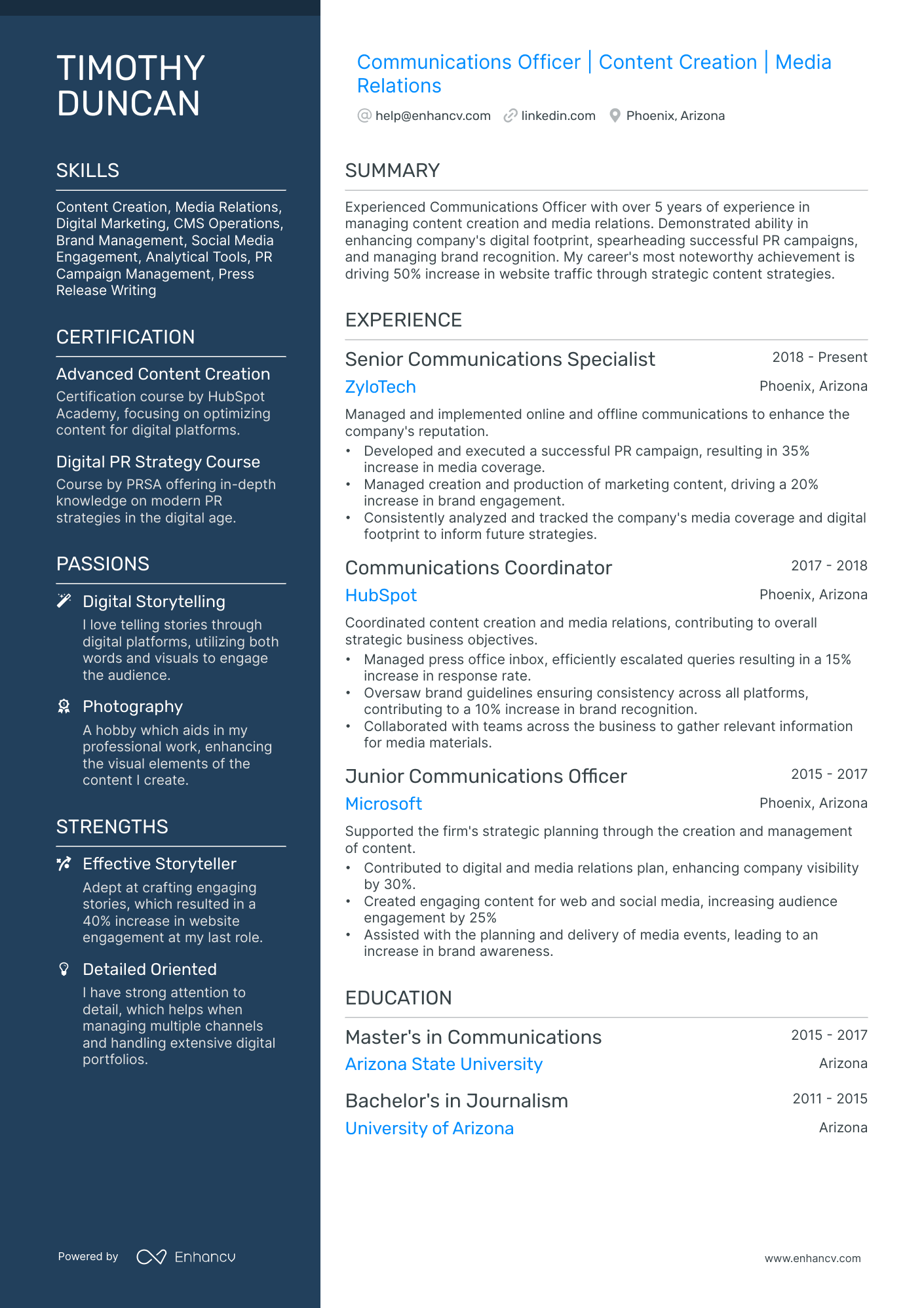
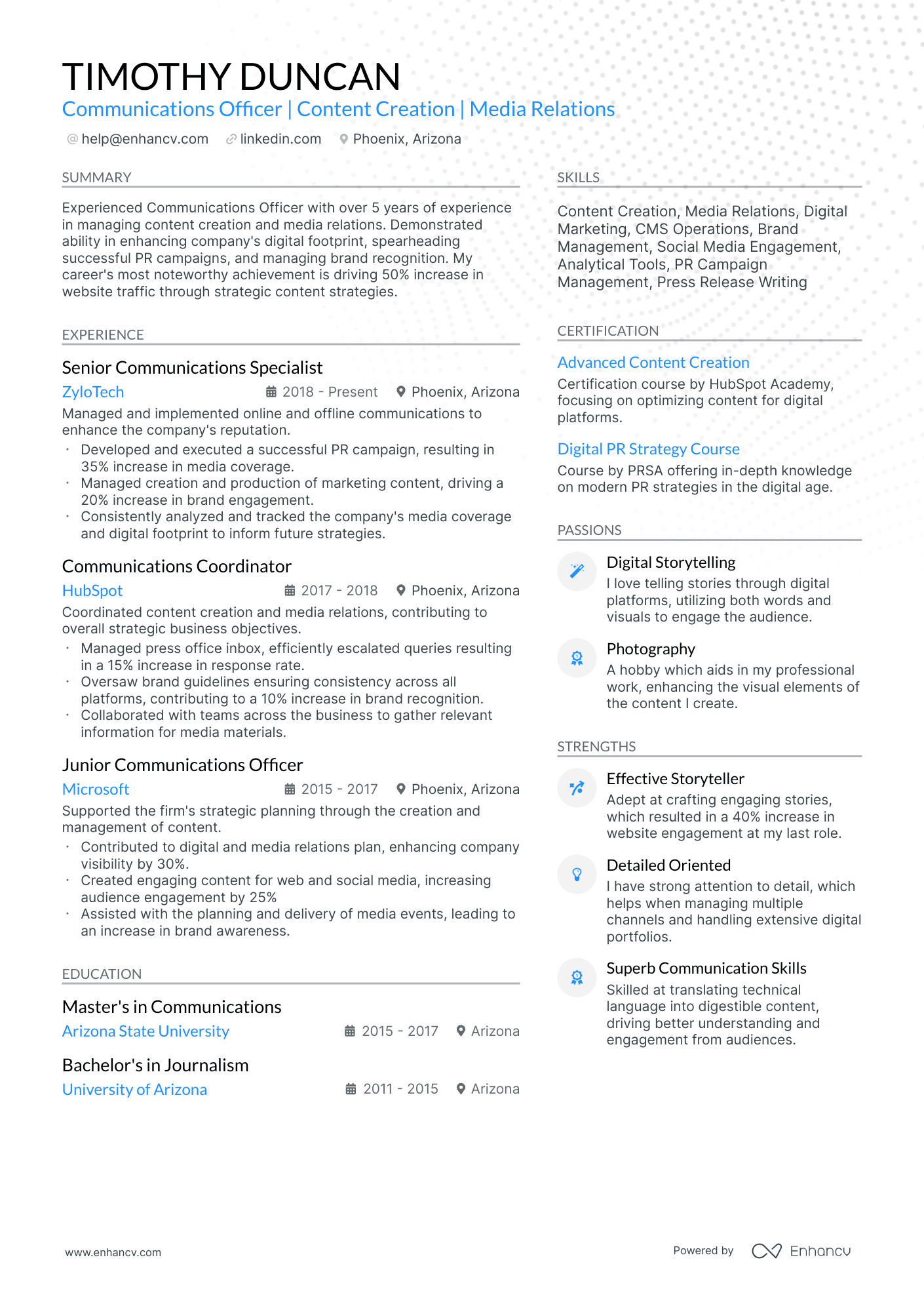
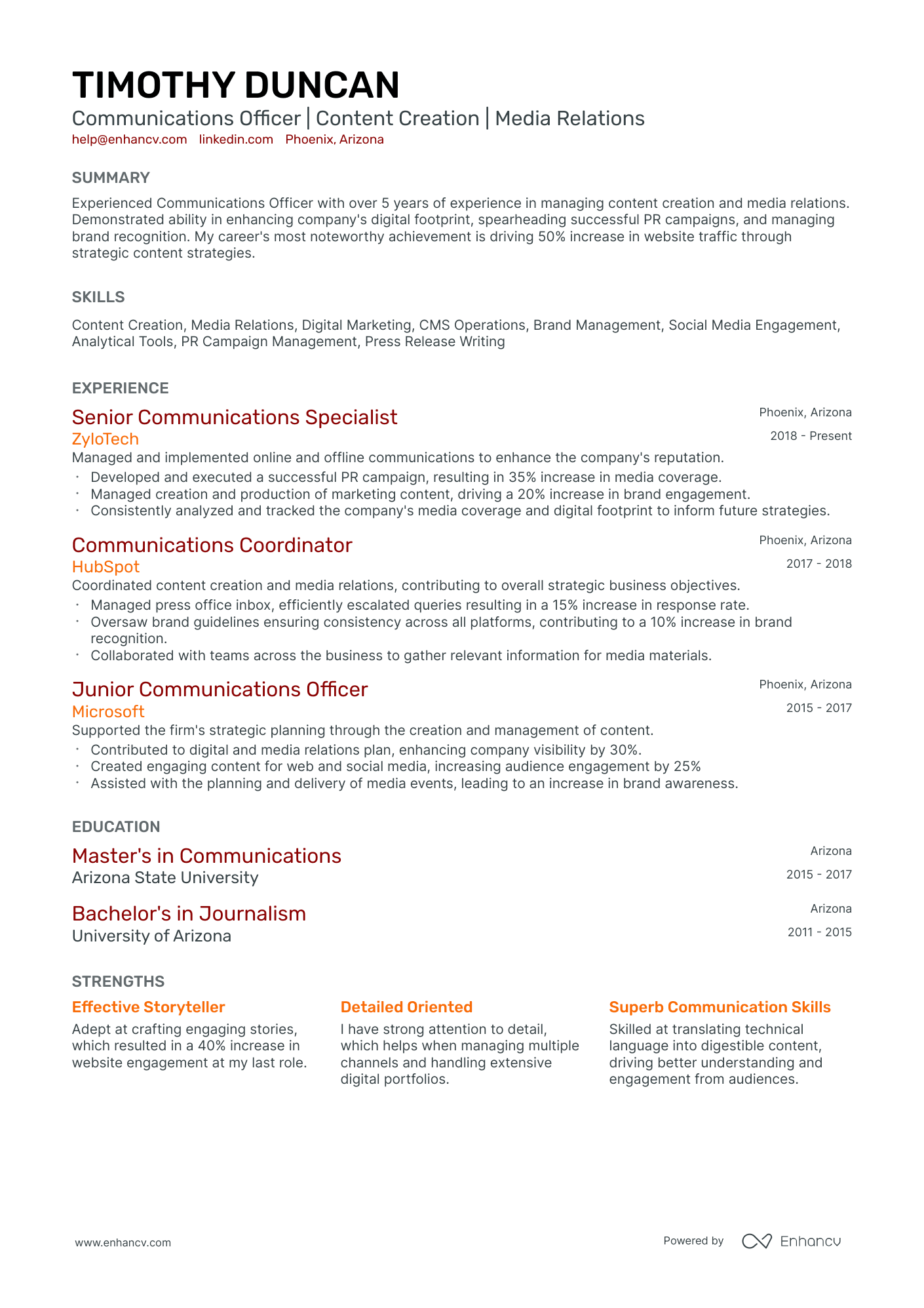
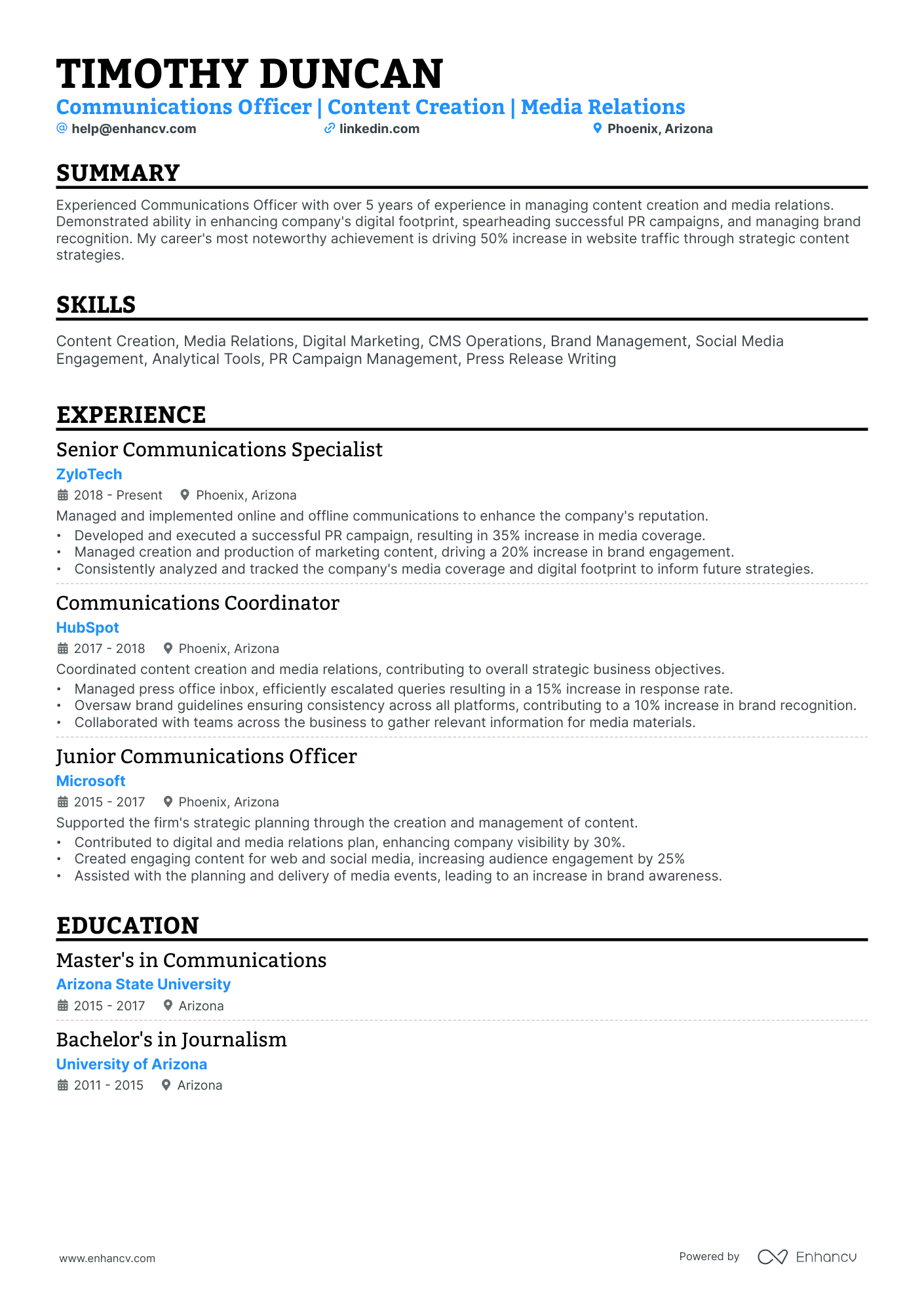
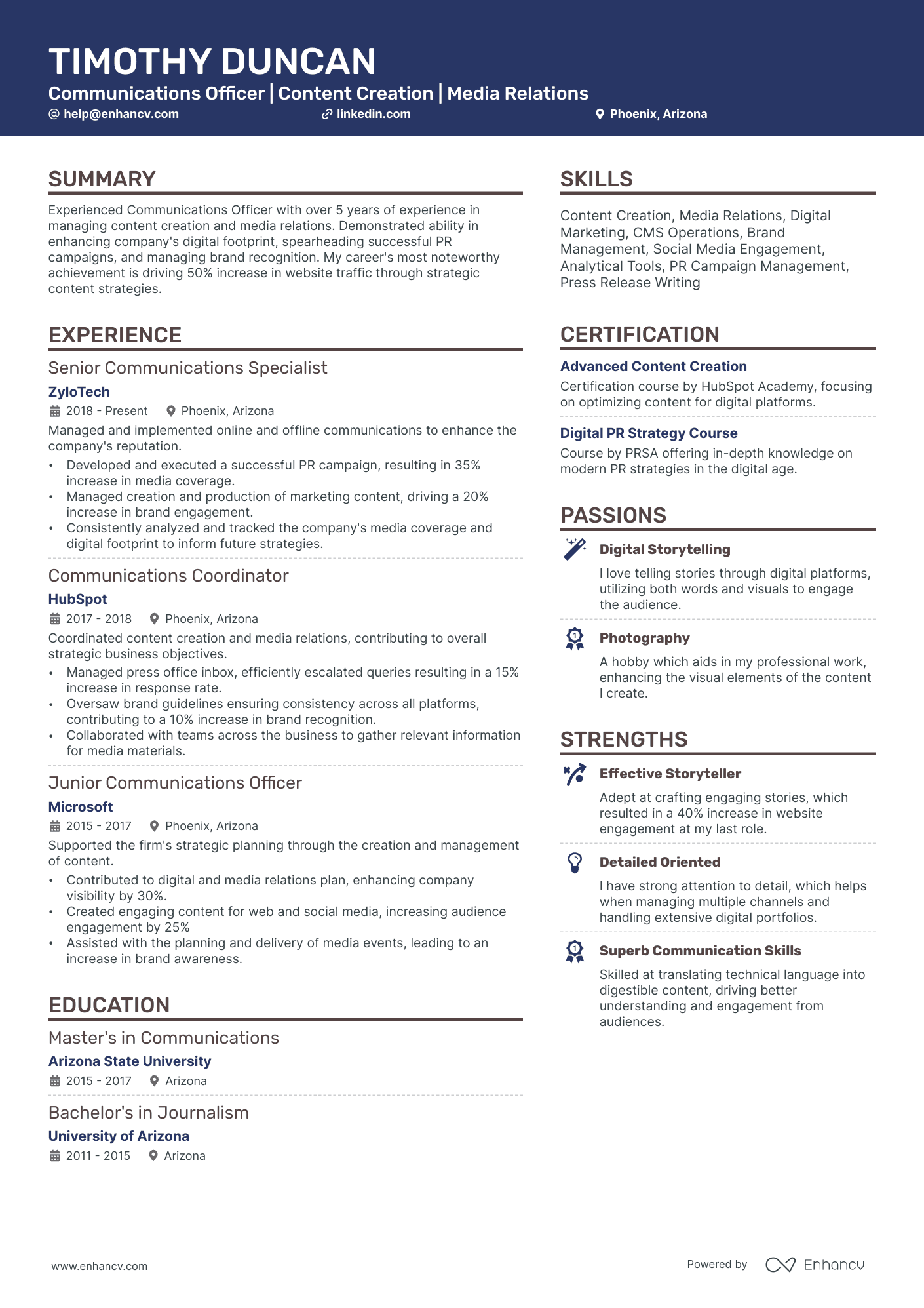
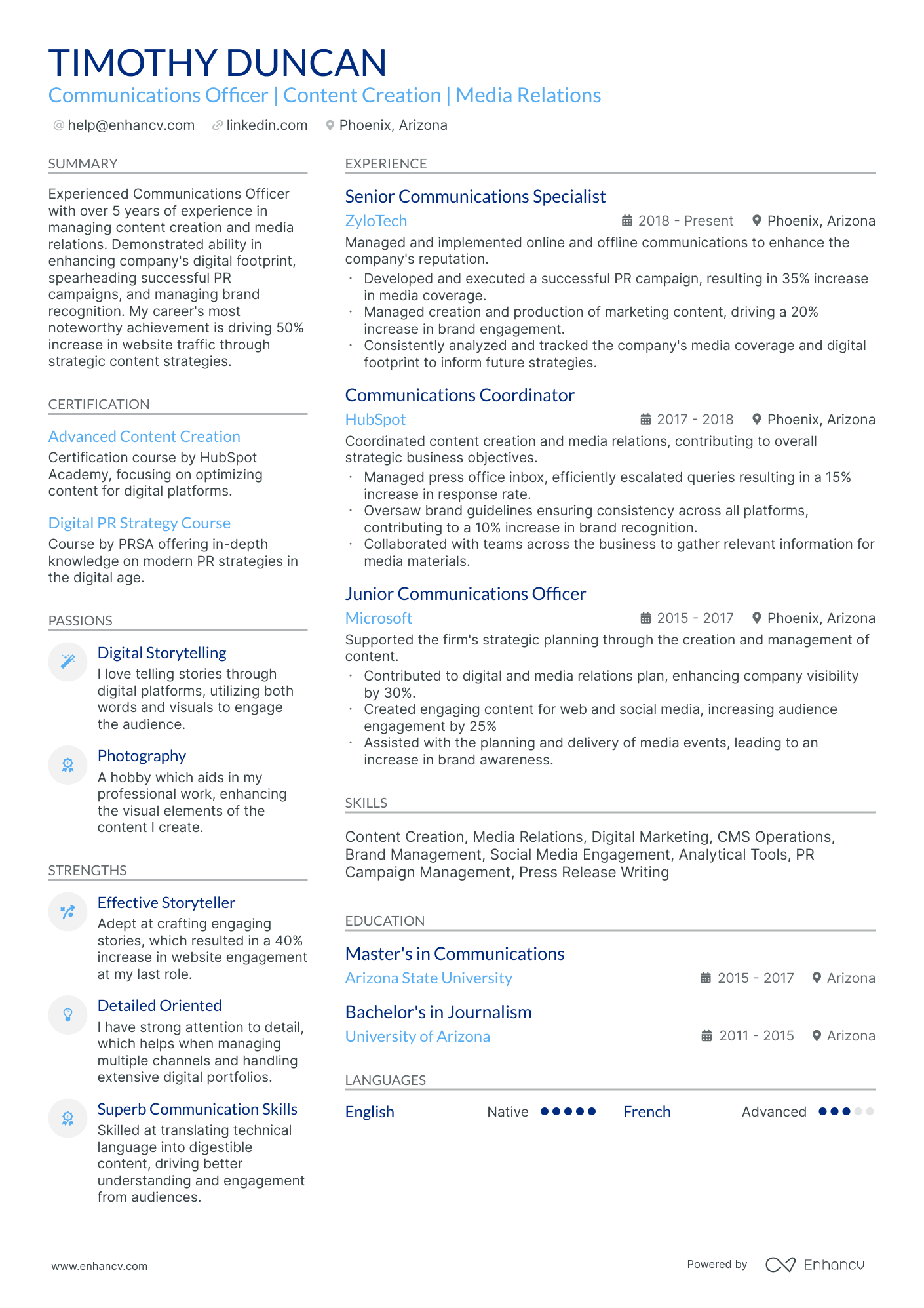
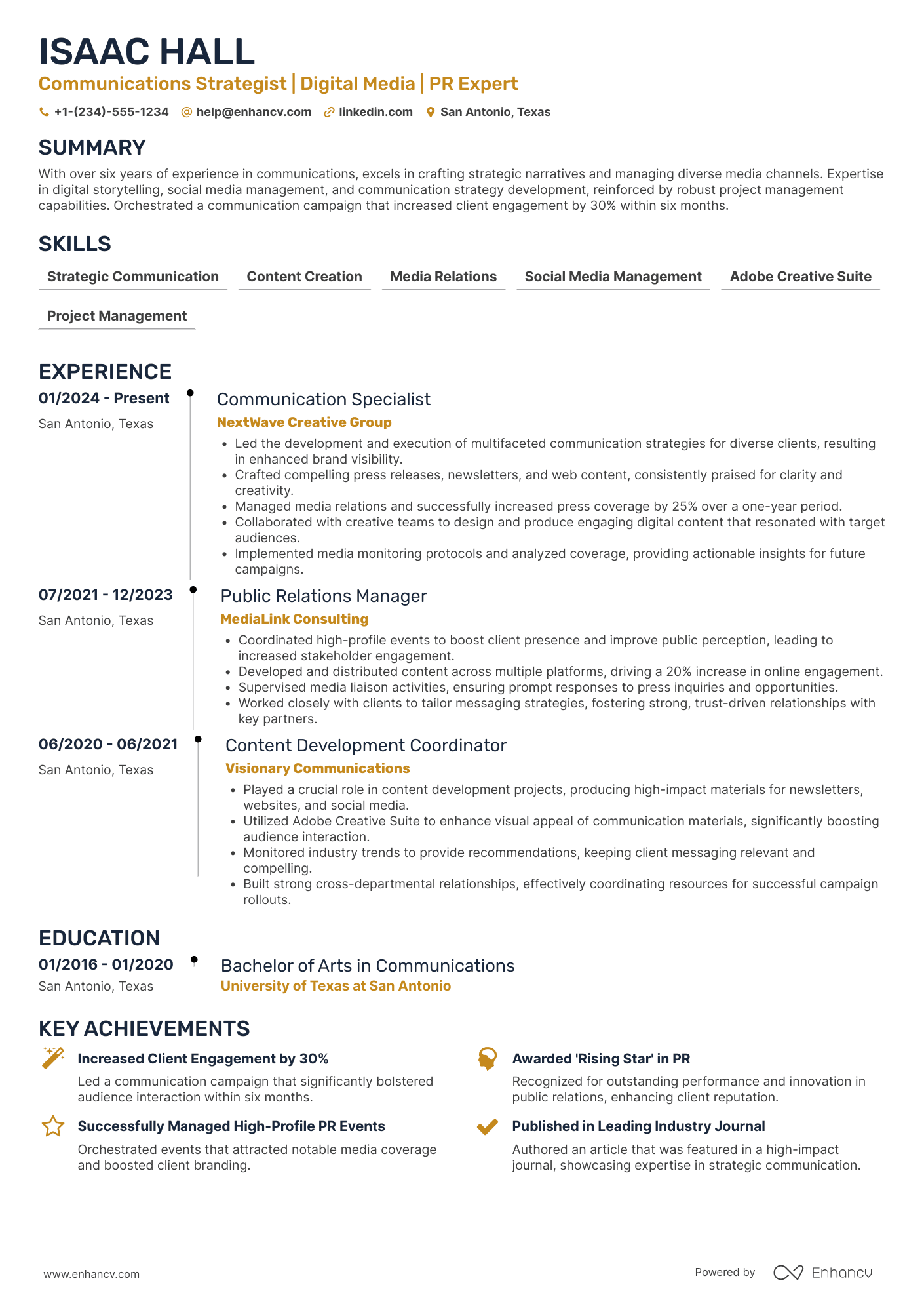
Most communications officer resume drafts fail because they list channels and tasks but don't connect messaging to measurable results. In today's hiring process, that gets missed by ATS screening and skimmed in seconds amid heavy competition. Understanding how to make your resume stand out is critical in a field where clear, persuasive writing is the core skill being evaluated.
A strong resume shows the outcomes you drove and the stakes you managed. You'll highlight lift in engagement, press pickups secured, crisis response timelines, campaign reach, stakeholder alignment, and reputation or revenue impact. You'll quantify scope, speed, quality, and business results.

Key takeaways
- Connect every communications achievement to a measurable outcome like coverage growth or engagement lift.
- Use reverse-chronological format for experienced candidates and hybrid format for career switchers.
- Tailor experience bullets to mirror the exact language and priorities in each job posting.
- Place skills above experience if you're junior; below experience if you're mid-level or senior.
- Quantify turnaround time, media placements, compliance accuracy, and stakeholder satisfaction in your bullets.
- Use Enhancv's Bullet Point Generator to turn vague duties into specific, recruiter-ready resume lines.
- Stop using AI to edit your resume once every claim reflects real, verifiable experience.
Job market snapshot for communications officers
We analyzed 80 recent communications officer job ads across major US job boards. These numbers help you understand employer expectations, salary landscape, industry demand at a glance.
What level of experience employers are looking for communications officers
| Years of Experience | Percentage found in job ads |
|---|---|
| 1–2 years | 7.5% (6) |
| 3–4 years | 2.5% (2) |
| 5–6 years | 12.5% (10) |
| 7–8 years | 1.3% (1) |
| 9–10 years | 2.5% (2) |
| 10+ years | 3.8% (3) |
| Not specified | 72.5% (58) |
Communications officer ads by area of specialization (industry)
| Industry (Area) | Percentage found in job ads |
|---|---|
| Finance & Banking | 33.8% (27) |
| Education | 32.5% (26) |
| Healthcare | 20.0% (16) |
Role overview stats
These tables show the most common responsibilities and employment types for communications officer roles. Use them to align your resume with what employers expect and to understand how the role is structured across the market.
Day-to-day activities and top responsibilities for a communications officer
| Responsibility | Percentage found in job ads |
|---|---|
| Social media | 18.8% (15) |
| Project management | 16.3% (13) |
| Word processing | 16.3% (13) |
| Content management systems | 15.0% (12) |
| Analytics | 11.3% (9) |
| Ncic | 11.3% (9) |
| Communications | 10.0% (8) |
| Cpr | 10.0% (8) |
| Database applications | 10.0% (8) |
| Email marketing | 10.0% (8) |
| Wordpress | 10.0% (8) |
| Computer aided dispatch | 8.8% (7) |
Type of employment (remote vs on-site vs hybrid)
| Employment type | Percentage found in job ads |
|---|---|
| On-site | 87.5% (70) |
| Hybrid | 10.0% (8) |
How to format a communications officer resume
Recruiters evaluating communications officer candidates prioritize clear writing ability, media relations experience, stakeholder engagement, and campaign management skills. A clean, well-structured resume format ensures these signals surface quickly during both human review and applicant tracking system (ATS) scans.

I have significant experience in this role—which format should I use?
Use a reverse-chronological format to lead with your most recent and relevant communications experience. Do:
- Highlight the scope and ownership of your communications responsibilities, including team size, budget authority, and the breadth of internal and external audiences you managed.
- Feature role-specific tools and domains such as media monitoring platforms, crisis communication protocols, content management systems, and public affairs strategy.
- Quantify outcomes tied to business impact, including media coverage growth, audience engagement metrics, sentiment improvements, or cost savings from in-house content production.
I'm junior or switching into this role—what format works best?
A hybrid format works best because it lets you lead with transferable communications skills while still showing a clear work history. Do:
- Place a skills section near the top of your resume featuring core competencies like media writing, social media management, press release development, and stakeholder communications.
- Include relevant projects, internships, volunteer communications work, or freelance content creation that demonstrates hands-on experience in the field.
- Connect every action to a measurable or observable result so hiring managers can assess your potential impact.
Why not use a functional resume?
A functional format strips away the timeline and context that recruiters need to evaluate how your communications skills were applied in real workplace settings, which weakens your candidacy even at the entry level.
- A functional format may be acceptable if you're making a career change into communications from a related field like journalism or marketing, have limited formal work history, or need to address significant resume gaps—but only if every listed skill is tied directly to a specific project, campaign, or measurable outcome.
Once you've established a clean, readable format, the next step is deciding which sections to include so each one reinforces your qualifications.
What sections should go on a communications officer resume
Recruiters expect a communications officer resume to show clear messaging expertise, stakeholder management, and measurable results across channels. Knowing what to put on a resume helps you prioritize the sections that matter most for this role.
Use this structure for maximum clarity:
- Header
- Summary
- Experience
- Skills
- Projects
- Education
- Certifications
- Optional sections: Awards, Publications, Languages
Your experience bullets should emphasize campaign impact, quantified outcomes, audience reach, and the scope of stakeholders and channels you managed.
Is your resume good enough?
Drop your resume here or choose a file. PDF & DOCX only. Max 2MB file size.
Once you’ve organized the key resume components, the next step is writing your communications officer experience section so it supports each element with clear, role-relevant impact.
How to write your communications officer resume experience
The experience section is where you prove you've shaped messaging, managed channels, and delivered communications outcomes—not just held a title. Hiring managers prioritize demonstrated impact over descriptive task lists, so every bullet should reflect shipped work, role-relevant tools or methods, and measurable results. Building a targeted resume ensures each entry speaks directly to the communications officer role you're pursuing.
Each entry should include:
- Job title
- Company and location (or remote)
- Dates of employment (month and year)
Three to five concise bullet points showing what you owned, how you executed, and what outcomes you delivered:
- Ownership scope: the communications programs, channels, content calendars, brand narratives, or stakeholder audiences you were directly accountable for as a communications officer.
- Execution approach: the media relations platforms, content management systems, crisis communication frameworks, analytics tools, or editorial methods you used to plan, produce, and distribute communications.
- Value improved: changes to brand visibility, message consistency, audience engagement, media coverage quality, internal alignment, or reputational risk that resulted from your communications work.
- Collaboration context: how you partnered with leadership, marketing, legal, product, HR, or external agencies and journalists to align messaging and execute integrated communications strategies.
- Impact delivered: outcomes expressed through reach, sentiment shifts, coverage results, campaign performance, or organizational influence rather than a list of daily activities.
Experience bullet formula
A communications officer experience example
✅ Right example - modern, quantified, specific.
Communications Officer
Harbor City Public Health Department | Harbor City, CA
2021–Present
Public health agency serving 1.2M residents, leading crisis and community communications across eight programs.
- Led crisis communications during three wildfire smoke events, publishing daily updates via GovDelivery and social channels; increased alert sign-ups by 38% and reduced hotline call volume by 22% through clearer self-service guidance.
- Built an editorial calendar in Asana and standardized approvals in Microsoft SharePoint; cut press release turnaround time from five days to two and improved on-time publication from 62% to 91%.
- Produced a bilingual media kit and spokesperson briefing process with program leads and legal; improved message accuracy by 30% and secured 45 earned media placements with zero corrections issued.
- Launched a monthly community newsletter using Mailchimp segmentation and A/B testing; raised open rates from 24% to 33% and drove a 19% increase in clinic appointment bookings tracked in Google Analytics.
- Partnered with designers and web developers to refresh the department site in Drupal, adding accessible templates and plain-language standards; reduced page bounce rate by 14% and improved accessibility audit scores from 78 to 92.
Now that you've seen how a strong experience section comes together, let's look at how to adjust those details to match a specific job posting.
How to tailor your communications officer resume experience
Recruiters evaluate your communications officer resume through both applicant tracking systems and manual review, so tailoring your resume to the job description is essential. Aligning your bullet points with the specific language and priorities in the listing increases your chances of passing both filters.
Ways to tailor your communications officer experience:
- Match media relations tools or platforms named in the job description.
- Mirror the exact terminology used for internal communications frameworks.
- Reflect specific KPIs like media impressions or engagement rates mentioned.
- Highlight crisis communication experience when the posting references it.
- Include relevant industry experience such as government or nonprofit sectors.
- Use the same language for brand messaging standards or style guides.
- Emphasize stakeholder engagement models referenced in the listing.
- Showcase content management systems or digital channels the role requires.
Tailoring means aligning your real accomplishments with what the role demands, not forcing disconnected keywords into your experience section.
Resume tailoring examples for communications officer
| Job description excerpt | Untailored | Tailored |
|---|---|---|
| Develop and execute strategic communications plans to support organizational priorities, including media relations, digital content strategy, and stakeholder engagement across multiple channels. | Helped with communications tasks and supported team projects. | Developed and executed multi-channel communications plans spanning media relations, digital content, and stakeholder engagement that increased organizational visibility by 35% over 12 months. |
| Manage the organization's social media presence across LinkedIn, X, and Instagram, using Hootsuite to schedule content, track analytics, and grow audience reach by 20% year over year. | Managed social media accounts and posted content regularly. | Managed LinkedIn, X, and Instagram accounts using Hootsuite to schedule content and analyze performance, growing combined audience reach by 24% year over year. |
| Draft press releases, talking points, and crisis communications materials in coordination with senior leadership and legal counsel to ensure timely, accurate public messaging. | Wrote various documents and assisted leadership with communication needs. | Drafted press releases, talking points, and crisis communications materials in coordination with senior leadership and legal counsel, reducing public response time during critical incidents from 48 hours to under six. |
Once you’ve aligned your experience with the role’s priorities, quantify your communications officer achievements to show the measurable impact behind that fit.
How to quantify your communications officer achievements
Quantifying your work proves your messages changed behavior, reduced risk, or improved service. Focus on turnaround time, reach and engagement tied to actions, media outcomes, accuracy and compliance rates, and volume delivered across channels. Using numbers on your resume transforms generic claims into concrete evidence of your communications impact.
Quantifying examples for communications officer
| Metric | Example |
|---|---|
| Turnaround time | "Cut press release turnaround from five days to two by standardizing approvals in Microsoft SharePoint and using templated briefs." |
| Media coverage quality | "Increased top-tier media pickups from eight to nineteen per quarter by refining pitch angles and tracking outreach in HubSpot." |
| Compliance accuracy | "Reduced policy communication errors from twelve to three per quarter by adding legal checklists and version control in Google Docs." |
| Stakeholder satisfaction | "Raised internal stakeholder satisfaction from 3.6 to 4.4 out of five by launching a monthly editorial calendar and weekly office hours." |
| Volume delivered | "Produced and scheduled 120 multi-channel updates in ninety days across email and intranet, maintaining a 98% on-time publishing rate." |
Turn vague job duties into measurable, recruiter-ready resume bullets in seconds with Enhancv's Bullet Point Generator.
With your bullet points clearly articulating your accomplishments, the next step is ensuring your skills section highlights the right mix of hard and soft skills that reinforce your qualifications.
How to list your hard and soft skills on a communications officer resume
Your skills section shows how you plan, execute, and measure communications, and recruiters and ATS scan it to confirm job-match keywords fast; aim for a balanced mix of hard skills like tools and channels and soft skills like stakeholder management. communications officer roles require a blend of:
- Product strategy and discovery skills.
- Data, analytics, and experimentation skills.
- Delivery, execution, and go-to-market discipline.
- Soft skills.
Your skills section should be:
- Scannable (bullet-style grouping).
- Relevant to the job post.
- Backed by proof in experience bullets.
- Updated with current tools.
Place your skills section:
- Above experience if you're junior or switching careers.
- Below experience if you're mid/senior with strong achievements.

Hard skills
- Media relations, press outreach
- Press releases, media kits
- Crisis communications planning
- Executive messaging, speechwriting
- Internal communications, change comms
- Editorial calendars, content governance
- Social media management, Sprout Social, Hootsuite
- Email marketing, Mailchimp, HubSpot
- Google Analytics 4, UTM tracking
- SEO basics, keyword research
- Brand guidelines, message frameworks
- CMS publishing, WordPress
Soft skills
- Turn ambiguity into clear messaging
- Write for multiple audiences fast
- Align stakeholders on narrative
- Manage approvals and feedback loops
- Prioritize work under deadlines
- Handle sensitive topics with discretion
- Defend recommendations with data
- Partner closely with legal and HR
- Lead cross-functional launch comms
- Stay calm during incidents
- Anticipate risks and questions
- Own outcomes end to end
How to show your communications officer skills in context
Skills shouldn't live only in a bulleted list on your resume. Explore curated resume skills examples to see how top candidates present their competencies effectively.
They should be demonstrated in:
- Your summary (high-level professional identity)
- Your experience (proof through outcomes)
Here's how that looks in practice.
Summary example
Senior communications officer with 10 years in healthcare, skilled in crisis messaging, Meltwater analytics, and stakeholder engagement. Led a rebrand campaign that boosted media coverage by 62% and strengthened executive visibility across national outlets.
- Reflects senior-level expertise clearly
- Names industry-relevant tools
- Leads with a measurable outcome
- Signals strong stakeholder soft skills
Experience example
Senior Communications Officer
Meridian Health Partners | Chicago, IL
June 2018–March 2024
- Developed a multichannel content strategy using Cision and Google Analytics, increasing website engagement by 45% within eight months.
- Partnered with clinical leadership to craft patient-facing messaging, reducing public inquiry response time by 30% across three departments.
- Managed crisis communication protocols during two organizational transitions, securing 98% positive sentiment in post-event media monitoring reports.
- Every bullet includes measurable proof
- Skills surface naturally through outcomes
Once you’ve tied your communications strengths to real outcomes and examples, the next step is to apply that same approach to building a communications officer resume when you don’t have direct experience.
How do I write a communications officer resume with no experience
Even without full-time experience, you can demonstrate readiness through:
- Student PR campaign deliverables
- Campus newspaper or newsletter editing
- Volunteer social media management
- Internship press release drafting
- Event promotion and media outreach
- Content calendar and analytics reports
- Website copywriting for student orgs
- Crisis response tabletop exercises
If you're building a resume without work experience, focus on:
- Writing samples with clear outcomes
- Channel metrics and reporting
- PR workflows and media lists
- Brand voice consistency across assets
Resume format tip for entry-level communications officer
Use a combination resume format because it highlights communications officer skills and projects first, while still showing education and relevant roles. Do:
- Add a portfolio link with three samples.
- Lead bullets with action verbs and metrics.
- Name tools: Google Analytics, Hootsuite, Canva.
- Tailor keywords to the job posting.
- Include relevant coursework and certifications.
- Managed volunteer social media management in Hootsuite, built a four-week content calendar, and increased event RSVPs by 28% in six weeks.
Even without professional experience, your education section can serve as the foundation of your resume—here's how to present it effectively.
How to list your education on a communications officer resume
Your education section helps hiring teams confirm you have the foundational knowledge a communications officer needs. It validates relevant training in media, writing, and strategic messaging.
Include:
- Degree name
- Institution
- Location
- Graduation year
- Relevant coursework (for juniors or entry-level candidates)
- Honors & GPA (if 3.5 or higher)
Skip month and day details—list the graduation year only.
Here's a strong education entry tailored to a communications officer role.
Example education entry
Bachelor of Arts in Communications
University of Wisconsin–Madison, Madison, WI
Graduated 2021
GPA: 3.7/4.0
- Relevant Coursework: Strategic Communication, Media Relations, Crisis Communication, Public Relations Writing, Digital Media Analytics
- Honors: Dean's List (six semesters), Lambda Pi Eta National Communication Honor Society
How to list your certifications on a communications officer resume
Certifications show a communications officer's commitment to learning, proficiency with modern tools, and alignment with industry standards that employers trust.
Include:
- Certificate name
- Issuing organization
- Year
- Optional: credential ID or URL
- Place certifications below education when your degree is recent and your certifications add supporting skills rather than core qualifications.
- Place certifications above education when they are recent, highly relevant, or required for the communications officer role you target.
Best certifications for your communications officer resume
- Accredited Public Relations (APR)
- Certificate in Principles of Public Relations
- Google Analytics Certification
- Hootsuite Social Marketing Certification
- HubSpot Content Marketing Certification
- HubSpot Social Media Marketing Certification
- Google Digital Marketing and E-commerce Professional Certificate
Once you’ve positioned your credentials where they strengthen your qualifications, shift to writing your communications officer resume summary to highlight those strengths upfront.
How to write your communications officer resume summary
Your resume summary is the first thing a recruiter reads, so it needs to earn attention fast. A strong opening frames you as a qualified communications officer before the rest of your resume does the heavy lifting.
Keep it to three to four lines, with:
- Your title and relevant years of experience in communications or public relations.
- The industry or domain where you've built expertise, such as nonprofit, corporate, or government.
- Core skills and tools like media relations, CMS platforms, or social media analytics.
- One or two measurable achievements, such as audience growth or media placement results.
- Soft skills tied to outcomes, like cross-team collaboration that improved campaign turnaround.

PRO TIP
At an entry or mid-level, emphasize specific tools you've used and tangible early wins. Highlight your domain knowledge and the types of content or campaigns you've delivered. Avoid vague phrases like "passionate communicator" or "eager to grow." Recruiters want evidence, not enthusiasm.
Example summary for a communications officer
Communications officer with three years of experience in nonprofit media relations and digital content strategy. Increased social media engagement by 45% using Hootsuite and targeted storytelling across four organizational campaigns.
Optimize your resume summary and objective for ATS
Drop your resume here or choose a file.
PDF & DOCX only. Max 2MB file size.
Now that your summary is ready to showcase your expertise, let's ensure the first thing recruiters see—your header—presents your contact details clearly and professionally.
What to include in a communications officer resume header
A resume header lists your key identifiers and contact details, helping a communications officer boost visibility, credibility, and pass recruiter screening fast.
Essential resume header elements
- Full name
- Tailored job title and headline
- Location
- Phone number
- Professional email
- GitHub link
- Portfolio link
Including a LinkedIn link helps recruiters verify experience quickly and supports screening.
Don't include a photo on a communications officer resume unless the role is explicitly front-facing or appearance-dependent.
Match your header title and headline to the job post, and keep links short, accurate, and easy to copy.
Communications officer resume header
Jordan Lee
Communications officer | Media relations and internal communications
Chicago, IL
(312) 555-01XX
jordan.lee@enhancv.com
github.com/jordanlee
jordanleecomms.com
linkedin.com/in/jordanlee
Once your contact details and key identifiers are in place at the top, the next step is to strengthen your application with additional sections that add relevant context and proof of fit.
Additional sections for communications officer resumes
Extra resume sections help you stand out when your core qualifications match other candidates—showcasing unique strengths that reinforce your communications expertise. For example, listing language skills can differentiate you in roles requiring multilingual audience engagement.
- Languages
- Publications
- Speaking engagements
- Professional affiliations
- Media features and press mentions
- Volunteer communications work
- Awards and honors
Once you've rounded out your resume with the right supplementary sections, it's worth turning your attention to the cover letter—a key companion document that can reinforce and expand on everything your resume presents.
Do communications officer resumes need a cover letter
A cover letter isn't always required for a communications officer, but it often helps in competitive searches or when hiring managers expect writing samples. If you're unsure about the basics, learning what a cover letter is and how it complements your resume can clarify when one is worth writing. It can make a difference when your resume needs context, or when you must show judgment and stakeholder awareness.
Use your cover letter to add details your communications officer resume can't show:
- Explain role and team fit: connect your experience to the organization's mission, stakeholders, and collaboration style.
- Highlight one or two relevant projects or outcomes: name the channel, audience, and measurable result, such as engagement, sign-ups, or media pickups.
- Show understanding of the product, users, or business context: reference key audiences, risks, and what success looks like for communications.
- Address career transitions or non-obvious experience: translate adjacent work into communications officer skills, such as messaging, crisis response, or executive communications.
Drop your resume here or choose a file.
PDF & DOCX only. Max 2MB file size.
Once you’ve decided whether to include a cover letter to add context beyond your resume, you can use AI to refine your communications officer resume more efficiently.
Using AI to improve your communications officer resume
AI can sharpen your resume's clarity, structure, and overall impact. It helps tighten language and highlight results. But overuse strips authenticity fast. Once your content feels clear and role-aligned, step away from AI entirely. If you're exploring tools, this guide on which AI is best for writing resumes can help you choose the right one for your needs.
Here are 10 practical prompts to strengthen specific sections of your communications officer resume:
- Strengthen your summary. "Rewrite my communications officer resume summary to emphasize strategic messaging expertise and measurable outcomes in under four sentences."
- Quantify experience bullets. "Add specific metrics and measurable results to each experience bullet on my communications officer resume without inventing any data."
- Tighten wordy descriptions. "Shorten every experience bullet on my communications officer resume to one concise line while preserving key accomplishments and context."
- Align skills strategically. "Review my communications officer skills section and remove vague entries, keeping only role-relevant, specific competencies."
- Improve action verbs. "Replace weak or repetitive action verbs in my communications officer experience section with stronger, more precise alternatives."
- Tailor to job postings. "Compare my communications officer resume to this job description and suggest targeted edits to improve alignment."
- Refine project descriptions. "Rewrite the projects section of my communications officer resume to clearly show my role, strategy, and campaign results."
- Enhance education relevance. "Revise my education section to highlight coursework and achievements directly relevant to a communications officer position."
- Clarify certification value. "Rewrite my certifications section so each entry clearly connects to core communications officer responsibilities and employer expectations."
- Eliminate filler language. "Identify and remove all filler words, clichés, and redundant phrases from my communications officer resume."
Stop using AI once your resume sounds accurate, specific, and aligned with real experience. AI should never invent experience or inflate claims—if it didn't happen, it doesn't belong here.
Conclusion
A strong communications officer resume proves impact with measurable outcomes, highlights role-specific skills, and stays easy to scan. Use a clear structure, strong verbs, and consistent formatting to help hiring teams find your value fast.
Today’s hiring market rewards clarity, accountability, and results. When your communications officer resume connects skills to outcomes and keeps the story focused, it shows you’re ready to deliver now and adapt next.