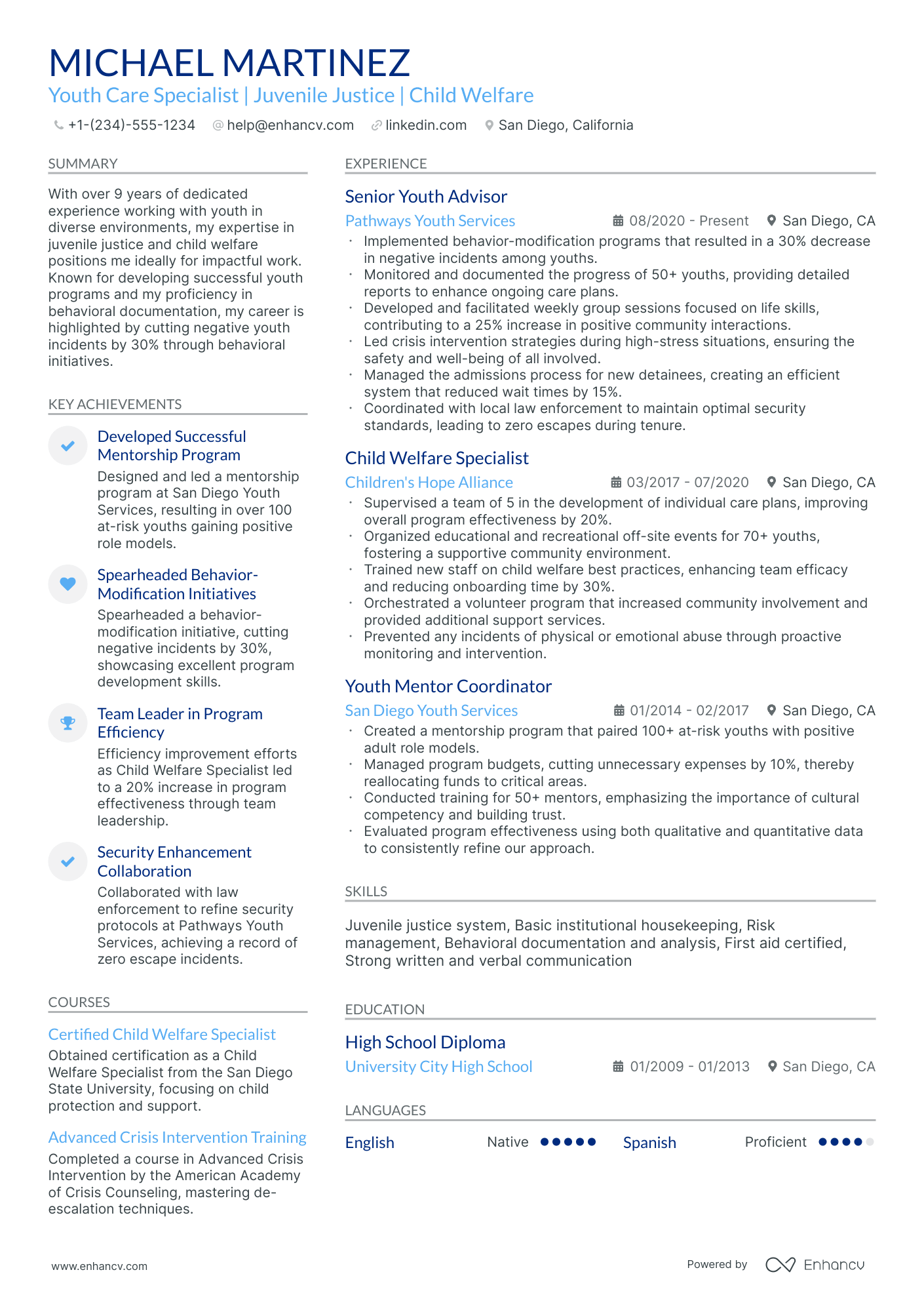
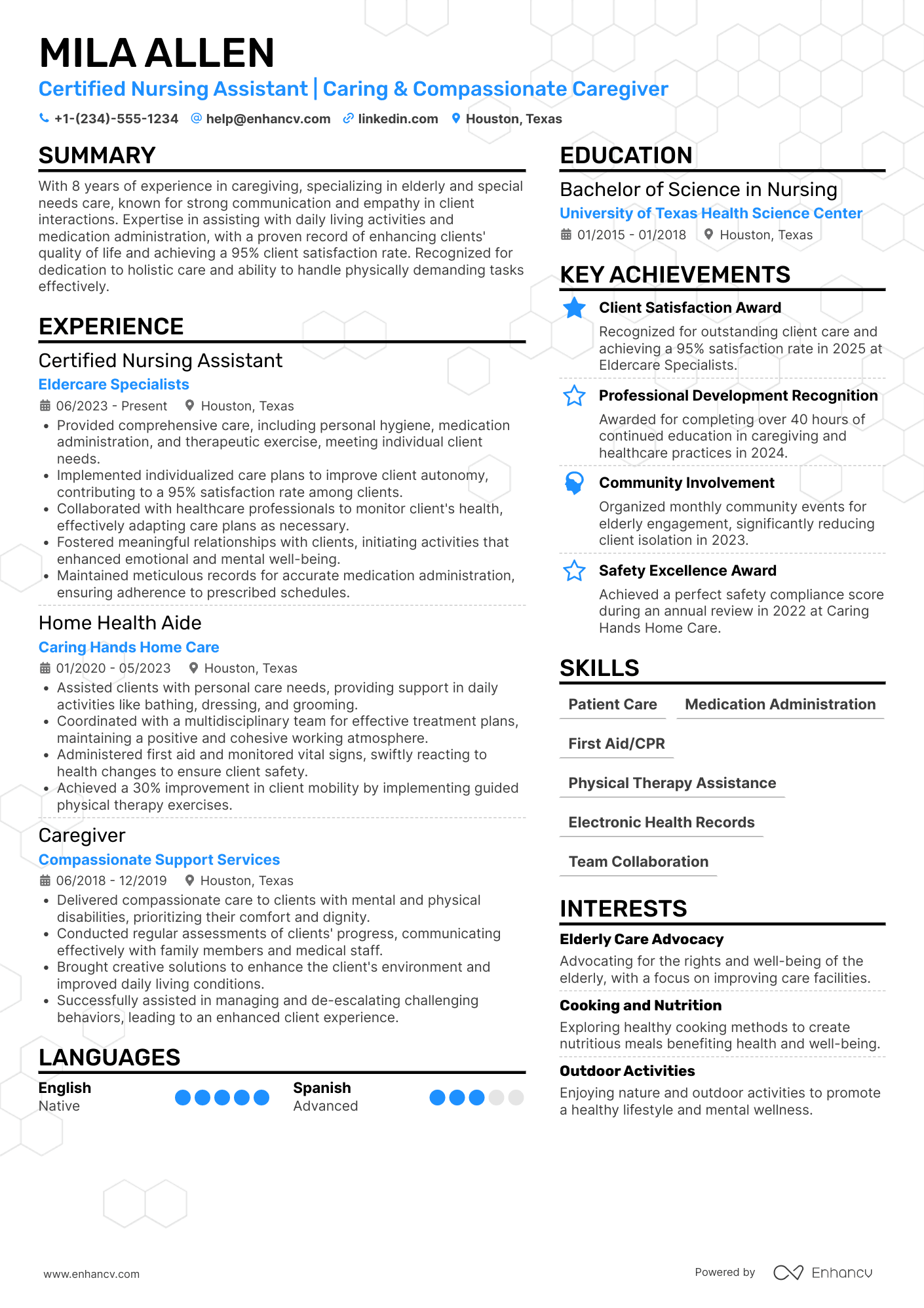
Many care worker resume drafts fail because they read like task lists and bury proof of safe, consistent care. That hurts when an ATS filters fast and recruiters scan in seconds amid heavy competition. If you're unsure where to begin, understanding how to write a resume from the ground up can help you avoid common pitfalls.
A strong resume shows outcomes that make you trustworthy and effective. Highlight reduced falls, improved medication adherence, higher satisfaction scores, faster care plan updates, calmer behaviors, fewer readmissions, or stable coverage across multiple clients. Quantify caseload size, shift volume, and incident-free days.

Key takeaways
- Quantify care outcomes like fall reductions, adherence rates, and satisfaction scores instead of listing duties.
- Use reverse-chronological format for experienced care workers and hybrid format for career changers.
- Tailor each resume to the job posting by mirroring its exact terminology and required tools.
- Aim for two-thirds hard skills and one-third soft skills, all backed by experience bullets.
- Tie every listed skill to a specific outcome, placement, or measurable result.
- Use a cover letter to explain context your resume can't, such as career transitions or team fit.
- Enhancv's Bullet Point Generator helps turn vague duties into measurable, recruiter-ready resume bullets.
Job market snapshot for care workers
We analyzed 194 recent care worker job ads across major US job boards. These numbers help you understand salary landscape, industry demand, role specialization trends at a glance.
What level of experience employers are looking for care workers
| Years of Experience | Percentage found in job ads |
|---|---|
| 1–2 years | 1.5% (3) |
| 3–4 years | 0.5% (1) |
| 10+ years | 14.4% (28) |
| Not specified | 82.5% (160) |
Care worker ads by area of specialization (industry)
| Industry (Area) | Percentage found in job ads |
|---|---|
| Healthcare | 54.1% (105) |
| Finance & Banking | 22.7% (44) |
| Government | 11.9% (23) |
| Education | 10.8% (21) |
Top companies hiring care workers
| Company | Percentage found in job ads |
|---|---|
| Aveanna Healthcare | 19.1% (37) |
| BAYADA Home Health Care | 13.4% (26) |
| State of Massachusetts | 9.3% (18) |
| Addus HomeCare Corporation | 7.7% (15) |
| Charter Schools USA | 6.7% (13) |
| Maine Health | 6.7% (13) |
Role overview stats
These tables show the most common responsibilities and employment types for care worker roles. Use them to align your resume with what employers expect and to understand how the role is structured across the market.
Day-to-day activities and top responsibilities for a care worker
| Responsibility | Percentage found in job ads |
|---|---|
| First aid | 11.3% (22) |
| Cpr | 6.2% (12) |
| Cardiopulmonary resuscitation | 4.1% (8) |
| Crisis intervention | 3.1% (6) |
| Hoyer lift | 3.1% (6) |
| Class d motor vehicle operator's license | 2.6% (5) |
| Reporting | 2.6% (5) |
| Auto insurance | 2.1% (4) |
| Medication administration program | 2.1% (4) |
| Motor vehicle operation | 2.1% (4) |
| Personal care assistance | 2.1% (4) |
| Communication skills | 1.5% (3) |
How to format a care worker resume
Recruiters hiring care workers prioritize compassion-driven experience, relevant certifications, and consistent hands-on client care history. The right resume format ensures these signals surface quickly during both human review and applicant tracking system (ATS) screening.

I have significant experience in this role—which format should I use?
Use a reverse-chronological format to present your care work history in a clear, linear timeline that highlights growth and deepening responsibility. Do:
- Lead with your most recent care role, emphasizing scope such as caseload size, care settings, and types of clients served.
- Feature role-specific skills and certifications—medication administration, person-centered care planning, manual handling, or dementia support—within each position.
- Quantify outcomes wherever possible, including client satisfaction improvements, incident reductions, or efficiency gains in care delivery.
I'm junior or switching into this role—what format works best?
A hybrid format works best, placing a dedicated skills section at the top while still providing a concise work history that shows how you've applied those abilities. Do:
- Position transferable skills—empathy, communication, first aid certification, safeguarding awareness—prominently near the top of your resume.
- Include volunteer placements, caregiving for family members, clinical rotations, or relevant coursework as professional experience entries.
- Connect each action to an outcome so hiring managers see the real-world impact of your abilities.
Why not use a functional resume?
A functional format strips away the timeline of your care experience, making it difficult for recruiters to verify where, when, and how you delivered client care—context that's essential in a role built on trust and accountability. A functional resume may be acceptable if you're entering care work after a career change, returning from an extended gap, or have limited formal employment history—but only if every listed skill is tied to a specific project, placement, or measurable outcome rather than presented in isolation.
Now that you've established a clean, readable layout, it's time to fill it with the right sections that highlight your qualifications as a care worker.
What sections should go on a care worker resume
Recruiters expect a care worker resume to show clear patient care experience, safety awareness, and reliable day-to-day support. Knowing what to put on a resume ensures you include every section that hiring managers look for.
Use this structure for maximum clarity:
- Header
- Summary
- Experience
- Skills
- Projects
- Education
- Certifications
- Optional sections: Volunteering, Languages, Awards
Strong experience bullets should emphasize measurable patient outcomes, caseload scope, safety and compliance results, and improvements in quality of care.
Is your resume good enough?
Drop your resume here or choose a file. PDF & DOCX only. Max 2MB file size.
Once you’ve organized your resume with the right core elements, the next step is to write your care worker resume experience in a way that uses that structure to show your impact.
How to write your care worker resume experience
The work experience section of your care worker resume should highlight the care you've delivered, the methods and tools you've used, and the measurable outcomes you've achieved for the individuals in your care. Hiring managers prioritize demonstrated impact—improved patient well-being, safer care environments, and tangible results—over descriptive task lists that simply recount daily duties.
Each entry should include:
- Job title
- Company and location (or remote)
- Dates of employment (month and year)
Three to five concise bullet points showing what you owned, how you executed, and what outcomes you delivered:
- Ownership scope: the caseloads, care plans, patient populations, residential units, or specialized programs you were directly accountable for as a care worker.
- Execution approach: the caregiving frameworks, assistive technologies, documentation systems, therapeutic techniques, or person-centered methods you used to make informed decisions and deliver consistent, high-quality care.
- Value improved: changes to patient well-being, safety compliance, care plan adherence, recovery timelines, daily living independence, or risk reduction that resulted from your direct involvement.
- Collaboration context: how you coordinated with nurses, physicians, social workers, families, occupational therapists, or external agencies to ensure holistic, uninterrupted care for your clients.
- Impact delivered: outcomes expressed through improvements in patient health, quality-of-life indicators, regulatory compliance, client retention, or organizational performance rather than a summary of tasks performed.
Experience bullet formula
A care worker experience example
✅ Right example - modern, quantified, specific.
Care Worker (Home Health Aide)
Harborview Home Care | Tampa, FL
2022–Present
In-home care provider supporting older adults and post-acute patients across a fifty-client caseload with a focus on safety, dignity, and independence.
- Delivered activities of daily living support for six to eight clients per shift using individualized care plans, improving on-time routine completion by 22% while maintaining zero missed critical tasks in CareSmart Electronic Health Record (electronic health record) documentation.
- Recorded vitals and symptom changes with a Bluetooth blood pressure cuff and pulse oximeter, escalating twenty-three clinically significant findings via SBAR (Situation, Background, Assessment, Recommendation) to the registered nurse and primary care provider, reducing avoidable urgent care visits by 14% over six months.
- Administered medication reminders and tracked adherence in MedReady eMAR (electronic medication administration record), raising documented adherence from 86% to 95% and cutting missed-dose incidents from nine per month to three per month through caregiver-family coordination.
- Implemented fall-prevention and infection-control protocols using gait belts, transfer boards, and Centers for Disease Control and Prevention guidance, lowering fall incidents from four to one per quarter and achieving 98% hand-hygiene compliance in supervisor audits.
- Coordinated weekly updates with social workers, physical therapists, and family stakeholders through secure messaging and shift handoff notes, reducing care-plan clarification calls by 30% and improving client satisfaction scores from 4.4 to 4.7 out of five.
Now that you've seen how a strong experience section looks in practice, let's break down how to customize yours for each specific job posting.
How to tailor your care worker resume experience
Recruiters evaluate care worker resumes through both human review and applicant tracking systems, so tailoring your resume to the job description increases your chances of advancing. Tailoring means adjusting how you present your real skills and accomplishments to match what the employer specifically requests.
Ways to tailor your care worker experience:
- Mirror the exact care plan terminology used in the job posting.
- Match named assistive technologies or mobility equipment you have used.
- Highlight compliance with specific regulations or standards the employer references.
- Reflect the documentation systems or electronic health records they require.
- Emphasize person-centered care frameworks mentioned in the job description.
- Include relevant experience with the populations or conditions they specify.
- Use the same language for safeguarding protocols the posting outlines.
- Align your duties with the collaboration models or team structures described.
Tailoring your experience means framing genuine accomplishments in language that directly reflects what the employer is asking for, not forcing keywords where they don't belong.
Resume tailoring examples for care worker
| Job description excerpt | Untailored | Tailored |
|---|---|---|
| "Assist clients with activities of daily living (ADLs), including bathing, dressing, and mobility support, following individualized care plans." | Helped patients with daily tasks and personal care needs. | Assisted 12+ clients daily with ADLs—bathing, dressing, and mobility transfers—strictly following individualized care plans to maintain safety and dignity. |
| "Monitor and document changes in client health status using electronic health records (EHR) and report concerns to the supervising registered nurse." | Kept track of patient conditions and reported issues to staff. | Monitored vital signs and behavioral changes for a caseload of eight residents, documenting observations in PointClickCare EHR and escalating concerns to the supervising registered nurse within 30 minutes. |
| "Provide compassionate dementia care using person-centered approaches, including redirection techniques and structured daily routines." | Worked with elderly patients who had memory problems. | Delivered person-centered dementia care for a 20-bed memory care unit, using redirection techniques and structured daily routines that reduced agitation incidents by 35% over six months. |
Once you’ve aligned your experience with the role’s priorities, quantify your care worker achievements to show the impact of that work with clear, measurable results.
How to quantify your care worker achievements
Numbers show how your care improved safety, comfort, and consistency. Focus on caseload volume, response time, care plan adherence, incident reductions, and satisfaction scores from residents, families, or supervisors. For more guidance on quantifying achievements, review examples that translate daily duties into compelling metrics.
Quantifying examples for care worker
| Metric | Example |
|---|---|
| Caseload volume | "Supported eight residents per shift across bathing, feeding, mobility, and companionship while meeting all scheduled care tasks." |
| Response time | "Reduced average call-bell response time from nine minutes to five minutes by reorganizing rounds and prioritizing high-risk residents." |
| Care plan compliance | "Maintained ninety-eight percent care plan adherence across daily activities of living documentation using PointClickCare." |
| Risk reduction | "Cut fall incidents by twenty percent over three months by reinforcing transfer protocols and completing hourly safety checks." |
| Satisfaction | "Improved family satisfaction scores from 4.2 to 4.7 out of five by providing weekly updates and coordinating care changes with nurses." |
Turn vague job duties into measurable, recruiter-ready resume bullets in seconds with Enhancv's Bullet Point Generator.
Once you've crafted strong bullet points for your experience section, you'll want to apply the same level of precision to presenting your hard and soft skills throughout your care worker resume.
How to list your hard and soft skills on a care worker resume
A well-organized skills section shows you can deliver safe, consistent care, and recruiters and applicant tracking systems scan it to match you to required competencies, so aim for a balanced mix—about two-thirds hard skills and one-third soft skills—aligned to the job post. care worker roles require a blend of:
- Product strategy and discovery skills
- Data, analytics, and experimentation skills
- Delivery, execution, and go-to-market discipline
- Soft skills
Your skills section should be:
- Scannable (bullet-style grouping).
- Relevant to the job post.
- Backed by proof in experience bullets.
- Updated with current tools.
Place your skills section:
- Above experience if you're junior or switching careers.
- Below experience if you're mid/senior with strong achievements.

Hard skills
- Activities of daily living support
- Safe patient transfers, gait belts
- Vital signs monitoring, pulse oximetry
- Infection control, personal protective equipment
- Medication reminders, medication logs
- Dementia care, behavior redirection
- Wound care, dressing changes
- Catheter care, incontinence care
- Nutrition support, meal preparation
- Documentation, electronic health records (EHR)
- Care plans, charting standards
- Cardiopulmonary resuscitation, first aid
Soft skills
- Clear shift handoffs
- Calm de-escalation under stress
- Patient-centered communication
- Family updates and education
- Prioritizes safety-critical tasks
- Escalates changes in condition
- Follows care plans precisely
- Coordinates with nurses and therapists
- Maintains dignity and privacy
- Handles sensitive information responsibly
- Adapts to changing routines
- Reliable attendance and punctuality
How to show your care worker skills in context
Skills shouldn't live only in a bulleted list on your resume. Explore examples of resume skills across different roles to see how other professionals present their abilities effectively.
They should be demonstrated in:
- Your summary (high-level professional identity)
- Your experience (proof through outcomes)
Here's what this looks like in practice.
Summary example
Compassionate care worker with eight years of experience in dementia and palliative support. Skilled in person-centered care planning, medication administration, and family communication. Improved resident satisfaction scores by 22% through individualized daily wellness routines.
- Reflects senior-level experience clearly
- Names specific care methods
- Includes a measurable outcome
- Highlights empathy and communication
Experience example
Senior Care Worker
Maplewood Elder Services | Portland, OR
March 2019–Present
- Coordinated individualized care plans using PointClickCare for 30+ residents, reducing medication errors by 18% within one year.
- Collaborated with nurses, therapists, and family members to implement mobility programs that decreased fall incidents by 25%.
- Trained 12 new care aides on safeguarding protocols and trauma-informed practices, improving team compliance audit scores by 15%.
- Every bullet includes measurable proof.
- Skills appear naturally within achievements.
Once you’ve demonstrated your care worker abilities through concrete examples, the next step is applying that same approach to writing a care worker resume with no experience.
How do I write a care worker resume with no experience
Even without full-time experience, you can demonstrate readiness through:
- Family caregiving for older relatives
- Volunteer shifts in assisted living
- Home health aide training modules
- First aid and CPR certification
- Patient transport volunteer program
- Childcare with hygiene routines
- Community meal delivery route
- Hospital visitor or companion role
If you're starting from scratch, this guide on building a resume without work experience walks you through every step.
Focus on:
- Measurable care tasks completed
- Safety training and certifications
- Documentation, logs, and accuracy
- Schedule reliability and shift coverage
Resume format tip for entry-level care worker
Use a combination resume format to highlight training, certifications, and relevant projects first, then list any work history. It keeps attention on care worker readiness, not missing job titles. Do:
- Add a "Relevant Experience" section for caregiving, volunteering, and training.
- List care tasks you performed: bathing support, meal prep, mobility assistance, and medication reminders.
- Include certifications with dates: First Aid and CPR, dementia training, and infection control.
- Use numbers for scope: hours, visits, clients, and on-time rate.
- Mention documentation tools used: care logs, checklists, and incident reports.
- Volunteered in assisted living, completed twelve companion visits, recorded care logs with zero missed entries, and followed infection control checklist each shift.
Even without hands-on experience, your education section can demonstrate the foundational knowledge and relevant training that qualify you for a care worker role.
How to list your education on a care worker resume
Your education section helps hiring teams confirm you have the foundational knowledge needed for safe, effective caregiving. It validates your training in health, welfare, and support practices.
Include:
- Degree name
- Institution
- Location
- Graduation year
- Relevant coursework (for juniors or entry-level candidates)
- Honors & GPA (if 3.5 or higher)
Skip month and day details—list the graduation year only.
Here's a strong education entry tailored to a care worker resume.
Example education entry
Associate of Applied Science in Health and Human Services
Brookdale Community College, Lincroft, NJ
Graduated 2021
GPA: 3.7/4.0
- Relevant coursework: Introduction to Gerontology, Personal Care Fundamentals, Mental Health First Aid, and Nutrition for Caregivers
- Honors: Dean's List, 2020–2021
How to list your certifications on a care worker resume
Certifications on a resume show a care worker's commitment to learning, proficiency with essential tools, and alignment with current care standards. They also help hiring teams confirm job-ready skills fast.
Include:
- Certificate name
- Issuing organization
- Year
- Optional: credential ID or URL
- List certifications below education when they're older, less relevant to the role, or secondary to your formal training.
- List certifications above education when they're recent, role-critical, or required for the care worker position you want.
Best certifications for your care worker resume
Certified Nursing Assistant (CNA) Home Health Aide (HHA) Certification CPR and AED Certification Basic Life Support (BLS) Certification First Aid Certification Medication Aide Certification Dementia Care Certification
Once you’ve documented your credentials and training accurately, you can write your care worker resume summary to highlight those qualifications upfront.
How to write your care worker resume summary
Your resume summary is the first thing a recruiter reads. A strong one instantly signals you have the compassion, skills, and hands-on experience the role demands.
Keep it to three to four lines, with:
- Your title and total years of care experience.
- The care setting or population you specialize in, such as elderly, disability, or mental health.
- Core skills like personal care, medication administration, or mobility assistance.
- One or two measurable achievements, such as client satisfaction scores or caseload size.
- A soft skill tied to a real outcome, like communication that reduced incident reports.

PRO TIP
At this level, emphasize practical skills, relevant certifications, and any early wins that show real impact. Highlight specific care settings you've worked in and populations you've supported. Avoid vague phrases like "passionate and dedicated" or "looking for an opportunity to grow." Replace them with concrete details recruiters can verify.
Example summary for a care worker
Compassionate care worker with two years of experience supporting elderly residents in assisted living facilities. Skilled in personal care, medication prompts, and mobility support. Improved resident satisfaction scores by 18% through individualized daily care routines.
Optimize your resume summary and objective for ATS
Drop your resume here or choose a file.
PDF & DOCX only. Max 2MB file size.
Now that you've crafted a summary that highlights your caregiving strengths, let's make sure your resume header presents your contact details clearly so employers can actually reach you.
What to include in a care worker resume header
A resume header lists your key contact and professional details, helping care worker applications stay visible, credible, and easy to screen quickly.
Essential resume header elements
- Full name
- Tailored job title and headline
- Location
- Phone number
- Professional email
- GitHub link
- Portfolio link
A LinkedIn link helps recruiters verify your experience fast and supports consistent screening across applicants.
Do not include a photo on a care worker resume unless the role is explicitly front-facing or appearance-dependent.
Put the most relevant care worker title first, and keep your contact details consistent across your resume and profiles.
Example
Care worker resume header
Jordan Reyes
Care worker | Home health aide focused on safe mobility support and daily living assistance
Phoenix, AZ
(602) 555-01XX
jordan.reyes@enhancv.com
github.com/jordanreyes
yourwebsite.com
linkedin.com/in/jordanreyes
Once your contact details and role identifiers are set at the top, add relevant additional sections to strengthen your care worker resume and support your candidacy.
Additional sections for care worker resumes
When your core qualifications match other applicants, additional sections help you stand out with role-specific credibility and personal strengths. For example, listing language skills can be especially valuable if you serve diverse client populations.
- Languages
- Certifications and training
- Volunteer experience
- Hobbies and interests
- Awards and recognition
- Professional affiliations
- References
Once you've strengthened your resume with relevant extra sections, pairing it with a well-crafted cover letter can further set your application apart.
Do care worker resumes need a cover letter
A cover letter isn't required for every care worker role, but it helps when the role is competitive or the employer expects one. If you're wondering what a cover letter is and when it matters, it can make a difference when your resume doesn't show fit, context, or a clear match.
Use a cover letter to add details your resume can't:
- Explain role and team fit: Match your experience to the client group, shift pattern, setting, and care approach the employer uses.
- Highlight one or two relevant projects or outcomes: Share a short example, such as reducing falls, improving medication adherence, or supporting a safe discharge plan.
- Show understanding of the product, users, or business context: Reference the care model, documentation tools, compliance needs, and what quality care looks like in that setting.
- Address career transitions or non-obvious experience: Connect transferable skills from other work to care worker tasks, such as de-escalation, hygiene support, or accurate reporting.
Drop your resume here or choose a file.
PDF & DOCX only. Max 2MB file size.
Even if you decide a cover letter won’t add value for your care worker application, you can strengthen your resume faster and more consistently by using AI to improve it.
Using AI to improve your care worker resume
AI can sharpen your resume's clarity, structure, and impact. It helps you find stronger phrasing and tighten loose sections. But overuse strips authenticity fast. Once your content feels clear and aligned with the care worker role, step away from AI. For practical starting points, explore these ChatGPT resume writing prompts tailored to different resume sections.
Here are 10 practical prompts you can copy and paste to strengthen specific sections of your care worker resume:
- Strengthen your summary. "Rewrite my care worker resume summary to highlight my strongest caregiving skills and years of hands-on experience in under four sentences."
- Quantify your impact. "Add measurable outcomes to these care worker experience bullets, such as number of clients served or response times improved."
- Tighten bullet points. "Shorten each of my care worker experience bullets to one concise line that leads with a strong action verb."
- Align with job posts. "Compare my care worker resume skills section against this job description and identify missing keywords I should add."
- Improve skills relevance. "Remove generic skills from my care worker resume and suggest role-specific alternatives like patient mobility assistance or medication tracking."
- Refine certifications. "Reorder and format my care worker certifications section so the most relevant credentials for this posting appear first."
- Clarify education details. "Rewrite my care worker education section to emphasize coursework and training directly related to patient care."
- Showcase volunteer work. "Turn my care worker volunteer experience into achievement-focused bullets that demonstrate transferable caregiving skills."
- Fix inconsistent formatting. "Standardize the tense, punctuation, and structure across all bullet points in my care worker resume experience section."
- Eliminate filler language. "Remove vague phrases like 'responsible for' and 'helped with' from my care worker resume and replace them with direct action statements."
Stop using AI once your resume sounds accurate, specific, and true to your real experience. AI should never invent experience or inflate claims—if it didn't happen, it doesn't belong here.
Conclusion
A strong care worker resume shows measurable outcomes, role-specific skills, and a clear structure. Use numbers to prove impact, highlight core care worker duties, and keep sections easy to scan.
This approach matches what employers need in today’s and near-future hiring market. It helps hiring teams see your readiness fast and trust you can deliver safe, reliable care.