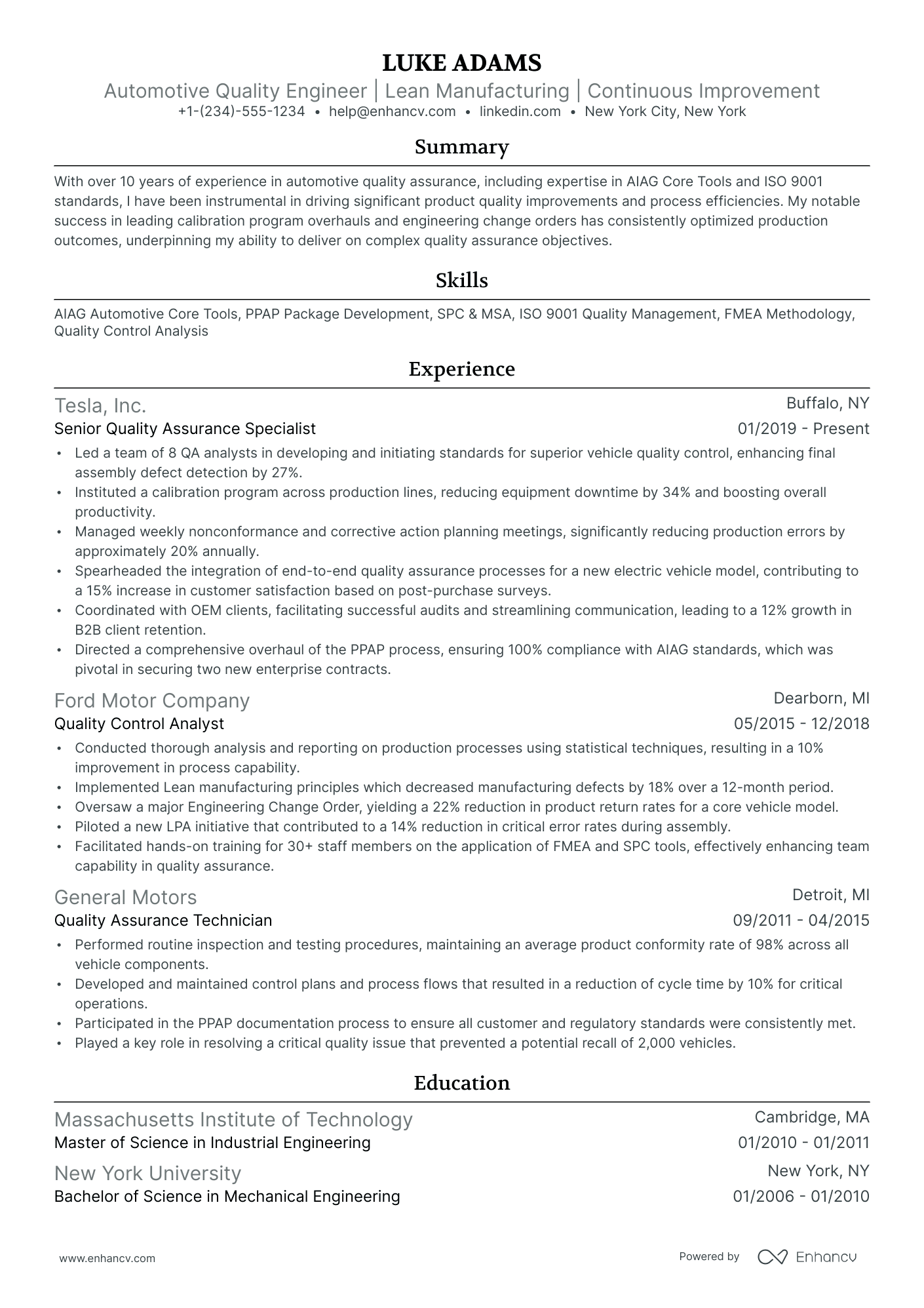
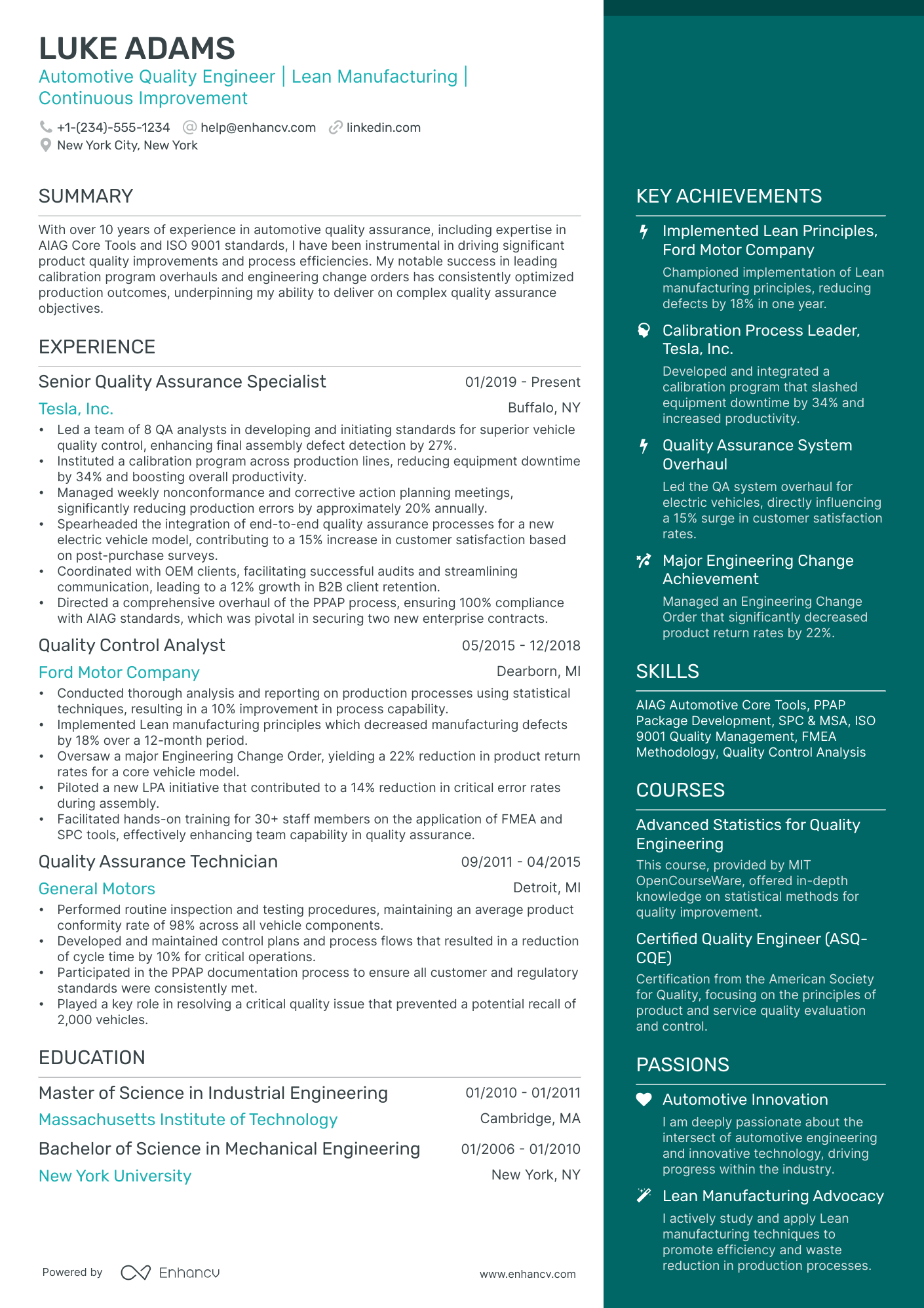
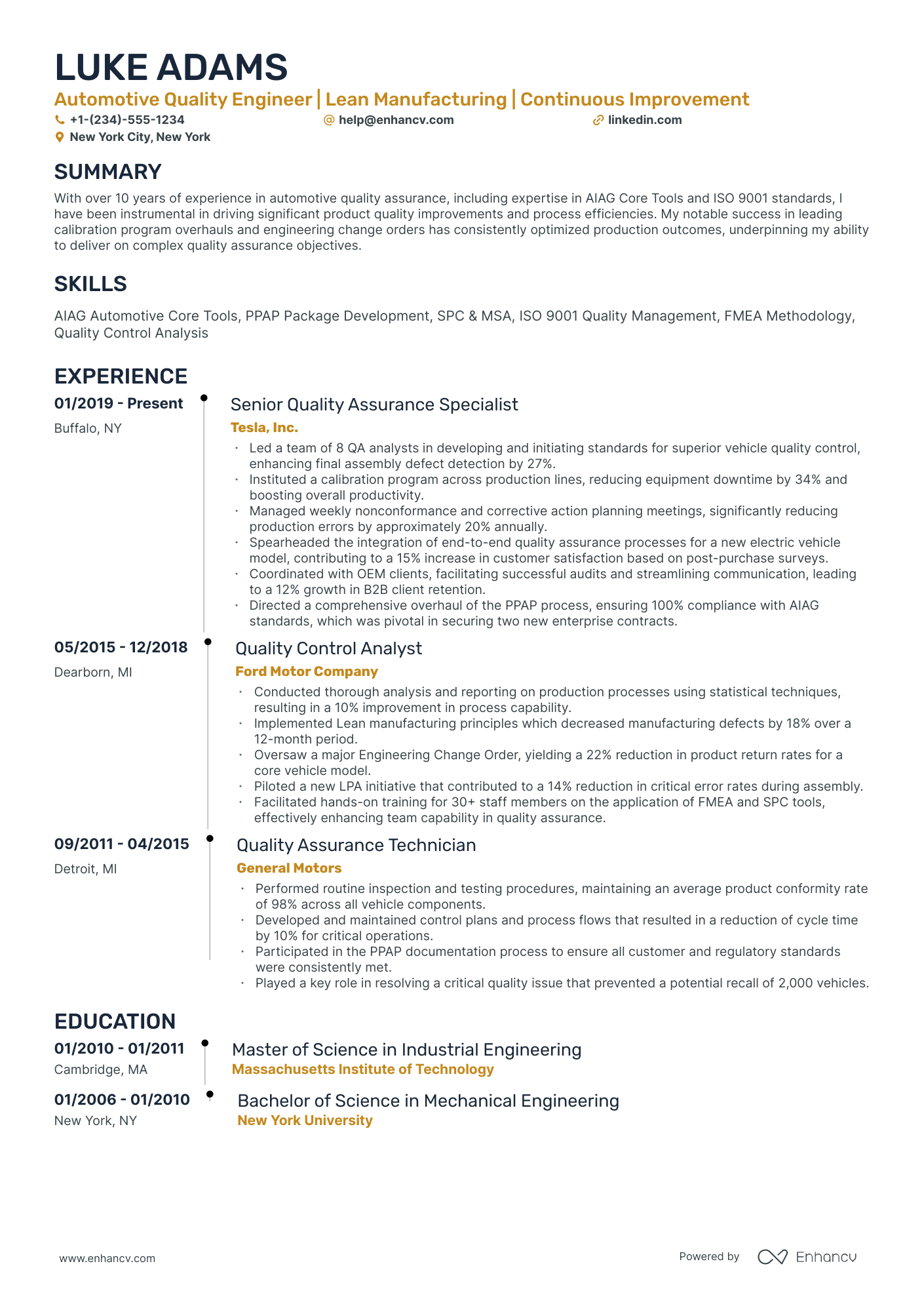
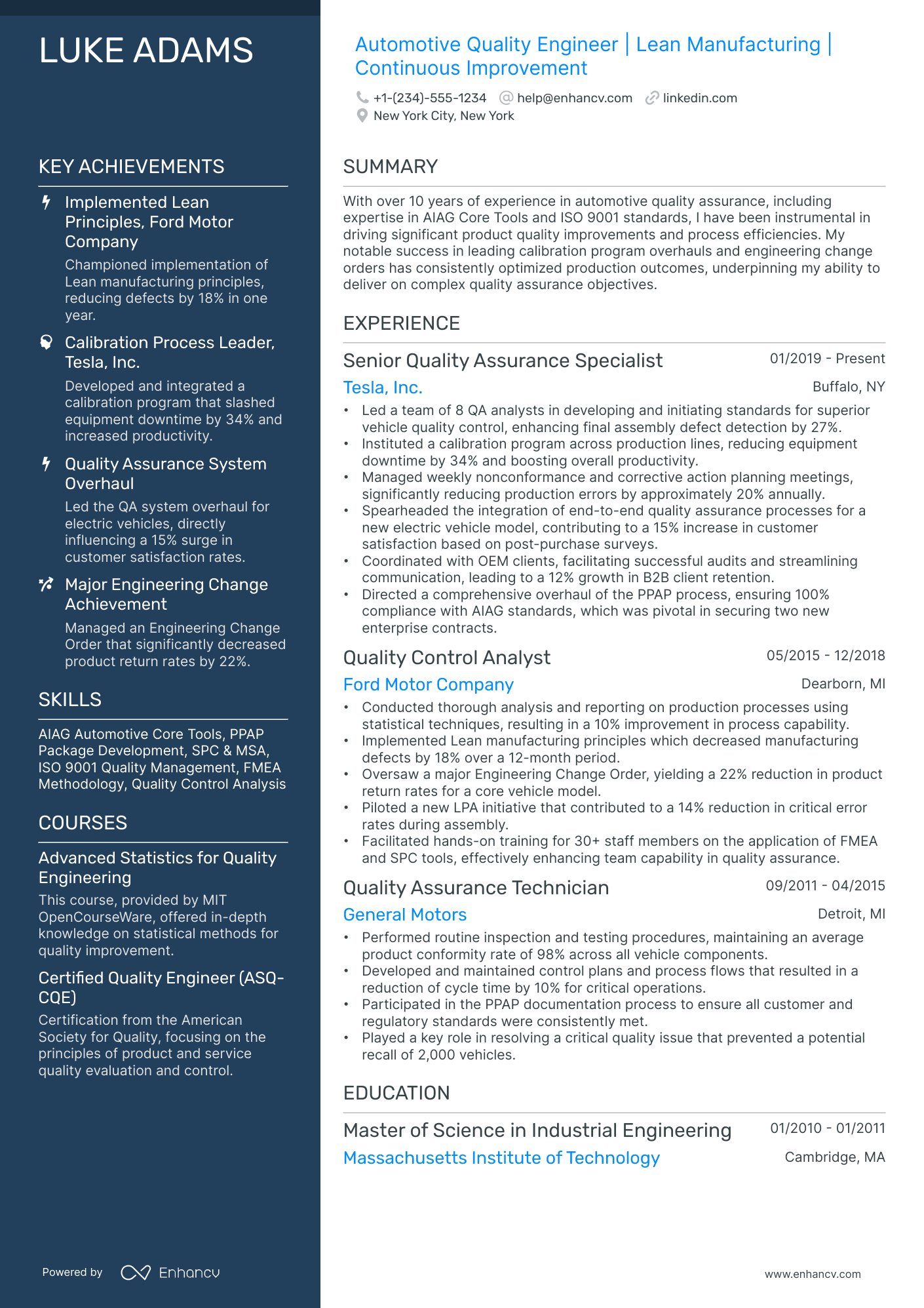
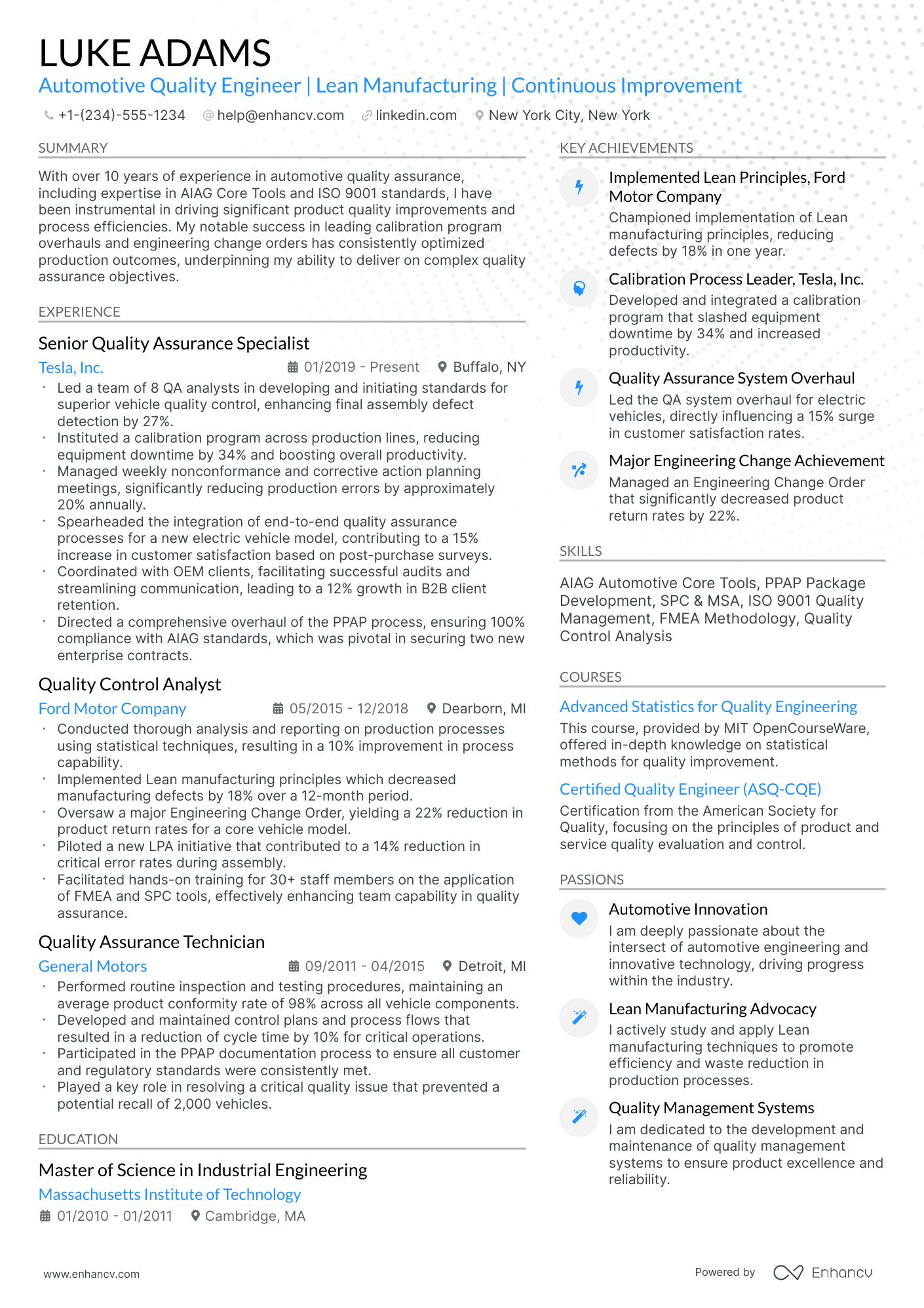
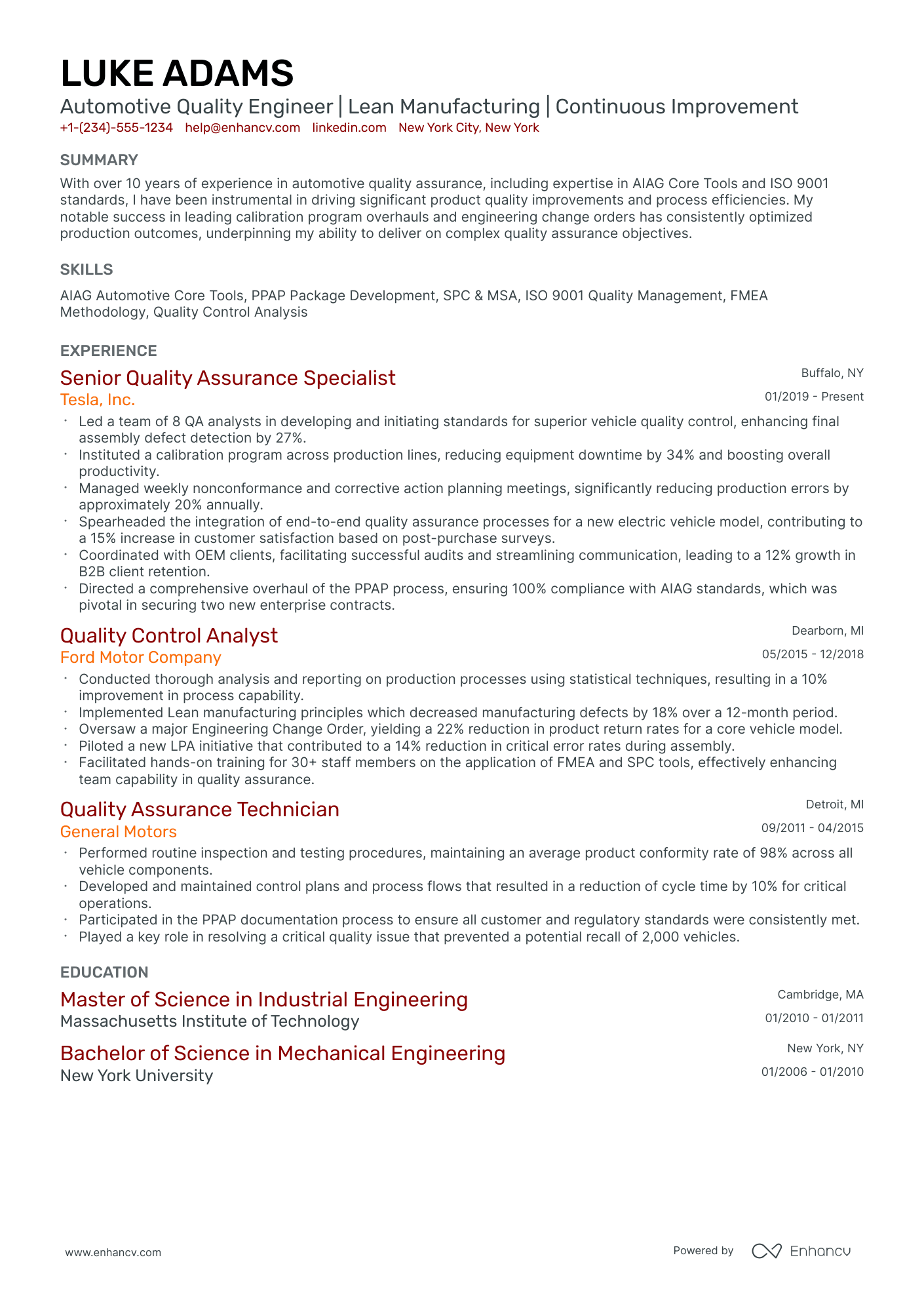
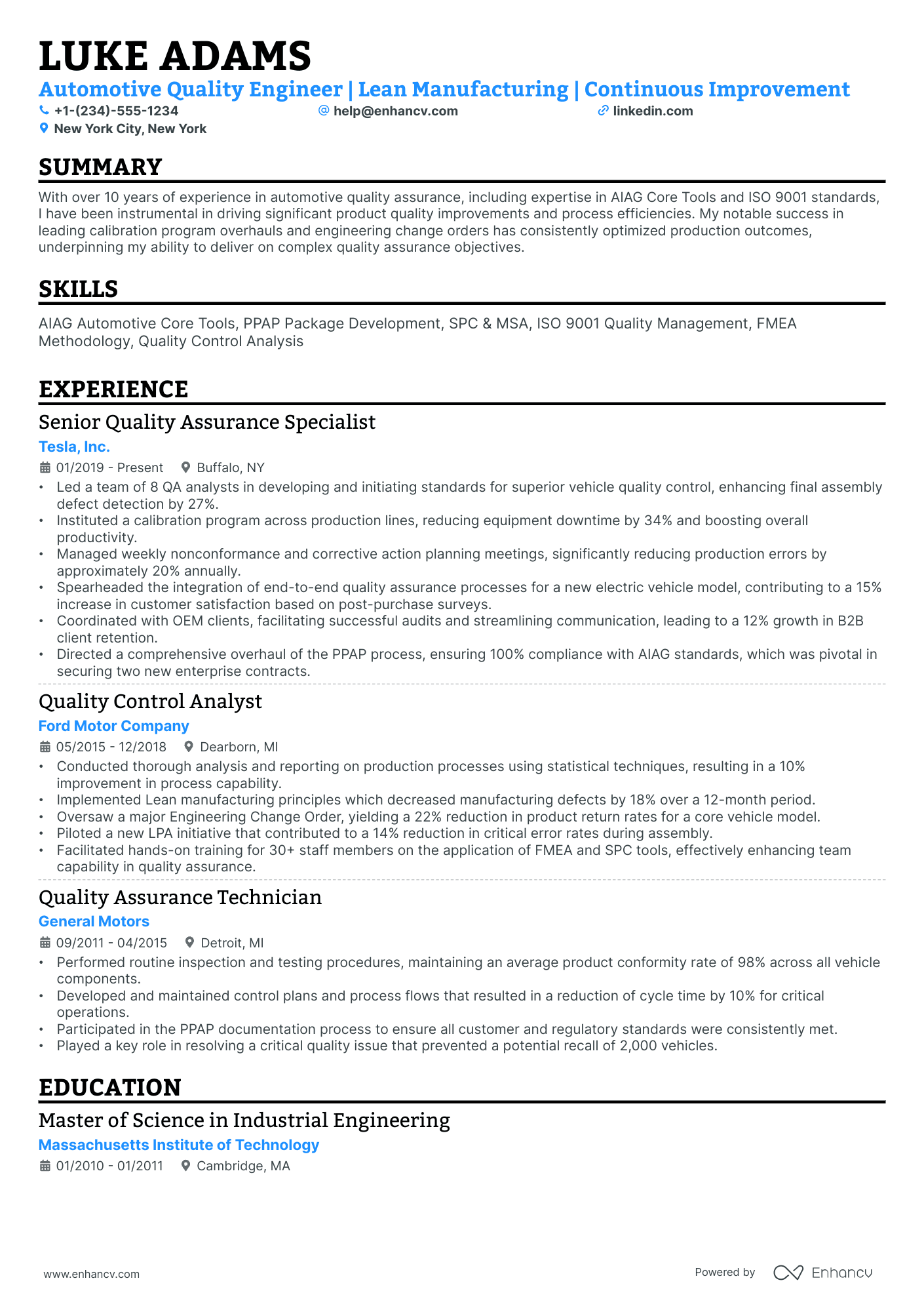
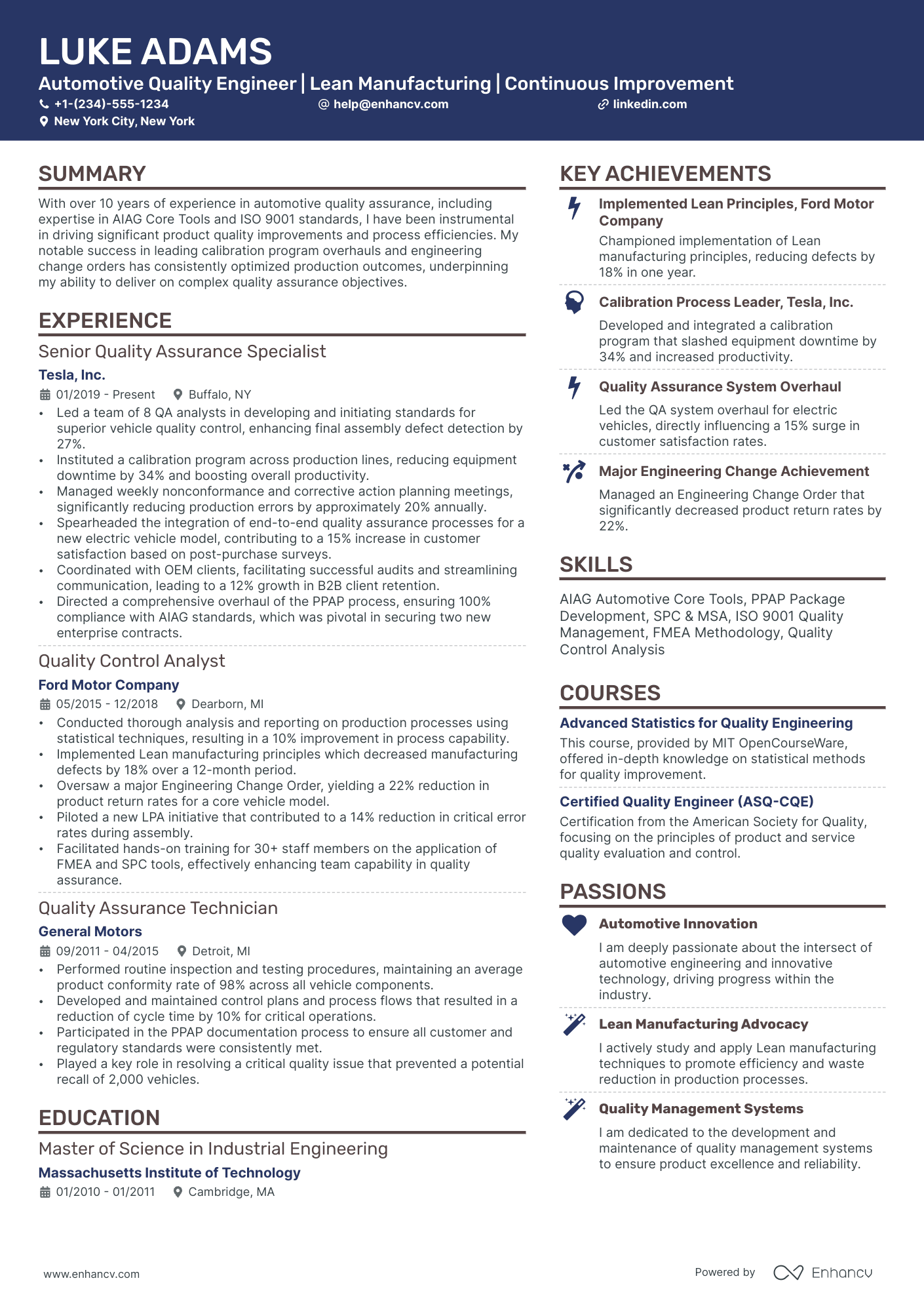
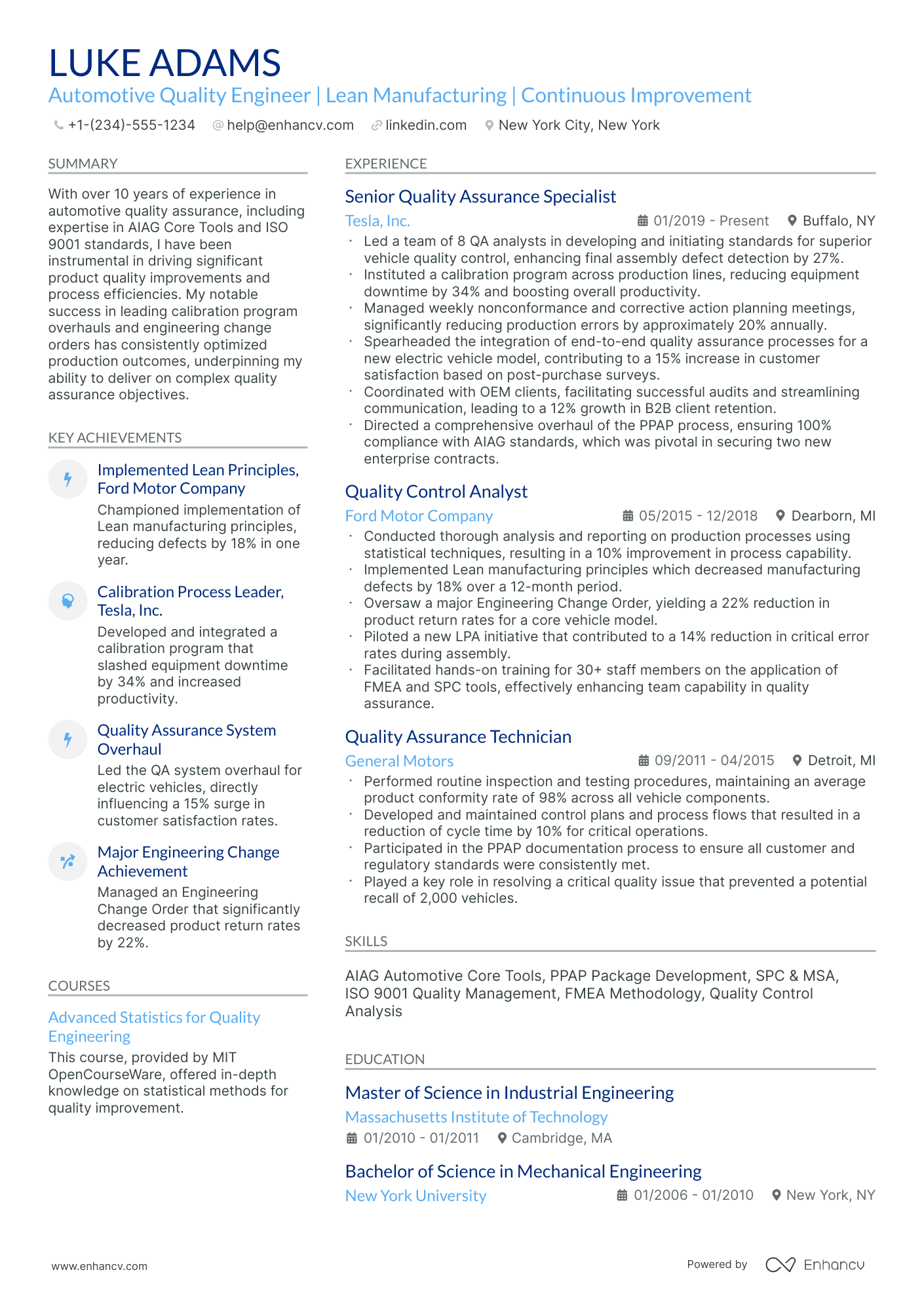
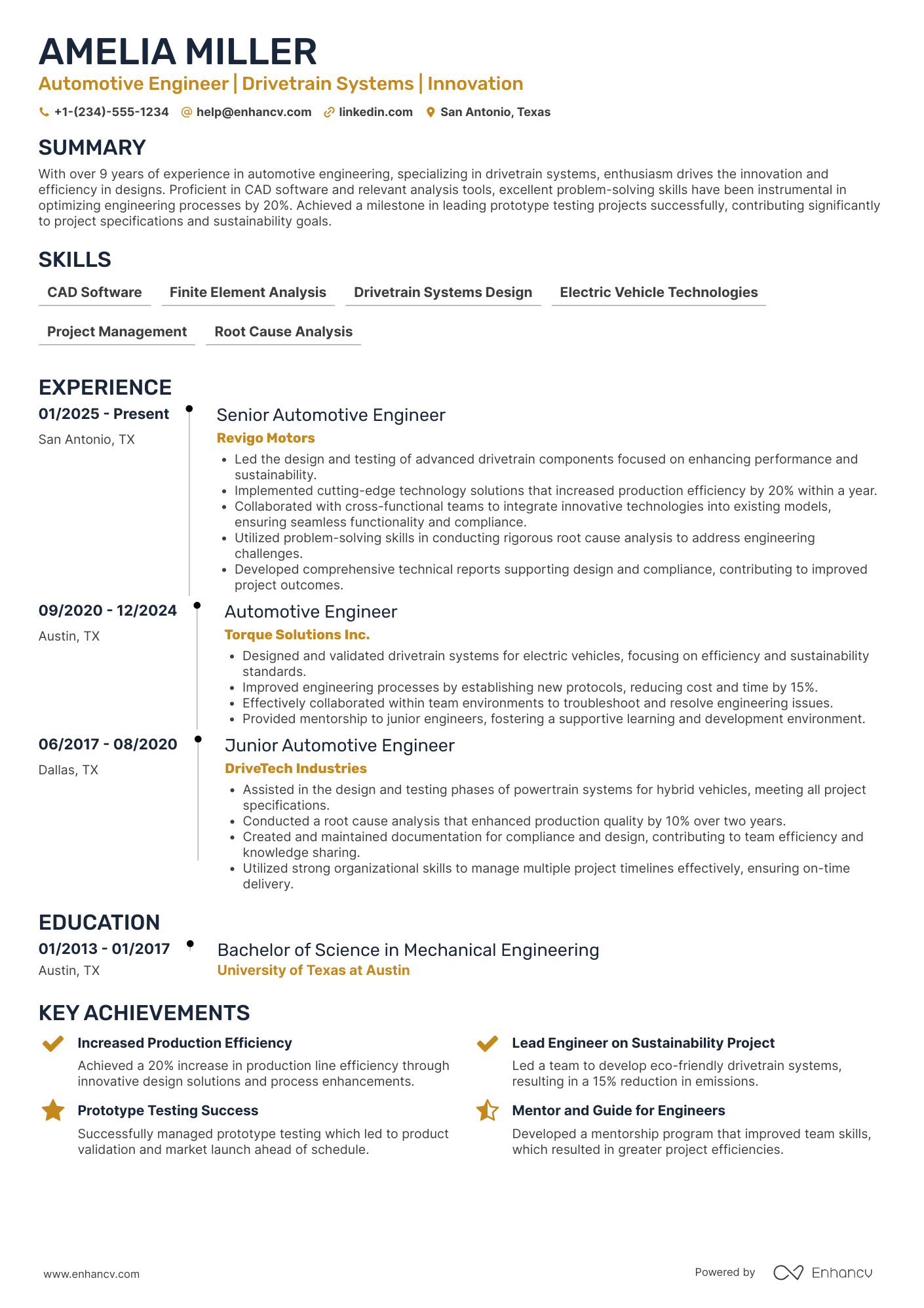
Many automotive engineering resume drafts fail because they list tools and tasks but don't connect work to measurable vehicle, manufacturing, or compliance outcomes. That gap gets filtered by ATS screening and lost in fast recruiter scans amid intense competition.
A strong resume shows what you improved and delivered, so you stand out quickly. Learning how to make your resume stand out starts with quantifying cost reductions, warranty claim drops, cycle-time cuts, defect rate improvements, validation pass rates, and on-time launch impact across platforms and suppliers.

Key takeaways
- Quantify engineering outcomes like cost savings, defect reductions, and cycle-time improvements in every bullet.
- Tailor your experience section to mirror the exact tools and standards each job posting names.
- Use reverse-chronological format for experienced engineers and hybrid format for career switchers.
- Anchor every listed skill to a specific project, result, or measurable engineering outcome.
- Lead your summary with your specialty domain, core tools, and one standout achievement.
- Enhancv's Bullet Point Generator helps turn routine engineering tasks into measurable, recruiter-ready statements.
- Stop using AI once your resume accurately reflects real experience—never fabricate or inflate claims.
How to format a automotive engineering resume
Recruiters evaluating automotive engineering resumes prioritize hands-on technical depth—powertrain design, vehicle dynamics, ADAS integration, CAE simulation—alongside evidence of cross-functional collaboration and measurable product outcomes. A clean, well-structured resume format ensures these signals surface quickly during both ATS parsing and the initial six-to-ten-second recruiter scan.

I have significant experience in this role—which format should I use?
Use a reverse-chronological format to present your automotive engineering career in a clear, progression-driven timeline. Do:
- Lead each role entry with your scope of ownership: vehicle subsystems managed, team size, program phases (concept through SOP), and OEM or Tier 1 partnerships.
- Highlight domain-specific tools and competencies—CATIA, MATLAB/Simulink, DFMEA, GD&T, ISO 26262 compliance, or emissions calibration—within the context of each position rather than in an isolated skills block.
- Quantify engineering outcomes tied to cost, quality, timing, or performance targets.
I'm junior or switching into this role—what format works best?
A hybrid format works best because it lets you lead with relevant technical skills while still showing a concise work history that provides context. Do:
- Place a focused skills section near the top featuring core automotive competencies—FEA, CFD, CAN bus protocols, or emissions testing—so ATS software and recruiters register your qualifications immediately.
- Include academic projects, SAE competition entries (Formula SAE, Baja SAE), internships, or adjacent engineering roles that demonstrate hands-on vehicle-level problem solving.
- Connect every listed skill or project to a concrete action and a measurable or observable result.
Why not use a functional resume?
A functional format strips away the timeline and context that hiring managers need to verify where, when, and how you applied your automotive engineering skills, making it harder to assess your readiness for the role. Functional formats can raise red flags with recruiters who expect to see progressive responsibility or consistent technical application, so avoid this structure unless none of the alternatives can adequately represent your background.
- Edge-case exception: A functional resume may be acceptable if you're transitioning from a related field (aerospace, heavy equipment, motorsport) or returning after a significant career gap—but only if every listed skill is anchored to a specific project, prototype, or measurable engineering outcome rather than presented as a standalone claim.
Once your layout and formatting choices are in place, the next step is determining which sections to include so each one serves a clear purpose on your resume.
What sections should go on a automotive engineering resume
Recruiters expect to quickly see your automotive engineering scope, core technical strengths, and measurable results across vehicle systems and programs. Knowing what to put on a resume helps you prioritize the right content. Use this structure for maximum clarity:
- Header
- Summary
- Experience
- Skills
- Projects
- Education
- Certifications
- Optional sections: Awards, Publications, Leadership
Strong experience bullets should emphasize engineering impact, quantified outcomes, program scope, and results across design, validation, and production.
Is your resume good enough?
Drop your resume here or choose a file. PDF & DOCX only. Max 2MB file size.
Now that you’ve organized the key resume components, focus on writing your automotive engineering experience section to show how your work supports those elements.
How to write your automotive engineering resume experience
The work experience section is where you prove you've shipped real automotive systems—from powertrain calibration to vehicle dynamics validation—using the tools, standards, and methods hiring managers expect to see. Prioritize demonstrated impact through measurable outcomes over descriptive task lists, because recruiters want evidence that your engineering work moved production metrics, resolved failure modes, or advanced a vehicle program.
Each entry should include:
- Job title
- Company and location (or remote)
- Dates of employment (month and year)
Three to five concise bullet points showing what you owned, how you executed, and what outcomes you delivered:
- Ownership scope: the vehicle systems, subsystems, component platforms, or program milestones you were directly accountable for—whether that covers chassis architecture, ADAS modules, emission control systems, or full vehicle integration across model lines.
- Execution approach: the engineering tools, simulation software, testing protocols, or design methodologies you relied on to make technical decisions and deliver work, such as CAE analysis packages, DFMEA processes, GD&T applications, or hardware-in-the-loop validation frameworks.
- Value improved: the specific gains you drove in durability, NVH performance, fuel efficiency, thermal management, crash safety ratings, manufacturing yield, or regulatory compliance tied directly to automotive engineering deliverables.
- Collaboration context: how you partnered with cross-functional teams—supply chain engineers, OEM program managers, manufacturing plants, tier-one suppliers, or homologation authorities—to align design intent with production feasibility and launch timelines.
- Impact delivered: the tangible outcomes your work produced, expressed through production-readiness milestones, weight or cost reductions, warranty claim trends, certification achievements, or accelerated development cycles rather than a list of daily activities.
Experience bullet formula
A automotive engineering experience example
✅ Right example - modern, quantified, specific.
Vehicle Dynamics Engineer
Apex Mobility | Detroit, MI
2022–Present
Supported development of a mid-size electric sport utility vehicle platform from prototype through pre-production in a fast-paced original equipment manufacturer environment.
- Led Model-in-the-Loop and Hardware-in-the-Loop validation in MATLAB/Simulink and dSPACE, reducing stability control calibration iterations by 28% and cutting test bench time by 120 hours per program phase.
- Tuned electronic stability control and torque vectoring using CANape and INCA with Controller Area Network (CAN) logging, improving wet-surface lateral stability by 14% and reducing intervention harshness complaints by 22% in customer clinics.
- Built a multi-body dynamics model in CarSim and validated it against proving-ground data in Python, increasing correlation accuracy from 0.82 to 0.93 and accelerating ride and handling sign-off by three weeks.
- Partnered with braking, powertrain, and software teams to implement ISO 26262 safety requirements and fault-injection tests, lowering critical Diagnostic Trouble Code (DTC) escapes by 35% prior to start of production.
- Executed Design of Experiments (DOE) for damper and bushing selections with suppliers and test engineering, reducing steering wheel vibration by 18% and saving $210K annually through optimized component specs.
Now that you've seen how a strong experience section looks in practice, let's break down how to tailor each element to match the specific automotive engineering role you're targeting.
How to tailor your automotive engineering resume experience
Recruiters evaluate your automotive engineering resume through both applicant tracking systems and manual review. Tailoring your resume to the job description ensures your qualifications connect directly with what the hiring team needs.
Ways to tailor your automotive engineering experience:
- Match CAD platforms and simulation tools listed in the job posting.
- Mirror the exact powertrain or vehicle system terminology used.
- Align your testing methods with standards like ISO 26262 referenced.
- Reflect specific ADAS or electrification experience the role requires.
- Use the same quality frameworks such as APQP or DFMEA mentioned.
- Highlight cross-functional collaboration with manufacturing or supplier teams noted.
- Emphasize emissions compliance or safety validation the posting prioritizes.
- Include NVH or thermal management expertise when the description specifies it.
Tailoring means aligning your real accomplishments with the role's stated requirements, not forcing disconnected keywords into your experience bullets.
Resume tailoring examples for automotive engineering
| Job description excerpt | Untailored | Tailored |
|---|---|---|
| "Design and validate powertrain mounting systems using CATIA V5 and FEA tools to meet NVH targets for electric vehicle platforms." | Worked on vehicle component design and helped with testing activities. | Designed and validated powertrain mounting systems in CATIA V5, running FEA simulations that reduced NVH levels by 12% across three electric vehicle platforms. |
| "Lead DFMEA sessions for chassis subsystems and drive corrective actions to meet IATF 16949 quality standards." | Participated in quality meetings and helped identify issues in vehicle systems. | Led DFMEA sessions for front and rear chassis subsystems, identifying 34 potential failure modes and driving corrective actions that maintained full IATF 16949 compliance over two production cycles. |
| "Develop and release stamped sheet metal components for body-in-white structures using GD&T principles and manage suppliers through PPAP." | Helped with part design and worked with outside vendors on manufacturing. | Developed and released 15+ stamped sheet metal components for body-in-white assemblies, applying GD&T per ASME Y14.5 and managing four Tier 1 suppliers through PPAP to achieve first-time approval on 92% of submissions. |
Once you’ve aligned your experience with the role’s priorities, the next step is to quantify your automotive engineering achievements so hiring teams can see the measurable impact behind that fit.
How to quantify your automotive engineering achievements
Quantifying shows how your work improved vehicle performance, quality, cost, and delivery. Focus on measurable outcomes like defect rates, test pass rates, weight or cost reductions, cycle time, and reliability under real duty cycles. Using numbers on your resume makes your contributions concrete and easy for recruiters to evaluate.
Quantifying examples for automotive engineering
| Metric | Example |
|---|---|
| Performance gain | "Improved engine torque by 6% and reduced fuel consumption by 3% by calibrating ECU maps in MATLAB and INCA across five drive cycles." |
| Reliability | "Cut warranty return rate from 1.8% to 1.1% by redesigning a connector seal, validating with 500-hour thermal cycling and IP67 ingress tests." |
| Quality defects | "Reduced end-of-line diagnostic failures by 22% by tightening CAN signal integrity limits and adding automated DBC checks in Python." |
| Cost reduction | "Saved $420K annually by consolidating three brackets into one stamped part, reducing mass by 0.6 kg and eliminating two fasteners per vehicle." |
| Delivery speed | "Shortened validation timeline by four weeks by automating HIL regression in Jenkins, increasing nightly test coverage from 120 to 380 cases." |
Turn your everyday tasks into measurable, recruiter-ready resume bullets in seconds with Enhancv's Bullet Point Generator.
Once you've crafted strong bullet points that highlight your accomplishments, the next step is ensuring your resume also showcases the right mix of hard and soft skills that automotive engineering employers are looking for.
How to list your hard and soft skills on a automotive engineering resume
Your skills section shows you can design, validate, and launch vehicle systems, and recruiters and ATS scan it to confirm keyword match and role fit—aim for a mix of hard skills (tools and methods) and soft skills (execution behaviors).
automotive engineering roles require a blend of:
- Product strategy and discovery skills.
- Data, analytics, and experimentation skills.
- Delivery, execution, and go-to-market discipline.
- Soft skills.
Your skills section should be:
- Scannable (bullet-style grouping).
- Relevant to the job post.
- Backed by proof in experience bullets.
- Updated with current tools.
Place your skills section:
- Above experience if you're junior or switching careers.
- Below experience if you're mid/senior with strong achievements.

Hard skills
- CATIA, Siemens NX
- SolidWorks, Creo Parametric
- GD&T, tolerance stack-up
- DFMEA, PFMEA
- DVP&R, validation planning
- MATLAB, Simulink
- CAN, LIN, UDS (ISO 14229)
- AUTOSAR, ISO 26262
- CFD, FEA
- Model-based systems engineering (SysML)
- Python, SQL
- DOE, regression analysis
Soft skills
- Translate requirements into specs
- Run cross-functional design reviews
- Make trade-off decisions fast
- Write testable acceptance criteria
- Communicate risks and mitigations
- Drive root-cause problem solving
- Coordinate suppliers and internal teams
- Manage change control and impact
- Present data-driven recommendations
- Own timelines and deliverables
- Resolve integration and interface issues
- Document decisions and rationale
How to show your automotive engineering skills in context
Skills shouldn't live only in a bulleted list on your resume. Explore examples of resume skills shown in context to see how top candidates integrate them throughout their documents.
They should be demonstrated in:
- Your summary (high-level professional identity)
- Your experience (proof through outcomes)
Here's how that looks in practice.
Summary example
Senior automotive engineer with 12 years in powertrain calibration and vehicle dynamics. Skilled in MATLAB, IATF 16949, and cross-functional program management. Led a chassis integration initiative that reduced warranty claims by 31% across two model years.
- Reflects senior-level expertise clearly
- Names industry-relevant tools and standards
- Includes a specific measurable outcome
- Signals cross-functional leadership ability
Experience example
Senior Powertrain Calibration Engineer
Rivian Automotive | Normal, IL
March 2019–August 2024
- Optimized engine calibration parameters using MATLAB and INCA, improving fuel efficiency by 8% across three vehicle platforms.
- Collaborated with emissions and NVH teams to achieve EPA Tier 3 compliance, eliminating two planned validation cycles.
- Led root-cause analysis for drivability concerns using CAN bus diagnostics, cutting field-reported issues by 24% within one model year.
- Every bullet contains measurable proof.
- Skills appear naturally within real achievements.
Once you’ve demonstrated your automotive engineering abilities through specific projects and measurable outcomes, the next step is translating that approach into a resume when you have no formal experience.
How do I write a automotive engineering resume with no experience
Even without full-time experience, you can demonstrate readiness through academic work and hands-on projects. Our guide on writing a resume without work experience covers this approach in detail. Consider showcasing:
- Formula SAE vehicle subsystem work
- Senior capstone automotive engineering project
- Powertrain or chassis lab reports
- CAD assemblies and detailed drawings
- MATLAB simulations and data analysis
- Internship-style research assistant role
- OEM-sponsored design challenge results
- Personal vehicle diagnostics and repairs
Focus on:
- Quantified test results and metrics
- CAD, simulation, and analysis outputs
- Manufacturing readiness and tolerances
- Requirements, traceability, and documentation
Resume format tip for entry-level automotive engineering
Use a hybrid resume format to lead with projects and skills, since it highlights automotive engineering work when your job history is limited. Do:
- Put projects above work history.
- Start bullets with strong engineering verbs.
- Add tools used: SolidWorks, MATLAB, ANSYS.
- Quantify results: weight, cost, time.
- Include test methods and validation steps.
- Modeled and optimized a Formula SAE brake rotor in SolidWorks and ANSYS, cutting peak stress 18% while meeting a 1.5 safety factor requirement.
Even without professional experience, your education section can carry significant weight on your resume—so formatting it effectively is essential.
How to list your education on a automotive engineering resume
Your education section helps hiring teams confirm you have the foundational engineering knowledge automotive engineering roles demand. It validates your technical training and academic preparation quickly.
Include:
- Degree name
- Institution
- Location
- Graduation year
- Relevant coursework (for juniors or entry-level candidates)
- Honors & GPA (if 3.5 or higher)
Avoid listing specific months or days for graduation. Use the year only to keep things clean and consistent.
Here's a strong automotive engineering education entry you can adapt for your own resume:
Example education entry
Bachelor of Science in Automotive Engineering
Kettering University, Flint, MI
Graduated 2022
GPA: 3.7/4.0
- Relevant Coursework: Vehicle Dynamics, Powertrain Systems, Thermodynamics, Automotive Materials Science, Embedded Control Systems
- Honors: Magna Cum Laude, Dean's List (six semesters)
How to list your certifications on a automotive engineering resume
Certifications on your resume show your commitment to learning, prove tool proficiency, and signal industry relevance in automotive engineering. They also help hiring teams assess your readiness for safety, quality, and development standards.
Include:
- Certificate name
- Issuing organization
- Year
- Optional: credential ID or URL
- Place certifications below education when they are older, less relevant to automotive engineering, or secondary to a strong degree program.
- Place certifications above education when they are recent, directly relevant to automotive engineering, or required for the roles you target.
Best certifications for your automotive engineering resume
- SAE International Vehicle Dynamics Certificate
- SAE International Automotive Engineering Essentials Certificate
- Automotive Safety Professional Certification (ASP)
- ISO 26262 Functional Safety Engineer Certification
- IATF 16949 Internal Auditor Certification
- Six Sigma Green Belt Certification
- CATIA V5 Certification
Once you’ve positioned your credentials where hiring managers can spot them quickly, focus on writing your automotive engineering resume summary to tie those qualifications to the role’s requirements upfront.
How to write your automotive engineering resume summary
Your resume summary is the first thing a recruiter reads. A strong opening positions you as a qualified automotive engineer before they scan the rest of the page.
Keep it to three to four lines, with:
- Your title and total years of hands-on automotive engineering experience.
- The domain you work in, such as powertrain, chassis, ADAS, or EV systems.
- Core tools and skills like MATLAB, Simulink, CAD, DFMEA, or GD&T.
- One or two measurable achievements, such as cost reductions or cycle time improvements.
- Soft skills tied to real outcomes, like cross-functional collaboration that accelerated a launch timeline.

PRO TIP
At an early-career level, emphasize technical skills, relevant coursework, and any project contributions with measurable results. Avoid vague phrases like "passionate engineer" or "fast learner." Recruiters want to see specific tools you've used and real impact you've made, even on a small scale.
Example summary for a automotive engineering
Entry-level automotive engineer with internship experience in powertrain validation using MATLAB and Simulink. Contributed to durability testing protocols that reduced evaluation cycle time by 15% across three vehicle platforms.
Optimize your resume summary and objective for ATS
Drop your resume here or choose a file.
PDF & DOCX only. Max 2MB file size.
Now that your summary effectively showcases your expertise and value, make sure recruiters can actually reach you by setting up a polished, complete header.
What to include in a automotive engineering resume header
A resume header lists your core contact and professional details, boosting visibility, credibility, and recruiter screening for automotive engineering roles.
Essential resume header elements
- Full name
- Tailored job title and headline
- Location
- Phone number
- Professional email
- GitHub link
- Portfolio link
A LinkedIn link helps recruiters confirm your experience quickly and supports fast screening.
Do not include photos on a automotive engineering resume unless the role is explicitly front-facing or appearance-dependent.
Match your header job title to the posting and include keywords like vehicle dynamics, powertrain, or ADAS only if they fit your experience.
Example
Automotive engineering resume header
Jordan Mitchell
Automotive engineer | Powertrain calibration and durability testing
Detroit, MI
(313) 555-01XX
your.name@enhancv.com
github.com/yourname
yourwebsite.com
linkedin.com/in/yourname
Once your contact details and professional identifiers are clearly presented at the top, you can strengthen your application further by adding relevant additional sections for automotive engineering resumes.
Additional sections for automotive engineering resumes
Beyond core qualifications, additional sections help you stand out when competing against equally skilled automotive engineering candidates for the same role.
They showcase well-rounded expertise and signal deeper commitment to the automotive engineering field.
Choose sections that directly reinforce your technical credibility or highlight unique professional value:
- Professional certifications (e.g., ASE, Six Sigma, DFSS)
- Patents and publications
- Technical conference presentations
- Languages
- Professional affiliations and memberships
- Hobbies and interests related to automotive engineering
- Continuing education and specialized training
Once you've strengthened your resume with relevant additional sections, it's worth pairing it with a cover letter to give hiring managers even more context about your qualifications.
Do automotive engineering resumes need a cover letter
Automotive engineering resumes don't always need a cover letter, but it helps in competitive roles or companies that expect one. Understanding what a cover letter is and when to use one can make a difference when your resume needs context or when hiring teams compare many similar candidates.
Use a cover letter to add value in these situations:
- Explain role and team fit by matching your experience to the job's vehicle systems, development phase, and cross-functional partners.
- Highlight one or two relevant projects or outcomes, such as reduced warranty claims, improved fuel economy, or shortened validation cycles.
- Show you understand the product, users, and business context, including safety, cost, manufacturability, and regulatory constraints.
- Address career transitions or non-obvious experience by connecting prior work to automotive engineering requirements and tools.
Drop your resume here or choose a file.
PDF & DOCX only. Max 2MB file size.
Once you’ve decided whether to include a cover letter based on the role and employer expectations, using AI to improve your automotive engineering resume can help you refine it faster and more accurately.
Using AI to improve your automotive engineering resume
AI can sharpen your resume's clarity, structure, and overall impact. It helps refine phrasing and highlight measurable results. However, overusing it risks making your resume sound generic. Stop once your content feels clear and aligned with your target automotive engineering role. For specific guidance, explore these ChatGPT resume writing prompts tailored to help you get started.
Here are ten practical prompts to strengthen specific sections of your automotive engineering resume:
- Strengthen your summary. "Rewrite my resume summary to highlight my core automotive engineering skills, years of experience, and key career achievements in under four sentences."
- Quantify your impact. "Add measurable results to these automotive engineering experience bullets, focusing on cost savings, efficiency gains, or production improvements."
- Sharpen technical skills. "Review my skills section and suggest missing technical competencies relevant to a mid-level automotive engineering role."
- Improve action verbs. "Replace weak or repetitive verbs in my automotive engineering experience bullets with stronger, more specific action verbs."
- Tailor to postings. "Compare my resume against this automotive engineering job description and identify gaps in keywords, skills, or qualifications."
- Refine project descriptions. "Rewrite my automotive engineering project entries to clearly state my role, the challenge, my approach, and the outcome."
- Clarify education details. "Improve my education section to emphasize coursework, honors, or research directly relevant to automotive engineering."
- Highlight certifications. "Reorganize my certifications section to prioritize credentials most valued in the automotive engineering industry today."
- Remove filler language. "Identify and remove vague or redundant phrases from my automotive engineering resume without losing important details."
- Improve overall readability. "Restructure my automotive engineering resume for better visual flow, consistent formatting, and logical section order."
Stop using AI once your resume sounds accurate, specific, and aligned with real experience. AI should never invent experience or inflate claims—if it didn't happen, it doesn't belong here.
Conclusion
A strong automotive engineering resume proves impact with measurable outcomes, role-specific skills, and a clear structure. Lead with results, quantify performance, and highlight tools, testing, and design work that match the role.
Keep each section easy to scan, with consistent formatting and focused bullet points. This approach shows you’re ready for today’s hiring market and near-future needs in automotive engineering.