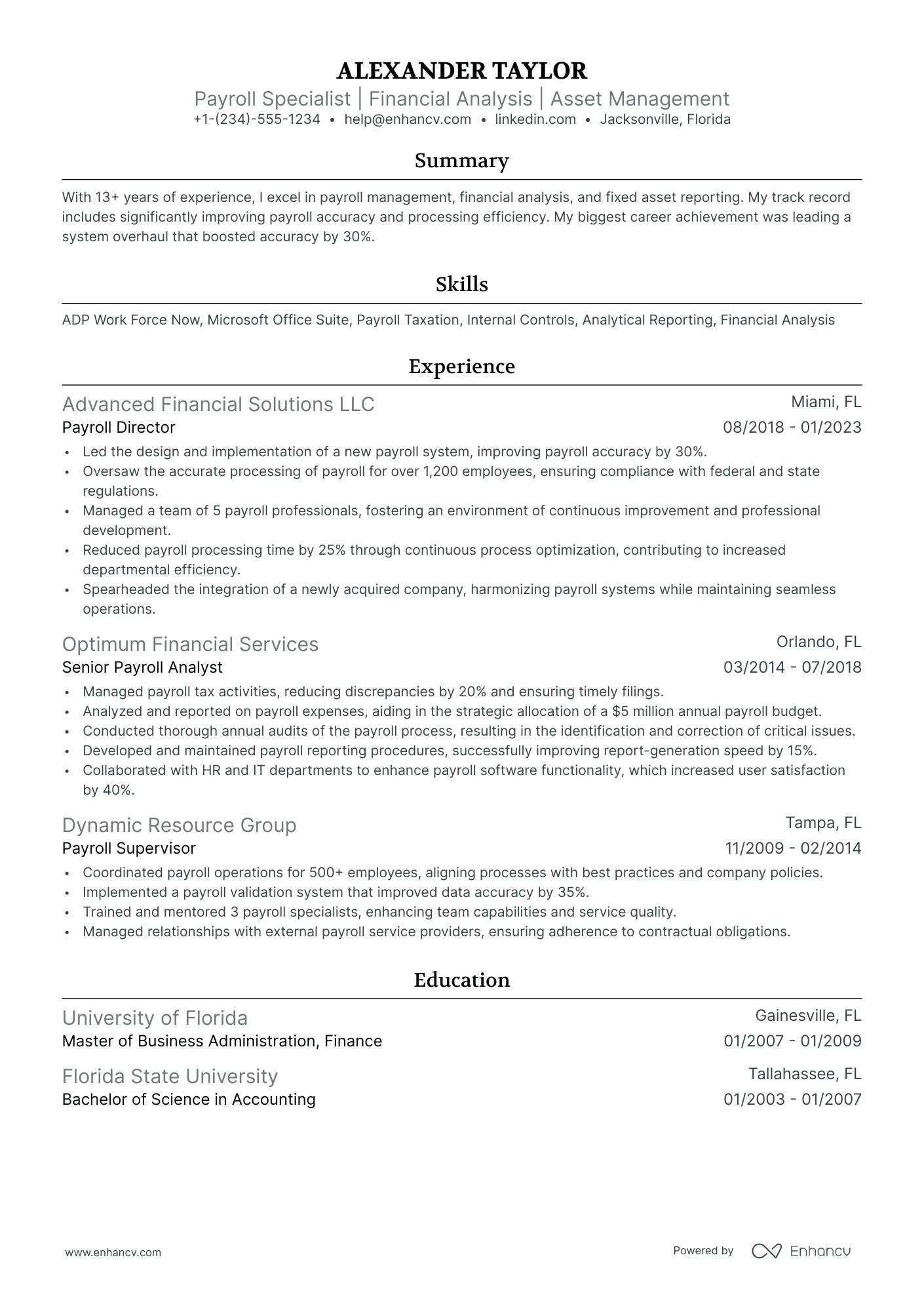
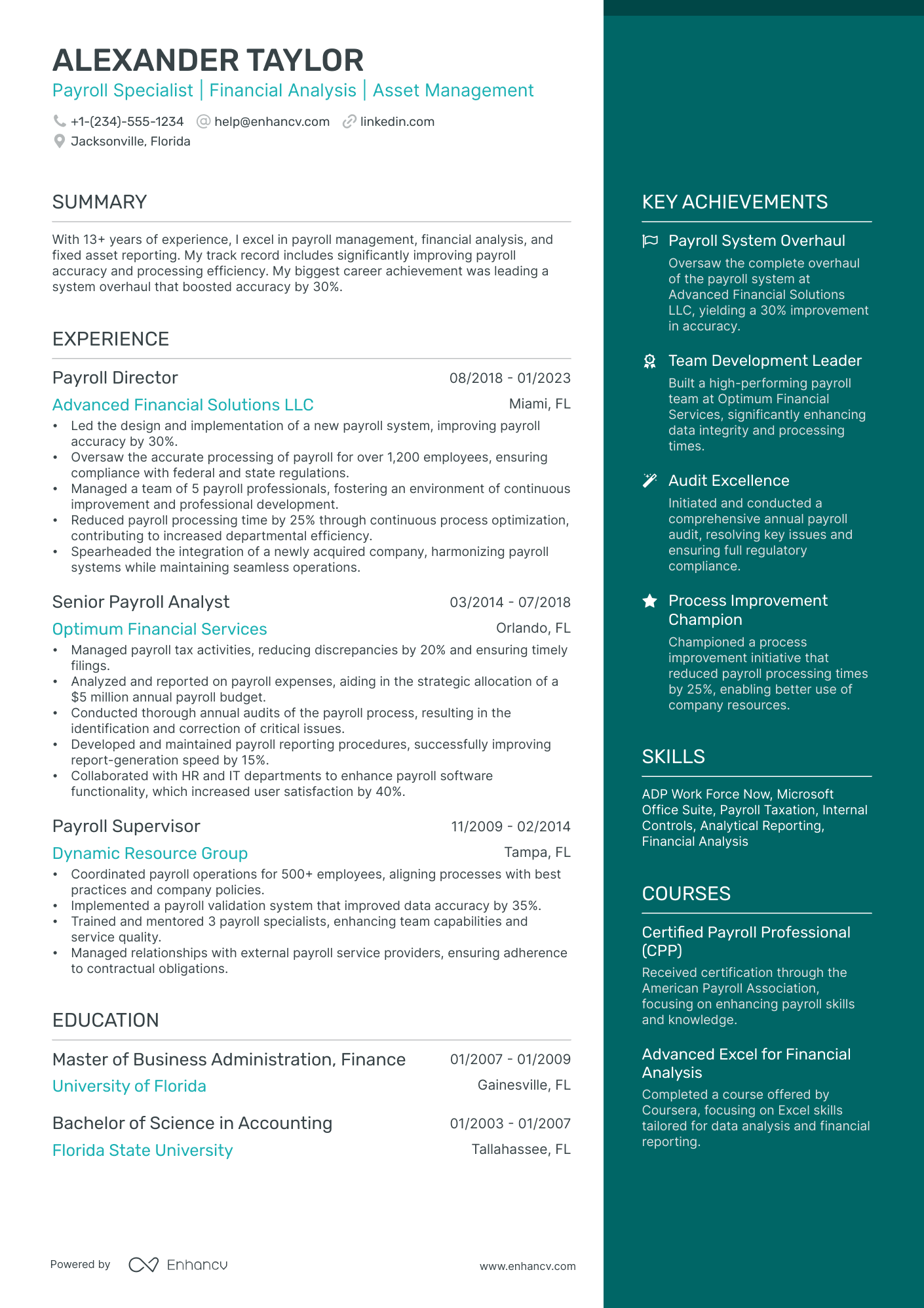
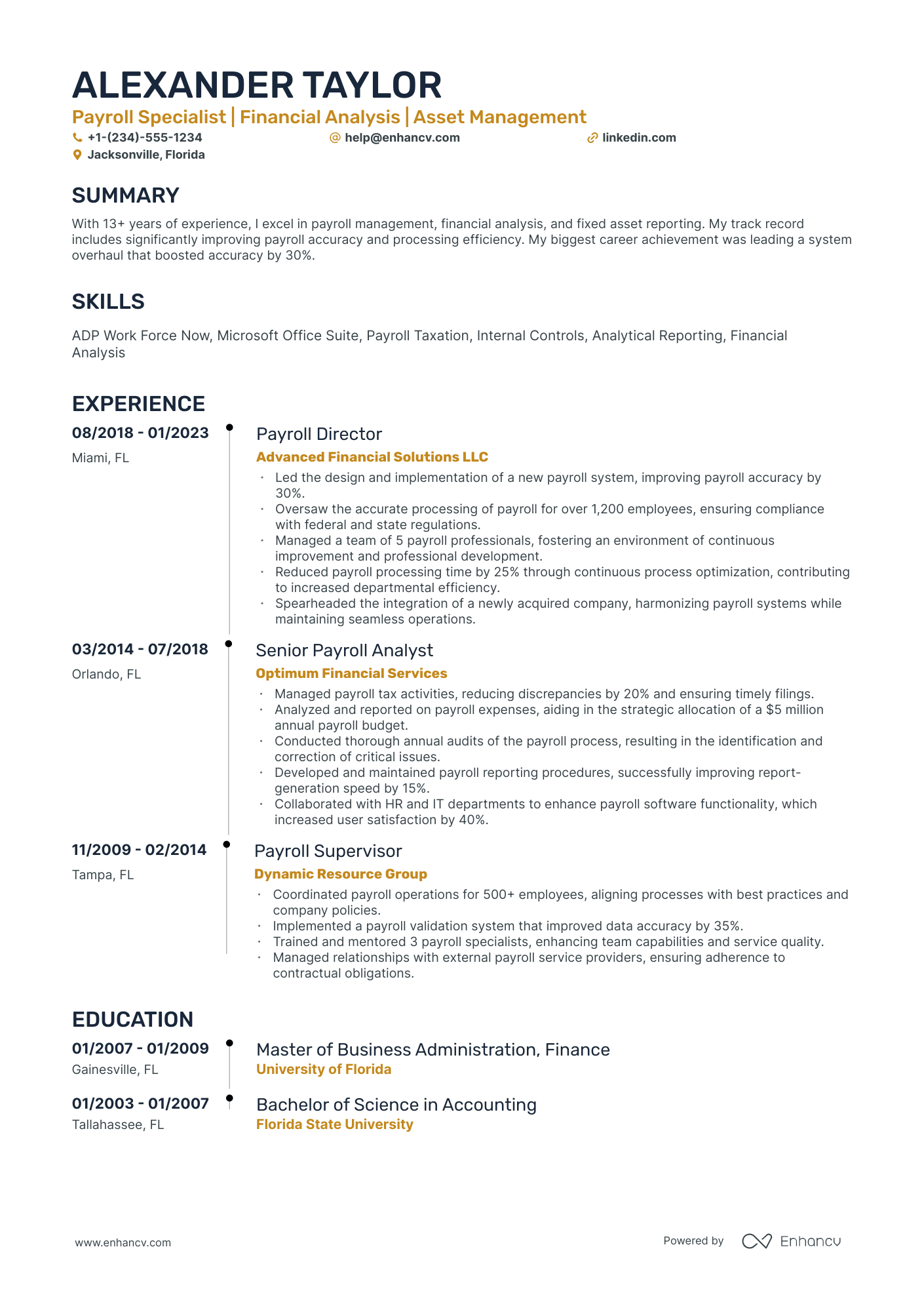
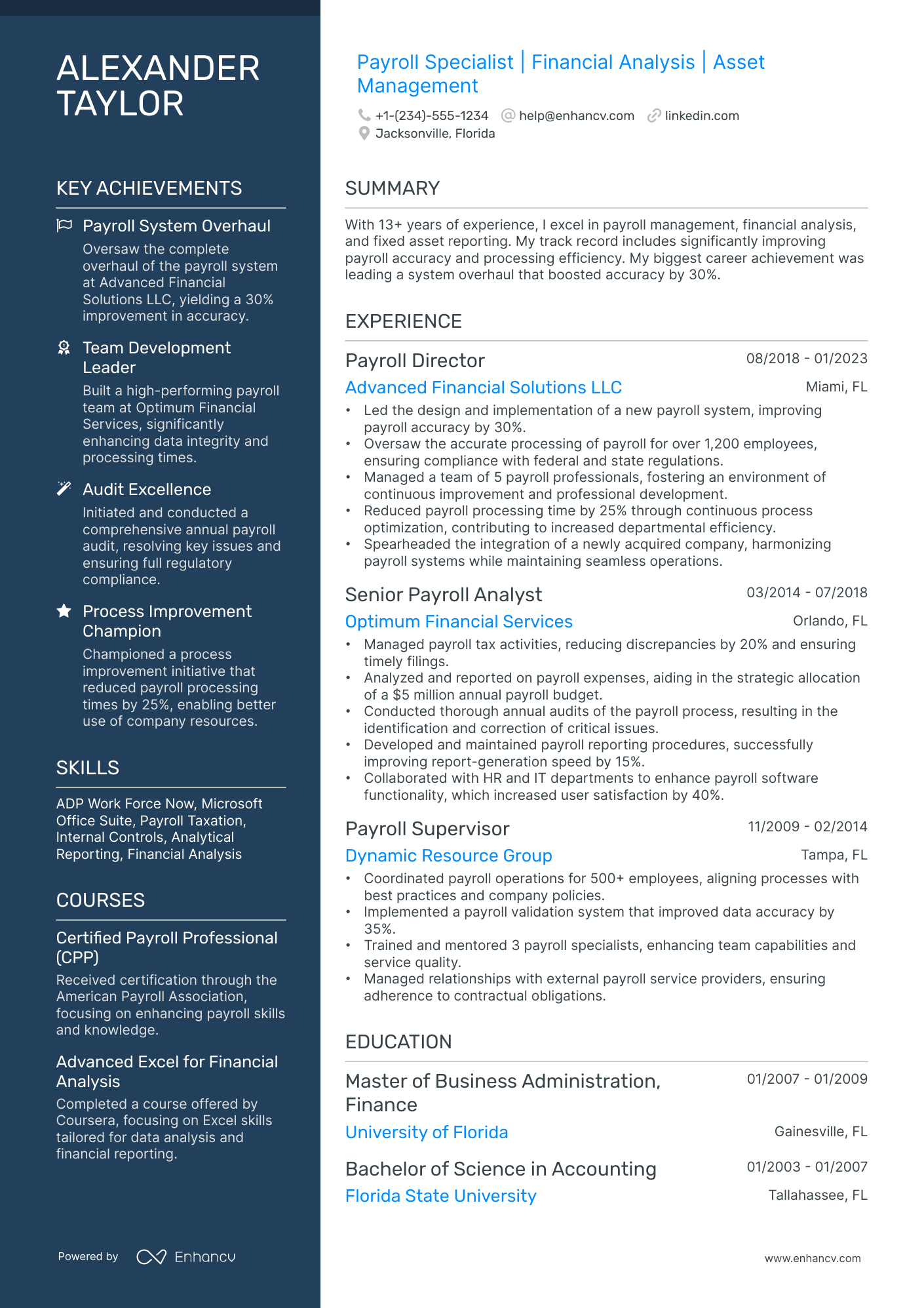
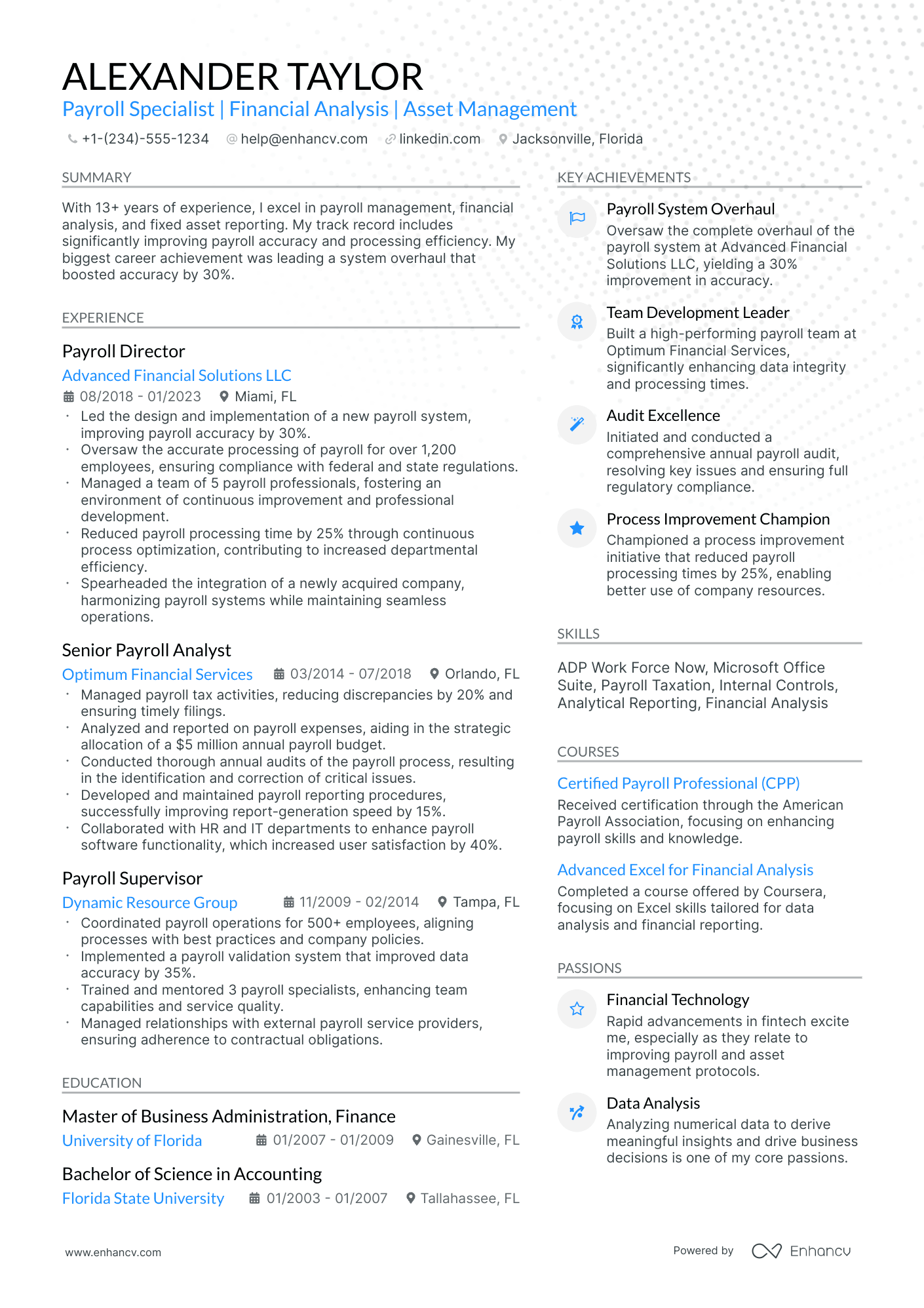
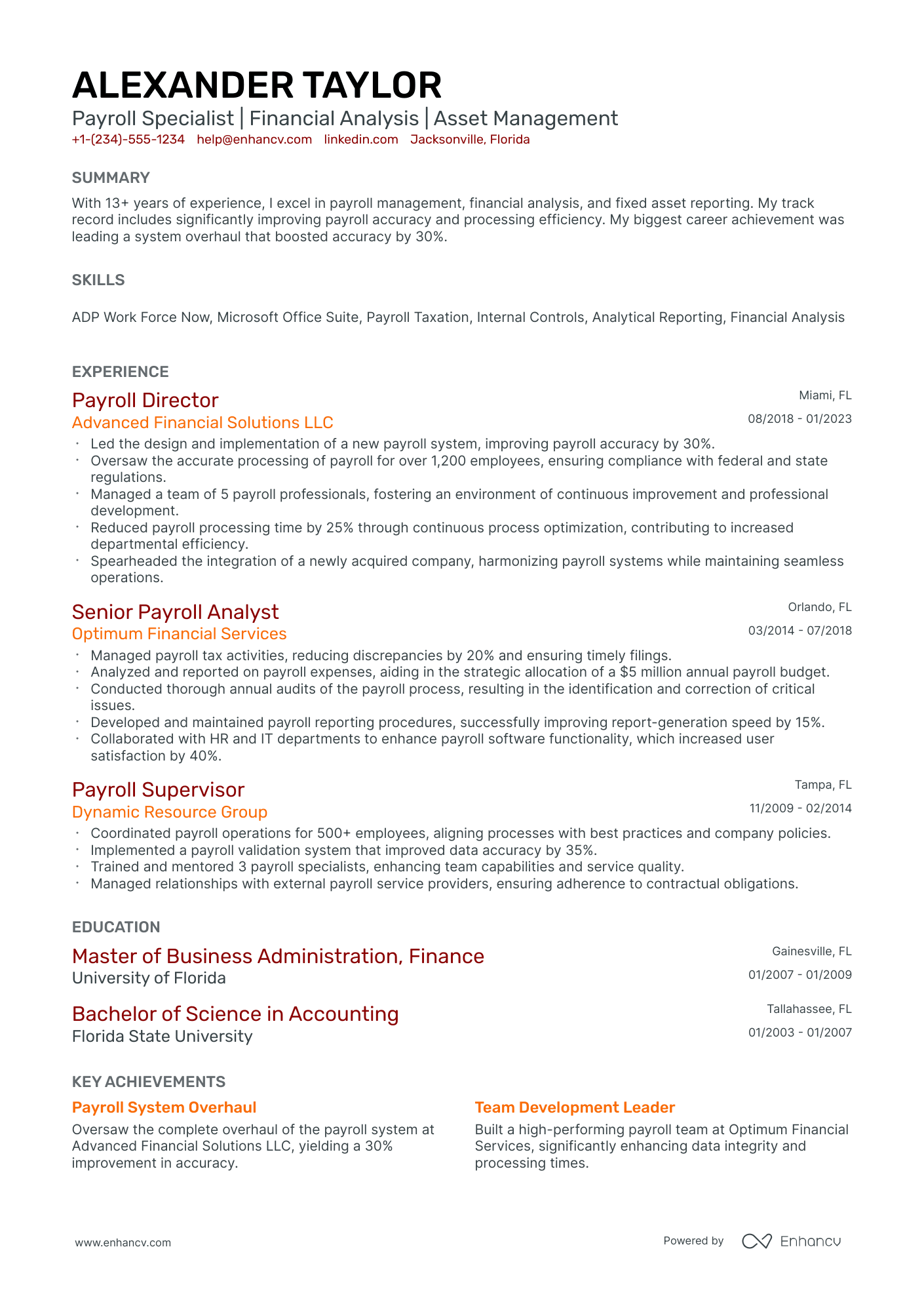
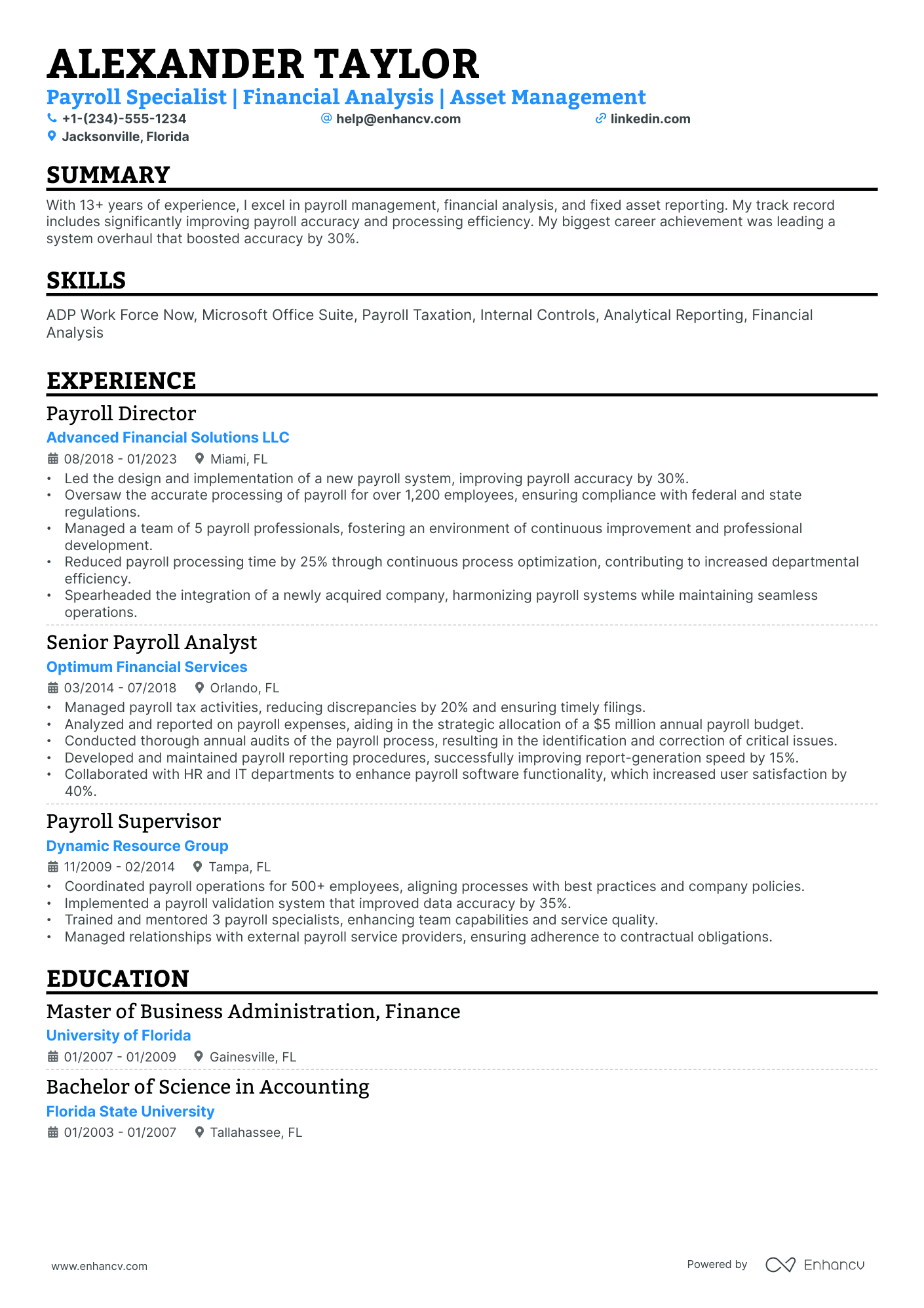
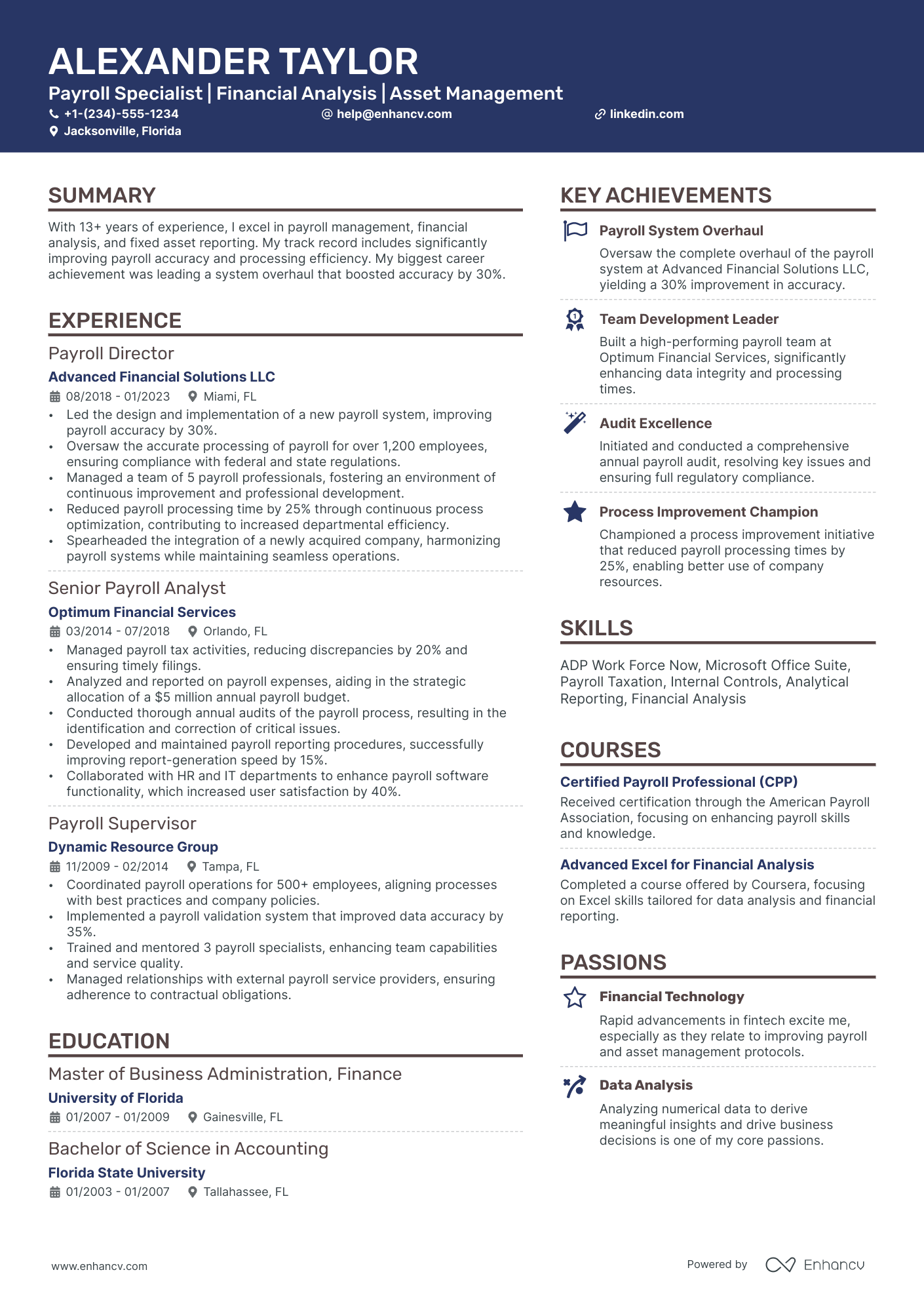
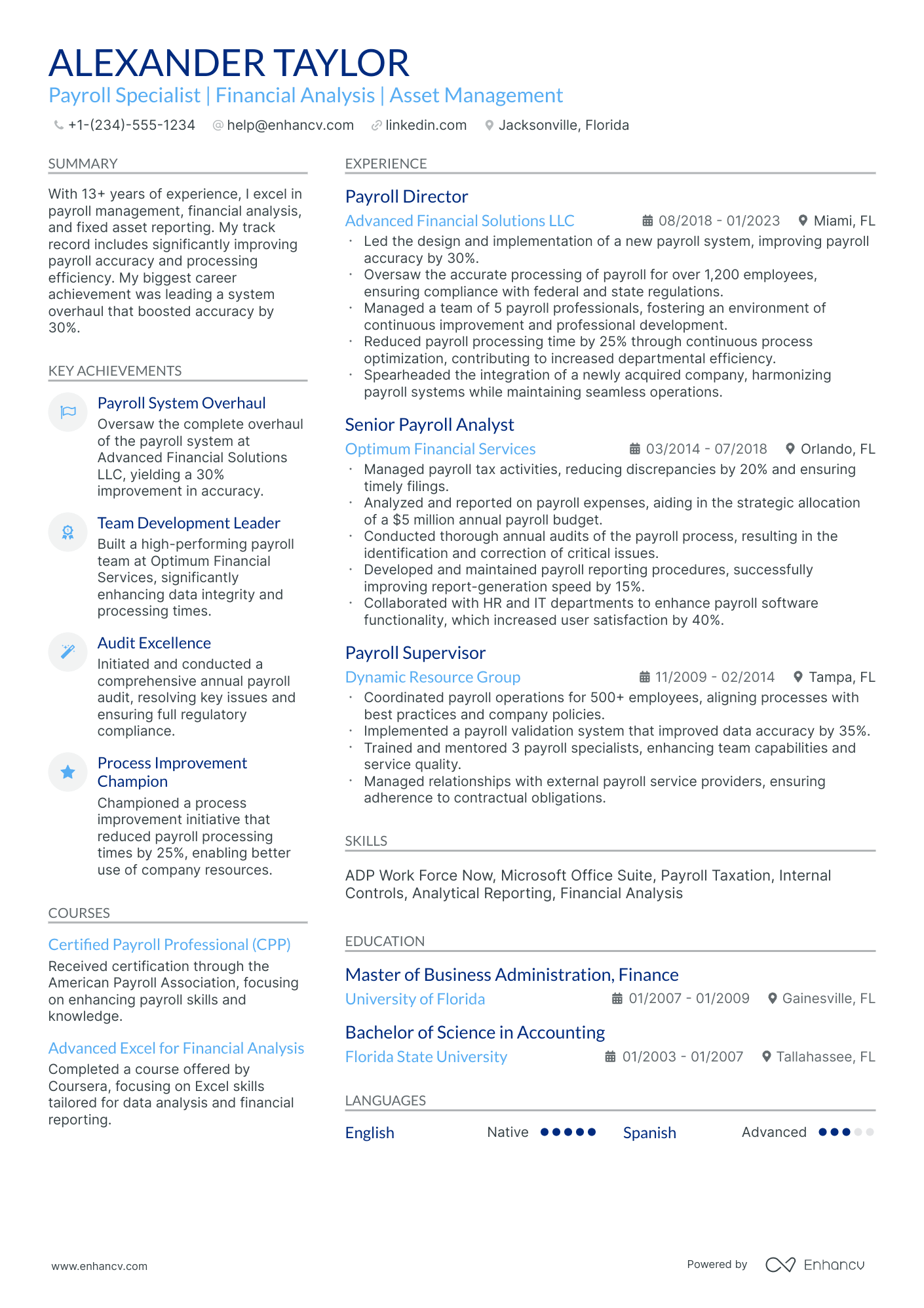
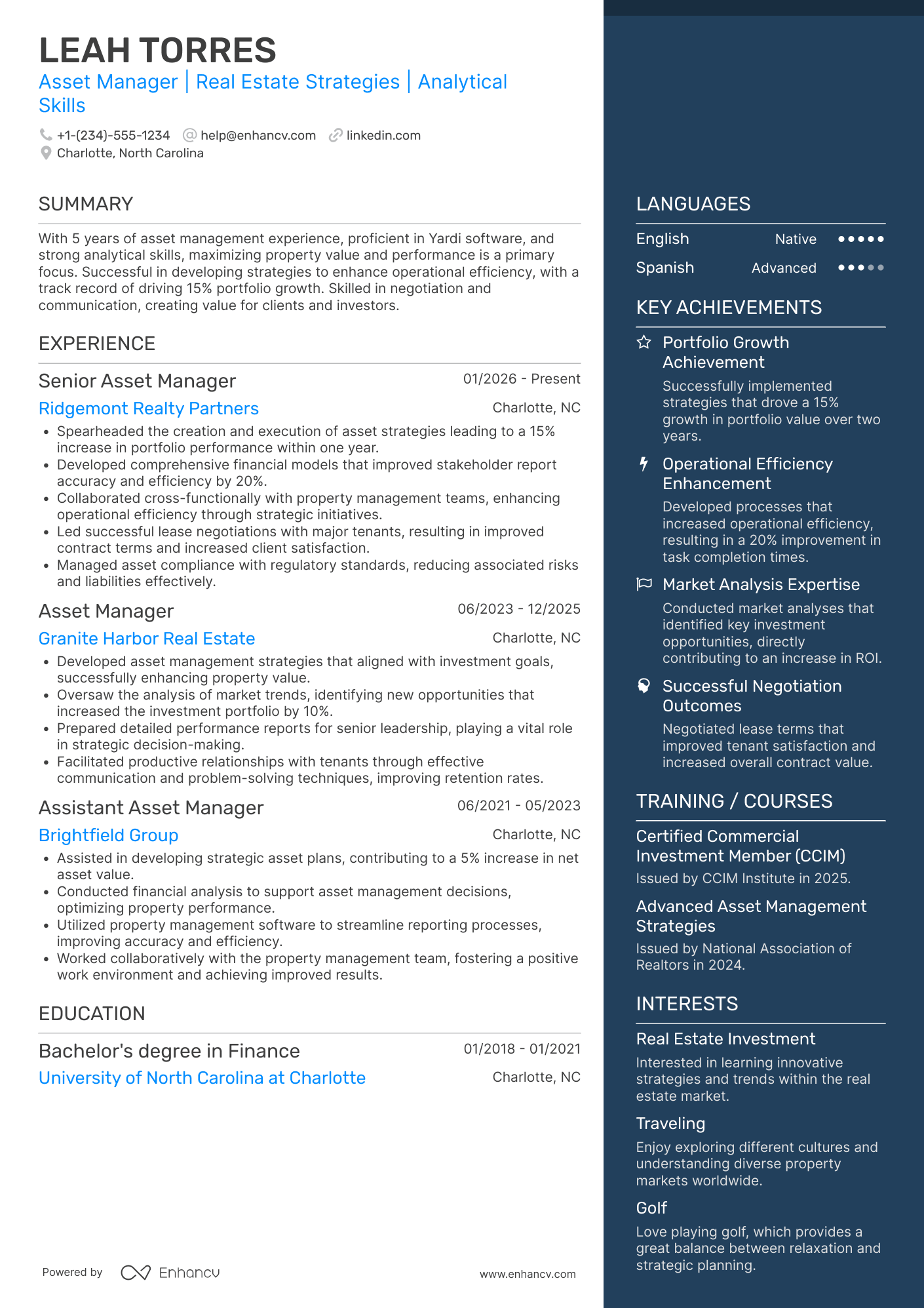
Many asset manager resumes fail because they bury investment outcomes under tool lists and generic duties. That costs interviews when an asset manager resume gets filtered by ATS keywords and skimmed in seconds in a crowded applicant pool. Understanding how to make your resume stand out is critical in such a competitive field.
Once the portfolio numbers are landing on the resume, the cover letter is where you explain the thesis behind them — our asset manager cover letter guide shows how to turn investment outcomes into the kind of story a hiring partner reads to the end.
A strong resume shows what you improved and how you measured it. Highlight assets under management growth, net operating income lift, vacancy reduction, capital project delivery on time and on budget, delinquency reduction, tenant retention gains, audit findings resolved, and risk exposure reduced.

Key takeaways
- Quantify portfolio outcomes like AUM growth, NOI lift, and risk reduction in every experience bullet.
- Use reverse-chronological format for senior roles to show progressive investment authority clearly.
- Tailor each resume to the job posting's exact tools, asset classes, and performance benchmarks.
- Anchor every listed skill to a measurable result in your summary or experience section.
- Place certifications like the CFA above education when they're recent and role-relevant.
- Write a three- to four-line summary featuring your specialty, core tools, and a quantified achievement.
- Use Enhancv's tools to turn vague duties into specific, metrics-driven resume bullets faster.
Job market snapshot for asset managers
We analyzed 944 recent asset manager job ads across major US job boards. These numbers help you understand employer expectations, role specialization trends, industry demand at a glance.
What level of experience employers are looking for asset managers
| Years of Experience | Percentage found in job ads |
|---|---|
| 1–2 years | 8.3% (78) |
| 3–4 years | 8.6% (81) |
| 5–6 years | 16.4% (155) |
| 7–8 years | 6.5% (61) |
| 9–10 years | 4.7% (44) |
| 10+ years | 6.9% (65) |
| Not specified | 52.6% (497) |
Asset manager ads by area of specialization (industry)
| Industry (Area) | Percentage found in job ads |
|---|---|
| Finance & Banking | 90.6% (855) |
| Healthcare | 2.4% (23) |
| Real Estate & Construction | 1.9% (18) |
| Government | 1.8% (17) |
| Energy | 1.3% (12) |
Top companies hiring asset managers
| Company | Percentage found in job ads |
|---|---|
| Accenture | 13.8% (130) |
| JPMorgan Chase & Co. | 8.2% (77) |
| KPMG | 4.2% (40) |
| Huntington Bancshares Inc | 4.0% (38) |
| Cadence Bank | 2.1% (20) |
| Fidelity Investments | 1.8% (17) |
| JLL | 1.5% (14) |
| Microsoft Corporation | 1.4% (13) |
| NorthMarq Capital | 1.4% (13) |
| Infosys LTD | 1.2% (11) |
Role overview stats
These tables show the most common responsibilities and employment types for asset manager roles. Use them to align your resume with what employers expect and to understand how the role is structured across the market.
Day-to-day activities and top responsibilities for a asset manager
| Responsibility | Percentage found in job ads |
|---|---|
| Excel | 13.8% (130) |
| Project management | 13.2% (125) |
| Asset management | 11.0% (104) |
| Microsoft excel | 10.3% (97) |
| It asset management | 8.3% (78) |
| Servicenow | 7.8% (74) |
| Microsoft word | 7.7% (73) |
| Data analysis | 5.9% (56) |
| Ai | 5.8% (55) |
| Microsoft powerpoint | 5.4% (51) |
| Accounting | 5.0% (47) |
| Bitcoin | 4.6% (43) |
Type of employment (remote vs on-site vs hybrid)
| Employment type | Percentage found in job ads |
|---|---|
| On-site | 72.4% (683) |
| Hybrid | 24.6% (232) |
| Remote | 3.1% (29) |
How to format a asset manager resume
Recruiters evaluating asset manager resumes prioritize evidence of portfolio performance, risk management judgment, and the ability to grow assets under management over time. A clean, well-structured format ensures these signals—investment returns, client retention rates, and AUM growth—surface quickly during both human review and ATS parsing. Choosing the right resume format is the first step toward making that happen.

I have significant experience in this role—which format should I use?
Use a reverse-chronological format to showcase progressive responsibility across funds, asset classes, and client portfolios. Do:
- Lead with your most recent role and clearly define the scope of assets, teams, and investment mandates you managed.
- Highlight proficiency in role-specific tools and domains such as Bloomberg Terminal, risk modeling platforms, fixed-income or equity strategies, and regulatory compliance frameworks.
- Quantify outcomes tied to portfolio performance, AUM growth, fee revenue, or risk-adjusted returns.
I'm junior or switching into this role—what format works best?
A hybrid format works best, letting you lead with core competencies in financial analysis and investment research while still presenting your work history in chronological order. Do:
- Place a dedicated skills section near the top featuring valuation methods, asset allocation frameworks, and tools like Excel modeling, FactSet, or Morningstar Direct.
- Include relevant projects, internships, or transitional experience such as equity research reports, CFA candidacy, or portfolio simulations that demonstrate analytical rigor.
- Link every action to a measurable outcome, even at a smaller scale, to show investment thinking and accountability.
Why hybrid and functional resumes don't work for senior roles
Hybrid and functional formats fragment your career timeline, making it difficult for hiring managers to trace how your investment authority, AUM responsibility, and leadership scope expanded across roles. These formats dilute the narrative of accountability and decision ownership that senior asset management positions demand—obscuring whether you led fund strategy, managed client relationships at scale, or drove measurable performance over market cycles. Avoid these formats entirely if you have five or more years of progressive asset management experience, as they'll raise more questions than they answer.
- Edge-case exception: A functional format may be acceptable only if you're transitioning into asset management from a closely related field (such as sell-side research or actuarial analysis) or returning after an extended career gap—but even then, every listed skill must be anchored to a specific project, portfolio outcome, or measurable result.
Once your resume's format establishes a clean, readable structure, the next step is filling it with the right sections to showcase your qualifications effectively.
What sections should go on a asset manager resume
Recruiters expect to quickly find your investment performance, risk management, and client outcomes on an asset manager resume. Knowing which resume sections to include ensures nothing critical gets overlooked. Use this structure for maximum clarity:
- Header
- Summary
- Experience
- Skills
- Projects
- Education
- Certifications
- Optional sections: Awards, Publications, Languages
Strong experience bullets should emphasize measurable performance, risk-adjusted results, assets under management, client retention, and the scope of portfolios you managed.
Is your resume good enough?
Drop your resume here or choose a file. PDF & DOCX only. Max 2MB file size.
Once you’ve organized your resume with the right components, the next step is to write your asset manager resume experience so each role clearly supports that structure.
How to write your asset manager resume experience
The experience section is where you prove you've delivered real results—not just managed portfolios on paper. Hiring managers reviewing asset manager resumes prioritize demonstrated impact through investment performance, risk-adjusted returns, and portfolio optimization over generic descriptions of daily responsibilities.
Each entry should include:
- Job title
- Company and location (or remote)
- Dates of employment (month and year)
Three to five concise bullet points showing what you owned, how you executed, and what outcomes you delivered:
- Ownership scope: the asset classes, portfolios, client segments, fund structures, or investment strategies you were directly accountable for managing and growing.
- Execution approach: the analytical models, valuation frameworks, portfolio management platforms, risk assessment tools, or research methodologies you relied on to inform allocation decisions and deliver work.
- Value improved: changes to portfolio performance, risk exposure, asset allocation efficiency, compliance adherence, or client retention that resulted from your direct involvement.
- Collaboration context: how you coordinated with research analysts, compliance teams, clients, custodians, broker-dealers, or senior investment committees to align strategy and execute on mandates.
- Impact delivered: outcomes framed as investment returns, assets under management growth, risk reduction, or client acquisition rather than a list of routine portfolio monitoring activities.
Experience bullet formula
A asset manager experience example
✅ Right example - modern, quantified, specific.
Senior Asset Manager
Summit Ridge Capital | New York, NY
2021–Present
Private real estate investment firm managing a $2.3B portfolio across multifamily and industrial assets nationwide.
- Directed annual business plans and budgets for 18 assets (6,400 units), improving net operating income by 11% year over year through rent strategy, expense controls, and capital prioritization in Yardi Voyager.
- Negotiated and executed 27 vendor contracts and three property management transitions, reducing controllable operating expenses by 8% and cutting invoice cycle time from 12 days to six using AvidXchange and standardized service level agreements.
- Built weekly portfolio dashboards in Power BI using Yardi exports, increasing forecast accuracy from 92% to 97% and enabling faster variance reviews with property managers, lenders, and internal leadership.
- Led capital expenditure programs totaling $34M, delivering 96% on-time completion and reducing change orders by 18% through Procore workflows and cross-functional coordination with construction managers, engineers, and architects.
- Strengthened risk and compliance controls by implementing quarterly lease audits and covenant tracking, reducing delinquency by 14% and preventing two loan covenant breaches through proactive lender reporting and corrective action plans.
Now that you've seen how a strong experience section looks in practice, let's break down how to customize yours for each specific role.
How to tailor your asset manager resume experience
Recruiters evaluate your asset manager resume through both applicant tracking systems and manual review, so alignment with the job posting matters. Tailoring your resume to the job description ensures the right skills, tools, and achievements stand out immediately.
Ways to tailor your asset manager experience:
- Match portfolio management platforms and financial software named in the posting.
- Mirror the exact asset classes or investment strategies the role requires.
- Use the same terminology for risk assessment frameworks or valuation methodologies.
- Reflect performance benchmarks or return-based KPIs the job description highlights.
- Include relevant regulatory compliance standards like SEC or FINRA requirements.
- Emphasize client relationship management if the role prioritizes stakeholder engagement.
- Highlight experience with specific reporting workflows or rebalancing processes referenced.
- Specify industry sectors or market segments that align with the firm's focus.
Tailoring means connecting your real accomplishments to what the employer needs—not forcing keywords into sentences where they don't belong.
Resume tailoring examples for asset manager
| Job description excerpt | Untailored | Tailored |
|---|
Once you’ve aligned your experience with the role’s priorities, quantify your asset manager achievements to show the measurable impact behind those choices.
How to quantify your asset manager achievements
Quantifying your work proves you protected capital and improved outcomes. Focus on assets under management, performance versus benchmark, risk and drawdowns, fee and revenue impact, compliance accuracy, and operational efficiency.
Quantifying examples for asset manager
| Metric | Example |
|---|---|
| AUM growth | "Grew assets under management from $420M to $510M in 12 months by expanding model portfolios and partnering with five advisor teams." |
| Performance vs benchmark | "Outperformed the Bloomberg US Aggregate Bond Index by 85 bps net of fees over 2023 by rotating duration and upgrading credit quality." |
| Risk reduction | "Cut maximum drawdown from -9.4% to -6.1% by adding downside hedges and tightening issuer limits in the investment policy statement." |
| Fee revenue | "Increased advisory fee revenue by $1.2M annually by migrating 140 households to discretionary management and standardizing tiered pricing." |
| Compliance accuracy | "Achieved 99.6% trade compliance across 3,800 orders using Bloomberg AIM pre-trade checks, with zero material audit findings." |
Turn vague job duties into measurable, recruiter-ready resume bullets in seconds with Enhancv's Bullet Point Generator.
Once you've crafted strong bullet points to showcase your experience, the next step is ensuring your resume also highlights the right hard and soft skills that asset management employers prioritize.
How to list your hard and soft skills on a asset manager resume
Your skills section shows you can drive investment performance and manage risk—recruiters and applicant tracking system (ATS) filters scan this section for role keywords, and strong resumes balance hard skills (tools and methods) with job-specific soft skills.
asset manager roles require a blend of:
- Product strategy and discovery skills.
- Data, analytics, and experimentation skills.
- Delivery, execution, and go-to-market discipline.
- Soft skills.
Your skills section should be:
- Scannable (bullet-style grouping).
- Relevant to the job post.
- Backed by proof in experience bullets.
- Updated with current tools.
Place your skills section:
- Above experience if you're junior or switching careers.
- Below experience if you're mid/senior with strong achievements.

Hard skills
- Portfolio construction, optimization
- Asset allocation, rebalancing
- Risk modeling, stress testing
- Performance attribution (Brinson)
- Factor models, multi-factor analysis
- Bloomberg Terminal, FactSet, Morningstar Direct
- Excel, VBA, Power BI
- Python, pandas, SQL
- Fixed income analytics, duration, convexity
- Derivatives, hedging strategies
- Compliance monitoring, IPS adherence
- Trade order management systems, post-trade reconciliation
Soft skills
- Investment thesis writing
- Conviction-based decision-making
- Clear client communication
- Stakeholder expectation management
- Cross-functional collaboration with trading and risk
- Escalation and issue resolution
- Prioritizing under market volatility
- Defending recommendations with evidence
- Negotiating fees and mandates
- Owning deadlines and deliverables
- Leading investment committee discussions
- Coaching analysts and associates
How to show your asset manager skills in context
Skills shouldn't live only in a dedicated skills list. You can explore common resume skills across roles to benchmark your own section.
They should be demonstrated in:
- Your summary (high-level professional identity)
- Your experience (proof through outcomes)
Here's what strong asset manager examples look like in practice.
Summary example
Senior asset manager with 12 years in commercial real estate portfolio oversight. Skilled in Yardi, discounted cash flow analysis, and tenant negotiations. Grew portfolio NOI by 22% across 15 mixed-use properties through strategic repositioning and lease restructuring.
- Reflects senior-level experience clearly
- Names industry-standard tools and methods
- Leads with a measurable financial outcome
- Highlights negotiation as a soft skill
Experience example
Senior Asset Manager
Greystone Capital Partners | Chicago, IL
March 2018–Present
- Increased portfolio net operating income by 19% over three years using Yardi-driven analytics and proactive lease renegotiations across 22 commercial properties.
- Collaborated with acquisitions and property management teams to underwrite $140M in new deals, applying discounted cash flow models and market benchmarking.
- Reduced tenant turnover by 31% by designing a retention program with quarterly business reviews and capital improvement incentives.
- Every bullet includes measurable proof
- Skills appear naturally within real outcomes
Once you’ve tied your asset management strengths to real outcomes and responsibilities, the next step is applying that approach to structuring an asset manager resume when you don’t have direct experience.
How do I write a asset manager resume with no experience
Even without full-time experience, you can demonstrate readiness through building a strong resume without work experience by leveraging projects and transferable skills:
- Student-managed investment fund role
- Asset inventory and tagging project
- Portfolio analysis capstone project
- Internship in finance operations
- Bloomberg Terminal coursework projects
- Excel financial modeling assignments
- Property management shadowing experience
- Volunteer treasury and budgeting work
Focus on:
- Asset tracking, valuation, and reporting
- Portfolio analysis with measurable results
- Compliance-ready documentation and controls
- Tools: Excel, Bloomberg Terminal
Resume format tip for entry-level asset manager
Use a skills-based resume format because it highlights asset manager tools, analysis methods, and projects when your work history is limited. Do:
- Lead with a skills summary tied to asset management.
- Add two to three project entries with metrics.
- List tools used: Excel, Bloomberg Terminal.
- Quantify impact: accuracy, time saved, returns.
- Include relevant coursework under education.
- Built an Excel portfolio tracker for a capstone fund, automated valuation updates, and cut weekly reporting time by 35% while improving data accuracy to 99%.
Even without direct experience, your educational background can serve as the foundation of your asset manager resume—here's how to present it effectively.
How to list your education on a asset manager resume
Your education section helps hiring teams confirm you have the foundational knowledge needed for an asset manager role. It validates academic training in finance, economics, or related fields.
Include:
- Degree name
- Institution
- Location
- Graduation year
- Relevant coursework (for juniors or entry-level candidates)
- Honors & GPA (if 3.5 or higher)
Skip month and day details—list the graduation year only.
Here's a strong education entry tailored for an asset manager resume.
Example education entry
Bachelor of Science in Finance
Georgetown University, Washington, D.C.
Graduated 2021
GPA: 3.7/4.0
- Relevant coursework: Portfolio Management, Fixed Income Analysis, Financial Modeling, Risk Management, and Econometrics.
- Honors: Dean's List (six semesters), Beta Gamma Sigma Honor Society.
How to list your certifications on a asset manager resume
Certifications on your resume show your commitment to learning, your proficiency with finance tools, and your industry relevance as an asset manager. They also signal credibility when you manage portfolios, risk, reporting, and client expectations.
Include:
- Certificate name
- Issuing organization
- Year
- Optional: credential ID or URL
- Place certifications below education when they're older, less relevant, or supplemental to your core asset manager qualifications.
- Place certifications above education when they're recent, highly relevant, or required for the asset manager roles you target.
Best certifications for your asset manager resume
Chartered Financial Analyst (CFA) Chartered Alternative Investment Analyst (CAIA) Financial Risk Manager (FRM) Certified Investment Management Analyst (CIMA) Chartered Market Technician (CMT) Certificate in Investment Performance Measurement (CIPM) Chartered Financial Consultant (ChFC)
Once you’ve positioned your credentials where they’re easiest to verify, you can write your asset manager resume summary to reinforce that expertise upfront.
How to write your asset manager resume summary
Your resume summary is the first thing a recruiter reads, so it needs to earn attention fast. A strong opening positions you as a qualified asset manager before the rest of your resume does any heavy lifting.
Keep it to three to four lines, with:
- Your title and total years of experience in asset management.
- The domain or asset class you specialize in, such as real estate, equities, or fixed income.
- Core tools and skills like portfolio analytics platforms, financial modeling, or risk assessment.
- One or two quantified achievements that prove your impact on returns or portfolio growth.
- Soft skills tied to real outcomes, such as client communication that improved retention rates.

PRO TIP
At the junior level, lead with relevant skills, certifications, and early wins that show you can contribute right away. Avoid vague descriptors like "passionate" or "motivated self-starter." Instead, anchor every claim to a specific tool, metric, or result from your experience.
Example summary for a asset manager
Asset manager with two years of experience in fixed-income portfolio analysis. Built client reporting dashboards using Bloomberg Terminal, improving quarterly review efficiency by 30%. Strong communicator who helped retain 15 mid-tier accounts during onboarding.
Optimize your resume summary and objective for ATS
Drop your resume here or choose a file.
PDF & DOCX only. Max 2MB file size.
Now that your summary articulates the value you bring, make sure your header presents the essential contact and professional details recruiters need to reach you.
What to include in a asset manager resume header
A resume header is the top section with your key details, and it boosts visibility, credibility, and recruiter screening for a asset manager role.
Essential resume header elements
- Full name
- Tailored job title and headline
- Location
- Phone number
- Professional email
- GitHub link
- Portfolio link
Including a LinkedIn link helps recruiters verify experience quickly and supports screening.
Do not include photos on a asset manager resume unless the role is explicitly front-facing or appearance-dependent.
Use a clear asset manager headline with your specialty, and keep links readable so recruiters can confirm fit in seconds.
Asset manager resume header
Jordan Lee
Asset Manager | Commercial Real Estate | Lease Administration
Chicago, IL
(312) 555-01XX
your.name@enhancv.com
github.com/yourname
yourwebsite.com
linkedin.com/in/yourname
Once your contact details and professional identifiers are in place, add optional sections to round out your asset manager resume with relevant supporting information.
Additional sections for asset manager resumes
When your core qualifications align closely with other candidates, additional sections can set you apart and reinforce your credibility as an asset manager. For example, listing language skills on your resume can be a differentiator when managing international portfolios or working with global clients.
- Languages
- Certifications (CFA, CAIA, FRM)
- Industry publications
- Professional affiliations
- Volunteer experience in financial literacy
- Conference speaking engagements
- Hobbies and interests
Once you've strengthened your resume with well-chosen additional sections, the next step is pairing it with a cover letter that gives your application even more impact.
Do asset manager resumes need a cover letter
A cover letter isn't required for an asset manager, but it helps in competitive searches or when hiring teams expect one. If you're unsure where to start, understanding what a cover letter is and how it complements your resume can help you decide. It can make a difference when your resume needs context, or when the role demands strong stakeholder communication.
Use a cover letter to add targeted context:
- Explain role and team fit: match your investment style, asset class focus, and collaboration approach to the asset manager's mandate.
- Highlight one or two outcomes: cite a portfolio result, risk reduction, or process improvement, and name the tools or data sources you used.
- Show business context: reference the firm's products, clients, constraints, and risk posture, and connect them to how you make decisions.
- Address transitions or non-obvious experience: clarify a move across asset classes, a gap, or a shift from research to an asset manager role.
Drop your resume here or choose a file.
PDF & DOCX only. Max 2MB file size.
Once you’ve decided whether to include a cover letter to strengthen your application, you can use AI to improve your asset manager resume and make it more targeted and effective.
Using AI to improve your asset manager resume
AI can sharpen your resume's clarity, structure, and overall impact. It helps tighten language and highlight measurable results. But overuse strips authenticity. Once your content feels clear and role-aligned, step away from AI. If you're exploring this approach, learn more about ChatGPT resume writing prompts to get started with effective inputs.
Here are 10 practical prompts to strengthen specific sections of your asset manager resume:
- Strengthen summary focus: "Rewrite my asset manager resume summary to emphasize portfolio performance, client retention, and investment strategy expertise in three concise sentences."
- Quantify experience bullets: "Add specific metrics like AUM growth, return percentages, or client acquisition numbers to each asset manager experience bullet on my resume."
- Tighten skills section: "Review my asset manager resume skills section and remove vague entries. Keep only hard skills relevant to portfolio management and risk analysis."
- Align with job posting: "Compare my asset manager resume experience bullets against this job description. Highlight gaps and suggest targeted rewrites."
- Improve action verbs: "Replace weak or repeated verbs in my asset manager experience section with stronger alternatives that convey leadership and analytical decision-making."
- Refine certifications section: "Reorder and format the certifications on my asset manager resume to prioritize CFA, CAIA, or other credentials most relevant to this role."
- Clarify project descriptions: "Rewrite the project entries on my asset manager resume to clearly state my role, the strategy used, and the measurable outcome."
- Trim redundant content: "Identify and remove any repetitive or overlapping statements across all sections of my asset manager resume."
- Elevate education details: "Revise the education section of my asset manager resume to highlight relevant coursework, honors, or finance-related research projects."
- Sharpen bullet structure: "Restructure each bullet in my asset manager resume using a clear result-action-context format with no bullet exceeding two lines."
Stop using AI once your resume sounds accurate, specific, and aligned with real experience. AI should never invent experience or inflate claims—if it didn't happen, it doesn't belong here.
Conclusion
A strong asset manager resume proves impact with measurable outcomes, role-specific skills, and a clear structure. Highlight portfolio performance, risk control, and client results with numbers. Keep each section scannable, consistent, and focused on what you delivered.
This approach shows you’re ready for today’s hiring market and the next hiring cycle. It makes your experience easy to verify and your value easy to compare. A well-structured asset manager resume helps hiring teams decide faster.