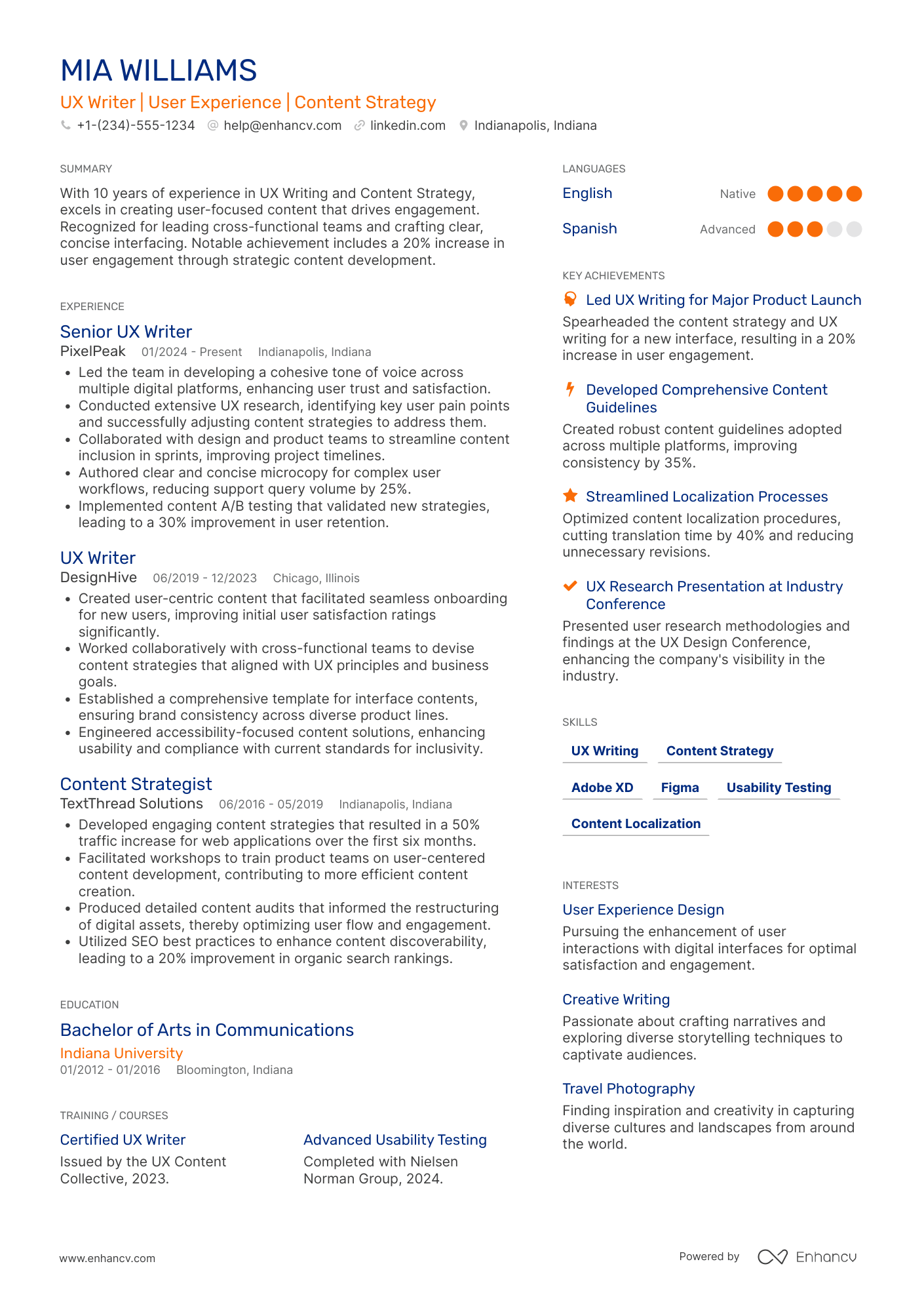
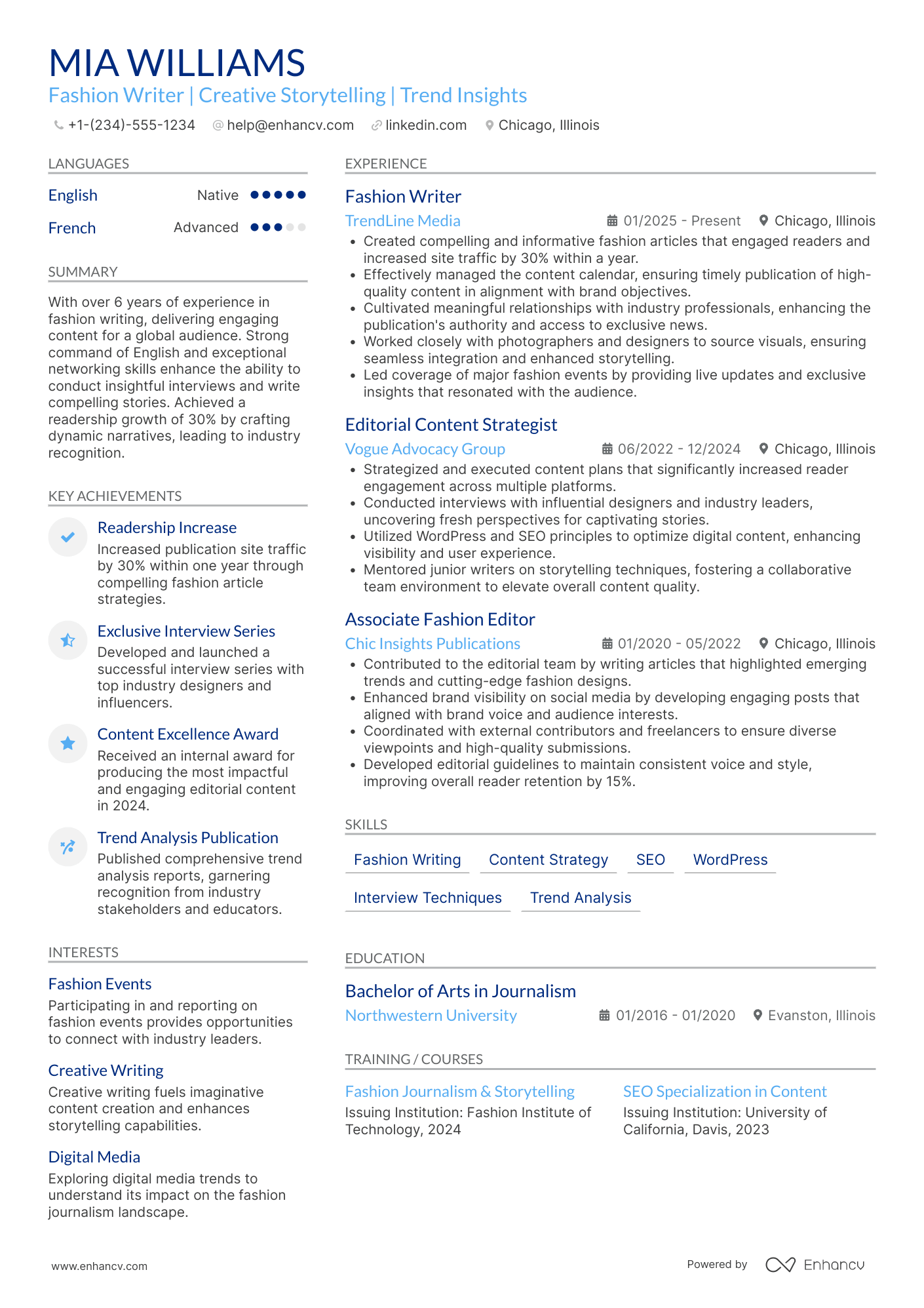
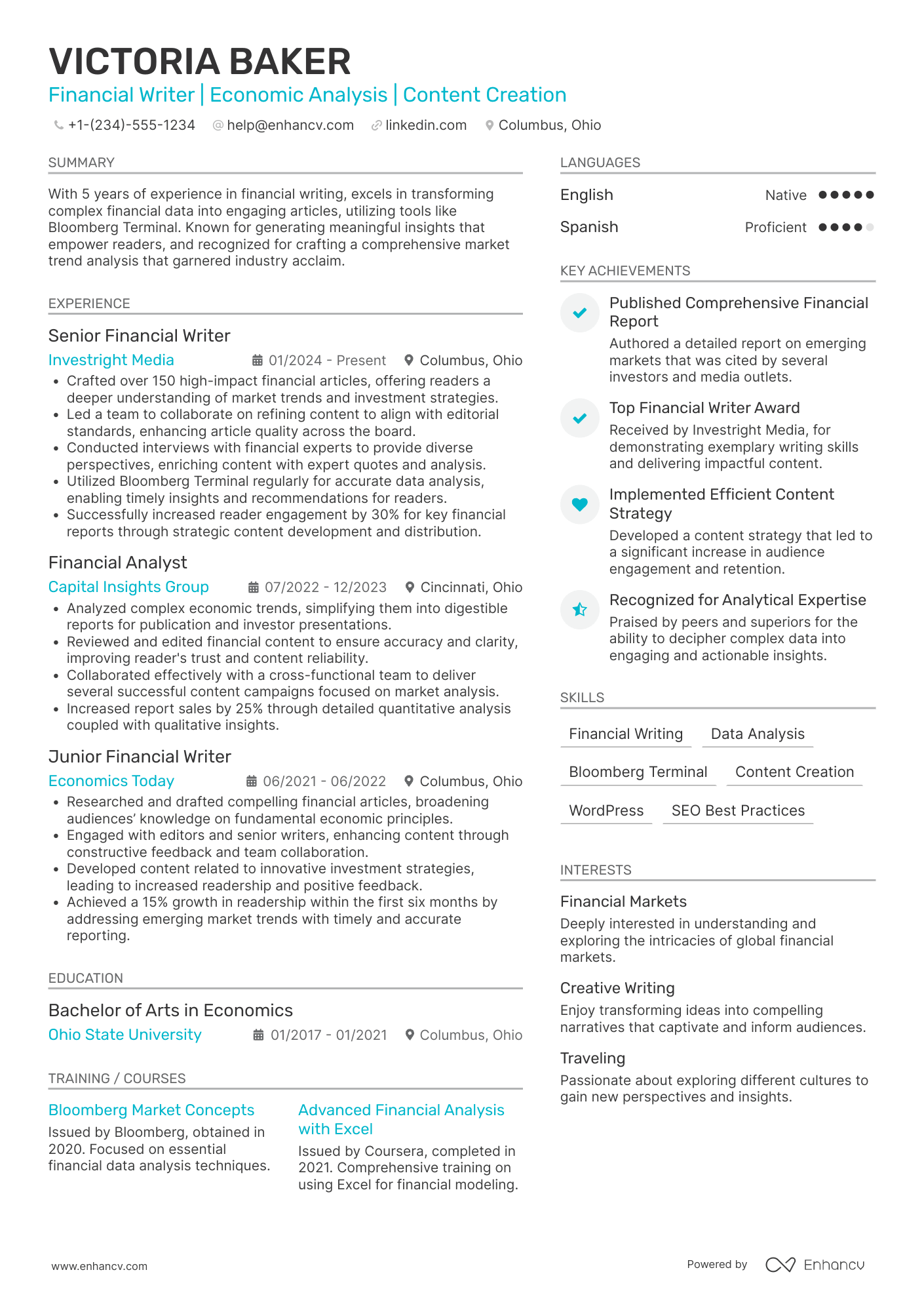
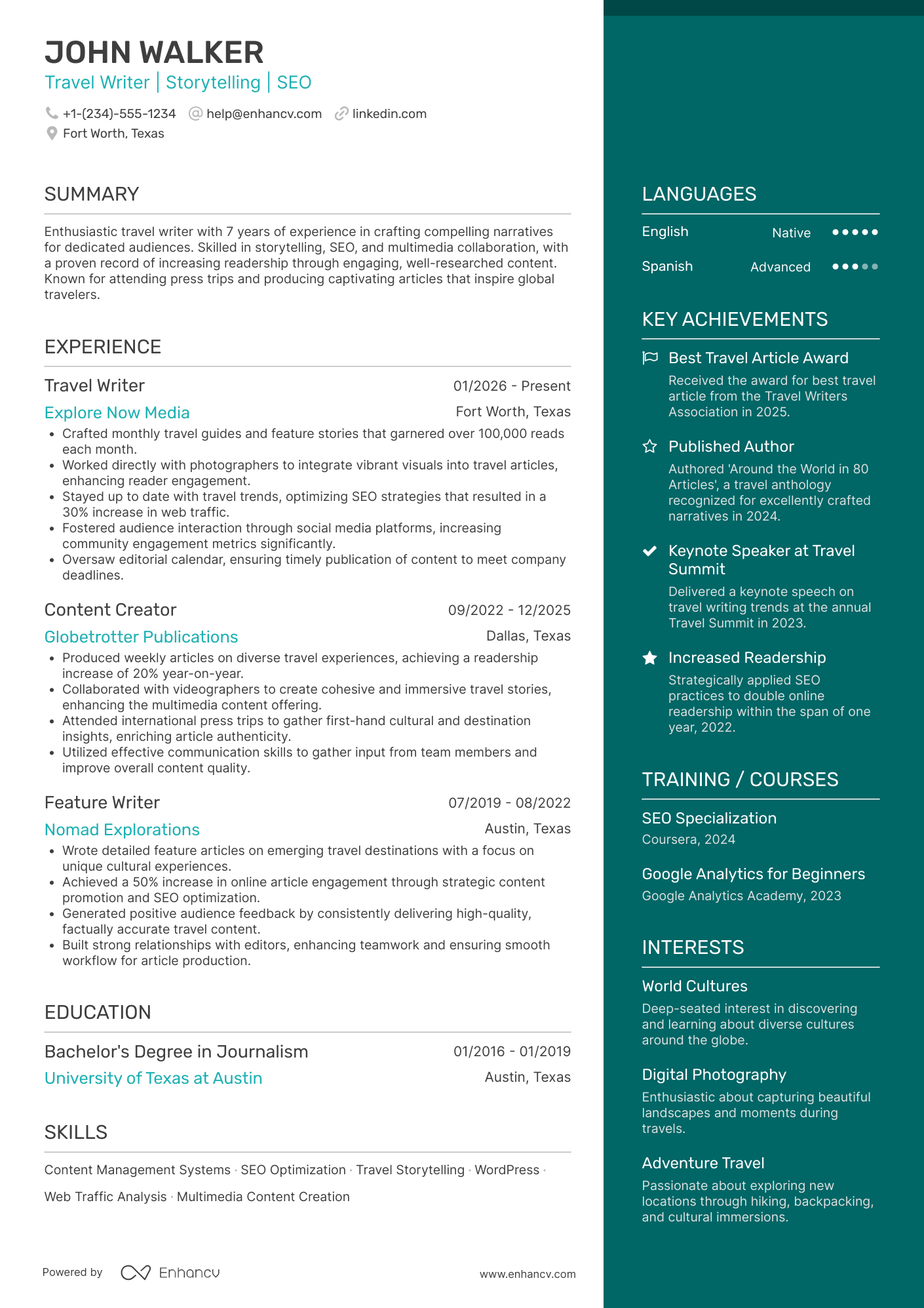
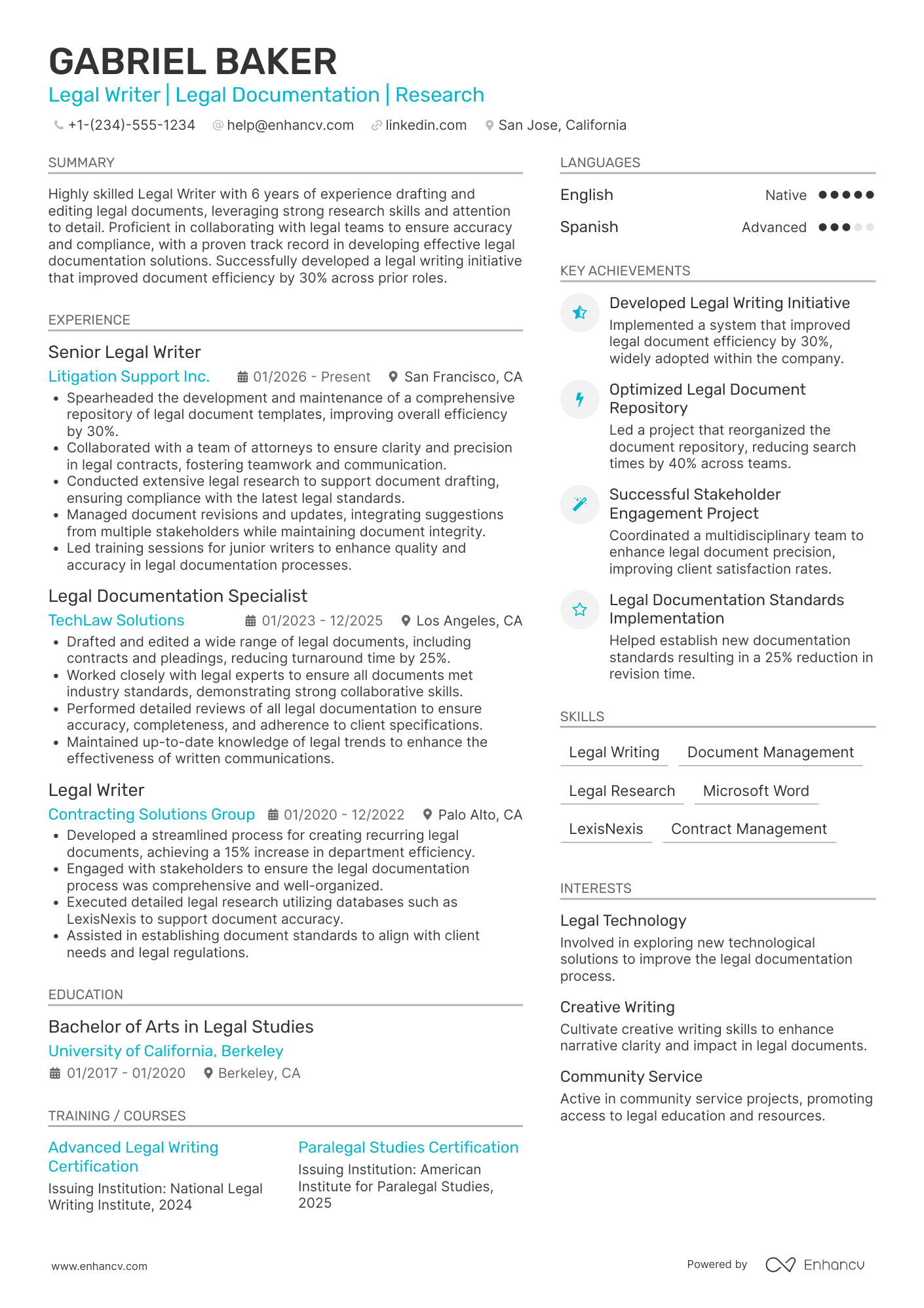
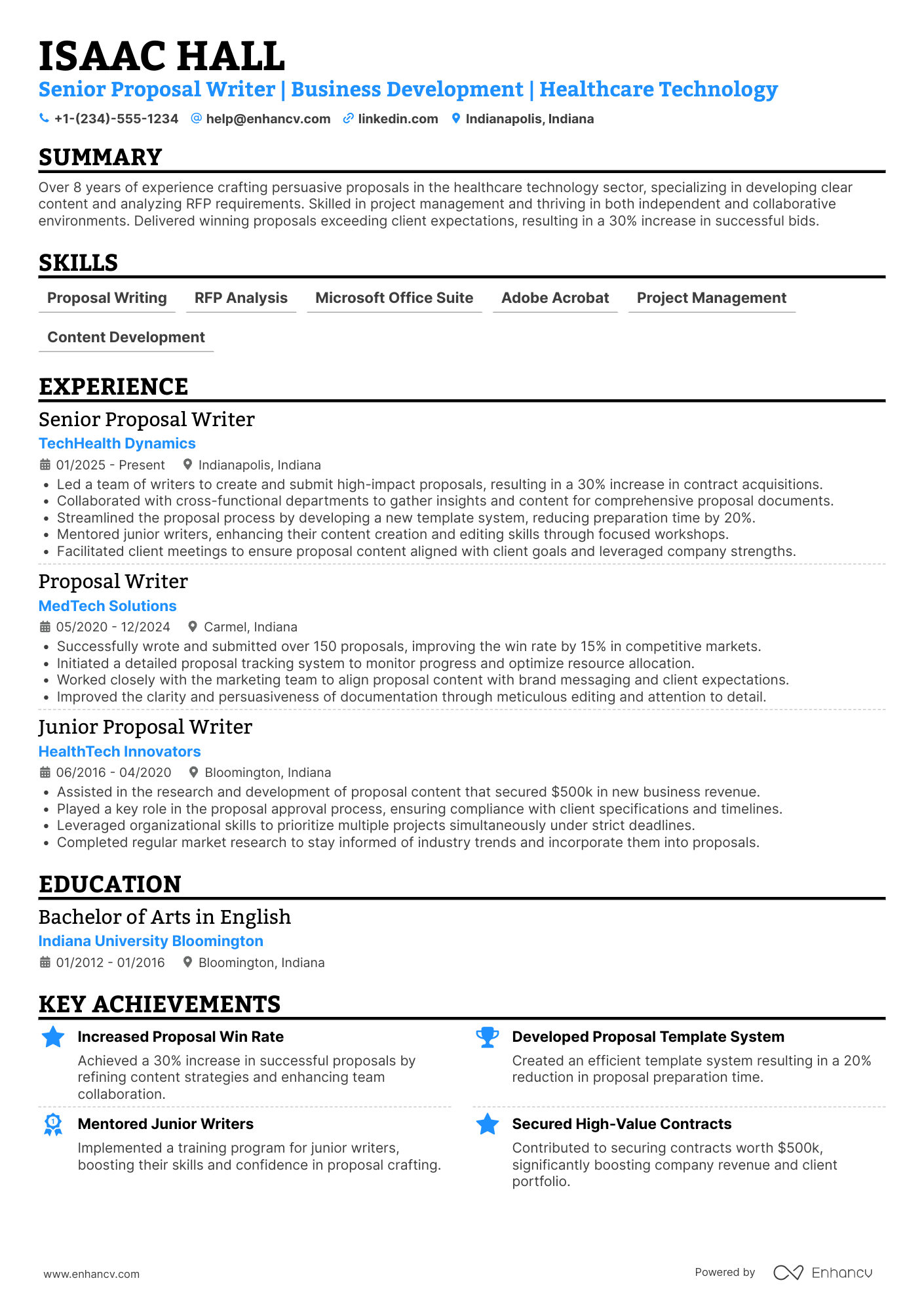
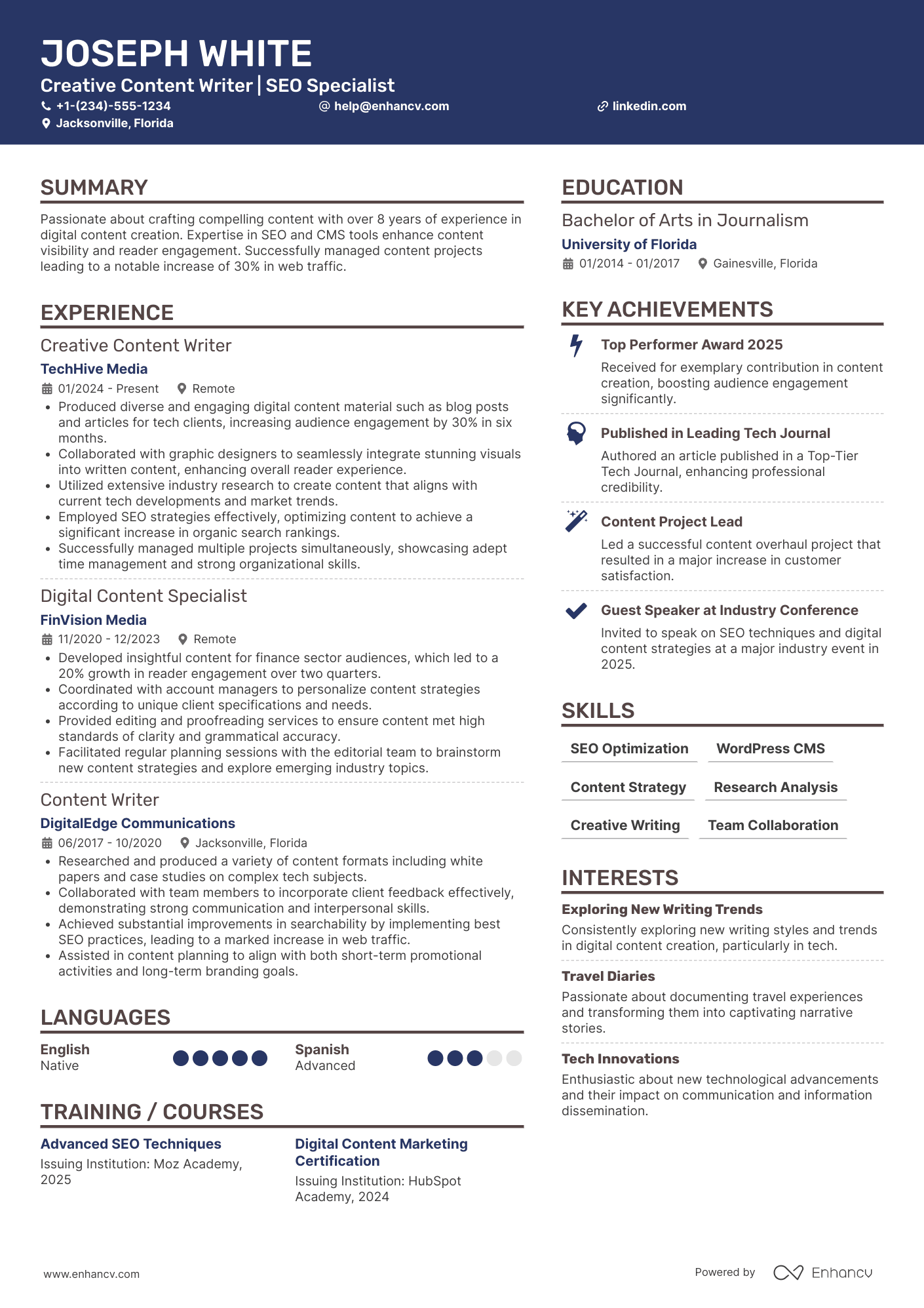
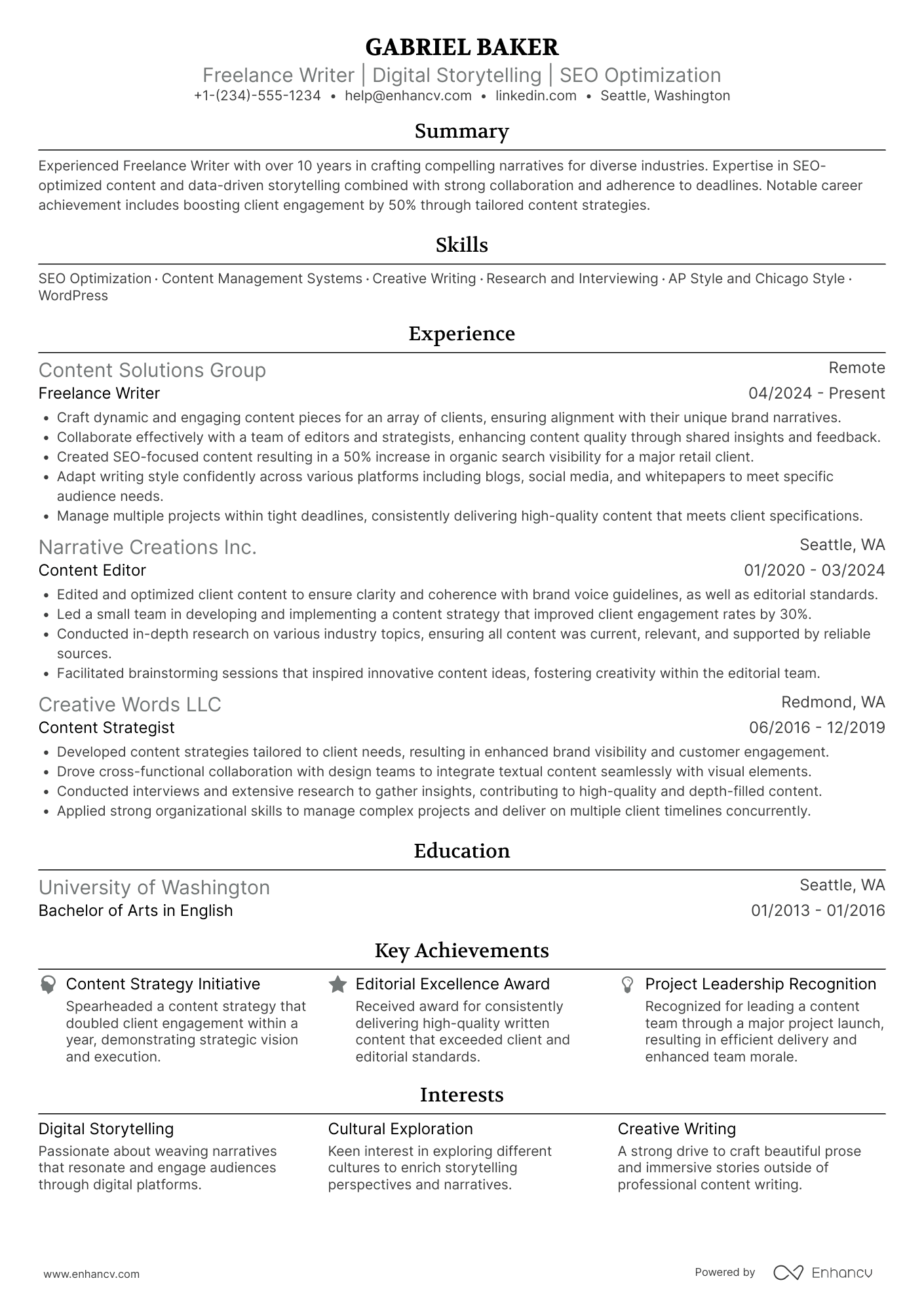
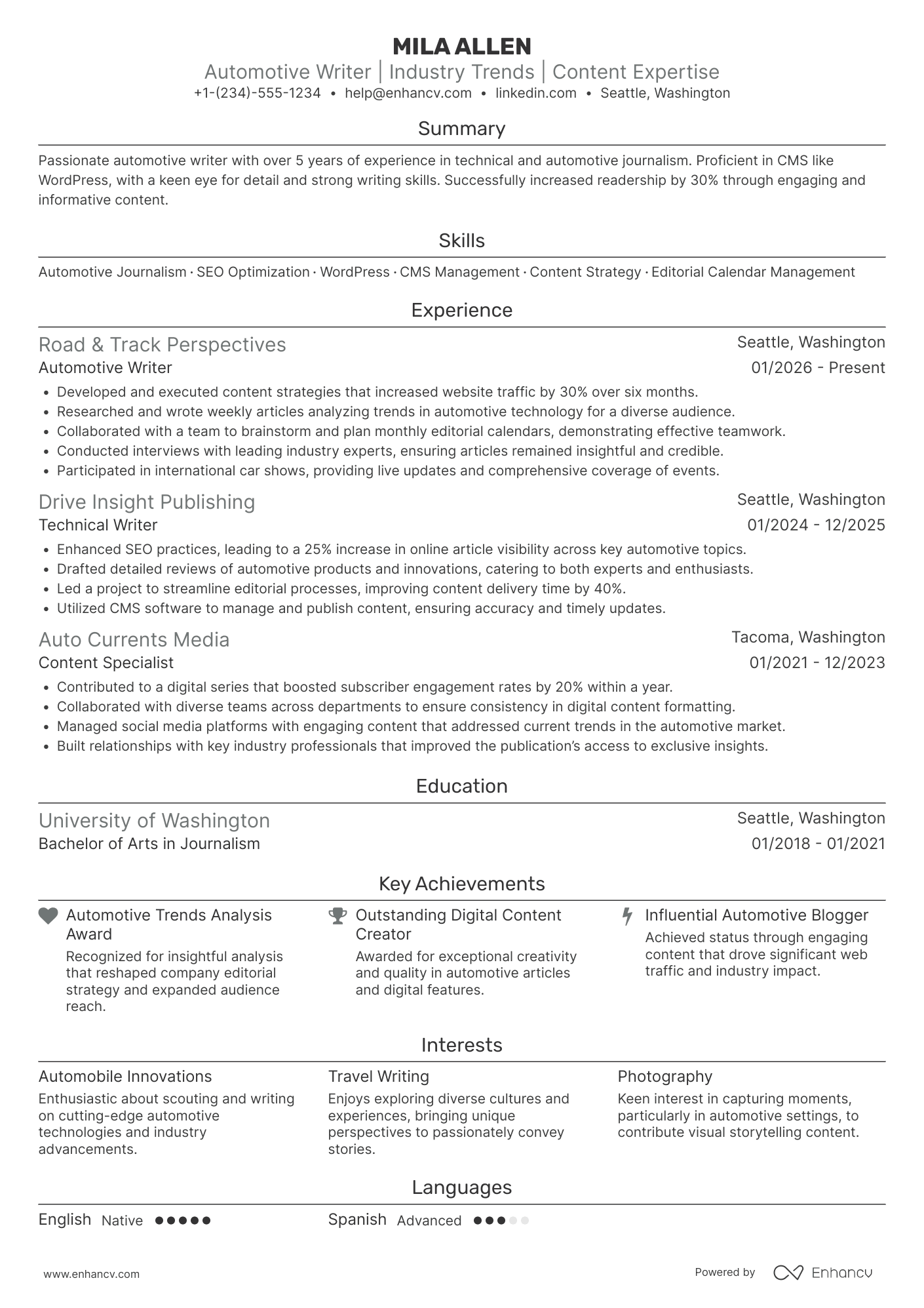
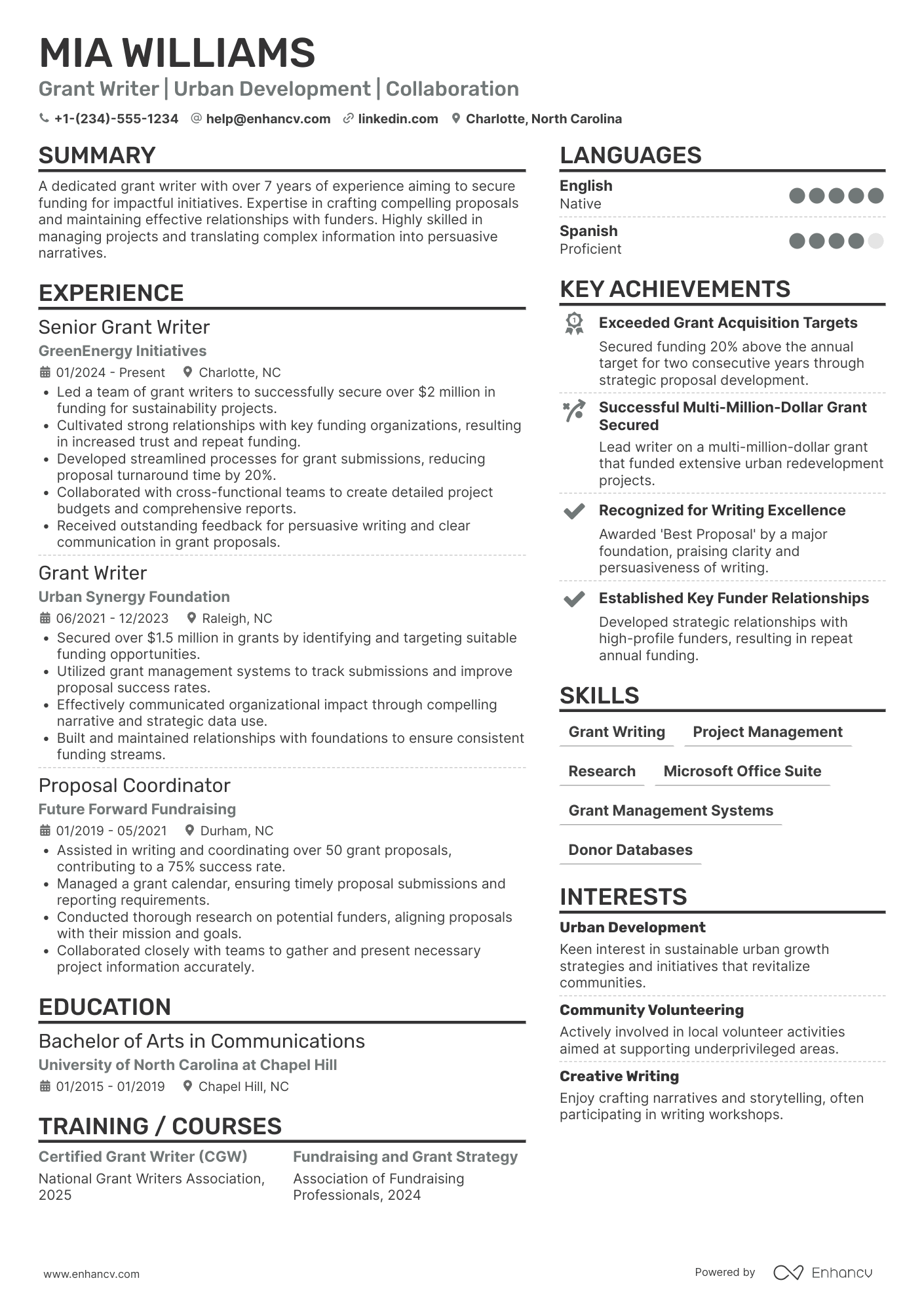
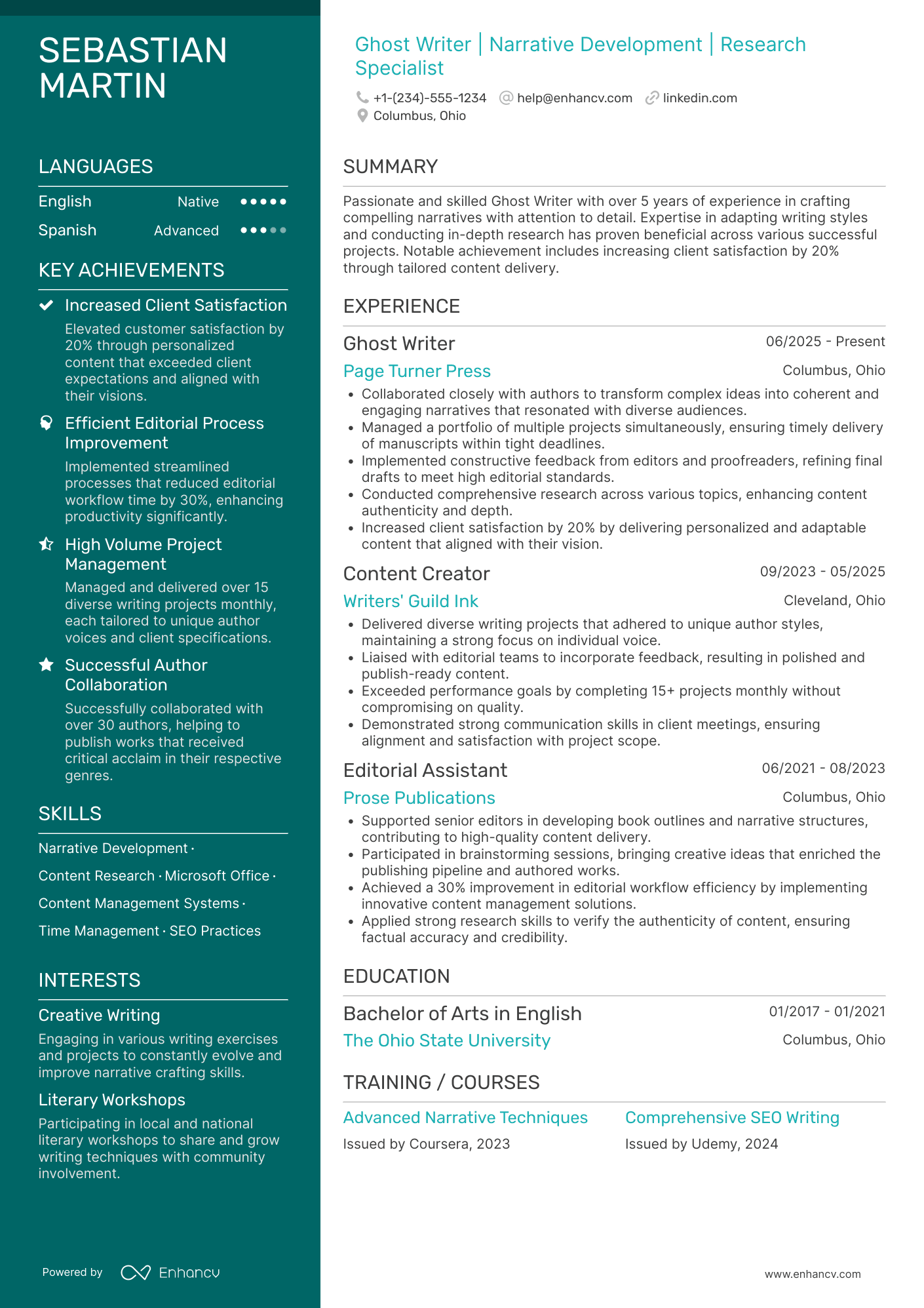
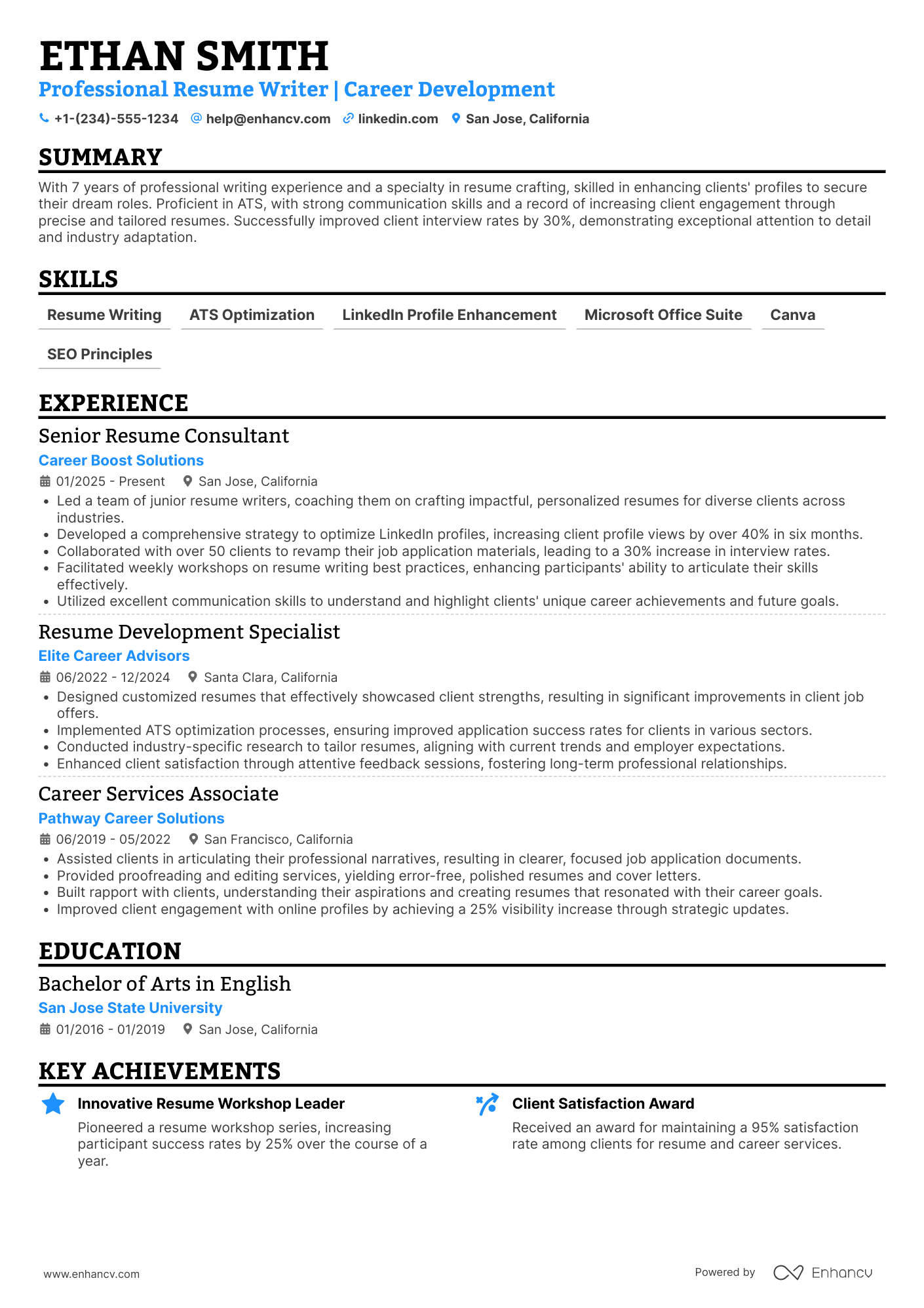
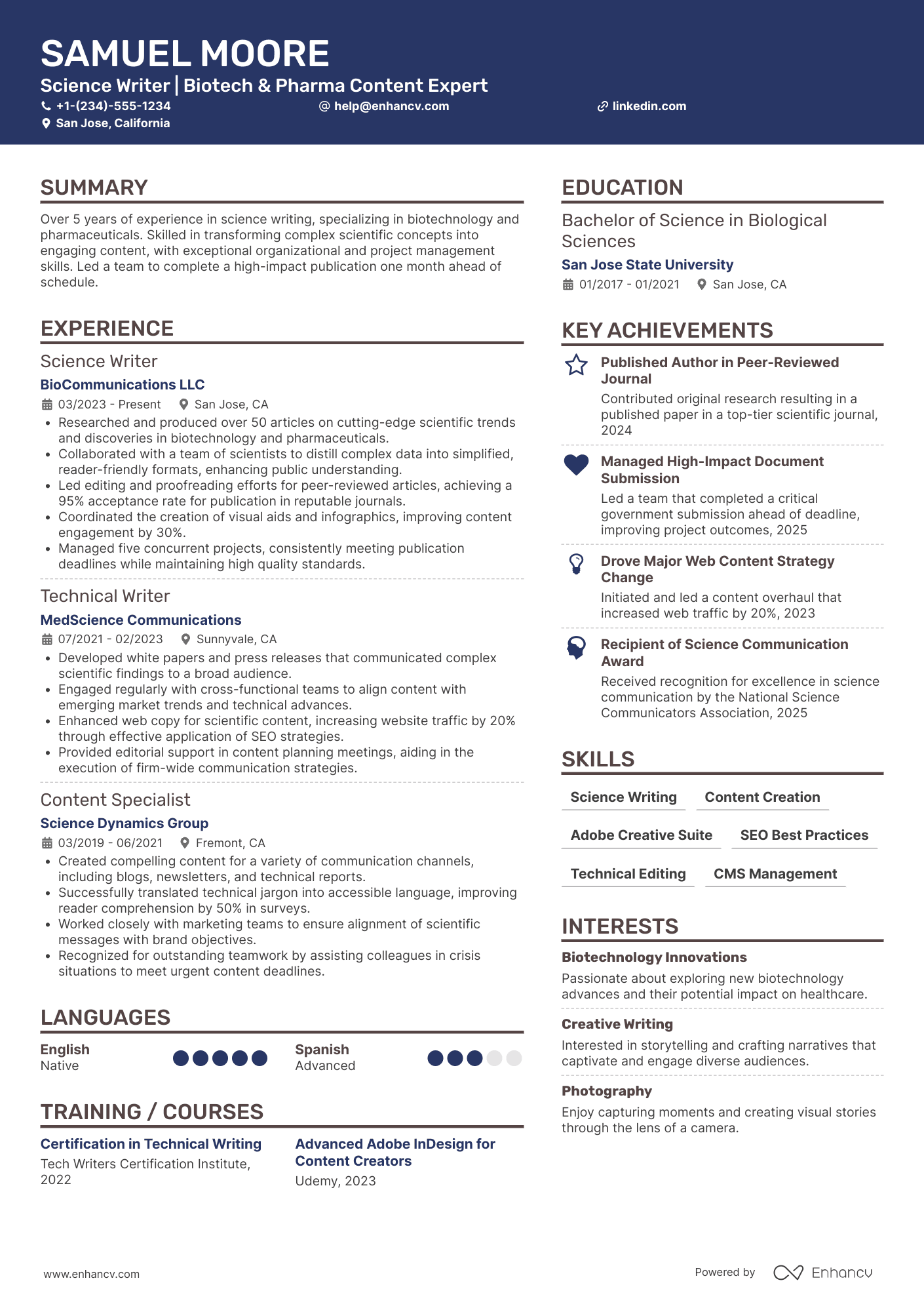
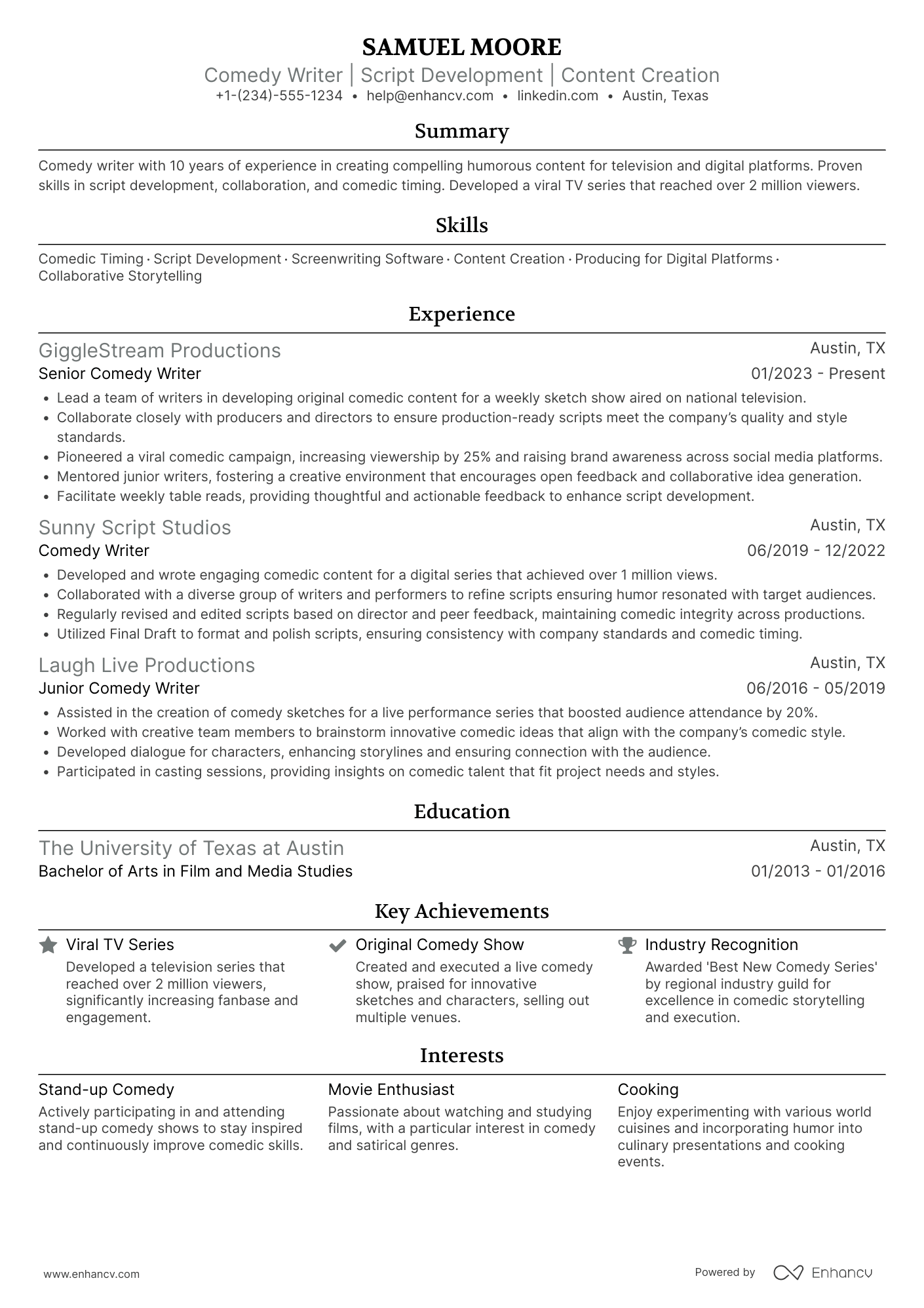
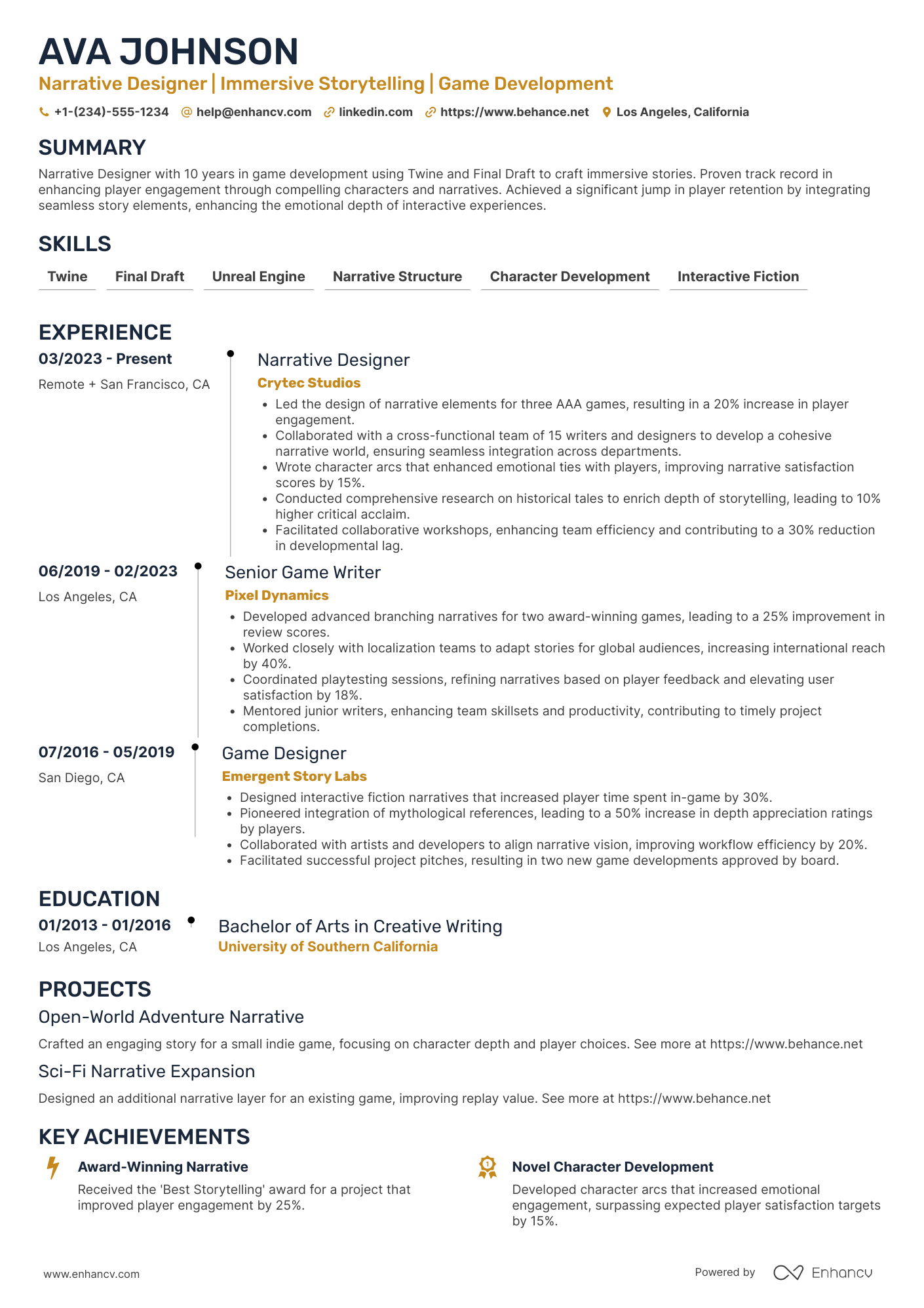
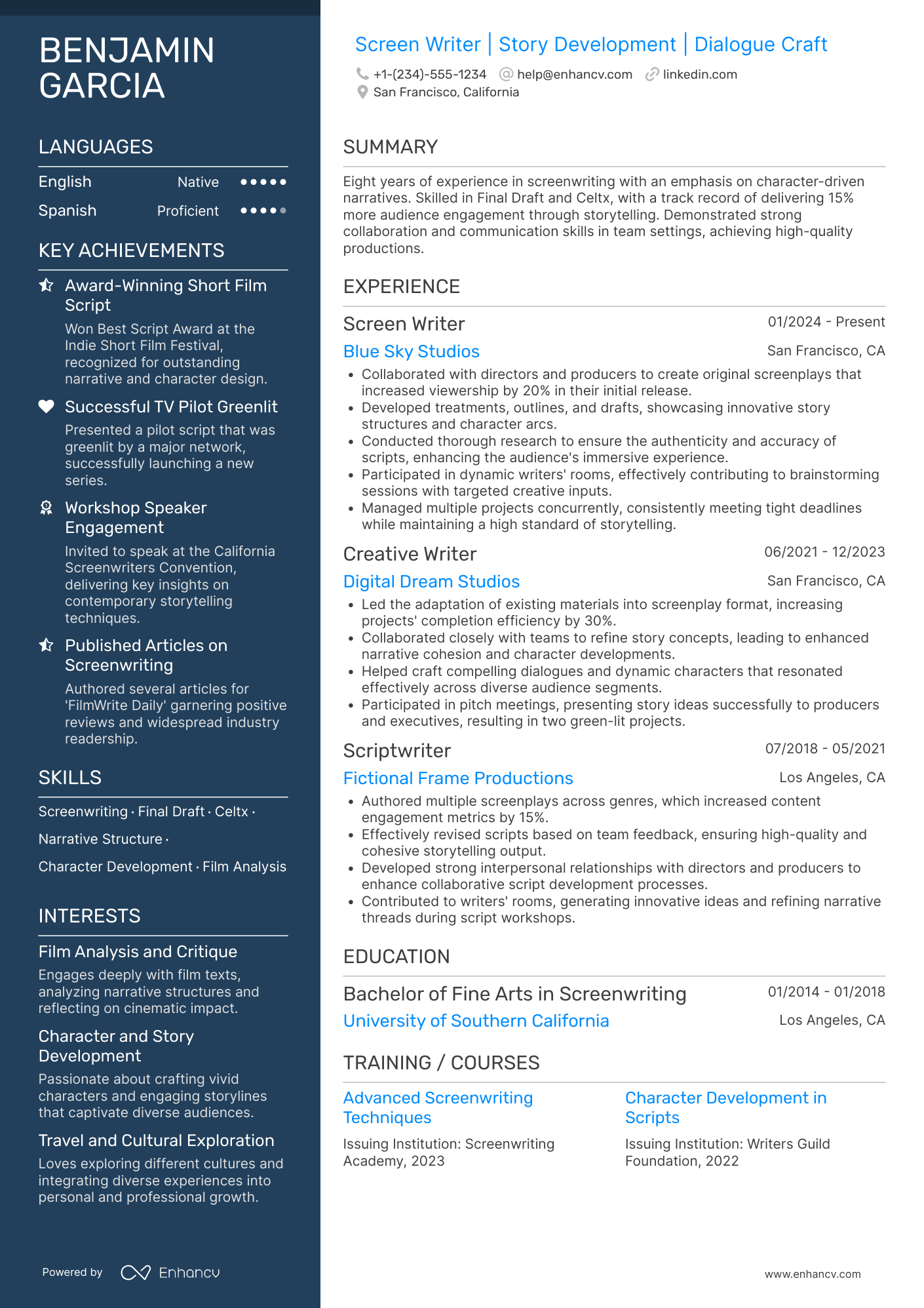
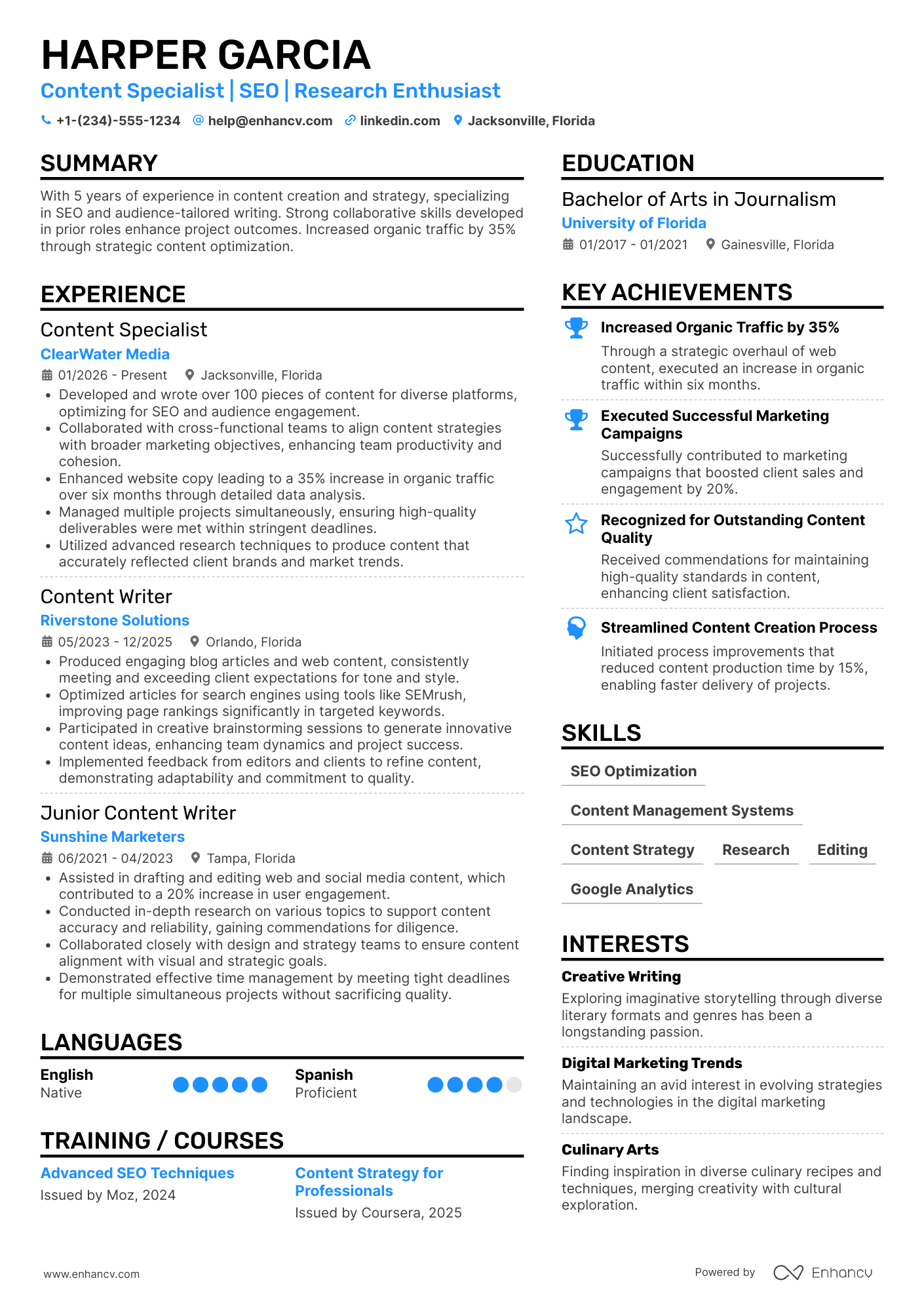
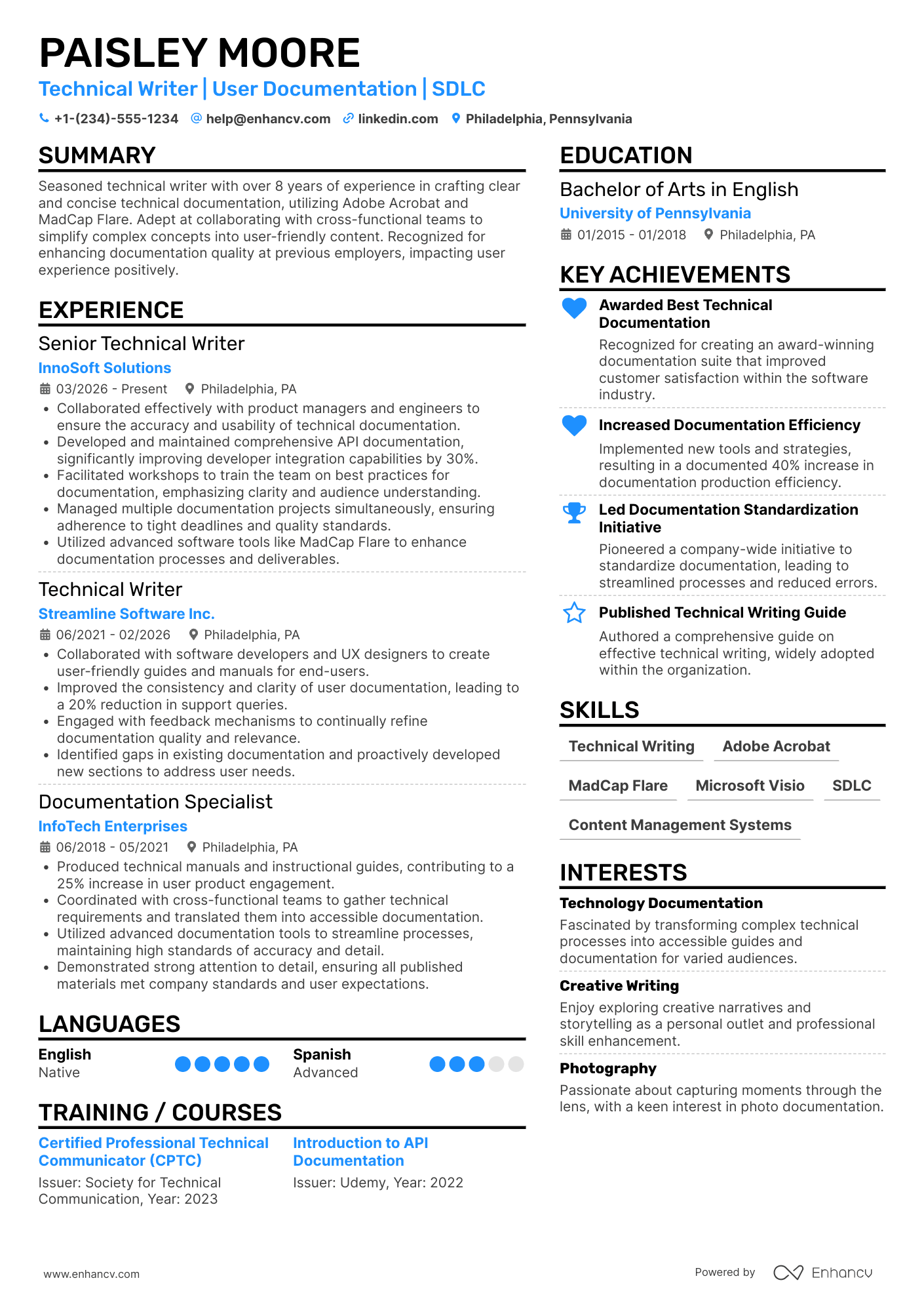
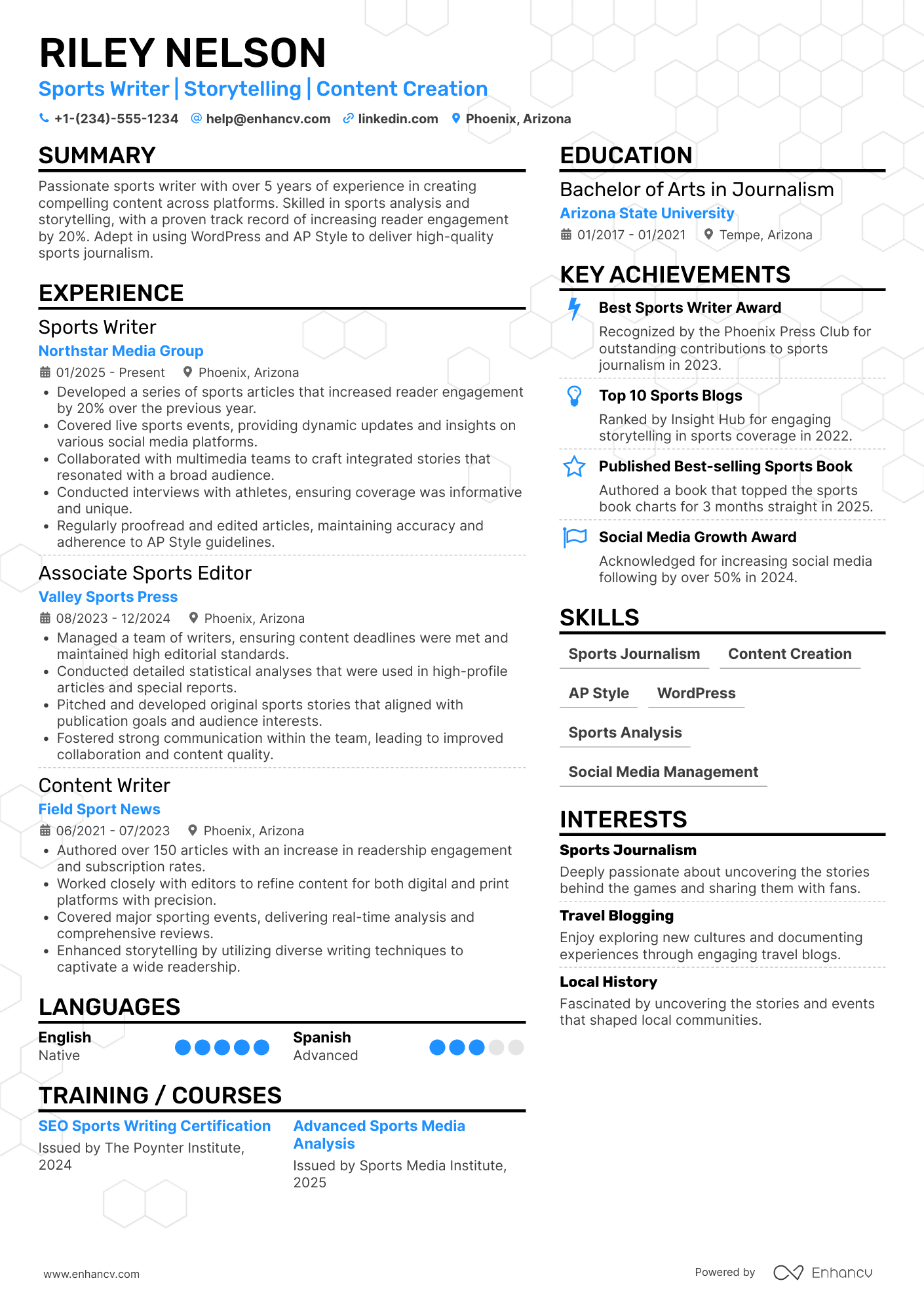
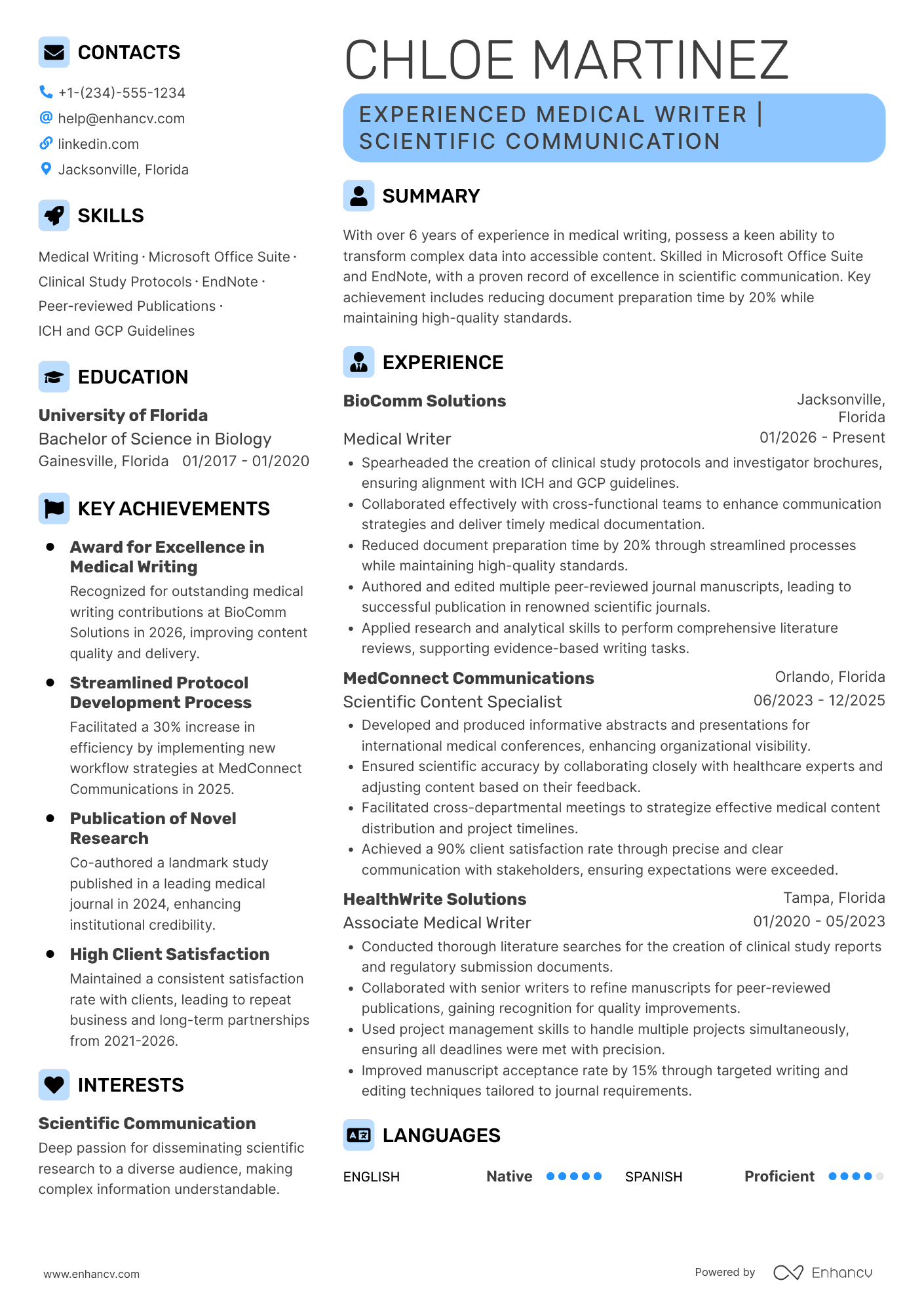
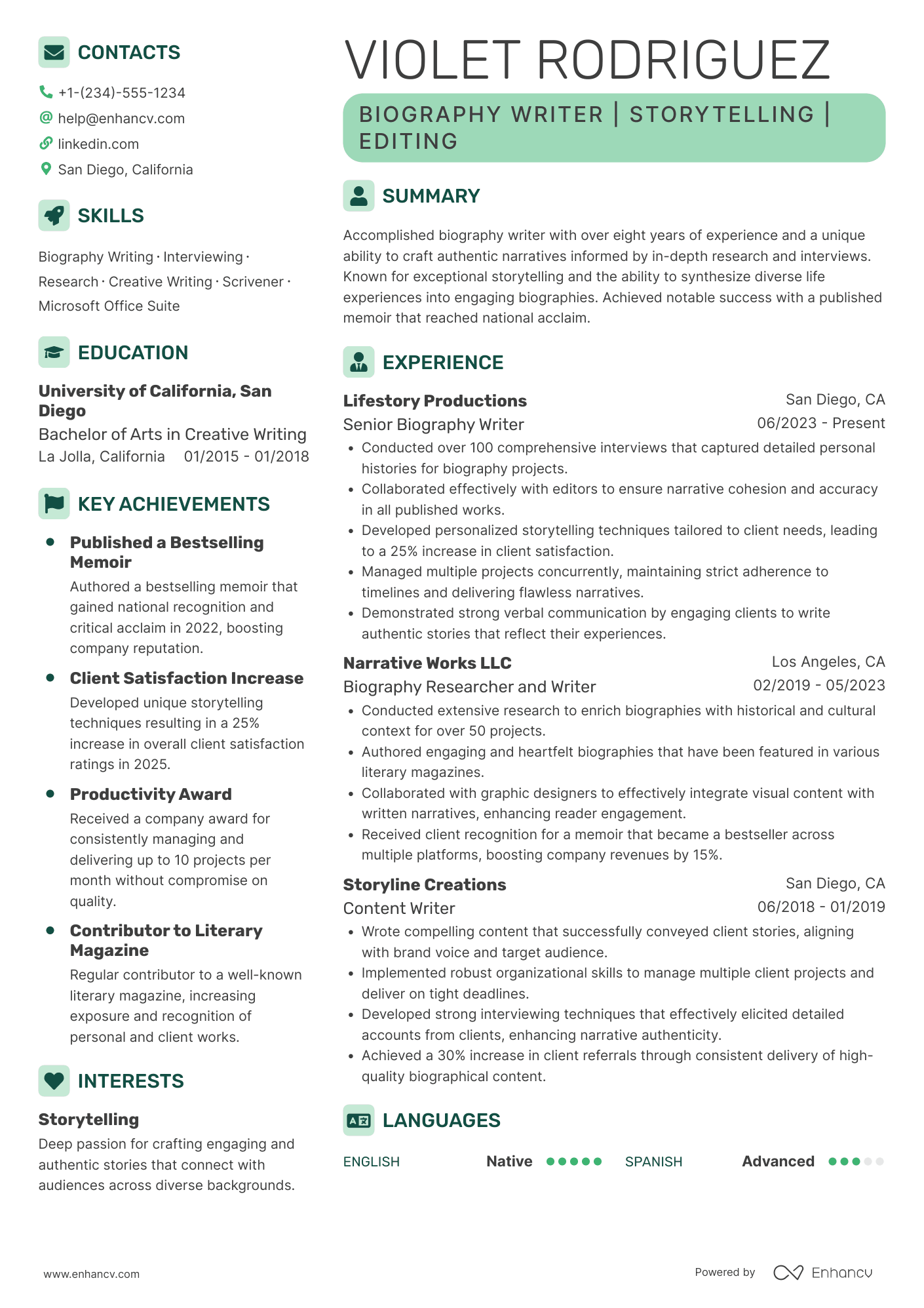
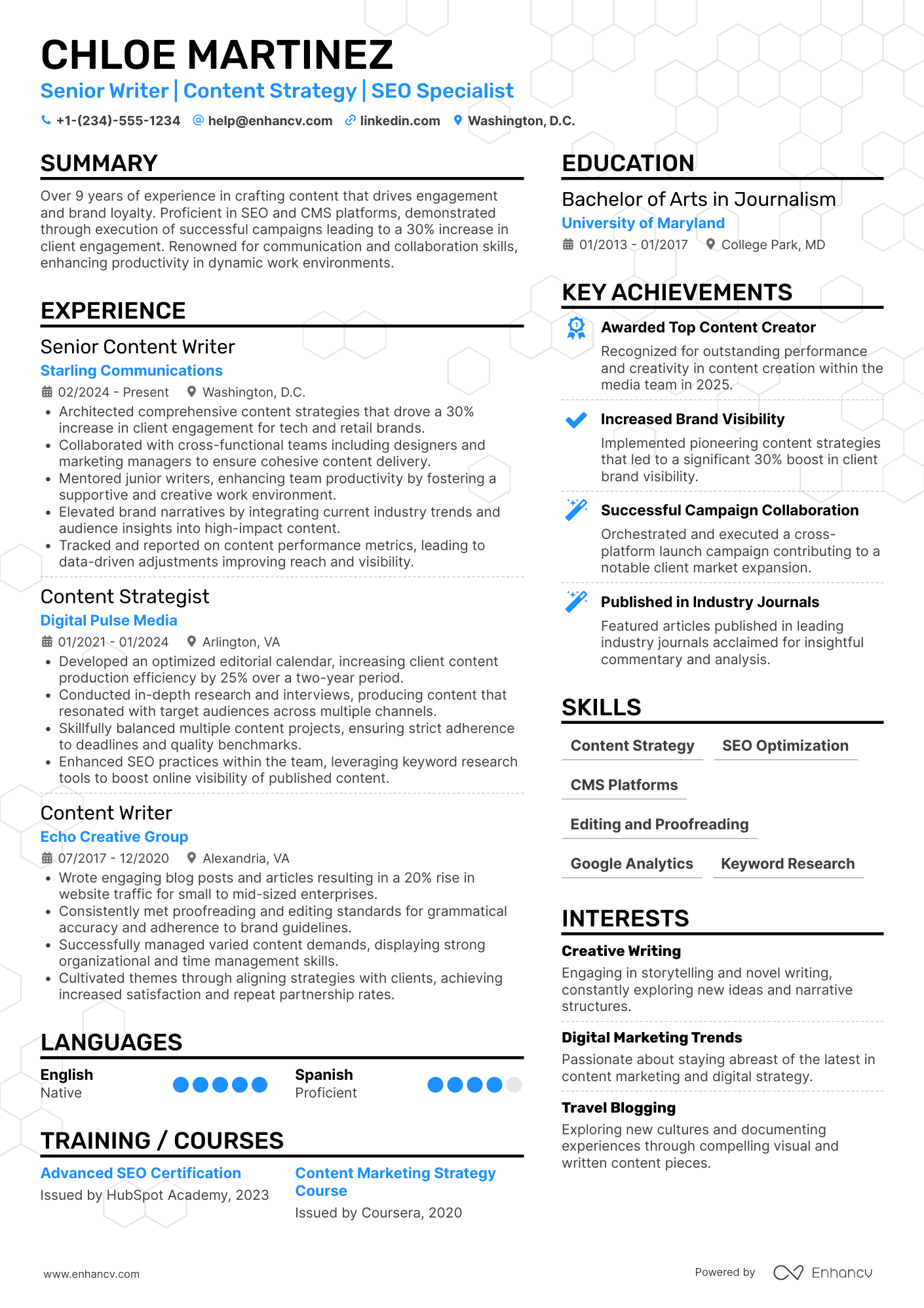
Most writer resume drafts fail because they read like job descriptions and bury the work behind vague duties. In today's hiring process, that gets filtered by ATS screening and missed in rapid recruiter scans amid heavy competition.
The resume lists the bylines and beats; a matching writer cover letter doubles as a writing sample and is what most editors actually decide on before they open the clips.
A strong resume shows what changed because of your writing. Knowing how to make your resume stand out means leading with outcomes like conversion lift, reduced support tickets, faster release cycles, improved readability scores, higher search rankings, and stakeholder adoption across teams.

Key takeaways
- Lead every experience bullet with measurable outcomes, not task descriptions.
- Choose reverse-chronological format for senior roles and hybrid format for career changers.
- Mirror the job posting's exact tools, content types, and terminology throughout your resume.
- Quantify achievements using metrics like traffic growth, conversion lift, and turnaround time.
- Demonstrate skills through summary and experience entries, not just a standalone list.
- Pair your resume with a cover letter when the role demands strong narrative judgment.
- Use Enhancv's Bullet Point Generator to turn vague duties into concrete, recruiter-ready bullets.
Job market snapshot for writers
We analyzed 1,868 recent writer job ads across major US job boards. These numbers help you understand employer expectations, employment type trends, regional hotspots at a glance.
What level of experience employers are looking for writers
| Years of Experience | Percentage found in job ads |
|---|---|
| 1–2 years | 6.6% (123) |
| 3–4 years | 7.2% (135) |
| 5–6 years | 6.9% (129) |
| 7–8 years | 2.2% (42) |
| 9–10 years | 0.6% (12) |
| 10+ years | 22.9% (428) |
| Not specified | 53.9% (1006) |
Writer ads by area of specialization (industry)
| Industry (Area) | Percentage found in job ads |
|---|---|
| Finance & Banking | 67.0% (1251) |
| Healthcare | 15.0% (280) |
| Education | 7.1% (132) |
| Manufacturing | 3.8% (71) |
| Media & Entertainment | 2.5% (46) |
| Government | 1.2% (23) |
| Professional Services | 1.1% (21) |
| Retail & E-commerce | 1.1% (21) |
| Telecommunications | 0.5% (10) |
Top companies hiring writers
| Company | Percentage found in job ads |
|---|---|
| Mondelez International, Inc. | 21.3% (397) |
| Wal-Mart | 19.3% (361) |
| Whole Foods | 4.7% (87) |
| Actalent | 2.0% (37) |
| Slalom | 2.0% (37) |
| Syneos Health, Inc | 1.2% (23) |
| Parexel | 1.0% (19) |
| Christian Brother Automotive | 1.0% (18) |
| Peraton | 0.8% (15) |
| Total Quality Logistics, Inc. | 0.8% (15) |
Role overview stats
These tables show the most common responsibilities and employment types for writer roles. Use them to align your resume with what employers expect and to understand how the role is structured across the market.
Day-to-day activities and top responsibilities for a writer
| Responsibility | Percentage found in job ads |
|---|---|
| Technical writing | 13.9% (260) |
| Customer service | 11.0% (205) |
| Microsoft word | 8.8% (164) |
| Excel | 7.8% (146) |
| Basic computer skills | 7.7% (143) |
| Communication | 7.4% (138) |
| Microsoft office | 7.3% (137) |
| Powerpoint | 5.2% (98) |
| Sharepoint | 4.6% (85) |
| Computer skills | 4.0% (75) |
| Editing | 4.0% (74) |
| Project management | 4.0% (74) |
Type of employment (remote vs on-site vs hybrid)
| Employment type | Percentage found in job ads |
|---|---|
| On-site | 81.6% (1525) |
| Remote | 9.6% (179) |
| Hybrid | 8.8% (164) |
How to format a writer resume
Recruiters evaluating writer resumes prioritize a strong portfolio of published work, versatility across content types, and evidence of measurable audience engagement or business results. Choosing the right resume format ensures these signals are immediately visible rather than buried under formatting that obscures your progression and impact.

I have significant experience as a writer—which format should I use?
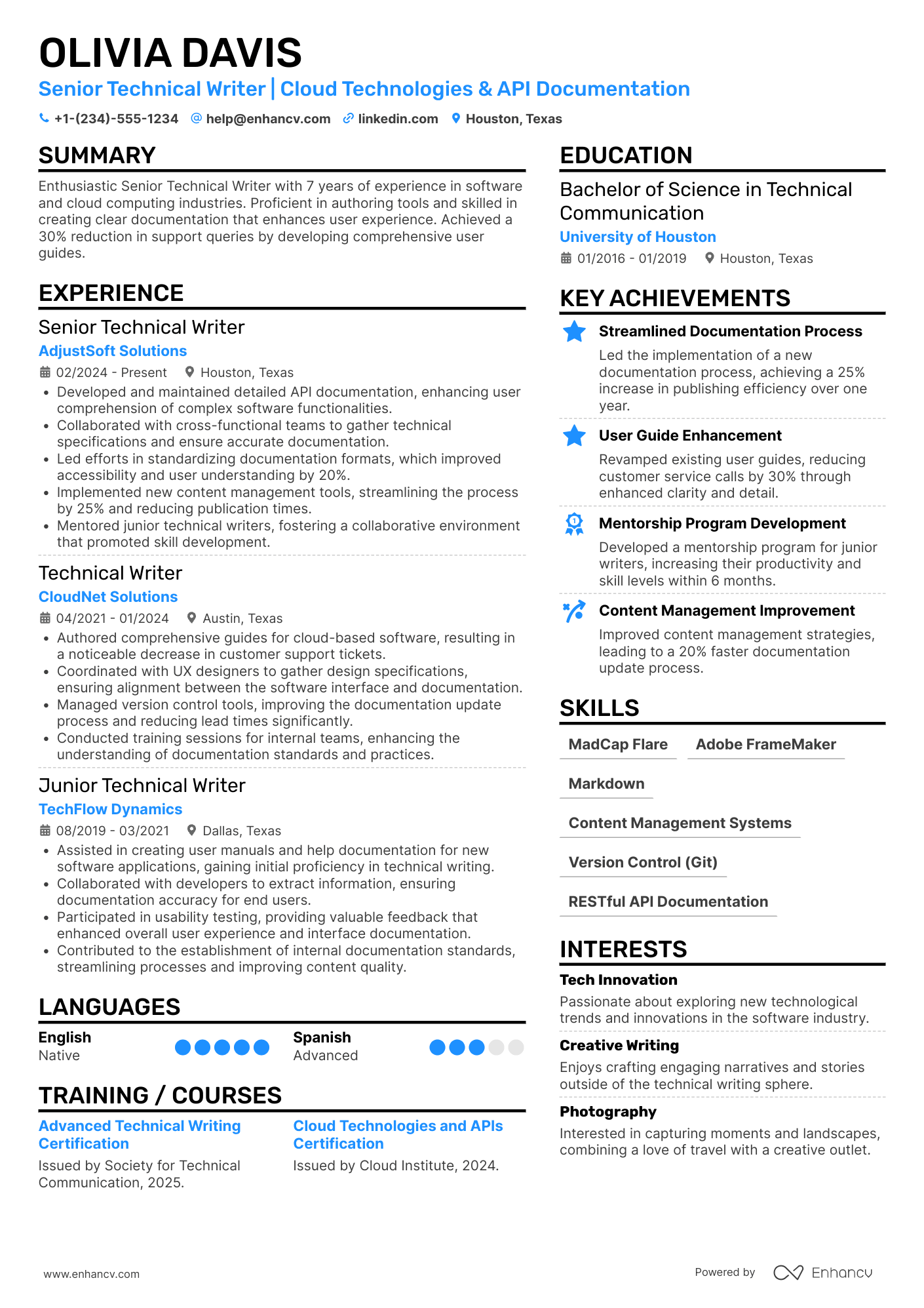
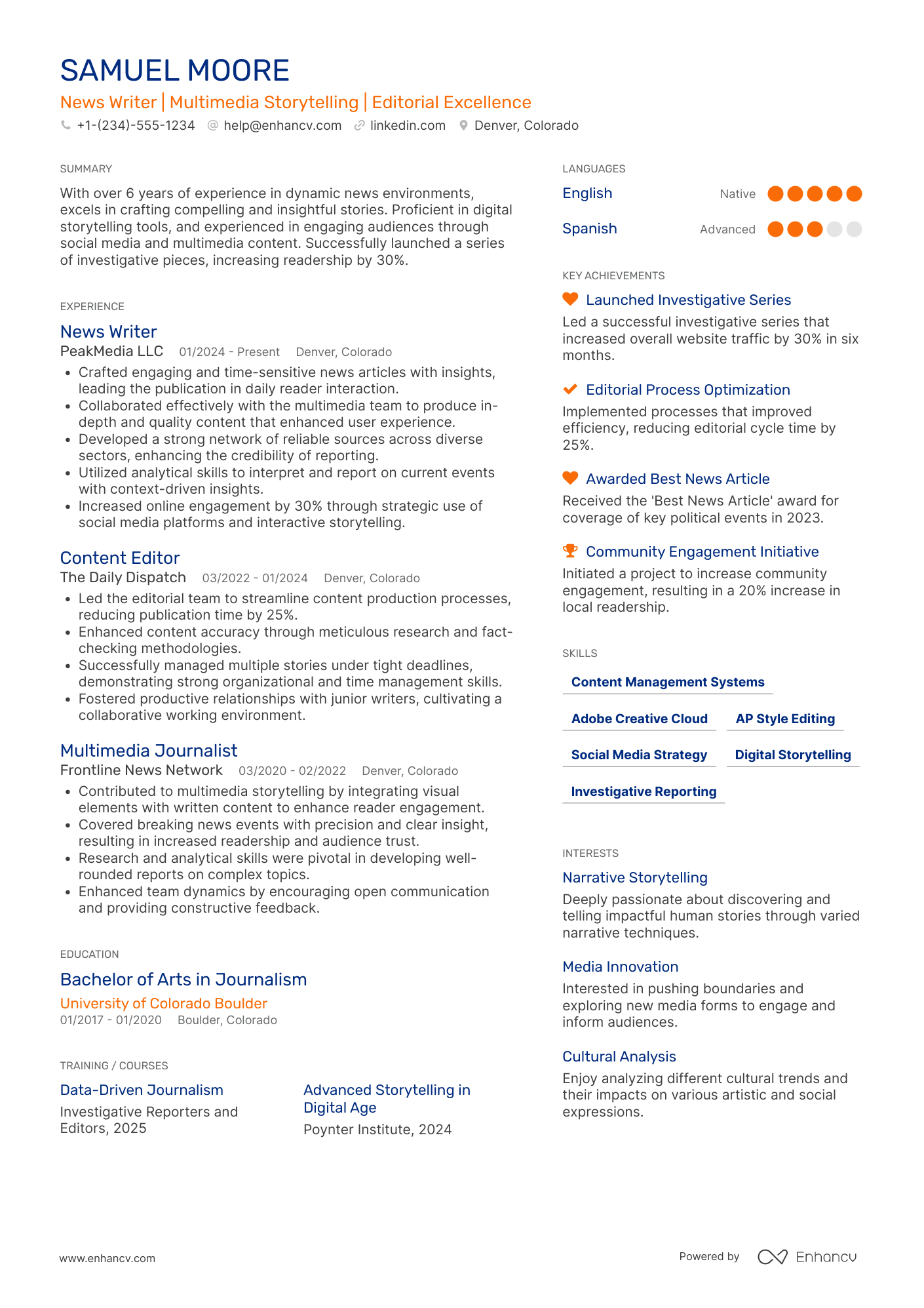
Use a reverse-chronological format to showcase your deepening expertise, expanding content responsibilities, and proven editorial impact over time. Do:
- Lead each role entry with your scope of ownership—content verticals managed, team size, editorial calendars overseen, or publication volume.
- Highlight domain-specific tools and skills such as content management systems (WordPress, Contentful), SEO platforms (Ahrefs, Semrush), analytics dashboards, and style guide development.
- Quantify outcomes tied to business goals: traffic growth, conversion lift, audience retention, or revenue attribution from content initiatives.
I'm junior or switching into a writer role—what format works best?
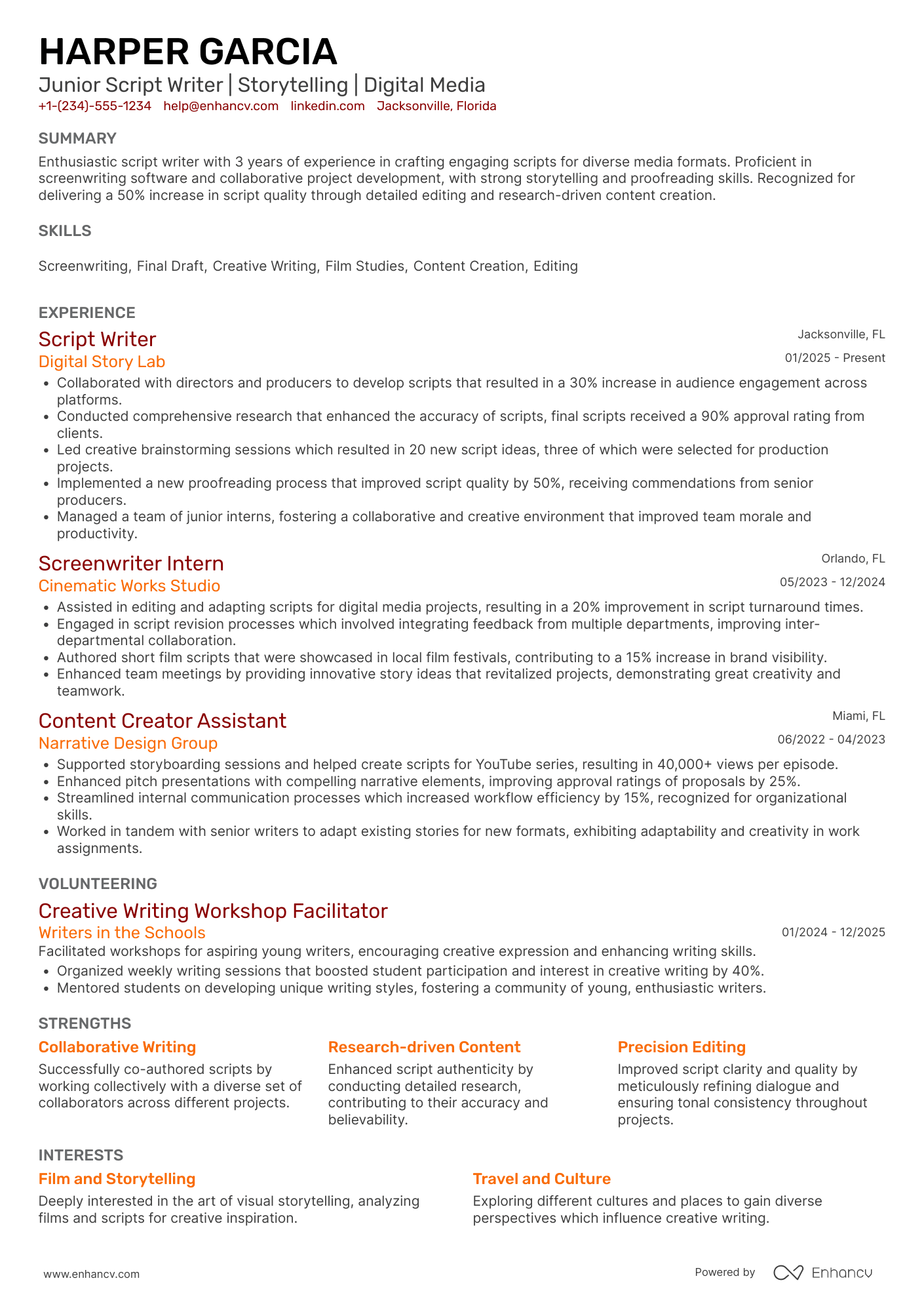
A hybrid format works best because it lets you lead with relevant writing skills and transferable competencies while still showing your work history in chronological order. Do:
- Place a dedicated skills section near the top featuring content types you're proficient in (blog posts, email campaigns, whitepapers, social copy) alongside tools like Google Analytics or AP style.
- Include freelance projects, personal blogs, academic publications, or volunteer writing work as legitimate experience entries with concrete deliverables.
- Link every action to a clear result so hiring managers see impact, not just activity.
Why not use a functional resume?
A functional resume strips away the timeline and context that hiring managers need to evaluate how your writing skills developed, where you applied them, and what results you delivered in each role. A functional format might be acceptable if you're a career changer with no professional writing history or you have significant resume gaps—but only if you anchor every listed skill to a specific project, publication, or measurable outcome rather than presenting skills in isolation.
Once you've settled on a format that highlights your strengths, the next step is filling it with the right sections to give hiring managers a complete picture of your qualifications.
What sections should go on a writer resume
Recruiters expect a writer resume to show clear, role-relevant writing experience, measurable outcomes, and a clean layout. Understanding which resume sections to include ensures you cover everything hiring managers look for.
Use this structure for maximum clarity:
- Header
- Summary
- Experience
- Skills
- Projects
- Education
- Certifications
- Optional sections: Publications, Awards, Languages
Make your experience bullets emphasize impact, outcomes, scope, and results, including metrics like traffic, conversions, engagement, revenue influence, or delivery speed.
Is your resume good enough?
Drop your resume here or choose a file. PDF & DOCX only. Max 2MB file size.
Now that you’ve chosen the key components to include, the next step is writing your resume experience section so those details translate into clear, relevant impact.
How to write your writer resume experience
The experience section is where you prove you can ship polished, audience-ready work—not just describe tasks you once performed. Hiring managers scanning a writer resume want to see delivered content, the tools or methods behind your process, and measurable outcomes that confirm your impact. Building a targeted resume ensures each entry speaks directly to the role you're pursuing.
Each entry should include:
- Job title
- Company and location (or remote)
- Dates of employment (month and year)
Three to five concise bullet points showing what you owned, how you executed, and what outcomes you delivered:
- Ownership scope: the publications, content verticals, brand voices, editorial calendars, or audience segments you were directly accountable for as a writer.
- Execution approach: the style guides, content management systems, SEO frameworks, research methods, or editorial workflows you relied on to plan, draft, and refine your writing.
- Value improved: changes to content quality, readability, search visibility, audience engagement, brand consistency, or production efficiency that resulted from your writing work.
- Collaboration context: how you partnered with editors, designers, subject-matter experts, marketing teams, or clients to align content with broader goals.
- Impact delivered: outcomes framed as published results, audience growth, content performance gains, or business contributions rather than a list of assignments completed.
Experience bullet formula
A writer experience example
✅ Right example - modern, quantified, specific.
Senior Content Writer (Product Marketing)
NimbusPay | Remote
2022–Present
Fintech platform serving 150,000 small businesses with invoicing, payments, and cash-flow tools.
- Led end-to-end launch messaging for three product releases using Figma, Notion, and Jira, increasing trial-to-paid conversion by 11% quarter over quarter.
- Built a quarterly editorial calendar and SEO content system in Google Analytics 4, Search Console, and Ahrefs, growing non-branded organic traffic by 38% and reducing cost per lead by 14%.
- Partnered with product managers, designers, and engineers to rewrite in-app microcopy and onboarding flows, cutting first-week support tickets by 19% and improving activation by 7%.
- Produced customer stories and sales enablement assets in HubSpot and Salesforce, supporting $2.4M in influenced pipeline and shortening sales cycle time by 12%.
- Established a voice and style guide and ran peer reviews in Grammarly Business, raising content quality scores from 3.8 to 4.6 out of five and reducing legal revisions by 22%.
Now that you've seen how a strong experience section comes together, let's break down how to tailor each element to match the specific writer role you're targeting.
How to tailor your writer resume experience
Recruiters evaluate your resume through applicant tracking systems and manual review, scanning for alignment with specific job requirements. Tailoring your resume to the job description increases your chances of passing both filters.
Ways to tailor your writer experience:
- Match content management systems and publishing tools listed in the posting.
- Mirror the style guides or editorial standards the employer follows.
- Use the exact terminology for content types the role requires.
- Highlight audience research or SEO methods referenced in the description.
- Include industry or subject matter expertise when the posting specifies it.
- Reflect collaboration workflows with designers or product teams if mentioned.
- Emphasize content performance tracking or engagement metrics they prioritize.
- Align your accessibility or brand compliance experience with stated requirements.
Effective tailoring connects your real accomplishments to what the employer needs rather than forcing unrelated keywords into your experience.
Resume tailoring examples for writer
| Job description excerpt | Untailored | Tailored |
|---|---|---|
| "Create SEO-optimized blog content using Clearscope and WordPress, targeting B2B SaaS audiences to drive organic traffic growth." | Wrote blog posts and articles for various company websites. | Produced 12+ monthly SEO-optimized blog posts in WordPress using Clearscope, increasing organic traffic to B2B SaaS product pages by 40% over six months. |
| "Develop long-form whitepapers and case studies in collaboration with subject matter experts in the cybersecurity industry." | Collaborated with team members to create different types of written content. | Co-authored eight cybersecurity whitepapers and 15 client case studies with subject matter experts, supporting a pipeline that generated $2.1M in qualified leads. |
| "Write and edit UX microcopy for mobile app interfaces, partnering with product design in Figma to improve user task completion rates." | Edited and proofread content to ensure quality across digital platforms. | Wrote and iterated on UX microcopy for 30+ mobile app screens in Figma alongside product designers, lifting user task completion rates by 18%. |
Once you’ve aligned your experience with the role’s needs, the next step is to quantify your writer achievements so employers can quickly see the impact of that fit.
How to quantify your writer achievements
Quantifying your achievements proves business impact, not just polish. Track cycle time, accuracy, conversions, satisfaction, and risk reduction to show how your work improved outcomes and sped delivery.
Quantifying examples for writer
| Metric | Example |
|---|---|
| Turnaround time | "Cut blog production from 12 to seven days by building a Trello workflow and reusable outlines across eight monthly posts." |
| Accuracy rate | "Reduced factual errors from 6% to 1% by adding a source checklist and Grammarly review on 40 client-facing articles." |
| Conversion lift | "Improved landing page sign-ups by 18% through A/B testing headlines in Optimizely across 25,000 monthly visitors." |
| Compliance risk | "Lowered legal revisions by 30% by standardizing claims language and adding a pre-submit checklist for regulated product copy." |
| Volume delivered | "Wrote and published 120 help center articles in six months, supporting a Zendesk migration and cutting ticket volume by 14%." |
Turn vague job duties into measurable, recruiter-ready resume bullets in seconds with Enhancv's Bullet Point Generator.
Once you've crafted strong bullet points to showcase your experience, the next step is highlighting the specific hard and soft skills that reinforce your qualifications as a writer.
How to list your hard and soft skills on a writer resume
Your skills section shows recruiters and an ATS (applicant tracking system) you can deliver publish-ready content, match the role's writing needs, and work cross-functionally; aim for a balanced mix of role-specific hard skills and execution-focused soft skills. writer roles require a blend of:
- Product strategy and discovery skills.
- Data, analytics, and experimentation skills.
- Delivery, execution, and go-to-market discipline.
- Soft skills.
Your skills section should be:
- Scannable (bullet-style grouping).
- Relevant to the job post.
- Backed by proof in experience bullets.
- Updated with current tools.
Place your skills section:
- Above experience if you're junior or switching careers.
- Below experience if you're mid/senior with strong achievements.

Hard skills
- Search engine optimization keyword research
- Content briefs and outlines
- Editorial calendars
- Style guides, AP Style
- Content management systems, WordPress
- Google Docs, Microsoft Word
- Grammarly, Hemingway Editor
- Google Analytics 4 reporting
- Search Console, Ahrefs, Semrush
- Conversion copywriting
- Email writing, Mailchimp
- Basic HTML, Markdown
Soft skills
- Translate feedback into revisions
- Interview subject matter experts
- Align stakeholders on messaging
- Ask clarifying questions early
- Prioritize deadlines and scope
- Manage multiple drafts in parallel
- Maintain version control discipline
- Defend editorial choices with evidence
- Adapt tone to audience and channel
- Flag risks and unblock approvals
- Collaborate smoothly with designers
- Self-edit for accuracy and clarity
How to show your writer skills in context
Skills shouldn't live only in a tidy list on your resume. Explore resume skills examples to see how other writers present their abilities effectively.
They should be demonstrated in:
- Your summary (high-level professional identity)
- Your experience (proof through outcomes)
Here's what this looks like in practice.
Summary example
Senior content writer with 8+ years crafting long-form B2B content using SEMrush and WordPress. Led a cross-functional rebrand that boosted organic traffic 45%. Known for translating complex topics into clear, audience-driven narratives.
- Signals senior-level expertise immediately
- Names industry-standard tools
- Leads with a measurable outcome
- Highlights communication as a soft skill
Experience example
Senior Content Writer
Ridgeline Digital | Remote
March 2019–August 2024
- Wrote 200+ SEO articles using Clearscope and Google Analytics, increasing organic sessions by 37% year over year.
- Collaborated with design and product teams to launch a resource hub that generated 12,000 monthly leads.
- Developed an editorial style guide adopted company-wide, reducing revision cycles by 25%.
- Every bullet includes measurable proof.
- Skills appear through real outcomes naturally.
Once you’ve demonstrated your writing ability through relevant examples, the next step is translating that proof into a strong writer resume even if you don’t have professional experience.
How do I write a writer resume with no experience
Even without full-time experience, you can demonstrate readiness through writing a resume without work experience that highlights your potential:
- Published blog or newsletter posts
- Campus newspaper or magazine clips
- Volunteer nonprofit web copy
- Freelance gigs on job boards
- Writing portfolio with case studies
- Paid internships or apprenticeships
- Writing contest placements or awards
- Guest posts on industry sites
Focus on:
- Published clips and portfolio links
- Clear niche and target audience
- Metrics: traffic, conversions, opens
- Tools: Google Docs, WordPress, Grammarly
Resume format tip for entry-level writer
Use a combination resume format to spotlight writing samples, tools, and outcomes before limited work history, so recruiters see proof fast. Do:
- Add a portfolio link near your name.
- Lead bullets with strong writing verbs.
- Quantify results using real metrics.
- List tools used in each project.
- Tailor keywords to the job post.
- Wrote and published eight blog posts in WordPress using keyword research and Grammarly, increasing average monthly organic sessions from 0 to 1,200 in twelve weeks.
Even without formal work history, your educational background can demonstrate relevant writing knowledge and training, making it a key section to get right.
How to list your education on a writer resume
Your education section helps hiring teams confirm you have foundational knowledge in writing, communication, or a related field. It validates your background quickly and efficiently.
Include:
- Degree name
- Institution
- Location
- Graduation year
- Relevant coursework (for juniors or entry-level candidates)
- Honors & GPA (if 3.5 or higher)
Skip month and day details—list the graduation year only.
Here's a strong education entry tailored for a writer resume.
Example education entry
Bachelor of Arts in English, Creative Writing Concentration
University of Michigan, Ann Arbor, MI
Graduated 2021
GPA: 3.7/4.0
- Relevant Coursework: Advanced Composition, Digital Storytelling, Rhetoric and Media Studies, Editing for Publication
- Honors: Magna Cum Laude, Dean's List (six semesters)
How to list your certifications on a writer resume
Certifications on your resume show a writer's commitment to learning, proficiency with modern tools, and alignment with industry standards, which helps hiring teams trust your skills faster.
Include:
- Certificate name
- Issuing organization
- Year
- Optional: credential ID or URL
- Place certifications below education when they're older, less relevant to the role, or secondary to your degree and core writing experience.
- Place certifications above education when they're recent and directly relevant, especially for tool-heavy roles or specialized writing niches.
Best certifications for your writer resume
- HubSpot Content Marketing Certification
- Google Analytics Certification
- Society for Technical Communication Certified Professional Technical Communicator
- American Medical Writers Association Essential Skills Certificate
- Chartered Institute of Marketing Professional Diploma in Digital Marketing
- Project Management Institute Certified Associate in Project Management
- Adobe Certified Professional in Adobe InDesign
Once you’ve placed your certifications where they add the most value, you can use that same credibility to shape your writer resume summary, which comes next.
How to write your writer resume summary
Your resume summary is the first thing a recruiter reads. A strong opening line immediately signals you're the right fit for the role.
Keep it to three to four lines, with:
- Your title and total years of writing experience.
- The domain or content type you specialize in, such as B2B SaaS, journalism, or UX copy.
- Core skills and tools like SEO, CMS platforms, AP style, or content strategy frameworks.
- One or two measurable achievements, such as traffic growth or engagement improvements.
- Soft skills tied to real outcomes, like collaboration that shortened editorial cycles.

PRO TIP
At the junior level, emphasize relevant skills, tools you've used, and early contributions that show initiative. Highlight specific content types and measurable results, even from internships or freelance work. Avoid vague descriptors like "passionate" or "hardworking." Skip motivational language entirely and let concrete details prove your value.
Example summary for a writer
Detail-oriented content writer with two years of experience producing SEO blog content for B2B SaaS brands. Increased organic traffic by 35% through keyword-driven articles managed in WordPress and optimized using Clearscope.
Optimize your resume summary and objective for ATS
Drop your resume here or choose a file.
PDF & DOCX only. Max 2MB file size.
Now that your summary captures your writing expertise at a glance, make sure the header above it presents your contact details correctly so recruiters can actually reach you.
What to include in a writer resume header
A resume header is the top section with your key identifiers, and it drives visibility, credibility, and fast recruiter screening for a writer.
Essential resume header elements
- Full name
- Tailored job title and headline
- Location
- Phone number
- Professional email
- GitHub link
- Portfolio link
A LinkedIn link helps recruiters confirm your work history fast and supports screening across roles and dates.
Don't include a photo on a writer resume unless the role is explicitly front-facing or appearance-dependent.
Match your header job title to the job posting and keep every link short, readable, and consistent across platforms.
Writer resume header
Jordan Parker
Writer | Technical and UX Writing
Austin, TX
(512) 555-01XX
your.name@enhancv.com
github.com/yourname
yourwebsite.com
linkedin.com/in/yourname
Once your header clearly identifies you and your writing focus, the next step is to add optional sections that reinforce your qualifications and fit the role.
Additional sections for writer resumes
When your core sections don't fully capture your expertise, additional sections can showcase what sets you apart from other writers. For example, listing language skills on your resume can be a strong differentiator for roles requiring multilingual content.
- Publications
- Languages
- Awards and honors
- Professional affiliations
- Certifications
- Hobbies and interests
- Portfolio or writing samples
Once you've rounded out your resume with the right supplementary sections, it's worth pairing it with a strong cover letter to make your application even more competitive.
Do writer resumes need a cover letter
A cover letter isn't required for a writer, but it often helps. If you're unsure what a cover letter is and when it adds value, it matters most for competitive roles or teams that expect strong narrative skills. It can make the difference when your resume needs context.
Use a cover letter to add value in these situations:
- Explain role and team fit by matching your writing strengths to the deliverables, workflows, and stakeholders in the job description.
- Highlight one or two relevant projects or outcomes, and name the impact using clear metrics, scope, or before-and-after results.
- Show understanding of the product, users, or business context by referencing a specific feature, audience need, or content challenge you can solve.
- Address career transitions or non-obvious experience by connecting past work to the role's core writing tasks and constraints.
Drop your resume here or choose a file.
PDF & DOCX only. Max 2MB file size.
Even if you decide a separate letter won’t add value for your application, the next step is strengthening your writer resume itself—using AI to improve your writer resume can help you do that faster and more consistently.
Using AI to improve your writer resume
AI can sharpen your resume's clarity, structure, and impact. It helps you find stronger phrasing and tighter organization. But overuse strips authenticity. Once your content sounds clear and role-aligned, step away from AI. If you're wondering which AI is best for writing resumes, start with tools that focus on structure and phrasing rather than generating content from scratch.
Here are 10 prompts you can copy and paste to strengthen specific sections of your writer resume:
- Strengthen your summary. "Rewrite my writer resume summary to highlight my strongest content expertise and measurable achievements in under four sentences."
- Quantify experience bullets. "Add specific metrics or measurable outcomes to each experience bullet on my writer resume where results are implied but not stated."
- Tighten wordy bullets. "Shorten each experience bullet on my writer resume to one concise line without losing key details or action verbs."
- Align skills strategically. "Compare my writer resume skills section to this job description and suggest which skills to add, remove, or reorder."
- Improve action verbs. "Replace weak or repetitive verbs in my writer resume experience section with stronger, more precise alternatives."
- Refine project descriptions. "Rewrite the projects section of my writer resume to clearly state each project's purpose, my role, and the outcome."
- Clarify education relevance. "Edit my writer resume education section to emphasize coursework, honors, or training directly relevant to this writing role."
- Showcase certifications clearly. "Reorganize the certifications on my writer resume by relevance to content strategy and editorial roles."
- Eliminate filler language. "Identify and remove vague or filler phrases across my entire writer resume that don't add specific value."
- Tailor for one role. "Adjust my writer resume so every section directly supports this specific job posting without fabricating any experience."
Stop using AI once your resume sounds accurate, specific, and aligned with real experience. AI should never invent experience or inflate claims—if it didn't happen, it doesn't belong here.
Conclusion
A strong writer resume proves impact with measurable outcomes, shows role-specific skills, and stays easy to scan. Clear structure, targeted keywords, and clean formatting help hiring teams find your value fast.
When your experience reads like published work—precise, relevant, and results-driven—you look ready for today’s hiring market. This approach keeps your writer resume competitive as expectations shift toward proof, clarity, and speed.