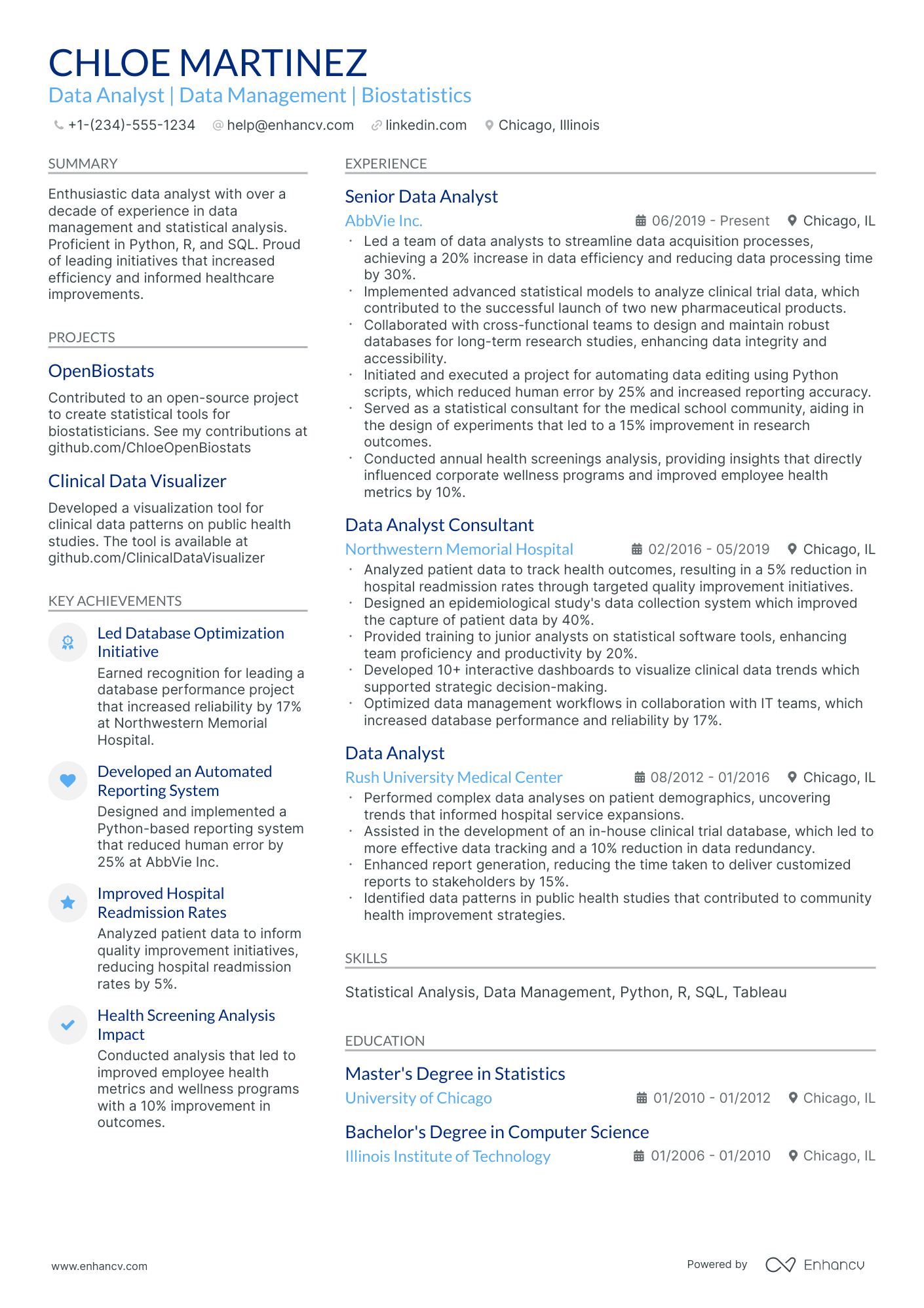
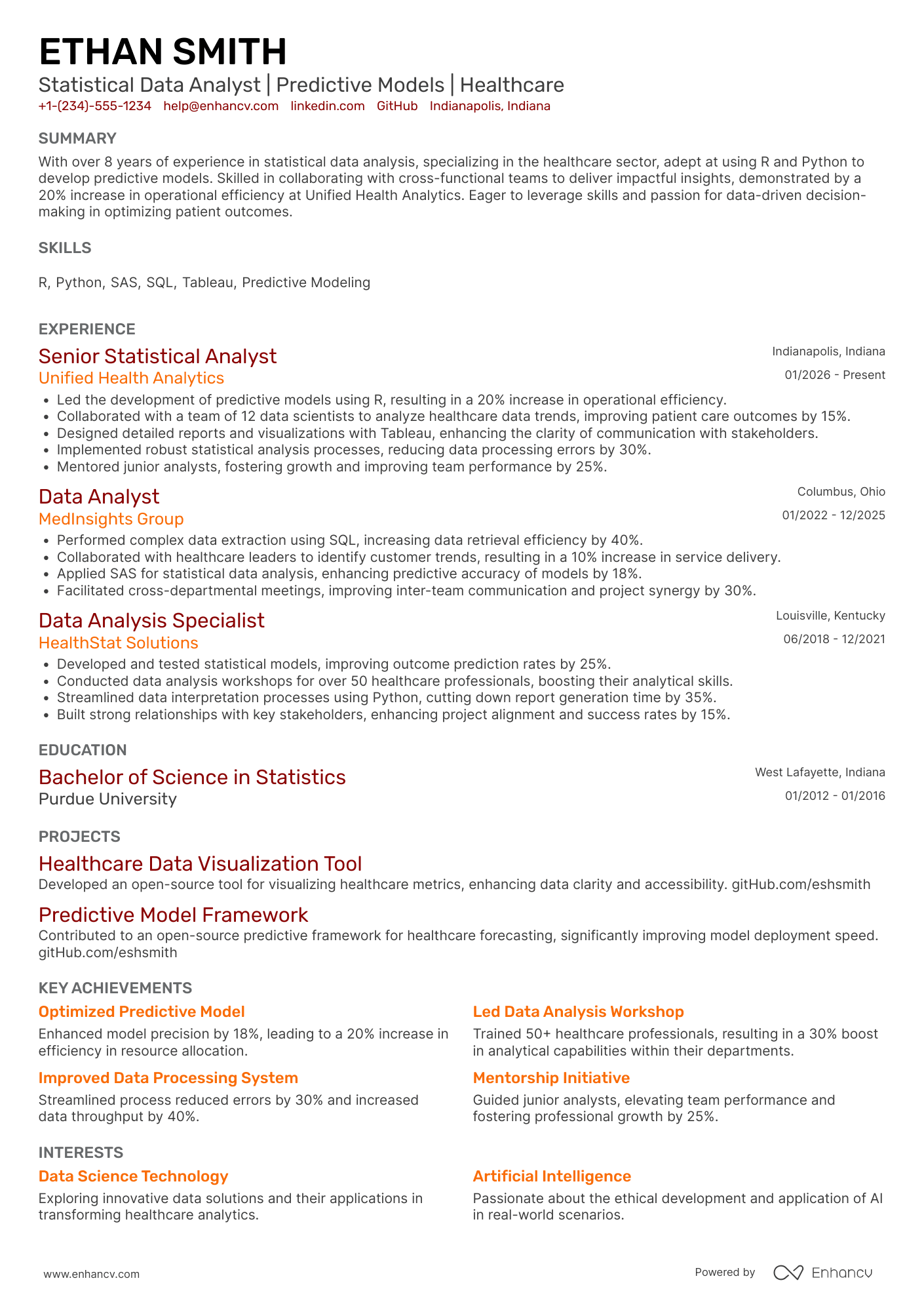
Most statistical data analyst resume submissions fail because they describe tools and tasks but don't connect analysis to decisions and results. That gap gets you filtered out in ATS screening and overlooked in rapid recruiter scans in a crowded market. Understanding how to make your resume stand out is essential in such a competitive field.
A strong resume shows what changed because of your work, with clear scope and measurable outcomes. You'll highlight lift in forecast accuracy, reduced reporting cycle time, improved data quality, supported revenue or cost decisions, delivered dashboards adopted by stakeholders.

Key takeaways
- Connect every statistical method and tool to a measurable business outcome on your resume.
- Use reverse-chronological format for experienced analysts and hybrid format for career switchers.
- Tailor experience bullets to mirror the exact language and priorities in each job posting.
- Quantify achievements using metrics like accuracy gains, cost savings, and reporting speed improvements.
- Demonstrate skills in context within your summary and experience—not just in a standalone list.
- Anchor projects, coursework, and certifications to specific results when you lack full-time experience.
- Use Enhancv to quickly refine bullet points and align your resume with statistical data analyst roles.
How to format a statistical data analyst resume
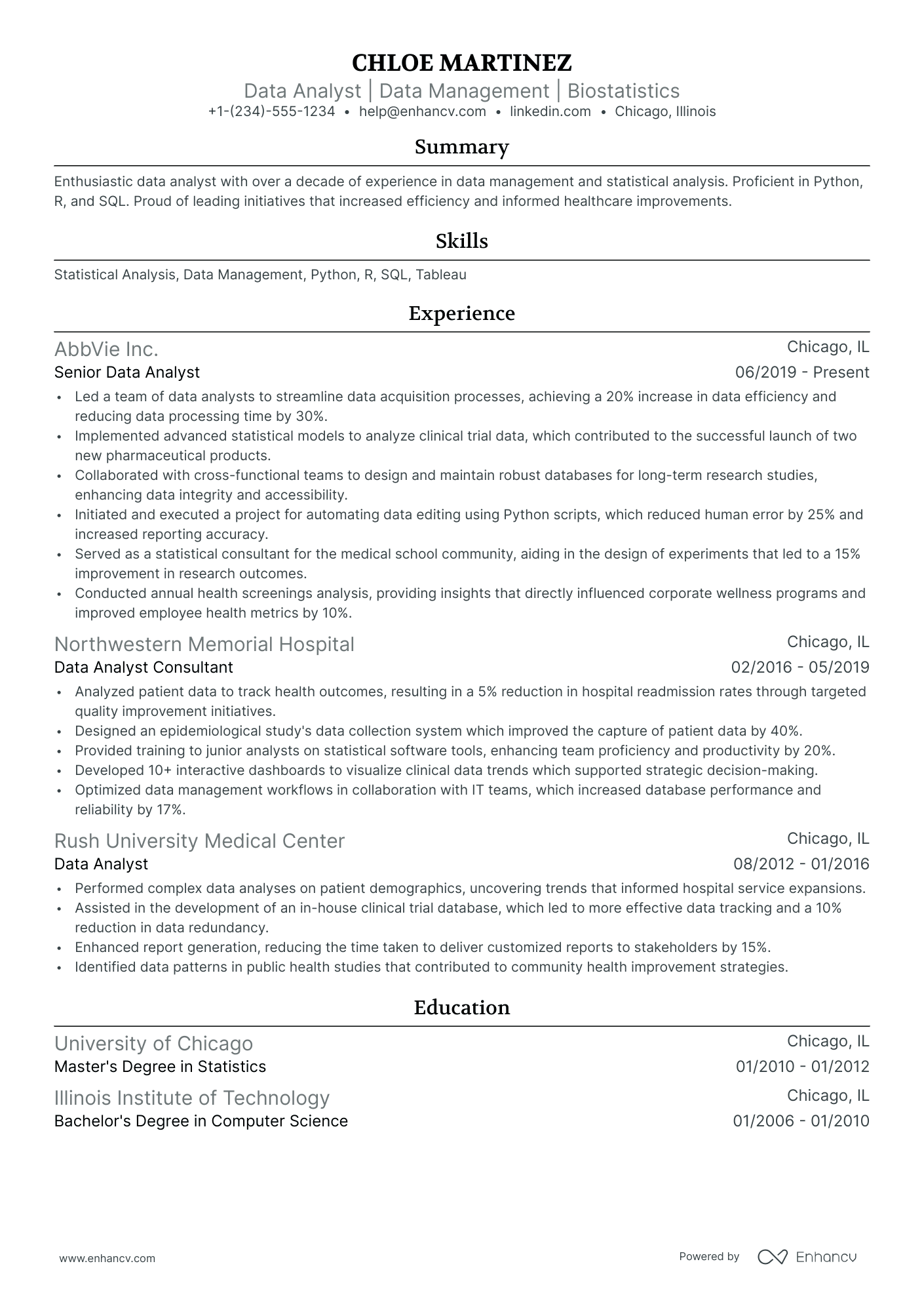
Recruiters evaluating statistical data analyst resumes prioritize evidence of analytical methodology, tool proficiency (SQL, Python, R, SAS), and the ability to translate complex data into actionable business insights. A clean reverse-chronological or hybrid format ensures these signals—along with relevant project work and quantified outcomes—surface quickly during both ATS parsing and human review. Choosing the right resume format is one of the most important decisions you'll make before writing a single bullet point.

I have significant experience in this role—which format should I use?
Use a reverse-chronological format to showcase your growing expertise in statistical analysis and the business impact of your work across successive roles. Do:
- Lead each role entry with your scope of ownership: datasets managed, stakeholder groups served, and analytical domains covered (e.g., forecasting, A/B testing, regression modeling).
- Highlight proficiency in role-specific tools and methods—SQL, R, Python, SAS, Tableau, hypothesis testing, predictive modeling—within the context of each position.
- Quantify outcomes tied to your analyses, such as revenue influenced, cost reductions identified, or improvements in decision-making speed.
I'm junior or switching into this role—what format works best?
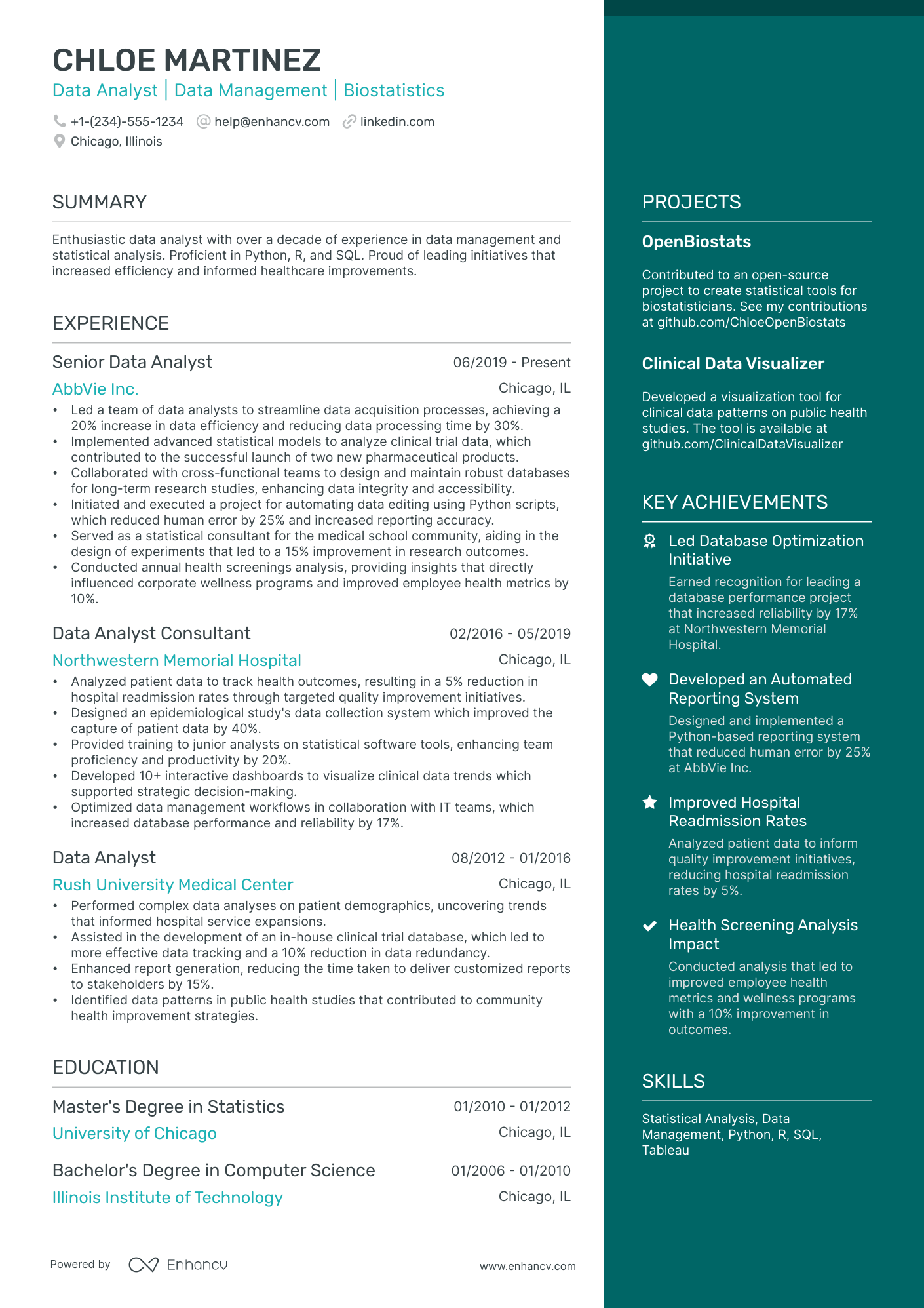
Use a hybrid format that places a focused skills section above a concise experience or project history, giving recruiters immediate visibility into your analytical capabilities. Do:
- Position core statistical and technical skills (SQL, R, Python, Excel, data visualization) in a dedicated section near the top of the resume.
- Feature academic projects, freelance analyses, internships, or capstone work that demonstrate hands-on experience with real or simulated datasets.
- Connect every listed skill or project to a specific action and a measurable or observable result.
Why not use a functional resume?
A functional format strips away the timeline and context recruiters need to verify how, where, and when you applied your statistical skills, making it harder for hiring managers to assess real competency or growth. A functional resume may be acceptable if you're transitioning from a adjacent field (e.g., academic research, economics, or actuarial work) or re-entering the workforce after a gap—but only if every listed skill is anchored to a specific project, dataset, or outcome rather than presented as a standalone claim.
Once you've established a clean, readable format, the next step is deciding which sections to include so each one earns its place on the page.
What sections should go on a statistical data analyst resume
Recruiters expect to see a clean, results-focused resume that proves you can analyze data, communicate insights, and improve decisions. Knowing what to put on a resume ensures every section you include works in your favor.
Use this structure for maximum clarity:
- Header
- Summary
- Experience
- Skills
- Projects
- Education
- Certifications
- Optional sections: Publications, Research, Languages
Strong experience bullets should emphasize measurable impact, business outcomes, analytical scope, and the results your work delivered.
Is your resume good enough?
Drop your resume here or choose a file. PDF & DOCX only. Max 2MB file size.
Now that you’ve organized the key resume components, focus next on writing your statistical data analyst experience section to show how your work supports those details with clear, results-driven examples.
How to write your statistical data analyst resume experience
The experience section is where you prove you can move from raw data to actionable statistical insight—and that the work you shipped changed how a team or organization made decisions. Hiring managers prioritize demonstrated impact over descriptive task lists, so every bullet should connect a statistical method or tool to a measurable business outcome. Building a targeted resume for each application ensures your experience section speaks directly to the role's priorities.
Each entry should include:
- Job title
- Company and location (or remote)
- Dates of employment (month and year)
Three to five concise bullet points showing what you owned, how you executed, and what outcomes you delivered:
- Ownership scope: the datasets, statistical models, reporting pipelines, or analytical domains you were directly accountable for as a statistical data analyst.
- Execution approach: the statistical software, programming languages, hypothesis-testing frameworks, or modeling techniques you applied to extract and validate insights.
- Value improved: the measurable changes you drove in forecast accuracy, data reliability, decision speed, risk reduction, or process efficiency through your analytical work.
- Collaboration context: how you partnered with data engineers, product managers, researchers, or business stakeholders to translate statistical findings into strategy or action.
- Impact delivered: the concrete results your analyses produced—expressed as shifts in revenue, cost savings, operational performance, or strategic direction rather than a list of tasks performed.
Experience bullet formula
A statistical data analyst experience example
✅ Right example - modern, quantified, specific.
Statistical Data Analyst
Cedar Ridge Health | Remote
2022–Present
Value-based care analytics team supporting six hundred clinics and twelve million member lives across the US.
- Built hierarchical logistic regression models in R (tidyverse, lme4) to predict thirty-day readmissions, improving area under the curve from 0.71 to 0.79 and reducing avoidable readmission costs by $1.2M annually.
- Automated claims and electronic health record data validation in SQL and Python (pandas, Great Expectations), cutting weekly quality checks from eight hours to two hours and reducing critical data defects by 38%.
- Designed and analyzed A/B tests for care outreach messaging with product managers and clinicians, increasing appointment adherence by 9.4% and improving net promoter score by six points.
- Developed Tableau dashboards with standardized definitions and statistical process control charts, accelerating executive reporting cycles by 60% and improving metric alignment across five stakeholder groups.
- Partnered with data engineers to optimize Snowflake queries and dbt models, reducing dashboard load times by 45% and lowering compute costs by 18% while maintaining audit-ready lineage.
Now that you've seen how a strong experience section comes together, let's look at how to adjust yours to match a specific job posting.
How to tailor your statistical data analyst resume experience
Recruiters evaluate your statistical data analyst resume through both applicant tracking systems and manual review. Tailoring your resume to the job description ensures your qualifications align with what the hiring team is actively seeking.
Ways to tailor your statistical data analyst experience:
- Match statistical software and programming languages listed in the job description.
- Mirror the exact terminology used for analytical methodologies or frameworks.
- Reflect KPIs or success metrics the employer highlights as priorities.
- Incorporate domain experience relevant to the industry or sector mentioned.
- Emphasize data quality and validation processes when the role requires them.
- Highlight collaboration with cross-functional teams if the posting references it.
- Include experience with specific database systems or cloud platforms named.
- Align your reporting and visualization tools with those the employer uses.
Tailoring means aligning your real accomplishments with the language and priorities of the job posting, not forcing keywords where they don't belong.
Resume tailoring examples for statistical data analyst
| Job description excerpt | Untailored | Tailored |
|---|---|---|
| "Perform regression analysis and hypothesis testing using SAS to support clinical trial outcomes for Phase II and III studies." | Analyzed data and created reports for various projects. | Conducted regression analysis and hypothesis testing in SAS across 12 Phase III clinical trials, identifying statistically significant efficacy endpoints that supported two successful FDA submissions. |
| "Build and maintain predictive models in R to forecast customer churn, working closely with the marketing analytics team." | Used statistical tools to help teams make better decisions. | Built and maintained predictive churn models in R for the marketing analytics team, improving customer retention forecast accuracy by 18% and reducing quarterly churn by 6%. |
| "Clean, transform, and analyze large survey datasets using Python and SQL to inform federal public health policy recommendations." | Worked with large datasets and provided insights to stakeholders. | Cleaned and transformed survey datasets with 2M+ records using Python and SQL, delivering statistical analyses that directly informed three federal public health policy recommendations on maternal health outcomes. |
Once you’ve aligned your experience with the role’s priorities, the next step is to quantify your achievements so employers can see the impact behind that fit.
How to quantify your statistical data analyst achievements
Quantifying proves your analysis drove better decisions, not just reports. Focus on accuracy, speed, cost, adoption, and risk reduction—then tie each to a dataset size, tool stack, and business outcome. Learning how to use numbers on your resume effectively is one of the fastest ways to strengthen your bullet points.
Quantifying examples for statistical data analyst
| Metric | Example |
|---|---|
| Data quality | "Reduced missing-value rate from 6.2% to 1.1% by adding Great Expectations checks in the ETL pipeline for 18 monthly data feeds." |
| Delivery speed | "Cut weekly KPI refresh time from 4 hours to 45 minutes by rewriting SQL and scheduling incremental loads in Airflow." |
| Model performance | "Improved churn model AUC from 0.71 to 0.82 using XGBoost and feature engineering on 2.4 million customer records." |
| Cost efficiency | "Lowered cloud query spend by 28% by partitioning BigQuery tables and optimizing joins across five high-traffic dashboards." |
| Risk reduction | "Prevented reporting errors by adding anomaly detection that flagged 37 metric spikes, reducing stakeholder escalations by 60% quarter over quarter." |
Turn vague job duties into measurable, recruiter-ready resume bullets in seconds with Enhancv's Bullet Point Generator.
Once you've crafted strong bullet points for your experience section, the next step is ensuring your resume also highlights the right hard and soft skills that reinforce your qualifications as a statistical data analyst.
How to list your hard and soft skills on a statistical data analyst resume
Your skills section shows recruiters and applicant tracking systems (ATS) that you can clean, analyze, and interpret data with the right tools and methods, and most resumes work best with a hard-skill-heavy mix supported by role-specific soft skills. Statistical data analyst roles require a blend of:
- Product strategy and discovery skills.
- Data, analytics, and experimentation skills.
- Delivery, execution, and go-to-market discipline.
- Soft skills.
Your skills section should be:
- Scannable (bullet-style grouping).
- Relevant to the job post.
- Backed by proof in experience bullets.
- Updated with current tools.
Place your skills section:
- Above experience if you're junior or switching careers.
- Below experience if you're mid/senior with strong achievements.

Hard skills
Listing relevant hard skills is critical for passing ATS filters and demonstrating technical competency:
- SQL, window functions
- Python, pandas, NumPy
- R, tidyverse
- Statistical modeling, regression
- Hypothesis testing, A/B testing
- Time series forecasting
- Power BI, DAX
- Tableau, calculated fields
- Excel, Power Query, PivotTables
- ETL pipelines, dbt
- Data warehousing, Snowflake, BigQuery
- Git, version control
Soft skills
Equally important are soft skills that show you can collaborate, communicate, and drive decisions:
- Translate questions into metrics
- Clarify requirements with stakeholders
- Explain statistical results clearly
- Flag data quality risks early
- Document assumptions and methods
- Prioritize analyses by impact
- Challenge conclusions with evidence
- Align on definitions and KPIs
- Partner with engineering on instrumentation
- Present insights with clear recommendations
- Manage deadlines across requests
- Own analysis from question to decision
How to show your statistical data analyst skills in context
Skills shouldn't live only in a bulleted list on your resume. Explore how other analysts present their resume skills for inspiration on grouping and phrasing.
They should be demonstrated in:
- Your summary (high-level professional identity)
- Your experience (proof through outcomes)
Here's what strong, skill-rich entries look like in practice.
Summary example
Senior statistical data analyst with eight years in healthcare analytics. Skilled in R, Python, SAS, and predictive modeling. Built patient readmission models that reduced 30-day readmission rates by 18%. Translates complex findings into actionable recommendations for clinical and executive stakeholders.
- Specifies senior-level experience clearly
- Names role-relevant tools and methods
- Quantifies a meaningful business outcome
- Highlights stakeholder communication skills
Experience example
Statistical Data Analyst II
Meridian Health Partners | Remote
June 2020–March 2025
- Developed logistic regression models in R and SAS that identified high-risk patient populations, reducing emergency department visits by 22%.
- Partnered with clinical operations and data engineering teams to automate weekly KPI dashboards in Python, cutting reporting time by 15 hours monthly.
- Designed A/B testing frameworks for patient outreach campaigns, improving engagement rates by 34% across three regional markets.
- Every bullet includes measurable proof
- Skills appear naturally within accomplishments
Once you’ve tied your analytical strengths to real outcomes and deliverables, the next step is learning how to write a statistical data analyst resume with no experience so you can present that evidence effectively without relying on a work history.
How do I write a statistical data analyst resume with no experience
Even without full-time experience, you can demonstrate readiness through projects, coursework, and volunteer work. Our guide on writing a resume without work experience covers additional strategies for building credibility from scratch. Consider showcasing:
- Capstone statistical analysis project.
- Course-based data cleaning assignments.
- Kaggle datasets and notebooks.
- Volunteer reporting for nonprofits.
- Research assistant data work.
- Internship or practicum analytics tasks.
- Personal dashboard and reporting portfolio.
- Open-source data contributions.
Focus on:
- SQL queries and data modeling.
- R or Python statistical analysis.
- Data cleaning and validation.
- Clear metrics and reproducible outputs.
Resume format tip for entry-level statistical data analyst
Use a combination resume format because it highlights skills and projects first, while still showing education and any relevant experience. Do:
- Lead with a skills section aligned to job posts.
- Add two to four projects with metrics.
- List tools used: SQL, R, Python.
- Describe methods: regression, A/B testing.
- Link a portfolio with notebooks.
- Built a Kaggle churn model in Python using logistic regression and cross-validation; improved baseline accuracy from 0.78 to 0.84 and documented results in a reproducible notebook.
Once you've structured your resume to highlight transferable skills and relevant projects, presenting your educational background effectively becomes the next essential step in building credibility as a candidate.
How to list your education on a statistical data analyst resume
Your education section helps hiring teams confirm you have the foundational training in statistics, mathematics, or data science needed to succeed as a statistical data analyst.
Include:
- Degree name
- Institution
- Location
- Graduation year
- Relevant coursework (for juniors or entry-level candidates)
- Honors & GPA (if 3.5 or higher)
Skip month and day details—list the graduation year only.
Here's a strong education entry tailored for a statistical data analyst resume:
Example education entry
Bachelor of Science in Statistics
University of Michigan, Ann Arbor, MI
Graduated 2022
GPA: 3.7/4.0
- Relevant coursework: Multivariate Analysis, Bayesian Statistics, Regression Modeling, Statistical Computing, Experimental Design, and Data Visualization
- Honors: Magna Cum Laude, Dean's List (six semesters)
How to list your certifications on a statistical data analyst resume
Certifications on your resume show your commitment to learning, prove tool proficiency, and signal industry relevance as a statistical data analyst. They also help hiring teams trust your skills when your work history is limited.
Include:
- Certificate name
- Issuing organization
- Year
- Optional: credential ID or URL
- List certifications below education when they are older, less relevant, or you already have strong, recent education for a statistical data analyst role.
- List certifications above education when they are recent, highly relevant, or they highlight core tools you will use as a statistical data analyst.
Best certifications for your statistical data analyst resume
- Google Advanced Data Analytics Professional Certificate
- IBM Data Analyst Professional Certificate
- Microsoft Certified: Power BI Data Analyst Associate
- SAS Certified Specialist: Base Programming Using SAS 9.4
- Tableau Desktop Specialist
- AWS Certified Data Analytics—Specialty
- Certified Analytics Professional (CAP)
Once you’ve positioned your credentials to validate your technical expertise, shift to your statistical data analyst resume summary to quickly connect that proof to the value you deliver.
How to write your statistical data analyst resume summary
Your resume summary is the first thing a recruiter reads. A strong one immediately signals you have the right skills and analytical foundation for a statistical data analyst role.
Keep it to three to four lines, with:
- Your title and years of relevant experience in data analysis or statistics.
- The domain or industry you've worked in, such as healthcare, finance, or e-commerce.
- Core tools and skills like SQL, R, Python, regression modeling, or data visualization.
- One or two quantified achievements that show your early impact on real projects.
- Soft skills tied to outcomes, such as cross-team collaboration that improved reporting speed.

PRO TIP
At this level, emphasize technical proficiency, relevant tools, and measurable contributions from internships or early roles. Show you can translate data into insights. Avoid vague phrases like "passionate problem-solver" or "eager learner." Replace them with specific skills and concrete results.
Example summary for a statistical data analyst
Statistical data analyst with two years of experience in R, SQL, and Python. Built automated reporting dashboards that reduced weekly analysis time by 30% for a mid-size e-commerce team.
Optimize your resume summary and objective for ATS
Drop your resume here or choose a file.
PDF & DOCX only. Max 2MB file size.
Before your summary can make an impact, recruiters need to find your contact details easily—which is why a well-structured header matters.
What to include in a statistical data analyst resume header
A resume header lists your key contact and professional links, and it boosts visibility, credibility, and recruiter screening for a statistical data analyst role.
Essential resume header elements
- Full name
- Tailored job title and headline
- Location
- Phone number
- Professional email
- GitHub link
- Portfolio link
A LinkedIn link helps recruiters verify your experience quickly and supports screening.
Do not include a photo on a statistical data analyst resume unless the role is explicitly front-facing or appearance-dependent.
Keep the header to one or two lines, match the job title to the posting, and use links that open to active, relevant work.
Example
Statistical data analyst resume header
Jordan Lee
Statistical Data Analyst | Regression, A/B Testing, SQL, Python
Chicago, IL
(312) 555-01XX
jordan.lee@enhancv.com
github.com/jordanlee
jordanlee.com
linkedin.com/in/jordanlee
Once your contact details and key identifiers are set at the top, add the following optional sections to strengthen your statistical data analyst resume with relevant supporting information.
Additional sections for statistical data analyst resumes
Beyond core resume sections, additional sections help you stand out when competing against equally qualified statistical data analyst candidates with similar technical backgrounds.
Consider adding these sections to strengthen your statistical data analyst resume:
- Publications and research papers
- Professional certifications
- Languages
- Technical conferences and presentations
- Professional affiliations and memberships
- Hobbies and interests
- Volunteer data projects
Once you've rounded out your resume with relevant additional sections, it's worth pairing it with a strong cover letter to maximize your impact.
Do statistical data analyst resumes need a cover letter
A cover letter isn't required for a statistical data analyst, but it helps when roles are competitive or hiring managers expect one. If you're unsure where to start, learning what a cover letter is and how it complements your resume can clarify whether you need one. It can make a difference when your resume needs context, or when you want to show clear fit.
Use a cover letter to add context your resume can't:
- Explain role or team fit by matching your methods, tools, and collaboration style to the job's priorities.
- Highlight one or two relevant projects or outcomes, including the problem, approach, and measurable impact.
- Show understanding of the product, users, or business context by naming key metrics, constraints, and tradeoffs you've handled.
- Address career transitions or non-obvious experience by connecting past work to statistical data analyst responsibilities and results.
Drop your resume here or choose a file.
PDF & DOCX only. Max 2MB file size.
Whether you include a cover letter depends on the role and application requirements, and AI tools can help you tailor your statistical data analyst resume efficiently when you need to stand out on its own.
Using AI to improve your statistical data analyst resume
AI can sharpen your resume's clarity, structure, and impact. It helps refine phrasing and highlight measurable results. But overuse strips authenticity. Once your content is clear and role-aligned, step away from AI. If you're exploring AI-assisted writing, our guide on ChatGPT resume writing prompts offers practical starting points.
Here are 10 practical prompts to strengthen specific sections of your statistical data analyst resume:
Strengthen your summary
Quantify experience bullets
Tighten skills relevance
Improve action verbs
Refine project descriptions
Align with job postings
Clarify technical tools
Trim redundant phrasing
Enhance education details
Spotlight certifications
Conclusion
A strong statistical data analyst resume highlights measurable outcomes, role-specific skills, and a clear structure. It shows how you improved accuracy, reduced reporting time, or increased stakeholder adoption. It also makes your tools, methods, and domain knowledge easy to scan.
Keep your statistical data analyst resume focused, consistent, and results-driven. When your impact, technical strengths, and communication skills appear clearly, you look ready for today’s hiring market and near-future needs.