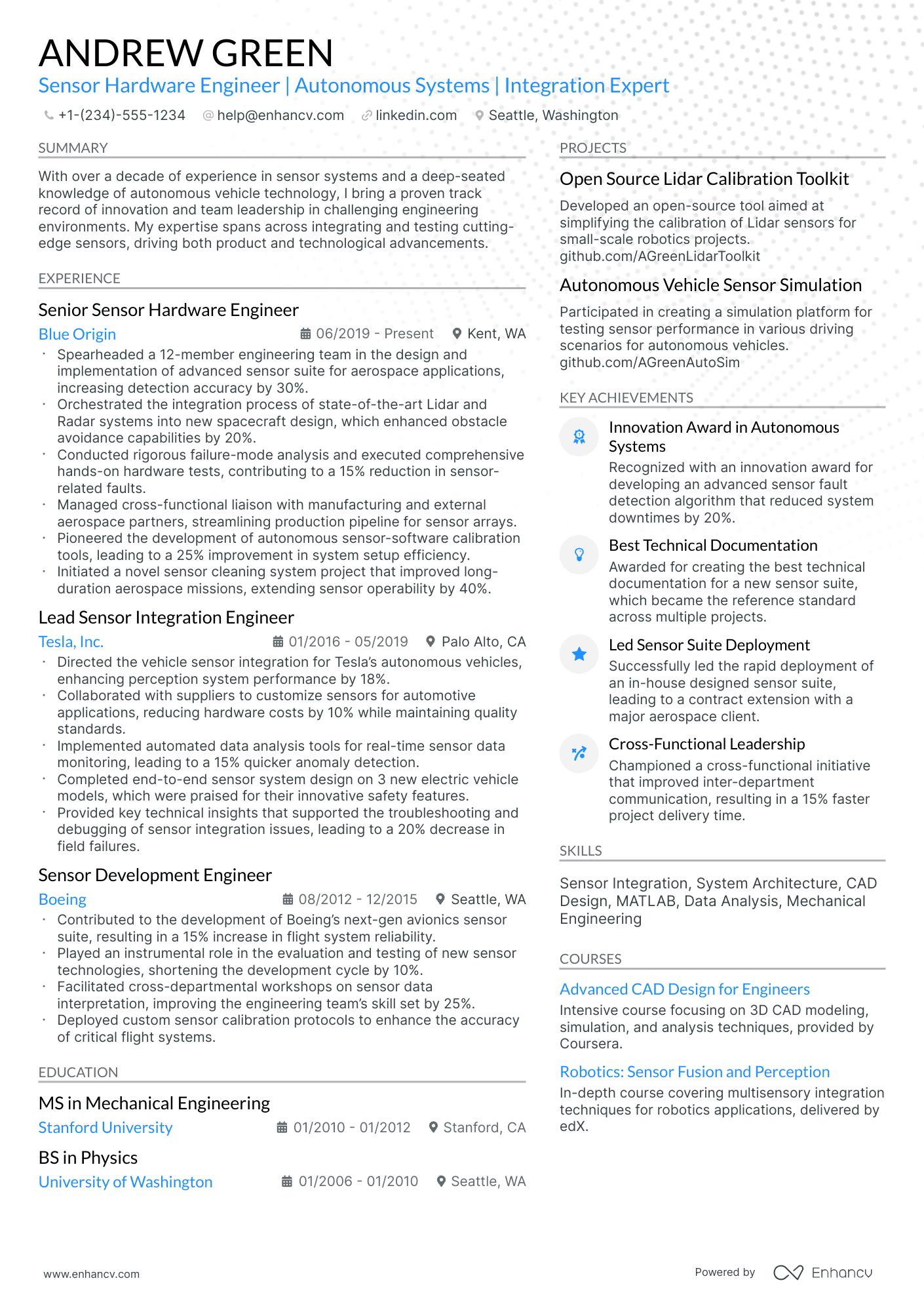
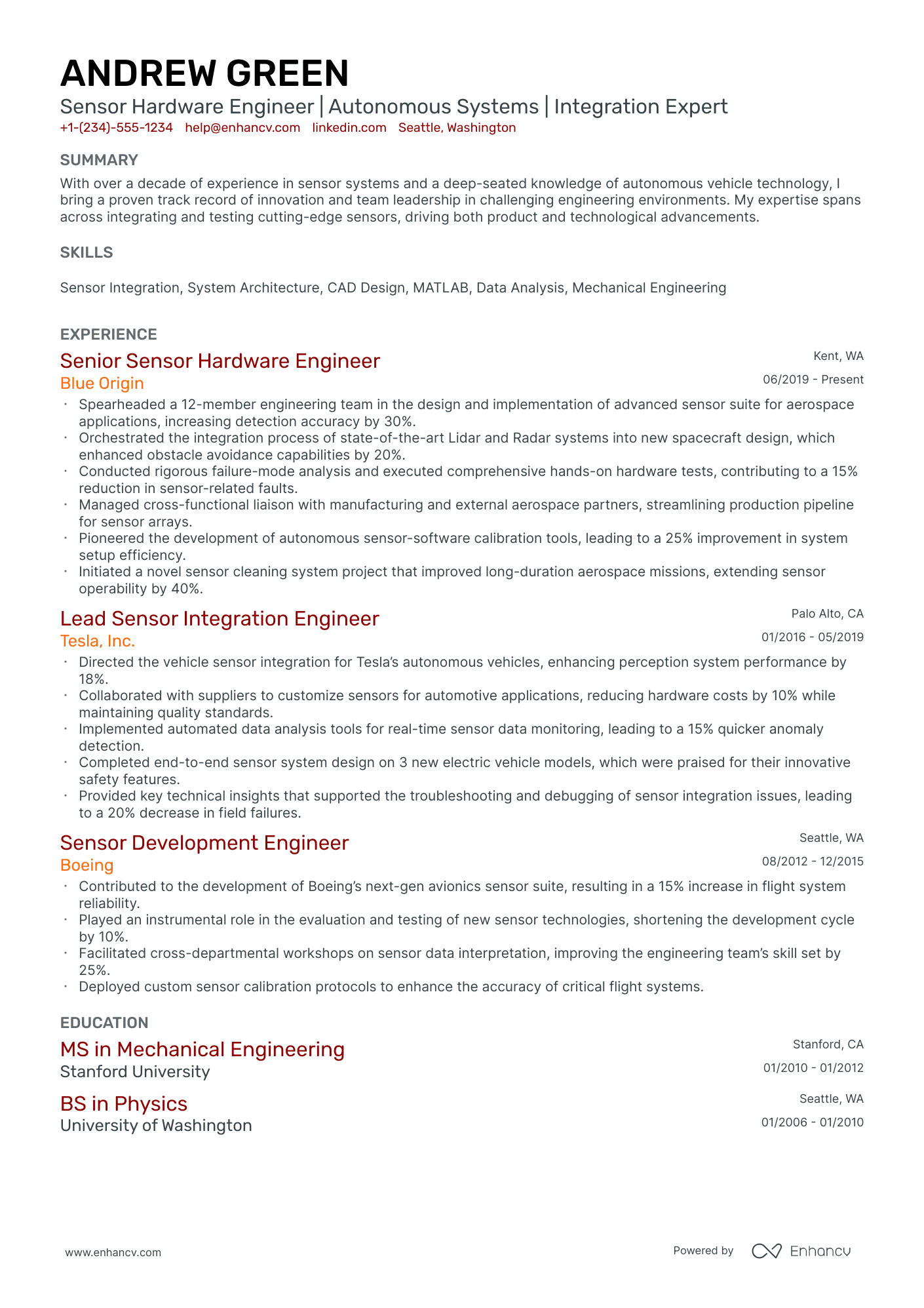
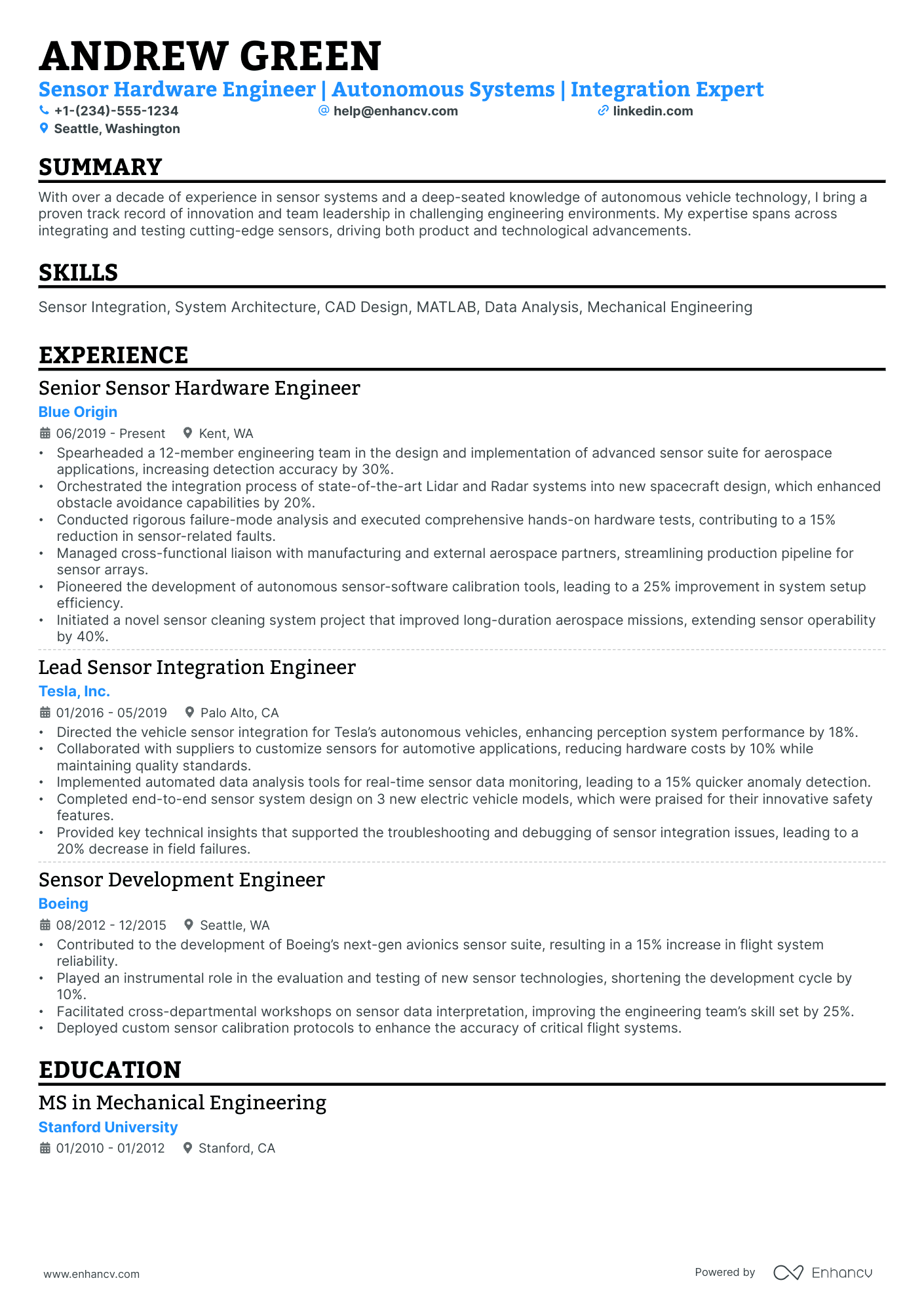
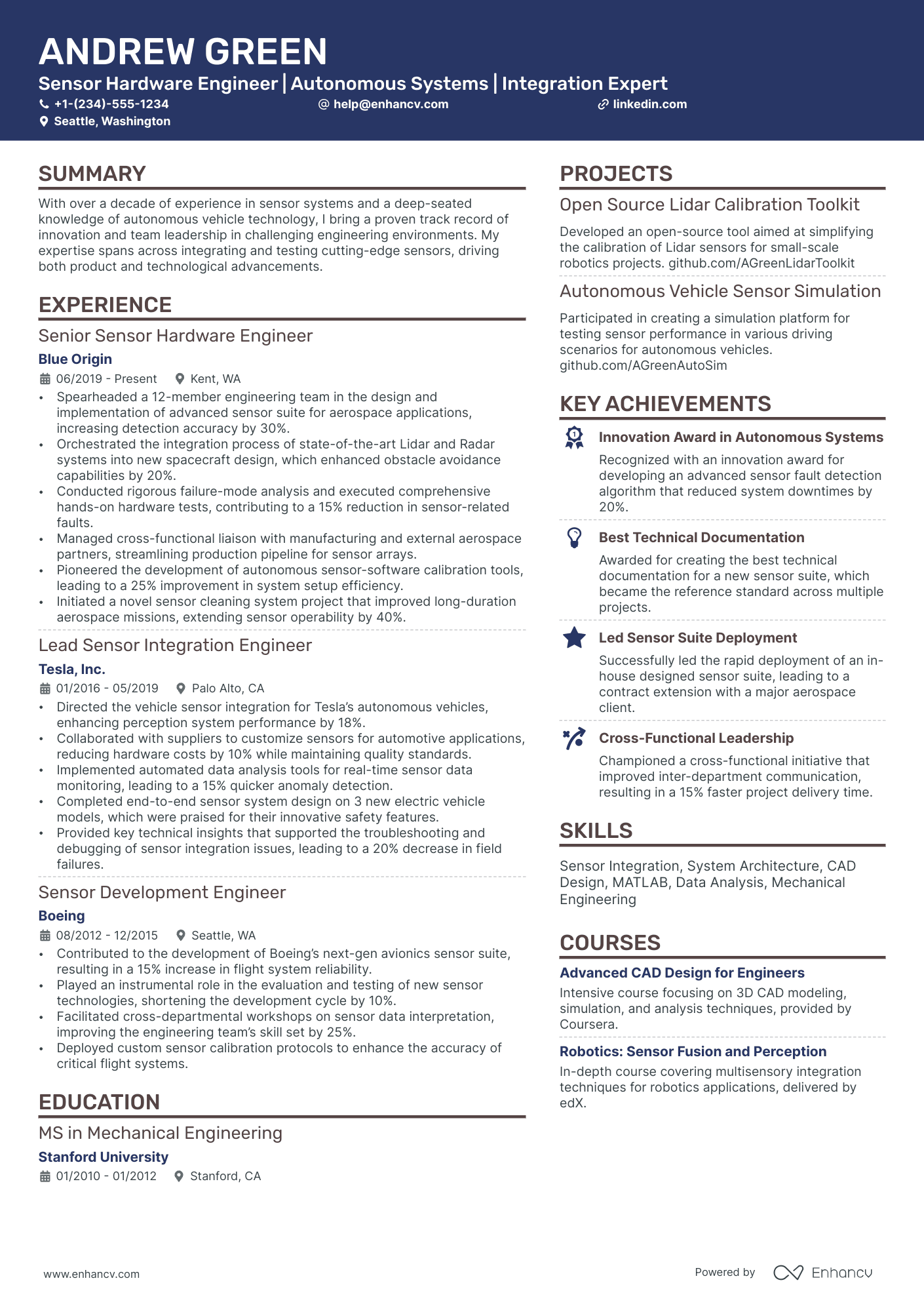
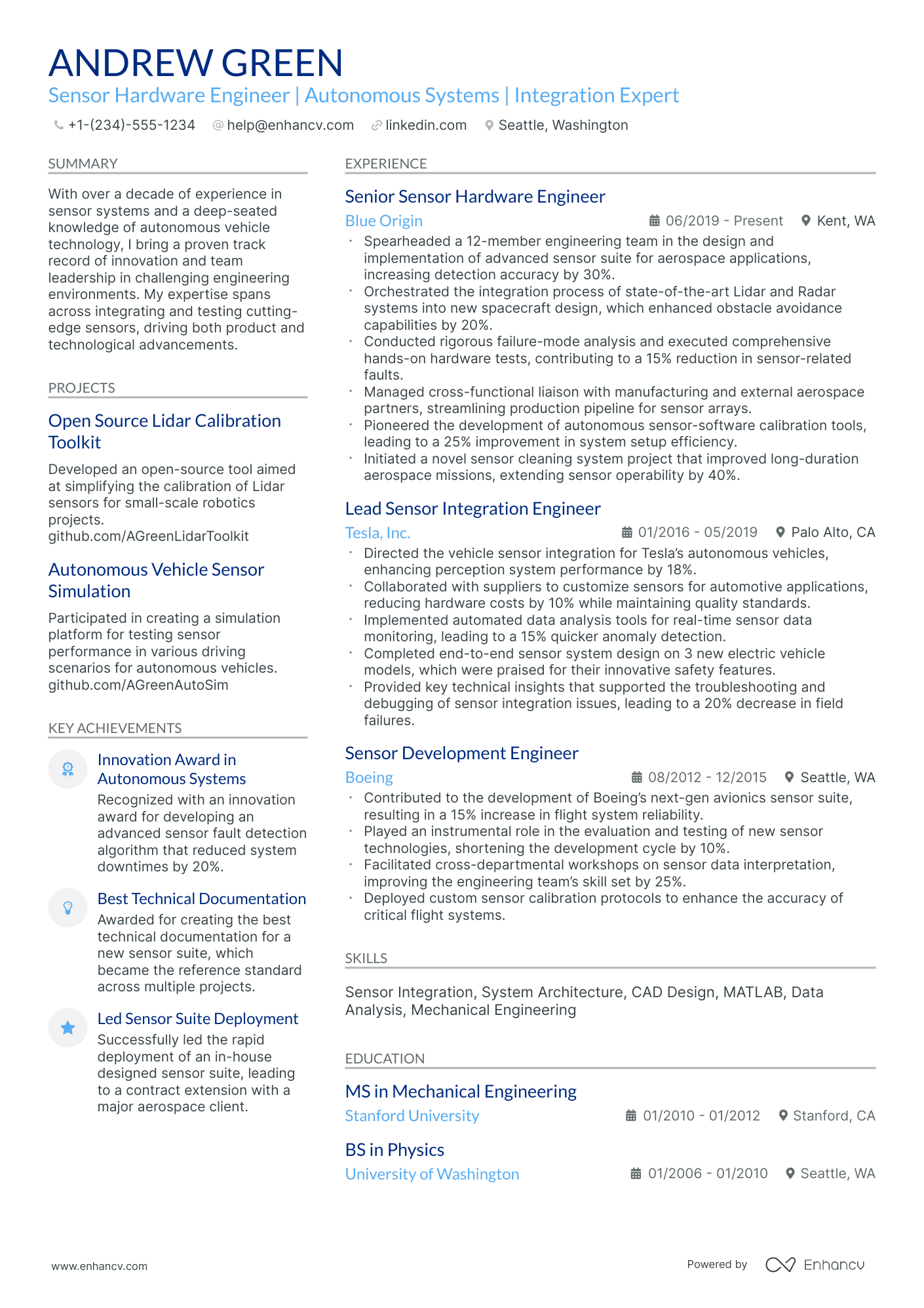
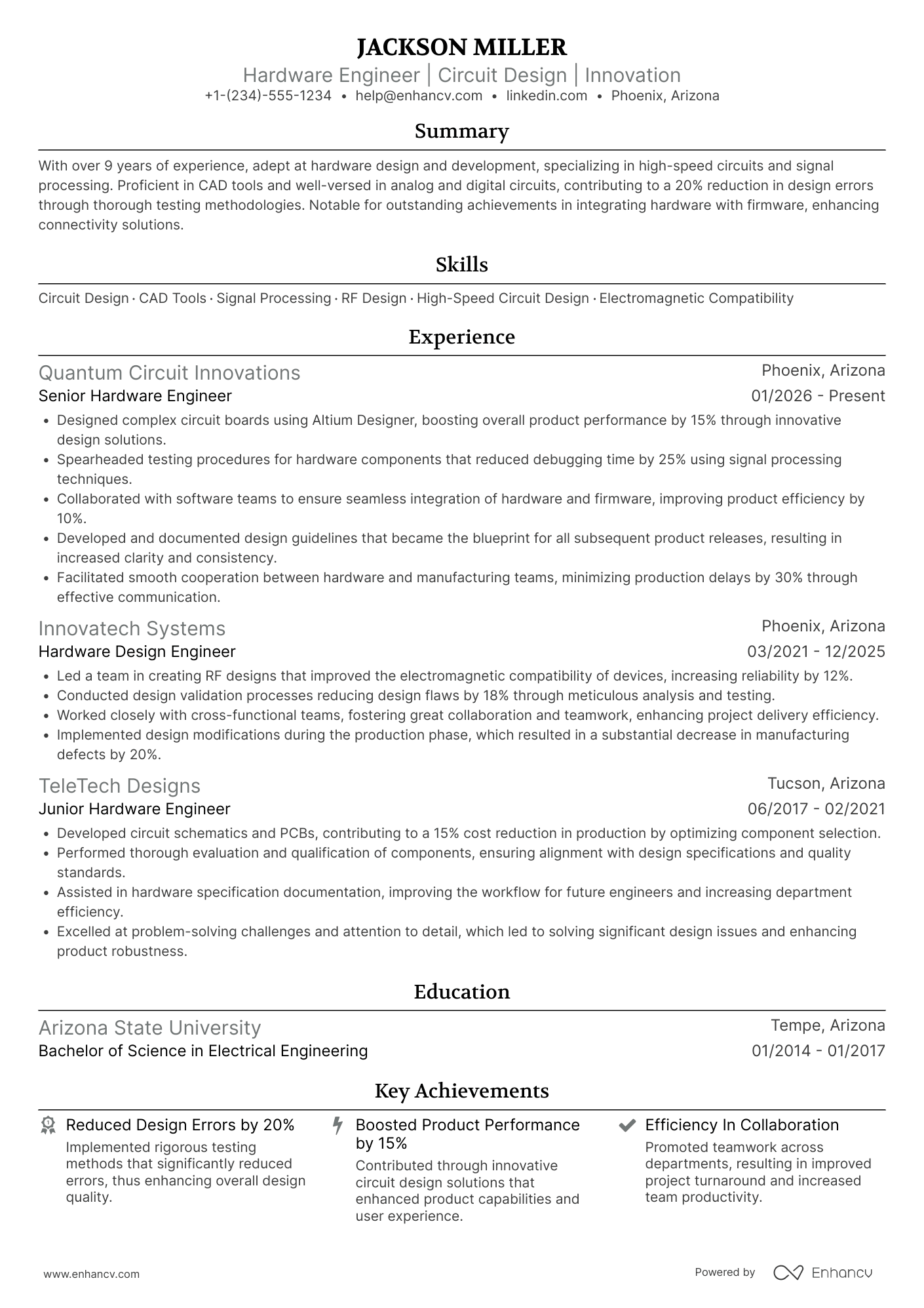
Many hardware engineer resume drafts fail because they list parts and tools but don't show verified impact, so the value is unclear in a ten-second scan. With ATS screening and intense competition, vague claims get filtered out fast.
A strong resume shows what you delivered and why it mattered. Knowing how to make your resume stand out starts with highlighting yield gains, defect escapes reduced, power or thermal improvements, on-time tape-out support, qualification pass rates, cost-down savings, and field return reductions. Include scope, timelines, and measurable results.

Key takeaways
- Quantify every achievement with metrics like yield gains, cost savings, or field failure reductions.
- Use reverse-chronological format for senior roles to show clear career progression.
- Tailor experience bullets to mirror each job posting's exact tools, standards, and terminology.
- Tie every listed skill to a specific project, action, and measurable outcome.
- Place a projects section above experience if you lack full-time hardware engineering roles.
- Pair hard skills with concise soft skills that show cross-functional collaboration and decision-making.
- Use Enhancv to turn vague duties into measurable, recruiter-ready resume bullets faster.
Job market snapshot for hardware engineers
We analyzed 371 recent hardware engineer job ads across major US job boards. These numbers help you understand skills in demand, employer expectations, role specialization trends at a glance.
What level of experience employers are looking for hardware engineers
| Years of Experience | Percentage found in job ads |
|---|---|
| 1–2 years | 3.5% (13) |
| 3–4 years | 10.0% (37) |
| 5–6 years | 13.7% (51) |
| 7–8 years | 8.6% (32) |
| 9–10 years | 5.4% (20) |
| 10+ years | 8.1% (30) |
| Not specified | 55.0% (204) |
Hardware engineer ads by area of specialization (industry)
| Industry (Area) | Percentage found in job ads |
|---|---|
| Finance & Banking | 58.0% (215) |
| Healthcare | 21.6% (80) |
| Manufacturing | 11.6% (43) |
| Retail & E-commerce | 3.0% (11) |
Top companies hiring hardware engineers
| Company | Percentage found in job ads |
|---|---|
| Blue Origin | 11.6% (43) |
| Actalent | 7.8% (29) |
| Microsoft Corporation | 6.5% (24) |
| Cisco Systems, Inc. | 5.1% (19) |
| Amazon.com, Inc. | 4.3% (16) |
Role overview stats
These tables show the most common responsibilities and employment types for hardware engineer roles. Use them to align your resume with what employers expect and to understand how the role is structured across the market.
Day-to-day activities and top responsibilities for a hardware engineer
| Responsibility | Percentage found in job ads |
|---|---|
| Electrical engineering | 15.4% (57) |
| Python | 15.4% (57) |
| Ethernet | 12.4% (46) |
| Mechanical engineering | 11.3% (42) |
| Fpga | 11.1% (41) |
| Pcb design | 11.1% (41) |
| Hardware design | 10.5% (39) |
| Signal integrity | 9.7% (36) |
| Pcb layout | 9.4% (35) |
| Linux | 9.2% (34) |
| Hardware engineering | 8.9% (33) |
| Oscilloscopes | 8.9% (33) |
Type of employment (remote vs on-site vs hybrid)
| Employment type | Percentage found in job ads |
|---|---|
| On-site | 86.3% (320) |
| Hybrid | 13.2% (49) |
How to format a hardware engineer resume
Recruiters evaluating hardware engineer resumes prioritize hands-on design experience, proficiency with industry-standard EDA tools, and demonstrated ability to take products from schematic capture through production validation. Choosing the right resume format ensures these technical signals—and the progression behind them—surface immediately during both automated parsing and manual review. A clean, chronological resume layout makes this even easier for hiring managers to scan quickly.

I have significant experience in this role—which format should I use?
Use a reverse-chronological format to present your deepest hardware design experience first, giving recruiters immediate access to your most relevant work. Do:
- Lead each role entry with your scope of ownership—board-level design, system architecture, or cross-functional hardware-firmware integration.
- List role-specific tools and domains prominently, including Altium Designer, Cadence OrCAD, SPICE simulation, signal integrity analysis, DFM/DFT methodologies, and power distribution network design.
- Quantify outcomes tied to product performance, cost reduction, yield improvement, or time-to-market acceleration.
I'm junior or switching into this role—what format works best?
A hybrid format works best, letting you lead with a focused technical skills section while still showing relevant project or work experience in chronological order. Do:
- Place core hardware skills—circuit design, schematic capture, PCB layout, lab instrumentation—near the top so ATS filters and recruiters find them immediately.
- Highlight academic projects, internships, or personal builds (such as custom power supply designs or FPGA development boards) that demonstrate hands-on hardware competence.
- Connect every listed skill to a specific action and a measurable or observable result.
Why hybrid and functional resumes don't work for senior roles
Hybrid and functional formats fragment your career timeline, obscuring the progression from individual contributor to design lead or system architect—exactly the trajectory hiring managers need to see. They also dilute leadership impact by separating achievements from the roles where accountability and decision ownership actually occurred, making it harder to evaluate the scope of your contributions. Avoid these formats entirely if you have five or more years of progressive hardware engineering experience, as they'll raise more questions than they answer.
- Edge-case exception: A functional format may be acceptable only if you're a senior professional re-entering hardware engineering after an extended career break or pivoting from a closely adjacent field (such as FPGA firmware into board-level design), but even then, every listed skill must be tied to a specific project and a concrete outcome.
Now that your resume's structure and layout are in place, it's time to fill each part with the right content—starting with knowing exactly which sections to include.
What sections should go on a hardware engineer resume
Recruiters expect a hardware engineer resume to clearly show your end-to-end design, validation, and production impact. Understanding which resume sections to include is critical for maximum clarity:
- Header
- Summary
- Experience
- Skills
- Projects
- Education
- Certifications
- Optional sections: Publications, Patents, Awards
Strong experience bullets should emphasize measurable results, technical scope, and outcomes across design, bring-up, validation, and manufacturing support.
Is your resume good enough?
Drop your resume here or choose a file. PDF & DOCX only. Max 2MB file size.
Now that you’ve organized your resume with the right core components, the next step is learning how to write your hardware engineer resume experience so each role clearly supports your qualifications.
How to write your hardware engineer resume experience
The experience section is where you prove you can ship reliable hardware—from schematic capture through production release—using the tools, methods, and validation processes the role demands. Hiring managers prioritize demonstrated impact over descriptive task lists, so every bullet should connect what you owned to a measurable outcome.
Each entry should include:
- Job title
- Company and location (or remote)
- Dates of employment (month and year)
Three to five concise bullet points showing what you owned, how you executed, and what outcomes you delivered:
- Ownership scope: the specific boards, subsystems, product lines, or platforms you were directly accountable for, including any responsibility for component selection, power architecture, or signal integrity across design revisions.
- Execution approach: the CAD tools, simulation environments, lab instruments, design-for-manufacturing practices, or verification methods you relied on to move a design from concept through prototyping to volume production.
- Value improved: the measurable changes you drove in board yield, thermal performance, power efficiency, test coverage, reliability margins, or time-to-tapeout that strengthened the product or reduced risk.
- Collaboration context: how you partnered with firmware, mechanical, manufacturing, test, or supply-chain teams—and any external vendors or contract manufacturers—to resolve cross-domain constraints and keep programs on schedule.
- Impact delivered: the concrete results your work produced, expressed through production volume, cost reduction, defect-rate improvement, certification milestones, or accelerated development timelines rather than a list of activities performed.
Experience bullet formula
A hardware engineer experience example
✅ Right example - modern, quantified, specific.
Senior hardware engineer
Apex Mobility Systems | Austin, TX
2021–Present
Designed and scaled embedded electronics for an electric scooter fleet operating in forty cities across North America.
- Architected a four-layer power and sensor board in Altium Designer, cutting field failure rate by 38% through tighter derating analysis, improved creepage, and updated protection circuitry.
- Validated DC-DC converters, battery fuel gauging, and motor current sensing using SPICE simulation, oscilloscope-based characterization, and Design of Experiments, improving energy efficiency by 12% and extending average range by 1.8 miles.
- Led bring-up for STM32-based embedded hardware with JTAG, logic analyzers, and automated manufacturing tests, reducing factory test time by 26% and increasing first-pass yield from 93% to 97%.
- Partnered with firmware, industrial design, and product teams to implement a new IP67 sealing and connector strategy, lowering water-ingress returns by 41% over two quarters.
- Managed component selection and lifecycle risk with approved vendor lists and alternate part qualification, preventing two line stoppages and avoiding $420,000 in expedited procurement costs during supply constraints.
Now that you've seen how a strong experience section comes together, let's look at how to adjust those details to match the specific job you're targeting.
How to tailor your hardware engineer resume experience
Recruiters evaluate your hardware engineer resume through both manual review and applicant tracking systems (ATS). Tailoring your resume to the job description increases your chances of passing both filters.
Ways to tailor your hardware engineer experience:
- Match EDA tools and simulation platforms listed in the job description.
- Mirror the exact terminology used for design verification methodologies.
- Align your metrics with the KPIs or success criteria referenced.
- Highlight relevant domain experience such as automotive or telecommunications.
- Emphasize signal integrity or power analysis if the posting specifies them.
- Reference compliance standards like IPC or ISO that the role requires.
- Include cross-functional collaboration with firmware or manufacturing teams mentioned.
- Reflect specific prototyping or testing workflows described in the posting.
Tailoring means aligning your real accomplishments with what the role demands, not forcing disconnected keywords into your experience bullets.
Resume tailoring examples for hardware engineer
| Job description excerpt | Untailored | Tailored |
|---|---|---|
| "Design and verify mixed-signal ASIC circuits using Cadence Virtuoso, with emphasis on power management ICs for automotive applications" | Worked on circuit design projects and helped with verification tasks. | Designed and verified mixed-signal ASIC circuits in Cadence Virtuoso for automotive power management ICs, reducing power consumption by 18% across three product lines. |
| "Develop FPGA-based prototyping platforms using Xilinx Vivado and SystemVerilog, collaborating with firmware teams to validate SoC architectures before tape-out" | Assisted with FPGA development and worked with cross-functional teams. | Built FPGA prototyping platforms in Xilinx Vivado using SystemVerilog, collaborating with firmware engineers to validate two SoC architectures and catching 12 critical bugs before tape-out. |
| "Perform signal integrity and power integrity analysis on high-speed PCB designs (DDR5, PCIe Gen5) using Ansys HFSS and Keysight ADS" | Ran simulations and analysis on PCB layouts to check for issues. | Conducted signal integrity and power integrity analysis on DDR5 and PCIe Gen5 PCB designs using Ansys HFSS and Keysight ADS, resolving crosstalk violations that improved first-pass yield by 25%. |
Once you’ve aligned your experience with the role’s requirements, the next step is to quantify your hardware engineer achievements so hiring teams can quickly see your impact.
How to quantify your hardware engineer achievements
Quantifying your achievements proves your designs shipped faster, ran better, and failed less. Focus on performance, reliability, quality, cost, and delivery metrics tied to test results, yield data, field returns, and schedule.
Quantifying examples for hardware engineer
| Metric | Example |
|---|---|
| Performance gain | "Improved FPGA signal-processing latency by 18% (42 ns to 34 ns) by optimizing pipelining in Vivado and validating timing closure at 250 MHz." |
| Reliability | "Reduced field failure rate from 1.6% to 0.4% by adding TVS protection and revising ESD layout, confirmed through IEC 61000-4-2 testing." |
| Manufacturing yield | "Increased first-pass yield from 92% to 97% by tightening impedance controls and updating ICT test vectors in Keysight, cutting rework by 120 units per quarter." |
| Cost reduction | "Cut bill of materials cost by $3.40 per unit on a 50,000-unit run by consolidating regulators and qualifying alternate passives using Altium and AVL reviews." |
| Delivery speed | "Shortened prototype bring-up from 10 days to six by automating test scripts in Python with SCPI for oscilloscopes and power supplies across three lab stations." |
Turn vague job duties into measurable, recruiter-ready resume bullets in seconds with Enhancv's Bullet Point Generator.
Once you've crafted strong bullet points to showcase your experience, you'll want to ensure the skills section of your hardware engineer resume highlights the right mix of hard and soft skills.
How to list your hard and soft skills on a hardware engineer resume
Your skills section shows you can design, validate, and ship reliable hardware, and recruiters and ATS scan it to confirm role fit fast; aim for a balanced mix of hard skills (most) supported by targeted, job-relevant soft skills. hardware engineer roles require a blend of:
- Product strategy and discovery skills
- Data, analytics, and experimentation skills
- Delivery, execution, and go-to-market discipline
- Soft skills
Your skills section should be:
- Scannable (bullet-style grouping).
- Relevant to the job post.
- Backed by proof in experience bullets.
- Updated with current tools.
Place your skills section:
- Above experience if you're junior or switching careers.
- Below experience if you're mid/senior with strong achievements.

Hard skills
- Schematic capture, PCB layout
- Altium Designer
- Cadence OrCAD, Allegro
- High-speed digital design
- DDR, PCIe, USB, Ethernet
- Signal integrity, power integrity
- Power supply design
- Analog circuit design
- EMC, EMI compliance testing
- DFM, DFT, FMEA
- Oscilloscope, logic analyzer, VNA
- Python, MATLAB
Soft skills
- Translate requirements into specs
- Drive design reviews to decisions
- Communicate tradeoffs clearly
- Align cross-functional stakeholders
- Own bring-up and debug plans
- Write test plans and reports
- Prioritize issues by risk
- Manage vendors and CM builds
- Coordinate lab work safely
- Document designs for handoff
- Escalate blockers early
- Close loops with firmware teams
How to show your hardware engineer skills in context
Skills shouldn't live only in a dedicated skills list. Explore resume skills examples to see how they can be woven throughout your document.
They should be demonstrated in:
- Your summary (high-level professional identity)
- Your experience (proof through outcomes)
Here's what strong, skills-rich content looks like in practice.
Summary example
Senior hardware engineer with 10+ years designing mixed-signal PCBs for aerospace applications. Skilled in Altium Designer, signal integrity analysis, and DFM optimization. Led a board redesign that cut production defects by 34% across three product lines.
- Reflects senior-level expertise clearly
- Names industry-relevant tools directly
- Includes a concrete, measurable outcome
- Signals leadership and cross-team collaboration
Experience example
Senior Hardware Engineer
Veridian Systems | Austin, TX
March 2019–Present
- Redesigned a 12-layer HDI PCB using Cadence Allegro, reducing signal crosstalk by 28% and passing EMC compliance on the first submission.
- Partnered with firmware and mechanical teams to co-develop a thermal management solution, cutting field failure rates by 19% within six months.
- Established automated design rule checks in Mentor Graphics, shortening peer review cycles by 35% across a five-engineer hardware group.
- Every bullet includes measurable proof.
- Skills appear naturally within real achievements.
Once you’ve framed your hardware engineering abilities through relevant projects and outcomes, the next step is applying that same approach to building a hardware engineer resume with no experience.
How do I write a hardware engineer resume with no experience
Even without full-time experience, you can demonstrate readiness through projects and academic work. Our guide on writing a resume without work experience walks you through the approach in detail. Consider showcasing:
- Senior design hardware capstone project
- FPGA development lab assignments
- PCB design and assembly builds
- Embedded systems course projects
- Electronics club competition prototypes
- Hardware internship or co-op
- Open-source hardware contributions
- Personal test bench experiments
Focus on:
- Schematics, PCB layout, and DFM
- Lab validation with documented results
- Firmware-hardware integration deliverables
- Clear, version-controlled project artifacts
Resume format tip for entry-level hardware engineer
Use a skills-forward reverse-chronological resume. It keeps projects and labs near the top while still showing education and any work history clearly. Do:
- Put a "Projects" section above experience.
- List tools per project: Altium Designer, KiCad, LTspice.
- Quantify results: yield, error, power, cost.
- Add links to GitHub and schematics.
- Tailor keywords to each job posting.
- Designed a two-layer PCB in KiCad, simulated power rails in LTspice, and validated with oscilloscope measurements, cutting ripple from 120 mV to 35 mV.
Once you've structured your resume around transferable skills and relevant projects, the next step is presenting your education—often the strongest section for candidates without professional experience.
How to list your education on a hardware engineer resume
Your education section helps hiring teams confirm you have the foundational knowledge needed. It validates your training in circuits, systems design, and engineering principles critical to the hardware engineer role.
Include:
- Degree name
- Institution
- Location
- Graduation year
- Relevant coursework (for juniors or entry-level candidates)
- Honors & GPA (if 3.5 or higher)
Skip month and day details—list the graduation year only.
Here's a strong education entry tailored for a hardware engineer resume:
Example education entry
Bachelor of Science in Electrical Engineering
Georgia Institute of Technology, Atlanta, GA
Graduated 2021
GPA: 3.7/4.0
- Relevant Coursework: VLSI Design, Digital Signal Processing, Embedded Systems, Power Electronics, Computer Architecture
- Honors: Magna Cum Laude, Dean's List (six semesters)
How to list your certifications on a hardware engineer resume
Certifications on your resume show your commitment to learning, prove proficiency with key tools, and signal industry relevance as a hardware engineer. They also help hiring teams validate your skills quickly.
Include:
- Certificate name
- Issuing organization
- Year
- Optional: credential ID or URL
- Place certifications below education when your degree is recent and your certifications are older or only loosely related to the hardware engineer role.
- Place certifications above education when they are recent, highly relevant, or required for the hardware engineer role you target.
Best certifications for your hardware engineer resume
- IPC CID (Certified Interconnect Designer)
- IPC CID+ (Advanced Certified Interconnect Designer)
- Certified LabVIEW Associate Developer (CLAD)
- Certified LabVIEW Developer (CLD)
- Altium Designer Certified Professional
- Autodesk Certified Professional: Fusion 360
- Certified Functional Safety Professional (CFSP)
Once you’ve positioned your credentials where recruiters can spot them, shift to your hardware engineer resume summary so you can reinforce those qualifications in a quick, high-impact introduction.
How to write your hardware engineer resume summary
Your resume summary is the first thing a recruiter reads. A strong one instantly signals you're qualified and worth interviewing for a hardware engineer role.
Keep it to three to four lines, with:
- Your title and total years of hands-on hardware engineering experience.
- Domain focus, such as consumer electronics, embedded systems, or power electronics.
- Core tools and skills like PCB design, VHDL, oscilloscopes, or Altium Designer.
- One or two measurable achievements, such as cost reductions or improved yields.
- Practical soft skills tied to outcomes, like cross-functional collaboration or mentoring interns.

PRO TIP
At the junior level, prioritize specific tools, relevant coursework, and any early contributions from internships or projects. Avoid vague descriptors like "passionate" or "motivated self-starter." Instead, show what you've built, tested, or improved—even on a small scale.
Example summary for a hardware engineer
Hardware engineer with two years of experience in consumer electronics PCB design using Altium Designer. Reduced prototype revision cycles by 30% through improved design-for-manufacturability practices across three product lines.
Optimize your resume summary and objective for ATS
Drop your resume here or choose a file.
PDF & DOCX only. Max 2MB file size.
Now that your summary captures your strongest qualifications, make sure recruiters can actually reach you by setting up a clear, complete header.
What to include in a hardware engineer resume header
A resume header lists your key contact and professional links, helping hardware engineer candidates boost visibility, credibility, and pass recruiter screening faster.
Essential resume header elements
- Full name
- Tailored job title and headline
- Location
- Phone number
- Professional email
- GitHub link
- Portfolio link
Including a LinkedIn link helps recruiters verify experience quickly and supports screening.
Don't include a photo on a hardware engineer resume unless the role is explicitly front-facing or appearance-dependent.
Keep your header to two lines, use consistent formatting, and match your job title to the posting to improve search and screening accuracy.
Hardware engineer resume header
Jordan Lee
Hardware Engineer | PCB Design, Embedded Systems, and Lab Validation
Austin, TX | (512) 555-12XX | jordan.lee@enhancv.com | github.com/jordanlee | jordanlee.com | linkedin.com/in/jordanlee
Once your contact details and key identifiers are in place, add additional sections to reinforce your qualifications with supporting information.
Additional sections for hardware engineer resumes
When your core qualifications closely match other candidates, additional sections can set you apart and reinforce your expertise as a hardware engineer. For example, listing language skills on your resume can be a differentiator for roles at global companies or teams working with international suppliers.
- Languages
- Publications and patents
- Professional affiliations (such as IEEE)
- Hobbies and interests
- Technical certifications
- Conference presentations
- Open-source hardware contributions
Once you've strengthened your resume with well-chosen additional sections, the next step is pairing it with a cover letter to make an even stronger impression.
Do hardware engineer resumes need a cover letter
A cover letter isn't required for a hardware engineer, but it helps in competitive roles or teams with strict hiring expectations. If you're unsure where to start, understanding what a cover letter is and when it adds value can help you decide. It can make a difference when your resume needs context, or when the role demands close product and cross-functional alignment.
Use a cover letter when it adds details your resume can't show:
- Explain role and team fit by naming the hardware engineer scope, interfaces, and partners you've worked with, such as firmware, mechanical, or test.
- Highlight one or two relevant projects or outcomes, including measurable results like yield, reliability, power, cost, or time-to-validation improvements.
- Show understanding of the product, users, and business context by tying your work to constraints, such as safety, compliance, manufacturability, or supply chain.
- Address career transitions or non-obvious experience by connecting prior work to the hardware engineer requirements and calling out transferable tools and methods.
Drop your resume here or choose a file.
PDF & DOCX only. Max 2MB file size.
Even if you decide a cover letter won’t add value for your hardware engineering applications, using AI to improve your hardware engineer resume is the next step to strengthen the document recruiters will review first.
Using AI to improve your hardware engineer resume
AI can sharpen your resume's clarity, structure, and impact. It helps refine bullet points, tighten language, and highlight measurable results. But overuse kills authenticity. Once your content is clear and role-aligned, step away from AI. If you're exploring tools, our comparison of which AI is best for writing resumes can help you choose the right one.
Here are 10 practical prompts to strengthen specific sections of your hardware engineer resume:
- Strengthen your summary: "Rewrite my hardware engineer resume summary to highlight core technical strengths and years of experience in under four sentences."
- Quantify experience bullets: "Add measurable outcomes to these hardware engineer experience bullet points, focusing on efficiency gains, cost reductions, or performance improvements."
- Tighten skills formatting: "Organize my hardware engineer skills section into clear categories like design tools, protocols, testing equipment, and programming languages."
- Clarify project contributions: "Rewrite this hardware engineer project description to clearly state my specific role, tools used, and the project's measurable result."
- Align with job postings: "Compare my hardware engineer experience bullets against this job description and suggest edits to better match required qualifications."
- Improve action verbs: "Replace weak or repetitive verbs in my hardware engineer experience section with precise, industry-relevant action verbs."
- Refine education details: "Rewrite my hardware engineer education section to emphasize relevant coursework, capstone projects, and applicable technical training."
- Highlight certifications clearly: "Format my hardware engineer certifications section for quick readability, including issuing organizations and completion dates."
- Remove redundant phrasing: "Identify and eliminate filler words or redundant phrases across my entire hardware engineer resume without changing the meaning."
- Sharpen technical descriptions: "Simplify overly complex technical language in my hardware engineer resume so both hiring managers and recruiters can understand it."
Stop using AI once your resume sounds accurate, specific, and aligned with real experience. AI should never invent experience or inflate claims—if it didn't happen, it doesn't belong here.
Conclusion
A strong hardware engineer resume shows measurable outcomes, role-specific skills, and a clear structure. Use metrics to prove impact, highlight core hardware engineer work, and keep each section easy to scan.
This approach matches today’s hiring market and stays relevant as requirements evolve. When your results, technical strengths, and organization are clear, you present as a hardware engineer ready to deliver on day one.