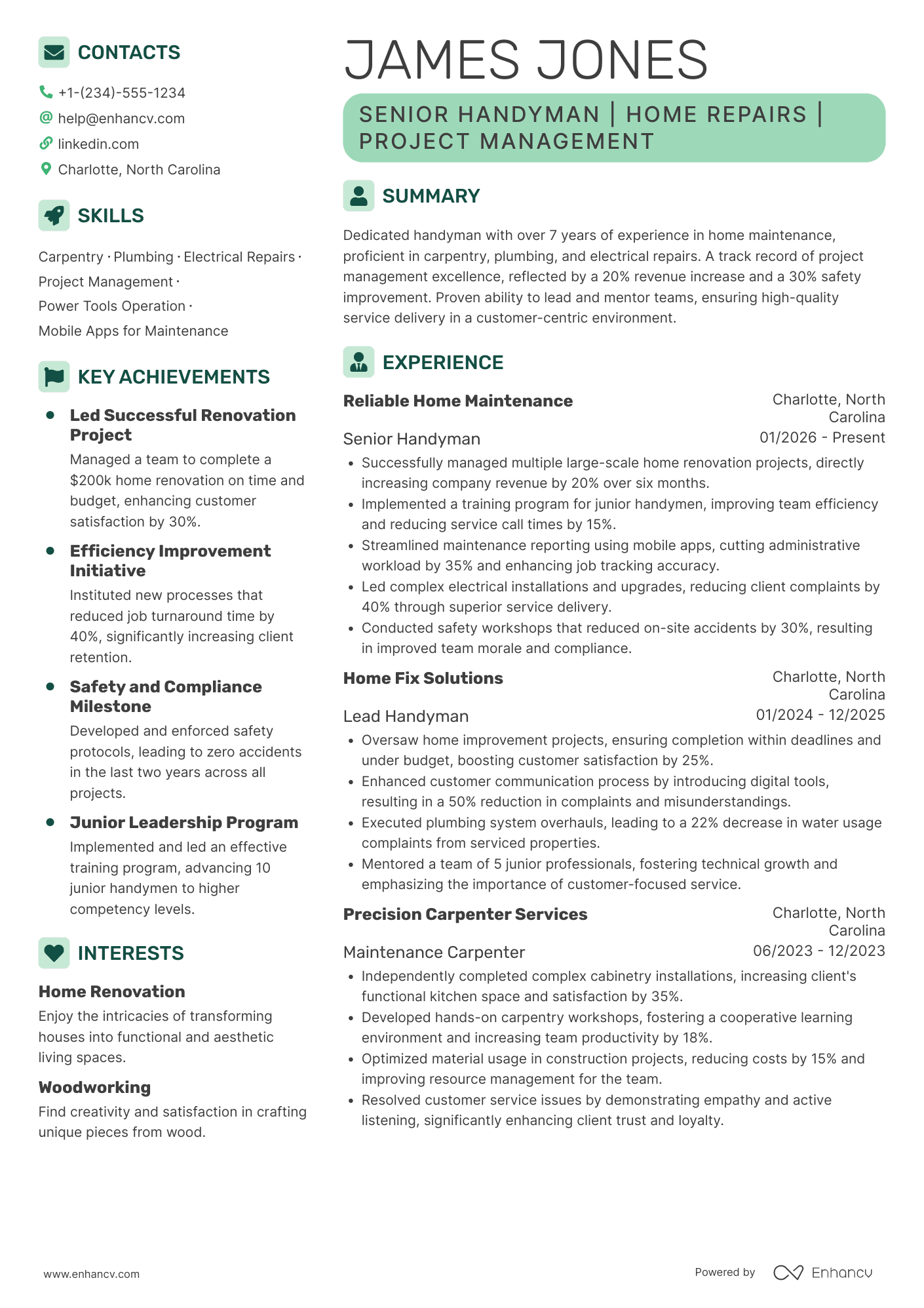
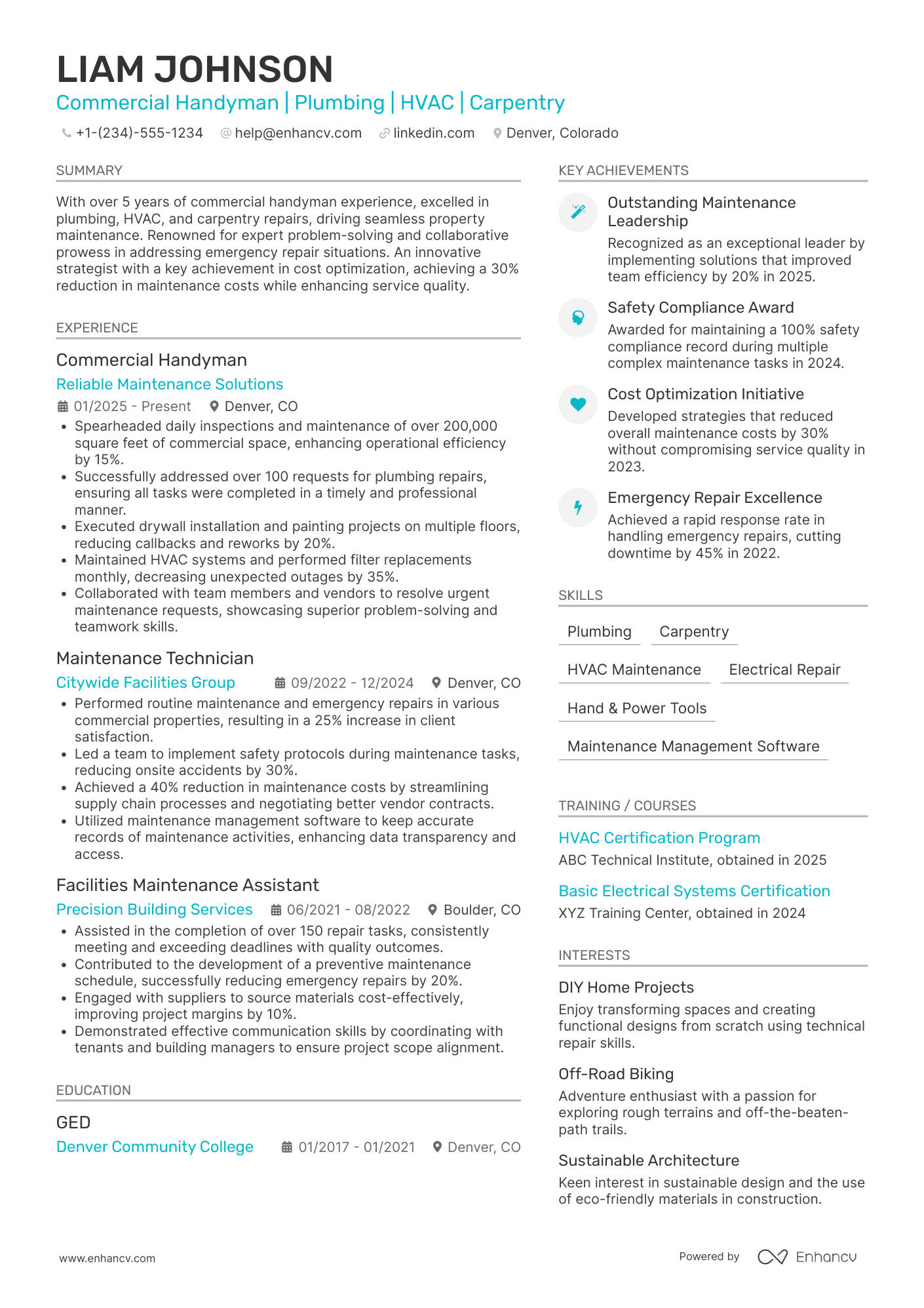
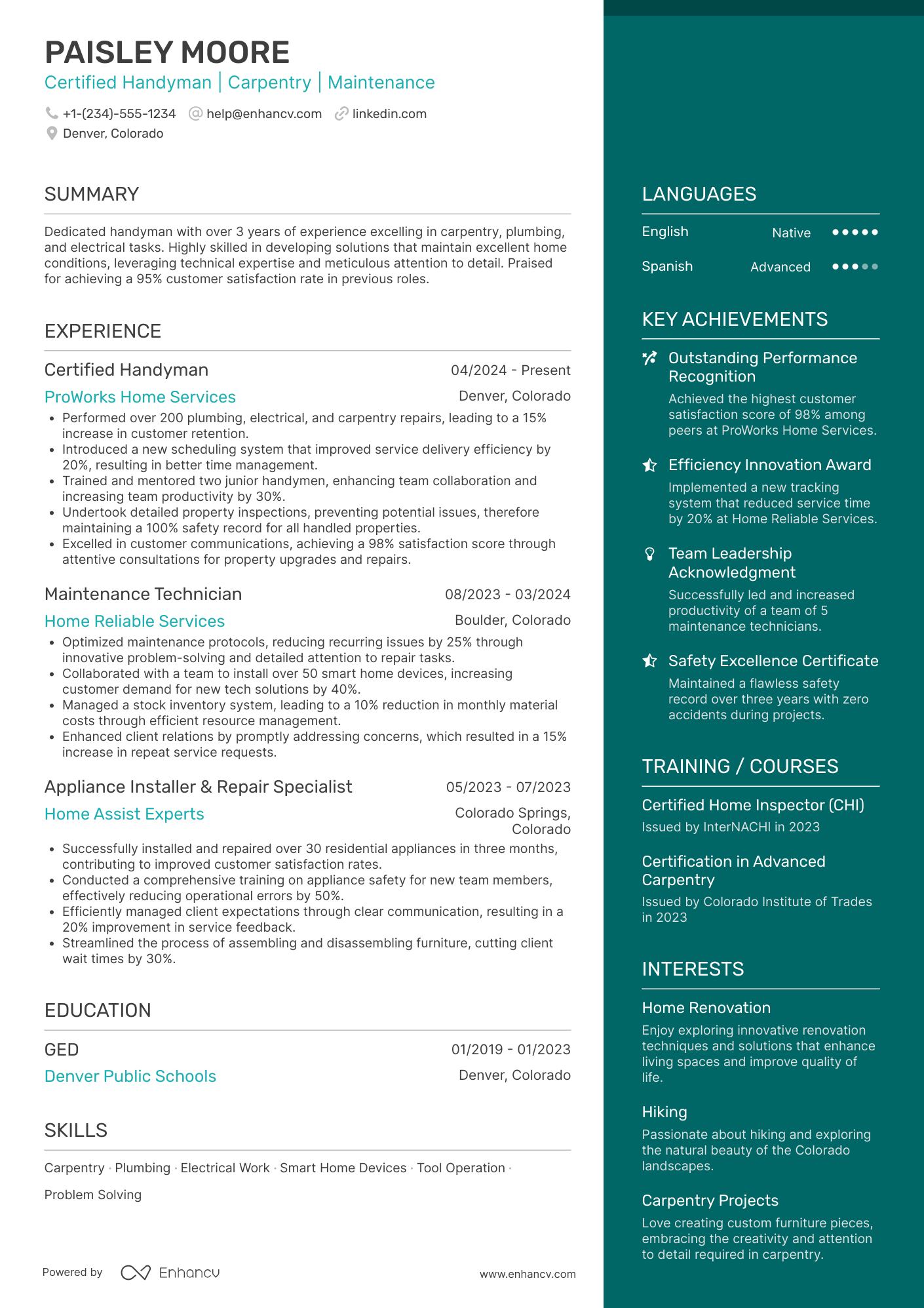
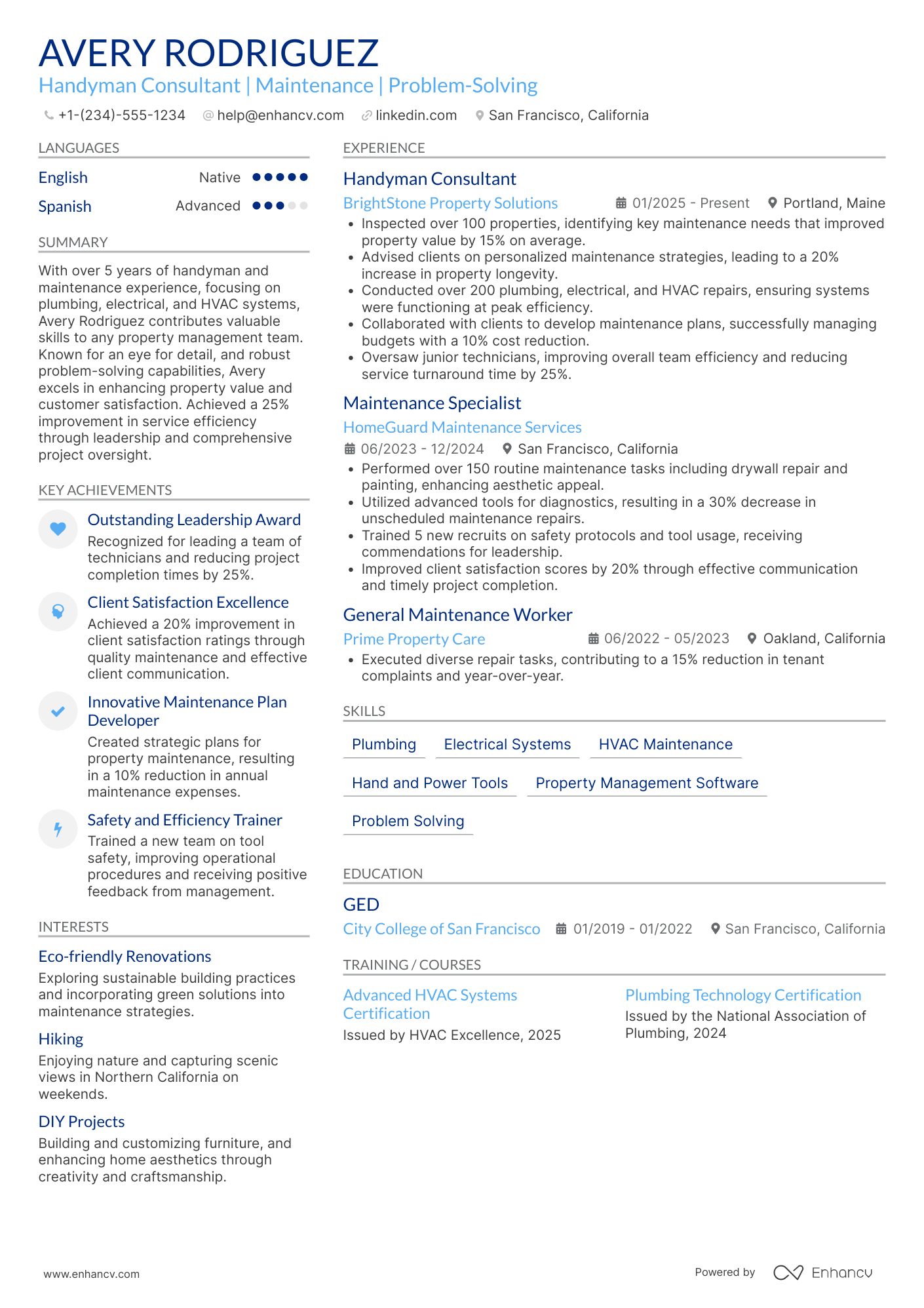
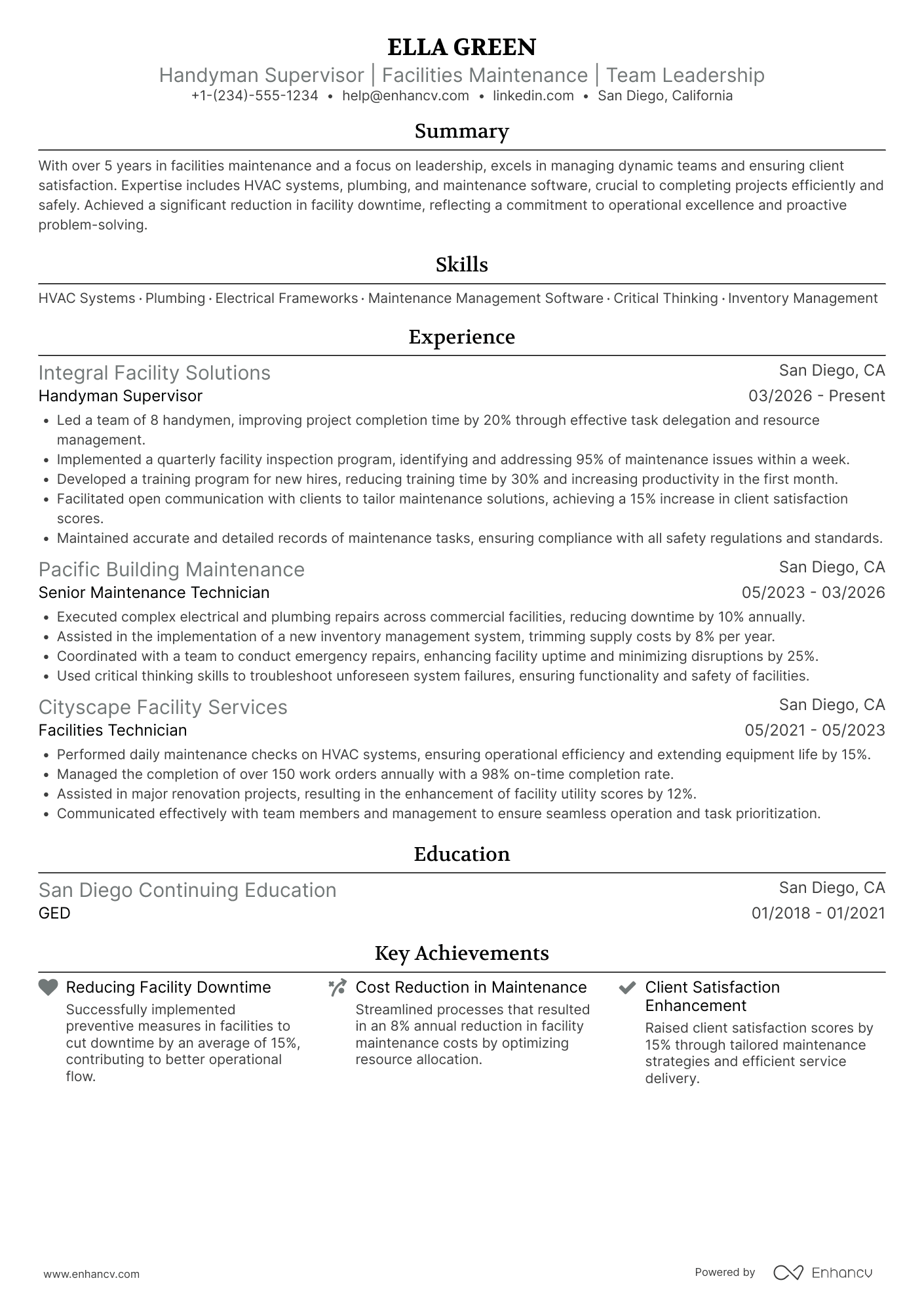
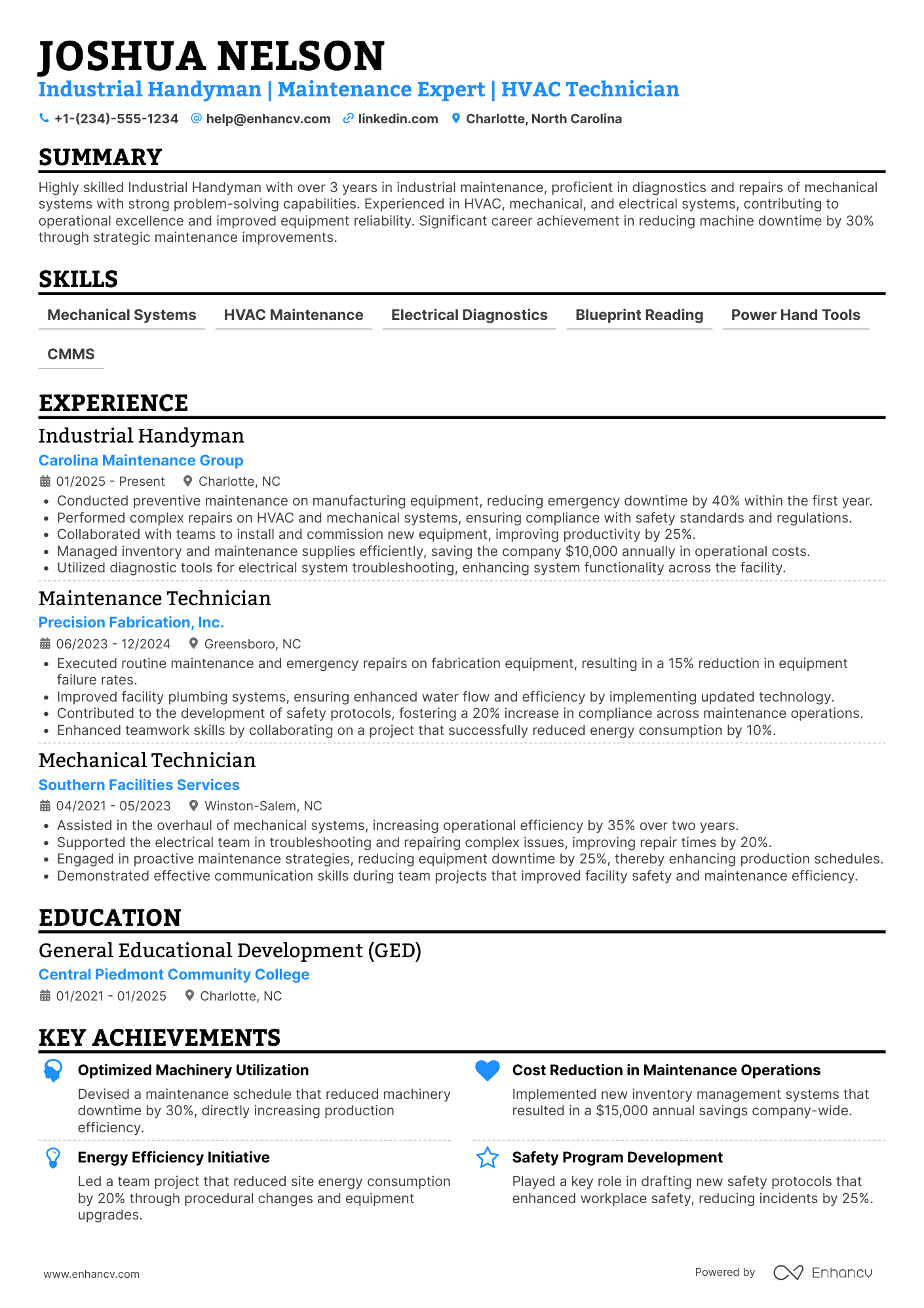
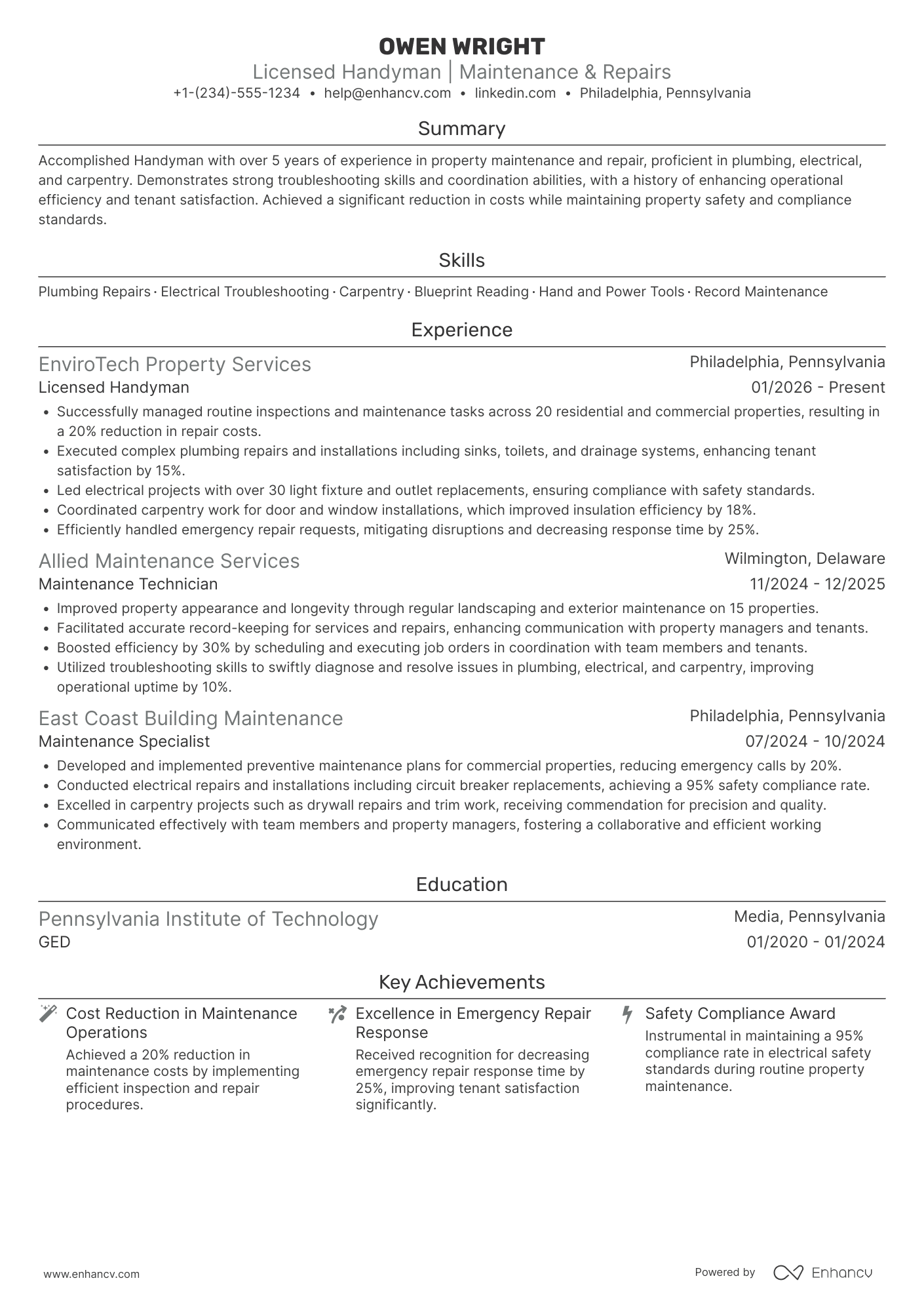
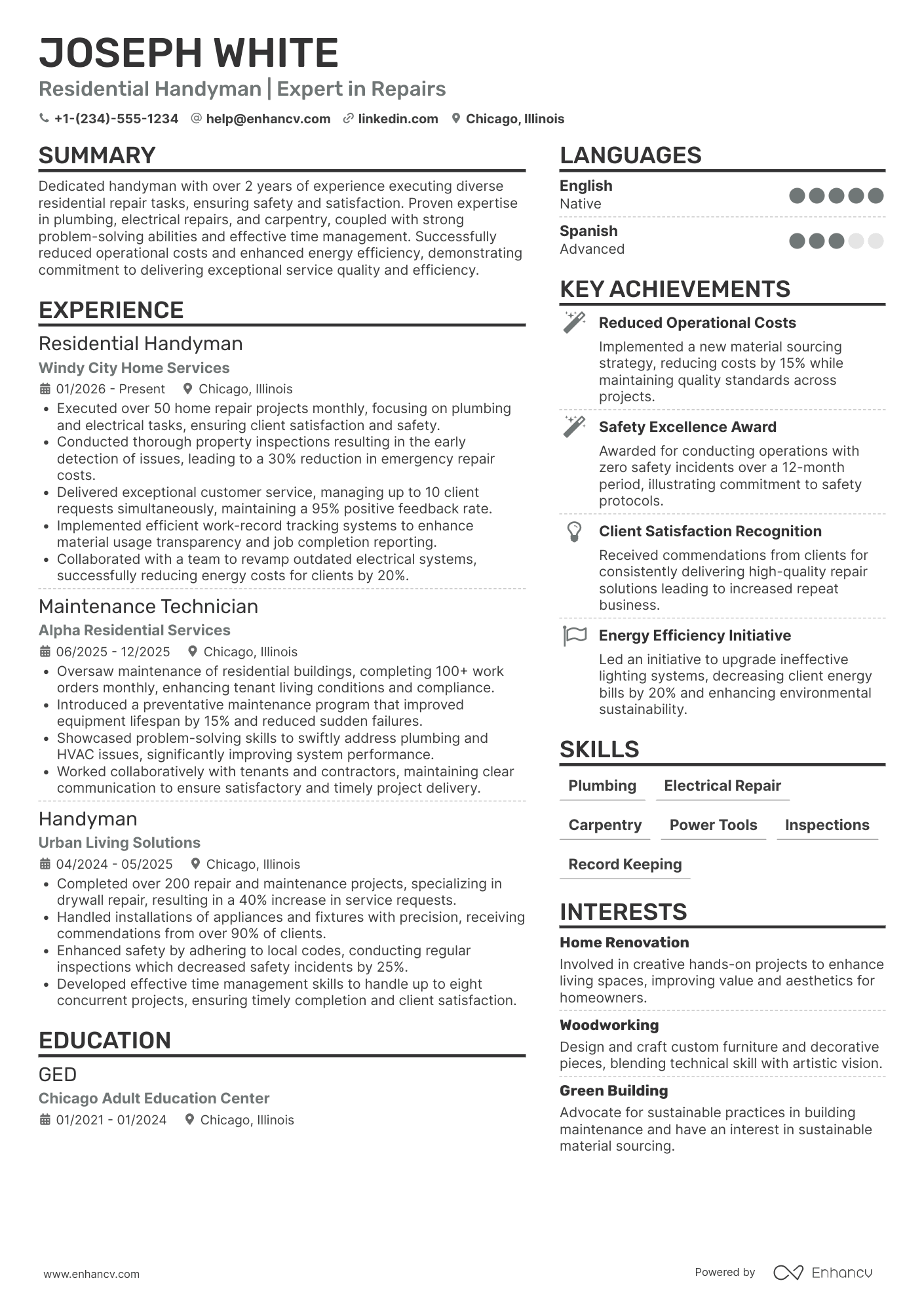
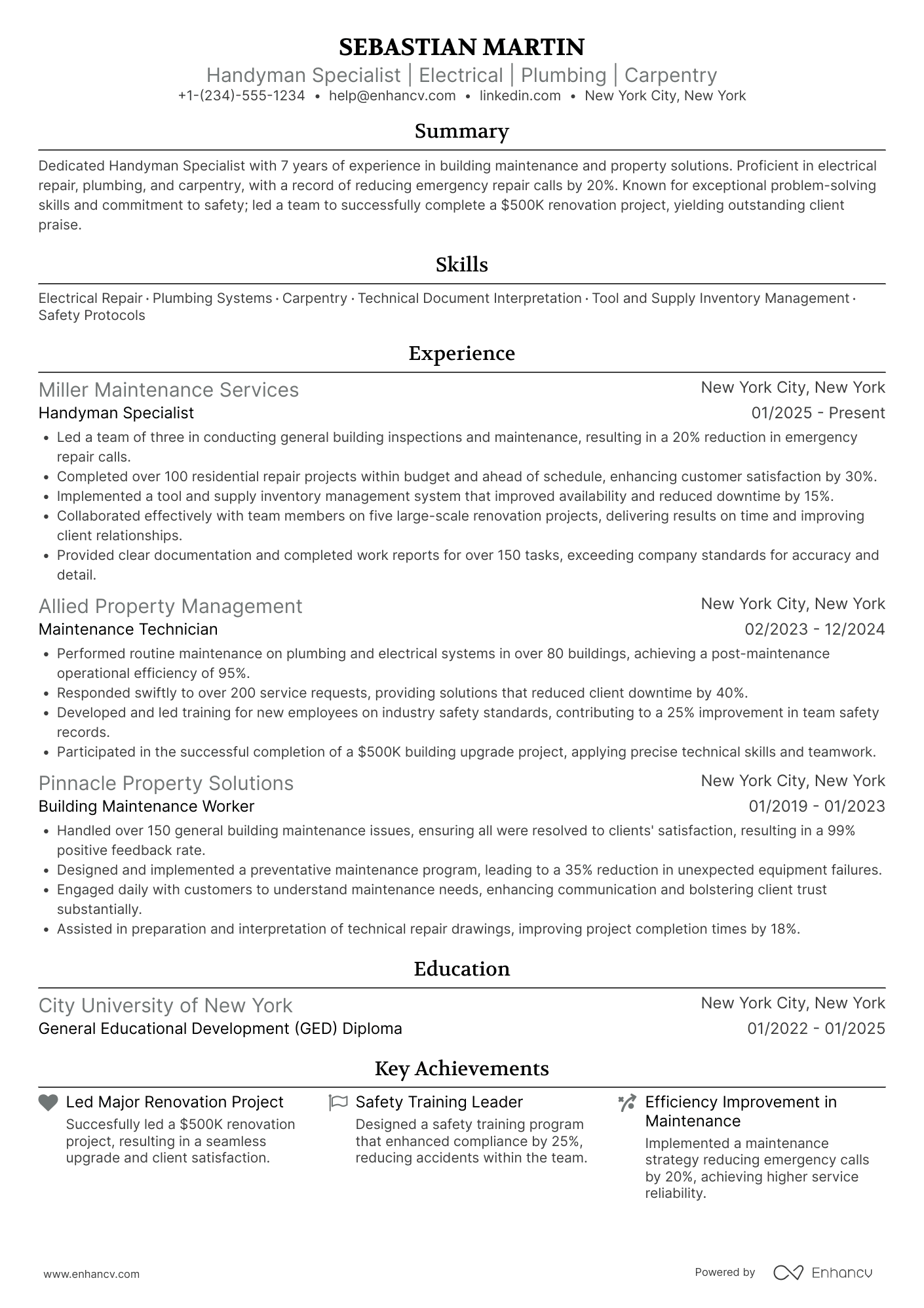
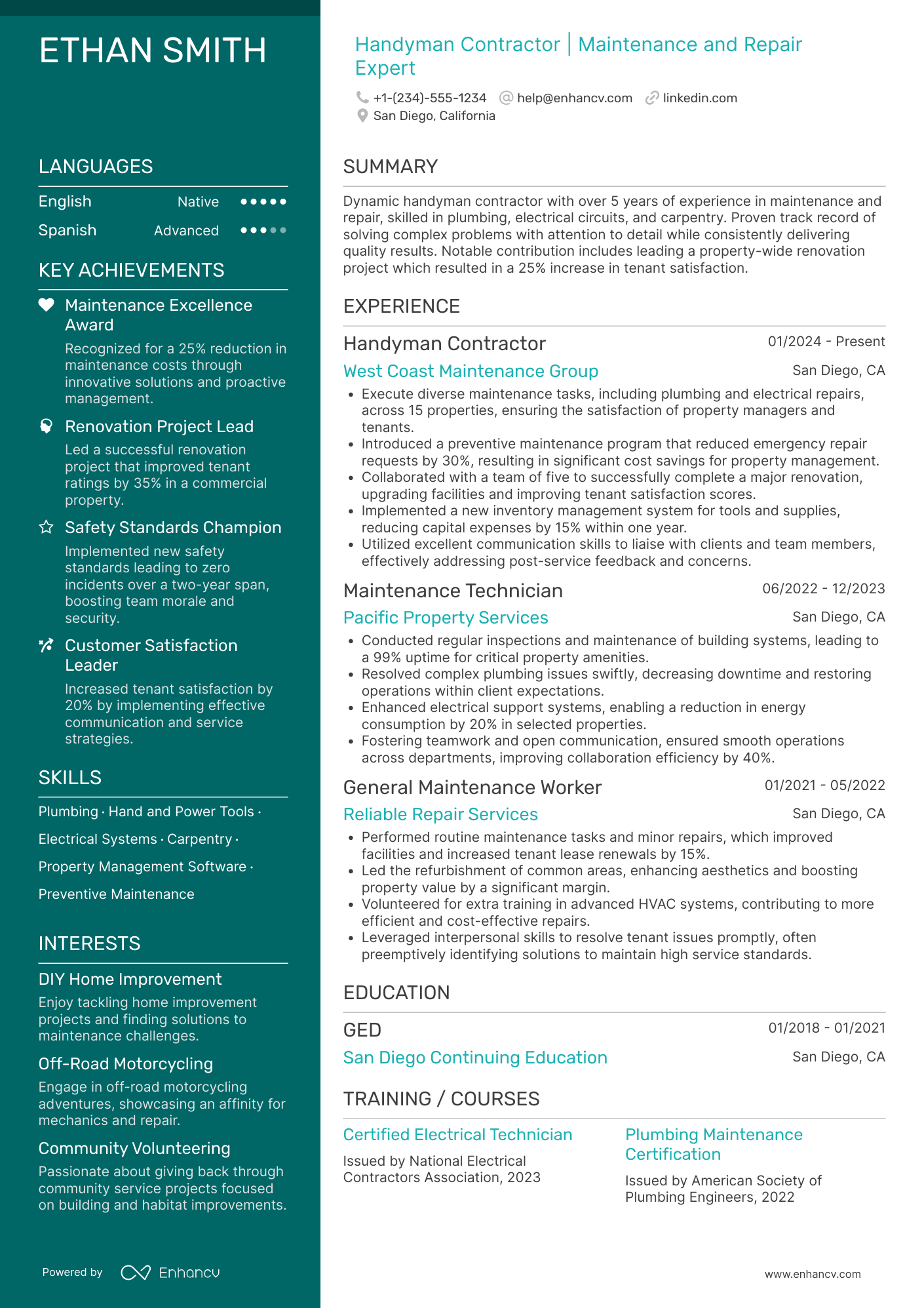
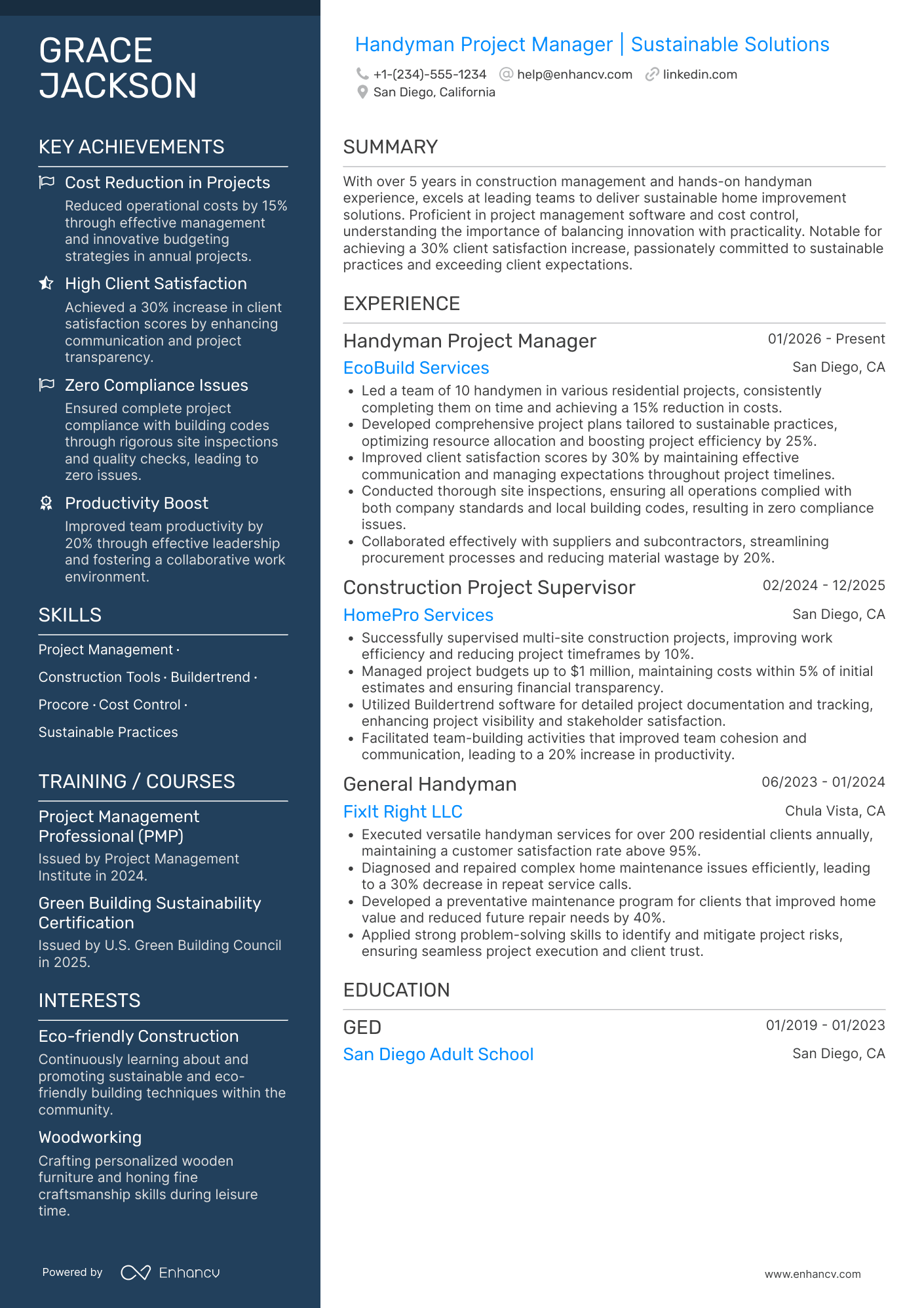
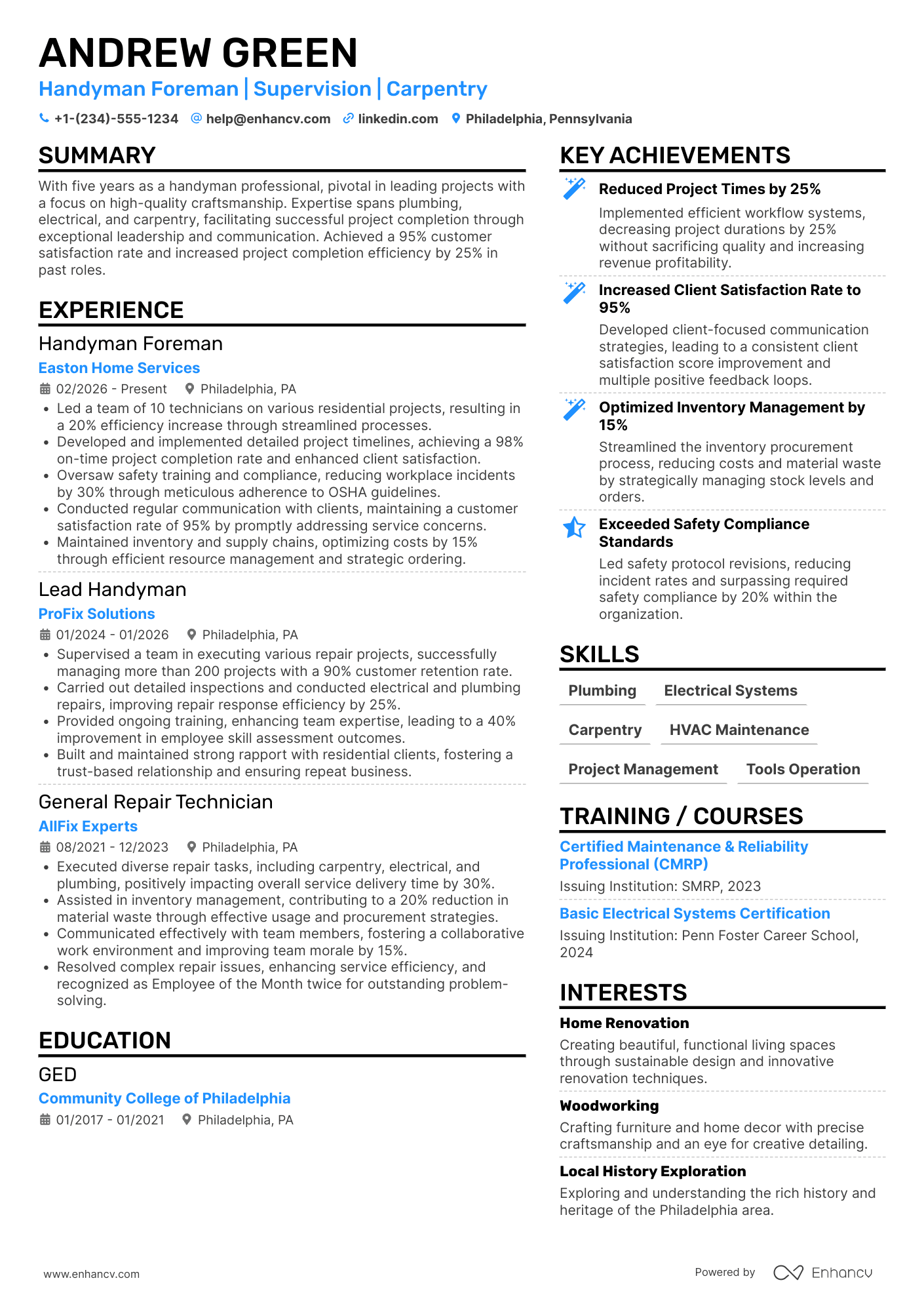
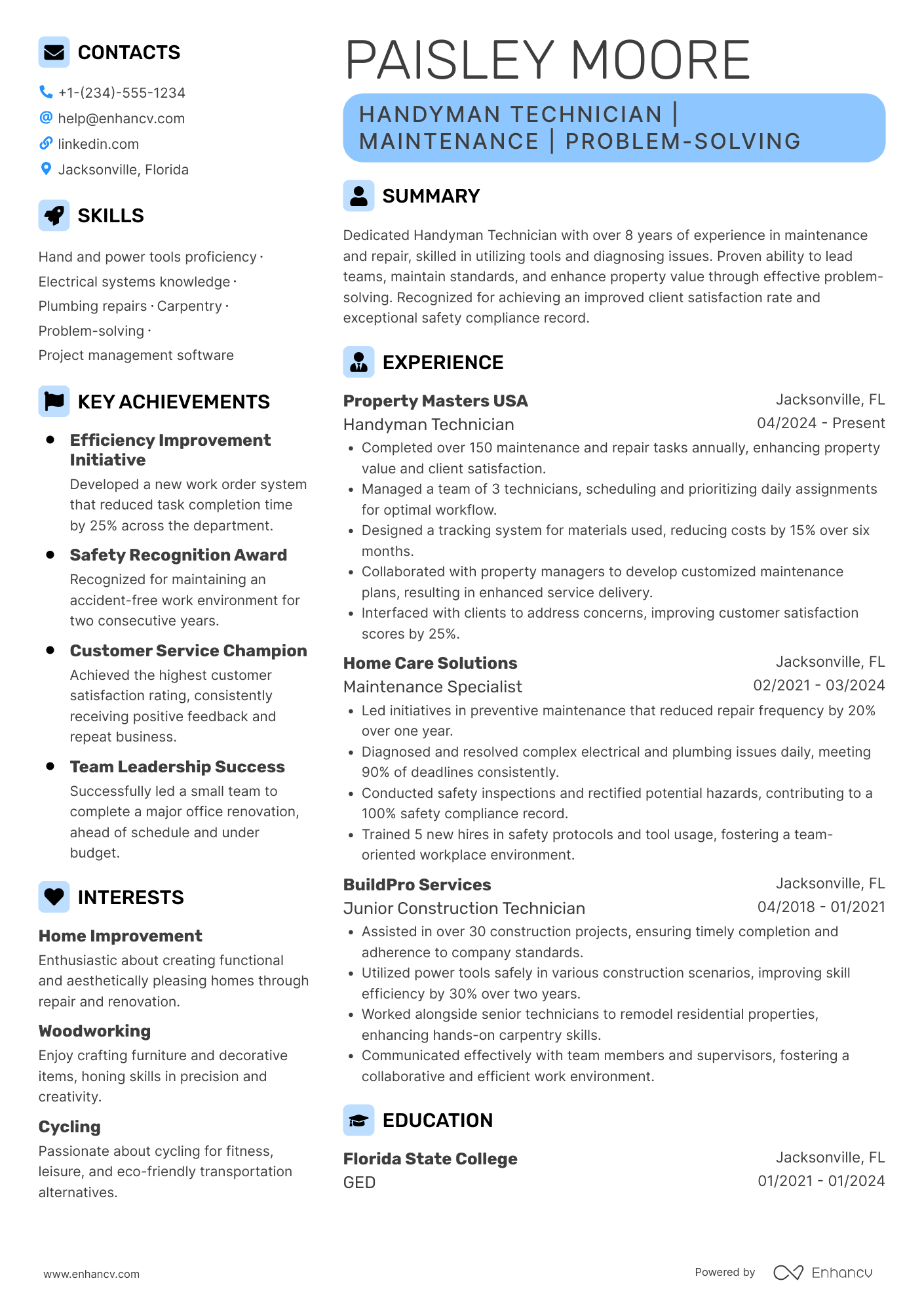
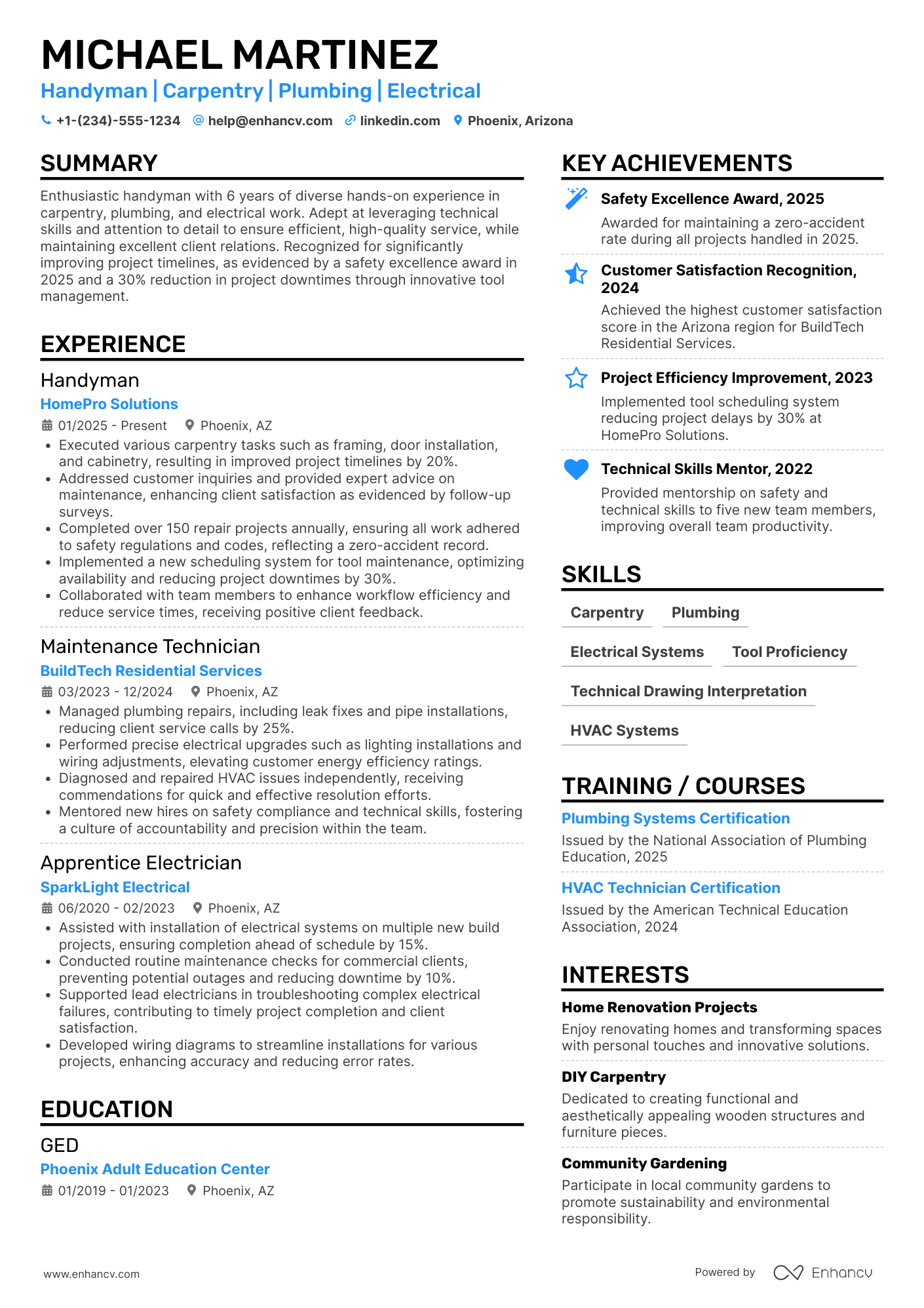
Many handyman resume drafts fail because they read like task lists and bury proof of results. That hurts when hiring teams rely on ATS filters and fast scans in a crowded applicant pool.
Sending a cover letter with it? Our handyman cover letter guide covers the storytelling half — where your range of trades and on-schedule track record get the context a building owner reads before they call.
A strong resume shows what you improved, fixed, or delivered, not just what you used. Understanding how to make your resume stand out means highlighting jobs completed on schedule, fewer callbacks, faster turnaround times, larger property coverage, budget savings, and higher customer ratings.

Key takeaways
- Quantify repair outcomes like turnaround time, callback rates, and cost savings on every bullet.
- Use reverse-chronological format if experienced and hybrid format if changing careers or junior.
- Tailor each resume to the job posting's tools, trade terms, and property types.
- Demonstrate skills inside your summary and experience bullets, not only in a skills list.
- Include certifications like OSHA 10-Hour or EPA Lead-Safe to build immediate credibility.
- Replace vague task descriptions with specific repairs, tools used, and measurable results.
- Use Enhancv to turn routine job duties into focused, recruiter-ready resume bullets faster.
Job market snapshot for handymans
We analyzed 51 recent handyman job ads across major US job boards. These numbers help you understand employer expectations, regional hotspots, experience requirements at a glance.
What level of experience employers are looking for handymans
| Years of Experience | Percentage found in job ads |
|---|---|
| 1–2 years | 13.7% (7) |
| 3–4 years | 11.8% (6) |
| 5–6 years | 3.9% (2) |
| Not specified | 70.6% (36) |
Handyman ads by area of specialization (industry)
| Industry (Area) | Percentage found in job ads |
|---|---|
| Finance & Banking | 35.3% (18) |
Role overview stats
These tables show the most common responsibilities and employment types for handyman roles. Use them to align your resume with what employers expect and to understand how the role is structured across the market.
Day-to-day activities and top responsibilities for a handyman
| Responsibility | Percentage found in job ads |
|---|---|
| Plumbing | 70.6% (36) |
| Painting | 66.7% (34) |
| Electrical | 54.9% (28) |
| Carpentry | 51.0% (26) |
| Hand tools | 39.2% (20) |
| Power tools | 37.3% (19) |
| Drywall | 31.4% (16) |
| Hvac | 19.6% (10) |
| Drywall repair | 17.6% (9) |
| Pressure washing | 9.8% (5) |
| Cmms | 7.8% (4) |
| Framing | 7.8% (4) |
How to format a handyman resume
Recruiters hiring for handyman roles prioritize a clear picture of your hands-on skills, the range of trades you can handle, and evidence that you complete jobs reliably and efficiently. Choosing the right resume format ensures those signals—versatility, practical competence, and dependable work history—are immediately visible rather than buried.

I have significant experience as a handyman—which format should I use?
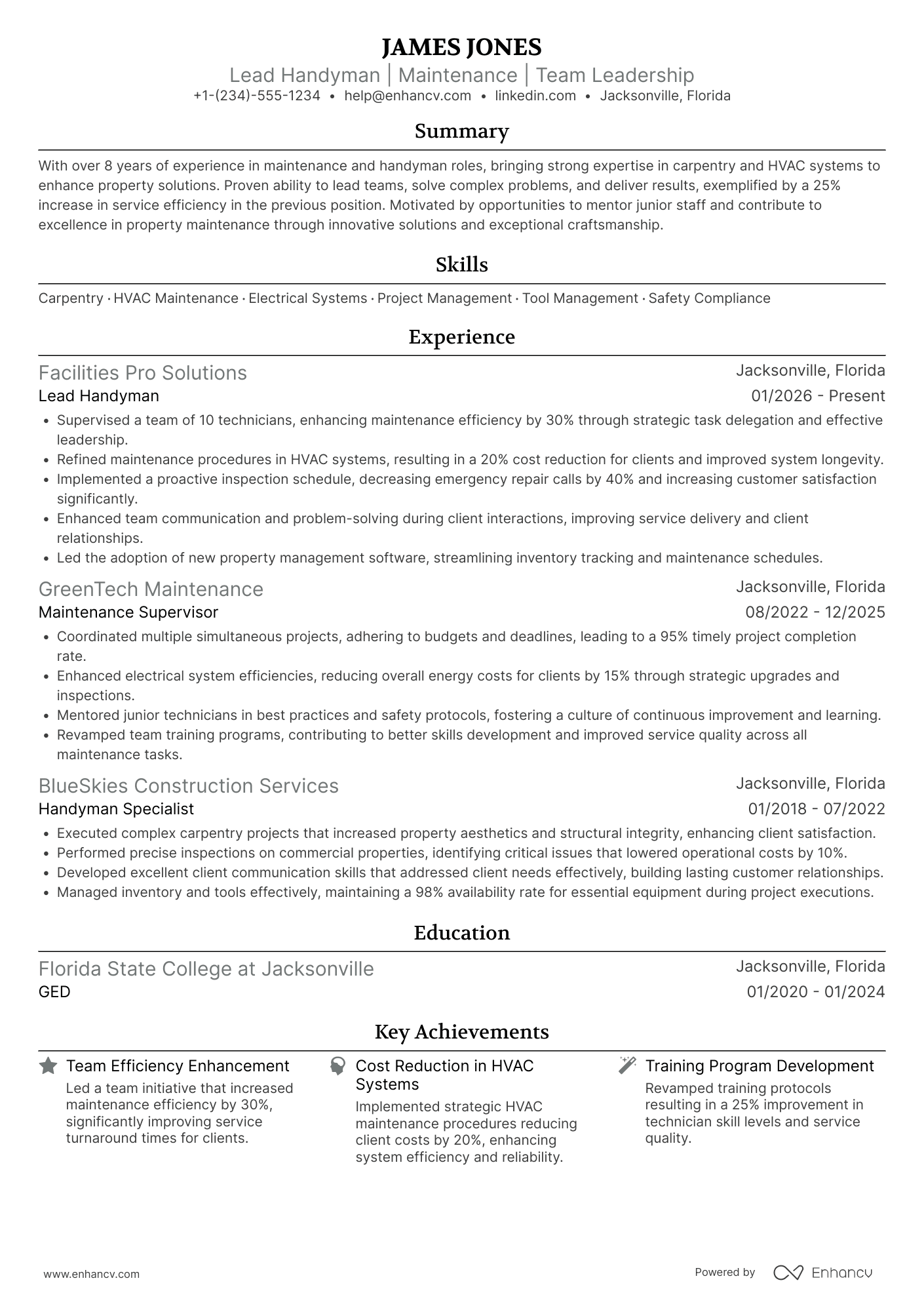
Use a reverse-chronological format to put your strongest, most recent work front and center. Do:
- Lead each role entry with the scope of work you owned—property types, number of units maintained, and the range of trades you performed (electrical, plumbing, carpentry, drywall, painting).
- Highlight specific tools, equipment, and technical knowledge relevant to the role, such as HVAC troubleshooting, power tool operation, building code compliance, or work order management software.
- Quantify outcomes wherever possible—cost savings, turnaround times, reduction in repeat service calls, or volume of completed work orders.
I'm junior or switching into a handyman role—what format works best?
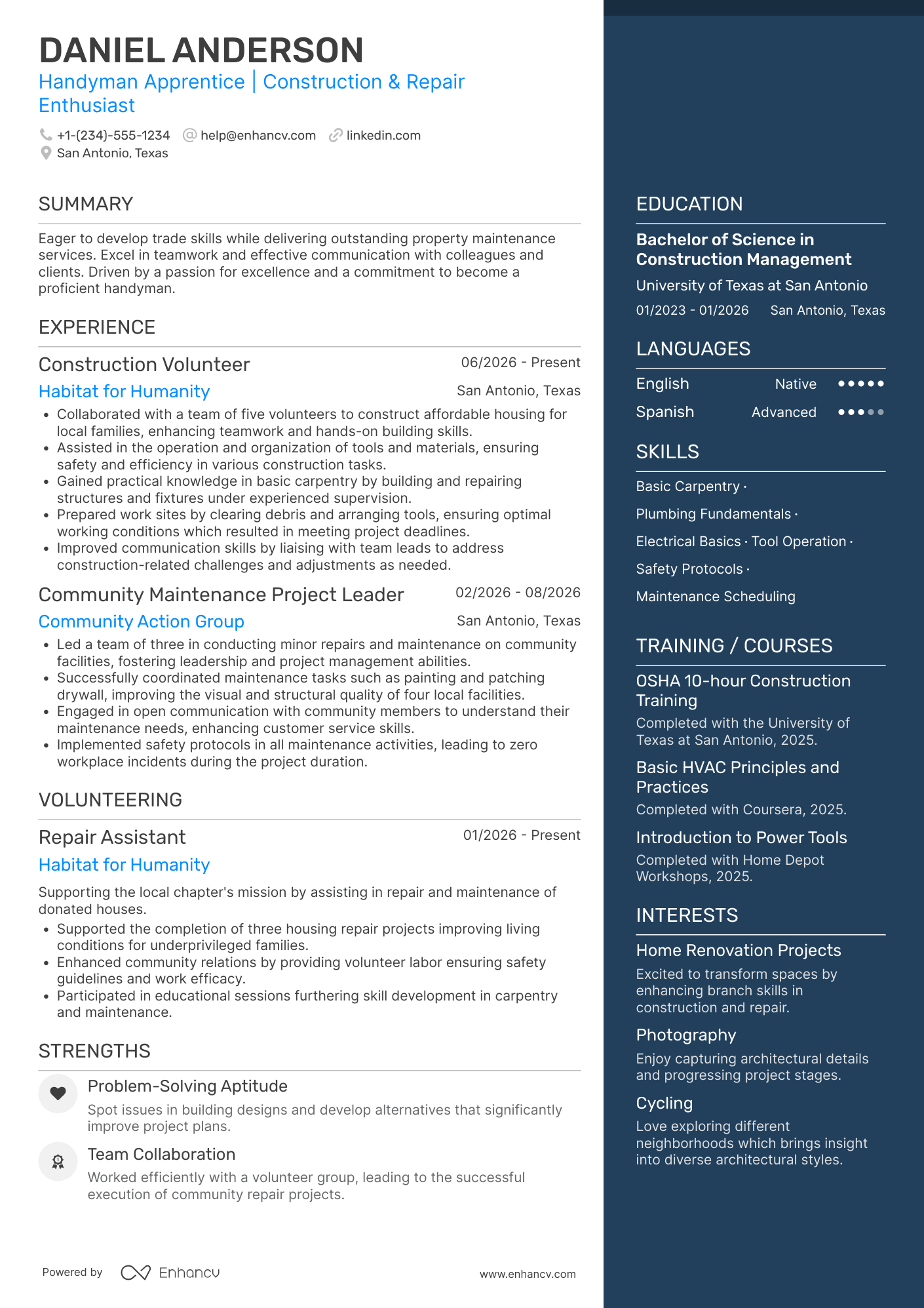
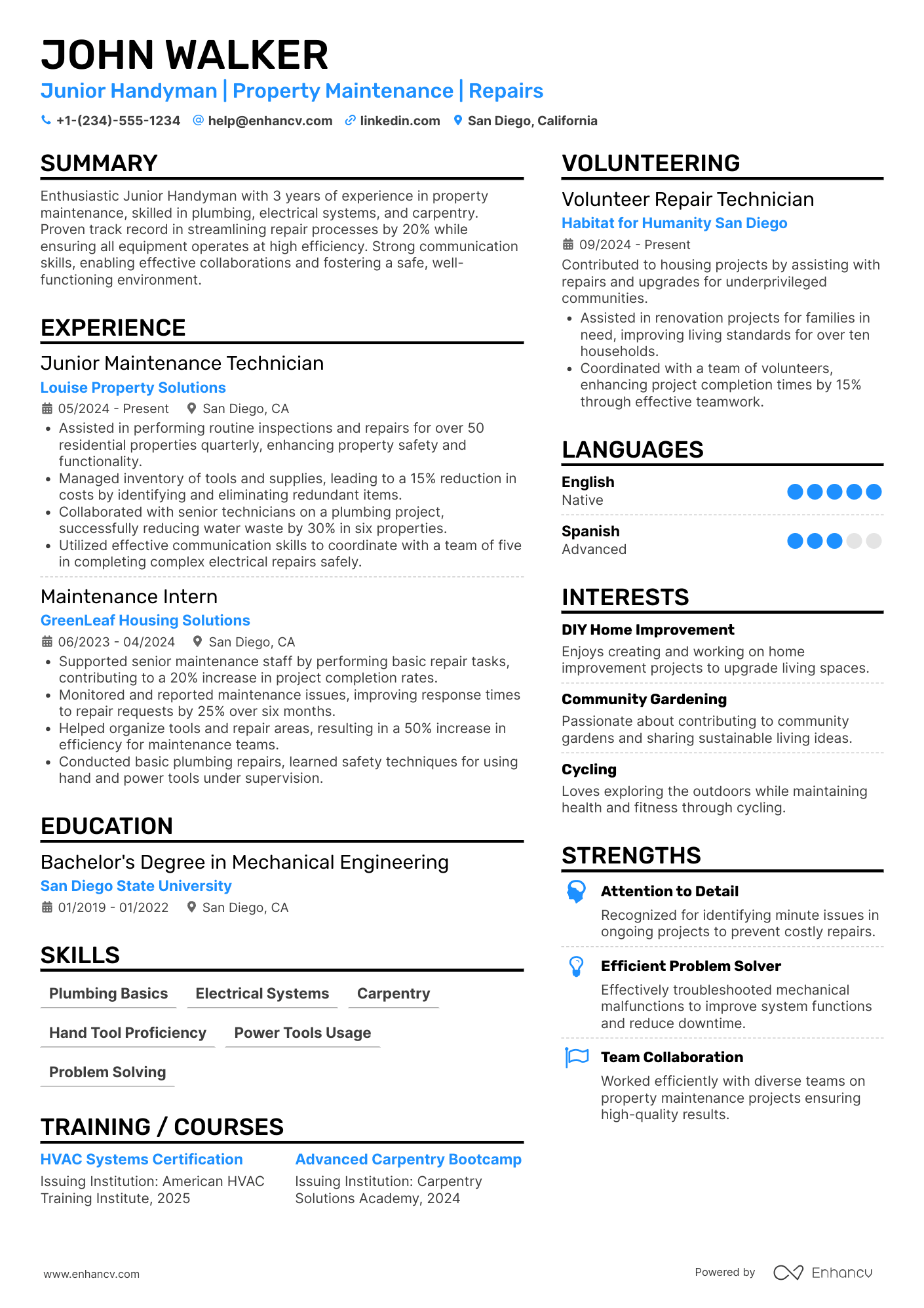
A hybrid format works best because it lets you lead with a targeted skills section while still showing relevant work or project history in chronological order. Do:
- Place a skills section near the top of your resume grouping core trade competencies—basic plumbing, electrical repairs, fixture installation, drywall patching—so recruiters and applicant tracking systems catch them immediately.
- Include hands-on projects, volunteer work, vocational training, or freelance jobs that demonstrate practical ability, even if they weren't formal handyman positions.
- Connect every skill or project to a concrete action and a measurable or observable result so hiring managers can assess your real capability.
Why not use a functional resume?
A functional resume strips away the timeline of your work, making it harder for hiring managers to verify where and when you applied your skills—which is a red flag for a role where reliability and consistent hands-on experience matter.
- Career changers with transferable trade skills: If you worked in construction, facilities maintenance, or a related field and are pivoting to a dedicated handyman role, a functional format can help you reframe those skills—but only if each skill is tied to a specific project or outcome.
- Limited formal work history: If you've done mostly freelance, side, or cash jobs without a structured employment record, a functional format lets you organize your abilities by trade category while referencing real projects.
Once you've locked in a clean, readable format, the next step is filling it with the right sections to showcase your skills and experience.
What sections should go on a handyman resume
Recruiters expect to quickly see your core trade capabilities, safety awareness, and a clear record of completed residential and commercial work. Knowing which resume sections to include helps you organize this information for maximum clarity.
Use this structure for maximum clarity:
- Header
- Summary
- Experience
- Skills
- Projects
- Education
- Certifications
- Optional sections: Licenses, Volunteering, Languages
Strong experience bullets should emphasize measurable results, job scope, turnaround time, quality outcomes, and repeat-client or safety performance.
Is your resume good enough?
Drop your resume here or choose a file. PDF & DOCX only. Max 2MB file size.
With your resume’s key components in place, the next step is to write the experience section in a way that clearly shows the value you delivered on the job.
How to write your handyman resume experience
The work experience section is where you prove you can get the job done—literally. Hiring managers want to see the repairs you completed, the tools and techniques you relied on, and the measurable outcomes you delivered, not a generic checklist of daily tasks.
Each entry should include:
- Job title
- Company and location (or remote)
- Dates of employment (month and year)
Three to five concise bullet points showing what you owned, how you executed, and what outcomes you delivered:
- Ownership scope: the types of properties, maintenance programs, renovation projects, or service areas you were directly responsible for as a handyman.
- Execution approach: the tools, building codes, repair techniques, or diagnostic methods you used to assess problems and complete work on time and to standard.
- Value improved: changes to property condition, safety compliance, turnaround time, tenant satisfaction, or cost efficiency that resulted from your repair and maintenance work.
- Collaboration context: how you coordinated with property managers, tenants, contractors, inspectors, or suppliers to schedule work, source materials, and resolve issues across multiple job sites.
- Impact delivered: outcomes tied to reduced maintenance backlogs, fewer repeat service calls, lower repair costs, or improved building performance rather than a simple list of tasks performed.
Experience bullet formula
A handyman experience example
✅ Right example - modern, quantified, specific.
Handyman
Harborview Property Services | Tampa, FL
2022–Present
Residential and small commercial maintenance provider supporting fifty-plus rental units and owner-occupied homes across the Tampa Bay area.
- Diagnosed and repaired plumbing leaks and clogs using a Ridgid micro inspection camera, PEX crimp tools, and Moen cartridge pullers, cutting repeat call-backs by 28% across three property managers.
- Completed electrical troubleshooting and fixture upgrades with a Fluke multimeter, GFCI testers, and Lutron dimmers, reducing safety-related work orders by 19% and improving inspection pass rates to 98%.
- Built and installed doors, trim, and cabinetry using a DeWalt miter saw, Kreg pocket-hole jig, and laser level, delivering twenty-two projects on schedule and cutting rework time by 35% through tighter tolerances.
- Implemented a preventive maintenance schedule in Jobber (job management software) and standardized photo-based closeout reports, saving clients an average of two hours per week on coordination and increasing repeat bookings by 15%.
- Coordinated scopes, materials, and access with tenants, suppliers, and licensed electricians and plumbers, completing 96% of jobs within the original estimate and reducing material waste by 12% through accurate takeoffs.
Now that you've seen how a strong experience section looks in practice, let's explore how to customize yours for each specific job posting.
How to tailor your handyman resume experience
Recruiters evaluate your handyman resume through both applicant tracking systems and manual review. Tailoring your resume to the job description helps you pass both filters.
Ways to tailor your handyman experience:
- Match specific tools and equipment listed in the job description.
- Mirror terminology for repair methods or maintenance procedures mentioned.
- Include building codes or safety standards referenced in the posting.
- Highlight relevant experience with residential or commercial properties specified.
- Emphasize trade specialties like plumbing or electrical work if requested.
- Reflect workflow models such as work order or ticketing systems named.
- Reference quality inspection or compliance protocols the employer prioritizes.
- Quantify results using the same performance criteria the posting describes.
Tailoring means aligning your real accomplishments with what the employer asks for, not forcing keywords where they don't belong.
Resume tailoring examples for handyman
| Job description excerpt | Untailored | Tailored |
|---|---|---|
| "Perform drywall repair, texture matching, and interior painting for residential rental units between tenant turnovers." | Handled various maintenance tasks around properties. | Completed drywall patching, texture matching, and full interior repainting across 15+ rental units per quarter, reducing turnover prep time by two days per unit. |
| "Troubleshoot and repair minor plumbing issues including faucet replacements, toilet repairs, and garbage disposal installations using standard hand and power tools." | Fixed things when they broke and helped with building upkeep. | Diagnosed and resolved minor plumbing issues—faucet replacements, toilet valve repairs, and garbage disposal installations—using pipe wrenches, basin wrenches, and cordless drills across a 200-unit apartment complex. |
| "Assemble furniture, mount shelving and TVs, and perform weather-sealing on doors and windows for commercial office spaces." | Assisted with general office repairs and small projects as needed. | Assembled modular office furniture, wall-mounted 30+ shelving units and flat-screen TVs, and applied weather-stripping and caulk sealing to exterior doors and windows across three commercial office buildings. |
Once you’ve aligned your experience with the role’s priorities, quantify your achievements to show the measurable impact of that work.
How to quantify your handyman achievements
Quantifying your achievements shows the real impact of your work beyond "fixed it." Focus on turnaround time, callback rate, cost savings, safety risk reduction, and customer satisfaction across jobs, properties, and maintenance schedules.
Quantifying examples for handyman
| Metric | Example |
|---|---|
| Turnaround time | "Completed twenty-two work orders per week across three rental properties, cutting average turnaround from three days to one day using a scheduled route and parts checklist." |
| Quality | "Reduced repeat-call callbacks from 12% to 4% over six months by standardizing caulking, drywall patching, and paint touch-up steps with a punch-list review." |
| Cost savings | "Saved $3,800 annually by repairing faucets, garbage disposals, and door hardware in-house instead of outsourcing, using a tracked parts log and approved vendors." |
| Safety risk | "Closed fifteen safety hazards in one quarter—loose handrails, trip thresholds, and GFCI failures—passing two property inspections with zero violations." |
| Customer satisfaction | "Maintained a 4.8/5 tenant satisfaction average across sixty service tickets by sending arrival windows, photo updates, and same-day follow-ups after repairs." |
Turn vague job duties into measurable, recruiter-ready resume bullets in seconds with Enhancv's Bullet Point Generator.
Once you've crafted strong bullet points for your experience section, the next step is making sure your skills section highlights the right mix of hard and soft skills.
How to list your hard and soft skills on a handyman resume
Your skills section shows you can complete repairs safely and correctly, and recruiters and an ATS (applicant tracking system) scan them to match you to the job post—most handyman resumes lean slightly heavier on hard skills than soft skills. handyman roles require a blend of:
- Product strategy and discovery skills.
- Data, analytics, and experimentation skills.
- Delivery, execution, and go-to-market discipline.
- Soft skills.
Your skills section should be:
- Scannable (bullet-style grouping).
- Relevant to the job post.
- Backed by proof in experience bullets.
- Updated with current tools.
Place your skills section:
- Above experience if you're junior or switching careers.
- Below experience if you're mid/senior with strong achievements.

Hard skills
- Drywall patching and finishing
- Interior and exterior painting
- Carpentry, trim, door hardware
- Plumbing repairs, fixture installs
- Electrical troubleshooting (basic)
- Power tools, hand tools, ladders
- Tile repair, grout, caulk
- Flooring installation and repair
- Appliance installation and hookups
- Stud finding, level, measuring
- Work order systems, invoicing apps
- OSHA safety, PPE compliance
Soft skills
- Triage and prioritize repairs
- Explain options and tradeoffs
- Set clear scope and expectations
- Provide accurate time estimates
- Communicate delays proactively
- Coordinate with tenants and vendors
- Document work and materials used
- Maintain clean, safe job sites
- Make on-site decisions quickly
- Follow through to completion
- Resolve issues without escalation
- Protect customer property and privacy
How to show your handyman skills in context
Skills shouldn't live only in a dedicated skills list. Explore resume skills examples to see how they can be demonstrated throughout your resume.
They should be demonstrated in:
- Your summary (high-level professional identity)
- Your experience (proof through outcomes)
Here's what that looks like in practice.
Summary example
Senior handyman with 12+ years of residential and commercial experience in plumbing, electrical, drywall, and finish carpentry. Reduced average repair turnaround by 30% through efficient scheduling and client-first communication across 200+ properties.
- Reflects senior-level expertise immediately
- Names specific trade skills and tools
- Includes a measurable performance outcome
- Highlights client communication as a soft skill
Experience example
Senior Maintenance Handyman
BrightPath Property Services | Denver, CO
March 2018–January 2025
- Completed 1,500+ work orders across plumbing, electrical, and carpentry, maintaining a 98% first-visit resolution rate.
- Collaborated with property managers and HVAC contractors to coordinate preventive maintenance, cutting emergency calls by 25%.
- Used digital tracking tools and inventory management to reduce material waste by 15% year over year.
- Every bullet contains measurable proof.
- Skills appear naturally through real outcomes.
Once you’ve demonstrated your practical abilities through specific, real-world examples, the next step is to apply that same approach to writing a handyman resume with no experience.
How do I write a handyman resume with no experience
Even without full-time experience, you can demonstrate readiness through hands-on projects and training. Our guide on writing a resume without work experience covers this in detail. Consider showcasing:
- Home repair projects for family
- Volunteer maintenance for nonprofits
- Property upkeep for landlords
- Furniture assembly and mounting work
- Small remodel tasks at home
- Tool handling and safety training
- Apprenticeship-style shadowing with tradespeople
- Before-and-after repair photo log
Focus on:
- Specific repairs and installations completed
- Tools, materials, and methods used
- Measurable results and job scope
- Safety practices and compliance training
Resume format tip for entry-level handyman
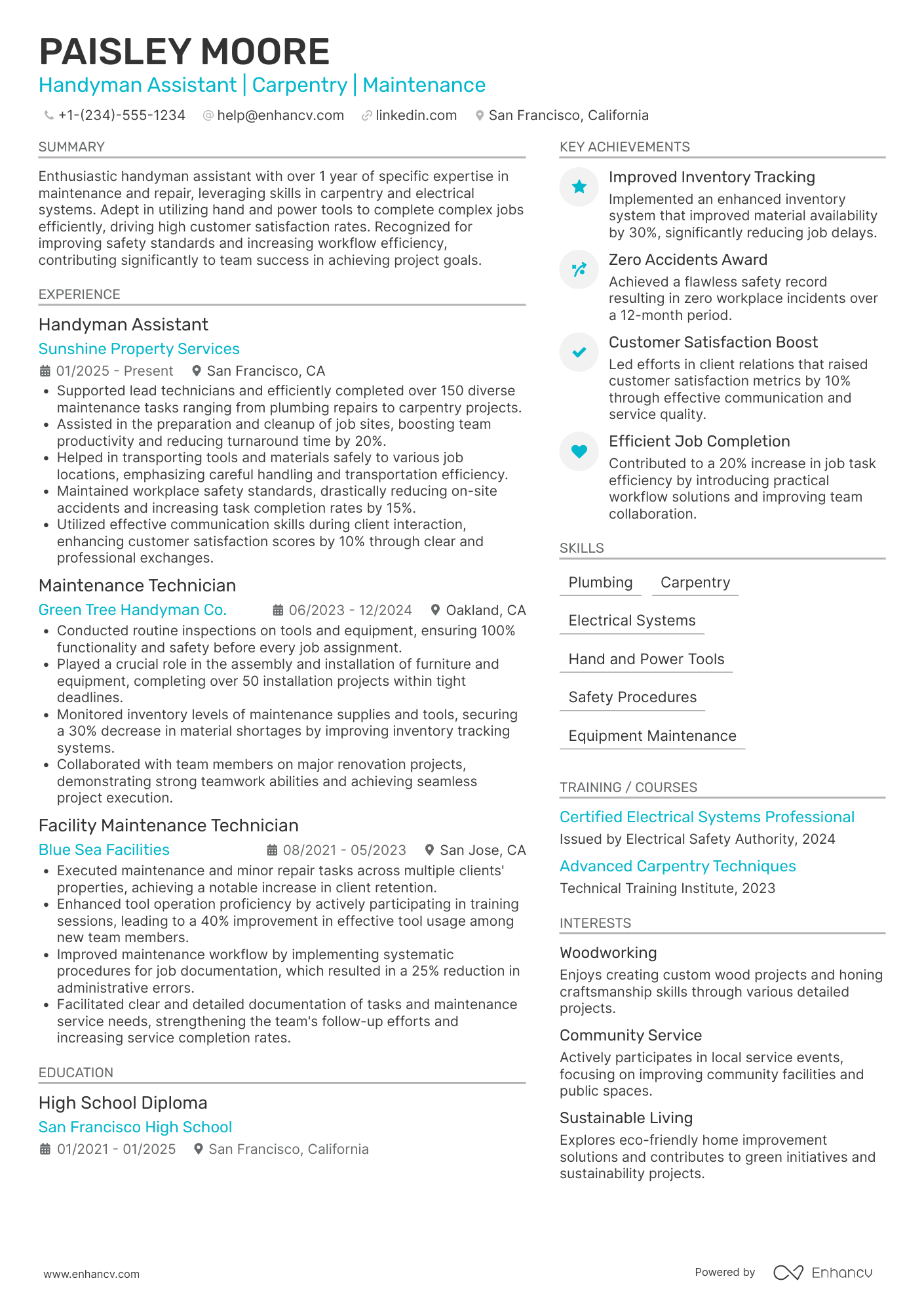
Use a combination resume format since it highlights skills and projects first, while still listing any work history, even if unrelated. Do:
- Add a "Projects" section with dates.
- List tools used under each project.
- Quantify results with counts and time.
- Include safety training and certifications.
- Attach a link to a photo portfolio.
- Mounted eight shelves using a stud finder, level, and anchors, reducing garage floor clutter by 40% and improving storage access.
Once you've structured your resume around transferable skills and relevant projects, the next step is presenting your education in a way that reinforces your qualifications.
How to list your education on a handyman resume
Your education section helps hiring teams confirm you have foundational knowledge in building systems, safety codes, and repair techniques relevant to the handyman trade.
Include:
- Degree name
- Institution
- Location
- Graduation year
- Relevant coursework (for juniors or entry-level candidates)
- Honors & GPA (if 3.5 or higher)
Skip month and day details—list the graduation year only.
Here's a strong education entry tailored for a handyman resume.
Example education entry
Associate of Applied Science in Building Maintenance Technology
Riverside Community College, Riverside, CA
Graduated 2019
GPA: 3.7
- Relevant coursework: Electrical Systems, Plumbing Fundamentals, HVAC Basics, Blueprint Reading, and Workplace Safety Compliance
- Honors: Dean's List, 2018–2019
How to list your certifications on a handyman resume
Certifications on your resume show your commitment to learning, prove tool and safety proficiency, and signal industry relevance for a handyman across residential and commercial projects. Include:
- Certificate name
- Issuing organization
- Year
- Optional: credential ID or URL
- Place certifications below education when they are older, general, or less relevant than your degree or training.
- Place certifications above education when they are recent, role-relevant, or required for the jobs you target.
Best certifications for your handyman resume
OSHA 10-Hour Construction Safety and Health EPA Lead-Safe Certified Renovator (RRP) NCCER Core: Introduction to Basic Construction Skills Home Inspection Certification (InterNACHI) NFPA 70E Electrical Safety Training Certified Pool and Spa Operator (CPO) Forklift Operator Certification
Once you’ve placed your credentials where hiring managers can spot them quickly, you’re ready to write your handyman resume summary to highlight those qualifications upfront.
How to write your handyman resume summary
Your resume summary is the first thing a recruiter reads. A strong one instantly signals you have the skills and reliability to handle diverse repair and maintenance tasks.
Keep it to three to four lines, with:
- Your title and total years of hands-on handyman experience.
- The setting you know best, such as residential, commercial, or property management.
- Core skills like plumbing, electrical, drywall, carpentry, and painting.
- One or two measurable wins, such as reduced costs or faster turnaround times.
- Practical soft skills shown through real results, like clear communication with tenants or dependable scheduling.

PRO TIP
At the handyman level, emphasize the breadth of your trade skills and any early results that prove reliability. Highlight specific tools and certifications you hold. Avoid vague phrases like "hard worker" or "passionate self-starter." Recruiters want to see what you can fix, how fast, and how well.
Example summary for a handyman
Versatile handyman with three years of residential maintenance experience in plumbing, electrical, and carpentry. Completed over 200 work orders annually with a 97% tenant satisfaction rate.
Optimize your resume summary and objective for ATS
Drop your resume here or choose a file.
PDF & DOCX only. Max 2MB file size.
Now that your summary captures your strongest qualifications, make sure the header framing it presents your contact details correctly so hiring managers can actually reach you.
What to include in a handyman resume header
Your resume header lists your key contact details and role focus, helping your handyman application stay visible, credible, and easy to screen fast.
Essential resume header elements
- Full name
- Tailored job title and headline
- Location
- Phone number
- Professional email
- GitHub link
- Portfolio link
A LinkedIn link helps recruiters verify your work history quickly and supports faster screening.
Do not include a photo on a handyman resume unless the role is explicitly front-facing or appearance-dependent.
Keep the header on one or two lines, match the job title to the posting, and use the same name across all profiles.
Example
Handyman resume header
Jordan Rivera
Handyman | Residential Repairs, Drywall, and Preventive Maintenance
Austin, TX
(512) 555-01XX
your.name@enhancv.com
github.com/yourname
yourwebsite.com
linkedin.com/in/yourname
With your contact details and role identification clearly presented at the top, you can now strengthen your application by adding additional sections that support the rest of your resume.
Additional sections for handyman resumes
Extra resume sections help you stand out when your core experience looks similar to other candidates. They build credibility and highlight unique qualifications specific to handyman work. For example, listing language skills on your resume can be a differentiator when serving diverse tenant populations.
- Languages
- Certifications and licenses
- Volunteer work
- Tools and equipment proficiency
- Hobbies and interests
- Professional affiliations
- Awards and recognitions
Once you've strengthened your resume with relevant additional sections, the next step is pairing it with a cover letter to give hiring managers a fuller picture of your qualifications.
Do handyman resumes need a cover letter
A cover letter isn't required for a handyman, but it helps when the role is competitive or the employer expects one. If you're unsure where to start, learn what a cover letter is and how it complements your resume. It can make a difference when your experience needs context or when the job involves steady client communication.
Use a cover letter to add details your resume can't:
- Explain role and team fit by matching your strengths to their needs, such as turning units fast, handling work orders, or supporting property managers.
- Highlight one or two relevant projects or outcomes, such as reducing repeat repairs, finishing a punch list early, or improving safety inspection results.
- Show you understand the business context, including tenant satisfaction, downtime costs, and how your work affects renewals, reviews, and maintenance budgets.
- Address career transitions or non-obvious experience, such as moving from construction to handyman work, or translating volunteer repairs into reliable, paid results.
Drop your resume here or choose a file.
PDF & DOCX only. Max 2MB file size.
Even if you decide to submit only a resume and skip an additional letter, the next step is using AI to improve your handyman resume so it reads clearly and matches what employers expect.
Using AI to improve your handyman resume
AI can sharpen your resume's clarity, structure, and overall impact. It helps you find stronger phrasing and tighten loose writing. But overuse kills authenticity. Once your content reads clearly and fits the role, step away from the tool. For specific guidance, check out these ChatGPT resume writing prompts designed to improve each section of your resume.
Here are 10 practical prompts you can copy and paste to strengthen specific sections of your handyman resume:
- Strengthen summary focus: "Rewrite my handyman resume summary to highlight my top three service areas and years of hands-on experience in under four sentences."
- Quantify experience bullets: "Add measurable results to each of my handyman experience bullets, such as project counts, time savings, or square footage completed."
- Tighten skills list: "Remove vague or redundant entries from my handyman skills section and group remaining skills into clear, relevant categories."
- Improve action verbs: "Replace weak or repetitive verbs in my handyman resume experience section with specific, industry-appropriate action words."
- Align with job posting: "Compare my handyman resume to this job description and flag missing keywords or qualifications I should address."
- Clarify project descriptions: "Rewrite my handyman project descriptions to specify materials used, scope of work, and completion timelines."
- Refine certifications section: "Reorganize my handyman certifications section by relevance and add brief context for any less commonly known credentials."
- Trim education details: "Shorten my handyman resume education section to include only entries directly relevant to maintenance or trade work."
- Fix inconsistent formatting: "Standardize the date formats, bullet structures, and tense usage across all sections of my handyman resume."
- Cut filler language: "Identify and remove filler words, clichés, or vague phrases throughout my handyman resume without losing important details."
Stop using AI once your resume sounds accurate, specific, and aligned with real experience. AI should never invent experience or inflate claims—if it didn't happen, it doesn't belong here.
Conclusion
A strong handyman resume shows results, not just tasks. Use measurable outcomes, role-specific skills, and a clear structure that makes your work easy to scan. Keep details specific, accurate, and focused on what you deliver.
This approach proves you’re ready for today’s hiring market and the near future. When your handyman resume stays organized and outcome-driven, it builds trust fast. It helps employers see your fit and contact you with confidence.