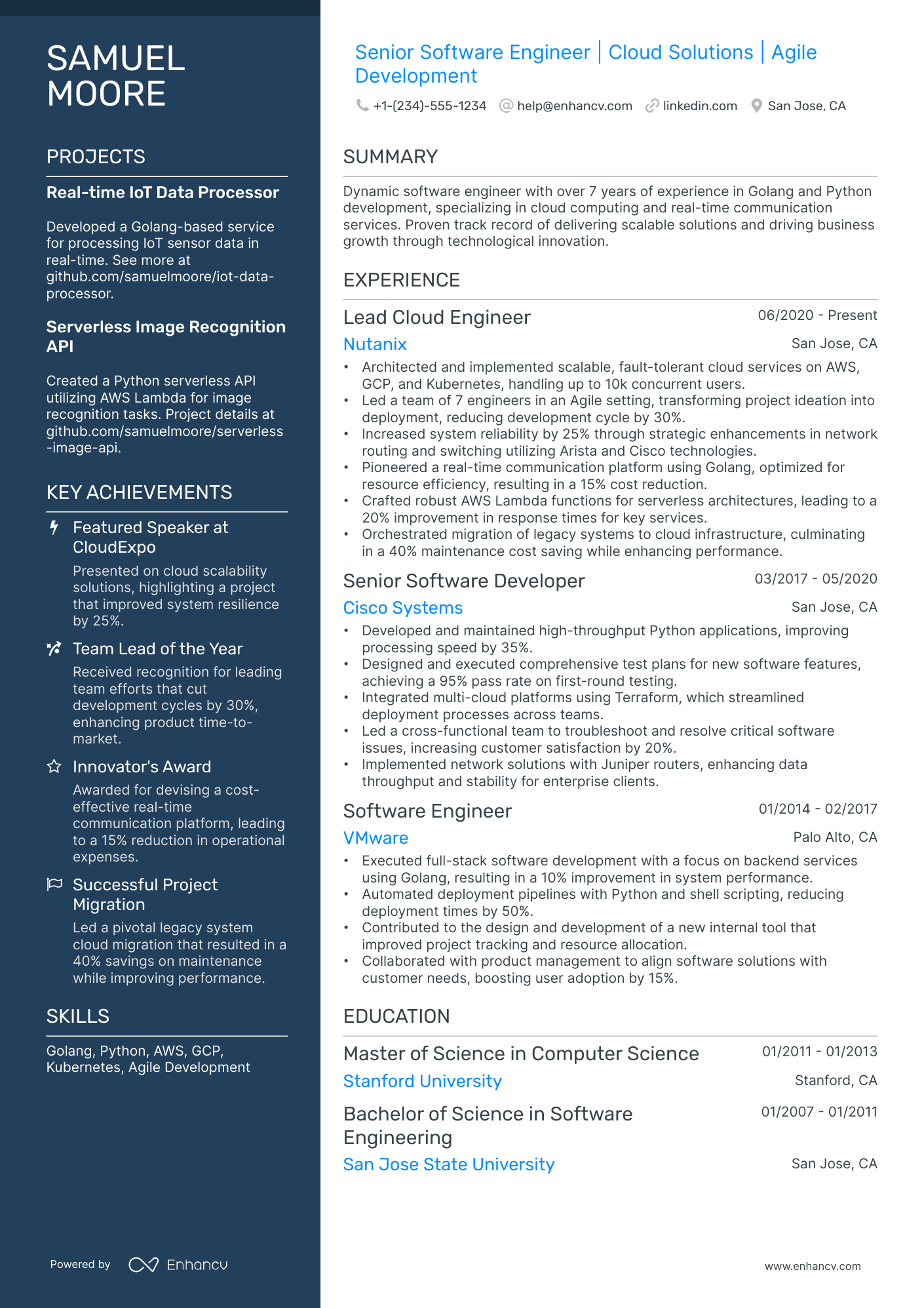
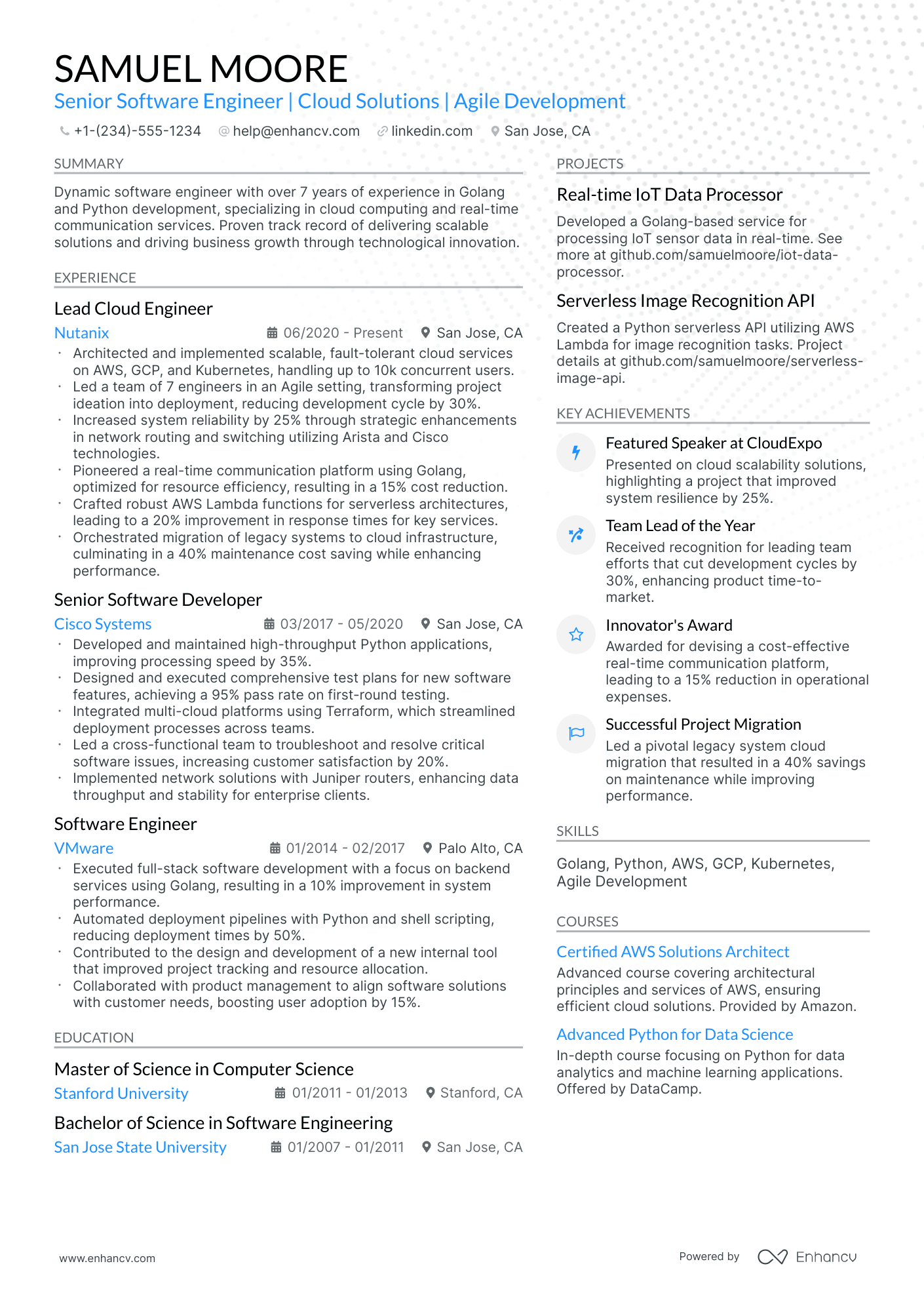
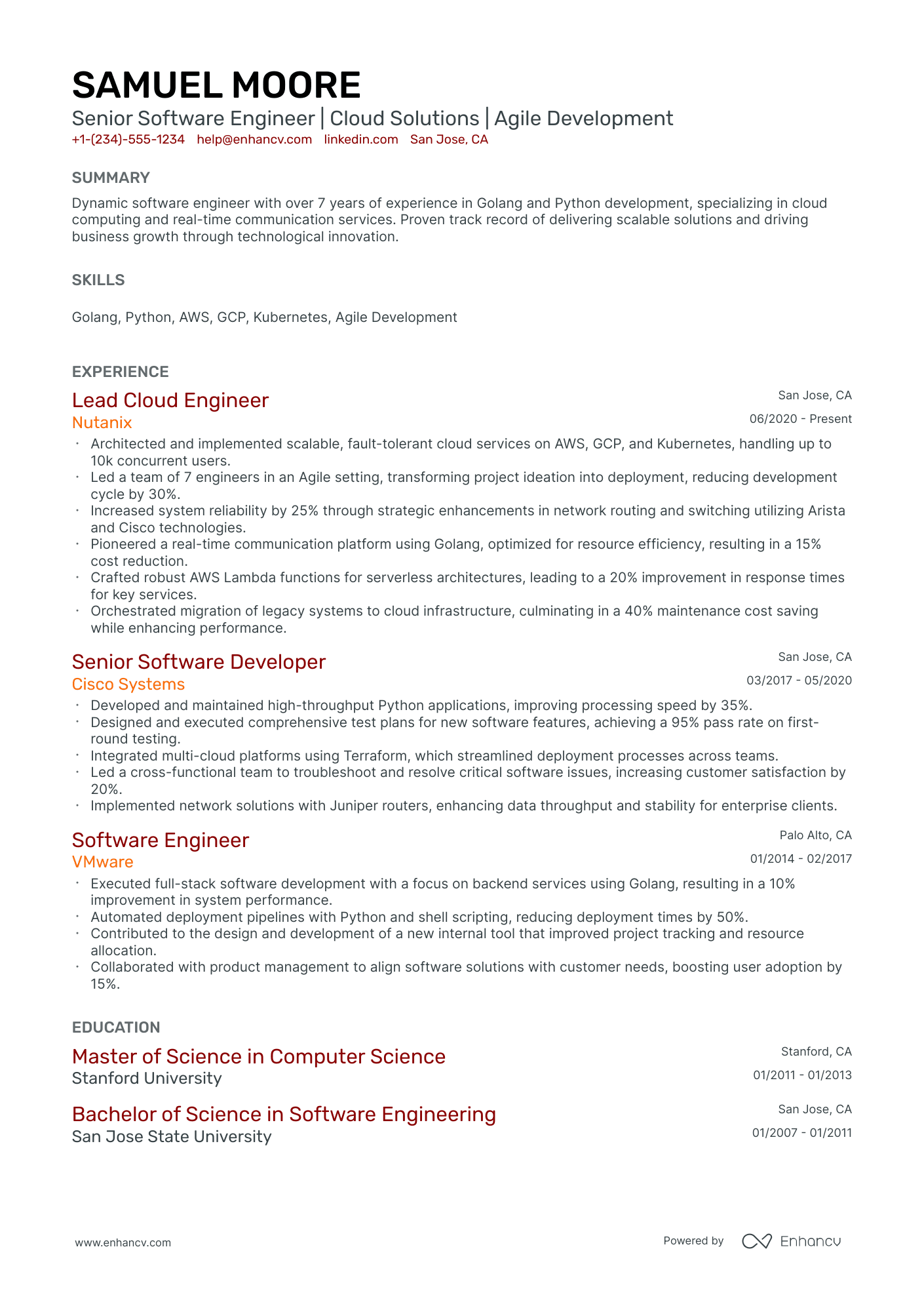
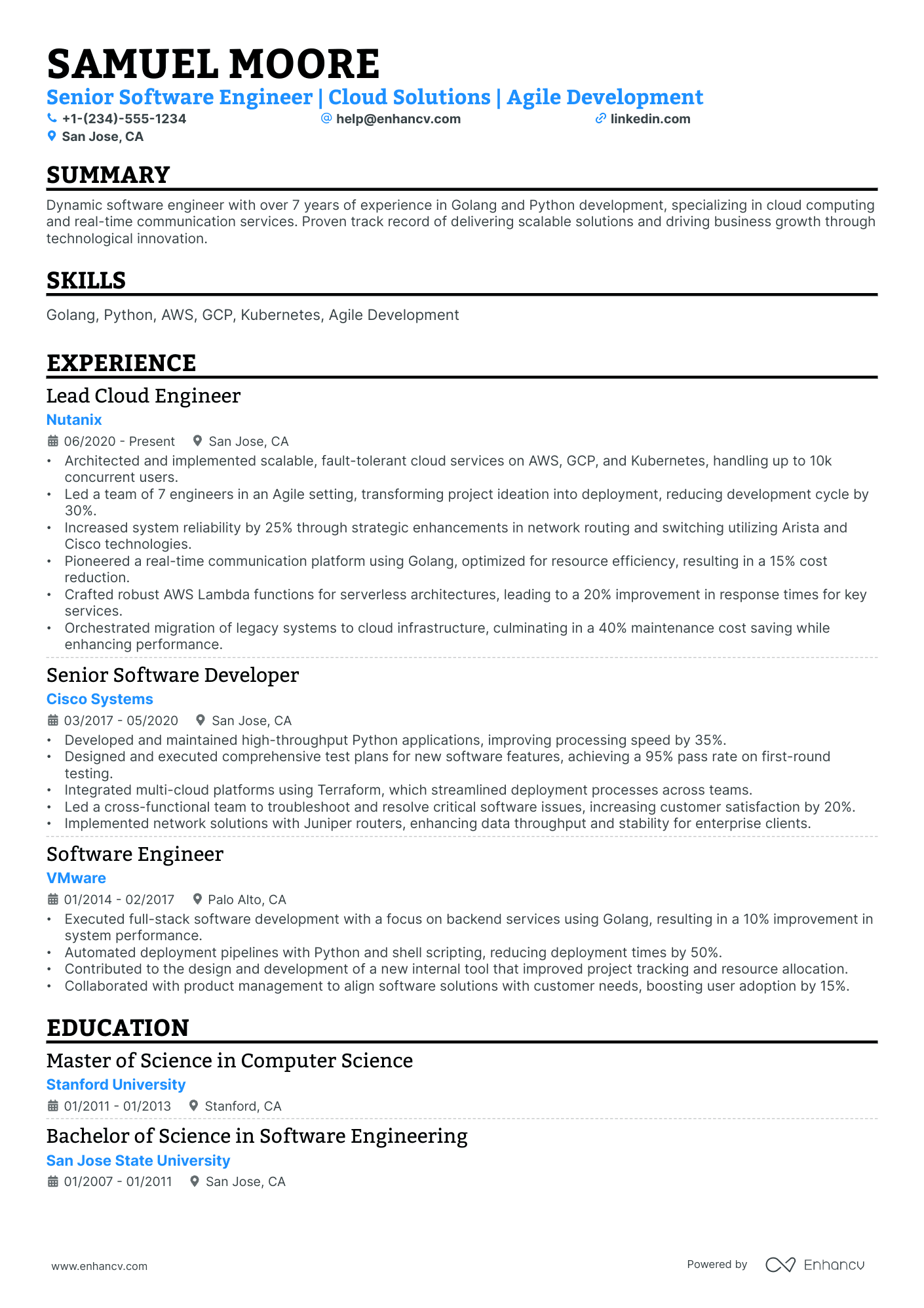
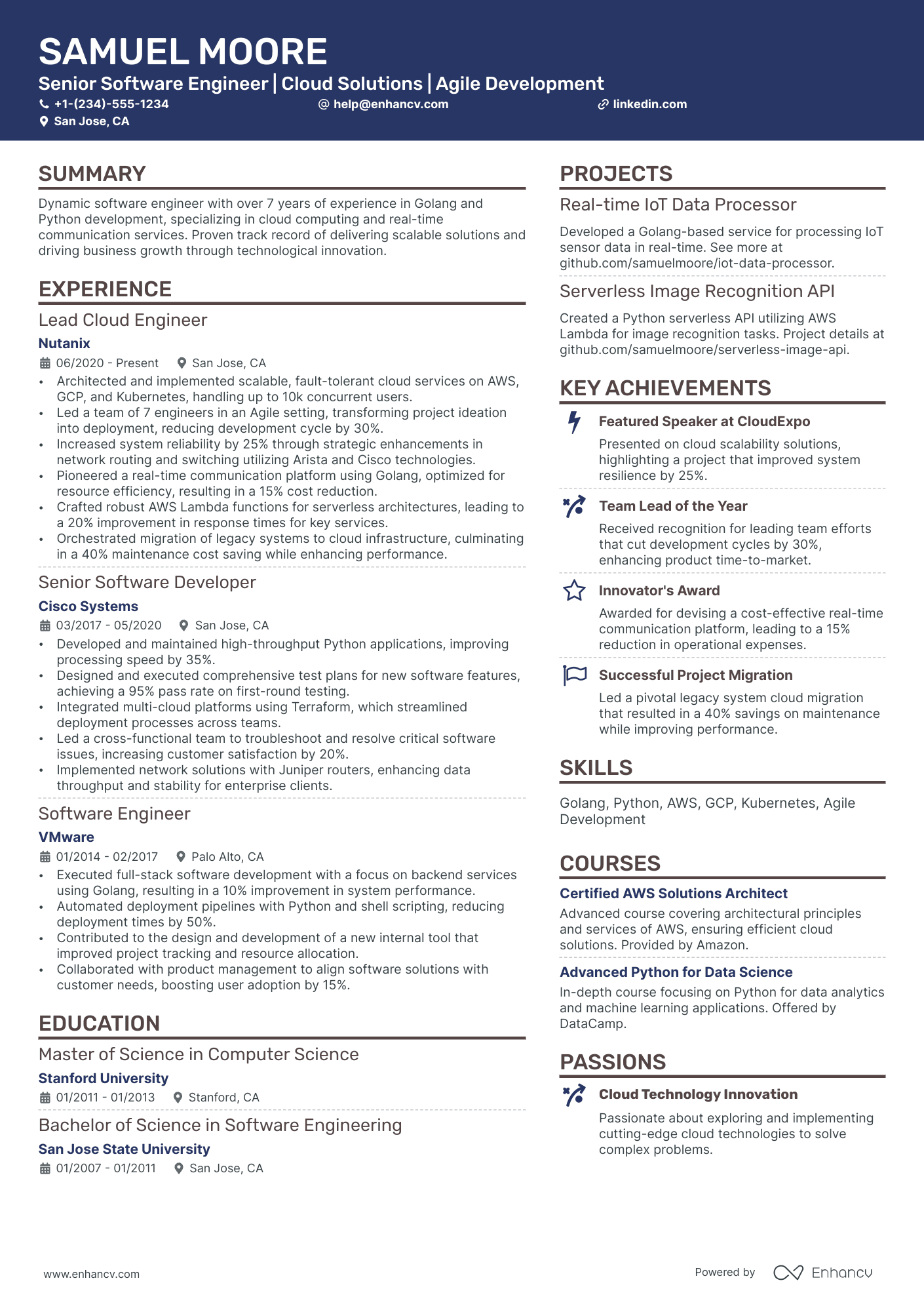
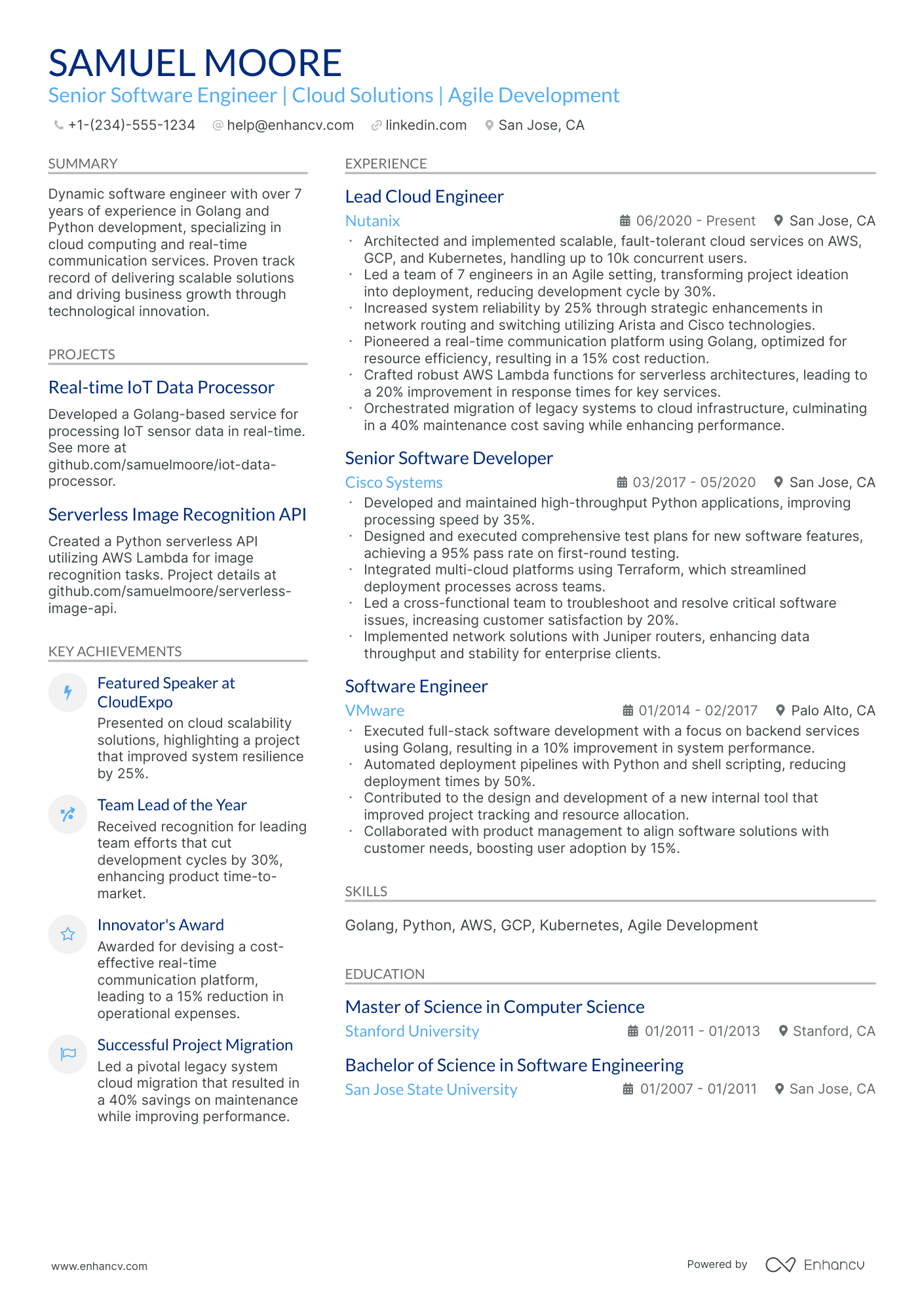
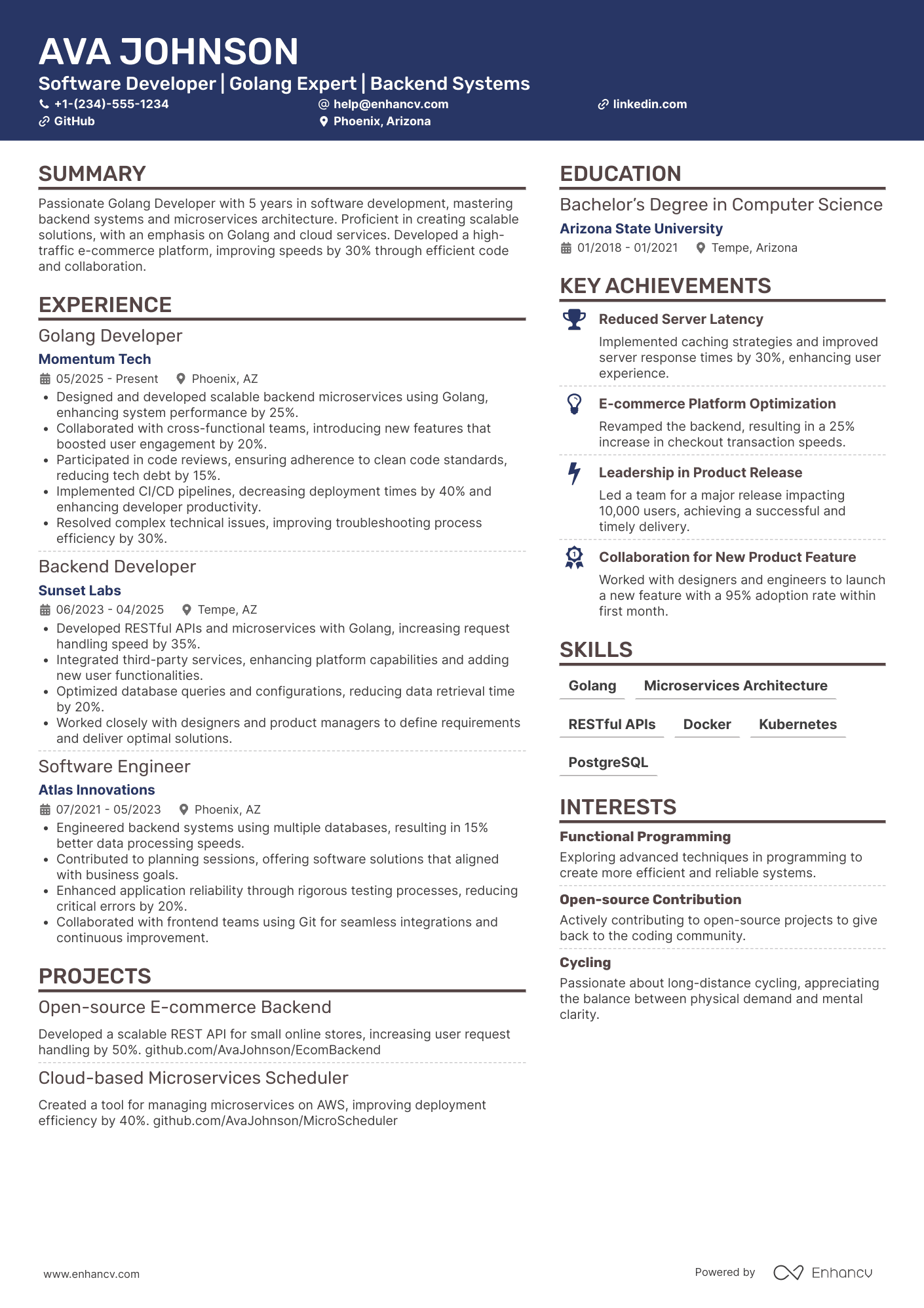
Most Go developer resume submissions fail because they read like tool inventories, not evidence of impact. That hurts you in ATS screening and rapid recruiter scans, where clear signals beat broad claims in a crowded pipeline.
A strong resume shows what you shipped and what changed because of it. You should highlight latency cuts, throughput gains, cloud cost reductions, incident rate drops, and faster release cycles. Add scope and proof: services owned, users supported, uptime, and measurable delivery timelines. If you're unsure where to begin, learning how to write a resume that prioritizes impact over description is the first step.

Key takeaways
- Anchor every resume bullet to a measurable outcome like latency, throughput, or cost savings.
- Use reverse-chronological format for experienced developers and hybrid format for career changers.
- Tailor each bullet to mirror the exact tools and terminology from the job posting.
- Demonstrate skills in context through your summary and experience, not just a standalone list.
- Showcase shipped Go projects with GitHub links when you lack full-time professional experience.
- Stop using AI once your resume accurately reflects real experience without inflated claims.
- Build your resume faster with Enhancv to keep every section focused, scannable, and recruiter-ready.
How to format a Go developer resume
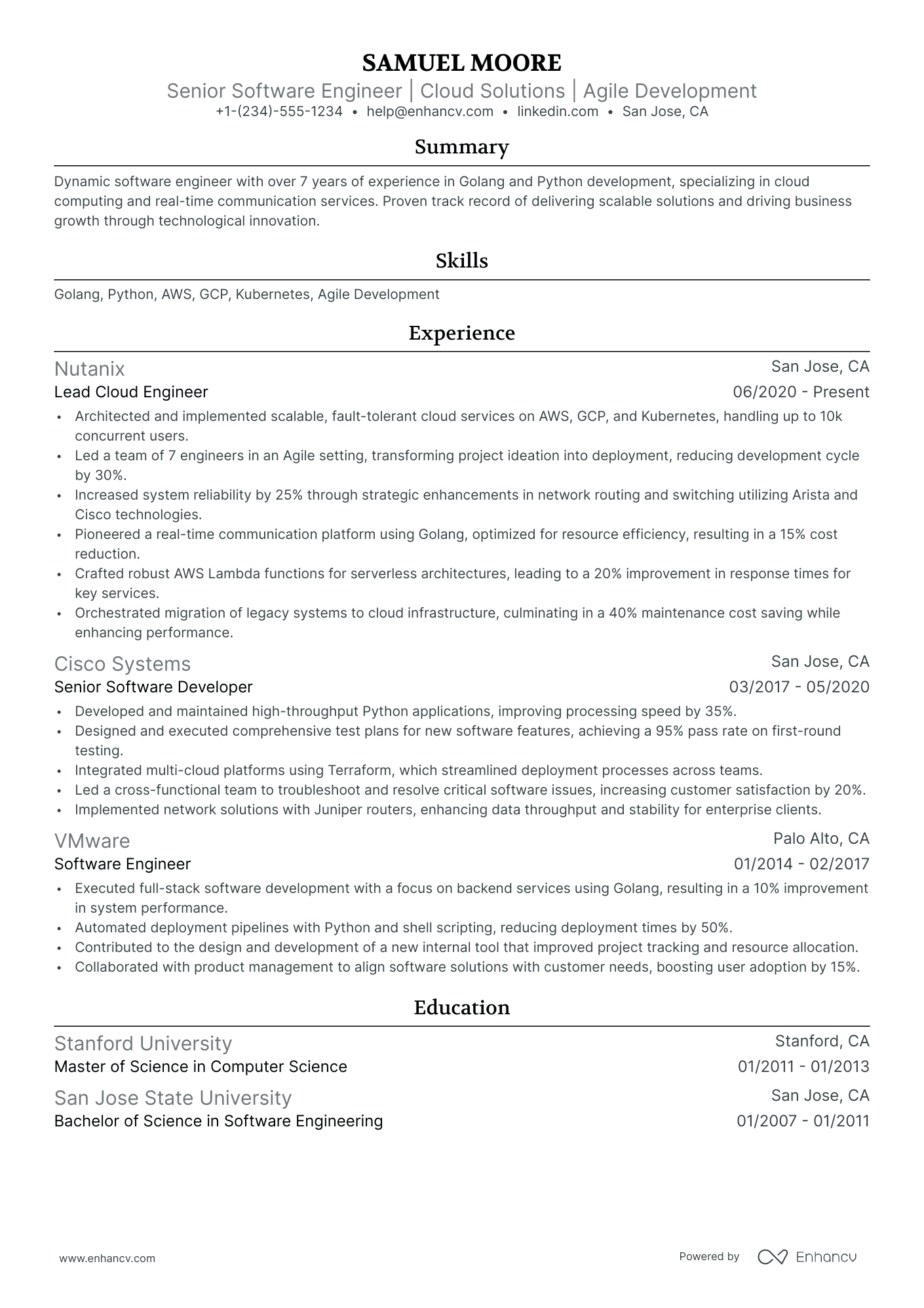
Recruiters evaluating Go developer resumes prioritize hands-on experience with Go's concurrency model, microservices architecture, cloud-native tooling, and measurable contributions to system performance or reliability. A clean, well-structured format ensures these technical signals surface quickly during both automated parsing and the initial human scan. Choosing the right resume format is essential to making your qualifications immediately visible.

I have significant experience in this role—which format should I use?
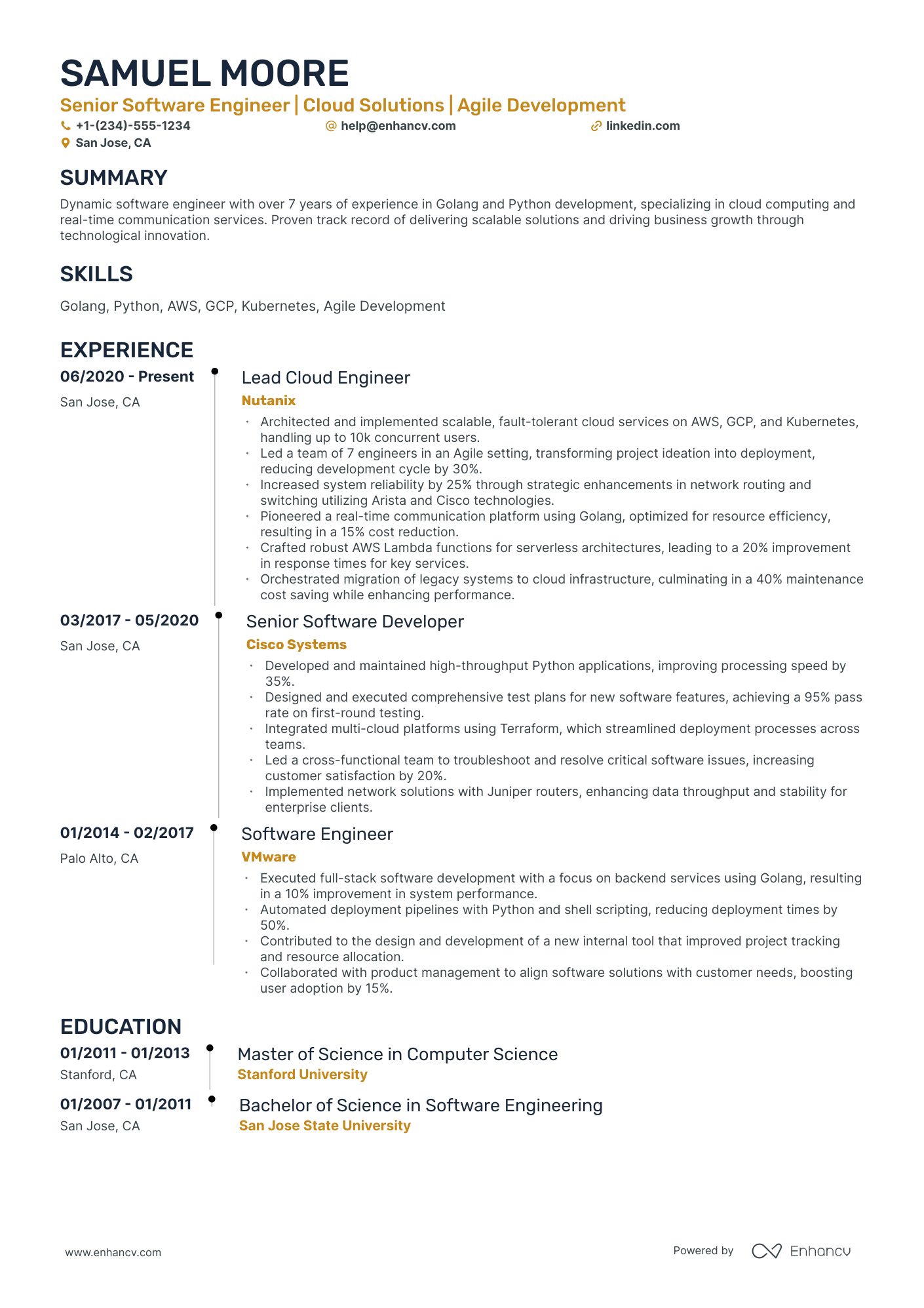
Use a reverse-chronological format to present your Go development experience in a clear, linear timeline that highlights growing technical ownership and impact. Do:
- Lead each role entry with your scope of ownership—services maintained, team size, system scale, or infrastructure decisions you drove.
- Highlight Go-specific tools and domains prominently: goroutines, channels, gRPC, Docker, Kubernetes, PostgreSQL, Redis, CI/CD pipelines, and observability stacks.
- Anchor every bullet to a measurable outcome such as latency reduction, throughput gains, deployment frequency, or cost savings.
I'm junior or switching into this role—what format works best?
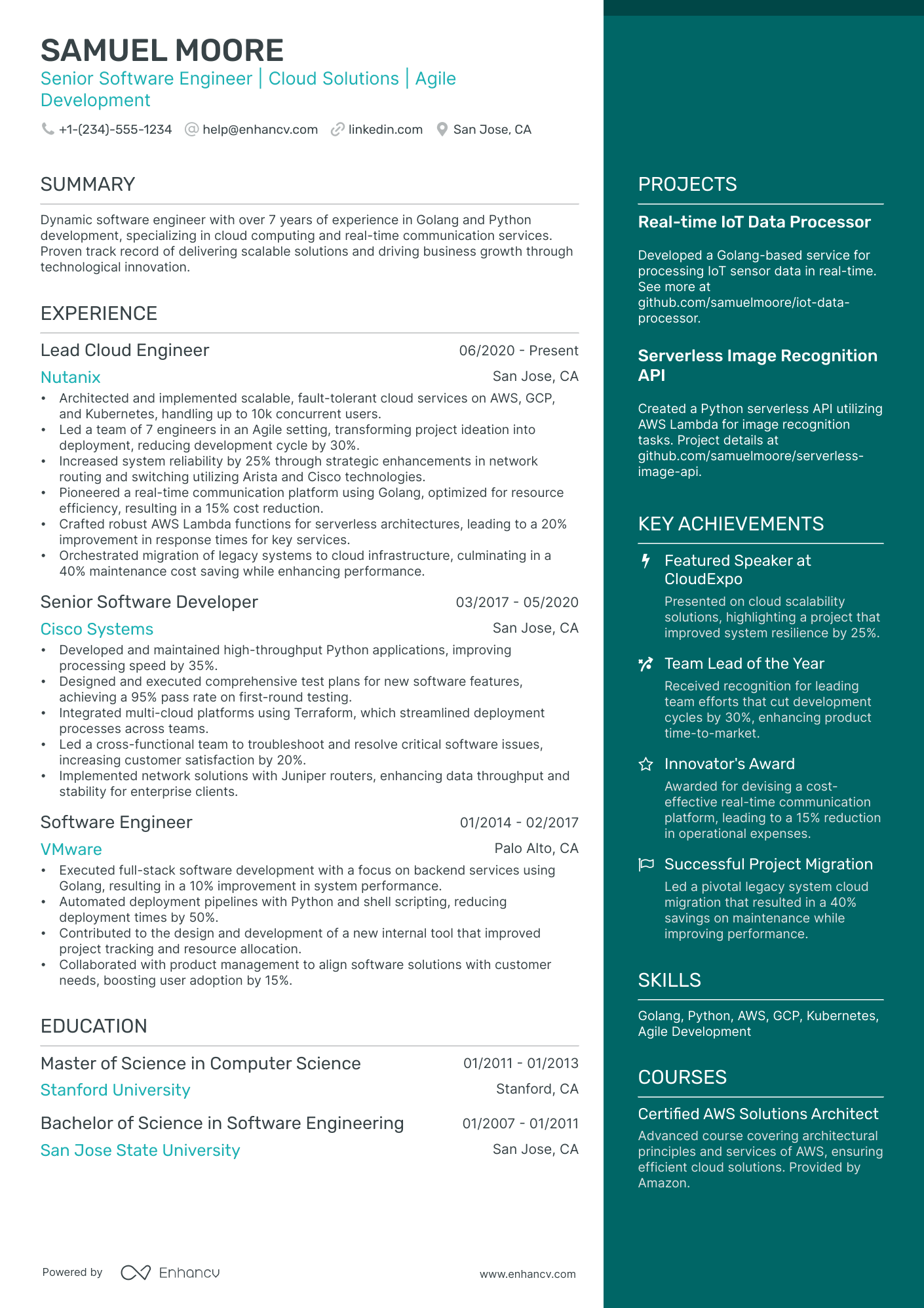
A hybrid format works best, letting you lead with a focused skills section while still providing a chronological work or project history that demonstrates applied competence. Do:
- Place a dedicated technical skills section near the top, listing Go proficiency, familiarity with standard library packages, and adjacent tools like Docker, Git, and SQL databases.
- Include personal projects, open-source contributions, or bootcamp capstones that involved writing Go in production-like contexts—API servers, CLI tools, or microservices.
- Connect every listed skill to a concrete action and a visible result so recruiters can assess real capability rather than keyword lists.
Why not use a functional resume?
A functional format strips away the project and employment context that hiring managers need to verify you've actually shipped Go code in a real development environment, making your technical claims harder to trust.
- Career changers with no Go work history may use a functional layout if they have completed substantial Go projects (open-source contributions, freelance microservices, or published CLI tools) and can tie every listed skill to a specific project and outcome.
With your layout and formatting set, it's time to fill each part of your resume with the right content—starting with knowing exactly which sections to include.
What sections should go on a Go developer resume
Recruiters expect you to present your Go development experience, technical strengths, and delivery outcomes in a clean, easy-to-scan format. Knowing what to put on a resume helps you prioritize the right content from the start. Use this structure for maximum clarity:
- Header
- Summary
- Experience
- Skills
- Projects
- Education
- Certifications
- Optional sections: Open-source work, Publications, Languages
Strong experience bullets should emphasize measurable impact, production scope, system reliability and performance gains, and the outcomes you delivered across services, APIs, and infrastructure.
Is your resume good enough?
Drop your resume here or choose a file. PDF & DOCX only. Max 2MB file size.
With your resume’s key components in place, the next step is to write your Go developer experience section so it supports each part with relevant, measurable impact.
How to write your Go developer resume experience
The experience section is where you prove you've shipped real Go-based software—not just written code in isolation. Hiring managers prioritize demonstrated impact, so every line should connect a role-relevant tool or method to a measurable outcome rather than restating a job description. Building a targeted resume ensures each bullet speaks directly to the role you're pursuing.
Each entry should include:
- Job title
- Company and location (or remote)
- Dates of employment (month and year)
Three to five concise bullet points showing what you owned, how you executed, and what outcomes you delivered:
- Ownership scope: the Go services, microservices, APIs, distributed systems, or platform components you were directly accountable for, including the scale of users, traffic, or data they handled.
- Execution approach: the Go-specific tooling, libraries, concurrency patterns, CI/CD pipelines, containerization strategies, or infrastructure-as-code methods you used to make technical decisions and deliver production-ready work.
- Value improved: the changes you drove in system performance, latency, memory efficiency, uptime, code reliability, test coverage, or security posture as a direct result of your Go development work.
- Collaboration context: how you worked with product managers, DevOps engineers, SREs, frontend teams, or external API consumers to align your Go services with broader product and infrastructure goals.
- Impact delivered: the outcomes your work produced, expressed through production results, system scale, release velocity, cost reduction, or business metrics rather than a list of tasks you performed.
Experience bullet formula
A Go developer experience example
✅ Right example - modern, quantified, specific.
Senior Go Developer
StreamForge | Remote
2022–Present
Built and scaled a real-time payments risk platform processing high-volume transactions for fintech clients.
- Architected and shipped Go microservices (Go, gRPC, PostgreSQL, Redis) handling 6,500 requests per second at peak, cutting p95 latency from 180 milliseconds to 95 milliseconds.
- Implemented event-driven ingestion with Kafka and idempotent consumers, reducing duplicate chargeback events by 72% and improving reconciliation accuracy across five downstream systems.
- Optimized hot paths with pprof, connection pooling, and query tuning, lowering compute costs by 18% while sustaining a 99.95% service-level objective.
- Hardened reliability with OpenTelemetry, Prometheus, and Grafana dashboards plus alerting runbooks, cutting mean time to detect from twelve minutes to four minutes and mean time to recover by 35%.
- Partnered with product managers, data engineers, and security to deliver a rules engine and audit trail (Go, JSON Schema, HashiCorp Vault), reducing manual review time by 40% and passing two external audits with zero high-severity findings.
Now that you've seen how a strong experience section comes together, let's look at how to adjust those details to match the specific job you're targeting.
How to tailor your Go developer resume experience
Recruiters evaluate your Go developer resume through applicant tracking systems and manual review, scoring candidates on how closely their experience matches the job posting. Tailoring your resume to the job description by adjusting each bullet to reflect the specific tools, standards, and outcomes listed increases your chances of clearing both filters.
Ways to tailor your Go developer experience:
- Mirror the exact Go frameworks and libraries named in the posting.
- Match concurrency patterns or architecture styles the role specifies.
- Reflect the same cloud platform or container orchestration tools listed.
- Use identical terminology for CI/CD pipelines or deployment workflows referenced.
- Highlight microservices or distributed systems experience when the role requires it.
- Emphasize reliability or performance optimization if the posting prioritizes uptime.
- Include security practices or compliance standards the job description mentions.
- Reference cross-functional collaboration models or agile workflows they describe.
Tailoring means aligning your real accomplishments with what the role demands, not forcing keywords into bullets where they don't belong.
Resume tailoring examples for Go developer
| Job description excerpt | Untailored | Tailored |
|---|---|---|
| "Build and maintain high-throughput microservices in Go, deployed on Kubernetes with CI/CD pipelines using GitHub Actions" | Developed backend services and helped with deployments. | Built and maintained 12 high-throughput Go microservices handling 50K+ requests per second, deployed on Kubernetes clusters with fully automated CI/CD pipelines using GitHub Actions. |
| "Design and optimize RESTful APIs integrated with PostgreSQL and Redis caching layers to support low-latency data retrieval" | Worked on APIs and databases for various applications. | Designed and optimized RESTful APIs in Go integrated with PostgreSQL and Redis caching layers, reducing average data retrieval latency from 180 ms to 35 ms across three product lines. |
| "Implement observability tooling using Prometheus and Grafana to monitor distributed Go services and reduce mean time to resolution" | Monitored systems and fixed issues when they came up. | Implemented observability tooling with Prometheus and Grafana across 15 distributed Go services, creating automated alerting dashboards that cut mean time to resolution from four hours to 40 minutes. |
Once you’ve aligned your experience with the role’s priorities, quantify your Go developer achievements to show the impact behind that fit.
How to quantify your Go developer achievements
Quantifying your achievements proves business impact beyond clean code. For Go developer roles, focus on latency, throughput, error rates, uptime, cloud cost, security risk reduction, and delivery speed.
Quantifying examples for Go developer
| Metric | Example |
|---|---|
| Latency | "Cut p95 API latency from 420 ms to 190 ms by adding Redis caching and optimizing PostgreSQL queries with pg_stat_statements." |
| Throughput | "Increased Kafka consumer throughput from 18k to 52k messages per minute by tuning goroutine worker pools and batch commits." |
| Reliability | "Reduced 5xx error rate from 1.8% to 0.4% by adding timeouts, retries with backoff, and circuit breakers using go-resilience." |
| Cloud cost | "Lowered AWS compute costs 22% by right-sizing ECS tasks and reducing CPU spikes after profiling with pprof." |
| Delivery speed | "Shortened release cadence from biweekly to twice weekly by adding GitHub Actions pipelines, unit tests, and Go linting gates." |
Turn vague job duties into measurable, recruiter-ready resume bullets in seconds with Enhancv's Bullet Point Generator.
Once your bullet points clearly convey your impact, it's equally important to highlight the hard and soft skills that back up those achievements on your Go developer resume.
How to list your hard and soft skills on a Go developer resume
Your skills section shows you can build, ship, and operate Go services, and recruiters and an ATS (applicant tracking system) scan this section to match keywords fast—aim for a balance of mostly hard skills with a smaller set of role-specific soft skills. Go developer roles require a blend of:
- Product strategy and discovery skills.
- Data, analytics, and experimentation skills.
- Delivery, execution, and go-to-market discipline.
- Soft skills.
Your skills section should be:
- Scannable (bullet-style grouping).
- Relevant to the job post.
- Backed by proof in experience bullets.
- Updated with current tools.
Place your skills section:
- Above experience if you're junior or switching careers.
- Below experience if you're mid/senior with strong achievements.

Hard skills
- Go, standard library
- Concurrency: goroutines, channels
- REST, gRPC, Protobuf
- Microservices architecture
- PostgreSQL, MySQL
- Redis, caching strategies
- Kafka, message queues
- Docker, Kubernetes
- AWS, Terraform
- CI/CD: GitHub Actions, Jenkins
- Observability: OpenTelemetry, Prometheus, Grafana
- Testing: unit, integration, benchmarks
Soft skills
- Write clear technical specs
- Break work into milestones
- Communicate tradeoffs early
- Drive incident response follow-ups
- Review code with actionable feedback
- Align APIs with stakeholders
- Own services end to end
- Prioritize reliability and latency
- Collaborate across backend and DevOps
- Document decisions and runbooks
- Triage bugs by impact
- Mentor junior engineers through pairing
How to show your Go developer skills in context
Your skills shouldn't live only in a dedicated skills list. You can explore common resume skills across roles to see how top candidates present theirs.
They should be demonstrated in:
- Your summary (high-level professional identity)
- Your experience (proof through outcomes)
Here's what strong, context-rich examples look like in practice.
Summary example
Senior Go developer with eight years of experience building high-throughput microservices in fintech. Proficient in gRPC, PostgreSQL, and Kubernetes. Reduced payment-processing latency by 40% through concurrency optimization. Known for mentoring junior engineers and driving clean-code practices.
- Specifies senior-level experience clearly
- Names role-relevant tools and frameworks
- Leads with a measurable performance outcome
- Highlights mentoring as a soft skill
Experience example
Senior Go Developer
Ledgerpoint | Remote
March 2020–February 2025
- Redesigned order-matching engine using Go concurrency patterns, cutting average response time from 120 ms to 54 ms.
- Partnered with the platform team to migrate 12 services from REST to gRPC, reducing inter-service payload size by 35%.
- Built a CI/CD pipeline with GitHub Actions and Docker, increasing deployment frequency by 60% across three squads.
- Every bullet includes a measurable outcome.
- Skills appear naturally within real achievements.
Once you’ve demonstrated your Go skills through concrete projects and outcomes, the next step is translating that evidence into a Go developer resume when you don’t have formal experience.
How do I write a Go developer resume with no experience
Even without full-time experience, you can demonstrate readiness through personal projects and community contributions. Our guide on writing a resume without work experience walks you through exactly how to structure this approach. Consider including:
- Open-source Go pull requests
- Personal Go microservice projects
- Freelance Go bug fixes
- Go coding challenges with benchmarks
- Go internship or apprenticeship work
- Hackathon Go backend contributions
- Course capstone in Go
- Technical blog posts on Go
Focus on:
- Shipped Go code with links
- Production-like APIs and tests
- Performance profiling and benchmarks
- Tooling: Git, Docker, CI
Resume format tip for entry-level Go developer
Use a hybrid resume format that leads with Projects and Skills, then adds Education and any work history. It highlights proof of Go developer readiness when paid experience is limited. Do:
- Put GitHub links beside each project.
- Start bullets with strong verbs.
- Quantify impact with metrics and timings.
- List Go tools used per project.
- Add tests, CI, and coverage numbers.
- Built a Go microservice with Gin, PostgreSQL, Docker, and GitHub Actions; added table-driven tests and reduced p95 latency from 220 ms to 140 ms.
Once you've structured your resume to highlight transferable skills and projects in place of professional experience, presenting your education effectively becomes your next strongest asset.
How to list your education on a Go developer resume
Your education section helps hiring teams confirm you have the technical foundation for the role. It validates core computer science knowledge essential for every Go developer.
Include:
- Degree name
- Institution
- Location
- Graduation year
- Relevant coursework (for juniors or entry-level candidates)
- Honors & GPA (if 3.5 or higher)
Skip month and day details—list the graduation year only.
Here's a strong education entry tailored to a Go developer resume.
Example education entry
Bachelor of Science in Computer Science
University of Wisconsin–Madison, Madison, WI
Graduated 2021
GPA: 3.7/4.0
- Relevant coursework: Distributed Systems, Data Structures & Algorithms, Operating Systems, Network Programming, Database Design
- Honors: Dean's List (six semesters), Magna Cum Laude
How to list your certifications on a Go developer resume
Certifications on a resume show a Go developer's commitment to learning, proficiency with modern tools, and alignment with industry needs. They also help validate skills when your work history is still growing.
Include:
- Certificate name
- Issuing organization
- Year
- Optional: credential ID or URL
- Place certifications below education when they're older, less relevant to Go developer roles, or mainly reinforce what your degree already covers.
- Place certifications above education when they're recent, highly relevant to the target Go developer role, or required by the job posting.
Best certifications for your Go developer resume
- AWS Certified Developer—Associate
- AWS Certified Solutions Architect—Associate
- Google Cloud Professional Cloud Developer
- Microsoft Certified: Azure Developer Associate
- Certified Kubernetes Application Developer (CKAD)
- HashiCorp Certified: Terraform Associate
Once you’ve positioned your credentials to support your Go skills, shift to your Go developer resume summary to highlight those strengths up front for hiring managers.
How to write your Go developer resume summary
Your resume summary is the first thing a recruiter reads, so it sets the tone for everything that follows. A strong summary quickly signals you're a fit for the Go developer role.
Keep it to three to four lines, with:
- Your title and total years of experience in Go development.
- The domain or product type you've worked in, such as cloud services or fintech.
- Core tools and technologies like Go, gRPC, PostgreSQL, Docker, or Kubernetes.
- One or two quantified achievements that show real impact.
- Soft skills tied to outcomes, such as collaboration that improved sprint velocity.

PRO TIP
At this level, focus on technical skills, relevant tools, and early contributions that prove you can deliver. Highlight specific projects where you added measurable value. Avoid vague traits like "passionate" or "fast learner." Skip motivational language and stick to concrete details recruiters can verify.
Example summary for a Go developer
Go developer with two years of experience building microservices for cloud-native fintech platforms. Reduced API response times by 35% using gRPC and PostgreSQL optimizations. Comfortable with Docker, Kubernetes, and CI/CD pipelines.
Optimize your resume summary and objective for ATS
Drop your resume here or choose a file.
PDF & DOCX only. Max 2MB file size.
Now that your summary captures your strongest qualifications, make sure your header presents the essential contact and professional details recruiters need to reach you.
What to include in a Go developer resume header
A resume header is the top block with your identifying and contact details, and it drives visibility, credibility, and fast recruiter screening for a Go developer.
Essential resume header elements.
- Full name
- Tailored job title and headline
- Location
- Phone number
- Professional email
- GitHub link
- Portfolio link
A LinkedIn link helps recruiters verify experience quickly and supports screening.
Don't include a photo on a Go developer resume unless the role is explicitly front-facing or appearance-dependent.
Match your header job title to the job posting and keep every link short, current, and relevant to Go developer work.
Go developer resume header
Jordan Lee
Go developer | Backend engineer focused on APIs and distributed systems
Austin, TX
(512) 555-12XX
jordan.lee@enhancv.com
github.com/jordanlee
jordanlee.dev
linkedin.com/in/jordanlee
Once your contact details and key identifiers are set at the top, add additional sections to round out your Go developer resume with relevant supporting information.
Additional sections for Go developer resumes
When your core qualifications match other candidates, additional sections can set you apart and reinforce your credibility as a Go developer.
- Languages
- Open source contributions
- Publications and technical blog posts
- Conference talks and meetups
- Hobbies and interests
- Professional memberships
- Hackathon and competition awards
Once you've strengthened your resume with relevant additional sections, pair it with a tailored cover letter to give hiring managers a fuller picture of your qualifications.
Do Go developer resumes need a cover letter
A cover letter isn't required for a Go developer, but it helps in competitive roles or teams that expect one. It can make a difference when your resume needs context, or when several candidates look similar. If you're unsure where to start, understanding what a cover letter is and how it complements your resume can help you decide.
Use a cover letter to add value, not repeat your resume:
- Explain role or team fit: Connect your Go developer strengths to the team's stack, architecture, and delivery needs.
- Highlight one or two relevant projects or outcomes: Name a Go service you shipped and the measurable result, like latency, cost, or reliability improvements.
- Show product, user, or business understanding: Reference the product's users and constraints, and explain how your Go developer work supports key goals.
- Address career transitions or non-obvious experience: Clarify how prior roles, domains, or languages translate into Go developer impact on this team.
Drop your resume here or choose a file.
PDF & DOCX only. Max 2MB file size.
Even if you decide a cover letter won’t add value for your Go developer application, using AI to improve your Go developer resume is the next step to sharpen your resume’s impact on its own.
Using AI to improve your Go developer resume
AI can sharpen your resume's clarity, structure, and impact. It helps tighten language and highlight results. But overuse dulls authenticity. Once your content is clear and role-aligned, step away from AI. If you're curious about where to start, explore which AI is best for writing resumes before diving into prompts.
Here are 10 practical prompts to strengthen specific sections of your Go developer resume:
- Strengthen your summary. "Rewrite my Go developer resume summary to highlight my core backend skills and years of experience in two concise sentences."
- Quantify your impact. "Add measurable outcomes to each of my Go developer experience bullets, focusing on performance gains, uptime, or throughput improvements."
- Tighten bullet phrasing. "Shorten each Go developer experience bullet to one line, starting with a strong action verb and removing filler words."
- Align skills strategically. "Reorganize my Go developer skills section to prioritize the most relevant tools, frameworks, and libraries for backend engineering roles."
- Clarify project descriptions. "Rewrite my Go developer project descriptions to clearly state the problem solved, tools used, and measurable result delivered."
- Remove redundant content. "Identify and remove any repeated or overlapping information across my Go developer resume sections."
- Improve certification context. "Add one sentence of context to each certification on my Go developer resume explaining how it applies to backend development."
- Tailor to job postings. "Compare my Go developer resume against this job description and suggest specific wording changes to improve alignment."
- Refine education details. "Rewrite the education section of my Go developer resume to emphasize relevant coursework, capstone projects, or technical research."
- Enhance technical storytelling. "Restructure my Go developer experience bullets using a clear problem-action-result format for each accomplishment."
Stop using AI once your resume sounds accurate, specific, and aligned with real experience. AI should never invent experience or inflate claims—if it didn't happen, it doesn't belong here.
Conclusion
A strong Go developer resume proves impact with measurable outcomes, highlights role-specific skills, and follows a clear structure. It shows what you built, improved, and shipped, with numbers that hiring teams can trust.
Keep each section focused and easy to scan, from summary to experience to skills. When your results and Go developer strengths are clear, you’ll look ready for today’s roles and the next hiring cycle.